How digitization through artificial intelligence and machine learning technologies has gained momentum post COVID-19?

Last Updated on 4 years ago by Imarticus Learning

In just a few months, the COVID-19 pandemic has managed to do what normal times would have taken years to achieve – a paradigm shift in the way companies in every industry and sector do business. Artificial intelligence and machine learning have been at the forefront during these challenging times. 

As the world gradually finds its way back to usual ways of life, it is interesting to see how the global crisis has paved the way for behavioral shifts, learning, and innovation. 

AI and ML in the Post-Covid-19 World

With the acceleration of digitization through Artificial Intelligence (AI) and Machine Learning (ML), digital sales have seen a boost, and businesses have focused their tech investments on cloud-based products and services. From online grocery stores and EdTech sites to online pharmacies and OTT players, the post-COVID-19 world looks very different through the AI and ML lens.

So, here are some examples to show how AI and ML technologies have gained momentum post-COVID-19:

  • AI and ML have been impacting the healthcare industry since long before the pandemic hit. AI algorithms have and continue to help in quickly sifting through large datasets to help identify similar diseases and their possible cures to accelerate the COVID-19 research work. 
  • AI and automation technology have also eased the healthcare sector’s administrative load by automating various processes. For example, data processing algorithms to extract data from internal systems and automatically generate medical reports and necessary audit trails have gained momentum post-pandemic. 
  • Also, advancements in ML will continue to help create new revenue streams. For example, scientists, drug researchers, and pharma companies are increasingly turning to AI and ML data processing algorithms to facilitate vaccine and drug discovery and their possible impacts on people. 
  • Lockdowns and social distancing norms have boosted online markets and the digital economy. However, even when the pandemic is gradually ebbing, customers are expected to continue using doorstep services as they did during the peak crisis. Hence, technologies like Augmented Reality (AR) and Virtual Reality (VR) have increased among eCommerce platforms to deliver a better customer experience. 
  • Talking about customer experience, the online retail industry has ramped up its use of AI chatbots and smart assistants to attend to the ever-increasing numbers of digital customers. Hence, the use of AI has helped streamline digital services, online ordering, and delivery systems. 
  • The pandemic has given rise to a digital workforce. To this end, the use of AI to quickly process applications, scan for eligibility and qualifications and perform other mandatory hiring checks has become the norm and is only expected to increase in the near future. 
  • The financial sector has also seen a dramatic rise in the use of AI and automation to serve its customers better and quicker during challenging times. For instance, banks leverage AI to help customers safely upload documents, categorize them and expedite processes without any delay. 
  • Lastly, greater digitization has also increased the risks of cybersecurity threats during the pandemic. While conventional cybersecurity risk management systems have failed to keep up with evolving cyber threats, AI offers innovative defenses. The pandemic has only nudged organizations to adopt holistic approaches to cybersecurity through AI and ML and create an integrated security system. 

How to Find the Best Artificial Intelligence Course?

If you want to learn AI and get a certification in AI and ML, opting for an online course can be the best call. But before you sign up for the course, ensure that it offers hands-on experience with real-world projects and has a curriculum with extensive coverage of concepts related to machine learning, NLP, deep learning, data science, and computer vision. 

Discover the critical facets of supply chain management and analytics with this certification

Last Updated on 4 years ago by Imarticus Learning

Supply chain management and analytics is a rapidly growing field that requires the expertise of both supply chain managers and data analysts. The advanced skill set needed to succeed in this profession means that certification can be an excellent way to build your career and improve your chances for advancement.

In this article, we will explore some of the critical facets of supply chain management and analytics with a focus on certification and how it can help you grow professionally.

What is Supply Chain Management and Analytics?

  • The supply chain is transforming raw materials into a finished product that is delivered to customers.
  • The entire process involves manufacturing, transportation, warehousing, and distribution of goods, and necessary information flows within an organization or across companies in the value network (suppliers/customers).
  • Supply Chain Management (SCM) includes all activities required for effective planning, execution, and control of global business processes that connect suppliers to manufacturers through logistics providers, whereas Analytics refers to data analysis for decision-making purposes.
  • SCM has evolved over time from traditional hierarchical management structures towards collaborative governance among various stakeholders involved in end-to-end value chains.
  • It involves disintermediation where most transactions take place between trading partners rather than via intermediaries such as banks or wholesalers.
  • Analytics plays a major role in such collaborative governance by providing decision-makers with fact-based insights and analytics to make better-informed decisions for managing global supply chains while considering the complexities involved in the process.

Why Certification Matters?

The ACP offers a wide range of certifications in supply chain management areas to help professionals stay abreast of rapidly changing technologies and enhance their credentials. Both the Supply Chain Management Professional certification program and Certified Analytics Professional (CAP®) certification are among popular ones for individuals aspiring to make a career in the analytics field.

At present, there is no specific degree or diploma programs that can provide an individual with the necessary knowledge across diverse business functions involved in the supply chain management process; hence professional certificates issued by global organizations such as APICS play a vital role in invalidating one’s skillset.

The CACP/CAP Program provides two certifications — CSCP Certification helps professionals work on large-scale complex projects involving application design, development, integration, and supply chain planning, execution, collaboration, & optimization solutions.

On the other hand, CAP Certification is designed for individuals with expertise in data management and analytics who can help organizations take advantage of big data and complex algorithms to drive better decision-making.

How to Become Certified in SCM&A?

– Individuals can prepare for these certifications by taking a Supply chain Management course, attending webinars, and reading books/journals on the subject.

– To earn CSCP or CAP Certification, one needs to pass a relevant certification exam based on knowledge of supply chain concepts. There are no prerequisites for this exam; however, having some work experience in a related field will be beneficial.

Build Your Career in Supply Chain Management and Analytics with Imarticus Learning

The Professional Certification in Supply Chain Management and Analytics offered by Imarticus Learning provides a cutting-edge experience for supply chain aspirants. This 6-months program is uniquely designed by IIT faculty and industry leaders to help you learn. With the ever-increasing trend of e-commerce, the amount of movement of goods has been ever-increasing. There has been a disproportionate jump in the number of jobs for SCM across industries.

Course USPs:

  • Cutting-edge curriculum and certification from e-learning center, IIT Roorkee
  • Experiential learning & impressive project portfolio
  • SCM and analytics – a power couple
  • Learn through real-life industry projects.

What to Look for in a Business Analytics Certification

Last Updated on 2 years ago by Imarticus Learning

As a business analyst, you should always “think outside the box,” but what does that mean? To help show our readers how they can think outside of the box when it comes to their career, we have put together this list of some things you should look for in a business analyst certification.

You might be wondering what you should know about Business Analytics Certifications, especially if you already have some technical background. The world of BI is overgrowing and is moving towards real-time reporting, so check out the types of certifications available.

What is a Business Analytics Certification?

To understand what business analytics certification means, let’s define the term certification. Certification is a process through which an authoritative third party recognizes an individual or company with expertise in a particular subject/skill.

Business Analytics certifications allow data professionals to demonstrate their knowledge of Business tools and techniques in business intelligence, predictive analytics, data mining, reporting, and more.

Unlike traditional enterprise software certifications (e.g., Oracle or SAP), Business Analytics certifications are vendor-neutral, which means they focus on the BI tools themselves rather than on a particular vendor tool suite.

How to become a successful business analyst?

If you are starting with your career in data analytics, the first thing to do is look at vendor-neutral certifications that can help build your foundation for success.

Business analyst certifications are generally into three separate categories: 

 Professional Certifications: Also referred to as entry-level or foundational credentials, professional-level certification programs provide a broad understanding of reporting and analytics capabilities.

Expert-Level Certifications: Also referred to as mid-level credentials, expert-level certification programs provide a more profound knowledge of Business tools and techniques in predictive analytics, data mining, or survey analysis.

Master-Level Certifications: Also referred to as advanced-level credentials, master-level certification programs focus on providing an even deeper understanding of Business tools and techniques in areas such as data visualization, dashboarding, or a particular industry.

Benefits of Business Analyst certification:
best Agile business analyst courses

  1. A business analyst certification proves that you have the expertise to succeed in the field of data analytics.
  2. It helps you master your tools and techniques, leading to increased productivity and efficiency.
  3. Certification increases your salary potential (up to 10%) and can help you earn a promotion or find a new job.
  4. It provides a sense of accomplishment and can give you the confidence to offer even better Business solutions for your organization.

Explore and learn with Imarticus Learning

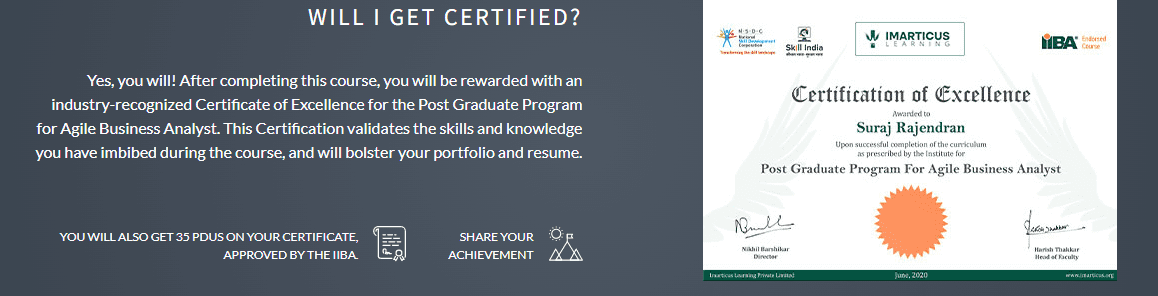
The Agile Business Analyst course is a six-month program that will prepare students for the tasks of an Agile Business Analyst. This placement-driven curriculum teaches students how to handle current business analysis processes with appropriate tools and approaches through several case studies, role-playing exercises, and hands-on training.

Some course USP:

  • This business analyst certification for students aids the students to learn job-relevant skills.
  • Impress employers & showcase skills with the best analyst Course endorsed by India’s most prestigious academic collaborations.

World-Class Academic Professors to learn from through live online sessions and discussions.

Want to Master Trade Life Cycle? A CIBOP Certification Can Help!

Last Updated on 2 years ago by Imarticus Learning

Want to Master Trade Life Cycle? A CIBOP Certification Can Help!

It is a critical aspect of trade and commerce. It refers to the process from the moment a product reaches its final destination and is used by consumers. If you want to master this complex process, then CIBOP certification can help you achieve your goal.

CIBOP stands for Chartered Institute of Business Operations Professionals. It provides training courses with various difficulty levels depending on your professional background, goals, interests, and beginner or advanced level diplomas, making you an expert in the field.

What is the Trade Life Cycle?

To better understand what the trade life cycle can do for you. In simple terms, it refers to all the stages involved in making a product, from study and design to production, marketing, and sales, distribution, use by consumers until its final disposal. It’s a complex process made of several simple steps, each with its functions and duties to be taken care of by both the business owner and all employees involved.

Why should I get certified as a CIBOP professional?

CIBOP is a certification designed by IBCPB to test and certify professionals in IB operations, such as financial analysts.

If you desire to expand your knowledge about how global markets function, if you want to broaden your horizons as well as complement your salary, then CIBOP certification may be the answer.

Why is Trade Life Cycle the most crucial aspect in business operations?

Business operations are all about creating and managing efficient processes so that everything runs smoothly. For this purpose, you need to study various aspects such as market trends, competitor analysis, labor force planning, client requests, transportation, distribution, profit margins, and others.

Other advantages of CIBOP certification: 

* Designing processes for your business operations that lead to better results

* Understanding how global markets work and increasing your chances on the job market

* Improving your performance at work and increasing your opportunities for promotion

* Attracting potential clients with a positive image of your company

* Showing customers what makes you different from the competition

CIBOP certification is an opportunity available to anyone who wants to enhance their skills to achieve better results. Why don’t you see it as a chance to improve your current job performance and increase your potential for promotion?

Learn Investment Banking with Imarticus Learning

Students can learn about complicated securities and derivatives, their trade-lifecycles, and the services that make up investment banking operations. Students of Imarticus Learning can work at most global investment banks with the CIBOP certificate, which the London Stock Exchange recognizes.

Some course USP:

  • This Investment Banking certification aids the students to learn job-relevant skills that prepare them for an exciting career.
  • Impress employers & showcase skills with a certification endorsed by India’s most prestigious academic collaborations.
  • World-Class Academic Professors to learn from through live online sessions and discussions. It will help students understand the 360-degree practical learning implementation with assignments.