Seven Latest Developments In Fintech

Fintech is everywhere in today’s world that aims at robust development from the way we make purchases to the way we borrow loans. Fintech is a short form of finance and technology clubbed together. Traditional financial services are given a chance by inducing technology into finance leveraging more scope for advanced financial services. Since consumers are adopting fintech at a faster pace, businesses or companies are investing more on fintech.

Nevertheless, fintech, as we observe, has reached the culmination like the other technologies such as blockchain, artificial intelligence, machine learning, virtual reality, and the cloud. Therefore, managing various financial aspects of a firm by outperforming the competition is possible only for a fintech professional who is well-versed in Fintech Courses.

Have a look at some of the key developments in the miracle world of fintech where disruptive technology meets finance:

Investing in digital transformation 

The experience of the customers with non-banking industries, retail and telecommunications have led to increased expectations from banks and credit unions. Access to the digital world has made the customers want for tech-savvy options in financial services. This strains the traditional working model of the financial institutions as more efforts need to be put in to cope with the competitive pressure. Hence, financial industries are investing a lump sum in digital transformation projects to satisfy the expectations of the consumers and to be on a digital upfront.

Application of Blockchain in fintech

Cryptocurrencies like Bitcoin and Ethereum took the world by storm which uses blockchain technology for peer-to-peer transactions and records it in a digital ledger thus eliminates the needs for prominent financial institutions. Blockchain is a transformative technology which poses huge potential grabbing the interest of the fintech industries. Recently, a successful pilot test for cross-border fund transfer from Thailand to Singapore was carried out using blockchain technology from the bank of Ayudhya to Standard Chartered Bank in Singapore. The use of blockchain by financial institutions will help its crowd of subsidiaries have efficient and flexible financial liquidity.

Inducing Artificial Intelligence in fintech

Artificial Intelligence (AI) can process the large sum of consumer data in seconds thereby, AI is leveraged more into the financial service industry more than using it as a cognitive for sales, marketing, wealth management, and investments. Artificial Intelligence is therefore used to work in close contact with many organizations to process and analyze its data using the latest algorithms and arrive at a promising solution for each customer. Its predictive analysis, automated chatbots and accurate decision making have advanced the position of AI from Machine Learning to robot-advisors.

Emerging Digital-only banks

The developments of fintech racing the market have posed a threat to the traditional banks with the dominance of digital-only banks. Thanks to the digital-savvy customers who were the ground reason behind the emergence of numerous digital products from these new players in town. Digital-only players focus on appealing to the masses with their innovative and efficient ideas. Thereby, pressurizing on the traditional banks to offer better and innovative digital solutions for its customers to protect themselves from these disrupters.

Design thinking

Fintech experts suggest that customer-first design should be the ideal key for the businesses who anticipate a positive outcome of UX vision. Clubbing their thoughts and creative engineering leads to an innovative mindset rather than just managing. The immersive UX vision which aims at satisfying the customer experience also benefits other aspects of technology like augmented reality(AR) and virtual reality(VR). A better consumer experience consolidating interactive and gamified experience is provided by using UX design for fintech.

Massive adoption of Cloud 

Cloud adoption in fintech is set to be predominant as more and more cloud in the banking sector is evident. The adoption of cloud in banking is mainly due to its acceleration in time frame enabling increased innovation and responsiveness to the fast-paced changes in the financial service sector. However, the security or user data protection where the earlier barriers for large scale adoption of cloud platform which is not a concern with the present-day highly protective systems.

The merger of physical and digital

Generally, fintech reaches people with access to data more than the ones who do not have access to the internet. To remove such barriers effectively by consolidating physical and digital experience, especially in a country like ours where many people still do not have a reach to the internet, this development in fintech appeals to the masses. Like Canara banks digital banking branch which invariably allows its customers to walk into the branch and use its end-to-end digital experience seamlessly.

Conclusion

The revolutionary developments in fintech have changed the phase of financial services in a robust and efficient way. Thereby, creating more demand for fintech professionals for evolving businesses. Transforming your knowledge by getting insights into Fintech Courses will be an ideal option to flourish in this rapidly moving world of development.

For more details, you can contact us through the Live Chat Support system or can even visit one of our training centers based in – Mumbai, Thane, Pune, Chennai, Banglore, Hyderabad, Delhi, Gurgaon, and Ahmedabad.

What Are Evolution of Fintech or Financial Technology?


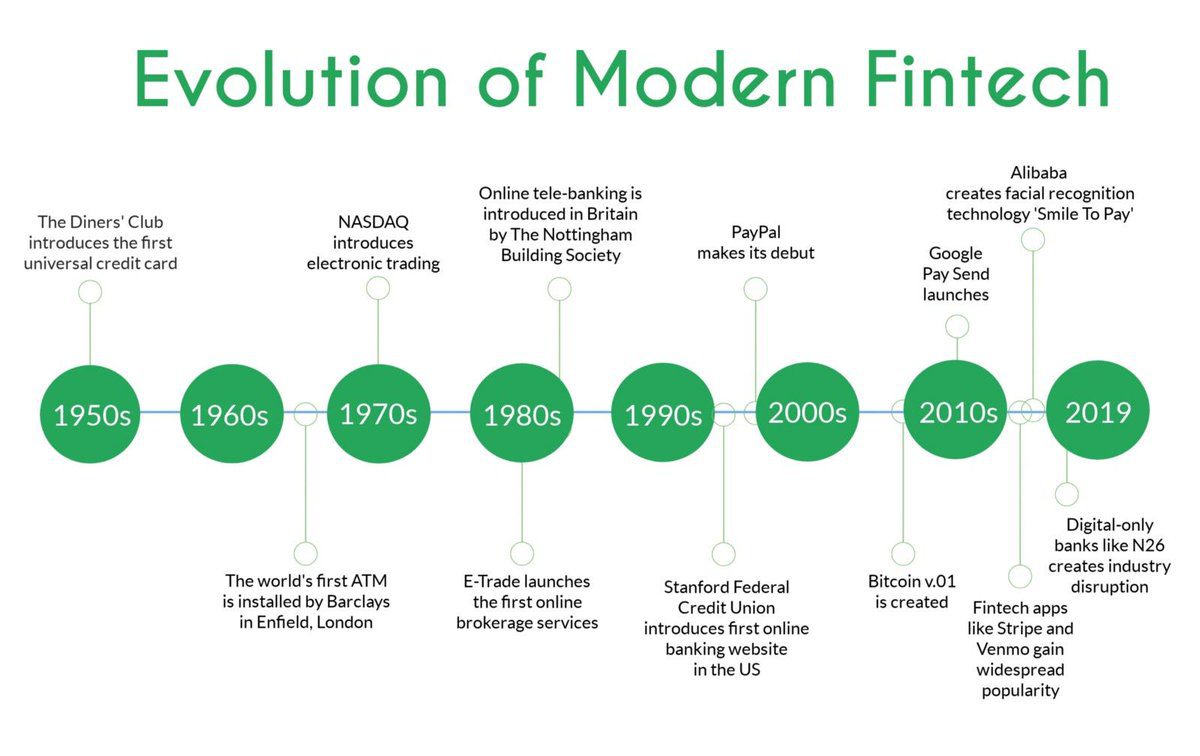
Technology and Finance have gone together for time immemorial. Initially, it was about making and maintaining records of financial transactions and later the introduction of coins, paper currency and promissory notes in the early 19th century. In modern times and about a decade ago Fin and Tech have got amalgamated into the era of fintech.

The early internet age:

Did you know that Fintech Courses teach you that the past 5 years cable under the seas far exceeds the cable network over the last 150 years since data and volumes of traffic have increased immensely? The first under-sea trans-Atlantic telegraphic cable fondly called Victorian internet-connected North America to West Europe and was in use since 1867. Financial markets at New York could connect to London, Asian markets, Europe, etc with its expansion. Forex references to GBPUSD also call this the cable-pair as most transactions were between the USD and GBP.

The laying of cabling infrastructure helped globalization and financial interactions between the period from inception in 1867 to 1914. The outbreak of WWI, the 1929 stock market crash and the Great Depression led to the slowing of the markets for over 25 years. During WWII codes and code-breakers were developed by the Germans and Britishers respectively. Communications in those days were through codes and set the initial foundation stone for coding. Just look at the German encoder shown below! It was the ability to build the decoders that leaked the German communications that led to an inversion of fates and an early end to WWII.

The ATM and calculator era:

The second phase of fintech began in 1967 with the digitization of analog to digital systems. It was also the beginning of RegTEch and early use of Fintech in development. The first ATM machine placed in the UK in Barclay’s Bank was the introduction and initiation of fintech. With more machines being made available the way people transacted and their relations with technology and finance changes irreversibly. Soon we saw the introduction of computing power in the TT 2500 DataMath hand-held calculator from Texas Instruments. This slowly evolved into today’s smartphones.

The electronic age:

The period between1970-80 saw the introduction of banking SWIFT codes and payment systems both international and domestic in 1973. SWIFT-(Society For Worldwide Interbank Financial Telecommunications) with its HQ in Belgium covered over 15 major countries and 239 banks. Today it is a portal for financial communication with 11,000 institutions and is the global payment system portal for financial communications. Between the ’70s and ’80s emerged NASDAQ the stock exchange with almost no human interference. The launch of the internet in the late ’80s saw internet banking and brought smart mobile phones into the hands of the common man.

Stock markets and payment systems: 

1999 saw .coms start and soon end. The 2008 financial crash brought into the limelight the distrust of customers and the start of the blockchain technology and cryptocurrencies. It also saw Siri, Google, Amazon, etc enter the digital assistant and payments platforms to revolutionize the financial scenario. Alongside e-commerce platforms emerged like TenCents, Alibaba and many others who all cashed in on the immense benefits of being early fintech players who have nearly replaced the way we shop, transact and buy things.

The present scenario: 

With the advent of smartphones, data analytics and the startup revolution Fintech post the 2008 financial meltdown emerged with blockchain technology being touted as the next big technological breakthrough. Blockchains have the potential to transform and disrupt the industrial scenario with cryptos, eCommerce platforms and digital currencies taking over. P2P lending, crowd-funding, angel investors and a complete transparent digital financial world is where we definitely are headed to.

Conclusion:

The evolution of fintech has been gradual and over the last decade, fintech is set to transform and disrupt many an industry. This makes the demand for personnel high and scope for jobs huge. Payments are also good and it makes a wise choice as a career. The fintech industry needs a large number of qualified personnel and is set to grow rapidly with even governmental policies promoting its growth. Incubators, startup hubs and integration of technology into all streams of life is the new mantra.

Do your Fintech courses at Imarticus Learning to get the ideal launch with assured placements. For more details, you can also contact us through the Live Chat Support system or can even visit one of our training centers based in – Mumbai, Thane, Pune, Chennai, Hyderabad, Delhi, Banglore, Gurgaon, and Ahmedabad.

Why Does Fintech Business Increasingly Prefer Python As a Primary Programming Language?

The last decade has been all about FinTech which has played a crucial role in many areas of financial transactions through smart use of technology. And Python definitely scores as the most popular language to use.

Here is why.
As taught in most fintech course financial services need the most-apt application to optimize costs, planning and the amalgamation of financial services. A HackerRank investigative report suggests that Python is the most popular language in use for FinTech firms in the US.

The report by e-Financial Careers ranks Python among the top 6 machine codes for the banking sector. Thus, doing a Fintech Course at a reputed institute like Imarticus can help you with certification and giving you the ideal launch into the technological world of fintech where well-paying jobs abound and demand for personnel is fast becoming a rage.

The fintech data science advantages of Python:

The fintech startups work with financial transactions that need records to be unchangeable, immutable and hard to tamper with. Decisions cost money and setbacks when they go wrong. The industry thus needs a ready-to-use programming language with ample libraries, components and high-performance maturity such as Python.

The Hacker Rank  2016 Study across the famous six of health care, media, and gaming, social media, security, fintech, and finance industries searched for the best popular programming knowledge.

Python, especially for fintech industries and as taught in Fintech courses, outstripped the rest by a huge margin in the performance testing on coding challenges. It also proved to be very popular in the financial sector.

The Python benefits:

Some outstanding features that set Python apart are

  • Simplicity and accuracy: Python has low bug-rates and error rates than the other programming languages.
  • Speed: Though not the fastest it scored in the time-to-market optimization tests.
  • Syntax: The collaborative syntax is straightforward in Python and is easy for interconnecting the C-suite, developer and technical-expert languages.
  • Libraries: The huge repository of free open-source libraries can be used for ready-made solutions in the financial and fintech sectors and are popular for training purposes in fintech courses. 

Use of python in industries:

Python is being widely used today in banking and is widespread among the hedge, investment and corporate finance bankers. This is because of Python scores in handling quantitative challenges in trade management, risk management, and pricing. It also makes use of its large number of libraries to handle issues related to analytics, compliance, data, and regulation.

Bootstrapped fintech startups may use various back-end programming languages. But from the point of view of time, efficiency and effort spent, Python outdoes the rest for fintech use. It is growing very quickly and has the potential to be supportive in almost any industry it is used in. No wonder Python is so popular, reliable and accurate!

Python can hence be effectively used in software for the following sectors and is great at multitasking especially as a back-end server.

  • Financial analysis
  • Insurance
  • Fintech
  • Banking
  • Stock markets
  • Data analytics
  • Cryptocurrency transactions.

Python Projects in Fintech:

Success and Python implementation are synonymous when blended with FinTech ideas.  Look at the P2P lending platform Zopa which uses a mix of Java, C#, and Python. Zopa helps the borrowers and creditors transact free of intermediaries. And Python has helped the algorithmic models of Zopa execute complex transactions on blockchain enabled platforms.

Even the payments system like Stripe, Braintree, Paypal, and other receiving and processing systems use Python-based applications for the authentication of users and transactions mainly due to its wide array of ready-to-use libraries.

Conclusion:

Many fintech startups use C, R, Java, etc. But, Python is ideal for the challenges of the fintech industry. It has scored over many languages in its popularity over Java, C, R, SQL and others in the HackerRank challenges over the top 6 industries. Python emerged the ideal language for programming in the financial and fintech sectors. Obviously one would do well to learn Python because the top 6 industrial sectors are recruiting.

The jobs in the top industries prefer expertise in Python and are high-paying and have well-defined scope for progress and grow your career. If you want to learn the latest applications of Python in the fintech sector just check out the Fintech Training at Imarticus. Hurry as opportunities may be limited!

For more details, in brief, you can also contact us through the Live Chat Support and can even visit one of our training centers based in – Mumbai, Thane, Pune, Chennai, Hyderabad, Bangalore, Delhi, Gurgaon.

Fintech Banks, All Set to Be Scrutinized Heavily by Relevant Regulators

Here’s when the fintech ventures tripled their global investments to 12.21billion USD. Clearly, since then the fintech industries have taken root in the revolution of digitization and blockchain technology. The early innovators accepted the challenges and the financial services industries took bold engaging steps to get them there.
Accenture reported their insights into the common themes needed for reimagining the fintech sector as openness, investment, and collaboration. Prophetic words and insights!
Cut to the present!
“Fintech banks all set to be scrutinized heavily by relevant regulators.” Is the latest shock to the growing fintech industries.
Fintech ruled the last half decade and emerged the most successful multi-billion dollar worth industry innovation in the financial world which can potentially disrupt and transform the way money is spent.
With the aim of developing faster-advanced systems for payment, the success of Fintech led to real-world banks totally powered by such innovations. Revolut, Monzo and such companies led the revolution’s success and the market was burgeoning with others who wanted to start such fintech banks and numerous applications targeted to make that possible. That’s when the ‘openness’ criterion apparently overstepped its boundaries and the regulators began taking a hard-stance in going slow with the green-light for such banks. Currently, their scrutiny is pretty stringent with the ultimate goal of ensuring fintech banks unscrupulous few do not cheat their customers.
Openness:
Transparency, customer trust, and openness are the core of the revolution where fintech innovation, digital technology and a lot of money is invested. Large organizations have the resources and knowledge capital to engage with such revolutionary technologically innovative solutions and change their culture and organizational structure to scale profitability very rapidly. They invest their assets, intellectual properties, and skilled resources to open up newer areas of services and products where customers are invested.
When the banks and financial services sectors grow explosively there are many who jump onto the bandwagon to unscrupulously make a profit at the expense of the customers. Scrutiny, regulation and heightened awareness is thus natural, essential and should be mandatorily undertaken. The PRA- Prudential Regulatory Authorities has rightly clamped down to take the necessary measures. The yearly approved proposals till Feb 2019 were just 4 compared to 12 licensed proposals in the previous year!
Investment:
Innovation, industrial growth and the promotion of financial systems never grow in isolation. Venture investing, capital markets and such are also invested in such fintech banks and industries. More than ever, the present trend is to focus on the immensely popular and profitable fintech innovations and even governments are not far behind in offering sops to the growing industry.
The decrease in the fintech banks approvals makes it very clear that the PRA means business. James Borley of PRA was quick to clarify that this was not a rap on the knuckles of an industry that is booming. Rather the stringent scrutiny measures are meant to ensure the dubious proposals stay out and transparency and openness encouraged while protecting the investors.
Collaboration:
The platform of fintech is a unique example of collaboration between two areas where traditionally there was none. Technology and finance both traditionally collaborated and shared process within their own areas. Fintech effectively opened up the rush for all industries to collaboratively partner in the quest for newer ideas, market opportunities, reduced costs, and increased value. With the PRA’s action collaboration will now have to be more effective, across diverse industries and outlooks to ensure value generation.
According to the PRA, they are encouraging increased inter-bank competition and will encourage the new bank players with a careful eye on scrutiny measures. The PRA challenges to approval can be easily gotten over with being prepared for ensuring the process does score on openness, transparency and investment protection.
Embracing scrutiny on all the above counts can create the foundation to disrupt their business models. By active participation, they do not need to sideline their core models for challenger non-core models where they could be relegated to the sidelines.
Concluding notes:
It is definitely going to be uphill to get fintech bank approvals from the PRA watchdogs. The very pace and rate of fintech disruption have meant that banks have altered their models to introduce new-age banking and a bouquet of services. Newer banks and services mean a boom in the need for trained professionals, training and better use of data analytics and customer insight.
If you are interested in a Fintech Career try the Imarticus Learning Academy who believes heightened scrutiny always makes better fintech banks.

The Modern Rules of Fintech

The new term Fintech has left all wondering as to what is fintech. Fintech is a combination word derived from financial technology and describes the financial services sector of the 21st century. Previously this term was used to describe the back-end dealing of financial institutions. At present this term now includes any innovation in the financial industry which is due to technology. It has redefined every aspect of money matters. Fintech adoption rate of India is approximately 52% which is second to China according to a report.
Fintech revolution in India started in the year 2015 which saw new fintech startups emerging through public and private investments. It was achieved through technical skills, finance, and passion for innovation. This along with the regulatory framework and government policies were also present to establish financial technology in India. Although India is still adapting to the commercial technology by transforming its economic ecosystem.

The ecosystem of the Indian Fintech sector:

The ecosystem of the Indian fintech sector comprises of the government, investors, financial institutions, and users. We will look into each of these and understand as to how these ultimately lead towards the establishment and growth of fintech India.

Government

The government is the most critical factor for the financial technology in India. The Indian government is in full support of fintech revolution along with regulators. By providing the funding, programs for financial inclusion and enablement, tax surcharge and relief the government is lending a helping hand to support this industry. The start-up India was launched in January 2016 with an amount of USD 1.5 billion funds for start-ups. Tax initiatives involve tax rebate being provided to those merchants who have more than 50 per cent transactions digitally, offering income tax exemption for the first three years to start-ups, and deduction of 80 per cent on patent costs for start-ups. The government is also providing the infrastructural support through its Digital India and smart city initiatives to promote digital infrastructure along with attracting foreign investments.

Regulators

The regulatory support in India for the development of the fintech industry has been phenomenal. Since fintech in India is in areas such as wealth management, lending, payments, and security. The regulatory initiatives involve the introduction of Unified payment interface which can take India towards a cashless environment, setting up Small finance banks and payments banks. The most regulated fintech sector in India currently is payment space.

Investors

Since financial technology is quite a new concept and it will take time to develop a complete understanding of this. What the investors need to know is that this is much more than being a payments technology merely.

Technology firms

Without the support of technology firms, fintech cannot flourish in India. Some technological firms are already working in the areas such as innovation, investment and incubation along with capability development. Besides this, they are also collaborating with the new entrants in the market to strengthen fintech India.

Financial sector

The most affected industry due to the advent of fintech is BFSI (banking financial services and insurance sector). The positive aspect, however, is the fact that this community is making the necessary changes to adopt this technology. The BFSI sector has taken a four-way strategy to develop this industry further. The procedure involves investment, market factors, collaboration and partnership.

Users

The Indian customers are adopting fintech offerings at a rapid pace. Due to the increase in the use of smartphones users are now looking for something which will help them to explore better option and avail better services for their banking needs.

Fintech impact on the financial sector

Since fintech, in particular, has a lot of influence on the financial industry it is essential to understand as to how this impact will create changes in this industry in the future.

Lending services

These companies are trying to use alternative techniques to provide faster access to capital and data sources.

Payments and remittance service

The objective of these payments companies is to allow users to make online payments without fraud using websites and smartphones. The amount is directly transferred into the payee’s account. Whereas the remittance companies aim at resolving all the remittance issues whether inward or outward remittances.

Personal finance

These fintech companies provide payments solutions to individuals using their funds. They have different market competitive packages to choose from.

Banking infrastructure services

These fintech companies have revolutionised access to information, using blockchain, digital data and analytics. Blockchain technology is the real game changer of the financial technology. It is a distributed ledger which maintains large data of customers. Blockchain technology aims to facilitate transactions using cryptocurrency to record and transmit ownership of data, currency and non-digital assets.

Equity funding services

Crowdfunding is an excellent opportunity for new start-ups since it allows them to borrow capital at lower rates as compared to the market rate.

Cryptocurrency

This is an emerging field in India holding a promising future.

Future of Fintech India

The future of fintech India is bright. With developments taking place in significant areas of fintech it is predicted that India will adopt this technology completely. Alternate lending, robot advisory, and digital payments will become the norm. Although there are threats which exist such as cybercrimes which can be mitigated through strict and efficient security measures.
 Nevertheless, the banking sector should look forward to the digital revolution as it will also bring new business opportunities.

Reliance Realty to Build Fintech Center in Navi Mumbai

The emergence of the amalgamation of technology and finance-related knowledge has created a consistent demand for banking services, fintech evolution, catering to the financial and insurance segment services, IT and cloud-based services and technology, the NBFC sector services and in keeping with the flow the growth of knowledge and training centers and institutes. Over the next two decades, this is expected to be the growing, return-oriented and most rapidly developing the economic sector. The state and central governments also have gone all out to promote and have a growth policy in place for the disrupting fintech segment.
Little wonder then that very large players like Reliance also have jumped onto the bandwagon. With a current -2.78 percent on NSE, RCom has taken all necessary approvals and initiated the development of its infrastructure in a well-timed plan to use its assets to develop Navi Mumbai’s island Smart Center for Fintech through its subsidiary realty arm. The Knowledge City named after its founder Dhirubhai Ambani- DAKC will have 3 million sft leasable and saleable space spread over a sprawling 132 acres campus in the satellite Navi Mumbai city. The Maharashtra Government, DIT and MIDC have approved the move lending credence to the promotion of Fintech in Maharashtra. The project is being touted as being twice the available space of the business complex in the busy industrial area of Bandra-Kurla of the city of Navi Mumbai.
RCom was recently in the eye of the debt-storm with an outstanding debt amounting to a little over 46 thousand crores in rupees and its filing an insolvency application in February 2019. Among its leading 40 creditors are Chinese and domestic banks besides Ericson. Using the route of restructuring of Strategic Debts, working on the sale of its spectrum, and the sale of its Nippon subsidiary, R Com had promised its creditors like the European Ericson to repay 550-cr Rs and defaulted forcing them to approach the highest court and NCL tribunal. The heavily indebted and financially stressed R Com has yet to begin its payments and the time-bound NCLT fast-tracked resolution is yet to see progress, which has been the situation for over nearly a year-and-a-half now. As of today, the creditors have not received any proceeds and the resolution plans which are underway, seem a long way off.
Swedish Ericsson has been baying for blood and repayment causing RCom and its subsidiaries RTelecom and RInfratel are also expected to file for insolvency separately. In an NCLT aided move for debt repayment and tardy resolution, the NCLT was quick to point out that the drawn-up plans are subject to speedy debt resolution and debtor repayments in a transparent manner where the funds from monetization of assets will need to be fast-tracked since the 270 day framework prescribed is fast drawing to its end. On the other hand, Shri Anil Ambani the Chairman has always claimed the plot which was the corporate hub of its operations had a developable market-value of 25,000 Cr in rupees.
Concluding Notes:
On an ending note, the establishment of the smart center for fintech in Maharashtra at Navi Mumbai sees the Reliance giant utilizing its property of over 132 acres in setting up an over 3 million sft state-of-the-art facility. The nearly finished and bankrupt titan hopes to be in the thick of the fintech revolution with this move for a structured government backed monetization initiative. Whether this move will bail out the stressed industrial giant is yet to be seen. However, it is aligned with the state policy to promote and develop the Fintech sector as its newest gambit in industrial development.
Do you have a head for spotting trends in the evolving financial markets and see scope for the policies and promotion of the fintech segment? Are you hoping to make a career of this and need efficient result-oriented training? Then, it is very important to select a reputed and experienced training partner especially at the beginning of your career.
If you also wish to be a part of the fintech revolution and wish to know how you can make a career in this evolving and promising field, then, check out the finance, technology and fintech courses at Imarticus Learning. The Learning-experience is based on the latest improvements and the methodology lays emphasis on being able to practically apply your knowledge. Besides, who wouldn’t want an able, reputed mentor and assured placements?  Hurry, fintech is evolving rapidly.

Why Fintech Needs to Start Counting for The Unimaginable 2020?

Fintech is a young achiever in India. Just a half-decade into its foray it has completely transformed the behavior of consumers. From cash to cards and now smartphone digital payments the concept of money stands redefined. The young Turk of Fintech can hope to see much development and should gear itself for 2020. The Government has placed its bet on the Fintech industry and has gone all out to promote the revolution with large incubators, sand-boxes, and promotion of the Digital India movement. So what does 2020 hold for this nascent industry? Let us explore the main contributory factors that are sure to dominate the next decade and usher in the digital revolution.
Digital Payments:
While blockchain technology and the digital mobile app solutions for payments like the interface for unified payments UPI the QR scan Bharat, initiatives of large online payment solutions like Amazon and Google Pay and many more the Indian markets will see much user-experience improvements. As of today, and according to NPCI the Indian payments corporation digital payments on UPI recorded a growth of 20 percent and 2018 saw over six-figure Crore worth money being transacted in nearly 621 million digital or mobile transactions. Truly messaging money is as simple as it gets!
Scanning of QR codes:
India uses the slightly outdated version of QR codes that are static while countries like China have moved to dynamic codes already. Even street vendors use the QR scan options to accept even the least payments and have made a huge impact on the behavior of the customers pan India. Alipay, Wechat, Tencent, Paypal, and a host of other big players see India as an emerging market for QR code scanning applications and evolving technologies in payment solutions. With sanctions and trade-wars hanging over the global industrial scenario 2020 will be a decisive year as far as Indian markets go.
Banking for MSME/ SME:
2020 will definitely be the year when the Fintech players fill the gaps in traditional retailer banking with innovative solutions and better customer experience. With fintech based aggressive companies competing for a place in the lending sector, the impetus for MSME/SME lending and credit is set to grow and will probably overtake retail-banking. Rightly so, since they are vital drivers for an economy that needs a boost and niche to grow into. Fintech also is a great step towards inclusion financially and a step in the right direction for the growth of industries according to the survey data from FICCIIBA.
Credit and lending apps:
Over and above the lofty goals of financial inclusion and growing the economy, the Indian market is where credit has been consistently withheld and is a cumbersome process. A plethora of changes is expected with online loan facilities and a population that is largely credit-starved. The over 15 crore market, the POS credit facilities being offered by giants like Amazon, Flipkart and others, and the rapid development of credit apps for digital lending are set to dominate the development of the Fintech sector especially with the credit card circulation rate is less than 3.9 crore. This is a win-win situation for the young digital-age consumers with instant facilities to pay in installments and for the business enterprises to cash in on the burgeoning customer market for credit facilities completely doing away with the unnecessary issue of credit cards.
Fintech training:
The growth in this sector has also seen the promotion of Fintech learning in a big way. The essentials of finance, technology and practical development of learning have seen unprecedented boom-time. Are you interested in what the Fintech industry could mean to your career and how you could be a part of this growth? Try the courses at Imarticus Learning which not only gear you for a career in Fintech but also offer assured placements in this next-gen technology.
In parting, 2020 looks promising for disrupting in the Fintech segment and the emergence of young startups as the unicorns of tomorrow for all the above reasons. Beat the helm of a fintech career and experience the seamless career transitions at Imarticus. Besides, where futuristic technology is expected to spur growth, one cannot but place a bet on the reputed favorites, right? Enroll at Imarticus today and ensure you are part of Fintech’s success.

Fully Utilize Fintech to Enhance Your Business


Fintech is the word evolved through the merging of “Finance” and “Technology”. As the word suggests, the term implies the development of the financial department in any business through technology. Though the word is a new addition to the Oxford dictionary, it is a dynamic and evolving part of business procedures.

It is an undeniable fact that like any other field, the world of business cannot go ahead without the tools of technology. Fintech courses have made the world of business and money transactions a more cohesive and transparent space against the traditional methods of banking, accessible to a maximum number of people because of greater internet expansion.

So how does one utilize this technology to enhance one’s business? Awareness is the first need. One must be increasingly conscious of the different developments made in the world of financial technology while data is a democratized commodity. While keeping a tab on other financial entrepreneurs, one must notice the critical technology involved in a specific process.

Keep your eyes open to the world of app development used for economic interactions and also to the growing platform of social media to expand your business. Not only is it an essential approach for the large growing industries but also a boosting option for smaller start-ups. Thus, whatever be the level of your business- keep a note of the following Fintech-utilization tips to boost it forward.

Artificial Intelligence has expanded the horizons of Fintech. The right investment in the right technology can open doors to your business for various customers. Techniques are developed every day, and web developers keep working on algorithms and apps which can be beneficial for your business if you utilize them with the right innovation.

New products come to birth through such creative ventures, which can create the required hype for your business. Crypto-currency, for example, is an area of growing interest in financial investment, and its growth depends on its transparency with data available to any investor.  The most important feature to determine the success of your product will be the accuracy on a real-time basis.

Financial inclusion is another critical aspect of utilising Fintech. Your product will be appreciated well if it reaches the economically weaker sections of the society who are otherwise deprived of greater luxuries of finances. Make your product reach these nooks and gaps of the broader economy. For example- mobile payment apps have significantly become popular because of their use among household transactions at the minimum of the local level. In turn, these apps have also developed links with banks which has benefitted not only the app’s business but also the convenience of its customers.

At this point, one must note that your innovative Fintech product should not aim at going against the traditional banking finance, but instead merge with them to enhance each other’s capacities. Try to develop associations with the existing trustworthy banks to increase your credibility points in the market. Safety and security are often significant concerns in the online exchange of financial data.

The privacy of an individual customer should be held with the utmost regard. Third party frisking of data may lead to hackers exploiting data, and this may cause a massive rupture in the development of one’s business. Therefore, one cannot take any risk with data security measures and must always keep a tab on them.

Finally, utilise the pre-established platforms of social media to expand your business or your product. Not only will you reach a guaranteed set of followers but also a realistic chance to be popularized through them. Let the world spread the excellent work that you do!

Bahrain Invites Indian Fintech Firms To Set Up Base


There are few fields which have seen as much a meteoric rise as fintech in recent years. There have been a lot of startups coming up around the world which work in the integration of technology to payments, and many of these are based out of India. In fact, India has more than 2,000 startups currently work in India, which represents a huge growth in the last five years alone. In 2014, this sum stood at around 700 – it has grown almost three-fold in the past 5 years.

Bahrain is looking to make a mark on the fintech sector as well and is constantly striving to establish itself as the fintech hub of the Middle East. In a bid to diversify from the traditional oil-based economy of Middle Eastern countries, Bahrain has been promoting and enticing many companies in the fintech sector to set up base in the nation. The Bahrain government is currently providing a lot of opportunities for the Indian firms to start their entry into various financial sector techs, like crypto assets, robot advisory, and blockchain.

The financial sector is actually extremely important to the government of Bahrain. The financial sector is actually the second biggest contributor to the Bahrain government, after the traditional oil and gas sector. The government has actually built up a capable support system in order to help the fintech startups thrive, and supports great innovation and growth in the sector.

There are many advantages that a fintech company gets when they shift to Bahrain. Apart from the strong support that the government provides companies, there are plenty of other perks – this includes a low cost of doing business, a large number of accelerators and many incubators too. This means that many companies have tried to get into this amazing ecosystem, including a large number of tech startups in India.

A sandbox actually offers a great opportunity for startups to push the limits of innovation in a safe space. Startups in Bahrain have actually started rolling out new products to the customers, in the testing phase – many of them have been gaining some great positive recognition too.

The investment promotion arm of the Bahrain government called the EDB has even signed a Memorandum of Understanding with the Maharashtra Government, in order to integrate the startups from the state into the markets in Bahrain. The formation of the Bahrain Fintech Bay, which is a private-public partnership platform, has played a huge role in attracting fintech startups too. It has worked to provide a physical space for fintech startups, and Bahrain is slowly shifting towards its bid for diversification. Around 42% of the fintech startups in the nation currently are based out of two cities – Bangalore and Mumbai. These two cities are actively targeted by the Bahrain government, and many fintech startups in the nation today are either entering the Bahrain markets with

How to Solve Issues With Fintech?


This is an era of open innovation. There is a massive opportunity for FinTech businesses and FinTech start-ups around the world right now. Research shows that there are currently about 3 billion people around the world who don’t have access to adequate financial services. They are undeserved in some way. Research indicates that there are somewhere between 2.1 and 2.5 trillion dollars of funding that is currently not available for small and medium customized businesses around the world. That means that there is a massive market opportunity to serve these individuals and small businesses along with opportunities to incorporate them in the financial system. Combined with this demand is the emergence of a new kind of supply and that is FinTech.

Solutions through innovations coming from emerging markets in the area of FinTech

The use of Alternative Data and New Data for credit scores:

A massive population around the world is, but their credit scores aren’t reflective of that. More importantly, a lot of people don’t have credit scores at all. That means they are un-scored and not able to access financial services and a whole list of other services despite their credit quality. FinTech helps support businesses that contribute to solving such a problem. Companies are dealing with Behavioural Credit Scoring online to supplement and complement existing credit scores.

Therefore if someone is on the cusp of getting or not getting a loan, these companies conduct an online behavioural interview and potentially put the customer into the borrower pool. There are also other companies which use the lending institution’s existing data and mobile and different kinds of data to improve scoring; create proxy scores for the potential borrowers.

The fundamental problem that FinTech is helping to solve is the information asymmetry issue. Large incumbent financial institutions in a lot of these markets may want to serve this class of borrower be it an individual or a small business. But they don’t have the infrastructure to help them, and they also don’t have the information they need to underwrite them; in the case of credit.

FinTech businesses and FinTech start-ups are coming in to help by using solutions like New Data and Alternative Data. There are an estimated 2.1 to 2.5 trillion dollars of a credit gap for micro and small-medium businesses in the world. And a lot of innovations are happening around using the internet to identify, acquire and ultimately underwrite small businesses the world over. Lots of such companies are looking for ways to use New Data and partnerships to serve potential borrowers.

AML Compliance:

It’s high time, finance-based organisations comply with the Anti Money Laundering (AML) regulatory Act. Over the years, millions have been fined by the financial regulators across the globe. Although these organisations have already spent millions to curb money laundering activities, financial institutions still get in customers that are declared financial risks by nationwide or worldwide watchdogs.

Eventually, before the AML officer can track down the particular watch list or sanction list, the money would already have been laundered. Fintech courses provides a solution to this problem by conducting real-time background checks relevant to AML compliance, something that used to be a time taking process under the manual review system.

In the under-served markets like India, East Africa and Mexico; fundamental forces like mobile phones, internet penetration, cloud computing, social media are setting the grounds to access financial services. Also, the financial institutions at large incumbent financial institutions in these markets are beginning to partner with early-stage FinTech businesses to expand their access as well. Therefore it is quite an exciting time to invest and support FinTech businesses.