CFA Levels: Your Complete Guide

If you have ever tried to understand the finance world from the outside, it can feel like watching a match without knowing the rules. You can see people making decisions, you can sense that money is moving, but the logic behind it looks distant. The CFA Program was built to close that distance. It gives you the rulebook, the tools, and the judgment you need to understand how professionals read companies, value assets, and manage money.

Finance works the same way.
The CFA Program doesn’t drop you into portfolio theory on day one. Instead, it guides you one level at a time, helping you build a foundation you can actually use.

Here’s the simple beauty of the journey:

→ Level I teaches you to see the financial world clearly.

Level II teaches you to analyse that world with precision.

→ Level III teaches you to make decisions in that world with confidence.

This progression is why the CFA charter has such credibility in the industry. It doesn’t promise shortcuts or memorised formulas. It builds thinking. It builds discipline. It builds judgment. These are the traits that employers value because they translate directly to real investment work, whether you are analysing a stock, evaluating a bond, or advising a client.

You don’t need to come from a finance family, have insider knowledge or be a mathematical genius. What you need is curiosity, consistency, and the willingness to grow through the CFA levels one step at a time.

In this blog, I’ll walk you through every part of that journey: what the CFA Program includes, how each level works, what the syllabus looks like, how difficult each level is, how much the CFA Program costs, and how you can plan your full learning roadmap.

By the end, you’ll know exactly what the CFA path looks like and whether it fits your goals. And if it does, you’ll have a much clearer plan of how to begin.


What Is the CFA Certification?

Before diving deeper into the CFA levels and how they work, it helps to understand what the CFA course actually represents. The Chartered Financial Analyst credential is one of the most recognised qualifications in global finance, known for its depth, rigour, and the real-world decision-making skills it builds.

If someone asks you what is CFA, think of it as a long-term training program that shapes you into a professional who can analyse markets, value companies, assess risk and manage investment portfolios. As a mentor, I often explain it using everyday examples because finance becomes easier when we break it down to things we already understand.

Imagine you are learning to drive.

  • First, you learn the rules, the basics, and how the car works.
  • Next, you practise driving in different environments: crowded streets, highways, and slopes.
  • Finally, you learn judgment: when to slow down, when to accelerate, and how to make safe choices.

The CFA certification works the same way through its three structured CFA levels.

Just like driving, you do not become confident overnight. You grow through repetition, better understanding and practice. The curriculum helps you build this confidence step by step.

Here is a summary table showing what each level tests and how it differs:

CFA LevelFocus / What You LearnExam FormatOutcome of Clearing
Level IFundamental tools: quantitative methods, basic valuations, financial reporting & analysis, ethics, etc.Multiple-choice questions (MCQs)Foundational understanding; eligible to attempt Level II
Level IIDeeper analysis, asset valuation across equities, fixed income, derivatives; advanced application of conceptsItem-set questions (vignettes + multiple-choice)Skill in analysing real-life financial situations; eligible for Level III
Level IIIPortfolio management, wealth planning, integration of all prior learning, and real-world portfolio decisionsMix of item-sets + constructed-response (essay / short answer) questionsReadiness to be a CFA charterholder (after work-experience requirement)

So when people ask “how many levels are there in CFA” or “what are CFA levels,” I give them this simple answer: there are three. And each level is more advanced than the previous one.

How the CFA Certification Builds Your Finance Skills

The program, also revered as the gold standard of finance certification, teaches you how to see the world the way investment professionals do. It starts simple and becomes deeper and more practical.

Here’s what the program helps you develop:

  • The ability to read and interpret real company financial statements
  • Skills to value stocks, bonds, derivatives and alternative assets
  • Understanding of global economic movements
  • Judgement to manage portfolios and make investment decisions
  • Ethical thinking is needed in real finance roles

Every concept connects to what you actually use on the job.

For instance, think about how we decide whether to buy a phone.
We check:

  • Price
  • Features
  • Brand reputation
  • Long-term value

In finance, the same habit becomes valuation. Instead of buying a phone, you’re analysing a stock or bond. The CFA certification trains you to make decisions with data rather than guesswork.

CFA Certification at a Glance

To make this clearer, here’s a simplified table that introduces the CFA qualification in a scan-friendly way:

AspectWhat It Means
Credential NameChartered Financial Analyst (CFA)
Governing BodyCFA Institute, USA
StructureThree CFA levels (Level I, II, III)
Focus AreasValuation, analysis, portfolio management, ethics
Who It’s ForAnalysts, finance aspirants, portfolio professionals, career switchers
Global RecognitionHighly recognised across investment, banking, and asset management

Watch this video that explains very practically how the CFA has become one of the best finance moves for your career today:


Why the CFA Program Is Designed as Three Levels

The reason behind having the CFA course details in three levels is rooted in the philosophy of building depth over time. Not many finance credentials adopt such a structured progressive path.

  • At Level I, the focus is on building a strong foundation, such as financial statement analysis, basic quantitative tools, ethics, economics, etc. This ensures everyone has a common base.
  • At Level II, you apply that base to valuation, asset pricing, and more complex instruments. You learn how to evaluate real-world assets.
  • At Level III, the emphasis is on synthesis and application, no longer standalone tools or formulas, but actual decision-making in a portfolio and wealth management context.

This design ensures a gradual ramp-up in complexity, making the CFA Program realistic for both students and working professionals.

Because of this structure, I believe that a single blog that explains all CFA levels, their syllabus, difficulty, fees, and progression, offers the most value to a prospective candidate.


What Is the Full CFA Levels Syllabus

To understand what you are signing up for, you need clarity on what topics each level covers. The syllabus evolves from basic to advanced, that you get in the CFA exam overview.

Here is a simplified high-level breakdown (topic areas that run across levels). Some of these topics are common across levels (with increasing depth).

Topic AreaImportance Across LevelsHow It Evolves
Ethics & Professional StandardsHigh throughout all levelsBasics at Level I; deeper application & real-world ethics dilemmas at Level II & III 
Quantitative MethodsStrong at Level I; still relevant laterBasics (statistics, time value) at Level I; used for valuations, modelling at Levels II & III
EconomicsFoundational at Level I; applied laterMacro and micro fundamentals; later applied to market valuations & asset pricing
Financial Reporting & Analysis (FRA)Important at Level I; critical at Level IIUnderstand company financials → Deep valuations, equity/fixed income analysis
Corporate FinanceFundamental at Level I; applied laterBasics → Capital budgeting, corporate actions, leverage, etc.
Equity / Fixed Income / Derivatives / Alternative InvestmentsIntroduced broadly at Level I; expanded and deepened laterValuation + analysis under different market conditions, instruments, and risk
Portfolio Management & Wealth PlanningIntroduced lightly early; central at Level IIIFrom basics to full portfolio construction, optimisation, and wealth planning strategies

This progressive layering makes the CFA curriculum robust.

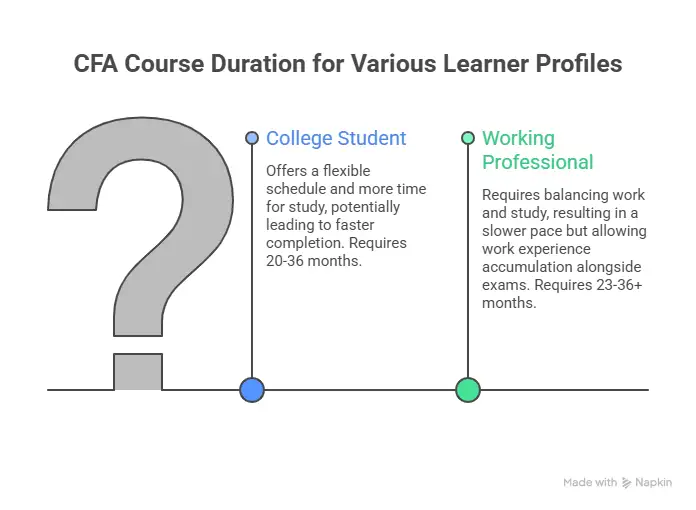
Most candidates need to dedicate significant time to each level. A self-paced approach often works best, especially for working professionals. 


Did you know? The CFA Program began in 1963 with only 284 charterholders, and today there are more than 190,000 charterholders globally.


How Long to Complete All CFA Levels & What It Costs

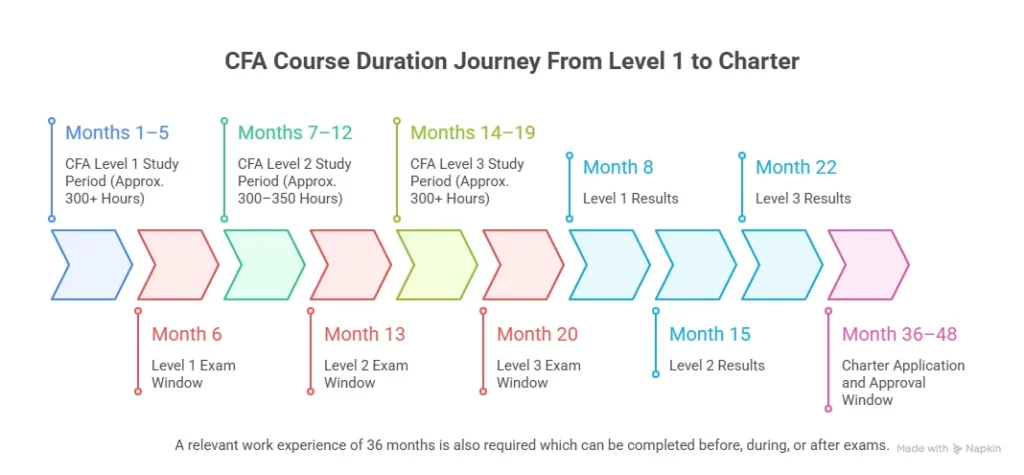
When I discuss CFA total levels, one natural question is: How much time and money should I expect to spend to complete all three levels? Below, I have explained the CFA duration required to go through the various levels.

Time Commitment

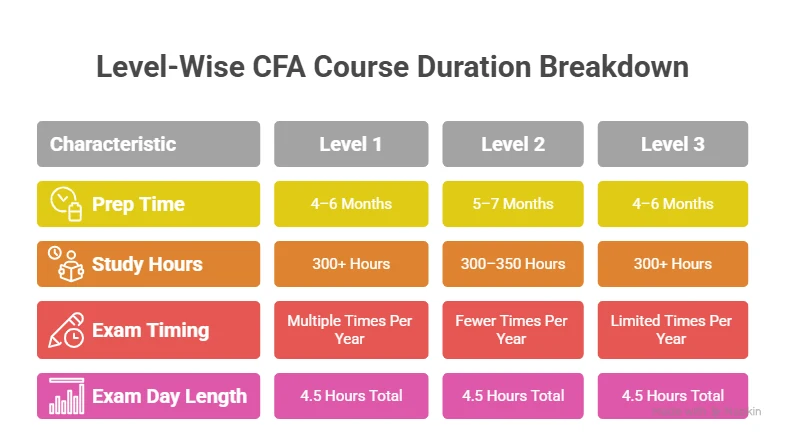
  • Recommended study time per level is around 300 hours.
  • Most people take three to four years to complete all levels, especially if they are working alongside.

That means realistically, you should plan for a multi-year commitment, with regular study intervals.

Fees & Costs

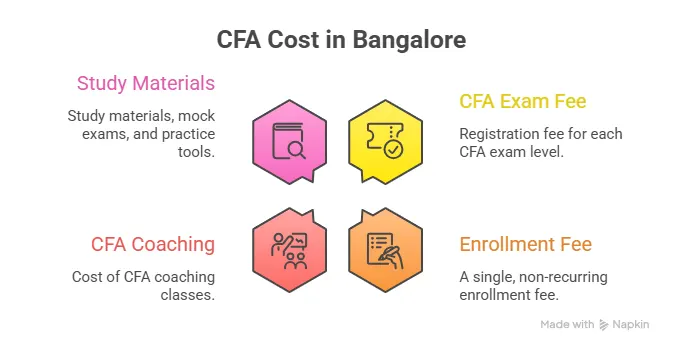
Here is a breakdown of typical costs and CFA course fees associated with the program:

Cost ComponentTypical AmountNotes
One-time Enrollment Fee (when first registering)$350Paid only once, at Level I registration
Registration Fee per Level (2025 fee structure)Level I / II: $990 (early) / $1,290 (standard); Level III: $1,090 / $1,390 Varies depending on when you register
Total Cost for All Three Levels (exam + registration)$3,520 – $4,600 (as per 2026 fee schedule)Excludes supplementary costs (study materials, etc.)

Beyond official exam fees, many candidates also invest in study materials, prep classes, mock tests, and sometimes retake costs or rescheduling. All these add up, which makes it important to budget wisely from the start.

From my experience mentoring students, I often advise them to treat the CFA Program as not just an academic journey but a financial as well as temporal investment.


Understanding the CFA Difficulty Level: Why Every Level Feels Tough

From the outside, the CFA Program might just look like “three exams.” But once you start, you realise the challenge is multidimensional: content volume, conceptual depth, application-based questions, and long-term discipline.

Here are some reasons the difficulty is real:

  • Breadth and Depth: The syllabus spans accounting, economics, ethics, quantitative methods, fixed income, equity, derivatives, alternative investments, and portfolio management; a lot of ground to cover.
  • Progressive Complexity: Concepts introduced at Level I reappear at Level II and Level III in much more complex forms (valuation models, real-world scenarios, portfolio optimisation).
  • Rigorous Exam Formats: From simple MCQs at Level I to vignette-based item sets at Level II, and essay + item sets at Level III. That requires both memory and analytical thinking.
  • Low Pass Rates: Historically, pass rates have remained low. Recent data shows the Level I pass rate is around 43–45%. Level II often below 50% and Level III has pass rates slightly higher but still challenging. (CFA Institute)

Because of this, when I mentor candidates, I always stress that clearing all CFA levels isn’t just about hard work; it’s about smart work, discipline, time management, and realistic planning.


A Deeper Look at the CFA All Levels Syllabus

I spend a lot of time guiding candidates on how to approach the curriculum. The CFA Institute updates the curriculum often, and here you should also know the CFA Program Policies, so I prefer to think of the CFA all levels syllabus as a learning map rather than a list. Each topic returns in a new form as you progress through the CFA levels, which helps you learn through repetition and context.

Below is a level-wise overview that gives you a clean understanding.

Level I Syllabus in Simple Language

CFA Level I tests the foundation you need for investment work. Almost every topic is tested. Your job here is to build comfort with the tools.

Key themes you meet at Level I:

  • Time value of money, statistics and probability
  • How to read and compare company financial statements
  • Intro to equity, fixed income, derivatives and alternatives
  • Understanding risk, return and basic portfolio terms
  • Using ethical standards in decision-making

Each topic here forms a brick. Later levels use these bricks to build larger structures.
Because this level has the widest spread of topics, I advise candidates to spend time learning the concepts slowly and to revise them often. It helps to use practice questions every day.


Watch this video that explains certain in-depth practical strategies that can help you clear the CFA Level 1 with ease, and this is the perfect guide that explains it in brief:


Level II Syllabus in Simple Language

CFA Level II takes the bricks from Level I and turns them into real structures. The entire level is built on practical interpretation. You do not get short MCQs here. Instead, you answer item-set questions. These are long caselets with three or four MCQs attached.

You need to read carefully, understand the story and pick answers that match the scenario.

How the topics evolve at Level II:

  • Equity and fixed income now rely on valuation models
  • FRA becomes deeper, especially with leases, pensions and intercorporate investments
  • Derivatives move to valuation, Greeks, and strategy building
  • Portfolio concepts grow from simple return calculations to full factor models

Students sometimes underestimate how much detail Level II requires. My advice is to use real examples from listed companies and global market developments. If you can link a concept to what you see in the news, you remember it better.

Level III Syllabus in Simple Language

CFA Level III brings everything to portfolio management. This is where you apply everything you learned across the CFA levels to real investment decisions.

You write constructed-response answers along with item sets. That means your thought process must be very clear.

What Level III focuses on:

  • Private wealth management
  • Institutional investor management
  • Behavioural finance
  • Fixed-income portfolio strategies
  • Equity portfolio strategies
  • Risk management at the portfolio level
  • Asset allocation
  • Performance evaluation

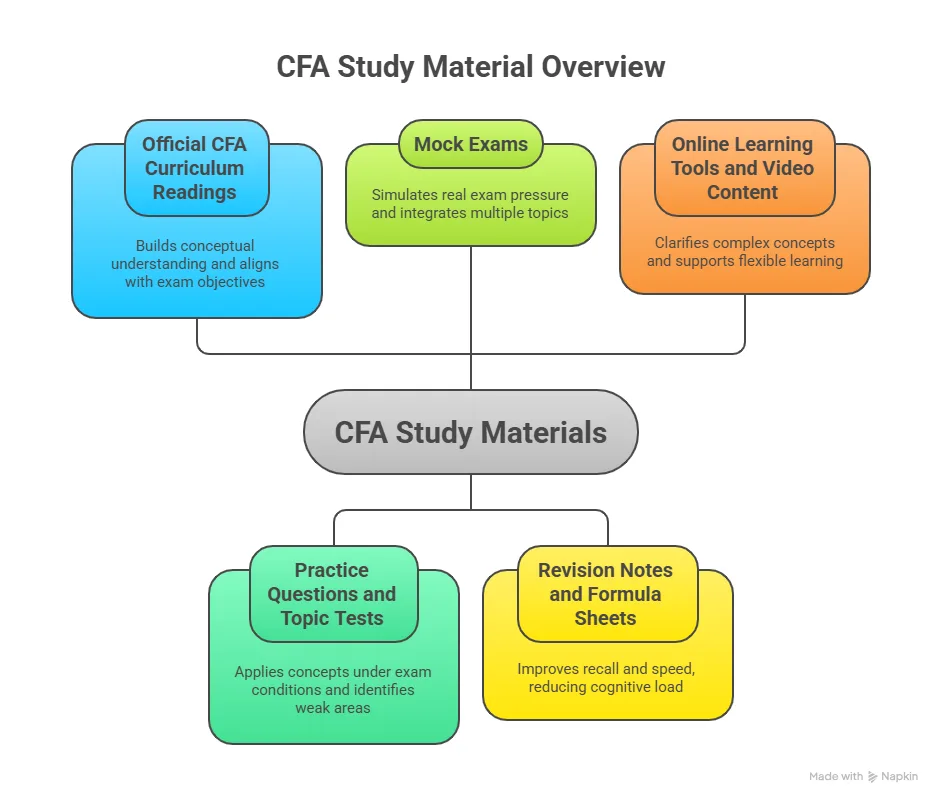
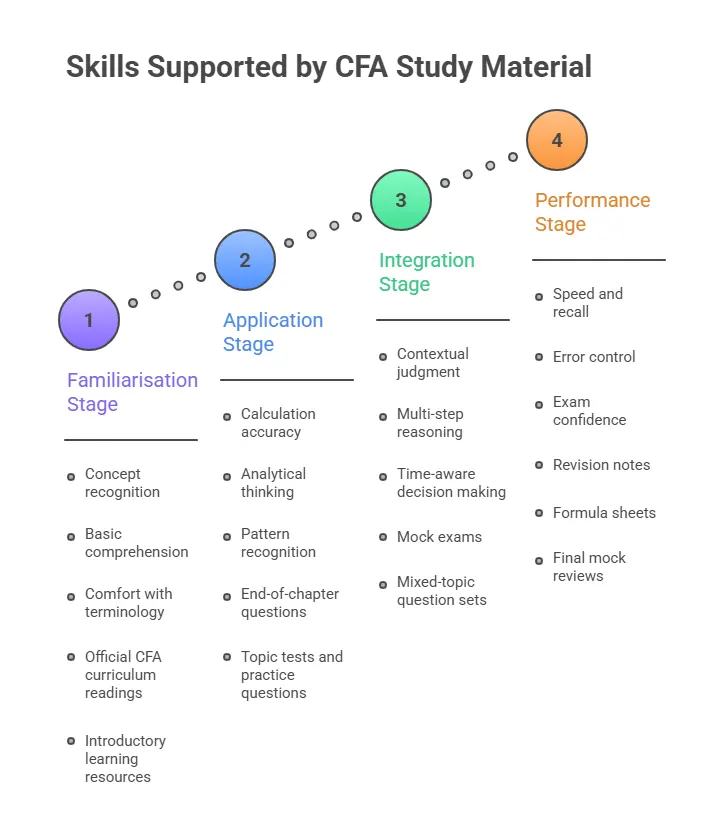
I always tell candidates to practise writing short, structured answers every day. Most students struggle at first because it feels unusual, but it gets easier with practice. You do not need long paragraphs. You need clarity. The infographic below highlights the CFA levels syllabus at a glance. You can discover what various levels consist of on a broader lens:

CFA Levels Syllabus Overview

Did you know? Time value of money calculations, introduced at Level I, reappear in advanced forms in CFA Level II and CFA Level III.


Realistic Study Strategy for All CFA Levels

After mentoring candidates for many years, I follow a simple rule: small steps taken every day are more powerful than long study sessions taken once a week. The syllabus is wide, and if you skip a day, you feel it.

Below is a pattern that works for most working professionals.

1. Start with reading, but never end with reading

Reading builds familiarity. But exams test your ability to apply. So a typical weekly plan may look like this:

  • Read 5 days a week
  • Practice questions 4 days a week
  • Revise 2 days a week
  • Attempt a full mock every 2 weeks during the last month

You can adjust this, but I find this rhythm easy to sustain for months.

2. Create small learning packets

Some candidates try to study an entire reading in one sitting. That often leads to burnout. Instead, break concepts into small packets. For example:

  • Discounted cash flow
  • Dividend discount valuation
  • FCFF and FCFE
  • Residual income models

Each of these packets can be done in a single evening. Smaller packets improve recall.

3. Use early morning study windows

Most candidates tell me they are too tired in the evening. I have seen better consistency when students study early in the morning. Even 60 minutes is enough if you do it every day.

4. Always use a formula notebook

The CFA Program uses many formulas. Some people try to memorise them at the end. That creates unnecessary stress. Instead, maintain a small formula notebook from the start. Add formulas as you learn them. By the time revision starts, your notebook and the CFA books become your most valuable resources.

5. Take 3 mock exams per level (minimum)

Mocks help you understand the exam. They also teach you:

  • How to manage time
  • How to recover from a tough section
  • How to stay calm when you don’t know the answer

Mocks also highlight weak areas quickly. I always ask candidates to analyse each mock carefully. This is where improvement happens.


How Working Professionals Should Approach CFA Prep

Many of my students come from full-time roles in banking, accounting, audit, fintech, equity research or consulting. They face the toughest schedule. Here are habits that help:

  • Use 60- to 90-minute study blocks
  • Keep weekends for revision and question practice
  • Avoid long breaks in study rhythm
  • Keep digital distractions away during study time
  • Use spaced repetition for memory-heavy areas like ethics and FRA

A steady pace wins this race. I have seen students with busy audit seasons or long banking hours clear levels because they kept a very small but daily commitment.


Career Paths After Clearing the CFA Levels

When candidates ask me what they can do after clearing all CFA levels, I often tell them to think of the CFA benefits as a way to sharpen the skills that markets demand. Many roles in finance rely on analytical thinking, valuation ability, financial modelling, portfolio understanding and ethical judgment. The CFA Program has all these in one place.

Here are some common roles that open up for people who complete the CFA levels and then build experience:

  • Equity research analyst
  • Portfolio analyst
  • Fixed-income analyst
  • Investment banking roles related to valuation
  • Wealth management and private banking
  • Risk analysis roles
  • Alternative investment roles in funds
  • ESG research roles
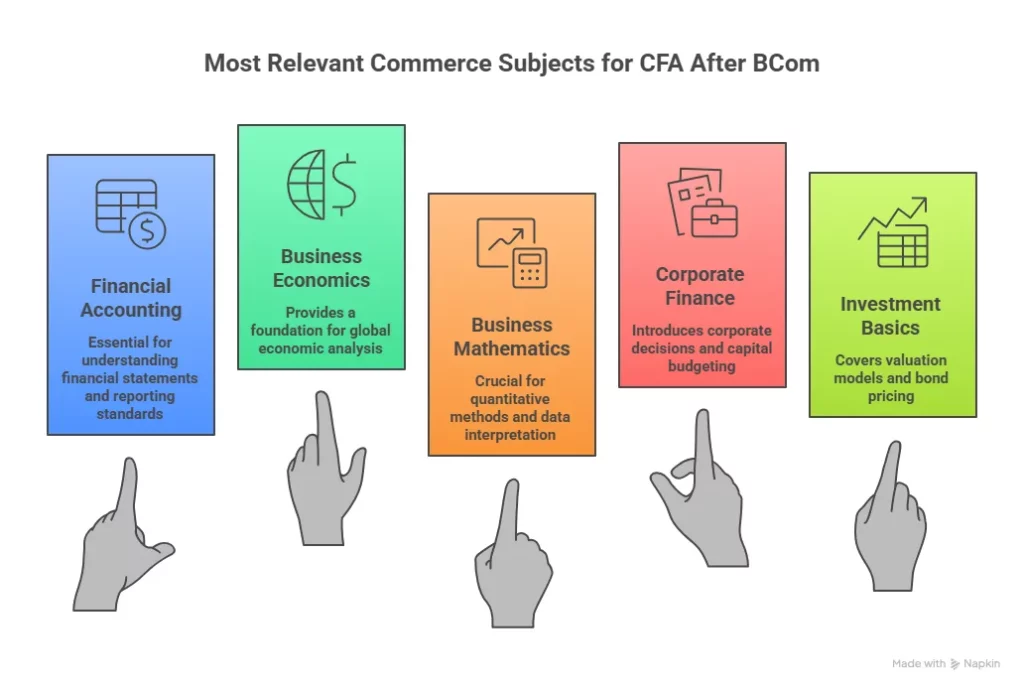
  • Corporate finance and strategy positions

Many roles do not require the charter as a strict rule, but having the CFA levels completed gives you a strong advantage during interviews. You show discipline and mastery of concepts. Employers value that because it reduces training time.

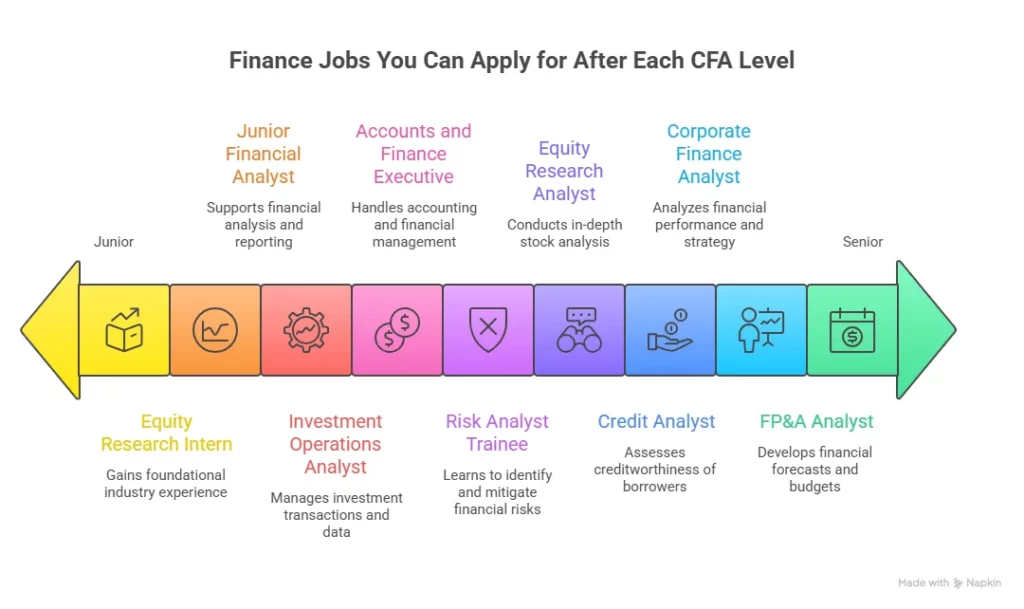
People who understand career options after CFA also find the CFA Program useful. I have seen engineers, statisticians, accountants, lawyers, computer science majors and even psychology majors complete the CFA levels and reshape their careers. What matters is curiosity and a willingness to learn finance in a structured way. The roles often get the most sought after when you consider the CFA salary outcomes that having the credential commands.

The visual below also encapsulates how various CFA levels translate to high-earning job roles across the globe. These are the most talked about and hot roles today in the finance job market:

CFA Levels and Job Relevance

Why Imarticus Learning Makes a Strong Case for CFA Candidates

When you choose Imarticus for your CFA course prep, you get advantages that go beyond just “reading and testing.” These are real differentiators that can make the difference between a struggle and a successful CFA completion:

  • Industry-Aligned Programme in Collaboration with a Big 4 Firm: Their CFA certification is delivered in collaboration with KPMG in India. This means the curriculum and case studies reflect actual market and corporate realities, not just textbook theory.
  • Global-Standard Study Material: They provide content from Kaplan Schweser, a globally trusted prep provider. That ensures you study from internationally benchmarked and up-to-date resources.
  • Dual-Teacher Model with Personalised Mentorship: Students get both live classes from chartered faculty and 24×7 support for doubts and clarifications. That kind of mentorship especially helps when you’re juggling CFA studies with a job or other commitments.
  • Money-Back / Partial Refund Guarantee: If you follow the prescribed schedule and still don’t pass, Imarticus offers a refund of 50% of your course fee. This reflects their confidence in the quality of training and reduces the financial risk for you.
  • Structured Learning with Real-World Case Studies and Internship Option: The programme includes business-case simulations, curated resources, and in some cases, internship opportunities (for top performers) with real organisations. This gives you practical exposure, not just exam prep, but a taste of real finance work.

FAQs on CFA Levels

Below are the most frequently asked questions about CFA levels. Each answer includes the primary keyword naturally and offers clear guidance.

How many levels of CFA are there?

There are three CFA levels in the CFA Program. Each level focuses on a different set of skills that build your finance knowledge step by step. You learn the tools at Level I, the applications at Level II, and portfolio management at Level III. These stages prepare you not only for the exam but also for real work in investment roles. If you train with Imarticus Learning, you receive guided support at every level, which helps you manage your study plan and stay consistent.

Is CFA Level II harder than Level I?

Most candidates feel that Level II is harder than Level I because the questions become longer and require deeper application. Level I introduces the concepts. Level II expects you to use those concepts in realistic valuation cases. This creates a natural jump in the CFA difficulty level. Many students join coaching support from Imarticus Learning during this level because the training keeps the pace steady.

Is 60 percent enough to pass CFA Level I?

There is no fixed passing score published by the CFA Institute. They use a process called the Minimum Passing Score, which changes after every exam cycle. Most candidates believe that scoring around 60 to 70 percent in mocks gives a reasonable chance to clear Level I. 

Is CFA Level II possible in three months?

It is possible to prepare for Level II in three months, but it requires full commitment, longer daily study hours and strong foundations from Level I. The CFA difficulty level at Level II feels higher because the questions need interpretation. If you can study two to three hours every day and go through many item-set questions, three months can work. Candidates who train with Imarticus Learning follow a structured schedule that helps them complete the core syllabus efficiently.

Can I clear CFA in one month?

Clearing a CFA level in one month is rare because the syllabus is large and requires a deep understanding. Most candidates need several months to study comfortably. The CFA levels are designed to be progressive, and each level requires practice, revision and mock exams. One month is too short for most students, especially if they have work commitments. 

Is 400 hours enough for CFA Level II?

Yes, 400 hours can be enough for Level II if you use those hours wisely. The CFA Institute recommends about 300 hours per level. Many students spend between 350 and 450 hours on Level II because the content feels heavier. What matters is how consistently you study. The CFA levels demand both understanding and stamina. You build both when you study regularly.

How many times can you fail CFA Level II?

There is no limit on how many times you can attempt Level II. You can take it as many times as you need. The CFA Program gives you freedom because the journey is different for everyone. Clearing all CFA levels is a long-term goal, not a short-term race. Support from Imarticus Learning also helps because structured guidance improves confidence.

Is CFA Level III tough?

Many candidates find Level III tough because of the essay-style questions. This format requires clarity in writing and comfort with portfolio management. The CFA difficulty level peaks here because you need to pull together everything from Levels I and II. If you practise writing short, structured answers, Level III becomes manageable. The key is to understand portfolio situations instead of memorising facts. 

Is the CFA exam MCQ-based?

Level I of the CFA Program is fully MCQ-based. Level II uses item-set questions, which are long caselets followed by MCQs. Level III is a mix of item sets and constructed-response questions. You start with direct questions, then move to applied questions, and finish with essay-style decision-based questions. This structure helps you learn how investment professionals think.


Your Path Forward in the CFA Journey

Completing all three CFA levels is a long journey, but it is also one of the most rewarding paths in finance. If you approach the syllabus with care, stay consistent and give yourself enough time, you build strong knowledge that stays with you for life. I have seen students with different backgrounds succeed. The ones who do well focus on understanding rather than rushing. If you take that approach, your learning becomes meaningful, and you grow both as a student and as a future professional.

Every year, students who come in are unsure of where to begin and eventually grow into confident analysts. That transformation is possible for anyone who approaches the CFA Course with patience and purpose. If you feel ready to take the first step, this is the right time to start shaping your future in finance. And if you want guided learning along the way, Imarticus Learning can support your journey with structure and direction.

CFA Exam: Smart Guide & Preparation Tips

If you’re planning to build a serious career in finance, investment banking, portfolio management, equity research, or risk management, chances are the CFA exam has already caught your attention. The CFA Program is one of the most respected paths you can take. It’s recognised globally, trusted by top financial institutions, and considered the gold standard for anyone who wants to master real-world finance.

But here’s something most students don’t realise at the beginning – The CFA is challenging, but it’s not impossible.

With the right preparation plan, the right study materials, guidance from the best CFA exam prep providers, and a clear understanding of how the exam actually works, clearing all three levels becomes far more manageable than it seems.

In this guide, I’ll break down everything you need to know, right from exam details, fees, topics, exam months, structure, and the best tips to prepare like a professional. Whether you’re just exploring or actively planning to register, this breakdown will help you understand exactly what to expect and how to prepare effectively.


Did You Know? Each CFA exam level is 4.5 hours long, split into two equal sessions – with an optional break in between.


Understanding CFA

A lot of students ask me, “What is CFA?, and Why is everyone in finance talking about it?” I can break it down in the simplest terms for everyone to understand it.

The CFA Course is offered by the CFA Institute and is designed for people who want to build real careers in investment analysis, portfolio management, wealth advisory, equity research, and all the big finance roles.

It is respected globally because the curriculum actually teaches what finance professionals use every day – ethics, financial analysis, valuation, risk management, and portfolio strategy. Nothing fancy. The CFA exam just tests real, practical skills employers value.

To earn the CFA charter, you need to clear all three levels, gain the required work experience, and follow strict ethical standards.

CFA Career Progression

CFA Exam Eligibility

Another common question I get is, “Am I even eligible to take the CFA exam?”

Thankfully, the requirements are pretty straightforward.

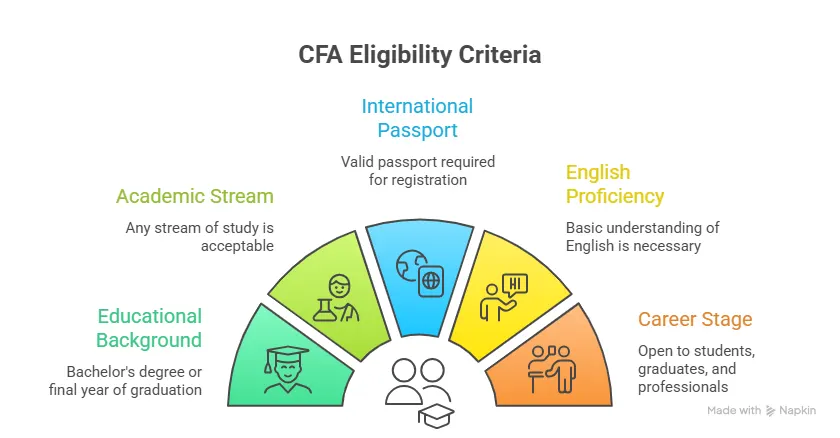
You can take the CFA Level 1 exam if you meet any one of these:

  • You’re in the final year of your bachelor’s degree.
  • You’ve completed your bachelor’s degree.
  • You have 4,000 hours of professional work experience, or
  • You have a combination of education and experience that totals 4,000 hours. 

That’s it. You don’t need a finance background,  a master’s degree, or prior certifications. Just meet the minimum eligibility, and you’re good to go.


If you want a quick reality check about the CFA journey, the video above breaks down common myths, who can actually pursue the program, how to balance studies with life, and why failing once doesn’t stop your CFA path.


CFA Exam Structure

Understanding the CFA course syllabus and exam structure early helps you plan smarter. Each level follows a unique pattern:

CFA LevelFormatExam Duration
Level 1180 multiple-choice questions4.5 hours (two sessions)
Level 288 vignettes + item-set questions4.5 hours (two sessions)
Level 3Essay-style constructed response + item sets4.5 hours

Level 1 – The Foundation

CFA Level 1 exams focus on understanding basic financial concepts, ethics, and core analytical tools. It tests your recall, definitions, and introductory financial analysis skills while giving you exposure to all major CFA exam topics.

Level 2 – The Analyst’s Exam

CFA Level 2 moves into application-based learning. It tests you through case studies, valuations, and data-driven scenarios. This level demands stronger analytical ability, financial modelling skills, and accuracy in applying concepts to real-world situations.

Level 3 – The Portfolio Mastery Stage

CFA Level 3 emphasises portfolio management and wealth planning. It tests your ability to reason, structure answers logically, and make client-oriented investment decisions with the essay-style questions. It integrates everything learned across previous levels into practical portfolio strategies.


Did you know? All CFA exams are computer-based and held at approved global test centres. Paper-based exams were discontinued in 2021.


CFA Exam Months

Many students ask me, “When exactly can I take the CFA exam? Do I need to wait an entire year?”

The good news is – not anymore. 

The CFA Institute now offers the exam multiple times a year, giving candidates far more flexibility than before. Here are the typical CFA exam months you can plan around:

  • CFA Level 1: February, May, August, November.
  • CFA Level 2: May, August, November.
  • CFA Level 3: February, August.

This flexible schedule means you can plan your preparation, work commitments, and even retakes comfortably – without feeling locked into a single annual exam cycle.

CFA Exam Registration Process 

Most students wonder how the registration works. Here’s the good news – it’s simple and fully online.

Here’s the step-by-step registration process:

  • Visit the CFA Institute Website – Create your CFA Institute account.
  • Choose Your Exam Level & Window – Select the exam month (from the windows available for your level).
  • Upload Eligibility Details – This includes your education or work experience.
  • Pay the Exam Fee – Early registration saves the most, so register as soon as possible.
  • Schedule Your Exam Slot – After payment, you can pick your exam day and time from the available test-centre options.
  • And that’s it – your CFA journey officially begins.

CFA Exams Cost 

Students often ask me, “What would they spend on the CFA Fees?” And I totally understand the concern behind that question. Knowing the CFA Course Fees and Exam costs in advance helps you plan your budget and your preparation. The CFA exams cost depends on when you register:

  • Early registration saves the most.
  • Standard fees apply if you miss the early window.
  • One-time enrollment fee for first-time Level 1 candidates.

The table below shows an overview of the CFA exam price:

Fee ComponentUSD Amount (approx.)INR Equivalent (₹)
One-time Enrollment Fee (first-time candidates)USD 350 ₹31,000-32,000
Early Registration Fee (per level)USD 990-1,090 ₹88,000-98,000
Standard Registration Fee (per level)USD 1,290-1,390 ₹1,15,000-1,25,000
Rescheduling / Retake Fee (if applicable)USD 250₹ 22,000-23,000

NoteThese INR equivalents are approximate. Actual INR cost will depend on the prevailing USD/INR exchange rate on the day of payment.

CFA Exam Fees

Here’s a fee breakdown for the CFA course at Imarticus:

Fee ComponentTypical Cost / Notes
Registration Fees₹10,000
Course fee per level₹60,000-75,000 per level 
What the fee covers (per level)Study materials + prep courses + coaching through that level 

NoteThe per-level fee is for the prep course/coaching offered by Imarticus, not the actual exam registration or exam-related fees.

Many candidates search for the CFA exam fees because budgeting is an important part of planning, especially across all three levels.


CFA Exam Topics

Across all levels, the CFA curriculum covers a wide range of concepts that finance professionals use every day. These topics build the exact skills needed for CFA certification career paths like investment banking, equity research, portfolio management, wealth advisory, risk analytics, and asset management. Whether you’re analysing financial statements, valuing companies, managing portfolios, or assessing market risks, the CFA exam topics are designed to prepare you for real-world responsibilities in these high-demand roles.

CFA TopicLevel 1 Weight (%)Level 2 Weight (%)Level 3 Weight (%)
Ethics~15-20%~10-15%~10-15%
Quantitative Methods~6-9%~5-10%~0% not assigned for Level 3
Economics~6-9%~5-10%~5-10%
Financial Statement Analysis~11-14%~10-15%~0% not assigned for Level 3
Corporate Issuers~6-9%~5-10%~0% not assigned for Level 3
Equity Investments~11-14%~10-15%~10-15%
Fixed Income~11-14%~10-15%~15-20%
Derivatives~5-8%~5-10%~5-10%
Alternative Investments~7-10%~5-10%~5-10%
Portfolio Management~8-12%~10-15%~30-35%

Each level goes deeper: 

  • CFA Level 1 covers Concepts, Definitions & basics.
  • CFA Level 2 focuses on Applications & valuation.
  • CFA Level 3 tests Portfolio integration – Portfolio construction & decision-making.

These are also the essential areas to focus on when choosing your CFA exam study materials.


CFA Facts: CFA charterholders work in 160+ countries, making it one of the most globally portable finance qualifications.


Best CFA Exam Study Materials 

Students often wonder what actually works for the right preparation. While there’s no correct answer, using a combination of the best CFA books can help in your journey. Choosing the right resources is half your success.

Here’s how to pick:

Study MaterialBest ForWhy It Helps
CFA Institute BooksIn-depth learningFull explanations, detailed concepts, and official examples.
Schweser NotesFast revisionConcise summaries, structured theory, and quick revision support.
Wiley / Bloomberg LearningDifficult topicsSimplifies complex areas like FRA, Derivatives, and Valuation.
CFA Exam Prep Courses (Imarticus Learning)Mentorship & guided studyLive support, doubt-solving, structured plans, and expert faculty.
Question Banks & CFA Past ExamsPractice & exam readinessBuilds accuracy, improves speed, and reflects real exam difficulty.

Best Tips to Prepare for the CFA Exam

Now that you are pretty aware of the CFA course details, it’s time to understand how successful students prepare for the CFA exams. Experts and successful CFA candidates agree on one thing: strategy matters as much as hard work. 

Here are the most effective CFA exam tips, inspired by real analyst and portfolio manager insights:

CFA Exam Preparation Tips

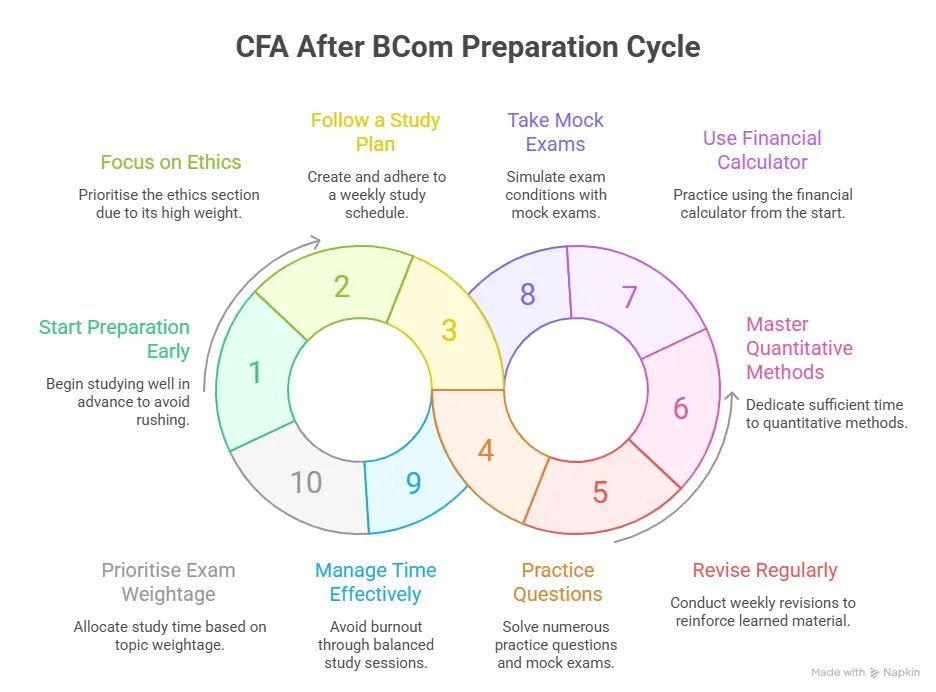
1. Start Early With a Structured Plan – Most candidates prepare for 4-6 months per level. Break your study into weekly milestones.

2. Prioritise High-Weight Topics – Areas like FRA, Equity, and Fixed Income carry huge weight – focus heavily on them.

3. Practice More Than You Read – CFA exam prep is 70% practice. Use Question banks, end-of-chapter problems, and mock tests.

4. Learn Efficiently (Not Just More) – Condense notes, use summary sheets, and review formulas regularly.

5. Strengthen Ethics ThoroughlyEthics performs a tie-breaker role – don’t underestimate it.

6. Simulate Exam-like Conditions – Take full mock exams to build stamina for the 4.5-hour exam.

7. Maintain Consistency – Keep your momentum steady, as consistency beats last-minute cramming.


CFA Exam Difficulty & Pass Rates

Let’s be honest – the CFA exam is challenging. But the difficulty does not mean the exam is complicated.

Here’s the real picture:

  • CFA Level 1 pass rates usually range around 22-30%.
  • CFA Level 2 pass rates are around 40%.
  • CFA Level 3 pass rates are slightly higher, often 40-50%.

The difficulty doesn’t come from tricky questions – it comes from the volume of concepts you need to master and the discipline required to stay consistent.

CFA Exam Pass Rates

Most candidates fail because they:

  • Don’t follow a fixed study plan,
  • Rely only on reading, not practice,
  • Underestimate Ethics,
  • Skip mocks,
  • Start studying too late.

Even though the pass rates are high, with the right preparation strategy and training, clearing each level on the first attempt is absolutely possible.

Is the CFA Exam Worth It?

Yes, the CFA designation is one of the most powerful career accelerators globally. Clearing the CFA course acts as a gateway to global finance and is beneficial if you want a career in:

  • Equity Research
  • Investment Banking
  • Portfolio Management
  • Wealth Management
  • Risk Analytics

It signals expertise, commitment, and professionalism – qualities every finance employer looks for today. And yes, the CFA exam can feel overwhelming in the beginning, but once you understand the structure, plan your preparation properly, and stay consistent, it becomes far more manageable than it appears.

Another thing students often ask me is about the CFA salary in India. While salaries vary based on your role and experience, CFA candidates and charterholders generally earn significantly higher than the average finance graduate. Many entry-level roles start with competitive packages, and as you gain experience, CFA-qualified professionals often move into high-paying roles in equity research, investment banking, portfolio management, and risk analytics.

In simple terms: the CFA is not just a certification – it’s a long-term investment in a career that grows with you. If you also want a quick breakdown of the salaries and roles you can expect after each CFA level, this short video explains it clearly and helps you understand the real career outcomes of the CFA journey.


Did You Know? CFA exams use multiple psychometric methods, including Minimum Passing Score (MPS) and equating, to ensure fair scoring across all exam sessions.


Why Choose Imarticus Learning for the CFA Exam?

A lot of students ask me, “There are so many platforms out there – should I prepare for the CFA exam with one of them?”

And honestly, the answer is simple: Imarticus makes the CFA journey easier, structured, and far more guided.

Here’s why:

  • Expert-Led Training With Industry Faculty – At Imarticus, you’re not just learning from trainers – you’re learning from real finance professionals. Many of them are ex-analysts and domain experts who’ve worked with the exact concepts you study for the CFA exam. They bring real-world examples into every session, which makes understanding complex topics a lot easier.
  • Live Doubt-Solving & Mentorship – Instead of figuring everything out on your own, you get continuous academic support. You can clarify doubts instantly, attend dedicated doubt-clearing sessions, and even get one-on-one guidance whenever you need it.
  • Complete Level-Wise Support –  Each level of the CFA program demands a different kind of preparation. Imarticus guides you through all three – whether it’s building your foundation for Level 1, tackling valuation-heavy concepts in Level 2, or mastering portfolio strategy for Level 3. Your entire journey is mapped out clearly.
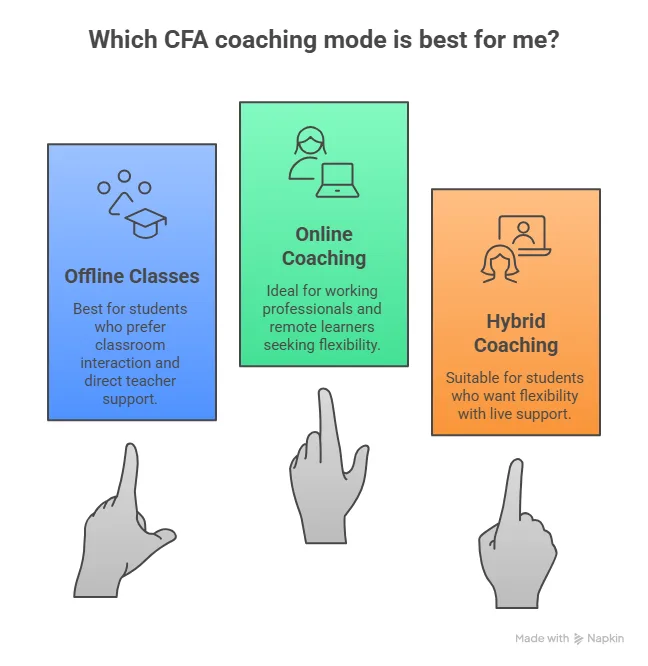
  • Flexible Learning Options (Online + Classroom) – Whether you’re a student, a working professional, or someone balancing both, the classes are designed to fit your schedule. You can choose online flexibility or a classroom experience based on what works best for you.
  • CFA-Aligned Study Materials & Practice Questions – The materials are designed to simplify complex topics like FRA, derivatives, and portfolio management – topics candidates usually find difficult.
  • Mock Exams, Test Series & Performance Tracking – The best way to crack the CFA exam is to practise exactly how you’ll be tested. Imarticus gives you full-length mock exams that mirror the real CFA pattern. You also get detailed performance reports so you know exactly where to improve before the big day.

In short, if you want guidance, structure, discipline, and expert mentorship – not just study material – Imarticus is one of the strongest partners you can choose for your CFA course

Imarticus Learning, in collaboration with KPMG in India, is supported with additional credibility, expertise, and industry relevance and provides a structured CFA preparation journey designed for guaranteed success.


FAQ’s About CFA Exam

Before we wrap up, here are some of the most frequently asked questions students ask me about the CFA exam. If you’re still unsure about anything – from eligibility to preparation – these answers will clear things up.

What are the CFA exam details I should know before registering?

The CFA exam is divided into three levels, each focusing on different areas of finance – from foundational concepts to advanced portfolio management. You must clear Levels 1, 2, and 3 sequentially, with each exam offered during specific exam months throughout the year.

Who is eligible for the CFA exam?

You can take the CFA Level 1 exam if you are in the final year of your bachelor’s degree, have already completed your degree, or have at least 4,000 hours of professional work experience. You can also qualify with a mix of education and work experience that adds up to those 4,000 hours. And honestly, you don’t need to be from finance at all – students from any background can start the CFA journey as long as they meet one of these simple requirements. To take the Level 2 and 3 exams, previous levels should be cleared successfully.

What is the total cost of the CFA?

In Indian currency, the total cost comes to roughly ₹30,000-32,000 for the enrollment fee and anywhere between ₹90,000-1,25,000 per level for the registration. And if you choose to prepare with a structured coaching provider like Imarticus Learning, you can expect an additional ₹60,000-75,000 per level for the classes, study materials, and guided support, which honestly makes the preparation a lot smoother.

What are the best CFA exam prep materials to study from?

Most candidates use CFA Institute Books (official curriculum), Schweser Notes for fast revision, Wiley or Bloomberg for clarity on tough topics, and Mock tests combined with CFA past exams for practice. Students who prefer structured learning often choose Imarticus Learning, which offers curated CFA exam prep materials, live sessions, practice questions, and mentorship.

Are CFA past exams available for practice?

Yes. The CFA Institute provides mock exams, practice questions, and topic tests within the candidate portal. They don’t release full past exams, but their official mocks closely reflect the exam pattern and difficulty level.

What is the CFA exam structure like for all three levels?

The CFA exam structure varies by level:

  • CFA Level 1: 180 multiple-choice questions
  • CFA Level 2: Vignette-based item sets
  • CFA Level 3: Essay-style constructed responses + item sets

Each level is 4.5 hours long, split into two sessions and tests deeper conceptual understanding as you progress.

How many hours should I study for the CFA exam?

Most candidates usually spend 300+ hours studying per level. It is recommended to stay consistent over months rather than last-minute cramming – a structured study plan and regular practice are key to clearing the exam.

Does the CFA program exam guarantee a job?

The CFA exam does not guarantee a job, but it significantly strengthens your profile. With the right practical skills, networking, and guidance from platforms like Imarticus Learning, it opens doors to global roles in investment banking, asset management, risk analytics, and equity research.


Wrapping Up Your CFA Exam Preparation

The CFA exam is challenging, but it rewards disciplined, consistent learners. With the right guidance and structured preparation, clearing all three levels becomes completely achievable. Thousands of students clear it every year – not because they’re geniuses, but because they follow the right approach, use the right CFA exam prep materials, and stay committed throughout the journey.

If you’re looking for structured coaching, expert mentorship, live doubt-solving, or guided study plans, the CFA course at Imarticus Learning in collaboration with KPMG in India is designed exactly for that. They help you study smarter, stay consistent, and build the skills you need not just to pass the exam – but to thrive in your finance career.

If you’re serious about building a global finance career, the CFA charter is one of the strongest investments you can make in yourself. Your CFA journey starts with one decision – and you’re already halfway there by reading this guide. Keep going, stay consistent, and you’ll get there.

Top CFA Benefits Every Finance Professional Should Know

A stronger wave of analytical, research-driven and ethically aligned finance roles is emerging across global and Indian markets, and the CFA Program sits at the centre of this shift. As financial decisions grow more data-heavy, organisations increasingly look for professionals who can analyse information with discipline, interpret markets accurately and communicate insights with precision. The CFA certification has become one of the most recognised pathways to building these capabilities.

Today, I see how the CFA benefits have extended far beyond exam success. This qualification often becomes a kind of professional filter. It signals that you can stay consistent over long study horizons, digest dense concepts, and still keep a practical perspective on real-world markets.

There is a subtle confidence I notice in professionals pursuing the CFA certification.

“They speak about risk not as a theoretical construct but as something they can frame, quantify, and manage.”

They talk about valuations through the lens of cash flows rather than stock price noise. These shifts don’t happen overnight. Ahead, I’ve detailed the CFA benefits that shape better analysts and stronger thinkers, along with the roles, skills and professional behaviours that evolve through this learning journey.


A Closer Look at the CFA Certification

Before I break down the CFA benefits that finance professionals rely on, it is important to understand what is CFA at its core. The CFA certification, offered by the CFA Institute, is an intensive learning path designed to teach investment analysis, ethical judgment and market interpretation with precision. The CFA course is recognised worldwide because it represents a blend of technical depth and disciplined learning. 

The curriculum spans areas that any modern finance role touches, from reporting analysis to derivatives, portfolio theory and alternative investments. When candidates begin this journey, they often discover that the coursework pushes them to refine how they think, measure, and communicate. This context forms the backdrop for the rest of the blog, because the benefits become clearer once you see the foundation on which they are built.

Technical depth of the CFA

Before diving into the wider benefits of the CFA charter, I want to unpack the conceptual scaffolding behind it. The curriculum doesn’t shy away from difficult territory. The finance world demands precision, and the programme is designed to build it.

Here’s how various concepts discussed in CFA strengthen analytical instincts:

  • Ethics builds a north star for decision-making, something that professionals carry through their careers.
  • Quantitative methods give the mathematical grounding to back intuitive assessments.
  • Economics provides the macro and micro reasoning needed to map business dynamics.
  • Financial reporting and analysis sharpen the ability to interpret statements beyond surface-level numbers.
  • Corporate finance roots you in capital structuring choices that organisations make every day.
  • Equity and fixed income create a dual-lens understanding of markets.
  • Derivatives encourage analytical rigour and scenario thinking.
  • Portfolio management brings everything together into a strategic allocation.

This layered structure is one reason CFA benefits feel long-lasting. The learning feels cumulative rather than fragmented. When learners begin applying these frameworks in their roles, the connections between topics usually stand out. The infographic below covers a few more aspects of the skills that you will acquire during the charter:

CFA Benefits and Skills Acquired

Professional Advantages that Consistently Stand Out

The following points highlight the professional advantages consistently associated with the CFA qualification, based on recurring trends across investment, research, risk and corporate finance functions.

1. A sharpened decision-making framework

Professionals often say they have gained the ability to pause and assess situations with more structure. Even outside pure analytical work, this helps when evaluating business cases, making hiring decisions, or assessing risk exposures. The rigour built through the curriculum creates a stable mental model to approach uncertain scenarios.

2. A natural alignment with how global firms work

Large institutions like BlackRock, JP Morgan, and Morgan Stanley usually appreciate how the entire programme aligns with real-world investment practice. The emphasis on professional judgement, evidence-based reasoning, and ethical frameworks mirrors the expectations in these organisations. For many roles, the CFA certification becomes an advantage because it signals readiness for structured environments.

3. Meaningful headroom for long-term growth

When candidates complete the programme, they often mention how they suddenly understand conversations that once felt inaccessible. They can decode discussions on credit markets, private equity models, or multi-asset portfolio positioning. This bridges the gap between junior and senior interaction points and accelerates long-term learning.

The following visual encapsulates the various CFA benefits a charterholder gains that help them bolster their finance careers not just with conviction but in-depth knowledge:

Key CFA Benefits for your Finance Career

Benefits Of CFA Level 1 For Early-Career Learners

This section matters especially for students or young professionals who wonder whether the first exam alone carries value. I’ve seen Level 1 act as a confidence anchor for those who want exposure to finance fundamentals without prior experience.

Before presenting a quick table, here’s the reasoning behind the Level 1 advantage. It gives learners:

  • Vocabulary of finance
  • Ability to interpret financial statements
  • Calculate yields
  • Understand simple valuation logic

This makes early conversations in internships feel more meaningful. Candidates start feeling comfortable in technical discussions, which improves workplace credibility.

What CFA Level 1 contributes to early careers

AspectBenefits for learners
Knowledge foundationCandidates develop proficiency in core finance concepts that employers can trust.
Workplace confidenceFamiliarity with terms like beta, duration, and free cash flow reduces hesitation in early analyst roles.
Proof of disciplinePassing Level 1 signals that a candidate can commit to structured learning.
Entry-level opportunitiesMany firms consider Level 1 as an encouraging indicator for analyst positions.

This blend of credibility and competence is why the benefits of CFA Level 1 have become a frequent discussion point among students I mentor.

Why the CFA Designation Matters in India’s Financial Job Market

Finance roles in India have changed significantly in the last decade. Firms are investing more in analytics teams, risk departments, ESG research units, and structured product desks. With the financial ecosystem expanding, the benefits of CFA in India have become more visible.

Let me illustrate this through actual market evidence.

According to the LinkedIn Workforce Report, hiring demand for roles like investment analysts and credit researchers has increased across cities such as Mumbai, Bengaluru, and Gurugram.

Simultaneously, NSE and BSE-listed firms have been expanding analyst coverage. The ecosystem needs professionals who can work comfortably with data-driven frameworks, and CFA candidates often step in confidently.

Professionals in India say that the curriculum gives them a competitive advantage because they can talk across functions. They understand reporting, valuation, macroeconomics, and risk modelling, which makes them comfortable working across departments.


CFA Benefits on Global Recognition and Mobility

One of the most understated CFA benefits is the idea that the designation preserves value across borders. Professionals relocating from India to Singapore, the UAE, or the UK often find that the CFA certification offers a stable reference point for recruiters.

In my experience mentoring learners who have moved abroad, two patterns appear frequently:

  • Recruiters respond positively when they see the charter progression on a resume.
  • The ethical and analytical foundation helps professionals integrate into new markets quickly.

Professionals regularly mention that the consistency of standards across the world gives them the confidence to transition without feeling lost in new environments.

Membership privileges that enhance long-term learning

Before presenting the details, I want to describe how membership benefits quietly shape a professional’s growth. The events, research publications, and discussion circles create a community-driven approach to learning. Professionals tell me they enjoy how the resources encourage them to stay curious long after completing the exams.

A closer look at CFA membership benefits

BenefitWhy it matters
Access to journals and researchHelps professionals stay in touch with global insights.
Networking opportunitiesOffers entry into a community of investment professionals.
Continuing education resourcesEncourages lifelong learning.
Career toolsAccess to global job boards and employer networks.

These membership touchpoints create a sense of direction for professionals who want continuous skill development. Whilst keeping this global appeal in mind, watch this video that breaks down a few myths that are often discussed regarding the CFA certification:


The Deeper Strategic Advantages Professionals Often Discover

Below is a list that captures the CFA benefits patterns I’ve observed across mid-career professionals who pursued the CFA charter during demanding work schedules. The benefits of CFA charter status show up gradually. They influence strategic thinking, leadership approaches, and the way professionals synthesise complex information.

Strategic habits that develop over time

  • Elevated analytical maturity
    Professionals say they begin evaluating situations through multiple frames rather than jumping to a single conclusion. Whether it is a debt restructuring project or an investment pitch, they naturally consider risks, constraints, and scenario outcomes.
  • Ability to communicate technical points clearly
    This is something employers value immensely. I’ve noticed that charterholders can explain complicated concepts like duration hedging or operating leverage in a simple manner. This clarity builds trust within teams.
  • Comfort with multi-asset thinking
    Many professionals who come from accounting or business backgrounds begin with limited exposure to portfolio theory. Over time, they develop comfort with asset allocation frameworks, which enables them to participate in conversations that once felt reserved for specialists.
  • Higher-quality decision filters
    This is one reason the benefits of CFA charter status often extend beyond pure finance roles. Professionals become more disciplined in assessing trade-offs in operations, strategy, or product finance contexts.

A Practical Overview Of CFA Advantages And Disadvantages

Before listing out the CFA benefits and disadvantages in detail, I want to explain why this section matters. Many learners only hear the upside, while the realities of the journey are equally important for informed decision-making. A clear-eyed view builds commitment and reduces surprises later.

CFA Advantages and Disadvantages

Below is a straightforward table capturing the balance of effort and reward.

AreaAdvantagesDisadvantages
Knowledge DepthStrong foundation in valuation, reporting, portfolio and economics.Requires long study hours across multiple exam levels.
Analytical SkillsBetter interpretation, modelling clarity and structured reasoning.High complexity; challenging without disciplined study.
Professional CredibilityRecognised signal of rigour and commitment.Does not guarantee job placement without experience.
Career FlexibilitySkills apply across research, risk, wealth, strategy and corporate finance.Value varies across industries and non-finance roles.
Global RecognitionAccepted across major global finance markets.Recognition strength differs slightly by geography.
Ethical FrameworkStrong grounding in professional ethics and decision standards.Continuous adherence to ethics may feel demanding.
Cost EfficiencyHigh long-term ROI relative to knowledge depth.Exam, registration and prep costs may feel heavy.
Learning DisciplineBuilds lasting study habits and self-management skills.Hard to balance with full-time work or academics.
Career GrowthOpens pathways to analytical and strategic finance roles.Benefits unfold gradually, not instantly.
Skill IntegrationUnifies multiple finance domains into one cohesive framework.Some concepts feel abstract without practical exposure.

Most candidates tell me they feel clearer once they understand both sides. This awareness helps them prepare mentally for the journey, which in turn improves performance. This video explains the nuances of how the CFA charter can be the best move of your finance career:


How CFA Thinking Influences Workplace Behaviour

I’ve always felt that one of the strongest CFA benefits is how it subtly improves behaviour in professional settings. Let me break down a few patterns I’ve noticed repeatedly among those I’ve mentored.

1. Respect for data integrity

Candidates become more cautious about using incomplete information. They double-check assumptions and validate sources. This creates reliability in their work, which colleagues appreciate.

2. Composure during analytical ambiguity

Finance roles involve uncertainty. Markets swing, valuations change, and information may be incomplete. Professionals with the CFA certification seem more comfortable navigating unclear scenarios because they prioritise logic over instinctive reactions.

3. Long-term orientation

The emphasis on ethical conduct and portfolio thinking naturally pushes professionals to look at career growth as a series of skill accumulations rather than quick wins.

4. Clearer financial intuition

Once professionals internalise frameworks like DCF valuation, compounding effects, yield curves, or risk premiums, they can interpret headlines with more clarity. They connect events to financial implications instantly.


Roles and Salaries That Reflect the True CFA Benefits

Understanding CFA benefits becomes much easier when you look at how they translate into real workplace responsibilities and compensation. This is also reflected in the impact assessment of the CFA Program in India that the financial industry rewards professionals who demonstrate structured reasoning, valuation depth, ethical consistency and clear communication, and these strengths map directly to several high-growth roles. 

Job RoleHow CFA Benefits ApplyAverage Salary Range 
Equity Research AnalystStrengthens valuation depth, modelling clarity, and report-building structure.₹6–18 LPA
Investment AnalystHelps interpret market trends, build investment theses, and evaluate businesses.₹7–22 LPA
Credit Risk AnalystEnhances understanding of financial statements, risk frameworks and credit assessment.₹5–14 LPA
Portfolio AnalystImproves portfolio construction logic, risk interpretation and asset allocation skills.₹8–20 LPA
Corporate Finance AssociateSupports capital structure analysis, budgeting, valuations and decision modelling.₹7–18 LPA
Wealth Management AdvisorStrengthens product understanding, asset allocation insight and communication clarity.₹5–15 LPA
Investment Banking Analyst (IB Support)Provides strong grounding in valuation, reporting analysis and transaction fundamentals.₹10–28 LPA
ESG / Sustainability AnalystHelps link financial metrics with sustainability frameworks and risk evaluation.₹6–16 LPA
Fintech Strategy AnalystBuilds structured analytical thinking and product-level financial evaluation.₹8–20 LPA
Risk Modelling AnalystSupports statistical reasoning, scenario modelling and sensitivity assessment.₹7–18 LPA

(Source: Glassdoor, AmbitionBox)

Companies hire based on a blend of analytical depth, decision maturity and communication clarity. These qualities often rise noticeably as candidates progress through CFA Level 1, Level 2 and the charter.

The roles listed above illustrate how the programme creates measurable workplace value, while the salary ranges offer a realistic view of where professionals with CFA exposure tend to find opportunities in India’s evolving finance ecosystem.

Understanding the long-term significance of the CFA designation

Whenever I conduct workshops with experienced professionals, someone inevitably asks about the long-term value of the designation. People want to know whether it remains relevant beyond the immediate job search phase.

What I’ve observed is that the relevance often increases with seniority. Here’s why:

  • Leaders handle multi-dimensional decisions that require structured thinking.
  • Strategic roles need a strong grasp of valuation, risk, and long-term capital allocation.
  • Senior professionals must interpret market shifts meaningfully.
  • Roles in investment committees often require grounding in ethical frameworks.

These elements align naturally with the strengths that CFA candidates develop.

Additionally, many professionals say the benefits of CFA in India are expanding because organisations are expanding their asset management and global capability centres. Markets like Mumbai, Bengaluru, Chennai, and Hyderabad have seen rising involvement from global firms, and the need for analytical talent continues to grow.

How global employers view the designation

Recruiters at multinational firms often use the CFA certification as a screening filter for analytical roles. It is not a guarantee of selection, but it signals that the candidate has prepared rigorously.
For instance:

  • JP Morgan, through its open postings on the global careers website, indicates a preference for candidates familiar with valuation and investment principles.
  • Goldman Sachs, through several public-facing analyst role listings, emphasises research and modelling proficiency.
  • Deloitte, EY, and KPMG frequently highlight analytical depth and structured thinking in job requirements.

Candidates with CFA progress often match these expectations more naturally.


The Softer Outcomes That Often Go Unnoticed

While most conversations around CFA benefits revolve around salaries and job titles, there are quieter shifts that matter just as much. I want to highlight a few because these often reshape a professional’s long-term trajectory.

1. Stronger financial storytelling

Professionals learn to connect data, trends, and decisions into a coherent narrative. Whether preparing an investment thesis or presenting a market outlook, charterholders often articulate their reasoning clearly.

2. Improved multidisciplinary awareness

Many professionals tell me they begin connecting macroeconomic shifts with company-level dynamics with greater ease. They can see how inflation data may influence valuations or how policy decisions may shape industry risk.

3. Higher self-accountability

The programme demands consistency. This habit tends to spill into work. People track deadlines better, manage multiple workstreams, and take ownership of outcomes more confidently.

4. Wider professional networks

Between study groups, alumni associations, and local societies, candidates and charterholders find themselves part of a community that shares opportunities and knowledge generously.


How Imarticus Learning Strengthens Your CFA Journey

When you think of a finance course that doesn’t just prepare you for exams but also aligns with real-world demands, a few things matter more than theory. The CFA course is powerful in itself, but what elevates the journey is the training backing, and that’s exactly what Imarticus delivers:

  • Globally-aligned, approved prep: Imarticus is an authorised provider for the CFA credential (among the top global finance accreditations worldwide).
  • Industry-connected curriculum: Their CFA programme is designed in collaboration with KPMG in India, ensuring what you learn reflects actual finance and market-analysis demands, not just exam theory.
  • Live classes + flexible delivery: Imarticus offers live online training, making the CFA journey accessible and manageable even alongside work or study commitments.
  • Comprehensive support system: Beyond lectures, you get curated study material, structured mock exams, revision kits, and mentorship, helping you convert learning into clarity and competence.
  • Broad recognition and mobility: With a globally respected qualification and preparation that meets international standards, the path to jobs, whether in India or abroad, becomes more realistic and reliable.

FAQs About CFA Benefits

Below are the most frequently asked questions related to CFA benefits, answered with depth, context, and practical insights. Each answer is crafted to reflect real-world value while integrating the required keywords naturally.

What are the benefits of getting a CFA?

The CFA benefits are multidimensional. Candidates gain strong valuation skills, confidence in financial modelling, a deeper appreciation for risk frameworks, and improved decision-making clarity. Many professionals also appreciate the global recognition the charter brings, especially when exploring opportunities across India, Singapore, the Middle East, or the UK. Over time, the benefits of CFA charter status expand into leadership capabilities, clearer communication, and a long-term orientation that supports career resilience.

What are the disadvantages of CFA?

While the benefits are significant, the programme also demands consistent effort, which some consider a disadvantage. The curriculum is extensive, requiring sustained focus over multiple years. Exam cycles demand planning, and balancing preparation with work or academics can feel challenging. The CFA certification journey requires discipline, and those entering without a structured plan may feel pressured. Many candidates manage this more comfortably by choosing Imarticus Learning, where guided preparation helps reduce the stress of navigating the curriculum alone. 

Is CFA really worth it?

The qualification improves analytical instincts, strengthens modelling skills, and enhances the way professionals interpret financial news, corporate actions, and market data. Professionals who study through structured platforms like Imarticus Learning often say the combination of curriculum depth and guided instruction creates meaningful career acceleration. For individuals who value long-term analytical strength and global recognition, the programme is often worth the commitment.

What are the top 3 skills for a financial analyst?

The first essential skill is valuation capability, which includes understanding cash flows, pricing models, and comparative metrics. The second is analytical reasoning, which helps professionals interpret news, sector dynamics, and company data in a structured manner. The third is communication, allowing analysts to convert complex insights into clear reports or presentations. 

Will CFA increase salary?

Many professionals experience salary improvement after acquiring the CFA certification because employers value structured analytical expertise. Individuals often transition into higher-paying roles in equity research, investment analysis, portfolio support, and risk functions. When combined with strong experience and performance, the programme improves negotiation strength and visibility for promotions.

How is life after CFA?

Life after completing the programme often reflects a sense of clarity and professional assurance. The CFA benefits show up in the ability to engage confidently in financial discussions, interpret business challenges with more nuance, and contribute meaningfully to analytical projects. Many professionals also experience expanded networks through membership communities and events. 

What is the salary of a CFA Level 1 in JP Morgan?

For CFA Level 1 candidates applying to analyst roles at JP Morgan typically earn ₹8 – 18.5 LPA. The average base salary is around ₹11.4 LPA, with total compensation commonly landing between ₹13-15 LPA when bonuses are included. This range varies based on city, business line and prior experience, but CFA Level 1 often strengthens a candidate’s technical credibility during the selection process.

Does Deloitte hire CFA Level 1?

Yes, Deloitte hires candidates who have completed CFA Level 1, especially for roles in valuation, financial advisory, and risk analysis. While Level 1 alone does not guarantee selection, it significantly strengthens a profile. Learners who gain guidance at Imarticus Learning often feel more confident during interview interactions because their understanding of core concepts is more grounded.


A Final Perspective to Carry Forward

The CFA benefits accumulate gradually, then reveal themselves suddenly the moment professionals realise they can interpret markets more confidently, contribute to decisions more meaningfully, and navigate opportunities with far greater clarity than before.

What stands out most to me is how it encourages patience, structured reasoning, and long-term judgment, qualities that matter deeply in a finance world shaped by complexity.

Whether someone chooses investment research, corporate strategy, asset management, or a role in India’s expanding financial ecosystem, this learning journey continues to offer direction long after the exams are over.

If you’re preparing to take your first step or planning your next level, choosing the right learning environment can make the process lighter and more purposeful. The CFA Course prep offered by Imarticus Learning provides top-notch learning outcomes for students who want structure, clarity, and experienced faculty walking with them through each concept.

CFA Level 3 Guide: Syllabus, Strategy, and Scoring Insights

CFA Level 3 is where the program finally feels like investment work rather than investment theory. The earlier stages focus on valuation, ratios and quantitative mechanics. At this level, the exam asks candidates to think like portfolio managers who must justify every choice they make for a real client. 

Imagine this common scenario.

“A client earns a strong salary, expects a large expense in five years and has a moderate risk appetite.”

You are asked to calculate their return need, recommend an asset mix and justify whether their risk capacity aligns with the proposed strategy.

Each part of the question builds on the previous one, similar to how actual investment committees operate. If you miss one detail, the rest of the reasoning collapses. This is the heart of CFA Level 3. You are no longer proving that you know finance. You are proving that you can use finance logically, responsibly and consistently.

Candidates often describe Level 3 as the stage where everything clicks. You start noticing that portfolio management is not about finding perfect answers. It is about making defensible decisions using incomplete but structured information. That is what the exam tests. And that is what makes it engaging for learners who enjoy real investment problem-solving.

This blog takes you inside the full experience of preparing for Level 3, focusing on the parts of the exam that truly influence performance. You will find practical frameworks for mastering the constructed response section, insights on interpreting IPS narratives, topic weight strategies, efficient study allocation models, revision loops, common error patterns and realistic examples that reflect how actual portfolio decisions are made. Whether you are just beginning your preparation or refining your final weeks, this guide gives you a clearer, more structured path to navigate Level 3 of CFA with confidence.


A Quick Look at What the CFA Program Covers

Before exploring CFA Level 3, readers often search for clarity on what is CFA, especially if they are new to the program structure. The CFA course, offered by the CFA Institute,  is a globally recognised pathway that develops investment professionals through a layered learning experience. Each level is designed to sharpen different skills that eventually converge at Level 3.

How the CFA Program Is Structured

The table below provides a simple, high-level view of the three CFA levels and what each one builds.

CFA StageCore FocusSkills Developed
Level 1Foundational frameworksFinancial tools, ethics basics, and market understanding
Level 2Analytical depthValuation, quantitative precision, complex case solving
Level 3Applied portfolio managementClient-oriented decisions, IPS creation, and communication clarity

This structure makes the final stage feel more practical and decision-driven compared to the earlier levels.

What CFA Training Prepares You For

The CFA course details are not limited to exams. It cultivates professional habits that align with real investment responsibilities. Candidates absorb principles that help them evaluate portfolios, manage risk and maintain ethical judgment in fast-changing market environments.

Key capabilities built across the CFA pathway

  • Analysing investments with structured logic.
  • Interpreting financial data within broader economic contexts.
  • Assessing suitability for different client types.
  • Maintaining independent, ethical decision-making.
  • Integrating multiple asset classes into coherent portfolios.

All of these capabilities come together meaningfully at CFA Level 3, which expects candidates to demonstrate applied reasoning instead of mechanical recall.

Why This Foundation Matters for CFA Level 3

The CFA is a gateway to leading global finance careers. Level 3 pulls elements from earlier levels into one integrated decision-making environment. Understanding the structure of the CFA Program helps candidates appreciate why Level 3 uses narrative-driven, client-oriented questions.

Key reasons this connection is important

  • Return calculations rely on valuation understanding from Level 2.
  • Risk tolerance decisions use behavioural concepts introduced earlier.
  • Portfolio construction requires familiarity with asset class interactions.
  • Ethics influences judgment in nearly every scenario.

This layering prepares candidates to respond like portfolio managers rather than exam takers. This video explains in depth, while giving practical references, as to why the CFA charter has become a gold standard of finance qualifications and one of the best moves for your finance career. 


Core Subjects Covered in CFA Level 3

CFA Level 3 focuses on applied portfolio management, and the subject mix reflects this shift. Instead of learning tools in isolation, candidates learn how different asset classes and decision frameworks work together to serve client needs. The curriculum blends analytical skill with judgment, which is why understanding each subject’s purpose becomes essential for exam success.

The table below summarises the major subjects tested at Level 3 along with their core focus areas.

TopicWhat It Covers
Individual Portfolio ManagementIPS, client constraints, return and risk objectives
Institutional Portfolio ManagementPension funds, endowments, insurance portfolios, banks, and foundations
Fixed Income Portfolio ManagementKey rate duration, curve strategies, interest rate risk, hedging tools
Equity Portfolio ManagementFactor exposures, manager selection, portfolio structuring
Alternative InvestmentsPrivate equity, real estate, hedge funds, and real assets in portfolios
Risk ManagementRisk measures, hedging frameworks, and multi-asset risk evaluation
Economics for Portfolio DecisionsEconomic growth expectations, market conditions, and macro considerations
DerivativesHedging, overlays, risk adjustments within portfolios
EthicsProfessional conduct, scenario judgement, standards application

These subjects anchor the analytical and decision-based tasks that appear throughout the Level 3, especially in the constructed response section, where topics often blend into multi-layered portfolio scenarios.

1. How the Constructed Response Session Works

The constructed response section is the signature feature of CFA Level 3. This is the session where many learners lose time by writing excessive explanations or drifting off task. The exam format is built around short, targeted responses that show accurate reasoning. The first step is always recognising what the command word is asking for. Reading the final command words before reading the whole question helps the mind stay anchored.

Understanding What Each Command Word Requires

Below is a detailed explanation to help candidates recognise how different instructions guide the format of the response. This table helps avoid wasting time on long paragraphs that do not gain additional marks.

Command WordWhat It SeeksHow To Answer
CalculateNumeric outputProvide the formula and the final figure, including units
DetermineA concrete conclusionState the final value or decision directly
RecommendA choice or actionBegin with the recommendation, then support it briefly
JustifyExplanation of reasoningDescribe the rationale using relevant curriculum logic
IdentifyA list of pointsProvide short bullets that give only the essential ideas

Practical Method for Constructed Response

Candidates benefit from creating memory templates for different tasks. IPS creation, return calculations, liquidity assessments and constraints can all follow standard patterns. These patterns act as mental scaffolding under time pressure. When a client case mentions a near-term purchase, that detail shapes liquidity and time horizon automatically. Treating client narratives as real people helps keep important elements in focus.

2. Portfolio Management at CFA Level 3

The curriculum of Level 3 focuses heavily on building and managing portfolios rather than valuing individual assets. Competence depends on connecting client details to appropriate strategies. This is often easier when students form mental pictures for each type of investor.

Private Wealth Clients

Private wealth management clients require attention to lifestyle spending, large expenses, income stability and return needs. When reading their investment policy statements, candidates can imagine individuals they know in similar financial positions. This makes risk capacity and liquidity constraints easier to identify.

Institutional Clients

Institutional considerations become much clearer when tied to everyday examples. Pension funds manage obligations to retirees. Endowments support long-term spending commitments. Insurance companies maintain portfolios within regulatory frameworks. These associations act as memory triggers when reading lengthy cases.

Techniques for Portfolio Rebalancing

The CFA Level 3 course includes portfolio rebalancing methods such as constant mix, constant proportion, and buy and hold. These concepts become easier to recall when linked with character traits. Constant mix mirrors a stabiliser mindset. Buy and hold reflects patience. Constant proportion resembles a more assertive risk posture. Using these mental pictures helps candidates recall the behaviour of each strategy under market changes.

3. Mastering Fixed Income at Level 3

Fixed income scenarios in Level 3 involve term structure changes, key rate duration and curve interpretation. A helpful analogy is to imagine the yield curve as a road. Any twist in the road affects certain sections more than others. Key rate duration highlights the segments that respond most. Slope shifts resemble gentle inclines and declines. This story-like approach helps bring structure to formulas and interpretations.

4. Equity Portfolio Concepts

CFA Level 3 moves away from valuing stocks and into analysing equity portfolios. Factor models, risk decomposition and manager selection take centre stage. A useful practice technique is to break every equity strategy into three categories. These are the drivers of returns, the exposure to risk and the suitability for the client. Repeating this habit builds speed during Level 3 prep. The following visual gives a demo strategy that many CFAs use in their daily work for managing equity portfolios with ease:

Equity Portfolio Strategy Selector for CFA Level 3

5. Alternative Investments in Context

Alternative investments become easier to understand due to their real-world links. Real estate cases involve cap rates and rental flows. Private equity questions refer to distribution waterfalls and deal structures. Hedge fund strategies show clear behaviour patterns. Since these ideas connect with market examples, retention improves naturally.

6. Ethics as a Decisive Scoring Component

Ethics holds significant weight in CFA Level 3 outcomes. Historically, candidates near the minimum passing score often shift into pass or fail categories based on Ethics performance. The section relies on scenario interpretation rather than plain recall. Exposure to varied question sources builds sharper instincts. Many learners who enrol in Level 3 classes practice Ethics from multiple providers to prepare for the range of possible contexts.

Common Ethics Themes at Level 3

Below is a summary of the key areas that consistently appear across Ethics questions. Candidates can use this to prioritise the topics that deliver the highest return on effort.

The table provides a focused list of recurring Ethics themes and the core skills needed for each.

Ethical AreaOften Tested TopicKey Skill Needed
ProfessionalismConflicts of interestIdentifying subtle bias or dual responsibility
Integrity of Capital MarketsUse of non-public informationDistinguishing materiality and suitability
Duties to ClientsSuitability checksAligning recommendations with client conditions
Duties to EmployersLoyalty and conductUnderstanding parallel activity concerns
Investment Analysis and RecommendationsResearch independenceDocumenting assumptions properly

Applying Behavioural and Practical Thinking

The Level 3 curriculum introduces behavioural concepts that influence investor decisions. Loss aversion, framing, regret and mental accounting influence how clients respond to information. Candidates who visualise these tendencies in real people find it easier to apply the theory in case studies. A straightforward method is to recall typical client behaviour from everyday situations. This builds natural recognition when reading behaviour-related vignettes.

Global Presence and Professional Motivation

CFA Level 3 is recognised internationally for its depth in applied portfolio management. Data published by the CFA Institute shows a global presence of charterholders in more than 160 countries through official membership statistics on their website. Many candidates feel a shift in confidence after studying at this level because they begin understanding client-oriented thinking. This mindset often proves useful in interviews for asset management, research and advisory roles.

Building a Practical Strategy for CFA Level 3

Preparation for Level 3 becomes easier when candidates align their efforts with how the exam is actually tested. The content rewards structured thinking and efficient time use. A study approach that blends conceptual understanding with case practice provides the strongest performance. Many candidates who prepare at this level notice that a gentle shift in learning style makes a significant improvement in recall. Instead of covering topics in linear order, the process becomes more thematic. For example, reading private wealth theory first and solving the linked constructed response cases immediately afterwards creates a loop that strengthens understanding.


Constructing an Effective Weekly Study Framework

Candidates who plan their time using blocks rather than daily micro schedules find the approach more flexible. It reduces the pressure of squeezing content into strict calendars. A weekly framework also allows a deeper focus on the Level 3 course without needing constant readjustments.

A Sample Weekly Study Breakdown

Below is a simplified structure learners often use during the main study window. It gives enough flexibility to adjust workload while staying aligned with the curriculum.

This table gives an example of how a typical study week may be organised for CFA Level 3. It creates space for reading, case practice and revision without overwhelming the candidate.

DayFocus AreaPurpose
MondayRead one major topicBuild a conceptual base
TuesdaySolve 2 to 3 constructed response casesApply new concepts
WednesdayReview errors from the prior dayUnderstand recurring weak spots
ThursdayCover a secondary subtopicMaintain syllabus continuity
FridaySolve item set questionsStrengthen analytical speed
SaturdayMixed practice setReinforce cross-topic thinking
SundayLight revision and restMaintain long-term recall

This type of rhythm helps sustain energy across several months and aligns with the intensity needed for CFA Level 3.

Balancing Reading and Practice

One of the common challenges candidates face is determining how much reading is necessary after completing CFA Level 2. Many assume their prior background carries them forward, but Level 3 introduces a strong focus on application. Reading the curriculum helps, yet it is the practice cases that reveal how theory functions in realistic portfolios. For example, reading about return objectives may feel simple, but writing them in a client-specific narrative requires careful thought. When preparing for the Level 3 exam, candidates who alternate between reading and case solving usually achieve faster improvement.


Understanding Topic Weight Distribution

The curriculum groups Level 3 topics into clusters that carry different weights. Recognising these weight patterns helps candidates allocate time effectively during CFA Level 3 prep.

Topic Weight Overview

Below is a general summary of how topics are distributed in Level 3. Although exact weights vary year to year, the structure consistently rewards command over portfolio management. This table outlines the typical weight distribution across Level 3 subjects. Candidates can use this view to make informed study choices.

TopicApproximate WeightPriority Level
Portfolio Management (Individual)HighEssential
Portfolio Management (Institutional)HighEssential
EthicsHighEssential
Fixed IncomeMediumImportant
Equity Portfolio ManagementMediumImportant
Alternative InvestmentsMediumUseful
Risk ManagementMediumUseful
DerivativesLow to MediumSupportive
EconomicsLowSupportive

The table helps learners understand the clear emphasis on portfolio management. A candidate who masters these sections gains stronger overall stability in the CFA Level 3 exam.


Building Case-Solving Skill

Case solving is the heart of CFA Level 3. It involves interpreting client data, prioritising relevant factors and structuring responses clearly. The most frequently tested component is the Investment Policy Statement. Every detail in the narrative often relates to an IPS element. Candidates benefit from learning a step-by-step IPS approach that never changes.

A Simple IPS Pattern to Practice

This method helps maintain consistency under pressure.

These bullets outline a repeatable process candidates can use when creating IPS responses in the CFA Level 3 exam.

  • Identify the client type
  • Understand their financial situation
  • Establish return objectives
  • Identify risk capacity and risk tolerance
  • Clarify liquidity needs
  • Define time horizon
  • Identify tax circumstances
  • State any legal or regulatory constraints
  • Summarise unique considerations

This checklist functions like a safety net. It prevents candidates from missing components that carry marks in the rubric.

1. Learning Through Error Analysis

Error analysis provides one of the deepest learning gains at Level 3. When a candidate solves a case and reviews their mistakes, they uncover patterns. Some candidates frequently miscalculate liquidity. Others miss risk constraints because they skim the narrative too quickly. Creating a separate notebook of recurring errors helps internalise these insights. This method becomes even more effective when paired with feedback from mentors or peers studying for the CFA Level 3 course.

2. Practical Time Management Techniques

Time management influences scores heavily in the constructed response section. Many candidates know the solutions conceptually but struggle to produce them fast enough. To improve speed, candidates can practice solving short scenarios within five-minute capsules. This builds instinctive decision-making. Another method is limiting each answer to a maximum of three bullet points unless the question specifies otherwise. The exam rewards accuracy, not length. Practising under these constraints trains efficiency.

3. How to Approach Item Sets Effectively

The item set section in CFA Level 3 still relies heavily on careful reading. Although candidates may feel more comfortable with this format after Level 2, the narratives at Level 3 require context-based interpretation. A helpful technique is to read the questions before reading the vignette. It gives the reader clarity on what to look for. While this approach does not work for everyone, many candidates find that it reduces the time spent rereading. Item sets also tend to integrate multiple topics, so interdisciplinary thinking becomes valuable during Level 3 prep.

The following visual gives a strategic breakdown of time allocation techniques based on the subjects of Level 3 for you to plan your preparation effectively:

CFA Level 3 Time-Allocation Efficiency Model

Understanding the Overall Cost of Preparation

The CFA Level 3 exam dates and fees include registration fees, preparation material and optional classes. Candidates generally calculate their total cost by considering three components. These include exam fees, prep course charges and the cost of mock exams or additional resources. The CFA Institute provides updated exam fee details directly on its official site, and candidates planning their budgets often check these well in advance.

Overview of CFA Level 3 Preparation Costs

Although prices vary depending on geography and provider, the table below provides a general structure to help candidates estimate the cost of the full preparation cycle.

This table outlines the typical cost elements for Level 3 preparation. It includes exam registration, prep providers and supplementary materials.

ComponentTypical RangeNotes
Exam RegistrationRefer to the official CFA Institute fee scheduleIncludes early and standard windows
Prep CourseVariable across providersDepends on live classes, recorded content or hybrid programs
Mock ExamsProvider dependentQuality varies across platforms
Books and SupplementsOptionalUseful for revision or extra practice
Additional ToolsMinimal to moderateIncludes flashcards, apps or formula sheets

This overview helps candidates plan the investment required for the Level 3 prep cycle.


Strengthening Revision Cycles for CFA Level 3

Revision at CFA Level 3 works best when it follows a looping structure. Candidates who repeat material in layered intervals retain concepts far better than those who attempt a single heavy revision push. The content at this stage requires practical insight along with theoretical recall. A looping revision pattern allows both to grow steadily. Each cycle improves clarity when solving cases and helps the candidate identify recurring decision frameworks.

1. A Three-Loop Revision Method

This approach gives candidates enough touchpoints with the curriculum without overwhelming their schedules. Each loop builds on the previous one.

The list below outlines how the three-loop revision process works for CFA Level 3 candidates.

  • Loop 1: High-level review of all notes and formula sheets
  • Loop 2: Constructed response practice under timed conditions
  • Loop 3: Mixed item sets, Ethics refresh and error consolidation

Loop 1 creates structure. Loop 2 builds speed. Loop 3 strengthens decision-making across topics.

2. Creating a Personal Level 3 Handbook

Based on the CFA Level 3 results published by the CFA Institute, some candidates benefit from building a personal handbook summarising tricky areas. This helps centre the mind during the final few weeks. A handbook condenses the large curriculum into manageable elements. Most learners include IPS templates, key decision rules, common pitfalls, brief ethics notes and error patterns. During Level 3 prep, this separate document often becomes a quick reference guide that saves time.

Suggested Sections for the Handbook

Below is a recommended structure that many successful candidates use. This list outlines common inclusions in a personal CFA Level 3 handbook.

  • Private wealth IPS checklist
  • Institutional investor characteristics table
  • Fixed income strategy notes
  • Equity factor model summaries
  • Risk management definitions
  • Alternative investments key concepts
  • Ethics triggers and grey area examples
  • Personal error notes and reminders

This type of handbook helps maintain clarity throughout the final study phase. Watch this video that breaks down some common myths about the CFA exam and helps you build confidence for your preparation journey:


Final Month Strategy for CFA Level 3

The last month before the exam is when refinement happens. At this stage, candidates should feel comfortable navigating the syllabus. The focus shifts to accuracy, speed and confidence. You can also refer to the candidate resources provided by the CFA Institute to strengthen your preparation.

A Structured Plan for the Last 30 Days

Below is a commonly recommended pattern that aligns with how many candidates revise effectively.

This table demonstrates how the final 30 days can be planned while keeping a balance between practice and review.

WeekPriorityActivities
Week 1Deep practiceSolve full-length constructed response sets and analyse errors
Week 2Mixed reinforcementComplete item sets across varied topics
Week 3Ethics and weak areasRevisit problem topics, revise Ethics cases
Week 4SimulationAttempt two to three mock exams and revise the handbook

This approach prepares candidates thoroughly for the Level 3 exam while helping maintain mental clarity.

Common Mistakes Candidates Should Avoid

Avoiding common errors improves performance more than many realise. Level 3 rewards precision and calm thinking, and many mistakes stem from rushing.

This list summarises recurring mistakes that candidates can avoid during the CFA Level 3 journey:

  • Skipping Ethics during revision
  • Writing long answers in constructed response questions
  • Ignoring time management drills
  • Misreading client details in IPS questions
  • Over-reliance on memorisation rather than application
  • Not analysing mock exam errors in detail
  • Solving questions without replicating exam conditions

Identifying these patterns early can protect candidates from losing marks unnecessarily. This video gives a practical approach for working professionals to clear the CFA strategically while balancing their work schedules:


FAQs About CFA Level 3

This section addresses the most frequently asked questions about CFA Level 3, offering clear explanations to help candidates understand exam expectations, preparation needs, eligibility requirements and the path that follows after completion.

Is CFA Level 3 tough?

CFA Level 3 is challenging because it focuses on applied thinking rather than memorised formulas. The exam uses complex narratives that require judgment, clarity and realistic portfolio interpretation. Many candidates find this level more mentally demanding because the constructed response format requires concise and accurate writing. Those who join Imarticus Learning benefit from guided case solving, which helps reduce the difficulty significantly.

What is a Level 3 CFA?

A Level 3 CFA candidate is someone who has reached the final stage of the CFA Program. Level 3 of CFA focuses on portfolio management, wealth planning and advanced investment decision making. The exam assesses how candidates apply theory to client-based situations. It blends IPS analysis, fixed income strategy, equity portfolio construction, alternative investments and Ethics. This stage reflects practical investment concepts and prepares candidates to think like real-world portfolio managers. 

Who is eligible for CFA Level 3?

A candidate becomes eligible for CFA Level 3 after clearing both CFA Level 1 and Level 2. Anyone who passes the earlier stages can register for Level 3 through the official CFA Institute website. No additional academic or professional eligibility is required. Since Level 3 highlights portfolio management, readiness depends on understanding earlier valuation concepts. 

Is CFA higher than MBA?

CFA and MBA programs serve different professional goals. CFA focuses on deep investment knowledge, portfolio construction and ethical decision-making, while MBA programs cover a broad business landscape, including marketing, management and operations. Many professionals pursue both qualifications because they complement each other. Someone preparing for CFA gains analytical depth and investment-specific expertise. Someone pursuing an MBA gains managerial and strategic exposure. The value of each depends on career goals.

How much is a CFA Level 3 salary?

A CFA Level 3 candidate in India typically earns ₹9 lakh to ₹18 lakh per year in early roles, rising to ₹18 lakh to ₹30 lakh with experience. Professionals with five to ten years in investment roles often earn ₹30 lakh to ₹50 lakh or more. Internationally, experienced professionals commonly earn USD 100,000 to 150,000 per year. Clearing Level 3 strengthens both credibility and compensation potential, especially when supported through structured preparation such as the programs offered by Imarticus Learning.

Can I do CFA without a degree?

Entry into the CFA Program does not always require a completed degree, as the CFA Institute allows registration based on certain alternative criteria. While a degree is not mandatory for progressing through the program, employers in finance often prefer candidates with both academic qualifications and the CFA credential. 

How many attempts for CFA Level 3?

The CFA Institute does not limit the number of attempts a candidate may take. A learner can attempt CFA Level 3 as many times as needed. Most candidates refine their approach after each sitting and build stronger familiarity with the exam style. Programs like CFA prep courses often help candidates identify weak areas quickly. Imarticus Learning offers doubt-clearing and structured practice that helps reduce the number of attempts needed.

Is 60 percent enough to pass CFA Level 3?

The CFA Institute does not publish an official minimum passing score. Historically, candidates often reference the idea that around 60% feel close to the passing zone, although this is not a published benchmark. Level 3 scores depend on the overall candidate performance distribution. Providers like Imarticus Learning often guide students on target scoring ranges during mock exams.

How many months to study for CFA Level 3?

Most candidates prepare for Level 3 over four to six months. The timeline depends on work schedules, familiarity with portfolio management concepts and study pace. A typical study cycle includes reading, practice cases, revision loops and mock exams. Candidates with demanding jobs often start early to distribute their workload. Preparing for CFA using structured prep materials with Imarticus Learning helps create an organised path, especially for those balancing multiple commitments while preparing.

What happens after I pass CFA Level 3?

Passing CFA Level 3 puts a candidate on the final stretch toward earning the charter. After completing this stage, candidates need to submit their relevant work experience for approval and complete the professional requirements laid out by the CFA Institute. Once approved, the candidate becomes a CFA charterholder. Many individuals experience a boost in workplace confidence and new opportunities once they clear this milestone.

Bringing Your CFA Level 3 Journey Into Focus

CFA Level 3 brings the entire CFA pathway together and prepares candidates to think like real portfolio managers. The concepts, cases and IPS work all build toward one goal: making clear, defensible investment decisions under realistic conditions. As you move deeper into your preparation, the habits that matter most are steady practice, sharp reading, clean writing and consistent revision. Small improvements in these areas compound quickly.

Many candidates find that structured guidance helps them stay disciplined and confident through the final stretch. If you prefer learning with support, the CFA course prep at Imarticus Learning offers organised case practice, doubt clearing and exam-focused study plans that align well with Level 3 requirements.

Stay patient, stay intentional and treat every practice session as a chance to refine your thinking. With the right preparation path, CFA becomes far more achievable than it first appears.

Best CFA Books: The Expert Guide to Top CFA Study Materials

Preparing for the CFA exam is not just about hard work – it’s about using the right CFA books, the right strategy, and the right sources. Ask any successful CFA charterholder, and they’ll tell you this:

The right books and your study materials decide how smoothly your preparation goes.

With so many CFA exam books, coaching materials, practice notes and shortcut guides floating around, choosing the right ones can feel overwhelming. That’s exactly why I am here to guide you. If you’re planning your CFA journey and want clarity on what to read, what to skip, and which CFA preparation books actually make an impact, you’re in the right place.

In this blog, I’ll break it down for you, step by step, so that you can choose the right CFA books for your preparation and succeed in your charter journey.


Understanding the CFA Program

Most students feel lost when they start their CFA journey – trust me, you’re not the only one. The good news is, once you understand what to study, everything becomes much more manageable.

Before we begin discussing the best CFA books, I think it is necessary to clarify what most students are confused about: 

What is CFA? What exactly does it prepare me for? 

Knowing what you’re preparing for makes choosing the right study material so much easier.

The Chartered Financial Analyst (CFA Course) offered by the CFA Institute is a globally respected qualification for anyone who wants to build a serious career in finance. Think of it as the gold standard for roles in:

  • Investment banking
  • Equity research
  • Portfolio and wealth management
  • Credit analysis
  • Risk management
  • Corporate finance

The course is split across three levels, each one testing a different layer of your financial skillset – so choosing the right CFA program books becomes crucial:

CFA LevelWhat You Learn
Level 1The foundation. You cover the basic building blocks – ethics, quantitative methods, financial reporting, and an introduction to investments.
Level 2This is where things get real. You dive deeper into valuation, complex financial models, and scenario-based applications.
Level 3Everything comes together with a strong focus on portfolio management and the exam’s unique essay-style (constructed response) questions.

In simple terms, the CFA doesn’t just teach you finance – it trains you to think like a global investment professional. Not a theory-heavy student, but someone who can actually analyse markets, value businesses, and make real decisions.

Your very first step is choosing the right CFA level books – the ones that help you study smarter, understand tough concepts without feeling lost, and stay genuinely exam-ready from day one. And the journey starts much earlier than most people realise. 

Once you see the structure of the CFA Program clearly, the entire journey starts feeling a lot less intimidating. Many students also factor in the CFA course fees early on, since the registration cost changes based on deadlines and exam levels. 


Did you know that when you register for the CFA exam, the official CFA Program curriculum (digital books) is included at no additional cost. These are the same books used to create the exam, making them the most accurate source of preparation.


Why the Right CFA Books Make All the Difference

Before choosing your study materials, it helps to understand the key CFA course details, including its three-level structure, exam pattern, and preparation requirements. The CFA course curriculum is dense, technical, and extremely detail-oriented. It’s designed to test not just what you know, but how well you can apply that knowledge across real-world finance scenarios. You dive deep into areas like:

If you’ve ever stared at a shelf of CFA books and wondered which ones are actually useful, you’re not alone. Every student reaches a point where the material feels too much. That’s usually a sign that you need better, clearer study resources.  Because the CFA course is a gateway to global finance careers, choosing the right books early can shape how smoothly your journey progresses.

With so many moving parts, simply covering the syllabus isn’t enough. You need CFA-recommended books that break down complex concepts, build your confidence topic by topic, and reflect the actual exam style. Good material doesn’t just help you understand the content – it helps you think as the exam expects.

Advantages of CFA Books

That’s exactly why most successful candidates follow a blend of official CFA Institute books combined with a trusted third-party resource. And trust me, the CFA curriculum looks scarier than it actually is – the right books make all the difference. A strong start in CFA Level 1 often makes the entire CFA journey much more manageable.


Did you know? While digital books are free with registration, candidates can also purchase printed CFA Program books for an additional fee. These are optional and contain the same content as the digital version.


CFA Books You Absolutely Need for Exam Success

Before diving into the details, it’s important to remember one thing: not all CFA books are created equal. Some help you build strong concepts, some help you revise faster, and some simply make the entire curriculum feel less overwhelming. 

Let’s look at the CFA course books that consistently work for students – year after year.

Official CFA Institute Books – The Official Study Material

These are the CFA official books – the most accurate, most detailed, and completely aligned with the exam. Why you need them:

  • Directly written by the CFA Institute.
  • Perfect for conceptual mastery.
  • Every Learning Outcome Statement (LOS) is covered.
  • Questions closely match real exam difficulty.

If you’re new to finance or someone who prefers deep, structured learning, these CFA Institute books are your best friend.

Schweser Notes – The Most Popular CFA Study Books

If you’ve spoken to even one CFA aspirant, you’ve heard of Schweser. 

Why everyone prefers Schweser Notes:

  • Shorter and easier to digest.
  • Ideal for revision.
  • Good for quick learning and time-pressed candidates.
  • Contains formula sheets, summaries, and practice questions.

Schweser is not a replacement for the CFA official books – but it’s the fastest way to revise and retain the syllabus.

Wiley CFA Books – Great for Concept Clarity

Wiley CFA books are a strong middle ground between detailed reading and exam-focused preparation.

Why students prefer Wiley:

  • Clear explanations.
  • Simple examples.
  • Great for tricky areas like derivatives and fixed income.
  • High-quality question bank.

If you feel the curriculum is too heavy and Schweser is too light, Wiley strikes the perfect balance.

Bloomberg CFA Books – Modern, Data-Driven Prep

Bloomberg has entered the CFA space with books and online prep tools that feel very modern compared to traditional materials. Why Bloomberg stands out:

  • Clean layout and simple explanations.
  • Focused on application.
  • Excellent adaptive practice questions.

If you prefer digital-first learning, Bloomberg CFA books can be a smart choice.

CFA Level-wise Books You Should Focus On

Once you go through the CFA course syllabus, you’ll notice how each level builds on different skills – from fundamentals to valuation and portfolio management. Each level of the CFA Program needs a slightly different strategy:

CFA LevelBest ForRecommended Mix
CFA Level 1 BooksFoundation building, understanding broad finance concepts, and practising MCQs.CFA Institute + Schweser
CFA Level 2 BooksComplex valuation, case-study-style questions.CFA Institute + Wiley or Schweser
CFA Level 3 BooksPortfolio management, constructed responses for essay questions.CFA Institute + Schweser (for revision)

Whichever level you’re on, a mix of CFA official books with one high-quality study guide usually works best. Once you understand what each level requires and choose the right study resources, it’s also helpful to know the kind of career and earning potential the CFA can lead to. The CFA salary in India is quite competitive, especially for roles in equity research, portfolio management, and investment banking.

Comprehensive Study Material – Approved Prep Provider

Imarticus Learning offers structured, exam-focused CFA prep material designed to simplify your learning.

Why students choose Imarticus study material:

  • Updated and aligned with the latest CFA curriculum.
  • Concept-driven explanations for easier understanding.
  • Handy revision notes and summaries.
  • Mock tests that mirror real CFA exam difficulty.
  • Guidance from CFA charterholders and industry experts.

If you want a guided, well-structured approach alongside your CFA official books, the Imarticus study material is a strong companion to your preparation. This kind of structured support becomes especially helpful when you’re preparing for the CFA Level 1 exams, where building strong fundamentals is crucial.


Watch this CFA Level 1 study plan video to learn how to structure a 4‑month prep schedule, focus on high‑weight topics, and boost your chances of passing on your first attempt with support from Imarticus Learning.


Which CFA Study Resource Is Right for You?

Different CFA study resources serve different purposes – some are great for deep concepts, others for revision, and some offer complete guidance. To help you make an informed choice, here’s a simple comparison that shows what each option brings to your preparation:

FeatureCFA Institute BooksSchweser NotesWileyBloombergImarticus Learning
Official CFA curriculum
Great for concept clarity & revision
Includes practice questions
Closest to real exam style
Structured study plan + Mentorship
Digital-first learning
Beginner Friendly + Useful for all CFA levels

CFA Facts: The CFA Institute is the only authority that publishes the official CFA Program curriculum. All other books are third-party exam prep materials meant to simplify, not replace, the official content.


CFA Books Online vs CFA Books Near Me

A lot of students overthink where to buy their CFA books – but honestly, both options work as long as you choose the right edition. Many candidates ask me: Should they buy the books online or look for books in stores near them? Here’s a quick breakdown: 

Buying CFA Books Online

Ideal if you want:

  • Updated 2025 CFA book editions.
  • Quick delivery and access to e-books.
  • Bundled question banks or online portals.

Most students prefer online purchases for convenience and authenticity.

Finding CFA Books Near You

Useful when you:

  • Want second-hand CFA course books.
  • Prefer checking the physical condition before buying.
  • Need books at short notice.

Bookshops often have older editions, so it is advised to check the publication year before purchasing.


How to Choose the Best CFA Study Books?

Here’s a simple way to pick the right resource:

  • If you want in-depth learning, choose CFA Institute books.
  • If you want fast learning and structured revision, go with Schweser Notes.
  • If you need clarity on difficult topics, Wiley helps simplify concepts.
  • If you study better online, Bloomberg, along with digital question banks, works well.

The right book depends on how you learn – not what others prefer. This becomes even more important when you move into CFA Level 2, where the focus shifts to complex valuation and deeper analytical application.

CFA Study Resources

Are CFA Course Books Enough to Clear the Exam?

Short answer: They’re necessary, but not enough alone.

You also need:

  • A good question bank.
  • Mock exams.
  • Revision loops.
  • Formula practice.
  • Topic-wise drills.

Think of your CFA course books as your foundation. What pushes you across the finish line is consistent practice.

Build a CFA Prep System That Actually Works

The CFA exam isn’t cracked by reading more – but by reading smart. If you’re preparing for the CFA Level 1 exam, building a strong foundation with the right books makes a huge difference in how confidently you progress to the next levels. Here’s what most successful candidates do:

  • Start with the official CFA books.
  • Use Schweser or Wiley for revision.
  • Practise consistently.
  • Analyse mock exams honestly.
  • Repeat and refine.

If you structure your prep well and choose your CFA course books wisely, you’ll walk into the exam hall with confidence – and walk out knowing you’ve done your best.


If you’re torn between CA and CFA, this short video breaks down both paths by difficulty, salary, job opportunities, and global scope, helping you decide which qualification is the better fit for your long-term finance career in India and abroad.


Best CFA Books & Who They’re For

Every CFA aspirant studies differently – some need detailed explanations, others prefer concise summaries, and many rely on digital tools. With so many CFA study materials available, it can be hard to know which ones actually match your needs. That’s why I’ve broken down the most popular CFA books based on who they work best for, so you can pick the one that fits your learning style and your level.

CFA Study ResourceBest ForStrengthsLimitations
CFA Institute Books (Official)Deep conceptual understandingHighly detailed, exam-alignedTime-consuming, heavy reading
Schweser NotesFast learners, revisionConcise, easy to reviseNot as detailed as official books
Wiley CFA BooksClarity on tough topicsSimple explanations, strong examplesLess popular than Schweser
Bloomberg CFA BooksDigital-first learnersAdaptive tools, clean layoutNewer, less tried-and-tested
CFA Level-specific GuidesFocused prep per levelLevel-wise strategiesRequires combining with other resources

Earning your CFA certification also opens doors to some of the most respected roles in finance, including investment banking, equity research, portfolio management, and corporate finance. These roles value the deep analytical, ethical, and investment-focused training that the CFA Program is known for – making you a strong fit for some of the most competitive opportunities in finance.


Why Start Your CFA Journey With Imarticus

Choosing the best CFA books is just one part of the journey. The next step is studying with the right guidance that helps you build the right foundation with the right mentors, the right study materials, and a structured approach that actually works- and that’s where Imarticus stands out. Preparing for the CFA exam is a big commitment. And here’s why thousands of CFA aspirants trust Imarticus:

  • Industry-Expert Faculty – Learn from CFA charterholders and seasoned finance professionals who simplify complex concepts and bring real-world context to every topic.
  • Structured Learning Path – Instead of randomly jumping between books, you follow a clear, exam-ready study plan designed to maximise retention.
  • Comprehensive Study Resources – You get access to curated learning content, doubt-clearing sessions, mock tests, and revision materials aligned with the latest CFA curriculum.
  • Personalised Mentoring – We help you identify your weak areas, build exam confidence, and stay accountable throughout your preparation.
  • Proven Success Track Record – Year after year, our students successfully clear CFA Level 1, 2, and 3 – because they study smart, not blindly.

If you want a prep experience that goes beyond books and actually prepares you for global finance roles, the CFA course at Imarticus is where your journey begins.


FAQs About CFA Books

By now, you probably still have a few questions, and that’s completely normal. Before you start buying materials or building a study plan, it’s normal to have a ton of questions – Which CFA course books are actually worth it? Do I really need to buy all of them? Should I purchase them online or from a store near me?

To make things simpler, I’ve answered some frequently asked questions students have. This will help you understand exactly what you need, what you don’t, and how to choose the right CFA study books with confidence.

What are the best CFA books for beginners?

For beginners, the CFA Institute books are the best starting point because they cover every concept in detail. You can pair them with Schweser Notes, which are among the best CFA study books for quick learning and revision.

What are considered the best CFA books overall?

The top choices most students rely on are CFA official books from the CFA Institute, Schweser Notes, Wiley CFA books, Bloomberg CFA preparation books, and Imarticus Learning Comprehensive Study Material. This mix covers concepts, practice, and revision – everything you need to prepare effectively.\

Which book is best for CFA Level 1?

The best CFA Level 1 books are the CFA Institute curriculum for concept-building + Schweser Notes for faster revision and problem-solving. Enrolling in Imarticus Learning prepares you to build the foundational knowledge required to clear the CFA Level 1 and be prepared for the Level 2.

Can I get CFA books for free?

When you register for the exam, the CFA Institute provides official books in digital format at no extra cost. Free PDFs from unofficial sources are not recommended as they’re often outdated or inaccurate. It is always advised to use study materials from official sources and approved preparation partners.

Can I self-study for the CFA exam using these books?

Absolutely. Many candidates clear all three levels with self-study using a good combination of CFA Institute books with trusted third-party materials like Schweser or Wiley. Opting for guided training from Imarticus Learning often helps you boost your success in the CFA exams.

How many books do I need to study for CFA Level 1?

On average, Level 1 has 6 CFA Level books, one for each topic group provided by the CFA Institute. Most students also use an additional revision resource like Schweser.

Are CFA program books different from CFA preparation books?

Yes. CFA program books are the CFA Institute’s official curriculum. Whereas CFA preparation books are third-party guides that simplify, summarise, and help with revision. Using both gives you the best balance of depth and efficiency.


Make Your CFA Books Work Smarter for You

No matter where you start, remember this: every CFA topper was once a confused beginner. You’re already ahead by choosing the right resources.

Choosing the best CFA books isn’t about buying everything on the market – it’s about selecting the resources that match your learning style and help you master the curriculum with confidence. Whether you prefer deep, structured learning with the CFA Institute books, quick and efficient revision with Schweser Notes, or clarity with Wiley and Bloomberg, the goal remains the same: build strong concepts and practise consistently.

But remember – books alone don’t help to clear the CFA exam. But a guided strategy does. If you want structured preparation, expert mentorship, and an ecosystem designed specifically for success in the CFA course, Imarticus Learning gives you a real advantage.

Your CFA journey is long, but with the right books, the right plan, and the right mentors, success becomes a lot more achievable.

CFA Level 2: Complete Study Blueprint for Every Candidate

CFA Level 2 represents a serious shift in the journey toward earning the CFA Charter. At this stage, candidates often realise that the earlier momentum from Level 1 is not enough to push them forward. The curriculum expects a calmer mind, a stronger sense of financial intuition, and a more mature way of interpreting information under pressure. Many students who previously relied on formula memory discover that the real test now revolves around linking ideas within a vignette and producing judgment rather than calculations.

The CFA Institute highlights in the official curriculum that Level 2 focuses on application-based learning through item set questions that involve multi-layered concepts. In this blog, we will uncover the foundation for how to approach the CFA Level 2 exam with clarity, structured planning, and a little more financial maturity than what candidates are usually accustomed to.


Understanding the CFA Level 2

The CFA course is regarded worldwide as the gold standard in finance education because it blends rigorous academic theory with real market application. For anyone wondering what is CFA, it is a globally respected certification, offered by the CFA Institute, that builds expertise in investment analysis, portfolio management, ethical practice and financial decision making. Its reputation comes from decades of industry trust, a strict curriculum, and an emphasis on analytical depth that employers across investment banking, asset management, equity research and corporate finance actively seek.

The CFA Level 2 exam demands a very different style of thinking compared to the earlier stage. Most students begin noticing this difference as early as the first week of preparation. The questions in the exam are longer, the concepts link together in complex ways, and the analytical skill required to process each vignette grows steadily.

A simple example can show the flavour of this change. If Level 1 asked whether a bond price increases when yield decreases, CFA Level 2 asks you to infer how the convexity behaviour would play out under different market shifts and how the change affects portfolio risk management techniques within an institutional mandate. This transition is what makes Level 2 intellectually satisfying but also demanding.

There is also greater emphasis on blending qualitative and quantitative reasoning. In subjects like Equity, Alternative Investments, and Portfolio Management, students deal with valuation models that behave differently depending on what assumptions you feed in. The CFA curriculum expects candidates to develop a financial instinct for identifying which assumptions matter most when interpreting a case study.

1. Topic Structure and Concept Flow

Before diving into a study plan, it helps to understand how the curriculum is organised. Candidates often underestimate the value of knowing the flow of concepts before they begin studying, and this becomes a common cause of inefficiency.

The following table shows the broad topic areas of CFA Level 2 along with typical weight ranges that indicate how often these topics appear. The description before the table clarifies exactly why weightage distribution matters for structured planning.

Topic Weights Overview

Topic AreaTypical Weight RangeWhy It Matters
Equity Investments15-20%Long valuation cases dominate the exam and act as high-scoring opportunities.
Financial Reporting and Analysis10-15%Multi-step accounting adjustments and ratio analysis show up frequently.
Fixed Income10-15%Yield curve analysis and credit modelling play a heavy role.
Corporate Issuers5-10%Capital structure and payout policy case studies test interpretation rather than memory.
Derivatives5-10%Complex payoff structures now appear inside long-form vignettes.
Portfolio Management10-15%Institutional investor cases rely on linking objectives, constraints and risk analytics.
Quantitative Methods5-10%Machine learning content has added a modern touch for candidates in recent cycles.
Economics5-10%Global macro interactions are assessed through real-world scenarios.
Alternative Investments5-10%Valuation frameworks for private equity and real assets appear regularly.
Ethics10-15%Ethical dilemmas continue to influence the pass or fail outcome for many candidates.

How Vignettes Change the Game

In CFA Level 2, the vignette is the centre of the experience. A vignette is a case narrative, often containing financial statements, market scenarios, and subtle hints that guide the direction of the correct answer.

A typical vignette may include:

  • A fund manager describing a shift in economic expectation
  • A client case with changing investment objectives
  • An analyst note containing valuation assumptions
  • A corporate finance specialist evaluating capital budget decisions

Even a single phrase inside a vignette can change how a calculation behaves, which is why Level 2 candidates often say that they feel intellectually alert throughout the exam. Readers who are new to the format can find the layout on the CFA Institute exam page.

A simple way to understand the structure is through a relatable analogy. Reading a vignette is similar to analysing a news article and identifying what information is fact, what is assumption, and what is interpretation. The stronger your ability to extract only the relevant data, the smoother your exam performance becomes. Watch this video that explains how CFA can be the best career move for you:


Building Conceptual Depth for CFA Level 2

The curriculum is created in a way that pushes candidates to become comfortable with nuance. Level 2 does not reward shortcuts or superficial reading. What works well is a combination of deep conceptual clarity and practice that strengthens your interpretation skills.

Below are some guiding ideas that tend to help candidates develop conceptual depth early in their preparation.

1. Create Linkages Across Topics

Many sections of the CFA Level 2 book content come alive when viewed together. For instance:

  • Equity valuation models often use growth assumptions that require an understanding of macroeconomic factors.
  • Fixed income credit modelling connects naturally with corporate finance risk concepts.
  • Portfolio management frameworks work best when applied alongside real equity and alternative investment scenarios.

When students start seeing these internal connections across subjects, their problem-solving accuracy rises.

2. Practice Interpretation Rather Than Calculation

Candidates frequently talk about how Level 2 requires a deeper style of reading. Most math questions contain embedded qualitative signals. For example, a shift in a firm’s market environment influences valuation as much as the formula itself. Students who master the art of extracting direction from narratives often outperform those focused only on formulas.

3. Start Reading Vignettes in Layers

A layered reading style helps a lot with CFA Level 2. The first reading gives you a bird’s-eye view. The second reading isolates what is relevant to the question. The third reading clarifies any numerical detail that could change the calculation. Candidates who move through these layers perform better because they avoid misinterpretation.


CFA Level 2 Books and What to Expect from Them

Students often ask which books offer the most value. This depends on your study habits. Below is a structured comparison of commonly used CFA Level 2 study resources. The table highlights the purpose of each source and how it can help different types of learners.

Guide to Popular Books

Resource TypeWhat It OffersBest For
CFA Institute CurriculumMost detailed conceptual coverage, complete learning outcomes, and practice problemsStudents who prefer full depth and do not mind a longer reading pace
Third Party SummariesCondensed explanations and formula sheetsCandidates who want a quicker revision method
Question BanksItem set practice that simulates the examStudents who learn better by solving rather than reading
Analyst ReportsReal-world valuation and strategy examplesCandidates with an interest in applied finance thinking

A mix of curriculum reading and question practice tends to work very well for CFA Level 2 because it creates a steady rhythm between theory and application.

Building a Productive Daily Flow

A productive study routine needs balance across three elements: conceptual reading, vignette solving, and spaced revision. The following structure helps candidates maintain a steady pace.

Daily Study Flow for CFA Level 2

This model shows how to structure your study time in a way that supports retention without overwhelming your mind.

  • Reading: 60 to 90 minutes
  • Solving 1 or 2 vignettes: 45 to 60 minutes
  • Reviewing mistakes: 20 to 30 minutes
  • Light spaced repetition tasks: 15 minutes

Exam Month and Planning Strategy

Choosing the right CFA Level 2 exam month is often underrated. The CFA Institute has exam cycles typically spread across February, May, August, and November. Students usually choose their exam month based on workload, family commitments, or whether they want more breathing time after Level 1. It helps to refer to the exam day guide to build a pacing strategy that feels natural during practice sessions.

A useful, simple rule is to select a cycle that allows:

  • A calm reading phase
  • A productive practice phase
  • A revision block of at least three weeks

Planning helps you avoid rushing into tight timelines. The following infographic shows the exam day strategy for students to avoid the last-minute rush:

CFA Level 2 Exam Strategy

Strategic Approaches for Mastering CFA Level 2 Concepts

The CFA Level 2 curriculum contains several layers of nuance that take time to absorb. Candidates often feel more confident once they realise that the curriculum is structured in a way that rewards methodical learners. Each idea is interconnected with another one, and the way you absorb these relationships determines how effectively you handle item set questions. Real progress begins when students stop treating subjects as isolated chapters and start noticing how valuation logic blends with macroeconomic thinking or how accounting adjustments influence portfolio decisions.

A productive way to navigate this level is to create your own system of interpretation. Many experienced mentors describe Level 2 as the stage where your analytical instincts start forming. These instincts get built by solving case studies, one small insight at a time. You read a vignette, you connect it to what you previously learned, you make a mistake, you correct it, and you slowly develop a strong internal sense of how financial reasoning behaves in different situations.

This part of the draft focuses on structured planning, topic sequencing, productive habits, mock exam strategies, time allocation templates, and practical techniques that candidates can implement from day one.

1. Sequencing Subjects for Maximum Retention

There is a lot of advice floating around regarding which subjects to study first. The sequence matters more than people realise because CFA Level 2 requires candidates to build conceptual momentum. Certain subjects warm up your analytical mind and prepare you for heavier sections that come later.

Below is a simple, effective subject order that has helped many candidates develop a steady flow.

Proposed Study Order

This sequence is designed to gradually build analytical depth. The structure avoids overwhelming candidates in the early weeks and allows heavier sections to be tackled once cognitive rhythm has been developed.

  1. Ethics
  2. Corporate Issuers
  3. Quantitative Methods
  4. Equity
  5. Economics
  6. Derivatives
  7. Fixed Income
  8. Alternative Investments
  9. Portfolio Management
  10. FRA
  11. Final Ethics Revision

This order balances your mental workload. Ethics provides a comfortable beginning. Quantitative Methods activates analytical thinking early. Equity, Fixed Income, and FRA are placed after your mind has warmed up, which helps you understand their subtleties with greater maturity. Ending with Ethics reinforces your judgment for exam day.

2. Creating a Weekly System That Helps You Retain Information

Most students tend to underestimate the power of consistency. Level 2 rewards those who develop routines that align with how their brain learns. Small daily efforts accumulate into powerful exam readiness.

Weekly Study System for CFA Level 2 Candidates

The following model creates a flexible weekly layout that combines reading, solving, reviewing, and active recall. It accommodates working professionals who can only study a few hours a day.

  • Reading: Three or four sessions a week
  • Item set practice: Two sessions a week
  • Deep review of errors: One session a week
  • Formula review: Short reinforcement every alternate day
  • Exam condition practice: One block every second week

Repeating this cycle for several months trains your mind to absorb concepts slowly but completely. The frequency of item set practice ensures you develop familiarity with the vignette style.

3. Mastering the Revision Phase

The revision phase is where candidates transform raw knowledge into confident exam performance. A structured revision cycle helps eliminate weak spots and strengthen pattern recognition.

Revision Cycle Template:

This template includes essential revision components that can be adapted to your schedule.

  1. Light reading refresh for each subject
  2. Solving two full item sets per major topic
  3. Creating a personalised error list
  4. Reviewing formula sheets twice a week
  5. Taking a full-length mock every Sunday
  6. Reviewing the mock carefully on Monday

Candidates who follow a weekly revision loop stay sharp and maintain memory clarity. The key is to avoid passive reading and ensure that revision is action-oriented. Here is a simple pie-chart distribution to help you map your preparation schedule. Even a simple layout like this can create discipline without adding unnecessary pressure:

Time Allocation for CFA Level 2 Study

Understanding CFA Level 2 Price and Budget Planning

Candidates often prepare better when they understand the total cost structure. The price depends on several components, including registration fees, materials, and optional classes.

The table below outlines common cost elements associated with preparing for the exam. These numbers are approximate and should be cross-referenced with the CFA Institute Fees Interactive Tool.

Approximate Price Components:

ComponentApproximate Cost Range
CFA Institute Registration FeeVaries based on early or standard registration
Curriculum (included digitally)Included in registration
Third Party BooksDepends on the provider
CFA Level 2 ClassesDifferent price points across providers
CFA Level 2 Course or Online ProgramVaries significantly
Mock Exam PacksAffordable add-ons

Setting aside a budget early removes financial uncertainty and keeps your preparation focused. Some students prefer a minimalistic approach with just the curriculum and question banks. Others allocate funds for structured CFA Level 2 classes or full courses.


Salary Prospects After CFA Level 2

Clearing CFA Level 2 can significantly improve your value in the job market. CFA Salary in India depends on factors like work experience, city, job role (equity research, credit analysis, asset/portfolio management, etc.), and employer type. The table below summarises what recent data suggests for India.

Typical Salary Ranges in India for Level 2 Charterholders

Experience/Role/Typical ScenarioApproximate SalaryComments
Entry-level / Early-career (0–2 years)₹ 6-8 LPAJunior analyst/research associate roles after Level 2 clearance
Early-mid level (2–4 years)₹ 8-12 LPAAnalyst/associate roles in investment banking, equity research, risk or credit analysis
Mid-level (3–5 years + demonstrated performance)₹ 10-15 LPAEquity research analyst, portfolio analyst, credit/risk analyst with responsibilities
Roles in financial hubs/metro cities (e.g. Mumbai, Bangalore)₹ 12-18 LPA (or more)Premium for location + demand + reputed firms

Here is a video that explains the various salary bands for the different CFA levels. You’ll get a better clarity on how global roles shape the compensation of this top-tier qualification:

What Roles Can CFA Level 2 Candidates Be Hired For

You might wonder what are your career options after CFA charter, rightCandidates often qualify for analytical and decision-support roles across core areas of finance. Employers value the ability to interpret financial statements, analyse investment opportunities, evaluate risk, and work with valuation frameworks. These capabilities open doors to several high-impact positions, such as:

  • Equity Research Analyst
  • Investment Banking Analyst
  • Credit Analyst
  • Risk Analyst
  • Portfolio Analyst
  • Asset Management Analyst
  • Corporate Finance Analyst
  • Alternative Investments Analyst
  • Financial Modelling and Valuation Roles

These roles value the analytical clarity and case-based thinking, making candidates competitive across both entry-level and early mid-level finance pathways.


Building Exam Day Readiness for CFA Level 2

Exam day performance depends heavily on a candidate’s ability to stay calm and follow a structured approach. The Level 2 exam rewards those who manage their time rather than those who rush through questions. Most students who do well develop steady habits in the last six to eight weeks of preparation. By the time exam day arrives, they know exactly how long they need for reading a vignette, how much time to allocate to each question, and how to move forward without getting stuck.

A calm, methodical mindset often makes the difference because the item set structure requires attention to detail. The CFA Institute explains the specific format in its official exam guidance, and understanding this format early helps candidates build their own strategies.

Below is a set of exam day techniques that I’d recommend.

1. Evaluating Mock Exams and Using Error Lists Efficiently

Mock exams are one of the most influential tools in the entire CFA Level 2 journey. They reveal patterns that candidates may not notice during daily study sessions. The goal of every mock exam is not to score high immediately. It is to understand why mistakes happen.

Mock Evaluation Framework

The structure below shows how to evaluate mocks effectively and transform errors into strengths.

  1. Solve one full mock under timed conditions.
  2. Record every incorrect answer without judgment.
  3. Categorise errors into conceptual errors, misinterpretation, calculation slips, or inattentive reading.
  4. Review concepts related to recurring errors.
  5. Write a short explanation to yourself about why the correct answer works.
  6. Revisit similar item sets within three days for reinforcement.

This approach trains your mind to recognise patterns. When you see a similar narrative in the actual exam, your brain recalls the earlier mistake and guides you toward the right answer. Candidates who maintain error logs throughout their revision phase usually feel more confident because they can see their progress clearly.

2. Practical Tips for Working Professionals Preparing for CFA Level 2

A large portion of CFA Level 2 candidates manage full-time jobs alongside preparation. They often face fatigue, irregular schedules, and varying levels of energy throughout the week. The goal is not to push harder but to study smarter.

Productive Methods for Busy Candidates

These techniques can help working professionals prepare effectively without overwhelming themselves.

  • Create a fixed 60 to 90-minute study window every weekday.
  • Use weekends for full item sets, mock exams, and deeper revision.
  • Keep formula sheets printed or bookmarked for quick five-minute refreshers.
  • Use commute time for light revision or flashcards.
  • Focus on subjects that require sustained attention during peak energy hours.
  • Avoid studying late at night if mental fatigue affects retention.

Many working professionals also rely on structured preparation classes or an online CFA Level 2 course that provides a guided schedule. A platform like Imarticus Learning helps because it offers structured mentorship and live doubt-solving sessions that remove confusion quickly.

3. Common Pitfalls Candidates Should Avoid

Every year, candidates repeat certain avoidable mistakes. Recognising these pitfalls early improves efficiency. The following list highlights common patterns that tend to affect exam readiness.

  • Relying only on summaries instead of mastering curriculum concepts
  • Limiting practice to short questions instead of full vignettes
  • Avoiding more difficult subjects like FRA or Derivatives until the last few weeks
  • Reading too fast during item sets
  • Skipping mock exams
  • Spending too much time creating elaborate notes instead of solving questions
  • Underestimating the final revision stage

Correcting these habits early builds the confidence needed during the exam window.


Why Choose Imarticus Learning for Your CFA Journey

A well-structured CFA course helps you build the analytical depth, exam discipline and industry readiness needed for global finance roles. Imarticus Learning strengthens this journey through guided mentorship, practical resources and a training environment designed to support every stage of your CFA preparation.

  • Official-Level Authorised Provider
    Imarticus Learning is recognised as an authorised prep provider for global certifications, including the Chartered Financial Analyst certification. This ensures that their curriculum, training materials, and structure align closely with global CFA standards.
  • Industry-Aligned Curriculum (in Collaboration with KPMG)
    The CFA program at Imarticus is developed in collaboration with KPMG, giving you a course structure that reflects actual industry requirements and expectations.
  • Strong Track Record + Money-Back Guarantee
    Imarticus offers a unique guarantee: if you clear the course and still don’t pass the exam, there is a partial refund promise. This commitment signals confidence in their teaching quality and reduces the risk for candidates.
  • Comprehensive Material & Support: Mock Exams, Revision Kits, Mentorship
    The program includes well-structured study resources, often beyond just lecture notes: mock exams, question banks, revision support, and guided mentoring to bridge the gap between theory and exam-style application.
  • Wide Network & Placement Support
    Through its broad industry connections and hiring partner network, Imarticus offers a pathway to placement support for finance roles, helping candidates convert certification into career opportunities.
  • Accessible for Diverse Backgrounds
    Whether you are a fresh graduate, a working professional or someone switching fields, the hybrid structure and study support make the CFA journey achievable. Imarticus’s format acknowledges diverse schedules and commitments.

Choosing Imarticus Learning for your CFA journey means choosing a structured, professional, and realistic path, one that mirrors global best practices, balances flexibility and discipline, and supports your growth beyond exams into real finance careers. If you are serious about forging a strong finance profile with international credibility and practical readiness, Imarticus provides a learning environment that aligns with those goals.


FAQs About CFA Level 2

A collection of the most frequently asked questions candidates ask about CFA Level 2, covering difficulty, preparation, exam details, career impact and practical guidance to help you move forward with clarity.

Is CFA Level 2 very difficult?

It is considered one of the most intellectually challenging stages of the CFA Program because it relies heavily on applied reasoning through long vignette-style questions. The exam requires candidates to interpret financial information, identify hidden clues in narratives, and apply valuation or risk management methods with precision. Candidates who want additional mentorship often join Imarticus Learning, which reduces the confusion that usually surrounds tougher sections. With steady planning and regular practice, CFA Level 2 becomes a rewarding and achievable stage.

What is CFA Level 2 for?

It is designed to test whether a candidate can apply investment analysis concepts in realistic scenarios, which is why the case-based format plays such a central role. This level evaluates how well candidates use knowledge from valuation, financial reporting, fixed income, portfolio management, and other domains to form analytical judgments. Students who aspire to develop stronger financial reasoning or pursue specialised finance careers often appreciate the depth that CFA Level 2 provides.

What is the CFA Level 2 salary?

Professionals who have cleared the exam usually position themselves for mid-level analytical roles. Such candidates in India usually earn ₹6-15 lakhs per year, depending on role and experience. International analyst and associate roles commonly offer $60,000 to 120,000. Students who pair the CFA credential with additional training programs from Imarticus Learning often strengthen their job competitiveness further.

Is CFA Level 2 enough to get a job?

It opens doors to several roles in finance, especially analytical profiles in investment research, valuation, financial modelling, or credit analysis. Employers appreciate the ability of Level 2 candidates to interpret financial data and handle real-world case scenarios. At the same time, job readiness depends on a combination of conceptual knowledge, practical skills, and professional experience. Clearing CFA Level 2 shows employers that you have reached an advanced stage in your analytical development.

How many hours are required to pass the CFA Level 2?

Most candidates require between 300 and 400 hours to prepare effectively for CFA Level 2. The exact number depends on your familiarity with financial concepts, your pace of comprehension, and your consistency throughout the study period. Many students spread their preparation across several months to accommodate work schedules. Others join the CFA prep program offered by Imarticus Learning, so that guided mentorship helps them stay on track.

How many attempts for CFA Level 2?

The CFA Institute does not impose a strict limit on the number of attempts for CFA Level 2, although candidates must follow spacing rules between exam cycles. Many learners take the exam more than once, especially since the vignette-based format requires a strong sense of interpretation that develops gradually. Clearing Level 2 often becomes easier when students follow a disciplined study flow and incorporate regular mock exams into their schedule. 

What is the hardest topic in CFA Level 2?

The hardest topic in Level 2 varies from candidate to candidate, although Financial Reporting and Analysis, Equity Investments, and Fixed Income frequently appear on students’ difficulty lists. These subjects involve layered concepts, multi-step calculations, and valuation judgments that demand careful reading of vignettes. The complexity becomes easier to manage once candidates build familiarity with the case-based format and develop a sense for which data points influence the final answer. Imarticus Learning breaks down difficult sections in a structured way, which helps learners move from confusion to clarity.

Is 3 months enough to study for CFA Level 2?

Three months can be enough to prepare for Level 2, although this depends heavily on the candidate’s background, available study hours, and consistency. A three-month timeline requires disciplined daily routines and minimal breaks in momentum. Students who choose this timeline often have prior exposure to investment concepts or a strong academic base in finance. Many learners who attempt the three-month schedule use external support systems from Imarticus Learning to maintain a steady pace.

What happens if I fail CFA Level 2?

Failing CFA Level 2 can feel discouraging, but it does not affect your eligibility to attempt the exam again. The CFA Institute allows candidates to retake the exam in future cycles, and many students improve significantly on their second attempt. Some candidates choose to join guided programs at Imarticus Learning to gain clarity and strengthen their confidence. With a fresh approach and well-structured preparation, candidates usually return stronger for the next cycle.


Bringing It All Together

CFA Level 2 sits at a meaningful turning point in the journey toward becoming a confident finance professional. This stage strengthens the way you interpret information, connect concepts, and make analytical judgments that mirror real investment decision-making. With steady study habits, smart topic focus and regular practice with vignette-style questions, candidates start building strong analytical instincts that last well beyond the exam. The curriculum demands effort, yet it rewards every hour you spend building deeper clarity.

If you have reached a stage in your career where you want stronger analytical depth and more credibility in the global finance landscape, beginning the CFA Course preparation with Imarticus Learning is a step worth taking.

CFA Course Syllabus Made Easy – Master All Levels Like a Pro

Preparing for the next leap in your finance career? If you’ve been thinking about becoming a CFA Charterholder, one thing quickly becomes clear – the CFA course syllabus isn’t just another list of topics. The CFA course syllabus is your full roadmap designed to turn you into a world-class finance professional. Whether your goal is to break into investment banking, portfolio management, equity research, or wealth advisory, the CFA curriculum is built to give you the precise skills that the industry looks for.

I’ll admit – the syllabus can definitely feel overwhelming at first glance. But that’s completely normal. The CFA program is built to challenge you, push your analytical thinking, and help you build real expertise step by step across all three levels.

In this guide, I’ll walk you through the CFA course syllabus, dissecting each level and explaining not just what you’ll study but how each level builds your finance foundation and how it shapes your approach to real-world finance. We’ll break down practical study tactics, prototypical career tracks, and advice that helps you go beyond passing exams to thriving as a finance leader. If you want to master the CFA syllabus like a pro, start here.


What is the CFA Program?

When people ask, “What is the CFA?” I ask them to imagine being recognised globally as a trusted investment professional. That’s the CFA credential – granted by CFA Institute – respected by banks, asset managers, consulting firms, and fintech giants alike. With over 190,000 charterholders spanning 160+ societies, the CFA badge isn’t just a line on your resume. It’s proof you’ve mastered ethics, investment analysis, and the science of portfolio management.​

As the CFA Institute states, “The CFA charter represents the highest standard of professional excellence in the investment management industry.” This commitment to ethics and excellence resonates through its robust syllabus.

As legendary investor Warren Buffett said, “The best investment you can make is in yourself.” Pursuing the CFA certification embodies this principle – investing in yourself to build a finance career with credibility and impact.

Pursuing the CFA means you’re preparing for real financial decision-making. You’ll be challenged on everything from global markets to ethical dilemmas to asset allocation. This is why the CFA Program stands out from general MBAs: it’s deeply specialised, industry-aligned, and focused on creating confident, ethical finance leaders.

The Structure: Three Levels, Three Mindsets

The CFA course syllabus is tiered into three distinct levels. Each level isn’t just harder – it tests a new kind of thinking:

  • CFA Course Syllabus Level I: Start with the basics – understand concepts, get the formulas right, and build the foundation you’ll use for every job in finance.
  • CFA Course Syllabus Level II: Now you analyse, critique, and apply ideas in realistic scenarios – often with complex calculations, item sets, and valuation models.
  • CFA Course Syllabus Level III: This is the boardroom. You integrate everything you’ve learned about portfolio construction, risk, and wealth management, making real strategic decisions.

Robert Shiller, Nobel laureate and finance professor, noted, “Understanding finance is essential to effective decision-making in all facets of life.” The CFA’s tiered approach reflects this broad necessity, building competence from foundational literacy to leadership.


Here’s a step-by-step CFA Level 1 study plan from top performers who cleared the exam on their first attempt to help you get started on the right note.


CFA Course Syllabus Overview

Understanding the full scope of the CFA journey and gaining clarity on the CFA course details, its curriculum, exam structure, and how it shapes your career can give you a clearer picture of what to expect along the way. 

The CFA course syllabus is divided into 10 core subjects, which appear across all three levels with increasing depth. 

  1. Ethics & Professional Standards
  2. Quantitative Methods
  3. Economics
  4. Financial Reporting & Analysis (FRA)
  5. Corporate Issuers
  6. Equity Investments
  7. Fixed Income
  8. Derivatives
  9. Alternative Investments
  10. Portfolio Management & Wealth Planning

As CFA Institute CEO Margaret Franklin reminds candidates, “Success is earned in the preparation.” Understanding the syllabus depth at each level will help you prepare strategically.

When planning your CFA journey, understanding the detailed breakdown of the CFA course fees is essential to budget effectively and avoid surprises along the way.


For more on how to weigh the cost of CFA certification against its career returns, check out this detailed analysis: CFA Certification Cost.


CFA Course Syllabus Level I (Foundation & Fundamentals)

This level ensures you understand how finance works before you start analysing it deeply. Think of Level I as your finance grammar toolkit. You won’t just memorise formulas – you’ll start applying them to small problems that echo real business issues.

Key Topics in CFA Course Syllabus Level I

Level I introduces you to the fundamental tools of finance. If you’re coming from accounting, commerce, engineering, or economics, this level brings everyone to the same baseline. Level I is where you master the language of finance. You’ll cover:

Topics Focus
EthicsCode of Ethics, Standards of Practice
Quant MethodsTime value of money, statistics, probability
EconomicsMicro + macro fundamentals
FRAFinancial statements, ratios, and cash flow analysis
Corporate IssuersCapital budgeting, cost of capital
Equity & Fixed IncomeMarket structures, valuation basics
DerivativesIntro to forwards, futures, options
AlternativesReal estate, private equity basics
Portfolio ManagementRisk, return, diversification

Focus: Understanding concepts + basic application.

Think of Level I like learning city planning basics. Before you build skyscrapers or complex road systems, you need to understand the land, zoning laws, and the essentials of utilities – just like grasping the basics of finance concepts and tools before deep analysis. For a detailed preparation pathway, refer to our comprehensive CFA Level 1 Prep Guide.


CFA Course Syllabus Level II (Advanced Analysis & Application)

Level II is often considered the toughest because it pushes you into real analytical work – just like an analyst at an investment firm. Here’s where you apply what you’ve learned and start thinking critically.

Key Topics in  CFA Course Syllabus Level II

Level II is famous for its item sets – groups of questions based on detailed vignettes. It’s the most analytical stage, and many students say it’s the toughest, because you have to think like an analyst in the real world. Think of Level II as the “investment analyst level.”

Topics Focus
EthicsSituational judgement. Still crucial – now with deeper complexity
Quant MethodsRegression, machine learning basics
EconomicsFX, economic growth, market cycles
FRAIntercorporate investments, pensions, multinational operations
Equity Advanced valuation (DCF, residual income, comparables)
Fixed IncomeYield curves, term structure, and credit models
DerivativesPricing, valuation, and hedging strategies
AlternativesCommodities, hedge funds, and PE valuations
Portfolio ManagementMultifactor models, portfolio construction

Focus: Valuation, financial modelling, deep analysis. 

Imagine planning a wedding where you must juggle numerous vendors, budgets, timelines, and unexpected changes between guests’ preferences and the weather. You apply your foundational knowledge to navigate complex scenarios – just as you analyse investments through detailed case studies at Level II.


CFA Course Syllabus Level III (Portfolio Management & Decision-Making)

Level III shifts from analysing companies to managing money for real clients. This is where you learn to think like a portfolio manager. Level III is the leadership stage – where you integrate the toolkit you’ve built so far. Here’s the deep dive:

Key Topics in CFA Course Syllabus  Level III

Level III finally brings everything together into client-driven investment decisions. The exam features essay-style constructed response questions alongside item sets. Real CFA success here means not just knowing the material but being able to explain, apply, and defend your recommendations – just like a portfolio manager or consultant.

Topics Focus
EthicsMore case-based learning
Behavioural FinanceInvestor biases, decision patterns
Private Wealth ManagementIPS, tax-efficient portfolios
Institutional InvestorsPension funds, insurance, and foundations
Capital Market ExpectationsForecasting, Modelling
Asset AllocationStrategic vs tactical allocation
Fixed Income & EquityActive vs passive investing
DerivativesRisk management strategies
Alternative InvestmentsPortfolio integration
Risk ManagementMonitoring, evaluation, performance reporting

Focus: Portfolio construction, wealth planning, real-world scenarios

Consider booking a multi-city travel itinerary where you must allocate time, budget, and activities optimally for different locations and clients’ preferences. You use your prior experience on individual destinations (Levels I & II) but now coordinate and manage the entire journey holistically – mirroring portfolio management at Level III.


This video demystifies all myths about the CFA exams and gives you an overview of eligibility and study tips.


CFA Course Syllabus Weightage

Understanding the relative importance of each topic in the CFA course syllabus and CFA course breakdown across the three CFA exam levels is key to creating a strategic study plan. 

The table below shows the approximate weightage percentages allocated by the CFA Institute to each subject area at Levels I, II, and III, helping you prioritise your efforts efficiently.

TopicLevel ILevel IILevel III
Ethics15-20%10-15%10-15%
Quant8-12%5-10%
Economics8-12%5-10%5-10%
FRA13-17%10-15%
Corporate Issuers8-12%5-10%
Equity10-12%15-20%10-15%
Fixed Income10-12%10-15%15-20%
Derivatives5-8%5-10%5-10%
Alternatives5-8%5-10%5-10%
Portfolio Management5-8%5-10%35-40%

Each exam is set ~6 months apart, with most candidates studying 300-400 hours per level.​


How to Build a Winning CFA Study Plan

Creating a structured study plan around the CFA course syllabus is key to staying organised, covering all topics effectively, and boosting your chances of exam success.

CFA Level I:

Dedicate 300 hours over ~6 months for the CFA Level 1 Exam. Carve out daily study time, focus hard on Ethics, FRA, and Quant Methods, and use flashcards for key terms. Practice MCQs; review why you got ones wrong.​

CFA Level 1 Study Plan

CFA Level II:

Book 350-400 hours. Practice item sets, prioritise equity and FRA, and use case studies. Try to mimic real analyst scenarios – justify every answer based on factual analysis.

CFA Level 2 Study Plan

CFA Level III:

Also, 350-400 hours. Now focus on essay writing, case analysis, and integrating multiple concepts. Review past exams and mocks, and understand how portfolio managers actually build strategies.

CFA Level 3 Study Plan

Balancing a full-time job while preparing for the CFA Level 1 exam can be tough. This short video shares three proven strategies to help you manage your time effectively, stay focused, and pass the CFA Level 1 exam on your first try:


Why Understanding the CFA Course Syllabus Matters!

The CFA program rewards smart planning – not random studying. When you understand how each topic fits into the bigger picture, you:

  • Study smarter, not harder.
  • Prioritise high-weightage topics.
  • Build confidence.
  • Study strategically, create a realistic and effective preparation plan.
  • Manage your time better.
  • Avoid unnecessary stress and overwhelm.
  • Maximise and improve your overall score.

The syllabus truly becomes your biggest asset – not a burden.

Tips to Master the CFA Course Syllabus

Mastering the CFA course syllabus can feel overwhelming, but with the right strategies and focus, you can tackle it efficiently and confidently.

Here’s what actually works for most candidates:

  • Build your plan backwards from exam dates. Block time every week – consistency beats last-minute cramming. ​Break the syllabus into weekly targets.
  • Use the CFA blueprints to prioritise weightage.
  • Use the CFA Institute curriculum, but diversify with prep providers and study groups. Fresh perspectives help. Ethics boosts borderline scores. It is your make-or-break topic; never neglect it.
  • Consistency beats cramming – especially for the CFA.
  • Schedule frequent mocks (timed and full-length). Analyse your weak spots after every session, and double up on revision on tough areas. Start mock tests 6-8 weeks before the exam.
  • Join CFA societies, webinars, or online classes to gain peer support and share doubts.
  • Practice topic-wise questions every day.
  • Review formulas weekly.

“Those who pursue the CFA charter demonstrate remarkable commitment to knowledge, ethics, and professional excellence – a trio of qualities that define the finance leaders of tomorrow.”

– Margaret Franklin (CEO, CFA Institute)


Career Outcomes: Where Does CFA Take You?

Completing the CFA program opens exciting doors across global finance sectors. For a detailed look at the diverse job roles, industries, and real-world career paths that CFA charterholders typically pursue, check out our comprehensive guide on CFA certification career opportunities:

  • Financial Analysis
  • Credit Research and Quantitative Analysis
  • Investment and Risk Analysis
  • Equity Research
  • Portfolio Management
  • Investment Banking​
  • Corporate Finance Management
  • Asset Management
  • Risk Management
  • Consulting

Charlie Munger, vice chairman of Berkshire Hathaway, once said about deep financial knowledge: “Spend each day trying to be a little wiser than you were when you woke up… Knowledge builds up like compound interest.” The CFA course embodies this compound growth in skills, knowledge, and career opportunities.

CFA charterholders report average salary increases of up to 192% compared to pre-CFA roles, especially in top markets. The credential signals global readiness and enhanced value in organisations.


For a detailed look at the earning potential and real-world impact of the CFA credential in India, you can explore our in-depth guide on CFA Salary in India.


Why Choose Imarticus for Your CFA Preparation?

Getting through the CFA course syllabus is challenging, but every step is mapped for your growth as a finance professional. Use the curriculum not just as exam prep but as a guide to thinking like an analyst, strategist, and trusted advisor. With consistent effort, top learning partners, the right resources, and strong ethical grounding, you’ll not only pass – you’ll be ready for leadership roles in global finance.

How Imarticus Learning Supports Your CFA Success:

With a comprehensive support system that combines expert guidance, practical resources, and career-focused mentorship, Imarticus Learning ensures that you’re fully prepared not just to pass the CFA exams but to excel and stand out in the competitive finance industry.
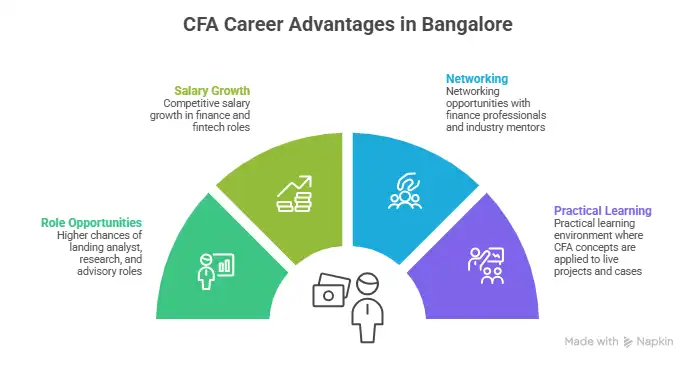
✅Mentor-Led Guidance: Experienced mentors offer personalised support, helping you to grasp complex CFA concepts and providing real-world insights to guide your learning journey.

✅Tailored Resources: Get study materials, practice exams, and mock tests aligned with the CFA Course syllabus, designed to help you understand and apply the material effectively.

✅Targeted Workshops: Focused workshops dive deep into key CFA course syllabus topics, giving you hands-on practice and the chance to refine your skills with peers.

✅Ethical Foundation: Ethics are at the core of the CFA program. Imarticus emphasises this, ensuring you’re not just exam-ready but also prepared to lead with integrity in the finance world.

✅Community & Networking: Connect with fellow candidates and industry professionals through events and get valuable insights from top mentors to help you succeed.

Imarticus Learning’s Programs offer mentor-led guidance, targeted workshops, and tailored resources to make your CFA journey strategic and successful. Be sure to check in regularly for syllabus updates, community events, and insights from top industry mentors.


FAQs About CFA Course Syllabus

Navigating the CFA course syllabus often raises many questions among candidates. Below are some of the most frequently asked questions that clarify common doubts and provide insights to help you prepare smarter and more confidently.

What areas are covered by the CFA?

The CFA course syllabus covers ethics, quantitative methods, economics, financial reporting, equity and fixed-income, derivatives, alternatives, and portfolio management. Imarticus Learning breaks this broad syllabus into manageable sections, helping you grasp concepts and apply them confidently in real-world finance.

Which CFA level is the toughest?

CFA Level II tends to be the most demanding. That’s because it focuses heavily on applying concepts through case studies and item-set questions, requiring deeper analytical thinking. The CFA course syllabus at this stage really pushes you to connect theory with practical scenarios, and Imarticus Learning offers targeted support to help you master this critical level.

How many study hours do I need?

Candidates who have cleared CFA recommend 300-400 hours per level on average. But it really depends on your starting point and how comfortable you are with the CFA course syllabus and subjects. Imarticus Learning guides you in creating a paced study plan that keeps you on track without feeling overwhelmed – it’s like having a road map for your CFA journey.

How Long Does It Take to Complete the CFA Course Syllabus?

Most candidates take 300 to 400 hours per level and 2.5 to 3 years to complete all three levels of the CFA course syllabus. Your timeline may vary depending on your background, work schedule, and study consistency.

Can I work full-time while preparing?

Absolutely! Many CFA candidates balance full-time work with their studies. It’s no cakewalk, but with disciplined time management and daily planning – skills we emphasise through dedicated mentorship at Imarticus – focusing on a few quality study hours every day beats last-minute cramming any day.

How should I approach mock exams?

Treat mock exams seriously like the main exams. Time yourself, mimic exam conditions, and deep dive into your results afterwards. Identify weak spots and review them regularly. Imarticus Learning’s mock exam platform and detailed feedback turn mistakes into valuable learning moments that boost both confidence and scores.

What are the CFA pass rates?

Pass rates tend to be tough but fair: globally, around 36% for Level I, 45% for Level II, and 56% for Level III. These stats remind us that the CFA is challenging, but with smart, consistent prep and strategy – just like what we offer at Imarticus – you can absolutely succeed.

Is the CFA worth the effort?

Without question. If you’re aiming for a finance career in investment analysis, portfolio management, or capital markets, the CFA charter is the gold standard. Imarticus Learning supports you beyond just passing the exam – we equip you with practical, real-world insights that fast-track your career in finance and set you up for long-term success.


Your CFA Journey Starts With Mastering the Syllabus

Mastering the CFA course syllabus is your first step towards earning the CFA charter. Whether you’re aiming for investment banking, asset management, equity research, or wealth advisory, the CFA curriculum gives you the exact skills employers look for.

Once you understand how each level works, your preparation becomes a lot more structured and less stressful. With the right study plan, good materials, and consistent effort, you can absolutely clear all three levels of the CFA course and build the global finance career you’re aiming for.

Your journey to a successful finance career begins with mastering the CFA course syllabus, but it doesn’t stop there. Enrol with Imarticus Learning today, where expert mentorship, tailored resources, and a supportive community will guide you every step of the way. Don’t just dream about the future – you can create it. Start your CFA certification preparation now and turn your career aspirations into reality. Your success story begins today – are you ready?

What is CFA? A Definitive Guide For 2025

This question always buzzes in the minds of commerce students and working professionals: What is CFA? You might have heard about investment banking, but have you ever wondered what course or qualification is required to become one? The CFA course helps you embark on your career in Investment Banking.

A CFA charterholder is a highly respected qualification by employers worldwide, giving you an edge over top management graduates. A CFA certification is not just a change in designation but a gateway to extraordinary opportunities in the world of finance.

Imagine you’re sitting in an exam hall with aspiring finance professionals. Everyone has the same dream of earning the three golden letters after their name, “CFA”.

The real challenge? Only about one in two candidates actually makes it to the finish line. The road is undoubtedly tough, but every step is absolutely worth it. And in this guide, I’ll walk you through everything you need to know not just to survive, but thrive on your CFA journey.

The CFA journey is challenging. But if you dream of working at Wall Street or Dalal Street with confidence, this certificate could be your golden ticket. The only question is, are you ready to begin your quest?

This guide will demystify your understanding of what is CFA course?

What is CFA?

The Chartered Financial Analyst (CFA) credential is the undisputed gold standard in investment management, equity research, portfolio management, risk analysis — anywhere serious finance happens. It’s not just about numbers or theories: it’s about building a calibre of thinking that separates the average from the exceptional.

Imagine you’re standing among 200,000+ finance professionals worldwide — that’s the current number of CFA charterholders who carry the designation in over 160 countries.

Here’s what makes it real:

  • The CFA syllabus consists of three levels. Level I tests your fundamentals. Level II forces you to apply these under pressure. Level III demands judgment — you must think like a portfolio manager, balancing risk, strategy, and ethics.
  • In May 2025, only 45% of those who took the Level I Exams passed — a sign of how rigorous the exam really is.
  • Level II in that same cycle saw a 54% pass rate, which is still tough, still discriminates the truly prepared.
  • Level III isn’t a walk in the park either. In February 2025, just 49% made it through.

And it’s not only about technical knowledge. The CFA Institute weaves ethics, professional conduct, and integrity into every level — not as afterthoughts, but as foundational pillars. When you complete all three exams and fulfil the work experience requirement, you don’t just earn a certificate: you gain a badge that says you’re serious about your craft.

CFA Course: What It Is and Why It Matters

When I first heard about the CFA, I have to admit, it sounded intimidating. Three tough exams, global recognition, and a curriculum that spans everything from portfolio management to ethics. But the more I dug in, the more I realised why it’s considered the gold standard in finance.

What is the full form of CFA?

The full form of CFA is Chartered Financial Analyst, offered by the CFA Institute. It’s one of those credentials that immediately tells people you know your stuff. From what I’ve read, it’s not just about memorising formulas – it’s about learning how to think like someone making real investment decisions, managing risks, and analysing markets at a high level. It is a highly regarded career choice for professionals looking to advance in executive positions.

What exactly is a Chartered Financial Analyst (CFA)?

The CFA is a globally recognised designation in investment management, respected as one of the highest credentials in the world of finance.

The CFA course is ideal for a career path in investment banking, portfolio management, and financial analysis, unlike other professional financial certifications with a focus on management accounting, financial accounting, auditing and taxation.

What exactly does a CFA do?

I’ve seen that CFA charterholders end up doing some pretty impactful work. They’re in investment management, corporate finance, equity research, and portfolio strategy. Essentially, they help companies make big decisions, often with millions of dollars on the line. It’s not an easy path — less than half of candidates pass each level — but that’s exactly why it’s so respected.

A CFA charterholder works in investment management, financial reporting and analysis, corporate finance, equity investment strategies, and economics. CFAs usually work in large financial services and investment banking organisations, where they are required to do extensive research and analysis.

This plays an essential role in guiding companies to make challenging and informed decisions in the complex financial markets.


💡 Imarticus is an authorised preparation provider of the CFA program, which is considered the gold standard of investment certification. 

You can even kickstart your CFA journey with industry leaders – Imarticus Learning offers CFA Training in collaboration with KPMG in India, giving aspirants both academic depth and real-world, practical exposure.


Is CFA Worth it in India? 

Let’s be real – CFA isn’t an easy ride. The exams are tough, the pass rate is low, and it takes years of effort. So is it worth it if you’re in India? For most people who want to break into finance or grow faster in the industry, yes, it is.

Here’s what makes it worth the grind:

  • It gives you a global badge of credibility. Whether you’re applying to firms in Mumbai or Singapore, those three letters carry weight.
  • In India, CFAs usually earn more than their non-CFA peers. Freshers may start around ₹8–10 LPA, but with experience, salaries often push past ₹40 LPA in top roles.
  • Clearing it shows employers you’ve got discipline and depth. That’s why CFAs are often trusted with serious investment decisions.
  • You also get plugged into a community of charterholders worldwide – people you can learn from, network with, and lean on.

Yes, the exams are brutal – less than half the people pass. But that’s what makes the CFA special. It signals that you’ve pushed through something most people can’t, and in finance, that reputation really matters.

Why Pursue the CFA?

You might be wondering, why do thousands of people around the world put themselves through the grind of the CFA exams every year? Because those three letters open doors that very few other qualifications can. The CFA isn’t just another certification; rather, it’s a mark of credibility, trust, and expertise in finance. The designation is globally recognised and respected.

It also signals something deeper to employers: discipline. Passing CFA levels does not just show your smartness, but also consistency, focus, and resilience — the qualities that matter just as much as technical skills in high-stakes finance. Beyond the bookish knowledge, you also join a worldwide network of charterholders — mentors, peers, and industry leaders you can learn from and lean on as your career grows.

In short, you don’t just pursue the CFA for the knowledge — you pursue it for the credibility, the career opportunities, and the community it connects you to.

How Long Does it take to Become a CFA?

It takes 2.5 to 4 years to clear all levels of CFA. This duration can vary depending on preparation time and how quickly you clear the exams.

 Conducted Preparation Time
CFA Level 1Feb, May, Aug, and Nov.6-9 months
CFA Level 2May, Aug, and Nov.9-12 months
CFA Level 3Feb and Aug.9-12 months

On average, candidates spend 300+ study hours per level, and the typical candidate finishes in about 3 years, if they clear all levels in their first attempt.

CFA Attempt Limits

You can take each Level of the CFA Exam a maximum of 6 times, with only two attempts per level each year. There is a waiting period of 6 months to retake the same level.


Interesting Fact – CFA is Not Just for Finance Majors. While most candidates come from finance or economics, people from engineering, IT, and even law backgrounds pursue it to enter the investment world.


The CFA Program Structure: A Deep Dive into the Levels 

If you are still doubting what is the CFA program? The CFA curriculum builds candidates with a strong financial and investment foundation.

It includes topics like:

  • Ethics,
  • Economics,
  • Quantitative methods,
  • Financial reporting,
  • Corporate finance,
  • Equity,
  • Fixed income,
  • Derivatives,
  • Alternative investments, and
  • Portfolio management.

Overview of CFA Exam Structure & CFA Exam Levels Explained

The CFA Exams build your knowledge, test your expertise and application skills in finance, investment and reporting. The table below explains key points for each Exam Level.

CFA LevelStage NameFocus AreasExam Duration & StructureQuestion TypeKey Skills Tested
CFA Level 1Foundation-10 Core Subjects
– Practical Skills Module
2 sessions of 2 hrs 15 mins (135 mins) each- Total duration: 4 hrs 30 mins180 Multiple-Choice Questions (MCQs)– No negative marking– Understanding fundamental concepts- Building core finance knowledge- Interpreting financial statements
CFA Level 2Asset Valuation & Application– 10 Core Subjects
– Application &
Analytical Skills
– Mastery in Asset Valuation
2 sessions of 2 hrs 12 mins (132 mins) each- Total duration: 4 hrs 24 mins- Each session has 11 item sets22 item sets (Case-based MCQs)88 questions in total– Applying finance theories to scenarios- Analytical & valuation skills- Problem-solving with data sets
CFA Level 3Portfolio Management & Wealth Planning– Portfolio construction & risk management- Wealth planning strategies- Advanced investment concepts
– Specialisation Pathways
2 sessions of 2 hrs 12 mins (132 mins) each- Total duration: 4 hrs 24 minsEssay-type questions (Constructed Response)- Some case-based MCQs– Decision-making like a portfolio manager- Communicating investment rationale- Strategic wealth planning & client advisory

If you are someone who is pursuing CFA with a full-time job, you can refer to this study plan.

CFA Course Fees

When a commerce or finance graduate decides to pursue CFA, the first thing they Google isn’t the syllabus, but the fees.
Can they afford it?
How much would each level cost in Indian rupees?
Would the investment be worth it?

CFA Course Fees in India

By the time you finish planning about pursuing CFA, you’ll know the CFA fees aren’t just numbers. They are milestones. Each rupee you save, each early registration you make, is part of your journey.

The CFA isn’t just testing your knowledge of finance; it is already teaching you financial discipline. And that lesson, once realised, feels priceless.

  • CFA Level 1: ₹60,000
  • CFA Level 2: ₹60,000
  • CFA Level 3: ₹60,000

At Imarticus Learning, you are given a 100% guarantee to receive a 50% refund of your course fees if you fail the CFA course exams.

Here’s a video to give you a detailed insight into how to clear the CFA Level 1 Exams:

CFA Syllabus

The CFA Syllabus develops a comprehensive skill set and prepares you for the investment and financial world. The Syllabus varies across the 3 levels. You can have a look at the subjects for each level below:

CFA Level 1 Syllabus

CFA Level 1 focuses on core modules, which consist of 10 subjects. It also includes two practical skills modules: Financial Modelling and Python Programming Fundamentals.

SubjectWeightage
Quantitative Methods6-9%
Economics6-9%
Portfolio Management8-12%
Corporate Issuers6-9%
Financial Statement Analysis11-14%
Equity Investments11-14%
Fixed Income11-14%
Derivatives5-8%
Alternative Investments7-10%
Ethical and Professional Standards15-20%

CFA Level 2 Syllabus

CFA Level 2 deepens your expertise on the same core modules with an in-depth focus on practical skills in Analytics, Python, Data Science, AI, and Python programming fundamentals, which is also offered in the Level 1.

CFA Level 3 Syllabus

CFA Level 3 has 6 core subjects with specialisation options and practical modules with case studies to enhance your skills. 

SubjectWeightage
Asset Allocation15-20%
Portfolio Construction15-20%
Performance Measurement5-10%
Derivatives and Risk Management10-15%
Ethical and Professional Standards10-15%
Specialisation Pathways –
Portfolio Management Pathway
Private Wealth Pathway
Private Markets Pathway
30-35%

The Level 3 also has a Practical Skills Module for Portfolio Development and Construction, and a Pathway Specific Module (Due Diligence – Private Markets Pathway / Practical Macro – Portfolio Management Pathway / Managing Private Wealth Clients – Private Wealth Pathway).

Navigating through the CFA Exam: Preparation Strategies & Tips

The CFA journey is beyond clearing the exams. It rewards discipline, consistent preparation, and the ability to stay focused at every stage. Each level teaches you to think through uncertainty and make sound decisions when the answers aren’t obvious. That’s what makes the CFA so much more than a qualification – it’s a true test of character.

This guide can help you with your CFA Certification journey:

Why opting for CFA Training or a dedicated CFA Course-prep can be a Game Changer?

Training isn’t just about someone teaching you the concepts and formulas. It’s about: 

  • Structured Learning: Access to tailored course material.
  • Expert Guidance: Faculty with subject matter expertise.
  • Accountability: Doubt-solving sessions and placement opportunities.
  • Peer Support: You get access to a dedicated channel with networking opportunities.
  • Industry-Relevant Resources: You often get access to industry collaboration events, webinars and live sessions.

Effective Study Strategies

To clear the CFA Exam, you need to follow a strategy and a dedicated routine. On average, candidates spend 300+ hours per level. So, if you are someone who can dedicate time and stay disciplined throughout the journey, you can definitely choose self-study.

Time Management

When you do self-study, you have to decide on your strategy and decide if you will spend your time on a topic with higher weightage or smaller weightage. If you’re a working professional with a 9-5 job, you can split study time by utilising weekdays for reading and concept building, weekends for mocks.

Revision

Revising the concepts learned by applying them and using proven strategies can prepare you for your exams.

Mock Exams

Taking practice tests and mock exams in a timed environment helps you prepare well for the exams and reduces stress.

Requirements to Become a CFA Charterholder

As a final-year B.Com student, when you first hear about CFA, it is quite common to feel excited. But then comes the flood of doubts about whether I am eligible.
Do I need any work experience?
What if I’m still in college?
Will my engineering degree be eligible?
How to become a CFA charterholder in India?

Criteria to enrol in CFA

Like most financial certificate aspirants, the CFA seems like a big dream, but the eligibility rules feel like a maze. To enrol in the CFA course, you need to meet the criteria below: 

  • Education: Candidates who hold a Bachelor’s degree or who have appeared for their final year exams and are waiting for the results from a recognised University are eligible to appear for the CFA Level 1 Exams.
  • Experience: You should have 4000 hours of work experience in the field of investment and decision-making.
  • Membership: Register and be a member of the CFA Institute by submitting up to 3 professional reference letters.

Start your CFA Journey with this Roadmap

If you are passionate about earning the most respected credential in investment management. The path to becoming a CFA (Chartered Financial Analyst) charterholder can be daunting.

As an aspirant, you will be overwhelmed with many questions and misconceptions about the CFA journey, like:
How to become a CFA charterholder in India?
How many CFA levels are there, and what’s the syllabus?
How to Study for the CFA Level 1?

CFA isn’t a cakewalk; it’s a demanding course with a series of exams with an utmost difficulty level designed to build an elite class of finance and investment professionals. But the good news is that with a strategic plan and meticulous approach, it’s easy to be a CFA charterholder.

This roadmap is designed to cut through the noise, demystify the process, and guide you step-by-step toward achieving the esteemed CFA Charter.

Stage Step Focus Area Key Requirements / Outcomes
Eligibility 1. Gain Eligibility Entry Requirements Bachelor’s degree (or final year), 4,000 hours of relevant work experience (min. 36 months), a valid passport, and meet professional conduct standards.
CFA Level 1 2. Enrol & Prepare Fundamentals Register with CFA Institute and schedule the Level I exam. Study investment tools, ethics, professional standards, and asset classes.
3. Pass CFA Level 1 Foundation Demonstrate solid understanding of basic investment concepts. Establish credibility in the field.
CFA Level 2 4. Enrol & Prepare Asset Valuation & Analysis Focus on valuation, applied analysis, case studies, and item-set questions.
5. Pass CFA Level 2 Application Showcase skills in valuing investments and applying financial data to real-world scenarios.
CFA Level 3 6. Enrol & Prepare Portfolio Management Study portfolio management, wealth planning, and advanced ethics. Practice essay + item-set questions.
7. Pass CFA Level 3 Integration Prove ability to integrate knowledge across all levels and act as an investment decision-maker.
Experience 8. Fulfil Work Experience Professional Practice Accumulate 4,000 hours of qualified work experience in investment decision-making and get professional reference checks.
CFA Charter 9. Become a CFA Charterholder Achievement Apply to CFA Institute, earn the CFA Charter, join the elite global network, and commit to ongoing learning & ethics.

Life as a CFA Charterholder: Career Impact & Beyond

A CFA has deep financial expertise with strong analytical, technical, decision-making and communication skills, making them highly adaptable and valuable in today’s fast-paced financial markets.

When you clear your CFA Level 3 exam, you aren’t just holding a certificate; you are holding a passport. A passport that could take you from Mumbai’s Dalal Street to New York’s Wall Street, and your career from equity research to portfolio management, from analyst to managing director.

But what exactly does that journey look like?
What careers open up?
And how fast can you grow with the three magical letters “CFA” next to your name?

What Job Roles can a CFA pursue?

The CFA charter isn’t just another degree; it’s a professional superpower. Globally recognised and deeply respected among investment circles, it is often considered a competitive alternative to an MBA in finance, signalling a clear message to employers: This person understands money, investment, and wealth management at a world-class level.

That’s why charterholders are found in top firms like:

  • JP Morgan
  • Goldman Sachs
  • BlackRock
  • Deloitte
  • MSCI, among others

So if you’re still wondering about CFA jobs, CFA professionals have an extensive scope for career advancement and opportunities, and often hold crucial roles like:

  • Portfolio Manager,
  • Research Analyst,
  • Investment Banker,
  • Risk Manager, and
  • Private Wealth Manager.

CFA Salary (India & Global)

CFAs often enjoy a lucrative earning potential worldwide, with a broad range of career opportunities in the field of investment banking, portfolio optimisation, equities & derivatives, market research, advanced analytics and client advisory services.

cfa salaries vs non cfa professionals

CFA Stage 1: The Analyst (Entry Point)

Entry-level CFAs often start their journey as Research Analysts, Risk Analysts, or Investment Banking Associates. Think of this stage as learning to hold the sword where you’re collecting data, analysing trends, and supporting decision-makers.

Job Roles:

Salary: Average salaries for CFA Freshers begin at ₹5–10 LPA in India and $70,000-90,000 in the USA.

CFA Stage 2: Strategists

By the time you clear Level 3, your profile transforms. You will no longer be just crunching numbers, but will start making investment calls. Employers trust you with bigger responsibilities.

Job Roles:

Salary: Average salaries for mid-senior level CFAs range between ₹12–25 LPA in India and $90,000-180,000 in the USA. Few experienced professionals draw higher salaries. 

CFA Stage 3: The Leader (Executive Level)

At this stage, experienced CFA charterholders step into leadership roles. They don’t just follow the markets anymore; they lead strategies worth billions by taking important investment decisions, advising institutional investors and high-net-worth clients.

Job Roles:

Salary: Average salaries for experienced CFAs range between ₹15 LPA – 1 Cr+ annually in India and over $200,000 in the USA.

Still calculating CFA’s ROI? This video explains how you can become a Portfolio Manager with CFA in just 18 months!

CFA vs MBA vs FRM vs CPA

Choosing the best career path can be challenging with multiple options in the market. This comparison will help you get a brief overview of the courses and understand which course is right for you.

 CFAMBAFRMCPA
Focus AreasInvestment Tools,
Valuing Asset Classes,
Portfolio Management,
Wealth Planning
Management,
HR,
Finance,
Marketing,
Operations,
Analytics,
Strategy,
IT,
Supply Chain Management,
Entrepreneurship
Quantitative Analysis,
Financial Markets & Products,
Valuation & Risk Models,
Market Risk,
Credit Risk,Operational Risk,Liquidity Risk.
Business Analysis & Reporting, Information Systems & Controls,
Tax Compliance & Planning.
Fees~₹3.4 – 4.5 Lacs~₹4 – 30 Lacs+~₹1.5 – 2 Lacs~₹3 – 4.5 Lacs
Duration2.5 – 4 years 2 years1 – 2 years12 – 18 months
Recognised In165+ countries (Global Recognition)Globally recognised based on University accreditation.190+ countries(Global Recognition)130+ countries(Global Recognition)

FAQs about CFA

Here are a few frequently asked questions about CFA.

What is the CFA course?

CFA is a globally recognised certification in investment and financial management.

What does CFA stand for?

CFA stands for Chartered Financial Analyst. A highly reputed certification in investment and financial management with global recognition.

Is the CFA worth it

CFA is a challenging yet rewarding job role which offers a high earning potential. If you are passionate about numbers, strategy and stock markets, the CFA is an excellent choice to master finance.

How hard is the CFA exam

The CFA exam has a relatively high difficulty level with a lower pass rate. It requires a disciplined and consistent approach, rigorous practice and a deep understanding of the concepts. The CFA exam isn’t hard if you master the fundamentals.

Can I skip CFA levels?

No, CFA levels cannot be skipped. One needs to give all three levels sequentially.

Do I need a finance background? 

Having a background in finance is not mandatory; however, it can be an added advantage if you have prior experience.

What’s the average pass rate?

CFA has a pass rate of below 50% which means only 50 out of 100 candidates clear the exam successfully.

Is CFA better than MBA?

CFAs and MBAs are completely different in nature, which does not make either course better than the other. MBA is a broader course which equips you with business and management skills with a specialisation in the degree. On the other hand, CFA is a specialisation in finance and investment management to deepen your financial knowledge and expertise.

Is CFA tougher than CA?

CA is considered tougher than CFA as it has a relatively lower pass percentage. CA Finals have an average passing rate of 18.75%. CFAs have an average passing rate between 40-50%.

What is a CFA salary?

The salary for CFAs starts from ₹5 LPA and goes higher for professionals with experience.

Begin Your CFA Journey Now

The CFA program is more than just a finance certification – it’s a globally recognised passport with access to a rewarding career in investment, portfolio management, and financial leadership. While the journey demands discipline, time, and effort, the knowledge and credibility it brings are unmatched.

Whether you come from finance, engineering, or even law, the CFA opens doors to opportunities across industries and geographies. If you’re committed to mastering the investment world and building a strong professional edge, the CFA charter is one of the best investments you can make in yourself.

We are India’s first and only approved certification prep provider that offers real-world business case studies, curated resources by top finance institutions like Kaplan Schweser, a dual teaching model, internship opportunities for top performers, and a joint certification that equips you with expert practical skills. 

Are you ready to start your CFA journey? We at Imarticus offer the CFA course in association with KPMG in India to create industry-led programs. Bookmark this complete guide and come back whenever you feel lost in the chaos of finance.

CFA Salary in India: How Much Can You Really Earn After Becoming a Chartered Financial Analyst?

You’ve just completed your B.Com or MBA, and now you’re stuck. You want a career in finance.

 But where do you go next? 

Job portals are full of openings that pay far less than what you expected. You dream of a solid job in investment banking or equity research, but something’s missing.

If you’re thinking about taking the CFA course, you’re on the right path. But here’s the question that most students keep asking: what is the real CFA salary in India? 

Let’s break it down.

What Makes the CFA Course So Popular in India?

The Chartered Financial Analyst (CFA) programme is a postgraduate professional qualification presented worldwide by the CFA Institute. However, it has become even more applicable in India in the last ten years. 

Why? 

Since the finance sector in India has expanded at a rapid rate, there is an increased demand for well-trained professionals with each passing year. This certification will provide you access to lots of lucrative areas, including equity research, portfolio management, etc. 

As more and more people try to pass through the programme every year, the programme is no longer restricted to investment bankers. Now CFA charter holders are offered even fintech jobs, as well as private equity and corporate finance.

The question that is always asked by students and professionals is whether the CFA salary is worth the effort, and will it be based in India. This will be answered depending on a lot of factors such as the experience, industry and the most importantly what level CFA you have passed.

CFA Salary in India: Level-Wise Earnings Breakdown

Here’s a quick look at the CFA level-wise salary in India based on career stage. Remember, the pay improves as you move forward in the course and gain work experience.

As of 25 December 2024, salaries reported by CFA professionals in India range from ₹1.2 lakh to ₹15 lakhs per year. This applies to those with experience between less than one year and up to 12 years.

CFA LevelAverage Salary (in ₹ LPA)Role Type
Level 1 ClearedAround ₹4–5 LPAAnalyst Intern, Research Assistant
Level 2 ClearedAround ₹6–8 LPAEquity Analyst, Junior Associate
CFA Charterholder₹10 LPA or higherInvestment Banker, Portfolio Manager

These ranges may shift slightly depending on the city, company, and your work history. However, they reflect current finance jobs salary trends in India.

The CFA course is one part of the journey. 

If you’re fresh out of college and have cleared just CFA Level 1, you’ll likely start with junior roles. But employers will see your effort and commitment. They know you’re investing in your career.

Once you clear Level 2, things get more serious. You now understand valuation, financial modelling, and investment tools better. This lets you apply for mid-level roles in equity research and risk management.

When you become a full CFA charterholder, your career options grow fast. This is where your CFA salary in India really starts reflecting your knowledge. You may lead teams or even head investment portfolios.

Top Industries Hiring CFA Professionals in India

Not every company hires CFA candidates. But those who do know exactly what they’re looking for.

CFA Salary in India

A few sectors where CFA professionals work in India:

  • Equity Research: Writing reports, forecasts, and company analysis
  • Portfolio Management: Managing HNI clients or working for AMCs
  • Risk Management: Working in banks or financial firms to assess and reduce risks
  • Financial Advisory: Helping companies with strategic decisions

These roles come with different responsibilities, but the CFA salary in India is usually better than many other finance certifications.

CFA Career Prospects in India: What’s the Real Picture?

Let’s address the big one: CFA career prospects in India.

More Indian companies are hiring CFA-qualified candidates. From Axis Bank and HDFC to ICICI Prudential and CRISIL,  all value the CFA programme. And the best part? Many of these companies also sponsor further training or allow study leave during exam months.

What’s even more encouraging is the growing demand in Tier 2 cities. Places like Pune, Ahmedabad, Jaipur, and Chandigarh are now seeing CFA demand grow.

Plus, companies in fintech and startups are not far behind. They look for professionals who can analyse data, forecast revenues, and manage investment strategy and the CFA course teaches all of this.

Chartered Financial Analyst Benefits That Matter

Choosing a professional course is not just about pay. 

Let’s talk about the Chartered Financial Analyst benefits that truly matter.

  • Strong Knowledge Base: It covers everything from economics to portfolio management
  • Job Mobility: Switch between roles or even countries with ease
  • Respect in the Industry: Hiring managers know the value of this qualification
  • Global Recognition: The CFA charter is widely accepted across more than 160 countries
  • Better Salary Negotiation: You walk into interviews with stronger leverage

Whether you’re working in Delhi, Bangalore, or Hyderabad, these benefits make you stand out in the competitive finance job market.

What Is the Scope of Investment Banking Salaries in India for CFA Professionals?

Automation and AI are changing the way finance works. However, the salary trends of finance jobs show that analytical and strategic roles are growing in demand.

That’s exactly where CFA-qualified professionals fit in.

Your ability to analyse data, understand risk, and manage investments sets you apart. You’ll make real decisions that shape business outcomes.

This is why many HR teams now list “CFA preferred” or “CFA-qualified” in their job descriptions.

Some ask, “Should I go for CFA or MBA?” Others compare it with CA, CPA, or even FRM.

Here’s the simple truth: CFA is best for investment-related roles. If you want to work in equity research, asset management, or risk, this course gives you focused skills. And in terms of CFA salary in India, it stands out when compared to many generalist certifications.

Also, the CFA programme is more affordable than most MBAs, especially those from top B-schools. Plus, it allows you to work and study at the same time.

Your Competitive Edge in the Finance Industry with Imarticus Learning

Imarticus Learning is the first authorised prep provider in India out of four of the most recognised certification programmes globally in the field of accounting and finance like the one that has world credibility, the Chartered Financial Analyst (CFA) programme.

CFA charter is a good credential of your profound knowledge in finance and investments. The qualification is global and opens doors of employment at leading financial institutions, banks, and investment houses.

  • Recognised as the gold standard for finance professionals
  • Includes digital, practical skill modules for hands-on learning
  • Better career opportunities in India and abroad
  • Connect with top industry experts through live sessions.

Career as a Chartered Financial Analyst

Wondering where a CFA qualification can take you?

Once you complete the programme, you can step into roles such as:

  • Financial Analyst
  • Credit Research Analyst
  • Quantitative Analyst
  • Investment Analyst
  • Risk Analyst
  • Equity Research Analyst
  • Investment Banker
  • Portfolio Manager

Salary Expectations

RegionAverage Salary
In India₹7.5 Lakhs per annum
International Roles$79,000 per annum

Senior CFA charterholders often report even higher figures, particularly in investment banking and portfolio management.

Start your CFA journey today with Imarticus Learning!

Know how to crack CFA Level 1 Exam in this video

FAQ

1. How does the CFA level-wise salary grow over time?
The CFA level-wise salary increases with each level passed. Level 2 offers mid-level roles, while charterholders earn the highest packages.

2. Which industries offer the best CFA salary in India?
Investment banking salaries in India are among the highest for CFA charterholders, followed by asset management and financial advisory roles.

3. Is CFA better than MBA for finance jobs in India?
For core investment roles, CFA often gives a deeper technical edge. Many recruiters prioritise CFA for specialised finance jobs and salary trends.

4. What are the benefits of being a chartered financial analyst in India?
Key Chartered Financial Analyst benefits include global recognition, better pay, strong finance knowledge, and access to top job roles.

5. Can I switch to investment banking with a CFA charter?
Yes, many CFA professionals transition into high-paying investment banking salaries in India, especially after Level 2 or Level 3.

6. Does CFA guarantee a job in finance after completion?
While no course can guarantee a job, the CFA boosts your chances significantly due to its relevance in finance jobs salary trends today.

Conclusion

Now you are aware of how CFA salary in India increases with time, the salary of the CFAs level wise, and how the CFA career opportunities in India are rising. 

The Chartered Financial Analyst benefits are difficult to underestimate if you are serious about finance. Either through taking investment banking or the latest finance careers and wages, this qualification places you ahead of others.

Take the first step today. Start your CFA journey and shape your future in finance!

CFA Course Details: Turn Your Resume Into a Golden Ticket to Global Finance

In most finance interviews today, one line on a resume changes the tone of the conversation: “CFA Level II Candidate” or “CFA Charterholder.”

It’s not magic. It’s signalling. It tells the interviewer that you’ve gone through a program known for its depth, precision, and rigour, a program that the global finance community still treats as the most reliable marker of competence. And that has earned it the reputation of a gold standard credential.

When someone speaks of the “CFA course” or “CFA courses” in the context of the “chartered financial analyst” designation, they’re referring to the entire journey of the CFA Institute’s credential: registration, exam levels, modules, practical experience, and membership. In effect, the “CFA program” is a pipeline from candidate → charter-holder.


What Is CFA? Breaking Down the CFA Course Details

Ask anyone who’s worked on a trading desk, or sat through an investment pitch at 11 p.m., and they’ll tell you, the CFA charter isn’t about passing exams. It’s about building judgment. When you look at the CFA course details, you realise they’re designed for exactly that, cultivating the analytical discipline and ethical grounding that real finance demands.

The Chartered Financial Analyst (CFA) program, run by the CFA Institute, has been around long enough to outlast trends in finance. Before fintech, before algorithmic trading, before “financial influencers,” this was the course that serious professionals quietly pursued while working full-time.

So, what is CFA, really? It’s the industry’s way of measuring whether you understand how money actually moves, not in theory, but in real markets, under pressure.

Here’s a simple way to see it:

If an MBA gives you a panoramic view of business, the CFA hands you the lens that lets you zoom into the numbers; the mechanics of risk, return, and valuation. It’s like learning to read the financial “DNA” of a company instead of just its headlines.

The CFA course has three levels, each structured to build a different layer of expertise.

  • Level I is about understanding the tools: financial reporting, quantitative methods, and ethics.
  • Level II teaches you how to apply them in analysis and valuation.
  • Level III focuses on how to manage portfolios and make strategic investment decisions.

And that’s why it’s often called the gold standard in finance. Across investment banks, asset management firms, consulting houses, and even family offices, a CFA next to your name quietly signals something specific; not prestige, but credibility.

Every charterholder has a version of the same story: years of late-night studying, long workdays, and a few failed attempts. But when they finally earn the charter, something shifts. Colleagues start asking them for investment rationale, not opinions. Recruiters stop asking if they’re “finance material.”


Watch this video to find out why this charter remains the most respected badge in global markets.


CFA Course Details: Duration & Timing 

When you dig into the CFA course details, one of the first questions that comes up is how long it really takes to complete. Understanding the CFA course duration helps you plan your preparation realistically, balancing study time, work commitments, and exam cycles.

Many aspirants start their journey wondering, “How long until I finish the CFA course?” The truth is, the timeline varies, but knowing what to expect helps you pace yourself without burnout.

Typical duration

  • Many candidates budget 300 hours per level for exam preparation per the Institute’s guidelines. 
  • Realistic completion timelines vary depending on full-time work, study habits, and exam availability.
  • In India, for working professionals, a 2 to 4 year timeline is common: e.g., one level every 9–12 months, plus time for work experience.

Exam windows & cadence

  • Exams for each level are offered multiple times a year: February, May, August, and November.
  • If you finish Level I in, say, August, you might attempt Level II the following February or May, hence the “calendar loaf” adds time.
  • If you fail or defer, the timeline extends. On average, many aspirants complete the entire “CFA course full details” path in about 3 years.

Here is a visual overview of the aspects of this charter that you can expect:

CFA Course Details

Here is an overview of the high-level components of the CFA Journey:

  • Registration/enrolment – initial entry into the CFA Program.
  • Exams – three sequential levels: Level I, Level II, Level III.
  • Work experience requirement – minimum professional investment/finance experience to become a charter-holder.

Membership & continuing obligations – once chartered, maintaining membership, abiding by ethics, and CPD.


CFA Course Details by Level

The CFA Course Details by Level reflect how the program is intentionally structured to transform a candidate’s approach to finance step by step. Each level serves a distinct purpose – Level I grounds you in the core concepts, Level II tests how you apply them in analytical and valuation contexts, and Level III challenges you to make strategic portfolio decisions like a practitioner.

Together, they form a well-sequenced journey from technical literacy to professional mastery. Understanding this progression helps candidates plan their CFA course duration realistically and align their study efforts with the depth and complexity of each stage

Here is a summary table of each level in the CFA program and typical completion times:

LevelFocus & FormatApprox. Study HoursTypical Duration from registration
Level IFoundations: ethics, quantitative methods, economics, accounting, etc.~300 hrs9–12 months
Level IIAsset valuation: equity, fixed income, derivatives, advanced financial reporting.~300–350 hrsAdditional 9–14 months
Level IIIPortfolio management & wealth planning: application of concepts, ethics embedded throughout.~300 hrs+Final 6-12 months + experience requirement

Work Experience & Other Requirements

A key part of the CFA course details is the work experience requirement, which many gloss over:

  • To become a full charter-holder, you must accumulate at least 4 years of qualified professional work experience in investment decision-making roles (it may be accrued before, during, or after passing the exams).
  • You must also apply to the CFA Institute once you have passed all three levels and met the experience requirement.
  • Annual membership dues: after chartering, there is an annual USD 299 membership fee to the CFA Institute, plus possibly local society dues. (CFA Institute)

This means that even after passing all three levels, there is an implied lag time before you can use “CFA charter-holder” on your résumé. Thus, when you talk about CFA course duration, it’s not just exam time but the total time to charter.


Most finance professionals think they’re too busy for CFA prep. The truth? Their work experience already gives them a head start. Watch this video to master the CFA with a smart 2-hour-a-day routine designed for full-time professionals.


Why this matters for India-based professionals

  • Given exam windows and typical work commitments, Indian aspirants often complete the programme in 3 to 4 years, sometimes more if balancing full-time work and travel.
  • Because of currency fluctuations and the cost of study/travel, you’ll want to budget accordingly (covered in Part 2).
  • The credential is globally recognised, which means even if you study in India, the duration and timeline are relevant to international employers.

Deep Dive into CFA Course Details

When you look beyond the usual list of subjects, the CFA Course Details reveal a carefully layered progression, one that mirrors how finance professionals evolve in real life. The curriculum is a map of financial maturity. It starts with the fundamentals of ethics and quantitative methods, builds analytical depth through financial reporting and corporate finance, and culminates in portfolio management and wealth planning.

This structured escalation not only ensures conceptual clarity but also trains your thinking to move from interpreting numbers to telling financial stories with purpose and precision.

Key topic areas across the programme

  • Ethical and Professional Standards (embedded in all levels)
  • Quantitative Methods
  • Economics
  • Financial Reporting & Analysis (FRA)
  • Corporate Finance
  • Equity Investments
  • Fixed Income
  • Derivatives
  • Alternative Investments
  • Portfolio Management & Wealth Planning

Topic-weight table example (for Level I)

TopicApprox. % Weight*
Ethical & Professional Standards~15–20%
Quantitative Methods~8–12%
Economics~8–10%
Financial Reporting & Analysis~13–17%
Corporate Finance~8–12%
Equity Investments~10–12%
Fixed Income~8–10%
Derivatives~5–8%
Alternative Investments~5–8%
Portfolio Management & Wealth Planning~5–8%

What the CFA Course will cost you in India

Understanding what the CFA course will cost you in India goes beyond just the registration fee; it’s about recognising the long-term value of the investment. Every stage of the CFA program demands not only financial planning but also a commitment of time and focus, making it essential to view the expense as part of your professional growth strategy.

By examining the CFA course details from a cost perspective, the CFA Level 1 prep can be better for candidates for the journey ahead, ensuring that each rupee spent translates into tangible career momentum and global credibility in the finance domain.

Global fee summary

  • The total fees for all three levels of the CFA programme range from USD 3,520 – USD 4,600, depending on registration timing. 
  • For the USD to INR conversion, additional local costs (coaching, materials, travel) must be added for the Indian context.

India-specific cost estimates

  • All three levels combined in India: approx ₹2.65 lakhs to ₹3.4 lakhs (excluding coaching) per one estimate.
  • Another estimate: ₹3 lakhs to ₹3.6 lakhs, including exam fees plus preparatory coaching. 

CFA Registration Fees and other expenses (India context)

ExpenseTypical AmountNotes
Registration & exam fees (all 3 levels)₹2.65 lakhs–₹3.4 lakhsEarly registration helps savings
Study materials/coaching₹60,000–₹2 lakhsVaries hugely by institute
Rescheduling/retake fees₹20,000–₹25,000 per levelIf you defer or fail
Membership dues post-charterUSD 299 (~₹25,000) + local society duesAnnual cost

Return on Investment (ROI) and Career Value of the CFA Course

The CFA course is a bit like learning to cook a proper meal for the first time. You spend more time chopping, cleaning, and simmering than actually eating. But once you’ve done it a few times, you realise that all that effort wasn’t wasted; it taught you control, timing, and judgment. And suddenly, what looked like “work” turns into a skill that pays off every single day.

That’s how the CFA works in your career. It takes patience to get through the syllabus, the exams, and the long study hours. But what you gain is credibility, sharper analysis, better decision-making that keeps giving back in the long run.

Real ROI in finance isn’t about the first paycheck after certification. It’s about the steady returns that come when your expertise starts to speak louder than your résumé.

Salary uplift & career access

  • While specific CFA Salary in India numbers vary, globally, a charter-holder often commands a significantly higher salary ceiling than non-charter peers.
  • Pass rates remain low because the credential’s scarcity adds premium value. 

Qualitative ROI

  • The “chartered financial analyst” credential signals to employers: strong analytical skills, ethics, investment-orientation, and global mindset.
  • For Indian professionals aiming at roles in portfolio management, wealth advisory, investment banking, and asset management, the CFA credential gives “ticket-to-table” access internationally.
  • At Imarticus Learning, we emphasise: completing the programme shows commitment and ability to manage a challenging study + work dual path, which many recruiters value.

Tips to maximise ROI

  • Choose your optional domain (once you reach Level III) aligned with your career interest (e.g., if you aim for private equity, pick alternative investments).
  • Start the work-experience log early so you can complete that part in parallel.
  • Time your exams smartly so you minimise idle gaps. Fewer idle months = faster CFA course duration = faster ROI.
  • Use networking (CFA society local chapter) to convert credentials into opportunities.

Study Strategy for the CFA Course

Beyond the content list and cost, the strategy is what separates successful candidates. Here are actionable pointers:

  • Create a study calendar: If you are working full-time, allocate 10–15 hours/week; aim to complete the curriculum 8–10 weeks before the exam to leave adequate revision time.
  • Use mock exams and question banks: Practising application increases retention; analytics show first-time passers tend to have a consistent schedule and mock count. 
  • Prioritise Ethics & Professional Standards: Many candidates underestimate this, yet it is heavily weighted and carries a clear signal of charter status.
  • Avoid large gaps between levels: As data shows, deferred candidates have lower pass rates. 
  • Leverage institute support: At Imarticus Learning, we provide study sessions, peer groups, and revision boot camps, all contributing to reducing the CFA course duration.

Exam Difficulty & Pass-Rate Insights

When discussing CFA course details, one question always surfaces: how hard is it to pass? The answer lies not just in numbers, but in understanding what the exams truly demand. Each level of the CFA program is designed to test a different layer of your analytical maturity. Level I checks your conceptual grasp across ten subjects, Level II pushes you into applied valuation and real-world case analysis, and Level III assesses how well you can integrate everything into portfolio-level decision-making.

The CFA exams are challenging because they simulate the rigour of real financial decision-making – where precision, patience, and ethical judgment intersect. Pass rates historically hover between 35% and 45%, a reflection of the program’s depth rather than its difficulty alone.

Snapshot of recent pass rates (global)

  • Level I: ~43% for August 2025.
  • Level II: ~44% for August 2025. 
  • Level III: ~50% for August 2025. 

What this means for you

  • More than half of global candidates fail each level. This signals the credential’s rigour and the value of proper preparation.
  • If you procrastinate, leave long gaps, or study less than recommended, your timeline will stretch, and your ROI will drop.
  • First-time test takers generally perform better than those deferred: recent data shows first-time Level I pass rate ~52% vs deferred ~28%. 

CFA Charter Turns Your Resume into a Golden Ticket

The CFA Charter doesn’t just add three letters to your name; it transforms how employers see you. Recruiters recognise it as proof of discipline, global competence, and ethical judgment, traits that instantly set you apart. According to the CFA Institute’s 2024 Compensation Study, Charterholders earn 50–60% higher median salaries than non-chartered peers, a strong signal of its market value.

Think of it as a global trust stamp for your resume. Whether you apply in Mumbai, London, or New York, “CFA Charterholder” tells hiring managers you don’t just understand finance, you think in its language.

The CFA Mindset Shift: Before and After the Charter

Before earning the charter, finance feels like solving numbers; after it, you start seeing the story behind them. The CFA mindset turns guesswork into insight, reaction into reasoning, and information into interpretation.

It’s the difference between playing chess and seeing the whole board; that’s the kind of clarity and foresight the CFA journey builds in every professional. This flowchart shows the skills that get added once you hold the charter.

CFA Mindset Shift

Strategic Advantages of the CFA Credential

What makes the CFA course worth doing from a strategic mindset?

  • Global recognition: The “chartered financial analyst” title is a global stamp of investment expertise, not just local accounting credentials.
  • Versatility: The syllabus covers a wide investment spectrum (equities, fixed income, derivatives, alternatives), enabling transitions into varied CFA roles.
  • Ethics-anchored: Employers increasingly value ethics/state-of-the-profession orientation; the CFA embeds this deeply.
  • Network access: Charter-holders join global and local CFA societies; these professional networks often drive jobs and career development.
  • Career differentiator: In India, especially, having “CFA” on your résumé sets you apart in competitive hiring, provided you communicate your “CFA course details” (what you learned, how you applied it).

FAQs on CFA Course Details

Before you take your first step toward becoming a Chartered Financial Analyst, it’s natural to have questions about timelines, difficulty, salaries, or the commitment it truly demands. This section compiles the most frequently asked questions about the CFA course details, giving you clear, experience-based insights to help you plan your journey with confidence. 

What is the CFA course for?

The CFA course is designed to provide a rigorous foundation and advanced skill-set in investment management, financial analysis, portfolio construction and ethics. The CFA course details cover three levels of exam content, work-experience requirements, and professional membership through the CFA Institute. Imarticus Learning ensures that you understand every step of the CFA course details, from registration to exams to charter application.

Is CFA harder than CA?

When comparing CA versus the CFA course, the CFA programme differs in focus, structure and global applicability. “Chartered accountant” tracks typically focus on accounting, audit and taxation in your local jurisdiction, while the CFA centres around investment analysis, portfolio management and global financial markets. The difficulty of the CFA course is reinforced by pass-rates (for example, ~43% at Level I) and the breadth of topics. With guidance from Imarticus Learning, your preparation will cover all the critical CFA course details to mitigate that challenge.

How many years CFA course?

The number of years to complete the CFA course varies widely. Many candidates finish within 3 to 4 years, but a faster path (2 years) is possible for full-time study; others may take longer if balancing full-time employment. As you review the CFA course details, make sure to factor in exam windows, necessary work experience and potential retakes, all of which affect your timeline.

What is a CFA salary?

The CFA credential is often associated with higher compensation compared to non-credentialed peers. When you display the relevant CFA credential on your resume (such as passing three levels, work experience, and portfolio management exposure), employers recognise the depth of training and may offer roles with enhanced pay scales.

Is CFA better than MBA?

Whether the CFA course is “better” than an MBA depends on your career goals. The CFA programme is highly specialised in investment finance, offering globally recognised certification and a rigorous curriculum. The MBA tends to cover broader management, leadership and business functions. If you aim for portfolio management or investment roles, the CFA course may provide stronger domain credibility; if you aim for general management, an MBA might be appropriate. 

Is CFA Level 3 very hard?

Yes, Level III is a challenging part of the CFA course. It emphasises synthesis of prior material (Levels I & II) and application through portfolio management, ethics and case-type questions. The pass rate (~50%) indicates that while candidates who reach Level III are committed, the exam sees rigorous testing. 

Can CFA earn 1 crore?

Achieving annual compensation of ₹1 crore (INR) with a CFA credential is possible, especially in senior investment-management roles, private equity, hedge funds, or global roles. However, merely completing the CFA course details is not a guarantee: your role, geography, experience, firm size, and value proposition matter. 

Is 27 too late for CFA?

No, age 27 is not too late for the CFA programme. At that age, you may have a few years of work experience already, which is advantageous. What’s more critical is your study plan, time commitment, and alignment with your career path. When you review the CFA course full details at Imarticus Learning, you’ll find that the timeline is flexible and adaptable to your individual context, and success at age 27 or older is common.

Is the CFA Level 1 pass rate?

The latest data shows that the pass rate for Level I of the CFA course is around 43% for August 2025 globally. That means fewer than half of the candidates pass on the first attempt. Reviewing and mastering the CFA course details, subject weights, exam format, and study hours significantly improves your odds. Imarticus Learning guides you through these specifics to maximise your results.

What if I fail in CFA Level 1?

If you fail Level I of the CFA course, it’s not the end of the road. You can attempt the next available exam window after ensuring you meet any deferral or retake conditions. But the failure will extend your CFA course duration and potentially increase costs (retake fees, extra study time).

What are the fees for the CFA exam in India?

In India, the fees for the CFA programme (all three levels combined) are typically in the range of ₹2.65 lakhs to ₹3.4 lakhs, excluding coaching and study materials. For individual levels, early registration discounts apply. When you evaluate these numbers, ensure you plan for the full CFA course, that is, registration, exams, study materials, retakes, and travel if required. 

What’s a good CFA score?

Since the CFA Institute does not publish exact minimum passing scores (MPS) for each exam, candid­ates rely on estimations. For Level I, estimates suggest a minimum of ~65-70% correct answers historically. A “good” score in the context of the CFA course details means comfortably above this threshold, with strong performance in Ethics, FRA and Portfolio Management. Imarticus Learning’s mock‐exam analytics help you target that “good” score.


Looking Ahead

The CFA course is a method, not a medal. Over the chapters here, you’ve seen its structure, the real-world curriculum that moves from accounts to valuation to portfolio judgment, the time and cost realities, and the behavioural habits the program installs. These CFA course details are the mechanics of professional reliability: how you frame a question, what assumptions you allow, and how you document a decision so others can trust it.

Completing the program reshapes your work: you stop guessing at signals and start testing them; you write memos that survive scrutiny; you make portfolio calls that account for tail risks, not just upside stories.

If you want a quick litmus test, ask yourself this: Do you want to be someone who’s repeatably right under pressure, or someone who hopes to be right? The CFA is the discipline that trains you toward the former.

If you’re ready to develop that level of mastery, explore the CFA Course in Collaboration with KPMG in India, offered by Imarticus Learning. Start building the skill set and credibility that define global finance professionals, one deliberate step at a time.