How can you use credit risk to your advantage in a post-COVID economy?

In the wake of the Covid Crash, many companies are exploring different ways to safeguard their assets from financial malfeasance. One way is to invest in credit risk management courses. These courses teach people how to identify and avoid risks with their finances, regardless of what type they may be.

The following post explores some benefits that these types, of course, can provide for your business or organization!

Why should you take a credit risk management course?

The relationship between a financial institution and its customers is changing. In the post-Covid economy, organizations need to be more aware of risk management strategies in order to provide efficient customer service with reduced costs. This is where credit risk courses come into play, as they can help you understand how relevant this area of business has become nowadays.

When it comes to acquiring new clients or retaining existing ones, banks can no longer rely on face-to-face meetings alone; rather, through digital channels such as mobile apps, users expect instant responses when their issues arise.

This creates an opportunity for companies that offer online training programs like our organization because we believe that even though technology may have changed the way people communicate these days, education still has a crucial role to play in today’s world.

How can the courses help your company?

The world of business is ever-changing, and in order for your organization to stay relevant, it needs to adapt its strategies according to the new environment. This means that understanding how credit risk management course works in a modern context will help you plan ahead when making a decision about your company’s future development.

For example, suppose you’re going through multiple loans at the moment. In that case, this course can provide guidance on which solution would be more suitable for your case so as not to fall into debt or miss out on an opportunity because of some miscalculated risks.

The benefits of taking these courses in today’s economy

  • Increase your knowledge of credit risk management. One major benefit that these courses provide is the opportunity to learn more about what you can do to avoid financial pitfalls.
  • Learn from experts in their respective fields. In addition, they offer a chance for people with little or no prior experience in this area to gain hands-on instruction from industry leaders and professionals who know what it takes to succeed.
  • Gain access into an exclusive network of like-minded individuals committed to protecting themselves and others against personal and corporate risks related to money matters such as debt, bankruptcy, etc.
  • When deciding whether or not taking one will be beneficial for your business or organization, it is important to look at what they have to offer.
  • The courses provide knowledge and a network of contacts in this area that can be advantageous for your business or organization.
  • Increase access to funding from banks and other financial institutions. In addition, the expertise provided by these individuals will increase your chances of obtaining loans from various organizations such as banks.

Join credit risk management courses at Imarticus Learning

Credit Risk and Underwriting Prodegree from Imarticus Learning is a brilliant way to acquire a toolkit that helps understand India’s credit landscape. Get a hands-on learning experience as you explore five comprehensive case studies.

Course USP’s:

  • Help you to identify up-skilling needs
  • Recommend suitable training solutions
  • Source as well as train talent as per the firm’s aims and objectives
  • Develop future leaders via MDP’s

For further details, contact us through the Live Chat Support system or visit our training centers in Mumbai, Thane, Pune, Chennai, Bengaluru, Delhi, Gurgaon.

Want to Master Trade Life Cycle? A CIBOP Certification Can Help!

Want to Master Trade Life Cycle? A CIBOP Certification Can Help!

It is a critical aspect of trade and commerce. It refers to the process from the moment a product reaches its final destination and is used by consumers. If you want to master this complex process, then CIBOP certification can help you achieve your goal.

CIBOP stands for Chartered Institute of Business Operations Professionals. It provides training courses with various difficulty levels depending on your professional background, goals, interests, and beginner or advanced level diplomas, making you an expert in the field.

What is the Trade Life Cycle?

To better understand what the trade life cycle can do for you. In simple terms, it refers to all the stages involved in making a product, from study and design to production, marketing, and sales, distribution, use by consumers until its final disposal. It’s a complex process made of several simple steps, each with its functions and duties to be taken care of by both the business owner and all employees involved.

Why should I get certified as a CIBOP professional?

CIBOP is a certification designed by IBCPB to test and certify professionals in IB operations, such as financial analysts.

If you desire to expand your knowledge about how global markets function, if you want to broaden your horizons as well as complement your salary, then CIBOP certification may be the answer.

Why is Trade Life Cycle the most crucial aspect in business operations?

Business operations are all about creating and managing efficient processes so that everything runs smoothly. For this purpose, you need to study various aspects such as market trends, competitor analysis, labor force planning, client requests, transportation, distribution, profit margins, and others.

Other advantages of CIBOP certification: 

* Designing processes for your business operations that lead to better results

* Understanding how global markets work and increasing your chances on the job market

* Improving your performance at work and increasing your opportunities for promotion

* Attracting potential clients with a positive image of your company

* Showing customers what makes you different from the competition

CIBOP certification is an opportunity available to anyone who wants to enhance their skills to achieve better results. Why don’t you see it as a chance to improve your current job performance and increase your potential for promotion?

Learn Investment Banking with Imarticus Learning

Students can learn about complicated securities and derivatives, their trade-lifecycles, and the services that make up investment banking operations. Students of Imarticus Learning can work at most global investment banks with the CIBOP certificate, which the London Stock Exchange recognizes.

Some course USP:

  • This Investment Banking certification aids the students to learn job-relevant skills that prepare them for an exciting career.
  • Impress employers & showcase skills with a certification endorsed by India’s most prestigious academic collaborations.
  • World-Class Academic Professors to learn from through live online sessions and discussions. It will help students understand the 360-degree practical learning implementation with assignments.

What Financial Analysts Look at While Generating Forecasts

There is a lot to consider when it comes to forecasting, and that’s why financial analysts spend a significant time determining what data sets are most impactful in their forecasts. Financial analysts often look at stock prices, economic indicators such as GDP growth rates, the unemployment rate, and consumer sentiment index before making predictions about future events. They also compare current conditions against past trends for clues about where things might head next.

 Forecasting is an art and science.

Taking accurate measurements and inputting this data in a forecasting model is crucial to producing an accurate forecast. It, however, does not always provide correct estimates because they can sometimes be too broad or too narrow. The input data can also be inaccurate or outdated, which can alter the entire forecast.

There are three standard views of what makes a forecast:

1) A forecast is a statement made at the time “T” about an event that will occur at a time “T+n.”

2) A forecast is a statement about the value of a variable in the future.

3) A forecast is just one possible outcome, given the information currently available.

Typically, Financial Analysts use forecasts as part of their valuation process to help assess what values are reasonable for key variables used in their analysis.

Factors to consider while generating forecast:

1) What is Forecasting?

Typically, forecasts are about revenue, earnings per share (EPS), future dividends, or cash flows.

2) How Frequently is the Forecast being Made?

Most forecasts utilize regularly. One example would be financial analysts who use quarterly sales estimates for each firm within their coverage universe to make buy/sell recommendations to their clients.

3) Who makes the forecast?

The individual who generates the forecast can (and should) affect its reliability. A seasoned financial analyst will often generate more reliable estimates than a novice analyst.

4) Is there a Methodology Used to arrive at the forecast?

There should always be a rational methodology behind any forecast used in valuation:

  • A correlation between two variables
  • The expected future growth in a variable (i.e., revenue or EPS)
  • A regression analysis of historical data that plots the predictor against the predicted

5) How are Data Being Collected?

Many analysts use forecasts based upon past performance, which can be unreliable if used for an extended period. An example would be new management instituting changes that reduce costs or increase revenues, improving future cash flows.

6) What is the Liquidity of the Asset?

It would be best if you considered the liquidity of an asset:

  • How easy is it to sell at market value?
  • Are there restrictions on its sale?

Explore and learn with Imarticus Learning

This financial analyst certification includes hands-on training with leading technologies, including APIs, Blockchain, Cloud Computing, AI, Machine Learning, RPA, IoT, and Big Data.

Some course USP:

  • This financial analyst course aid the students to learn job-relevant skills that prepare them for a career.
  • Impress employers & showcase skills with the best online finance courses endorsed by India’s most prestigious academic collaborations.
  • World-Class Academic Professors to learn from through live online sessions and discussions. It will help students understand the 360-degree practical learning implementation with assignments.

Contact us through the live chat support system or schedule a visit to Mumbai, Thane, Pune, Chennai, Bengaluru, Delhi, Gurgaon training centers.

Must-have Soft Skills for Investment Bankers

What Does an Investment Banker Do?

A career path in the financial market is getting the attention of high-qualified professionals, as it has a good salary and career prospects. In the financial accounting roles, an investment banker is a very profitable track, but also a very complex one. An investment banker can be hired either by an individual or by an institution with the aim of raising capital for a company.

In this sense, the investment banker is a facilitator, an advisor who manages risks wisely, increasing liquidity and profit. An investment banker will be a figure who will carry out complicated transactions, issue securities, documenting, and communicating decisions made on behalf of their clients. Moreover, this advisor will take care of the shares offered by the private entities in the public market.

Investment Banker Profile

Being a complex transaction dealmaker is a job that needs high standards and qualifications. This means that the professional needs an advanced finance background. Not only is there a need for knowledge of the financial markets, but also a deep understanding of math.

best JAIN MBA online coursesHowever, if the idea is to enhance the professional trajectory, certifications, diplomas, and relevant experience will always be vital.

An international, industry-based MBA in investment banking will not only provide a robust curriculum but also a critical mindset to cope with the challenge.

The Must-Have Soft Skills

As aforementioned, investment banking is a deeply analytical career. In this case, this means that the professional will need to be competent to use a diverse set of banking tools, understand and master the accounting principles, have a systemic deep comprehension of the company’s cost structure, liquidity, core strategic and financial performance. To summarise, culture, finance, and stakeholders’ management encompass the non-extensive list, to align and comprehend the goal, mission, and purposes of the top management at the core of each company. 

All in all, this means the professional must be efficient and resilient to cope with the varied set of missions. Being able to work under pressure within a team, smiling through long days, building a tough shell and being a hard nut to crack, are some of the qualities that are needed. This will be complemented with a high sense of responsibility and transparency through the transactions. All this together with deep knowledge about innovation, cutting-edge industries and technology. 

Advanced Skill Learning from Imarticus

The challenge seems to be quite big, and sometimes impossible. However, with the right education and guidance, becoming a top-level professional in the new age of investment banking is possible. Imarticus offers a high-level quality program from India’s prestigious JAIN University.

The degree has adapted to the dynamic panorama derived from the COVID-19, including innovative technological tools, to have solid online learning about every paradigm of the cutting-edge New Age FinTech solutions and Investment Banking Operations. This degree will be a unique asset to your career development, enriched with the development of critical, entrepreneurial skills.

With the JAIN MBA strong career support supplementary program, you will get connected to the international level alumni and to high impact recruiters, enhancing your chances with an added 1-to-1 mentorship to ensure access to a competitive job market.

Conclusion

If you are looking for a very competitive career path in the banking sector, specifically in investment and equity matters, having a strong background will not be a plus but a primary requirement. Apply now to the JAIN MBA degree in Investment Banking and Equity Research to skyrocket your career.

The world is rapidly changing and adapting, you should as well. Apply to our program and learn from the experts about the best banking tools to catapult you into the career of your dreams.

From mortgage forbearance to credit risk management, here’s everything you need to know

Have you ever heard of Mortgage Forbearance? If not, then here are we to discuss it in detail! Mortgage Forbearance is a credit management tool that helps you lower your monthly mortgage payments and, in most cases, interest rates. In simple terms, it’s a credit management tool that gives you time to recover if your credit score hits a low point.

Wouldn’t it be great if there was an easy way to understand what credit risk management is? Well, we have simplified this process for anyone who has ever wondered about credit scores and how they affect them. Credit risk management is the credit score management process that determines how credit is managed in a business. In most cases, credit risk managers are tasked with credit analysis, and depending on their findings-they have the authority to either reject or approve credit applications within an organization.

Credit risk management is very important. In my opinion, one should focus on credit risk management courses because it allows you to take credit risk management in a more detailed manner. With credit courses, you will be able to understand credit and credit scores better than before. Here are the benefits of enrolling in this course.

  • Help you understand credit risk management better: Understanding credit risk management better can help you to take credit decisions. In the credit course, you will learn about credit risk and how it works which means that eventually, your business would be able to decide its own credit policies.
  • Boost your career: Credit risk management can help you to excel in your credit-related career. Being a credit analyst or credit manager is not an easy job and it requires hard work as well as some credit risk modeling courses. We all know that any company will hire only those individuals who have proper knowledge about credit scores, credit policies, etc. In simple words, if you want to boost your credit career, you should definitely enroll in one of these courses.
  • In-depth understanding of credit score: The credit course will provide you with an in-depth understanding of credit scores. You should know that the credit courses are designed by industry professionals who have years of experience under their belt, so you can expect to learn a lot from these courses.
  • Allows one to understand credit policies: After taking credit analyst courses, you will be able to manage and implement credit processes more efficiently. With the credit risk course, one can actually learn about credit policies which would help him/her in making effective credit decisions later on.

Grow and Learn with Imarticus Learning

Imarticus offers Credit risk modeling courses to help credit analysts manage their credit scoring process. These courses are designed in such a way that they allow you to understand credit policies and credit scores better than before, which will help you grow your career pretty quickly. So, if you really want to excel in the field of credit risk management, make sure you enroll in credit courses today.

Course USP’s:

  • Provides you with an in-depth understanding of the financial and non-financial credit market.
  • Boost career as a credit analyst or credit manager.
  • Gain industry certifications from credit risk management courses.

Live-Insights credit risk management course will provide you with credit courses that allow credit analysts to manage credit scores more efficiently.

How to Become a Successful Investment Banker with this Certification Program

The Investment Banking Certification Program is the best way to learn the skills you need to become a successful investment banker. The program offers an online course with video lectures and interactive quizzes that provide real-world knowledge on mergers, acquisitions, financial modeling, debt securities, equity securities, structured products, and more.

CIBOP is an elite group of professionals who have shown a keen ability to work in the banking industry. They can perform many tasks related to finance, which is why they are so valuable to companies.

What is CIBOP?

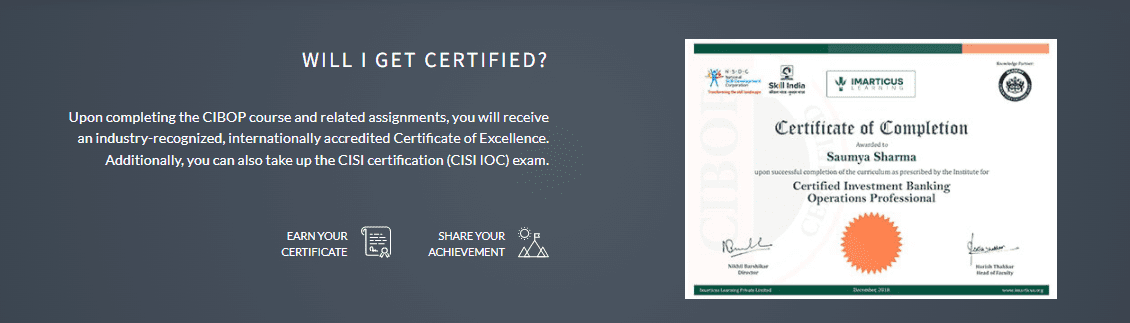
Certified Investment Banking Operartions Professionals (CIBOP)  is a certification designed by the Investment Banking Professional Certification Board (IBCPB) to test and certify professionals in IB operations, such as financial analysts.

Few skills necessary for success in IB operations:

  • Scheduling and controlling activities
  • Ensuring compliance with policies and procedures
  • Keeping informed of market conditions
  • Maintaining relationships with clients
  • Identifying opportunities for profitable business

CIBOP certification requirements are flexible to meet the needs of already qualified professionals and those seeking to be certified. For example, if you have at least one year of experience in IB operations, you may obtain the professional designation of CIBOA. Companies look for these individuals because they can perform all necessary tasks related to banking operations.

best investment banking courses with placement in IndiaTo obtain CIBOP certification, applicants must pass a 100-question written test and provide references attest to their knowledge and abilities. Applicants are then required to pay a fee and complete a criminal background check if they have not already done so for an earlier certification process.

Benefits of CIBOP Certification for Investment Banking Professionals

Professionals who receive CIBOP certification are more likely to be promoted within their current industry. Companies look for employees who can perform many investment-related tasks successfully, and this certification demonstrates your expertise in these areas. Additionally, professionals who work closely with clients will likely benefit from CIBOP certification due to its focus on client relationships.

Benefits of CIBOP Certification for Employers

As an employer, you may benefit from increased employee morale and productivity if your employees can obtain CIBOP certification. Professionals who hold this designation tend to stay with their company longer than average, decreasing training costs in the long run. Professionals will likely feel more confident in their abilities as employees and be more willing to take on additional tasks. It will ultimately lead to enhanced performance from these individuals, as they will feel they can do it all.

Because CIBOP is not specifically for investment banker courses alone, its benefits extend beyond those who work within the financial industry. If you believe that earning this certification would enhance your career or increase the success of your business, you can go with Imarticus Learning.

Explore Investment Banking with Imarticus Learning

Students now have the opportunity to learn about complicated securities and derivatives, trade-lifecycles, and the services that make up IB operations. This 180-hour powerhouse CIBOP course will thoroughly prepare students for banking operations, treasury, and clearing services.

Some course USP:

  • This Investment Banking course with placement assurance aids the students to learn job-relevant skills that prepare them for an exciting career.
  • Impress employers & showcase skills with a certification endorsed by India’s most prestigious academic collaborations.
  • World-Class Academic Professors to learn from through live online sessions and discussions. It will help students understand the 360-degree practical learning implementation with assignments.

Contact us through the live chat support system or schedule a visit to training centers in Mumbai, Thane, Pune, Chennai, Bengaluru, Hyderabad, Delhi, and Gurgaon.

10 Golden Rules to Adhere Before You Invest in the Stock Market

If you have extra money, it is better to invest them in shares for higher returns. However, it is not guaranteed that you will generate huge revenue by buying stocks. There are several risks associated with buying/selling stocks, and you need to address them.

Proper research should be conducted before buying shares to avoid any risks. Young enthusiasts that want to become successful investment bankers should know about the stock market, trade finance, and other aspects of the capital world. Read on to know ten rules that should be followed before investing in the stock market.


  • Ignore the herd mentality


You cannot invest in stocks of any business just because everyone is investing in that business. You should research on a personal level to know which business is best to invest in. Your stock investment decisions should not be influenced by some other person. If you want to take advice, better take it from a stock market expert.


  • Collect information


You cannot just buy shares of a company because it belongs to a booming industry. You should collect information about a company before buying its stocks. Investors always read equity research reports before investing in any company. The equity research report consists of the financial performance of the company and associated risks.


  • Study the trends


You should invest in a business that you understand. When you understand the industry practices, you can predict whether the stock will overperform or underperform. To predict the performance of a company’s stock, you can study past trends. If the company shares have fallen several times in the past, it may not be a good investment option.


  • Do not panic


Many investors panic when a market disruption arises. The key to success in the stock market is to follow a disciplined investment approach. You will have to show patience during the market disruption. If market volatility increases, you can wait it out by keeping the bigger picture in mind.


  • Don’t chase emotions


Many people lose money in the stock market because they invested due to emotional reasons. Greed is the biggest reason why some people lose everything in the stock market. Don’t invest in stocks if you are in search of wealth overnight. With consistent and disciplined investment, you can make money out of the stock market.


  • Diversify your investments


Your stock market investment portfolio should be broad. For lower risks, you should invest in numerous businesses. Try buying stocks of different companies that can provide huge returns.


  • Invest extra income


Don’t invest your spending in the stock market. You should always invest the extra income that you make in the stock market. It is important to analyze your financial situation before you buy shares.


  • Monitor your portfolio


An event in some other part of the world can also affect the financial market. It is better to monitor your portfolio rigorously for better results.


  • Hold stocks for a longer period


People hold stocks for a shorter time for small profits. However, successful investors hold onto stocks for years and generate more revenue.


  •  Keep an eye on market performance


You should be aware of upcoming disruptions or volatilities in the stock market. You can read forecasting reports to stay ahead of time.

How to learn investment banking concepts?

You can go for institutional banking and finance courses after graduation. However, institutional banking and finance courses after graduation are costly and do not offer flexibility. Instead, you can choose the MBA in Investment Banking & Equity Research offered by Imarticus Learning.

This online MBA course is provided in partnership with Jain University which, is a premier institution. Start your JAIN MBA Course now!  

How do financial institutions focus on strengthening the quality of loan portfolio while mitigating credit risk underwriting?

With the financial market changing and evolving with trends, the credit market has changed as well. The reason being more & more people are seeking credit from the lending market.

This increased graph of credit-sourcing has created an environment where competition among lenders has reached a fever pitch, with banks and other financial institutions fighting tooth and nail for market share.

But if you’re looking to get ahead of the pack, it pays to think outside the box. By developing a loan portfolio, you may have to include not just high-interest installment loans but also low-interest refinancing options.

In this blog post, we’ll take a deep dive into the world of portfolio analysis and credit risk.

What Is Credit Risk Underwriting? 

Credit risk underwriting is the process of building a credit profile for an individual to determine their creditworthiness. It can be considered as “due diligence” between lenders and potential borrowers.

Under this process, customer data such as employment history, income stability, and general suitability is reviewed to determine if individuals pose a default risk. However, it’s important to note that every lender has its criteria that individuals must meet to be accepted into an agreement.

Effective Ways financial institutions may use to strengthen the loan portfolio: 

A strong credit culture is an essential ingredient to the success of any bank. A loan portfolio with high-quality, low-risk loans provides stability for customers looking to invest in local businesses.

1. Cultivate a relationship with service providers: 

Learning about new lending opportunities and sharing them with your potential borrowers helps strengthen your relationship with accountants, attorneys, insurance agents, and other vendors.

Creating a good impact will help you on top of the mind of professionals, and whenever someone needs financial assistance, they can refer to you.

 2. Get regular updates from the line lenders: 

Managers are constantly on the lookout for updates from line lenders. They need to know what’s in their pipeline, how prospects are progressing, and other potential financing opportunities that might arise at any given time.

3. Update the prospects detail regularly: 

The prospect database should remain accurate and up-to-date. Contacting the right person will save your time, which means that their contact information becomes invaluable when it comes down to deciding who should receive your message most efficiently!

4. Review customer’s financial information: 

Expanding your reach by using customers’ financial data can help to identify their area of need. Following this, you may call the prospect with a solution that meets all those requirements or at least narrows them down for more focused marketing efforts.

Get More Insights into Loan Portfolio with Imarticus Learning: 

Imarticus Learning offers an in-depth understanding of credit risk and underwriting through their 145+ credit analyst course.

The credit risk analyst course mainly covers credit underwriting, credit administration, legal and regulatory requirement, and the impact of new-age technology.

 Our course USPs: 

Why is JAIN Online MBA the Top Business Management Course in 2021?

What do you want to be when you grow up? It’s a question that many children ask, but it can apply to adults as well. We may find ourselves asking the same query for those who have been in the workforce for a while. The answer might seem obvious at first—we’re looking for a job! But what are our options? Do we look for jobs where skills are not needed or desired? Or do we take the time now to gain skills that will make us more marketable and desirable candidates down the road?

The decision is yours, but JAIN MBA is one of the most lucrative options for students looking to add skills and knowledge for a successful career.

The program supports learners to build their management, leadership, and communication skills and succeed at work. Students learn best practices from top industry professionals to help them get ahead of the competition and get a higher-paying job. This course is perfect for recent graduates or current employees looking to advance their careers in the modern workforce.

Features of JAIN online MBA

  1. Highly qualified faculty members are experts in various fields such as accounting, finance, marketing/sales, etc., all with significant experience working in the business world.
  2. Flexible – enroll at your own pace and start when you want to! You can take a break and then sign back up and pick up right where you left off.
  3. Live online classes are offered for students looking to interact face-to-face with instructors and other students.
  4. Dynamic curriculum that You can personalize to fit your interests, needs, and goals by adding elective courses in your area of study of interest.
  5. The JAIN MBA program provides students with live Web conferencing services for scheduled class meetings, discussion boards, chat rooms, and virtual study groups.

Why should you pursue JAIN online MBA?

Online learning is an excellent way to advance your job objectives while being in your comfort zone and not jeopardizing your future! While online learning has been increasing over the last decade, JAIN (Deemed-to-be University) is going above and beyond to develop JAIN Online to make education more accessible to everyone.

JAIN Online aims to make individuals obtain global insights to face real-world challenges and create worldwide networks to accomplish long-term professional objectives by bringing competent academic experts and digital innovators.

  • You can study while you work and earn your MBA in less time with no travel or relocating required!
  • The program prepares students for today’s competitive world by teaching them how to use technology in business and guiding them towards becoming top industry professionals.
  • Students will be able to enhance their leadership skills through the JAIN ONLINE MBA program courses.

Explore and Learn with Imarticus Learning

We’ve teamed up with the acclaimed JAIN Online to improve its rigorous MBA curriculum, which now covers every aspect of modern business management operations. The course provides in-depth knowledge of essential elements of the industry.

This one-of-a-kind business management course includes hands-on instruction from industry professionals and covers every essential facet of the business. Students may apply what they learn in the immersive tech-enabled learning experience to real-world business settings and difficulties.

Some course USP:

  • This business management course for students is with placement assurance aid the students to learn job-relevant skills.
  • Impress employers & showcase skills with the best online MBA courses endorsed by India’s most prestigious academic collaborations.
  • World-Class Academic Professors to learn from through live online sessions and discussions.

Why is a Distance Online MBA the New Normal?

As the world evolves, so does education. With the rise of technology and globalization, many professionals find that they need an MBA to be competitive in their field – but can’t afford to give up their job or take time off for a traditional on-campus MBA.

Distance MBAs fill this gap by providing students with an affordable option that fits into their schedule and is accessible from anywhere in the world. Distance MBAs are becoming the new normal.

Find out what an MBA is and why it’s important?

A distance MBA program allows students to take courses within their preferred schedule, at their own pace, and usually from anywhere in the world with an Internet connection. Most distance online programs offer asynchronous coursework, meaning that each student has more time to complete coursework and assignments. In contrast, some programs offer synchronous coursework, where coursework and lectures happen at a particular time, and everyone participates.

In today’s competitive global economy, a Master of Business Administration (MBA) has become a requirement for career advancement and executive-level positions. Many business professionals who already hold an undergraduate degree in a field such as marketing or finance decide to obtain an MBA to boost their career and give themselves another edge in their profession.

Why a Distance MBA online classes the new normal?

  1. An MBA degree can open the door to more career opportunities with higher salaries
  2. The programs are flexible and designed for working professionals.
  3. Due to technological advancements, students no longer have to be limited by location or schedule.
  4. They can access rich online learning resources from anywhere in the world through the Internet.

The pros and cons of distance education:

Pros

  1. Flexibility: Students can complete their coursework on their own time according to their schedule.
  2. Affordability: Distance education programs are usually cheaper than traditional on-campus MBA programs due to the lack of physical facilities, equipment, and faculty required for the program.
  3. Personalized Learning Environment: Most distance education programs take less time than traditional MBA programs, allowing students to focus only on the topics relevant to their studies. This personalized learning environment can result in higher grades and better performance.

Cons

  1. Lack of Personal Interaction: Distance education programs lack face-to-face interaction between students and professors or classmates, limiting professional networking and interactions.
  2. Lack of Socialization: Distance education programs can be isolating due to the lack of social interaction with fellow students and professors, limiting potential opportunities for advancement.
  3. Lack of Practical Application: Some courses offered in distance education programs do not provide practical applications to real-life scenarios, which can cause students to feel unprepared for the working world after graduation.

Explore and learn with Imarticus Learning

This distance learning online MBA course includes hands-on training with leading technologies, including APIs, Blockchain, Cloud Computing, AI, Machine Learning, RPA, IoT, and Big Data.

Some course USP:

  • This MBA course is with placement assurance aid the students to learn job-relevant skills that prepare them for a career in MBA.
  • Impress employers & showcase skills with the best online MBA courses endorsed by India’s most prestigious academic collaborations.
  • World-Class Academic Professors to learn from through live online sessions and discussions. It will help students understand the 360-degree practical learning implementation with assignments.

Contact us through the live chat support system or schedule a visit to Mumbai, Thane, Pune, Chennai, Bengaluru, Delhi, Gurgaon training centers.