


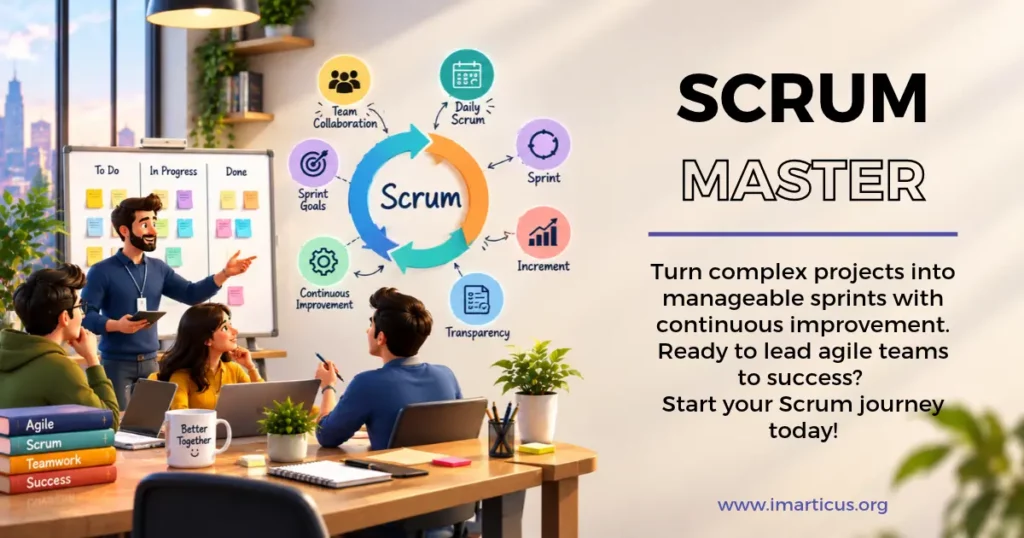
Last updated on October 21st, 2026 at 06:20 pm
A Scrum Master assists the Scrum team in doing its job right and improving with each Scrum cycle. Now let’s get back to the question: What is a Scrum Master? A coach, a meeting host, and a problem solver, all in one person, with no power to order anyone around. Most people become a certified Scrum Master through CSM from Scrum Alliance or PSM I from Scrum.org. CSM is a 16-hour course plus an exam that you renew every two years. PSM I is a US$200 exam that never expires. According to PayScale’s April 2026 data, the average base pay in India is around ₹16.5 lakh per year, with the majority of people falling in the range of ₹6.5 lakh to ₹30 lakh. Scrum master jobs are mostly in IT services, product companies, banks, and consulting. They usually go to people who already worked in delivery teams as developers, testers, or analysts.
Ask three people what a Scrum Master does, and you’ll hear three different things. A project manager. The person who runs the stand-up. Something in HR. All of the answers contain some truth and much confusion, so let’s clear up that mess. This blog will discuss the role definition, work description, certification process, salary of the role in India, roles available, and interview questions.
There are people out there who go through the same questions when they want this job. Do I have to code? Is a certificate enough? Can I get hired with no experience? I’ll answer all three honestly. Numbers are in tables, so you can scan them quickly.
Already made up your mind? Our Project Management Prodegree Course runs for four months and ends with a project you build yourself. Take a look, then come back and finish reading. The rest of this blog will help you decide if this career is right for you.
Don’t Let Our Best Advice Get Buried
Add Imarticus as a Preferred Source — see more of what we publish, every time you search.

Who is a Scrum Master?
If you are new to agile, the simplest way to think about it is this. A Scrum Master is a member of a Scrum team whose job is to help the team work well together. They are not the boss and they are not the one doing the technical work. They make sure the team understands Scrum, follows it properly, and keeps improving the way it works.
Scrum Masters are found in software companies, banks, consulting firms and even non-IT teams like marketing and operations. Anywhere a small team builds something in short cycles, there is usually a Scrum Master involved. In day-to-day work, a Scrum Master does three main things:
- Helps the team follow Scrum and run its meetings well.
- Removes blockers that slow the team down.
- Supports the Product Owner and the wider organisation in working with the team.
Scrum Master Meaning
A Scrum Master looks after how the team works. The team does the work, and the Scrum Master clears the way. They don’t assign tasks, and they don’t sign anything off. They ask simple questions. Is the stand-up helping? Is somebody stuck? Does the plan still make sense?
Remember college group projects where nobody knew who was doing what? The Scrum Master is the one who quietly sorts that out without taking over. Your part of the work stays yours.
If you search for what a Scrum Master is, you’ll find plenty of people calling it a manager role. It isn’t. They have no authority over people, because the team decides who does what. Taking notes isn’t the job either, and it isn’t project management. A project manager is the person who is supervising the project, keeping an eye on the scope, budget, and timelines. The team is watched by a Scrum Master. According to the Scrum Guide, the Scrum Master is a true leader who serves the team and the whole organisation. They lead by serving.
Definition of a Scrum Master
The official definition is in the Scrum Guide, a short rulebook written by the people who created Scrum. The 2020 edition is still the latest one on the official site.
Scrum is a method of breaking down large work into small bits and completing them in order. Each piece is an instance of the Sprint class. Every Sprint, the team selects a small goal, creates and tests it, demonstrates it to the people who requested it, and then gets feedback from them to inform the next conversation on making tomorrow’s goal.
Notice the word accountable. The Scrum Master doesn’t fix every problem. They make sure the right conditions exist. Scrum was developed in the early 1990’s and presented for the first time in 1995.
So, what is a Scrum Master is in one line? The person accountable for how well a Scrum team works together.
How Scrum Works
A little background first, because the role won’t make sense without it. This takes a short time, because Scrum is small.
Scrum means splitting big work into small pieces and finishing them one at a time. Each piece is a Sprint. In every Sprint, the team picks a small goal, builds and tests it, shows it to the people who asked for it, and uses their feedback to plan what comes next.
Take a food delivery app. The team doesn’t try to build everything at once. They pick a two-week goal, like letting customers search for restaurants. They build it, show it, then pick the next goal.
The Scrum Team
A Scrum team is small, with everyone needed to deliver something useful in a Sprint. No sub-teams, no ranks. It has three accountabilities:
- The Product Owner is responsible for determining the next thing the team should work on and prioritising the Product Backlog.
- The Developers do the real work, whether that’s coding, testing, design or data analysis, and they plan their own Sprint.
- The Scrum Master looks after how well Scrum is working for everyone.
Small teams communicate with one another; problems are caught early. According to the Scrum Guide, the size of the team is usually 10 or less.
The Five Scrum Events
Everything happens inside a Sprint, which lasts one month or less. Four more events sit inside it, and each gives the team a chance to check progress and change direction. The times below are maximums for a one-month Sprint. Shorter Sprints get shorter events.
| Event | What it is for | Maximum time (one-month Sprint) |
| Sprint | Holds all the work and events together | One month or less |
| Sprint Planning | Agreeing the Sprint Goal and picking the work | 8 hours |
| Daily Scrum | Checking progress toward the Sprint Goal | 15 minutes |
| Sprint Review | Showing results to stakeholders and deciding what comes next | 4 hours |
| Sprint Retrospective | Finding ways to improve quality and effectiveness | 3 hours |
None of these is a status update for a manager. The Scrum Master makes sure each one happens, finishes on time, and is worth the team’s time.
- Sprint Planning: Team selects a goal and the work that they believe they will be able to complete.
- Daily Scrum: 15-minute meeting to catch up. Are we on track? Who needs help?
- Sprint Review: The team’s showcase of a built product and discussion of their next steps.
- Sprint Retrospective: What went well, what didn’t, and what to change.
Scrum Master Roles and Responsibilities
The Scrum Guide divides it among the team, the Product Owner and the organisation. I’ll use the same split because it makes the work easy to picture.
Serving the Scrum Team
Most of the time goes here. The aim is a team that decides for itself and still stays on track.
A Scrum Master doesn’t hand out work. They ask the questions until the group has discovered their own answer. If one useful result that comes up to the Definition of Done is better than a lot of halfway finished things, then they keep everyone focused on Done. They have to deal with obstacles, such as having no access to a test environment. The guide says the Scrum Master causes it to be removed, which doesn’t mean doing it alone. And they protect the events so they happen, stay positive, and finish on time.
Serving the Product Owner
A Product Owner can have a great vision and still be buried in a messy backlog. The Scrum Master helps with the practical side:
- Better ways to set the Product Goal and manage the backlog.
- Planning from what really happened in past Sprints, not hope.
- Facilitating stakeholder conversations when asked.
Serving the Organisation
This part is often the hardest. It happens away from the team, with managers who haven’t read the Scrum Guide and probably won’t.
- Training and coaching the company to do Scrum correctly.
- Helping stakeholders make a decision based on their observations, not assumptions.
- Filling the gap between the stakeholders and the Scrum teams.
One thing I’ve noticed: good Scrum Masters talk less in meetings over time. The team starts answering its own questions. That’s usually how you know the coaching is working.
Did You Know?
Scrum Guide states that Scrum Teams are usually between 10 and 99 members. Not every Scrum Master is responsible for an entire department, but rather a small group. Source
What does a Scrum Master do?
Ask a Scrum Master what they did today and the answer is usually not “I managed the team.” It sounds more like “I helped the team get unstuck.” That’s the best short answer to what a Scrum Master does. They look after the way a team works, so the team can focus on the work itself.
Here is how that looks in a normal week.
- They run the Scrum meetings. The Scrum Master sets up Sprint Planning, the Daily Scrum, the Sprint Review and the Retrospective. They make sure each one starts on time, stays on topic and ends when it should.
- They sort out blockers. Maybe a developer is waiting for access to a test server, or two people can’t agree on an approach. The Scrum Master helps get it moving, usually by connecting the right people.
- They coach instead of instructing. If someone asks “what should I do?”, a good Scrum Master will ask “what have you tried so far?” The team learns to solve its own problems.
- They help the Product Owner. This means keeping the backlog in order and making sure the team knows what matters most.
- They talk to the rest of the company. Managers and stakeholders often don’t know how Scrum works. The Scrum Master explains it, politely and as many times as needed.
So what is the role of a Scrum Master in one line? To make sure the team has what it needs to do good work and keeps getting better at it. For the full list of duties, see the Roles and Responsibilities section above.
Scrum Master vs Project Manager
People mix these two up all the time, and some job descriptions make it worse. Here’s where they overlap and where they don’t.
| Point | Scrum Master | Project Manager |
| Main focus | How well the team works and follows Scrum | Delivering scope, time, and cost |
| Authority | No authority over people, leads by coaching | Usually assigns work and owns the plan |
| Planning | The team plans each Sprint together | The manager builds and updates the plan |
| Accountable for | Scrum and the team’s effectiveness | The overall project outcome |
| Typical approach | Scrum and other agile methods | Waterfall, agile or a hybrid |
| Sign of success | A team that improves Sprint after Sprint | A project delivered on agreed terms |
In small companies, one person often does both jobs. That’s fine if they know which hat they’re wearing in which meeting. The Product Owner is a separate role again. That person decides what gets built, and the Scrum Master looks after how Scrum runs around it.
Scrum Master Skills
Most of what makes a good Scrum Master has nothing to do with software. Beginners are usually surprised by that. Skills first, tools later.
| Skill | How it shows up at work |
| Facilitation | Running a Retrospective so quiet people speak up, and loud people listen |
| Coaching | Asking “what have you tried so far?” instead of giving the answer |
| Conflict handling | Helping two Developers who disagree reach a decision without taking a side |
| Communication | Explaining a delay to a stakeholder in two clear sentences |
| Agile knowledge | Knowing the rules well enough to explain why they exist |
| Reading team data | Using velocity and burndown charts to start a conversation, never to score people |
If the people side is where you’d like to start, our blog on how management courses build leadership skills is a good first read.
How to Become a Scrum Master
Nobody is born knowing this job, and most good Scrum Masters started somewhere else. So, who can make the switch and how will it play out?
The path is simple. Skipping the middle steps is how people end up with a badge and no confidence.
- Read the Scrum Guide. It’s short, free, and official.
- Work on a team that uses Scrum. Any role is fine, as long as you see real Sprints.
- Volunteer to facilitate. Offer to run a Retrospective or the Daily Scrum.
- Get certified. Pick CSM or PSM I using the table above.
- Learn the tools. Jira, Confluence, and one simple board tool are enough.
- Apply, or ask for a move. Look for junior Scrum Master roles, or ask your own company to let you try.
Don’t rush the middle steps. A few real Sprints will teach you more than any course. The certificate opens the door, but the Sprints you’ve actually worked through are what get you the job.
Who Can Become a Scrum Master?
This role is for anyone who enjoys supporting teams to work well together and is able to remain calm when plans are changing.
- Students/fresh graduates: Get to know the frameworks and tools at this stage, and then go and work in a team that practices Scrum.
- For IT professionals: like developers, testers, and analysts, having the opportunity to see Sprints from the inside is quite a bonus.
- People outside IT: Operations, finance, and marketing teams run agile too, and the Scrum Guide says Scrum works well beyond software.
Qualification to become a Scrum Master
There’s no single qualification that makes you a Scrum Master. The Scrum Guide doesn’t ask for a degree, and no law requires a certificate. In practice, employers usually look for a mix of the points below.
- Education: A bachelor’s degree is the common starting point. BTech, BE, BCA, BSc and BCom all work. An MBA or MCA helps but isn’t a must.
- Experience: Usually one to two years or more on an agile team, as a developer, tester, business analyst or coordinator.
- Certification: CSM or PSM I is the most common ask. It’s often listed as “preferred” rather than compulsory.
- Tools: Working knowledge of Jira, plus Confluence or a similar board tool.
- People skills: Facilitation, coaching, conflict handling and clear communication.
Your degree matters least out of all of these. A BCom graduate who has run Retrospectives for a year can easily beat an engineer who has only read about Scrum. What employers want to see is that you’ve worked through real Sprints and can explain what you learned.
If you don’t have the experience yet, start with the steps above. Join a Scrum team in any role, get certified, and learn the tools.
Scrum Master Certification
You don’t legally need a certificate. Still, many employers use it to filter applications. Two options lead the pack, so here’s what each involves, based on the official pages.
Certified Scrum Master (CSM)
The Certified Scrum Master is a credential from the Scrum Alliance. You do 16 hours of training, usually over two or three days, then take the exam online.
- 50 multiple-choice questions in one hour. You need 37 correct to pass.
- Two attempts come with the course fee, and you get 90 days after the course to pass.
- You renew every two years using Scrum Education Units.
PSM I
Professional Scrum Master I comes from Scrum.org. A course isn’t required, but the site strongly recommends one.
- 80 questions in 60 minutes, with a pass mark of 85%.
- US$200 per attempt.
- Valid for life, with no renewal fee.
CSM vs PSM I
Both are well respected. Most hiring managers I’ve spoken to care more about whether you can explain a Retrospective than about which badge you hold.
| Point | CSM | PSM I |
| Awarding body | Scrum Alliance | Scrum.org |
| Course | Required, 16 hours | Recommended, not required |
| Exam | 50 questions, 74% to pass | 80 questions, 85% to pass |
| Cost | Bundled with the course, so it varies by trainer | US$200 per attempt |
| Validity | Two years, then renew | Lifetime |
If you learn better from a trainer and group discussion, go for CSM. If you’re happy studying alone and want to spend less, PSM I is the cheaper route. Please note that fees are subject to change; visit the official websites before payment.
Scrum Master Tools
Tools won’t make you good at the job, but not knowing them can cost you in an interview. They’re all just ways to keep work visible.
- Jira: the team’s to-do list. Each piece of work is a card on a board with columns like To Do, In Progress, and Done. Learn this one first.
- Confluence: a shared notebook for team agreements like the Definition of Done, plus meeting notes.
- Trello and Asana: simpler boards, popular with smaller teams and non-IT teams.
- Microsoft Project: a timeline tool, handy when dates are fixed in hybrid projects.
Do not attempt to learn all 4! With a bit of knowledge of Jira, a sense of one lighter, and you are set for most interviews.
Also Read: What Is Agile Scrum?
Scrum Master Salary in India
Pay is always a topic of discussion, and it is a fact that pay is widely variable. I did use PayScale for the broad strokes and AmbitionBox for cities. As said, in small sample situations. There are two factors to consider:
- The higher the number of profiles, the more reliable the number is.
- Base pay is just the base component of compensation. It’s important to remember that bonus and extras are part of total pay, and you shouldn’t be looking at comparing the two.
Scrum Master Salary based on Experience
PayScale’s page, last updated in April 2026, shows an average base salary of about ₹16.5 lakh a year across 176 profiles. Ten percent of profiles are below ₹6.5 lakh and ten percent are above ₹30 lakh. (Source)
| Level | Average total pay a year | Sample |
| Under 1 year of experience | About ₹5.7 LPA | 6 salaries, so treat with care |
| 1 to 4 years | About ₹9.4 LPA | 31 salaries |
| All Scrum Masters (base pay) | About ₹16.5 LPA | 176 profiles |
Look at the jump from entry level to the overall average. That’s how much experience counts here. Also, most people don’t start out as a Scrum Master, so the early numbers are thin.
Scrum Master Salary by City
AmbitionBox does not provide averages, and the pages I looked at have been updated in 2025. Ranges are in lakhs per year.
| City | Scrum Master | Senior Scrum Master |
| Bengaluru | 7 to 30 LPA | 13 to 40 LPA |
| Pune | 7.2 to 28 LPA | 13 to 36.8 LPA |
| Hyderabad | 6 to 26 LPA | 10.5 to 37.6 LPA |
The salary rates for Gurugram are approximately ₹6.8 LPA to ₹29 LPA for Scrum Masters, and in Chennai, the salary rates for senior roles are around ₹11 lakh to ₹35 lakh. The salary range for banking is approximately between ₹8.1 lakh and ₹28 lakh on the same premise. Where you land in a range depends on how many real Sprints you’ve worked through, the domain you know, and the size of the teams you’ve handled.
Also Read: Management Consultant Salary in India
Scrum Master Jobs
Agile isn’t just for software anymore, so scrum master jobs show up in more places than people expect. Any company that builds things in steps, with a team, can use one. Here’s what to search for and where to look.
Common Scrum Master Job Titles
Job boards rarely stick to one title, so try a few. The programme page I mention later lists Scrum Master among its career outcomes, which tells you how close the role sits to project jobs.
- Scrum Master or Senior Scrum Master
- Agile Delivery Lead or Delivery Manager
- Agile Coach
- Agile Project Manager
Check out the job description, not only the job title. Look out for words such as coaching, facilitating, Sprint, backlog, and Retrospective, which indicate that it’s similar to what this blog describes.
Where to Find Scrum Master Jobs
The majority of openings are within the IT services, software product enterprises, banks, consulting, and analytics companies. The primary hubs are Bengaluru, Pune, Hyderabad, and Delhi NCR, and there are many jobs that have remote/hybrid work options. If you already work in an industry like banking, that’s an edge, because you know how the business runs.
Business analysts have a natural way in. Our blog on the business analyst certification course mentions Scrum Master as one of the roles that path can lead to.
Where can a Fresher find the Job?
Very rarely as their first employment. Most companies want to hire someone who has experienced multiple Sprint failures; thus, people typically begin in roles such as tester, developer, analyst, or coordinator. Moving to an agile team is now feasible after a year or two, and after obtaining a certification. Freshers can still prepare:
- Join a Scrum team in any role.
- When you feel ready, be sure to offer to hold a Retrospective.
- Read and use the Scrum Guide, practise Jira.
Scrum Master Interview Questions
Interviewers mix definition questions with situation questions. These eight come up a lot. The answers are kept to the minimum to help you recite them in your own words.
- What is Scrum? A lightweight framework that enables you to produce value by solving complex problems in a short time in Sprints.
- What are the people in a Scrum team? One Scrum Master, one Product Owner, and the Developers (no sub-teams or hierarchy).
- So, what is the job of a Scrum Master? Implements Scrum, enhances the effectiveness of the team, and cares for the team, the Product Owner, and the organisation.
- What is the difference between a project manager and him/her? A Scrum Master is a coach and a blocker remover, but has no authority over individuals.
- What’s the Definition of Done? Shared description of what is required to be true for work to be part of the Increment, for example: tested and reviewed.
- What does the word “impediment” mean? Anything blocking the team, like a missing access approval. The Scrum Master helps get it removed.
- A stakeholder wants new work mid-Sprint. What do you do? Changes can’t put the Sprint Goal at risk, so bring in the Product Owner to renegotiate scope.
- Who can cancel a Sprint? Just the Product Owner – only when the Sprint Goal is no longer relevant.
Also Read: Top 25 Agile Interview Questions
Future of the Scrum Master Role
The core rules haven’t moved, since the 2020 Scrum Guide is still the current edition. What’s changing is the tooling around them, and that changes how a Scrum Master spends the day. The boring parts get easier, like writing user stories, tidying notes, and spotting a Sprint that’s falling behind.
AI in the Scrum Master’s Work
For the Scrum Master, AI is a game-changer.AI is a great enabler for the Scrum Master. That takes the admin off your plate and leaves more time for the people side, which no tool handles well. If you want to practise these tools properly, our generative AI programme for professionals is worth a look.
- User stories, retrospective summaries and Sprint risk flags from Board data can already be created by AI tools.
- Learn how to coach, facilitate and manage conflict and enjoy the rest of the tools.
- Treat AI output as a first draft and check it against what you saw in the team.
My own view is that Scrum Masters who coach well will matter more, and the ones who only run meetings will find it harder.
Why Choose Imarticus for Project Management Learning
If you want a structured way into agile and project roles, here’s what our programme offers. Everything below comes from the programme page, so you can compare it with other options on facts.
| USP | What it means for you |
| Knowledge partnership with PwC Academy | Interactive master classes with professionals, using real-life examples. |
| Hands-on tools | Learn how to use JIRA, Confluence, Trello, Asana, and MS Project |
| AI-driven project management | Forecasting timelines, predicting risks, automating reports, and building dashboards in Notion and ClickUp |
| PMP preparation | 35 PDUs, which is what you need to apply for the PMP exam |
| Your project, our mentorship | Build a real project from your own life or work, with expert guidance |
| Complete curriculum | Fundamentals, Waterfall, Agile (Scrum, Kanban, SAFe), Hybrid and Lean Six Sigma |
| Format | Four months and 100 hours of live online classes |
| Certificate | Awarded jointly by Imarticus Learning and PwC Academy |
| Fee | ₹99,000 including taxes, paid in instalments |
Scrum Master is one of the career outcomes listed on the page, as well as Project Manager, Agile Project Manager, and Business Analyst. It also states explicitly that PwC is not looking to support you with your job search, so do it in conjunction with your learning. If it’s your wish, dive into the Project Management Prodegree Course and see the program and timeline on the page.
FAQs About Scrum Master
These are the frequently asked questions about Scrum Master that people ask me most. I kept each answer short on purpose.
What is a Scrum Master?
Scrum Master is one of the career outcomes listed on the page, as well as Project Manager, Agile Project Manager, and Business Analyst. It also states explicitly that PwC is not looking to support you with your job search, so do it in conjunction with your learning. If it’s your wish, dive into the project management prodegree and see the program and timeline on the page.
What are the roles and responsibilities of a Scrum Master?
A Scrum Master is the individual on a Scrum team that is responsible for creating Scrum and ensuring the team’s effectiveness. They act as a coach for the team, help the Product Owner, clear obstacles, and ensure that Scrum events take place. This role is more of a service to the team than a managerial role.
Is Scrum Master a good career in India?
Yes, Scrum Master is a good career in India. if you’re more of a people person than a tool person. According to data from PayScale, the average base salary in April 2026 is approximately ₹16.5 Lakhs per year. From here, you can progress to becoming an Agile Coach, Delivery Manager, or Program Manager.
Which is better, CSM or PSM I?
It would depend on your requirement. CSM consists of a 16-hour course and is a two-year-old course. PSM I is $200, has an 85% pass mark, and is permanent. Choose according to your budget and preferred method of learning.
Can a fresher become a Scrum Master?
It’s very rare for this to be a first job, since almost all employers want to experience agile teams for a period of time. Typically, after a year or two, and with a certification in hand, the fresher will traverse the types of roles and cross over to become a tester, developer, analyst, or coordinator.
Do Scrum Masters need to code?
No, Scrum Masters don’t need to code. A Scrum Master is not a developer. A little technical know-how will do wonders for you, as you will see the blockers sooner and ask better questions. However, facilitation, coaching, and clear communication are more important than programming.
Can a Scrum Master also be the Product Owner?
Yes a Scrum Master can be the Product Owner. The Scrum Guide considers them to be distinct responsibilities. They are typically not combined since the Product Owner determines what should be built and the Scrum Master is responsible for the proper functioning of Scrum. This can become confused between jobs and sometimes is done by small teams.
How long does it take to become a Scrum Master?
It depends on what you mean. The certificate is quick. CSM takes two or three days of training, and PSM I usually takes a few weeks of self-study. The job itself takes longer. Most people spend one to two years on an agile team first, as a tester, developer or analyst, before they get a Scrum Master role. So don’t rush the badge. The time you spend working inside real Sprints is what makes you ready.
Start Small and Let the Scrum Master Role Grow With You
At the start, I said you’d get three different answers if you asked three people what a Scrum Master does. Now you can give a fourth, better one. A Scrum Master is the person who helps a team work well and keep getting better, without being anyone’s boss. The role has no authority over anyone, yet it’s accountable for how well a whole team works. That odd mix is what makes it hard. It’s also what makes it worth doing.
The hard part is that you can’t order anyone around. You get results by asking good questions, clearing blockers and making sure the team’s meetings are worth attending. The rewarding part shows up slowly. One day you notice the team is solving its own problems, and you’re talking less in meetings than you used to. That’s usually the sign you’re doing the job well. On the practical side, the pay is decent, scrum master jobs are open across IT services, banks, product companies and consulting, and the work stays interesting because every team is different.
You don’t need to master everything at once. Don’t try to learn it all at once. Read the Scrum Guide, join a team with Sprints, select the certificate that you can afford, and learn from the initial few Retros. If you’re in need of a guided path of live classes and real project mentorship, consider signing up for Imarticus Learning’s Project Management Prodegree Course and taking the first step toward your first Scrum Master role.
Liked This? Follow Us Where You Already Search.
Preferred Sources is Google’s built-in follow button — no app, no login, just more Imarticus in your results.