


SUMMARY
How many subjects are there in CMA, and what do you actually study in each one? The CMA course subjects are designed to take you beyond accounting basics, covering areas such as financial planning, cost management, performance analysis, reporting and strategic decision-making. This CMA course subjects list breaks down the CMA full syllabus and explains what each subject is meant to help you understand, so you can see exactly what the course involves, how the subjects connect with one another, and what to expect before you start preparing for the CMA exams.
Any milestone begins with knowing where to start. For anyone aspiring to become a Certified Management Accountant, the CMA course subjects give you exactly that starting point. They shape not just how you prepare for the exam, but how you think as a finance leader. Too often, people jump into CMA prep without really understanding what the syllabus demands. You wouldn’t want such an approach because you want to be laser-sharp in your preparation and get the subjects right from day one.
It is a certification with global recognition offered by the IMA. The CMA curriculum covers the core areas of management accounting and finance that every business relies on. Right from budgeting and cost control to corporate finance and ethical decision-making, the CMA certification tests you rigorously, which truly makes you a ‘numbers maverick’.
For someone preparing to become a CMA, these subjects are more than an exam checklist. They represent the skills you’ll use daily in senior finance roles, like analysing numbers, guiding strategy, and helping companies make sound decisions and more.
Don’t Let Our Best Advice Get Buried
Add Imarticus as a Preferred Source — see more of what we publish, every time you search.

In this guide, we will break down the entire CMA syllabus, explain why each subject is relevant, break down the requirements of the exam structure, and explore career options to pursue once you have completed each course. I map out the CMA Syllabus topic by topic, with the weightage of each area and what you can expect from both exam parts. It also answers the questions that usually come up while starting preparation, including how many subjects are there in CMA, what the CMA Course Syllabus actually covers, which areas carry more weight, and how the CMA full syllabus fits into your study plan.
Did you know?
Most students don’t struggle with CMA because the syllabus is difficult – they struggle because they don’t understand what each part is actually testing. Part 1 checks whether you can run a business internally. Part 2 checks whether you can make decisions that grow it. If you prepare for both the same way, you’re setting yourself up to fail.
What is the CMA Course?
If you’ve searched for – what is CMA on your search engine. The CMA (Certified Management Accountant) course is a qualification designated by the Institute of Management Accountants (IMA), USA, and recognised in over 170 countries. Unlike qualifications that lean heavily on taxation or auditing, CMA aims at planning, analysis, control, and decision-making.
CMA course subjects list is designed for professionals with a desire to step away from generating numbers and instead interpret, analyse, and lead with numbers. This is why the CMA course subjects are centred around two enormous ideas: financial planning and strategic management. Collectively, they place you firmly in leadership roles in multinational corporations, large consulting firms, or institutions based on finance.
What are the core CMA subjects?
When you first see the CMA course subjects list, the number of topics can make the syllabus feel bigger than it really is. A closer look shows a fairly simple structure. There are two exam parts, and each part has six main areas.
Part 1 stays close to the day-to-day financial side of a business. You deal with financial reporting, planning, budgeting, performance, costs, internal controls, and technology and analytics. Part 2 takes those financial skills into areas such as financial analysis, corporate finance, business decisions, risk, investments, and ethics.
That is the basic shape of the CMA subjects. Once you know where each topic belongs, it becomes much easier to decide what to study and when.
How the CMA subject list is divided
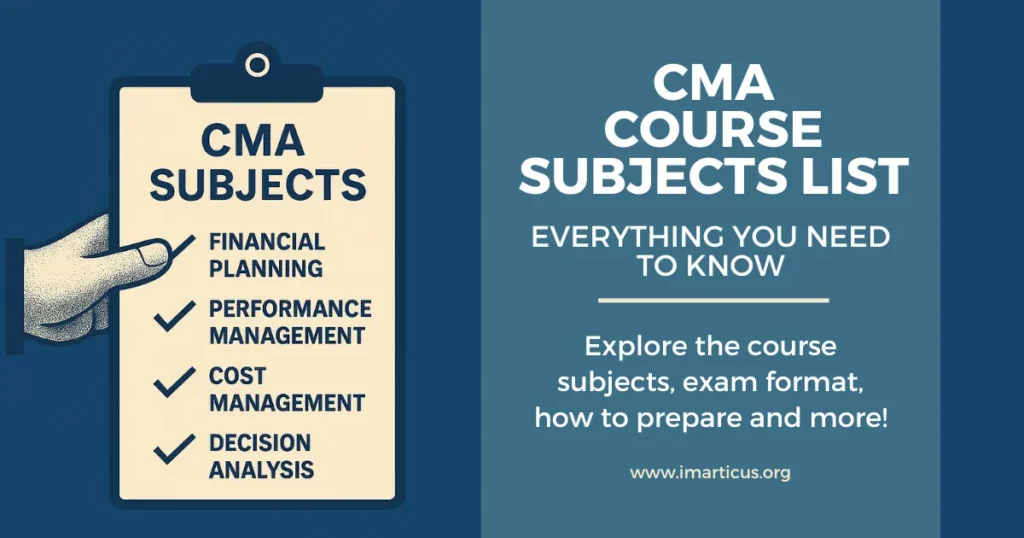
The CMA course subjects list follows the same two-part structure as the exam. Part 1 is called Financial Planning, Performance, and Analytics. Part 2 is Strategic Financial Management.
The weightage also gives you a useful sense of proportion. For example, Planning, Budgeting, and Forecasting carries 20% in Part 1. Performance Management also carries 20%. In Part 2, Business Decision Analysis has the highest weightage at 25%. This is where the CMA Course details become useful. You can use the weightage to decide how much practice each area needs instead of giving every chapter the same amount of time.
What is CMA Course, and what do you study?
So, what is CMA Course when you look beyond the name? At its core, it is a professional qualification built around management accounting and financial management.
The subjects in CMA reflect that purpose. You work with financial information, budgets, costs and performance measures. You then move into financial analysis, corporate finance, risk and investment decisions. That is also why the CMA Syllabus has a mix of calculations, concepts and business situations. A candidate needs to know the numbers and know what those numbers mean in a business setting.
How many subjects are there in CMA?
If you are wondering how many subjects are there in CMA, the current IMA structure gives you 12 major competency areas in total. There are six in Part 1 and six in Part 2.
| Exam part | Main focus | Core areas |
| Part 1 | Financial planning | 6 |
| Part 1 | Performance and analytics | Included |
| Part 2 | Financial management | 6 |
| Part 2 | Strategic decisions | Included |
| Both parts | Complete CMA framework | 12 |
There are smaller topics within each area, so the answer to how many subjects are there in CMA can look different depending on whether someone is counting the major areas or every individual topic in the official outline. For planning your studies, the 12 major areas give you the cleanest starting point.
Also Read: How much time does it take to complete CMA?
CMA Course Subjects Overview
The CMA exam is split into two parts. Each part has its own set of subjects, with weightages that reflect the importance of those skills in practice.
CMA Part 1: Financial Planning, Performance, and Analytics
This part focuses on the fundamentals of managing and analysing a company’s financial operations.
| CMA Subject | Topics Covered | Weightage |
| External Financial Reporting Decisions | Principles of financial statements, recognition, measurement, disclosures | 15% |
| Planning, Budgeting, and Forecasting | Budgeting concepts, forecasting techniques, and variance analysis | 20% |
| Performance Management | KPIs, responsibility centres, cost and variance measures | 20% |
| Cost Management | Costing systems, allocation methods, and activity-based costing | 15% |
| Internal Controls | Governance, risk management, compliance frameworks | 15% |
| Technology and Analytics | Data analytics, financial modelling, and technology applications in finance | 15% |
CMA Part 2: Strategic Financial Management
This section of the CMA course subjects list pushes you into leadership territory, asking you to apply advanced financial concepts in real-world decision-making.
| CMA Subject | Topics Covered | Weightage |
| Financial Statement Analysis | Ratio analysis, financial health indicators, and earnings quality | 20% |
| Corporate Finance | Capital structure, cost of capital, risk-return analysis | 20% |
| Decision Analysis | Pricing, capital budgeting, risk assessment, and investment planning | 25% |
| Risk Management | Hedging, insurance, enterprise risk strategies | 10% |
| Investment Decisions | Valuation models, mergers & acquisitions, security analysis | 10% |
| Professional Ethics | Compliance, corporate responsibility, ethical standards | 15% |
Collectively, these two parts of the CMA course subjects list cover everything from everyday financial planning to high-level strategy, covering the CMA course subjects, both indisputably broad and practical.
👉 Fact: According to IMA’s 2023 report, CMA professionals earn on average 58% more than non-CMAs in similar roles, making it one of the most ROI-positive certifications in finance.
What does the CMA Course Syllabus cover?
The CMA Course Syllabus goes into the smaller topics under each major area. In Part 1, this includes areas such as financial statement concepts, strategic planning, budgeting, forecasting, cost measurement, internal controls, and technology and analytics. Part 2 brings in financial statement analysis, working capital, financing decisions, risk and return, business decision analysis, capital investment, and professional ethics.
The CMA exam subjects therefore cover a fairly wide stretch of finance. You may be calculating a variance in one section and assessing an investment decision in another. That is where the CMA full syllabus is worth keeping handy. It shows what sits underneath the broad subject names and gives you a better checklist for preparation.
How to use the CMA Syllabus while preparing
The CMA Syllabus works well as a checklist. Take one major area at a time and break it into the smaller topics given by IMA. The CMA Course Syllabus can sit alongside your study planner. Tick off a topic after you have studied it and practised questions from it. Keep a separate note of areas where your accuracy is still weak. A simple tracker can include:
- Topic covered
- Questions attempted
- Accuracy
- Formulae to revise
- Topics needing another round
The CMA course subjects list then becomes something you actually use during preparation. It stays useful when you are planning your week, reviewing a mock test or deciding what to revise next.
How should you approach the CMA exam subjects?
The CMA exam subjects need different kinds of practice. Some topics are calculation-heavy. Others ask you to interpret information or choose the most suitable course of action.
That distinction matters when you study the subjects in CMA. Reading a chapter on budgeting gives you the basic concepts. Solving questions shows whether you can apply them. The same applies to financial statement analysis, cost management and decision analysis.
The official IMA content outlines also set different cognitive levels for various CMA course subjects list areas. Some topics require application and analysis. So your preparation should leave room for questions that make you work with the information rather than simply recall it.
What should you know before starting the CMA Course?
Before starting the CMA Course, check the current IMA syllabus and certification requirements. You need to pass both exam parts and meet the education and work experience requirements for the certification.
The question What is CMA Course also becomes easier to answer once you see the complete picture. The exams are the academic part of the qualification. Your education, experience and IMA membership requirements also matter. The CMA course subjects list gives you the academic roadmap. The official IMA content outline gives you the finer detail within that roadmap.
How to work through the CMA full syllabus
The CMA full syllabus is much easier to handle when you stop treating it as one giant checklist. Pick one area. Finish its concepts. Solve questions. Note down the topics that still feel unclear. Then move forward.
The CMA course subject details can help you make those notes specific. Instead of writing “revise Part 1”, write “revise variance analysis” or “practise budgeting questions”. Small changes like this make a study plan much easier to follow. If you are still asking how many subjects are there in CMA, use the 12 major competency areas as your top-level checklist. Then use the detailed syllabus to work through the topics underneath them.
Keeping the CMA course subjects list useful
The CMA course subjects list does not have to disappear once you finish your first round of study. Keep it open when you take mocks and review your scores. You can mark each area based on your current level of preparation.
| Status | What it means | Next step |
| Started | First reading done | Practise questions |
| Practising | Questions underway | Track accuracy |
| Needs revision | Errors remain | Revisit concepts |
| Test ready | Good practice scores | Add to mocks |
| Completed | Strong performance | Review periodically |
The CMA subject list gives you the broad picture. Your notes and question practice fill in the detail. That is a much more useful way to look at the CMA course subjects list. You know what the syllabus contains, you know where the weightage sits, and you have a clear way to turn the list into an actual study plan.
Did you know?
Over 70% of the CMA exam focuses on the practical application of concepts through real-world business scenarios. This is why mock exams and case studies are as important as studying theory.
Why the CMA Course Subjects Matter
The CMA syllabus wasn’t designed in isolation – it reflects what businesses demand from finance professionals today. Here’s why these subjects are so valuable:
The CMA course subjects list cover fundamental concepts that are highly relevant to today’s business practices. Rather than graduating with a theoretical education, CMA students will graduate with essential financial management skills that will enable professionals to make empirical, data-based decisions in complex business problems.
- Industry and Employment Relevance – The CMA syllabus is aligned with today’s most relevant critical trends in the areas of financial analytics, risk management & corporate finance, and employers will place a high value on it.
- Global Certification Recognition – Individuals who earn a CMA certification will have globally recognised international career opportunities that are typically in multinational corporations, financial firms & government agencies.
- Higher Earning Potential – CMA individuals earn 58% more than their non-certified counterparts.
Where the CMA course subject details matter
The CMA course subjects list become particularly useful once you start planning revision. Take Part 2 as an example. Business Decision Analysis carries 25%. Financial Statement Analysis and Corporate Finance each carry 20%. Enterprise Risk Management and Capital Investment Decisions carry 10% each, while Professional Ethics carries 15%.
👉 Insight: The CMA syllabus is regularly updated to match industry standards and reflect trends. For example, the inclusion of Technology & Analytics in Part 1 is a response to the growing demand for finance professionals skilled in data-driven decision-making.
CMA Exam Format and Passing Criteria
The CMA exam subjects are divided into two exams (Part 1 &Part 2), which test candidates on advanced financial and strategic management concepts.
| Exam Details | Specifications |
| Exam Duration | Four hours per part |
| Total Marks | 500 per exam |
| Passing Score | 360 per exam |
| Question Format | 100 MCQs + 2 Essay Questions |
| Exam Windows | January-February, May-June, September-October |
The MCQs test conceptual clarity, while the essays push you to apply knowledge to business scenarios. For example, you might be asked to evaluate a budget proposal, analyse risk exposure, or justify an investment decision, all rooted in the CMA course subjects.
At Imarticus Learning, we make sure students are equipped to pass the exam with specific mentoring, doubt clearance sessions, & indicative mock tests that follow the structure of the actual exam.
For complete details on the CMA course and enrollment process, visit the CMA Course page.
👉 Quick Fact: Only around 45-50% of candidates pass each part of the CMA exam on their first attempt, highlighting the importance of structured preparation.
How to Prepare for CMA Course Subjects
CMA course subjects list preparation requires more than just reading chapters and solving questions. The exam brings together knowledge, stamina, and clarity of thought. Successful individuals are adept at training their minds to deal with stress, making connections between ideas, and acting with accuracy.
CMA Study Material to Prepare for the Exam
Success in CMA course subjects list rarely comes from passive reading or cramming in the last few days before the exam. Success will come from a preparation toolkit that matches the exam’s intensity. Oftentimes, the right CMA study materials will help structure your preparation, boost your confidence, and put you in a mental state that the exam will be looking for.
At Imarticus Learning, we have broken down the layered strategy to ensure every resource we provide has a purpose in your journey.
Comprehensive CMA Study Material
Think of this as your foundation. The CMA books and concept guides give you the depth you need, while flashcards and MCQs keep your recall sharp. The practice tests, meanwhile, are where you test your stamina, exposing the little mistakes you wouldn’t notice while studying casually. And when you have video lectures led by CMA-certified faculty,
Live Online Classes
Opt for CMA classes with over 250 hours of live sessions, and you get the kind of interactivity that makes tough topics less intimidating. Doubts don’t pile up; they’re solved on the spot. And with revision tools at hand, you keep looping back, reinforcing concepts until they’re second nature.
Placement Assistance
CMA is a career pivot. That’s why the program doesn’t stop at exam prep. Resume-building workshops, mock interviews, and placement bootcamps with multinational companies are part of the design. It’s not about handing you CMA jobs but making you job-ready in a way that employers actually recognise.
Money-Back Guarantee
One of the biggest worries students have is: What if I don’t clear it? Imarticus reduces that anxiety with a 50% refund guarantee if you don’t pass. It signals confidence in their process, but more importantly, it gives you a safety net while you give the exam your best shot.
Flexible Learning Options
Life doesn’t pause while you prepare. The course is structured over 6-8 months, with zero-cost EMI plans that make it easier to commit. It’s flexible enough to fit into the schedule of working professionals, yet structured enough to keep you moving steadily towards exam day.
If you’re starting your US CMA journey, this is the most important clarity you need early on: Which part is tougher? What’s the syllabus difference? Which one should you attempt first? Getting these answers right can save you months of effort.
CMA Course Subjects Study Resources
The right study material to prepare for the CMA course subjects list can make the difference between struggling and succeeding. Official IMA resources are a must, but many students also benefit from structured programs and CMA online classes.
For instance, at Imarticus Learning, the CMA prep certificate includes:
- 250+ hours of guided classes with CMA-certified faculty.
- Mock exams that replicate the actual testing experience.
- Textbooks, MCQs, flashcards, and video lectures tailored to the syllabus.
- Pre-placement bootcamps to help students transition into global roles after certification, along with guidance on jobs for CMA freshers to kickstart their careers.
- Surgent US CMA’s study material, which is recognised as a top content provider by IMA US.
The idea isn’t just to pass but to master the CMA course subjects in a way that makes you job-ready.
Put Your CMA Preparation to the Test
You have covered the syllabus. Now give yourself a chance to see how far your preparation has come. Practise with the free US CMA Question Paper and then take a CMA mock test to build confidence and sharpen your exam readiness.
Also Read: What are the CMA course fees?
Who Should Pursue the CMA Certification?
The CMA isn’t just for one type of professional. It’s a flexible qualification that fits into different career paths. If you’re considering CMA registration, you’re likely aiming for more than just a qualification – you’re targeting high-growth, global finance roles.
- Finance graduates who want to fast-track into high-growth roles.
- Accounting professionals seeking a shift from compliance to strategy.
- MBA students looking to add a global credential to their profile.
- Working professionals looking for international opportunities in finance.
If your ambition is to move beyond reporting numbers to influencing business outcomes, the CMA course subjects are designed for you.
👉 Career Tip: CMA is not limited to finance majors. Even engineers, MBAs, and professionals from other backgrounds pursue CMA to pivot into finance leadership roles.
Career Opportunities After CMA
The CMA career can span financial analysis, management accounting, risk, treasury and corporate finance. Common CMA jobs include Financial Analyst, Management Accountant and Risk Manager, with opportunities to move into senior roles such as Corporate Controller or CFO.
Your CMA salary will depend on factors such as experience, role, location and industry. As your skills grow, the CMA career scope can open doors across multinational companies, consulting firms, accounting firms and other large organisations. Mastering the CMA course subjects prepares you for a wide range of roles, including:
- Financial Analyst – interpreting financial data for decisions.
- Management Accountant – planning, budgeting, and cost control.
- Risk Management Consultant – identifying and mitigating corporate risks.
- Treasury Manager – handling corporate cash flow and investments.
- Corporate Accountant – overseeing internal reporting and compliance.
- Chief Financial Officer (CFO) – leading financial strategy at the highest level.
Multinational corporations, consulting firms, the Big Four audit and accounting firms, and government agencies comprise the range of employers. The demand for CMAs continues to rise as businesses operate in a more complicated financial environment. Future employers will require people with the technical and strategic knowledge and skills needed to add value to the business in the financial functions.
👉 Fact: Nearly 80% of CMAs end up in management roles within years of certification – proof of its strong career acceleration. (Source)
Why Choose Imarticus Learning for CMA Course Subjects List Preparation?
India’s first and only Authorised Prep Provider for CMA USA, CFA USA, ACCA UK, and CPA USA. The useful part of the Imarticus CMA Course is the amount of industry exposure built into the preparation. The course is developed in collaboration with KPMG in India, with specific elements such as practitioner-led sessions, evaluated case studies and a joint certification. Then there is Surgent for exam preparation and a pre-placement bootcamp for the career side. These are concrete parts of the programme, so they are worth looking at when choosing where to prepare.
- CMA preparation built with KPMG in India: The programme combines CMA preparation with KPMG-curated resources, business case studies and practitioner-led sessions.
- 23 business case studies: Students work through 23 case studies based on the US CMA curriculum. These are aligned with the sessions and evaluated by KPMG in India practitioners. That gives the syllabus a much more practical angle.
- 12 KPMG practitioner sessions every year: The programme includes monthly finance trend webinars along with 12 one-hour live sessions each year conducted by KPMG in India practitioners.
- Joint Imarticus Learning and KPMG in India certification: After completing the programme and passing the IMA CMA exams, learners receive a joint certification co-issued by Imarticus Learning and KPMG in India.
- Surgent-powered CMA preparation: The programme includes Surgent CMA review content, with AI-powered question banks, adaptive mock exams, practice tests and a 24×7 AI tutor.
- IMA Gold Learning Partner: Imarticus Learning is an IMA Gold Learning Partner, which is the highest partner designation mentioned on the programme page for CMA learning providers.
- 50% money-back guarantee: Learners who complete the programme, attempt the exams and still do not pass are eligible for a 50% refund of the course fee, subject to the programme terms.
- KPMG in India internship opportunity for the top performer: The highest-scoring performer in the internal CMA preparation assessments who also passes the IMA CMA exam can earn an opportunity to intern at KPMG in India. Job-Ready Training with Advanced Excel and Financial Modelling skills.
- Pre-placement bootcamp: With Placement Support with access to 500+ hiring companies, the programme includes resume building, interview coaching, soft-skills training and assured interview opportunities. Proven Track Record of 56,000+ students placed, with the highest salary up to ₹24 LPA.
- Online and offline CMA classes: Students can choose between live online learning and classroom-based CMA coaching. Expert Faculty with CMA, CA, CFA, & CPA certifications, and the programme runs over a 6-8 month training duration.
The strongest point here is the combination of KPMG-linked industry exposure, 23 evaluated case studies, Surgent exam preparation and career support. Those are specific programme features a student can actually use during the CMA journey. Imarticus Learning ensures that every student receives the best training, study material, and career guidance to maximise their success in the CMA exam.
If you want to understand how CMA concepts are actually tested in real job scenarios, this mock interview gives a practical glimpse into the kind of questions and thinking expected from candidates.
FAQs about the US CMA Course Subjects
If you are considering taking the CMA exam and have an inordinate number of questions surrounding the CMA course subjects, exam structure, preparation, or career opportunities, read below. We answer some of the most frequently asked questions to help you proceed through your CMA journey with confidence and understanding.
What are the CMA course subjects list?
The CMA course subjects are split into two parts. Part 1 is about financial planning, reporting, performance management, cost management, and analytics, which are part of daily finance work. Part 2 covers corporate finance, investment choices, strategy, and ethics that prepare candidates for leadership positions where finance decisions impact an organisation’s results.
How many US CMA exams are there?
To become a CMA, you must complete two examinations, one for each part of the reading syllabus. Each exam has 100 multiple-choice questions and two essay scenarios to assess your understanding of the material. Together, the two exams assess whether, as a candidate, you can apply both your technical skill and strategic thought to the role of a financial manager.
What is the passing score for both parts of the US CMA exam?
To pass each CMA exam, a score of at least 360 out of 500 is required. This is to demonstrate your achievement in understanding the main subject matter and applying those concepts to finance and management in practice. Besides having subject matter knowledge, you will need to practice answering CMA exam-type questions in a timed manner to be successful.
How long does it take to complete the CMA course subjects list?
Most candidates complete the CMA within 6-8 months of consistent preparation. However, working professionals may take longer, depending on schedules. The actual time depends on your ability to quickly cover the CMA curriculum. A structured study plan can significantly shorten your overall preparation time.
What is the best way to prepare for the CMA course subjects list?
The best preparation technique for the US CMA is a balanced combination of studying, practice and mock tests. The focus primarily should be on mastery of high-weightage areas such as decision analysis and corporate finance, while simultaneously practising essay-style questions. Finding a formal program which includes expert help and support allows for support through guided lectures, mock exams and placement assistance.
What can I do to pass the CMA USA exam on the first attempt?
Give yourself enough time to cover the syllabus properly. Study the concepts, solve questions every day and use mock tests to check your progress. Imarticus Learning can add structure through live classes, practice questions and mock exams.
What is the structure of the US CMA exam?
The US CMA has two parts. Part 1 covers Financial Planning, Performance, and Analytics. Part 2 covers Strategic Financial Management. Each exam lasts four hours. From September/October 2026, English exams will use case-based questions in most regions.
Can I complete the US CMA course subjects list in one month?
You can read through the US CMA course subjects list in a month with an intensive schedule. You will still need time to practise questions and revise. Imarticus Learning recommends 6 to 8 months for its CMA training programme, which gives more room for proper preparation.
Do CMA Course Subjects Really Prepare You for a Finance Career?
The CMA course subjects list is a deliberate sequence that mirrors the transition of a finance professional. The first part positions you in the practices of reporting, planning, and cost control, the domains that keep an organisation in equilibrium. The second part takes your thinking outward with considerations around investment, the long-term health of the organisation, and the ethical weight of choices. Together, they present a transition from the operational perspective to the strategic perspective.
What makes the design effective is its reflection of the realities of business. A financial analyst who cannot articulate conclusions from a budget or forecast has functionality that is as limited as a strategist who cannot discern the signals buried in financial statements. The CMA syllabus mandates that you learn to do both, as that duality is the difference between someone who is just good with numbers and someone who can lead using them.
The exam format, which blends multiple-choice questions and paragraphs, fosters that balance of abilities. You’re assessed on whether you know the answer, but you are also assessed on whether you can share it in a clearly communicated, logical, and structured way. As a practice, that is the most highly coveted skill by companies – the ability to turn data into relevant and suggestive information.
In the end, mastering the CMA course subjects is less about earning a certificate and more about acquiring a way of thinking. Once, if you’ve worked through the connections between reporting, risk, and strategy, you’ll start seeing patterns in business problems that others miss. That perspective shapes the way you approach every financial challenge that comes your way.
👉 For anyone serious about mastering the CMA course subjects, guidance matters as much as grit. The CMA Course by Imarticus Learning gives you both classroom knowledge and professional clarity.
Liked This? Follow Us Where You Already Search.
Preferred Sources is Google’s built-in follow button — no app, no login, just more Imarticus in your results.
