What Is The Basic Difference Between Scrum And Agile?

It doesn’t matter if you are new to the field of software development, enrolling in a business analyst course online, just getting familiar with it, or already have some experience in it, Scrum and Agile are the two terms you must have heard.

business analyst online courseWhile both process management practices share identical approaches, the key differences between them are what you must learn about if you want to pursue a career in project management, software development, or both.

This will help you in choosing among various business analyst certification courses online. So, without further ado, let’s get into it!

What is Agile?

Agile methodology basically helps with the SDLC (Software Development Life Cycle) process and you can learn about it in a business analyst course online. It helps in reiterating the development and testing in the SDLC process. In the Agile process, development activities run simultaneously with testing activities.

This is something very different from other software development methodologies. Developers, stakeholders, businesses, and the client here work together on strategy analysis which encourages teamwork and better communication.

What is Scrum?

Scrum is a process in Agile (Scrum in Agile) that lets the software development team solely focus on providing the business values to customers in a brief amount of time by repeatedly and rapidly reviewing the actual working software and doing a strategy analysis.

The Scrum framework acknowledges the fact that the requirements of the project are not known at the inception of the project and likely to change. Scrum in Agile focuses on teamwork, accountability, and iteration to reach well-defined targets.

What is the difference between the two?

Both Scrum and Agile include iterative processes, cooperative decision-making, and client interaction. To choose which business analytics certification is best, knowing the difference between Scrum and Agile is important as they may seem similar on the surface.

The key difference is that Agile is a project management methodology that makes use of a core set of principles and values, while Scrum is a particular Agile approach that facilitates the project. Therefore, if you learn Agile, then you will most probably also learn Scrum if you choose a good Agile business analyst course with placement.

The other key differences between Agile and Scrum are:

  • Scrum can be broken down into smaller sprints and shorter deliverables whereas in Agile everything that needs to be delivered is done at the end of the project.
  • Agile includes team members from various cross-functional departments whereas, in Scrum, the project team has specific roles to play like product owner and Scrum master.
  • In Agile, the process design and its execution are kept as simple as possible whereas, in Scrum, the process design and execution are mostly experimental and innovative.

Business Analyst online courseAn important thing to note is that Agile does not necessarily mean Scrum even though Scrum is an approach in Agile. Notably, they are quite different approaches and processes that take the Agile approach towards project management.

It can be concluded that both Agile and Scrum while somewhat similar cannot be substituted with each other, because they have quite major differences. Agile is a more aggressive and preferred approach than Scrum. You can choose a business analyst course with placement to get to know them better.

Everything You Need To Know About Business Analyst Career in India!

A business analyst is someone who improves the business processes in an organization. Business analysts assist their clients in improving processes, accuracy, etc. They use modern technologies like data analysis, big data management, etc. to forecast and do risk management. Business analysts study market trends and predict customer buying habits.

This helps in increasing the business and grabbing potential opportunities. Due to the rise in market uncertainty/disruption, firms need skilled professionals who can help them in making better business decisions. The data produced by the firms/businesses need to be analyzed for key insights.

Let us see more about the roles of a business analyst & Business Analyst career opportunities in India.

Business Analyst Course in IndiaRoles of a Business Analyst

If you are thinking of building a career as a business analyst in India, you must know about the key responsibilities of a business analyst which are as follows:

  • Collecting market information and conducting research/data analysis to predict customer buying habits.
  • Predicting/forecasting opportunities in the market.
  • Managing customer engagement on various social media sites or online platforms.
  • Assisting stakeholders/clients in making better business decisions. Business analysts also help in creating better business models around which the organization’s operational strategy revolves.
  • Conducting SWOT (Strengths, Weaknesses, Opportunities, and Threats) analysis of the business from time to time.
  • Using the business data to enhance business processes.
  • Managing the business resources & assisting in resource allocation. Business analysts help in using business resources sustainably.
  • Ensuring increased ROI (Return on Investment).

Business Analyst Career in India

Large companies in India require skilled professionals who can manage their data and can predict market opportunities. Mid-size and small-scale companies in India are also hiring business analysts for cost optimization and making better financial decisions. Mid-size & small-scale companies do have budget constraints and they hire business analysts for resource allocation and budget management.

The top players/firms who hire business analysts in India are Tata Consultancy Services, Accenture, Amazon, Flipkart, Ernst & Young, Deloitte, etc. According to surveys conducted by LinkedIn, the average business analyst annual salary in India is around INR 13.5 lakh with salaries ranging between INR 5.3 lakh – 22.1 lakh.

India is witnessing the use of new-age technologies for easing business processes. Firms in India use technologies like data analysis, machine learning, artificial intelligence, deep learning, etc. Business analysts also use data analysis tools to forecast better.

The recent Covid-19 attack has caused a lot of market disruption in India and also globally. Companies are finding it hard to survive in this phase and they are understanding the need for a skilled business analyst to predict risks & opportunities.

India is a developing country and a lot of businesses are transitioning themselves. A lot of mid-size companies have jumped to a bigger level in recent times in India. Business analysts are in huge demand in India and this trend is supposed to continue because of the urge for data management & forecasting skills.

A business analyst can do several tasks besides an analytical job. He/she can act as a mediator, project coordinator, etc. whenever required. The shortage of skilled business analysts in the Indian market has opened door to various job roles regarding business analysts.

Why there will be a Demand for Business Analysts?

Business analyst courses will be in huge demand in India in the future. Some of the major reasons for the huge demand for business analysts are:

  • It is believed that the responsibilities of business analysts cannot be automated. Business analysts have a human touch and will be in demand. Stakeholders/firms need someone who can help in communicating the business goals with the employees & help them in using the data analysis insights for the betterment of the business.
  • The current market disruptions caused due to Covid-19 have forced firms to hire business analysts for future risks.
  • Increased number of mid-size & large-scale companies in India.
  • A large amount of data is being produced by firms/businesses and it needs to be managed.
  • Rise of new-age technologies and better data analytics tools.
  • Lack of expert business analysts in the market.

Job Types in Business Analytics

If you are thinking of shaping your career as a business analyst then you should know about the various job roles in the business analytics industry. You can analyze your skills and choose the job type which is best suited & you can do a targeted study. Different types of job in the Indian business analytics industry are as follows:

  • Business Analyst – They help in optimizing the processes within the client’s organization and suggest ways to improve them.
  • Business Consultant – They are responsible for assisting their clients in making better financial decisions. Business consultants have in-depth industry knowledge and help in creating new/better business processes. They also keep an eye on industry trends.
  • Marketing Specialist – They are responsible for the promotion of products/services. They also collect reviews & feedbacks about any particular service/product from the end-users. They also research customer expectations and try to come up with a relatable product/service.
  • Product Manager – They are concerned with the product-market lifecycle. They are also responsible for adding new features to any particular product/service.
  • Requirements Manager – They are responsible for fulfilling the request/requirements of the stakeholders. They are also concerned with the software system requirement for achieving the desired business goals.
  • System Analyst – They are responsible for conveying business requirements to the IT team/technical team. They also make sure that the technical team of any organization is equipped with the necessary tools/applications to achieve the business goals.

Note – The above job roles are in general perceptive. One can find one individual doing many chores in some firms. Business analysts are multitaskers by default and have many roles & responsibilities associated with them.

Business Analyst Course in IndiaKey Skills Required for Business Analyst

If you are thinking to become a business analyst in India, you should know about the skills required in the industry which are:

  • Technical Skills – You will come across many computer technical skills and applications as a business analyst. You will have to sit with the IT team and convey the business objectives to them. The applications/technologies business analysts come across during their tenure are Microsoft Office, Microsoft Visio, SQL (Structured Query Language), etc. You will have to be fluent in software designing & business model designing tools.
  • Analytical Skills – You should be good with data analysis & statistics. Business analysts manage big data to find out the key insights. You should be good with forecasting skills if you want to become a successful business analyst.
  • Financial Planning Skills – Business analysts are required to make sure that all the resources are allocated within the financial budget of the organization/firm. You will have to assist your clients in making better financial decisions.
  • Problem-Solving Skills – You should have interpretation skills so that you can understand the risks. Risk identification & management is one of the key responsibilities of a business analyst.
  • Communication skills – You will have to convey stakeholders’ expectations to employees. You will have to conduct meetings & brainstorming sessions from time to time.

Education Required

You will have to acquire the necessary skills to become a business analyst. You can opt for an institutional degree or online certification courses to gain the necessary skills. It is tough to opt for an institutional degree as most of the institutions are closed in India due to the Covid-19 scenario.

You can utilize this time and can learn from home by opting for online certification courses & programs via a reliable source like Imarticus Learning. The industry-oriented learning approach of Imarticus Learning will help you in acquiring the necessary skills along with case studies.

Imarticus Learning has expert faculty and will also provide you placement support.

Online MBA Courses

Business analyst qualifications required can also change according to the firm.

If you are opting for a graduation or post-graduation degree, then you can do a degree in business administration or finance. A lot of firms also hire individuals with IT/engineering backgrounds for data analysis & handling the latest technologies.

You can also find a job as a business analyst by doing an MBA. Many leading education institutions in India provide a degree in Business Administration (BA) which has a tenure ranging between 1-2 years.

Certification courses can save your time and can get you into the industry quickly. Certification courses from Imarticus Learning are quite affordable & informative. You can also opt for an agile certification that helps you in learning how to manage complex projects & agile processes. Certification courses can save your time & money and can help you in learning concepts quickly.

Conclusion

A business analyst is a good job and perhaps this is the right time to enter the business analytics industry. One should gain the necessary skills along with fluency in the latest technologies used for business analytics. India is a developing market and there are a lot of growth opportunities.

One can learn about the skills needed by an online program or certification course. You can learn from Imarticus Learning online courses which are one of the prominent online education providers in India. Grab your business analyst course now!

High Demand Online Classes To Learn!

Over the last few years, the boost of online outlets has culminated in a widespread educational spree. There is a wide range of online courses today that provide easy online training with the help of online classes.

Learning new things adds to your arsenal and strengthens your ability to successfully do a job. Having said that, we should not forget the incredible training institutions that help us in doing so. Therefore, in this article, we will look at some of the most amazing courses offered by Imarticus.

High Demand Online courses offered by Imarticus learning

Financial Online classes is a training organization that provides Prodegree, PG, and certification programs. The major areas that are spanned via its courses include technology, finance, analytics, and marketing.

Some of the most demanded courses are listed as follows:

This course is conducted in collaboration with SP Jain School Of Global Management. Via hands-on training from industry experts, real-world case studies, ventures involving innovations like Blockchain and Cloud Computing, as well as insightful experiences with leaders of the FinTech industry and entrepreneurs, this course empowers your FinTech awareness.

Created in collaboration with Moody’s Analytics, this course lets a person acquire a powerful toolkit that helps them understand the credit landscape of India, learn the entire loan evaluation process, and perform financial analysis with due diligence. The whole length of the course is 145+ hours.

Inside core finance, this 180+ hour skill-building curriculum develops mastery through multiple roles. The program brings you an accepted curriculum, powerful faculty, and practical learning in collaboration with KPMG in India, with over 25+ hours of delivery from KPMG specialists.

Designed as a 350+ hour rigorous course with the most in-depth knowledge of finance and accounting, this Finance and Account Post Grad Program is one of the best finance courses offered by Imarticus.

Online Digital Marketing CourseThis course is designed to provide an in-depth understanding of the fundamentals of finance, accounting, AP, taxation, risk and control, AR, technology enablers, among other fields, over six semesters through classroom instruction and hands-on case studies.  This realistic learning approach would enable aspirants at an analyst/senior analyst level to take on F&A outsourcing positions.

World-class industry experts have developed the Data Science Prodegree to deepen their understanding of data science principles and create powerful models to produce valuable market insights or predictions. It is a technical learning experience filled with information that includes a cutting-edge curriculum, case studies, and real-business ventures, and tech-enabled education.

The Accredited Digital Marketing Course has been developed by industry experts across many industry-specific projects to provide you with hands-on expertise and experience. Also, in line with current marketing strategies, the cutting-edge program promises ample career development in the area of Digital Marketing, leading to great prospects for work placement shortly.

The Digital Marketing Post Grad Program is a continuation of the Prodegree to give you a more realistic and systematic overview of the principles of Digital Marketing. A very collaborative approach that focuses more on multiple capstone projects, job-ready skills, and assured placements is adapted by the postgraduate program. This course prepares you to begin or upgrade your career in the Digital Marketing segment end-to-end.

Conclusion

An increasing and exciting new way to learn about almost everything is online learning. However, learning online is different from learning in a face-to-face environment, and before committing yourself to something it is important to think about your goals, your needs, and your interests.

Why Should you Become a Certified Business Analyst?

Businesses are made to expand and grow, for which data analysis and success measurement are vital. Efficiently analyzing the data and putting forth a plan of action is where business analytics plays a key role.

Introduction to BA and Growth Scope

Business analytics is essential data for every organization. The data is used to measure success metrics and plan for the future and define goals. 

According to IDC, 55% of IT budgets go into business growth initiatives, which inevitably pushes for the growing demand of business analysts. But the actual number of employable certified business analysts is much lesser than the demand. So this is a great career opportunity for those interested in analytics.

Why Become A Business Analyst?

Here are some reasons for motivations to become a successful business analyst:

Low Barriers to Entry: Business Analysis being in the growth stage, the role of a BA has low entry barriers compared to other professions. But the rise in importance of IIBA, CBAP accreditation and, ISEB qualification is changing scenarios rapidly.

Challenging And Demanding Job: A business analyst utilizes multiple skills like problem-solving, relationship management, time management, etc. This makes the job role a challenging ride. However, anyone enjoying challenges is welcomed on board.

Spring to Other Careers: The skills acquired by business analysts are helpful in many roles and open doors to opportunities to move up in better profiles.

Use Existing Industry Knowledge: General business or industry-specific knowledge makes you a valuable asset and differentiates you from other business analysts.

The Importance of Business Analytics Certification

The concept of business analytics might sound simple, but it demands excellent technical proficiency to excel as a business analyst. Skilled professionals must understand technology and business and make an organizational commitment to data-driven decision-making.

Thus, adequate training and suitable business analyst certification courses are of great help. Here are some advantages of enrolling in business analyst certification courses:

Business Analyst courseCareer Growth Opportunities

Too obvious, but in a competitive job market, job security is everything. Being certified for something that’s in demand certainly gives you an edge. Besides lucrative job opportunities, you get better salary advantages after enrolling in a business analyst course online.

Structured Learning 

The business analyst course in India is strategically structured. The course framework includes fundamentals of strategy analysis and data analytics, and other advanced components. Therefore, only a business analyst course online can provide a complete learning package. Also, some business analyst course fees may surprise you over affordability!

Vast Employment Opportunities

Since every business depends on data analytics these days, you establish eligibility for employment in different industries with a certification course. Unfortunately, not every career path offers the flexibility and diversity of fitting into multiple job roles and qualify for high-paying jobs.

Learn More About Popular Business Analytics tools

The business Analyst Certification program trains you to perform different tasks using some most popular tools in business analytics. To name a few, Microsoft Excel, NumPy, SciPy, Tableau, Python, R, SAS are some tools you’ll be trained to use.

Commitment & dedication For Interests

Obtaining certification for business analyst courses in India proves your dedication and establishes your acumen. Employers appreciate the candidate’s efforts and hire those who have worked hard to obtain a particular certification. 

Learn with Peers & Experts at Imarticus:

Anything must be started from building a base. A building without a foundation can be a risky affair. Imarticus understands this and offers PG programs in Data Analytics and ProDegree in Data Science and Machine Learning.

The Agile Business Analyst programs empower candidates to gain business insights, communication skills, domain expertise, and management skills. Since industry experts supervise the learning program, students can interact with professional business analysts and learn from their experience.

If you’re looking for a business analyst course in India, Imarticus has a couple of great options available; to learn more about courses in analytics, check out their course catalog and business analyst course fees today!

Related Article:

https://imarticus.org/why-agile-is-important/

Why Agile is Important?

Any software methodological framework used to plan and structure the development of a system is a development methodology. Over the years, many development methodologies have evolved according to the needs and wants of the business. Scrum, Lean and waterfall methodologies are examples of this.

Like any other methodologies, these too have their strengths and weaknesses. Amongst these, Agile methodology has proven its effectiveness in larger and smaller organizations. In this methodology, the requirements and solutions are part of a collaboration. You align the product development with client requirement and organization goals and thus, it is based on iterative development. If you are planning to take up a Business Analyst Course online, you need to know how it works.

How Does Agile Work?

Sprint
Sprint, in Agile, is a given timeframe to meet the goals. The team and the client meet up to discuss the goal and the criteria at each sprint. The repeatable framework, the Scrum agile methodology has cross-functional members to work towards the completion of a sprint. There is the client, a project lead, and a product owner as stakeholders and if needed, the team works on various small sprints to accomplish the goal.

Scrum
A subset of agile, what differentiates a scrum from other agile processes is the specific practices and concepts that are divided into three groups – Time boxes, artefacts and roles. Usually, a scrum is used to manage complex Scrum is most often used to manage the development of complex software and products.

The advantage is that it helps the organization to easily adapt to the changing requirements. Thus, a scrum helps an organization to improve the quality of the deliverables, offering better control over the schedule and state of the projects and provides estimates without spending much time.

Characteristics and Benefits of Agile
Iterative in nature: Being iterative, the revenue, testing and approval can be identified early. Improved quality: Agile features integration of testing from the beginning through the end of the development cycle. The testing is conducted regularly, in each phase and this helps ensure the quality. Ensuring the quality at each stage helps develop a high-quality product at the end, that satisfies all the client requirements.

Better transparency: Agile allows the stakeholders to monitor the progress and this will help sure the quality of the product at every stage. So satisfying the expectations of the client is no more a matter of concern.

Lower Risk: A timely placed testing and the user involvement reduces the risk to a greater extent. As the client has access to the development in each stage, there is no chance of a disappointment regarding the product not meeting the requirements.

Flexibility and cost-effectiveness
Unlike other approaches where the changes result in anadditional expense on planning and specifications. Agile project management is well-designed to accommodate the changes. It adopts new policies in a fixed time. Moreover, transparency helps the client make better decisions on time.

Customer Engagement: Agile engages the customers throughout the process and hence, it helps in creating better relationships with the clients. At any given point of time, they can assess the development and check the quality of the product. This is a great advantage as it saves time reworking on understanding the requirements and to design and come up with a new product. Greater customer engagement leads to cordial relationships and helps retention of the client.

Better work environment: Agile gives a better working environment for the software developers because they can be in touch with the clients on a regular basis to check their requirements and to discuss the progress with every sprint. This helps them stay focus and motivated.

Conclusion
Adopting agile helps improve your team’s productivity and facilitates delivering high-quality products and services to your clients. It benefits your organization by reducing the cost of production while guaranteeing customer satisfaction. Thus, it benefits the organization and its clients. It ensures the faster return of interest. As this improves your job scope, getting an Agile certification helps an IT candidate secure a good job as well.

How Do Imarticus Online Internships Help in Students’ Learning And Placement?

The online-driven workplace that businesses currently employ ensures the availability of countless career opportunities. And, the ones with technical skillset requirements are getting quite some traction.

Notably, the demand for such career options seems to be growing even in the near future. Considering this, there also comes a demand for skilled students ready to take the industry by storm.

While there are multiple ways to gain the required skill set for a job opportunity, the best of them are acquiring certifications and taking online classes or courses.

Besides, it is always better to have hands-on experience in your domain before entering a permanent job. And, internships are the best way to gain the required skills and desired attitude to excel in a job.

Online MBA Education CoursesWhy go for internships?

Nowadays, employers expect a candidate to be the best in skillsets when they just enter the organization. So, they have to invest less time training them. In order to gain a moderate to the professional level of skill set before even entering a job, internships are the best way. This is the reason internships are always recommended.

Now, let us take a look at how you will be benefited from an internship.

Real-life, industry-based projects: Though study programs, including offline and online learning modes, tell what your job will actually require you to do, in real life, organizational projects are way more difficult and challenging. So, once you get into an internship, you will be given a real-life experience of such projects. It would be really difficult to perform tasks initially. But, with the help of your team members, you will be able to complete your tasks and overcome challenges, thereby improving your skills and enhancing your knowledge in the process.

fintech CareerProper personal exposure: During an internship, you are exposed to much more than just technical issues. That is, you will get a guided exposure to company conferences, meetings, discussions, etc. This way, you will be meeting people from several departments. All the above will help you gain an understanding of how an organization runs and how various people and departments interact with each other. This will give you a good experience in business understanding and interpersonal skills.


A chance to develop your skills: You will be put through various projects where you will be facing different types of challenges in almost every step. To get the work done the right way, you will need to communicate with your team members and heads. This will help you acquire information on the process. Also, this will help you improve your communication skills. Further, internships offer opportunities to improve your skills related to organizational operations and project management.

By the end of an internship, you would have gained proper knowledge about organizational working, project plans, and essential technical and communication skills required for project progress and completion. With practical exposure, internships in association with theoretical knowledge of the domain offer the much-needed push to be the desirable candidate during placement drives or walk-in interviews.

Reinvent Your Career With Discounted Programs Against The Pandemic!

The COVID-19 is likely to set different industry trends, opening up potential corners related to technology and finance. With the globe adopting the new normal of the 21st-century pandemic, thoughts turn to what comes for those looking for careers in finance and analytics!

With the removal of lockdowns and lifting of restrictions, economies are stimulating. Safety and wellness remain a priority for everyone. The pandemic presents an opportunity to explore the hidden potentials and secure jobs in finance, technology, and analytics through training for future in-demand skills. This calls for the advancement and upgradation of professionals and businesses.

Jobs of Tomorrow:

According to research, “97 million new roles will emerge by 2025, which will be more adapted to a new division of labor between machines, humans, and algorithms”. Such roles are already in demand, including data analysts and scientists, AI and machine learning specialists, robotics engineers, Fintech experts, and business analysts. Organizations need a back-up of an exemplary talent pipeline to implement technologies appropriately.

In this situation, job roles related to technology like cybersecurity experts and data scientists will be in-demand to secure organizations’ surface area from potential risks. This digital transformation increases the reliability of skilled and well-trained professionals.

It’ time to fight back and reclaim control of your career with a strategy that helps you succeed, i.e., intensive training and upgrading.

Fight Back Covid With Imarticus and Prepare!

Many may lurk into uncertainty on where to start?

Well, you definitely can’t sit still and let Covid ruin your career. At Imarticus, we assist you in fighting back by becoming a skilled New Age professional.

We provide a platform for you to invest time into E-learning and new-age career programs. Imarticus learning addresses all your future needs through intensive training that helps you secure a job in top companies in the industry.

While the pandemic may be a problem for others, at Imarticus, we turn this into an opportunity for you. Avail up to 30% off on our placement-oriented future-skill professional training programs and upgrade to the New Age career of your dreams! Imarticus understands your passion for your profession; thus, our ‘industry-first approach’ and industry-academia gap bridging idea prepare aspirants for job placements.

Data scientistBe it a new-age career in analytics, or a career in finance, or a career in marketing, Imarticus learning is focused on skill retraining and upskilling for jobs of tomorrow.



We offer MBA certification courses and management programs for recent graduates, young professionals, and executives. Our programs have been assisting professionals in developing critical thinking, retrain, enhance knowledge, and develop careers strategically for years. Now it’s your turn to enroll in our new-age career programs.

MBA Certification ProgramsImraticus learning aims to train you for in-demand skills, extract insights, and improve decision-making. This is a golden opportunity to enroll in over ‘3000 hours’ of advanced E-learning classes that polish you into an asset for many organizations. Imarticus offers a fee waiver, with discounts up to 30%, which is an exclusive offer during this pandemic era.

Rather than Covid-19 hampering your career dreams, Imarticus lets you turn the tables and explore the potential through learning programs. Sign-up today for these tailored programs to claim control of your careers.

Imarticus Learning strongly respects the power of time and wishes professionals to be productive while staying home during the pandemic. The online e-learning programs are curtailed exclusively for professionals to explore their skills through our programs. Enroll today to avail exclusive discounts on job-centered training programs that add a badge of knowledge and acumen to your career.

Believe it or not, this is the best way to fight back COVID while staying safe at home and boosting careers!

What is the Difference Between SAFe and Scrum Master Certification

What Exactly is Scrum and What is Scrum Master?

Scrum is a structure that helps build team working habits. It encourages teams to use past experiences to learn from them, self organise when working on an issue and analyse both their losses and wins in order to improve. This agile management device defines a set of meetings, instruments and roles which work together in order to help teams in structuring and managing their work.

Scrum masters help in facilitating scrum and is an agile framework that is lightweight. It focuses on time sensitive iterations called sprints and as a facilitator it acts as almost a coach to the team called servant leader. Scrum leaders must consider opportunities that will help the team improve its quality of work while remaining committed to the scrum’s foundation values.

What is Scrum Master Certification and What Does it Entail?

Scrum master certification helps people understand what good scrum is as per official scrum guides. The basis of the certification is the scrum guide. The certified exam for this is lightweight with 100 multiple choice questions drawn over a span of 2 hours and is taken after scrum master training.

What is SAFe?

SAFe happens to be a globally leading framework used to scale Agile across enterprises. It is designed to increase efficiency by driving a faster time to market ratio thus increasing productivity. Lean-Agile transformation is a combination of leadership engagement and education as well as training. Its role-based curriculum assists enterprises in bettering results.

What is SAFe certification and what does it entail?

This certification assists in resolving coordination issues in three stages:

1. Introducing management at an executive level thus passing on available budgets onto different value streams.
2. Organising the value stream within the company in order to generate various products and distinct services.
3. Encouraging more roles and practices at different stream levels.
Its basis is the website and training material provided by them in order to cover a larger span of content than just plain scrum.

The SAFe examination is a lot harder to clear considering its huge course content and highly advanced level of certification. There are 70 questions with a requirement of at least 75% to clear the exam. The exam like the scrum master examination requires training and preparation.

The differences in scrum master certification and SAFe certification are as follows:

Scrum master certification:

  1. It is structured and curated for a single team.
  2. It has three primary operational roles – Scrum Master, it’s development teams and the owner of the product.
  3. Usually four ceremonies are part of this. They are, daily scrum, stand-up meeting, deciding plan and review. This helps in reflecting on issues and rectifying them.
  4. The scrum master course for certification usually fits into one framework.
  5. It is mostly self-organised with cross-functional teams being co-located.
  6. It is more of a foundation level certificate. It can be used as a stepping stone to be able to proceed to more complicated certifications like SAFe.

SAFe certification:

  1. This could entail a team of a hundred to even a thousand members for turnkey projects.
  2. It is used majorly in scaled project environment groups.
  3. The roles covered here, under SAFe, are beyond scrum master certification. Its roles may even go as high as portfolio and program management levels.
  4. It is not just restricted to team level but can cover ceremonies beyond that as well.
  5. Covering a combination of multiple frameworks, it proves to be advanced and versatile.
  6. It can be located in a multitude of sites due to its time flexibility allowing it to be found in different time zones as well. They can thus be called a centralised and decentralised decision making environment.

When Science Drives Business Outcomes- Applying Cloud, Blockchain and IoT to Solve Customer Challenges

Businesses depend on customer satisfaction as it is what ensures growth. With the help of technologies like Cloud, Blockchain, and IoT, companies across industries can solve issues related to customer service and improve business-customer relations. A Cloud DevOps engineer certification is the first step towards that. You can choose Imarticus Learning’s SCBI program to start a great career in software engineering.  

best software engineering coursesUsing Cloud, Blockchain, and IoT to Improve Customer Service 

Businesses can invest in new-age technological solutions like Cloud, Blockchain, and IoT to minimize customer challenges. Ensuring that customer service is reliable is important in every business and it is what drives the revenue. Therefore, you need to focus on automating and optimizing the processes that impact customer service. 

Most companies are transitioning from their on-premise infrastructure to Cloud infrastructure to implement automation of specific business processes. However, Cloud migration also allows businesses to explore different operational opportunities. When businesses rely on just on-premise architecture and manual processes, it is difficult to experiment and therefore, customer service cannot improve.

You are unable to exceed the expectations of customers and offer new services or products. However, Cloud computing increases scalability and makes operations more flexible. In doing so, companies can start using and analyzing big data and modify the customer relation models. A Cloud DevOps engineer will be able to assist in developing different ways of customer engagement and meet the demands of potential clients as well as the market at large. 

Apart from Cloud, Blockchain and IoT can also transform customer service. These technologies focus on customer experience. Integrating Blockchain with IoT can increase the accountability of businesses in terms of customer experience and engagement. It can also make the business accessible to all customers. Since Blockchain technology is instrumental in providing security to IoT devices, the integration of the two can improve security for customer engagements.

Existing and potential customers will feel comfortable interacting with the business if their personal information is well-protected. Clients often use IoT devices, especially if smart contracts are involved. Therefore, security issues are challenges that you need to look into. With Blockchain and Cloud, security for IoT devices can be improved greatly. 

If you are interested in working with such current technologies, you can opt for a software engineer course from Imarticus Learning. It will provide a holistic approach towards industry-oriented education. 

Learn the Practical Applications of Cloud, Blockchain, and IoT

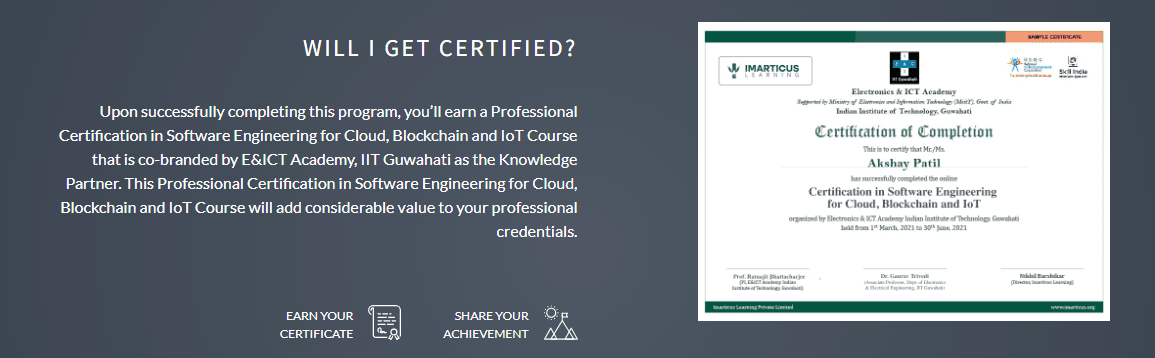
To learn about the implementation of Cloud, Blockchain, and IoT in different industries, you need to invest in a software engineer course. Imarticus Learning has a Certification in Software Engineering for Cloud, Blockchain, and IoT course that offers industry experience and hands-on training to all students. The course is in collaboration with E & ICT Academy and IIT Guwahati. Therefore, you will get to interact with industry experts and academicians in the field of software engineering. You can develop the necessary job-relevant skills and learn several interesting concepts.

These include data source and networking, IoT Cloud, IoT big data processing, build and deployment of different Cloud applications, Blockchain development as well as Cloud DevOps. Once you complete the course, you will become a successful Cloud DevOps engineer and there will be plenty of job opportunities for you. Imarticus Learning also offers career services.

The instructors and mentors focus on your areas of interest and help you land jobs in those fields. You will also learn essential soft skills and establish contacts that will help you in your professional life. 

The Cloud DevOps engineer certification from Imarticus Learning includes a Capstone project. The project enables students to experience how the industries can benefit from software solutions. It will help you become more confident in your skills and thus, have a successful career.

Here’s are 7 reasons on how to determine the software engineering in cloud, blockchain, and IoT technology is the right fit?

The increasing data production demands more resilient, efficient ways of collecting and managing information. The Internet and the rapid development of computing devices have enabled us to have a digital and physical world merged together. Indeed, data can be collected from pretty much any device and registered in servers instead of local data warehouses.

Information can be verified between involved parties and encrypted to ensure its transparency and safety. This new world in which technology plays a central role has its limitations that can be overcome by a new generation of IT professionals.

New-Age Software Engineer

Software development has gone into the trends, using edge-cutting technologies, pacing up to the latest inventions, and creating new business applications. As the industry grows, scalability, users’ trust, and some other technical issues arise as well. One of the main issues is the lack of qualified professionals. Getting into the new-age software poses a set of advantages that will be explained briefly in the following paragraphs.

  1. High-Demand Job Market: these cutting-edge technologies are revolutionizing economies. Every industry will need to adapt, create new processes, and enable digitalization. This means the job market will be increasing in the upcoming years.
  2. Flexibility in Career Prospects: new roles are being created around the new technological breakthroughs. Career opportunities will be diverse: developers, architects, designers, managers, quality and assurance engineers, business developers, brokers, marketers, advisors, consultants, etc.
  3. Applications in Every Industry: apart from being trendy technologies, they also have applications in every kind of industrial sector. This flexibility allows you to focus your career on any economic activity. You can also work for governments and intergovernmental organizations.
  4. Have a Real Impact on the Industry: becoming an expert in this new industry, gives power to your opinion. Start a career in which you can collaborate to shape solutions and see a tangible impact on digital products.
  5. Improve Your Salary: an emerging complicated, yet fascinating domain brings better remuneration. Blockchain, IoT, and computing engineering have very attractive salaries for software developers.
  6. Be in an Emerging, Innovative Sector: an interesting, innovation-driven industry. Be part of this new domain, construct, prototype, and code in an advanced scientific environment.
  7. An Industry Full of Challenges To Overcome: the lack of maturity of the technology poses huge challenges in its future development. However, this allows new professionals to challenge themselves and push limits forward.
  8. Learn How To Adapt Your Skills to Incoming Trends: as part of the new-age employee force, you will be in touch with the last trends on the market, being able to upgrade constantly your skills and upskill your profile to the uncertain future.

 Imarticus As Your Career Developer

Are you willing to be a part of the innovative new generation of tech professionals? With the Imarticus 9-months extensive course in Cloud, Blockchain, and IoT Software Engineering course, you can take off a future-proof career.

Adapt to the upcoming trends learning in-demand skills, from industry experts, develop an impressive GitHub portfolio and get a software engineer certification from one of the most prestigious institutions in India. Our Certification in Software Engineering for Cloud, Blockchain, and IoT program enhances the job opportunities of students as we offer an advanced career assistance service with access to industry and private networks. 

Conclusion 

New-Age software development is a trendy, emerging field that is creating new job opportunities. New-age professionals will benefit from a promising sector, developing a unique career path. Are you interested in new technologies? Imarticus offers you a Software development certificate online course that will give you the tools to skyrocket your career. Apply now and get the benefits from being on an innovative tech path! 

best software engineering courses