Learn about the various perceptions and misconceptions surrounding cyber security

For a subject that has such a significant impact on the day-to-day activities of companies and particulars, the field of cyber security happens to be surrounded by a series of misconceptions that might cause an overall loss of interest from both, general and knowledgeable audiences. Not only this is prejudicial because it could affect their performance in a negative fashion, but also because these wrong perceptions put them at risk from different perspectives.

Have you ever found yourself in the middle of a discussion about a trending subject where you notice that you are basically repeating ideas and statements that you have read online as your own? Maybe you found these in an opinion article, perhaps you saw a few comments about a controversial post and learned them by heart, but never stopped to properly digest the information and generate your own point of view?

This situation is most common than you would think, and it is precisely this kind of interaction, where the participants might or not be aware of their lack of knowledge, and they speak and state about a theme they do not know much about, using someone else’s words, and eventually convincing themselves it is a topic they know and understand, where misconceptions come from. Sometimes it is more dangerous to know a little part of the story but believe you know it all than knowing nothing but being aware of it.

However, this situation is easy to remediate with little time spent in research and analysis. Keep reading if you think cyber security might be one of these blurry, grey areas to you.

Main misconceptions and other perceptions about cyber security

  1. Only big companies are exposed to cyber threats: Cyberattacks target companies not only based on their size or revenue but also on other numerous factors of interest to them. This means that these kinds of incidents are unpredictable and should therefore be included within the risk analysis of the company, as their consequences could be detrimental to basically any firm.

  2. There is one magic solution to cyberattacks: The agents that represent a cyber threat evolve over time, learning from previous attacks, improving their methods, introducing new technologies, and doing more accurate studies of their targets. The solution to prevent these cyber-incidents cannot be a one-time thing, as it becomes more obsolete every day. Instead, it must evolve and adapt to the new threats in order to increase its ability to identify and neutralize them.

  3. All hackers represent danger: Hackers that practice ethical hacking legitimately attacks systems aiming to identify the weak spots that actual threat agents could take advantage of and use what they find to remediate the vulnerabilities of the structure/system.

  4. Risk assessments deliver full visibility to hazards: Audits are useful to identify potential threats, nonetheless, your resilience should be evaluated taking the context into account, as every individual/company’s response is affected by their particular susceptibility to risks based on their nature and characteristics.

What can I do to be better prepared in case of a cyber security breach?

The unpredictability of cyberattacks is one of the characteristics that make them so dangerous, nevertheless, being prepared with an optimal cyber security system can help you prevent menaces that would otherwise be extremely harmful to your company.

Knowing your weaknesses allows you to correct them, and an excellent way of improving your ability to identify said vulnerabilities is by taking ethical hacking and cyber security courses, as they focus on teaching you how to recognize your potential cyber security breaches and finally remediate them.


How to become a data scientist by optimizing your career

In 2021, many businesses have transformed themselves digitally. Businesses are interacting with customers on digital channels. The digital channels are also helping businesses to provide services round-the-clock to customers. Business organizations have never cared about their IT infrastructure more than now. With accelerating digital transformation, the amount of data produced by business organizations is also increasing.

There is a need for skilled data scientists in the industry that can perform high-end data analysis and extract insights. It is why many young aspirants want to learn data science and secure their careers. Read on to the best way to learn data science and secure your career. 

Roles of data scientists in 2021

Before you go on a job hunt in the industry, you should know about the roles of a data scientist. Some of the tasks performed by a data scientist in 2021 are as follows:

  • Data scientists must collect data from various sources to perform analysis. In starting, data scientists collect unstructured data that makes no sense. However, the unstructured data contains many meaningful insights that will be uncovered after analysis.
  • Once data is collected from different sources, it needs to be cleaned and classified. Redundant data points or outliers need to be removed for high-end data analysis. At present, data scientists use many analytics platforms for faster data cleaning and classification.
  • A data scientist also performs exploratory data analysis to identify the main characteristics of a data set. Via exploratory data analysis, data sources are manipulated to get the answers needed.
  • Data scientists are also involved in developing better analytics models. Analytics models run on algorithms are performing data analysis without any manual support. Data scientists also use new-age technologies to develop better analytics models.
  • Data scientists often collaborate with other IT teams to find loopholes in the IT infrastructure. With analytics results, data scientists try to implement methods that could drive business performance.
  • Data scientists also make data accessible for everyone in a business organization. They represent complex data via several visualization techniques. It makes data easier to understand by every employee of a business organization.
  • Business organizations rely on data scientists to find trends and patterns among data sets. Those patterns are then used to prepare market forecasts and demand forecasts.

Skillset required for becoming a data scientist in 2021

data science online course can help you in acquiring the competencies required by a data scientist. The skills required by data scientists in 2021 are listed below:

  • Data scientists need to be fluent in coding languages like Python, Java, SQL, and MATLAB. A reliable data science online course can help learn the coding languages used by data scientists.
  • Data scientists need to have a sense of the current business landscape in which they are working. Many firms spend funds on data science training with business in focus for their employees.
  • Analytical and data visualization skills are necessary for a data scientist. Young aspirants can undergo data science training to learn data mining, munging, visualization, and reporting.

Which is the best course to learn the skills needed by a data scientist?

Imarticus provides the best data science certification courses for young aspirants. It also offers a PG Program in Data Analytics & ML for working data scientists. Its Data Science Prodegree is also popular among aspirants in India. 

All the data science courses offered by Imarticus Learning follow an industry-endorsed curriculum. The industry-oriented curriculum focuses on teaching industry practices to job seekers. By learning techniques and practices used by data scientists, you will be job-ready. Start your data science certification course to become a successful data scientist!

How big data analytics is used in social media

Almost all of us are familiar with social media in 2021. There are many social media platforms run by different companies in the world. Not to forget, the large number of social media users that have been added in recent years. With the rise of social media, the amount of data produced by different platforms is unmatchable. The likes, shares, and comments across social media platforms contain information regarding user behavior.

It is why business organizations are using big data analytics to make the best use of the data available on social media platforms. Big data analytics is widely used in social media to shape marketing strategies and much more. Read on to know seven ways how big data analytics is used in social media.

  • Omnichannel presence

Many business applications and websites have a social media integration. Customers can log in to a business application using their social media credentials. It helps businesses to collect customer data from social media platforms and use them to provide better services. You can get access to social media posts, browser history, and much more. Since customers have an omnichannel presence, you can collect data from all sources to know more about the preferences of customers.

  • Real-time activity monitoring

Social media is a place where you immediately get to know when someone has liked a post or shared a product link. Businesses monitor the activity of customers on social media to know about their current mood. If a social media user is liking your product posts, you can show them an email quickly to convert them into a customer. No other platform can inform customer preferences in real-time other than social media. Big data is used extensively to collect real-time activity reports on social media.

  • Forecasting

When big data is mixed with modern-day technologies like ML and AI, it can predict customer preferences. Based on customer habits on social media, AI/ML algorithms predict their demands. Businesses then focus on releasing new products/services as per the future demands. For example, when a customer buys something online, the chances of them buying similar products increase.

  • Security

Data vendors cannot illegally transfer customer data to the wrong hands. When customers share data on social media, that data can only be used for business purposes. Your social media data cannot be placed in the wrong hands by business organizations. Big data is used for enhancing the security of social media platforms based on customer suggestions.


  • Campaign monitoring


Marketers run social media campaigns to boost their ROI (Return on Investment). Using big data, marketers can know how well a social media campaign has performed. Young aspirants can go for big data training to know more about how to run social media campaigns and study high-end analytics.


  • Product pricing


When a firm launches its product on social media, customers give their valuable opinions. Social media is widely used to determine whether customers are satisfied with the pricing of a product or not. Big data training includes data collection from social media channels and how to analyze them.


  • Ad creation


Social media is used to collect info about customer preferences. Based on that info, targeted, and personalized advertisements are displayed on social media channels. Technologies like Hadoop programming and Python programming are also used by big data analysts in social media.

Young aspirants can go for the big data analytics programs launched by Imarticus Learning. Its PG Program in ML and Data Analytics can help working professionals in getting a raise. Start your big data course and learn Python and Hadoop programming!

How supply chain snags affect global economic growth

The global economy depends on supply chains that have networks running across continents. This is why any issue with the supply chain can directly affect economic growth. If you learn SCM, you will notice that most of the time, supply chain snags occur due to issues with the management. Now, you can ensure that they have a positive impact on economic growth. To do this, you will have to opt for a supply chain management course

How Can Supply Chain Snags Affect the Global Economy?

Since supply chains are vital for most businesses, any management issue can harm economic growth. Those who opt for a supply chain management career need to be aware of the snags that can affect the global economy. 

  • Fluctuations in Customer Demand

Supply chains often depend on the demands of the customers. But due to various external factors, these demands can fall. When this happens, excess products go to waste. However, at times, customer demands can increase rapidly. If supply chains are not optimized enough to handle such a spike, there will be utter chaos. This can lead to limited products, improper pricing, and issues with the delivery of goods. If global supply chains are unable to meet demands, the economy is bound to suffer. 

  • Shortage of Workforce

While you can optimize several aspects of the supply chain, a human workforce is necessary. A shortage of workforce means less production or a slow-moving supply chain. If the supply chain gets held up due to inevitable glitches, many might quit due to extended periods of no work. When the supply chain starts working again, there will be an inadequate workforce to handle the pressure. This snag can adversely affect economic growth, particularly when production slows down or the delivery of goods stops. 


  • Increase of Freight Rates


Since supply chains are closely related to the global economy, snags may increase freight charges. If shipping routes, particularly for global supply chains, are disrupted, the freight rates will increase rapidly. When businesses cannot pay the costs, that particular link in the supply chain will stop functioning.  

  • A Slowdown of Industrial Activity

A snag in a supply chain can slow down activity in an entire industry. If one part of the supply chain does not move forward, the rest cannot follow. The economy will suffer as vast quantities of raw material go to waste, and the labour force reduces due to certain issues with managing a specific supply chain. 

  • Bottlenecks in Manufacturing and Production

Supply chain bottlenecks can occur anytime, primarily if the supply chain is not being appropriately managed. If there is a supply bottleneck, then manufacturing will be affected. While this affects the availability of products, it can also affect the earnings of those involved in the production stages. 

To understand how an aspect of the global economy is dependent on supply chains, you need to gain extensive knowledge. Learning supply chain planning can help you build the required skills. 

Supply Chain Management for Sustained Economic Growth

Supply chains, when appropriately managed, can contribute to economic growth and even maintain it. To learn about sustainable supply chains, you can opt for a supply chain management course. Imarticus Learning offers Professional Certification in Supply Chain Management and Analytics. This program is in collaboration with IIT Roorkee, DoMs, and E-Learning Centre.

The institute also has various industry experts collaborating to create a well-rounded curriculum. Imarticus Learning ensures that students can understand supply chain management from a strategic and operational viewpoint. This will help you establish a rewarding supply chain management career

The course offered by Imarticus Learning includes supply chain planning and prepares you for the industry through six projects. These are all based on real situations, and you can develop the experience necessary to become a successful supply chain manager. You can also opt for a job in data science, demand planning, or supply and operations planning. 

Why Python for Data Science is Easy to Learn for Beginners?

Why Python for Data Science is Easy to Learn for Beginners?

Python is one of the most popular programming languages for data science. Python offers many advantages that make it easy for beginners, including its user-friendly syntax and powerful libraries. In this blog post, we’ll explore why Python is an excellent choice if you’re new to data science and want a language that’s both fun and effective for getting started.

Why is it easy to learn Python?

  1. Python’s Simple, Clear Syntax

If you’re new to programming or coming from a different language, learning how to code in Python can be straightforward. It has a clear syntax that is often more readable than other programming languages, making it easy to understand. Moreover, Python does not have any mandatory declarations or keywords, which means it doesn’t require a lot of boilerplate.

  1. Python’s Powerful Libraries for Data Science

Python has several libraries for data science, including NumPy, Pandas, and Scikit-Learn. These libraries make it easy to work with datasets, do scientific calculations, and build machine learning models. In addition to these libraries, Python has an extensive collection of modules for specific purposes. Many data science projects are built with libraries included in the standard distribution of Python, making it even easier to work with them.

  1. Community Support for Data Science in Python

The vast majority of courses on data science use Python as the teaching language. It means that if you’re new to data science, there are more resources available for learning python than for other languages.

Though many beginners find it easy to learn Python programming basics, data science often requires a deeper understanding of Python’s application in practice. For example, you need to know which algorithm will work best for the problem at hand with machine learning projects. Python has an active community of users who continually contribute to its success by contributing to open source projects and data science-related blog posts.

Is it possible to learn python training for beginners?

Absolutely! While working in Python requires more effort than in other languages, many online resources help you get started with data science in Python.

There are also plenty of books, courses, and tutorials available that will guide you through topics such as machine learning algorithms, visualization tools, and statistical concepts. As you can see, there are lots of reasons why Python is an excellent choice for beginners.

Learn Data Science with Imarticus Learning

A postgraduate program is for corporate experts to help students master real-world Data Science applications from the ground up and construct strong models to provide business insights and forecasts. The program is for graduates and early-career professionals (0-5 years) who want to grow their careers in Data Science, the most in-demand job skill. With this program’s job assurance guarantee, students may take a significant step forward in their careers.

Some course USP:

  • This Data science courses with placement assurance aid the students to learn job-relevant skills that prepare them for an exciting career.
  • Impress employers & showcase skills with a certification endorsed by India’s most prestigious academic collaborations.
  • World-Class Academic Professors to learn from through live online sessions and discussions. It will help students understand the 360-degree practical learning implementation with assignments.

Contact us through the live chat support system or schedule a visit to training centers in Mumbai, Thane, Pune, Chennai, Bengaluru, Delhi, and Gurgaon.

How long term modeling of our future energy system can be mapped with artificial intelligence and machine learning

Today, technology and sustainability are the main axes of development. To secure the planet and continue the growth of industry, we are engaged in a global energy transition. Most countries have become aware that measures must be taken to address a problem that, if not curbed, will have catastrophic consequences for the environment and, of course, for human beings themselves.

However, such a transformation requires the support of technology and, because of the enormous amount of data, artificial intelligence and machine learning courses are the basis to ensure the advancement of the energy sector. At Imarticus you can join the postgraduate program in data analytics & machine learning (AIML).

Technology as a tool

Changing the energy paradigm of the last century will be an arduous and complicated task. That is why new technologies have a lot to say as tools to facilitate evolution. The Internet of Things, machine learning, artificial intelligence, and Big Data will be key to making the processes of change as effective as possible. Massive data analysis must become a fundamental pillar for transforming how energy is generated, transmitted, and distributed.

Artificial Intelligence allows us to handle enormous quantities and analyze them logically and reasonably. About energy, in particular, we have data on meteorology, health, or the behavior of the people involved in the system: who generates electricity, who transports and distributes it, and who consumes it.

Data that, when properly analyzed, can provide a tailor-made understanding of the sector. The development and implementation of intelligent systems must not only facilitate the massive introduction of alternative energy sources but will also have the task of achieving rationalized storage of this energy, as well as providing greater flexibility for the demand, i.e. the people who use it.

Three levels of analytics can be applied: descriptive, to know what information is available and where to apply intelligence, predictive analytics, to anticipate production or demand, and prescriptive analytics. With the data, we work on predicting production, including renewable energies and demand, with the implementation of smart meters. In addition, technical and non-technical incidents, such as energy fraud, are detected. All of this is aimed at optimising the energy model, with the resulting economic and environmental benefits. We will see a huge take-off in the number of professionals who will choose to pursue a machine learning career.

Tools for the consumer

In this scenario, smart meters and internet-enabled sensors will be commonplace, which will improve our energy use while at the same time making it possible to bring costs in line with what each individual actually consumes.

Thus, machine learning will automate processes, while artificial intelligence will make it possible for devices to work automatically and learn from consumers’ habits. This will also be possible on a large scale, so that the operation of future solar or wind power plants, to give just two examples, will be more effective in a shorter space of time.

In this respect, we should note that although everyone is involved in the energy transition and awareness must start in every household, the technology will be geared towards people having little to do in terms of reducing consumption and costs.

Artificial intelligence-based models and predictions facilitate and will continue to be a major advantage in mapping energy systems. What is most surprising is that this is just one of the many applications of these technologies. If you want to contribute to the change, you can sign up for AI and ML courses by E&ICT Academy, IIT Guwahati.

Establish your career as a digital procurement and contracts advisor in the supply chain management and analytics industry

Do you know why you should future-proof your career with a professional certification in supply chain management & analytics (SCM)? Nowadays, companies highlight the need to digitize their business processes in order to have more competitive, resilient, and flexible supply chains.

For this reason, those companies that have not yet started down this path have rethought their short and medium-term strategy by committing to the digitization of their supply chains. It is therefore the perfect time to take a logistics and supply chain management course.

What do we mean by digitizing the supply chain?

When we talk about digitizing the supply chain, we are referring to the introduction of advanced technology for management from the generation of demand or the purchase of raw materials to delivery to the end customer, including sales, production, logistics, and transport, and focusing on critical and key points such as inventory management, supplier relations, delivery control, and smart order management.

Why digitize the supply chain?

This technology makes it possible to reduce and/or eliminate tasks that lack added value in daily management and helps companies to deliver their products and services faster, more efficiently, at a lower cost, with higher quality and a better level of service.

Correct implementation and management of the new systems will add value to the business through smooth planning and execution of operations, getting the maximum profitability of each activity. This is achieved because today’s planning systems provide end-to-end visibility of the supply chain, allowing managers to monitor and track the status of all tasks occurring in real-time (at suppliers, plants, warehouses, distribution centers, etc.).

This continuous traceability will enable the identification of inefficiencies and potential problems, improve decision making and contribute to overall business growth.

Other notable benefits arising from the digitization of the supply chain are as follows:

  • Reduced delivery times: thanks to greater visibility and traceability in orders and greater availability of information, the status, and location of each order will be monitored at all times, allowing for real-time incident resolution, or more agile and intelligent decision making. 
  • Improved collaboration: supply chain managers, their suppliers, and customers will be aware of what is happening at all times and will be able to share crucial information dynamically and in real-time, which increases efficiency and fluidity in the management of the entire chain. 
  • Cost reduction: digitization will help reduce overall costs by optimizing inventory management, creating more accurate forecasts, improving demand planning, etc.

Thanks to digitization, this supply chain management course will make you able to make decisions that mitigate risks, give companies a competitive advantage in the marketplace, and optimize virtually all operations at a minimal cost.

In the face of competition, investing in supply chain digitization has become a necessity, as it has been proven that those who have already implemented specific supply chain technology solutions, as well as those who have developed solutions based on their ERP (enterprise resource planning), are now able to significantly improve their efficiency, performance, and productivity, as well as quickly monetize their investment.

It is clear that to keep up with the advancement of business, it is necessary to get at least one logistics and supply chain management course. To stay ahead of the competition, this supply chain certification prepares you for today’s challenges with a practical and up-to-date understanding of the industry.

How digitization through artificial intelligence and machine learning technologies has gained momentum post COVID-19?

In just a few months, the COVID-19 pandemic has managed to do what normal times would have taken years to achieve – a paradigm shift in the way companies in every industry and sector do business. Artificial intelligence and machine learning have been at the forefront during these challenging times. 

As the world gradually finds its way back to usual ways of life, it is interesting to see how the global crisis has paved the way for behavioral shifts, learning, and innovation. 

AI and ML in the Post-Covid-19 World

With the acceleration of digitization through Artificial Intelligence (AI) and Machine Learning (ML), digital sales have seen a boost, and businesses have focused their tech investments on cloud-based products and services. From online grocery stores and EdTech sites to online pharmacies and OTT players, the post-COVID-19 world looks very different through the AI and ML lens.

So, here are some examples to show how AI and ML technologies have gained momentum post-COVID-19:

  • AI and ML have been impacting the healthcare industry since long before the pandemic hit. AI algorithms have and continue to help in quickly sifting through large datasets to help identify similar diseases and their possible cures to accelerate the COVID-19 research work. 
  • AI and automation technology have also eased the healthcare sector’s administrative load by automating various processes. For example, data processing algorithms to extract data from internal systems and automatically generate medical reports and necessary audit trails have gained momentum post-pandemic. 
  • Also, advancements in ML will continue to help create new revenue streams. For example, scientists, drug researchers, and pharma companies are increasingly turning to AI and ML data processing algorithms to facilitate vaccine and drug discovery and their possible impacts on people. 
  • Lockdowns and social distancing norms have boosted online markets and the digital economy. However, even when the pandemic is gradually ebbing, customers are expected to continue using doorstep services as they did during the peak crisis. Hence, technologies like Augmented Reality (AR) and Virtual Reality (VR) have increased among eCommerce platforms to deliver a better customer experience. 
  • Talking about customer experience, the online retail industry has ramped up its use of AI chatbots and smart assistants to attend to the ever-increasing numbers of digital customers. Hence, the use of AI has helped streamline digital services, online ordering, and delivery systems. 
  • The pandemic has given rise to a digital workforce. To this end, the use of AI to quickly process applications, scan for eligibility and qualifications and perform other mandatory hiring checks has become the norm and is only expected to increase in the near future. 
  • The financial sector has also seen a dramatic rise in the use of AI and automation to serve its customers better and quicker during challenging times. For instance, banks leverage AI to help customers safely upload documents, categorize them and expedite processes without any delay. 
  • Lastly, greater digitization has also increased the risks of cybersecurity threats during the pandemic. While conventional cybersecurity risk management systems have failed to keep up with evolving cyber threats, AI offers innovative defenses. The pandemic has only nudged organizations to adopt holistic approaches to cybersecurity through AI and ML and create an integrated security system. 

How to Find the Best Artificial Intelligence Course?

If you want to learn AI and get a certification in AI and ML, opting for an online course can be the best call. But before you sign up for the course, ensure that it offers hands-on experience with real-world projects and has a curriculum with extensive coverage of concepts related to machine learning, NLP, deep learning, data science, and computer vision. 

Discover the critical facets of supply chain management and analytics with this certification

Supply chain management and analytics is a rapidly growing field that requires the expertise of both supply chain managers and data analysts. The advanced skill set needed to succeed in this profession means that certification can be an excellent way to build your career and improve your chances for advancement.

In this article, we will explore some of the critical facets of supply chain management and analytics with a focus on certification and how it can help you grow professionally.

What is Supply Chain Management and Analytics?

  • The supply chain is transforming raw materials into a finished product that is delivered to customers.
  • The entire process involves manufacturing, transportation, warehousing, and distribution of goods, and necessary information flows within an organization or across companies in the value network (suppliers/customers).
  • Supply Chain Management (SCM) includes all activities required for effective planning, execution, and control of global business processes that connect suppliers to manufacturers through logistics providers, whereas Analytics refers to data analysis for decision-making purposes.
  • SCM has evolved over time from traditional hierarchical management structures towards collaborative governance among various stakeholders involved in end-to-end value chains.
  • It involves disintermediation where most transactions take place between trading partners rather than via intermediaries such as banks or wholesalers.
  • Analytics plays a major role in such collaborative governance by providing decision-makers with fact-based insights and analytics to make better-informed decisions for managing global supply chains while considering the complexities involved in the process.

Why Certification Matters?

The ACP offers a wide range of certifications in supply chain management areas to help professionals stay abreast of rapidly changing technologies and enhance their credentials. Both the Supply Chain Management Professional certification program and Certified Analytics Professional (CAP®) certification are among popular ones for individuals aspiring to make a career in the analytics field.

At present, there is no specific degree or diploma programs that can provide an individual with the necessary knowledge across diverse business functions involved in the supply chain management process; hence professional certificates issued by global organizations such as APICS play a vital role in invalidating one’s skillset.

The CACP/CAP Program provides two certifications — CSCP Certification helps professionals work on large-scale complex projects involving application design, development, integration, and supply chain planning, execution, collaboration, & optimization solutions.

On the other hand, CAP Certification is designed for individuals with expertise in data management and analytics who can help organizations take advantage of big data and complex algorithms to drive better decision-making.

How to Become Certified in SCM&A?

– Individuals can prepare for these certifications by taking a Supply chain Management course, attending webinars, and reading books/journals on the subject.

– To earn CSCP or CAP Certification, one needs to pass a relevant certification exam based on knowledge of supply chain concepts. There are no prerequisites for this exam; however, having some work experience in a related field will be beneficial.

Build Your Career in Supply Chain Management and Analytics with Imarticus Learning

The Professional Certification in Supply Chain Management and Analytics offered by Imarticus Learning provides a cutting-edge experience for supply chain aspirants. This 6-months program is uniquely designed by IIT faculty and industry leaders to help you learn. With the ever-increasing trend of e-commerce, the amount of movement of goods has been ever-increasing. There has been a disproportionate jump in the number of jobs for SCM across industries.

Course USPs:

  • Cutting-edge curriculum and certification from e-learning center, IIT Roorkee
  • Experiential learning & impressive project portfolio
  • SCM and analytics – a power couple
  • Learn through real-life industry projects.

What to Look for in a Business Analytics Certification

As a business analyst, you should always “think outside the box,” but what does that mean? To help show our readers how they can think outside of the box when it comes to their career, we have put together this list of some things you should look for in a business analyst certification.

You might be wondering what you should know about Business Analytics Certifications, especially if you already have some technical background. The world of BI is overgrowing and is moving towards real-time reporting, so check out the types of certifications available.

What is a Business Analytics Certification?

To understand what business analytics certification means, let’s define the term certification. Certification is a process through which an authoritative third party recognizes an individual or company with expertise in a particular subject/skill.

Business Analytics certifications allow data professionals to demonstrate their knowledge of Business tools and techniques in business intelligence, predictive analytics, data mining, reporting, and more.

Unlike traditional enterprise software certifications (e.g., Oracle or SAP), Business Analytics certifications are vendor-neutral, which means they focus on the BI tools themselves rather than on a particular vendor tool suite.

How to become a successful business analyst?

If you are starting with your career in data analytics, the first thing to do is look at vendor-neutral certifications that can help build your foundation for success.

Business analyst certifications are generally into three separate categories: 

 Professional Certifications: Also referred to as entry-level or foundational credentials, professional-level certification programs provide a broad understanding of reporting and analytics capabilities.

Expert-Level Certifications: Also referred to as mid-level credentials, expert-level certification programs provide a more profound knowledge of Business tools and techniques in predictive analytics, data mining, or survey analysis.

Master-Level Certifications: Also referred to as advanced-level credentials, master-level certification programs focus on providing an even deeper understanding of Business tools and techniques in areas such as data visualization, dashboarding, or a particular industry.

Benefits of Business Analyst certification:
best Agile business analyst courses

  1. A business analyst certification proves that you have the expertise to succeed in the field of data analytics.
  2. It helps you master your tools and techniques, leading to increased productivity and efficiency.
  3. Certification increases your salary potential (up to 10%) and can help you earn a promotion or find a new job.
  4. It provides a sense of accomplishment and can give you the confidence to offer even better Business solutions for your organization.

Explore and learn with Imarticus Learning

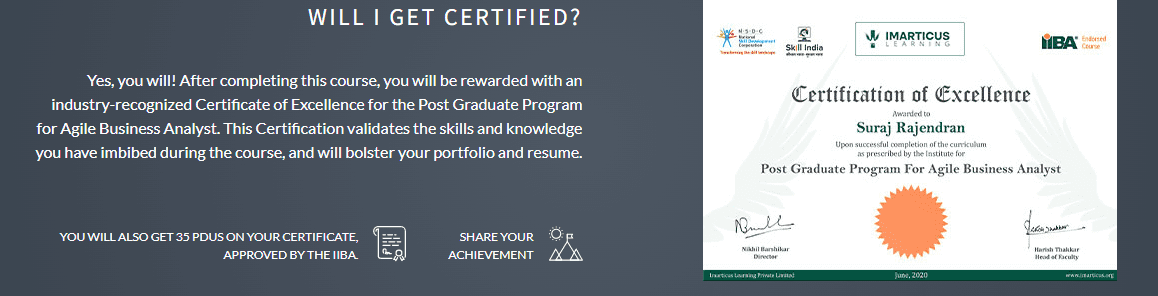
The Agile Business Analyst course is a six-month program that will prepare students for the tasks of an Agile Business Analyst. This placement-driven curriculum teaches students how to handle current business analysis processes with appropriate tools and approaches through several case studies, role-playing exercises, and hands-on training.

Some course USP:

  • This business analyst certification for students aids the students to learn job-relevant skills.
  • Impress employers & showcase skills with the best analyst Course endorsed by India’s most prestigious academic collaborations.

World-Class Academic Professors to learn from through live online sessions and discussions.