Tips and tricks for a successful career in AI and machine learning

Tips and tricks for a successful career in AI and machine learning

Artificial Intelligence (AI) and Machine Learning (ML) are two of the most in-demand skills in the tech industry today. And with good reason, these cutting-edge technologies are transforming how businesses operate.

Learning about these technologies is the best way to prepare and excel in this change.

So, if you’ve ever wondered about making a career in AI and ML, you’re in the right place. Here are five tips and tricks to help you succeed in this exciting field.

1. Define Your Goals and Narrow Your Focus

Do you want to become an expert in a specific area, or do you want to use these technologies to solve particular problems? 

Once you have a clear goal in mind, you can start to narrow down your focus area. For example, if you want to use ML to solve problems, you may want to focus on data mining, predictive modelling, or natural language processing. 

To become an expert in a specific area, you may want to focus on research or developing new algorithms. Whatever your goals, it is essential to choose a focus area you are passionate about to stay motivated and succeed in your AI and ML career.

2. Build A Strong Foundation

A career in AI or ML can be enriching, but it requires a strong foundation in both theoretical and practical skills. It is essential to work with data and have strong math skills.

You’ll need to understand algorithms and data structures well and experience working with large data sets. Familiarity with popular AI and ML libraries and frameworks will also be helpful. 

Plenty of resources are available online in the form of courses and in libraries to help you get started. You can also consider an AI or ML certification to dig deeper into the subject.

3. Develop A Portfolio Of Projects 

One crucial aspect of any successful career in AI and ML is having a solid portfolio of projects. This portfolio can showcase your skills and abilities to potential employers and help you land your desired jobs. 

When developing your portfolio, choose projects highlighting your strengths and showcasing your skills. If you’re starting, you may want to consider choosing smaller tasks that you can complete quickly. As you gain experience, you can add more complex projects to your portfolio.

There are a few things to keep in mind when developing your portfolio of AI and ML projects:

  • Make sure to choose projects that are interesting to you and that you can complete within a reasonable timeframe.
  • Try to choose projects that will showcase your skills in both AI and ML.
  • Don’t be afraid to ask for help from others when needed.

With these tips in mind, you’re well on your way to developing a solid portfolio of AI and ML projects.

4. Find A Mentor

Finding a mentor is critical for anyone wanting a successful career in AI and ML. 

A mentor can provide guidance, support, and advice regarding career choices and opportunities. Having a mentor can also help you stay motivated and focused on your goals. It allows you to navigate the often-complex world of AI and ML and can provide invaluable insights.

Your mentor is someone who has already made the journey you’re looking to complete. You can find your mentor in your workplace, social media platforms, communities, etc.

5. Network

In today’s competitive job market, having a solid professional network is more critical than ever. 

A strong network can provide access to mentors, colleagues, and collaborators who can help further your career in AI and ML. In addition, networking can help you find a job, get promoted, and advance your AI and ML career. 

By networking with other AI and ML experts, professionals can stay up-to-date on the latest trends and developments, share ideas and best practices, and find new opportunities.

You can get involved in the ML community, whether attending meetups or conferences or participating in online forums.

You can look for online platforms and communities to find enthusiasts like yourself and network with them.

Conclusion

The field of AI and ML is constantly evolving, so it’s essential to keep updated about these changes. 

But if you’re starting, learning the basics will require you to enrol for AI and ML certification. And if you wish to learn from the best of the best, check out Imarticus Learning’s dedicated Artificial Intelligence and Machine Learning course in collaboration with the Indian Institute of Technology.

Imarticus Learning offers chat support and has excellent training centers in Mumbai, Thane, Pune, Chennai, Bengaluru, Delhi, and Gurgaon. Please reach out for further clarity.

Imarticus in the news: Best education brand in Analytics

Imarticus Learning in the News: Best Education Brand in Analytics

In an event ceremony organised in Delhi, Imarticus Learning was awarded the Best Education Brand in Analytics, 2022. In its 5th year, The Economic Times – Best Education Brands 2022 had the attendance of eminent dignitaries from the field of education and leadership. The guest list included personalities like Dr. Ranoj Pegu, Hon’ble Education Minister, Government of Assam; Mr. KK Aggarwal, Chairperson, National Board of Accreditation (NBA); Dr. Anil Sahasrabudhe, Chairman, All India Council for Technical Education (AICTE).

We, at Imarticus Learning, have always trusted the power of academics and education, and we are extremely thrilled to receive an award for being the best EdTech Company in analytics. Our achievements in the domain of analytics will inspire both students and new players. That will be beneficial for the collective good of society. 

How did we Achieve This Distinction? 

We have always been motivated by an innovative and collaborative spirit at Imarticus. This motivation constantly drives us to put extra effort into the development of courses of inclusive learning, which provide a great experience in person. If a student gets extra attention from the brightest minds, then they also improve their performance and become better with their skill sets.

We shall continue bringing newer and advanced concepts with the best analytics programs to our learners. We aim to become more than just the best education brand in analytics in India. Our aim is to create a platform that is accessible and helps the Indian youth to be ready for the professional field.

Mr. Nikhil Barshikar, the CEO of Imarticus, received a prestigious award at this event. He dedicated this achievement to all the students, faculty, staff, alumni, and partners of Imarticus. He thanked everyone involved for his/her unshakable loyalty and support.

This event organised by Economic Times brought together the best education brands and emphasised the importance of the role that the education sector has been playing. It has constantly been nurturing tomorrow’s leaders.

So, receiving an award as prestigious as this will only boost our confidence and prompt us to achieve greater success in the coming years.

Our Aim and Vision

India is one of the most populous countries in the world. Hence, the scope of the education sector is massive. Even though there are various prominent educational institutions in the country, they can only seat a selected few.

So, does that mean others will be deprived of a world-class education? Well, no, and the aim of Imarticus Learning is to fill that gap.

Our vision at Imarticus Learning is not just to become the best EdTech Company in India, but we strive to serve society too by providing an opportunity for everyone to access the course from leading universities and be ready for the challenges of the professional world.

Imarticus is a rare organisation that uses its aspirations to fuel the students’ ambitions by providing the highest quality of education. Our curriculum is approved by global academic institutions, and they aim to solve a problem. To elaborate, the focus here is not only on providing a course of study just to gain knowledge, but we, at Imarticus Learning, emphasise creating better professionals too who will solve critical problems in the coming days. So, our courses focus more on the application part of a subject rather than just its theoretical knowledge.

This award recognises our contributions to becoming one of the best and most reputed education brands in the country and also at an international level. That is why we are making a significant impact on the analytics sector with cutting-edge technology and a globally reputed curriculum.

What Else Happened at the Event?

The Economic Times – Best Education Brands event was a meeting and union of leading thought leaders who have been leading from the front in starting educational reforms. They have been contributing with both expertise and better financial setups in the education sector.

What’s Next?

In recent years, new and reputed brands have helped transform India into a knowledge sanctuary. They are developing individuals in the field of analytics. Analytics as education is increasingly gaining importance in the complete progress of India as a nation. The development of academic infrastructure will be the key focus in the present decade. In this situation, there will be an investment in academic infrastructure. Subsequently, the education sector will see much progress in the next ten to twenty years.

Speakers at this event also stressed the significance of encouraging pioneering institutes in the space of higher academics. An EdTech company like Imarticus Learning could help reshape the education sector and prepare the Indian youth for a fast-evolving world. 

2022 Data science job trends, careers and industry insights

2022 Data science job trends, careers, and industry insights

Without data, everything is just an opinion. And business decisions are not made on opinion; they are made based on facts and details. This is where a data scientist enters the business realm. 

But, what is data science exactly? Well, data science is the study of large volumes of data using advanced technology and programming tools to extract meaningful information from them. These data points serve as the foundation for making both primary as well as key and strategic business decisions.

Today, data scientists are quite high in demand in the job market. This can be primarily attributed to two reasons – the growing shift of businesses to the digital space and rise of the consumer behavioral analytics. 

Suppose you also want to ride this wave of growth in the space of data analytics. In that case, you can learn data science by getting enrolled in our Certificate Program in Data Science and Machine Learning and saying yes to your data science career dreams!

Top Data Science Job Trends and Industry Insights 2022

If you aspire to make a career in the field of data science, you must keep your skill set and knowledge base updated for the following job trends in the domain –

  • Demand For Data Scientists Increased by Over 30%

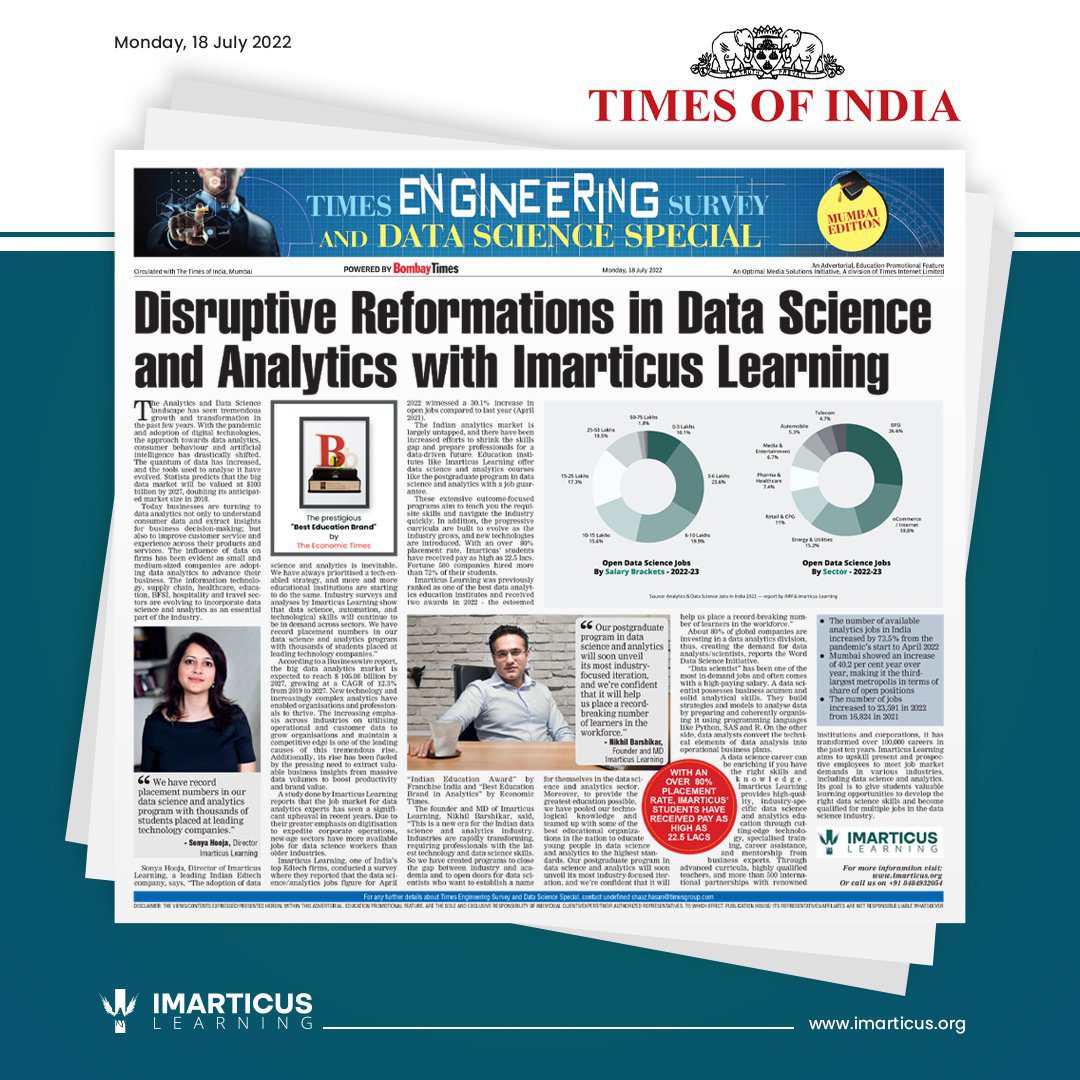
The demand for data scientists in India increased by 30.1% in April 2022, as compared to the last year. With this, India’s share in the global demand for data scientists increased from 9.4% in 2021 to 11.6% in 2022.

  • BFSI Sector Emerged as the Biggest Employer for Data Scientists

In FY2022, the BFSI sector accounted for the highest demand (26.6% ) for data scientists in India, according to the latest Analytics India Magazine (AIM) report. After the BFSI sector, the e-commerce and internet space hired the largest number of data scientists in the country.

  • Bengaluru – The New Hub For Data Scientists

The city of Bengaluru created the maximum number of Data Science jobs in India in 2022, with as many as more than 51,000 positions. This can be attributed to the city’s bent on the IT sector and the presence of several emerging startups and unicorns there. After Bengaluru, Delhi-NCR registered the highest number of data science jobs.

  • Employers Prefer Engineers Turned Data Scientists

In 2022, the majority of Individuals who got hired for data science job roles belonged to the engineering stream. As high as 56% of them were engineering undergraduates, and 25.9% were engineering masters. Non-engineering undergraduates comprised 35.2% of the sphere, whereas MBAs accounted for 17.4% of the hires.

  • Most Popular Data Science Designation – Business Analyst

As many as 39% of the data science jobs which were advertised in 2022 came with the designation of ‘Business Analyst’. The second-most popular title in the space, appearing in 34.6% of the job openings, has been that of ‘Data Engineer.’

A Sneak Peek into Data Science Careers

To bag a job in the data science domain, you need to have a good mix of both technical and non-technical skills.

Top Technical Skills For Data Science Career

Today, organisations are hiring individuals who are not only good at evaluating data using basic data analytics software but who can also automate them using augmented analytics technologies like Artificial Intelligence, Machine Learning, and Natural Language Processing (NLP) for real-time insights.

You must also be well equipped with programming languages like C++, Python, R, Java, and SQL and data visualization tools like Tableau to get your desired data science job. Knowledge of platforms like Hadoop and Apache Spark is also a plus.

Top Non-Technical Skills For Data Science Career

Just being technically sound is not enough; you must also possess the following non-technical skills to make a career in the field of data science – 

  1. Analytical skills
  2. Ability to work and collaborate in a team
  3. Good communication skills to translate your understanding of data to the stakeholders

Final Words

Data Science has been touted as the future of jobs, not only in India but all over the world. 

According to the latest Mckinsey report, almost all organizations will become data-driven, becoming a default setting. This indicates that in the near future, the reliance on data and the need for data scientists will only be a steep upward curve. So, if you wish to make a career in this emerging and growing field, you must start now and get a data science certification in India.

For detailed guidance and advice on the data science course, contact us through chat support, or drive to our training centers in Mumbai, Thane, Pune, Chennai, Bengaluru, Delhi, and Gurgaon. 

Building A Data Science Portfolio From Scratch

Building A Data Science Portfolio From Scratch

Data Science is one of the most popular fields of work, especially among the millennials and Gen Z. But what is it exactly? Well, it is the field of study of tons of data to extract meaningful information for efficient and effective decision-making.

If you aspire to be a data scientist, it is important for you to understand two things really well. Firstly, you should be a master of your skills be it programming languages, use of statistical methods, or data visualisation, you should know all of these in and out. 

If you are looking for a short-term online course, which will help you upskill and enhance your knowledge base, come join our Certificate Program in Data Science and Machine Learning with iHUB DivyaSampark @IIT Roorkee.

Besides learning the concepts and methodologies of data science, you must also focus on building a strong portfolio of your work in the domain. Unlike management and engineering professionals, creating a resume is not enough to get your desired data science job.

You must have a strong portfolio of your projects and overall profile so that you can stand out among millions of other applicants. As part of our data science online training, we also teach you how you can build an impressive profile for yourself from scratch along with grooming you for mock interviews! So, what are you waiting for? Come join us today and take the first step toward your bright data science future.

Tips to Build An Awesome Data Science Portfolio From Scratch

Following are some of the tried and tested strategies that you can make use of to build an amazing data science portfolio – 

  • Let Your Portfolio Reflect Your True Passion

It is often said that you should fake it till you make it. But, that’s not advisable when it comes to your work portfolio. Mentioning projects and interests in your portfolio which look fancy but fail to inspire you does not help get the job you really want. 

Your portfolio must be authentic. It should capture who you want to be and the projects you like or wish to work on in the future. You can do this by walking recruiters through your journey in the field, and what inspired you to enter the data science space. 

  • Highlight Your Strong Technical Understanding

Data Science is all about how well you understand all the technical concepts and implement them to solve real-life problems. You must mention all the data science certification courses completed by you along with the projects you have worked on, highlighting the specific techniques of which you made use. 

There are two important things which you must remember in this regard. Firstly, don’t clutter your portfolio with all the ML techniques and projects which you have worked on, mention only the important ones. The second thing which you must keep in mind is that you must customize this section as per the requirements of the job you are applying for. This helps you grab the attention of the recruiter and rank among relevant profiles.

  • Show Off Your Communication Skills

In order to solve complex real-life problems as a data scientist, you must possess good communication skills so that you can effectively translate the identified data insights to the leadership so that they can make key strategic decisions. Thus, you must showcase how good you are as a communicator. 

You can do so by mentioning narratives along with your work samples. Highlighting your strong communication side also helps recruiters understand how you approach problems and infer data to solve them.

  • Limit the Length of Your Portfolio to One Page

While creating a work portfolio, think like a recruiter who has tons of applications and profiles to go through. Keep the portfolio short in length, but to the point to ease the job of the recruiter by bringing their attention to the qualities and skill set they are looking for.  While doing this, ensure that your portfolio is well organised and categorised to speed up the screening process.

Take Away

Your work portfolio is like your first impression for the recruiter who can be offering you your dream data science job. Thus, it is important to get this first impression right by creating a stunning portfolio that highlights both your technical and non-technical skills. Your portfolio should mirror your capabilities, knowledge base, and your zeal for the role. 

Still unsure how to go about it? Feel free to contact us through chat support, or just visit our nearest training centers in Mumbai, Thane, Pune, Chennai, Bengaluru, Delhi, and Gurgaon. We are always happy to help you!

Explore Machine Learning: Here’s How to Find Your Way Through the Data Science Maze

Explore Machine Learning: Here’s How to Find Your Way Through the Data Science Maze

The term ‘Machine Learning’ was coined in 1959 by then-IBM computer scientist Arthur Samuel while designing a computer algorithm for the classic game of Checkers. Today, this term is immensely popular owing to the technology’s wide application across industries.

But what is Machine Learning or ML? It is a computational method that is used to obtain artificial intelligence by making a machine learn how to solve problems on its own rather than requiring explicit programming software. 

Machine Learning is widely used in the field of data science as it helps find the way through tons of data instantly and accurately! But how? By using statistical methods and algorithms to train computers so that they can accurately classify data sets and make reliable predictions to uncover key data insights.

Does all this sound interesting to you? Do you aspire to use advanced Machine Learning technologies to solve real-life problems and arrive at data-driven solutions? If yes, then you should check out our data science courses which are equipped with not only data mining techniques but also machine learning tools along with Python, SQL, and Tableau.

Machine Learning Concepts Which Every Data Scientist Must Know About

Data science learners must be able to develop a solid foundation and specialise in machine learning with Python for data-driven decision-making. Ultimately, you want to assist organisations to make smart decisions for growth and offer insightful data analysis.

Following are some of the key Machine Learning tools which you must know about if you are aspiring for a data science career:

  • Clustering

CLustering is the simplest unsupervised ML method that lets the algorithm define the output for mining data. The most famous clustering method is ‘K-Means’ under which the letter ‘K’ refers to the number of clusters into which the miner wants to divide the unlabelled data. 

The clustering method is used for drawing analysis in varied fields such as for creating customer segments for different marketing techniques as well as for identifying earthquake-prone areas.

  • Neural Networks

If you are interested in the Deep Learning subset of ML, then you must know Neural Networks in and out. Neural Network is a network of algorithms that identify patterns or relationships among different data points in a set in a way similar to the working of a human brain. 

It is widely used for making forecasts and improving decision-making in fields like stock market trading, medical diagnosis, etc. You can learn more about neural networks in our data science online training programs.

  • Regression

Regression is one of the fundamental supervised ML techniques which help data scientists in creating predictive models by defining a relationship between dependent and independent variables. 

There are various types of regression models, however, broadly they can be classified into three groups: Simple Linear Regression Model (SLRM), Multiple Linear Regression Model (MLRM), and Logistic Regression.

  • Natural Language Processing (NLP)

Natural Language Processing (NLP) forms the basis of Machine Learning as it trains machines to learn the language of humans. You can find some of the everyday applications of NLP in voice-controlled applications like Apple’s Siri, Google Assistant, Amazon’s Alexa, etc. NLP is also found in execution in the fields of text summarization and sentiment analysis. 

  • Ensemble Methods

The concept of the Ensemble Method is quite similar to that of assembling. For instance, if you are not happy with all the car options available in the market and wish to come up with a car design, you can assemble your favorite car parts of different cars and design a car of your choice. 

Similarly, if as a data scientist, you are not convinced with the results of different predictive models, you can combine all of them to arrive at better predictions.

  • Transfer Learning

Transfer Learning is one of the efficient ML techniques which lets you use parts of previously programmed neural nets to develop a similar model. For instance, if you are a data scientist who has developed a technique to filter different styles of men’s clothing in buckets like shirts, t-shirts, kurtas, etc., you can use parts of transfer learning to develop a mechanism that can be used for categorising women’s clothing in say, dresses, jumpsuits, tops, etc.

Takeaway

Machine Learning has become a crucial part of the data science field today, which has made the process of analysing and predicting data faster and more accurate than before. 

Be it for real-time navigation, or product recommendations, as a data scientist you will always find Machine Learning and Data Science going hand-in-hand. And the future of data science is expected to be even more promising with the advancements in ML techniques and methods.

Thinking of kickstarting your data science career? Contact us through chat support, or just visit our nearest training centers in Mumbai, Thane, Pune, Chennai, Bengaluru, Delhi, Gurgaon.

Our Certificate Program In Data Science And Machine Learning is created by iHUB DivyaSampark at IIT Roorkee and will instruct you on the fundamentals and features of data science and machine learning and give you the skills necessary to put these ideas into practice and apply them to real-world issues.

IIT Machine Learning: Introduction To The Machine Learning World

Machine Learning has been a buzzword in recent years, possibly due to the large quantity of data produced by applications, the rise in processing power, and the development of better algorithms.

Machine Learning is employed everywhere, from automating monotonous operations to providing sophisticated insights; companies in every area are attempting to capitalize on it. You could already be using a gadget that makes use of it. 

Introduction to the machine learning world

You may apply machine learning in prediction systems as well. Supervised learning, reinforcement learning, and unsupervised learning are the three categories of machine learning. The computer is given a set of training data together with the intended output and subsequently learns how to produce the desired output using the training data. This process is known as supervised learning. 

When the computer gets a collection of data but not the intended result, it must learn to recognize the structure in the data on its own through unsupervised learning. Reinforcement learning is where the computer gets a set of data and a reward function, and the computer has to learn to produce the desired output to maximize the reward.

Machine learning is a powerful tool that may apply to many tasks, including predictions, voice recognition, and face and facial expression detection. 

Application of Machine Learning

 Speech recognition is the procedure of converting spoken words into text. Speech dialing, call routing, and appliance control are all examples of voice user interfaces. You may also use it for simple data entering and structuring papers.

One of the popular uses of machine learning is image recognition. It recognizes items, people, places, digital photos, etc. Facebook has an auto friend tagging recommendation option. When we submit a picture with our Facebook friends, we instantly get a tagging recommendation with their names, powered by machine learning’s face identification and recognition algorithm.

Machine learning techniques are currently widely employed in various voice recognition applications. Google Assistant, Siri, Cortana, and Alexa use speech recognition technologies to respond to spoken commands.

Machine learning is a subtype of AI that allows machines to learn from data, improve performance based on previous experiences, and make predictions. 

Learn Machine Learning and AI courses with Imarticus Learning

Become an AI engineer by attending the E & ICT Academy deep learning Artificial Intelligence certificate course. Students will benefit from this IIT Machine Learning Course as they prepare for jobs as data scientists, data analysts, machine learning engineers, and AI engineers.

Course Benefits For Learners

  • Students work on 25 real-world projects to get industry experience and prepare for a rewarding career in data science.
  • You may impress employers and exhibit your abilities with an E & ICT Academy, IIT Guwahati, and an Imarticus Learning-endorsed credential.
  • This machine learning certification will assist students in obtaining lucrative professions in artificial intelligence and machine learning.

10 Beginner-Friendly Steps To Learn Machine Learning

10 Beginner-Friendly Steps To Learn Machine Learning

Machine Learning is believed to be the future of data science. According to Forbes insights, the global Machine Learning market is valued at $21.17 billion and is expected to surpass $209.90 billion by 2029. But what is Machine Learning? 

Machine Learning is an advanced technology for making machines learn to work without direct programming or commands from humans. It uses various statistical methods and algorithms that help computers and software identify patterns and produce the desired results.

If you aspire to learn Machine Learning and explore the field of data science, you can start with the steps provided below:

Step 1: Learn Python

The first step toward mastering Machine Learning is learning a programming language to analyse data and derive meaningful insights from it. The most popular programming language in this regard is Python. 

Step 2: Sharpen Your Mathematical Skills

Brush up your mathematical and statistical concepts like probability, regression, calculus, linear algebra, and hypothesis testing. These are necessary as they come in handy for designing and understanding different algorithms and predictive models.

Step 3: Understand How Machine Learning Works

Once you have mastered a programming language and revisited mathematical concepts, you can start picking up different Machine Learning concepts. For starters, you can research the different types of Machine Learning and their applications. Essentially, there are three types of Machine Learning concepts: Unsupervised Learning, Supervised Learning, and Reinforcement Learning.

Step 4: Get Hands-on With Data Science Tools

Start learning different data science tools like the Jupyter Notebook, Anaconda, Apache Hadoop, etc. These tools teach you to create and share documents containing codes, equations, and data visualizations.

Step 5: Learn How To Design and Select Algorithms

An algorithm is a set of rules you use to process a data set. Since a data set contains a large number of data points that are varied in nature, a single algorithm cannot be used to solve it. Thus, you must know how to design diverse algorithms and select the ones that can be used for different data sets. You will acquire this skill only with practice and over time. 

Step 6: Learn Data Visualisation and Manipulation

To implement Machine Learning, you must be able to visualise data with the help of software like Tableau to make sense of it. For this, you must familiarise yourself with software like NumPy, Pandas, and Matplotlib. These tools teach you to visualise and manipulate data and extract meaningful information.

Step 7: Build Your First Machine Learning Model

Once you have mastered all the preliminary tools and software, you should devise your first Machine Learning model. You can use any online platform to create your machine learning model. 

Step 8: Tune Your ML Model

After devising your Machine Learning model, use it to train an algorithm over a data set and see how it works. Based on the results, tune it and add features that can improve its accuracy and speed. 

Step 9: Learn Deep Learning

Move on to acquire Deep Learning skills as Machine Learning works well only with small sets of data; to deal with large sets, you need to know Deep Learning. 

Step 10: Get Practical Experience

As a final step, get some hands-on experience to test your knowledge and skills. You can take up projects or join a Machine Learning internship. Practical experience will help you implement theoretical concepts and boost your confidence by providing actual results.

Take Away

Machine Learning is a rapidly evolving domain. If you aspire to make a career in Data Science and Machine Learning, it will be helpful to start as early as possible. You can either learn the fundamentals through free resources on the internet or take up paid courses to get a better understanding. 

Imarticus Learning offers a certificate program in data science and machine learning, a 5-month weekend course offering comprehensive understanding and live training facilities by the IIT faculty and industry experts. Feel free to contact us through our chat support. You can also visit your nearest training center in Mumbai, Thane, Pune, Chennai, Bengaluru, Delhi, and Gurgaon. 

AI Engineer Course: Understand Design Gamification In Grammarly

AI Engineer Course: Understand Design Gamification In Grammarly

As an AI engineer, it’s essential to understand the design of gamification in grammar tools like Grammarly. You can create more effective AI applications by understanding how to use grammar in these tools.

Grammarly is a popular grammar tool that uses gamification to help users improve their writing. The tool gives users points for correct grammar usage and provides feedback on their writing.

Understanding how grammar gets used in Grammarly can help you design more effective AI applications. If you can understand how users interact with the tool, you can create AI applications that are more effective at helping users improve their writing.

What is gamification, and how can it help grammar learning?

Gamification is using game aspects to persuade people and solve issues in non-game environments. Gamification, as a creative, productive, and exciting learning activity, may be utilized as an educational tool to improve learning outcomes in the twenty-first century.

The tone of writing is one of Grammarly’s most intriguing aspects. To offer better suggestions, a user may easily customize the tone and audience of their writing. 

Grammarly also offers its customers a weekly writing update check-full of writing insights and more. It analyzes its users’ content in real-time to deliver the proper suggestions.

The benefits of using gamification in grammar learning

Communicating clearly and effectively in today’s fast-paced world is more important than ever. Grammar is critical to effective communication, and many people struggle with mastering it. Gamification can be a great way to learn and practice grammar.

There are some key benefits of using gamification in grammar learning:

  • It can help make the learning process more fun and engaging.
  • It can help improve retention and understanding by providing a more interactive learning experience.
  • It can help improve motivation and focus, as the learner actively engages in learning.

Consider gamification if you’re looking for more fun and effective way to learn grammar. It just might be the boost you need to improve your communication skills. Gamification is a fun and effective way to learn grammar. Providing a more interactive learning experience can help improve retention and understanding. Additionally, it can help improve motivation and focus, as the learner is actively engaged in the learning process.

Learn Machine Learning and AI courses with Imarticus Learning.

Become an AI engineer by attending the E & ICT Academy deep learning Artificial Intelligence certificate course. Students will benefit from this AI course as they prepare for jobs as data scientists, data analysts, machine learning engineers, and AI engineers.

Course Benefits For Learners

  • Students work on 25 real-world projects to get industry experience and prepare for a rewarding career in data science.
  • You may impress employers and exhibit your abilities with an E & ICT Academy, IIT Guwahati, and an Imarticus Learning-endorsed credential.
  • This AI Certification will assist students in obtaining lucrative professions in artificial intelligence and machine learning.

Contact us through chat support, or drive to our training centers in Mumbai, Thane, Pune, Chennai, Bengaluru, Delhi, and Gurgaon. 

Understand Quality Metrics Of Chatbot Training Data: Data Analytics Beyond Training In 2022

Understand Quality Metrics Of Chatbot Training Data: Data Analytics Beyond Training In 2022

A chatbot is a software or a computer program that simulates human communication or “chatter” via text or voice interactions. Chatbot analytics, also known as conversational analytics, chatbot analytics, bot analytics, and chatbot intelligence, is a valuable tool for directing business chatbot trials. This post will help you understand the quality matrix of chatbot training. 

What is chatbot analytics?

Users increasingly use chatbot virtual assistants in business-to-consumer and business-to-business environments to conduct simple tasks—chatbot analytics evaluate previous bot conversations to get insights about chatbot performance and customer experience. 

The work of a company as a chatbot developer does not finish when their bot goes online. Because of the increased competition in every business, customer experience has become a critical driver in establishing a competitive advantage. After a company introduces a chatbot, it is the right time to monitor how users interact with it.

Understand Quality Metrics Of Chatbot Training Data

Once you recognize how a chatbot works, you can use chatbot analytics and metrics to analyze its success. You can continuously monitor response time, conversion rate, and efficiency enhancement with KPIs to significantly increase it.

Goal Completion Rate: GCR is at the top of our list since it accurately assesses your chatbot’s effectiveness by collecting the proportion of successful user interactions with the chatbot.

Engaged Users: These are active users who have daily or weekly discussions with your bot. The active users recognize the value of employing your chatbot. They enjoy utilizing your bot and continue to patronize your company.

Conversation starter messages: Interactions between the consumer and the bot are bidirectional, and the number of times the bot begins the discussion serves as the foundation for the next measure.

Bot Messages: This indicates the total number of messages sent by the bot during a discussion. We want this statistic to be high since it measures the length of the dialogue between the consumer and the bot.

In Messages: This category displays the user’s messages. We need to know if the user interacts with the chatbot. We don’t need to utilize a chatbot if this category is deficient.

Miss Messages: These are messages that our chatbot is unable to process. This measure may be difficult to compute. The number of times the chatbot misinterprets the input.

Data scientists and data engineers are now among the most in-demand employment categories worldwide. Finance and insurance, retail, healthcare, information technology, and telecommunications have opened their doors to data analytics specialists.

Discover Data Science Certification with Imarticus Learning

Learn how to apply data science in the real world and create predictive models that improve business outcomes. This data analytics course with placement is suitable for recent graduates and professionals looking to advance their careers in data science and analytics. Students can now master data science skills by participating in 25 in-class, real-world projects and gaining practical experience through hackathons, capstone projects, and mock interviews.

Course Benefits For learners:

  • Learn the fundamentals of data analytics, machine learning, and the most in-demand data science tools and methodologies to become job-ready.
  • These concentrated sessions with hands-on exercises make learning more effective and efficient. 
  • Students can clear all of their doubts in live sessions and take part in discussions throughout the course.

Contact us through chat support, or drive to one of our training centers in Mumbai, Thane, Pune, Chennai, Bengaluru, Delhi, and Gurgaon. 

The best stream to opt for becoming a data scientist

The best stream to opt for becoming a data scientist

Data science tops the list of the most wanted jobs in the technology world. Data scientists are highly demanded in all the major industries like retail, marketing, health & medical, manufacturing, and many others.

In a nutshell, any data-centric organization can’t simply operate without a data scientist and hence it is the hottest career option in today’s time. If you want to become a data scientist but don’t know how to become one, this article is for you. Keep reading to learn about the best stream for becoming a data scientist! 

Which Stream to Choose for Becoming a Data Scientist? 

Data Science is a field that is open to all types of aspirants. Although people with a technology background can have more edge than the others, anyone with the required skills and problem-solving attitude can join the field. 

Remember that there is no specific requirement for a degree needed to become a data scientist. All it takes is a specific skill set, interest, and passion to enter this field. A good understanding of the contextual applications around streams like maths, statistics, computer science, physics, engineering, etc. is necessary. However, this doesn’t mean if you don’t belong to these fields, then you can’t be a data scientist. You can because people from fields like commerce or medical have transitioned their careers as data scientists by developing the required skill set. 

How to Become a Data Scientist?

To become a data scientist, it is very important to have a solid base of statistical programming skills. Further knowledge in data visualization, linear algebra, and programming is a must. A bachelor’s degree in computer science, maths, IT, physics, or any other related field is also required in the field. Alternatively, you can also become a data scientist by taking the right data science course from a recognized institute. 

To become a data scientist you should be analytical, curious, and skilled enough to ask the right questions from the right customers with an aim to extract as much data as possible. The right academic background combined with the right skill set can set you on the right path to joining the data science industry. 

Skills Needed to Become a Data Scientist? 

The most important skills required for securing a job as a data scientist include proficiency in programming languages like Python and R, among a few others. These skills can be easily developed through training and practice. 

Below are the other sought-after skills to become a data scientist

  • Mathematics 
  • Statistics 
  • Risk management 
  • Cloud tools
  • Programming languages like Python, R, Java, SAS, SQL, AWS, etc. 
  • Big Data experience 
  • Data Engineering 
  • Software Engineering 
  • Product Management 
  • Neural Networks 
  • Quantitative and Qualitative Skills 
  • Dashboard working experience 

These are the main skills that are required for a data scientist job. The best part is, that anyone can learn these skills through a variety of courses and study material available on the internet. Alternatively, you can also learn data science online by taking a data scientist course, which includes all of the above modules. 

Ready to Build the Required Skillset 

Even if you’re from a computer science and mathematics background, you can’t become a data scientist if you don’t have a passion for data science. This field requires passion and interest more than any specific background, always remember that. When you have passion, your life becomes much more interesting in the data scientist profession. 

As long as you’re willing to work on yourself and learn programming and other skills we’ve talked about, you can become a successful data scientist – it will not matter if you’re a teacher or a lawyer!

Sure, studying subjects like maths, computer science, and statistics gives you an upper hand, however, the field of data science doesn’t restrict anyone if they have the right skills. 

And that’s all about it. 

What stream should I select for becoming a data scientist? The answer is, more than choosing a stream, work on the required skill set for building a successful data scientist career. So, don’t wait anymore and take up the right data scientist course or certification to learn data science online!