Skip to content
Imarticus Learning
  • About
Contact Us
×
  • About
  • Contact Us

Category: Analytics

How To Use Logistic Regression in Python?

Posted on August 14, 2021April 11, 2024 by Imarticus Learning
How To Use Logistic Regression in Python?

Logistic regression is amongst the most popular machine learning (ML) algorithms. If you are learning about machine learning and its implementation, then you must be well-acquainted with this algorithm as it forms the basis for many advanced algorithms.

Python tutorialIn the following Python tutorial, we will discuss what logistic regression is, and how you can use this machine learning algorithm through Python while using Python for data science.

What is logistic regression?

Logistic regression refers to a machine learning algorithm used for classifying data points. It is a supervised learning algorithm, which means that it maps inputs to output according to the example pairs of the input and output.

Even though logistic regression is a simple algorithm, it has many applications in various sectors such as detecting spam, identifying cancer, and predicting diabetes.

The reason why it is called logistic regression is that it operates quite similarly to a linear regression algorithm. Notably, linear regression is another simple and highly popular machine learning algorithm.

How to use logistic regression in Python?

To perform logistic regression in Python, you will need to follow several steps. The first prerequisite is to be familiar with the algorithm and programming in Python. You should know the fundamental theorem behind logistic regression to use it effectively.

The steps for using logistic regression in Python are:

  • Installing the required Python packages (Matplotlib, NumPy, scikit-learn, and StatsModels)
  • Getting the data to train and test the model
  • Preparing the data, including cleaning it and fixing missing values
  • Transforming the data into the required form
  • Making the classification model
  • Training your model with the available data
  • Testing the model to check its accuracy
  • Optimizing the model until it has reached the required accuracy

You only need to follow such a small list of steps while using Python for this algorithm.

How to pursue a career in data science?

Data science is a broad field and the machine learning algorithm we discussed above is only a small fraction of it. If you are interested in pursuing a career in data science, then we recommend taking a data science course in India.

Investment Banking CoursesTaking such a course will help you learn the various concepts present in this subject including several machine learning algorithms and the use of artificial intelligence (AI). You can get a data science certification India-based that teaches you the latest in-demand skills for this field quickly and efficiently.

A well-reputed data science certification India-based would teach you big data, data visualization, SQL, statistics, R, Apache Spark, and many relevant skills necessary to become an expert. Moreover, having a certification will make it easier for you to stand out from your peers and become a preferred choice among the recruiters.

Learning about machine learning algorithms can be very interesting. If you are keen on learning about Python for data science through a Python tutorial, then it would be best to complete a data science course in India. And, to learn logistic regression effectively, you should practice it in different use cases. You can check out our data analytics course here.

Posted in AnalyticsTagged learn python, Python Programming Course, python online training, Python career, Machine Learning through Python, Python tutorial

Top 10 Data Visualisation Tools

Posted on August 13, 2021November 29, 2023 by Imarticus Learning


Top 10 data visualization tools

As the internet and technology become more complex and multi-faceted, there is a significant increase in data across industries. Data storytelling is an intrinsic part of any business, whether big or small because the truth lies in the numbers! Visualizing this data is far from easy, but with the advancement of intelligence, there are tools aplenty that help visualize data, track key information and build business and strategic solutions to scale.

An effective data visualization tool is one that allows users to choose from visually stimulating displays of data and track trends in your industry or field– all the while being easy to use. Here are the top 10 data visualization tools that you need to step up your analytics game:

  1. Sisense

Sisense uses agile analysis software, making it one of the most common names in the data analytics field. With an easy-to-use drag and drop interface, Sisense allows you to pull out key data from a big dump and arrange it in the form of dashboards and graphic presentations. Their interactive dashboards feature allows sharing between individuals, clients, and organizations.

  • Periscope Data

This powerful analytics tool allows users to compact all data sources into one functional dashboard. Entire organizations can share data on Periscope, making it perfect for dynamic work environments. Their custom visualization feature allows those familiar with R and Python to create interactive displays of data.

  • Zoho Analytics

In Zoho, the spirit of collaboration is strong. The business analytics platform uses tools to generate valuable data reports. What’s more, users can embed these reports directly into blogs, websites and landing pages for easier sharing with a customer or client base.

  • Tableau

Seamless transitioning from desktop to mobile is the draw of this business intelligence system. Flexible data approaches allow users to select from pre-designed approaches to bring up a report or data representation that’s unique to a company. Their 24/7 technical help center and drag-and-drop interface also earn it brownie points.

  • Microsoft Power BI

From the tech titan Microsoft comes the Power BI, a whole suite of business analytics tools that quickly convert complex data into interactive visuals. It’s also one of the more affordable options– its free version allows individuals to play around before dropping any money on it.

  • Klipfolio

Klipfolio is special in that it’s connected to a repository of not less than 500 data sources– some web-based such as Google Analytics and social media platform Twitter, and others ‘in-house’. Its customizable dashboard and pre-built templates allow for quick and easy data visualization for beginners.

  • IBM Watson Analytics

IBM Watson is definitely one of the more commonly-known business intelligence software. The tool allows for custom dashboards and a list of templates facilitate easy report creation. The intelligent software answers your questions when you type them in and three different packages allow any organization, from small-scale to enterprise, to play around on it.

  • MATLAB

MATLAB is one for the diverse range of users– amateurs to tech experts. The data analysis tool can rope in data from various sources and deliver real-time updates. Its in-built graphical tools allow for quick and steady designing of visuals and reports. The analytic algorithm itself can be played around with– only minimal changes to the program required.

  • SAP Analytics Cloud

This software is packed with collaborative tools and events management features. Import and export tools allow users to download and share spreadsheets, graphics, and visuals. The real-time analytics can be used to generate forecasts for your next big business strategy. Further, the system allows teams to set up processes and events.

  1. Kibana

A data visualization and analysis software, Kibana is equipped with a unique feature– Elastic Stack– that facilitates observation of different data sources for comprehensive or real-time reports. Its anomaly detection feature makes it a running contender against all other big data names out there.

Good data visualization software opens up conversations within organizations and represents complex data in clear, effective and interactive manners. Dashboards, graphics, and interactive reports allow viewers to engage with data, facilitate deeper learning and show progress and statistics.

Over time, effective data visualization tools allow companies to track progress, forecast key events and generally maintain terrific records of their data in crystal-clear formats.

For more details, you can also visit – Imarticus Learning and can drop your query by filling up a simple form through the site or can contact us through the Live Chat Support system or can even visit one of our training centers based in – Mumbai, Thane, Pune, Chennai, Banglore, Delhi, Hyderabad, Gurgaon, and Ahmedabad.

Posted in AnalyticsTagged data analytics, Data Visulization

What is Business Analytics and Why do You Need it For Success?

Posted on August 13, 2021March 22, 2024 by Imarticus Learning
What is Business Analytics and Why do You Need it For Success?

Are you interested in pursuing a business analytics career? Then you have come to the right place. In the following column, we will explain what business analytics is and how it helps businesses grow. You will also find out how you can pursue a career in this field. Read on…

What is Business Analytics?

Business analytics is an interdisciplinary field that uses computer science, statistics, and machine learning (ML) to enhance the decision-making process of an organization. Its goal is to generate valuable insights that help a company make smarter decisions based on data. Business analytics focuses on narrowing down which datasets are valuable and how to use them to enhance productivity, efficiency, and growth.

It analyses data from multiple sources including CRM tools and cloud solutions. Business analytics relies on machine learning algorithms to find insights from the collected data which would be invisible otherwise. The generated insights help the decision-makers of the organization to forecast future results and the outcomes of the various choices available to them.

Business analytics uses descriptive, predictive, diagnostic, and prescriptive analytics. Selecting one from these different forms of analytics depends on the problem and situation.

Benefits of Business Analytics

There are many advantages of using business analytics. And, following are some of the most prominent ones among them:

Measuring progress: By using business analytics, companies can evaluate their current position more accurately. It allows them to consider multiple factors at once and figure out how much progress they have made in a financial year (or longer duration).

It helps them understand the factors that contributed to their progress and plan accordingly.

Predicting outcomes: Business analytics helps a business determine its trajectory, where it is headed, and what it should expect. Companies can find out the probable outcomes of various situations and modify their future strategies accordingly.

business analytics courses in IndiaBusiness analytics also helps them mitigate risk as they can identify and evaluate the risks surrounding them and their various ventures more accurately. A popular application of business analytics is evaluating investments.

Understanding competition: A company must know what its competition is doing and how it is making progress. Business analytics courses help them evaluate their competitors and find out which factors put them in their current position.

Just as a company can predict its own trajectory by using business analytics, it can forecast the trajectory of its competitors as well.

Learn Business Analytics

As you can see, there are many advantages of business analytics. Due to its versatile application and utility, companies in various industries are on the lookout for skilled business analytics professionals. That is why now is the perfect time to start a business analytics career. If you are interested in entering this field as a professional, then you will need to learn business analytics properly.

There are many business analytics courses in India which you can join. Enrolling in well-reputed business analytics courses in India will help you learn business analytics, its various concepts, and skills better, while also getting certified as an expert.

Having a certification will help you showcase your expertise as a business analytics professional and stand out from your peers. Recruiters prefer certified professionals over others as they have the assurance of their skills and knowledge.

In a nutshell, business analytics is a robust skill that helps companies improve their efficiency, productivity, and planning. The demand for business analytics is also rising rapidly. If you want to learn more about how to pursue a career in this field, then you can check out this business analytics course.

Related Article:

https://imarticus.org/the-growing-need-of-data-storytelling-as-salient-analytical-skillbig-d/

Posted in AnalyticsTagged big data courses in India  . big data analytics courses, career in business analytics, Big Data and Hadoop, business analytics online training, Business Analytics courses in India, Business Analytics career

15 Questions to Ask at Machine Learning Interview

Posted on August 13, 2021October 15, 2021 by Imarticus Learning
15 Questions to Ask at Machine Learning Interview

There has been a lot of debate about what are the most common machine learning interview questions during an interview. Some say a proper knowledge is required for answering the questions of machine learning while some say knowledge of python programming is enough to crack machine learning interview questions.
Here are some commonly asked questions about machine learning which is very important to know if the user is interested in machine learning online training.

Clearly explain dimensionality reduction stating its usability and benefits?

The process where the number of featured variables is minimized, taking into account a set of principal variables, can be termed as dimensionality reduction. Now it can be said that dimensionality reduction technique can be used in order to know how much a variable can contribute to representing the information. The technique that is mostly preferred and also used to know the contribution of a variable are nonlinear and trial and error technique. Some of the benefits of this process are known to be speeding computation, minimizing storage space and reduction in data dimension.

How can a user handle missing or corrupted data in a data set?

The best possible way to find a corrupted data in a data set is by replacing the variable with another value or by introducing new column and rows. Now it has noted that are few other techniques to find the missing data are known as the fillna() method and other is known as the dropna() and insull() method.

What is clustering algorithm?

Clustering algorithm can be defined as the unsupervised learning technique which used for finding out the structure of an unlabelled data. This clustering could be defined as the data which is similar in their orientation but dissimilar when compared to other clusters.

How can exploratory data analysis or EDA can be performed?

The main goal of this algorithm is to find out the information about the data before it is being applied to any model. Basically when EDA is performed the IT professionals look for some global insights which is to check out the mean variable of each specific class. After this action is performed then the IT professionals run a panda known df.info () to check for any of the variables are categorical or continuous like int, float or string.

How to decide on which machine learning model to use?

In deciding which machine learning model to use one should always keep the no freelunchtheorem at the back of their mind. Now if the user wants to estimate a direct relationship between the output variable and single variable then choosing a single regression model or multiple regression model is the best choice. Now if the user wants to determine complex nonlinear relationships then choosing neutral network model is the ideal choice.

How to use convolutions of pictures instead of FC layers?

This can be explained in two parts, firstly the users need to derive the information from the image since FC will have no actual information. The second part is using convolution neural networks which is useful since the FC acts as its own detector.

What makes CNN translation invariant?

Now it has to be noted that each convolution acts on its own way or acts as its own feature detector meaning if the user wants to perform image detection then convolution acts as a own feature detector. Now it is irrelevant where the image is since convolution will be acted in the entire image.

Why is there max polling classification in CNN’s?

CNN’s contains max pooling classification because it has the ability to minimize the computation process since the feature maps tend to be smaller in size than that of pooling. In addition, with the help of max poling classification of more translation can be found invariance.

Why does CNN’s have encoder-decoder style or structure?

CNN’s have the encoder-decoder structure for two reasons, firstly the encoder is helpful in extracting the feature network and the decoder is used to decode the image in segments and thenupscale it back to its original size

What is the importance of residual networks?

One of the major importance of residual networks is that it allows access from the past or previous layers of data. This access allows the flow of information to be smooth throughout the network.

What is batch normalization and how does it work

The technique where each input layer gets modified as the previous layers tend to change is known as the batch modification. The batch normalization mainly works by making a standard deviation to be 1 and the output to be zero.

How to handle imbalance data sheet?

Datasheet could be handled with the few basic steps. Some of these include:

  • Using class weights.
  • Using the training examples again and gain.
  • Avoid any under sample if the data is too large.
  • Use data augmentation.

Why machine learning is using small kernels instead of large kernels?

The use of small kernels is due to the fact that, with smaller kernels proper receptive field can be known. Since smaller kernels use small computations and fewer parameters it is possible to get more mapping functions and even more filters.

Can there be any other projects which can be related?

In order to draw relations with some other projects, the user doesn’t need to think a lot. The user just have to think over the facts which connect the research to business.

Explain the current master’s research? What worked? What did not? Future directions?

Current master’s research basically means which algorithms can be used to determine the value of coefficients and which model is best suitable for use. The use of machine learning algorithms worked a great deal but the single regression technique did not give the values correctly. Future directions would taking the time and doing research first before jumping to anyconclusion.

Conclusion

Thus from the FAQ, it can very well be said that these are some of the most common machine learning online training questions that the user can encounter during the course of online study. Furthermore, these questions also provide a glimpse of python programming which serves as an asset to the machine learning.

Posted in Analytics

How The Machine Learning Will Improve Education In The Future?

Posted on August 12, 2021October 15, 2021 by Imarticus Learning


Education has definitely moved away from the teacher facing a classroom of students all using the same textbook. Today the learning experience is internet and ML dependent for data, technology, and digital resources, No wonder the education system is deeply invested in machine learning.

Let us explore how a machine learning course of AI is going to bring its benefits to the education experience of the future. The class sizes keep increasing with compulsory education and teachers are often facing many challenges in giving attention and help to the large numbers of students. A big challenge like this has been simplified by incorporating computer programs with ML algorithms that allow each student to follow his own pace and learning curve.

The newer methods of experiential learning at educational institutions use advanced techniques of AI, machine learning and deep learning in instructing and teaching like chatbots and learning bots. A differentiated machine learning course and AI style of learning deal with the most effective style to help the student learn.

Adaptive based learning curates the learning exercises matching them to the student’s needs and knowledge gaps. Competency-based AI tests aid the students to gauge their learning levels and progress from thereon. Using all these three types of learning, ML and AI can together test how well the students adapt their learning to applications and thus promote the progress of students based on individual interests.

What is machine learning? 

The definition of ML- machine learning is that it gives the AI the ability to self-learn from data, mimicking the human brain and is based on statistical techniques. The algorithm used need not be supervised or explicitly programmed. Almost all ML applications in education work very closely with concepts that are interconnected with artificial learning, deep learning of data, neural networks based on complex self-learning algorithms and the very basic concepts of a horde of machine learning course based applications helping machines do repetitive and intuitive tasks most times more accurately and better than humans themselves.

The benefits of machine learning in education:

Here are some ways in which ML makes a difference in the educational experience of educators and students.

Aid the educators: Data mining is the basis of ML and how well it performs. Forming a single repository of the students in one database, ML can effectively study each student’s behavior versus his peers. Thus ML can help cluster similar students and pace them better throughout the learning experience with the right resources and learning materials.

Gives insight to a student’s performance: One of the huge pluses of ML is the ability to give insights and make predictions based on data of a student’s performance. The ML technology can identify gaps and weaknesses to help students stay ahead of the curve.

Capacity to test students: ML can offer both offline and online tests and guidance that helps students to revise, relearn and evaluate performances. Both educators and students can benefit from their foresight and insights. The AI and ML-based tests and multiple choice answers also test the practical application of knowledge and not just rote learning.

Fair gradation of students: ML removes any bias in grading and scoring. The objective style tests and assignment answers can now be automatically assessed with tools like Grammarly or Turn It In. Both online and offline resources, MOOCs and such can be integrated into the learning process.

Experiential and customized learning: Personalizing the experience and offering near-instantaneous feedback is a huge advantage of ML. Both students and teachers can now benefit from knowing how to fill the knowledge gaps.

Content and feedback are instantaneous: ML is excellent at organizing content, task lists, learning resources, colleges, schools information and much more, to personalize the studying for each student. This helps students grade themselves and progress up the ladder with the suggested courses.

Through identifying weaknesses, machine learning can organize content more effectively. For example, as students learn one skill, they move on to the next skill continually building upon knowledge.

Drop-out rate reduction and retention: Corrective action can be applied rapidly if knowledge gaps persist and are identified by ML. This prevents higher drop-out rates while improving retention levels.

Availability based tutoring: This means ML will facilitate the student’s needs with an available expert tutor for effective learning and tutoring.

Conclusions:

Yes, technology and ML especially will transform the educational experience with more and more algorithms being developed by the minute. If you want to learn all about how to make a career in this field then do a machine learning course at the reputed Imarticus Learning Institute. Now is the right time to jump onto the bandwagon. Why wait?

Posted in AnalyticsTagged machine learning courses, machine learning training, machine learning certification, Artificial Intelligence

How To Become Data Analyst After 12th?

Posted on August 12, 2021January 20, 2024 by Imarticus Learning
How To Become Data Analyst After 12th?

Data science, especially data analytics, is becoming the most desired job in the world with time. With multiple job positions and abundant opportunities, it is only wise to opt for data science courses after 12th or graduation. Students aspiring to be data analysts need to have a clear picture of how to become a data analyst and what data scientists do.

The first thing that an aspirant needs to know is that data analytics is a subset of data science, and hence knowing what is data science is paramount to learning what data analytics is.

Why a career in data analytics?


As data is becoming the most essential commodity to organizations worldwide, it is only wise to opt for a data science course in India. There are many benefits of data science courses and the most important one is that you can start a career in data analytics.

Business analytics courses will also boost the knowledge of a candidate in data analytics as it will help in understanding the domain better. Before understanding the requirements let us list the benefits of a job in analytics:

  • There are many job opportunities in the domain. Thousands of vacant positions are only waiting to be filled by qualified candidates
  • The salary of a data analyst is even higher than that of an IT professional
  • There are different domains within data analytics that can be a great option for career and salary growth
  • A challenging and stimulating work environment with a great work-life balance
  • An elite lifestyle

What are the requirements to become a data analyst?

You can opt for data science courses after 12th for UG. But, there are further options to start a data science course in India even after UG at PG or doctorate levels. You can also opt for certifications and diploma courses after the 12th.

At the postgraduate level, you can opt for a specialization in computer management and computer science to start your analytics career.

For pursuing a postgraduate program, a bachelor’s degree with a minimum of 50% marks is required, preferably in computer science or data science and from a recognized university.

Apart from educational qualifications, several soft skills like analytical and numerical skills are important for pursuing a career in data analytics. Further, a deep and thorough understanding of computer software and programming languages including querying languages (like Hive, SQL, and Pig), scripting languages (including Python and Matlab), statistical languages (such as R, SPSS, and SAS), and Excel is a must.

Besides, data analysts must possess problem-solving and interpretive skills to explain and present the process of data analysis and its results to decision-makers.

A data analytics course can help a student after 12th to bag high-paying jobs like data scientist, data engineer, database administrator, data analyst, and data architect. If you want to expand your job horizon, then you can even choose to do business analytics courses to end up in even higher positions with better commissions.

Posted in AnalyticsTagged data analytics online training, Career Options after Graduation, How to become Data Analyst, certifications and diploma courses after 12th, Business Analytics Course, data analytics career, Data Analytics Course, Big Data and Hadoop

Take Advantage of This Once-In-A-Lifetime Opportunity To Express Your Ideas And Win Fantastic Prizes.

Posted on August 11, 2021May 30, 2025 by Imarticus Learning
Take Advantage of This Once-In-A-Lifetime Opportunity To Express Your Ideas And Win Fantastic Prizes.

Are you a Data science blogger? Imarticus Data Science is proud to announce our Data Science Blogging contest. This contest will reward the best Data Science blog posts of 2021 with fantastic prizes with up to 10,000 gifts vouchers.  

Do you feel like you have many insightful thoughts to share as a blog on Data Science & Analytics? If you enjoy writing about data science, there is a once-in-a-lifetime opportunity to put your ideas in front of countrywide audiences. And the best blog post author stands to win a prize for their work!

data science and analytics blogging contestShare your blog on any of the following topics: 

  • Data science
  • Data Analytics
  • Machine Learning
  • Data Engineering
  • Deep Learning
  • Computer Vision
  • Python Programming and many more related to Data Analytics topics. 

 The Criteria to Participate in Data science Blogging contest

  • All blogs should be 500 to 1000 words in length.
  • The content must be original, well-researched, plagiarism-free, and informative.
  • Do not entertain duplicate posts.
  • The deadline is August 31st, 2021, at 11:59 pm IST.
  • The number of article contributors is restricted to three members.
  • blog.imarticus.org will host all the articles with credit given to the contributor(s). Blog entries are considered Imarticus Learning intellectual property from this point onward.

 How to enter in the Data science Blogging contest and the process

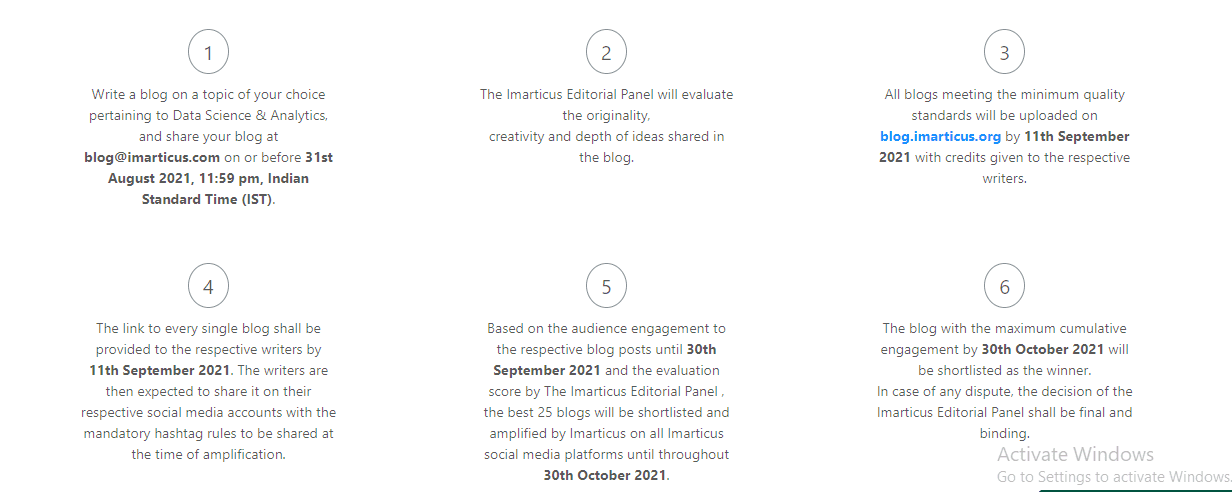
  1. Write a blog on a topic of your choice pertaining the data science and analytics. After completion, share your blog at blog@imarticus.com on or before August 31st, 2021, 11:59 pm, Indian Standard Time (IST).
  2. The originality, creativity, and level of depth in all blog articles.
  3. The content should meet the minimum criteria explained above and be submitted before the given deadline.
  4. Will upload all the eligible blogs on or before September 11th, 2021.
  5. The writers will receive the respective blog links by September 11th, 2021. The individual should share the blog link on their social channels with mandatory hashtag rules.
  6. Imarticus team will evaluate the engagement on the individual blog posts until September 30th, 2021. The Imarticus panel team will shortlist the best 25 blogs and promotes them on their social channels until October 30th, 2021.
  7. The blog that receives the most engagement by October 30th, 2021, is shortlisted as the winner. Imarticus Editorial Panel’s decision is final and binding in case of any dispute.data science and analytics blogging contest

 Why should you participate in the Imarticus Blogger of Year Contest?

  1. Imarticus Social recognizes your skill and is eager to help promote your blog.
  2. Exiting winning amount to motivate and encourage your effort.
  3. The winner details will get necessary coverage within the media promoted and supported by Imarticus Learning.
  4. We will promote the interview of the top 25 selected bloggers on different social channels of Imarticus Learning. 

Apart from the 10,000 gift voucher to the winner, Imarticus Learning will give prizes to the other participants. The details are as follows:

  • Winner: 10,000
  • Runner Up: 7,500
  • 3rd Place: 5,000
  • 4th to 10th Position: 2,000
  • 11th to 20th Position: Imarticus Hall of Fame Entrydata science and analytics blogging contest

T&C Apply.
Imarticus Learning shall own the Intellectual Rights of the blog content shared with us at blog@imarticus.com with due credits to the writer(s) till perpetuity. Imarticus Learning reserves all the rights to use, publish or remove the content on all our platforms.

The decision of the Imarticus Editorial Panel shall be final and binding in all matters. Any dispute will fall under the jurisdiction of Mumbai. The winners will receive Gift Vouchers.
To know more – Click here 

Conclusion: 

If you are interested in data science and want to share your ideas with the world, then this is a once-in-a-lifetime opportunity. Entering our #ImarticusBlogLikeAPro Season 1 Championship Award along with a cash prize of INR 10,000/ will not only is fun, but it could also win you fantastic prizes! Professional tone required for submission.

Posted in AnalyticsTagged Analytics, Education, Big Data Career, data analytics online training, Big Data Analytics Certification Course, data science and analytics, best data science cours, data analytics online course

Customer Data Mapping, Engagement and Developing Trust with Data Analytics!

Posted on August 11, 2021March 29, 2024 by Imarticus Learning
Customer Data Mapping, Engagement and Developing Trust with Data Analytics!

Data analytics is the new talk of the town. You might be planning to learn something online and wondering if you should do a data analytics course or a certification in data analytics, then this article will tell you the reasons to learn data analytics online and how in every business sector data analytics is getting more relevant every day.

To ensure the success of any business, developing trust and ensuring customer satisfaction has always been a key recipe. The introduction of analytics in customer data mapping has completely transformed the way businesses engage with their customers and win their trust.

With proper customer data utilization using analytics, businesses are able to engage customers in a more personalized way. Many organizations are reaping the benefit of using analytics to improve customer engagement.  Analytics allow using intelligence in the customer data to provide tailor-made offerings. Several factors like using various data sources, well-developed core analytics capabilities and integration of AI and IoT into processes make this possible.

Key trends in customer engagement using analytics:

Growth is likely to continue:

More companies have started using analytics for better customer satisfaction, and this percentage is growing each year.

Analytics going to be the main driving force:

This has been observed that organizations that are more experienced in using analytics than their competitors are able to gain more trust and provide more customer satisfaction.

Analytically experienced are using more data:

data analytics courses in IndiaAnalytically experienced organizations tend to use more data from all possible sources when compared to lesser experienced organizations.

Data sources, like customer, vendor, regulator, and competitor data, and data types, like mobile, social, and public data, all are getting used and playing a major role.

Key points for better customer mapping

Data source and data types:

Large in volume and variation ensures quality data. When different types of data like mobile, social, and public data are collected from various sources like customers, vendors, regulators, and competitors, analytics can lead you to a more accurate forecast.

Integrated system:

By using the data-based dashboard while fixing your customer strategy, the scope of guesswork comes down to null. Data analytics systems integrate into existing infrastructure with minimal effort and without a need for overall change. Integrating new data and analytics into the existing model improves your customer service.

Innovation to turn customer mapping into customer satisfaction

Data mapping using analytics takes traditional data mapping to a whole new level. This works as the best foundation for decision-making. These strategic changes could include social media strategy, website upgrades, and many other things.

Building profiles using Analytics

Analytics helps to identify each client independently, based on their intercommunications throughout their journey with the business. Businesses can then trace and gather precious data for future use. Analytics can build individual customer profiles using this data based on real-time action, habits, and inclinations.

Importance of Qualitative data

Few analytical tools support solutions that take qualitative data into account. Knowing how happy customers are, key phrases they use, or survey feedback are all forms of qualitative data. Quantitative data analytics and qualitative customer experiences must be equally prioritized to ensure a better result.

Prioritization of personalization

Incorporating customer journey analytics into strategy is important. Using analytics, the appeased customer is going to receive can be personalized and segmented. When customers receive more personalized and relevant content, they are likely to be more interested.

Conclusion

If you want to learn data analytics online, then Imarticus offers you a data analytics course and certification in a data analytics program that you might be interested in.

best data analytics courses in IndiaMapping customer data, understanding the buyer’s persona (a fictional identity of a buyer based on customer data), and going the extra mile to meet the customer’s demands can really help businesses, and data analytics is the way to go.

Posted in AnalyticsTagged Analytics, data analytics career, Best Data Analytics courses in India, best data analytics online training, data analytics in data mapping, engagement and developing

Business Simulations – The What, How & Why?

Posted on August 11, 2021October 12, 2022 by Imarticus Learning
Business Simulations – The What, How & Why?

What are business simulations?

Business simulations are highly interactive learning tools that provide a hands-on experience to the participants. They focus on practical methodologies like building skills while learning, improving knowledge on concepts, and allow to grow by looking at the bigger picture.

Such experiential learning ways to train participants in various fields can help engage them among themselves while doing their best for their own growth and development and at the same time, help the organization achieve its goals.

Business simulations can be chosen based on four major factors:

Technology

Simulations based on technology can be beneficial when avoiding paper-based simulations. They carry an ability to visualize the learning and can gather participant data. They simplify complex data to make learning an easier experience with more interactivity and personalization.

Response and Feedback

Simulations can create a realistic context but they can also respond to various inputs by the learners immediately or provide feedback once done. This is the input-response-feedback cycle. The inputs can be a financial decision or a dialogue or questions.

Responses can be in the form of visual prompts, financial calculation indicators, etc., such as a budget change. Feedback comes in the end when the participants see how their inputs affect the responses. For example, through a heat map or financial report, etc.

Realism

Unlike case studies or role-plays, simulations can replicate an external situation for participants to make decisions in a virtual environment which is realistic, so that they can make similar decisions in real environment on-the-job. A limitation to realism is that if taken to extremes, it may complicate the learning environment which may lead to a distracting or inappropriate application.

Process and Outcome-Focussed

Simulation-based learning involves a learning process which could be in the form of dialogue or competition, driven by the learners, and the final result. The outcomes can be intrapersonal, interpersonal, external, and related to business. The intrapersonal outcome implies whether the participants have learned anything about themselves.

Interpersonal is based on the question of whether the participants were able to cooperate, coordinate and develop relationships. Business based outcome checks whether the learners were able to create value. External outcomes involve information regarding how the learners’ decisions fit into the context of the organization’s values and the community and within the industry.

The most interesting fact about business simulations is that they require participants to implement what they learn in a risk-free environment. Thus, encouraging them to appreciate the business strategy and business management systems to improve skills, performance, and growth. In short, business simulations function as a bridge to fill the gap between theoretical learning and practical or real-life learning experience. For instance, the participants can make relevant decisions in a challenging environment or situation, similar to what their role demands at their organization.

Business simulations allow the learners to study the markets, its participants and act accordingly, based on their observations, strategically or operationally.

How do business simulations work?

Josh Bersin said that “Learners retain only 5% of what they listen and 10% of what they read, but they remember more than 50% of what they learn through discussion and interaction”.

They create learners who engage more

Interactive learning methods are useful to create more discussions, help in making learning fun while retaining more information and develop relevant skills.

Easy retention through immediate application

By immediately implementing the learned concepts, the participants learn by doing, thus, retaining more information quickly. This stickiness is beneficial for the transfer of knowledge in real-life situations at work.

Simulation helps abstract reality

Simulation games can help recreate real-world experiences that can be practiced by participants in a risk-free environment.

 Learners get more empowered

Participants can understand how the businesses work in a much detailed manner, by taking control and making choices differently.

Business Simulations prepare participants for real-world problems

By the time learners encounter similar situations in their business environment, they are equipped with skills and techniques to be well-prepared for real-life issues.

Business simulations can be blended

Through live classrooms, eLearning sessions, virtual classrooms or blended deliveries, business simulations can be delivered to the learners. The delivery experience can be chosen based on the choice of the participants at various levels.

They build networks

Business simulations promote the formation of vast communities or networks of learners who can interact with each other.

Why use business simulations? 

Business simulations come with several benefits, but here are the key reasons why they should be used for teaching concepts:

Business simulations can imitate the on-the-job learning style

According to many researchers in the corporate training world, more than 70% of what participants learn comes from experience, 20% is learned through interactive learning, and 10% is due to traditional learning methodologies, which may include reading and case studies. Business simulations can imitate real-life situations and be useful in replicating on-the-job.

They provide risk-free decision making

Business simulations allow participants to experience learning in a realistic but risk-free environment. This means that the learners get opportunities to make decisions and mistakes which do not cost the organizations. Without any fateful consequences, the participants can change their behaviors and attitudes according to the situation by learning from experience.

Business simulations are realistic

By replicating realistic market environments, business simulations can be an effective tool for learning by using real and complex situations and implementing the same in corporate environments. The success of simulation is when there is no difference between the game simulation and the real business.

They help participants use their time effectively

Simulations come with limited time, which creates an environment for quick decision-making. In this way, the learners are forced into making decisions under pressure but also ensure that the right decision is made within the deadline.

Simulations create a common culture among the learners

There is no better tool than business simulations to create a common goal for a group of learners. Through teamwork, the participants can think and act together to make decisions and resolve conflicts.

Posted in AnalyticsTagged Training, Learning and Development, Business Simulation, business, building skills

What is The Difference Between Data Analysis and Data Science?

Posted on August 10, 2021November 29, 2023 by Imarticus Learning

Following the current technological transformations within the economy, there has been an emergence of enormous career options, wherein, Data Science is the hottest. According to the Glassdoor, Data Science arose as the highest-paid area. On the other hand, there is a significant field that has been gazing attention for years, i.e., Data Analysis. Both the Data Science and Data Analysis is often confused by the individuals.

However, the terms are incredibly different in accordance with their job roles and the contribution they do to the businesses. But, are these the only factors that make these two distinct from each other? Well, to know more we need to take a look below:


t
Also Read: Top 5 Data Science Trends in 2018

Data Analysis Data Science:

Data Analysis is referred to as the process of accumulating the data and then analyzing it to persuade the decision making for the business. The analysis is undertaken with a business goal and impact the strategies. Whereas, Data Science is a much broader concept where a set of tools and techniques are implied to extract the insights from the data. It involves several aspects of mathematics, statistics, scientific methods, etc. to drive the essential analysis of data

Skills:

The individuals misinterpret Data Analysis with Data Science, but the methodologies for both are diverse. The skillset for the two are distinct as well. The fundamental skills required for Data Analysis are Data Visualisation, HIVE, and PIG, Communication Skills, Mathematics, In-Depth understanding of R and Python and Statistics. On the other hand, the Data Science embed the skills like – Machine Learning, Analytical Skills, Database Coding, SAS/R, understanding of Bayesian Networks and Hive


Techniques:

Though the areas – Data Analysis and Data Science, are often confused about being similar, but the methodology is different for both. The methods used in the two are diverse. The essential techniques used in Data Analysis are – Data Mining, Regression, Network Analysis, Simulation, Time Series Analysis, Genetic Algorithms and so on. While, the Data Science involves – Split Testing, categorizing the issues, cluster analysis and so on

Aim:

Just like the areas are different, so are their goals. The Data analysis is basically about answering the questions generated, for the betterment of the businesses. While Data Science is concerned with shaping the questions followed by answering The Data science, as illustrated above, is a more profound concept


The era of Artificial Intelligence and Machine Learning is shaping the economy in a much more comprehensive aspect. The organizations are moving towards a data-driven decision-making process. The data is becoming imperative in functioning and is not limited to the Information Technology organizations.

It is soon taking over the industries like – Sports, Medicine, Hospitality, etc. Such technological advancements have led to a rise in job opportunities in the area of Data Science and Analysis. The merely significant facet which needs to be taken into consideration is the understanding of the difference between the two. Big Data is the future which is expected to lay a considerable impact on the operations of both industries and routine life.

Related Article: What a Data Scientist Could Do?

Posted in AnalyticsTagged data analytics, Data Science, data mining, Data Science Trends

Posts navigation

Older posts
Newer posts

Subscribe Blog

Receive top education news, lesson ideas, teaching tips and more!

Invalid email address
We promise not to spam you. You can unsubscribe at any time.
Thanks for subscribing!
Imarticus Learning

Industries

  • Finance
  • Analytics
  • Technology
  • Marketing

Support

  • About Us
  • Help and Support
  • Refer and Earn
  • Careers at Imarticus
Industries
  • Finance
  • Analytics
  • Technology
  • Marketing
Support
  • About Us
  • Help and Support
  • Refer and Earn
  • Careers at Imarticus
Follow us on
Facebook Twitter LinkedIn Instagram YouTube
Download our app now
Google Play App Store

Our Programs

Finance Programs

Postgraduate Program in Banking and Finance IIM Calcutta Executive Programme in Investment Banking and Capital Markets KPMG Financial Analysis Prodegree IIM Indore Postgraduate Certificate Programme for Emerging CFOs IIM Lucknow Advanced Management Programme in Financial Services and Capital Markets US CMA Certification Program with KPMG in India Certified Investment Banking Operations Professional Association of Chartered Certified Accountants (ACCA) with KPMG in India Postgraduate Financial Analysis Program US CPA Certification Program with KPMG India ISB Executive Education Chief Financial Officer Programme IIM Lucknow Chief Finance Officer Specialisation Global Senior Leadership Programme CFA Certification Program with KPMG in India IIM Lucknow Executive Programme in Corporate and Investment Banking IIM Lucknow Executive Programme In Applied Finance Financial Risk Manager, USA (FRM®) IIM Calcutta Private Equity & Venture Capital Programme Derivatives: Futures and Forwards – Simplified The Fundamentals of Financial Markets Financial Modelling Demystified Investment Banking Basics Accounting Fundamentals Certification Introduction to Stock Trading

Analytics Programs

Postgraduate Program in Data Science and Analytics with GenAI IIM Calcutta Senior Management Programme in Business Analytics Executive PG Program in Data Science & AI Certification in Data Analytics with Gen AI

Technology Programs

IIM Lucknow Executive Programme in AI for Business Advanced Certificate Program in Generative AI in Association with E&ICT Academy, IIT Guwahati Generative AI for Managers in Association with PwC Academy IIM Nagpur Global Senior Executive Leadership Programme – Chief Technology Officer

Marketing Programs

IIM Raipur Executive Certificate Programme for Strategic Chief Marketing Officers IIM Indore Post Graduate Certificate Programme for Emerging Chief Marketing Officers IIM Lucknow Chief Marketing Officer Specialisation Global Senior Leadership Programme MyCaptain Digital Marketing Program

General Management Programs

IIM Lucknow Global Senior Leadership Programme IIM Raipur Executive Certificate Programme for Strategic Chief Executive Officers IIM Lucknow Senior Management Programme IIM Nagpur Global Senior Executive Leadership Programme IIM Nagpur Postgraduate Certificate for Future CEOs IIM Indore Accelerated General Management Programme for Aspiring Leaders Global Senior Executive Leadership Programme – Chief Business Officer AI-First Product Management ProDegree

Operations Programs

IIT Roorkee Advanced Certificate In Supply Chain Management and Analytics IIM Raipur Executive Certificate Programme for Strategic Chief Operations Officers E&ICT Academy, IIT Guwahati Advanced Certification Program in Digital Supply Chain Management IIM Lucknow Chief Operations Officer Specialisation Global Senior Leadership Programme IIM Udaipur Advanced Programme in Digital Supply Chain Management IIM Nagpur Global Senior Executive Leadership Programme – Chief Operating Officer Project Management Prodegree™

Sales Programs

IIM Lucknow Executive Programme in Sales & Marketing Leadership IIM Udaipur Chief Business Officer Program

Human Resources Programs

IIM Lucknow People Leadership & Strategic HRM Programme CEC, IIT Roorkee Professional Certificate In Human Resource Management And Analytics IIM Lucknow Chief Human Resource Officer Specialisation Global Senior Leadership Programme

Fintech Programs

KL MBA In Fintech Delhi School of Business PGDM in Fintech Firebird Institute of Research in Management PGDM in Fintech JECRC | MBA in Fintech SRM - M.S. in FinTech Building future fintech leaders Silver Oak Institute of Business Management (SOIBM), Ahmedabad MBA in FinTech PGDM in Fintech

Business Analytics Programs

Firebird Institute of Research in Management PGDM in Business Analytics VGU | MBA In Business Analytics

Executive Mba Programs

Executive MBA By RV University
Finance Programs
Postgraduate Program in Banking and Finance IIM Calcutta Executive Programme in Investment Banking and Capital Markets KPMG Financial Analysis Prodegree IIM Indore Postgraduate Certificate Programme for Emerging CFOs IIM Lucknow Advanced Management Programme in Financial Services and Capital Markets US CMA Certification Program with KPMG in India Certified Investment Banking Operations Professional Association of Chartered Certified Accountants (ACCA) with KPMG in India Postgraduate Financial Analysis Program US CPA Certification Program with KPMG India ISB Executive Education Chief Financial Officer Programme IIM Lucknow Chief Finance Officer Specialisation Global Senior Leadership Programme CFA Certification Program with KPMG in India IIM Lucknow Executive Programme in Corporate and Investment Banking IIM Lucknow Executive Programme In Applied Finance Financial Risk Manager, USA (FRM®) IIM Calcutta Private Equity & Venture Capital Programme Derivatives: Futures and Forwards – Simplified The Fundamentals of Financial Markets Financial Modelling Demystified Investment Banking Basics Accounting Fundamentals Certification Introduction to Stock Trading
Analytics Programs
Postgraduate Program in Data Science and Analytics with GenAI IIM Calcutta Senior Management Programme in Business Analytics Executive PG Program in Data Science & AI Certification in Data Analytics with Gen AI
Technology Programs
IIM Lucknow Executive Programme in AI for Business Advanced Certificate Program in Generative AI in Association with E&ICT Academy, IIT Guwahati Generative AI for Managers in Association with PwC Academy IIM Nagpur Global Senior Executive Leadership Programme – Chief Technology Officer
Marketing Programs
IIM Raipur Executive Certificate Programme for Strategic Chief Marketing Officers IIM Indore Post Graduate Certificate Programme for Emerging Chief Marketing Officers IIM Lucknow Chief Marketing Officer Specialisation Global Senior Leadership Programme MyCaptain Digital Marketing Program
General Management Programs
IIM Lucknow Global Senior Leadership Programme IIM Raipur Executive Certificate Programme for Strategic Chief Executive Officers IIM Lucknow Senior Management Programme IIM Nagpur Global Senior Executive Leadership Programme IIM Nagpur Postgraduate Certificate for Future CEOs IIM Indore Accelerated General Management Programme for Aspiring Leaders Global Senior Executive Leadership Programme – Chief Business Officer AI-First Product Management ProDegree
Operations Programs
IIT Roorkee Advanced Certificate In Supply Chain Management and Analytics IIM Raipur Executive Certificate Programme for Strategic Chief Operations Officers E&ICT Academy, IIT Guwahati Advanced Certification Program in Digital Supply Chain Management IIM Lucknow Chief Operations Officer Specialisation Global Senior Leadership Programme IIM Udaipur Advanced Programme in Digital Supply Chain Management IIM Nagpur Global Senior Executive Leadership Programme – Chief Operating Officer Project Management Prodegree™
Sales Programs
IIM Lucknow Executive Programme in Sales & Marketing Leadership IIM Udaipur Chief Business Officer Program
Human Resources Programs
IIM Lucknow People Leadership & Strategic HRM Programme CEC, IIT Roorkee Professional Certificate In Human Resource Management And Analytics IIM Lucknow Chief Human Resource Officer Specialisation Global Senior Leadership Programme
Fintech Programs
KL MBA In Fintech Delhi School of Business PGDM in Fintech Firebird Institute of Research in Management PGDM in Fintech JECRC | MBA in Fintech SRM - M.S. in FinTech Building future fintech leaders Silver Oak Institute of Business Management (SOIBM), Ahmedabad MBA in FinTech PGDM in Fintech
Business Analytics Programs
Firebird Institute of Research in Management PGDM in Business Analytics VGU | MBA In Business Analytics
Executive Mba Programs
Executive MBA By RV University

Our Centers

West

mumbai+91 9953578090
Nagpur+91 9873681040
Thane+91 9953823020
Pune+91 9953953040
Ahmedabad+91 9953431020
Indore+91 9711358090

North

Delhi+91 9953894060
Gurgaon+91 9953213080
Noida+91 9953213080
Jaipur+91 9953781050
Lucknow+91 7065029191
Dehradun+91 7065029191

South

Bangalore Koramangala+91 9953981060
Bangalore Marathahalli+91 9953961020
Chennai+91 9953741030
Hyderabad+91 9953923050
Coimbatore+91 9953781020
Cochin+91 9711682050

East

Kolkata+91 9873161080
Bhubaneswar+91 7669577474
Patna+91 9873591080
Durg+91 9711632070

UAE

Dubai+971 565114477
West
mumbai
+91 9953578090
Nagpur
+91 9873681040
Thane
+91 9953823020
Pune
+91 9953953040
Ahmedabad
+91 9953431020
Indore
+91 9711358090
North
Delhi
+91 9953894060
Gurgaon
+91 9953213080
Noida
+91 9953213080
Jaipur
+91 9953781050
Lucknow
+91 7065029191
Dehradun
+91 7065029191
South
Bangalore Koramangala
+91 9953981060
Bangalore Marathahalli
+91 9953961020
Chennai
+91 9953741030
Hyderabad
+91 9953923050
Coimbatore
+91 9953781020
Cochin
+91 9711682050
East
Kolkata
+91 9873161080
Bhubaneswar
+91 7669577474
Patna
+91 9873591080
Durg
+91 9711632070
UAE
Dubai
+971 565114477

Other Programs

College Partnership+91-9953522030
B2A (KLU)+91-9953491020
ACCA UK+91-9873281080
CMA USA+91-9873271060
CPA USA+91-9643131040
CFA+91-9711831040
Download our app now
Google Play App Store
Company Logo
Terms & Conditions | Privacy Policy

© 2025 Imarticus Learning Pvt. Ltd. All rights reserved.