How learning a tableau course can enhance your career prospects

With the advancement of technology, data skills are in demand. Everything we do revolves around the analysis of people’s behavior and understanding the statistics behind their decisions. Tableau is a computerized program that improves this analysis by making data more simple and accessible. It converts big data into a small and understandable form, at the same time giving an insight into the small data. 

The Tableau course at Imarticus will build a career in business intelligence and data analytics. You can get answers fast and also develop an unforeseen insight into statistics.

Tableau Career Opportunities

Today, companies have an enormous inflow of data with implications in their business. Therefore business corporations across the globe need an interactive and easy-to-use tool that can examine the data while giving an insight into it. 

Tableau software helps these corporations to visualize, explore, examine, and share the data so that they can take timely action and spread their business.

Tableau Analytics should have analytical skills. They should be problem-solving, innovative, and detail-oriented. They should also be a team worker and know business intelligence tools and Query languages.

With the data analytics course with placement by Imarticus, you will become a Tableau professional. Our program covers all the fundamentals and topics for building a promising Tableau career. We will teach you everything from scratch so that your career moves to the peak level. After the completion of this course, you will have varied career options, such as: business analytics certification courseTableau consultant
  • Data analyst
  • Business analyst
  • Business intelligence analyst
  • Business intelligence developer
  • Business intelligence manager

As a Tableau developer, you will prepare visualization and presentation and conclude data to improve business excellence. Tableau visualization will assist you to create innovative solutions for business problems.  

Tableau professionals can work on business problems and provide technical solutions for them. The visualization of the data will help them in finding an innovative solution and they can also work with the storage tools. With the development and expansion of the organization, the inflow of business data will also increase. Tableau Analytics can also enhance the system of the organization to meet this increase in data.

Data visualization and business intelligence are the requirements for the success of business organizations. The growth of many organizations depends upon these. Thus, the future of a Tableau professional is promising and bright.

Data Analytics Certification

We know that data is the backbone of every organization. With the increase in data, its storage is also increasing. Therefore, data visualization tools like Tableau help us to visualize data and examine the results.

At Imarticus, we know the value of data science. With our Data Analytics and Machine Learning Course, you will learn the real-world application of data science. You can build significant models that will give insight into the business. You can also make predictions.

If you are looking for a career in data science and Analytics, our course will help you become a Tableau professional. We have a 100% track record of interview and placement after completing this course successfully.


Artificial Intelligence in Digital Lending

Artificial intelligence is the future of digital lending. A recent study by an international banking group found that AI can cut costs in lending operations by as much as 37%. It is because it reduces risk and removes bias from decision-making. With less human intervention, loans are made quicker and more accurately. 

The use of AI will be pervasive in the financial sector over the next decade, which means now is the right time to explore how artificial intelligence could work for your company! 

What is artificial intelligence?

Artificial intelligence is a way to make computer systems think like humans. It means that it can learn and solve problems. AI solutions are processing large amounts of data instead of just one number or factor at a time. This technology enables digital lending companies to find a better solution for each customer.

AI has three main functions in digital lending:

  • AI Predicts the creditworthiness of future borrowers based on data from past clients’ behavior.

  • It Optimizes processes and costs by improving efficiency, increasing scalability, and reducing turnaround times with machine learning technology that can do repetitive tasks.

  • Enhancing customer experience with chatbots and other digital assistants can provide recommendations, help fill out forms, and answer questions in real-time.

Combining AI with big data allows lenders to make better decisions regarding risk assessment, credit scoring, and product design. The benefits for borrowers are lower interest rates and faster approvals.

How can AI help speed up the loan application process?

Applications for a loan can be long and tedious. They often require submitting personal information, such as Social Security numbers, addresses, and contact information. You can speed this process up with the help of AI. With the use of an AI chatbot, you can quickly submit your application without filling out any forms. The bot will then gather the information it needs from you and submit your application. 

All of this can be done within a matter of minutes, much faster than any human employee could do alone. The bot will ask for personal details such as name, address, phone number if it is needed to verify identity or employment status. If not already collected by one of the data verification services, the bot will also request recent pay stubs and bank statements to help assess the applicant’s credit risk.

Discover Credit Analyst Course in India with Imarticus Learning

Acquire a robust toolbox to help students grasp India’s credit environment, study the complete loan evaluation and due diligence procedure, and conduct financial analysis with this 145+ hour Credit Risk and Underwriting Pro degree. 

Course Benefits For Learners:

  • Learn in-demand skills and receive access to high-value tools with a rigorous, case-study-based program created with Moody’s Analytics.

  • The only credit risk certification teaches students about the lending environment, credit underwriting, legal and regulatory requirements, and the influence of new-age technologies.

  • This credit risk management course help students meet and exceed employer expectations by improving their business and analytical abilities and providing an understanding of the Banking, NBFC, and Credit worlds.

Spark or Hadoop? Here’s the Answer to this Dilemma

Every year, an increasing number of distributed systems to manage data are introduced to the industry. Among them, Spark and Hadoop have emerged as the most successful ones. This article discusses these two systems and tries to find out which one is better.

What’s Hadoop?
Hadoop is a general-purpose form of distributed processing that consists of several components. The Hadoop Distributed File System (HDFS), YARN and MapReduce are some very important components of Hadoop. Even though this system is entirely built in Java, it is accessible through many other languages including Python. An SQL like interface which allows running queries on HDFS, Hive is another important feature of Hadoop.

What’s Spark?

Spark is a relatively new project developed in 2012. It enables us to process data in parallel across a cluster. The major difference with Hadoop is that it works in-memory. Spark can process data in RAM using a concept called RDD or Resilient Distributed Dataset. It also comes with several APIs. Even though the original interface was written in Scala, based on the heavy usage by data scientists, R and Python endpoints were also provided.

Now let’s take a look at these platforms in different perspectives such as performance, cost and machine learning.

Performance
It is found that spark can run 100 times faster in-memory and ten times faster on disk than Hadoop. Especially when it comes to machine learning applications such as Naive Bayes and K-means, Spark is much faster. Following are the crucial reasons behind the better performance of Spark.

While running a selected part of a MapReduce task, Spark is not limited by the input-output concerns. It enables faster operation in applications.
The DAGs of spark permits optimization between each step. So, there would be performance tuning during the process which is not present in Hadoop.
However, in situations where the spark is running on YARN, the performance is found to be reduced. Also, sometimes it could lead to RAM overhead memory leaks. So, in a batch processing use-case, Hadoop is the more efficient system.

Costs
Since both Spark and Hadoop are open-source Apache projects, you can potentially use them with zero installation cost. However, there are other costs such as maintenance, hardware purchase and costs of supporting team. We know that the Hadoop requires more memory on disk and spark requires more RAM. In that sense, spark clusters are more expensive to set up. Also, since it is a new system, the experts of Spark would be rarer and more expensive.

Machine Learning Capabilities

Spark comes with a machine learning library, MLLib to use for the iterative machine learning applications. It includes regression and classification. Also, you can build machine learning pipelines with hyperparameter tuning using it.

Hadoop makes use of Mahout to process data. It has clustering, batch based collaborative filtering, and classification. Lately, it is being phased out in favor of Samsara. It is a Scala-backed DSL language and allows you to build your own algorithms.

Conclusion
It is sure that these two are the most prominent distributed systems available today for data processing. Between them, Hadoop is mainly recommended for disk-heavy operations while Spark is more flexible. However, the in-memory processing architecture Spark is more expensive than that of the Hadoop. So pointing out one as better than the other is not easy. It varies under different circumstances.

How to become an DevOps Engineer in 2022

DevOps engineer is one of the popular career options these days, especially using the Cloud. It is a collaboration or someone who has bridged the gap between developers and operational engineers. It is one of the highly paid jobs as well. 

People having good communication skills, multitasking ability, and are willing to collaborate with multiple teams are suitable to become DevOps engineers. So how does one become one? By understanding what it means, the responsibilities associated with it, and completing the necessary courses. 

What is a DevOps Engineer?

In an IT ecosystem, anyone who can deploy and manage the operations of an application from its development stage or production can be termed a DevOps Engineer. It is not a single designation but a collective term referring to many professional designations. 

Anyone with sound knowledge, experience, and passion for developing technologies and evolving practices can become a DevOps engineer. You just need to be up for the challenge of developing and deploying the software meant for its purpose. 

One of the emerging trends in this field is the opportunity to be a Cloud DevOps engineer. Here, the software development is mainly using web or cloud-based tools. They can access these tools from anywhere- on-premise or off-premise, concerning their location. 

On-premise refers to the office of the company and off-premise is anywhere other than the office. Either way, the purpose or responsibility here is to develop the application with continued delivery. 

What are the responsibilities?

The basic responsibilities of a DevOps engineer are to plan and execute the development, installation, test, and configure the application as needed. You will also be required to communicate the planning with the various teams concerned. Keeping abreast with the latest developments and updating the software according to the changes in the technology world are also part of the job profile. 

How to become a DevOps Engineer?

The most important step to be a DevOps engineer is to have a sound knowledge of 

  • Learn a programming language such as Java, Javascript, Python, etc. 
  • Understand different operating systems, mainly Linux
  • Learn different security and networking concepts like HTTP, FTTP, DNS, etc.
  • Organizing projects using a source code management
  • Know about automation tools
  • Understand cloud computing

Courses to be a DevOps Engineer

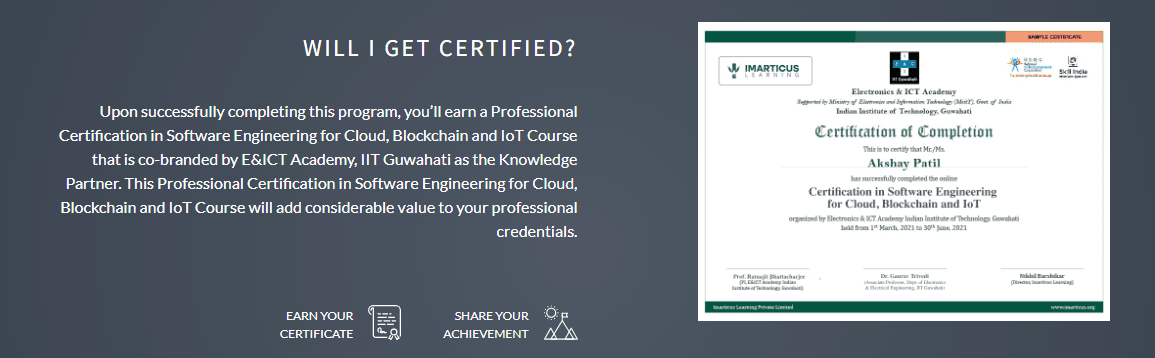
Since Cloud computing is the major highlight these days, it would be ideal to choose a certification course such as the Certification in Software Engineering for Cloud, Blockchain, and IoT offered by Imarticus, in association with IIT Guwahati.  

best software engineering coursesIt is a wonderful option that will be quite suitable for beginners and professionals equally. There is no need to have any experience in coding to be eligible for this course. 

Unlike the other courses of Certification in Software Engineering, apart from the usual live classes and interactive sessions, SCBI offers a 3-day immersion at the IIT campus.  

Why should you choose SCBI at Imarticus?

Imarticus connects you to the top academicians from the top institutions of the country and other countries. They provide proper guidance and mentoring to properly nurture you to become job-ready. 

The training, assessment, monitoring, mentorship, and project are all chosen well to help you gain the much-needed advantage over other candidates for the job opportunities. You will also be getting career support in all possible manners. 

At the same time completing this cloud-related course is highly significant to become a DevOps engineer but it is not the only or most important requirement. You must also fulfill the other requirements and develop some strong personal skills to be eligible and excel at the job. 

Financial Technology Courses: Training tomorrow’s tech leaders

In the age of technology, financial institutions are looking for employees with knowledge in financial technology. They need people who can help them keep up with the competition and stay ahead of the curve. That’s why more and more universities are starting to offer financial technology courses.

The best Fintech course will train tomorrow’s tech leaders in everything from blockchain to big data analytics. If you’re interested in the finance profession, you should consider enrolling in one of these courses! 

In this blog post, we will discuss:

  • The benefits of financial technology courses
  • How financial technology will impact the future of business and finance
  • The career opportunities available in the field of financial technology

The Benefits of Financial Technology Courses

In the coming years, financial technology courses will become more and more important as businesses look to train the next generation of leaders. Here are the advantages of taking these courses in 2022:

  • You’ll learn how to use new technologies to solve financial problems.
  • You’ll gain an understanding of how economic systems work.
  • You’ll develop the skills you need to create innovative financial products.
  • You’ll be able to work in various industries, including finance, banking, and insurance.

How will financial technology impact the future of business and finance?

Financial Technology courses are popping up all over the place and for a good reason. Professionals who understand FinTech will be in high demand as businesses of all sizes seek to adopt new technologies to streamline their operations and stay competitive.

Here are just a few examples of how FinTech is changing the game:

  • Digital currencies such as Bitcoin are disrupting traditional banking and payment systems 
  • Artificial intelligence and machine learning create predictive analytics that can help businesses make better financial decisions 
  • The blockchain is altering the way we do business by facilitating secure, transparent transactions without the need for a third party

The career opportunities available in the field of financial technology

Colleges and universities are beginning to offer financial technology courses as part of their curriculum to meet the needs of this expanding technology. These classes provide students with the skills to work in many different roles within the financial technology field.

The demand for skilled workers in financial technology will only grow in the coming years. That’s why students must begin their training and start preparing themselves for a career in this exciting field. The future of finance is waiting for you!

 Discover Career in FinTech with Imarticus Learning

The FinTech online training will give students real-world experience and networking to land their dream job in this competitive industry. Students will learn how financial technologies are changing our society, which is why it’s become so popular as an emerging profession – but don’t stop there!

There’s still time for students who want a future with theory knowledge AND practical application skills; take advantage now before these opportunities fly off the shelves.

Course Benefits For Learners:

  • Students will be prepared with the knowledge to lead in this exciting industry. From machine learning algorithms, blockchain tech, and more – our Fintech certification course has it all!best Fintech courses in India


  • Fintech students can keep up-to-date with the latest developments in their field by attending Fintech networking events, job boards, and webinars. 
  • This innovative, cutting-edge program gives the student a premium learning experience in the field of New Age FinTech.

Beat the market: Learn Computer Vision in Python

Are you looking to learn a new skill that can give you an edge over your competition? If so, then you should consider learning computer vision with Python. This powerful programming language has become increasingly popular in recent years and is perfect for tackling complex computer vision tasks.

This blog post will discuss computer vision and learn it using Python. We will also provide a few resources to get you started!

According to the World Economic Forum, nearly half of all jobs will get replaced by automation within the next 20 years. To stay relevant in this speedily changing world, we must learn new skills that can help us adapt and succeed.

One such skill is computer vision which allows you to teach computers to see as humans do! It’s an excellent process to stand out from the crowd, and you can use it in various industries such as security, manufacturing, healthcare, and more.

What is computer vision?

It is a field of AI that trains machines to understand the content of digital images or videos. You can do it by using algorithms, machine learning techniques, and deep learning networks to identify objects in an image or video frame.

With Python programming language, it’s possible to create programs quickly without having profound knowledge about computer vision algorithms or models. 

Tips to get started with computer vision in Python

There are many different ways to get started with computer vision in Python.

OpenCV library:

The OpenCV library is a popular choice for working with computer vision in Python. It provides a wide range of functions that allow you to efficiently perform tasks such as object detection and feature extraction from images or video streams. 

Scikit-learn library:

The Scikit-learn library is another popular choice for working with computer vision in Python. It provides a range of algorithms for performing image classification, object detection, and regression analysis tasks. 

Keras library:

The Keras library is another popular choice for working with computer vision in Python. It provides a high-level neural networks API, making it easy to build and train deep learning models. 

Tensorflow library: 

The Tensorflow library is another popular choice for Python computer vision. Python’s high-level programming language provides an API for building and training neural networks.  

Matplotlib library: 

The Matplotlib library is another popular choice for working with computer vision in Python. It provides a high-level API for creating charts and graphs using the Matplotlib library is another popular choice for working with computer vision in Python.

 Discover AIML Course with Imarticus Learning

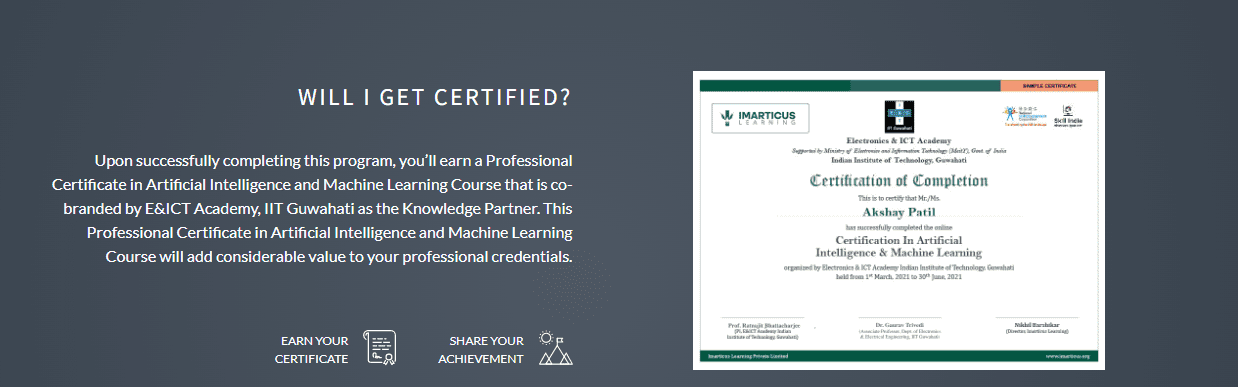
The Artificial Intelligence and Machine Learning certification collaborate with industry professionals to deliver the most satisfactory learning experience for aspiring AIML students.

best artificial intelligence courses by E&ICT Academy, IIT GuwahatiThis intensive Python certification will prepare the student for a data scientist, Data Analyst, Machine Learning Engineer, and AI Engineer.

Course Benefits For Learners:

  • This Supervised Learning course will help students improve their Artificial Intelligence basic abilities.
    Students can take advantage of our Expert Mentorship program to learn about AIML in a practical setting.
     
  • Impress employers and demonstrate their AI talents with a Supervised Learning certification supported by India’s most famous academic collaborations. 
  • This course will help students gain access to attractive professional prospects in Artificial Intelligence and Machine Learning.

Procurement- Switch your focus from sourcing to supply chain management and analytics

The world of procurement has changed dramatically in the past decade. With an increasing shortage of skilled labor and a rising global economy, companies are experiencing growing pains trying to keep up with the demands for goods and services. 

One way to meet these challenges is by adopting new procurement methods to serve your organization’s needs better. This blog post discusses how to start focusing on supply chain management and analytics instead of just sourcing materials for production! 

What is supply chain management?

Supply chain management is the process of planning, organizing, and managing the flow of materials and goods from supplier to consumer. It includes forecasting demand, coordinating production schedules, managing inventory levels, and ensuring that products are delivered on time and in good condition. 

The reason to focus on supply chain management is that it allows you to optimize your entire production process. By understanding how the different parts of the supply chain interact, you can identify and address any inefficiencies. It will help you reduce costs, improve quality, and increase production speed. In addition, you can use supply chain analytics to make better decisions about where to allocate resources and how to respond to market fluctuations.

The benefits of focusing on supply chain management 

The main challenge in focusing on supply chain management is that it requires a lot of time and effort to set up and optimize. Getting everyone on board with the new approach can also be challenging. However, with careful planning and execution, the benefits of supply chain management will far outweigh the costs. 

Some of the benefits include:

  • Reduced manufacturing and inventory costs
  • Improved quality and speed of production
  • More accurate forecasting of demand
  • Easier identification and resolution of problems in the supply chain
  • Greater flexibility to respond to changes in the marketplace

How to start focusing on supply chain management?

Focusing on supply chain management is not easy, and it will take some time to design your system correctly. One way that you can start making this transition is by setting up a dedicated team within procurement. This team should create an overall strategy and work with other departments (such as engineering) to implement changes. You will also need to invest in the right tools and software to help you manage your supply chain.

The procurement world is changing, and those who don’t adapt will be left behind. By switching your focus from sourcing materials to managing the entire supply chain, you can improve efficiency, reduce costs, and stay ahead of the competition.

Explore Supply chain Management Career with Imarticus Learning.

The supply chain management course with analytics offers an experience beyond just classroom learning – our partnerships allow candidates interested in entering this hands-on field training from some of today’s top professionals!

Course Benefits For Learners:

  • We prepare students for a rewarding career in Supply Chain Analytics course by immersing themselves in six real-world projects that will provide them with a thorough understanding of the sector. 
  • Supply chain management course prepares students for competitive jobs such as Demand Planner or Data Scientist, which employers today have in high demand! 
  • By utilizing the power of Python, this course will help students become more data-centric and enhance Supply Chain decision-making.

Finance Edition – Money Management in 2022

Be it an individual or a company, everyone needs to manage their funds and use them wisely. It is why companies hire money management experts to utilize their capital wisely. Usually, business organizations rely on investment bankers for money-related advice.

Most people are unaware of the basic concept of money management. By knowing about money management, you can also boost personal growth. Are you looking for an investment banking course to learn money management skills? Read on to know more about money management and the best investment banking certification course. 

Understanding money management 

Planning how to spend the available capital comes under money management. It includes saving, tracking, and spending the available funds. Even big business owners also need help with money management. They cannot just keep their capital stored in a locker for ages. They need to invest the available capital and grow it over the years. All these processes come under money management. 

Investment bankers are usually the ones who have excellent money management skills. If there is a good investment opportunity that can grow your capital size, investment bankers will identify it. Many investment banks have HNI and UHNWI individuals as their clients that need help with money management. If you are preparing for a job in the investment banking sector, you should have some money management skills. Money management skills will help you manage personal finances effectively. 

When talking about corporate finance, money management is concerned with budgeting. A company’s budget is created based on the marketing strategies and overhead expenses. Currently, there is a lack of skilled investment bankers that are into corporate finance management.

It is why business organizations are ready to pay a hefty amount to young investment bankers that can help them with money management. You can choose a reliable money management course and grab a lucrative job deal in 2022. 

Money management skills to learn in 2022

Some money management skills an investment banker should know in 2022 are as follows: 

  • An investment banker should know the 70/20/10 when it comes to money management. According to the 70/20/10 rule, 70% of the money should be allocated for necessary expenses and bills. 20% of the available money can be allocated to debt and savings, while 10% of the money can be spent on wants. Some corporate entities also follow the 50/30/20 rule while creating corporate budgets.
  • Corporate entities hire money management experts to set financial goals. If you are an aspiring investment banker, you should be able to evaluate the current financial performance of any company. Based on the current financial situation of a company, financial goals are decided.
  • Debt management is one of the crucial tasks in money management. No company wants to sink in the ocean of debt and hamper its business continuity. Investment bankers help corporate entities to decide their repayment capacity. Based on the repayment capacity, debts are taken by entities to meet financial obligations. 

These were some of the necessary money management skills for investment bankers in 2022. We at Imarticus Learning have bought a specially-designed course for young investment bankers looking to make a mark in the industry. Our CIBOP course is best to learn investment banking skills in 2022. 

Why rely on the CIBOP course?

We offer the CIBOP course to young investment bankers in association with the London Stock Exchange Group. It consists of an industry-oriented curriculum that will make you aware of the trending practices in the investment banking sector. Towards the end of the CIBOP course, we will help you get a lucrative job offer and kickstart your investment banking career. Join the CIBOP course and learn money management skills in 2022!

What Are The New Advancements In Data Analytics?

Data analytics is a field which witnesses a continuous revolution. Since data is becoming increasingly valuable with each passing time, it has been treated with great care and concern. New tools, techniques, theories, and trends are always introduced in the data analytics sector to cope with the constant changes in the industries and societies. You can opt for a sought-after data analytics course to get a deeper understanding.

In this article, we will go through some of the latest data analytics opportunities which have come up in the industry.

The Intelligent Data Mesh

The intelligent data mesh has been termed the next revolution in healthcare and medical diagnostics systems in the coming years by the Gartner Top 10 Strategic Technology Trends in 2018.

The “Intelligent Data Mesh” has been described by Gartner as a meeting point of the physical and digital worlds where humans, machines, data, and services have been entwined together into a mesh.

The purpose is to gather the benefits offered by all these individual entities into a single unit to find solutions to complex issues thought to be insolvable until now.

One major industry expected to benefit most from this system is the healthcare industry where Intelligent Data Mesh is being hailed as a game-changer in enhancing patient care.

Blockchain

Blockchain continues to be an exciting technology even in 2018 and is expected to remain so for at least another decade. New advancements are being made almost daily regarding this technology as blockchain finds wider uses in various industries with time.

It will not be wrong to describe blockchain as one of the greatest data analytics opportunities. The concept of blockchain started with the idea of a decentralized digital currency which came to be known as Bitcoin in the market.

However, even though the controversy regarding the currency rose the concept of a decentralized and open-source peer-to-peer modeled technology for storing and analysing data. The concept of blockchain is now applied in a wide range of industries with its use predicted to keep rising soon.

Artificial Intelligence

Artificial intelligence is one such data analytics opportunity which is finding widespread adoption in all businesses and decision-making applications. As per Gartner 2018, as much as 41 percent of organizations have already adopted AI into some aspect of their functioning while the remaining 59 percent are striving hard to do the same.

There is considerable research going on at present to incorporate artificial intelligence into the field of data science too. With data becoming larger and more complex with each passing minute, management of such data is getting out of manual capacities very soon. Scholars have now turned to AI for storing, handling, manipulating and managing larger chunks of data in a safe environment.

Augmented Reality

Augmented Reality is an interesting new technology coming up in recent years. As a source which facilitates the interaction between machine and humans in a unique manner, AR has the potential to be a game-changer in the field of data sciences making it another top data analytics opportunity in the future.
best big data analytics course

AR can provide for the development of simpler UIs for the man-machine interaction when merged with AI allowing the users to store and interact with data in a completely new manner.

Imagine going to an island where all your data is stored in different treasure chests and you are provided with customised keys to access the chests with your data in it. These things may be possible in the future because of the use of AR in data analytics. 

Imarticus Learning offers select best data analytics courses that not only boosts your skillset but also your career as a whole. 

Frequently Asked Questions

What is a data analytics course?

Data analytics involves examining raw data to extract valuable and actionable insights. These insights, once gleaned, serve as the basis for informed and strategic business decisions, contributing to the enhancement of overall business intelligence.

Do data analysts require coding?

Certainly, coding is a fundamental requirement when undertaking an online Data Analytics Degree. While highly advanced programming skills may be optional, mastering the basics of R and Python is crucial. Additionally, a solid command of querying languages such as SQL is indispensable for a comprehensive understanding of data analytics.

Is Python a mandate for data analysts?

Possessing a thorough grasp of Python programming proves highly advantageous for data analysts. Employers commonly anticipate proficiency in utilizing Python libraries to streamline various data-related tasks. Consequently, acquiring skills in Python emerges as a prudent and strategic career decision for aspiring data analysts.

5 things to know about a software engineering certificate course in 2022

Software engineering has been around for a long time, and it is only getting more popular. With the advancement of technology, many jobs are available in this field that wasn’t possible before. For those interested in software engineering but don’t know where to start, here are five things you should know about an upcoming Software Engineering Certificate course!

Software engineering is the most in-demand and lucrative career in the digital age. A certificate course in software engineering can help you build upon your existing skills and knowledge to make yourself more marketable and qualified for this high-paying career. 

Certification in a software engineering course is different from a degree program because it does not take as long to complete but still offers valuable knowledge that can open doors for career opportunities. 

Here are five things to know about the software engineering certificate course in 2022

#01: The program will be online

The software engineering certificate course in 2022 will be online. It means that students from all over the world can enroll in the program and learn at their own pace.

#02: Ability to use more than one development language:

Using more than one development language in a software engineering course is advantageous. In 2022, you will expect that most of the graduates will have this skill and can apply for various job opportunities. Even though Java programming is still in demand, employers also look for individuals fluent in Python or Scala languages.

#03: The course will focus on the most critical software engineering skills.

The certificate program in 2022 will teach students a range of essential skills, such as how to design, test, and develop software. Industry experts design the curriculum with employers’ needs in mind. It helps you build your career or advance your current role within this dynamic field.

#04: Job Opportunities

There are thousands of job opportunities available in the field. It includes giant companies, small organizations, and startups. If these fields don’t work for you, there is always freelancing too! There’s plenty of work out there to look.

#05: Salary and Benefits

Salaries for software engineering certificate holders are typically high. As with most jobs, the benefits also tend to be good. It includes medical insurance, dental insurance, and more. Make sure you research what a company’s benefits package looks like before accepting a position!

Software engineering certificate courses are excellent ways to code. They provide learners with an understanding of several different coding languages and frameworks that they can use in the future! The job market is also picking up, so you should have no trouble finding a career after completing this course.

Discover Software Engineering Course with Imarticus Learning.

The Certification in Software Engineering for Blockchain, Cloud, and IoT program gives aspiring software engineers the most satisfactory learning experience possible. This curriculum focuses on cloud computing-related technologies such as blockchain or the internet of things (IoT). 

Course Benefits For Learners:

  • Study cutting-edge technologies like Cloud, Blockchain, and IoT and various real-world projects that will expose students to a range of sectors to prepare for an exciting cloud DevOps engineer career.
  • Students can obtain practical experience by working on projects inspired by notable businesses and real-life events.
  • Become a new-age software engineer by managing real-world challenges, understanding the basics of software design, and learning vital skills.