The Importance Of Responsive Web Design In Fast Paced World

Currently, with the landscape of technology constantly evolving, having a website that adapts to different devices and screen sizes is crucial. This is where responsive web design comes into play. In this blog, we will explore the concept of responsive web design and understand its significance in our fast-paced world.

What is Responsive Web Design?

Responsive web design is an approach to web development that ensures optimal viewing and interaction experiences across a wide range of devices, from desktop computers to smartphones and tablets. With responsive design, websites automatically adjust their layout and content based on the screen size and orientation of the device being used.

The Role of Responsive Web Design

Enhanced User Experience

When users are always on the go, they expect websites to load quickly and provide seamless navigation across devices. A responsive website ensures that users can easily access information and have a smooth browsing experience regardless of the device they are using.

Improved SEO Performance

Search engines like Google prioritise mobile-friendly websites in their search results. Having a responsive website not only enhances user experience but also boosts your search engine optimization (SEO) efforts. A higher ranking in search results leads to increased visibility, more organic traffic, and potential business growth.

Cost-Effective Solution

Developing separate websites or apps for different devices can be expensive and time-consuming. Responsive web design eliminates the need for multiple versions by offering a unified solution that works well on any screen size or device type. This saves businesses both time and money while ensuring consistency in branding and user experience.

Adapting to Changing Trends:

Technology advances rapidly, with new devices hitting the market regularly. By adopting responsive web design principles, businesses can future-proof their online presence by accommodating emerging technologies effortlessly. This flexibility allows companies to stay ahead of the curve without having to redesign their website every time a new device is introduced.

Real-World Examples

Let’s take a look at two companies that have successfully implemented responsive web design and reaped the benefits:

Amazon

Amazon, the e-commerce giant, understands the importance of delivering a seamless user experience across devices. Their responsive website ensures that customers can easily browse and shop using their smartphones, tablets, or desktop computers. This approach has contributed to their success as one of the world’s leading online marketplaces.

Airbnb

Airbnb, a global accommodation booking platform, caters to travelers from various backgrounds who access their website through different devices. By implementing responsive web design, Airbnb ensures that users can effortlessly search and book accommodations regardless of whether they are using a laptop or a mobile phone. This commitment to user experience has helped them establish a strong presence in the travel industry.

Final Word

In today’s fast-paced world, where convenience and speed are paramount, having a website that adapts to different devices is essential. Responsive web design not only enhances user experience but also improves SEO performance and provides a cost-effective solution for businesses. By embracing this approach, companies can stay ahead of technological advancements while offering their customers an exceptional online experience.

If you want to enhance your web development skills and learn more about responsive web design, consider enrolling in Imarticus Learning’s comprehensive web development course. Our program covers all aspects of modern web development, including responsive design techniques.

Don’t miss out on this opportunity to boost your career prospects in the ever-evolving field of technology. Visit our website today to learn more and get started on your journey towards becoming a proficient web developer.


Top 6 Data Management Trends To Watch In 2024

Why you should know the latest trends in data management

Today, data management has become a critical aspect for businesses and professionals alike. It is essential to stay updated with the latest trends in data management to remain competitive and relevant in the industry. This blog will explore and highlight the significance of the top six data management trends for which professionals should watch out.

Overview of data management

Data management involves the collection, storage, organisation and analysis of data to derive valuable insights and support decision-making processes. It plays a crucial role in various industries such as banking and finance, healthcare, retail and more. Effective data management allows businesses to optimise operations as well as enhance customer experiences and drive innovation.

Significance of data management

Large volumes of data are generated each day and managing it efficiently has become paramount. Organisations that can successfully implement robust data management practices gain a competitive edge by leveraging their data effectively. Proficiency in data management is also highly sought after by employers across industries. Here are 6 key trends that have emerged in data management in 2023

Cloud-based data management

One significant trend that will continue to dominate in 2023 is the adoption of cloud-based data management solutions. Cloud platforms offer scalability, flexibility and cost-effectiveness for storing and processing large volumes of data. The convenience of accessing data from anywhere at any time makes cloud-based solutions an attractive choice for organisations.

Data governance

Data governance refers to establishing policies and procedures to ensure the quality, integrity, security and compliance of organisational data. In 2023, there will be an increased focus on implementing comprehensive data governance frameworks to maintain trustworthiness and reliability of information assets. Professionals skilled in data governance will be highly valued as they can help organisations mitigate risks related to privacy breaches or regulatory non-compliance.

Artificial Intelligence (AI) and Machine Learning (ML)

AI and ML technologies are transforming the data management landscape. In 2023, there will be a growing need for professionals who can leverage AI and ML algorithms to analyse vast amounts of data and generate actionable insights. These technologies enable automation, predictive analytics and anomaly detection, empowering businesses to make data-driven decisions faster and more accurately.

Data privacy and security

The increased concern around data privacy and security will continue to shape data management practices in 2023. With the implementation of regulations like the General Data Protection Regulation (GDPR), organisations must prioritise securing sensitive information. Professionals well-versed in data privacy laws and cybersecurity measures will be at the forefront of safeguarding valuable data assets.

Data visualisation

In an era where information overload is a reality, the ability to communicate insights effectively has become pivotal. Data visualisation tools enable professionals to present complex data sets in visually appealing formats, making it easier for stakeholders to understand and interpret the information. In 2023, proficiency in data visualisation techniques will be highly sought after by organisations aiming to deliver impactful presentations that drive actionable outcomes.

Data ethics

As society becomes more aware of the ethical implications of using personal data, organisations are expected to uphold higher standards of ethical practices surrounding data collection, usage and sharing. Professionals with knowledge of ethical frameworks related to data management will be indispensable as they guide organisations towards responsible use of customer information.

Effective data management is the need of the hour

As we step into 2023, knowledge of and insight into the latest trends in data management is crucial for professionals seeking career growth in this field. Cloud-based solutions, data governance frameworks, AI/ML technologies, enhanced privacy measures, effective data visualisation techniques and ethical considerations are key areas that demand attention. To stay ahead of the curve, consider upskilling through courses such as the financial planning and analysis course or obtaining a certificate in financial analysis from reputable institutions like Imarticus Learning.

If you want to enhance your knowledge in analytics or explore other data management courses, Imarticus Learning offers comprehensive programs that cover these trends and more. Read more about the course here.

Web Scraping for Data Collection

Collecting relevant data from the billions of pages online and scanning their content is an impossible task, given the amount of data generated daily. Web scraping thereby saves the day in these situations. Whether listing products or collecting information for research, web extraction software is indispensable.

Web scraping, also known as web extraction, is a method for gathering data in large quantities before formatting it from unstructured to structured. In a time when the number of websites is constantly proliferating, it is quite difficult to collect appropriate data. This challenging operation is made simpler via web scraping. Understanding web scraping is essential to build a successful career in data science because it entails data acquisition. 

Learn more about the software, its features, functions and other pertinent information with this article.

What is web scraping?

When a large amount of information is obtained from a reliable website, its structure will be in HTML format, which must be converted into structured data either in a database or a spreadsheet. Web scraping is the process of collecting and converting raw data from web pages.

The methods include using specific APIs and online tools or even creating unique web scraping programs. Web pages are made using text-based markup languages (HTML and XHTML), typically containing a substantial quantity of useful text-based information. Most websites are developed with end users and not with machine usage in mind. As a result, it is now simpler to scrape online pages thanks to the development of dedicated tools and software. Some websites provide direct bulk data extraction, while others do not. Web scraping is useful in these circumstances since it extracts the data via an API or custom scraping code.

A scraper and a crawler are necessary for the data extraction procedure. By clicking on connections to other websites, the AI-based “crawler” searches the web for the exact material it requires. On the other hand, the scraper is a special tool used for data extraction from websites. The scraper’s architecture may vary significantly depending on the project’s scale and difficulty in extracting data precisely and effectively. 

Sign up for a data analytics certification course to gain in-depth insight into web scraping.

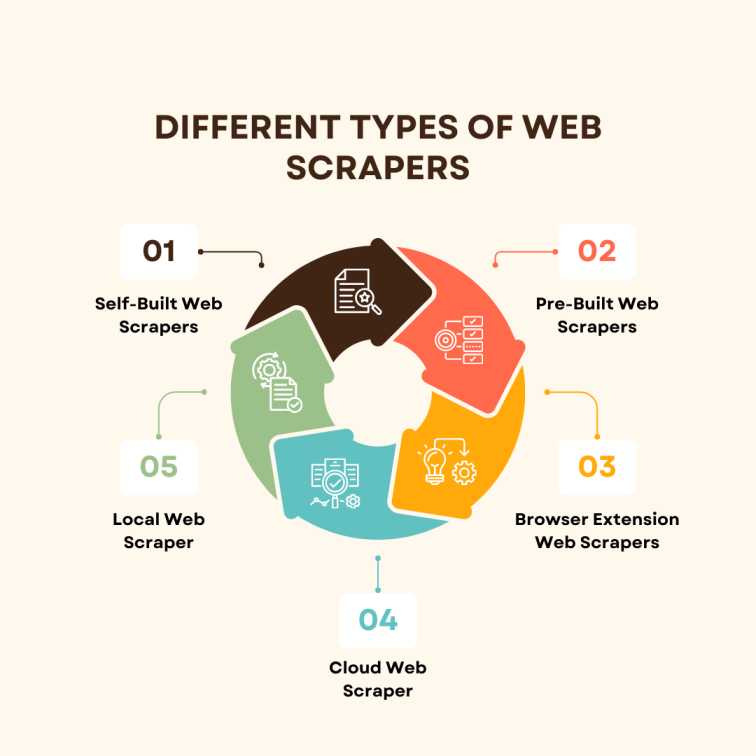
Different Types of Web Scrapers

Different Types of Web Scrapers

Depending on which section they fall under, web scrapers are further categorised into five types— locally-built web scrapers, cloud web scrapers, browser extensions web scrapers, pre-built web scrapers, and self-built web scrapers.

To succeed in a career in data analytics, it is essential to understand the different types of web scrapers.

Self-Built Web Scrapers

Self-built web scrapers can be made with less programming experience than other types. As a result, they are not strongly suggested, but they offer a great entry point into the world of data collection.

Pre-Built Web Scrapers

Everybody can easily access this web scraper. They are simple to use, are customisable and can be downloaded freely.

Its customisation ability sets it apart from other web scrapers in several ways.

Browser Extension Web Scrapers

As the name implies, the browser’s extension sets it apart from other browsers. The user finds it simpler to use the extension because of its familiarity with the browser. The browser’s functionality is compromised by limited features. As it is far more sophisticated than the browser and provides a more streamlined working environment, software web scrapers are used to overcome this challenge.

Cloud Web Scraper

Web scrapers operating in the cloud are typically provided by the company where you bought them. The cloud is an off-site server. They spare your computer’s resources so it can concentrate on other tasks because they do not require scraping data from websites. 

Local Web Scraper

These scrapers operate by using local resources that are available right from the computer. The device’s speed slows down as a result of using up RAM or the CPU’s energy. Completing tasks becomes laborious as the device’s performance and speed decline. 

Techniques Used

Registering for a data science course is the ideal choice for aspiring data scientists to master the techniques used during web scraping. The techniques include the following:

  • Copying specific data from a website and pasting it into a spreadsheet manually.
  • Using Python, which has demonstrated greater capacity to scrape substantial amounts of data from particular websites. It is highlighted because it can mimic the expressions. Scrapers also make use of a variety of programming languages, including JavaScript and C++.
  • An information extraction technique where the user applies machine learning to gather information.
  • Utilising semantic markups or metadata, semantic annotation recognition locates and extracts data snippets.

How Does It Work?

In data science training, participants are given a thorough explanation of web scraping. Illustrated below is the step-by-step process of web scraping.

  1. The initial and most crucial step is requesting access. The web scraper sends an HTTP request to a specific website to gather data from that site.
  2. When the request is approved, the scraper examines the HTML to decipher and explain the content.
  3. After going through the HTML structure, the structure’s decoding reveals the information, and the necessary data is then extracted.
  4. The extracted data is manually entered into a particular spreadsheet as the final step after decoding the HTML structure.

Conclusion

Online scraping is essential in an era where the number of websites is growing rapidly. Data collection has evolved into a crucial tactic for businesses and individuals alike. Accuracy and collection of data are critical for a business’s success, and there are numerous different data collection tools, methods, and procedures. Web scraping continues to be one of the most popular tools and key subjects covered in data analytics courses. By enrolling in the Post Graduate Programme in Data Science and Analytics, the knowledge gained in the field of data science will help establish a career to become a data analyst in future.

Visit the Imarticus Learning website to learn more about the data science certification programme.

Exit Strategy for CFOs

Initiating an exit strategy can be equivalent to steering through uncharted waters. Besides being a key tool in the ever-evolving business landscape, an exit strategy has a great prospect. You’ve cultivated your business, watched it expand, and now you plan to exit. How can you ensure this changeover adds value to your venture besides being seamless? The key to the solution lies in the mastery of Chief Financial Officers (CFOs).

This blog will unwind the essence of CFOs in devising a successful exit strategy by focusing on invaluable insights from the CFOs themselves.

If you want to gain first-hand knowledge of implementing effective exit strategies, enrol in the CFO training courses and get a CFO certification today!

What is the importance of exit strategies?

An exit strategy is beyond a financial operation. This strategic roadmap determines the result of your business. It concerns defending stakeholders’ interests, securing seamless growth for your associates, and ensuring your financial growth. CFOs are pivotal in directing this process with their financial insight and strategic forethought.

  • Fixing Clear Objectives: No journey can be planned without first considering the destination. An exit strategy, similarly, needs a clear goal. What is the purpose of your exit – an attractive financial growth, seamless growth for your committed associates, or a potent plan for your upcoming venture? The foundation lies in defining these objectives, and CFOs are best suited to give life to these aspirations through sustainable economic plans.
  • Selecting the Right Course of Action: Multiple roads in exits include acquisitions, mergers, management takeovers, IPOs (Initial Public Offerings), or mergers that may form a fresh entity. You need in-depth knowledge of your business, market trends, and big-picture thinking to determine the optimal path. CFOs are the best mentors in driving you toward the road that aligns with your objectives perfectly.
  • Financial Alertness: The CFO’s Expertise: Numbers speak louder than figures; they tell a story. CFOs are innate narrators. They offer detailed financial estimations, critically examining every facet of your venture’s economic health. They devise a compelling economic narrative that makes your business irresistible to potential investors or buyers, be it future forecasts or current standings.
  • Operational Brilliance: Productiveness has its magnetism. CFOs team up with different departments, pinpointing inefficiencies and simplifying operations. They enhance your business’s appeal, transforming it into a compelling opportunity for potential investors and buyers, aiming for a seamless acquisition.
  • Defendor of Legal Compliance: It can be intimidating to navigate legal perplexities. CFOs ensure contracts, rights of intellectual properties, and regulatory compliance by working closely with legal advisors. This increases your business’s credibility besides mitigating risks, both being key factors for a seamless exit.

What are the roles of CFOs in exit planning?

With its international grid of proficient CFOs and FDs (Financial Directors), the CFO Centre bestows priceless support to enterprises in exit planning. They allow enterprises to avail professional financial advice, if need be, by offering on-demand CFO assistance. The services provided by expert CFOs and FDs align with the essential components of practical exit planning.

  • Comprehensive Economic Assessment: To identify areas for modification and invent strategies to add value to businesses, CFOs run in-depth economic evaluations.
  • Strategic Recommendation: Expert CFOs from the CFO Centre offer strategic recommendations to assist businesses in choosing the most practical exit strategy based on market trends and their unique affairs.
  • Operational Brilliance: The professionals from the CFO Centre help enterprises achieve operational efficiency through financial management and process optimisation, thus charming potential investors and buyers.
  • Market Prospects and International Network: The CFO Centre boasts an expansive network and market prospects that increase ventures’ visibility, bringing businesses, potential investors, or buyers across geographical borders under the same roof.

Navigating the Constraints of CFOs in Modern Business

CFOs exert tremendous authority and responsibility in the complexity of modern business. Yet, it is essential to recognise that even these economic experts have shortcomings. To gain a holistic insight into corporate decision-making, it is essential to comprehend these limitations of CFOs.

  • Dependence on Numbers: It is extremely challenging for CFOs as they usually rely on numbers. This shortsighted outlook outranks their strategic acuities, thus restricting their impact in non-economic areas.
  • Market Irregularity: CFOs deal with unforeseen market evolution. International events and economic instabilities don’t allow for seamless financial predictions, making it challenging to devise long-lasting financial strategies.
  • Technological Limitations: Adopting evolving technologies like blockchain and AI (artificial intelligence) is essential. Continued learning is essential to navigate these intricate systems, thus making it difficult for CFOs to keep themselves technologically updated.
  • Regulatory Complexity: CFOs should stay up-to-date with ever-evolving regulations. Steering through a grid of regulatory compliance essentials is intimidating and tedious.

Future of CFOs

CFOs are much more than mere number crunchers – they are architects of economic innovation as businesses march into a digitally driven future. The market evolution is transforming their role, offering an irresistible insight into a future where CFOs lead strategic decision-making.

  • Strategic Forecasters: Future CFOs can be strategic forecasters, devising far-sighted economic strategies applying AI and predictive analytics. They can enhance informed decision-making through their data interpretation skills.
  • Incorporators of Technology: Future CFOs can seamlessly incorporate technologies like machine learning and blockchain into economic strategies, enhancing precision, efficiency, and cybersecurity, thus sparking financial revolutions.
  • Risk Management and Compliance Maestros: CFOs can become professional risk managers with the rise of global instabilities and cyber attacks. Their mastery of financial risk assessment can be the key to safeguarding businesses against growing threats.
  • Sustainability Patrons: Future CFOs can be mentors in incorporating sustainable approaches into financial planning. They can uphold corporate social responsibility by aligning financial goals with environmental, social, and governance (ESG) purposes.

Conclusion

The exit strategy is more about creating a legacy than closing a chapter. With CFOs serving as the guiding light, this evolution transforms from an intimidating task into a compelling opportunity. 

With its invaluable experience and international network, the CFO Centre is a service provider and a gateway to a future of boundless opportunity for businesses.

Make your exit journey compelling with Imarticus Learning’s Postgraduate Certificate Programme for Emerging CFOs. Propel your financial career with this CFO certification offering the eminent IIM Indore executive alumni status.

Visit Imarticus Learning and download the brochure for details.

Essentials of Finance: Debt and Equity Financing

Finance is an integral part of every business and all of its stages. In business, every day-to-day activity has a financial implication. Every employee needs to understand the financial impacts of these activities in relation to the bigger picture of the organisation. 

For raising capital for business needs, organisations mainly have two financing options: equity and debt. These two financing methods have their own pros and cons, which we will discuss in detail in this blog. 

If you wish to build a career in investment banking, a thorough understanding of debt and equity financing is essential. Being well-versed with financing can help develop necessary financial strategies for the company. Enrol in an investment banking course to strengthen your financial knowledge and skills and boost your resume. 

What is Financing?

Simply put, providing funds for various business activities, investing and making purchases constitute financing. Financial institutes provide capital to businesses, investors and consumers to help them achieve their financial goals, usually to earn profit from that investment in future. 

Types of Financing 

As we have already mentioned before, there are two main types of financing — debt financing and equity financing. For anyone who wants to build a career in banking and finance, it is essential to understand the concepts of debt and equity. Let us understand these two types in detail. 

What is debt financing?

The process of borrowing money without leveraging your ownership rights is known as debt financing. It involves borrowing a certain amount of money, which has to be paid back with time, along with an agreed-upon rate of interest. 

Debt can either be a loan or in the form of the sale of bonds, but it does not change the borrowing conditions. Generally, the interest rate and the payback date are predetermined. There might be certain consequences if the recipient fails to pay back the amount within the specified time. 

This type of financing allows you to have a clear idea about how much this financing will cost, and you do not have to share the ownership of your business. To learn more about this, enrol in a banking and finance course. 

Advantages 

  • The lender does not have any ownership rights over the business. 
  • The interest paid on loans is after the deduction of taxes. 
  • The recipient can decide the duration of the loan. 

Disadvantages 

  • The money has to be returned within the specified time. 
  • Having too much debt creates an issue in raising equity capital. 
  • The interest rate is usually high, downsizing any chance of growth of the company. 

What is equity financing? 

Equity financing can be defined as the process of raising capital by selling shares of your business to financiers. There are different sources of equity finance, such as venture capitalists, angel investors, equity crowdfunding platforms and private equity firms. 

Some businesses raise several equity funds from various kinds of investors over the business lifecycle. Apart from the ownership rights, investors also get a share of the company’s future profits – dividends. 

Equity investors make a return on their investment eventually by selling their shares or from dividends. These individuals have an interest in the success of the company. The right investors will also provide contacts and expertise for the growth of the business. 

Advantages 

  • It is lower in risk as businesses do not have to pay any amount back. 
  • You create a network of investors, increasing the credibility of the business. 
  • If the business fails, there is no repayment that you have to think about. 

Disadvantages 

  • Investors have to be consulted when making any big decisions about the company. 
  • You will have to share both the business’s ownership and profit percentage. 
  • Finding the correct investors for the business commands effort and time. 

Look up credible investment banking courses online to understand the two financing types and other financial modelling aspects in detail. 

Debt or Equity: Which Should You Choose?

Deciding between debt and equity financing requires an in-depth understanding of the intricacies of the financial sector. An investment banking certification can help you decide the best financing option for an organisation. 

Debt finance might be the correct option for you if:

  • You want to remain the sole owner of your company. 
  • You have a consistent cash flow and a proven business module. 
  • You want a short-time relationship that is over with the loan repayment. 

On the other hand, equity finance might be the correct option for you if:

  • You have a lock of collateral or have a limited financial history. 
  • You do not want the burden of regular loan repayments. 
  • You want to grow into new markets and expand operations. 

Debt and Equity Ratio 

The financial ratio comparing the amount of debt to the amount of equity used for financing a business is called the debt-to-equity ratio. This ratio can be calculated by dividing the total liabilities (what the business owes others) by shareholders’ equity (total assets – total liabilities). 

This metric is vital as potential investors and lenders might consider it to get an insight into the business’s financial health. The higher the ratio, the riskier the investment, as the organisation may be unable to repay its debts. 

However, investors and money lenders might not want to invest in businesses having a very low debt-equity ratio either. This can imply that the business hasn’t grown much, making use of the debt amount. 

What is a good debt-to-equity ratio? 

The answer to this question largely depends upon the industry your business is in. Organisations investing large sums of money into their asset (capital-intensive companies) often have a comparatively higher ratio. 

For example, businesses in the manufacturing industry have a comparatively higher debt-to-equity ratio. On the contrary, businesses in the service industry tend to have a lower debt-to-equity ratio. 

If you want to learn about the debt-equity ratio, sign up for a banking course from any credible institute. 

Conclusion 

Debt and equity financing are ways through which businesses acquire the necessary funding. Your ideal financing method depends on several factors, such as your business goal, need for control and tolerance for risk. 

Several businesses in their startup stage pursue equity financing. On the other hand, those who are already established and those without any debt-related issues with a strong credit score might prefer debt financing. 

If you want to learn about the types of financing and their implications in detail, check out Imarticus’s Certified Investment Banking Operations Professional course. This investment banker course is a flag-ship industry-approved programme designed for candidates with less than three years of job experience. 

HR Technology Trends: How AI and Automation are Transforming HR Practices

In the vast realm of Human Resources, technology has been a driving force behind reshaping traditional practices. Two of the most prominent trends that stand out in this aspect are none other than Artificial Intelligence and Automation. 

According to a recent survey, as much as 88% of companies worldwide use some form of AI in HR, including recruitment. Not just this, by the end of the year 2023, the global market for AI recruitment is going to witness exponential growth, amounting to $590.5 million.

Given these statistics and the rapid integration of AI-powered tools into HR practices, it can be safe to say that Artificial Intelligence and automation are here to stay. 

On that note, mentioned below is a detailed article wherein we will explore some of the many trends that are reshaping the future of workforce management. 

Recruitment And Talent Acquisition

Talent acquisition and onboarding are two of the most critical processes in HR. Contrary to the traditional recruitment processes that involved manual screening of numerous resumes, AI-driven tools are now transforming this landscape. Thanks to machine learning algorithms, AI-powered platforms can now rapidly and accurately match applicants with open positions. In addition to this, HR professionals can now also be able to predict a person’s likelihood of accepting the job offer and, thereafter, their performance outcomes, all with the help of Artificial Intelligence.

The use of AI is not limited to the recruitment process alone but extends further to the onboarding process. AI tools powered by Natural Language Processing capabilities can collect feedback from new employees. Based on the insights gathered, recruiters can then make all the necessary changes, such as delivering relevant content, identifying training needs, and more. In addition to this, AI can also be used to track employee performance and productivity by analyzing vast amounts of data. This allows for more agile performance management, enabling timely interventions and adjustments to maximise employee potential.

Automation Of Repetitive Tasks

Traditionally, HR professionals spend a significant amount of time manually processing basic tasks such as time tracking, leave management, and more. This can not only be extremely time-consuming but is also susceptible to human-prone errors. With the help of HR technology solutions, most of these tasks can now be automated and streamlined, reducing human intervention and allowing recruiters and HR professionals to focus on other significant areas.

For example, automated systems enable employees to submit leave requests through self-service portals. The system can then automatically route requests to appropriate managers for approval, reducing the administrative burden on HR staff. 

In addition to this, AI-driven solutions can also be used to automate performance management. This includes scheduling check-ins, sending reminders for goal setting, and even collecting feedback from peers. All of these ultimately help to ensure that performance management becomes a continuous and less burdensome process.

Virtual Assistants and Chatbots

The integration of virtual assistants and chatbots in HR processes has further exemplified the synergy between AI technology and human resource management. They not only aim to enhance efficiency and responsiveness but also contribute to a more engaging and employee-centric HR experience. 

For example, the introduction of the Employee Self-Service (ESS) portal allows individuals to complete tasks without the need for any administrative intervention. This, in turn, reduces the workload on HR professionals, allowing them to focus on more strategic and strategic tasks. 

In addition to this, chatbots can also guide candidates throughout the entire application process, assisting them with form submission, document upload, and other similar administrative tasks. This simplifies the whole process and also reduces the likelihood of candidate drop-offs due to complexity. 

Conclusion

From recruitment to employee engagement and performance management, HR technologies are reshaping every facet of human resources. As organisations embrace these trends, they not only get to be much more efficient but also gain that much-needed competitive edge in today’s dynamic marketplace. The key is to strike the right balance between innovation and ethical use. If you wish to know more about the same or pursue a bright career in this field, then do not forget to check out this People Management program brought to you by Imarticus Learning in collaboration with IIM-Lucknow. In this 11-month duration HR leadership course, you will get to explore all the intricacies of human resource management. In addition to this, it also brings forth numerous advantages, including masterclasses by CXOs, winsome learning experiences, and more.

Just-in-Time (JIT) vs. Safety Stock: Balancing Inventory in Planning

Did you know that the global supply chain’s lean inventory management, often referred to as just-in-time (JIT), has been under scrutiny due to its perceived vulnerabilities during unexpected disruptions? 

The pandemic brought to light the challenges of maintaining a balance between JIT and safety stock. According to a report by the Biden administration, JIT practices have increased risks in various industries, from auto manufacturing to pharmaceuticals, as they reduce safety stock and limit companies’ adaptability to sudden spikes in demand. This revelation has prompted a re-evaluation of supply chain planning strategies. As businesses grapple with these challenges, the age-old debate between JIT and safety stock has resurfaced, emphasising the need for a more resilient and agile supply chain planning approach.

Given these insights, one can’t help but wonder: Within the framework of supply chain planning, how can companies effectively balance the streamlined nature of JIT with the protective cushion of safety stock? As global dynamics shift, it’s evident that a fresh approach to supply chain planning is emerging, emphasising a blend of operational efficiency and robustness.

What is Just-In-Time Inventory Planning?

Just-In-Time (JIT) inventory methodology is a tactical method in inventory control and supply chain planning, focusing on reducing inventory quantities by procuring and obtaining products precisely when they’re essential for production. 

Instead of maintaining large stockpiles of inventory, businesses employing JIT techniques order materials and products based on actual demand, ensuring that items arrive just when they’re required. This method reduces the costs associated with holding excessive inventory, such as storage fees and potential obsolescence. 

Originating from Japanese manufacturing practices, JIT emphasises efficiency, waste reduction, and continuous improvement in the production cycle. By aligning production schedules closely with customer orders, JIT helps businesses become more responsive, agile, and cost-effective in their operations.

What is Safety Stock?

Safety stock is pivotal in inventory management, serving as a safeguard against unexpected interruptions in the supply chain. It’s designed to guarantee that companies can fulfil customer needs, even when confronted with unexpected variations in supply or demand.

Determining the right amount of safety stock involves considering factors like lead time, demand variability, and the company’s desired service level. While Just-in-Time (JIT) inventory planning emphasises minimising stock levels for efficiency, safety stock acts as a safeguard, ensuring uninterrupted operations in unpredictable scenarios.

Just-In-Time or Safety Stock: Which One Should You Choose?

Inventory management remains a critical aspect of ensuring operational efficiency and customer satisfaction. Businesses often grapple with two prominent strategies: Just-In-Time (JIT) and Safety Stock. But which one is the right fit for your business?

Just-In-Time (JIT): This approach, rooted in the Toyota Production System, emphasises reducing inventory levels and producing goods only when there’s actual demand. The primary objective is to minimise waste and free up capital that’s otherwise tied up in inventory. 

Safety Stock: On the other hand, safety stock acts as a buffer against unpredicted fluctuations in demand or supply. It’s essentially an extra quantity of inventory kept on hand to mitigate the risk of stockouts.

So, which strategy should you adopt? The answer isn’t straightforward. For businesses operating in environments with stable demand and reliable suppliers, JIT might be the way to go. However, safety stock might be more prudent for those in volatile markets or with unpredictable supply chains. In many cases, a hybrid approach, blending elements of both JIT and safety stock, can offer the flexibility and security businesses need in today’s ever-evolving landscape.

A Balance Between The Two – Why is it Important?

The recent global events have spotlighted the vulnerabilities in supply chain strategies that lean heavily on just-in-time (JIT) inventory systems. During the early days of the pandemic, empty grocery store shelves and vacant car dealerships became emblematic of the challenges posed by lean inventory practices. For years, industries have been trimming down inventory levels to cut costs, but the pandemic underscored the risks of having too little safety stock on hand.

According to a Gartner survey, there’s a growing interest among supply chain professionals to bolster their safety stock. However, the allure of JIT’s benefits remains strong for many. A closer look at major companies reveals a nuanced picture: while inventory levels have risen in many instances, they often align with a surge in sales, suggesting companies are striving to keep pace with demand rather than merely accumulating safety stock. 

Yet, the challenges of the past year have prompted introspection. The Biden administration’s report on supply chain resilience highlighted the risks associated with JIT practices, noting its contribution to vulnerabilities in sectors ranging from auto manufacturing to pharmaceuticals. The report emphasised that the rapid recovery of vehicle demand in the latter half of 2020 caught the auto industry off-guard, largely due to its JIT supply chains and limited visibility into upstream suppliers.

The ongoing debate suggests that while JIT will continue to be a significant strategy, there’s a growing recognition of the need for a more balanced approach.

To Wrap Up

The balance between Just-In-Time (JIT) and Safety Stock has highlighted the complexities of modern supply chain management. As businesses strive to be more efficient, adaptable, and resilient, a well-rounded approach to inventory management becomes important. The lessons learned from recent global disruptions underscore the value of continuous learning and adaptation in supply chain strategies. 

Investing in a digital supply chain course can provide invaluable insights and tools for professionals looking to navigate these complexities and stay ahead of the curve. Mastering the nuances of digital supply chain management will enhance operational efficiency and pave the way for sustainable growth and resilience in an ever-evolving global landscape.

Forecasting and Projection Techniques for Financial Modelling

In the world of finance, the ability to foresee future trends is crucial. Robust forecasting and projection techniques in financial modelling are indispensable for strategic planning, risk management, and smart investment choices. These techniques enable strategic planning by offering insights into potential future scenarios. This foresight allows businesses and financial institutions to chart plans that align with evolving market dynamics and changing consumer behaviours.

For investment banking, these techniques are vital. They provide a reliable roadmap for decision-making amidst uncertainty, enabling investment bankers to make informed choices, mitigate risks, and seize lucrative opportunities in the ever-changing financial landscape.

This blog will give you a deeper insight into these techniques, ranging from implementing the straight-line method to using advanced algorithms like time series analysis and regression analytics. 

Straight-Line Method

The straight-line method is a fundamental and intuitive technique in financial modelling for making forecasts. It assumes a linear relationship between variables, often used to estimate trends over time. This approach involves plotting historical data points on a graph and drawing a straight line that best fits these points. 

By extending this line into the future, analysts can make predictions based on the established trend. However, its simplicity might overlook complex relationships and could be less suitable for scenarios where rates of change vary.

Simple Linear Regression

Simple linear regression is a statistical method employed to model the connection between two variables, commonly denoted as ‘x’ (independent variable) and ‘y’ (dependent variable). It aims to find a linear equation that best fits the data points, allowing predictions and projections based on this relationship. 

For example, financial modelling might predict how changes in sales (independent variable) affect revenue (dependent variable). While useful, it assumes a linear relationship between variables and may not capture more intricate interactions.

Multiple Linear Regression

Unlike simple linear regression, multiple linear regression involves considering several independent variables influencing one dependent variable. It extends the concept by accounting for multiple factors affecting the predicted outcome. 

In finance, this technique might be applied to forecast stock prices, where factors like interest rates, market trends, and company performance are analysed together to predict stock values. Multiple linear regression offers a more nuanced analysis by considering various influencing factors simultaneously.

Moving Average

The Moving Average is a widely used technique in financial modelling for forecasting trends or smoothing out short-term fluctuations in data. It involves calculating an average of a specific number of data points within a defined period. 

For instance, a simple moving average might take the average of the last ‘n’ periods to predict future trends. It’s particularly useful for eliminating random fluctuations in data and highlighting underlying trends. In finance, this technique is commonly applied in technical analysis to forecast stock prices or financial indicators over a certain timeframe.

Time Series Analysis

Time Series Analysis is a comprehensive method used to analyse and interpret sequential data collected over regular intervals. It involves studying patterns, trends, and seasonal variations within the data to make predictions about future values based on past observations. 

This technique encompasses various statistical tools and models, such as ARIMA (AutoRegressive Integrated Moving Average) or exponential smoothing methods, to forecast future values. Time Series Analysis is widely used in finance to predict stock prices, interest rates, sales figures, and other financial metrics.

Regression Analysis

Regression Analysis is a potent statistical method extensively used in financial modelling to forecast future trends and relationships based on historical data. It examines connections between a dependent variable (the outcome predicted) and one or more independent variables (factors influencing the outcome).

Different regression analysis techniques include:

  • Simple Linear Regression: Predicts a dependent variable using one independent variable. For instance, in finance, it might forecast how interest rate changes affect bond prices.
  • Multiple Linear Regression: Involves multiple independent variables impacting one dependent variable. For financial modelling, it could forecast a company’s stock price using factors like market index, revenue, and expenses.
  • Polynomial Regression: Fits a curve to data points, beneficial for capturing nonlinear relationships between variables in financial data.

These techniques help financial analysts understand relationships, forecast outcomes, and assess the impact of various factors. They’re crucial for making informed decisions in finance by predicting trends and outcomes amidst market uncertainties.

Scenario and Sensitivity Analysis 

Scenario Analysis involves exploring various potential future situations by adjusting different variables in financial models, offering insights into diverse outcomes based on altered assumptions. It helps stakeholders evaluate risks and opportunities through different scenarios, aiding decision-making amid uncertainties. 

On the other hand, Sensitivity Analysis assesses how changes in specific input variables affect outputs, identifying critical factors influencing outcomes and measuring the model’s robustness. 

Both techniques assist in understanding possible scenarios, gauging risks, and making informed decisions, crucial for navigating the dynamic landscape of finance by preparing for multiple contingencies and understanding the impact of changing variables on financial projections.

Monte-Carlos Simulation Technique

Monte Carlo Simulation is a sophisticated statistical technique used in financial modelling to forecast potential outcomes by considering multiple variables and their probability distributions. This method involves running numerous simulations using random values for the variables, based on their probability distributions, to predict a range of possible outcomes. 

In financial applications, Monte Carlo Simulation can assess the potential risks associated with investments, estimate asset prices, evaluate portfolio performance, or simulate economic scenarios. Generating a large number of scenarios, each with varying inputs provides a comprehensive view of potential outcomes, probabilities, and risk levels.

This technique enables decision-makers to make informed choices by understanding the likelihood of different scenarios and their associated risks, enhancing the resilience of financial strategies in an ever-changing environment. Monte Carlo Simulation is particularly valuable for complex financial models where multiple variables interact, allowing for a more comprehensive assessment of uncertainty and risk.

Conclusion 

Forecasting and projection techniques serve as the guiding beacons in the field of finance especially in financial modelling. Integrating historical data analysis with sophisticated algorithms empowers stakeholders to envisage potential outcomes, enabling efficient decision-making in diverse financial domains. 

In investment banking, corporate finance, risk management, and economic analysis, mastering these techniques strengthens strategies, sharpens understanding, and builds resilience against uncertainty.

Enrolling in a Certified Investment Banking Operations Professional course from Imarticus Learning can significantly advance one’s career in banking, particularly in investment operations and finance. This certification equips professionals with a comprehensive understanding of investment banking operations, including vital concepts in securities, risk management, financial analysis, and regulatory compliance. 

Essentials of Asset Management: Hedge Funds and Mutual Funds

Organisations all across the world are concerned about asset management. It includes developing and managing every aspect of an asset systematically. Assets are significant because they drive business. Businesses nowadays are heavily dependent on their physical assets to sustain effectively in the competition. 

The process of asset management helps businesses derive value from their assets and achieve their organisational goals. Companies have practised asset management for a very long time, but it is an ever-evolving domain. It is crucial to keep at par with the changes and adapt to them. 

This blog will discuss the essentials of asset management in detail. If you want to get trained for the industry and learn about professionals, a credible investment banking course help you gain the knowledge. 

What is asset management? 

It can be defined as a process of planning and controlling the acquisitions, operations, maintenance, renewal and disposal of organisational assets. Asset management is used for improving the delivery potential of assets and minimising the risks and costs involved. 

Proper development and effective maintenance of people, systems and processes ensures a positive enhancement of capital over the asset lifecycle. 

Best practices for effective asset management 

Developing an effective asset management process can help businesses monitor and manage their assets in an organised manner. With an effective strategy in place, organisations are able to improve the efficiency and productivity of an investment. 

The main parts of an effective asset management process are: 

  1. Creating an asset register: a list of the available assets.
  2. Identify the asset conditions and rating system. 
  3. Tracking asset depreciation at fixed time intervals. 
  4. Deciding an asset’s value and its cost of replacement. 
  5. Move from reactive to predictive asset maintenance. 
  6. Ensure database integrity by focusing on change management. 
  7. Automate jobs like asset reporting, data collection, and more to eliminate paperwork. 

You can learn in detail about the best practices for asset management from a credible investment banking course. 

What are hedge funds? 

Hedge funds collect money from various investors and invest in securities and different investments to get positive returns. It is a limited partnership of private investors. Their money is managed by professional fund managers who use a number of strategies, including trading or leveraging non-traditional assets to gain above-average investment returns. 

Hedge funds are limited to wealthy investors who are able to afford the high fees and risks of hedge investing. These funds charge a much higher fee in comparison to conventional investment funds. An investor investing in hedge funds is known as an accredited investor. 

Types of Hedge Funds 

These funds target selected investors and pools of security that are primed for making gains. Some common types of hedge funds are: 

  • Global macro hedge funds: These actively managed funds try to profit from board market swings caused by political or economic events. 
  • Relative value hedge funds: These hedge funds target the temporary differences in prices of related security, taking advantage of spread or price insufficiencies. 
  • Equity hedge fund: These funds can either be global or specific to one country. This type invests in lucrative stocks when hedging against downturns in equity markets by shorting stock indices or overvalued stocks. 
  • Activist hedge fund: This fund aims to invest in organisations and take actions that boost stock prices. This may include demands that companies cut down costs, change the board of directors or restructure assets. 

What are mutual funds? 

It is an investment option where the money collected from many people is pooled together to buy a number of bonds, stocks, or other securities. These combined holdings of mutual funds are called its portfolio. Investors purchase shares in mutual funds, each share representing an investor’s ownership and income those shares generate.

Money managers are responsible for managing this mix. They offer people a portfolio structured to match the investment objectives as given in the fund’s prospects. 

Types of mutual funds 

Mutual funds can be classified according to the asset class, structure, and investment objective. 

Based on asset class 

This classification is done on the basis of the asset in which a mutual fund is investing. These funds are: 

  • Equity funds: These funds invest in stocks or equity and related instruments. These have the highest return potential but also pose the highest level of risk. This is ideal for investors who have some experience in investing. 
  • Debt funds: These funds invest money in debt instruments like company debentures, government bonds and different securities delivering fixed income. 
  • Hybrid funds: These funds serve as a bridge between equity funds and debt funds. Investors find an optimum mix between bonds and stocks; the ratio can either be fixed or variable. 

Based on investment objective:

Every mutual fund has a specific investment objective – some aim to help increase the capital, some save tax and many more. Some of these are: 

  • Growth funds: These are equity funds whose primary goal is to grow the capital of the business in the long run. 
  • Liquid funds: These funds invest in instruments having short to very short maturities (not above 91 days) to ensure liquidity. 
  • Income funds: These funds primarily invest in bonds and debentures having fixed maturity, which offers the investor a regular source of income. 

Based on structure 

Mutual funds can also be classified based on their structure. These bonds are: 

  • Open-ended funds: These funds are bought and sold according to the current net asset value of the fund. It can be purchased or sold throughout the year. 
  • Close-ended funds: These funds can only be bought during the New Fund Offer (NFO) period. These funds are also classified as stock exchanges; however, liquidity is usually very low. 
  • Interval funds: These funds are a combination of open-ended and close-ended funds. The fund house opens the funds to be bought or sold. 

Hedge funds vs. mutual funds 

Hedge funds and mutual funds have quite a few differences between them. If you want to build a career in banking, you must have an understanding of the difference between these two. Some of the differences have been listed below: 

Parameter  Hedge funds  Mutual funds 
Investment objective The goal is to achieve absolute market returns irrespective of market movements.  The goal is to produce relative returns higher than the market. 
Liquidity  Generally offer monthly, yearly or quarterly liquidity. It might impose a lockup period.  Generally, there are daily or weekly dealings. 
Minimum investment requirements  Several are private funds that have higher minimum investment requirements.  Mainly public, having minimum investment requirements. 

Conclusion 

The primary goal of asset management is to maximise the value of an investment portfolio with time, along with maintaining a proper level of risk. Asset management has a number of benefits, such as helping repair, rehabilitate, and replace assets efficiently and increasing the lifespan of an asset. 

If you want to make a career in banking, you must understand the concepts of asset management, hedge funds, mutual funds and their strategies. Check out the Certified Investment Banking Operations Professional course by Imarticus. This investment banking course is ideal for professionals with at least three years of work experience.Enrol with Imarticus today to learn from experienced professionals. 

The Role of Corporate Banking in Indian Economy Growth

Corporate banking refers to the specialised banking services provided to large corporations, multinational companies and government entities. It focuses on meeting the financial needs of these entities, which often require complex and tailored solutions. Corporate banks offer a wide range of services, including lending, cash management, trade finance, treasury services, risk management and advisory services.

In this blog, we will explore the concept of corporate banking, its significance in driving economic growth and how it impacts the Indian economy. Additionally, we will discuss the services and products offered by corporate banks, their role in economic development, the challenges they face and the growth prospects for corporate banking in India.

Importance of Banking in Economic Growth

The banking sector plays a pivotal role in facilitating economic growth. By providing access to capital and financial resources, banks enable businesses to expand their operations and invest in new projects. This stimulates job creation, increases productivity levels across industries and promotes innovation and technological advancements.

Overview of the Indian Economy

India is one of the world’s fastest-growing economies with a diverse mix of sectors contributing to its GDP. The country has witnessed remarkable progress over the years due to various factors such as economic reforms, globalisation efforts, favourable demographics and digital transformation. However, sustained economic growth requires a robust banking sector that can support businesses at every stage of their lifecycle.

Corporate Banking Services and Products

Corporate banks offer a wide range of specialised products and services designed specifically for corporations. These include working capital finance solutions such as cash credit limits and overdraft facilities to manage day-to-day operational expenses. They also provide term loans for capital expenditure purposes like expanding production capacity or setting up new facilities.

Furthermore, corporate banks offer trade finance services like letters of credit (LC), bank guarantees and export-import financing to support international trade transactions. They assist in managing foreign exchange risks, facilitate cross-border payments and provide valuable insights into global market trends.

Corporate Banks’ Role in Economic Development

Corporate banks serve as catalysts for economic development by financing infrastructure projects, supporting small and medium-sized enterprises (SMEs) and enabling businesses to seize growth opportunities. They act as intermediaries between savers and borrowers, mobilising funds from surplus sectors of the economy to deficit sectors.

Corporate banks facilitate investment in key sectors such as manufacturing, agriculture, real estate and services by providing financial resources. This leads to increased employment opportunities, improved standards of living and enhanced competitiveness in domestic and global markets.

Challenges Faced by Corporate Banks

While corporate banking is vital in promoting economic growth, it faces certain challenges unique to the industry. These include navigating regulatory compliance requirements, managing credit risks effectively and adopting digital transformation strategies amidst evolving customer expectations.

Moreover, as businesses become more complex and interconnected globally, corporate banks need to stay updated with changing market dynamics and emerging technologies to remain competitive.

Growth Prospects for Corporate Banking

Despite the challenges faced by the corporate banking sector in India, there are significant growth prospects on the horizon. As the economy continues to expand rapidly across various sectors such as fintech, e-commerce, renewable energy and infrastructure development, there will be an increased demand for specialised financial services.

Additionally, with government initiatives like “Make in India” encouraging domestic manufacturing and foreign direct investments (FDI), corporate banks will play a pivotal role in supporting these initiatives through tailored financial solutions.

Craft Your Own Success Story

In conclusion, corporate banking plays a vital role in driving economic growth by providing critical financial services to corporations. In India’s context specifically: its diverse economy requires a robust banking sector that can cater to the unique needs of businesses at different stages of their journey. Despite challenges faced by corporate banks today, they have tremendous growth prospects given the country’s expanding sectors and government initiatives.

If you want to enhance your skills in corporate banking with a course in financial services, consider enrolling in Imarticus Learning’s IIM L Finance Course. This comprehensive programme offers a structured curriculum designed by industry experts to equip you with the knowledge and skills required for a successful career in finance. Don’t miss out on this chance to boost your career prospects. Visit our website today to learn more and get started on your journey to corporate banking or financial services.