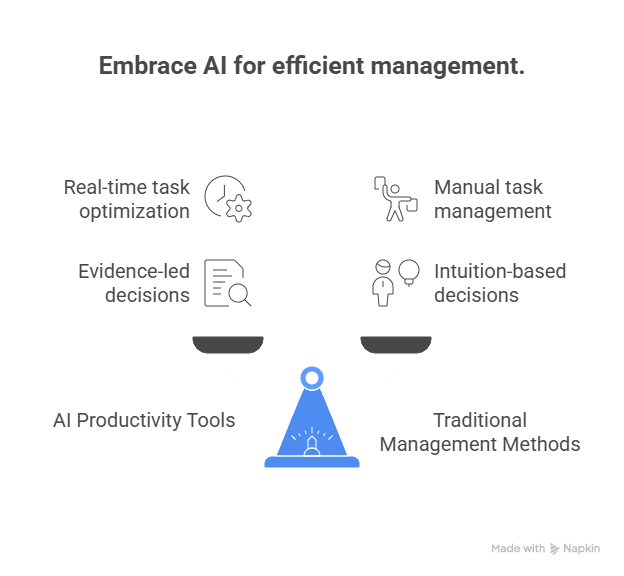
Let’s be realistic — money management at the executive level is not merely about keeping an Excel sheet under control. It involves making strategic choices in real-time, reconciling the interests of stakeholders, and predicting outcomes under extremely volatile conditions. Whether you are a CFO for a multinational or a business leader managing more than one department, pressure to make correct financial choices is humongous.
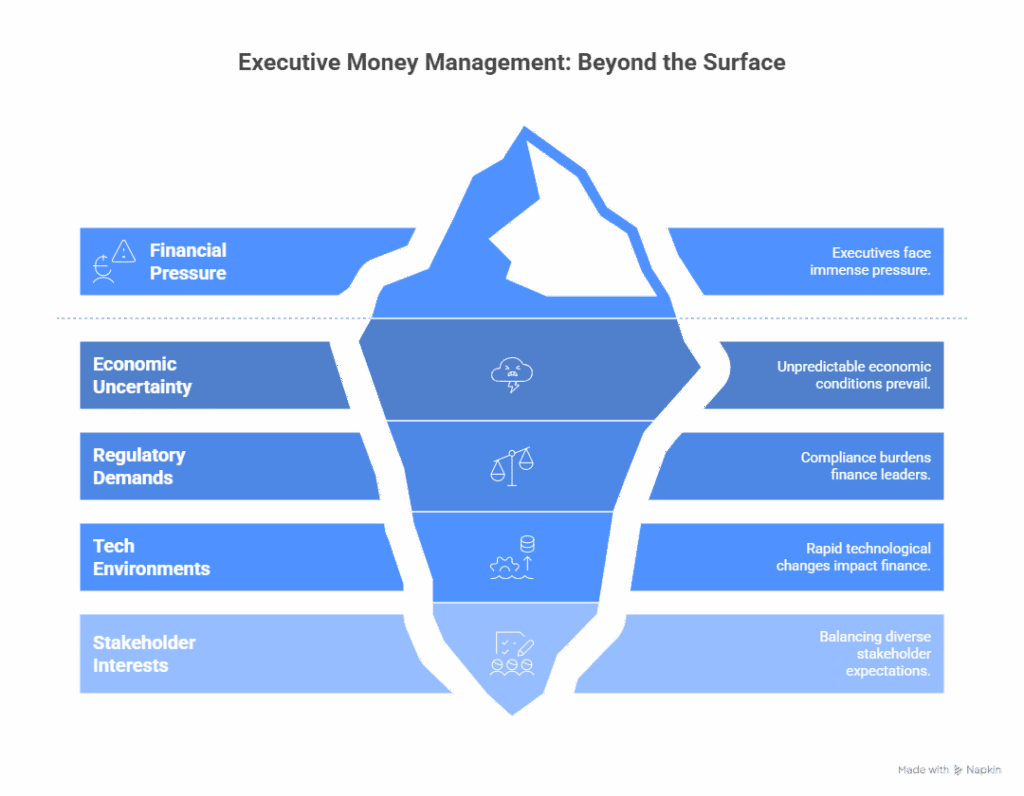
In the current corporate environment, finance leaders are confronted with a war zone of economic uncertainty, regulatory demands, and changing tech environments. As stakes are greater, so is the requirement for sound leadership financial competencies and advanced decision-making. Let’s dive in-depth into the most urgent money-connected challenges that executives currently face, and how an Executive Finance Program can be a game-changer.
Executive Finance Challenges in a Fast-Moving Economy
As economies leap back and forth at light speed, executives have to respond with the same speed. What was effective in the boardroom last quarter may already be yesterday’s news.
Financial executives tend to be running after real-time information. They are under pressure to make high-value choices without always having the luxury of having all the information. The pressure of ensuring business continuity while adjusting financial strategies to emerging regulation, digital transformations, and evolving customer behaviors is great.
Key Executive Finance Challenges Include
Balancing short-term liquidity and long-term objectives
Managing market uncertainty and inflation threats
Adjusting internal financial policies to conform to new compliance standards
Harmonizing ESG (Environmental, Social, Governance) thinking with decision-making
McKinsey Report: Just 11% of finance chiefs consider themselves ready for abrupt macroeconomic shocks.
Corporate Budgeting Challenges and Sophisticated Financial Choices
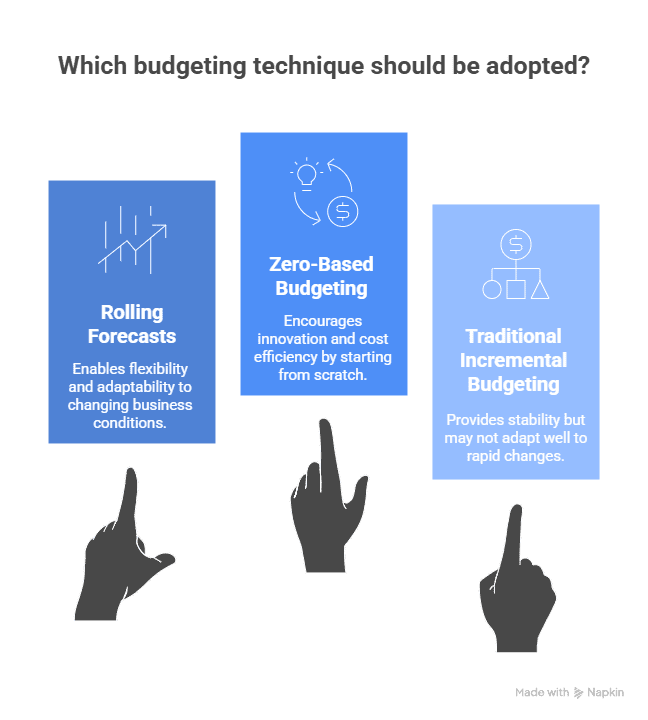
Corporate budgeting is more than just doling out money — it’s about putting the right priorities in place according to company strategy. Budgeting is too often a game of tug-of-war between departments, deadlines, and executive vision.
Executives often struggle with implementing agile budgeting systems. Conventional methods just aren’t flexible enough to react to the latest trends or crises. In addition, budget planning can be an overly time-consuming administrative process that constrains bandwidth for more strategic decision-making.
Common Corporate Budgeting Challenges:
Slow approval cycles
Static annual planning models
Disconnection between budget and actual-time performance data
No cross-functional transparency
Budgeting Challenge
Description
Delayed Approvals
Multiple stakeholders slowing down budget sanctioning
Static Planning
Inflexibility to adapt to new priorities mid-cycle
Forecast Mismatch
Disconnect between projected and actuals
Transparency Gaps
Siloed information creates inaccurate allocations
Strategic Financial Planning in Volatile Markets
Strategic budgeting takes foresight over the long term, but how do you make plans when the market is not cooperative? Executives usually have to forecast earnings in the face of economic turmoil, supply chain disruptions, and changing consumer sentiment.
Financial planning must be flexible. Leaders require adaptive structures that facilitate scenario modeling, risk analysis, and data-driven forecasts. This is where the Executive Finance Program comes in — empowering leaders with adaptable planning tools and analytical decision-making frameworks.
Strategic Financial Planning Must Account For:
Scenario planning and sensitivity analysis
Investment prioritization in uncertain conditions
Aligning financial objectives with business vision
Harnessing real-time data and AI forecasting capabilities
Managing Cash Flow in the Midst of Operating Pressure
Profitable companies can get into trouble with bad cash flow. Cash is king, and for executives, it is about ensuring the company never experiences a liquidity crisis.
The problem is in aligning collections, payables, inventory cycles, and investment in capital. Additionally, in expanding organizations, executives need to ensure subsidiaries and teams are in sync with central financial controls — no easy task with an operation across geographies.
Challenges in Cash Flow Management:
Tardy receivables and high DSOs (Days Sales Outstanding)
Inventory holding problems
Unpredictable input costs
Lack of visibility among business units
Key Tactics for Cash Flow Improvement:
Digitised collections and invoicing systems
Dynamic forecasting for cash
Reduced payable cycles through early payment discounts
Leadership Financial Skills and Team Accountability
Financial literacy at the executive level isn’t merely about number-crunching. It’s about being a strategic thinker, a data storyteller, a stakeholder influencer, and a financial literacy builder across teams.
Finance leaders of today must mentor, delegate, and get cross-functional teams to deliver. Many executives, however, do not have formal training to build others’ finance skills. This is where leadership finance capabilities come in — particularly in cascading strategy intent down the line.
Top Leadership Financial Skills Required:
Converting difficult financials into meaningful insights
Cross-functional team alignment on financial KPIs
Delegating and checking financial tasks
Coaching non-financial leaders on fiscal responsibility
Weak Financial Leadership Symptoms:
No cost ownership in teams
Inconsistent reporting accuracy
Teams making budget decisions in silos
Poor finance and operations alignment
How an Executive Finance Program Can Help
If you find yourself nodding your head to these challenges, it might be time to take a formal learning experience. A well-designed Executive Finance Program provides more than just armchair knowledge — it’s a tactical toolbox for today’s financial leaders.
Executives make high-risk decisions, and without sophisticated financial education and strategic models, they can make expensive mistakes. Specialized training bridges this gap with experiential education and leadership tools.
Q2: What are some of the telltale symptoms of ineffective executive-level financial planning?
Symptoms include missing targets, overrunning budgets, decision-making out of cycle, and a lack of departmental alignment. These tend to be the result of poor forecasting or strategic misalignment.
Q3: Why does budgeting become a bottleneck within big organisations?
Budgeting creates issues when it is too rigid, is not collegial with departments, or does not include real-time input. This slows down progress and causes miscalculation of resources.
Q4: Why is cash flow more significant than profitability?
Profit is abstract until it’s realised, whereas cash flow is the immediate fuel that energises the business. An organisation may be profitable but still crash because of inadequate liquidity.
Q5: How do finance leaders make teams more accountable?
Through the establishment of clear financial KPIs, training, dashboarding & ownership, finance leaders can instill more accountability across departments.
Q6: What is the significance of scenario planning in executive finance?
It enables leaders to assess various outcomes & prepare proactive responses, especially in volatile markets.. thus enhancing resilience.
Q7: Can digital tools help overcome challenges of executive finance?
Yes. Applications like AI-based forecasting, automated reporting, and ERPs supported by cloud infrastructure provide real-time insights and minimize human error in financial processes.
Q8: What is the ROI of an Executive Finance Program?
The payoff comes in enhanced decision-making, better team alignment, accelerated promotions, and more organisational impact. The learning pays off in terms of long-term value.
Q9: How do leadership financial skills differ from technical skills?
Leadership skills are concerned with influence, communication, decision-making, and team building, whereas technical skills are concerned with financial modelling, analysis, and reporting.
Q10: Is the IIM Indore Executive Finance Program relevant for mid-career professionals?
Certainly. It’s geared for mid to senior finance leaders wanting to move into strategic positions or CFOs in their future.
Conclusion
Managing the corporate finance environment is no longer an exercise in numbers. It’s vision, flexibility, and power. From managing macroeconomic uncertainty to building a financially savvy team ethos, executives today require more than experience — they require constant upskilling. Adopting an Executive Finance Program can be the difference between money management and money mastery.
So, you want to be a COO? That’s not a job title—it’s a calling. The Chief Operating Officer is the conductor of an organisation’s execution muscle. You’re not merely checking off strategy tick boxes; you’re spearheading the transformation, juggling internal operations, and becoming the CEO’s right-hand person. If you’ve been wondering how to get into being a COO, you’re in the right place.
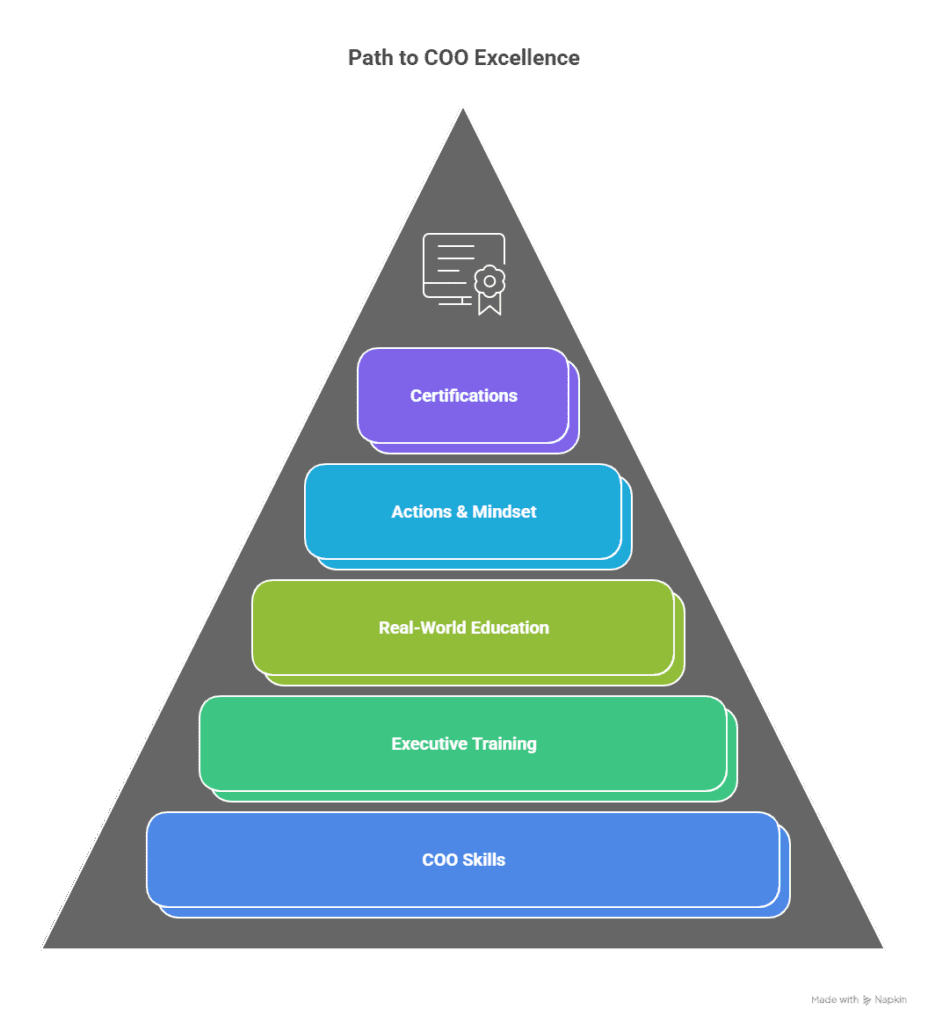
In this guide, we’re going in-depth with everything that makes a rockstar COO—starting from COO skills development and executive training to real-world education routes. Whether you’re a mid-manager or already in a senior position -this guide will take you through the actions, mindset & certifications you need to confidently take on the COO role.
Understanding the COO Position
The Chief Operating Officer is usually the behind-the-scenes hero of C-suite management. CEOs are visionaries.. but COOs make the vision a reality with execution, alignment & operational effectiveness. A COO manages day to day operations, constructs scalable systems & keeps the firm running like a well oiled machine.
COOs are responsible for cross-functional leadership. From HR to IT, logistics to customer service, they touch nearly every business unit. Understanding the full business landscape—and having the judgement to course-correct quickly—is critical. If you’re asking how to become a COO, start by immersing yourself in the operations mindset.
Typical Responsibilities of a COO
Responsibility
Description
Strategic Execution
Turn CEO vision into real outcomes
People Management
Lead, motivate and retain key teams
Financial Oversight
Ensure operational profitability
Risk Management
Mitigate threats and align compliance
Performance Metrics
Monitor KPIs and drive optimisation
COO Skills Development: What You Need
In order to actually know how to be a COO, you first need to develop a broad set of hard and soft skills. It’s not about understanding operations; it’s about dealing with complexity, people, and crisis.
COO capabilities development starts with an anchor in understanding business functions—but emotional intelligence, flexibility, and tech literacy are added to the mix. In the emerging business environment of today, COOs will need to drive digital transformation and enable sustainability agendas too.
Key Skills for COOs:
Strategic thinking with execution-first orientation
Cross-functional leadership and collaboration
Financial acumen and budget stewardship
Crisis management and high-pressure decision-making
Communication mastery, particularly in times of organisational change
Tech-savviness, including digital tools, AI, and automation
Emotional intelligence for leading high-performing teams
By McKinsey, COOs increasingly set the culture of execution and resilience. In brief, they’re culture carriers.
Executive Operations Training: Enhance Your Skills
One does not become a COO overnight. Purposeful learning is critical. That’s where executive operations training fits in. Through short-term certification or interactive leadership residencies, ongoing upskilling helps you stay competitive.
This training provides you with a 360° perspective of operations. You’ll see how to link strategy with processes, create agile systems, lead people through transformation, and leverage tech for growth. The idea is to move out of functional silos and work enterprise-wide.
Executive Program Key Training Modules:
Module
Focus
Strategic Operations
Business modelling, process redesign
Digital Transformation
AI, automation, agile workflows
People and Culture
Talent strategy, team engagement
Finance and Risk
Budgeting, compliance, scenario planning
Leadership Simulation
Crisis response, boardroom readiness
Leading universities and organizations such as Harvard Business Review consistently point to the role executive education plays in expediting C-suite readiness.
Chief Operating Officer Course: Your Career Journey
Paying for a Chief Operating Officer course is one of the best decisions you can ever make. Why? Because these courses are crafted to provide you with the theory, frameworks, and experiential knowledge that you need to deliver at the top.
These are not academic qualifications—they’re indicators of credibility. And they give you membership to top peer groups and mentorship from industry experts. You also get exposure to real-world simulations, which check your leadership potential.
Why Take a Chief Operating Officer Course?
It confirms your strategic and operational skills
Develops your executive presence and boardroom impact
Introduces you to cross-sector challenges and solutions
Strengthens decision-making using data, dashboards, and tools
Provides networking access to alumni, mentors, and leaders
Becoming a COO isn’t just about the destination—it’s about the leadership evolution. The leadership path for COOs typically starts from mid-level functional roles like project management, operations, finance, or sales.
Once you’re taking on cross-functional projects, steering transformation programs, and driving real innovation, you’re getting into COO territory. By then, you should already have a proven track record in P&L roles, managing sizable teams, and actually delivering on strategy—not just planning it. If you haven’t checked those boxes, you’re probably not ready for the next step.
Typical Leadership Career Paths to COO:
Project Manager → Program Director → VP of Ops → COO
Sales Director → Country Head → COO
Finance Manager → Controller → Director of Ops → COO
Product Manager → Chief Product Officer → COO
The COO role of today, as Gartner sees it, is to be a growth partner—developing new engines of revenue and keeping old systems intact.
How to Become a COO: Actionable Steps
So let’s break down the grand question: how to become a COO? There isn’t a single answer, but there are established paths. These steps can greatly improve your odds of arriving in the COO chair. Here’s your practical roadmap:
Step-by-Step Guide to Becoming a COO:
Begin with a deep functional background in operations, finance, or supply chain.
Establish cross-functional understanding by working on projects outside your existing department.
Obtain executive operations training to establish strategic depth.
Take a Chief Operating Officer course for focused grooming as a leader.
Network with C-suite leaders and COOs to learn about current challenges.
Demonstrate impact through KPIs, profitability, and process improvements.
Seek mentor and sponsor feedback to refine your leadership style.
Stay current with tech trends and industry changes to stay relevant.
Remember, becoming a COO is a path to professional excellence and self-knowledge.
FAQs
Q1: How much time does it take to become a COO?
It would generally take 12–20 years of increasing leadership experience across functions, industries, or geography. But with intentional development & proper mentorship -you can accelerate this process.
Q2: Do I need an MBA to be a COO?
An MBA is helpful, but not essential. What really counts is your depth of operations, leadership impact, and business influence.
Q3: What industries are hiring COOs the most?
Tech, logistics, healthcare, fintech, and retail are the ones experiencing a hike in COO hiring right now, owing to intricate operations and scaling issues.
Q4: What’s the average COO salary in India?
As per AmbitionBox and Glassdoor.. typical COO salaries can fall between INR 50L to INR 1.2Cr per annum, based on the organization & experience.
Q5: Is technical experience necessary to become a COO?
Yes, particularly if you can show strong people leadership, business sense, and the capacity to implement strategy across segments.
Q6: What is the greatest challenge for newbie COOs?
Establishing trust between departments and bringing everyone together to common execution targets is usually the toughest part of the transition.
Q7: How do I get a mentor to advise my COO path?
Start within your current organisation or alumni networks. Many executive courses also offer formal mentorship programs.
Q8: What’s the difference between a COO and a CEO?
While CEOs focus on long-term vision, market positioning, and investor relations, COOs focus on execution, alignment, and internal performance.
Q9: Are there any books that can help me become a COO?
Yes, there are books like High Output Management by Andy Grove and The First 90 Days by Michael Watkins that are very good.
Q10: How do I prove I’m prepared for the COO job?
Take on enterprise wide projects, drive transformation initiatives, persuade stakeholders & provide measurable business results.
Key Takeaways
COO is an execution-oriented and strategically challenging role.
Start with operations mastery and then extend to enterprise-wide leadership.
COO skills training, executive operations training, and taking a Chief Operating Officer course is crucial.
Learn the path to leadership for COOs to chart your rise clearly.
Identifying how to become a COO is all about combining business impact with leadership presence.
Conclusion
The path to the COO suite is complicated but fulfilling. Let’s be real—it takes more than a stacked resume to earn real credibility. Building a solid operational base, always pushing your skillset forward, and learning from top performers—that’s how you set yourself up for serious leadership growth. Still curious about carving your path to COO? Start today. Learn. Network. Lead. And above all—invest in the right training.
Ever imagined yourself shaping the marketing vision of a global brand? The role of the Chief Marketing Officer (CMO) has evolved dramatically in recent years. It’s no longer just about creating catchy campaigns or monitoring ad budgets. The modern CMO is a data-savvy strategist, a technology enthusiast, and above all, a customer whisperer. So, if you’ve been asking yourself, how to become a CMO, you’re already thinking like a future leader.
With how fast AI, martech, and customer data platforms are evolving, the roles expected of a CMO have also changed. Today, they are expected to drive growth, claim customer experience, and guide digital transformation. This blog is your guide to the key skills that every future CMO must possess to thrive in today’s marketing world.
Marketing Leadership Skills
Being a CMO necessitates the mixture of experience and technical know-how with right leadership skills, vision, and inspiration to cross-functional teams. Before being the marketing counterpart of the chief operating officer, this future CMO must be a strategic leader who integrates marketing with other business efforts through ambiguity and change.
For someone to understand how to become a CMO, one must first understand that leadership applied in marketing is not the title of a candidate, but rather it is a mindset; Marketing leadership comprises empowering teams, strategizing, and integrating departments. The capacity to lead empathetically, envisioningly, and being versatile is what really distinguishes effective CMOs.
The most important leadership characteristics to develop are:
Visionary imagination to set marketing in conjunction with long-term business objectives
Emotional intelligence to manage high-performing, diverse teams
Cross-functional collaboration between product, sales, and customer success
Risk management and decision-making in the face of uncertainty
You cannot afford to be serious about figuring out how to become a CMO unless developing digital marketing expertise. Today’s customers engage brands across multiple touchpoints—social, search, email, mobile, and even voice assistants. Ability to architect a cohesive digital strategy is a must.
Digital marketing skills involve everything from SEO & SEM to performance marketing & programmatic ad buying. But it’s not just equipment.. it’s about knowing how to understand user behavior & create personalized, scalable campaigns that convert. Learn about the top digital marketing trends for CMOs in 2025 – Gartner
Here’s how the digital world impacts the CMO’s role:
Digital Domain
Why It Matters for CMOs
SEO & Content Strategy
Drives organic traffic & thought leadership
Social Media Marketing
Builds brand presence & community trust
Performance Marketing
Ties ad spend directly to ROI
CRM and Email Automation
Enhances customer retention and lifecycle value
Martech Integration
Streamlines marketing workflows
Strategic Branding Skills
Let’s be real—a strong brand isn’t just a “nice to have,” it’s the main event. No matter if you’re B2C or B2B, people buy from brands that genuinely connect with them, deliver what they promise, and actually make sense when they talk. If you’re eyeing that CMO title, you need to make branding your bread and butter.
The next-gen CMO needs to own the brand -inside & out. It’s not just about spinning a nice story for the annual report.. it’s about making sure every single interaction with customers tells that story, loud & clear. You have to really understand who your customers are, what they care about & what keeps them coming back ..or drives them away. Competitive landscape?? You better be two steps ahead. And when it comes to creative, forget cookie-cutter campaigns —the brand’s personality has to jump out at people, wherever they see it. That’s what sets a leader apart. Why purpose-led branding is leading the future – Forbes
Skills in branding that next-gen CMOs need to excel at:
Creating harmonious brand architecture for products and geographies
Conducting regular brand audits and tracking brand equity
Positioning internal culture in accordance with outer brand values
Directing creative storytelling and visual identity
Managing brand crises and reputation issues
Customer Engagement Strategies
If you’re serious about stepping into a CMO role, customer engagement needs to be your north star. That’s not just marketing fluff—it’s the foundation for real growth. Forget the old playbook of mass emails and generic loyalty programs; those tactics just don’t cut it anymore.
Let’s be real—relying on endless email blasts or generic loyalty schemes just won’t cut it in today’s market. Success now hinges on using data smartly to craft personalized experiences that actually resonate with customers. The CMOs who’ll thrive? They’re the ones who put the customer front and center in every strategy, building real, lasting connections between people and the brand. That’s the playbook going forward.
High-impact customer engagement strategies are:
Personalized marketing through AI and predictive analytics
Omnichannel journey mapping and experience design
Building online communities and brand advocates
Creating feedback loops to enhance products and messaging
The use of interactive content formats such as quizzes, polls, and webinars
Marketing Analytics Skills
In today’s age of big data, instincts just won’t do. Every budding marketing leader serious about finding out how to become a CMO needs to adopt data analytics. The skill of extracting insights from marketing metrics and turning them into strategic decisions is now a must.
From ROI tracking to A/B testing creatives, CMOs need to be data-driven decision-makers. But dashboards aside, they need to be able to tell great stories with data in order to engage stakeholders and inform the marketing team.
Essential analytics skills for next-generation CMOs:
Knowledge of key metrics by channel (CTR, CAC, CLTV, NPS)
Applying analytics tools such as Google Analytics, Tableau, Power BI
Utilizing attribution models in measuring campaign performance
Predicting trends through predictive modelling
Building data-informed strategies for budgeting and growth
How to Become a CMO: Final Thoughts
Still wondering how to become a CMO in today’s competitive landscape?? The journey isn’t linear. but it’s certainly achievable if you’re willing to upskill & lead with impact. The role demands a blend of creativity, data literacy, technological agility, and a deep understanding of people—both customers and teams.
One of the strongly recommended options is the Post Graduate Certificate Programme for Emerging Chief Marketing Officers by IIM Indore and Imarticus Learning. This forward thinking program provides marketing professionals with leadership, analytics, branding & strategic planning skills —readying you to take a seat in the CMO chair with confidence.
Key Takeaways
The new CMO is supposed to be a data-driven, technology-savvy, customer-oriented leader.
Good marketing leadership skills drive business function alignment.
Digital marketing skills provide omnichannel consistency and performance.
Strategic branding skills defend and boost your brand equity.
Customer engagement strategies reinforce loyalty and spur advocacy.
Marketing analytics skills provide evidence-based, high-impact decisions.
To thrive as a future CMO, upskill consistently, lead from the heart, and keep ahead of trends.
Conclusion
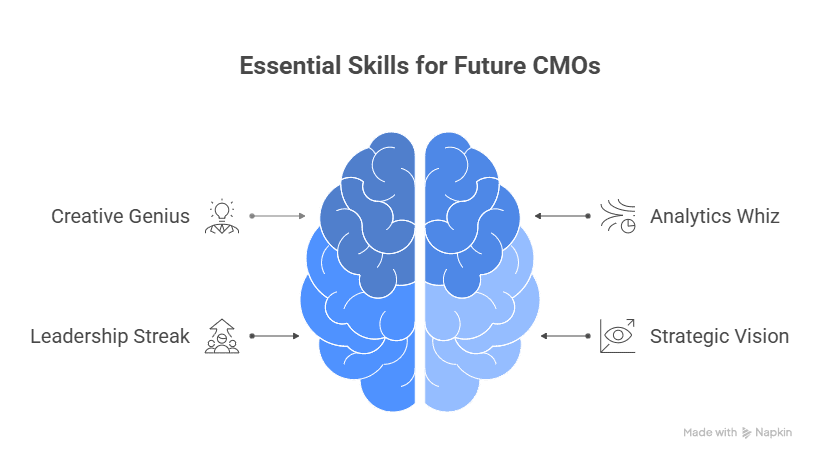
The CMO job is among the most lively and powerful roles in contemporary business. These days, marketing isn’t just about running ads—it’s about pushing boundaries, leveraging data, actually understanding your customers, and thinking strategically. If you want that CMO chair, you’ve gotta build a toolkit that’s part creative genius, part analytics whiz, with a leadership streak and a vision you can actually deliver on.
Let’s be real: the marketing landscape is only going to get messier and more competitive. But for folks who are ready? There’s serious potential to make waves and drive real innovation. Are you ready to take the lead?
FAQs
1. What is the standard career trajectory for becoming a CMO?
Many CMOs begin in functions such as -brand management, digital marketing or product marketing, eventually expanding into leadership & strategy roles. Building cross-functional experience & executive education significantly boosts your track.
2. Do I require an MBA in order to become a CMO?
An MBA is not required, but it can certainly speed up your process. More critical are your strategic sense, leadership ability, and marketing outcomes. Specialized executive programs can provide the same benefits.
3. How long does it take to be a CMO?
It usually requires 10–15 years of experience.. to get to the CMO level, depending on the company size & your professional path. Accelerated programs and&early involvement in analytics or leadership can help shorten the path.
4. Which industries are in greatest need of CMOs today?
Technology, e-commerce, financial services, consumer packaged goods & healthcare -are quickly hiring CMOs as they are investing in digital expansion and customer experience.
5. How do CMOs keep themselves current with marketing trends?
They monitor industry press, attend international conferences, engage with peer networks & spend time in continuous learning through certifications and executive education.
6. Do you need to know data analytics as a CMO?
Yes. Decision-making based on data is the stamp of success for today’s CMOs. You should be at ease with analytics so that you can justify budgets, optimize strategies, and monitor performance accurately.
7. Which soft skills are essential for CMOs?
Empathy, communication, emotional intelligence, flexibility & influencing without authority are essential soft skills for successful marketing leadership.
8. Can I be a CMO if I have a background in sales?
Yes, numerous CMOs have made the leap from sales roles. If you can establish expertise in branding, analytics, and customer experience, your commercial acumen will be an absolute asset.
9. What is the greatest challenge facing future CMOs?
Balancing data & creativity, keeping up with fast-changing technology.. and generating sustainable value in customer touchpoints are some of the biggest challenges facing tomorrow’s CMOs.
10. How do I future-proof my marketing career?
Be curious, accept digital technology, learn analytics, look for a mentor, and take higher-level executive programs like the one provided by Imarticus and IIM Indore.
Ever find yourself picturing life at the top of the tech food chain? Steering the ship on digital strategy, calling the shots on innovation, leading teams that actually get stuff done? If that’s on your radar, mapping out the path to CTO is where you start.
Just so we’re clear.. though, this isn’t some overnight leap. It’s a marathon -think years of sharpening your skills, building your network & developing the leadership chops it takes to handle the big decisions. Get ready to put in the work. If you’re a software developer looking to move up to the next tier or a tech entrepreneur looking for organized growth, this blog will take you through all that there is to know about becoming a Chief Technology Officer. We’ll cover the CTO career path, essential skills for CTOs, technology leadership roles to know, and the advantage of joining formal CTO training courses.
Knowing the CTO Career Path
Becoming a CTO is as much a strategic journey as the position itself. Different from linear careers, this one features a series of branching experiences, ranging from development to management to executive-level decision-making. It’s not so much about checking boxes as it is gaining depth, vision, and power.
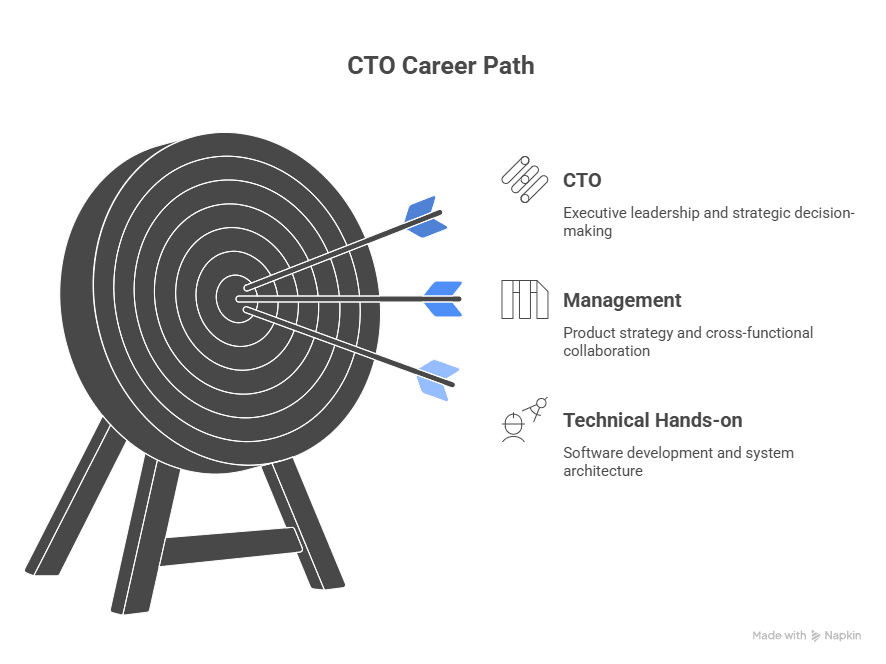
A CTO career trajectory typically starts with technical hands-on positions —Software Developer, Network Engineer or Systems Architect, for example. With experience, professionals transition to lead or management positions, increasingly aligning with product strategy & cross-functional collaboration. At this stage.. those on their way to the CTO position begin aligning with business objectives & executive leadership.
Common Benchmarks in a CTO Career Path:
Career Stage
Experience
Typical Roles
Early Career
0–5 years
Software Engineer, Data Analyst, QA Specialist
Mid-Career
5–10 years
Tech Lead, Engineering Manager, Product Architect
Senior Career
10–15+ years
VP of Engineering, Director of Technology, CTO
Learn more about career ladders in tech on Gartner
Must-Have Skills for CTOs
What sets a standout tech leader apart? Let’s be real: it’s not just about knowing the ins and outs of code or managing a dev team. For CTOs who actually move the needle, it’s this solid mix of technical expertise, leadership skills, and a sharp sense for business. The CTO gig isn’t just overseeing tech projects or tossing around jargon—it’s about turning the company’s big-picture vision into a smart, actionable tech roadmap.
You can’t just sit in your silo, either. A great CTO dives deep into the tech stack, sure, but they’ve also got to communicate with execs and stakeholders in a language that actually makes sense. It’s about leading innovation, steering clear of risks, and, honestly, having a pretty good read on where tech’s heading next. That’s how you go from “good” to “indispensable” in the C-suite.
Top Skills for CTOs:
Technical Expertise: Cloud computing, AI/ML, cybersecurity, system architecture
One typically walks into several technology leadership roles before becoming a CTO. Let’s be real! these positions are more than just a line on your resume —they’re where you cut your teeth making actual business decisions, learning from your wins (& your flops), and proving you can handle responsibility. Every time you move up.. it’s another chance to sharpen your instincts & pick up real market insight. Whether you’re steering a product team, overseeing infrastructure, or creating systems that don’t buckle under pressure, these leadership roles are pretty much non-negotiable if you’re aiming for the boardroom. Tech leadership isn’t just another bullet point; it’s your proving ground before you get near the C-suite. You start to shape outside of code and become a driving force in business results.
Typical Technology Leadership Positions:
Tech Lead: Directs codebase, assists junior developers, reports on status
Engineering Manager: Exercises team structure, performance, and recruitment
Head of Technology: Directs tech stack, aligns technology objectives with strategy
VP of Engineering: Oversees cross-functional teamwork, product launches, and delivery scores
Signing up for CTO Training Programs
Most prospective tech leaders stagnate halfway through their careers because they do not get exposed to executive-level thinking. That’s where CTO training programs step in. Such programs are meant to close the gap between excellent tech skills and exceptional leadership.
By combining lectures, case studies, and project-based work, such programs mirror actual CTO-level situations. Strategically, from digital transformation to organisational leadership, these trainings accelerate your development.
Advantages of CTO Training Programs:
Gain insights through live case studies
Establish financial knowledge and business strategy skills
When you’re getting to the C-suite, technical brilliance alone is no longer sufficient. A Chief Technology Officer needs a well-rounded set of Chief Technology Officer skills that include leadership, business acumen, and vision.
It’s the phase where you’re supposed to think M&A, budgeting for technology, future-proofing infrastructure, and mentoring VPs. You’re not only responsible for code anymore—you’re defining the tech culture and enterprise success.
Chief Technology Officer Skills You Need to Master:
Enterprise Strategy & Vision Alignment
Digital Transformation & Change Management
Organisational Agility & Team Structuring
Investor & Board-Level Communication
Risk Mitigation and Cybersecurity Oversight
FAQs
1. How long does it take to become a CTO?
It typically takes 10 to 15 years of cumulative experience in technical & leadership positions to be a CTO.. based on industry, education, and experience.
2. Do I need an MBA to be a CTO?
An MBA is not necessary but can greatly complement your business skills, particularly in large organizations or product-centric organizations.
3. Can a non-engineer become a CTO?
Although the majority of CTOs come from technical backgrounds.. those from related fields with significant tech experience & leadership abilities can ascend to the position.
4. What’s the difference between a CTO and CIO?
A CTO focuses on external technology innovation & product development -whereas a CIO handles internal IT systems & infrastructure.
5. Is it necessary to know coding as a CTO?
While hands-on coding is not expected at the C-level, a strong foundational knowledge is essential to lead engineering and make strategic decisions.
6. Are CTO roles available in non-tech companies?
Yes. Finance, healthcare, and education sectors increasingly employ CTOs to spearhead their digital transformation initiatives.
7. How much is the average CTO salary in India?
The salary of a CTO in India varies from ₹40 LPA to ₹1 Cr+, with regard to company size, experience, and domain.
8. How does one increase visibility for CTO positions?
Visibility can be increased through thought leadership, open-source contributions, tech talks, and effective networking.
9. Do CTOs collaborate with marketing and finance teams?
Yes. CTOs frequently work across functions to tie technology to business requirements, particularly with finance, marketing, and operations groups.
10. What is the essential soft skill for a CTO?
Emotional intelligence —leading, resolving conflict & influencing stakeholders is critical to being a successful CTO.
Key Takeaways
The path of how to be a CTO is long but strategically profitable.
Start by excelling in technical positions, then gradually transition into leadership.
Develop CTO skills like strategic thinking, communications, and innovation.
Develop experience through technology leadership positions prior to moving to the top.
Enroll in systematic CTO training programs to accelerate the transition.
Continuously adapt your Chief Technology Officer skills to remain relevant.
Conclusion
Let’s be honest—earning the CTO title isn’t just about upgrading your business card. It’s about stepping up to lead, taking ownership, and setting the tech vision that actually moves the needle. If you get energized by driving innovation and delivering real impact, well, CTO could be the next stop on your career roadmap.
Moving from junior developer to the C-suite? No sugarcoating it—it’s a demanding climb. But it’s also where the real excitement (and influence) is. Use this as your guide, not just a checklist. The tech industry needs leaders who don’t just follow trends—they set them. So, are you ready to take the reins and shape the future? Let’s get to work.
Arriving on the scene into the volatile and technologically driven landscape, demanding growth through innovation and adaptability, CFO activities do not concern themselves with book balancing and compliance. In short, if you seek to enter the CFO role, one thing is certain–you can no longer rely on a CFO toolbox of yesterday.
The contemporary CFO should be a strategic thinker, a technologically savvy decision-maker, and a powerful leader, all combined into one. From AI-driven analytics skills to financial agility, the competencies have changed significantly. That’s where Chief financial officer training comes in—not only for survival, but for superior performance.
Financial Leadership Skills for CFOs
Those days are gone when CFOs were limited to control and accounting functions. They now head large multifunctional teams, impact boardroom discussions, and shape long-term strategies. It is no longer a choice, but integral—developing financial leadership skills.
A strong CFO today needs grit, emotional smarts, and the ability to genuinely connect with people—especially when things get rocky. It’s not just about the numbers anymore. Effective people management, clear communication across teams & leading change with real presence have all become essential to driving results. If a CFO can’t step up & inspire confidence, especially during tough times, they’re missing the mark.
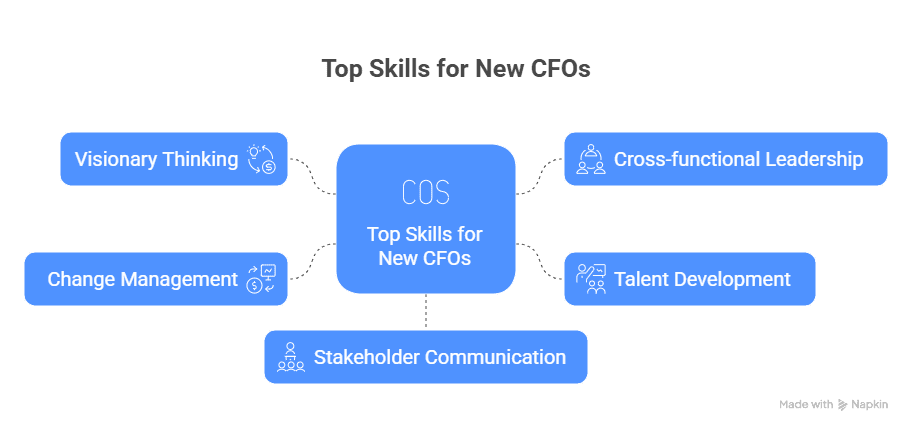
Top Leadership Skills for CFOs Today:
Skill
Description
Visionary Thinking
Setting financial direction aligned with business goals
Cross-functional Leadership
Collaborating with Marketing, IT, HR, and Operations
Talent Development
Mentoring finance teams for future leadership
Change Management
Driving and managing financial transformation
Stakeholder Communication
Presenting to boards, investors, regulators
Investment in Chief financial officer training enables leaders to sharpen these soft and strategic skills—particularly those transitioning from operational finance.
Strategic Thinking for CFOs
Strategic foresight is what truly sets a standout CFO apart in today’s business landscape. It’s not enough anymore to just deliver the numbers every quarter.. companies expect their CFOs to provide sharp insights that actually shape the organization’s direction. A CFO with strategic vision doesn’t just focus on financial statements -they’re evaluating capital investments, analyzing long-term risks, exploring opportunities in new markets, and ensuring the company is ahead of the curve with sustainability initiatives. That’s the difference between simply managing finances and actually driving the business forward. The CFO now has to co-own corporate strategy and work hand in hand with CEOs and COOs.
The most crucial aspects of strategic thinking are:
Long-term scenario planning
M&A evaluation and due diligence
Return on capital analytics
Sustainability and ESG reporting
Market intelligence and benchmarking
According to McKinsey, 41% of CFOs now dedicate most of their time to strategic leadership roles, compared to only 25% a decade ago. Clearly, the bar has been raised.
Mastering Financial Risk Management
Risk is now more multidimensional than ever—cybersecurity, global supply chains, currency fluctuations, regulatory changes—the list keeps growing. That’s why financial risk management sits at the core of a modern CFO’s responsibilities.
New-generation CFOs must move from reactive to proactive risk approaches. They must not only comprehend risk exposure but also develop frameworks that enhance resilience and business continuity.
Major risk management areas for CFOs:
Operational risk and fraud detection
Cybersecurity and data privacy governance
Treasury risk such as currency and interest rates
Climate and sustainability-linked financial disclosures
Regulatory compliance geographically
Most of these dangers are handled by the application of predictive analytics, AI-based models, and scenario planning—capabilities that may be learned through Chief financial officer training packages for the future.
A good read here is by Deloitte detailing how CFOs are becoming the focal point of enterprise risk strategy.
Digital Finance Skills for Modern CFOs
Finance is going digital, and fast. From robotic process automation (RPA) to cloud ERP to predictive modeling, technology is redefining the role of finance. CFOs today must build strong digital finance skills to stay relevant and future-ready.
You don’t need to be a coder to thrive in digital finance, but understanding the tools and how to apply them for insights and efficiency is vital.
Major Digital Tools CFOs Need to Know:
Tool/Tech
Purpose
Power BI / Tableau
Data visualisation and insights
SAP S/4HANA / Oracle
Cloud-based financial planning and control
AI/ML Models
Predictive forecasting, anomaly detection
RPA Tools
Automating routine finance tasks
Blockchain
Secure, real-time ledger tracking
An HBR study mentions that organisations with technologically savvy CFOs realize 1.5x greater profitability and customer satisfaction growth.
The CFO career path has changed. Today’s CFOs often function as strategists, technologist, compliance officers, and advisors to the board. To ensure future growth and that you to acquire, to learn and invest in opportunities to grow and that will set you up for future growth as a CFO, is essential to map your journey.
Regardless if you are coming up from a controller position or pivoting from investment banking, what capabilities you need at each path can create momentum to moving forward. Mentorship, upskilling and certification will have a huge impact.
CFO Career Development Roadmap:
Level 1: Senior Manager/Analyst
Develop core technical competencies, budgeting, and financial modeling.
Level 2: Director/Financial Controller
Take ownership of audit, reporting, and budgeting.
Level 3: Strategy Head/VP Finance
Exposure to leadership, M&A, and investor relations.
Level 4: CFO
Oversee enterprise-wide initiatives, board communication, and strategy execution.
To remain competitive, you need to focus on professional growth with formal Chief financial officer training aligned with business directions and individual goals.
Key Takeaways
The changing role of CFO broadens from finance leader to strategic and digital executive.
Great leadership in financial management is required, whilst managing people, unpleasant change, and value delivery.
Business-oriented thinking enables CFOs with long-term influence in business and credibility at board level.
Being a CFO entails risk management in finance-centric making of decisions, which is crucial in a globalised, technology-driven, and complex economy.
Endowing future-proof digital finance skills makes CFOs transformation enablers rather than scorekeepers.
Career growth for CFOs necessitates attitude upgrading, proactive thinking, and forward thinking.
Pursuing future-centric courses such as Imarticus Learning’s Chief financial officer training will help unleash your full leadership potential.
Frequently Asked Questions (FAQs)
1. Why is chief financial officer training essential for modern finance leaders?
Chief financial officer training equips aspiring CFOs with the advanced leadership, strategic thinking, and digital finance skills needed to navigate complex business environments and lead enterprise transformation.
2. What are the most critical financial leadership skills for today’s CFOs?
Modern CFOs are expected to collaborate across departments, communicate persuasively with stakeholders, cultivate talent, and maintain composure during chaos—because, let’s face it, disruption is the norm now. Anyone hoping to thrive needs to be more than a numbers person; they need the toolkit to lead transformation from the front.
3. How does strategic thinking help CFOs drive business growth? Strategic thinking enables CFOs to go beyond financial reporting and contribute to corporate strategy through capital planning, M&A insights, market analysis, and ESG initiatives.
4. What role does digital finance play in a CFO’s responsibilities today? Digital finance skills help CFOs leverage tools like AI, RPA, and data analytics for real-time insights, efficiency gains, and predictive forecasting—crucial for staying competitive.
5. How do CFOs remain ahead in financial risk management?
CFOs need to use proactive risk models on cybersecurity, treasury, compliance, and sustainability. Contemporary training enhances capability in AI-enabled risk analytics and scenario planning.
6. What’s the best path for CFO career growth? The typical path includes roles like senior analyst, controller, finance director, and VP of finance—each requiring targeted upskilling. Structured training and mentorship are key to advancing to the CFO level.
7. Are there soft skills CFOs need today?
Yes. Emotional intelligence, communication, toughness, and people leadership are now equally essential as technical skills for successful CFO performance.
8. Do I require a technology background to acquire digital finance skills?
No. Although some basic understanding is beneficial, CFO-centric programs break down intricate tools and focus on applied usage over intensive technical coding.
9. What are the benefits of enrolling in the IIM Indore CFO program? The program offers a comprehensive mix of strategic finance, leadership, and digital innovation training—designed to accelerate CFO readiness and career growth in a global context.
10. How can I assess if I’m ready for CFO training?
If you’re currently in mid-to-senior finance roles, eager to lead transformation, and want to expand your strategic and digital capabilities, CFO training is the next logical step in your journey.
Conclusion
Today’s CFO is not merely a number-cruncher; they define the story. In an age of continued transformation—whether from AI disruption, or ESG imperatives—today’s CFO must be a strategist, technologist, and a coach. It requires a different skillset—combining technical aptitude, business sensibility, digital experience and emotional intelligence.
If you are willing to ascend to the next generation of financial leadership, now is the right time to do so. Through customized programs such as the Postgraduate Certificate Programme for Emerging CFOs by IIM Indore and Imarticus Learning, you can move on from being a capable finance manager to being an impactful CFO.
The workplace is changing and it is happening faster than anyone could have imagined. If you are a business leader or manager trying to figure out how to position your team moving forward, well the answer just might be in two little letters: AI. More specifically, Gen AI Concepts. These new tools are changing how teams create, collaborate, innovate & get work done. But remember.. the change isn’t just technology, it’s about people.
Assisting your team to transition to a generative AI solution isn’t just giving them a tool and hoping for the best. It is about giving the team the tools, skills, interactions, and support to engage with change with some thought and approach. In this guide we will break it all out clearly and practically, providing steps that all leaders – even non-technical leaders – can action right away.
Understanding the Need for Generative AI Training
Gen AI isn’t a passing trend—it’s a transformative force. In industries from finance to marketing, HR to operations, AI tools are now embedded in everyday workflows. Yet these tools, such as ChatGPT, Midjourney and GitHub Copilot proliferate, employees often don’t have the mental frame or context for how to use them meaningfully. To integrate Gen AI Concepts like prompt engineering, LLM applications, and synthetic content generation, we need to demystify them at scale. If you do not engage in systematic programs for learning, teams are likely to misuse tools and data by accident, or competitors could be inventing on that particular topic or corner, shrinking margins and unique value, or worse, you could working against data privacy and security principles. That said, a recent IBM study indicated that 70% of companies leveraging AI for work still did not feel their employees were ready. So before you invest in AI platforms, invest in your people first.
Generative AI Training for Employees: Laying the Foundation
The first step is to help employees establish a foundational understanding. Before getting into the details, teams should have an understanding of what Gen AI Concepts are, how Gen AI concepts are different from traditional AI, and why Gen AI concepts matter.
This means shifting the mindset from “AI will replace us” to “AI will assist us”. And that change starts with education.
Here’s how to build your AI learning base:
Start with basic Gen AI Concepts—what is generative AI, what are LLMs, and how they function
Use real-world business use cases tailored to your industry
Offer cross-functional sessions so non-tech staff see relevance
Encourage interactive learning through tools like ChatGPT and DALL·E
Incorporate ethical use cases and bias mitigation in content
Why this works: It not only boosts confidence but also builds shared language and understanding across the organisation.
Upskilling Teams for AI Adoption: Practical Methods
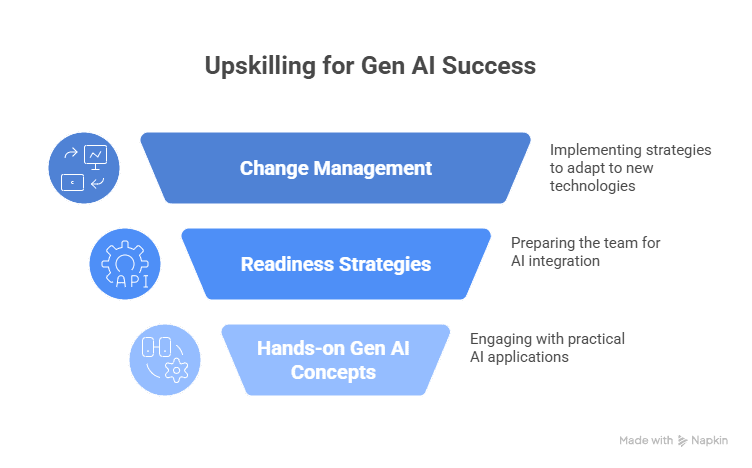
Once your team is comfortable with core Gen AI Concepts, it’s time to build competence. This means shifting from theoretical understanding to practical skills. Think of it like teaching your team to drive—not just understand what a car is.
Methods to upskill effectively:
Internal bootcamps run by your digital or L&D teams
Microlearning modules using scenario-based training
Tool-specific training (e.g., Prompt Engineering for ChatGPT, Generative Design with Adobe Firefly)
Cross-functional hackathons to explore real-time AI solutions
Shadowing and mentoring for peer-to-peer learning
Certification-based programs with outcomes tied to roles
Consider enrolling your team in specialised programs like the Certificate in Gen AI by Imarticus Learning—designed to equip professionals with real-world, role-based AI fluency. Click here to explore the course.
AI Readiness for Business Leaders: Strategic Insights
While your teams execute, your leadership has to strategise. AI readiness isn’t just a technical milestone.. it’s a cultural and structural shift. Leaders need to speak the language of AI -while also translating it to business outcomes.
Two critical pillars to focus on:
AI governance and security: Business leaders must define policies around the safe, compliant use of Gen AI tools. This includes data handling, model accuracy, and employee guidelines.
Change enablement strategy: Managers should create momentum, not mandates. Communicate the why behind the AI shift, align it with business goals, and measure progress through engagement metrics.
According to McKinsey, companies that link AI strategy with business value see 2.4x more ROI from their transformation initiatives.
Implementing AI in the Workplace: Tools and Platforms
Now that you’ve trained your people and aligned your leaders, it’s time to introduce AI into the normal rhythm of work. But there are thousands of AI tools available, where do you even start?
Here is a step-by-step approach to Gen AI tool roll out.
1. Audit your existing workflows: Look for tasks that are manual or repetitive, and creative tasks that can be supported by AI.
2. Select tools for each particular role: For example a content team may want to find tools like Jasper or Copy.ai; a finance team may want to look for tools like Forecast or Pigment.
3. Train and test each respective tool: Identify champions within each group, trial each tool, and report back on the performance.
4. Ensure AI tools are reported within the same system: Make sure that your AI tools are reporting outputs to your CRM, ERP, or communications platform.
5. Track and measure: Use dashboards to be able to measure who is using the tools, their level of effeciency using each policy, and be able to measure your ROI.
Common Workplace AI Tools by Function
Category
AI Tools
Content Creation
ChatGPT, Jasper, Copy.ai
Data Analysis
Tableau AI, Microsoft Fabric, Power BI with Copilot
Customer Service
Intercom Fin, Drift, Tidio
Productivity
Notion AI, GrammarlyGO, Otter.ai
Design
Adobe Firefly, Canva Magic Studio
Coding
GitHub Copilot, Tabnine
Change Management with AI: Leading the Transition
No matter how good your tools are, people make the difference. And people need time, space, and support to adjust. That’s where change management with AI comes in.
It’s not enough to launch tools—you need to launch conversations, address fear, and celebrate small wins. Your people aren’t resisting AI—they’re resisting sudden, unsupported change.
Long-Term Support Strategies:
Create an AI Champions Network across departments
Host monthly AI Showcases where teams share what they’ve built
Incentivise AI experiments with rewards or recognition
Keep training continuous, not one-time
Listen to feedback, and iterate accordingly
As Harvard Business Review notes, companies that build a feedback loop into their AI adoption strategy see 3x faster adaptation and higher morale.
Key Takeaways
Gen AI Concepts are essential for modern business operations
Structured training boosts confidence and reduces misuse
Role-specific upskilling makes AI adoption smoother
Business leaders must drive alignment through governance and vision
AI tools should be introduced with integration and tracking in mind
Change management ensures long-term adoption and people-first success
FAQs
1. What are Gen AI Concepts specifically?
Gen AI Concepts are overarching concepts like large language models (LLMs), natural language processing, AI-based content generation which is in the workings of a tool like ChatGPT or Midjourney.
2. How does generative AI differ from traditional AI?
Generative AI does not analyze data and predict outcomes, rather generative AIs produce new data including text, image, code or design. In other words, generative AI is very creative and generative AI is more flexible than traditional AIs.
3. How can I convince my team that AI won’t replace them?
Emphasise that Gen AI is a tool that enhances productivity, not a threat. Support this with upskilling opportunities and case studies of role augmentation.
4. Which departments derives most immediate benefits from Gen AI?
Content creation, marketing, human resources (HR), customer service and data analysis will hit go-live first if at all—but really every department can experience the benefits of idea generation and automation of simply getting things done.
5. How long does it take for AI training?
Depending on the role complexity, the foundational Gen AI training takes roughly 2-4 weeks, and learning the tools and becoming proficient may take continuous use closer to 3 months.
6. How do I start adopting AI in a small company?
Start with one pilot team, document what they learn, scale what worked, and celebrate initial successes as early wins. Be measure agile, and people-focused.
7. Are there risks of exposing the company to controversies if we use Gen AI at work?
Yes, especially around IP, data privacy, content authenticity, etc. Be diligent and use tools with enterprise grade security and follow your internal guidelines .
8. How do we measure ROI on AI upskilling?
Measuring ROI on upskilling using AI can be hard. Track metrics around time savings, quality of output, employee engagement and usage of tools to get about a complete picture of how it is impacting the business.
9. What soft skills support AI integration?
Critical thinking, adaptability, ethical reasoning & curiosity are as important as tech fluency when working with AI tools.
10. Can Gen AI help with leadership tasks too?
Absolutely. Leaders can use Gen AI for strategy simulations, speechwriting, report summaries, and even culture-building prompts.
Conclusion
Embracing generative AI is about preparing for, and contributing towards the smarter, more productive, future of work. If you’ve developed a strategy, have the right tools and most importantly, if you have a people-first learning and training strategy, your workforce is capable of thriving in the AI era.
Now is the time to kickstart Generative AI concepts in your teams across departments and apply hands-on learning. Make sure support is available at every stage of the transformation.
Ready to support even deeper AI capabilities in your team? Sign up for Imarticus Learning’s ‘Generative AI for Managers in Association with PwC Academy’ course – a practical, role-based course designed to prepare your team for the future of work.
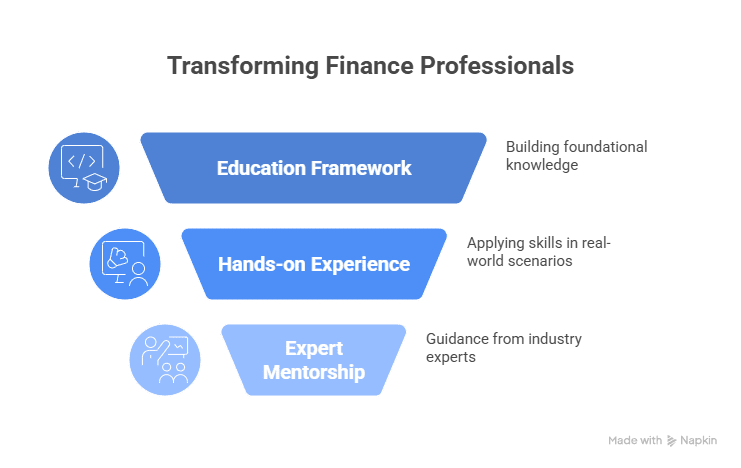
Let’s face it-spreadsheets have their limits. As you move through your finance career in India, you may have felt as if the demands of the job were asking for you to go beyond basics and speak the language of actual deals. Transitioning to that level is not just a matter of learning more Excel functionalities or finding the hottest templates to download. What you need is a shift in thinking, based on a framework of education, hands-on experience, and expert mentorship. This is the power of a financial modelling and valuation course.
This blog breaks down how the right course doesn’t just upskill you but rewires your thinking for high-stakes environments like investment banking, private equity, or corporate finance. It delves into how such programs, built around real-world finance projects and advanced valuation strategies, empower Indian professionals and students to evolve from spreadsheet users into deal-making pros.
Why Finance Career Transformation Requires More Than Excel
Ask a hiring manager in finance, and they’ll say the same as the last 20 they spoke with – basic proficiency in spreadsheets is given, but not enough. If you’re building a discounted cash flow model or evaluating a leveraged buyout, decision-makers want talent who can model uncertainty, think about risks, and link numbers back to a strategy. This is where a financial modelling and valuation course closes the gap.
A career transformation in finance does not take place in a bubble. It requires the right mix of applied case studies, simulations, and the right curriculum designed for industry ramp-up and performance. Programs designed for Indian students and professionals often come integrated with tools like Excel, PowerPoint, and even Python—all essential to modern finance roles.
Here’s what you need beyond Excel:
Deep understanding of valuation frameworks
Clear communication of insights through dashboards and presentations
Scenario building and stress-testing assumptions
Modelling for real transactions like IPOs, mergers, and capital raises
Interpreting industry trends through structured financial storytelling
Advanced Valuation Strategies: Beyond the Basics
Valuation is more art than science. Sure, you can compute a fair value using DCF or comparable company analysis. But are you skilled enough to challenge assumptions, adjust for market anomalies, or understand intangible asset valuation? That’s what advanced valuation strategies are all about.
Courses that focus on financial modelling and valuation don’t just spoon-feed you formulas. They teach you how to build flexible, dynamic models from scratch. And more importantly, they help you interpret the story those numbers tell.
Comparison Table: Basic vs. Advanced Valuation Techniques
Parameter
Basic Approach
Advanced Valuation Strategies
Method Used
DCF, Relative Valuation
Sum-of-the-parts, Contingent Claims
Adjustments Considered
Limited to common ratios
Minority discounts, Control premiums
Industry Application
General
Sector-specific (Tech, Real Estate, etc)
Risk Analysis
Single variable sensitivity
Monte Carlo simulation, scenario testing
For a deeper dive into advanced valuation thinking, check out this Harvard Business Review article on measuring company value beyond financials.
The Role of M&A Financial Modelling Training
Mergers and acquisitions aren’t just flashy headlines in the Economic Times; they are complex, multilayered transactions that require razor-sharp modelling skills. This is where M&A financial modelling training takes centre stage in any serious financial modelling and valuation course.
Learning how to construct models for M&A includes everything from target screening and synergy analysis to post-deal integration and scenario building. It’s the kind of learning that not only helps you in interviews but prepares you for deal rooms and boardroom discussions.
What You Learn in M&A Modules:
Modelling accretion/dilution
Financing mix: debt vs. equity
Sensitivity to synergies and cost savings
Pre- and post-deal valuation
Due diligence modelling techniques
Risk-adjusted return analysis
According to PwC’s Global M&A Industry Trends, global M&A volume is projected to remain strong into 2025. That means demand for M&A-ready professionals is only increasing.
Real-World Finance Projects: Learning That Sticks
Reading textbooks is fine. But nothing prepares you for the real world like actual project work. A robust financial modelling and valuation course always includes real-world finance projects that replicate industry scenarios.
These capstone projects are designed to mimic IPO valuations, LBO models, sector-specific valuation models, or even private equity case studies. You don’t just learn; you do.
Real-World Finance Project Examples:
IPO Valuation for a FinTech startup
LBO Model for a Private Equity transaction
DCF valuation of a large-cap listed company
Sector analysis of banking or pharmaceuticals
Simulation of a buy-side investment pitch
This experience becomes especially valuable for Indian students aiming for high-performance finance roles in investment banking, equity research, or corporate strategy.
Investment Analyst Upskilling: Tools and Techniques That Matter
As a budding or mid-career analyst, the transition from reporting historical data to forecasting future growth is essential. That’s where investment analyst upskilling through a financial modelling and valuation course really shines.
From learning Excel hacks for model speed to mastering databases like Bloomberg or Capital IQ, this upskilling prepares analysts to function as strategic advisors rather than mere data handlers.
Must-Have Tools for Investment Analysts:
Microsoft Excel (advanced functions, macros)
PowerPoint (investment decks)
Capital IQ, Bloomberg, Refinitiv
Python/R for quantitative models
Tableau for financial dashboards
Scenario and risk modelling templates
Upskilling like this not only helps in job interviews but makes you better at articulating insights, pricing deals, and evaluating investment opportunities.
The Course That Delivers: Financial Analysis Prodegree
If you’re ready to take the leap, Imarticus Learning’s Financial Analysis Prodegree is a top choice. Co-created with industry experts, this course offers intensive training in financial modelling and valuation, complete with real-world finance projects, live mentorship, and placement assistance.
It’s designed for Indian learners seeking genuine finance career transformation. Whether you’re just out of college or have a few years in the field, the program adapts to your pace, giving you access to tools, techniques, and case-based learning.
FAQs
Q1: Who should take a financial modelling and valuation course?
This course is well suited to finance graduates, MBAs, working professionals in banking or investment roles, and career changers trying to get into finance. It is also suitable for entrepreneurs looking to better understand valuation metrics.
Q2: How long does it take to finish such a course?
Whereas some part time or online options allow for more flexible pacing especially for working professionals, most programs can be completed in 3 to 6 months depending on the intensity and structure of the course.
Q3: Do I need to have prior finance knowledge to enrol?
Having some base level of knowledge is useful but many courses start with fundamental building blocks and develop to such complex modelling that they are accessible to beginners.
Q4: Are the tools I will learn in the course relevant to the job market?
Absolutely! Most programs focus on Excel, PowerPoint and sometimes even Bloomberg or Python. You won’t be able to avoid these programs in corporate finance, investment banking and equity research.
Q5: Will I complete hands-on project work with the course materials?
Yes, particularly with the better courses. You will work on IPOs, M&A cases, LBO models and then you can present the finished products in your job interviews.
Q6: How does this course help in job placement?
Many programs have industry tie-ups, career services, and placement support. Real-world projects and strong portfolios often give candidates an edge in interviews.
Q7: Can I learn this course online?
Definitely. In fact, online learning offers flexibility. Look for programs with live classes, mentor support, and real-time feedback for the best outcomes.
Q8: What salary boost can I expect post-certification?
While it varies, many professionals report salary jumps of 20-40% post-certification, especially when transitioning into high-value roles.
Q9: Is certification important in finance hiring?
Yes. A recognised certification acts as a signal to recruiters about your skills and commitment. It also helps you stand out in competitive applicant pools.
Q10: What makes the Imarticus Prodegree different?
The mix of practical training, expert faculty, and career services sets it apart. It’s structured around outcomes, not just content.
Key Takeaways
A financial modelling and valuation course is more than a skill upgrade—it’s a mindset transformation.
Learning advanced valuation strategies helps you value companies beyond simple ratios.
M&A financial modelling training is crucial for understanding complex transactions.
Real-world finance projects make learning stick and build your portfolio.
Investment analyst upskilling includes hands-on tools that align with modern job requirements.
Courses like the Financial Analysis Prodegree offer industry-driven content and career support.
Conclusion
In today’s hy-per-competitive world of finance, to become a deal-making superstar requires way beyond Excel skills. You need a structured learning plan, quality coaching and real life experiential learning. A quality financial modelling and valuation program doesn’t just prepare you for jobs, it prepares you for deals.
So if you are serious about advancing your career in finance, the time to act is now. Sign up for a program like the Financial Analysis Prodegree and step into the world of true finance, real skills and real results.
Voice-controlled assistants and AI-powered search engines are being recognised for their transformative impact on how information is found. Millions of people are now asking questions of Siri, Google Assistant, or Alexa, seeking answers, sending messages, playing music, or making reservations, rather than typing keywords into a browser.
Large language models (LLMs), such as ChatGPT and Gemini, are utilised to summarise entire web pages, compare products, and offer recommendations. For businesses, it is being understood that simply ranking well in traditional search is no longer sufficient.
While brands must be made visible across both search engines and AI tools, they must be crafted to be easily spoken by humans and clearly understood by machines. This in-depth guide is designed to explain how voice search works, why it is considered important, how it differs from text-based search, and how AI is changing the discovery of content.
The latest statistics on adoption are included, actionable strategies for optimising sites are provided, and the most common questions about voice and AI search are answered. Whether one is a marketer, business owner, or content creator, insights on preparing marketing efforts for the next generation of search are to be gained.
Voice Search: Adoption and Trends
Voice search has evolved from a novelty to a mainstream behaviour. According to DataReportal, approximately 20.5% of internet users worldwide engaged with voice search in mid-2024, translating to one in five people. This figure has been observed to slowly rise again, following a decline from a 2022 high of 22.5%. The number of voice assistant devices has surged to 8.4 billion, exceeding the global population, as stated by Demandsage. In the U.S., it is expected that over 153 million Americans will be using voice assistants by 2025.
Analysis conducted by Backlinko, utilising data from DataReportal and Edison Research, indicates that 30% of internet users aged 16 to 64 utilise voice assistants weekly. In 2024, it is estimated that approximately 98 million people in the U.S. owned a smart speaker. Usage rates are noted to vary by demographic: 61.9% of millennials, 55.2% of Gen Z, and 51.9% of Gen X report monthly usage of voice assistants, while only about 31.5% of baby boomers do so. Most voice queries are made on smartphones (56%), followed by smart speakers (35%) and televisions (34%), according to Backlinko.
The statistics also highlight how voice search is utilised:
Local Intent Dominates: Research conducted by Synup and cited in G2’s voice search report shows that about 76% of voice searches are conducted for nearby or local information. Mobile voice searches are reported to be three times more likely to seek local information than text searches, and more than half of consumers are found to discover local businesses through voice search.
Brief but Conversational Queries: It has been observed that the average voice search result is around 29 words. Complete questions are typically asked by users rather than simply typing keywords, with nearly 10% of voice searches containing a question.
Speed Matters: A study conducted by Backlinko of 10,000 Google Home responses found that voice search pages are loaded in approximately 4.6 seconds. Websites with high domain authority, natural language, and substantial social sharing are often found to provide the top answers.
Active Smart Speaker Owners: It is noted that users of smart speakers typically inquire about 11 different tasks each day. Half of smart speaker owners appreciate the ability to use voice commands to keep their hands free.
Emerging Commerce: Currently, it is reported that only about 8% of U.S. adults utilise voice shopping regularly, and purchase-related terms are not considered among the most common voice queries. However, 38.8 million Americans—representing 13.6% of the population—are found to use smart speakers for shopping-related activities, such as adding items to their carts.
The evidence suggests that voice search technology is widely utilised for everyday tasks, quick information retrieval, and local searches. While voice commerce is still observed to be on the rise, the high volume of voice interactions indicates that optimisation is essential for any business aiming to remain discoverable.
How Voice Search Works and How It Differs from Text Search
Voice search uses automatic speech recognition to convert spoken words into text and natural language processing to interpret the user’s intent. Digital assistants such as Siri, Google Assistant, Alexa, and Cortana pull answers from search engines and read them aloud. Users invoke these assistants on smartphones, smart speakers, in cars & even on wearables.
Voice queries differ from typed queries in several important ways:
Conversational phrasing. People speak in full sentences, such as “Who won the cricket match last night?” rather than “cricket match results.” Because of this, voice queries tend to be longer and more natural. They often start with question words like who, what, where, when, why, or how.
Context and intent. Voice assistants consider context such as the user’s location, previous interactions, and time of day. For example, asking “Where’s the nearest petrol pump?” triggers a local search, whereas typing “petrol pump” may display general information. More than half of voice searches have local intent.
Single answer output. On most smart speakers, the assistant reads only one result. Because there is “no prize for second place,” siteimprove”, ranking at the top of text search results and appearing in featured snippets, becomes crucial. According to Backlinko’s analysis, about 40.7 % of voice search answers come from featured snippets.
Short, direct answers. Voice results are brief, typically around 29 words. Assistants prefer content that answers a question directly and clearly.
Platform diversity. Not all voice assistants use Google. Google Assistant relies on Google Search, while Amazon’s Alexa and Microsoft’s Cortana primarily use Bing siteimprove. Optimising for voice, therefore, means aligning with both search engines.
These differences mean that voice search optimisation requires a strategy. Rather than targeting single keywords, marketers need to think in terms of questions and natural language. Mastering conversational search means anticipating how people speak and ensuring your answers fit their intent.
Why Voice Search Matters for Your Business
Voice search is not just viewed as a convenience; it is becoming a primary method through which products and services are found. Here are the reasons why attention should be paid to this trend:
High adoption across devices is being observed. With billions of devices supporting voice commands and 20% of global internet users engaging in voice search, a large segment of potential customers may be missed if this channel is ignored.
Local discovery is being emphasised, as over half of voice searches relate to local businesses. After performing a local voice search, it is reported that 88% of individuals visit or call a store within a day. If foot traffic is relied upon for business, optimisation for local voice queries can drive real-world conversions.
Hands-free convenience is preferred by users who turn to voice search while multitasking—such as during driving, cooking, or exercising—making it a viable solution when typing is impractical. Information provided through voice offers a competitive edge in these scenarios.
Limited competition is present in the voice search space. Since assistants deliver a single result, capturing that spot can attract the entire voice search audience for a given query. Yet, many businesses have not been optimised for voice, leaving opportunities available for those who take action now.
In summary, voice search is no longer regarded as optional. It is considered a critical component of modern SEO and local marketing, and its significance is expected to increase with rising adoption.
SEO Strategies for Voice Search
Voice search optimisation (sometimes referred to as voice search SEO) is involved in the tailoring of content and websites so that digital assistants can be easily found and read aloud. Throughout this section, tips on how voice search optimisation can be implemented naturally will be provided—without the use of keyword stuffing or technical jargon. The following steps will be presented to capture voice traffic and improve overall voice search optimisation efforts.
1. Research Conversational Keywords and Questions
Traditional keyword research tools can still be found to be useful, but a focus should be placed on natural phrases that reflect how people speak. Common questions can be revealed by tools like Google’s “People Also Ask” and forums such as Reddit and Quora. Question words (“what,” “how,” “where”) and long-tail keywords – extended phrases of three or more words that mirror the way people talk – should be looked for. Synup’s data suggests that voice search queries are predicted to be conversational 80 % of the time in 2024 (learn.g2.com), so aim for complete sentences rather than short fragments.
2. Provide Direct Answers Near the Top of Your Content
Voice assistants pull answers from concise paragraphs, lists & tables. Structure your content so that each section addresses a specific question. For example:- if the heading is “What is voice search SEO?”, the next sentence should explain it clearly. Backlinko’s research indicates that highly ranked voice results are written in natural language and at a ninth‑grade reading level.
Use bullet points and numbered lists to summarise complex information. Keep paragraphs short (2–3 sentences) and avoid industry jargon. This makes it easier for assistants to extract the answer and increases your chances of appearing in featured snippets, which supply 40.7 % of voice answers, according to backlinko.com.
3. Optimise for Featured Snippets and People Also Ask
To earn featured snippets:
Include the target question in a heading (H2 or H3).
Answer the question immediately in 30–40 words.
Use tables to compare data and lists to present steps.
Add relevant images or diagrams when useful.
Featured snippets not only secure the voice answer but also appear above regular search results, driving more clicks on desktop and mobile. Additionally, answering related questions helps you show up in “People Also Ask” sections, which often feed voice assistants.
4. Use Structured Data (Schema)
Schema markup tells search engines what your content means. For voice search, implement the following types:
FAQPage: Mark up frequently asked questions and answers.
HowTo: Structure step‑by‑step guides.
Recipe, Event, Product, etc.: Tag specific content types relevant to your business.
LocalBusiness: Include your business name, address, phone, and operating hours.
Schema can also include the speakable property, which highlights text that should be read aloud by voice assistants. Always validate your markup through Google’s Rich Results Test or Schema.org’s validator.
5. Strengthen Your Local Presence
Since 76 % of voice searches are local, local SEO is essential:
Claim and optimise your Google Business Profile (also known as Google My Business). Provide accurate details—address, phone number, hours—and select relevant categories. Add photos and encourage customer reviews to increase.
Use consistent Name, Address, Phone (NAP) information across all directories (Yelp, Bing Places, Apple Maps, etc.).
Create content tailored to local queries, mentioning neighbourhoods, landmarks, or service areas.
Encourage satisfied customers to leave voice‑friendly reviews. Positive reviews can improve your ranking in local results.
6. Improve Page Speed and Mobile Experience
Voice results favour pages that load quickly and render well on mobile devices. In Backlinko’s analysis, voice pages load in around 4.6 seconds (backlinko.com), much faster than the average webpage. To meet this standard:
Use responsive design and test across multiple screen sizes.
Compress images and use next‑generation formats like WebP.
Reduce unnecessary scripts and enable browser caching.
Use HTTPS to ensure a secure connection.
7. Test Voice Queries and Monitor Analytics
Voice optimisation isn’t a one‑time task. Ask your smart speaker common questions related to your business. Note which pages appear and adjust your content accordingly. To see which queries drive the traffic, many SEO tools now track voice search performance to determine this. Whether the answers satisfy user metrics like click-through rate, bounce rate and time on page is considered.
Introducing AI Search and Generative Engine Optimisation (GEO)
In addition to voice search, marketers must now account for AI‑powered search experiences. ChatGPT, Perplexity, Gemini & Bing Copilot — tools like these generate responses by pulling information from across the web and summarising it into conversational answers. How people find and interact with content, this approach is called AI Overviews, generative AI search, or AI‑powered search. Preparing your site for generative AI search is part of a broader set of AI SEO strategies that go beyond traditional optimisation.
Why AI Search Matters
Generative engines are growing rapidly. Walker Sands notes that ChatGPT surpassed Bing in visitor volume in 2024, receiving more than 10 million queries per day. Other AI platforms like Perplexity and Gemini are also expanding. This shift means that audiences are increasingly turning to AI tools for information instead of traditional search engines.
Marketers must adapt because generative AI responses may not direct users to your website. Rather than clicking links, users get an answer directly from the AI. To remain visible, you need to ensure that AI systems reference your brand and content accurately.
What Is Generative Engine Optimisation?
Generative Engine Optimisation (GEO) is the practice of optimising content and website structure so that AI‑driven models like ChatGPT correctly include, summarise, and cite your material. It extends traditional SEO by focusing on the context and relationships within your content and the broader knowledge graph. Key differences between GEO and SEO include:
Focus: SEO aims to get pages indexed and ranked by search engines, while GEO aims to ensure that AI systems understand and reference your brand in their generated answers.
Optimisation techniques: SEO emphasises keywords, site structure, and backlinks; GEO involves adding context through schema markup, concise introductions, author assignments, and inline citations.
Outcome: SEO seeks to drive visits to your website, whereas GEO strives to have AI engines cite your brand even if the user never clicks through.
GEO doesn’t replace SEO; it complements it. According to Walker Sands, many best practices overlap. By integrating GEO into your strategy, you broaden your visibility across both search engines and AI platforms.
How Generative Engines Work
Generative engines are large language models trained on vast datasets. They learn language patterns and context by analysing public information and then generate responses to prompts. To stay current, these models incorporate new data from user interactions, recent web content & feedback. Optimising for these engines involves ensuring that your content is accessible, well-structured & cited by other authoritative sources.
Strategies for Generative Engine Optimisation
Walker Sands outlines six key ingredients for a successful GEO strategy. Below, we adapt these principles for marketers:
Research and analysis: Identify the prompts and questions your audience might ask an AI. Analyse generative engine outputs to understand what terms and phrases they use. Monitor how your brand appears in AI responses and compare with competitors.
Content strategy: Create concise, keyword‑rich articles that answer questions. Add unique insights, data, and visuals. Update your content regularly and assign authors to build credibility. Use schema markup and strong headings to help AI systems parse your text.
Content distribution: Share your content in communities such as LinkedIn, Reddit & Quora. Encourage user‑generated content like reviews and testimonials. Build a social presence to increase citations.
Brand authority: Develop a consistent brand voice and acquire backlinks from reputable sources. Use public relations and influencer partnerships to gain mentions and establish authority.
Technical foundations: Ensure that your website is technically sound—fast, mobile‑friendly, and free of crawl errors. Optimise metadata, sitemaps & structured data so AI and search bots can access and interpret your pages.
Measurement: Configure analytics tools to track traffic & conversions from AI platforms. As generative search evolves, adjust your strategy based on performance data.
Frequently Asked Questions About Voice and AI Search
Below are concise answers to the most popular queries appearing on search results pages. Incorporate these into your website, adjusting the wording to fit your brand and location.
1. What is voice search SEO?
Voice search SEO (or voice search optimisation) refers to tailoring web pages so that voice assistants like Siri, Google Assistant, and Alexa can easily find and read them aloud. It emphasises conversational keywords, succinct answers, and proper structures.
2. How does voice search work?
Voice assistants convert speech to text, interpret the user’s intent using natural language processing, and retrieve the most relevant answer from search results. The assistant then reads the answer aloud. Because the output is usually a single result, ranking highly & providing clear answers is essential.
3. Why is voice search important for local businesses?
Most voice searches have local intent, and after a local voice search, 88% of users visit or call a store within a day. Optimising your Google Business Profile and ensuring consistent local information across the web helps you capture this traffic.
4. Do all voice assistants use the same search engine?
No! Google Assistant uses Google Search, while Amazon’s Alexa and Microsoft’s Cortana rely on Siteimprove. To reach all voice users, submit your site to both Google Search Console & Bing Webmaster Tools and follow best practices for both search engines.
5. What is AI‑powered search (AI Overviews)?
AI‑powered search refers to generative engines like ChatGPT, Perplexity, and Google’s Search Generative Experience that compile information from various sources and deliver conversational summaries. These tools answer users’ questions directly, without requiring them to click through multiple links.
6. What is the difference between SEO and GEO?
SEO (Search Engine Optimisation): Improves your site’s ranking on search engines by optimising keywords, structure, & backlinks.
GEO (Generative Engine Optimisation): Ensures AI systems understand, cite, and accurately represent your brand in generated answers.
SEO drives visitors to your website; GEO ensures brand visibility even when users stay within AI tools.
7. How can I optimise for AI search?
Conduct research to identify likely AI prompts.
Create concise and authoritative content with clear structure.
Implement schema markup.
Build brand authority through citations & PR.
Ensure technical health of your website.
Monitor analytics to track AI‑generated traffic.
These AI SEO strategies help your content surface in generative AI search results and complement your broader SEO efforts.
8. Will AI search replace traditional search engines?
Not entirely. AI search and traditional search serve different purposes and often complement each other.
Generative engines excel at summarising information and providing quick answers.
Search engines still drive traffic and enable deep research.
Both will likely coexist, and businesses should optimise for both.
Conclusion
The way information is discovered is being transformed by voice and AI search. With billions of voice assistants in use and a growing number of users turning to ChatGPT and other AI tools, these channels cannot be ignored by businesses. Voice queries are conversational and often local, with immediate answers being demanded.
AI search goes further; summaries are generated that may or may not link back to your site. Success will require the optimisation of voice search as well as broader omnichannel optimisation—an approach that ensures discoverability across traditional search engines, generative AI search tools, social media, and other channels. Attention should be focused on natural language, direct answers, structured data, strong local signals, and a technically sound website.
Generative Engine Optimisation extends these principles to AI platforms. The workings of LLMs should be understood, authoritative content should be crafted, brand authority should be built, and performance should be monitored to ensure inclusion in AI-generated responses for the brand.
Action should be taken now to ensure a strong position for thriving as search evolves.
If you’re a CFO or headed in that direction, you already understand—budgeting is more than a series of numbers on a spreadsheet. It’s where vision and execution come together. The Chief Financial Officer of today do not just manage funds—they control the strategic engine of the business. The role of budgeting is no longer simply about cutting costs; it is now about growing, building resilience, and an organization’s ability to be agile in a world that is constantly shifting.
In this blog, we break down everything that CFOs must know about budgeting, by combining traditional principles with the newest developments. Whether you’re fresh to the C-suite or reviewing your methodology, this CFO training manual provides a strategic dive into financial planning, budgeting best practices, and revolutionary tools to lead the way.
Table of Contents
The Importance of Financial Planning for CFOs
Top Budgeting Strategies for CFOs
Corporate Budgeting Best Practices
Strategic Budgeting Techniques Every CFO Must Know
CFO Financial Management: Aligning Budget with Business Objectives
Key Takeaways
FAQs
Conclusion
The Importance of Financial Planning to CFOs
A well-formulated financial plan is the backbone of any winning budgeting exercise. Financial planning by CFOs goes beyond the financial year—it is all about creating a long-term master plan that addresses risk, investment, and expansion. Contemporary CFO training places high emphasis on the importance of foresight, scenario modeling, and macroeconomic analysis in financial planning.
CFOs have transitioned from number crunchers to strategic advisors. Financial Planning now requires communication with other functions in the organization, understanding of pressures in the industry, and flexibility to shift gears, without worry to modify the plan along the way. In this backdrop, financial planning for CFOs becomes the guide that provides direction to every budgeting decision.
Budgeting techniques for CFOs need to transcend traditional incremental budgets. In today’s world, adaptive structures like rolling forecasts and zero-based budgeting are becoming the standard. These techniques enable CFOs to manage uncertainty, drive innovation, and refocus on shifting business realities.
CFOs must combine past data with predictive analysis, along with setting budgets that enable both fixed and variable cost control. Budgeting is not a static report; it’s a living document that adjusts in harmony with your business.
CFO Budgeting Responsibilities
Responsibility
Purpose
Strategic Planning
Align budgets with long-term business goals
Forecasting & Analysis
Prepare for market shifts and financial risks
Cost Optimisation
Improve efficiency and reduce unnecessary spend
Team Collaboration
Ensure cross-departmental alignment and accountability
Performance Monitoring
Track KPIs and adjust strategies as needed
Technology Adoption
Enhance accuracy with budgeting tools and automation
Stakeholder Communication
Present financial plans clearly to leadership and boards
Best corporate budgeting practices are meant to instill discipline, transparency, and strategic alignment in every business unit. CFOs that embrace such practices are able to promote more accountability and performance-driven culture.
A best practice is more than process; it’s about attitude. Cross-departmental collaboration, stakeholder alignment, and technology alignment are important. Current CFO training approaches value data-driven decisions and cloud-based budgeting software to drive accuracy and reduce turnaround.
Best Practices Checklist:
Engage department heads from the beginning
Use cloud-based budgeting software (such as Adaptive Insights, Anaplan)
Incorporate contingencies and buffers
Prioritize KPIs, not line items
Embed budgeting with performance dashboards
Visit: Deloitte’s 2024 CFO Insights on Budget Transformation
Strategic Budgeting Techniques That Every CFO Must Know
Budgeting without strategy is like being lost with no map. Practical strategic budgeting techniques enable CFOs to make decisions around strategic investments, allocate resources more impactfully, and shape financial plans with a view to long-term goals.
Strategic budgeting has two dimensions—short-term agility and long-term sustainability/feasibility. Whether your budgeting os for digital transformation, M&A activity, or international expansion, these strategies help financial leaders ensure they are building value with every dollar.
Key Strategic Methods:
Portfolio-based budgeting (resource allocation based on ROI)
Risk-weighted capital planning
Integrated scenario planning
CapEx vs OpEx balancing
Goal-focused budgeting
A fundamental aspect of strategic CFO training is how to say no to projects that are not aligned with the vision of the company—no matter how profitable they might appear in the short term.
CFO Financial Management: Budgeting in Alignment with Business Objectives
Good CFO financial management implies budgets as facilitators of strategic results rather than as constraints on cost. This is the crossroads of vision, execution, and value.
To do this, CFOs need to take high-level strategy and convert it into tangible financial results, and vice versa. Budgeting is then the link between what the organisation desires to accomplish and how it will accomplish it. CFOs need to lead from the front—align departments, rationalise spend, and embed a performance-first culture.
How CFOs Align Budgets to Strategy:
Establish top-down strategic goals
Link KPIs to every budget line
Make quarterly reviews and reforecasts
Connect financial results to departmental bonuses
Use dashboards to track real-time progress
Ready to learn all these budgeting techniques in detail?
Budgeting is no longer an operational but a strategic responsibility for CFOs.
CFO training should encompass planning, forecasting, and scenario analysis capabilities.
Methods such as rolling forecasts, ZBB, and risk-weighted planning enhance agility.
Best practices include technology embrace, cross-functional alignment, and frequent reforecasting.
Each CFO should reconcile budgeting with overall corporate strategy and measurable objectives.
FAQs
1. What’s the best budgeting approach for contemporary CFOs?
Although it depends on the organisation’s requirements, rolling forecasts and zero-based budgeting are becoming highly effective because they are highly adaptable and rationalise costs.
2. How do CFOs enhance the accuracy of financial planning?
Through the combination of cross-functional inputs, the use of AI-driven analytics, and repeated scenario simulations, CFOs can enhance the accuracy and timeliness of financial plans.
3. Why is budgeting so important in CFO training programmes?
Budgeting underlies financial control, resource allocation, and the execution of strategy. CFO training incorporates it to develop foresight, responsiveness, and alignment with stakeholders.
4. What strategic budgeting tools do CFOs use?
Well known tools are -Anaplan, Oracle Hyperion, Adaptive Insights & Workday. These systems enable real time collaboration, sophisticated forecasting & tracking of performance.
5. How frequently should CFOs revise the budget?
Budgets should ideally be reviewed every quarter.. but high-growth or volatile businesses can take advantage of monthly or rolling revisions in order to maintain alignment with changing realities.
6. How does a CFO resolve budget conflicts between departments?
Good communication, priority transparency, and objective models like ROI analysis or goal alignment resolve conflicts between departments over budgets.
7. Do traditional budgeting practices remain relevant?
They remain relevant in settled industries but most CFOs are embracing hybrid or agile models to lead the way in volatile environments.
8. What is the role of technology in CFO financial management?
Technology speeds up the preparation of the budget, makes it more accurate with automation, and more visible with dashboards and real-time metrics.
9. How do CFOs best prepare for budget presentations to the board?
CFOs must convert financial information into stories—with emphasis on impact, ROI, and strategic fit. Visualization and peer benchmarking are also effective.
10. Can budgeting be used to manage risks?
Definitely. Strategic budgeting involves planning for contingencies, reserving funds, and prioritizing low-risk, high-impact programs.
Conclusion
Budgeting has changed—and so must the CFO of today. As the organisation’s financial stewards, CFOs are required to connect capital with capability, risk with resilience, and strategy with execution. From learning about cutting-edge CFO training methods to excelling in agile budgeting models, financial executives must be ahead of the curve.
Budgeting mastery comes with influence mastery, foresight mastery, and transformation mastery.
Generative AI Business Use Cases – Real-World Examples
Generative AI for Managers – Strategic Benefits
Key Takeaways
Conclusion
FAQs
Introduction
Let’s be honest—your to-do list as a manager never ends. You have a team to manage, reports to read, strategic meetings to attend, and an avalanche of emails that never seems to stop! Enter Generative AI (Gen AI) – your new secret weapon for getting back some time in your day to concentrate on what’s really important – leadership, strategy, and results.
All the buzz about Gen AI is not just technology hype. It is the most powerful game-changer in a manager’s toolkit today. If you’re still only using calendar invites & email filters to manage your tasks.. you’re missing the boat. But with the right Gen AI Course -you can discover countless time-saving workflows and productivity hacks that will change the way you lead.
AI Productivity Tools for Managers
The question is no longer if you should use AI-it is how do you use it. Government officials in New Zealand are already using smart platforms to help optimise tasks, automate the flow of work, and make evidence-led decisions in real time.
These AI productivity tools for managers are not imaginary and out of reach-they are real, here and now! The challenge now is knowing which tool to use for what.
In summary, these tools don’t replace managers—they amplify them. They automate admin tasks, streamline communication, and free up your calendar for high-impact work.
Read more: McKinsey’s latest report on AI productivity in management
Save Time with AI at Work – Key Strategies
The workplace today is straightforward: all managers are being asked to accomplish more in less time. AI is a proven method for saving time at work, not just a trendy test drive.
A central insight here is that Gen AI will be the most useful if pulled into your work routine. Whether it is performance evaluations you need to prepare, agendas for meetings, or even assessing the status of projects, Gen AI models can do the heavy lifting.
List of Time-Saving AI Integrations:
Auto-summarise meeting transcripts using tools like Otter.ai
Draft detailed team emails with ChatGPT prompts
Automate task assignments in project management tools
Schedule and reschedule meetings using AI-based calendar bots
Quickly analyse sentiment from employee feedback surveys
Create slide decks from scratch based on reports
Generate job descriptions and onboarding documents
Suggest priority tasks using AI to-do lists
Translate communication for global teams in real time
Detect process inefficiencies through AI-based analytics
For managers juggling operations, AI offers more than speed—it delivers operational clarity. From supply chain monitoring to internal ticket resolution, AI in business operations improves transparency and workflow efficiency.
Imagine an AI system that flags bottlenecks before they escalate or predicts when customer queries will spike. That’s no longer fiction—it’s function.
As a manager, delegation is one of your most powerful tools. But what if you could delegate to an algorithm? With automating tasks with AI, that’s exactly what happens.
Start with repetitive tasks—daily check-ins, calendar blocks, status updates. These are perfect candidates for automation. Then move to creative support, like AI-assisted presentations or report generation.
Automatable Tasks by AI Category:
Task Type
Tool Example
Time Saved Weekly
Meeting Summaries
Otter, Fireflies
3–4 hours
Report Drafting
Jasper, ChatGPT
2–3 hours
Workflow Automation
Zapier, Make.com
5+ hours
Email Responses
Superhuman AI
2 hours
Task Assignments
Trello + Butler
1 hour
With the right Gen AI Course, managers can learn to implement these tools effectively without needing a tech background.
Generative AI Business Use Cases – Real-World Examples
Real businesses are already seeing big wins from Gen AI. These generative AI business use cases show that managers who embrace AI don’t just get more done—they lead better.
Here are standout examples:
Unilever: Uses AI to automate hiring processes, saving weeks per cycle.
PepsiCo: Leveraged Gen AI to generate retail insights, cutting report generation by 80%.
LinkedIn: Uses AI to optimise recruitment messaging and engagement.
Slack: Has integrated generative summaries directly into conversations.
Each case illustrates the power of AI when aligned with clear business goals.
Generative AI for Managers – Strategic Benefits
So, how can generative AI for managers actually improve leadership? Beyond saving time.. it sharpens decision making & strengthens communication.
Managers often juggle conflicting priorities. Gen AI helps by highlighting patterns, distilling key points & surfacing trends in performance data or customer feedback. It becomes your second brain for strategic thinking.
Strategic benefits managers can leverage:
Better Decision-Making: AI provides data-backed insights instantly
Faster Onboarding: Automated training materials for new joiners
Improved Communication: Gen AI drafts memos, strategies, and updates
Talent Development: Create tailored growth plans using AI suggestions
Scenario Modelling: Plan responses to what-if business scenarios
The result? More clarity, more confidence—and a team that feels genuinely led.
Key Takeaways
Gen AI is not just a tool for techies—managers across industries are leveraging it daily
AI productivity tools for managers include ChatGPT, Notion AI, Jasper, Zapier, and more
You can save up to 10+ hours a week by automating repeatable workflows
AI in business operations streamlines decision-making and problem detection
Real companies like PwC and Unilever are using Gen AI to boost efficiency
A dedicated Gen AI Course equips managers with practical, job-ready skills
Conclusion
If you’re a manager who is still stuck in the spreadsheet swamp or overwrought by your inbox, it’s time to embrace change in your management style. Gen AI is not there to replace you, but rather to amplify you. It’s there to take on the drudgery to free you up to lead with impact. From automating workflows to driving better strategy, the possibilities are endless and exciting.
The future of management will be AI-enabled, and you don’t have to be a tech master to get started. You just need a plan – and the right course.
Gen AI refers to generative artificial intelligence, capable of creating content, summarising data & automating tasks. For managers.. it saves time, enhances decision-making, and improves team communication.
2. Is it difficult for non-tech managers to learn Gen AI tools?
Not at all. Most Gen AI platforms are user-friendly and intuitive. With a dedicated Gen AI Course, even non-technical managers can start using AI tools confidently.
3. Could AI potentially replace managers entirely?
No.. while AI enables enhanced decision-making & can automate low-level tasks, it can’t replicate the leadership, empathy & critical thinking that managers bring.
4. What are some of the best AI productivity tools for managers?
Some of the “Top” tools include ChatGPT for better communication, Notion AI for document summarization, Jasper for content, Trello + Butler for project automation, and Zapier for workflows.
5. How much time can managers save using AI?
Depending on the usage of AI, managers can automate some of the routine parts of their job and streamline reporting, etc, as well as enhance intrateam communication with Gen AI, saving between 5 and 10 hours a week.
6. Is there any risk in using AI at work?
Yes, it comes with risks in data privacy and over-reliance. Managers should be sure to be ethical in their AI use, verify outputs where appropriate, and ensure specific platforms are within company policies.
7. How is Gen AI used in operational processes in business?
In resource planning; sentiment analysis; customer support automation; internal communication; predictive analytics for supply chain decisions.
8. Can Gen AI support employee training and onboarding?
Yes through Gen AI -managers can create onboarding materials, quizzes, handbooks & even scenario simulations to be used in employee training sessions.
9. What are real-world examples of companies using Gen AI?
Firms like PwC, Unilever & PepsiCo are using Gen AI to automate HR, generate insights & streamline operations across departments.
10. Where can I learn more about Gen AI for managers?