Over the past few years, there has been substantial growth in the investment market. People are becoming more aware of recent economic trends. However, the long-term benefits of investment banking come with huge market risks.
It might sound daunting, but there are certain effective risk management techniques too to help with market risk. In this blog, we will discuss all of these in detail, so that you can invest consciously.
Market Risk Definition
The market risk definition is quite straightforward. The unpredictability surrounding any investment choice is referred to as market risk, often called systematic risk. Unexpected changes in variables that frequently impact the whole financial market are a typical cause of price volatility.
Market risk is determined by the performance of the market as a whole and is not specifically tied to the company or industry that an investor is participating in. An investor must thus keep an eye on several macro factors linked to the financial industry, such as interest rates, inflation, the equilibrium of payments, budget shortfalls, and regional issues.
Various Forms of Market Risk
Interest Rate Risk Interest rate risk results from unexpected changes in interest rates brought on by the monetary policies of the central bank actions. Long-term parity in the returns on securities provided across all markets requires a modification of market demand alongside supply for the instrument. Therefore, a rise in rates would result in a decrease in the price of the security. It is mostly connected to securities with fixed income.
Commodity Risk Some commodities, like food grains or oil, are used as indirect inputs in the production of many other things and are therefore essential to every economy. Any fluctuations in commodity prices have a cascading effect on performance in the market and frequently lead to a supply-side crisis.
Currency Risk
Another name for currency risk is exchange rate risk. It speaks about the potential for a decrease in the return that an investor receives as a result of the worth of their native currency depreciating. Usually, while making an overseas investment, the risk is considered into account.
Country Risk Several macro issues that are outside the purview of the marketplaces might impact the return on investment. These include the degree of political stability, the degree of fiscal imbalance, the regulatory environment, the ease of doing business, and the vulnerability to natural disasters. When choosing to make an overseas investment, one must evaluate the level of risk involved with such elements.
Ways to Alleviate Market Risk
The risk cannot be minimised by diversification because it impacts the entire market, however, it may be hedged for low exposure. As a consequence, even with meticulous execution of basic and analytical research on the specific investment choice, investors may not receive the desired profits.
In addition to using techniques like Value at Risk (VaR) modelling to predict potential damage via quantitative risk management, professional analysts frequently view fluctuations, or the absolute/percentage variation in rates, as a useful indicator of market risk.
By comparing an asset’s beta coefficient to the market as a whole, an investor can ascertain the degree of market risk volatility associated with that investment or portfolio. The capital asset pricing model (CAPM) is another tool used to calculate the projected return on an asset.
Risk Management in Investment Banking
Risk management in investment banking refers to the systematic process banks employ to identify, assess, and mitigate a variety of risks, such as credit, market, operational, and compliance risks that influence investment and operational decisions.
The process of systematically identifying, assessing, and minimising risks that a bank may face in the course of its regular business is known as banking risk management, and it is intended to guarantee stability and long-term sustainability.
In the banking industry, efficient risk management may support the preservation of the system’s overall viability, investor and depositor interests, and financial stability. It’s an important job that needs constant care and adjustment to the changing financial scene. Enrolling in an investment banking course could also be a great place to gain more knowledge related to risk management skills.
Important Steps of A Risk Management Process
The risk management process consists of these five fundamental steps, which are used to manage market risk:
Identifying the Risk
Analysing the Risk
Evaluating the Risk
Treating the Risk
Monitoring the Risk
Step 1: Identifying the Risk
Determining the risks which the company faces in its operational environment is the first stage in the risk management process.
There are several varieties of dangers, including:
Risks to the law
Dangers to the environment
Market dangers
Risks related to regulations, etc.
This strategy has the benefit of making these risks obvious to all organisation stakeholders who have system access.
Step 2: Analysing the Risk
A market risk must be examined when it has been recognised. It is important to look at how many business operations the risk impacts to evaluate the risk’s degree and significance. Certain risks, if they materialise, have the potential to completely collapse the company, while other risks in the analysis will simply cause minimal setbacks.
Step 3: Evaluating the Risk
Depending on how serious the risks are, most risk management solutions include many risk categories. A market risk that could end in a little dissatisfaction is rated low, whereas a market risk that could cause an enormous loss is rated maximum. Classifying risks is crucial since it provides an organisation with a comprehensive understanding of its overall risk exposure.
There are primarily two types of risk assessments: Qualitative Risk Assessment and Quantitative Risk Assessment
Step 4: Treating the Risk
Alerts may be delivered from inside the system to all pertinent stakeholders in a risk management solution. The risk may be discussed, as well as potential solutions, from within the framework. Furthermore, senior executives may closely monitor the advancements made inside the system and the remedies that are being proposed.
Step 5: Monitoring the Risk
Two types of risks that require constant monitoring are market risks and environmental risks. When using manual methods, watchful staff members do the monitoring. These specialists must maintain vigilant monitoring of all risk parameters.
The risk management system keeps an eye on the company’s whole risk framework in a digital setting. Additionally, computers are far more adept than humans in constantly tracking risks.
Investing is necessary in today’s time. But, investing does come with its cons too. But if aspiring investors can follow the steps that have been discussed in this blog, steering away from risks and managing them can get easier.
Enrol in the Certified Investment Banking Operations Professional (CIBOP™) by Imarticus to learn more about market risks and risk management.
Frequently Asked Questions
Why is risk management essential for banks? For banks to preserve their credibility, maximise return on investment, guarantee financial stability, comply with legal obligations, and promote long-term development and long-term viability risk management is essential.
How is stress testing essential in risk management? Stress testing helps banks find weaknesses and modify risk management techniques by modelling extreme market situations, recessions, or specific risks like loan defaults. This helps banks examine their resilience under undesirable scenarios.
In what ways can risk management help banks comply with regulations? Identifying, assessing, and mitigating risks related to financial transactions, data security, anti-money laundering (AML) regulations, and client protection statutes are all part of risk management. By doing this, banks are guaranteed to adhere to regulatory standards. Enrolling in an investment banking course can also provide deeper insights into the varied benefits of risk management.
How can a bank assess and manage credit risk? To assess credit risk, banks look at debtor repayment capacity, collateral, and financial condition. Examples of mitigation strategies include risk-based pricing, credit limit setting, and portfolio diversification.
If you’re reading this, you’re probably asking one of two questions: “Is CPA worth it?” or “How soon will my CPA salary make this whole effort pay off?”
Think about it – what makes certain professionals stand out in finance? How do they gain the credibility to advise on multi-crore budgets, manage risks, or guide companies through complex audits?
This is exactly where specialised training and a CPA certification come into play. It’s what separates someone who simply crunches numbers from a professional who can lead financial strategy, influence major decisions, and command top-tier salaries.
In this blog, we’ll walk through the full map – what is the full form of CPA, real salary ranges in India according to roles and experience, city and industry premiums, how to strategically approach the fresher to leadership pay, and more.
Did you know? Median salary for a new CPA graduate with a bachelor’s degree in the US is $60,834 in 2025, marking an 11% increase over the previous AICPA survey period.
Overview of CPA
You’ve probably heard people talk about accountants, auditors, or finance managers, but not all of them have the same influence or earning potential. Some handle routine bookkeeping, while others are trusted to make strategic decisions that can shape the future of a company. And now, you might wonder who is behind these roles. Well, usually a professional with a CPA is trusted for these kinds of responsibilities.
Sounds like a buzzword, but you are not really sure what is CPA or even what is the full form of CPA. Let me break it down. The full form of CPA is Certified Public Accountant – a US professional accounting license that shows you passed the Uniform CPA Examination and met education & experience requirements.
It’s not a job title but a professional credential that opens roles in audit, tax, finance, risk, and corporate leadership. The AICPA (American Institute of CPAs) is the primary body behind the exam and resources.
What matters for salary is that employers pay for transferable skills (US GAAP/IFRS, tax, audit procedures, financial reporting), and CPAs often command higher pay in cross-border or MNC setups because they can speak both the technical accounting language and global regulatory dialects.
CPA Salary in India
Having a CPA in India can genuinely change the course of your career and open doors to higher earning potential. But it’s important to stay grounded – clearing the CPA exam doesn’t instantly make you a six-figure professional. The salaries you see are tied to the level of responsibility, expertise, and trust that companies place in a CPA. It’s a qualification that allows you to take charge of audits, taxation, financial planning, and strategic decisions that shape a business’s direction.
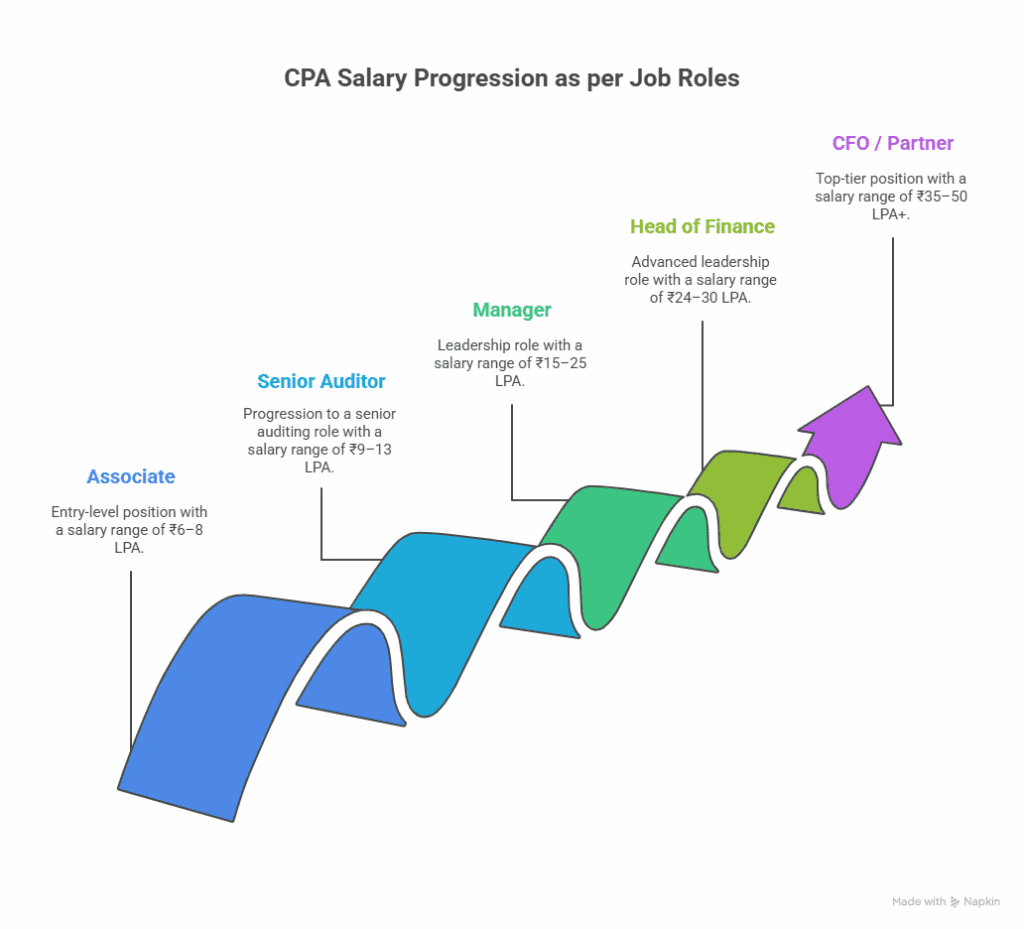
When you’re just starting, the pay is good – it’s enough to live comfortably and start building some savings. The real growth happens as you gain experience, choose a niche, and step into roles where your work influences major business decisions. That’s when your compensation begins to truly match the value you deliver as a finance professional.
Senior / leadership: ₹20–30 LPA+ – CFOs/Partners in Big firms can go much higher
CPA Salary in India by Experience
If you’re looking at a CPA purely through the lens of salary, here’s the truth: it grows steadily, not suddenly. The good part? It’s a growth you can count on. The market in India rewards CPAs who stay curious, take on complex projects, and continuously adapt to changing global standards.
If you’re worried about whether the CPA pays off – it does, but in the most sustainable way possible. Not overnight, but over time, your salary becomes a reflection of the trust your qualification commands.
Experience Level
Average Annual Salary (INR)
Fresher/Entry-Level (0-1 year)
₹6-9 LPA
Early-Career (2-4 years)
₹6–10 LPA (Total Compensation)
Mid-Career (5-10 years)
₹15–25 LPA
Senior/Experienced (10+ years)
₹24–30 LPA or more (Leadership roles often higher)
The jump between mid and senior – when you take on managerial ownership, client responsibility, or cross-border reporting – can multiply pay by 2x or more. That’s where most CPAs go from “comfortable” to “six-figure in INR” territory.
Salary growth over a CPA’s career
New hires with master’s degrees saw starting salaries increase roughly 17% to a median $67,750 from the previous survey.
You can make a Management jump (within 5→10 yrs): the biggest multiplier when the role expands beyond technical work.
CPA Salary by Industry
Not every CPA earns the same, and that’s because industries value accounting expertise differently. A CPA working in financial consulting or investment management often handles high-stakes decisions – so the compensation reflects that. On the other hand, those in manufacturing or public sector roles might enjoy more stability but at a steadier pay scale.
In India, the industry you choose often decides how fast your CPA qualification starts paying off. Technology, BFSI (Banking, Financial Services & Insurance), and consulting firms tend to offer the most aggressive salary growth, especially if you’re handling cross-border compliance or US GAAP reporting.
But ultimately, each sector brings something different to the table – some offer learning, some offer lifestyle, and a few offer both. The table below breaks down how CPA salaries vary across industries, so you can plan your career not just around your skills, but around where those skills are valued most.
Industry
Average Range
Big-4 / Audit firms
₹6–20 LPA (entry → manager)
MNC Finance / Corporate FP&A
₹8–25 LPA
Consulting / Advisory
₹10–30+ LPA
Tech (product firms)
₹8–22 LPA
Banking / BFSI
₹9–28 LPA
Public sector / NGOs
₹4–10 LPA
CPA Salary by Cities
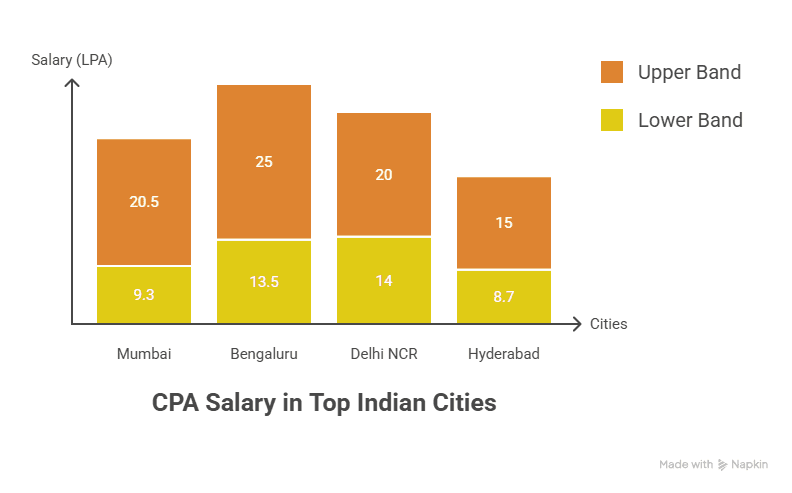
Understanding how CPA salaries vary by city can help you make informed decisions about career opportunities and relocation. Here’s a snapshot of average salaries for Certified Public Accountants (CPAs) in key Indian cities:
Consulting and MNC corporate roles generally pay more because the work requires both technical and commercial acumen; Big-4 gives a strong early-career pay and learning curve, while senior Big-4 partners and ex-partners move to CFO/Controller roles with very high pay.
Key Takeaway→ Metro cities like Mumbai and Bengaluru top the charts due to the concentration of MNCs and finance centres.
Factors Impacting CPA Salary
A CPA’s paycheck doesn’t just depend on clearing the exam; it’s shaped by where you work, what you specialise in, how much experience you’ve gathered, and even how you position yourself in the market.
Two people with the same qualifications can have completely different salary stories. One might be working at a Big 4 firm in Mumbai handling multinational audits, while another could be consulting for startups remotely from Pune – both valid, both valuable, but with very different pay scales.
Understanding these factors early helps you make smarter career choices – from the industry you enter to the city you move to, to the niche you build expertise in.
Top factors:
Experience & Role Scope – early promotion to manager or specialist roles (tax/transfer pricing/forensic) multiplies pay faster than years alone. Mentor tip: Seek role expansions that add client-facing responsibility or people management within 3–5 years.
Industry – consulting/big-4/MNCs pay premiums. Tech companies with finance teams also pay well for US GAAP know-how. Mentor tip:Move laterally to BFSI or tech if you want steep salary growth.
City / Cost-of-doing-business – Mumbai, Bangalore, Delhi & Hyderabad command premiums (10–20%). Mentor tip: If you’re remote and earning from US firms, location is secondary – skill is king.
Skill Specialisation – IFRS conversions, US GAAP, international tax, and forensic accounting attract better pay. Mentor tip:Add a niche certificate (forensic, valuation) to your stack.
Employer Reputation (Big-4 / MNC vs domestic) – Big-4 lifts brand & learning; MNCs may pay more for control roles. Mentor Tip: If you want global mobility or cross-border exposure, Big 4 experience makes you a plug-and-play fit for multinational teams.
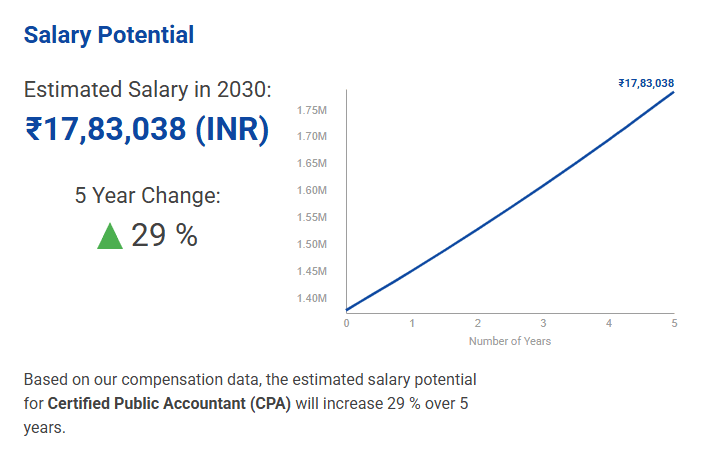
Once you understand what impacts a CPA’s earning power: experience, specialisation, and the trust you build in the market, the growth curve starts to make perfect sense. Below is a projection for the CPA Salary by 2030.
What impacts CPA salary the most?
Specialisation (tax, IFRS, transfer pricing): +20–40% pay uplift.
City: Mumbai/Bengaluru/Delhi pays ~10–20% more.
Scope of Responsibilities: client-facing + managerial = faster increases.
CPA vs CMA vs CA – The Salary and ROI comparison
If you’re trying to decide between the CPA, CMA, and CA certifications, you’re not alone. A lot of people reach this stage and wonder which one will actually help them grow their careers meaningfully.
The CPA is your ticket to global opportunities. It’s respected everywhere and can get you into roles in audit, taxation, or corporate finance that pay really well.
The CMA is more about understanding the business side of numbers, like planning, budgeting, and helping companies make smart financial moves. It’s a great choice if you enjoy strategy and want to grow in corporate roles.
The CA has deep roots in India and still carries huge respect here, especially if you’re interested in audit, tax, or compliance. This comparison highlights the earning potential for each qualification, helping you make an informed career choice.
Differentiator / Feature
CPA
CMA
CA
Global Recognition
✅
✅
❌
Average Global Starting Salary
✅
✅
❌
Mid-Career Salary Growth
✅
✅
✅
Top-Tier Salary Potential (10+ years)
✅
✅
✅
ROI (Cost-to-Earning Ratio)
✅
✅
❌
Duration to Qualify (Shorter)
✅
✅
❌
Recognition by MNCs & Global Firms
✅
✅
❌
Ease of Global Mobility
✅
✅
❌
Alignment with US/IFRS Standards
✅
✅
❌
Demand in Big 4 Firms
✅
✅
✅
CPA Salary Comparison with CA
The comparison below breaks down how salaries differ between CPAs and CAs across experience levels and roles, helping you see where each qualification truly shines – whether your goal is stability at home or a global finance career.
Level
CPA average
CA average
Notes
Entry(0–2 yrs)
6–8
5–6
CPA often edges CA at entry where US-focused roles exist.
Mid(5–10 yrs)
11–14
9–12
CPA shows a premium in MNC roles.
Senior(10+ yrs)
20–35+
15–25
CPA senior managers/CFOs often command global packages.
The “better” path depends on your desired market: if you want early domestic accounting roles in India only, CA is excellent. If you’re targeting MNCs, US reporting, or the US job market, a CPA increases global mobility and may improve salary upside.
Key Takeaway→ CPA offers global portability and often higher pay in MNC roles; CA is excellent for India-specific tax/audit depth. Choose based on target geography & role.
CPA Salaries In India vs the USA
If you benchmark against the US, the nominal numbers differ hugely due to currency and living costs.
Headline numbers:
US average CPA salary: ~$80k–120k+ depending on source and role.
What that means for India-based CPAs working for US firms: If you secure a remote role paid in USD, your INR salary (after conversion) can look dramatically higher – but remember taxation and benefits differ.
This video walks you through pay scales shift between India, the US, and other major markets – and what really drives those differences beyond just currency. It’s a quick, insightful watch that brings the numbers to life.
Executive CPA Salary in India and the US
When CPAs step into top executive roles, the pay gap between India and the US really starts to show – and it’s not just about the currency difference. It’s about the scale of work, the level of responsibility, and how each market values senior finance professionals.
In India, executive-level CPAs earn well above the average mid- or senior-level salary, especially if they’re working with multinational companies or global consulting firms. In the US, those same roles come with even higher compensation – not only because of the cost of living, but because these positions often shape major business and financial strategies.
The table below gives you a clearer picture of what executive CPAs typically earn in both countries. It’s not just about comparing numbers – it’s about understanding what drives those differences: experience, industry, and the size of the company you work for all play a big part in how far your CPA can take you.
Starting as a CPA, your salary reflects not just your qualification, but also the market you’re stepping into. In India, fresh CPAs earn a good starting pay that grows as they gain experience and take on bigger responsibilities. In the US, starting salaries are generally higher, thanks to the larger scale and cost of living differences.
The table below gives a quick snapshot of what is the CPA salary typically in India and the US. It’s a handy way to get a sense of what to expect as you begin your career and start planning your next steps.
Country
Experience Level
Average Annual Salary
India
Fresher/Entry-Level
₹6–8.5 LPA
India
Fresher/Entry-Level (Metro Cities)
Up to ₹13.8 LPA
US
Fresher/Entry-Level
$55,000–75,000
Average CPA Salary by Country
CPA salaries can be very different depending on where you are in the world. A lot of that comes down to the economy, industry demand, and the cost of living. In India, CPAs get a strong start and plenty of room to grow. But in places like the US, Canada, or Australia, salaries are usually higher, and the work often comes with more international exposure.
The table below gives you an easy snapshot of average CPA salaries by country. It’s a good way to see not just the numbers, but also the kinds of opportunities your qualification could open up for you.
Country
Average Annual Salary
United States of America (USA)
$90,000–99,000
Australia
$113,035
Canada
$100,291
India
₹9,12,663
Japan
¥7,755,349
United Arab Emirates (UAE)
AED 180,000
Ireland
€50,000
Understanding How CPA Salary Increases Over Time
Your CPA license is the key, but how fast you unlock its full earning potential depends on the moves you make. From choosing the right industry and city to specialising in high-demand niches, small tactical decisions can multiply your pay faster than just waiting for yearly increments.
In this section, we’ll share some approaches that can help you understand how can your CPA salaries grow over time, with smarter choices that translate directly into higher compensation and career growth.
Build a niche: Master one high-demand niche (transfer pricing, international tax, forensic). Market it on LinkedIn and include niche keywords.
Ask for higher-responsibility projects: Volunteer for cross-border reporting or client-facing tasks – responsibility beats tenure.
Get secondment experience: Temporary placements in MNC finance teams or overseas secondments boost pay and resume.
Consider lateral moves: Moving companies often yield higher jumps than annual increments.
Upskill with tech: SQL, Power BI, or automation tools increase bargaining power.
FAQs about CPA Salary
If you’ve made it this far, you probably still have a few questions buzzing in your head about CPA salary – how it grows, what affects it, and whether it’s really worth the effort. This section clears up the most common questions students and professionals ask about CPA salaries.
Who earns more, CA or CPA?
Both credentials are valuable. Generally, a CPA working in MNCs or roles requiring US GAAP/IFRS knowledge can earn a higher CPA salary in global-facing roles, whereas a CA may have stronger domestic opportunities in Indian tax and statutory audit. By seniority (10+ yrs), many CPAs who move into leadership roles or global finance positions will often see higher compensation than their CA counterparts, but individual outcomes depend on role, industry, and negotiation.
What is the highest CPA salary?
The top CPA salary varies widely. In India, senior CPAs who reach the C-suite (CFO, Finance Head, etc.) or become partners in large firms can earn ₹40–50 LPA and beyond, while global packages for senior finance executives can be higher. In the US, senior CPAs in finance leadership roles often average well into six figures (USD), and specialised roles or Big-4 partners report significantly higher pay.
Is CPA better than an MBA?
Better” depends on goals. A CPA is specialised, technical, and highly valued for accounting/audit/tax work; an MBA is generalist, leadership- and strategy-focused. If you want deep finance & reporting expertise and technical credibility, a CPA can be a higher ROI. If you want broad business leadership and a strong management network, an MBA might be the way to go. Some professionals do both to maximise skills and pay.
Am I eligible for CPA?
Your eligibility depends on the various state boards and the specific requirements (e.g. education credits, residency). Most candidates require 120–150 credit hours with accounting and business subjects. Check the AICPA/state board guidance for your exact pathway.
Is CPA a good career option?
Yes. CPAs are in global demand as the designation signals competence and opens doors in audit, tax, corporate finance, and advisory. In India, as businesses find their global footing, the demand for CPAs with international reporting skills will continue to grow.
Is CPA in demand in India?
Yes, CPA is very much in demand in India, particularly among MNCs, US-facing finance teams, consulting firms, and companies doing cross-border reporting. The demand is strongest in major finance hubs like Mumbai and Bengaluru.
Is CPA more difficult than CA?
Both are challenging but different. CA tests India-specific tax, law and audit frameworks extensively. CPA focuses on US exam content and state credentialing rules; difficulty depends on background, study approach, and exam readiness. Many Indian candidates find the CPA exam manageable with structured prep because it’s modular and exam-focused.
What is the fees of CPA course in India?
Fees usually vary: application stages like exam registration, board fees, and coaching combined fall in the range of ₹2–4 lakhs, depending on the coaching provider and your selected state board. Always check the latest fee schedules from the state board and coaching providers.
Which companies hire CPA in India?
Common employers include Big-4 firms, MNCs (Amazon, IBM, JP Morgan), tech product companies, consultancies, and banks, essentially any firm with international reporting or US filing requirements.
Your Next Steps
The true value of the CPA isn’t just in the paychecks – it’s in the kind of professional you become along the way. Salary is a milestone, not the destination. What the CPA does is refine how you think about money, business, and trust. It turns you from someone who records numbers into someone who interprets them – who helps companies make decisions that ripple through balance sheets, markets, and lives.
It’s a credential that demands discipline, but it also builds perspective. A CPA learns early that growth doesn’t come from chasing higher salaries alone, but from earning influence – the ability to walk into a boardroom and be trusted with financial truths. Some CPAs climb fast in multinational firms; others carve their niche in startups or consulting. But across every path, the thread remains the same: the ones who keep learning, keep rising.
Think of it like compounding interest – small, consistent efforts in learning, networking, and specialisation quietly multiply into exponential career returns. Your CPA license is the principal; how you invest it defines your yield.
If you’re ready to take that step – to not just earn more, but become more – the CPA Program in collaboration with KPMG in India offers the structure, mentorship, and global credibility to help you get there. With a money-back guarantee if you don’t clear your exams, live and on-demand sessions that adapt to your schedule, and projects that make you apply what you learn, it’s built for professionals who are serious about building a global finance career.
Because careers don’t just happen; they’re built with intention, skill, and the right guidance.
In today’s hyper-connected world, our reliance on digital technologies has created a vast and complex landscape, one that unfortunately attracts malicious actors. Cybersecurity is the practice of protecting our digital assets, information, and systems from unauthorised access, use, disclosure, disruption, modification, or destruction. It is the digital armour that shields our businesses, personal data, and critical infrastructure from the ever-evolving threats posed by cybercriminals.
The stakes have never been higher. Cybercrime is a booming industry, costing businesses trillions of dollars globally each year. This Is not just a statistic, it translates to real-world consequences. A successful cyberattack can cripple a company’s operations, erode customer trust, and inflict significant financial damage.
In this article, we will learn about what does cybersecurity protect and what kind of threats it protects us from. By understanding the cybersecurity landscape and taking proactive measures, companies and even individuals can significantly reduce the risk of falling victim to cyberattacks. Let us learn more.
Understanding the Cost and Financial Impact of a Cyber Breach
Before we delve into the cybersecurity threats and strategies for mitigation, let us first find out the financial damage caused by cyberattacks (aside from data loss and many other damages). Here are the costs incurred when a cyberattack is successfully carried out:
Malware: $23,856 per incident
This is the average cost per incident businesses incur due to malware infections.
Denial-of-Service (DoS) Attacks: $100,000 per hour)
This is the immense financial losses businesses experience per hour during such attacks.
Source: Gartner: Cost of DDoS Attacks
So the answer to “what does cybersecurity protect” would be “everything” as these attacks lead to great financial losses, regardless of the asset or data that got compromised.
Common Cybersecurity Threats and Attacks
The digital landscape is teeming with malicious actors wielding a diverse arsenal of cyber threats (threat definition cybersecurity: any attack that can lead to losses or damages). Let us delve into the most common ones and equip you with the strategies for mitigation to combat them:
Malware
Malware are fundamentally any malicious program that is intended to cause harm to target computing systems. Here are some:
Viruses: These malicious programs self-replicate by attaching themselves to legitimate files. Once a user opens an infected file, the virus can spread throughout the system, corrupting data and disrupting operations.
Worms: Similar to viruses, worms can self-replicate, but they exploit network vulnerabilities to spread from device to device without requiring user interaction.
Ransomware: This particularly nasty form of malware encrypts a victim’s data, essentially holding it hostage. Attackers then demand a ransom payment in exchange for the decryption key.
Real-World Example: The 2021 ransomware attack on Colonial Pipeline, a major fuel pipeline operator in the United States, crippled fuel distribution for several days. The attack resulted in millions of dollars in ransom payments and widespread gas shortages.
Phishing
Phishing attacks are a deceptive attempt to trick victims into revealing sensitive information, such as passwords or credit card details. Attackers often use tactics like:
Spoofed Emails: Emails disguised to appear from legitimate sources (e.g., banks, social media platforms).
Urgency and Scarcity: Creating a sense of urgency or exploiting fear of missing out (FOMO) to pressure victims into clicking malicious links.
Suspicious Attachments: Attaching infected files or documents that appear enticing but compromise systems upon opening.
To empower your employees to identify phishing attempts, you can create a “Phishing Email Spotting Checklist.” This checklist would outline key red flags to watch out for, such as:
Mismatched Sender Addresses: Does the email address look slightly off compared to the legitimate sender’s address?
Generic Greetings: Beware of generic greetings like “Dear Customer” instead of personalisation.
Grammatical Errors and Typos: Professional organisations rarely send emails riddled with errors.
Suspicious Links and Attachments: Hover over links before clicking to see the actual destination URL. Do not open attachments unless you were expecting them from a trusted source.
Social Engineering
Social engineering exploits human psychology to manipulate victims into divulging confidential information or granting unauthorised access to systems. Attackers employ various tactics, including:
Pretexting: Creating a fabricated scenario to gain a victim’s trust, such as impersonating IT support and requesting login credentials.
Quid Pro Quo: Offering something in exchange for sensitive information, like fake technical support promising to fix a non-existent issue.
Baiting: Luring victims with tempting offers or exploiting curiosity to click on malicious links or download infected files.
Case Study: In 2016, attackers successfully breached the computer network of the Democratic National Committee (DNC) using a combination of spear phishing emails and social engineering techniques. By impersonating legitimate sources, attackers tricked DNC staff into clicking on malicious links and revealing login credentials. This attack highlights the importance of employee awareness and training to identify social engineering tactics.
Denial-of-Service
A Denial-of-Service (DoS) attack aims to overwhelm a website or online service with a flood of traffic, rendering it inaccessible to legitimate users. Imagine a crowd blocking the entrance to a store, that is the basic idea behind a DoS attack. Businesses that rely heavily on online services, like e-commerce platforms or financial institutions, are particularly vulnerable to DoS attacks.
Here are some strategies businesses can adopt to mitigate DoS attacks:
Implementing DDoS protection services: These services can detect and filter out malicious traffic before it disrupts operations.
Limiting login attempts: This can help prevent brute-force attacks, a common technique used in DoS attacks.
Having a backup plan: A disaster recovery plan ensures business continuity even if a DoS attack occurs.
Zero-Day Threats
Zero-day attacks exploit previously unknown vulnerabilities in software or systems. These attacks are particularly dangerous because security patches have not been developed yet. The importance of staying updated with the latest security patches and software updates cannot be overstated in mitigating zero-day attacks.
Insider Threats
Do not underestimate the threat posed by insiders. Disgruntled employees, contractors, or even business partners with authorised access can misuse their privileges to steal data, disrupt operations, or launch cyberattacks.
Here are some strategies for mitigating insider threats:
Implement strong access controls: Granting access only to the data and systems employees absolutely need for their job functions minimises the potential damage an insider can inflict.
Regular monitoring and auditing: Monitor user activity and system logs to detect suspicious behaviour that might indicate an insider threat.
Background checks and security awareness training: Conduct thorough background checks on potential employees and contractors, and provide ongoing security awareness training to educate employees on insider threats and best practices.
Essential Cybersecurity Measures
In today’s digital age, fortifying your defences is paramount. Now that we know what does cybersecurity protect, let us find out about some essential cybersecurity measures. Here is your arsenal to build a robust cybersecurity posture and safeguard your digital assets:
Network Security
Your network is the gateway to your data. Here are crucial tools to secure it:
Firewalls: These act as digital gatekeepers, filtering incoming and outgoing traffic based on predefined security rules. They block unauthorised access attempts, preventing malicious actors from infiltrating your network.
Intrusion Detection/Prevention Systems (IDS/IPS): These systems continuously monitor network activity for suspicious behaviour. IDS systems detect potential threats, while IPS systems actively prevent them from causing harm.
Network Segmentation: Dividing your network into smaller segments can minimise the impact of a security breach. If one segment gets compromised, the damage is contained, preventing attackers from accessing your entire network.
Assessing your current network security posture is crucial. You should follow a solid roadmap to evaluate your defences and identify areas for improvement. This roadmap would cover aspects such as:
Firewall configuration and rule management
IDS/IPS deployment and monitoring
Network segmentation strategies
Secure remote access protocols
Endpoint Security
Every device connected to your network is a potential entry point for cyberattacks. Endpoint security solutions provide vital protection for these devices:
Antivirus and Anti-malware Software: These traditional solutions scan devices for known malware threats and prevent them from infecting your systems.
Endpoint Detection and Response (EDR): EDR solutions go beyond basic antivirus by providing real-time monitoring, threat detection, and response capabilities. They can identify and neutralise even sophisticated zero-day attacks.
Choosing the right endpoint security solution depends on your specific needs and budget. Here is a comparison chart to help you navigate the options:
Feature
Vendor A
Vendor B
Vendor C
Antivirus Protection
Yes
Yes
Yes
Anti-malware Protection
Yes
Yes
Yes
EDR Capabilities
Yes
Yes (Limited)
Yes (Advanced)
Mobile Device Security
Yes
Yes
Yes
Centralised Management
Yes
Yes
Yes
Data Security
Data is the lifeblood of any organisation. Here is how to ensure its confidentiality and integrity:
Data Encryption: Encryption scrambles data using a secret key, rendering it unreadable to unauthorised users. This protects sensitive information even if it is intercepted during a cyberattack.
Access Controls: Implementing access controls ensures that only authorised users can access specific data based on their job roles. This principle of “least privilege” minimises the potential damage if access credentials are compromised.
A well-defined data security policy outlines your organisation’s approach to protecting sensitive information. You should follow a recognised data security framework for crafting your own policy, covering aspects such as:
Passwords are the first line of defence for user accounts. Here is how to fortify them:
Strong Passwords: Encourage the use of complex passwords with a combination of uppercase and lowercase letters, numbers, and symbols. Avoid using easily guessable words or personal information.
Multi-Factor Authentication (MFA): MFA adds an extra layer of security by requiring a secondary verification factor beyond just a password, such as a code from an authentication app or fingerprint verification. This significantly reduces the risk of unauthorised access even if attackers steal a password.
Equipping your employees with the knowledge to create and manage strong passwords is vital. We should always promote generating secure and memorable passwords for personal and business accounts.
Employee Training & Awareness
Employees are often the first line of defence against cyberattacks. Investing in cybersecurity awareness training empowers them to identify threats and make informed decisions online:
Security Awareness Training: Regular training sessions educate employees on various cyber threats, social engineering tactics, and best practices for secure online behaviour.
Phishing Simulations: Simulating phishing attacks allows employees to test their skills in identifying suspicious emails and helps them learn from their mistakes in a controlled environment.
We understand that developing training materials can be time-consuming but it is extremely important for streamlining cybersecurity processes. Companies should offer downloadable cybersecurity awareness training materials to their employees, including:
Presentations on common cyber threats
Interactive quizzes and exercises
Short explainer videos on key security concepts
Regular Backups & Disaster Recovery
Even with the most robust defences, cyberattacks can happen. Here is how to ensure business continuity:
Regular Backups: Regularly backing up your data to a secure offsite location allows you to recover critical information in the event of a cyberattack, hardware failure, or natural disaster.
Disaster Recovery Plan: A well-defined disaster recovery plan outlines the steps your organisation will take to resume operations after a disruptive event. It should include procedures for data recovery, system restoration, and communication with stakeholders.
Creating a comprehensive disaster recovery plan can seem daunting but it is necessary. It should have a structured approach that covers aspects like:
Identifying critical business functions
Risk assessment and mitigation strategies
Data backup and recovery procedures
Business continuity communication plan
By implementing these essential cybersecurity measures and empowering your employees, you can build a strong digital fortress and significantly reduce the risk of falling victim to cyberattacks. We should always remember that cybersecurity is an ongoing process, stay vigilant and adapt your defences as new threats emerge.
If you wish to become a cybersecurity expert, you can enrol in the Advanced Certificate in
Cybersecurity and Blockchain by E&ICT IIT Guwahati. This cybersecurity course will help you become an effective cybersecurity professional capable of protecting an organisation’s data and assets.
Advanced Cybersecurity Safeguards
While the essential measures outlined previously form a solid foundation, cybersecurity is an ever-evolving battlefield. In this kind of modern warfare where threats are always evolving and getting more effective, advanced strategies for mitigation are needed. These advanced safeguards, implemented alongside the essential measures outlined earlier, provide a comprehensive approach to cybersecurity.
Here, we delve into advanced strategies for mitigation to further fortify your digital defences:
Vulnerability Management
Vulnerability management is the systematic process of identifying, prioritising, and patching vulnerabilities in your software and systems. Here is why it is crucial:
Exploited vulnerabilities are the entry points for many cyberattacks. Regular vulnerability assessments help identify these weaknesses before attackers do.
Patching vulnerabilities is like repairing those loopholes or weaknesses in your defences, closing the gaps that attackers could exploit.
Security Information and Event Management (SIEM)
Security threats come from various sources such as suspicious login attempts, malware infections or network traffic anomalies. SIEM solutions act as your central nervous system for security, offering:
Real-time monitoring and analysis of security events from various devices and applications across your network.
Log aggregation and correlation. SIEM gathers data from diverse sources, consolidates it into a single platform, and identifies patterns that might indicate a potential security breach.
Incident alerting and investigation. SIEM can automatically trigger alerts when suspicious activity is detected, allowing you to investigate and respond to potential threats promptly.
Penetration Testing
Think of penetration testing as a controlled ethical hacking exercise. Security professionals simulate real-world cyberattacks to identify vulnerabilities in your systems and network defences. Here is how it benefits you:
Proactive identification of weaknesses: Penetration testing helps uncover security gaps that attackers might exploit before they launch a real attack.
Improved defence strategies: By understanding how attackers might infiltrate your systems, you can prioritise patching vulnerabilities and strengthen your defences accordingly.
Enhanced security posture: Regular penetration testing helps ensure your organisation stays ahead of the curve and maintains a robust security posture.
The Evolving Threat Landscape
The cybersecurity landscape is akin to a chameleon, constantly changing colors and adapting tactics. Here is why staying informed is paramount:
New threats emerge all the time. Cybercriminals are constantly devising new techniques to exploit vulnerabilities. Being aware of the latest threats allows you to proactively take steps to mitigate them.
Security best practices evolve. As threats change, so do the best practices for defending against them. Staying updated ensures your cybersecurity strategies remain effective.
Staying Informed
Equipping yourself with knowledge is your greatest defence. Here are some reputable resources to keep you informed about emerging cybersecurity threats and trends:
Websites:
The National Institute of Standards and Technology (NIST) Cybersecurity Framework (https://www.nist.gov/cyberframework) provides a comprehensive framework for managing cybersecurity risk.
The Cybersecurity & Infrastructure Security Agency (CISA) (https://www.cisa.gov/) offers valuable resources on various cyber threats and best practices for mitigation.
Publications:
SecurityWeek (https://www.securityweek.com/) offers a wealth of news and analysis on cybersecurity threats, vulnerabilities, and security solutions.
SC Magazine (https://www.scmagazine.com/) is another industry publication providing in-depth coverage of cybersecurity news, trends, and best practices.
The Key to Success
Now that you know the answer to “What does cybersecurity protect?”, it is important to understand that cybersecurity is not a one-time fix, it is an ongoing process. Here is how to ensure your defences stay strong:
Regularly review and update your cybersecurity policies and procedures. As threats evolve, so should your defences.
Conduct periodic security assessments and penetration testing. Identify and address emerging vulnerabilities before they become critical issues.
Foster a culture of security awareness within your organisation. Educate your employees on cybersecurity best practices and encourage them to report suspicious activity.
Building a Culture of Cybersecurity
In today’s digital age, cybersecurity is no longer optional, it is a strategic imperative. By adopting a proactive approach and fostering a culture of security awareness within your organisation, you can significantly reduce your cyber risk and safeguard your valuable assets.
Shifting from Reactive to Proactive
Reactive cybersecurity is akin to closing the barn door after the horses have bolted. A proactive approach emphasises prevention and preparedness. By implementing the essential and advanced safeguards outlined in this guide, you can anticipate threats and build robust defences before attackers strike.
Fostering a Culture of Security Awareness
Your employees are your first line of defence. By fostering a culture of security awareness, you empower them to identify threats, make informed decisions online, and report suspicious activity.
Here are some key strategies to cultivate this culture:
Regular Security Awareness Training: Invest in ongoing training programs to educate employees on cybersecurity best practices, common threats, and social engineering tactics.
Phishing Simulations: Simulate phishing attacks to test employees’ ability to identify suspicious emails and provide real-world learning experiences.
Open Communication: Encourage employees to report suspicious activity or concerns without fear of reprisal. Foster a culture of open communication where security is everyone’s responsibility.
Wrapping Up
By prioritising cybersecurity, building strong defences, and empowering your employees, you can navigate the ever-evolving threat landscape with confidence. Remember, cybersecurity is a journey, not a destination. Embrace continuous improvement, stay informed, and adapt your strategies to stay ahead of the curve. Together, we can create a more secure digital future for everyone.
Finally, by staying informed, continuously adapting your strategies, and fostering a culture of security awareness, you can build a resilient digital posture that can withstand even the most sophisticated cyberattacks. So, what does cybersecurity protect? All of us. Me, you and everybody else. Remember, cybersecurity is a shared responsibility, let us work together to create a safer digital world.
Wish to become a cybersecurity expert? You can enrol in Imarticus Learning and IIT Guwahati’s Advanced Certificate in Cybersecurity and Blockchain to become a cybersecurity professional. This cybersecurity course will open up new doors for you in the domain of cybersecurity.
Frequently Asked Questions
I keep hearing about phishing attacks, what are they and how can I avoid them?
Phishing emails (or messages) try to trick you into clicking malicious links or downloading infected attachments. They often appear to be from legitimate sources like your bank or employer. Be cautious of suspicious emails, don’t click on unknown links, and verify sender legitimacy before opening attachments.
What are some common cybersecurity threats for businesses?
Businesses face various threats, including malware attacks (viruses, ransomware), data breaches, and unauthorised access attempts. These can disrupt operations, damage reputations, and result in financial losses.
What’s the best way to protect my business from cyberattacks?
There is no single solution, but a layered approach is key. Implement strong passwords, install security software, educate employees on cybersecurity best practices, and regularly back up your data. Consider security audits to identify vulnerabilities in your systems.
What should I do if I suspect a cyberattack on my business?
Act swiftly. Isolate affected devices, disconnect from networks, and report the incident to the relevant authorities. If ransomware is involved, don’t pay the ransom – seek professional help for data recovery.
As competition increases in various industry sectors, more and more companies flock to use newer systems and technologies to gain a competitive advantage. One such technological solution which is proving itself is business analytics.
The scope of business analytics is wide. This article will discuss the different ways business analytics is helping transform different industries.
What is Business Analytics?
A primary question that comes to mind is what is business analytics? Business analytics is the process of using data, statistical analysis, and various methods to better understand business performance and make choices. It involves collecting, processing, and analysing massive amounts of data in order to derive relevant insights. These insights enable businesses to better their operations, strategy, and overall performance. To learn more about this topic, business analytics courses help a lot.
Key Steps in Business Analytics
With respect to the scope of business analytics in improving industries includes extracting meaningful insights from raw data. Business analytics includes these steps:
Data Collection: Collecting information from a variety of sources, including sales records, customer interactions, social media, and more. This data can be either structured (like databases) or unstructured (like social media posts).
Transforming Data: Sometimes the format of the raw data is of no use in business analytics. The format of the data needs to be changed in this scenario to better suit the analysis process. This can include finding out the summaries, sums, and averages or changing into entirely different data types.
Data Processing: This step involves cleaning and organising collected data to ensure that it is accurate and useful. This may include deleting duplicates, correcting errors, and transforming data to a standard format.
Statistical Analysis: Using statistical tools to examine data and uncover trends, patterns, and relationships. This may include techniques such as regression analysis, hypothesis testing, and clustering.
Types of Business Analytics
There are mainly 4 types of business analytics used in modern industry. They are namely predictive, prescriptive, descriptive and diagnostic. Here is an in-depth look at each of them.
Descriptive Analytics: In this type of business analytics, data is processed to figure out patterns, trends and relationships.
Predictive Analytics: In this type of analytics, past data is processed and transformed to predict future events.
Prescriptive Analytics: This type of business analytics deals with processing past data to find trends and find out how future problems can be subverted.
Diagnostic Analytics: This involves processing data to figure out why an event took place in the past.
To learn more about business analytics, one can pursue a Senior Management in Business Analytics course among many other business analytics courses.
Scope of Business Analytics in Different Industries
The scope of business analytics is immense, it is changing the way companies operate and make choices in today’s data-driven world. Business analytics covers a wide range of industries, including finance, healthcare, retail, and manufacturing. Businesses gain insights by leveraging data and advanced analytical tools, which improve efficiency, optimise operations, improve customer experiences, and drive innovation. Here are some of the ways business analytics is helping various industries in 2024.
Manufacturing
The manufacturing industry was one of the first to see practical use cases of business analytics. The scope of business analytics in manufacturing includes increasing operational efficiency, cutting costs, and improving customer satisfaction. Let’s look at some of the key ways business analytics can be used in manufacturing.
Supply Chain Optimisation: Business analytics analyse data from all stages of the supply chain, including suppliers, vendors, and customers. This information can be utilised to detect trends and patterns. as well as discover potential cost reductions and process improvements.
Quality Control: Business analytics allows you to examine production process data and identify opportunities for improvement. This can assist companies enhance their product quality. This drives higher customer satisfaction and hence retention.
Energy Management: Manufacturers also use business analytics to optimise energy use and expenses. Companies can develop more energy-efficient operations by assessing their energy consumption patterns and production schedules. This not only decreases the environmental impact but also cuts energy expenditures, which can be significant in manufacturing processes.
Healthcare
Business analytics in healthcare can help predict patient outcomes, personalise treatments, and improve care delivery by studying historical and real-time data.
The healthcare industry is integrating business analytics to improve save costs, and boost overall operational efficiencies. Here are some of the scope of business analytics in the healthcare industry:
Improving Patient Outcomes: By studying patterns in patient data, doctors can anticipate unfavourable outcomes using business analytics, resulting in the quicker implementation of therapy which is often life-saving. This approach reduces probable health risks and enhances the quality of care.
Improving Operational Efficiency: Hospitals and clinics use business analytics to optimise their day-to-day operations. Healthcare professionals and scheduling to inventory management can be improved using this approach. By studying usage patterns and patient movement, healthcare facilities can not only better allocate resources, but also make sure that they meet patient demands while also operating efficiently.
Cost Reduction and Management: By analysing data on drug usage, treatment efficacy, and patient recovery rates, hospitals may optimise their spending and invest in treatments and equipment that provide the most value for money.
Education
The scope of business analytics is not limited to just the corporate industry. It has also extended itself to the education sector.
Here are some of the use cases of business analytics in the education sector:
Learning Management Systems (LMS) Analytics: LMS analytics is crucial to modern education, and business analytics plays an important role in optimising efficiency. LMS monitors student engagement, evaluates the efficacy of online content, and provides insights into how digital learning tools are used, resulting in more successful LMS systems.
Curriculum Development: Business analytics can also be used for curriculum development. Educational institutions can identify areas of the curriculum that require improvement by analysing data on student performance across multiple topics, subjects and programmes. This results in more dynamic and relevant educational offers, better-preparing students for the demands of the modern industry.
Predictive analytics for student success: Institutions can forecast student outcomes using past data, allowing for early intervention for students who are not showing signs of passing a class. This approach can greatly improve graduation rates and academic success.
Finance
Business analytics is critical, especially in the banking industry. This industry requires precision, foresight, and compliance. Financial institutions may make informed decisions about risk management, operational efficiency, and client engagement. These informed decisions are formed by leveraging massive amounts of data from transactions, market movements, consumer behaviour, and economic indicators.
Here are some of the ways business analytics has helped the finance industry:
Risk Management: One of the most important uses of business analytics in finance is risk management. Financial institutions use sophisticated analytical models to assess and reduce the risks associated with loans, investments, and financial markets. These models can forecast probable defaults, market swings, and other financial hazards by assessing historical data and current market trends, allowing businesses to take proactive steps.
Fraud Detection: Another important application is fraud detection. Business analytics technologies, using machine learning algorithms and pattern recognition, can detect odd transactions that may suggest fraudulent activity. This allows for quicker reactions and decreases the financial losses associated with fraud.
E-Commerce
The global e-commerce market is estimated to be valued at $6.3 trillion by 2024, up from $5.8 trillion in 2023. E-commerce is one of the most competitive businesses due to its continual growth.
Thus, E-commerce businesses are continuously trying to outperform each other using new business analytics trends. Here are some of the ways business analytics is helping the E-commerce industry:
Personalisation of Customer Experiences: The use of business analytics in e-commerce enables the development of highly personalised purchasing experiences. Companies can personalise product recommendations, marketing messaging, and promotional offers by evaluating customer behaviour, purchase history, and preferences. This level of customisation not only improves the consumer experience but also increases sales and loyalty.
Innovative Marketing Campaign: The application of business analytics is critical to the success of e-commerce marketing campaigns. Businesses may optimise their advertising expenditure, focus on high-performing channels, and increase the overall ROI of their marketing efforts by reviewing the effectiveness of previous campaigns across several channels.
Real Estate
The scope of business analytics in the real estate industry is wide. Real estate brokers leverage data analysis for tasks like precise property valuation and uncovering current market trends. By analysing past and present patterns, skilled brokers can forecast future market conditions, ultimately empowering them to provide exceptional service to their clients.
Here is an in-depth look at some ways business analytics helps the real estate industry:
Lead Generation and Conversion: Real estate companies use business analytics to improve their lead generation and conversion strategies. Companies can better understand what draws customers by examining data from multiple sources such as websites, social media and online adverts.
More accurate projection of property values: A fair price is an immensely important affair when it comes to both buying and selling properties in real estate. Sellers rely on their broker to sell their property for the greatest possible price in the shortest amount of time. The days of guesswork in real estate pricing are gone. Today, brokers have a wealth of comparable data at their fingertips. This allows them to analyse past sales of similar properties, considering factors like age, condition, amenities and accessibility. This data-driven approach leads to more realistic listing prices, benefiting both sellers and buyers.
Energy and Utility Production
Business analytics is very important in the energy and utility production industry. It ranges from using predictive models to predict demand. It is also used to forecast weather so that greener energy production alternatives can be used.
Here is a closer look at the points.
Forecasting Energy Demand: Energy production companies can very accurately predict future energy demand by examining previous consumption data, weather patterns and economic indicators. This forecasting aids in planning generation and distribution to avoid shortages or overproduction, which is especially important in regions that rely heavily on renewable resources such as solar and wind. This also helps in cost-cutting.
Renewable Energy Integration: Analytics play a huge role in the renewable energy sector. Because renewable sources depend on the weather, it is most important to weather forecast to figure out how much electricity can be produced.
Transportation
The scope of business analytics is not utilised fully in the transportation industry. First-world country governments use business analytics to understand people’s needs, transform cities into smart cities using IoT, control traffic, optimise route planning and intelligent transportation systems, and manage congestion. Here are some ways business analytics is helping the transportation industry:
Route Optimisation: One of the most common applications of business analytics in transportation is route optimisation. Analytics software can calculate the most efficient delivery and transportation routes by assessing traffic data, weather conditions, vehicle conditions, and real-time updates. This minimises fuel use, saves time, and improves overall transportation efficiency.
Managing Vehicle Health: Business analytics is essential for managing a group of cars. It can get very difficult to check up on individual cars personally so business analytics is used to monitor vehicle health, track maintenance schedules, and predict breakdowns before they happen.
Insurance
Many insurance companies provide a wide range of insurance products, including coverage for cars, property, health, and long-term care. Each has a unique risk profile. Regardless of the products they offer, many insurance businesses aim to decrease costs, enhance profits, and foster long-term customer relationships.
Many rely on data-driven predictive analysis to make effective business decisions that support these objectives. Here are some of the ways business analytics helps this industry:
Mitigate Fraud: Business analytics make it easier to identify trends, whereas advanced analytics and predictive modelling use data like past claims and externally gained data like credit ratings to flag claims that are likely to be fraudulent.
Organic Lead Generation: Business analytics provides marketers and insurers with a comprehensive knowledge of their Customer Acquisition Cost (CAC), which shows how much is spent on organic lead generation and third-party suppliers. The final result is that it provides a clear picture of where companies should focus their resources.
Entertainment and Media
The global pandemic has changed how people consume media and entertainment. More and more people are turning to OTT platforms for rich media content. Business analytics has one very effective use case in this industry:
Effective Strategy Development: Business analytics helps decision-making and strategy development in the entertainment industry. Data-driven insights allow analysts to recognise emerging trends, estimate market demand, and make informed decisions about content creation, distribution, and investment. Data analytics is also useful for optimising advertising campaigns, identifying target audiences, and assessing the effectiveness of promotional activities.
In Conclusion
The business analytics market is growing at an exponential rate. With more and more industry applications of business analytics, the demand for business analysts is greater than ever. The scope of business analytics is only going to get wider from here. This will create more jobs in this field.
If you want to get into this field and become a business analyst yourself, you can pursue a Senior Management in Business Analytics course by Imarticus. Completing a certified course will surely clear your concepts. This course will provide you with all the skills you will need to work in this sector.
What are some surprising ways business analytics is impacting industries?
Business analytics has gone beyond traditional number-crunching. Industries like healthcare are using data to predict patient outcomes, manufacturers are using it to optimise production lines and there are many more examples such as these.
How can I upskill in business analytics?
You can go for specific courses or certifications that can help you develop your business analytics skills. Imarticus Learning offers many online courses and certification programs to get you started.
Is business analytics relevant to my industry?
Business analytics is becoming increasingly relevant across almost all industries. Even if your specific role isn’t directly involved in data analysis, understanding how data can be used can give you a significant edge.
Are these changes mostly happening in tech companies, or are they relevant to more traditional businesses too?
Business analytics is revolutionising both tech and traditional businesses. While some applications might be more cutting-edge in tech, the core principles of using data to make informed decisions are valuable for any organisation. The report likely explores how traditional industries like retail or manufacturing are leveraging data analytics to improve efficiency, understand customer behaviour, and gain a competitive edge.
Whenever looking for a job, one of the first thoughts that strikes an individual is “What will be my pay scale?” As a business analyst, there are a lot of opportunities available to an individual as of 2024 because this job role is quite in demand.
As per a report published by the US Bureau of Labor Statistics projects, business analytics salary will experience a steep growth of somewhere around 10% between the years 2022 and 2032. This will also make the profession of business analytics, grow faster and steeper than any other profession for that matter. Business analysts are in demand already, and it is expected to experience more growth in the coming years.
The COVID-19 pandemic has acted as a catalyst for the digital revolution and has acted as a mean factor for the demand of business analysts. However, there is a lack of analytically-driven individuals, and hence, business analytics job salary have scaled greater heights. it acts as an incentive to draw competent and skilled personnel towards a company.
Factors Affecting Business Analyst Salary
Business analysts have to perform various and diverse functions within an organisation. Business analytics salary depends upon various factors. The following are the determinant factors of business analytics job salary:
Location: business analytics careers are a wide domain and their salaries highly depend upon the job location one chooses to work in. For example, a person who is a business analyst in Bangalore city will have a higher pay scale than a person working in the same job role in Thiruvananthapuram. It is decided by the cost of living index and the popularity of the job role in a particular city.
Specific role: business analytics salary also differs based on the job title or job role of an individual. A person who is a business analyst in finance, IT or marketing will have a higher pay scale compared to a business analyst in the sales or technical department.
Skillset: Skillset makes a huge difference in the salaries of individuals for a job role. A business analyst having varied and diverse skills with effective performance will be paid a higher salary. On the other hand, business analysts possessing limited skills will be paid considerably less.
Experience: One of the most important determining factors of business analytics salary is the amount of experience an individual possesses. An inexperienced person will earn relatively less than a person who has a considerable amount of experience in this field.
Industry/Sector: another significant factor is the sector in which an individual is working. A business analyst working in the IT sector will have a higher pay scale than a business analyst working in the healthcare sector. The rise in technology has prioritised the technological sector, enabling the business analyst of this industry to be more in demand than those of the sales, and consultancy sectors.
Certifications/Credentials: Accredited certifications in business analysis are a powerful way to stand out in a competitive field. These programs not only enhance your knowledge and skillset but also demonstrate your commitment to the profession, potentially leading to higher earning potential and faster career advancement compared to uncertified peers.
Business Analytics Salary in 2024
Business analysts are critical for organisations of all sizes, making them a sought-after skillset worldwide. Their dynamic roles and the impact they bring command lucrative salaries. However, business analytics salary vary depending on various factors such as skills, certifications, location and experience.
Business Analyst Salary: Based on Experience
One major parameter affecting a business analyst’s salary is their experience. Candidates with more experience are offered a higher salary. Given below is the salary structure of business analysts, which varies based on their experience.
Beginner
The average junior business analytics salary in India is INR 5 lakhs per annum. If someone wishes to upskill themselves in this domain, they can enrol for the Senior Management Programme in Business Analytics, IIM Calcutta by Imarticus and explore the advantages of this course.
Intermediate
The average salary of an intermediate-level business analyst in India with almost 5 years of experience is INR 12.7 lakhs annually.
Advanced
The average salary of a senior business analyst with an immense amount of experience for more than a decade in India is INR 18.3 lakhs annually.
Business Analytics Salary: Based on Location
Another main factor that affectsbusiness analytics jobs salary is the location of the job. Here is a comparison of the salaries of business analysts based in different countries and cities.
India
Business analytics salary in India vary based on which city or state in India one is working in. In the table given below, the salaries of business analytics professionals working in different cities in India are mentioned:
Different cities in the United States have varied salaries for business analytics careers. The most popular cities with this job role are stated as follows:
Different cities in Canada have different salaries for business analytics experts. The salaries of different cities have been elucidated below in the mentioned:
Business analytics careers differ in job roles based on industries. Hence, business analytics salary are also different in several sectors. The sector which is booming offers higher packages to its employees when compared to the industries facing stagnant and low returns.
Salaries of business analysts based on various industries are given in the table:
A business analyst has to perform various operations, and it is not possible for one single person to be equipped with the skills that are required in every sector. That is why various designations or job titles have been assigned to the individuals working as business analysts.
Business analytics salary varies based on the job title as well. Summary of salaries on the basis of job titles have been enumerated as follows:
Business analysts are responsible for managing dynamic tasks, which require various types of hard and soft skills. The ever-evolving digital era makes the role of business analysts even more challenging as they need to match the industry demands now and then.
However, one can enrol for business analytics courses in order to improve their skills, which will ultimately result in a salary hike.
Individuals can consider the following tips which will help them to elevate their annual salary packages:
Gain advanced degrees such as master’s and PhD and earn a specialisation in a particular field.
Take up effective certification courses that are beneficial for improving one’s skill set.
Seek an opportunity where one can take up managerial and leadership positions that can validate their expertise and result in increased income.
One may explore the booming industries in order to secure a high salary package.
Future Trend
The LinkedIn 2021 Report for Jobs On The Rise reflected that there has been a great demand for job positions involving digital skills, and there is no sign for them to go down. The report shows that there will be more than 150 million job opportunities in the tech field in the world in the next five years. The field of business analytics is predicted to grow at the rate of 5.9% in the next decade as stated in the report published by Emni Burning Glass.
And the market for business analysts is expected to grow enormously in the coming years. It is the best opportunity for the younger generation to take up business analytics as a profession. This job will provide great exposure to the individuals and will also fetch them lucrative salaries.
The market for business analytics will increase and so does the investment in the sector. It is the ideal time for individuals to market themselves to employers and to secure a decent salary package.
Conclusion
In the rapidly evolving technological era, business analytics is considered to be a very important job role and every organisation needs efficient business analytics professionals in each department. Hence, this is a booming job role offering lucrative packages to individuals.
If you have a knack for the tech industry and have considerable knowledge about business operations, then this can be the right job role for you. To enhance your knowledge and skills, you can enrol on various business analytics courses. You may sign up for the Senior Management Programme in Business Analytics, IIM Calcutta by Imarticus. This will help you to gain hands-on experience, and you can thrive as a business analyst in the competitive corporate world.
Frequently Asked Questions
What is the salary of a business analyst in future?
Business analytics salary will only grow in the near future. At present, it shows an estimate of INR 10.5 lakhs annual pay in 2024, in India.
What is the salary of a business analyst with four years of experience in India?
An intermediate-level business analyst who has an experience of four years can earn up to 9.5 lakhs to 10 lakhs in a year.
What is the highest salary of a business analyst in India?
The salary of a business analyst ranges from 6 lakhs to 15 lakhs per year in India. However, an experienced business analyst may earn more than 15 lakhs annually.
Is business analyst a high-paying job?
Business analysts are paid a higher salary than professionals in other business roles. It is a high-paying job and is expected to grow more in future.
As generative AI takes over, a tidal wave of innovation is set to hit all sectors. It will help create ground-breaking marketing campaigns, design new products, and develop code ideas—all in one go! That is the power that generative AI applications put in your hands.
This blog explores the numerous ways generative AI is being used in the real world. We explore areas of marketing, design, science, and manufacturing.
Definition of Generative AI
Generative AI, short for generative artificial intelligence, is a type of AI that can create new data —text, images, music, or code. It works by learning the patterns and relationships within a massive dataset of existing content.
It is similar to having a giant library with books on every topic. Generative AI applications read all these, learn the rules of grammar, sentence structure, and storytelling, and then use that knowledge to write their own stories.
Here’s how it works:
Training: Generative AI models are trained on massive datasets. This could be millions of images, lines of code, or pieces of music.
Pattern recognition: As the model is trained, it recognises patterns and relationships within the data. It learns to recognise the elements that make up a cat picture, a pop song, or a computer program.
Content creation: Once trained, the model can use that knowledge to generate new content. It can create realistic images of cats that have never existed, compose music in a specific genre, or write code for a new software program.
After all, what is generative AI if it isn’t about diversification?
Examples of Generative AI
Generative AI is an emerging field with many applications. We’re already seeing it used in:
Marketing: New ad copy, product descriptions, and social media content.
Art and design: New design ideas, unique visual content, and music.
Science and engineering: Drug discovery, materials science, and new product development.
Here are some examples of generative AI applications by area of expertise:
Text Generation
Jasper: Marketing copy, blog posts, website content, and scripts.
Writesonic: Product descriptions, social media posts, and email marketing campaigns.
Scribe: Academic and professional writing, research, summarising articles and reports.
Image Generation
DALL-E 2: OpenAI’s tool that turns text descriptions into photorealistic images.
Midjourney: Image generation platform for creative and artistic outputs.
NightCafeCreator: Digital artwork based on user prompts and artistic styles.
Code Generation
Github Copilot: AI assistant for programmers that suggests code completions and functions based on context.
Tabnine: Code completion tool that learns from your coding style.
DeepCode: Code quality improvement.
In terms of miscellaneous activities, here’s more of what generative AI applications can perform:
Murf.ai: Voiceovers in many styles and languages.
Amper Music: Music to your preferences and mood.
Synthesia: Videos from text inputs. AI presenters.
Generative AI Applications
Generative AI deals with multitudes of industries. Its applications are known to have worked within these industries successfully:
Marketing and Advertising
Marketing has gotten even more creative with generative AI applications. Here’s how generative AI is making marketing effective:
Personalised messages for everyone: What is generative AI but a haven for human interaction? No more one-size-fits-all marketing! Generative AI can create content, like ad copy and social media posts, that talks directly to each person’s interests. Not just that, a recent report even showed how over 44% of marketers use GenAI solely for email copy while others depend on it for social media copies.
Visuals in a flash: Creating great images and videos is a pain. Generative AI can create unique visuals for your brand and campaign in seconds, saving you time and money. Access fresh content, constantly, without the hassle.
Testing made easy: Finding the perfect marketing message is similar to finding a needle in a haystack. Generative AI can create multiple versions of ads and headlines, and you can test them all quickly to see what works best. It’s like having a million test audiences at your fingertips!
Targeting like a professional: The definition of Generative AI extends to analysing tons of data to know what people want. You can precisely target your ads, making them reach the right people with the right message at the right time. To learn more, opt for generative AI courses like the Advanced Certificate Programme in Generative AI by Imarticus.
Here are a few popular examples of where we can experience Gen AI:
Netflix: A movie trailer made just for you, highlighting the bits you’ll love most. That’s what Netflix does with generative AI, and it keeps people hooked.
Uber: Ever get an Uber email with a special offer just for you? Generative AI applications like this use your past rides to suggest deals that make sense and keep you seeking more.
BBC: The BBC uses generative AI applications to create personalised social media posts based on your viewing habits so you discover various content.
Software Development
The definition of Generative AI is incomplete without the mention of software development. This technology allows you to write repetitive code snippets.
Moreover, you can use it for suggestions to solve problems and even instruct it to catch bugs before they sabotage your code. Moreover, 91% of Deloitte professionals believe in the power of Generative AI applications to improve organisational productivity.
Let’s look at some examples:
Github Copilot: This popular tool is like an AI assistant regarding generative AI applications. It suggests code completions and functions as you type.
Tabnine: Another code completion tool, Tabnine learns your coding style and preferences over time and gives you suggestions based on how you work.
DeepCode: This AI tool goes beyond just writing code. It analyses your codebase to find potential bugs and security vulnerabilities so you can write cleaner and more secure software.
Financial services
Generative AI applications create entirely new data and are moving quickly across industries. Below are a few ways generative AI is disrupting industries:
JPMorgan Chase: Experiment with generative AI to analyse data and find trading opportunities.
HSBC: Use generative AI to create synthetic data for fraud detection models.
BlackRock: Explore generative AI for portfolio optimisation, building more diverse investment strategies.
Enterprises
Generative AI can automate the mundane —data entry, report generation, and even basic coding. It frees employees to do what they do best: innovate, strategise, and crush those quarterly targets.
Here’s how generative AI applications aid enterprises:
Personalised customer interaction: Create unique content, targeted marketing materials, and chatbots that truly connect with customers.
Work smarter: Brainstorm new product ideas, generate design variations, and write basic code for prototypes —all with AI as your partner.
Data-driven decisions: Analyse massive datasets and find hidden insights to make better business decisions.
Streamline operations: Less time on admin tasks means more money saved.
Alleviate marketing and sales: Personalised content creation means higher conversion rates and a stronger brand.
R&D to the rescue: Bring innovative ideas to market faster.
Become a risk management expert: Identify and mitigate financial risks before they strike.
Generative Adversarial Networks (GANs)
Two AI systems are in an artistic battle. One is the generator, trying to create more realistic paintings, and the other is the discriminator, trying to separate the real from the fake. This is the basic idea of Generative Adversarial Networks (GANs), a deep learning technique that explores the limits of artificial creativity. This is where generative AI applications find their extension.
How GANs Work
Here’s an example to get you started: A forger is creating very convincing counterfeits while a detective is trying to catch the forgeries. The forger improves their technique based on the detective’s feedback, and the loop continues.
In a GAN:
The generator: Creates new data, like images, text, or music, from random noise.
The discriminator: Analyses the generated data and tries to determine if it’s real or fake based on its training on real data.
Through this ongoing competition, the generator learns to create increasingly realistic outputs, while the discriminator becomes a sharper critic.
Generative AI Applications Using GANs
Generative AI courses often cover GANs, an integral part of GenAI. GANs are no longer confined to research labs. Instead, you can find them in these areas:
Art and Design
GANs can create incredibly realistic images in any style. With Generative AI applications, you can generate new fashion designs that capture the essence of a particular era or designer or compose music that seamlessly blends different genres. GANs can even create photorealistic portraits from text descriptions, opening up new possibilities for personalised art.
Marketing and Advertising
Personalise marketing campaigns by generating targeted visuals or crafting product descriptions for specific demographics. For instance, generative AI applications let GANs create custom social media posts for a user’s interests or generate product mockups. GANs can also generate different ad variations for A/B testing so marketers can optimise their campaigns for maximum impact.
Drug Discovery and Materials Science
Simulate complex molecules or materials to speed up research and development. GANs can analyse huge datasets of existing molecules and materials and then use that knowledge to generate entirely new ones with specific properties.
This can lead to breakthroughs in areas like medicine, where GANs can design new drugs with fewer side effects, or in materials science, where GANs can create new materials with better strength, conductivity, or other desirable properties.
Fashion and E-commerce
Create personalised clothing recommendations based on a user’s style or browsing history. Imagine a virtual stylist powered by GANs who can suggest new outfits that match your current wardrobe or create a look for a special occasion.
GANs can also create product images for online stores, eliminating the need for expensive photo shoots and allowing for more product views to be shown.
Summary
Generative AI applications are modifying industries, from automating tasks in companies to creating new art forms with GANs. As this tech matures, the demand for skilled people will skyrocket.
This is the right time to register for generative AI courses. An Advanced Certificate Programme in Generative AI will give you the knowledge and skills to lead in this space, learn from industry experts, develop practical skills, and move your career forward.
Don’t miss out – sign up now and command generative AI!
FAQs
What is generative AI?
The definition of Generative AI extends to a type of AI that can create entirely new data, such as text, images, music, or even code from inputs in the same format. All you have to do is give it instructions according to the modality of the system.
What is the difference between AI and generative AI?
AI is great at data analysis, the foundation for tasks like recommendation systems or fraud detection. Generative AI applications let a specialised type of AI go a step further. It can analyse data and use that knowledge to create new content, like realistic images or new product designs.
How to use GenAI?
Using GenAI is as simple as it gets. Describe what you want (text, image, code), and feed it data. You will have your AI output in no time.
What are GenAI examples?
Generative AI applications are widespread in terms of text generation (like AI-written articles), image synthesis (creating images from descriptions), and music composition (generating songs on varied styles).
Artificial intelligence encompasses tasks related to replicating human brain activities such as learning, reasoning, language comprehension, problem-solving abilities, etc., by computers or software-driven robots. Thus, AI is a modern-day technology experiencing speedy evolution with each passing day to match and surpass human intelligence. Machine learning, deep learning, etc., are different specialised verticals of AI.
In this article, we shall explore in detail the answer to ‘what is generative AI’. We shall also learn about generative AI tools, skills in generative AI and generative AI courses.
What is Generative AI?
There are several types of artificial intelligence. Some are purely reactive with expertise in only one field, while some respond with limited memory. Robots with “theory of mind” and “self-awareness” are being researched and shall be the future of AI.
However, another type of AI has gained tremendous momentum in recent years—generative AI. Generative AI is a vertical of artificial intelligence tasked with developing new, imaginative, or futuristic content in the form of images, video, written content, etc., from available data. Applications of generative AI are plentiful, including police departments, healthcare, marketing, security, etc.
In the modern digital economy, generative AI plays a major role, and hence, learning skills in generative AI and expertise in handling generative AI tools can give aspirants a significant edge in the job market.
What is Generative AI and its benefits?
Generative AI leverages its huge data bank and realises human inputs to produce desired results. The advantages of generative AI abilities are multi-fold, and benefits can be obtained across many sectors. Some of the benefits of generative AI are as follows –
Automation
In digital marketing, even small business houses look forward to automation in some of their basic or routine functions. The main purpose is to deploy fewer human resources and achieve speedier execution.
Customisation
With the help of generative AI, business houses can offer extremely tailor-made services. Based on user inputs and preferences, generative AI activates its recommendation engine to suggest user similar products, services, visuals, articles, etc.
Optimisation
Client behavioural patterns and preferences both change drastically over time. However, organisations must withstand challenges and still be competitive. Generative AI can boost creativity and product design optimisation.
Enhanced service experience
Generative AI enhances customer service experience to the next level. Customers may clarify most of their queries with the chatbot services around the clock. Thus, clients get better services, and organisations reduce the cost of excess manpower.
Reduction in cost and time
The creativity of generative AI in automation reduces production processes, thus saving both cost and time. Generative AI also analyses client reviews and helps create acceptable, cost-effective, futuristic product designs.
Enhanced revenue and profit
When better customer service is realised, revenue increases. When cost production time is reduced, profit is enhanced.
Skills in Generative AI
To get a fair idea of ‘what is generative AI’, we need to understand the important skills in generative AI. There are a good number of institutions offering generative AI courses, which can transform the career path of any prospective candidate. Some of the most sought-after skills in generative AI are as follows –
Natural language processing (NLP)
Understanding natural human languages is important for replicating human intelligence. Thus, a vast amount of data is collected through different communication channels, such as emails, chats, texts, videos, etc.
Deep learning
This specialised type of machine learning is meant for critical (but human-like) decisions through robots. Designed after the neurons of the human brain, the DL method uses several layers of artificial neural networks to achieve its objectives. DL is utilised in industrial manufacturing, self-driven cars and for cancer cell detection.
AI Chatbot
This robotic agent is mainly used to respond to client queries as a customer support function. E-commerce, retail, banking, and insurance sectors use this extensively. However, these services are not completely independent and require human intervention for maintenance and even responding to critical or unique queries.
PyTorch
It is a framework based on the open-source ML library from Facebook. It helps create and train deep learning models and neural networks used in NLP and related software. PyTorch is developed using Python and is extremely popular among Python developers.
This is a skill that creates ideal inputs so that the results produced by generative AI models are useful for their intended purpose. A prompt engineer handholds the entire process of a generative AI model until it reaches its ideal evolution.
Computational biology
This skill utilises big data from the biological science field and, with the help of generative AI, understands biological systems, relationships, genetic research and medicine development for new diseases.
TensorFlow
It is a Google-coded open-source ML framework used to create and train neural networks. Because of its creative elements and real-world applications, it is equally appreciated in the AI research and developer communities.
AI image generation
Many generative AI services are available that can create desired images from natural language inputs. This skill is widely used in police services to generate images of alleged criminals.
We can understand what is generative AI by reviewing these top on-demand skill sets. These different skills in generative AI help an aspiring candidate to understand and choose the right skill set as per his or her abilities and likings. It is required to understand that artificial intelligence will require special professionals with desired skill sets. Thus, upskilling is the best mantra to sustain and survive.
Generative AI Tools
To successfully reflect upon ‘what is generative AI’, we must understand the different generative AI tools and languages that pave the way for a futuristic world of artificial intelligence.
The different generative AI tools or programming tools and software development tools are as follows –
Atom
It is a free, open-source desktop and code editor that works on Windows, Linux and OS X. It performs cross-function editing and is capable of smart auto-completion.
NetBeans
It is a Java-based open-source tool capable of quickly developing mobile and desktop apps. It performs static analysis and visual debugger functions.
CodeCharge Studio
It is a pre-built rapid application development (RAD) tool meant for data-driven web functions using the internet or intranet with limited coding. It has the feature of a visual integrated development environment (IDE) and code generation.
Azure
Azure is a cloud-based MS tool that can deploy AI models as APIs. It performs several important desktop functions, such as storage services, data management, virtual networking, caching, etc.
Linx
It is a low-code tool for data centre backend automation. This tool makes web services easier to design and develop.
Dreamweaver
It is an Adobe-owned software programming editor tool for developing complex and responsive websites. It supports fast and flexible coding with multi-monitor support.
CloudForge
It is a SaaS platform for cloud-based collaborative application development. It can manage and integrate different development tools and support file sharing and document management. Its visibility and reporting functions are worth mentioning.
Embold
It helps to locate the bugs that disturb software’s robustness and maintainability. It generates code problems and security flaws. It is often used in mobile development.
GeneXus
It is a customer-based platform with digital analytics that creates, automates, and maintains databases and applications in various languages.
Bitbucket
It is a browser revision control tool for the software development team to create and review codes. It is also capable of storing large files in Git.
Zend Studio
It is a cloud-based IDE tool for creating, debugging, prototyping and testing mobile and web applications.
Crimson Editor
It is a free MS compact HTML text and code editing tool with syntax highlighting and auto-indentation properties.
All the above-mentioned tools will help the prospective candidate to get an idea about what is generative AI.
Conclusion
To be a master of generative AI tools, one needs to be a master of programming languages. Some of the top software languages for AI are Python, Java, SQL, C#, C or C++, and R. For a beginner to get a guideline regarding what is generative AI and which language to start with, they need to enrol in good generative AI courses with reputed institutions.
The Advanced Certificate Programme in Generative AI in Association with E&ICT Academy, IIT Guwahati by Imarticus, will give prospective candidates a massive head start in their careers. The course is 6 months long and includes 140 extra hours.
Visit the official website of Imarticus for more details.
FAQs
How are generative AI tools applied in daily life?
Productivity and information availability become faster and hassle-free when generative AI is used.
What is Azure?
Azure is a cloud-based MS tool with the capability of deployment of AI models as APIs.
What is PyTorch?
It is a framework from an open source ML library on Facebook.
Ever wondered how some CEOs make millions while the rest of us make ends meet? Take Julie Sweet, CEO of Accenture, who makes more in a month than most people make in a year. Is it just dumb luck, or is there more to it?
This post digs into CEO salary, the factors that contribute to their big paychecks and what they do to deserve such big bucks. For instance, did you know that the Airasia CEO salary provided enough for Tony Fernandes to have a total net worth of $335 million by the end of 2020?
Sit back and get ready to separate myth from reality. Is a CEO’s job worth millions a month? Keep reading to find out!
What actually contributes to the big CEO salaries?
The CEO salary is debatable, given the many responsibilities associated with the role.
Julia Sweet is a C-suite executive at the tech giant Accenture, where she helps businesses with strategy, consulting, digital transformation, and more. She has been in the spotlight for her leadership, but it’s not just her impressive CEO career path that gets attention.
In 2023, her CEO salary was a whopping $34 million. But the question is, what is the salary figure, just the base salary, or are there other components?
CEO salary isn’t a single number. It’s a package deal that includes:
Salary: The base pay is high but usually not the biggest chunk. For example, Tim Cook, CEO of Apple, got a base salary of $3 million in 2023, but his total CEO salary package was a whopping $63.2 million.
Bonuses: Tied to company performance, bonuses can be big motivators. The bonuses can vary greatly depending on hitting specific targets, contributing significantly to the company’s ROI. The total compensation a CEO earns is heavily influenced by bonuses and can run in hundreds of millions per year.
Stock options: CEO salary often depends on their investment in their company, too. CEOs often get to buy company stock at a discounted price and can reap huge rewards if the stock price goes up.
Factors Affecting a CEO’s Paycheck: Company, Performance, Industry and More
When it comes to CEO salary, what you earn goes beyond your job title. Here are some key factors that affect the CEO salary:
Company size: Bigger companies have more resources to offer competitive salaries and benefits packages. Think about it —a tech startup can’t compete with a tech giant on salary alone.
Performance: The CEO salary is a big deal. Companies reward top performers with raises, bonuses, and promotions, which can add up to a big chunk of your total pay.
Industry: Some industries just offer more CEO salary. For example, someone in finance or tech might get a higher base salary than someone in education or social work for the same level of experience. This is because of the supply and demand for skilled workers in each industry.
Beyond these two, there’s a whole other world of factors:
Cost of living: A company in a high-cost-of-living city like San Francisco will pay more to compensate for housing and other expenses. For example, in the case of AirAsia CEO salary, it is significantly higher given the operational base of the CEO is Kuala Lumpur, an expensive city.
Education and experience: The more academic and professional experiences a candidate can show on a resume, the better the CEO career path will be. The more you bring to the table, the more you’ll earn.
Labor market: If there’s a high demand for your skills and a low supply of qualified workers, you’ve got leverage to negotiate a good salary.
Who do CEO decisions affect mainly?
Among CEO training courses, IIM Raipur’s Executive Certificate Program helps CEOs tackle tough challenges and make smart decisions to grow their businesses in the long run. After all, CEO decisions have a ripple effect and impact various stakeholders within the company’s ecosystem.
For Employees
Let’s take employees, for example. A CEO salary depends upon the decision to enter a new market or expand product lines, which can be a big opportunity for employee growth. On the other hand, decisions like restructuring or downsizing can lead to job insecurity and a demoralised workforce.
Julia Sweet is known for putting employee well-being first. Her CEO career path focusing on creating a positive work environment and gender equality is an example of how strong leadership can empower employees.
Shareholders
Shareholders, the lifeblood of any public company, are all about financial performance. Any company, including the Google CEO salary depends on the efficacy of decisions made. These decisions cover everything from product development to risk management, impacting profits, stock price, and, ultimately shareholder returns. Julia Sweet gets this.
At Accenture, her focus on long-term sustainability means the company’s growth path benefits shareholders for years to come. However, prioritising short-term gains over long-term vision can be disastrous. Finding the balance is key.
CX
Finally, a CEO’s decisions can impact the customer experience. Product quality, innovation, and pricing strategy all play a big role in customer satisfaction and brand loyalty. Being a strong advocate for ethical business practices prioritises responsible sourcing and environmentally friendly practices.
High Pay: Contribution V. Income Inequality
CEO salary is a trending topic at all times. Some argue that exceptional CEOs like Julia Sweet of Accenture are strategic geniuses who grow the company, attract top talent, and create significant shareholder value.
They say their skills are worth a premium salary, just like top athletes. Performance-based pay structures would mean that CEOs make decisions that benefit the company in the long term, aligning their interests with shareholders.
However, critics say the gap between CEO salary and average worker pay is just not sustainable. In 1990, CEOs made 40-50 times the average worker’s pay; today, CEOs make 196 times what their median employee earns.
The widening income gap means social immobility and economic injustice, even for Google employees. The emphasis on stock options means short-term gains over long-term thinking, leading to decisions that boost stock prices at the expense of employee well-being or sustainable business practices.
High Earners and Low Earners: The CEO Pay Spectrum
Julia Sweet’s case is an example of the high-end. CEO salaries vary greatly depending on the industry, company size, and performance. Some industries consistently pay the CEO salary equivalent to the highest wage. Here are a few:
Technology: Tech companies like Apple, Alphabet (Google), and Microsoft are known for massive CEO packages. The Google CEO salary stood at $226 million in 2022. The industry’s fast pace and high growth and the impact a CEO can have on a company’s success drive these big salaries. The estimates run to tens and hundreds of millions annually, heavily influenced by stock options.
Pharmaceuticals: Pharmaceuticals is another high-paying industry for CEOs. The highest-paid pharma CEO in 2023 was Joaquin Duato of Johnson & Johnson, with a total compensation package of $28.42 million, after a pay leap of 116% from the previous year.
Financial services: Wall Street giants like investment banks and hedge funds are known for their big CEO salary packages. CEOs in this industry can make millions, with bonuses and stock options adding to their total pay.
The Bottom Line
CEO salary is a complex issue with debatable points on both sides. While Julia Sweet’s stint at Accenture shows what CEOs can do for a company, the massive gap between high and low CEO salaries implies toeing the line of fairness and income equality.
Ultimately, it’s a matter of perspective whether a CEO salary is justified. However, one thing is for sure: the role of a CEO is demanding and requires a special skill set. If you want to lead a company to new heights, consider developing the necessary capabilities with an Executive Certificate Programme for Strategic Chief Executive Officers.
This programme will equip you with strategic thinking, leadership skills, and financial acumen to succeed as a CEO. So, what do you think?
Frequently Asked Questions
Do CEOs deserve their pay?
CEO salary can be controversial, with some arguing their leadership drives company success, justifying high salaries. However, critics point out that large pay gaps between CEOs and workers affect social mobility and employee well-being.
How do CEOs get so much money?
CEO salary is influenced by company size, industry, and performance. Many CEOs get bonuses and stock options on top of their base salary, which adds to their total compensation.
What is the Google CEO salary?
Google CEO salary can vary depending on bonuses and stock options, but it’s always among the highest in the market. Sundar Pichai, the CEO of Google-owning Alphabet, reportedly received $226 million in 2022.
Which CEO makes the most per year?
It’s hard to say who the highest-paid CEO is globally, as total compensation can vary. However, big and successful tech and finance company CEOs are usually at the top. Currently, Sundar Pichai of Alphabet, Tim Cook of Apple, and Barry McCarthy of Deluxe Corporation are the top-most paid in the CEO salary list.
The global supply chain is no longer a linear process shrouded in obscurity. It is morphing into a dynamic, data-driven ecosystem where the role of IT in supply chain management is enormous. Fueling this transformation is the big data revolution. Sensor data, customer behaviour and a constant stream of transactions are generating an unprecedented volume of information. While this data offers a treasure trove of insights, traditional methods and legacy systems struggle to handle its complexity.
We can use big data analytics with sophisticated supply chain management tools to unlock the hidden potential within this data. By harnessing these insights, businesses can optimise efficiency, gain real-time visibility, and reshape their supply chain management techniques and strategies for a competitive edge.
In this article, we will discuss the big data revolution in supply chains in detail. We will also explore how the sheer volume, variety, and velocity of data challenges traditional systems. Let us learn more.
The Big Data Revolution in Supply Chains
The modern supply chain is a symphony of information. Every click, every sensor reading, every transaction generates data and a staggering amount of it. Sensor data from connected devices tracks inventory movement in real time. Customer behaviour online paints a vivid picture of demand trends. Transaction records offer a detailed history of every step a product takes, from raw materials to your doorstep.
This data explosion presents a challenge. Traditional data management systems, designed for a bygone era, struggle to keep pace. Think about filing cabinets overflowing with unlabeled documents, that is the predicament many companies face with their legacy systems. They simply cannot handle the volume, variety, and velocity of data generated in today’s hyper-connected supply chains.
Here is where the concept of big data analytics enters the scene. It is not just about storing massive datasets, it is about unlocking their potential. Big data analytics employs sophisticated tools and techniques to extract meaningful insights from this vast ocean of information. These insights empower businesses to make informed decisions that can revolutionise their supply chain operations.
From all of this, companies involved in supply chains are understanding how important the role of IT in supply chain management is. The tides are changing and most modern supply chain techniques now involve the use of big data tools and technologies.
The Benefits of Big Data in Supply Chains
Gone are the days of relying on gut instinct for demand forecasting. Big data analytics empowers supply chains with the power of predictive intelligence. By analysing vast datasets encompassing everything from historical sales figures to social media sentiment analysis, businesses can forecast future demand with unparalleled accuracy.
We can think of a retailer leveraging big data to predict the next seasonal must-have. They can analyse social media buzz, identify trending keywords, and combine this with historical sales data to pinpoint the exact quantity of that perfect summer hat. This not only prevents stockouts and frustrated customers but also reduces the risk of excess inventory clogging up valuable warehouse space.
Beyond demand, big data transforms the very essence of transportation and logistics. Real-time data from GPS tracking and connected vehicles paints a dynamic picture of your entire fleet. Imagine a logistics company using this data to predict traffic congestion before it happens. By rerouting shipments dynamically, they can minimise delays, ensure on-time deliveries, and keep customers happy.
A real-world example: A major logistics company used big data to predict traffic jams and reroute trucks, saving millions in fuel costs and delivery delays.
Finally, big data brings a new level of control to inventory management. By analysing historical stock levels, product lifecycles, and even customer preferences gleaned from social media, businesses can identify patterns and optimise inventory like never before. Imagine a manufacturer using big data to predict equipment failures that could disrupt production. Proactive maintenance, fueled by data insights, minimises downtime and ensures a smooth flow of goods.
Big data is not just about collecting information, it is about harnessing its power to transform every aspect of your supply chain. From forecasting demand with pinpoint accuracy to optimising logistics and streamlining inventory, big data equips you with the tools to navigate the complexities of the modern supply chain and emerge as a leader.
Essential Big Data Supply Chain Management Techniques
Big data may be vast, but it is useless without the proper tools for navigating it. We are now aware that the role of IT in supply chain management is extremely crucial. Here, we delve into the essential big data practices that empower supply chain management techniques to transform information overload into actionable insights.
Data Warehousing and Integration
Traditional data management in supply chains is fragmented and inefficient. Data warehouses come to the rescue, acting as central repositories that consolidate information from diverse sources like sales figures, sensor data, and customer transactions. This unified platform allows for comprehensive analysis, enabling you to see the bigger picture and identify hidden patterns.
However, data quality is paramount. Dirty data, riddled with inconsistencies and errors, leads to misleading insights. Data cleansing removes inaccuracies and ensures data standardisation across all sources. Think of it as organising those scattered clues into a cohesive timeline so that accurate conclusions can be drawn from the collection.
Data Visualisation
Data visualisation is the art of transforming complex datasets into clear and compelling visuals such as charts, graphs and dashboards. These tools bring data to life, allowing you to identify trends, track key performance indicators (KPIs) like delivery times or inventory levels, and pinpoint bottlenecks in your supply chain. We can imagine a real-time dashboard monitoring shipment locations, a visual representation that empowers us to proactively address delays and ensure smooth deliveries.
Machine Learning and Predictive Analytics
Big data is not just about the past, it is about predicting the future. Machine learning algorithms are intelligent systems that can learn from historical data and identify patterns. These patterns can then be used to forecast future events or trends, such as product demand surges or potential equipment failures. Think of a manufacturing company using machine learning to analyse sensor data from machines and predict maintenance needs before breakdowns occur. This proactive approach minimises downtime and keeps production lines running smoothly.
Cloud Computing: A Scalable Solution for Big Data
Traditional data storage solutions often buckle under the weight of massive datasets. Cloud computing emerges as a hero, offering scalable and cost-effective storage and processing power. Think of a company storing vast amounts of sensor data without the burden of maintaining expensive on-site infrastructure. Cloud platforms provide a flexible and secure solution, allowing businesses to scale their data storage and analytics capabilities based on their needs.
Big Data Analytics Platforms
Extracting meaningful insights from big data requires sophisticated tools. Popular big data analytics platforms like Hadoop and Spark offer powerful frameworks for data processing, analysis, and visualisation. Additionally, major cloud providers like Amazon Web Services (AWS), Microsoft Azure, and Google Cloud Platform offer robust big data solutions that leverage the power of the cloud. These platforms provide a user-friendly interface and pre-built tools, making big data analytics accessible to a wider range of users within your organisation.
Internet of Things (IoT) Integration
The Internet of Things (IoT) is a network of interconnected devices that collect and transmit data. Sensors embedded in everything from warehouses to trucks and even products themselves are generating a real-time stream of information. Let us imagine a warehouse equipped with IoT sensors tracking inventory movement, providing real-time visibility into stock levels and optimising picking and packing operations. Integrating this sensor data with your big data analytics platform unlocks a treasure trove of insights for optimising every step of your supply chain.
By harnessing the power of these tools and technologies, businesses can transform their supply chains into data-driven powerhouses. Imagine a future where:
Demand forecasting has become an art form, with pinpoint accuracy fueled by real-time data and machine learning.
Logistics networks operate with laser focus, optimising routes, minimising delays, and ensuring on-time deliveries.
Inventory management reaches new heights, with real-time data guiding stock levels, preventing stockouts, and reducing waste.
The big data revolution in supply chains is here, and it is poised to transform the way we manage the flow of goods around the world. Are you ready to embrace the future? You can enrol in Imarticus Learning and IIT Roorkee’s Advanced Certificate In Supply Chain Management And Analytics. This Supply Chain Management course is offered by Imarticus in collaboration with the CEC Department, IIT Roorkee and will teach you all essential supply chain management tools and techniques.
Implementing Big Data in Your Supply Chain
The big data revolution is exciting, but translating potential into reality requires a strategic approach. We already know that the role of IT in supply chain management is of great importance. Here is a step-by-step guide to help you implement big data solutions and unlock their power within your supply chain:
1. Define Your Goals and Challenges: Charting Your Course
Before diving headfirst into big data, take a moment to map your course. What are your specific goals? Do you aim to improve demand forecasting accuracy by 15%? Reduce transportation costs by 10%? Clearly defining your objectives ensures your big data strategy is laser-focused on achieving tangible results.
2. Assess Your Data Landscape: Taking Stock of Your Resources
Building a strong house requires a solid foundation. Similarly, successful big data implementation hinges on understanding your current data landscape. Evaluate your existing data infrastructure – what data are you currently collecting, and how is it stored? Identify potential data sources within your organisation, from sales records and inventory data to sensor readings from connected devices. This comprehensive analysis will guide you in determining the data you need to harness the power of big data.
3. Develop a Data Management Strategy: Building a Clean and Accessible Foundation
Try to think of a chef trying to cook a masterpiece with a disorganised pantry. That is akin to building big data analytics on messy, inconsistent data. Develop a data management strategy that outlines data collection procedures, storage solutions, and most importantly, data cleaning processes. This ensures data quality and accessibility, allowing you to extract reliable insights for informed decision-making.
4. Choose the Right Tools and Technologies: Selecting the Perfect Fit
The big data landscape offers a vast array of tools and technologies. Do not get overwhelmed! By clearly defining your goals and assessing your data needs, you can select the right tools for the job. Consider factors like budget constraints, scalability requirements, and your existing IT infrastructure.
5. Build Your Team and Upskill Your Workforce: Investing in People Power
Big data is powerful, but it is only as effective as the people who use it. Building a team with data analytics expertise is crucial for successful implementation. Invest in training your existing workforce in data-driven decision-making and data analysis fundamentals. This empowers them to leverage the insights generated from big data and translate them into actionable strategies.
Remember, implementing big data is a journey, not a destination. Embrace a continuous learning mindset, stay updated on emerging technologies, and adapt your approach as needed. It is extremely important to remember how big the role of IT in supply chain management is. By following these steps and fostering a data-driven culture within your organisation, you can harness the power of big data to transform your supply chain into a competitive powerhouse.
The Future of Big Data in Supply Chains
The big data revolution in supply chains is just getting started and the role of IT in supply chain management is already immense in modern times. As we hurtle towards the future, emerging trends like artificial intelligence (AI), blockchain, and edge computing promise to further revolutionise how we manage the flow of goods around the world.
AI: The Power of Intelligent Automation
Imagine a future where AI algorithms analyse real-time data from sensors and cameras, autonomously optimising warehouse layouts and picking routes. This is the power of AI in supply chains. AI can automate complex tasks like demand forecasting, anomaly detection in sensor data, and even predictive maintenance, ensuring equipment operates at peak efficiency.
Blockchain: Building a Secure and Transparent Ecosystem
The current supply chain can be riddled with inefficiencies and a lack of transparency. Blockchain, a secure and decentralised ledger technology, has the potential to transform this landscape. Imagine a system where every step of a product’s journey, from raw materials to your doorstep, is recorded on a tamper-proof blockchain. This fosters trust, improves traceability, and streamlines communication between all stakeholders in the supply chain.
Edge Computing: Real-Time Insights at the Source
Big data often relies on centralised processing, which can create latency issues. Edge computing brings processing power closer to the source of the data, enabling real-time analysis and decision-making. Imagine a network of connected devices in warehouses and on trucks processing sensor data in real time, allowing for immediate adjustments to optimise operations and address potential issues before they snowball.
A Connected, Intelligent, and Data-Driven Future
The convergence of these trends paints a picture of a future supply chain ecosystem that is:
Hyper-connected: Every device, from sensors to machines, is seamlessly integrated, generating a real-time data stream that fuels intelligent decision-making.
Incredibly intelligent: AI algorithms analyse vast datasets, automating tasks, optimising processes, and predicting potential disruptions.
Utterly transparent: Blockchain ensures secure and verifiable data exchange, fostering trust and collaboration across the entire supply chain.
This future holds immense potential for businesses to achieve unprecedented levels of efficiency, agility, and responsiveness. By embracing big data and the role of IT in supply chain management, supply chain leaders can navigate the complexities of an interconnected world and ensure their organisations are well-positioned for success in the years to come.
Wrapping Up
By leveraging big data, supply chain leaders can unlock a competitive edge in today’s dynamic and data-driven world. Remember, successful implementation requires a strategic approach and continuous learning. Finally, as a modern supply chain professional, we should always remember that the role of IT in supply chain management is immense.
Stay updated on the latest advancements in big data technologies and best practices. Most importantly, cultivate a data-driven culture within your organisation to empower your team to leverage data for informed decision-making at all levels.
Interested in a career in supply chain management? Enrol in Imarticus Learning’s Advanced Certificate Supply Chain Management and Analytics to learn all the essential supply chain management techniques and skills you will need.
Frequently Asked Questions
Can big data be used effectively for supply chains?
Yes. It helps predict demand, track shipments in real time and optimise logistics for a competitive edge.
What are the challenges with big data in supply chains?
Data access, talent shortage, and choosing the right tools can be hurdles, but planning and clear goals can help overcome them.
What are the benefits of big data beyond saving money in supply chains?
Big data lets businesses be more sustainable (e.g., optimising routes) and build stronger partnerships with suppliers through data-driven insights.
What is the future of supply chain data?
Emerging techniques like AI and real-time analytics promise to transform how businesses manage and optimise their supply chains.