Steps Investment Banks are Taking to Cope with the Covid-19 Crisis

Last Updated on 6 months ago by Imarticus Learning

The world never saw what was coming. The Covid-19 pandemic has impacted the global economy and the Indian economy. The downsizing and disruption of small and medium-sized enterprises, establishment of new business model and the business continuity plan, excessive demand and adoption of digitalisation and introducing a high standard of digital transformation like AI, Cloud computing, SaS and many more such trends were visible for quite some time in 2020 and also extended to 2021. The services like loan advancements, remittance, credit and debit cards, payments, investment management, risk management, raising capital and others were massively affected which resulted in crises of banks. This forced the possibility of revolution. The banks had to come up with alternative actions to regain the profitability margin.

Several operating divisions like commercial banking, retail banking, investment banking transformed to cope up with the Covid-19 crisis. Multiple challenges have affected revenue generations because of interruption in services, social distancing and digital mode of service offering. The investment banks specifically needed to take immediate actions as specified below.

  1. The services and offerings have to be digital, also known as touchless mode of operations
  2. Introduction of Artificial Intelligence and software that offers quality data and insights to drive company growth
  3. Offering self-service and smooth interface to enhance the experience of online platforms making it easier for customers to access
  4. Strong Infrastructure that can withstand or foresee risk also known as resilience

Based on the mixed impact on the Investment banking platform and how different firms responded or continue to respond to the Covid-19 crisis, it is expected that this division will undergo some permanent changes like the adoption of Cloud Technology and mutualisation of services through partnering with fintech companies; risk management which is majorly taken care of by the digital technologies; adaptation of new client engagement models because of a hybrid working ecosystem- virtual collaboration is trending.

To keep up with these permanent changes in the business model and succeed in the post-covid era, investment banks need to accept and adopt digital transformation and build resilience to avoid such global attacks in the future.

Just to have an idea of how investment banking works, we will highlight the top two ways to give an overview of their functionality.

  1. Mergers and Acquisitions: An investment bank will evaluate the companies and identify the strengths of each division which allows the M&As to happen at a fair price and in return the bank gets a certain percentage of the deal as their fees.
  2. Initial Public Offering (IPO deals): An investment bank helps set the price of the offerings going public for the first time and get enlisted on the stock market. They market it proactively to their clients and earn a commission on the raising capital.

There are other ways of how investment banking works such as Private Wealth Management, Prime Brokerage and Proprietary trading and these are as popular and revenue generation oriented as the other ones. 

Investment banking is one of the highest paying jobs in the world of finance. Investment bankers usually make 30-40% higher salaries because such banks are more profitable compared to other management firms.  Investment banks deal at an institutional level with big tech firms, global or national banks. Having a curiosity to know about this industry is good but also is important to know what do you learn in investment banking. You do not require any specific degree to learn investment banking but having said that, some skills in economics, mathematics, business and finance will add to your benefit when you are in an interview. An investment banking certification course will introduce you to several subjects like financial modelling and accounting, risk management and market analysis.

You may enrol yourself for a program like Certified Investment Banking Operations Professional that offers you investment banking certification which will help seek clarity on what you learn in investment banking. Once you have an entry into the industry, you can only see yourself flourish and achieve a future that you dreamt of.

Principal Component Analysis in Python – and its Most Common Applications!

Last Updated on 4 years ago by Imarticus Learning

Principal Component Analysis is a widely used data analysis technique that can identify patterns in large datasets. It has been applied to fields as diverse as astronomy, psychology and even marketing!

PCA in Python: Explained

PCA is a statistical technique that can reduce the dimensionality of data sets by transforming them into new sets of orthogonal (uncorrelated) variables called principal components or eigenvectors. PCA is a data analysis technique that reduces the dimensionality of data to reveal patterns. It’s an essential method in many fields, including machine learning, bioinformatics and statistical computing.

When to use PCA?

  • Whenever you need to ensure that variables in data are independent of each other.
  • When you need to reduce the number of variables in a data set with different variables in it.
  • When you need to interpret variable & data selection out of it.

Some Common Applications of Principal Component Analysis (PCA)

Principal Component Analysis performs well in identifying various influencing factors affecting results in particular areas. It can correlate factors associated with a candidate who might be winning/losing. In the election commission, the PCA technique is also used in many applications, different industries, & multiple fields. Some are discussed below:

  • Image compression: PCA can be employed in image compression and can resize the image as per the requirements while determining different patterns.
  • Customer profiling: Principal Component Analysis helps in Customer profiling based on demographics & their intellect in the purchase.
  • Research: PCA is a widely known technique widely used by researchers in different fields, especially food science.
  • Banking: It can also be used in banking for activities like filing applicants’ names for loans, credit cards, etc.
  • Maintaining Customer Perception towards brands.
  • Finance: PCA is used diversely in the field of Finance to analyze stocks quantitatively, forecast portfolio returns, and interest rate implantation.
  • Medical and Healthcare: PCA is also used in the Healthcare sector and related areas like patient insurance data. There are multiple sources of data with a vast number of variables correlated to each other. Probable resources are hospitals, pharmacies, etc.

To make a career in profiles associated with all these functions, a person needs to have a thorough knowledge of IoT and cloud computing. The best way to gain insights is to enrol into professional cloud DevOps engineering certification.

Learn and Grow with Imarticus Learning:

Enrol on the best Cloud, Blockchain and IoT Software Engineering Course at Imarticus Learning. The Certification in Software Engineering for Cloud, Blockchain and IoT program has been designed by industry leaders to provide the best learning outcome to aspiring Software Engineers. 

The extensive program helps students prepare for the new-age Software Engineer role specialising in Cloud, Blockchain and IoT. It is an opportunity to build a strong foundation of Software Engineering concepts & industry experts who will help you learn the practical implementation of Cloud, Blockchain and IoT through real-world projects. The course goes a long way to help unlock lucrative career opportunities in the field of Software Engineering. Here are some Course USPs of Certification in Software Engineering:

  • Uniquely designed by E&ICT Academy, IIT Guwahati & other industry leaders
  • Learn exactly what the job market demands. 
  • Get ready for the job roles you aspire. 
  • Learn Cloud, Blockchain and IoT application skills through multiple business projects.

Contact us through the Live Chat Support system or visit our training centres in Mumbai, Thane, Pune, Chennai, Bengaluru, Hyderabad, Delhi, Gurgaon, and Ahmedabad.

The Fintech Sector: Scope of the Industry and Opportunities for Agriculture!

Last Updated on 6 months ago by Imarticus Learning

The fintech sector is a rising industry that has come to define the contemporary era. The term “fintech” refers to financial technologies and encompasses digital innovations in payments, lending, insurance and investment management. One of the primary reasons for this growth is that these companies offer better solutions than traditional financial institutions.

The Scope of the Fintech Industry?

The Fintech sector is a fast-growing industry that has been evolving rapidly since the word was first coined in 1999.

  • The Fintech sector is revolutionizing the way we do business. It will be difficult for banks to compete with this new wave of technology that has come about in recent years. 
  • There are many opportunities in the agricultural industry, but it’s essential to know where you stand on your current level of technological development before taking any steps forward.
  • India’s fintech market is the world’s fastest-growing- 67 per cent of the more than 2,100 fintech entities in operation have been set up in the last five years. India’s fintech market is valued at US$31 billion, which is projected to grow to US$84 billion by 2025. 
  • The fintech transaction value size is projected to grow to US$138 billion by 2023 from US$66 billion in 2019. 
  • According to a Boston Consulting Group report, Indian fintech companies will reach a valuation of US$150-160 billion by 2025, becoming thrice more valuable in the next five years.

Evolution of Fintech: Opportunities for Agricultural Sector

Fintech is now looking at opportunities to serve agricultural sectors and farms across India, which can potentially transform rural life by providing access to affordable credit and insurance products- two things that we take for granted but are often inaccessible without significant wealth or connections. Here is how Fintech is assisting Agricultural Sector:

  • Easy Loans for Farmers: The agricultural sector needs to borrow money frequently. With Fintech, there are no middlemen, the efforts of the fintech sector to make direct loans are consistent.
  • Direct Connections: Farmers have better opportunities to establish direct connections with lenders & other institutions for better operations. This change can potentially stabilize the sector.
  • Ongoing Payment Model: Instead of paying large payments for equipment & tools, farmers can now use various ongoing payment programs. People can better organize finances more efficiently by paying for what is used, skipping problems arising from conventional payment models.
  • Affordable Financial Services: Financial services are becoming more accessible to farmers. Some companies are focusing on this aspect to bring a greater variety of financial tools & utilities.
  • Better Insurance: The availability of crop insurance plans for farmers is shaping the sector in a better manner.

Grow your Career with Imarticus Learning:

Imarticus Learning has collaborated with prestigious universities to enhance robust Fintech Training courses. Enrol into MBA in FinTech, which covers every paradigm of cutting-edge New Age FinTech solutions. The curriculum is designed to provide students with in-depth exposure to critical elements of the FinTech domain.

This program covers every critical aspect of FinTech via hands-on training with prominent technologies such as API, Blockchain, Cloud Computing, AI, Machine Learning, RPA, IoT and Big Data. This program enables students to apply what they learn while dealing with real business scenarios & problems.

Some Course USP’s:

  • UGC Entitled Online Degree Programs
  • NAAC ‘A’ Graded University with Graded Autonomy Status
  • Top Ranked University in India – NIRF & QS World Rankings
  • Program Delivery follows the prescribed four quadrants approach from UGC
  • Learning Hours and Credits at par with Full-Time Classroom Programs
  • Innovative Programs Accredited by Global Professional Bodies

If you want to skyrocket your FinTech career prospects by transforming into a FinTech expert, your search ends here, and a spectacular FinTech learning journey begins. Contact us through Live Chat Support system or visit our training centres in Mumbai, Thane, Pune, Chennai, Bangalore, Hyderabad, Delhi and Gurgaon.

What is a supply chain analytics certification all about?

Last Updated on 3 years ago by Imarticus Learning

A supply chain is a network that connects a firm and its suppliers in order to manufacture and deliver a certain product to the end user. This network consists of many activities, individuals, entities, information and resources. The supply chain also symbolizes the steps involved in getting a product or service from its initial state to the customer.

Companies create supply chains in order to minimize costs and remain competitive in the business world.

A supply chain is a series of processes that must be followed in order to provide a product or service to a consumer. Moving and processing raw resources into finished products, transporting those items and distributing them to end users are among the procedures. Producers, vendors, warehouses, transportation companies, distribution hubs and retailers are all part of the supply chain.

 What is supply chain analytics?

 It is the study of data from a range of supply chain applications, such as supply chain execution systems for sourcing, inventory management, order management, warehouse management and fulfilment, and transportation management, known as supply chain analytics. A supply chain is like a domino effect: each step in the network impacts the one after it, and any faults at any point might have an influence on the ability to satisfy consumer needs.

Companies can use supply chain analytics to collect, analyse and act on data created by their supply networks. It enables them to make not only short-term adjustments but also long-term strategic improvements that will provide the company with a competitive advantage. A supply chain management certification online can be a saviour if you want to pursue this as your career.

 What is a supply chain analytics certification all about?

 A supply chain analytics certification is all about learning the nitty-gritty of how a supply chain functions. Keep reading to know the benefits of enrolling in a certificate course in supply chain management.

 This six-month certificate course in supply chain management has been specially prepared by IIT faculty and industry professionals to assist you in learning. During this era of the trend of e-commerce, the number of products in transit has also increased. The number of SCM employees has increased disproportionately across industries. This training will prepare you to capitalise on this opportunity.

 Areas that a good supply chain analytics certification cover:

  1. It must teach you real-world examples of how analytics may be applied to many domains of a supply chain, such as selling, logistics, production and sourcing, to have a major social or economic effect.
  1. You should also be taught about the employment market, job requirements and preparation.
  1. It should teach you about supply chain analytics employment options, qualifications and how to go about with its preparation.
  1. CVs should be taught to be redesigned and updated with the expertise of an insider to help you bag your desired job.
  1. Role-playing interviews and model interview responses should be provided so that you succeed in any technical interview round.
  1. It should cover technologies like Big Data, AI and IoT. These technologies are dominating the world and must be taught.
  1. It should teach you programming languages like R and Python.
  1. It should teach you how to manage uncertainties in the supply chain.
  1. It should teach you to design the supply chain and the distribution network.

Conclusion:

The IIT Supply chain management course is one of the most desired courses. This

IIT Supply chain management is one of the best courses available and teaches you most of the important skills and prepares you for the industry. If you want to save some money, yet want to learn the relevant skills required to have a fulfilling and successful career, then go for a supply chain management certification online.

Did you know enrolling for these online MBA courses gets you a whole host of exclusive benefits?

Last Updated on 4 years ago by Imarticus Learning

We live in a time when everybody desires an MBA! It has become a norm, and people make that choice without fully understanding why. That is most likely why business schools ask the same question in their MBA applications and interviews.

 While it is extremely important to figure out why you want to pursue it as a career after graduation, it is equally important to enrol yourself somewhere reliable. There are many courses that promise you a lot of perks, but end up delivering nothing. Those of you who are unable to go for a full-time MBA course should consider distance learning MBA programmes.

Here are two of the best online MBA courses that will help you shape a good career:

 MBA in Fintech:

  1. This FinTech MBA online course includes all the key components of FinTech as well as provides you hands-on experience with leading technologies, including API, Blockchain, Cloud Computing, AI, Machine Learning, RPA, IoT and Big Data.
  2. On enrolling to this JAIN Online MBA in FinTech, you will be given access to five professional courses on LinkedIn. Each course is meant to broaden your understanding of essential FinTech components through an easy online learning experience, boosting your ability to comprehend complicated FinTech subject matter during the main MBA course.
  3. This JAIN Online MBA in FinTech learning experience is given using the four quadrants strategy, resulting in optimal learner engagement. Each quadrant has 120 hours of learning, two-way live online classes, pre-recorded lectures on their Learning Management System (LMS), student conversation forums on the LMS, comprehensive e-content & printed material for in-depth comparisons, self-study tasks, case studies, et al.
  4. This MBA in Investment Banking & Equity Research includes significant student mentoring programmes. One can take advantage of the weekend Virtual Mentoring Sessions while simultaneously attending doubt resolving sessions with lecturers during live lectures or on the Learning Management System discussion boards.
  5. Along with feedback on Resume Writing and Interview Prep, they offer a specialised Corporate Relations Team to help one find the ideal career path. The Corporate Relations Team provides regular feedback on the CV and social media profiling, as well as 1-on-1 Mock Interview Sessions.

MBA in Investment Banking:

 This distance learning MBA course, just as the aforementioned course, grants you a host of benefits which include:

  1. This Investment Banking MBA Programme covers every key facet of the industry. This course helps you learn Accounting, Financial Analysis, Economics & Markets Principles, Investment Banking Operations, and a lot more.
  2. As part of this forward-thinking programme, you will have ongoing access to the university’s lab environment, allowing you to put theory into practice.
  1. Following completion of your Investment Banking MBA, you will receive exceptional career support and job placement options from both JAIN University’s Relations Team and Imarticus Learning’s specialised Placement Team.

Conclusion:

 These two are one of the best online MBA courses you’ll find, and both of them are acknowledged by the UGC. They give you a whole bunch of benefits which you can enjoy while juggling between your work as well as academics. If you are looking for a lucrative career after graduation, then give this a shot!


What Is A Cluster Analysis With R? How Can You Learn It From A Scratch?

Last Updated on 4 years ago by Imarticus Learning

What is Cluster analysis?

Cluster means a group, and a cluster of data means a group of data that are similar in type. This type of analysis is described more like discovery than a prediction, in which the machine searches for similarities within the data.

Cluster analysis in the data science career can be used in customer segmentation, stock market clustering, and to reduce dimensionality. It is done by grouping data with similar values. This analysis is good for business.

Supervised and Unsupervised Learning-

The simple difference between both types of learning is that the supervised method predicts the outcome, while the unsupervised method produces a new variable.

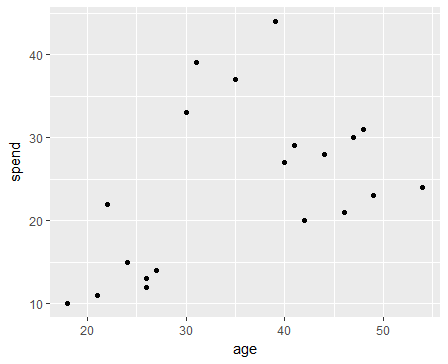
Here is an example. A dataset of the total expenditure of the customers and their age is provided. Now the company wants to send more ad emails to its customers.

library(ggplot2)

df <- data.frame(age = c(18, 21, 22, 24, 26, 26, 27, 30, 31, 35, 39, 40, 41, 42, 44, 46, 47, 48, 49, 54),

spend = c(10, 11, 22, 15, 12, 13, 14, 33, 39, 37, 44, 27, 29, 20, 28, 21, 30, 31, 23, 24)

)

ggplot(df, aes(x = age, y = spend)) +

geom_point()

In the graph, there will be certain groups of points. In the bottom, the group of dots represents the group of young people with less money.

The topmost group represents the middle age people with higher budgets, and the rightmost group represents the old people with a lower budget.

This is one of the straightforward examples of cluster analysis. 

K-means algorithm

It is a common clustering method. This algorithm reduces the distance between the observations to easily find the cluster of data. This is also known as a local optimal solutions algorithm. The distances of the observations can be measured through their coordinates.

How does the algorithm work?

  1. Chooses groups randomly
  2. The distance between the cluster center (centroid) and other observations are calculated.
  3. This results in a group of observations. K new clusters are formed and the observations are clustered with the closest centroid.
  4. The centroid is shifted to the mean coordinates of the group.
  5. Distances according to the new centroids are calculated. New boundaries are created, and the observations move from one group to another as they are clustered with the nearest new centroid.
  6. Repeat the process until no observations change their group.

The distance along x and y-axis is defined as-

D(x,y)= √ Summation of (Σ) square of (Xi-Yi). This is known as the Euclidean distance and is commonly used in the k-means algorithm. Other methods that can be used to find the distance between observations are Manhattan and Minkowski.

Select the number of clusters

The difficulty of K-means is choosing the number of clusters (k). A high k-value selected will have a large number of groups and can increase stability, but can overfit data. Overfitting is the process in which the performance of the model decreases for new data because the model has learned just the training data and this learning cannot be generalized.

The formula for choosing the number of clusters-

Cluster= √ (2/n)

Import data

K means is not suitable for factor variables. It is because the discrete values do not produce accurate predictions and it is based on the distance.

library(dplyr)

PATH <-“https://raw.githubusercontent.com/guru99-edu/R-Programming/master/computers.csv”

df <- read.csv(PATH) %>%

select(-c(X, cd, multi, premium))

glimpse(df)

Output:

Observations: 6,259

Variables: 7

$ price  <int> 1499, 1795, 1595, 1849, 3295, 3695, 1720, 1995, 2225, 2575, 2195, 2605, 2045, 2295, 2699…

$ speed  <int> 25, 33, 25, 25, 33, 66, 25, 50, 50, 50, 33, 66, 50, 25, 50, 50, 33, 33, 33, 66, 33, 66, …

$ hd     <int> 80, 85, 170, 170, 340, 340, 170, 85, 210, 210, 170, 210, 130, 245, 212, 130, 85, 210, 25…

$ ram    <int> 4, 2, 4, 8, 16, 16, 4, 2, 8, 4, 8, 8, 4, 8, 8, 4, 2, 4, 4, 8, 4, 4, 16, 4, 8, 2, 4, 8, 1…

$ screen <int> 14, 14, 15, 14, 14, 14, 14, 14, 14, 15, 15, 14, 14, 14, 14, 14, 14, 15, 15, 14, 14, 14, …

$ ads    <int> 94, 94, 94, 94, 94, 94, 94, 94, 94, 94, 94, 94, 94, 94, 94, 94, 94, 94, 94, 94, 94, 94, …

$ trend  <int> 1, 1, 1, 1, 1, 1, 1, 1, 1, 1, 1, 1, 1, 1, 1, 1, 1, 1, 1, 1, 1, 1, 1, 1, 1, 1, 1, 1, 1, 1…

Optimal k

Elbow method is one of the methods to choose the best k value (the number of clusters). It uses in-group similarity or dissimilarity to determine the variability. Elbow graph can be constructed in the following way-

1. Create a function that computes the sum of squares of the cluster. 

kmean_withinss <- function(k) {

cluster <- kmeans(rescale_df, k)

return (cluster$tot.withinss)

}

2. Run it n times

# Set maximum cluster

max_k <-20

# Run algorithm over a range of k

wss <- sapply(2:max_k, kmean_withinss)

3. Use the results to create a data frame

# Create a data frame to plot the graph

elbow <-data.frame(2:max_k, wss)

4. Plot the results

# Plot the graph with gglop

ggplot(elbow, aes(x = X2.max_k, y = wss)) +

geom_point() +

geom_line() +

scale_x_continuous(breaks = seq(1, 20, by = 1))