
7 Key Skills Required For Machine Learning Jobs!

Reading Time: 3 minutes

Overall, 2017 saw an upward trend in talent acquisition across Machine Learning. This will further increase in 2018.
With technology such as Machine learning, AI, and predictive analytics reshaping the business landscape, software products, aggregators, Fintech, and E-commerce will drive the demand for technology professionals in India.

Machine Learning is usually associated with Artificial Intelligence (AI) that provides computers with the ability to do certain tasks, such as recognition, diagnosis, planning, robot control, prediction, etc., without being explicitly programmed. It focuses on the development of algorithms that can teach themselves to grow and change when exposed to new data.

Now, are you trying to understand some of the skills necessary to get a Machine Learning job? A great candidate should have a deep understanding of a broad set of algorithms and applied math, problem-solving and analytical skills, probability and statistics, and programming languages.

Here is a list of key skill sets in detail:

Programming Languages like Python/C++/R/Java

If you want a job in Machine Learning, you will probably have to learn all these languages at some point. C++ can help in speeding code up. R works great in statistics and plots, and Hadoop is Java-based, so you probably need to implement mappers and reducers in Java.

Probability and Statistics

Theories help in learning about algorithms. Great samples are Naive Bayes, Gaussian Mixture Models, and Hidden Markov Models. You need to have a firm understanding of Probability and Stats to understand these models. Use statistics as a model evaluation metric: confusion matrices, receiver-operator curves, p-values, etc.

Data Modeling & Evaluation

A key part of this estimation process is continually evaluating how good a given model is. Depending on the task at hand, you will need to choose an appropriate accuracy/error measure (e.g. log-loss for classification, sum-of-squared-errors for regression, etc.) and an evaluation strategy (training-testing split, sequential vs. randomized cross-validation, etc.)

Machine Learning Algorithms

Having a firm understanding of algorithm theory and knowing how the algorithm works, you can also discriminate models such as SVMs. You will need to understand subjects such as gradient descent, convex optimization, quadratic programming, partial differential equations, and alike.

Distributed Computing

Most of the time, machine learning jobs entail working with large data sets these days. You cannot process this data using a single machine, you need to distribute it across an entire cluster. Projects such as Apache Hadoop and cloud services like Amazon’s EC2 makes it easier and cost-effective.

Advanced Signal Processing Techniques

Feature extraction is one of the most important parts of machine-learning. Different types of problems need various solutions, you may be able to utilize really cool advanced signal processing algorithms such as wavelets, shearlets, curvelets, contourlets, bandlets.

Other skills:

  1. Update yourself:

    You must stay up to date with any up and coming changes. It also means being aware of the news regarding the development of the tools (changelog, conferences, etc.), theory, and algorithms (research papers, blogs, conference videos, etc.).

  2. Read a lot:

    Read papers like Google Map-Reduce, Google File System, Google Big Table, The Unreasonable Effectiveness of Data.

The next question you would have is, “What can I do to develop these skills?” Unless you already have a strong quantitative background, the road to becoming a Machine Learning Specialist will be a bit challenging – but not impossible.

However, if it’s something you’re sincerely interested in and have a passion for Machine Learning and lifelong learning, don’t let your background discourage you from pursuing Machine Learning as a career.

Related Post:  What is The Easiest Way To Learn Machine Learning?

What You Would Need To Become a Machine Learning Engineer?

Reading Time: 2 minutes

Have you ever wondered why your Facebook feed contains several sponsored advertisements for digital cameras the day after you do a Google search for good digital cameras? Or have you seen supercomputers like Watson max all questions on a show and go on to beat established quiz enthusiasts hands down?

All of it is machine learning in action for you, where those computers or software systems have been fed large amounts of data and also given algorithms that help them think like a human brain would, to make educated decisions. Artificial intelligence and machine learning have captured the imagination of scientists, corporates, users and even job seekers all over the world. As a job seeker, though, you should be clear about the skills you will need before you jump on to the bandwagon.

Also Read: Future of Machine Learning in India

Fundamental Requirements

Many job seekers have a wrong notion that picking up a few programming languages is the first step to a machine learning career. But the skillsets required going some way further back. Since machine learning will involve a non-human entity making correct predictions and inferences, therefore the focus is on cold, hard logic and mathematical principles. You need to have a strong grounding in probability (Markov and Bayes should be names familiar to you!) and also statistics. You need to have the knack for looking at a big pile of data (probably unstructured), and be able to identify gaps in it, and also spot trends and patterns.

Programming Requirements (Skills)

This is the core of the skillsets you would require and would be likely to require you to have a formal certification too. You need to be able to use your programming skills and your knowledge of data structures and computer architecture to create dynamic algorithms. You should be adept at parallel programming, and the basics of stacks and b-trees should come easily to you. A good machine learning engineer needs to be proficient in application programming interfaces (APIs), and also have the ability to use machine learning libraries created by other developers.

Programming Requirements (Languages)

As we know it today, machine learning is technically bound to any one particular programming language, so you do have a choice there. But let us examine the three most popular programming languages that machine learning engineers commonly use. First up is Python whose multiple libraries like NumPy and SciPy (and also specific machine learning libraries like Theano or TensorFlow) make it one of the most popular programming languages for machine learning. Then there is another language called R, which lends itself very well to machine learning.

This programming language is a favorite of data scientists and statistical programmers and has been happily adopted by several machine learning engineers. And finally, we have the old warhorse C++, which is not as advanced as Python or R, but because it is good for networking protocols and infrastructure interfacing, it is still used for machine learning programming.

Apart from these technical skills which you need, two more skills are also necessary – the ability to look at a system holistically (including sales, inventory, billing etc.), and the ability to remember that your output would have machines as the audience, not humans! So are you up for it?

Related Post : What are The Skills You Need to Become a Machine Learning Engineer?

What is The Easiest Way To Learn Machine Learning?

Reading Time: 2 minutes

Machine Learning is applied to enable machines to process and make decisions by figuring patterns without explicit programming. This can be achieved via multiple techniques one of them is through training machines on a large dataset called training dataset that is used to create models to help machines in making decisions when exposed to real-time data.

There is no shortcut to learning, and when it comes to Machine Learning the process is definitely not quick but if you are inclined to Artificial Intelligence then there is a smarter way of ensuring quality learning with little investment.

Also Read: Future of Machine Learning in India

Machine Learning is about optimization and to optimize data mining learners should have a decent level of programming knowledge and skills. There are many languages that provide Machine Learning capabilities and there are various online courses available to learn them, but it is imperative to choose a language you already have some background with to make sure you pick up fast.

Python is easy to learn and is optimal for data manipulation and repeated tasks while R caret is a little elusive but is good for ad-hoc analysis and exploring datasets.


Before you really embark on your journey to become a Machine Learning specialist you need to understand the concepts of Machine Learning and invest in the theory of it via specific online courses like Machine Learning course from Andrew Ng and Learning from Data course by Prof. Yaser Abu-Mostafa.

Learning from videos has proven to be more efficient and quick, although the power of books should never be undermined since in this article our focus is to make learning quicker I recommend videos and slideshows over books and papers.
As you acquire deeper knowledge of Machine Learning you would come across various Machine Learning algorithms, these are broadly classified into three categories based on the amount of “feedback” provided to a system to enforce learning, these categories are:

1.) Supervised Learning.
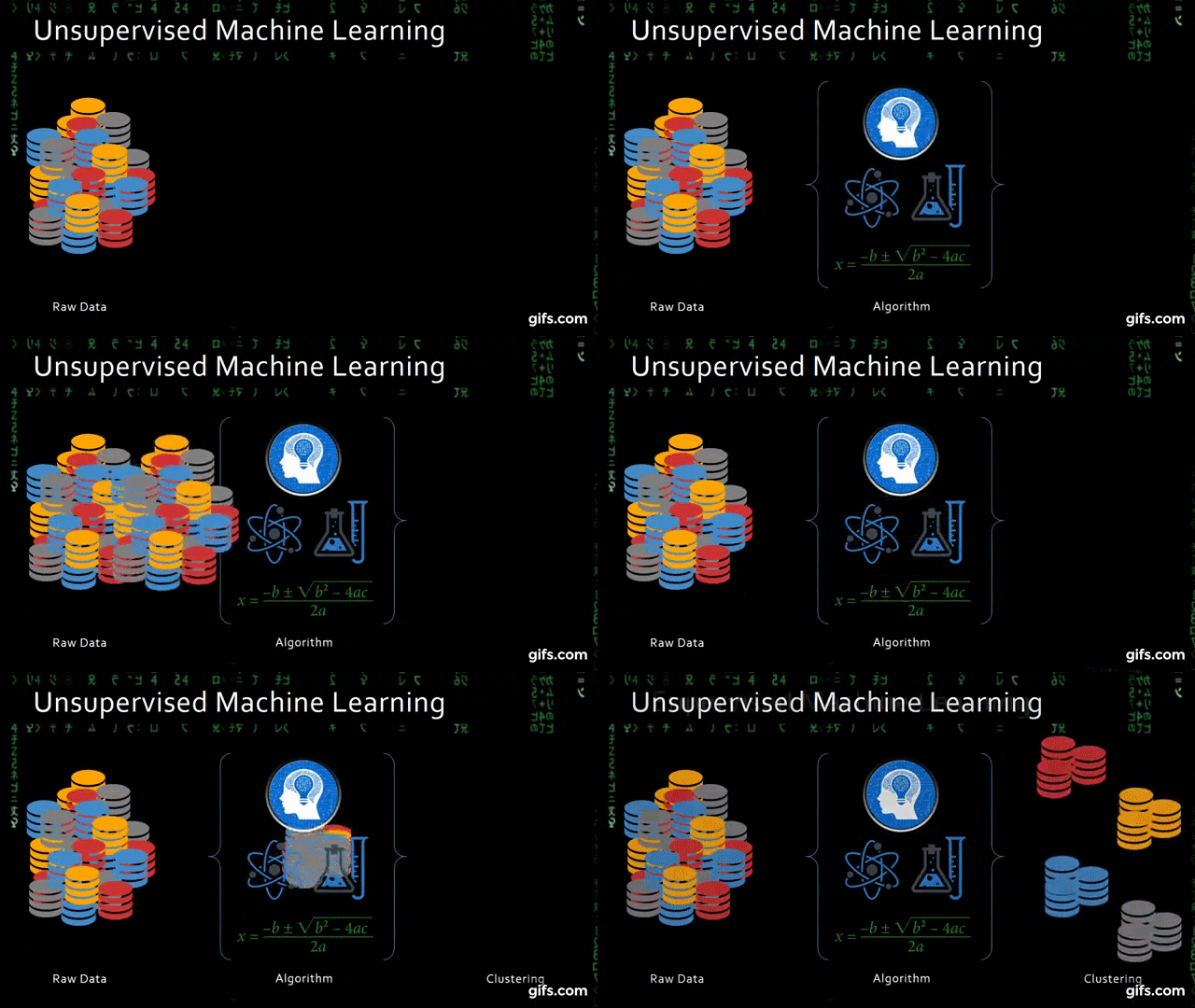
2.) Un-Supervised Learning.
3.) Reinforcement Learning.

To acquire a better understanding of these algorithms you need to have the fundamental knowledge of Linear algebra, Probability theory, Optimization, Calculus and Multivariable calculus etc.

Machine Learning works on raw unstructured big data so it is important for you to understand data statistics including descriptive and inferential statistics.
You also need to have a deep understanding of various Data Cleaning techniques and different stages of data explorations to deal with a large number of unstructured data bits. Most of the times Machine Learning systems need to process incomplete or damaged/scrambled data, for such scenarios handy knowledge of techniques like Variable Identification, Univariate and Multivariate analysis, Missing values treatment, Outlier treatment becomes very useful.
Once you have undergone the basic courses for Machine Learning foundation building it is time to practice what you have learned, Kaggle Knowledge competition is a good place to start. By experimenting more you can polish your skills well and know your level, and shortcomings on which you can work on. Popular Machine Learning communities to help you further in learning are as follows:

  1. https://machinelearningmastery.com/
  2. https://stats.stackexchange.com/
  3. https://www.reddit.com/r/MachineLearning/
  4. https://www.reddit.com/r/datascience/

 
Related Article: What are The Skills You Need to Become a Machine Learning Engineer?

Master the Skills of Fintech And Be Successful

Reading Time: 2 minutes

Master the Skills of Fintech And Be Successful

FinTech is a financial technology that covers a large group of organisations utilising programming and innovation to give monetary administrations. In FinTech, the majority of candidates will have a software engineering qualification.

Even though the industry is a combination of finance and technology, so when looking for the skills that have to be appropriate for being a part of this FinTech industry, technology comes first.
As the financial industry is progressively encountering changes, experts are on the hunt for skilled and trained people. The following are the overview of skills and capabilities emphatically looked for to work in FinTech.
Communication skills
Regardless of whether you work with merchants, business analysts or IT people, you must have the capacity to clarify parts of your tech venture unmistakably and compactly to your client.
It is imperative to understand that fintech courses aren’t only about developments and advancements, fintech includes more things. New companies need to sell their products and services, and, consequently, they require great managers and client relations experts, who have great communication abilities, having the capacity to clarify the key parts of the product. So you need to master this skill to be successful.
Teamwork abilities
In FinTech, you’ll be working with various individuals at various phases of a venture. You’ll frequently work under strain and to tight due dates to get the work completed, which implies you’ll need a decent association with the colleagues to request to ensure the work gets conveyed on time. So be prepared to work hard on your skills to achieve your objectives.
Problem-solving capacity
Working in FinTech is not an easy job, you’ll continually be searching for approaches to make things work quicker and all the more proficiently. You need to manage data and information and lessen the risk factor constantly. The key thing is having the capacity to know and understand an issue, divide it into its basic components and after that work out how technology can help you out. This is maybe the ability you have to work on
Gain work experience
You can gain work experience through an internship. A practical experience that one can gain over the education will likewise have an upper hand over the individuals who have classroom experience.
So working as an intern will give you much more experience and will boost up your skills.
AI and ML Knowledge
AI and ML stand for artificial intelligence and machine learning respectively. They both are becoming progressively essential in the field of FinTech. Machine Learning and Artificial intelligence specialists are highly looked after by investment banks to enable them to actualize financially effective solutions and show signs of improvement in client experiences.
Cyber security expert
Over the most recent couple of years, there is a huge increment in cyber crimes with finance being the main purpose behind these crimes. For somebody working in FinTech, knowledge about cyber security is a basic piece of the job. In case you’re working as a software designer, understanding and knowledge of cyber security is expected to create secure applications and programming software, so that client data and information are secured.
Knowledge about finance
Meanwhile, focus on building up your insight into the financial sector. Stay up to date with the latest updates in the markets of the finance world. You can upgrade your knowledge by perusing the Financial Times and the Economist, or viewing Bloomberg TV, and also there are so many blogs to read.

What are The Skills You Need to Become a Machine Learning Engineer?

Reading Time: 3 minutes

Machine Learning (ML) is a subset of Artificial Intelligence, which enables the computers to perform certain tasks such as Recognition, Diagnosis, Planning, Robotics Control, Prediction etc., without specific programming. Machine Learning focuses on developing algorithms with the capability of teaching itself to grow and adapt when exposed to new sets of data. As a result, there is a massive interest in the field of machine learning, in individuals who wish to pursue their career in this field, as well as organizations who wish to reap the benefits by its application.
As a Machine Learning engineer, it is very important that you understand not only the specific skill set, but also that you have a fair understanding of the environment, for which you are designing.

Let us understand this with the help of an example, assume that you are working for a retail store. And let us say the company wants to design a reward system, through which coupons are issued based on facts like, purchase history, with the intent that the issued coupons will actually be used. Now traditional data analysis approach would be to study the historical data, and figure out trends, and subsequently propose a strategy. But in the Machine Learning approach an engineer would need to create an automated coupon generation system, however, you will only be successful, if you understand the peripheral functions of the environment like the inventory, Catalogue, Pricing, Purchase Orders, Invoice Generation, CRM Software etc.,

So the skill requirement is not only restricted to the application of machine learning algorithms and the understanding of what to apply when, it is also equally important to understand the Interconnected Relationships of these Functions so that you can then successfully create a software which integrates interface, for an effective output.
Now for the real deal, the actual technical skills you need to kick-start your career as a machine learning engineer. You need to have a good and detailed understanding of the ML Algorithms, Mathematics, Skills in Problem Solving and Analytical thinking, and above all an innate sense of Curiosity. In addition to this, the below mentioned Skill….
Programming Languages like C++ can help in speeding code up, R, Python & Java works wonders for statistics.
Theories like Naïve Bayes, Hidden Markov Model, would require you to have a good understanding of Probability and Statistics so that you can comprehend these models.
A firm understanding of Applied Math and Algorithm theory, along with the knowledge of how the algorithms works, will help you discriminate models.
You will also need to skill yourself on Distributed Computing, as a machine learning role would require you to work on large datasets, which cannot be processed using a single machine, but you will be required to distribute it across an entire cluster

Data Modelling and Evaluation

Data Modelling is the process of estimating the underlying structure of any given dataset, with the intent of finding a pattern that is useful or picks up predictions of previously unseen trends. This process will be futile if the appropriate evaluation is not done to access the effectiveness of the model. So that you can choose an appropriate error measure, and apply an evaluation strategy, it is important that you understand these measures, even while applying standard algorithms.

Software Engineering and System Design

These are considered as the typical output of any ML engineer’s deliverables. It is that small component that becomes a part of the larger ecosystem. Like said earlier you need to make the puzzle, keeping in mind the various components, ensure they work with the help of proper communication of the system with the interface, and finally carefully design the system such, that any bottlenecks are avoided and the algorithms successfully scale along with the volume of data.
It is hence without a doubt that the demand for machine learning Engineers will rise exponentially, as the challenges of the world are complex and only complex systems will be able to solve them. Machine Learning Engineers are building these complex systems, therefore you become the future!
Also Read : Skills Required to Learn Machine Learning

Everything You Need To Know About Machine Learning and Deep Learning

Reading Time: 3 minutes

Artificial Intelligence (AI), Machine learning (ML) and Deep Learning (DL), can be imagined as the three bears from Goldilocks staying together in a house, where each member has a specific use but yet conceptually they are interconnected. Artificial Intelligence is the big umbrella under which resides the Machine Learning concepts, and Deep Learning can be referred to as a sub-set of Machine Learning. So while Deep Learning and subsequently Machine learning comprises of Artificial Intelligence, the other way around is not necessarily true.
The field of data science is buzzing with these terminologies, and in all the noise it is very easily misinterpreted, and often Machine Learning and Deep Learning are used interchangeably for one another. One thing is certain that Deep Learning is a technique for implementing Machine Learning.
Also Read: Future of Machine Learning in India
Let us understand this by breaking down the puzzle….

Artificial Intelligence orchestrates the capacity of a machine to comprehend complex human tasks like, decision making, understanding spoken language, detecting fraud, in short, it enables a machine to imitate intelligent human behaviour.
Machine Learning is surely a part of AI, where it enables a computer to act in a specific way without the need for explicit programming. This is imperative as the volume of data is ever increasing and to keep up, the machine should have the capability of implementing effective algorithms which can effectively and efficiently make predictions by recognising patterns. To perform the same, data scientists have a number of existing ML methods or Algorithms which can be easily applied to any data problem, at the same time it can be applied to a number of real-life use cases, for example, recommendation engines, or applying Natural Language Processing (NLP) in chat logs.

Deep Learning is a subset of ML and when data scientist refers to the term deep learning they most often mean Deep Artificial Neural Networks or alternatively Deep Reinforcement Learning.
Deep Artificial Neural Networks are essentially a set of Algorithms which are popular in recent times, for setting new records in accuracy while dealing with complex problems like, Image Recognition, Sound Recognition, Recommendations Systems, etc…, To add on, one can easily define DL in a similar manner to ML, so it can be safely said that DL also enables a computer to act in a specific manner without the need of explicit programming, with the addition that DL ensures it produces results with higher accuracy.
DL is often more complex as compared to ML, the prerequisites to DL would be a high-performance computer and huge volumes of Labelled data to give reliable results.
ML can be used with a small volume data set and has a shorter training time, while DL will be effective with large volume data set and often requires a longer training time. In ML you can use your own features, so for example, if you need a computer to be trained on recognising an image of a cat, you will first need to key in all the relevant features of a cat into it. In DL you will need to feed the computer with large volumes of data with cat images, and the system will choose the features on itself which characterises a cat. Hence the training time is longer, while the chances of accurate information are higher due to the complexity of reaching the conclusion, in some cases, it is more accurate than humans.
Driverless Cars, Movie Recommendations and preventive health care are all possibilities enabled by Deep Learning. DL in the future could be responsible for machine assistance in possibly all aspects of life. Deep Learning has the promise of taking the application of AI from fantasy to reality.
Related Article: Skills Required to Learn Machine Learning

How is Machine Learning Helping Businesses Grow?

Reading Time: 2 minutes

Machine learning (ML) technologies represent one of the exciting new aspects of the digital age. These technologies are premised on sophisticated algorithms that empower modern enterprises to tackle a variety of business problems. Computers and digital systems that use Machine learning are designed to gain experience from various processes and apply certain rules and data sets to perform complex calculations.

Modern machine learning systems also leverage the use of cloud technologies in a bid to maximize speed and cost-effectiveness.

  • Recent advances in the commercialization of cloud computing services allow business organizations to utilize huge offerings in compute and storage services. Large cloud players are offering modern enterprises an opportunity to use cloud computing solutions powered by machine learning technologies. These systems are also “creating new opportunities for innovators to offload labour-intensive research and analysis to the cloud.”
  • Machine learning systems are enabling business decision makers to visualize data more efficiently. The use of these technologies enables business analysts and business managers to access and utilize data analysis paradigms. This means that machine learning systems are essentially crunching huge volumes of data and electronic information and presenting patterns, analysis, and insights to modern businesses. This personnel can analyze these patterns to quickly initiate business decisions in response to evolving market conditions.
    • Digital technologies have emerged as a major enabler in modern societies. Machine learning and artificial intelligence technologies are no exceptions. Cloud-based machine learning algorithms can process current data from business environments to predict future consumer requirements, market trends, etc. This enables business organizations to process unprecedented amounts of data in the ultimate pursuit of growing and expanding their commercial footprints. Companies and brands that can effectively anticipate future requirements are better positioned for future market performance.
    • Certain industries such as logistics and transportation can gain clear benefits by implementing machine learning technologies. Vehicles can be fitted with digital devices and transmission systems that generate data regarding the performance of vehicle systems and sub-systems. Analysis of such data can help vehicle designers and engineers to refine and improve the performance of each vehicle over time. Higher mileage from each vehicle and fewer maintenance hours can help these businesses to earn larger profits.


  • Machine learning algorithms can help the banking and insurance industry to spot and prevent instances of fraud. Certain insurance service providers are using the technology to scan the faces of loan applicants and insurance policy applicants. These algorithms have access to huge databases that enable them to detect any scope or intent of fraud ahead of time.
    Thus, machine learning systems help these service providers to expand the scope of their business while cutting scope for malfeasance and thereby reducing losses. Such use of machine learning technologies is expected to gain momentum in time.
  • Artificial intelligence technologies and machine learning algorithms are helping businesses to make decisions that are more efficient. Retailers can use these technologies to analyze sales data from the past and other points of market information to control their inventories and supplies. This approach removes the scope of guesswork in certain aspects of business operations while creating scope for efficient operations and greater profits.

Related Article : Skills Required to Learn Machine Learning

How Much Does Machine Learning Matter in Data Science?

Reading Time: 2 minutes

How Much Does Machine Learning Matter in Data Science?

Data Science and Machine Learning are mostly used synonymously; most people also believe one is a trendy word for another.
Data Science is in some sense an umbrella of techniques used to extract information and get better insights into the available data. The range of this type of analysis varies from something as elementary as MIS reports on the one hand and on the other, an intense scientific approach where techniques such as getting inferential analysis, predictive analysis, descriptive analysis, exploratory analysis and so on are considered.
Machine Learning can be explained as an essential part of Artificial Intelligence. Machine Learning empowers the computers to get into a self-learning mode, eliminating the need for overt programming. With the help of new data being fed into the system, these computers can then learn information, adapt to the required changes, and learn and develop all by themselves. They are not human dependent for improvement. Automation of the later part of data mining can be called as Machine Learning.
Machine Learning is not a new term, it has been around for a while, some common applications include, web search, spam filters, credit scoring, online recommendation engines, cyber fraud detection or some advance recent development like the automated google car, however, the ability to automatically learn and develop and apply mathematical calculations to the big data is only currently getting impetus.

Why does Machine Learning matter?

Like all fields which aid development, Machine Learning is also constantly evolving. And as a custom approach to development comes the rise in importance and the demand. One can say Machine Learning is imperative to Data scientists as it helps them drive high-value predictions that can help arrive at better decisions and help take the right actions most importantly in real time, to be effective, and to do this with as minimal human intervention as possible. It eases the task of the data scientist in an automated process and hence is gaining a lot of importance.
Availability of massive data increases the difficulty in analysing it, hence increase in data is directly proportionate to the problems associated with bringing in predictive models that work appropriately. You see a statistical analysis is limited to understanding samples that are static, as a result with time it could give inaccurate conclusions or solutions.
As a knight in shining armour enters Machine Learning which is able to give good solutions to analysing the data in huge volumes. Machine Learning is a leap forward from other available applications like statistics, computer science, etc.., Machine Learning will help produce real results and analysis through the development of effective and efficient algorithms and data-driven models for real-time processing of data.
Machine learning and Data Science will be partners working together. This is the ability of the machine to gain knowledge from data, so without the data, there is very little that machines can learn to do. Thus, it gives a push to get valuable data in order to get valuable and accurate solutions or predictions. So the increased use of machine learning will act as a catalyst to give higher importance to data science. In future, basic levels of machine learning will become a standard operating for a data scientist.
Related Article : What’s Machine Learning all about?

The Promises of Artificial Intelligence: Introduction

Reading Time: 2 minutes

The field of Artificial Intelligence seems to working on a winning streak. In the year 2005, the U. S Defence Advance Research Project Agency, held the DARPA Grand Challenge, which was supposedly held to spur development of autonomous vehicles, basically in order to make self-driven, smart cars. This challenge was taken up and successfully completed by 5 teams. In the year 2011, in a great competition of Jeopardy, the IBM Watson system, was successfully able to beat two long time, human champions of the same legendary game. Another great win of technology over the human race would be in the year 2016, when Google DeepMind’s AlphaGo system was able to successfully defeat the world champion of Go Player, who was reportedly the world champion for 18 consecutive times.
While these feats of technology over the human brain are extremely commendable, today the long surviving dream of humans, which basically revolved around developing technology to control their surroundings, has finally come to fruition. This has resulted in the form of Google’s Google Assistant, Microsoft’s Cortana, Apple’s Siri and Amazon’s Alexa. As a result of all of these AI (Artificial Intelligence) powered virtual assistants, people are able to make greater use of technology in order to live better lives.
Artificial Intelligence is considered to be a field of computer science, which is entirely devoted to the creation of computing machines and systems, all of which are able to perform operations that are similar to human learning and decision making. According to the Association for the Advancement of Artificial Intelligence, AI is, “the scientific understanding of the mechanisms underlying thought and intelligent behaviour and their embodiment in machines.” While these intelligence levels can never be compared to those of the humans, but they can certainly vary in terms of various technologies.
Artificial Intelligence includes a number of functions, which include learning, which primarily includes a number of approaches such as deep learning, transfer learning, human learning and especially decision making. All of these functionalities can later help in the execution of various fields such as cardiology, accounting, law, deductive reasoning, quantitative reasoning, and mainly interactions with people, in order to not only perform tasks, but also to learn from the environment.
While the recent changes may be extremely mind blowing, the promise of AI has always been existing since era of electromechanical computing, this began in the time period, after the World War 2. The first conference of Artificial Intelligence was held at the college of Dartmouth in the year 1956 and at that time, it was said that AI could be achieved within the time period of summer. Later on, in the 1960’s there were scientists, who claimed that in the next decade, it would be possible to see various machines controlling human lives. But it was in the year 1965, when the Nobel Laureate, Herbert Simon, who is supposed to have predicted the words, which would have some substance and which were, “In the next 20 years, it would be possible that machines would be able to do any work of labour that man can”.
With Artificial Intelligence, going in full fervour, the field which it has affected most in the field of Data Science. And as there are many who believe that there is a great to achieve in this field, have begun to get trained in the same by approaching professional training institute – Imarticus Learning.

Learn Machine Learning With Python in Simple Steps

Reading Time: 2 minutes

Learn Machine Learning With Python in Simple Steps

There exist a number of free and accessible Python Machine Learning resources in the market today. While it may be true that anyone can begin their learning process, in a hassle free way but, the amount of variety poses a threat of confusion. Many data aspirants undergo a number of apprehensions like deciding which course to take, how to proceed and most importantly, where exactly to begin.
In order to reduce your apprehensions, we have got here a complete guide to being efficient at understanding and mastering, machine learning with Python. Let’s begin with tackling one of the most important questions, which is ‘Where to Begin?’ While everyone, regardless of the field of study they belong to, faces this question but, it would be agreed upon that to begin somewhere, is the hardest step to take. Couple that with having to make a choice from among the multiple options and you land up confused and staggering.
There are a number of professionals who code but have sufficient working knowledge about computer science. Similarly, if you are looking to get trained in Machine Learning with Python, you don’t need to have a through theoretical knowledge, the practical side more than makes up for it. There exist a number of source libraries, which help with the machine learning aspect, while working with Python. A few of them, those that are known as scientific Python libraries, can be distinguished by the names, nymph (used for N-dimensional array objects), pandas (python data analysis library), matplotlib 2D plotting library) and so on. If you are well aware of the variety of topics of machine learning, which make it easy to work with Python and with the help of professional training courses, it would be a cake walk.
Assuming that the reader is a novice at Machine Learning, Python and any data analysis resources, scientific computing or any other related resource. Let’s begin from the basics, to begin with, you are required to mandatoraly have a certain amount of foundational knowledge about Python, in order to make use of it in Machine Learning. When it comes down to it, your level of experience and comfort in the usage of this data analytics tool, would help you choose the proper starting point. To begin with, you have to first install the Python software, using one with industrial strength implementation for operating services like Linux, Windows is always better.
As most of the work of a Data Scientist revolves around Machine Learning algorithms, it as a whole reflects the field of Data Science. For an aspirant, it is not very important to thoroughly understand kernel methods, as opposed to being well versed with the practical usage of the same. Like they say, practical application of any particular tool, is entirely relative to the theoretical understanding. Machine Learning, in particular, is a concept which very few can learn on their own. This is why most people tend to opt for professional training institutes. Institutes like Imarticus Learning, usually focus on teaching various data analytics tools and machine learning, with a more practical approach coupled with case studies and mentoring from the industry experts.