


The financial crisis of NBFCs a major concern
For a long time, various corporations, including insurance firms, had made investments through short-term instruments in the Infrastructure Finance Company IL&FS, which has to led to a significant liquidity crunch today. Amidst this scenario, the Non-Banking Finance Companies (NBFCs) have been majorly affected by the current liquidity crisis in India. The relationship between the Government and RBI is going through a rough phase as well due to the prevailing circumstances. Adding to the tension is the ban on using Aadhaar information for microlending during December 2018.
Interference of RBI to save IL & FS from the liquidity crunch
The reports from the Ministry of Corporate Affairs (MCA) states that the total debts of IL&FS as of 2017-2018 balance sheet stands at INR 63,000 crores today. The NBFCs were expecting a ray of hope from the RBI, but to their surprise, the reserve bank imposed more rigid rules and regulations for risk management, and asset-liability structures. In the last quarter of 2018, the RBI had announced to inject INR 40,000 crore to help the soaring funds through Government securities into the system.
The problems faced by NBFCs are mostly attributed to their dependencies in short-term borrowings and long-term lending loans to builders and real estate players. Therefore RBI’s ruling enforces more disciplined liquidity management in the future is a welcoming approach. However, the point to be concerned is the unknown course of action for the NBFCs to get out of the present liquidity crisis without which implementing new measures is difficult.
The financial crunch of the NBFCs has affected the loans against the property market in the fiscal year 2019 in India. A secured loan where one party pledges a property with a lender and borrow against it is a Loan Against Property (LAP). In a report from the reporting agency, India Ratings and Research stated that the weak LAP in FY19 is mainly due to lack of strong emotions on the property market and the liquidity crunch faced by NBFCs.
An insight into global M&A
The United Nations Conference on Trade and Development’s (UNCTAD) World Investment Report of 2019 release states that there is a substantial decline in the global FDI by 13% in 2018 which is a third consecutive decline. The slide in global FDI is USD 1.3T in 2018 from USD 1.5T in 2017. However, India witnessed a 6% growth in FDI in 2018 to 42B. This growth is attributed to the activities in cross-border mergers and acquisitions, communication, production, and financial service sector.
The growth of e-commerce in India is expected to increase tentatively by a large extent. It is estimated that India’s e-commerce transactions to reach USD200B by 2026. Further, the trending online retail businesses coupled with telecommunication growth has leveraged the increase in cross-border M&As in India to USD 33B in 2018 from USD 23B in 2017.
The domestic M&A emerging as a life saver
A blockbuster merger was by the American multinational retail corporation, Walmart and India’s largest fashion e-commerce giant Flipkart. The telecommunication alliances and deals were worth USD 2B that collectively associates deals from Vodafone and American Tower. India’s blooming year for M&As was 2018, after which the first quarter of FY2019 has been low. The reason for this subdued effect is attributed to the gloomy global M&A market.
The quarterly report figures indicated a fall in M&A in Q1CY19 to $9.9B from $21.6b in Q1CY18. However, the domestic deals were a breather for India, the most significant being the merger between Bandhan bank and Gruh Finance, which was a $3.2B deal. Another agreement was between GMR airports, and Tata group led Consortium, which amounted to $1.2B. While Japan and Germany were favorite partners for cross-border M&A, the US remained at the top of the chart with 14 inbounds and 14 outbound deals with India. The Indian business executives are high on confidence that one-third of them are expected to undertake M&A in 2019.
To Sum Up
The backup of domestic consolidation for India and continued support of interests from FDI is considered a root cause for having a stable M&A in the future. Given the weak sentiment in the bond market, the current liquidity crisis may remain stubborn for NBFCs at the present moment.
Get more interesting about Current Liquidity Crisis and M&A, by applying for an Investment Banking Courses
Tag: Investment banking course
The Investment Banking Course That Will Get You Hired

Prateek shares his experience and the journey that led to an investment banking job at Goldman Sachs
Investment Banking is an industry that’s hard to break into, even with a master’s degree in finance. Prateek, a postgraduate in banking & finance, talks about how Imarticus Learning’s Investment Banking Training program helped him land his dream job.
What’s your background, and why did you enroll in the Investment Banking course?
My name is Prateek Dhar, and I have a bachelor’s degree in accounts and auditing from NM college. After attaining my bachelor’s degree, I went on to graduate with a master’s degree in banking and finance. After my post-graduation, I was looking for more learning and career opportunities and stumbled upon Imarticus and the Investment Banking courses. I was interested in and enquired about the course. I also looked through Imarticus Learning reviews to gauge public opinion. On visiting the center, the career counselors helped guide me on the path to an investment banking career, and I decided to enroll for the course.
Tell us about your experience during the course.
My entire journey with Imarticus has been incredible. The course content is comprehensive, in-depth, and aligned to the requirements of the industry. The best part of the course is, without a doubt, the trainers. They have experienced professionals and have a good grip on the finance domain and on the concepts they teach. Moreover, the course isn’t restricted to just theoretical knowledge. The trainers ensure that practical learning is incorporated into every concept that you learn.
Imarticus has helped me gain a lot of knowledge, and I’m thankful for the experience.
Why would you recommend this Investment Banking course?
Well, in my opinion, the most important aspect of any course is the trainers. This is the reason I would recommend the course at Imarticus. Not only are the trainers knowledgeable and extremely skilled, but they also are approachable, helpful and are ready to assist with any queries that you may have. The classroom lectures are interactive, and this helps keep up with the learning curve.
What are your thoughts about Imarticus Learning’s placement services?
Fantastic! I was placed at Goldman Sachs through Imarticus and couldn’t have asked for more. Many of the major investment banks – BNP Paribas, Morgan Stanley, Goldman Sachs, GlobeOp and more – recruit from Imarticus and this is an excellent opportunity for freshers to make their mark in the industry. Imarticus will help you crack better opportunities in the market by helping you refine your resume along with your communication and interview skills.
While the course is a short-term journey, it has given me long-term prospects within the investment banking industry. Anyone looking for an investment banking career should come to Imarticus.
Are you looking to launch your investment banking career? Click here to inquire about the program.
Can Chartered Accountants become Investment Bankers? How?

Investment banking is a challenging and exciting career opportunity that many can pursue. Grit, determination and a smart attitude are what it takes to become an investment banker.
Many chartered accountants look at pivoting their career to investment banking due to the myriad of opportunities available in the field. While chartered accountancy is challenging, investment banking opens a new world of functions and risk aspects that one can learn and grow in. Individuals who are dynamic, hardworking and dedicated have a chance to pursue an investment banking course and move into the field naturally.
A career in investment banking is highly risky, exciting and dynamic and they are always on the lookout for individuals who are ambitious and charismatic. There are many different types of functions that one performs in investment banking predominantly revolving around raising funds, auditing, client relationship, and mergers. The biggest function though is to raise equity for your clients and project a growth trajectory.
Hence investment bankers need to make decisions keeping in mind the future of the client and do so in a qualitative fashion. The job also has long hours and involves strategic thinking at every step of the way.
Here are the top ways that one can switch into investment banking from accounting.
Understand the Functions
As mentioned earlier in the article, investment banking requires a lot of strategic thinking and making smart choices for your clients. This can be high risk as the company’s future depends on raising funds and taking off. Before looking at switching from chartered accounting, one must evaluate and scope out the work portfolio of investment banking. Individuals who have completed an investment banking training will have a basic understanding of what does it take to raise capital for a company and this is an area of expertise that one must master.
Country Specific Rules
Before shifting to investment banking, one must understand the specific set of rules and regulations defined in each country for the field of banking. For instance, in India, it is a natural progression for many accountants to switch from chartered accounting to banking and then financial advisors. Some countries may also require an exam to be given in order to pursue investment banking as a career. Understanding this is the key to moving successfully into the investment banking space.
Ability to work with clients
One of the top things that banking and accounting have in common is the option to learn how to build relationships. In investment banking, long term relationships and the ability to upsell and understand your client goes a long way. If you have good communication skills, are proficient in math and are hard working you already have the foundation for a career in investment banking.
Conclusion
A lucrative career path, investment banking may demand long working hours, quick thinking in a stressful situation and more. However, the results can be deeply rewarding to individuals who pursue the same.
Also Read: How to Become Investment Banker
How do I become an Investment Banker?

The investment banking industry is one of the most competitive ones out there and breaking into it may seem like a monumental task. Here’s Nikita’s story on how she took the first step.
Do you want a career in investment banking but are wondering where to begin? You’re not alone. Nikita, a commerce graduate, was looking to enter the investment banking industry but didn’t know where to begin.
Well, we’re glad to say, she’s well on the path to her dream job. Here’s her story:
Hi, my name is Nikita Iyer and I have a bachelor’s degree in finance and investment analysis from Amity University, Noida. I am currently pursuing the investment banking operations course from Imarticus Learning in Mumbai.
I always wanted to build a career in investment banking but never had a clear idea about the path to achieving my ambition. A relative of mine who had completed a course at Imarticus recommended the investment banking training.
Truth be told, I was a little alarmed when I came across a couple of reviews that said Imarticus Learning is fake. My reaction – What? Turns out the reviews were baseless and I had nothing to worry about. I went through the course curriculum and the brochure spoke to a counselor at Imarticus and immediately enrolled for the program.
The best part about Imarticus is the guidance provided by the faculty even for the smallest problem that I faced.
On a scale of 1 – 5, I would rate the faculty a perfect 5.
The guest lectures also were an important part of the program and were very informative. The lecture covered options strategies and gave me a deep understanding of how options and securities are traded in the market.
As part of Imarticus Learning’s placement services, the team also reviewed my resume and helped me sharpen it. The faculty provided me with a lot of information about what to include and what to omit from my resume and helped me articulate my goals and objectives clearly and concisely.
I’m extremely happy with the progression of each module of the course.
The concepts that were taught were not just theoretical but also included plenty of practical applications. I was also exposed to the real world of investment banking through projects and trading simulations.
I would definitely recommend Imarticus because my learning experience has been fantastic so far.
Also Read: Ways to Get First Job At Investment Bank
Become an Investment Banker in 3 Months. Here’s How?

Shubhadeep’s transition from engineering to an investment banking job in three months truly is inspirational.
Career transitions are hard. Really hard.
Don’t we all occasionally have days when we step back from the daily grind of work and think – “If only I could be paid to do what I’m passionate about”?
Shubhadeep was having one of those days.
An engineering graduate, Shubhadeep was disappointed with the career opportunities that were presented to him after four years of college. He wanted to enter the world of finance, more specifically, he wanted to be an investment banker. The thing is, transitioning from engineering to investment banking is no piece of cake and he realized that.
Over a period of more than a week, Shubhadeep dived into researching the most effective means to achieve his ambitions. His brother, also an investment banker, gave positive reactions on Imarticus review glassdoor and pointed him toward the investment banking certifications. A face-to-face counseling session was the turning point and he decided to enroll for the investment banking course.
“The course is crisp and clear and the lectures are in-depth. It’s very easy to co-relate everything I study in class to the investment banking industry,” he says.
Three months after enrolling for the course, Shubhadeep has landed a job with SS&C GlobeOp and now works as an associate within the investor services division.
Isn’t that great? We think so.
Do you want to be three months away from an investment banking job? Click here and speak to our career experts today.
What Are The Ways of Reducing Financial Risk?

Synopsis
One of the biggest things that people learn in investment banking is how to undertake risk and manage it, which makes it a lucrative career to pursue. Here’s how.
Today, everyone wants to pursue a career in investment banking. One of the biggest reasons which individuals are training in investment banking course and then finding a job in the field is due to the fact that it is a high risk, high pay-out kind of a career.
The industry employees individuals who are driven, hardworking and smart. It requires dedication and the job involves long hours. Many educational institutes are providing certification courses in Investment Banking to individuals in order to pursue this career.
One of the biggest things they teach you when it comes to investment banking courses is assessing different kinds of risks for your clients. From operational risk, legal risk to financial risk, there are many things to consider before launching and growing a business. Large multinational organizations go to investment bankers to help them assess the different aspects of running a business including raising capital, risks associated with the business and growth trajectory.
Those who are pursuing a career in investment banking need to understand the financial risk a business is willing to take in order to grow and provide solutions to mitigate or manage the risk. Here are some top ways financial risk can be managed.
Perform a Risk Assessment
At the onset of the business, investment bankers need to take a stock of all the various kinds of risks associated with running a particular business and prepare a risk assessment plan. This will give the business an opportunity to take stock, build ideas and have a plan in place to reduce or mitigate risk. One example that stands out is, it is a good idea to get certain equipment insured so that some of the risks can be transferred to insurance parties.
Maintain a contingency plan
Since we know that every business involves risk a good way to proceed when it comes to taking the business to the next level is by ensuring that there is a plan B. A contingency plan with adequate funds is a good approach to managing financial risks. This means that if you are in a difficult position, you will be able to look at the second plan of action for answers
Reduce Risk of Operation
Sometimes operational risk can lead to financial losses which mean that it is also a financial risk. Having a good management infrastructure in place, keeping employees happy, performing due diligence minimizing credit risk can all go a long way when it comes to reducing operational risk. Operational risk also can be external that is legal issues which can crop up along the way when it comes to running a business. Making sure to consider all the legal and state implications while setting up a business can go a long way when it comes to running a business.
Conclusion
Once investment bankers have learned to deal with various kinds of financial risks, they will be in a better position to help their clients grow and succeed in business.
How Do You Define Financial Risk?

Synopsis
Investment banking is one of the most sought after career paths today. Learning how to help companies deal with financial risk is at the heart of investment banking.
Investment banking jobs are prestigious, lucrative and come with significant risk as well. The financial sector hires individuals who have not only undergone investment banking training but also are smart, hardworking and driven. Investment bankers work primarily revolves around helping big corporates who are their clients make informed financial decisions by taking stock of the various pros and cons. A key aspect of this job also involves assessing the various types of risks when it comes to running a business.
Financial risk is one of the most important things businesses consider while looking at expanding or simple day to day operations. It is one of the top concerns when it comes to finding capital to run the business, prepare contingency plans and also to forecast the growth trajectory of the business. For those wanting to pursue the certification courses in investment banking, this is the biggest lesson to learn.
When it comes to investing, one of the first things that individuals learn about in investment banking courses, is risk management. Here are the different types of risks and how to manage it.
Financial Risk
One of the high priority risks for business is a financial risk and it can be categorized into various types such as market risk, credit risk, liquidity risk, operational risk, and legal risk. Market risk is the risk associated with stocks, the interest rate in the stock market which is not in the control of the organization. Liquidity risk, on the other hand, can be further classified as asset liquidity risk and funding liquidity risk. Funding liquidity risk arises when there are not enough buyers for the product or service. External threats for a business include the legal risk that is the potential of getting lawsuits. If a company has to face financial losses or legal issues then it can be considered as legal risk.
Operational Risk
One of the biggest risks associated with a business is an operational risk and it predominantly revolves around mismanagement or any other technical failures. It can also mean fraudulent activities or risk of fraudulent activities that every business must think about. Operating a business also involves a risk of losing employees due to bad management which also comes under this type of risk.
Business Risk
Sometimes the very nature of the business may involve risks such as risk the type of jobs carried out by individuals, diseases associated with carrying out the job and political scenarios, etc. This means that the investment for this type of business from the very beginning will be very high as it will need to account for the type of job itself.
Conclusion
Learning how to manage financial risk for the clients is an important attribute that investment bankers must learn in order to succeed in their career.
Danish Azam’s transition from engineering to an Investment Banking Career!
You don’t need a degree or background in finance to become an investment banker. Find that hard to believe? Well, we don’t blame you.
The mainstream ideology is that the traditional starting point for every investment banker is a bachelor’s degree in economics or finance with a master’s or Ph.D. in rocket science. So I exaggerated a little – but the fact remains – anybody aspiring to be an investment banker without a conventional degree in finance will, in all likelihood, give up!
Danish Azam’s transition from a civil engineering graduate to the investment banking division at SS&C GlobeOp challenges the status quo and is an inspiration for everyone wanting to start a career in investment banking. Read his story here.
Q: Tell us a little about yourself.
I’m a Danish Azam, and I have a bachelor’s degree in civil engineering. I recently graduated from the Certified Investment Banking Operations course at Imarticus and have been placed at SS&C GlobeOp.
Q: What convinced you to enroll with Imarticus?
I heard about Imarticus through a friend who recommended the course to me. At first, I was hesitant because I had absolutely no background in finance, but I spoke to a counselor at Imarticus who charted an investment banking career path for me and assured me that the transition from engineering to finance was possible. I was convinced and decided to enroll in the course.
Q: Was the transition from engineering to finance challenging?
Quite honestly, it wasn’t as difficult as I had anticipated. Considering the fact that I am from an engineering background and the course is in Finance, I have not faced any challenges and could keep up because of the knowledgeable faculty and the detailed curriculum.
Q: Were the guest lectures helpful?
The guest lectures were beneficial. I was able to co-relate the topics I was taught in class with the practical projects and assignments, and this has helped me grasp particularly challenging concepts like options strategies and derivatives.
Q: What did you like most about the program?
I’d have to say the faculty and the learning facilities. The faculty were extremely helpful and made every concept clear with a focus on real-world simulations and hands-on experience to make the training sessions interactive. The learning infrastructure at Imarticus is exceptional.
The online learning management system – LearnTron – is available to students 24/7. If ever I had a doubt or couldn’t remember a specific concept taught in class, I would go back home and go through the lecture to enhance my knowledge in a better manner.
Q: Tell us a little about the career and placement services.
In addition to technical sessions, soft skill sessions are also conducted and saying these sessions were beneficial would be an understatement. The resume building workshop helped me craft my resume into an effective and efficient one with the help of the experts at Imarticus.
I was pleasantly surprised because the placement services were much better than I had anticipated. Even before completing the course, the placements team brought me a couple of interview opportunities. They didn’t stop there; through mock interviews and interview prep, the trainers helped me hone my communication skills. In all, I appeared for two interviews and cracked one of them. I now work at SS&C Globe Op; my job involves much of what I learned at Imarticus, and I couldn’t be happier.
It’s not too late to begin. Click Here to speak to a career counselor and start your investment banking career.
Media Professional Turns to Investment Banking – Rashmi’s Incredible Career Transition
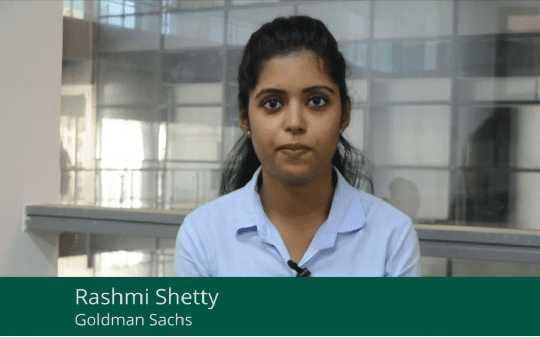
Rashmi Shetty’s ambition was to work with a top-tier global investment bank and that was specifically why she enrolled for Imarticus Learning’s Certified Investment Banking Operations Course.
How did we know that? Well, Rashmi’s first question on orientation day was “When will Goldman Sachs conduct their placement drive?”
Rashmi, a media graduate with a bachelor’s degree in Mass Media and a master’s degree in Mass Communication, yearned for a career in the dynamic investment banking industry but encountered a roadblock – “Where do I begin?” She came across Imarticus’ investment banking course, received positive Imarticus Learning reviews from her peers and decided to take the leap.
Considering the fact that Rashmi had no background in finance, it’s no surprise that the initial stages of the course were a tad bit overwhelming. Nevertheless, the program’s focus on everything from the basics of finance to advanced derivatives and commodities meant that even without a ‘finance degree’, Rashmi could effortlessly keep up with the learning curve. “This investment banking course is very good for anyone looking for a long-term career in investment banking,” she says.
What Rashmi liked most about the program was the practical approach to learning and the introduction of innovative teaching methods through a combination of classroom training, self-paced online lectures, and quizzes.
Even before completing the course, during her second semester, Goldman Sachs conducted a placement drive in Bangalore and Rashmi was one of the candidates for the interview. Imarticus Learning’s placement team urged her on, preparing her to face the interview through resume building workshops, interview prep, and mock interviews. Rashmi left Bangalore with an offer letter from Goldman Sachs in hand, ecstatic that she was one step closer to achieving her Investment Banking dreams.
“The interview went really well, I got placed at Goldman Sachs, and I’m so happy about it,” Rashmi exclaimed as soon as she walked into class the next day.
Are you an aspiring investment banker?
Enquire about Imarticus’ Investment Banking Operations Program and start your success story today.
Top Five Fiction Reads Set in The World of Investment Banking

Investment banking is an immensely specialized field wherein financial corporations termed as investments banks assist public and private commercial entities in complex transactions. So, it is natural to have much literature that surrounds this broad topic. To save your precious time in finding out the best fiction books available on investment banking, here are the top five handpicked books that are set amidst the world of investment banking.
Lets us know the thought flow of various authors in these fiction books on investment banking:
1. Free to trade by Michael Ridpath
The journey of this fiction book brings out the insights of the author upon the possible business complexities. This is a novel of suspense by a British author, where you see the narrator, Paul Murray is an ex-Olympic runner and a bond trader in London whose life turns upside down when his colleague drowns into the Thames. Paul suspects it to be a murder, whereas the police suspect it to be an accident or suicide. Free to Trade being Ridpath financial thriller where the narrator Paul sets on a road to London, Manhattan and Las Vegas to untap the fraudulent activities involved in the colleague’s death. The author has told his story well through a skillful narrative of the protagonist.
2. The Chairman by Stephen Frey
Shedding light on the darker side of the wall street, The Chairman portrays the power and risks faced by the young Christian Gillette who heads the throne of a towering firm after the sudden demise of its owner. A phase where Gillette escapes an explosion throws light on the undeniable risks that come along with power. The journey of Gillette when he takes the helm includes destruction, success, failure, attacks, betrayal, loyalty and assassination. The world of billion-dollar deals in this fiction gets exciting when the enemies try to hold the success ladder of Gillette. This highly finance-centric thriller has a cutting edge and intense that is portrayed in Stephen Frey’s novels surrounded in the financial world.
3. The Predator by Micheal Ridpath
Top investment bank Bloomfield Weiss has taught its employees to be predators, winners and killer deal makers. During the bank’s training program period, Chris and Lenka along with a gang of friends get on an upfront confrontation on their failed love story, when one of the group dies the rest of the members are left to cover up the truth. After a decade, Chris finds Lenka murdered and his world falls apart as he has to tackle the pressure of the company to keep it afloat along with the loss of his friends and business partners. The author has provided a master class financial thriller which one cannot afford to miss.
4. The price of Risk by Christopher Reich
This is yet another impeccable financial thriller by Christopher Reich that brings espionage to Wall Street. Being the head of the investment bank Comstock Partners, Bobby gets bewildered by a threatening text message from his father right before his death. Bobby’s investigation gets him trapped in an unruly way with the US target. This journey is enlightened by short, fast-paced scenarios, including a chapter where the wife of Bobby is also entangled to the same conspiracy. Reich confines this novel brilliantly into the world of finance, and international terrorism entangles Bobby in identifying the killer of his father.
5. The Day Trader by Stephen W. Frey
Augustus McKnight, who is having a dead-end life being a sales representative of a paper company, earns a lump sum by investing in the stock market. Even before he could reveal the windfall, his wife confronts him about her illicit affair. The death of Augustus’s wife makes him the beneficiary of million dollar life insurance. To get over the devastating loss of his wife Augustus plunges into rigorous stock market trading and finds that he is just a pawn and a target in the exhilarating world of finance. This novel narrates the gamble between life and fortune of Augustus with nerve-wracking suspense.
Bottom Line
These fascinating stories tailored in the world of finance are an absolute treat for book lovers. The impeccable knowledge of the authors in the manipulative world of investment banking has led them to display a peek into the other side of investment banking. These books will undoubtedly be an excellent choice to widen your knowledge of the industry and the risks associated with it. Albeit in a fun way!
To know more details regarding Fiction in the world of Investment Banking, you can also consider our an Investment Banking Certification.