Statistics For Data science

Data Science is the effective extraction of insights and data information. It is the science of going beyond numbers to find real-world applications and meanings in the data. To extract the information embedded in complex datasets, Data Scientists use myriad techniques and tools in modelling, data exploration, and visualization.

The most important mathematical tool of statistics brings in a variety of validated tools for such data exploration. Statistics is an application of mathematics that provides for mathematical concrete data summarization. Rather than use one or all data points, it renders a data point that can be effectively used to describe the properties of the point regarding its make-up, structure and so on.

Here are the most basic techniques of statistics most popularly used and very effective in Data Science and its practical applications.

(1) Central Tendency

This feature is the typical variable value of the dataset. When a normal distribution is x-y centered at (110, 110) it means the distribution contains the typical central tendency (110, 110) and that this value is chosen as the typical summarizing value of the data set. This also provides us with the biasing information of the set.

There are 2 methods commonly used to select central tendency.

Mean:

The average value is the mid-point around which data is distributed. Given 5 numbers here is how you calculate the Mean. Ex: There are five numbers

Mean= (188 2 63 13 52) / 5 = 65.6 aka mathematical average value used in Numpy and other Python libraries.

Median:

Median is the true middle value of the dataset when it is sorted and may not be equal to the mean value. The Median for the sample set requires sorting and is:

[2, 13, 52, 63, 188] → 52

The median and mean can be calculated using simple numpy Python one-liners:

numpy.median(array)

numpy.mean(array)

(2) Spread

The spread of data shows whether the data is around a single value or spread out across a range. If we treat the distributions as a Gaussian probability figure of a real-world dataset, the blue curve has a small spread with data points close to a narrow range. The red line curve has the largest spread. The figure also shows the curves SD-standard deviation values.

Standard Deviation:

This quantifies the spread of data and involves these 5 steps:

1. Calculate mean.

2. For each value calculate the square of its distance from the mean value.

3. Add all the values from Step 2.

4. Divide by the number of data points.

5. Calculate the square root.

Made with https://www.mathcha.io/editor

Bigger values indicate greater spread. Smaller values mean the data is concentrated around mean value.

In Numpy SD is calculated as

numpy.std(array)

(3) Percentiles

The percentile shows the exact data point position in the range of values and if it is low or high.

By saying the pth percentile one means there is p% of data in the lower part and the remaining in the upper part of the range.

Take the set of 11 numbers below and arrange them in ascending values.

3, 1, 5, 9, 7, 11, 15,13, 19, 17, 21. Here 15 is at the 70th percentile dividing the set at this number. 70% lies below 15 and the rest above it.

The 50th percentile in Numpy is calculated as

numpy.percentile(array, 50)

(4) Skewness

The Skewness or data asymmetry with a positive value means the values are to the left and concentrated while negative means a right concentration of the data points.

Skewness is calculated as

Skewness informs us about data distribution is Gaussian. The higher the skewness, the further away from being a Gaussian distribution the dataset is.

Here’s how we can compute the Skewness in Scipy code:

scipy.stats.skew(array)

(5) Covariance and Correlation

Covariance

The covariance indicates if the two variables are “related” or not. The positive covariance means if one value increases so do the other and a negative covariance means when one increases the other decreases.

Correlation

Correlation values lie between -1 and 1 and are calculated as the covariance divided by the product of SD of the two variables. When 1 it has perfect values and one increase leads to the other moving in the same direction. When less than one and negative the increase in one leads to a decline in the other.

Conclusion: 

When doing PCA-Principal Component Analysis knowing the above 5 concepts is useful and can explain data effectively and helps summarize the dataset in terms like correlation in techniques like Dimensionality Reduction. Thus when more data can be defined by a median or mean values the remaining data can be ignored. If you want to learn data science, try the Imarticus Learning Academy where careers in data science are made.


Good Ways to Learn Data Science Algorithms, if Not From IT background?

At the beginning of your career in data sciences, algorithms are hugely over-rated. Every routine task, every subroutine, every strategy or method you do or write is because of an effective algorithm. In essence, all programs are formed of algorithms and you implement them with every line of code you write! Even in real life, you are executing tasks by algorithms formulated in your brain and just remember that all algorithms are simulations of how the human brain works.
Just as you begin with baby-steps and then worry about speed and efficiency it is a good routine to start your Data science career with the algorithms if you are not from a computer science background. And there are hordes of resources online that you can start with. Some people prefer the Youtube tutorials to reading books or even a tandem process including texts and videos which is fine.
As a beginner of a Data Science Career, your focus should be on making your algorithm work. Scalability comes much later when you integrate writing programs for large databases. Start with simple tasks. You will need to learn by practice and with determination laced with dedication. Don’t give up, as you never did, when you started walking or talking in English!
At the onset of learning, you will need to:

  • Understand and develop algorithms.
  • Understand how the computer processes and accesses information.
  • What limitations does the computer face when executing the task on hand?

Here’s an example of how algorithms work. Though huge amounts of data are stored and processed almost instantly, it can process/access only one/two pieces of information every time. This is the basis that algorithms use for simple tasks like finding the lowest/ highest number. An algorithm is essentially a series of sequential steps that helps the computer perform a task.
Starting with very basic algorithms for finding maximum/ minimum numbers, identifying prime numbers, sorting a list, etc will help understand and move to more complex algorithms. Modern times computer scientists use the suite and libraries of optimized and developed algorithms for both basic and complicated tasks.
For one who is not from a computer science background here are the basic steps to learn algorithm writing.

  • Begin with basic mathematics needed for algorithmic complexity analysis and proofs.
  • Learn a basic computer language like the C Suite.
  • Read about data science topics and the best programming practices:
  • Study algorithms and data structures
  • Learn about data analytics, databases and how the algorithms in CLRS work.

Learning algorithms and mathematics:
All algorithms for a  data science career requires proficiency in the three topics of Linear Algebra, Probability Theory, and Multivariate Calculus.
Some of the many reasons why mathematics is crucial in learning about algorithms are: 

  1. Selecting the apt algorithm with a mix of parameters including accuracy, model complexity, training time, number of features, number of parameters and such.
  2. Selecting the validation of strategies and parameter-settings.
  3. Using the tradeoff of Bias-Variance in identifying under or overfitting.
  4. Estimating uncertainty and confidence intervals.

Can you learn Math for data science quickly? The answer is that it is not required for you to be an expert. Rather understand the concepts and applications of the math to algorithms.
Doing math and learning algorithms through self-learning is time-consuming and laborious. But, there is no easy way out. If you want to quicken the process there are short and intensive training institutes to help.
While there may be any number of resources online, mathematics and algorithms are best learned by solving problems and doing! You must undertake homework, assignments and regular tests of your knowledge.
One way of getting there quickly and easily is to do a Data Science Course with a bootcamp for mathematics at Imarticus Learning. This will ensure the smooth transition of math and algorithmic data science applications. At the end of this course, you can build your algorithms and experiment with them in your projects.
Conclusion:
Algorithms and Mathematics are all about practice and more practice. However, it is crucial in today’s modern world where data sciences, AI, ML, VR, AR, and CS rule.
These sectors are where most career aspirants are seeking to make their careers because of the ever-increasing demand for professionals and the fact that with an increase in data and development of these core sectors, there are plentiful opportunities to land the well-paid jobs.
At the Imarticus Learning, Data Science career course, you will find a variety of courses on offer for both the newbie and tech-geek wanting to go ahead in his/her career.
For more details, you can contact us through the Live Chat Support system or can even visit one of our training centers based in – Mumbai, Thane, Pune, Chennai, Bangalore, Hyderabad, Delhi and Gurgaon.
Start today if you want to do a course in the algorithms used in data sciences. Happy coding!

What Do Experienced Data Scientist Know That Beginner Data Scientist Don’t Know?

The one thing that sets the experienced data scientist from the beginner’s data scientist career is that 99 percent of data sciences lies in the effective use of story-telling!

At the start of one data scientist career, most have the same skill-set as the top scientists with many years of experience and are job-prepared. The best of them learn to use their tools and techniques gained with practice and expertise to become excellent at using data to tell a compelling user-story. A data scientist in the early stages of the career is actually practicing as an analyst of data and probably comes from any of these fields. Namely,

  • Data analysis and wanting to pursue academics.
  • Analysts on the business intelligence side.
  • With computer science, statistics or mathematics expertise.

Large doses of the previous job role are normally used at the beginning of the data scientist’s jump into this field. That is being job prepared! And it will not be uncommon if the analysts are the busy rattling of their insights on blodgets and widgets, the business intelligence or business analysts present information in complex tables and graphs, and the group of CS, mathematicians, and statisticians write code the whole day. But that is not what a data scientist’s role is about especially in this role.

Whether you have deep learning knowledge, can crack ML algorithms, or write compelling codes for vector classifiers the skills you will need to be an excellent data scientist are not the same as the skills you landed the job with.

Your job is to use the data to tell the most compelling story while using your skills, tools and techniques learned to graphically illustrate your narration. Compare your story to a thrilling novel that you can’t put down till the last page. Your tale has to be anchored to the data and last till the final calculations are presented.

Story-telling skills:

For this, you will need the following skills they did not teach you in college and comes with aptitude, practice, and experience in a Data Scientist Career. Let us explore these attributes.

  • Structure: This is the manner of presenting data and information in an easily comprehended, logical, no-nonsense and understandable way that any reader or user can relate to. That’s precisely why most storybooks introduce their characters in the first few chapters itself. Most people err in not defining the issue and pitching its solution at the very start of writing.
  • Theory of the narrative: Good stories sustain interest till the very end and that is the essence of the narration. Keep your lines tight and use your data findings to get the story across cogently.
  • Expressive writing: This is the essential glue that holds the interest, tells the narrative and proves your point clearly and without ambiguity. Your grammar, sentence construction and choice of apt terms and words will go a long way and comes only by practice. Whether it be an email, a press note or internal communication remember that it may land on the table of the management head or your juniors.You wouldn’t want spelling and syntax errors in your calculations or writing style. Avoid ambiguous terms, technical jargon, and irrelevant information. At the beginning all tasks are difficult. They do ease out with regular practice and learning the right way to do things.
  • Presenting complex information: Being a data scientist isn’t totally about writing those accurate reports. As you move up the ladder you will be asked for your views, suggestions, and assessment. These are of a highly complex and technical nature and you need to train yourself to present your views without compromising accuracy, truth or the crucial data supporting your premise.This needs a lot of practice in all the above attributes to reach a level of credibility coupled with all the essentials and ingredients of the story. If you fail here you are possibly doomed to remain in those middle rungs of your career and can never rise to the top. Wisdom and skill are not gained by the number of years you spend on the job. They are learned on the job with regular and dedicated practice.

Conclusion:

The difference between the artist and artisan is the situation that occurs in the Data Scientist Career. No matter what your background is, excellence at the data scientist’s job comes from practice and learning from experiences. In data sciences, you will not only have to acquire the right tools of the trade, but you will also have to excel at wielding them artistically to tell the story WITH data. Not tell the story OF data.

At Imarticus Learning the data scientist learns this during the training in the soft-skills and personality development modules. Begin your story-telling today!

How Can You Prepare for The Data Science Interview?

How Can You Prepare for The Data Science Interview?

Do you have the jitters before every interview? Everyone does! Besides trying to run through the probable questions mentally, you need to stand well-placed with three fundamental attributes. They are aptitude, mathematical knowledge, and proficiency in technical skills. To explain and convince the other person does call for excellent communicative skills and a presence of mind! Commonly, data science courses will include learning of techniques in Big Data, Machine Learning, and programming languages like R and Python.
Before you try and prepare for a data science interview, you need to be honest with yourself and identify your key strengths and weaknesses.
What do you think the questions asked to you will be? Let’s have a look at the best techniques to conquer those butterflies in your stomach advocated by Imarticus Learning to get ahead of the crowd and ensure you emerge successful with a Data science Course.
Task 1: Understand your skill set, job profile, and application:
The essentials for any post in data sciences though, are the practical implementation-skills of your domain knowledge, the tools, and techniques you have competency in, great aptitude and comprehension attributes in quantitative, analytical analysis, programming languages and your confidence in answering questions on them.
Task-2: Crack the technical round:
Cover conceptual understanding of important topics needing the application of programming languages like Tableau, TensorFlow, Scala, Python, SQL, and R. You can expect most interviews to have a skill-test round where questions will be a case-study or assignment based on your skill-sets and implementation values of your learning. This is probably where all your tasks, test cases, project work, and case studies will be the litmus tested.
Task-3: Revise your basic topics well:
Since time and explanations need to be concise and succinct, you would do well to revisit supportive topics of data science like –

  • Concepts in Probability, Bayes Theorem, the distribution probability, etc.

·  Modelling techniques, Linear and non-linear Regression, Statistical Models, Time series,  Models for Non-Parametric data, popular algorithms, data tools, and libraries, etc.

  • Deep learning, database best practices, ML, ConvNets, LSTM, and other neural networks

You will need to make effective presentations of an industrially-relevant scenario through discussions or case-studies. It is a challenge to present the problem, cite research undertaken by you or others, suggest a valid solution and discuss business outcomes. Ensure you use and showcase your capability to solve problems, reinforce your learning, display solution finding, presentation, and team skills in this round.
Task-4: It’s perfectly valid to not have all the right answers in the personal round:
Data science is a vast field, and innovations happen every day through newer and more optimized models and statistical techniques. There are ten ways to do one thing, and at the end of the day, nobody has all the correct answers. So it’s fine if you do not know anything. However, the flexibility to adapt to teams and accept other’s views, the vision to add value to the employing organization, and learn-on-the-job are non-negotiable in this round.
Task-5: Your resume is the basis of measuring you:
Most times, it is best to mention what matters most in resume writing. Questions asked during interviews will silently explore your admissions. Be prepared to link your learning to your job experiences and prepare for justification of career decisions and choices made and stated in your resume.
Task-6: Continued Learning and practice counts:
An excellent Data science course certification, webinars, community learning, MOOCs and internships are good validations and endorse your desire for continued learning, focus on applications and job-suitability as well. Practice and repeat the reinforcement of your learning curve.
Conclusion:
Especially for first-timer career aspirants, the interview can prove to be very stressful. It is okay to stumble and fail, but the ability to get back up on your feet and justify your strengths is crucial. A Data Science career is a juggling of multiple domains and soft skills, a strong persona, dedication, and intent.
At Imarticus Learning, the methodology is to practically train you as a generalist on all the above tasks and includes resume-writing, personality-development and interview-training modules leading to assured placements. Their certification is widely accepted in industry circles as a skill-endorsement and being job-ready. So, why wait? Enroll today.

Top Python Libraries For Data Science

Top 10 Python Libraries For Data Science

With the advent of digitization, the business space has been critically revolutionized and with the introduction of data analytics, it has become easier to tap prospects and convert them by understanding their psychology by the insights derived from the same. In today’s scenario, Python language has proven to be the big boon for developers in order to create websites, applications as well as computer games. Also, with its 137000 libraries, it has helped greatly in the world of data analysis where the business platforms ardently require relevant information derived from big data that can prove conducive for critical decision making.

Let us discuss some important names of Python Libraries that can greatly benefit the data analytics space.

Theono

Theono is similar to Tensorflow that helps data scientists in performing multi-dimensional arrays relevant to computing operations. With Theono you can optimize, express and array enabled mathematical operations. It is popular amongst data scientists because of its C code generator that helps in faster evaluation.

NumPy

NumPy is undoubtedly one of the first choices amongst data scientists who are well informed about the technologies and work with data-oriented stuff. It comes with a registered BSD license and it is useful for performing scientific computations. It can also be used as a multi-dimensional container that can treat generic data. If you are at a nascent stage of data science, then it is key for you to have a good comprehension of NumPy in order to process real-world data sets. NumPy is the foundational scientific-computational library in Data Science. Its precompiled numerical and mathematical routines combined with its ability to optimize data-structures make it ideal for computations with complex matrices and data arrays.

Keras

One of the most powerful libraries on the list that allows high-level neural networks APIs for integration is Keras. It was primarily created to help with the growing challenges in complex research, thus helping to compute faster. Keras is one of the best options if you use deep learning libraries in your work. It creates a user-friendly environment to reduce efforts in cognitive load with facile API’s giving the results we want. Keras written in Python is used with building interfaces for Neural Networks. The Keras API is for humans and emphasizes user experience. It is supported at the backend by CNTK, TensorFlow or Theano. It is useful for advanced and research apps because it can use individual stand-alone components like optimizers, neural layers, initialization sequences, cost functions, regularization and activation sequences for newer expressions and combinations.

SciPy

A number of people get confused between SciPy stack and library. SciPy is widely preferred by data scientists, researchers, and developers as it provides statistics, integration, optimization and linear algebra packages for computation. SciPy is a linked library which aids NumPy and makes it applicable to functions like Fourier series and transformation, regression and minimization. SciPy follows the installation of NumPy.

NLKT

NLKT is basically national language tool kit. And as its name suggests, it is very useful for accomplishing national language tasks. With its help, you can perform operations like text tagging, stemming, classifications, regression, tokenization, corpus tree creation, name entities recognition, semantic reasoning, and various other complex AI tasks.

Tensorflow

Tensorflow is an open source library designed by Google that helps in computing data low graphs with empowered machine learning algorithms. It was created to cater to the high demand for training neural networks work. It is known for its high performance and flexible architecture deployment for all GPUs, CPUs, and TPUs. Tensor has a flexible architecture written in C and has features for binding while being deployed on GPUs, CPUs used for deep learning in neural networks. Being a second generation language its enhanced speed, performance and flexibility are excellent.

Bokeh

Bokeh is a visualization library for designing that helps in designing interactive plots. It is developed on Matplotib and supports interactive designs in the web browser.

Plotly

Plotly is one of the most popular and talked about web-based frameworks for data scientists. If you want to employ Plotly in your web-based model is to be employed properly with setting up API keys.


SciKit-Learn

SciKit learn is typically used for simple data related and mining work. Licensed under BSD, it is an open source. It is mostly used for classification, regression and clustering manage spam, image recognition, and a lot more. The Scikit-learn module in Python integrates ML algorithms for both unsupervised and supervised medium-scale problems. Its API consistency, performance, documentation, and emphasis are on bringing ML to non-specialists in a ready simple high-level language. It is easy to adapt in production, commercial and academic enterprises because of its interface to the ML algorithms library.

Pandas:

The open-source library of Pandas has the ability to reshape structures in data and label tabular and series data for alignment automatically. It can find and fix missing data, work and save multiple formats of data, and provides labelling of heterogeneous data indexing. It is compatible with NumPy and can be used in various streams like statistics, engineering, social sciences, and finance.

Theano:

Theano is used to define arrays in Data Science which allows optimization, definition, and evaluation of mathematical expressions and differentiation of symbols using GPUs. It is initially difficult to learn and differs from Python libraries running on Fortran and C. Theano can also run on GPUs thereby increasing speed and performance using parallel processing.

PyBrain

PyBrain is one of the best in class ML libraries and it stands for Python Based Reinforcement Learning, Artificial Intelligence. If you are an entry-level data scientist, it will provide you with flexible modules and algorithms for advanced research. PyBrain is stacked with neural network algorithms that can deal with large dimensionality and continuous states. Its flexible algorithms are popular in research and since the algorithms are in the kernel they can be adapted using deep learning neural networks to any real-life tasks using reinforcement learning.

Shogun:

Shogun like the other Python libraries has the best features of semi-supervised, multi-task and large-scale learning, visualization and test frameworks; multi-class classification, one-time classification, regression, pre-processing, structured output learning, and built-in model selection strategies. It can be deployed on most OSs, is written in C and uses multiple kernel learning, testing and even supports binding to other ML libraries.


Comprehensively, if you are a budding data analyst or an established data scientist, you can use the above-mentioned tools as per your requirement depending on the kind of work you’re doing. This is why it is very important to understand the various libraries available that can make your work much easier for you to accomplish your task much effectively and faster. Python has been traversing the data universe for a long time with its ever-evolving tools and it is key to know them if you want to make a mark in the data analytics field. For more details, in brief, you can also search for – Imarticus Learning and can drop your query by filling up a simple form from the site or can contact us through the Live Chat Support system or can even visit one of our training centers based in – Mumbai, Thane, Pune, Chennai, Bangalore, Hyderabad, Delhi and Gurgaon.

What is R Programming For Data Science

Data sciences have become a crucial part of everyday jobs. The availability of data, an advanced computing software, and a focus on decisions that are analytics-driven has made data sciences a booming field. Jobs abound in this field and hence large interest also exists on which languages to learn.

Why R is Best Suited to Data Analytics:

The Foundation for R opines that R is an environment-creating language for graphics and statistical computing. Originally developed by Robert Gentleman and Ross Ihaka at New Zealand’s Auckland University sometime in the early 90s, the free-to-use, open-source statistical framework platform R has evolved and has been used in thousands of libraries created and used by various data analysts.
• R is an object-oriented language used for data analysis by data-scientists, analysts, and statisticians for predictive modeling, statistical analysis, and data visualization.
• R is also a language used for programming since it provides for functions, operators, objects, etc that allows statisticians to make sense of, explore, visualize and make models from statistical data.
• R is the ideal statistical analysis environment due to the ease of implementing statistical methods. It is very popular for research applications and its ability for predictive modeling allows techniques to be vetted before implementation in R.
• R is open-source and hence free to use requiring no license or extra software to run it. Its quality has evolved due to its popular use, open interfaces, and numerical accuracy that allows it’s being used compatibly with most systems and applications.
• R has a large user community. Its leadership includes global computer scientists and statisticians who also have a forum for 2 million plus users who are constantly helping evolve it into a well-supported language with an extremely well-supported community.

How It Compares With Python:

R and Python are the most popular tools for data science work. Both are flexible, open source, and evolved just over a decade ago. R is used for statistical analysis while Python is a programming language that can be termed general-purpose. These are both in combination essential for data analysis where you are involved in working with large data sets, machine learning, and creating data visualization insights based on complexities involving data sciences.
The Process of Data Science
Very simply put the processes of data science involve the four subdivisions discussed below. Let’s compare the two for the following.
Data Collection
Python is supportive of different data formats. You can use CSVs, JSON and SQL tables directly in your code. You can even find Python solutions when stuck on Google. Rvest, magrittr, and beautifulsoup packages in Python resolve issues in parsing, web scraping, requests etc.
Data can be imported from CSV, Excel, text files etc. Minitab or SPSS file formats can be converted into R data frames. R is not as efficient in getting web information but handles data from common sources just as well.
Data Exploration
One can hold large volumes of data, sort, display data and filter large amounts of data using Pandas without the lag of Excel. Data frames can be redefined and defined throughout a project. You can clean data and scan it before you clean up empirical sense data.
R is an ace at a numerical and statistical analysis of large datasets. You can apply statistical tests, build probability distributions, and use standard ML and data mining techniques. Signal processing, optimization, basics of analytics, statistical processing, random number generation, and ML tasks are easy to perform from its rather limited libraries.
Data Modeling:
Numerical modeling analysis with Numpy, scientific computing with SciPy and the sci-kit learn code library with machine learning algorithms are some excellent working features in Python.
The R’s core functionality and specific modeling analyses are rather limited and compatible packages may have to be used.
Data Visualization
The Anaconda enabled IPython Notebook, the Matplotlib library, Plot.ly, Python API, nbconvert function and many more are great tools available in Python.
ggplot2, statistical analysis abilities, saving of files in various formats like jpg, pdf etc, the base graphics module and graphical displays make R the best tool for statistical analysis complexities.

In parting, before choosing to learn just one language, ask yourself why you want to do a course in R for data science? Is it for programming experience, research, and teaching, working in the industry, studying statistical or ML in data sciences, visualizing data in graphics or just interest in software engineering?

Research Data science Training well and you will find that depending on what functions you need both are excellent languages to learn for a career in data sciences. At Imarticus Learning, R is used widely to understand data analytics and then move to learn Python for data analytics.

Is Python Required for Data Science? How Long Does It Take to Learn Python for Data Science?

Data Science and its analytics require good knowledge and the flexibility to work with statistical data including various graphics. Python is tomorrow’s language and has a vast array of tools and libraries. Its installation program Anaconda works with many operating systems and protocols like XML, HTML, JSON, etc. It scores because it is an OO language well-suited for web development, gaming, ML and its algorithms, Big Data operations, and so much more.
Its Scipy module is excellent for computing, engineering and mathematical tasks allowing analysis, modeling, and even recording/ editing sessions in IPython which has an interactive shell supporting visualization and parallel computing of data. The decorators of functionality are a good feature in Python. Its latest V3.6 features the asyncio module, API stability, JIT compiler, Pyjion, and CPython aids.

Uses of Python:

Learn-by-doing for tasks involving python for data science and Big data Analytics will help in the following.
Web development can be easy with Flask, Bottle, Django, Pyramid, etc especially to cover even the backend REST APIs.
Game development is enhanced through Pygame where you can use the module to create a video game.
Computer VisionTools like Opency, Face detection, Color detection, etc is available in Python.
Scraping the web from websites that cannot expose data due to lack of an API is regularly done by price-comparison e-commerce sites, news and data aggregators using Python libraries like BeautifulSoup, Requests, Scrapy, PyMongo or Pydoop.
Tasks involving ML algorithms like identification of fingerprints, predicting stock prices, spam detection etc using ML is supported by Python’s modules like Theano, Scikit-learn, Tensorflow, etc. Even Deep Learning is possible with Tensorflow.
Developing cross-platform GUI desktop application is a breeze with the Python modules of PyQt, Tkinter etc.
Made-easy Robotics uses Raspberry Pi as its core which can be easily coded on Python.
Data Analysis from both offline/online data needing cleaning can be achieved in Pandas. Matplotlib can help find patterns and data visualization which are essential steps before applying any ML algorithm.
Browser Automation tasks like browser opening, FB posts and status are quick using Python’s Selenium.
Content Management tasks including advanced ones are relatively faster with Plone, Django, CMS etc.
Big Data libraries are more flexible and use as a learning tool.

How to Learn Python:

Here is a step-by-step approach to becoming a Kaggler on Python from an absolute Python newbie complete with tools and ready to kick-start your career in data-sciences.
Step 1: Read, learn and understand why you are using Python:
Zero in on your reasons for learning to use Python, its features and why it scores in data sciences.
Step 2: Machine set-up procedures:
Firstly use Continuum.io to download Anaconda. Just in case you need help, refer to complete instructions for the OS by just clicking on the link.
Step 3: Python language fundamentals learning:
It is always better to gain experience from a reputed institute like Imarticus Learning for doing a course on data analytics and data sciences. Their curriculum is excellent and includes hands-on practice, mentoring and enhancing practical skills in Python.
Step 4: Use Python in interactive coding and Regular Expressions:
When using data from various sources the data will need cleaning before the analytics stage. Try assignments like choosing baby-names and data wrangling steps to become adept at this task.
Step 5: Gain proficiency in Python libraries like Matplotlib, NumPy, Pandas and SciPy.
Practice in these frequently used libraries is very important. Try out these following tasks and resources like NumPy tutorial and NumPy arrays, SciPy tutorials, Matplotlib tutorial, the ipython notebook, Pandas, Data munging and exploratory analysis of data.
Step 5: Use Python for Visualization:
A good resource is linked in the CS 109 lecture series.
Step 7: Imbibe ML and Scikit-learn:
These are very important data analysis steps.
Step 8: Use Python and keep practicing:
Try hackathons like Kaggle, DataHack and many others.
Step 9: Neural networks and Deep Learning
Try out short courses on the above topics to enhance your skills.
In conclusion, many reputed institutes offer a Data science Course. The course at Imarticus also offers other advantages such as learning through convenient modes and timings, global updated industry-relevant curriculum, extensive hands-on practice and certification that ensure you use the mentorship to be career and job-ready from the very first day.

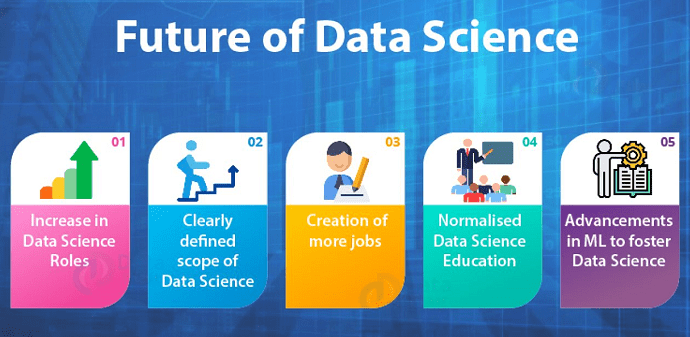
Where Data Science Will Be 5 years From Now?

Data is everywhere and data science is the perfect m mixture of algorithms, programming, deploying statistics, deductive reasoning, and data interference.

Data is the amalgamation of statistics, programming, mathematics, reasoning, and more importantly, a data scientist is a field that comprises everything that related to data cleaning, preparation, and analysis.

But when thinking about where data science will be 5 years from now, it’s useful to know how data science has made its unique position in the science field over the past five years.

Why is it hard to imagine a world without data?

As of late, advanced data have become so unavoidable and essential that we’ve nearly turned out to be unwilling to deal with anything that isn’t in data. To request that an information researcher takes a shot at something that isn’t digitized. Give them a table scribbled on a wrinkly bit of paper. Or then again, to more replicate the size of what we will discuss, whole libraries of thick books, flooding with tables of data.

Stack them around their work area and they’d most likely run away and never return. It is because the digital codes of information have become essentials and valuable. We cannot do modern work without them.  That’s the reason digitalization of the data is the whole story that makes our business work easier.

What data scientists do on a regular basis?

Data scientist begins their day by converting a business case into the algorithm, analytic agenda, develop codes, and exploring pattern to calculate which impact they will have on the business. They utilize business analytics to not just clarify what impact the information will have on an organization later on, however, can likewise help devise solutions that will assist the organization in moving forward.

So if you are perfect in statistics for data science, mathematics calculations, algorithms, and resolve highly complex business problems efficiently than the position of a data scientist is a round of clock available for you.

If we talk about data science salary, the job, and salary of the data scientist always on the top on in India but all over the world. A career in information particularly appeals to the youthful IT experts due to the positive relationship between the long periods of work experience and higher data science salary.

What does a data scientist actually need?

If you want to explore your career in data science, you are in the right place. Here we suggest you how to learn data science and statistics for data science along with the kind of skills recruiters expecting from you.

First and foremost, before entering in the data science choose the best data science online course. Because with the help of online courses you can build your skills easily and efficiently. Secondly, there are many roles in data science, so pick the one that depends on your background and work experience.

So, now you have decided on your job role and subscribed to the data science online course. The next thing you need to do is when you take up the course is learn data science go through actively, always follow the instructor instructions, the reason we are saying to follow the course regularly because it gives you a clear picture regarding data science skills.

The demand for data science is enormous and businesses are putting huge time and money into Data Scientists. So making the correct strides will prompt an exponential development. This guide gives tips that can kick you off and assist you in avoiding some expensive mistakes.

Data science is the core of the business because all the operations related to the business depend on the data science from statistics to decision making companies are using data science and its story not end here.

How to Become A Data Scientist?

A data scientist is a new trend, and everyone has been working to find a stable place in it. It is ranked on the top as one of the hottest jobs in the Harvard business review. This guide will help you to know about the details of becoming a data scientist.

Who is a Data Scientist?

Before going towards the steps, it is mandatory to know what it means: Data scientists are people expert in analyzing data and have practical technical skills to tackle complex technical problems. They are a unique blend of a mathematician, computer scientist, and trend spotter.
They are professionals in both it and business sector, and that’s why they earn more than enough.

Also Read: What is the Role of a Data Scientist?

How to become one?

Learn statistics, ml, and algebra. A good data scientist can solve any problem better than a computer science engineer. They are well learned in the statistics and algebra. That is why deepening the knowledge about the mentioned subject is a fundamental need to start the journey as a data scientist.

Learn more about databases

The database is a frequent subject in computer science. A data scientist, however, makes you safer in securing your high paying job. This can only happen if a thorough study of databases is done.

Coding

It is a common part of the computer science world. It is, however, important to note that unless one becomes a better coder, they cannot become a data scientist. A data scientist has efficient experience in coding, and they have deep knowledge about it.

Practice and Work on Projects

Whosoever has achieved the status of becoming a data scientist; they will recommend you to start practising your coding and programming skills in real time. Practice makes a man perfect, and a data scientist is an ideal computer science engineer.

Practice on big data software

The data scientist has to deal with various non-segregated and segregated data. To make things easy, many data scientist use big data software such as MapReduce or Hadoop. Becoming an expert in using the software can help you in achieving your desired goal.

Become expert in data munging

It is a process in which raw data is further converted into easy to study and well-analyzed form. A data scientist is an expert in it. You have to practice more to become one.

Learn more!

It is one of the critical processes of becoming a data scientist. It is known to everyone that a computer scientist has to be updated about the new languages in the field. A data scientist is also the same. They have to be well learned in their area and become experts. This can happen by being in the association of like-minded people and developing the curiosity to learn more.

Development of Powerful Communication Skills

How will you communicate with people if you fear to go in front of an audience? Communication skills, therefore, most important part of any job profile. An expert data scientist has practical communication skills that separate them from others.

Apply for Jobs

After learning, practising and studying thoroughly, if you are sure of your talent and skills, you can start applying for the jobs by making an attractive portfolio.

Conclusion

Becoming a data scientist is not an easy task.
However, the situation can be tackled by using the process of learning and practice. The more you practice, the better you become. Even if you fail in interviews, you can still practice and learn. Who knows? You can be the next data scientist expert.
Related Article: What a Data Scientist Could Do?

Do Data Scientist Use Object Oriented Programming?

It is estimated that there are 2.5 quintillion bytes of data produced every day in our world. In this data-driven world, the career opportunities for a skilled data scientist are endless. With the data production rate predicted to go higher than of now, the career opportunities for those who can manage data are not going anywhere. This article discusses whether data scientists are using Object-Oriented Programming. Let’s find out.

What is Object-Oriented Programming
Object-Oriented Programming or OOP is a model of the programming language organized around objects rather than the actions. It also emphasizes data rather than the logic. Traditionally, a program is considered to be a logical procedure that converts input data into output.

In such cases, the challenge was to come up with a logic that works. The OOP model redefined that concept. It takes the view that we should care more about the objects we are trying to manipulate rather than the logic we use. These objects could be anything from humans defined by names and addresses to little widgets such as buttons on the desktop.

The main advantages of OOP are:
• Programs with a clearer modular structure.
• Codes are reusable through inheritance.
• Flexibility through polymorphism.
• Very effective problem-solving.

Object-Oriented Programming in Data Science
Using Object-Oriented Programming for data science may not always be the best choice. As we said, the OOP model cares more about the objects than the logic. This type of approach is most suited for GUI, interactive application, and APIs exposing mutable situations. When it comes to data science, functional programming is preferred more due to superior performance than compared to the OOP model. The advantage of better maintainability offered by OOP is sacrificed in the data science for the sake of performance.

Polymorphism is an important feature of OOP. It allows a loosely coupled architecture, where the same interface can be easily substituted for different implementations. This feature is very helpful when dealing with applications of large size. However, data scientists seldom use large codebase. They always use small scripts and prototypes. So, OOP would be far too much overhead with no significant benefits.

Although, machine learning libraries are a must needed thing for data scientists. Most of these libraries make use of object-oriented programming, at least the ones in Python. Machine learning libraries such as Scikit-learn heavily make use of OPP. Data scientists who work with R and SQL will never have to use OOP.

Conclusion
It is clear that even though Object-Oriented Programming Offers a lot of benefits, it is not exactly what data science need. So in general, object-oriented programming is seldom used by the data scientists.

If the data science career seems to suit you, wait no more. Imarticus is offering courses on data science prodegree, which will provide you with all the skills and knowledge to excel in your career. This Genpact data science course allows you to start your journey on the right foot with placement assistance at so much more.