Enhance your Resume with These Online Certificate Courses for MBA Students

Colleges are starting, and you’re thinking about applying for jobs. One of the first things employers will ask for is a resume, which can be intimidating if you don’t have any work experience to list. But what if I told you that it’s possible to build your resume with online certificate courses?

In this blog post, we’ll discuss how taking just a few courses from top universities worldwide can provide an excellent foundation to show future employers that you are serious about advancing in your current position! This blog post will outline the best online MBA courses.

MBA IN FINTECH PROGRAM:

  • The interactive FinTech learning experience allows students to apply what they have learned to real-world business challenges and circumstances.
  • This rigorous JAIN(Deemed-to-be-University) online MBA program comprehensively examines the paradigms of New Age FinTech, providing the student with a high-quality learning experience.
  • Hands-on training from industry experts, real-business case studies, tech-enabled projects based on Blockchain, Cloud Computing, and other prominent New Age tech tools, as well as valuable interactions with FinTech industry leaders and entrepreneurs, will empower their professional FinTech knowledge like never before.

MBA IN INVESTMENT BANKING & EQUITY RESEARCH:

  • Banking and finance are varying at a breakneck pace, primarily fueled by cutting-edge transformational technologies.
  • As a result, New Age Investment Banking’s complexity has evolved to mirror these shifts.
  • The widespread use of financial technology has dramatically transformed the global economy’s dynamics, leading to a surge in demand for tech-savvy New Age Investment Banking Professionals.
  • This comprehensive Online MBA program delves deeply into the many paradigms of New Age Investment Banking, providing a student with a high-quality learning experience.

PROGRAM FOR DUAL BANKING AND FINANCE MANAGEMENT

  • This dual Banking and Finance Management program is excellent for individuals wanting to advance their BFSI professions thanks to its innovative curriculum and two parallel study pathways.
  • This unique approach to professional education redefines students’ industry knowledge and successfully enhances their vocational talents throughout their learning journey.
  • NMIMS Global Access MBA (Distance) in Banking and Finance Management is a comprehensive, 24-month unique combination of two industry-endorsed Finance and Banking courses specially designed to upgrade existing careers in the booming Banking and Finance industry.
  • Suppose students are searching for all of the advantages of a traditional Masters in Banking and Finance. In that case, Masters in Quantitative Finance, Masters in Banking and Financial Economics, or Masters in Financial Management, this globally renowned PGP in New Age Banking Program is the answer.

Explore JAIN MBA Program with Imarticus Learning:

This JAIN MBA includes hands-on instruction from industry professionals and covers every vital area of course. Students may apply what they learn in the immersive tech-enabled learning experience to real-world business settings and challenges.

Some course USP:

World-Class Academic Professors to learn from through live online sessions and discussions.

Aspire to Become a Financial Analyst? Start with These Financial Modelling Courses Today

Financial analysts are a vital part of the financial world. They work with companies and individuals to determine their economic status, assess risk, and analyze company performance. It’s a demanding job that requires dedication and intelligence. But what do you need to know before embarking on your journey? This post will tell you everything you need to know about becoming a Financial Analyst, so read on!

A financial analyst provides advice and support to senior management with their decision-making. They are responsible for calculating various finance-related equations based on company data. The role involves analyzing past performance and predicting future outcomes to guide strategic planning.

Who is a financial analyst?

The term ‘financial analyst’ has become a common phrase in today’s corporate world. Companies worldwide are looking for people with this specific expertise who can handle and manage their finances appropriately. There is a high demand from financial firms, banks, mutual funds, insurance companies, and other stock market-related organizations. It has become a well-sought-after career path, and the numbers don’t seem to be slowing down anytime soon.

Role and responsibilities of the financial analyst:

Becoming a financial analyst means you will be working with senior managers to make informed decisions. You will also need intense research, analytical and mathematical skills.

On the other hand, it is highly challenging to land a job as a financial analyst because of the high demand for these roles. You must have the right qualifications and experience before you apply. Merely having a degree in finance isn’t enough; you also need practical experience and knowledge of the industry. The roles and responsibilities are listed below:

  1. Monitor financial activities to ensure they are following guidelines laid down by the company
  2. Analyze data and status of a business, its finances as well as sales and other performance indicators
  3. Identify problems or areas for improvement and suggest plans to overcome these shortcomings
  4. Prepare reports which summarize their findings and present them to senior management for further action
  5. Use various financial tools and models to determine the current state of the business, its past performance as well as future potential

Enroll in a Financial analyst course with Imarticus Learning today!

If students aim to become financial analysts, here’s their golden opportunity. Imarticus Learning is training professionals from all industries and backgrounds to take up this profession easily through our advanced financial modeling certification. We understand the importance of learning from experts in various industries for years and putting that into practice by having our faculty members have years of experience in the corporate world.

Some course USP:

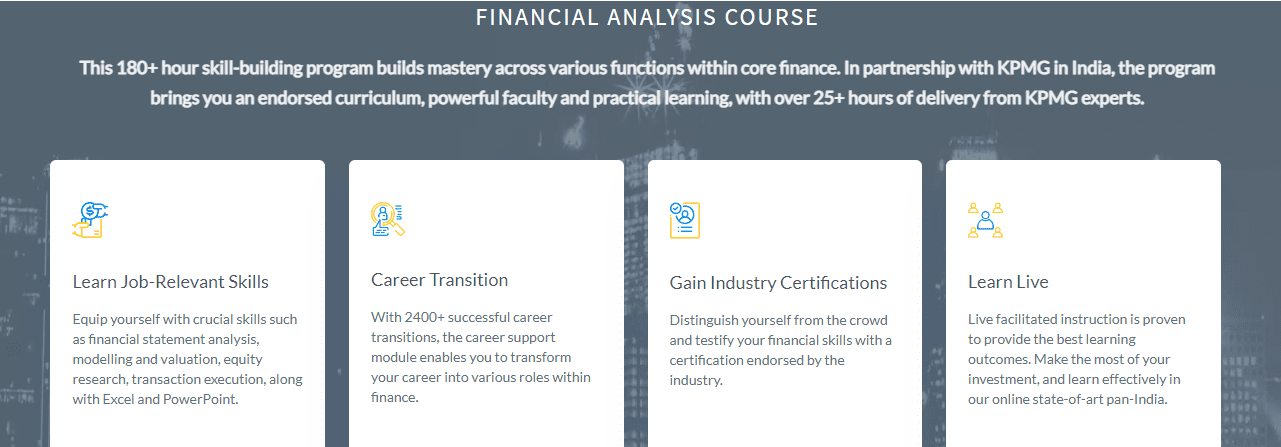
  • This 180+ hour skill-building program develops competence in a variety of crucial finance operations.
  • The program provides the student with an endorsed curriculum, excellent professors, and practical learning.
  • Financial statement analysis, modeling and valuation, equities research, deal execution, and Excel and PowerPoint are skills students will need.
  • The best learning outcomes demonstrated to come from live assisted instruction.
  • This financial modeling course for students is with placement assurance aid the students to learn job-relevant skills.
  • Impress employers & showcase skills with the financial analyst course endorsed by India’s most prestigious academic collaborations.
  • World-Class Academic Professors to learn from through live online sessions and discussions.

Contact us through the chat support system or visit Mumbai, Thane, Pune, Chennai, Bengaluru, Delhi, Gurgaon training centers.

What is all the Hype About Commodity Market Investments?

What is the commodity market?

Commodity investment is the buying and selling of different types of commodities like agricultural products and livestock (soft commodities), and metals and energy products (hard commodities). These products can be bought and sold in bulk.

The commodity market has been around for a very long time, the number of investors is still limited. However, this has changed over the past few years. This money market has become wildly popular and is often used by manufacturers and wholesale traders. Just like the stock market, there are several online platforms available that deal with investments in the commodity market.

How is the commodity market related to the stock market?  

The prices in the commodity market often fluctuate depending on the demand and supply of the product and services. If the supply is in abundance, the price goes down, if the supply is less and demand is more, the price automatically increases.

The commodity market and the financial market have a negative correlation. For example, the rising prices in oil and gas have often been linked to lower prices in the stock market and high prices in the stock market would mean that oil prices have decreased. Similarly, during high inflation, the prices of commodities remain high and when inflation is lower, stocks and bonds tend to perform better.

Non-fuel commodity prices were 38% higher in April 2021 than the same month in 2020. That is the highest rate of growth since 1970. This shows that the world has entered into the mode of “supercycle” where there are going to be a lot of economic changes globally and commodities are going to increase.

Why should you consider investing in the commodity market?

The commodity market is considered a safe investment. Also, this money market holds great value under the economy of the country as well as those who make a living out of it. Here’s why you should consider investing in the commodity market –

  •       Better quality – The market is very strict about the quality of the commodity during the trade. This benefits the buyer and the seller.

  •       Price discovery – The market guarantees transparent ways to identify the original prices of the commodities. This ensures that the commodities are not sold at cheaper rates to middlemen.

  •       Risk management – The sellers of the commodities have various tools like futures and options for risk management and to deal with their losses.

  •       Safety – Trading in commodities can be considered a great way to diversify their portfolios. Investing in commodities can safeguard their capital if the stock market falls.

  •       Margin trading – There is always a leveraged margin when trading in commodities. Large transactions can be done with a little amount of cash in hand.

 Stock markets give speedy returns while the commodity market is gradual. There are high returns possible in the latter as well but the investor should have an expert insight. One cannot predict the prices in this market that changes rapidly.

An individual must be well-versed with the economy of the country as well as international trade before they choose to invest in the commodity market because although it is safe, there may be some risks involved. To understand how to manage those risks, there are risk management courses available online, which will guide you thoroughly. 

Top 5 Hard Skills Required to Become a Merger and Acquisitions Senior Analyst

Mergers and Acquisitions are among the most important events in the corporate sector. And, obviously, with such an important event comes a position of equal importance. Mergers and Acquisitions analysis is a high demanding job that leaves no place for error. And, because as long as the corporate sector as a whole remains, it is a surety that mergers and acquisitions will keep on happening, it is also a guarantee that a mergers and acquisitions analyst will be needed no matter the time.

So, if you want to pursue a fruitful career in this sector and give your future the flourish it deserves, then the best option for you would be to do a proper merger and acquisition analyst course, chartered financial analyst course, or SWOT analysis course.  

chartered analyst courseA lot of institutions offer a solid merger and acquisition analyst course in India. Such an institute is Imarticus Learnings.

It not only provides a compact financial analysis prodegree but also comes with placement opportunities that give you the chance to land your dream job right from the get-go.

However, there are a few skills that M&A analysts must possess. Here, we are going to talk about them.

Finance Modelling and Valuation Techniques

The job of M&A analysts is to assess prospective companies in the field to acquire or merge with. They need to evaluate both profits and losses of a merger for all the parties included. So, obviously, they need high-level skills of financial modeling course helps them chalk out the goals and the means to achieve them.

SWOT analysis courseAnother important skill analysts should have is to be able to put the correct value to each aspect of a merger. They need to determine as precisely as possible the appropriate premiums needed for acquisition.

This is why they must always stay ahead of industrial knowledge and analyze all the recent value reports of events.

This is one of the reasons why students with a degree in chartered financial analyst course or SWOT analysis course get high preference in this field.

Flawless Pitch Books

Another skill analysts must have is making flawless pitch books. It is important to present all the information and stats regarding the merger to all the parties involved appealingly. 

Accounting Prowess and Industrial Knowledge

As these deals often tend to cost millions, the analysts must have accounting prowess so that they can keep a check on all the transactions made. Analysts also need core industrial knowledge as all mergers and acquisitions made are very industry-specific.

Staying up to date with International Corporate Scenarios

A good analyst should always stay up to date with international corporate scenarios. As mergers are a common event for businesses both local and global, a deep understanding of the function and process goes a long way to help clients.

In-depth Knowledge of Industrial Law

This is possibly one of the most important skills needed in an analyst. A good analyst should be acquainted with all the laws that need to be regarded during a merger and acquisitions process as any error can lead to serious legal trouble for everyone involved.

Conclusion

A merger and acquisitions analyst has no room for error and should always be at least two steps ahead of everyone to guide them properly. And, the only way to do that is by learning the process completely. Imarticus Learnings brings to you a great opportunity with its financial analysis prodegree that will help you get the boost you need in your career.

Top Cryptocurrency Exchanges in India of 2021

With the market’s exponential growth, it is not surprising that India has also seen an increase in its number of crypto exchanges. With 1.3 billion people, India will be one of the leading countries trading over the next decade. This blog post reviews some top trades in India worth investing in now or keeping an eye on as they grow.

What are cryptocurrency exchanges?

Cryptocurrency success has led to the creation of crypto exchanges. It is a platform where investors can purchase and trade cryptocurrencies like Bitcoin (BTC). Crypto exchanges allow you to own several cryptocurrencies without having to invest in expensive mining rigs.

Top 6 Crypto Exchanges in India:

  1. CoinDelta

CoinDelta is one of the leading exchanges in India that also has low trading fees. The site features an intuitive user that makes it easy for new investors to understand and experience. It was launched in December 2013, which means it has more than three years of experience in the Indian market.

  1. 2. Coinsecure

One of India’s most popular exchanges recommends the ideal exchange for traders wishing to invest in Bitcoin. The site supports multiple languages and has an easy-to-use trading interface with simple buy/sell options, live charts, etc. Although their fees are a little higher, they offer a fast and straightforward trading experience.

  1. BitBay

Based out of Poland, this exchange is not well-known in the Indian market; however, it offers some great features that make it one of the top exchanges around. It supports multiple fiat currencies and has an easy-to-use interface with advanced charting tools and several trading options.

  1. Coinome

An Indian exchange backed by the famous Bitcoin trading company, Zebpay, offers some impressive features that make it one of the top exchanges in India. It provides an instant account creation facility and has multiple payment options, high liquidity, and low fees.

  1. Koinex

One of India’s most popular exchanges, Koinex, offers some exciting features that make it stand apart from its competitors. It supports multiple cryptocurrencies and has live updates on the homepage with real-time order books and instant deposits. The site also has an impressive trading app for Android devices.

  1. WazirX

With over 300,000 registered users on its beta launch in October 2018, WazirX is one of the newer exchanges in India. However, as a new exchange, it has some impressive features and plans to expand its range of tradable cryptocurrencies. It offers high liquidity and low fees, along with an easy-to-use interface and excellent security features.

Explore and Learn with Imarticus Learning

The Professional Certificate In FinTech, developed by SP Jain School Of Global Management and Imarticus Learning, is Asia’s leading FinTech course. Hands-on training from industry professionals, real-world case studies, projects incorporating technologies like Blockchain and Cloud Computing, and significant interactions with FinTech industry leaders and entrepreneurs are all part of this course, making it an attraction for those eyeing a career in Crypto.

Some course USP:

  • This Cryptocurrency course is with placement assurance aid the students to learn job-relevant skills that prepare them for an exciting career.
  • Impress employers & showcase skills with a certification endorsed by India’s most prestigious academic collaborations.
  • World-Class Academic Professors to learn from through live online sessions and discussions. It will help students understand the 360-degree practical learning implementation with assignments.

How Starters Must Go About Investing? How Small Should They Start?


The stock market is a marketplace where trade i.e., issuing, buying, and selling of stocks, bonds, etc. occurs. Investing in the stock market for the long term can help you manage your finances. It is an instrumental task of understanding stocks and shares. If you are just starting, then investing in the stock market could seem a little intimidating. 

How is Investment Banking Related to Stocks?

Investment banks assist companies or individuals to create or raise capital. They arrange for the buying and selling of stocks and provide consultancy on better opportunities for investors, beginners, or professionals. It may seem intimidating to learn investment banking, but it will help you understand the stock market better. 

How do Beginners Invest in the Stock Market?

  1. Determine the approach you want to take – Setting the approach you want to take in the beginning can make the future of your investing much easier. Your approach will also help you determine your investment management (long-term or short-term).

  2. Decide the amount you want to invest – The amount you want to invest can be decided based on the goal you want to achieve. It is inadvisable to invest in stocks if you need the money in the next five years.

  3. Open an investment account – To make all the trades in India, you need to open a specialized account, a Demat account, or a Dematerialised account. This account holds the shares and bonds in a digital form securely. The shares that are bought are deposited in this account which makes trading much easier.

  4. Choose where you want to invest – To choose where you should invest, you must first understand the options –
  • Stocks – Stocks are ownership shares of a single company. They are purchased at a certain price and fluctuate according to the market. This makes it a risky investment.

  • Bonds – Bonds are loans to companies or the government, and they agree to pay back in a certain amount of time. Till then you get interested. This poses a lesser risk.

  • Mutual Funds – Mutual Funds are like a trust that collects money from different investors who purchase securities. They are a safe investment for beginners.

How Much Should the Beginners Start With?  

It is advised for beginners to start investing as early as possible because your investment portfolio depends on it. When you start investing at a younger age you can take a risky approach, and if anything goes wrong, then you will have enough time to recover that amount and make profits. For example, during the Covid-19 pandemic in 2020, the stock market fell almost 40% only to rise to an all-time high over the next few months.  

Many people delay investing in the stock market because they think it requires a lot of money. Nothing could be further from the truth. You can start with as little as Rs.500/- per month and can increase it over the years if and when you can get the funds.

Conclusion 

Investing in the stock market is a great opportunity to gain wealth over the years. It gives every person an equal chance to earn money and also increase knowledge. There are investment banking courses with placements that can help you learn further. 

How a Financial Planning and Analysis Course can Help you Become a Financial Planning Lead

Finance courses have been a top favorite for students wanting a stable career for a long time. That is true for both in and out of India. However, with the progress of the field, a lot of new courses have been introduced to the masses over the years, such as Financial Technology, Blockchain Technology, New Age Banking, Financial Modelling course, Financial Planning, and Analysis courses.

The financial planning and analysis course has gained popularity among students in a short time. This is why a lot of institutes in India offer a financial analyst course. Imarticus Learnings as always has come through with a compact Financial Analysis prodegree with job interviews offers. If you want a chance to boost up your career, then go ahead and check it out.   

financial anlayst courseHere, we are going to talk about what financial planning and analysis courses entail, how they can help you to become a financial planning lead, and the all-around advantages a financial planning and analysis course can have over your career.

What Does a Financial Planning Course Entail?

A financial planning course basically teaches students the skillset needed to chalk out any financial situations successfully relating to today’s economic scenario. Here, we are going to discuss the objectives of a financial planning course:

  • To prepare students for real-world economic scenarios with proper case studies
  • To nurture the analytical and strategic skills needed for a financial planning career
  • To train them accordingly so that they can meet the needs of the demanding industry

How Does it Help you Become a Financial Planning Lead?

The job of financial planners basically involves chalking out the financial goals of companies or individuals and guiding them into achieving them. They are hired by financial planning firms and are one of the most in-demand as well as highest-paying jobs nowadays.

As a financial planning and analysis course provides the necessary training needed for a career in any sort of financial services, it obviously automatically increases your chance of becoming a financial planning lead. 

All-around Advantages in Your Career of a Financial Planning and Analysis Course

There are numerous advantages of a financial planning course in your career. Here are a few of them:

  • There are a lot of career options for you to choose from such as broker/dealer, investment advisor, wealth management officer, customer services, and asset management.
  • You can utilize your financial planning course in your start-up as well. It will save a lot of money to use your own skills as a financial planner instead of hiring one.
  • It is one of the most in-demand courses right now, so a stable career is guaranteed.
  • It is also one of the highest-paying jobs nowadays.

Conclusion

Just like all other corporate sectors, the finance one being possibly the most important has progressed quite dramatically in the last few years. And, to progress it even further, more and more financial planners are needed.

This is why it is the golden time to get enrolled in a financial planning and analysis course and secure your future. Imarticus Learnings is providing you with a golden opportunity to boost your career with its financial analysis course that is sure to put you leagues beyond your peers.

Top 5 Soft Skills Every Project Finance Manager Needs

Soft skills are necessary for professional advancement. While managers need to know the subject matter of each project and be experts in their fields, they also should have certain soft skills. Soft skills are taught in most Financial Analysis courses. These skills help candidates become the best project manager that they can be. A chartered financial analyst who possesses all essential soft skills can help their teams achieve all goals. 

What Are the 5 Skills Project Finance Managers Should Possess?

There are 5 major skills that every project finance manager needs to have. These skills have been discussed below. 

  • Leadership

Leadership skills are necessary for every manager. They can only become reliable managers if they know how to lead and tackle team members. As leaders, project finance managers are responsible for introducing a vision for the team. They should motivate other team members and bring everyone up to date with how the project is evolving. Managers need to ensure buy-in from executives and provide all necessary resources to the team. 

  • Budgeting

Project managers who are dealing with financial analysis and ratio analysis should be skilled in budgeting. While working on projects, managers need to know how to introduce a budget and stay within it. At times there might be a financial constraint. If the company is dealing with financial issues, projects need to be done on a tight budget. Project finance managers need to create a budget that is not unreasonable. 

  • Time Management

Project finance managers have to deal with multiple tasks all at once. Since they are responsible for all aspects of the project, they have to pace out the tasks so that all deadlines can be met. They need to give every team member a specific time frame within which all tasks can be completed. Managers will also need to keep time aside to check and verify the work that has been done. Time management is therefore essential.

  • Risk Management

There is risk involved in every stage of financial analysis. Project managers are tasked with assessing the risks. This is an essential skill and while much of it is based on data analysis, managers need to trust their instincts as well. Project finance managers need to anticipate and manage risks effectively. By identifying potential risks, project finance managers can assist team members and clients avoid major problems. 

  • Communication Skills

Every project manager needs to possess communication skills. They need to know how to communicate with team members and other managers. It is not only verbal communication that matters but also written communication. Project finance managers who have great communication skills can easily set up partnerships and collaborate with other teams. They should also effectively communicate the status of the project with the stakeholders. 

How to Become a Skilled Project Finance Manager? 

To become a project finance manager with the best soft skills, one can opt for a financial analyst course from a leading institute like Imarticus Learning. Imarticus Learning offers a Financial Analysis Prodegree and the course is in collaboration with KPMG. Industry experts provide extensive training for a total of 25 hours and prepare students to tackle real-world situations. While the course includes several topics like ratio analysis, accounting, corporate finance, private equity and investment banking, it also ensures that students are learning soft skills. These soft skills help them get through placements and land jobs in their areas of interest. The combination of relevant expertise, hands-on experience and soft skills allow students to explore different opportunities in the financial sector. 

The chartered financial analyst course offered by Imarticus Learning is holistic and consists of a methodology that is based on projects. This trains students to deal with various tasks and develop all essential managerial skills. The degree will ensure the success of all candidates in the industry. 

Simplification Is What Most Banking and Financial Institutions Need to Address Various Challenges, but How?

In this modern era, every person is trying to harness the power of financial services. With increasing transactions and financial services, banks are looking for simplification in day-to-day operations. Numerous challenges are threatening the banking industry currently. To address those challenges, financial institutions should have a pre-planned strategy. The new-age banking landscape is complex, and banks are looking to simplify their operations for sustainable development. Simplification helps financial institutions adapt to the evolving demands of the customers. Read on to know how banks and financial institutions can simplify their operations to address several challenges.

Challenges for banks and financial institutions

Various challenges for banks and financial institutions in the current scenario are as follows:

  • The expectations of customers from banks and financial institutions have drastically increased over the years. Customers have become more aware and demanding when it comes to financial services. To enhance customer experience, financial institutions have to cater to their needs.
  • With the introduction of FinTech, customers are looking to access financial services at their fingertips. Financial institutions have to adopt technology on a large scale to provide FinTech services.
  • Earlier, there were fewer banks and financial institutions. At present, there are many banks, loan firms, FinTech firms, and other types of financial institutions. Customers can change their bank anytime they want. Banks have to provide quality services to stay ahead amidst the high competition.
  • Many investment banks are not able to fulfil the expectations of the shareholders/investors. The pressure from investors is also a challenge faced by banks nowadays.
  • The compliance regulations have become stricter and more complex. Financial institutions have to understand the complex regulations and ensure strict compliance.
  • Large amount of data is being produced by banks and financial institutions every day. Financial institutions have to make the best use of data which is also a challenge these days.

How to achieve simplification?

A step-to-step guide for banks and financial institutions to achieve simplification is as follows:

  • Start by identifying the purpose, role and target audience of the financial institution.
  • You have to choose a direction for your financial institutions. The business architecture is decided before you begin operations. For example, a financial institution can follow a sales approach or can go for multi-brand management.
  • Determine the critical business activities for your financial institution. The activities that provide a competitive advantage to the financial institution should be completed in-house. Other activities can be outsourced to boost simplification.
  • Financial institutions need to undergo a digital transformation for capabilities that are not bound by legacy issues. You will have to adapt technology to survive in this new-age banking era.
  • You will have to create a simplification roadmap for your employees. Your employees can go for banking and finance online courses to know more about new-age practices.

Which course is best for new-age banking?

The PGP in New Age Banking offered by Imarticus Learning is the best course for young enthusiasts. You can unlock career options after graduation with this banking course. Imarticus allows you to pay a part of the course fee in starting and the remaining after getting placed. The dual banking course follows two parallel learning paths and an industry-endorsed curriculum. Young aspirants looking to build a career in the BFSI industry can go for this new-age banking course.

Conclusion

Most of the online banking courses do not offer placement support. With extensive placement support from Imarticus, you can build a successful career in the banking/finance industry. For working professionals, the banking course can help in getting a 25% hike in current salary. Start PG diploma in banking and finance now!  

Understanding How Indian Microfinance Institutions (MFIs) Work?

When it comes to loans, people who use banking facilities can easily apply for a bank loan. However, loans in India are also provided to people who do not have any banking facilities. Microfinance Institutions (MFIs) in India are those companies that lend small loans to people. The amount of a microloan can differ according to the country. In India, all loans below INR 1 lakh are considered to be microloans. Young enthusiasts that want to build a career in banking should know about the microfinancing scenario in India. Read on to know more about MFIs in India. 

Goals of MFIs

Microfinancing is an important concept in investment banking. You should know about microfinancing to secure a better job deal in the investment banking sector. Before understanding the working of MFIs, you should know about their goals. The objectives of MFIs in India are as follows:  

  • An MFI aims to become a financial institution that assists the growth of sustainable businesses and communities. 
  • MFIs help the weaker sections of society by providing the required resources. MFIs have a huge contribution when it comes to the development of women from weaker backgrounds. MFIs have successfully created income generation opportunities for women in India. 
  • Some of the top MFIs in India have contributed to decreasing poverty in the country. MFIs always work on faster and new ways to eradicate poverty. 
  • An MFI will create self-employment opportunities for people that can’t access the available amenities. 
  • MFIs also teach rural people beneficial skills that can help in creating income opportunities. 

As per the records of the World Bank, there are around 1.7 billion people around the world that don’t have access to banking services. These people are the target audience of an MFI. MFIs have had a major role in boosting the economy of the nation. It is why financial institutions expect their employees to know about MFIs. 

How do MFIs work?

MFIs form several groups for distributing small loans, resources, and training facilities to people. Several groups formed by MFIs that help them in functioning are as follows: 

  • MFIs form a JLG (Joint Liability Group) for distributing small loans to a group of 5 -10 people. The small loans are distributed against the mutual guarantee of each member. Every member of the group is responsible for the repayment of the loan amount. 
  • MFIs help in forming an SHG (Self Help Group). An SHG is a group of people with similar economic and social backgrounds. A non-profit organisation is formed between the people and money is collected from each individual. The money is then distributed to members according to their needs. 
  • MFIs are also involved in making loans more accessible for people from rural areas. MFIs always search for ways to provide small loans to people without any collateral. 

How to learn more about MFIs in India? 

If you want to learn investment banking then learn about all its aspects. Microfinancing is important for financial institutions that want to be recognised as a people’s bank. You can go for detailed investment banker courses offered by EdTech platforms. Imarticus Learning is a reliable source that can help you know more about MFIs and other investment banking concepts. The Certified Investment Banking Operations Professional course offered by Imarticus comes with a job assurance guarantee. You can gain industry certifications and learn with an industry-endorsed curriculum. 

Conclusion 

Online training from a reliable source like Imarticus can help you kickstart your career as an investment banker. Imarticus will provide tips and training for investment banking interviews. It will also offer investment banking case studies for a better learning curve. Choose an online course to know more about MFIs!