How data plays a crucial role in effective in effective financial planning and analysis

The financial world is rapidly changing, and data plays a crucial role in making decisions. You can use data to analyze past trends or predict future ones, which helps you plan for the future better than ever before. This post will give you an idea of collecting, analyzing, and using data to your advantage.

What is data?

Data is a collection of information that gets organized to be searched, analyzed, and interpreted. You can collect data through surveys, polls, or interviews to get an accurate representation of the opinions or behaviors of the general population.

How do data help in financial planning?

To plan effectively for the future, you need to look at trends and data from the past. For example, if you’re considering buying a car in five years, understanding how car prices have changed over time will help you make an accurate prediction of the price you’ll likely pay in five years. By knowing this information, you can either save more money or make alternate plans.

Data for individuals

  • Collecting a large amount of data is best done in a spreadsheet.
  • It would be best to start by making a list of your monthly expenses, including rent or mortgages, groceries, and utilities.
  • This list will guide you plan out the year to come and understand how much money you have available for purchases that might not occur every month, such as buying a new TV or going out to dinner.

Data for businesses

  • Business owners can use data to identify trends in the market.
  • They can also use data to predict future demand for a product or service, which will allow them to plan their inventory.

The future of data in the world of finance

  • Over the next few decades, people will become increasingly more reliant on technology to make financial decisions. 
  • Businesses will utilize data analysis to run their companies more efficiently and effectively.

Why should you care about data in your finances?

  • In many ways, data is becoming a part of life.
  • You don’t have to be an expert who works with numbers all day long to understand the impact of data on your finances.
  •  By taking a few minutes to analyze your monthly expenditures and plan for upcoming expenses, you’ll be able to track your budget and save money every month. 
  • Data is everywhere, and it can even play a significant role in your financial life.

Explore and Learn with Imarticus Learning

This fascinating financial planning and analysis course emphasizes ‘learning by doing’ through case studies, seminars, and hands-on projects. It simplifies corporate valuation processes, financial modeling approaches, and financial analyst abilities into easily digestible chunks of information.

Some course USP:

  • These financial modeling courses are to aid the students in learning job-relevant skills.

  • Impress employers & showcase skills with financial analyst courses endorsed by India’s most prestigious academic collaborations.

  • World-Class Academic Professors to learn from through live online sessions and discussions.

The next generation of fintech certification courses

People are no more bound to visit a physical bank for any financial service. Fintech platforms have displaced the services of traditional banks. People can now make a transaction with ease via their smartphone while sitting on the couch. Due to the rise of fintech, professional learning courses have now changed their curriculum. Banking and finance courses are now including fintech concepts as it is in demand.

Most of the banks are now going digital and adopting fintech services. There is a huge demand in the market for fintech employees. In such a scenario, young aspirants must be taught about fintech concepts. Read on to know the next generation of fintech certification programs

best Fintech courses in IndiaUnderstanding the fintech industry

Why is there a need to change the curriculum of financial/banking courses? It is because bank officials are no longer involved in traditional activities only. New-age banks hire professionals that are skilled in technology besides traditional financial activities.

For example, consider a bank that has just launched its fintech platform. Besides cashiers and managers, the bank will also hire fintech experts to monitor the performance of the fintech platform.

Technology has changed a lot in the banking and finance sector. Age-old courses do not contain much information about the new-age technologies that are displacing traditional financial services. It is why young aspirants are demanding industry-oriented courses that could cover the recent innovations in the finance sector.

There are many fintech courses online but, not all follow an industry-oriented curriculum. By knowing about the recent innovation, it does not mean that one should ignore the core concepts of finance and banking. An effective online course will cover core concepts of banking/finance along with fintech innovations in recent times.

What should a new-age fintech course cover?

You should choose an online fintech course wisely. Choose a course that focuses less on outdated technologies and more on the latest innovations. The goal of an effective fintech course should be to teach students job-relevant skills. Some concepts that should be covered by a new-age fintech course in 2022 are as follows:

  • Robotic Process Automation (RPA): RPA is widely used for automating several processes in the fintech industry. For example, RPA is used for client onboarding, loan processing, compliance management, claims processing, and many other tasks. With RPA, the burden of manual labour on fintech employees has been reduced. A new-age fintech course should cover RPA and its applications in the industry. 
  • Artificial Intelligence (AI): AI is widely used by fintech professionals for data analytics and forecasting. Smart AI algorithms can also detect frauds and money laundering activities with minimal human support. If you want to build a career in fintech, you should be fluent in new-age technologies like AI and RPA. 
  • Blockchain: The fintech industry also consists of cryptocurrency services and blockchain is the backbone of digital currency. Fintech professionals also use blockchain to store and manage transactional data securely. 
  • Cloud computing: Cloud computing is widely used by fintech professionals to store data. Fintech firms usually prefer cloud platforms for storing sensitive data as physical data centers are prone to cyberattacks.

Besides the above technologies, there are many other new-age technologies used in the fintech sector. If you want to build a successful career in fintech, look for new-age courses that cover the latest innovations. We at Imarticus Learning offer an MBA program, a PGDM course, and a certification program in fintech for young aspirants.

Our Fintech online training covers all the latest technologies and tools used by fintech professionals. You will learn from industry experts and become ready to work in the fintech industry. Start your new-age fintech course right away!

Whatsapp and the future of digital lending

WhatsApp Pay is WhatsApp’s new service that allows users to send money to each other for free and as easily as sending a message and making purchases at small businesses, without having to leave the chat platform. The service debuted in Brazil, the second-largest market for WhatsApp in the world after India, but quickly expanded to the rest of the world within months making WhatsApp the future of digital lending.

E-commerce today
Businesses, which can already upload their product catalogs on the commercial version of WhatsApp and answer users’ questions, will have to pay a 3.99% processing fee to receive payments from customers, similar to the amount they may already pay when accepting credit card transactions.

This service joins others made by Mark Zuckerberg’s company such as Facebook Shops which allows sellers to create digital storefronts on Facebook and Instagram in what analysts estimate to be a 30 billion a year revenue opportunity. The social network has also begun rolling out Facebook Pay, a service similar to WhatsApp payments but for Facebook and its Messenger app, integrating WhatsApp Pay so that users’ card information is stored in both services. The social network can thus collect data on spending patterns and compete with Amazon.

Undoubtedly, the strength of Amazon and Alibaba’s advertising business is forcing Facebook and Google to fight back in e-commerce. These two companies control two-thirds of the global digital advertising market, but they are seeing Amazon aggressively entering their turf, thanks to more effective advertising, as the propensity to purchase is much higher for the user who is impacted by Amazon advertising than the average user who sees ads on Google and Facebook.

The reality of this scenario goes further because while Amazon has the real purchase information that it can monetize on its advertising platform, Facebook and Google lack the key areas that allow them to compete head-to-head with Amazon and Alibaba in e-commerce territory: payments and logistics. Therefore, having the transaction end on Facebook and Google is a fundamental strategic key to gaining a broader view of what is really happening in transactions between buyers and sellers.

Facebook Pay (and also WhatsApp Pay) allows anyone to pay in any Facebook Shop in the same way as they would on Amazon, eBay, or Aliexpress. In fact, it is a system that only requires a payment method (a credit or debit card, for example) to be added to the Facebook user’s account, turning it into a virtual wallet, just like Amazon Pay, Google Pay, Apple Pay or Samsung Pay.

The Future of digital lending
In the data economy, turnover matters little in the short term; the global ranking of major financial institutions by criteria such as categorization by total assets or market capitalization offers little clue as to their future: it is a vision that is as monolithic as it is short-sighted in the face of the new reality marked by the critical mass of data: if artificial intelligence gets better results the more data you have, how can we compare the data generated by 144 million users of Banco Santander with the more than 300 million users of PayPal or the trillions of data that any of the GAFA [Google, Apple, Facebook, and Amazon] could collect from their users in financial matters.

Conclusion
Is because of the stated above that credit analyst courses in India are becoming more demanded each day. At Imarticus we offer a Credit Risk and Underwriting Prodegree that offer credit control courses and credit risk modeling courses that profile your professional path to this leading trend.

What Do You Need to Study to Become an Anti-Money Laundering Specialist?

An Anti-Money Laundering Specialist (AML specialist) is a professional who is committed to a financial system in protecting it against money laundering. An AML specialist is also responsible for looking out for, scrutinizing, and reporting any kind of financial transactions that are deemed suspicious. 

Unlike a Money Market Analyst, the AML specialist is a smaller group of 20k individuals across the globe. To be eligible to be such a specialist, one must clear the certification- Certified Anti-Money Laundering Specialist (CAMS). But this certification course is the last lap of a series of academic and certification courses. 

Academic qualifications

The suitable academic qualifications include a bachelor’s degree preferably in finance-related subjects, maths, etc. It also requires you to have a specific number of credits for a bachelor’s degree, coursework during college, professional experience, and additional points for completing other related certification courses before getting eligible for the CAMS course. Each certification course carries separate credit points. 

For the CAMS eligibility, you must have at least 40 credit points. With multiple options, aspirants could comfortably compile the necessary points. Several certification courses carry a significant number of points so choosing them carefully will earn you enough points. 

Certification courses

One of the most important certification courses for CAMS eligibility is CIBOP. The Certified Investment Banking Operations Professional course serves as the stepping stone towards being an AML specialist. 

Such courses for investment banking are conducted by experienced professionals. Most of the curriculum covered here has a global outlook so further upskilling in related fields will be easier for the candidates. Other certification courses to look forward to are CPP, CPA, and CPE. 

Personal and professional skills

Apart from the academic qualifications, the candidates should also have certain personal skills to excel in the job profile. In many cases, the anti-money laundering specialist could very well be an entry-level job. To climb the corporate ladder from there onwards, these personal, as well as professional skills, will be highly important. Some of the basic skills required here are, 

  • Experience in financial management, investment banking, AML banking, etc. This is one of the reasons why Investment banking courses are popular. 
  • One must have strong communication skills verbally, and interpersonally. 
  • Having analytical skills makes their job easier and problem-solving skills will be an added advantage. 
  • One of the most significant added skills would be a thorough knowledge of the AML data vendors. You need to have a clear understanding of the value and structure of the data provided. 

Significance of CAMS

AML specialist is a challenging career where you need to be constantly aware of the trends in the financial world so that you know where to look for what. CAMS is a global certificate so the curriculum is also going to be highly challenging. The standard of this certification is regularly raised so one must keep up with the current financial affairs and regulations. 

At the same time, you can complete other certification courses to prepare yourself for the bigger league by understanding the field and getting more experience in your profession before you make the big leap. 

Courses such as the CIBOP are ideal for knowledge up-gradation and getting ideal job profiles for professional experience. 

Takeaways

Though CIBOP is quite suitable for newcomers, they can choose the various investment banking courses or other kinds of banking courses before heading towards other specialist courses. This way they can become more authoritative with their decisions in their further career options.  

A-Z: Best practices and resources in financial modelling

Financial modeling is used for representing any company or project in number. An organization can know whether starting a new project will be beneficial for the company or not. The importance of financial modeling has forced corporate organizations to hire expert financial analysts.

However, there is a need to create effective financial models that could predict the financial impact accurately. It is why organizations invest in financial analyst training so they could develop better financial models. Read on to know some of the best practices for financial modeling and the required resources. 

financial analyst certification courseBest practices for creating effective financial models

Before starting a new project or company, you should develop financial models to predict the financial impact. One can take better business decisions if they have accurate financial models. Some of the practices for creating effective financial models are as follows:

  • Decide the intention and goal of developing the financial model

What issue is going to be resolved by the financial model? Financial models can tell you about the performance of stocks/shares, financial position, and much more. You need to decide the financial factors that you want to know by developing a financial model.

  • Try to create a straightforward model

Financial analysts are expert individuals when it comes to understanding financial statements. However, the financial model will be used by company executives, shareholders, and business owners to make better decisions. A financial model should be straightforward so it could be understood by all.

You need to decide on minimum inputs and outputs that could successfully create the financial model. You need to use only those financial factors in your model that could help in achieving the output explained in the above pointer.

  • Plan the structure of your financial model

You need to decide how inputs and outputs will be laid across your financial model. Usually, excel sheets are used for creating a financial model. Make sure the structure of your financial model is easy to understand by everyone.

  • Think about data integrity

You need to make sure the financial data presented in your model is accurate, consistent, and complete. There should be no missing values in your financial model. Data validation and conditional formatting offered by Excel could help you in ensuring data integrity.

  • Test your financial model

To test the effectiveness of your financial models, you can provide dummy values in the input section. You can run stress tests by feeding hyperbolic scenarios that may occur at some point. Financial analyst training can help you in knowing more about how to test a financial model.

Resources for financial modeling

The most crucial resource for data modeling is financial data. Without abundant financial data, you cannot create an accurate financial model. Applications like Excel and PowerPoint are used by financial analysts to create financial models. Before developing a financial model, you may have to indulge in transactions analysis, equity research, etc. A financial modeling course can help in knowing the best resources for creating accurate financial models.   

Learn financial modeling with Imarticus

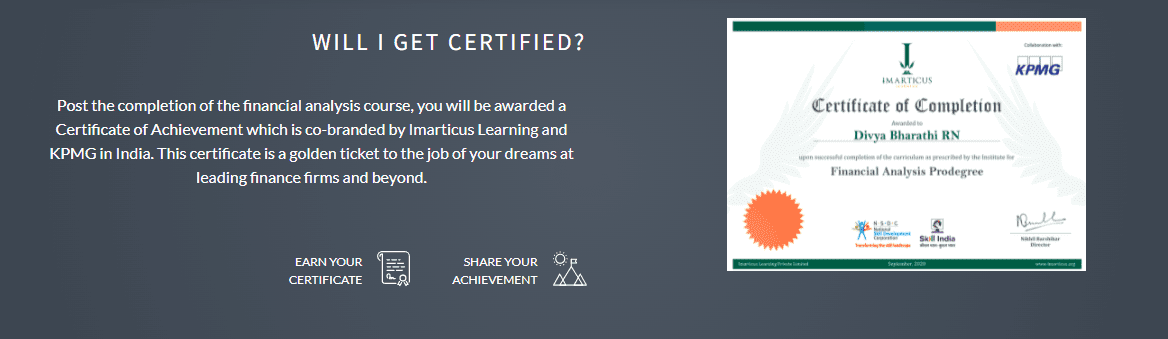
Imarticus Learning is now a common name among those looking for financial modeling courses. We circulate a Financial Analysis Prodegree (FAP) for those looking to become successful financial analysts. The financial analyst certification provided at the end of the course will also be endorsed by KPMG. You can get a lucrative job in the finance sector with an industry-recognized financial analyst certification.

The FAP course will allow you to work on numerous real-world projects related to financial modeling. You will also learn how to develop accurate models with Excel and PowerPoint. Start your financial analysis course now to learn financial modeling!

The factors driving India’s stock market boom

It seems like everywhere you look, there is an article about the growing economy in India. The GDP has grown by 6% year on year, and the stock market continues to rise. The Indian economy still faces many challenges, including corruption, poverty, lack of infrastructure, high inflation rates, and low literacy rates.

While these problems are longstanding ones for India, they should consider them before investing money into what looks like an attractive market right now. So while it might seem like a good idea to put your money into Indian stocks right now because everyone else is doing so too (momentum investing). It may be better to wait until more data on the Indian economy is available, and we know if their GDP growth rate will continue at 6%.

1.      Government Policies: 

  • While some policies may be controversial, the Indian government is doing a lot to attract foreign investment.
  • The Prime Minister’s office has held meetings with CEOs and business leaders to get their perspectives on what India needs to improve its economy.
  • He needs to follow through and make the changes necessary for foreign investors to feel comfortable putting their money into India.

2. Foreign Investment:

Recently, there has been great news about foreign companies investing in India and setting up production facilities here: 

  • Walmart is planning to spend nearly $1 billion in India shortly. 
  • Toyota wants to increase its production plant numbers from two to four over the next few years.
  • Dell is looking for more places to open up shop, both nationally and regionally.  
  • Google wants to double the size of its workforce in India over the next few years.

3. Indian Stock market:

The Indian stock market has been on a tear recently, increasing by over 10% in the past month and making many investors very happy:

  • When news about India’s economy is released, the stock market often jumps up due to increased trading volume. 
  • It could be because people buy stocks based on rumors or speculation rather than actual data about the economy.

4. Exchange Rates:

  • The Indian rupee has been rising relative to the U.S. dollar lately.
  • It means that foreign investors can buy more Indian stocks with their dollars now than they could have a few months ago.  
  • However, this rupee appreciation might be short-lived as inflation in India is still high and will likely remain elevated for the next few years.

Explore and Learn with Imarticus Learning

Learn about complicated securities and derivatives, their trade-lifecycles, and the services that make up an investment banking career. Complex securities and derivative markets and their trading lifecycles and functionalities get covered in the investment banking course.

Some course USP:

  • This Investment banking course for students is with placement assurance aid the students to learn job-relevant skills.

  • Impress employers & showcase skills with the certification in capital market endorsed by India’s most prestigious academic collaborations.

  • World-Class Academic Professors to learn from through live online sessions and discussions.

How to choose the right course to become a financial analyst

The finance industry has finally understood the power of data analysis in making better decisions. Many young individuals are now planning to become financial analysts for reputed organizations. To become a financial analyst, you will have to possess several skills and competencies. There are a plethora of finance-related courses, and you have to choose the right one. Read on to know how to become a financial analyst for a reputed organization. 

Why go for an online professional degree?

Many young enthusiasts believe that an institutional degree is enough to get into the industry. For becoming a financial analyst, an academic background in math, accounts, or finance is appreciated. However, you will still not be job-ready even after a traditional degree. A traditional degree will focus on theoretical concepts and not on industry skills. It is why many students look for a CFA course in India that can help them get an industry-recognized certification. 

Young aspirants looking for a CFA course in India should try the FAP (Financial Analysis Prodegree). We at Imarticus Learning, offer the best professional course for aspiring financial analysts. A professional degree/program makes you job-ready by teaching your industry practices and skills. Let us see how our FAP course has everything to help you become a financial analyst. 

Industry-recognized certification 

Many students go for certification courses from unreliable sources which are not of any use. One should look for the level of certification provided by the course provider before choosing a financial analysis course. For our FAP course, you will receive a certification recognized by KPMG, one of the leading professional services companies on the globe. With an industry-endorsed certification, you can get a lucrative job as a financial analyst. 

Placement assistance 

One should always look for placement assistance while choosing a financial analyst course. Unreliable EdTech platforms do not offer placement assistance to young enthusiasts. At Imarticus Learning, you will receive rigorous placement assistance to kickstart your career as a financial analyst.

We have trained many enthusiasts over the years and helped them achieve their career goals. Students trained by Imarticus are currently working at esteemed organizations like Accenture, Deutsche Bank, Royal Bank of Scotland, Infosys, Wipro, Goldman Sachs, and Morgan Stanley. After completing the FAP course, you can become any of the following in the finance industry: 

  • Asset valuation advisor 
  • Financial planner 
  • Equity research analyst 
  • Financial analyst 
  • M&A analyst 
  • Corporate finance manager 
  • Asset and wealth management associate 

Industry-related projects and case studies 

financial analyst course should have the perfect blend of experimental and conceptual learning. Many courses only focus on theoretical concepts related to financial analysis. To know about the practices of a financial analyst in the industry, you need to work on real-world projects. Our FAP course allows enthusiasts to work on several projects and refer to many case studies.

With real-world projects and case studies, you can know about the problems faced by financial analysts in the industry and how they solve them. During the FAP course, you will get to work on projects related to financial modeling, M&A pitch presentation, accounting & ratios, corporate strategy, and equity research. 

How to join the financial analysis program?

It is easy to join the FAP program and fulfill your career goals. You just have to enquire and get counseled by the admissions team of Imarticus. After counseling, you will be enrolled in the FAP program. The 13-week-long FAP program will cover several aspects of financial analysis. You can pay for the FAP course at once (10% discount for one-time payment) or break it into installments/EMI. Start your financial analysis professional course right away!

How to invest smartly during a bull market?

The market is surging, and it’s been a lot of fun. It’s direct to get caught up in the excitement and start thinking about all the money you’re going to be making. But this is when you have to remember that there are always two sides to every coin.

Yes, during a bull market, it seems like your investments will double overnight but so will your losses if you don’t invest smartly. This blog post gives some ideas on making sure you stay on top of things while enjoying the ride!

Some tips that will keep your money safe:

  1. Stay informed
  • First of all, it’s essential to understand the reason behind the increased activity. The best method to do this is by staying up-to-date with market news and government announcements.
  • To keep informed, you should combine internet research with the help of a television or radio.
  1. Watch out for trading tips
  • In general, trading tips aren’t an excellent idea during a bull market. The most successful traders don’t share their secrets, and since everyone is already making great returns on their investments, none of them want to pass up potential business.
  • In times of increased volatility, it’s easy to come across trading tips that claim they can help you double money in just a few days. But the truth is, they only sound too good to be true because they probably are.
  1. Don’t fall for get-rich-quick schemes
  • It’s easy to be tempted by get-rich-quick schemes during this time of year. The reason for this is that most of them promise sky-high returns in just a short time.
  • It would help if you remembered that there’s no such thing as easy money when it comes to get-rich-quick schemes. If someone promises you easy money, run away as fast as you can!
  1. Invest in your financial education
  • A great way to make sure you don’t lose out on anything while still enjoying the benefits of a bull market is by investing in yourself.
  • It means making time to learn more about finance, money management, and investing.
  • Students can take these courses at their place and time, eventually developing a good understanding of how money works.

Explore and Learn with Imarticus Learning

This 180-hour powerhouse investment banking course will thoroughly prepare the student for a job in investment banking operations, treasury, Derivatives Markets, and clearing services. Learn about complicated securities and derivatives, their trade life cycle, and the services that make up investment banking operations. 

Some course USP:

  • These Investment banking courses for students is with placement assurance aid the students to learn job-relevant skills.
  • Impress employers & showcase skills with the certification in investment banking endorsed by India’s most prestigious academic collaborations.
  • World-Class Academic Professors to learn from through live online sessions and discussions.

Understanding securitization from scratch

Securitization is a complex topic that can be intimidating for those who are new to it. We’ll walk through the different types of securities and how they work together to create one entity (i.e., a pool) that holds all these pieces together under one umbrella. For a more in-depth explanation of this post, read on here.

What is security?

The first thing to understand about securitization is the concept of “security.” A security is any contract or instrument that represents financial value. Securities can get divided into several types of categories: debt, equity, and derivatives. Debt instruments are the most common types of securities that we’ll discuss in this article.

Debt

A debt instrument is a contract between two parties. The first party (the borrower) agrees to engage in some financial transaction with the second party (the lender). In return for engaging in the transaction, the borrower pays back a sum of money to the lender. The borrower’s promise of payment is a debt instrument because it represents a financial obligation to the lender.

Types of Debt Instruments:

  1. Loans: Loans are one of the most common types of debt instruments. When an individual or business takes out a loan, they are borrowing money from a lender. The person or company agrees to repay the loan amount, plus interest, by a specific date.
  2. Debentures: A debenture is a debt instrument that represents ownership in a corporation. A debenture issuer (the borrower) borrows money from an investor (the lender). In return for the money, debenture holders (the debenture holders) receive a contract representing their ownership in the issuer.
  3. Bonds: Bonds are debentures that an organization has issued (i.e., a corporation or government) instead of by an individual or business.
  4. Preferred Stock: This type of security represents ownership in a corporation and does not include any obligation for dividend payments, unlike common stock.
  5. Mortgages: When you take out a mortgage, you borrow money from a bank to purchase a house. In return for the loan, you agree to repay the bank. 

Types of Equity Securities

  1. Common Stock: This security represents ownership in a corporation and includes the right to vote on major company decisions.
  2. Preferred Stock: It is similar to common stock. However, preferred stock includes the right to receive dividend payments, in addition to voting rights.
  3. Warrants: It is a security that gives the holder the right, not the obligation, to purchase another security (like common stock or preferred stock) at a pre-determined price.
  4. Stock Options: It is a contract between two parties where one party has the right to buy another security at a pre-determined price.
  5. Convertibles: Convertible security, the holder has the right to convert the contract into another type of security, usually common stock in another company.

Explore and Learn with Imarticus Learning

This one-of-a-kind FinTech MBA program combines hands-on instruction with cutting-edge technologies like APIs, Blockchain, Cloud Computing, AI, Machine Learning, RPA, IoT, and Big Data to cover every key area of FinTech. The interactive FinTech certification in India allows students to apply what they have learned to real-world business challenges and circumstances.

Some course USP:

  • These financial technology courses aid the students in learning job-relevant skills.
  • Impress employers & showcase skills with fintech certification programs endorsed by India’s most prestigious academic collaborations.
  • World-Class Academic Professors to learn from through live online sessions and discussions.

 Contact us through the chat support system or visit Mumbai, Thane, Pune, Chennai, Bengaluru, Delhi, and Gurgaon training centers.

All about Digital Lending Models: Driving factors and benefits

Digital Lending business models have taken over the globe. These business models have increased the profitability of lending activities while making applying for loans easier for consumers. It has been estimated that the market size of the digital lending market will reach $12.1 billion by 2023. This is a huge CAGR (Compound Annual Growth Rate) of 18.7% as compared to 2018. Digital lending is faster, more efficient, and cuts down costs for both lenders and consumers.

Digital lending models also help financial firms expand exponentially without the need to physically be present in various cities. With new technologies to support digital lending, taking a loan has never been easier. Similarly, for companies, lending money has never been faster.

Onboarding new users have become easier due to this. Credit risk management courses and credit risk modeling courses also place a lot of importance on digital lending business models. Now, let us check what is a digital lending and why it is so popular in modern times.

What is Digital Lending?

Digital Lending is a method of disbursing loans through applications or other electronic mediums. Compared to traditional lending, digital lending is faster, efficient, and more convenient. Through automation and analytics, most of the pre-lending requirements are taken care of, thus, helping companies determine which users are eligible for loans.

This also helps decide upon the credit limit for users based on their credit history or payment history. With the incorporation of technologies such as blockchain and encrypted applications, digital lending applications or portals have never been safer.

Here are the 2 main types of Digital Lending Business Models for common consumers:

  • Third-Party Loan Market: This digital lending model is based on showcasing loans from various banks and financial institutions through a specific portal. Peer to Peer lending is also another variation of this business model. Peer to Peer model helps match borrowers and lenders through a common platform.

  • Lending Applications and Online Lending portals: This model is based on lending loans or credit through mobile apps or online portals directly to users. The Line of Credit model is another approach to this and many lenders are using this model for disbursing funds that are available as credit.

There are also 3 other digital lending business models for working with other businesses and organizations:

  • SME Lending: Digitally lending funds to small and medium-sized enterprises
  • Supply Chain Financing: Financing products or resources directly from wholesale sellers or marketplaces.
  • Invoice Financing: Providing working capital based on customer invoices that are unpaid. This helps in meeting liquidity requirements that are short-term.

Driving Factors of Digital Lending Models 

Here are the main driving factors for digital lending:

  • There are fewer regulations, rules, and compliance requirements.
  • Most consumers have access to the internet, this makes it easy for Fintech companies to reach out to their borrowers.
  • Millennials are huge fans of convenient methods. Since applying for loans online or digitally is faster and easier, they are more likely to use digital lending apps.

Conclusion

The key benefits of digital lending models are faster loans with quick disbursements and the need for minimal documentation. Having a credit history is also not a necessity for digital lending models and companies are open to lending funds to first-time borrowers as well. Especially for millennials, there is nothing better than digitally borrowing money.

Good Credit risk management courses and credit risk modeling courses  such as the Credit Risk and Underwriting Prodegree from Imarticus can help professionals understand more about analyzing the risk involved with digital and traditional lending models