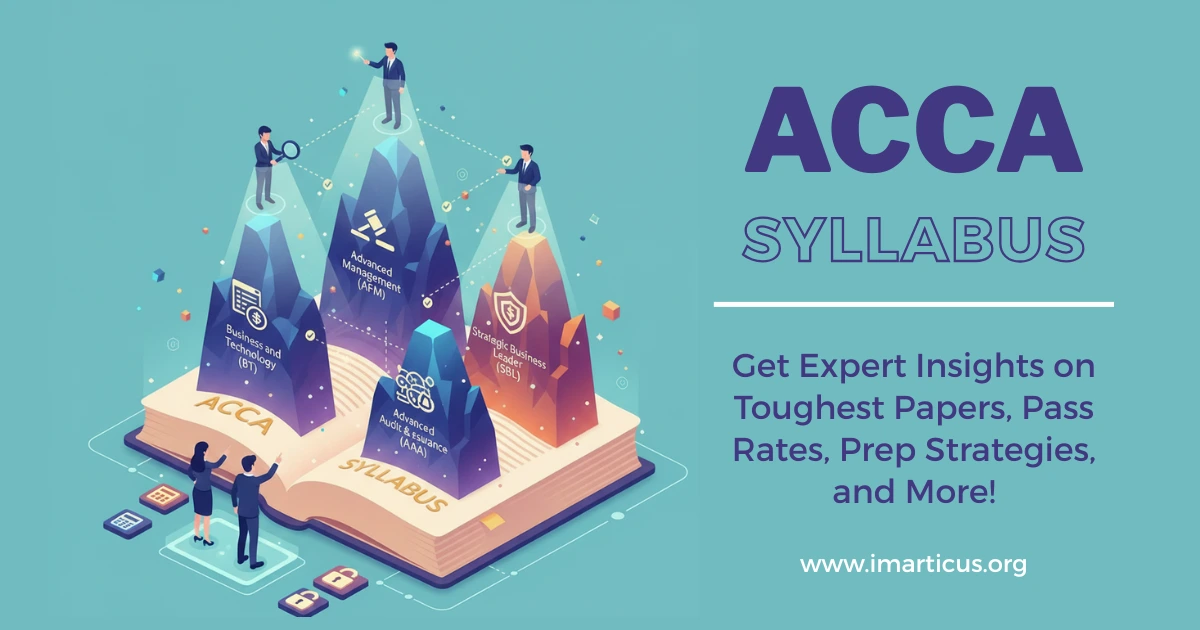
ACCA Course Subjects: Difficulty Levels & Preparation Guide

If you’re thinking of stepping into accounting or finance, the ACCA qualification probably popped up in your research. Makes sense. It’s one of the most recognised credentials in the finance world. But before you begin, it’s totally normal to pause and ask: 

What exactly are the ACCA course subjects?
Which are the hardest ACCA subjects to study?

Which are the toughest ACCA papers?

And how should you plan your preparation?

What exactly am I signing up for?

I’ll cover the entire list of ACCA subjects, break down what each paper is all about, and highlight the ones students typically struggle with. Think of this as your simple, no-jargon roadmap to understand the ACCA structure before you begin your journey.

By the end, you’ll know exactly what you’re signing up for and how to tackle the ACCA syllabus smartly – not stressfully. Let’s get started.


ACCA Course Overview

When I first started exploring the ACCA Certification, the thing that helped me understand it best was this simple idea: ACCA course subjects aren’t a random collection of tough accounting papers – the ACCA syllabus is a carefully designed journey that trains you step-by-step, just like learning a new sport. 

Let me explain.

When you’re learning a sport like cricket or football, nobody hands you the toughest moves on day one. You don’t jump straight into reverse sweeps or bicycle kicks.

You start simple, with the basics.

Once those basics feel natural – when holding the bat doesn’t feel awkward anymore or passing the ball starts to feel instinctive – you slowly step into the fun stuff. You learn the clever techniques, the smart strategies, and eventually you develop that big-match mindset coaches always talk about. 

Professional courses work in the same way. You don’t dive into the advanced stuff on day one. You start with the foundation, get comfortable, and then everything you learn after that starts to click into place. The ACCA difficulty level increases gradually across stages, so you never feel thrown into advanced concepts unprepared.

The ACCA qualification follows the same approach. As you move through each stage, you’ll truly understand what is ACCA and how the entire qualification builds your skills layer by layer. The ACCA course subjects take you from the foundation to the advanced level, so nothing feels overwhelming on day one.

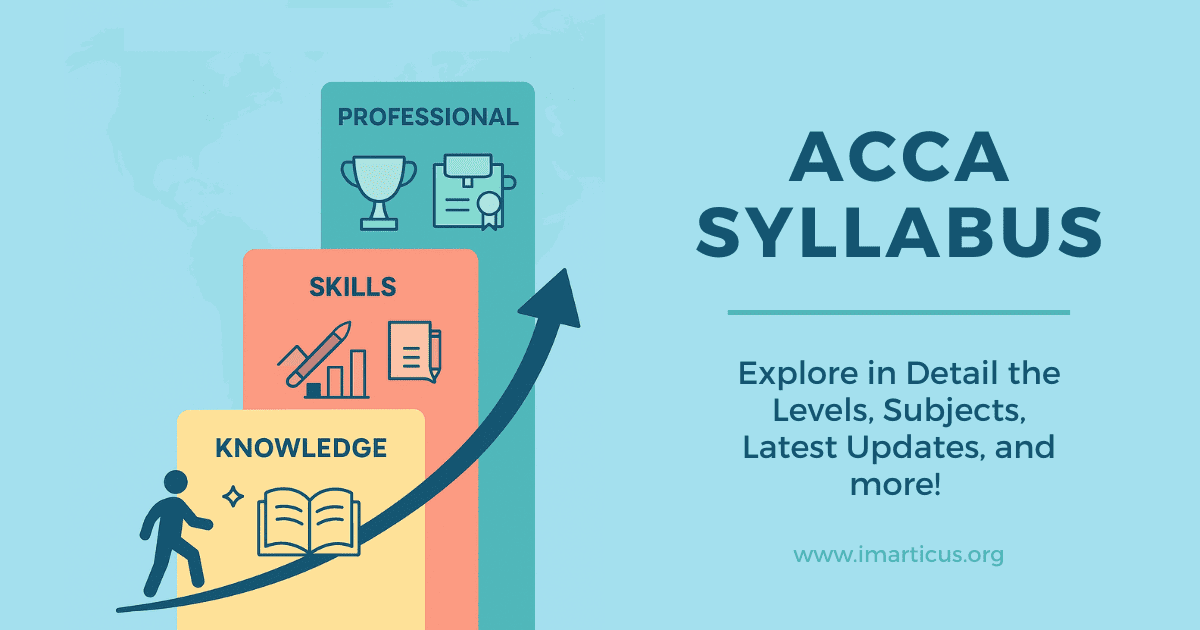
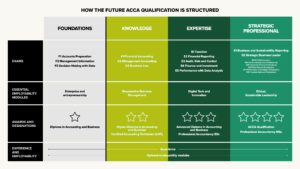
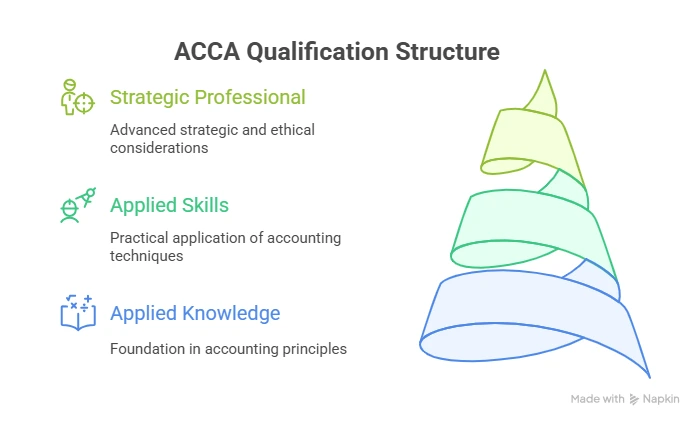
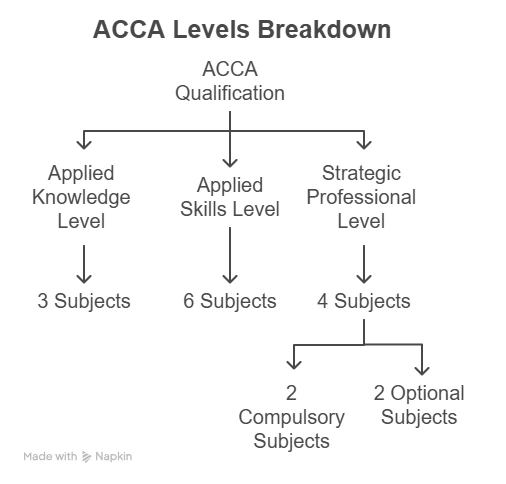
ACCA course subjects are structured into 3 levels – Applied Knowledge, Applied Skills, and Strategic Professional – each designed to build your expertise gradually from basic concepts to advanced financial leadership.

1. Applied Knowledge (Beginner Stage – Like Learning the Basics of a Sport)

This level is your warm-up. Just like you first learn basic drills in a sport, here you learn:

  • How businesses work
  • How accounting functions
  • How numbers tell stories

Nothing too overwhelming – just helping you get comfortable with the fundamentals.

2. Applied Skills (Intermediate Stage – Like Practising Techniques & Game Strategy)

Once you’ve got the basics, ACCA course subjects move you into the real action. This stage is like practising shot selection, field placements, or game strategy.

You’re now handling:

  • Financial reporting
  • Auditing basics
  • Taxation
  • Performance analysis
  • Business law
  • Financial management

These subjects help you understand how finance works in actual companies – not just in theory. For many students, this is the point where the ACCA difficulty level begins to rise because the subjects feel more like real-world finance.

3. Strategic Professional (Advanced Stage – Like Playing Actual Matches)

This is the tournament stage – where you think and perform like a professional. These papers also present unique ACCA exam challenges because they test your ability to think under pressure.

Here, ACCA course subjects tests:

  • Your judgment
  • Your ability to analyse scenarios
  • Your leadership skills
  • Your strategic decision-making
  • Your ability to apply everything you’ve learned

It’s like finally playing competitive matches, where you don’t just execute skills – you read the game, anticipate moves, and make decisions under pressure.


💡 Quick Fact:

ACCA has over 241,000 members and 542,000 future members across 178 countries. This global reach is one of the reasons employers trust ACCA-certified professionals.


What Are ACCA Course Subjects?

When I first started digging into the ACCA qualification, the very first question I had was, “Okay, but what will I actually be studying?” And if that’s the question running through your mind right now, you’re in good company – almost every beginner wonders the same thing.

The ACCA programme is organised into three levels, and each level comes with its own set of subjects – or “papers,” as ACCA officially calls them. The structure is actually quite thoughtful: you start with the fundamentals, slowly build your technical skills, and eventually move into the strategic, big-picture topics that shape real finance decisions.

You begin with the basics, build your skills paper by paper, and eventually reach the stage where you’re thinking like a finance professional who can lead, make decisions, and solve real-world business problems. It’s less about memorising formulas and more about growing into someone who understands how finance really works.

For a clearer understanding of what each ACCA subject covers, here’s the simple breakdown:

ACCA Qualification Structure

The journey is pretty intuitive. Altogether, you will study 13 ACCA course subjects, unless you receive exemptions based on your academic background. Many students also wonder about exemptions at this stage, so understanding ACCA course eligibility becomes important. Once you know your exemptions, it becomes much easier to plan how you’ll move through the remaining ACCA papers without feeling overwhelmed.

This level-wise progression is intentional. The ACCA course slowly shifts you from learning concepts – applying them, using them to solve real business problems like a finance leader. It’s not just about formulas; it’s about understanding how finance truly works in the real world.


💡 Did You Know?

Even though ACCA has 13 subjects, you never study all 13 if you qualify for exemptions. Many B.Com, BBA, MBA, and CA Inter students start directly from the Applied Skills level. To quickly check which papers you are exempt from, try the official ACCA exemptions calculator.


So What Is ACCA Really Preparing You For?

In simple words:

The ACCA course subjects prepare you to think, analyse, and make decisions like a global finance professional.

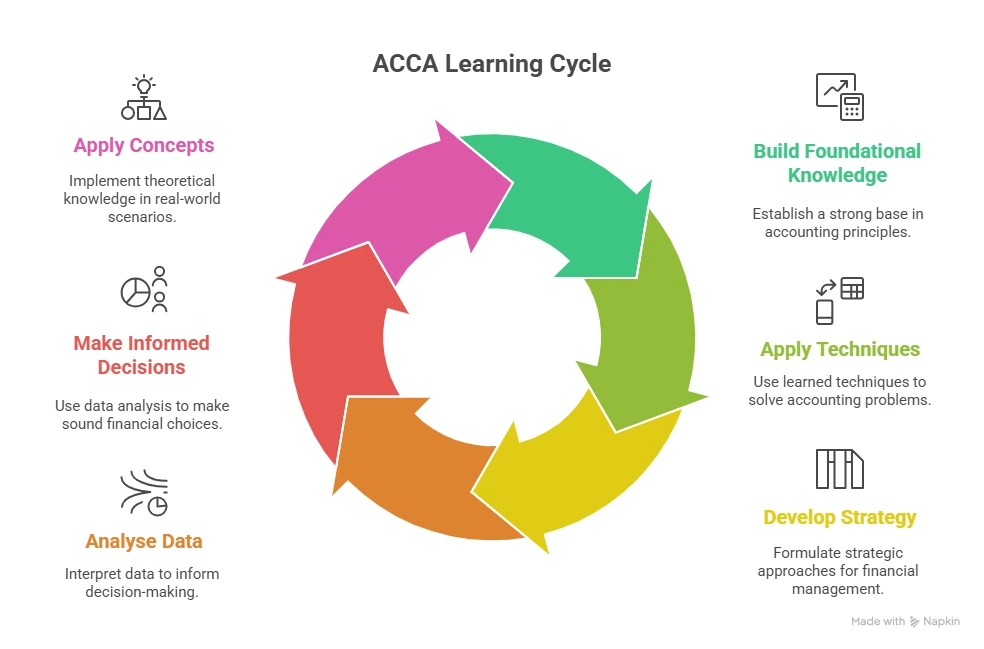
You move from:

Basics → Techniques → Strategy

Data → Decisions

Concepts → Real-world application

And by the time you finish all 13 papers, you’re not just “good at accounting” – you’ll be someone who understands business, risk, performance, leadership, and financial strategy. Once you see how each paper connects, the ACCA difficulty level starts to make a lot more sense.

ACCA Learning Cycle

Just like a trained athlete, you’re ready for the field.


💡 Quick Insight:

Strategic Professional papers are considered the “real ACCA exams.” These determine your ability to think like a finance leader, which is why pass rates drop significantly here.


Still trying to picture how the ACCA journey actually flows? This video gives a clear overview.


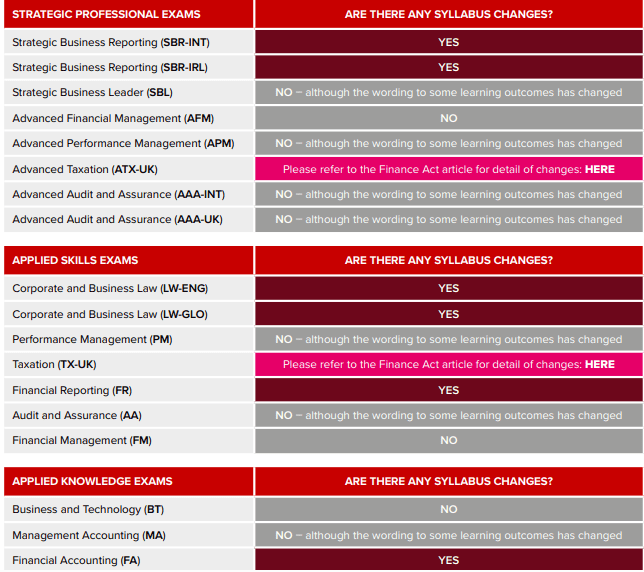
ACCA Course Subjects List (2025)

Let’s walk through the full list of ACCA course subjects, level by level, so you have a clear picture of what you’re signing up for.

  • Applied Knowledge: BT, MA, FA
  • Applied Skills: LW, PM, TX, FR, AA, FM
  • Strategic Professional: SBL, SBR + (AFM /APM / ATX / AAA)
ACCA Levels Breakdown

1. Applied Knowledge Level (Foundation Level)

If you’re just getting started with ACCA, this level is where you build your base. Think of these subjects as the “warm-up” – they introduce you to how businesses function and how accounting really works behind the scenes.

  • Business and Technology (BT)

This one eases you into the world of business. You’ll learn about how companies are structured, how they’re managed, and why ethics and governance matter. It’s a smooth, beginner-friendly start.

  • Management Accounting (MA)

Here’s where things get more practical. MA helps you understand costing, budgeting, and decision-making – basically the skills managers use every day to keep a business running efficiently.

  • Financial Accounting (FA)

This is the heart of accounting. You’ll work with double-entry bookkeeping, financial statements, and the basics of reporting standards. Don’t worry, it starts simple and builds up gradually.

In short, this level helps you get comfortable with two big ideas – how businesses work and how numbers tell their story.

2. Applied Skills Level

Once the basics are sorted, this level pushes you into real-world accounting and finance situations.

  • Corporate and Business Law (LW)

Covers laws that affect businesses – from contracts to company operations.

  • Performance Management (PM)

A mix of calculations and analysis. Expect costing techniques, variance analysis, and performance evaluation.

  • Taxation (TX)

A complete introduction to personal and business taxation and tax planning.

  • Financial Reporting (FR)

You’ll dive deeper into IFRS, financial statement preparation, and consolidations.

  • Audit and Assurance (AA)

Introduces you to how audits work, what auditors look for, and how risks are evaluated.

  • Financial Management (FM)

Covers working capital, investment appraisal, risk management, and financing decisions.

This level is where students realise: “Okay, now it’s feeling like real accounting.” This stage is also where many students begin to see how the ACCA course subjects start connecting with real workplace scenarios.

3. Strategic Professional Level

This is the final stretch – where ACCA turns you into a finance leader who can make decisions, analyse risks, and understand big-picture strategy.

Compulsory Papers

These papers are mandatory for every ACCA candidate and form the core of your strategic and leadership training, and shape the real-world decision-making and reporting skills every future finance leader needs.

Strategic Business Leader (SBL)

A long case-study exam combining ethics, leadership, governance, strategy, and risk.

It’s challenging, but incredibly rewarding.

Strategic Business Reporting (SBR)

Deep dive into IFRS with professional judgment, interpretation, and complex reporting scenarios. It’s one of the ACCA’s toughest papers, mainly because it expects you to apply IFRS, not memorise it.
Tip:
Most students lose marks in SBR because they explain the standard instead of applying it to the scenario. ACCA rewards judgment, not definitions.

Optional PapersPick Any Two

  • Advanced Financial Management (AFM)
  • Advanced Performance Management (APM)
  • Advanced Taxation (ATX)
  • Advanced Audit and Assurance (AAA)

These advanced ACCA course subjects let you specialise in what you enjoy – finance, performance, tax, or audit.

Before moving ahead, having a basic understanding of the ACCA course details can give you better clarity. 


💡 Did you know that the Applied Knowledge exams are fully on-demand – you can take them anytime during the year at an ACCA-approved exam centre.


Which ACCA Course Subjects Are the Most Challenging?

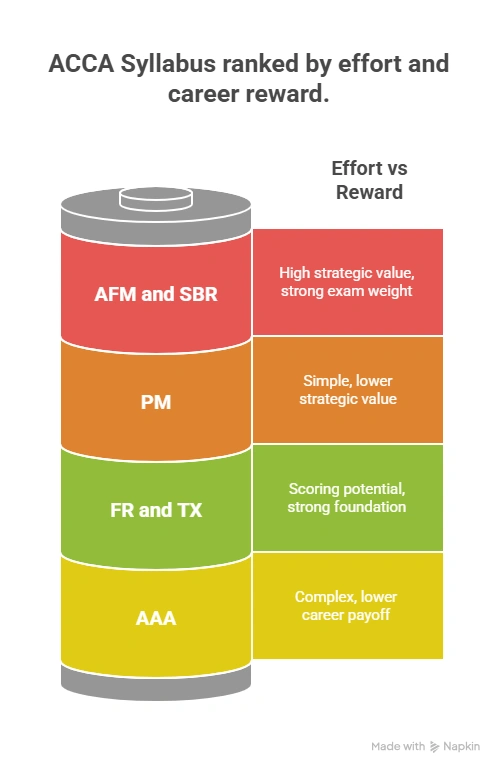
Let’s be honest – certain ACCA course subjects feel a lot heavier than others. Every student has their own strengths, but there are a few papers that consistently show up on the “toughest” list. Based on student feedback and global pass rates, here are the papers that top the “most difficult” list:

Paper CodeSubject NameDifficultyRecent Global Pass Rate
SBRStrategic Business Reporting★★★★★~47%
AFMAdvanced Financial Management★★★★★~41%
AAAAdvanced Audit & Assurance★★★★★~33%
SBLStrategic Business Leader★★★★☆~51%
FRFinancial Reporting★★★★☆~49%
TX (UK)Taxation (UK Variant)★★★☆☆~51%

Source – ACCA pass rate insights show a clear pattern – the more application-based a paper is, the lower the pass rate tends to be.

Understanding which are the challenging ACCA subjects gives you a head start on planning your study strategy.

1. Strategic Business Reporting (SBR)

SBR tests how well you can apply IFRS – not just recall it. You’ll need strong judgment and clear explanations.

Why it’s tough:

  • Heavy application of IFRS.
  • Requires clear writing and justification.
  • Case-based and judgment-driven.

Recommended preparation strategy:

  • Practice writing clear, structured explanations.
  • Use the ACCA Technical Articles for IFRS application.
  • Focus on scenario-based questions, not mugging standards.
  • Attempt timed mock exams regularly.

SBR Exam Guide

2. Advanced Financial Management (AFM)

Concept-heavy and packed with calculations, AFM pushes your understanding of financial strategy under time pressure. AFM is often listed among the hardest ACCA subjects because it combines heavy calculations with strategic decision-making.

Why it’s tough:

  • Calculation-heavy.
  • Complex financial strategy.
  • Time pressure is intense.

Recommended preparation strategy:

  • Solve calculation-heavy questions daily.
  • Build strong fundamentals of NPV, risk, forex, and derivatives.
  • Memorise key formulas and learn shortcuts.
  • Use past papers to improve speed and accuracy.

AFM Exam Guide

3. Advanced Audit & Assurance (AAA)

A highly scenario-driven paper where you’re expected to think like a professional auditor. AAA is also considered one of the hardest ACCA subjects due to how deeply it tests audit judgment.

Why it’s tough:

  • Deep scenario analysis.
  • Requires professional audit thinking.
  • One of ACCA’s lowest pass rates.

Recommended preparation strategy:

  • Study examiner reports to understand common mistakes.
  • Practice identifying risks, procedures, and audit issues.
  • Follow a structured approach to long-form answers.
  • Focus on professional scepticism and tone in responses.

AAA Exam Guide

4. Strategic Business Leader (SBL)

SBL is unique – A long, integrated case-study exam that tests leadership, strategy, governance, and communication in one place.

Why it’s tough:

  • Very long case-study format.
  • Heavy integration of multiple topics.
  • Time management is half the battle.

Recommended preparation strategy:

  • Practice mock ACCA exams to build stamina.
  • Practice writing reports and memos in a professional style.
  • Use a timed reading-and-planning approach.
  • Strengthen knowledge of ethics, governance, and strategy.

SBL Exam Guide

5. Financial Reporting (FR)

FR builds your foundation in financial statements, standards, and interpretation. Many students find the volume of IFRS concepts challenging at first.
Why it’s tough:

  • Broad coverage of IFRS fundamentals.
  • Mix of theory + calculations.
  • Requires strong conceptual clarity.

Recommended preparation strategy:

  • Solve consolidation questions repeatedly.
  • Make summary notes for each standard.
  • Focus on understanding, not memorising.
  • Work through MCQs to reinforce theory.

FR Exam Guide

6. Taxation – UK Variant (TX-UK)

TX covers UK tax rules, computations, and application. While not as intense as AFM or AAA, the sheer content and frequent rule changes make it tricky.
Why it’s tough:

  • High volume of tax rules and exceptions.
  • Requires accuracy in computations.
  • Easy to lose marks due to small mistakes.

Recommended preparation strategy:

  • Create quick-reference tax tables for revision.
  • Practice computational questions daily.
  • Memorise allowances, limits, and exemptions early.
  • Use revision kits to learn common question patterns.

TX UK Exam Guide

SBR, AFM, AAA, and SBL consistently rank among the ACCA toughest papers because they require deeper analysis, judgment, structured writing, heavy application, complex scenarios and have a lower global pass rate. Lower pass rates usually indicate papers that require more application, judgment, and clear written communication. 

Tip: These papers aren’t “impossible.” They just demand consistency, lots of practice with past papers, and a clear strategy. With the right preparation, you can absolutely crack them.


💡 Latest ACCA Exam Insight:

Professional-level papers like AAA and AFM tend to have the lowest pass rates globally because they test analysis, judgement, and written communication – not just technical knowledge.


Why Do Some ACCA Subjects Feel Harder Than Others?

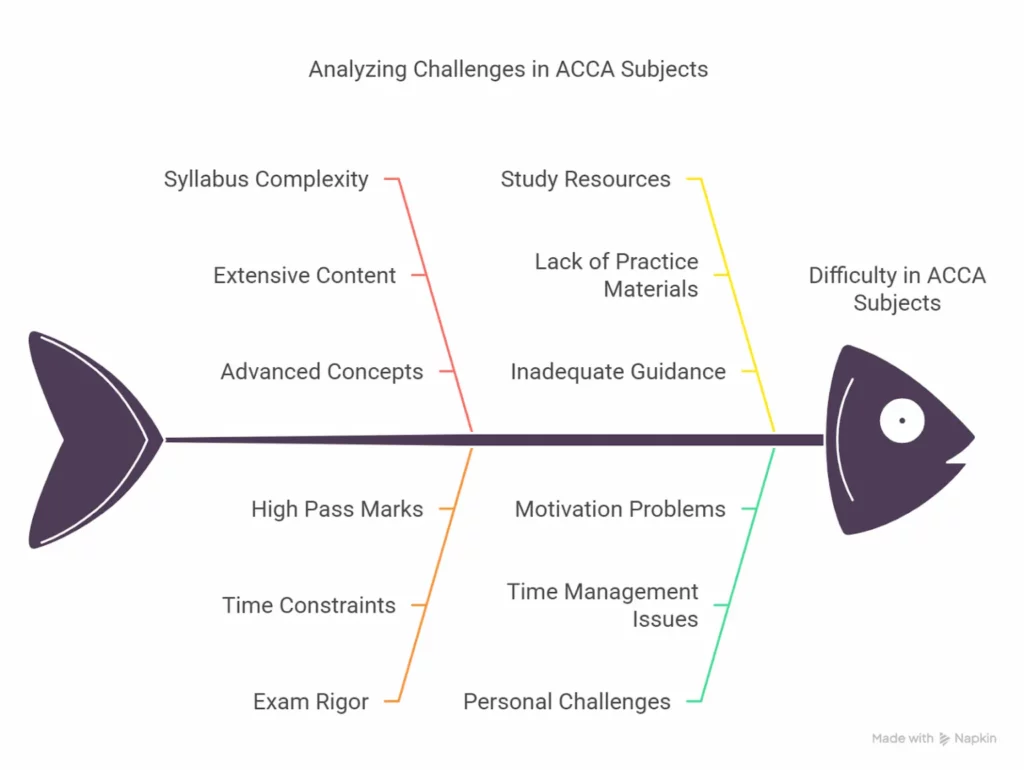
The hardest ACCA subjects are usually the ones that require you to apply concepts, not simply recall them. Some ACCA course subjects and papers feel tougher simply because they demand more depth, more application, and a lot more mental stamina than the rest, and they expect you to think like a professional, not just a student. 

If you look at ACCA pass rate insights, papers like AAA and AFM consistently rank on the lower side due to high judgment requirements. Time pressure and scenario-based questions are some of the biggest ACCA exam challenges students face. 

A few reasons why the difficulty spikes:

  • Some papers have very large syllabi.
  • Professional-level subjects are mostly application-based, not theory-based.
  • Questions are entirely scenario-based; you must apply concepts, not memorise them.
  • If your basics in FR, AA, or FM are weak, the advanced versions feel tougher.
  • Working professionals often struggle with time.
  • Scenario-based questions require structured, clear, and professional writing with quick thinking.

But with the right preparation strategy, even the hardest papers become manageable. The key is to understand what each of the ACCA course subjects expects from you, so you can tailor your preparation instead of studying everything with the same intensity.


💡 Did You Know?

The Applied Skills papers follow a computer-based exam format, with a mix of MCQs, scenario-based questions, and longer constructed responses – a big shift from the foundation level.


Here’s a video that gives a clear walkthrough of the ACCA syllabus and shows how you can structure your preparation for success:


How to Prepare for the Toughest ACCA Course Subjects?

If there’s one thing I’ve learned from students who crack the hardest ACCA course subjects and papers, it’s this: you don’t need to study more – you need to study smarter. Here’s what successful candidates who clear the ACCA Exam usually do:

Start with the syllabus

Know what’s important and what’s not. Begin with a thorough review of the syllabus to focus on exam-relevant topics.

Solve past papers – lots of them

ACCA repeats concepts, not questions. Practice extensively with past papers to familiarise yourself with question patterns.

Read examiner reports

Study examiner reports to understand common pitfalls. They literally tell you why students fail. 

Practice under timed conditions

Time your practice sessions, especially for SBL and AFM, due to their time-intensive nature. This helps reduce one of the most common ACCA exam challenges – running out of time during long scenario questions.

Build strong foundations

Strengthen foundational subjects like FR, FM, and AA to support advanced papers – SBR, AFM, and AAA.

Keep your answers structured

Maintain clear, well-structured answers favoured by examiners. ACCA examiners love well-organised, logical responses.

What is the Best Order to Attempt ACCA Course Subjects?

Here’s a smooth, balanced sequence to attempt ACCA course subjects:

Start with Applied Knowledge:

BT → MA → FA

Then move to Applied Skills:

LW → FR → FM → PM → TX → AA

Finish with Strategic Professional:

SBR → SBL → (AFM / AAA / APM / ATX)

Smart Tip: It’s advised to avoid attempting more than one professional-level paper simultaneously unless you have ample study time.


Here’s a video that walks through the exam pattern for ACCA and what to expect when preparing for the more challenging papers:


The Imarticus Advantage: A Better Way to Learn ACCA Course Subjects

Let’s be honest – ACCA can feel overwhelming at times. Many students start worrying early about the ACCA toughest papers, especially when they hear about how demanding the Strategic Professional stage can be. That’s exactly why having the right support system matters. Imarticus Learning is built around one goal: helping you understand the ACCA course subjects in a way that actually makes sense, and guiding you all the way to exam-day confidence.

Here’s what makes learning ACCA course subjects with Imarticus feel different:

✅ Only ACCA-Approved Prep Provider With a Gold Standard Teaching Model

Imarticus isn’t just authorised – it’s recognised by ACCA for delivering high-quality training. This gives you structured learning, internationally aligned study material, and a teaching approach vetted by ACCA itself.

✅ Mentors Who Make Tough Concepts Easy

To help students handle some of the hardest ACCA subjects, Imarticus offers guided learning and structured preparation. You learn from faculty who’ve actually worked in the industry and know how to break things down so they’re easier to grasp – especially the trickier papers. 

✅ A Clear, Step-by-Step Learning Path

No more wondering what to study next. The program takes you from the basics to the advanced levels of ACCA course subjects smoothly, so you always feel in control of your progress.

✅ Real-Time Support Whenever You’re Stuck

Whether it’s a late-night doubt or a tricky IFRS concept, you get support through live classes, Q&A sessions, and doubt-solving channels.

✅ Training That Mirrors the Real Exam

You’ll practice with past papers, mock exams, and exam-style questions, so by the time you sit for your paper, nothing feels unfamiliar.

✅ Placement Assistance + Job Guarantee/Money-Back Options

As one of the few ACCA partners offering 100% Job Guarantee programmes, Imarticus prepares you for interviews, builds your resume, connects you with industry recruiters, and supports your transition into high-demand finance roles.

In short, Imarticus doesn’t just teach you the ACCA course subjects – they walk with you through the entire journey, making it smoother, more structured, and a lot less stressful.


FAQs About ACCA Course Subjects

Still have a few questions on your mind about ACCA course subjects? Here are a few frequently asked questions about the doubts almost every ACCA beginner has:

How many ACCA subjects are there?

There are 13 ACCA subjects in total before exemptions come into play. Each one builds your skills step by step – from basics to advanced finance concepts. When you train with Imarticus Learning, you also get clear guidance on how to navigate them smoothly.

What are the 13 subjects in ACCA?

ACCA comes with a total of 13 papers, and they’re split across three levels that you progress through step by step.

Applied Knowledge: BT, MA, FA

These are your basics – the foundation of everything you’ll learn next.

Applied Skills: LW, PM, TX, FR, AA, FM

Here’s where things start feeling “real,” with subjects that connect directly to day-to-day finance roles.

Strategic Professional: SBL, SBR + any two of AFM, APM, ATX, AAA.
At this stage, you learn to think like a finance leader.

Which is the hardest subject in ACCA?

Papers like SBR, AAA, AFM, and SBL are widely considered the toughest among the ACCA course subjects because they’re application-heavy and require strong judgment, clear writing, and real-world problem-solving. These papers also tend to have lower global pass rates. Many students at Imarticus Learning find that structured guidance and expert faculty make a big difference when preparing for these challenging subjects.

Do I need to complete the subjects in order?

You generally follow the ACCA structure level by level, but within the Applied Skills stage, you can mix ACCA course subjects based on what feels comfortable. Many students choose an order that plays to their strengths. Imarticus Learning helps you plan the smartest sequence so you don’t feel overwhelmed.

Are the Strategic Professional papers very difficult?

These papers are definitely more challenging and represent the highest ACCA difficulty level because they rely heavily on applying concepts from earlier ACCA course subjects. However, with consistent practice, solid concepts, and smart exam technique, they’re completely achievable. Learners at Imarticus Learning often clear these papers successfully thanks to expert faculty, structured coaching, and guided practice.

Can working professionals clear ACCA?

Absolutely, thousands of working professionals complete ACCA every year. It just takes good time management and a study plan that fits your routine. Balancing work and study becomes one of the major ACCA exam challenges, which is why flexible learning support matters. Many learners at Imarticus Learning balance their jobs and ACCA preparation successfully with flexible support.

Do I get exemptions in ACCA?

Yes, many qualifications like B.Com, CA, and MBA can make you eligible for exemptions from certain ACCA course subjects. ACCA looks at your academic background and clearly tells you which papers you can skip, so you don’t waste time studying topics you already qualify for. And if you’re not sure where you stand, Imarticus Learning makes the process super simple by helping you check your exemption status and plan the remaining ACCA papers you need to finish.

What is the ACCA pass rate?

Pass rates vary by level, but most subjects fall in the 45%-55% range. Foundation papers usually see higher pass rates, while advanced papers like AAA, AFM, and SBR often hover between 35%-50% due to their difficulty. These ACCA pass rate insights help students understand which papers require deeper, more deliberate preparation.


Your Path to Cracking the ACCA Course Subjects

Every ACCA student has that moment of doubt: “Can I really clear all these papers?”

The truth is – yes, you absolutely can. 

Cracking the ACCA exam isn’t just about studying hard – it’s about studying smart. The ACCA course subjects are designed to build your skills gradually to help you grow from basic accounting knowledge to advanced strategic thinking. 

With steady practice, the right guidance, and a bit of consistency, you’ll notice yourself moving through each level with more clarity and confidence – and before you know it, the whole ACCA journey starts to feel far more manageable, maybe even enjoyable.

When you combine the ACCA pass rate insights with a smart study plan, the entire qualification becomes far more approachable. Are you ready to leap? Start your ACCA Certification preparation with the right support and set yourself up for success.

ACCA Course Eligibility 2025: Who Can Apply and Exemptions

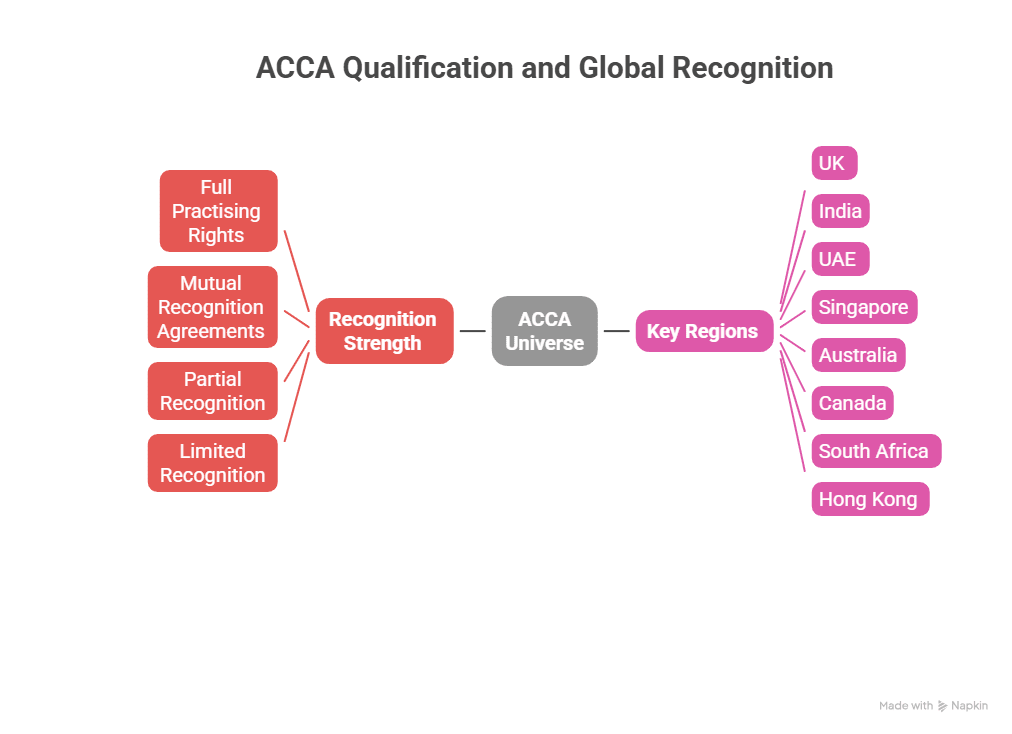
The Association of Chartered Certified Accountants (ACCA) opens the gateway to a global accounting career – a qualification recognised in over 180 countries that equips finance professionals and aspirants alike with the tools to excel in auditing, taxation, management accounting, and financial consultancy. 

And yet: before you jump in, one question looms –
Am I eligible?
And can my current degree help me skip a few steps?

Good question, because the answer could help you save both time and money. That’s exactly what we’ll walk you through today: eligibility, exemptions, and how to map your path.

Whether you’re a Class 12 student aspiring to become a global finance professional or a working accountant wanting to expand your international credentials, understanding ACCA course eligibility and its exemptions can dramatically shape your journey.


What is ACCA? 

If you are still wondering what is ACCA? The Association of Chartered Certified Accountants (ACCA) qualification is a globally respected and recognised qualification that equips you for roles in accounting, audit, taxation, management, and financial consultancy.

You can think of ACCA as your global accounting passport. ACCA is offered by the UK-based Association of Chartered Certified Accountants. It has built a syllabus that spans across three levels: Applied Knowledge → Applied Skills → Strategic Professional.

The table below shows a comprehensive overview of the ACCA subject list:

LevelFocus AreaPapers / Modules
Applied KnowledgeBasics of Finance & BusinessBusiness & Technology (BT), Management Accounting (MA), Financial Accounting (FA)
Applied SkillsTechnical & Analytical Finance skillsCorporate & Business Law (LW), Performance Management (PM), Taxation (TX), Financial Reporting (FR), Audit & Assurance (AA), Financial Management (FM)
Strategic ProfessionalAdvanced Strategy, Leadership & SpecialisationEssentials: Strategic Business Leader (SBL), Strategic Business Reporting (SBR); Optional (Choose 2): Advanced Financial Management (AFM), Advanced Performance Management (APM), Advanced Taxation (ATX), Advanced Audit and Assurance (AAA)

The ACCA course syllabus covers core areas like finance, taxation, management accounting, and auditing – ensuring well-rounded professional expertise.

Each level builds your technical base, professional insight, and strategic decision-making ability, culminating in a globally recognised credential that commands premium positions in multinational corporations and Big Four firms alike.

The program’s global structure and industry alignment make it highly sought-after in regions like India, the UAE, Singapore, the UK, and other financial hubs.

Here’s a detailed video guide to help you understand what ACCA is and how to map your career path:

Why ACCA Stands Out

  • Recognised in 180+ countries
  • Over 800,000 members and future members globally
  • Endorsed by 7600+ approved employers
  • Offers flexible study modes (full-time, part-time, online)
  • Delivers strong ROI and excellent placement opportunities

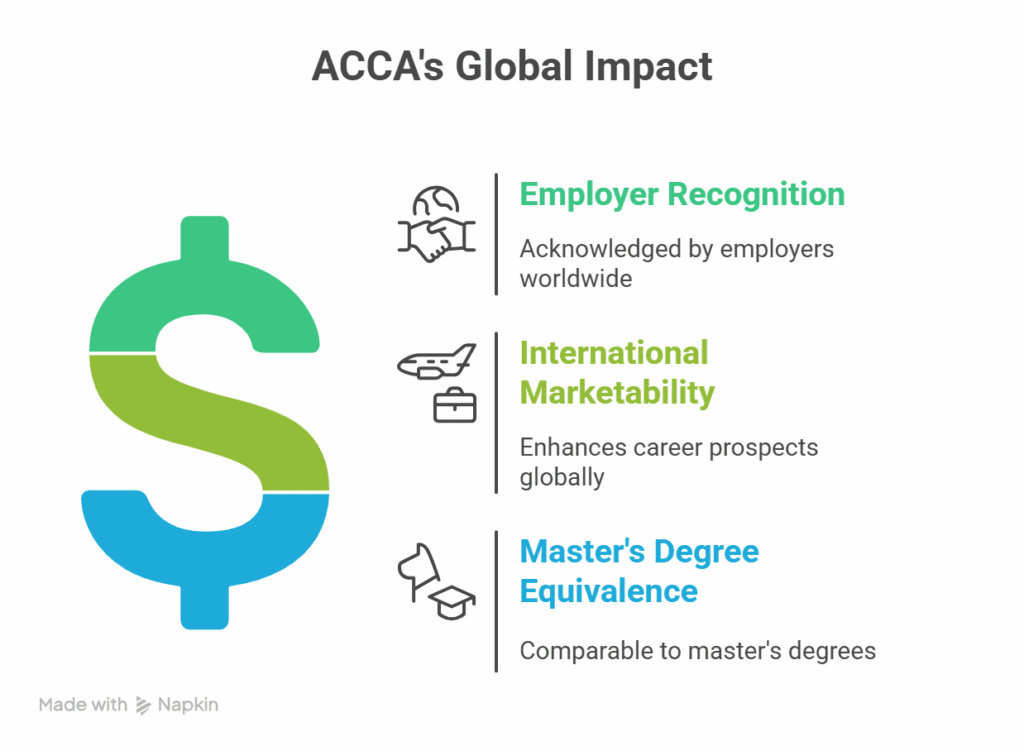
ACCA distinguishes itself not just as a qualification but as a career accelerator – a passport to international career mobility and financial leadership.

So if you’re thinking, “I want to build a finance or accounting career that isn’t restricted to India”, ACCA becomes a smart choice. 


Why Choose ACCA in 2025?

The world of finance is borderless. With ACCA, you’re not just limited to one country, but have:

  • Global recognition, enabling cross-border job opportunities.
  • The ability to leverage your prior qualifications – any degree or diploma is not wasted, but becomes your leverage for faster progress.
  • With ACCA, you get the flexibility to work across industries like audit, consulting, corporate finance, taxation, and risk management.
acca course career benefits

Who Can Apply for ACCA? 

The ACCA qualification requirements are designed to ensure students have a strong grasp of business, accounting, and finance fundamentals before progressing to advanced strategic papers.

Anyone passionate about unlocking career potential in finance or accounting can apply for ACCA, provided they meet basic educational standards. ACCA eligibility in India depends on your educational background and work experience. Here’s where it gets interesting – your past education and experience matter, because they determine your starting point and options for exemptions.

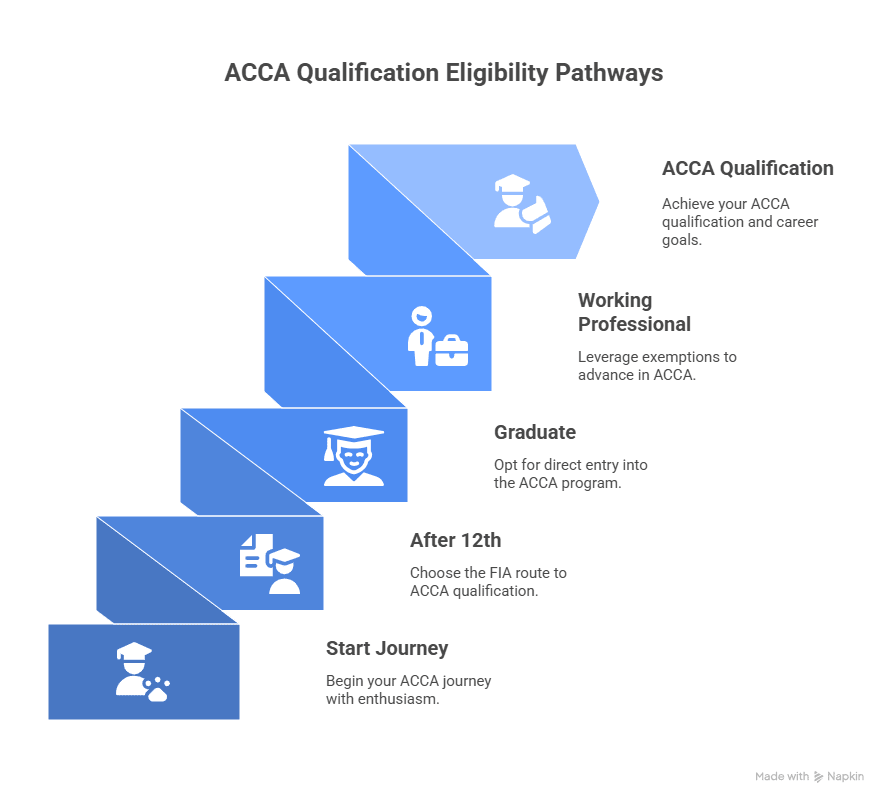
ACCA Eligibility After 12th Commerce

Pursuing ACCA after 12th is one of the best ways to start early and build a strong international accounting foundation. If you’ve finished 10+2 (Class 12), you can kick off your ACCA journey—here’s what you need to meet the eligibility requirements:

  • Maths or Accounts as a subject
  • English proficiency
  • 65% marks in Maths/Accounts and 50% marks in other subjects

Pro Tip: If you have completed the 10th grade or do not meet the marks requirements or are a Non-commerce student, you may need to start with the Foundations in Accountancy (FIA) route before progressing to the full ACCA qualification.

Once you complete this, you can smoothly transition into the full ACCA qualification.

This flexibility is what makes ACCA truly global – it adapts to your educational background rather than restricting you.


If you are a BCom graduate looking to leverage your career with ACCA, this video will help you with a clear approach:


ACCA Eligibility After Graduation or Post-Graduation

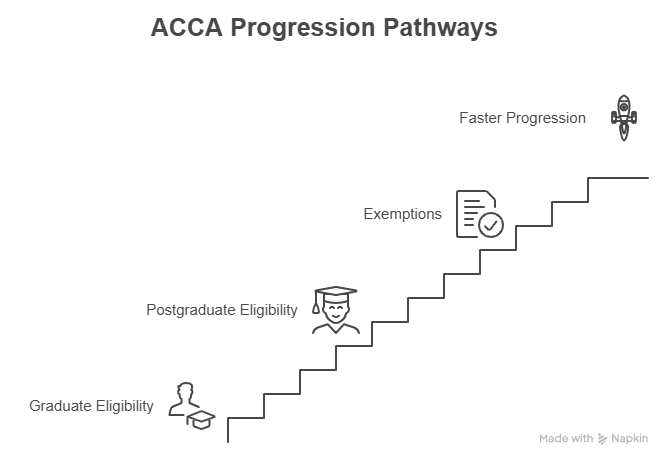
If you’re considering ACCA after graduation, your degree gives you a major advantage – allowing for possible exemptions and faster progression.

acca course eligibility pathway


Choosing ACCA after graduation or post-graduation helps you save time since your academic background often qualifies you for exemptions from foundational papers.

ACCA also offers exemptions for candidates who have cleared the CA intermediate or IPCC exams.

ACCA Eligibility for Working Professionals

Professionals with experience in finance or accounting can apply for ACCA, leveraging both their academic qualifications and work experience to accelerate the path. Individuals with finance or commerce experience are equally eligible.


Qualifications-wise Eligibility and Exemptions Overview

The ACCA Exemptions system allows candidates to bypass certain exam papers based on prior qualifications, making it possible to save time and effort while progressing through the ACCA qualification.

Candidate TypeEligibility RequirementsPathwayExemptions Available
Class 12 (Commerce)65% in Maths/Accounts and English; 50% in other subjectsDirect ACCA registrationNone (must attempt all papers)
Class 12 (Non-Commerce)Completed Class 12, may lack commerce subjectsStart with the Foundations in Accountancy (FIA) routeExemptions start post-FIA
Graduate (Commerce/Finance)Bachelor’s in relevant fields (B.Com, BBA, BA Hons)Direct ACCA registration with exemptionsTypically, 4-6 papers are exempted
Postgraduate (Finance)CA Inter, M.Com, MBA FinanceDirect registration with more exemptionsUp to 6 papers
Working ProfessionalsRelevant academic qualifications + work experienceAccelerated entry possibleVaried by qualification

ACCA Exemptions Explained (India 2025)

Here’s the good part: ACCA Exemptions in India mean you don’t have to sit certain ACCA exams. If you’ve already covered some ground, you might skip certain papers because your previous qualification covers similar content. It saves time, effort, and cost.

QualificationExemptions Available (up to)
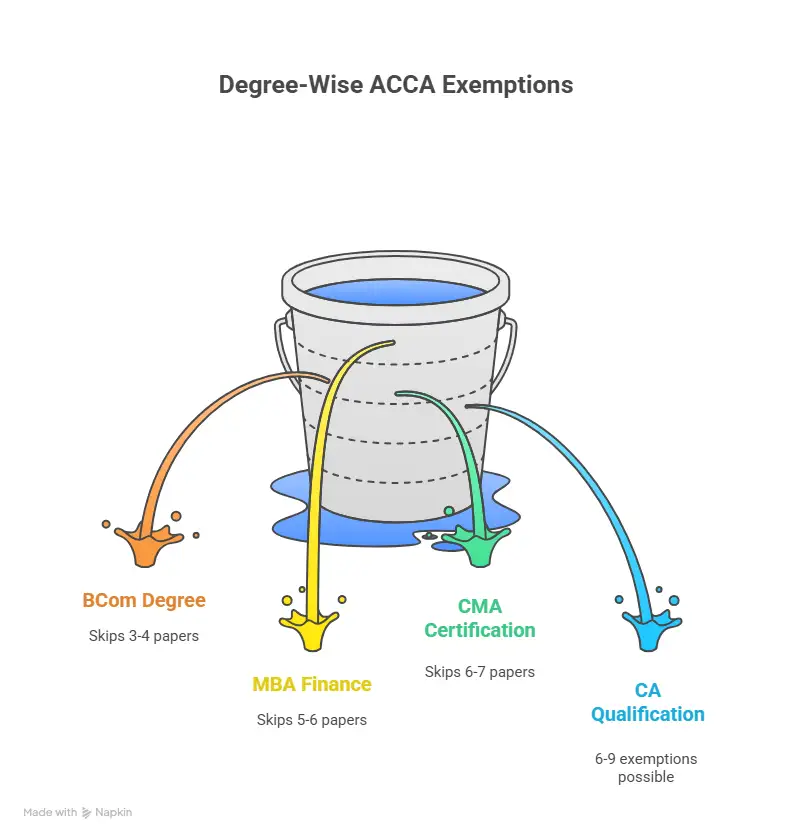
B.Com / BBA (Finance)4 papers in Applied Knowledge & Skills
MBA (Finance) / M.Com6 papers
CA Inter / IPCC5 papers
Chartered Accountant (India)9 papers
CMA / CPA / CIMAVaries based on issuing body and syllabus match

Remember: All exemptions are subject to ACCA UK’s verification through its official exemption calculator, and documentation (transcripts, degree certificates) must be uploaded for review.


How to Apply for ACCA Exemptions

The ACCA exemption process is designed to be convenient and transparent:
Here’s the step-by-step:

  1. Visit the official ACCA Exemption Calculator on the ACCA Global website. 
  2. Enter your qualification details to check available exemptions. 
  3. Upload academic certificates, mark sheets, or professional credentials. 
  4. Await confirmation and an official exemption offer from ACCA.

Once approved, you can begin your ACCA journey directly from the next eligible paper- skipping earlier modules you have already covered in your studies.

Tip: Keep your documents ready (transcripts, mark-sheets) so you don’t delay this step.

Are you a qualified CA, wishing to pursue ACCA? This video will give you a brief overview:


ACCA Course Duration and Fees: Exam Pattern Explained

Before planning your timeline, get familiar with the ACCA course syllabus so you can prioritise subjects and leverage exemptions smartly.
When diving into the ACCA journey, it’s important to understand the ACCA course duration and fees clearly – this helps you plan well and budget effectively. The ACCA qualification involves a total of 13 papers spread across three different levels: Applied Knowledge, Applied Skills, and Strategic Professional. Typically, most students finish this journey in about 2 to 3 years, but if you’re eligible for exemptions because of previous qualifications, this duration can be significantly shorter.

  • Number of Exams: 13 papers in total across three levels (Applied Knowledge, Applied Skills, Strategic Professional)
  • Duration: Average completion time varies from 2 to 3 years, shortenable via exemptions.
  • Exam Pattern: Computer-based with quarterly exam sessions worldwide.
  • Passing Marks: 50% per paper required to pass.

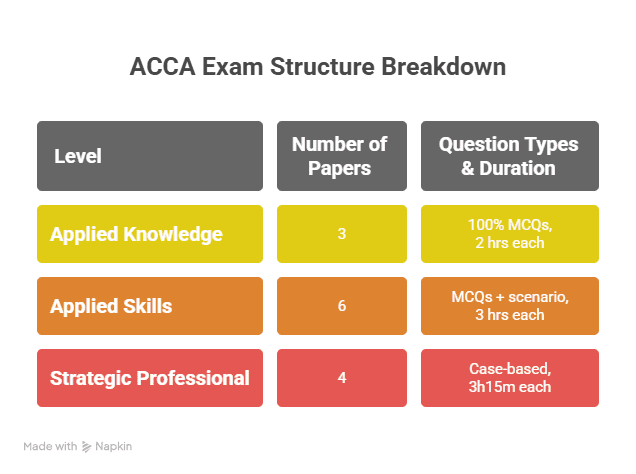
Here’s a detailed breakdown of the levels, how many papers each has, the exam duration, format, and passing marks:

LevelNumber of PapersExam DurationFormatPassing Mark
Applied Knowledge32 hours eachMultiple Choice Questions (MCQs)50%
Applied Skills62 – 3 hours eachMix of Objective & Written Answers50%
Strategic Professional4 (2 compulsory + 2 options)3 – 4 hoursCase Studies, Essays, Reports50%

Did you know?
Your degree becomes a springboard to reach higher ACCA levels faster.


Fast-track ACCA Options for Graduates and Professionals

Understanding ACCA exemptions in India helps you fast-track your qualification, reduce costs, and start working sooner. Exemptions aren’t just about skipping exams – they’re about accelerating your career. For example, a B.Com graduate can fast-track their ACCA journey significantly:

  • Without exemptions – 13 exams (approx. 3 years)
  • With exemptions – As few as 9 exams (can finish in just 1.5 – 2 years)

The ACCA Exemption Calculator, available on the official ACCA website, is the definitive tool to determine exact exemptions based on your individual qualifications. It compares your prior academic or professional credentials against the ACCA syllabus to identify courses you can skip. This is highly recommended before registration to optimise your study plan and reduce exam load.

This acceleration saves substantial time and reduces tuition and exam costs – ideal for students eager to enter the job market early or professionals aiming for rapid advancement.

Candidate CategoryNumber of ExamsApproximate DurationRemarks
Without Exemptions133 yearsFull syllabus
With Exemptions (B.Com)Around 91.5 – 2 yearsLeverages prior qualifications
CA Qualified CandidatesAround 41 – 1.5 yearsMaximum number of exemptions

If you are confused between going for a postgraduate commerce degree or ACCA, this video will demystify your career path:


Global Career Advantages of Becoming an ACCA

Once qualified, ACCA members enjoy numerous professional advantages that go beyond a single country or region.

Global Mobility

As an international qualification, ACCA allows easy transition between continents for roles across auditing, consulting, taxation, or finance management.

High-Value Designations

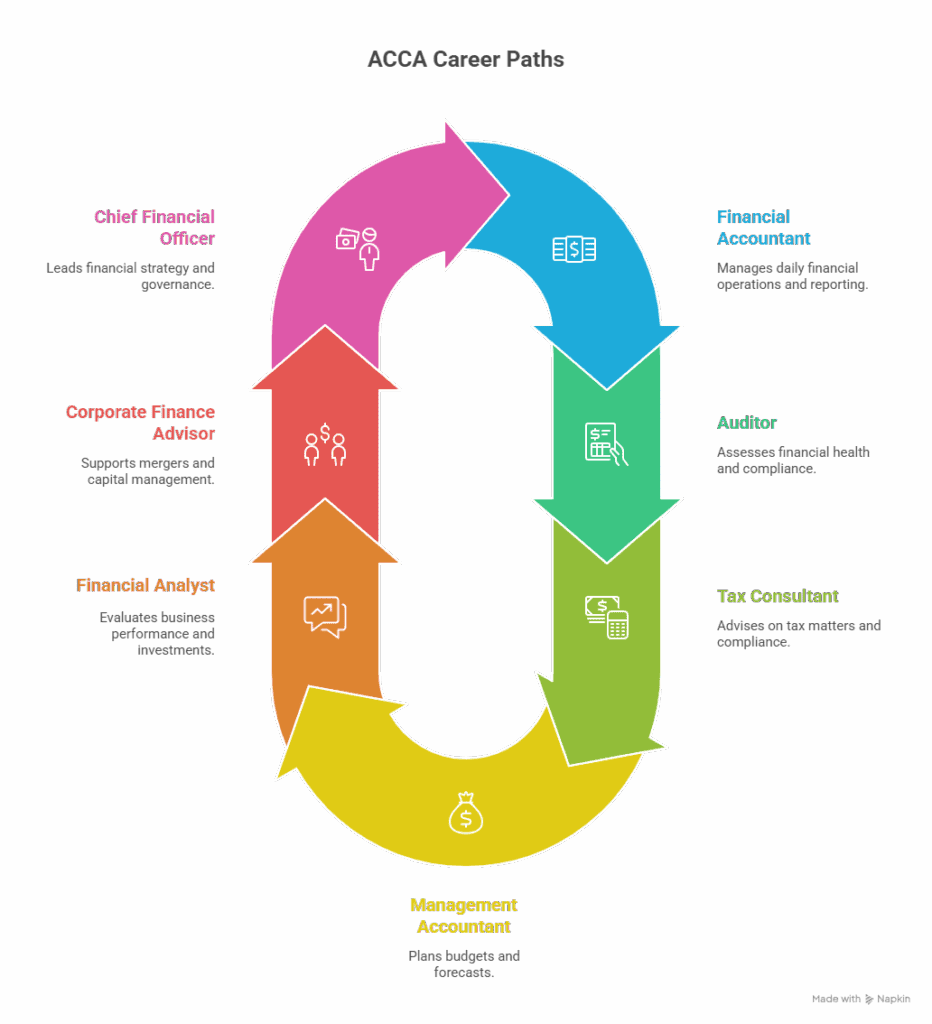
ACCA professionals can work as Auditors, Controllers, Tax Advisors, Management Accountants, or Financial Consultants with global firms like Deloitte, PwC, EY, and KPMG.

Salary Leverage

Their earning potential surpasses local norms – thanks to global acceptance and cross-border career options. ACCA professionals earn competitive packages starting from ₹7-10 LPA in India, scaling higher globally depending on experience.

Career Flexibility

You can switch seamlessly between industries – finance, fintech, consulting, or corporate strategy because ACCA builds both analytical and management proficiency.

Professional Prestige

Being an ACCA member connects you to a network of finance leaders and influencers, reinforcing your credibility wherever you work.


Why Choose Imarticus for ACCA in 2025

Partnering with Imarticus Learning, an official ACCA learning facilitator, can elevate your ACCA preparation experience with structured mentorship, global content, and assured outcomes.

Key Advantages of ACCA with Imarticus:

  • Guaranteed placement after completing two ACCA levels.
  • No-limit passing guarantee with free reappear sessions.
  • Pre-placement bootcamps and interview preparation for job readiness.
  • Simulation-based global curriculum
  • Dual certification: ACCA + QPA (Qualified Professional Accountant)
  • Course content powered by Kaplan – an ACCA Gold Approved Learning Partner

This combination of international curriculum and domestic career support ensures you emerge with both technical skills and practical employability.

Are you confused between pursuing an MBA and ACCA for accelerated career growth? This video will guide you to understand which career is the best for you:


How an Accounting Degree Strengthens Your ACCA Journey

Holding a degree in commerce, business, or finance is an enormous advantage because it creates overlap with ACCA’s foundational papers. This overlap results in:

  • Recognition of prior learning reduces study load.
  • Exemption from foundational papers cuts time and cost.
  • Early exposure to advanced strategic modules sharpens career readiness.
  • Employers value your combined academic and professional training.

Essentially, it means your academic background empowers you to skip redundancy and focus on higher-value skill-building.


FAQs on ACCA Course Eligibility

Before wrapping up, let’s clear up a few frequently asked questions about ACCA course eligibility in India that students have. 

Who is eligible for the ACCA degree?

Anyone who has passed Class 12 with the required marks in Maths or Accounts, and English can apply for ACCA. Graduates, postgraduates, and even professionals from commerce or non-commerce backgrounds are also eligible, though your entry level and ACCA exemptions in India will depend on your previous qualifications.

What qualifications do I need for ACCA?

Before applying, it’s essential to understand the ACCA qualification requirements, which vary depending on your academic background and experience. To start ACCA, you need to have completed Class 12 with at least 65% marks in Maths/Accounts and English, plus 50% in other subjects. If you don’t meet these requirements, you can begin with the Foundations in Accountancy (FIA) levels and then transition to ACCA.

How many levels are there in ACCA?

The ACCA course syllabus is structured into three key levels: Applied Knowledge, Applied Skills, and Strategic Professional. Each level progressively builds your technical knowledge and leadership capabilities to prepare you for senior finance roles, making it ideal for those planning ACCA after graduation or even while pursuing a commerce degree.

Can commerce graduates apply directly?

Yes, commerce graduates like B.Com or BBA holders can apply directly and are often eligible for ACCA exemptions in India from foundational ACCA papers. This allows them to fast-track their studies and benefit from a shorter ACCA course duration and fees compared to starting from the foundation level.

Is there an age limit?

The minimum age limit to enrol in ACCA in India is typically 16 years, but most students join after completing Class 12 when they meet the basic academic requirements outlined under ACCA course eligibility.

What if I am a non-commerce student?

Yes, non-commerce students can still pursue ACCA after 12th, but they might need to start with the Foundations in Accountancy (FIA) route before moving to the full ACCA qualification. This flexible entry ensures ACCA eligibility in India is open to learners from diverse educational backgrounds.

How do I check exemptions?

You can easily check ACCA exemptions in India by using the official ACCA Exemption Calculator available on their website. You will need to enter your prior qualifications and institute details, so ACCA can assess which exams you can skip.

How long does ACCA take?

Typically, the ACCA course duration is about 2 to 3 years to complete all exams, but this can be shortened significantly with exemptions based on your previous qualifications and your study pace. Students pursuing ACCA after graduation can often complete the program faster due to prior learning credits.

Can I finish ACCA in 1 year?

While it’s ambitious and challenging, finishing ACCA in one year is possible if you qualify for maximum exemptions and can dedicate full-time study. However, for most candidates, a timeframe of 18-24 months is considered more realistic, depending on ACCA qualification requirements and study intensity.

Is ACCA tougher than CA?

ACCA and CA have different structures and syllabus focuses. The ACCA course syllabus is globally oriented with flexible exam schedules, while CA is India-specific and traditionally more rigorous. The difficulty depends on your goals and learning style. ACCA after graduation often gets smoother due to a strong understanding of familiar concepts and flexible exam scheduling. ACCA offers exemptions for prior qualifications recognised by the institute. Whereas, CA does not offer exemptions except for exemptions on clearing the papers in a particular group.

What is the attempt limit for ACCA?

There is no limit on the number of attempts for ACCA exams in India. You can keep retaking papers until you pass, supported by flexible exam dates. You might need to take the exams according to the sessions held per year. The ACCA exams are held in 4 sessions per year, which means you can take 8 exams per calendar year – making it easier to manage ACCA course duration and fees efficiently.

Can I do ACCA without maths?

Yes, you can pursue ACCA after 12th, even without a strong maths background, since the program focuses more on practical accounting and finance skills. However, a basic understanding of numbers, analysis, basic arithmetic and algebraic operations is necessary and will help you navigate the ACCA qualification requirements smoothly.


Accelerate Your Career with ACCA 

Whether you start ACCA after 12th or later in your career, the qualification gives you flexibility and recognition across borders to take charge of your career on your terms. It’s not just about exams – it’s about making your education work for you, saving time, cutting unnecessary costs, and fast-tracking your ambitions. Understanding ACCA course eligibility and exemptions is like having a map: it shows you the smartest path forward, tailored to what you’ve already achieved. No guesswork, no wasted effort – just a clear route to becoming a globally recognised finance professional.

Working with a trusted learning partner like Imarticus Learning takes this even further. With personalised mentorship, practical guidance, and structured preparation, you’re not just studying – you’re preparing for real-world success. From placement support and interview coaching to dual certification with KPMG India, every step is designed to give your profile that extra edge. With Kaplan-powered ACCA Gold-standard content, rigorous academics meet career readiness. The result? You transform your degree into a launchpad for a high-value, international career, moving confidently from learner to sought-after finance professional.

Start your ACCA journey today and step into a borderless financial future where your degree does more than open doors; it builds bridges across the global accounting landscape.

ACCA Course Duration Guide: Timelines, Exemptions & Exam Planning

If you sit down with ten ACCA students and ask them how long the ACCA Course takes, you’ll hear ten different answers. One will say 18 months. Another will confidently promise you 2 years. Someone else will whisper, “3 years… if you don’t lose momentum.”

And honestly? They’re all right.

ACCA isn’t a one-speed qualification. It behaves more like a career accelerator that adapts to the person pursuing it. A commerce student taking two papers every session moves differently from a working professional attempting one. A CA Inter candidate with exemptions races ahead in a way a 12th-pass beginner cannot.

That’s the beauty of ACCA. It stretches when you need time, and it moves fast when you’re ready.

What many students don’t realise is this:
ACCA isn’t designed to measure how quickly you study; it’s designed to measure how intelligently you plan.

The qualification is now recognised in 180+ countries, used by more than 9,000 approved employers, and aligned to global standards like IFRS. A survey by ACCA Global noted that 7 out of 10 CFOs prefer candidates trained in international reporting and strategic finance frameworks, exactly what ACCA builds.

And thinking like a professional takes time, but not as much time as most students fear.

That brings us to the question every ACCA aspirant types into Google at some point:

“How long does the ACCA course actually take?”

Not the ideal timeline. Not the brochure timeline.
But the real, background-based, exemption-based, experience-based, life-friendly timeline.

That’s exactly what this guide breaks down: clearly, practically, and with examples from real student journeys.
By the end, you won’t just know the ACCA course duration.
You’ll know your personalised duration, the fastest route for your profile, the effect of exemptions, the best exam sequencing, and the smart study habits that determine whether your journey takes 18 months or 36 months.

What is the ACCA Course?

Ask any student, “What is ACCA?” and most will say something like:
“An accounting qualification from the UK… I think?”

But the ACCA Course is much bigger, deeper, and more forward-looking than that simple line suggests.

At its core, ACCA, the Association of Chartered Certified Accountants, is a global professional qualification built to shape finance leaders who can work anywhere in the world. Over 247,000 members and 526,000 students study ACCA across 180+ countries because it blends accounting, strategy, analytics, ethics, and leadership into one continuous skill path.

The best way to understand the ACCA course is to think of it as a training system, not a set of exams. It’s designed to teach you:

1. Get the fundamentals right (Applied Knowledge)

These papers develop the core vocabulary of finance.
Students often underestimate this level because the names sound benign, but this is where ACCA builds your conceptual sharpness.

You study:

Imagine building a house. This level is the foundation cement: invisible later, but absolutely irreplaceable.

2. Build professional-grade skills (Applied Skills)

These subjects expose you to the accounting engine of a real organisation. Case scenarios start appearing. Analytical questions take centre stage.

You study:

Almost every role in finance: internal audit, financial reporting, treasury, compliance, and controllership pulls directly from this set.

3. Learn to think like a leader (Strategic Professional)

This is the level that transforms candidates into decision-makers.

You study:

Plus choose two from:

This level mirrors real boardroom thinking: managing risks, linking strategy to numbers, and defending recommendations.

Here is a video that breaks down the ACCA course and all its details:


What Your ACCA Syllabus Intentionally Trains You To Become

The ACCA syllabus is a deliberate progression that reshapes the way you analyse, question, and solve real financial problems. You begin by understanding numbers, then evolve into someone who interprets them, and ultimately grow into someone who can influence decisions made in boardrooms. By the time you complete the ACCA Course, you’re not just exam-ready, you’re industry-ready, future-ready, and trained to think like a complete finance professional.

The ACCA syllabus builds five competencies simultaneously:

  1. Technical Accounting Expertise
    IFRS, consolidation, taxation policies, and audit testing.
  2. Analytical Decision-Making
    Variance analysis, risk assessment, and strategic case evaluation.
  3. Ethical & Professional Judgment
    Reinforced by the mandatory Ethics and Professional Skills module.
  4. Business Leadership
    Scenario-based questions involving governance, risk, and control.
  5. Digital Fluency
    ACCA now integrates analytics, data interpretation, and emerging tech concepts.

A recruiter doesn’t hire you for knowing “one subject.”
They hire you because the qualification shapes you into someone who can interpret a balance sheet, challenge a budget, improve internal controls, and forecast business outcomes with confidence.

This is what separates an ACCA candidate from a regular BCom/MBA graduate. Watch the video below to find out about high-paying jobs that the ACCA course offers: 


ACCA Course Structure: How the Journey Progresses From Start to Finish

The ACCA Course is organised in a way that mirrors how real finance careers grow. You begin with the Applied Knowledge papers, which give you the basic tools: how financial statements work, how costs behave, and how businesses function.

Then you step into the Applied Skills level, where the subjects start looking a lot like the tasks junior analysts, auditors, or accountants handle every day. By the time you reach the Strategic Professional level, the focus shifts to case-based thinking, drafting reports, analysing risks, and making decisions the way senior finance teams do. Mastering these levels enables you to explore a vast range of career opportunities with ACCA around the globe.

Level 1: Applied Knowledge

3 foundational subjects

  • BT – Business and Technology
  • MA – Management Accounting
  • FA – Financial Accounting

Exam Format: On-demand computer-based exams.
Difficulty: Beginner-friendly.

Level 2: Applied Skills

6 intermediate subjects

  • Corporate & Business Law
  • Performance Management
  • Taxation
  • Financial Reporting
  • Audit and Assurance
  • Financial Management

Exam Format: Session-based exams (March, June, September, December)
Difficulty: Concept + application-heavy.

Level 3: Strategic Professional

4 advanced-level subjects

  • Strategic Business Leader (Core)
  • Strategic Business Reporting (Core)
  • 2 Optional Papers (APM, AFM, AAA, ATX)

Exam Format: Case-study and professional judgment-based.
Difficulty: High; requires scenario thinking and analysis.


ACCA Course Duration Explained 

The ACCA Course is modular. A driven candidate can finish it in 18–24 months, while a working professional might take 30–36 months. The variation is based on four factors:

1. Background-based exemptions

BCom/BAF students typically receive 3–5 exemptions.
MBA/CA Inter candidates may receive 6–9.
Non-commerce graduates usually begin with zero.

2. How many papers do you take per exam session

You may sit for:

  • Up to 4 papers per session
  • Up to 8 papers per year

This flexibility changes everything.

3. Whether you’re studying full-time or part-time

A full-time student can take 2–3 papers per session.
A working professional may prefer 1 paper at a time.

4. Resits

Pass rates globally hover around:

  • Applied Knowledge: 65%
  • Applied Skills: 50–55%
  • Strategic Professional: 40–50%

Even a single resit can increase your ACCA time duration by 3 months. This is why mentorship-based coaching tends to shorten total duration.

ACCA Course Duration: How Long Does It Take to Complete the ACCA Journey?

Every ACCA journey runs at its own pace, and the duration depends heavily on where you’re starting from, how many exemptions you receive, and how many papers you can manage each exam window.

Instead of giving a one-size-fits-all number, this breakdown helps you understand the timeline that aligns with your background, schedule, and study style, so you can plan the ACCA Course realistically from day one. Whether you’re someone who wants to understand how to do ACCA after 12th or a mid-career professional looking for a strategic jump!

Below is an easy-to-understand mapping for students deciding how much time they realistically need:

ProfileEstimated ACCA Time Duration
12th Pass (Commerce)3–3.5 years
BCom/BAF Graduate2–2.5 years
MBA (Finance)1.5–2 years
CA Inter Cleared1.5–2 years
Non-commerce Graduate3–4 years
Working Professionals2–3 years, depending on workload

Pass Rates Across ACCA Levels

When planning your preparation for the ACCA Course, it’s important to understand how pass rates vary across levels and papers. This helps you set realistic expectations and allocate your effort wisely.

Key Insights at a Glance

  • Foundation / Applied Knowledge papers tend to show higher pass rates, often above 60–80%.
  • Applied Skills and Strategic Professional levels generally register pass rates in the 40–55% range, indicating greater difficulty and need for deeper preparation.
  • Some papers consistently show lower pass rates (especially optional Strategic Professional papers), signalling higher complexity and application-intensive content.

Recent Pass Rate Table by Level:

LevelPaperApprox Pass Rate*
Applied KnowledgeBT (Business & Technology)~ 88 % (June 2025)
Applied KnowledgeFA (Financial Accounting)~ 68 % (June 2025)
Applied SkillsLW (Corporate & Business Law)~ 81 % (June 2025)
Applied SkillsFR (Financial Reporting)~ 50 % (June 2025)
Strategic Professional (Ess)SBL (Strategic Business Leader)~ 51 % (Sep 2025)
Strategic Professional (Opt)AFM (Advanced Financial Management)~ 46 % (June 2025) 

(Source)

Why the Variation in Pass Rates Matters

  • The high pass rate for BT (~88 %) reflects its foundational nature and broader accessibility.
  • Lower pass rates for FR, AFM and similar papers reflect greater complexity, case-based scenarios, and advanced application requirements.
  • Understanding this helps you plan study time: for tougher papers, you should allocate more resources, and consider joining a structured programme like the one at Imarticus Learning to maximise your chances.

ACCA Course Duration: How Long Students Actually Take

When you look beyond official timelines and speak to students in real study groups, coaching classes, or audit firms, you notice a clear pattern: everyone’s ACCA journey settles into its own rhythm.

This section captures those real timelines based on how students actually study, attempt papers, and balance responsibilities, giving you a practical reference for what’s genuinely common

Scenario 1: Final Year BCom Student

  • 3 exemptions
  • Takes 2 papers per session
  • Usually finishes in 30-32 months

Scenario 2: Working MBA Professional

  • 4-6 exemptions
  • Prefers 1 paper per session
  • Usually finishes in 24-28 months

Scenario 3: CA Inter Student

  • 5–7 exemptions
  • Strong conceptual base
  • Usually finishes in 18-22 months

Scenario 4: Non-Commerce Student

  • No exemptions
  • Needs more foundation building
  • Usually finishes in 36-40 months

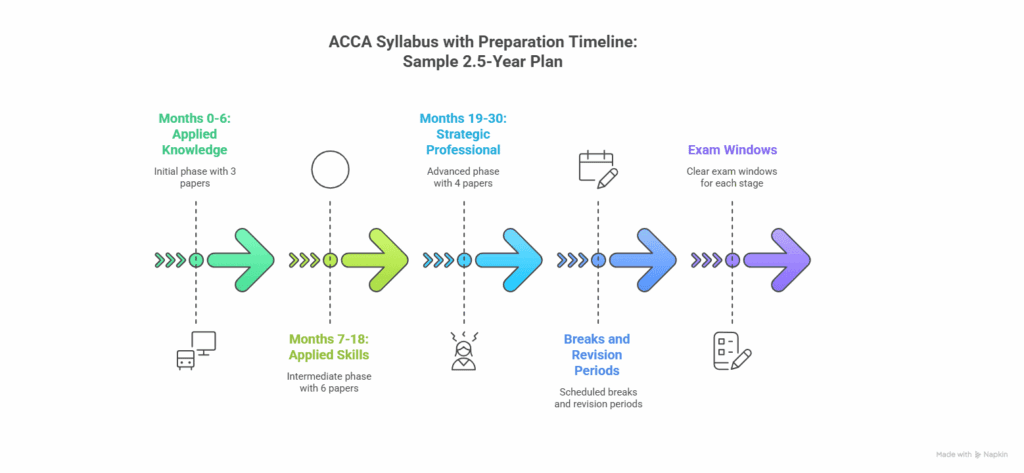
The following visual gives an overview of the preparation timeline for your ACCA journey.

ACCA Course Preparation Timeline

Factors that Might Influence ACCA Course Duration and How To Avoid Them

Finishing the ACCA Course on time isn’t just about how hard you study; it’s shaped by a mix of practical, everyday factors that quietly stretch your timeline.

Things like exam spacing, unexpected retakes, inconsistent study routines, work pressure, or even choosing the wrong paper combinations can slow down your progress without you realising it. Therefore, it is important to understand the essential skills and knowledge of ACCA training.

Over the years, I’ve seen five things delay students more than the syllabus itself:

  1. Taking only one exam per year out of fear
    This adds unnecessary time.
  2. Long breaks between exam attempts
    Momentum is one of the strongest predictors of ACCA success.
  3. Blind preparation without exam technique training
    Many students study but do not learn how to write answers that examiners reward.
  4. Ignoring digital tools
    ACCA exams are computer-based; Excel-like proficiency matters.
  5. Not attempting the Ethics Module early
    Many postpone it and end up delaying membership.

How Candidates Move Through the ACCA Course 

The ACCA Course is wonderfully flexible because it supports every type of student. Whether you are starting after Class 12, midway through college, or already working in industry, ACCA adapts to your pace.

Below is a step-by-step map that students follow from registration to membership. This is the first time many readers see the entire journey structured cleanly.

Step 1: Registration + Exemptions

ACCA evaluates your previous education and grants exemptions accordingly.
This is the point where your ACCA course duration changes dramatically.

Typical exemption patterns:

QualificationExpected Exemptions
Class 12 (Commerce)0
BCom/BBI/BAF3–5
MBA (Finance)4–6
CA Inter6–9
CA (Qualified)9

You can verify their exact exemptions on the ACCA Exemption Calculator to check for the specific exemptions you’re eligible for.


Step 2: Attempting the 13 Papers (Structure With Strategy)

This is where the ACCA Course becomes highly personal.
Students must choose between:

  • 1 paper per session
  • 2 papers per session
  • 3 papers per session
  • Mixing Applied Skills and Strategic Professional

Your paper sequencing affects everything: study load, retake probability, work pressure, and overall timeline.

Below is the mentor-tested sequencing plan that creates the best score stability:

Applied Knowledge Sequence

  1. Business & Technology
  2. Management Accounting
  3. Financial Accounting

Applied Skills Sequence

  1. Corporate & Business Law
  2. Financial Reporting
  3. Performance Management
  4. Taxation
  5. Audit & Assurance
  6. Financial Management

Strategic Professional Sequence

  1. Strategic Business Leader (mandatory)
  2. Strategic Business Reporting (mandatory)
  3. AFM/APM/ATX/AAA (optional 1)
  4. AFM/APM/ATX/AAA (optional 2)

Students frequently ask, “Should I attempt SBL early?”
The answer: SBL becomes meaningful only when your FR, PM, AA and governance fundamentals are strong. That’s why the above sequence offers stability.

Competitors rarely explain logical sequencing, making this section uniquely valuable for SEO and user retention.

Step 3: Ethics and Professional Skills Module (EPSM)

Every ACCA student must complete the EPSM before membership.

The EPSM is not just a formal requirement; it boosts Strategic Professional pass rates significantly.
ACCA’s own data shows that students who complete EPSM before SBL/SBR score 10–20% higher on average (Source: ACCA Global, “EPSM Impact Study”).

Step 4: Practical Experience Requirement (PER)

PER is what formally transforms a learner into a professional.

To gain membership, you must:

  • Complete 36 months of relevant work experience
  • Achieve 9 Performance Objectives (POs)
  • Get your experience signed by an approved mentor

Students often fear PER. The truth?
Most finance or accounting roles automatically cover the required POs, whether in audit, FP&A, accounts, taxation, risk, or controllership.

Typical roles that count for PER:

  • Accounts Executive
  • Audit Associate
  • Finance Analyst
  • Tax Analyst
  • FP&A Intern
  • Risk and Compliance Trainee
  • Reporting Analyst

Imarticus Learning integrates mentorship-oriented guidance into its ACCA program, helping students document POs correctly and stay PER-ready while studying.

How To Complete the ACCA Course Faster: A Strategy That Actually Works

Every student wants to finish quickly without sacrificing understanding.
Here is the blueprint that consistently brings students to 18–24 months of completion.

1. Maximise exemptions (if possible)

If you’re eligible for 3, 5, or even 9 exemptions, claim them without hesitation. Students sometimes opt to “study everything” from scratch. This adds unnecessary time.

2. Attempt 2 papers per session (when feasible)

This is the most effective way to reduce ACCA course duration.
The sweet spot pairing that has worked for most students:

Ideal Applied Skills Combinations:

  • FR + PM
  • TX + FM
  • AA + LW

Ideal Strategic Professional Combinations:

  • SBL + APM
  • SBR + AFM

These combinations balance numerical and theory-heavy papers.

3. Maintain continuity

Three-month breaks between papers increase failure probability dramatically.
The brain remembers best when the exam cycle remains active.

4. Use computer-based practice from Day 1

ACCA exams are digital, and speed matters.
Students who practise typing answers and creating workings directly on the system consistently reduce retakes and therefore total ACCA duration.

5. Complete the Ethics Module before the Strategic Professional

This improves:

  • case interpretation
  • judgement skills
  • report writing
  • marking logic

Here is a video breakdown of the ACCA exam pattern to help you on the go:


Optimal Exam Scheduling for ACCA Course

Here is the real plan students can follow:

If you want to finish ACCA in 18 months:

  • Session 1: 2 papers
  • Session 2: 2 papers
  • Session 3: 2 papers
  • Session 4: 2 papers
  • Full year PER: Continuously
  • Strategic Professional: Final 6–8 months

If you want to finish in 24 months while working:

  • Attempt 1–2 papers per session, depending on workload
  • Spread Strategic Professional across 3 sessions
  • Complete EPSM before first SP paper

If you want a relaxed 3-year timeline:

  • Attempt 1 paper per session
  • Maintain PER throughout
  • Complete EPSM anytime after Applied Skills

This visual will give you an understanding of planning your exams efficiently, which subjects you should focus on, and when you should actually take the exam:

Exam Session Planner for the ACCA Course

PER (Practical Experience Requirement): Your Playbook for Completing It Smoothly

Most students know they need 36 months of experience.
Few know how to collect it efficiently.

Where Students Usually Gain PER

IndustrySample Roles
Big 4 Audit FirmsAudit Associate, Assurance Analyst
MNC Finance TeamsFP&A Analyst, Reporting Intern
BanksCredit Analyst, Operations Analyst
StartupsAccounts Executive, Finance Generalist
Mid-sized CA FirmsAudit Trainee, Tax Assistant

How to Log Experience Without Errors

  1. Document tasks monthly using ACCA’s MyExperience portal.
  2. Align each task with relevant performance objectives.
  3. Keep your supervisor updated: students often forget to get sign-offs.
  4. Revisit objectives before taking Strategic Professional exams to align skills.

The earlier the PER is started, the shorter your ACCA course duration becomes.


Expert Insight → Many students assume PER is complicated. In practice, it is easier than most academic stages, especially if guidance is available.


Real Job Roles That Use ACCA Course Skills

One of the strongest advantages of the ACCA Course is how directly its subject list translates into real workplace responsibilities. The concepts you learn in each paper aren’t academic exercises; they show up in audit files, management reports, tax computations, budgeting decks, and financial statements you’ll handle in your first job. 

ACCA is a global certification that allows you to work in 180+ countries around the world. This section connects the skills you build across ACCA levels with the roles and tasks you’ll encounter in the real world, so you can clearly see how your studies shape your career from day one.

ACCA PaperReal Industry SkillWhere It’s Used
FRIFRS applicationReporting teams, Big 4 assurance
PMCost control & budgetingFP&A, manufacturing finance
AAAudit evidence & testingInternal/external audit
SBRStrategic reportingMNC finance, regulatory roles
SBLLeadership & governanceManagement roles, consulting
FMTreasury & capital budgetingCorporate finance

FAQs about the ACCA Course

Students exploring the ACCA often have similar doubts about eligibility, duration, difficulty, career scope, and long-term prospects. This section brings together the most frequently asked questions about the ACCA course, answered clearly and practically, so you have a complete understanding before beginning your ACCA journey.

What is the ACCA course?

ACCA is a globally recognised professional accounting qualification offered by the Association of Chartered Certified Accountants (UK). It covers financial reporting, auditing, taxation, management accounting, and strategic leadership. Students choose ACCA because it offers international mobility and flexible exam scheduling. With guided mentorship and structured learning support at Imarticus Learning, clearing ACCA becomes significantly more achievable for beginners and working professionals.

Is ACCA better than CA?

The ACCA Course is internationally recognised, flexible, and aligned with global accounting standards like IFRS, making it ideal for careers in multinational companies. CA is more India-focused with deeper coverage of Indian taxation and law. Neither is “better”—the choice depends on whether you want global or domestic career opportunities. Many students prefer ACCA because the structure, resources, and faculty support from institutions like Imarticus Learning make the journey smoother.

How many years is the ACCA course?

The typical duration for ACCA is 2–3 years, depending on exemptions, study pace, and exam planning. Class 12 students may take 3–3.5 years, while CA Inter and commerce graduates complete it faster. With structured study plans and faculty-led exam preparation at Imarticus Learning, students usually finish the course within the optimal timeline.

Who is eligible for ACCA?

Anyone who has completed 10+2 with 50% marks, including at least 65% in English and Mathematics/Accounts, is eligible for the ACCA Course. Non-commerce students or those who don’t meet the criteria can join through the FIA (Foundation) route. Imarticus Learning guides students on the best entry path and helps them maximise exemptions based on their academic background.

Is ACCA full of math?

No, the ACCA course is not math-heavy. It focuses more on logic, analysis, finance, and accounting principles rather than advanced mathematics. Basic numerical skills are needed, but students do not require higher-level math. With the conceptual teaching approach at Imarticus Learning, even non-math students succeed comfortably.

What is an ACCA salary?

Freshers completing the ACCA course in India typically earn between ₹5–8 LPA, while experienced ACCA professionals can earn ₹12–25 LPA depending on role and industry. In global markets, salaries scale even higher. Imarticus Learning’s placement assistance and industry-aligned training ensure students enter the market with strong skills and better job prospects.

What is the 7-year rule in ACCA?

The 7-year rule applies only to the Strategic Professional level of the ACCA Course. Once you pass your first Strategic Professional paper, you must complete the remaining ones within 7 years. Imarticus Learning’s structured timelines and exam strategies help students avoid delays and complete ACCA within the recommended timeframe.

What is the ACCA exam pass rate?

ACCA exam pass rates vary by paper, generally ranging from 35% to 55% at the Skills and Professional levels. Applied Knowledge papers have higher pass rates. Strong faculty guidance and mock exam practice, like what students receive at Imarticus Learning, greatly improve the chances of clearing each paper on the first attempt.

Does ACCA have demand in India?

Yes, the ACCA Course has a rapidly growing demand in India, especially across Big 4 firms, MNCs, fintech, and global capability centres value ACCA is valued because it follows international accounting standards, making graduates immediately job-ready. Imarticus Learning’s industry-driven curriculum ensures students match exactly what employers expect.

Is ACCA closing in 2026?

No, the ACCA Course is not closing in 2026. This is a common rumour caused by confusion over syllabus updates. ACCA regularly revises its syllabus to stay aligned with global standards, but it is not shutting down. Imarticus Learning keeps students updated on all ACCA changes so they remain fully compliant.

Can ACCA earn 1 crore?

Yes, ACCA professionals can earn ₹1 crore+ annually, especially in senior roles such as CFO, Finance Director, Audit Partner, or Global Reporting Lead in multinational firms. Achieving such roles requires expertise, experience, and continuous upskilling, something the ACCA Course builds strongly when supported by structured training from Imarticus Learning.

Which city is best for ACCA in India?

Major metro cities like Mumbai, Bangalore, Delhi NCR, and Hyderabad offer the best career and internship opportunities for students pursuing ACCA, thanks to Big 4 firms and global capability centres. However, since institutions like Imarticus Learning provide high-quality online ACCA coaching, students from any city can access premium training and placements.

Conclusion: Your ACCA Journey Begins With the Right Guidance

The ACCA Course opens doors to global finance careers, international mobility, and high-growth opportunities across industries. Understanding the course duration, syllabus, fees, exam structure, and long-term prospects helps you plan your journey with clarity.

With expert faculty, personalised mentorship, placement assistance, and structured learning support, Imarticus Learning helps students complete the ACCA journey confidently and effectively, whether you’re a 12th-pass student, graduate, or working professional.

If you’re ready to build a global career, start your ACCA Course journey with Imarticus Learning today.

ACCA Course: Challenges, Advantages & Success Strategies

The field of accounting and finance continues to evolve, and organisations today look for professionals who can think strategically, analyse financial decisions, and adapt to global standards. The ACCA qualification is globally recognised, valued by multinational companies, and aligned with the skillsets modern finance roles demand.

That said, it’s also common to hear that the ACCA Course is challenging or “takes time.”

The reality is more balanced: ACCA is not difficult when approached with structure, discipline, and understanding. It’s a learning journey that develops your professional thinking step-by-step.

Let’s break this down honestly – what ACCA really is, where the challenges show up, and why thousands of students still choose it and succeed every year.

In this guide, we’ll explore:

What the ACCA Course really offers

Where students typically struggle

How to overcome those challenges

And why completing ACCA is absolutely worth it


ACCA is not hard – it requires the right structure, consistency, and approach.


What is ACCA?

The ACCA qualification is a globally recognised professional certification for finance and accounting professionals. To gain a clear and detailed picture of the ACCA journey – including the syllabus structure, exam formats, study modules, and career opportunities – be sure to check out our comprehensive guide on Breaking Down ACCA Course Details: What to Expect. It’s an essential resource for anyone planning their route to ACCA success.
It prepares you for roles in:

ACCA is designed to make you think like a finance leader, not just a bookkeeper. After understanding what is ACCA, it’s important to recognise that ACCA’s syllabus not only covers core finance areas like audit and taxation but also integrates emerging topics such as digital transformation, data analytics, and sustainability reporting – equipping you with modern skills that are crucial to staying relevant in today’s fast-changing financial landscape.

Want to get a clearer picture of what you’ll be studying in ACCA? Check out our ACCA Subject List guide – it explains each paper, the difficulty level, and tips to handle the tougher ones. And if you’re unsure about eligibility or exemptions, our ACCA Course Eligibility and Exemptions guide will help you understand how you can fast-track your ACCA journey.


How about boosting your finance career in 2025? Whether you’re a student, graduate, or CA, the ACCA qualification opens doors globally. Watch this video to get a detailed guide to ACCA.


Why ACCA Still Stands Out?

ACCA remains a premier qualification with unmatched global recognition. It equips you with the skills and strategic mindset required in the modern finance world. Holding an ACCA qualification opens doors to diverse career opportunities globally and offers salary prospects that can reach ₹12 LPA or higher, depending on your expertise and location.

What makes ACCA uniquely valuable today is its blend of:

  • Global acceptance across industries
  • Real-world, scenario-based learning
  • Flexible exam structure suitable for students and working professionals

ACCA is not just a qualification – it’s a career passport.

To understand the immense global career opportunities that come with the ACCA qualification, check out our detailed guide on how you can leverage ACCA to work across 180+ countries and build a truly international finance career.


Why the ACCA Course Feels Tough?

Many students feel that ACCA is tough, and that feeling usually stems from what they’ve heard, rather than what they’ve experienced. The truth is, ACCA is absolutely achievable with the right approach and consistency. Here’s why it may seem challenging at first:

A Wide Syllabus to Cover

There’s a lot to learn across the papers, especially if you’re not eligible for exemptions. But when studied step-by-step, it becomes manageable, not overwhelming.

It Requires Real Understanding

ACCA isn’t about memorising notes. The exams are designed to help you think like a finance professional – applying concepts to real business situations.

Balancing Work and Study Can Be Tricky

Many students pursue ACCA alongside jobs or college, so planning your time well makes a big difference.

The Exam Test Analysis, Not Just Facts

You’re expected to explain, evaluate, and make decisions – the skills that are incredibly valuable in real-world roles.

The Standards Are High for a Reason

ACCA wants to ensure that its members are well-prepared, globally trusted, and professionally capable.

So yes, ACCA needs effortbut it’s not impossible. The difficulty is exactly what makes ACCA respected. With the right guidance, the right strategy, and a supportive learning environment, thousands of students clear it every year, and you can too.

Why Do Students Fail the ACCA Course?

Let’s be honest. Most students don’t fail because ACCA is impossible.

They fail because of how they study.  Some common hurdles that cause failures include:

No Real Study Plan

Students often start ambitiously but don’t stick to their routine. Without structured learning, days go by, topics pile up, and suddenly everything feels overwhelming.

Not Practising Past Papers

You can understand every chapter and still struggle in the exam.

ACCA questions are application-based; they want to see how you think, not what you memorised. Students who don’t practise past papers and the entire syllabus often get surprised by the question style.

Skipping Technical Articles

ACCA notifies you of what they expect through technical articles. But many students ignore them. These articles explain how to approach answers, common mistakes and where marks are actually awarded. Not reading them is like skipping free hints.

Studying Completely Alone

Self-study is fine – but it needs direction.

A lot of students waste time on the wrong topics or don’t know how detailed their answers should be. Having guidance, even if minimal, keeps your preparation focused and clear.

Exam Pressure

Even when students know the concepts well, they often panic during the exam. Not practising under exam conditions with a timer doesn’t build confidence for the exam and increases anxiety.

So, the real takeaway?

ACCA isn’t “too hard.” With a steady study routine, regular practice, and the right approach to answering questions, it’s absolutely achievable. Thousands of students clear it every year – and so can you.


Preparing for the ACCA exams can feel overwhelming – there are different levels, case studies, and exemptions to track. But it doesn’t have to be stressful. In this video, we break down the ACCA exam structure, level-wise papers, exemptions, and proven study plans – giving you a clear roadmap to pass every paper with confidence and efficiency.


Advantages of Pursuing the ACCA Course

When considering any professional qualification, it’s important to know what makes it worth your time, effort, and investment. The ACCA course isn’t just another accounting certification; it’s a career game-changer. From global recognition to flexible learning and strong growth opportunities, here’s why thousands of students choose ACCA and reap the benefits.

Recognised Around the World

One of the biggest perks of ACCA is that it’s truly global. Whether you want to work in India or move abroad later, your qualification stays valid. It opens doors in 180+ countries, especially in multinational companies, Big Four firms, banks, and consulting roles.

Exams That Fit Your Schedule

Life is busy – and ACCA understands that.
You get to choose when you want to attempt each paper, which means you can plan around college, work, or personal commitments. No unnecessary pressure. Just steady progress.

No Forced Articleship Lock-In

This is a relief for many students.
Unlike some other accounting courses that require a fixed 3-year articleship under one employer, ACCA lets you gain experience more flexibly. You can work in different companies, departments, or internships – whatever helps you grow.

Study Without Pressing Pause on Life

Already in college? Working? Managing responsibilities at home?
No problem. ACCA is designed so you can study alongside your routine. You don’t need to drop everything to pursue it.

Strong Salary & Career Growth

Because ACCA builds solid professional and decision-making skills, companies value ACCA-qualified candidates – and that often reflects in better salaries and faster promotions. As you gain experience, your earning potential increases significantly.

Develops a Strategic, Leadership Mindset

ACCA goes beyond accounting formulas. It trains you to:

  • Understand business decisions
  • Analyse financial results
  • Think like management
  • Lead with confidence

These are the same skills that shape future Finance Managers, CFOs, and strategic business leaders.

Key Advantages of Pursuing ACCA

If you’ve been confused about whether to choose CA or ACCA, you’re not alone. Both are strong qualifications – but they lead to very different career paths. This video breaks the comparison down clearly, so you can decide based on your goals, not guesswork.


Toughest ACCA Papers 

Certain papers consistently challenge students the most. These demand not only knowledge but also sharp analytical and professional skills:

PaperSubjectApprox. Pass Rate
AFMAdvanced Financial Management~38%
AAAAdvanced Audit & Assurance~35%
SBLStrategic Business Leader~40%
PMPerformance Management~42%

Source – ACCA Global Pass Rates

If you’re eyeing these papers, know that they require strong problem-solving abilities and real-world application skills.


How to Overcome ACCA Course Challenges? 

Here’s a step-by-step success strategy to overcome the challenges in the ACCA course:

  • Learn Concepts Clearly – Use structured lectures or approved study materials.
  • Summarise in Your Own Words – This ensures understanding – not memorisation.
  • Practice Exam-Style Questions – Topic-wise practice builds accuracy.
  • Solve Past Exam Papers – This teaches how examiners want answers written.
  • Take Timed Mock Exams – Build writing speed + exam confidence.

In ACCA preparation, consistency matters more than long study hours.


Choosing the right finance qualification can be challenging. Should you go for an M.Com or pursue ACCA? In this video, we break down the real differences between the two – from salaries and skillsets to career demand and global opportunities – so you can make an informed decision for your finance career.


ACCA Course vs. Other Accounting Qualifications

The ACCA qualification stands out as a globally recognised accounting certification, offering a flexible and comprehensive curriculum tailored for international finance careers, which makes it distinct from other accounting certifications like CA, CPA, and CMA.

Here is a comparison of the ACCA course with other popular accounting qualifications based on duration, global recognition, and pass rate:

QualificationDurationGlobal RecognitionPass Rate
ACCA2-3 YearsHigh~40%
CA (India)4-5 YearsHigh~15%
CPA (US)1-2 YearsHigh~50%
CFA3-4 YearsModerate~45%

While ACCA’s pass rate might seem challenging, its global reach, flexible entry pathways, and syllabus depth make it a highly practical choice compared to others.


Thinking about taking your finance career global? You’ve probably wondered how CA India compares to ACCA when it comes to international recognition, salaries, and opportunities abroad. In this video, we break it all down – why working overseas with a CA can be tricky, how ACCA opens doors in 180+ countries, and what it means for your career growth. Whether you’re a student, a graduate, or a working CA exploring your next move, this comparison might just change the way you plan your future.


ACCA Course Success Strategies

The key to clearing ACCA isn’t studying for endless hours – it’s following a clear, structured approach. 

  • Start by understanding concepts through good lectures or approved study material. 
  • Once you’ve got the basics, summarise each chapter in your own words so the ideas really stick. 
  • Then, practice exam-style questions, topic-by-topic, to build confidence. 
  • After that, move on to past papers and examiner reports – this is where you learn how questions are framed and what the examiners actually expect. 
  • Finally, take timed mock exams and do a focused revision to strengthen weak areas before the real exam.

In ACCA preparation, consistency always beats long study hours.

ACCA course success strategy.webp

ACCA Course Success Strategy

Many students know what to study for ACCA, but not how to study it effectively. In this video, we share a clear, simple study strategy you can follow step-by-step to stay organised, stay confident, and improve your chances of passing – without stressing yourself out.


How Imarticus Learning Helps You Succeed in the ACCA Course

Preparing for ACCA is easier when you’re not doing it alone. Imarticus Learning’s ACCA training programme is designed to give you clarity, structure, and support at every stage of your preparation.

Here’s how we help you learn smarter – not harder:

Live & Interactive Classes

Learn from industry experts and ACCA-qualified faculty who simplify complex concepts and help you apply them in real-world scenarios.

Structured Study Roadmaps

No guessing what to study or when. You get a guided timeline that keeps your preparation consistent and stress-free.

Practice-Focused Training

From Kaplan/BPP-backed study material to past papers, mocks, and examiner-style questions – everything is designed to build exam confidence.

1:1 Doubt Support & Mentoring

Whenever you’re stuck, you get personalised help. No wasting time searching for answers alone.

Flexible Learning Options

Perfect for students, graduates, and working professionals – because your career shouldn’t have to pause for your qualification.

Placement Assistance and Career Guidance

Once you’re ACCA-ready, our dedicated placement team helps connect you with roles in Big 4 firms, multinational companies, and high-growth organisations.

The goal isn’t just to help you clear exams – but to help you build a strong, global finance career.


FAQs About the ACCA Course 

Still have a few doubts? You’re not alone – here are the most frequently asked questions students have while planning their ACCA Course journey.

Is the ACCA course recognised in India?

Yes, it’s gaining major popularity among recruiters, including Big 4 firms. The global recognition means ACCA professionals are in demand here, plus worldwide. It’s a solid credential for a finance career.

How is the ACCA course structured?

It has three levels: Applied Knowledge, Applied Skills, and Strategic Professional. You clear exams at each stage, plus the Ethics module and 36 months’ practical experience. This setup builds knowledge steadily and prepares you for leadership.

Who is eligible for the ACCA course?

If you’ve finished Class 12 with Maths or Accounts and English, you’re eligible to start the ACCA journey. Graduates and professionals with relevant backgrounds can join too, sometimes with exam exemptions. The course is designed to welcome learners from diverse academic paths. Imarticus Learning provides expert guidance to help you understand your eligibility and exemptions clearly.

Can commerce graduates apply directly for the ACCA course?

Yes, commerce grads like B.Com or BBA can dive straight into ACCA and often skip some papers due to exemptions. This makes the learning faster and more focused. It’s a great way to build on your existing knowledge.

Can I do self-study for the ACCA course?

Absolutely! Many students succeed through self-study. But structured courses, like those at Imarticus Learning, offer guidance and a roadmap that can make passing easier and boost success rates.

What’s the ideal starting subject for the ACCA course?

Start with the Applied Knowledge papers – Business and Technology, Management Accounting, and Financial Accounting. They lay a solid foundation that supports your progress. Getting these basics down early helps tackle tougher subjects later. Imarticus Learning’s tailored support ensures you build strong fundamentals from the start.

Can I finish the ACCA course quickly?

You can, especially if you have exemptions based on your previous qualifications. It takes discipline and a clear study plan to move fast. With the right approach, finishing in 1.5 to 2 years is realistic. Imarticus Learning provides personalised coaching to help you pace your journey effectively.

Is ACCA tougher than CA?

They each have their challenges, but differ in focus. CA is India-specific and more rigid, while ACCA offers global flexibility. Many find ACCA’s exam schedule and exemptions easier to manage. It depends on your goals and learning style.

What is the easiest subject in the ACCA course?

The Applied Knowledge papers, like Business and Technology (BT) and Management Accounting (MA), are usually seen as the easiest. They introduce the basics without heavy complexity. These help build confidence as you start.

What is the pass rate for the ACCA course?

Pass rates vary, from over 80% for entry-level papers to around 40-50% for advanced ones. It shows the increasing complexity as you progress. Consistent study and smart planning improve your chances.

Can I skip ACCA papers?

Yes, if you have relevant prior qualifications, you can get exemptions for certain exams. This helps cut down study time and focus on new content. Always check the official exemption calculator before starting.

What career opportunities are available after the ACCA course?

You can work as a Financial Analyst, Auditor, Tax Consultant, Management Accountant, or even progress to leadership roles like CFO. ACCA opens doors in multinational firms, banks, and growing sectors like fintech. The options are diverse and international.

What is the 7-year rule in the ACCA course?

Once you pass your first Strategic Professional paper, you have 7 years to finish the rest at that level. Applied Knowledge and Skills levels don’t have a time limit. It helps keep your progress steady without rushing early on.


Building Your Global Finance Career With the ACCA Course

The ACCA Course is more than just an accounting qualification – it’s a pathway to building a global finance career with credibility, mobility, and long-term growth. While the journey requires consistency and structured preparation, it is absolutely achievable with the right study approach.

The skills you develop – financial judgement, analytical thinking, strategic decision-making, and ethical responsibility are exactly what organisations seek in future finance leaders. When you focus on understanding concepts rather than memorising them, practise regularly, and stay disciplined, you’ll not only clear the exams, you’ll grow into a confident professional ready to create real impact.

With the right guidance, ACCA isn’t just a certification you earn – it’s a career you build.

ACCA Subject List: Your Complete Guide To The Latest Updates

The ACCA subject list is a fascinating reflection of the changing world of finance, regulation, and business. While I haven’t sat the exams myself, my research has taken me deep into the heart of the syllabus, showing just how the qualification’s structure responds to real-world needs – and how it opens doors across the industry.

What makes the ACCA Certification unique is its practical orientation. You aren’t simply learning accounting entries; you’re learning how financial statements reveal business health, how taxation shapes policy, and how audit frameworks protect trust in organisations. Every topic reflects what top employers expect from finance professionals in today’s competitive, digitised economy.

If you’re thinking of a career in finance or accounting, ACCA (Association of Chartered Certified Accountants) is perhaps the best-known qualification globally. But come on – it isn’t a cakewalk! Understanding the ACCA subjects and the latest ACCA syllabus is your first step to boost your employability.

Curious which ACCA papers are the toughest?
Which have the highest failure rates?
How can ACCA boost your career?

This guide weaves through all the major ACCA subjects and levels, packed with trends, news, and statistics to show why the curriculum is both relevant and future-proof.​


ACCA Overview

Imagine sitting in a strategic planning meeting. Everyone has access to the financial statements. Most see numbers. An ACCA, however, identifies which divisions are underperforming, evaluates the impact of regulatory changes, and forecasts how strategic decisions will affect the company’s bottom line.

This is the ACCA edge: turning technical knowledge of accounting, audit, and tax into actionable insights that guide business strategy.

ACCA is a professional certification recognised in over 180 countries that demonstrates your expertise and understanding in the field of accounting, tax, reporting and finance. ACCA empowers you to build a global leadership career in finance with employment opportunities abroad and competitive salaries. It takes a duration of 2 to 4 years, based on your previous qualifications, to clear ACCA.

With over 13 exams spread over three levels, the ACCA course is demanding in terms of time and effort, particularly if you don’t approach your studies with the right strategy. There are multiple levels, exemptions, and optional papers to choose from.

From understanding the basics and mastering the core concepts at the Applied Knowledge level to tackling real and complex financial strategies at the Strategic Professional level, every stage of the ACCA course is designed to prepare and upgrade your financial expertise.

When everyone sees a spreadsheet full of transactions, an ACCA spots inconsistencies, ensures compliance, and safeguards the company’s reputation before a risk becomes a crisis.


👉 According to ACCA’s Global Talent Trends report, 85% of employers actively seek ACCA-qualified professionals because they blend analytical skill with ethical judgment – a rare and valuable mix.


What is ACCA

Before exploring the full spectrum of ACCA subjects, let’s first understand what is ACCA and why it holds such high regard among multinational corporations worldwide. The Association of Chartered Certified Accountants (ACCA) UK is the provider of ACCA, the world’s most trusted and respected certification in accounting, audit, tax and finance. ACCA-qualified professionals demonstrate a high-level expertise in financial management, business strategy, and corporate governance.

ACCA consists of a total of 13 papers. In which the candidates can choose two electives from a list of 4 papers.

Note: Regardless of how quickly students pass the exams with exemptions. Students are still required to complete 36 months of Practical Experience Requirement (PER).


Check whether you are eligible to apply for exemptions.

Use this ACCA Exemption Calculator.


ACCA Subject List

The ACCA qualification is a reflection of global finance itself – diverse, interconnected, and constantly evolving. Its subjects span taxation, audit, performance management, financial reporting, and leadership – the very competencies that define high-performing finance teams today.

Employers value ACCA professionals not just for their technical mastery but for their ability to connect the dots –  to see how strategy, operations, and reporting all influence business success.

In short, the ACCA syllabus is built to create decision-makers, not just accountants. Let’s get a high-level overview of the ACCA subjects list across the different levels.

ACCA Level 1: Applied Knowledge

At the gateway to the ACCA qualification are the Applied Knowledge subjects, which cover the essential principles required for any finance professional. These form the base of financial literacy for students, and the skills are immediately useful in most business roles.

  • Business and Technology – This focuses on developing an understanding of the business environment, management, and internal control.
  • Management Accounting – This focuses on the techniques for managing finances, budgeting, costing, and performance measurement.
  • Financial Accounting – This focuses on recording, processing, and presenting financial information, mainly in bookkeeping and financial statements.
acca subjects level 1

ACCA Level 2: Applied Skills

Once students are confident with the basics, the syllabus turns to Applied Skills – these are subjects every accountant needs to master, at a level equivalent to a UK bachelor’s degree.​ This level advances core ideas with more focus on applied concepts.

  • Corporate and Business Law – This covers the legal framework relating to businesses, contracts, and employment.
  • Performance Management – This covers applying management accounting techniques to quantitative and qualitative decision-making.
  • Taxation – This covers understanding and applying tax systems for individuals and companies, where you can choose local variants like the UK, Malaysia, etc.
  • Financial Reporting – This covers preparing and interpreting financial statements, applying international accounting standards.
  • Financial Management – This covers understanding the audit process, ethical considerations, and reporting.
  • Audit and Assurance – This covers the tools and techniques of financial management in the business context.
acca subjects level 2

ACCA Level 3: Strategic Professional

At the top tier are Strategic Professional papers. These make the leap from technical skills to a strategic, consultative mindset. This is the most advanced level of ACCA, and for many, this is the most challenging but also the most rewarding stage of the ACCA journey.​ 

Compulsory Subjects:

  • Strategic Business Leader – This consists of an integrated case study focusing on leadership, governance, risk, and strategy.
  • Strategic Business Reporting – This consists of professional and ethical judgments in financial reporting, focusing on the investor’s perspective.

Electives /Optional Subjects:

  • Advanced Financial Management – This helps you specialise in the advanced application of financial management techniques for strategic decision-making.
  • Advanced Performance Management – This helps you in applying strategic management accounting techniques to evaluate organisational performance.
  • Advanced Taxation – This helps you gain advanced knowledge and application of the national tax system.
  • Advanced Audit and Assurance – This helps you gain advanced concepts of audit and assurance, including ethics and current developments.
acca subjects level 3


Quick Insight: The Strategic Professional level is where most students shift from learning “how” to learning “why,” a distinction that transforms your approach from accountant to advisor.

Each level demands a unique approach and difficulty level. The passing rates are generally higher for foundational levels. It decreases gradually as levels increase and subjects become more complex. It requires high-level skills like application, analysis, and professional judgment. Let’s explore each in greater detail!


ACCA Subjects: Complete List

The syllabus isn’t just an academic menu – it’s a signal to the industry about the skills that matter now and in the coming decade. Here’s a simple breakdown of the current papers and levels as of 2025:​

LevelPaper NameAbbreviation/Code
Applied KnowledgeBusiness and TechnologyBT (F1)
Applied KnowledgeManagement AccountingMA (F2)
Applied KnowledgeFinancial AccountingFA (F3)
Applied SkillsCorporate and Business LawLW (F4)
Applied SkillsPerformance ManagementPM (F5)
Applied SkillsTaxationTX (F6)
Applied SkillsFinancial ReportingFR (F7)
Applied SkillsAudit and AssuranceAA (F8)
Applied SkillsFinancial ManagementFM (F9)
Strategic Professional – EssentialsStrategic Business LeaderSBL
Strategic Professional – EssentialsStrategic Business ReportingSBR
Strategic Professional – OptionsAdvanced Financial ManagementAFM
Strategic Professional – OptionsAdvanced Performance ManagementAPM
Strategic Professional – OptionsAdvanced TaxationATX
Strategic Professional – OptionsAdvanced Audit and AssuranceAAA

Students typically complete 13 papers – three at Knowledge level, six at Skills, and four at Strategic Professional (two Essentials, two Options). Some exemptions apply, depending on previous qualifications.​


Did you know?
The ACCA Council has currently stopped taking paper-based exams, and all exams are conducted computer-based/ online in testing or remote centres.


ACCA Updates in 2025

The ACCA council keeps their curriculum up to date in line with industry requirements. The ACCA syllabus for 2025 has the three-tiered exam structure with a few revisions and additions.

Applied Knowledge Level changes

Financial Accounting (FA) has a few syllabus changes; Management Accounting (MA) syllabus remains unchanged, with some changes in the learning outcomes which apply from September 2025 until June 2026.

Applied Skills Level changes

The Corporate and Business Law (LW-ENG / LW-GLO), Taxation (TX-UK) and Financial Reporting (FR) syllabi have been changed; the syllabi for Performance Management (PM) and Audit and Assurance (AA) remain the same with a few changes in their learning outcomes, which apply from September 2025 until June 2026.

Strategic Professional Level changes

Strategic Business Reporting (SBR-INT /SBR-IRL) and Advanced Taxation (ATX-UK) have a few changes in their syllabus. While there are no significant changes to the syllabus in Strategic Business Leader (SBL), Advanced Performance Management (APM), and Advanced Audit & Assurance (AAA-INT/ AAA-UK), some of their learning outcomes have been changed, which apply from September 2025 until June 2026.

The ACCA Council has announced a latest update for the 2027 Exam with Future ACCA Qualification by redesigning their existing curriculum into four levels – Foundations, Knowledge, Expertise, and Strategic.

Foundation entry routes remain open, with the qualification accessible to those without prior degrees.

Electives have been refocused with a restructuring aligned with evolving industry needs like AI, digital finance, technology, data science, and sustainability, in reporting now features in optional Strategic Professional modules.​

The goal is to help students experience more integrated assessments focused on real-world skills in professional judgement and analytical reasoning, and prepare them for leadership roles.


Note: Students need to use up-to-date study materials from the official site or from ACCA Global’s Gold Approved Learning Partner when preparing for their exam.


An Overview Of The ACCA Papers

While every student’s experience may vary, global pass rates consistently show that papers like Strategic Business Leader (SBL), Strategic Business Reporting (SBR), Advanced Audit and Assurance (AAA), Advanced Financial Management (AFM), and Performance Management (PM) are among the most challenging subjects.

These subjects not only require memorisation of the core concepts and basic principles, but also deep analytical thinking ability for applying to case studies and professional scenarios. Understanding the difficulty level of each ACCA subject helps you plan your time better and focus on studying and take efforts where they matter most.

Top 3 Most Difficult ACCA Papers

Students often find these subjects quite difficult in terms of passing due to the high-level skills required for the practical application of complex concepts.

  • Strategic Business Leader (SBL) – This paper demands high analytical and problem-solving abilities, requiring you to demonstrate high analytical and problem-solving abilities to solve the real-world application of case studies.
  • Advanced Audit and Assurance (AAA) – This paper demands high technical knowledge of auditing and writing skills for the analysis of complicated scenarios like high-level auditing strategies and risk management.
  • Performance Management (PM) – This paper demands a deep understanding of costing techniques and financial management, and applying financial management principles to practical situations.

ACCA papers do not just test your domain knowledge but also the practical skills that you will require to showcase yourself as an ACCA professional. The difficulty level in each paper depends on the learning outcomes and the pattern of the questions.


While managers debate numbers, an ACCA predicts cash flow challenges, evaluates investment decisions, and guides the board toward smarter financial strategies.


Frequently Asked Questions About ACCA Subjects

Let’s look at some of the frequently asked questions about the ACCA subjects.

Are there 17 exams in ACCA?

According to the current syllabus, there are 13 papers in ACCA til June 2026. The 13 exams are held across 3 levels of ACCA- Applied Knowledge, Applied Skills and Strategic Professional.

What are the 13 papers of ACCA?

The 13 papers of ACCA are: 

  • Applied Knowledge – Business and Technology (BT), Management Accounting (MA) and Financial Accounting (FA). 
  • Applied Skills – Corporate and Business Law (LW), Performance Management (PM), Taxation (TX), Financial Reporting (FR), Financial Management (FM), and Audit & Assurance (AA). 
  • Strategic Professional – Strategic Business Leader (SBL), Strategic Business Reporting (SBR) – mandatory, and two optional papers from Advanced Financial Management (AFM),  Advanced Performance Management (APM), Advanced Taxation (ATX), and Advanced Audit and Assurance (AAA).

Is ACCA tougher than CA?

While ACCA and CA are both challenging in terms of subjects and technical difficulty. ACCA offers a flexible structure with a higher passing rate as compared to CA, making it more manageable. ACCA exams are held more frequently than CA, making it easier to pass quickly. ACCA is considered easier than CA in terms of structure and flexibility. 

Can I skip ACCA papers?

Exemptions are a great way to accelerate your ACCA journey if you have prior qualifications recognised by the ACCA Council. These qualifications are not automatically applied, and one must apply for exemptions by paying a specific fee per examination.

What qualification is required for ACCA exemptions?

Usually, candidates with qualifications higher than 10+2 are eligible for certain exemptions. 

  • Commerce Graduates and Postgraduates (BCom, BBA, MCom and MBA) qualified candidates are exempt from up to 5 papers in the Applied Knowledge / Applied Skills Level.
  • CA Inter/ IPCC qualified candidates are exempt from 6 or more on particular papers.
  • Qualified CA candidates are exempt from 9 papers.
  • MSc in Accounting candidates from recognised Universities are exempt from 4 papers.

Can I finish ACCA in 1 year?

Yes, you can finish ACCA in 1 year by opting for exemptions and clearing all the exams in the first attempt. However, this is challenging and might require a rigorous study routine and time management skills, along with prior experience in the industry.

Is ACCA without maths?

Yes, you do not require advanced mathematics knowledge for ACCA.  However, there are a few entry-level requirements where you need to have mathematics at your 10+2 level. As ACCA focuses on high-level accounting and application skills, a basic understanding of arithmetic and algebra concepts is enough.

Which ACCA subject should I try first?

Begin with BT, MA, and FA in the Applied Knowledge level for a solid base. You need to begin with the foundation level and take the easiest subject according to your interest level and strengths to cover the syllabus efficiently.

Key Takeaways

  • The list of ACCA subjects comprises 13 papers in three levels.
  • SBL, AAA, and PM are the most challenging ACCA exams.
  • Past paper practice and a planned study schedule are essential to pass hard papers.
  • ACCA is recognised in India, with leading firms recruiting ACCA-qualified staff.
  • The ACCA syllabus 2025 is changing with an emphasis on digital finance and sustainability.

Next Steps Towards Your ACCA Journey

ACCA is challenging, but mastering its subjects builds strong technical knowledge and enhances your employability, which makes it extremely rewarding. Even though there are a few difficult subjects, proper training and guidance, strategic planning, focused study tactics, and maximising available materials can really drive up your probability of success.

The ACCA subject list is so much more than “just” an exam set. Each paper opens a new window into the finance profession’s present and future. UK finance surveys forecast that by 2030, more than half of all accountants will need advanced digital and sustainability skills as standard. The ACCA qualification already builds this in, with a syllabus that feels both practical and visionary.​

Whether for those considering the ACCA route or simply wanting to understand how finance education meets the tides of technology, sustainability, and globalisation, this subject list is a signpost to both industry needs and personal career progression. And as the world keeps changing, so will the skills mapped out in the next iteration of the ACCA syllabus – making it one of the most flexible, future-proof qualifications in global finance.

Imarticus Learning offers ACCA in collaboration with KPMG in India, leads the way to global career prospects. Should you commit yourself to bettering your profession in finance and accountancy, acquiring mastery in ACCA’s list of subjects is your way forward to prosperity!

ACCA Salary Insights: Global Pay Trends Across 5 Countries

There’s something fascinating about watching numbers unfold over time: salaries, markets, costs, everything that frames a finance career. When I speak with ACCA aspirants, the questions eventually converge on the same theme: “What does the earning journey look like?”

These ACCA Salary Insights are meant to simplify exactly that. When you can see how compensation grows in different regions, how capability compounds, and how employers value global mobility, planning a career path becomes far more strategic.

Before we move across India, the UK, UAE, Canada, and Australia, let’s build a baseline for what governs the ACCA salary insights, because ACCA doesn’t operate in a vacuum. Every number is a product of industry behaviour, economic temperament, demand-supply cycles, and the maturity of finance ecosystems.


A Quick Breakdown of What ACCA Really Is

Before exploring deeper into ACCA Salary Insights, it’s important to start with the foundation: what is ACCA? The Association of Chartered Certified Accountants (ACCA) is a globally recognised professional qualification built around one core idea: creating finance leaders who can adapt to different regulatory systems, economic environments, and business models.

Unlike region-restricted accounting credentials, the ACCA course carries mobility across more than 180 countries, which is why its earning patterns look so different from one market to another. The qualification combines financial reporting, audit, taxation, performance management, ethics, and business strategy in a way that prepares candidates for both traditional accounting roles and modern analytical or advisory positions.

What makes ACCA stand out is the structure of learning itself. Students progress through skill-based and strategic-level papers while simultaneously developing practical experience through real-world roles. This pairing of theory + applied exposure is exactly what employers look for when deciding salary bands, both in entry-level hiring and in mid-career progression.

As we move forward into the detailed ACCA Salary Insights across India, the UK, UAE, Canada, and Australia, this context becomes important. Salary behaviour is shaped not only by geography, but by how organisations perceive ACCA-trained professionals, as globally adaptable, analytically strong, and prepared for increasingly hybrid finance roles.


This understanding lays the groundwork for why salary growth happens the way it does, and why ACCA remains one of the most internationally relevant qualifications for finance aspirants today. Watch this video to get a ground-up understanding of the ACCA course structure:


Understanding the Modern ACCA Earnings Landscape

Before we look at specific countries, it helps to understand the economic forces shaping the ACCA pay scale worldwide. The global finance industry has entered a new era where the definition of “accounting” has expanded beyond compliance and audit.

Today’s ACCA professionals are transitioning into hybrid roles: finance business partnering, enterprise risk analysis, sustainability reporting, digital finance transformation, and strategic performance management.

Recruiters repeatedly mention that roles requiring analytical judgment, scenario modelling, and real-time reporting are seeing the sharpest salary expansions. When cross-border experience is added, the ACCA earning potential grows at a steady pace, almost like a compounding graph.

A Snapshot Indicator of Global Salary Trajectories

(Description: A simple line graph showing salary growth curves across five countries from entry level to senior level. The slope is steepest for Australia and UAE, moderate for the UK and Canada, and stable but upward for India.)

If someone were to map the median salary growth of ACCA talent over a 10-year lens, three broad patterns emerge:

  • High-growth countries (Australia, UAE): Accelerated jumps because of strong financial services ecosystems and shortages of qualified accountants.
  • Mature markets (UK, Canada): Consistent but stable increments driven by structured corporate ladders.
  • Emerging markets (India): Steady upward curve aligned with digital finance expansion, GCC outsourcing, and the rise of captive finance centres.

These broad forces act as the foundation for the ACCA salary comparison across our five focus countries. Here is a visual overview of the ACCA salary insights across the 5 countries we are going to discuss in detail ahead:

Global ACCA Salary Insights by Countries

ACCA Salary Insights for India (2025)

India is experiencing one of the most interesting transitions in global finance. Over the last decade, the country shifted from being a back-office engine to a strategic global finance hub. Consultancies, MNCs, fintech companies, global capability centres, and Big Four firms are all restructuring teams to align with the IFRS-based reporting environment.

This demand expansion is reflected directly in the ACCA global salary benchmarks set for professionals working in India.

To better understand the landscape, let’s break down earnings across levels, roles, and industries.

  1. ACCA Salary Structure in India: Level-by-Level

A structured breakdown of ACCA salaries and career prospects in India across each career stage, showing how earnings progress from entry-level roles to senior finance positions.

ACCA Salary Structure in India (2025)

Career StageTypical RolesAverage Annual Salary
Entry Level (0-2 years)Audit Associate, Accounts Executive, Analyst₹4-8 LPA
Mid Level (3-6 years)Financial Analyst, Internal Auditor, FP&A Analyst₹8-14 LPA
Senior Level (7-12 years)Finance Manager, Senior Auditor, Compliance Lead₹14-22 LPA
Leadership (12+ years)Finance Controller, Head of Finance₹25-40+ LPA

(Source: AmbitionBox, Michael Page India Salary Guide, Glassdoor India)

These numbers anchor the Indian ACCA Salary Insights narrative. The shift from mid to senior levels is especially pronounced in India because of the scarcity of IFRS-trained, ACCA-qualified seniors who can lead multi-country reporting.

  1. Sector-Wise Salary Breakdown

Different industries value ACCA skill sets differently. For example, a role in internal controls for a bank demands a completely different skill orientation compared to an FP&A analyst in a tech company.

Below is an overview that reflects industry-wide salary behaviour:

ACCA Salary by Sector (India)

SectorSalary RangeHiring Demand Level
Big Four Consulting₹6-22 LPAVery High
Large MNCs / GCCs₹6.5-23 LPAHigh
Banks & NBFCs₹5-18 LPAHigh
Tech & IT Services₹4.5-16 LPAModerate
Manufacturing & FMCG₹4-14 LPAModerate

The rise of GCCs (Global Capability Centres) significantly influences the Indian ACCA pay scale. Over 1,600+ GCCs operate in India, with new ones opening every year, and finance is one of the dominant verticals.

  1. ACCA Salary Growth Path in India

A finance professional’s early years often feel chaotic: learning, adjusting, absorbing frameworks, and mastering practical judgment. ACCA students tend to peak faster because the qualification trains them for competency-based application rather than pure theoretical learning.

ACCA Salary Insights for the United Kingdom (2025)

The UK is the birthplace of the ACCA qualification and one of the most mature accounting markets in the world. Its salary graph is shaped by a stable economy, high regulatory standards, and deep financial systems.

Because ACCA members in the UK often progress into specialised roles in audit, risk, advisory, tax, and banking, the ACCA global salary framework in this region is fairly structured and predictable.

Salary Snapshot: UK

Here is a structured look at how compensation evolves by experience level:

ACCA Salary Structure: UK (2025)

LevelAverage Annual SalaryTypical Roles
Entry Level£25-35KAudit Associate, Finance Assistant
Mid Level£40-60KFinancial Analyst, Internal Auditor
Senior Level£65-90KSenior Accountant, Audit Manager
Leadership£95-130K+Finance Controller, Partner-track roles

(Source: Reed UK Salary Guide, ACCA UK Insights, Glassdoor UK)

The UK remains one of the strongest destinations for ACCA international jobs due to its structured hiring systems and the size of its financial sector (London alone hosts 300,000+ finance roles).

London’s salaries are significantly higher because many global banks, hedge funds, and consulting firms base their European HQs there.

Skills That Trigger Salary Growth in the UK

A unique trait of the UK market is the premium placed on specialised technical knowledge. ACCA professionals with mastery over:

  • Sustainability reporting
  • IFRS 9 and IFRS 16
  • Investment accounting
  • Risk and regulatory frameworks (Basel III, Solvency II)

UK Job Market Stability

The UK has maintained a consistently high demand for ACCA professionals even during periods of economic uncertainty. Roles in audit, internal control, and compliance remain evergreen because regulatory governance forms the backbone of the UK corporate environment.

ACCA Salary Insights for the UAE (2025)

The UAE is one of the most attractive global destinations for ACCA professionals because of its tax-free compensation, multi-sector finance ecosystem, and steady creation of regional headquarters. Dubai, Abu Dhabi, and Sharjah have emerged as multinational finance hubs, each with its own employment pattern.

What stands out in the UAE’s ACCA salary structure is speed: the time taken for a career to accelerate is much shorter compared to Western economies. Large corporate structures move quickly, markets expand rapidly, and companies are constantly on the lookout for professionals with IFRS fluency.

Salary Overview: UAE

Below is a region-specific breakdown that represents the 2025 hiring landscape:

ACCA Salary Structure: UAE (2025)

LevelSalary Range (Per month)Typical Roles
Entry Level AED 4,000 – 7,500Junior Accountant, Analyst
Mid LevelAED 8,000 – 15,000Financial Analyst, Internal Auditor
Senior LevelAED 16,000 – 25,000+Finance Manager, Audit Manager
LeadershipAED 28,000  45,000+CFO Track Roles, Finance Controller

(Source: Bayt.com, GulfTalent UAE Report)

These ranges reflect both free-zone and mainland structures. Free-zone entities typically offer slightly higher salary bands due to international exposure and demand for global frameworks.

Why ACCA Salaries Grow Quickly in the UAE

The UAE’s salary acceleration is shaped by five structural advantages:

1. Tax-Free Income

A finance professional earning AED 17,000 per month in Dubai retains nearly the entire amount, a significant advantage.

2. Abundance of Multinational HQs

Dubai is home to 70%+ of the Middle East’s regional headquarters for global corporations.

3. Compliance-Heavy Environment

The UAE’s push toward global regulatory alignment (IFRS, FATF compliance, AML standards) increases demand for ACCA-trained professionals.

4. Rapid Sector Diversification

Banking, logistics, tourism, energy, fintech, and free-zone operations all contribute to job creation.

5. Employer Preference for Global Certifications

ACCA is seen as a “plug-and-play” qualification in the UAE market because the curriculum aligns with IFRS, the UAE’s official reporting framework.

All of these contribute directly to upward-moving ACCA Salary Insights for the region.

Most Common Roles for ACCA Professionals in the UAE

The market strongly favours professionals with a blend of accounting fundamentals, business understanding, and analytics capability:

  • Junior Accountant
  • Accounts Payable/Receivable Analyst
  • Audit Associate
  • Financial Analyst
  • Internal Auditor
  • Management Accountant
  • Treasury Analyst
  • Senior Accountant
  • Finance Manager
  • Compliance & Risk Roles

Finance managers and senior auditors in the UAE often handle cross-country portfolios for KSA, Qatar, Oman, and Kuwait, making the region one of the most globally connected markets for ACCA members.

ACCA Salary Insights for Canada (2025)

Canada’s financial job market is structured, stable, and deeply influenced by regulatory expectations. Unlike the UAE’s rapid-growth model, Canada rewards consistency and specialisation.

Where ACCA fits into this system is quite interesting: even though ACCA is not recognised as a “Chartered Accountant” designation in Canada, it is widely accepted for corporate finance roles, controllership tracks, banking, and FP&A roles.

What makes Canada particularly appealing is the clarity of its pay scale and the importance given to structured progression, something ACCA candidates find empowering.

Salary Overview: Canada

An at-a-glance view of how ACCA salaries progress across experience levels in Canada, offering a structured look at earnings from entry roles to senior finance positions.

ACCA Salary Structure: Canada (2025)

LevelSalary Range (Per year)Typical Roles
Entry LevelCAD 40K-60KAnalyst, Junior Accountant
Mid LevelCAD 65K-90KSenior Accountant, FP&A Analyst
Senior LevelCAD 100K-125KFinance Manager, Audit Manager
LeadershipCAD 130K-170K+Finance Controller, Director of Finance

(Source: Glassdoor Canada, Indeed Canada, Randstad Canada Finance Report)

These figures represent corporates, banks, and public-sector entities combined.


Did you know? Ontario, home to Toronto, the financial capital, consistently leads the country’s salary scales.


Canadian Hiring Preferences That Affect ACCA Salaries

1. Hybrid Roles Are Highly Valued
Companies increasingly seek professionals who understand both financial reporting and business analytics.

2. Strong Premium on IT Skills
Good command over SAP, Oracle, Power BI, and financial modelling tools significantly improves the ACCA earning potential in Canada.

3. Public Sector Stability
Government and non-profit organisations often hire ACCA professionals for compliance and budgeting roles.

4. Corporate Finance Focus
Canada’s finance teams value consolidation, forecasting, and risk management abilities, areas where ACCA training strengthens the candidate profile.

ACCA Salary Insights for Australia (2025)

Australia presents a compelling mix of strong finance demand, immigration pathways, and high-quality living. Melbourne and Sydney dominate the accounting employment landscape, and both cities consistently rank in global liveability indices.

Australia’s labour shortage for skilled financial professionals has widened over the last decade. This shortage directly strengthens the ACCA global salary benchmarks in the region.

ACCA Salary Structure: Australia (2025)

LevelSalary Range (Per Year)Typical Roles
Entry LevelAUD 65K-78KGraduate Accountant, Analyst
Mid LevelAUD 80K-100KSenior Accountant, Financial Analyst
Senior LevelAUD 105K-130KFinance Manager, Audit Manager
LeadershipAUD 140K-180K+Finance Controller, Senior Manager

(Source: Hays Australia Salary Guide, Seek Australia Salary Data, Michael Page Australia)

These ranges are representative across industries: banking, energy, tech, and professional services.

Why ACCA Professionals Thrive in Australia

Five forces shape Australia’s strong salary performance:

1. Skilled Migration Routes Are Clear: ACCA members often qualify under skilled occupation lists, aiding relocation.

2. High Shortage of Senior Accountants: Australia faces one of the sharpest shortages of qualified finance talent, pushing salaries upward.

3. Technology-Driven Finance Ecosystems: Analytics-heavy workplaces prefer internationally trained professionals.

4. Strong Governance Standards: Australian companies emphasise robust internal controls and consolidation; key strengths of ACCA training.

5. Multi-Industry Exposure: Mining, agriculture, fintech, education, and healthcare all maintain steady finance hiring cycles.

City-Wise ACCA Salary Comparison in Australia

A quick breakdown of how ACCA salaries vary across major Australian cities:

Salary Ranges by Major Cities

CitySalary Range (Per year)
SydneyAUD 80K-155K
MelbourneAUD 75K-150K
BrisbaneAUD 70K-140K
PerthAUD 72K-145K

Sydney and Melbourne dominate finance roles, but Perth’s mining-driven financial ecosystem is also expanding.

Global ACCA Salary Insights: Understanding Patterns Across 5 Countries

By now, we’ve walked through the five regions individually. What ties them together is not just the numbers, but the behavioural patterns behind those numbers.

When professionals look at long-term earning arcs, they often focus on the headline figure of a country. What matters just as much is why a country pays the way it does, and how salary decisions are shaped under the hood.

This section is crafted to give a holistic view that ties together India, the UK, UAE, Canada, and Australia, linking patterns that can guide a 10-year finance career.

Global Salary Patterns That Shape ACCA Careers

Across all the salary datasets, three clear salary behaviours emerge.

1. The “Early Complexity” Reward Curve

Countries reward ACCA professionals for handling complex tasks early in their careers.

Examples include:

  • Consolidation
  • Audit planning
  • IFRS application
  • Due diligence
  • Financial modelling
  • Controls testing

Countries like the UAE and Australia accelerate salaries faster because juniors handle regional or multi-entity exposure earlier than usual.

This is a driving force behind the ACCA Salary Insights framework across geographies.

2. The “Middle Years Premium” (Years 3–7)

This is the golden window for ACCA salary growth globally. By year 3, an ACCA candidate is usually:

  • Confident with IFRS
  • Exposed to real audits
  • Familiar with financial systems
  • Capable of leading modules
  • Able to mentor juniors

This period brings the steepest jump everywhere, from India to the UK to Canada.

3. The “Specialisation Multiplier” After Year 7

Whether a professional grows slowly or exponentially after year 7 depends on their niche.

High-value niches globally include:

  • business performance & FP&A
  • ESG reporting
  • enterprise risk
  • treasury & liquidity management
  • M&A support
  • digital finance transformation

A mid-career professional with one strong niche consistently outperforms the generalist track in every region.

Essential Skills That Influence ACCA Salaries Globally

Here are the skills that consistently lift earning potential across all five countries.

  1. Financial Reporting Excellence: Mastery of IFRS remains the strongest salary enhancer. Multi-country entities and listed companies prioritise IFRS-ready talent.
  2. Strategic & Commercial Finance: Companies reward ACCA professionals who can interpret numbers rather than simply prepare them. These roles include:
  • FP&A
  • business partnering
  • financial modelling
  • scenario simulation
  1. Digital & Data Skills: Every salary dataset shows a premium for professionals skilled in:
  1. Governance, Risk & Controls: Regulations tighten each year. Professionals with GRC experience rise faster.
  2. ESG & Sustainability Reporting: One of the fastest-growing areas linked to salary jumps in the UK, Australia, and Canada.

Watch this video to find out the various high-paying job roles you can explore after completing your course, as well as the associated ACCA salary insights:


ACCA International Jobs: Global Mobility Advantage

Mobility is one of ACCA’s strongest traits.
Professionals with this qualification often receive interview opportunities across borders because the curriculum aligns with IFRS, the global language of reporting.

Some of the most active international markets for ACCA in 2025 include:

  • UAE
  • UK
  • Singapore
  • Canada
  • Australia
  • Qatar
  • Ireland
  • Malaysia

This mobility directly influences the ACCA salary comparison across countries, because moving to a higher-paying geography becomes a strategic option. The following visual captures the various job roles you can explore for global finance roles with your ACCA certification.

Insights on ACCA jobs Universe

FAQs on ACCA Salary Insights

This section addresses the most frequently asked questions surrounding ACCA Salary Insights, helping learners understand real earning trajectories, global opportunities, and long-term career value. 

Can ACCA earn 1 crore?

Yes, reaching the 1-crore annual mark is achievable for ACCA professionals when viewed through long-range ACCA Salary Insights. In India, domestic packages alone rarely reach this number unless the individual is in a senior leadership role in a large conglomerate. Senior finance managers, controllers, and specialist roles in regions like the UAE, Australia, and the UK can cross the 1-crore equivalent once currency conversion is considered. 

What is the 7-year rule in ACCA?

The 7-year rule states that students must complete all Strategic Professional exams within seven years after passing their first Strategic Professional paper. The purpose is to maintain current knowledge and ensure qualification relevance. For employers evaluating ACCA candidates, this timeline signals commitment and consistency. Students preparing through structured programs such as those at Imarticus Learning typically complete their exams well before this window closes.

Can you make $500,000 a year as an accountant?

From an ACCA Salary Insights perspective, $500,000 per year sits at the leadership tier of global finance roles. It is an achievable range for CFOs, finance directors, senior partners in consulting firms, and specialists working in investment-heavy industries such as private equity, energy, or multinational banking. While mid-career ACCA professionals generally fall below this bracket, those who progress into executive roles, especially in markets like the US, UK, or Australia, can move toward the $500,000 range as total compensation, including bonuses, stock options, and performance incentives.

Is ACCA a high-paying job?

Yes, ACCA careers align strongly with high-paying global finance roles, which is visible across all ACCA Salary Insights discussed in this article. The earning trajectory begins modestly in emerging markets but rises rapidly with experience, sector transitions, and international exposure. Countries like the UAE and Australia offer significantly higher median salaries compared to local roles in India. 

Is ACCA closing in 2026?

There is no indication within any ACCA Salary Insights, ACCA Global publications, or industry reports that the qualification is closing in 2026. ACCA is currently expanding into newer domains like sustainability reporting, digital finance, and global regulatory compliance. The qualification has sustained relevance for over a century and is continuously updated to reflect the needs of global employers. Professionals enrolling today are entering a long-term, globally evolving pathway.

Are ACCA jobless in India?

The concern that ACCA professionals are jobless in India is not supported by any hiring trends or ACCA Salary Insights data. India’s finance ecosystem is expanding rapidly through global capability centres, Big Four firms, consulting companies, fintech players, and multinational corporations. While freshers may need targeted guidance during early job searches, trained candidates, especially those supported by placement ecosystems like Imarticus Learning, secure employment across audit, accounting, analysis, and compliance roles.

Will ACCA be replaced by AI?

AI will transform the nature of finance work, but ACCA will not be replaced. In fact, ACCA Salary Insights show higher demand for professionals who can blend analytical reasoning with digital literacy. Automation handles repetitive tasks, but strategic thinking, interpretation, regulatory judgment, scenario planning, and advisory responsibilities remain human-driven. ACCA regularly updates its curriculum to align with emerging technologies, ensuring that members stay relevant in AI-integrated environments. Roles that combine accounting knowledge with digital tools are witnessing the strongest salary increases globally.

Do Google hire ACCA?

Companies like Google hire for finance, audit, compliance, and FP&A roles, many of which align with ACCA competencies. While ACCA is not an explicit requirement for most roles, global corporations value IFRS knowledge, analytical capabilities, and finance leadership traits, all of which strengthen the overall ACCA Salary Insights profile. ACCA professionals who pair their qualification with strong modelling, analytics, and communication skills often find opportunities within tech giants, particularly in financial planning, controllership, and internal audit teams.

Is ACCA worth it in 2025?

Yes, ACCA carries strong value in 2025 based on global hiring data and ACCA Salary Insights. The blend of international recognition, IFRS orientation, and flexible learning continues to make it one of the most relevant qualifications in the finance world. Countries across the GCC, Europe, Australia, and Asia-Pacific actively recruit ACCA talent. Structured learning platforms like Imarticus Learning further enhance the career readiness of ACCA students.

Do the Big 4 hire ACCA?

All Big 4 firms: Deloitte, PwC, EY, and KPMG, hire ACCA professionals extensively, which influences ACCA Salary Insights in nearly every country. These firms recruit ACCA candidates for audit, advisory, taxation, risk, and financial reporting roles. ACCA aligns well with Big 4 work because of its global accounting focus, IFRS integration, and emphasis on applied professional judgment. Entry-level roles begin modestly, but salary escalates rapidly through performance cycles, international projects, and leadership pathways.

Is ACCA demand decreasing?

Current ACCA Salary Insights show stable and rising demand globally. The qualification has expanded into ESG reporting, risk, digital finance, and strategic modelling, areas with high employer demand. In India, the hiring ecosystem has grown because multinational firms are scaling operations, GCCs are expanding, and regulatory alignment is increasing. Internationally, regions like the UAE, UK, Canada, and Australia continue to recruit ACCA professionals consistently. The demand curve is upward, not declining.


Bringing It All Together

As you’ve seen throughout these ACCA Salary Insights, the earning journey of an ACCA professional isn’t defined by a single country, role, or salary number. It’s shaped by how global finance ecosystems evolve, how skills deepen over time, and how opportunities expand when a qualification is recognised across borders.

If this blog helped you understand anything clearly, it’s that the ACCA pathway opens doors in ways that are both structured and flexible: structured in how salaries rise with experience, yet flexible in how easily professionals can move across industries, specialisations, and countries. That blend is what makes ACCA such a strong long-term investment for anyone building a global finance career.

Many professionals choose structured mentoring to strengthen their preparation, and platforms like Imarticus Learning with their ACCA course prep support that journey with the kind of training that builds confidence and competence at the same time.

Preparation of Journal, Ledger and Trial balance for Accountants (Master Journal Entry Example: Step-by-Step Guide to Preparing Journal, Ledger, and Trial Balance for Accountants)

Accurate record-keeping ensures transparency in finance. In this guide, we will focus on how to prepare a journal entry, preparing ledgers, and creating trial balances. We will look at journal entry examples in order to understand the process better.

If you wish to become a certified chartered accountant, you can sign up for the ACCA course offered by Imarticus Learning.

Understanding Journal Entries

What is a Journal Entry?

  • A journal entry records financial transactions.
  • It follows the double-entry bookkeeping system.
  • Debits and credits must always balance.

Structure of a Journal Entry

  • Date: When the transaction occurs.
  • Account Title: Name of the account affected.
  • Debit and Credit Columns: Show amounts for each side.
  • Narration: A brief explanation of the transaction.

Types of Journal Entries

  • Simple Entry: Involves one debit and one credit.
  • Compound Entry: Includes multiple debits or credits.

How to Prepare a Journal Entry?

1. Identify the Transaction

  • Analyse source documents like invoices or receipts.
  • Determine accounts affected by the transaction.

2. Classify Accounts

  • Group accounts under assets, liabilities, or equity.

3. Record Debit and Credit

  • Debit accounts receiving value.
  • Credit accounts giving value.

4. Write the Entry

  • Enter the date, account title, and amounts.
  • Add a narration explaining the transaction.

5. Review and Verify

  • Ensure debits equal credits.
  • Cross-check for errors before posting.

Transitioning from Journal to Ledger

What is a Ledger?

  • A ledger organises journal entries by account.
  • It simplifies tracking balances for each account.

Purpose of a Ledger

  • Summarises financial activities.
  • Helps in preparing financial statements.

Accounting Ledger Preparation

1. Open an Account

  • Assign a unique name and number.
  • Use separate pages for each account.

2. Post Journal Entries

  • Transfer details from the journal.
  • Record debits and credits under respective accounts.

3. Calculate Balances

  • Add up debits and credits separately.
  • Compute the account’s closing balance.

4. Cross-Verify

  • Compare with the journal for accuracy.
  • Make corrections if discrepancies arise.

Understanding the Trial Balance

What is a Trial Balance?

  • A trial balance lists all ledger accounts.
  • It ensures total debits match total credits.

Purpose of a Trial Balance

  • Checks the mathematical accuracy of books.
  • Serves as a basis for financial statements.

Steps to Prepare a Trial Balance

1. List All Ledger Accounts

  • Include both asset and liability accounts.
  • Arrange accounts in a structured format.

2. Record Balances

  • Take the closing balances from ledgers.
  • Use separate columns for debit and credit.

3. Add Totals

  • Sum up debits and credits separately.
  • Ensure both sides are equal.

4. Identify Errors (if any)

  • Check for discrepancies in totals.
  • Review journal and ledger entries for mistakes.

Common Errors and How to Avoid Them

Errors in Journal Entries

  • Misclassification of accounts can lead to errors.
  • Avoid by properly analysing each transaction.

Errors in Accounting Ledger Preparation

  • Posting to incorrect accounts causes confusion.
  • Cross-check account names while posting.

Errors in Trial Balance

  • Unbalanced totals indicate mistakes.
  • Ensure all ledger balances are accurately transferred.

Journal Entry Example: Journal to Trial Balance

Journal Entry Example of Transaction

Date: January 1, 2024
Transaction: Purchased office supplies for Rs. 1,000.

Step 1: Journal Entry

Debit: Office Supplies Rs. 1,000
Credit: Cash Rs. 1,000

Step 2: Post to Ledger

  • Record Rs. 1,000 in the Office Supplies account (debit).
  • Record Rs. 1,000 in the Cash account (credit).

Step 3: Prepare Trial Balance

  • Office Supplies: Debit Rs. 1,000
  • Cash: Credit Rs. 1,000
  • Total: Debit Rs. 1,000, Credit Rs. 1,000

Importance of Journal Entries and Preparing Ledger and Trial Balance

Ensures Financial Accuracy

  • Highlights errors in real-time.
  • Avoids discrepancies in financial reporting.

Aids in Decision-Making

  • Provides a clear financial snapshot.
  • Helps in planning and resource allocation.

Builds Transparency

  • Simplifies audits and compliance processes.
  • Enhances trust with stakeholders.

Best Practices for Accountants

Maintain Consistency

  • Follow standardised accounting principles.
  • Use uniform formats for entries and ledgers.

Leverage Technology

  • Use accounting software for efficiency.
  • Use automation for repetitive tasks to save time.

Regularly Review Books

  • Schedule periodic audits of financial records.
  • Address discrepancies immediately to prevent escalation.

Emerging Trends in Accounting

Digital Transformation

  • Cloud-based tools streamline journal and ledger management.
  • Blockchain ensures transparent and tamper-proof records.

Data Analytics

  • Predictive analytics optimise budgeting.
  • Insights from data improve decision-making.

The Role of Automation in Accounting

Modern tools automate repetitive accounting tasks. Automation saves time and minimises errors. Examples include automated ledger entries and trial balance checks.

Analysing Adjusting Entries for Accuracy

Adjusting entries correct end-of-period balances. They ensure accurate financial statement preparation. Trial balances detect discrepancies in ledgers. Imbalances often indicate recording mistakes. Accountants resolve errors to maintain accuracy.

Depreciation Entries in Journal and Ledger

Depreciation allocates asset costs over time. Journal entries reflect periodic depreciation. Ledgers track cumulative depreciation and net asset value.

Handling Reversing Entries in Accounting

Reversing entries simplifies future transactions. They adjust temporary account balances. This practice ensures smoother financial record updates. Discrepancies require journal adjustments. It ensures accurate cash flow tracking.

Specialised Journals: Sales and Purchases

Specialised journals streamline recurring transactions. Sales journals track revenue entries. Purchase journals document procurement costs.

Closing Entries for Temporary Accounts

Temporary accounts reset after financial periods. Closing entries transfer balances to permanent accounts. This prepares books for the next cycle.

Understanding Retained Earnings and Equity Accounts

Retained earnings track cumulative profits. Equity accounts reflect ownership stakes. Both play crucial roles in financial reporting.

Conclusion

Preparing journals, ledgers, and trial balances is essential. It ensures financial accuracy and supports informed decision-making. Embracing technology and ethical practices enhances accounting efficiency.

Frequently Asked Questions

What do we use journal entries in accounting?
A journal entry records financial transactions accurately. It ensures all debits and credits are balanced.

Why are ledgers so important in accounting?
Ledgers organise transactions by account. They provide a clear view of account balances.

How does a trial balance help businesses?
Trial balances verify the accuracy of ledgers. They ensure total debits and credits match.

What are common errors in financial recording?
Errors include misclassification of accounts or posting mistakes. Regular reviews help avoid such issues.

From Budgets to Profits: Your Ultimate Guide to Financial Mastery!

The ability to maximise resources and master financial management is more crucial than ever. Effective financial strategies are the cornerstone of sustainable growth, whether you’re a small business owner or leading a large corporation. 

But are you making the most of your financial resources?

From resource allocation to budgeting techniques, managing your finances can directly impact your ability to scale and thrive. In this post, we’ll explore actionable strategies to help you control your finances, optimise your resources, and set your business on a path to lasting success.

What is Financial Management?

Financial management is important in overseeing a company’s profitability, expenses, cash flow, and credit. These key areas align with the overarching goal of maximising the firm’s value for its shareholders.

The primary aim is to maximise the business’s wealth by maintaining an optimal balance among profitability, liquidity, and risk.

Effective financial management includes several key activities, such as budgeting, forecasting future finances, managing financial risks, and ensuring compliance with financial regulations.

The main components of financial management are:

  • Financial Planning: Estimating the capital required and assessing its sources.
  • Financial Control: Ensuring the company uses its assets efficiently.
  • Financial Decision-making: Involves making decisions regarding investments, financing, and dividends.
  • Capital Structure: Determining the appropriate mix of debt & equity to finance the company’s operations.

The Importance of Financial Management

Financial management is the pillar of a successful organisation. The primary objective is to maximise profitability while ensuring compliance with financial regulations. Businesses prioritising financial management can make informed decisions, which leads to better resource allocation and, ultimately, business growth.

Key Components of Resource Allocation

Resource allocation involves the process of assigning & managing assets in a way that supports an organisation’s strategic goals. 

Here are some key components to consider:

  • Identifying Resource Needs: Conduct a comprehensive assessment of the human, financial, and technological resources needed to achieve your business objectives.
  • Prioritising Projects: Use metrics such as return on investment (ROI) and alignment with strategic goals to determine which initiatives deserve funding.
  • Monitoring and Adjusting: Implement regular reviews of resource allocation to ensure efficiency. The market is dynamic, and flexibility is key to staying ahead.

Budgeting Techniques for Financial Growth

Effective budgeting is crucial for managing your organisation’s finances. 

Here are a few techniques to consider:

  • Zero-Based Budgeting (ZBB)

This method requires justifying all expenses from scratch for each new period. ZBB allocates resources efficiently based on current needs rather than historical spending.

  • Incremental Budgeting

This approach involves using the previous year’s budget as a base & adjusting it for inflation or other factors. While simpler, it may lead to complacency if not monitored closely.

  • Flexible Budgeting

A flexible budget adjusts expenses based on actual activity levels, making it easier to plan for variable costs and adapt to changes in the business environment.

Budgeting Techniques Advantages Disadvantages
Zero-Based Budgeting (ZBB) High efficiency, cost control Time-consuming
Incremental Budgeting Simplicity and ease of use Potential for inefficiency
Flexible Budgeting Adaptability to changes Complexity in planning

Business Growth Strategies: Maximising Your Resources

With proper financial management and resource allocation, several business growth strategies can drive growth:

  • Investing in Technology: Automation and software solutions can streamline processes and reduce overhead costs, leading to better resource management.
  • Upskilling Employees: Investing in your workforce through training programmes can enhance skills, improve productivity, and ultimately contribute to growth.
  • Exploring New Markets: Diversifying your product lines or entering new geographical areas can open new revenue streams. However, thorough financial analysis is essential to ensure sustainable growth.

Key Areas to Strengthen Your Financial Management Strategy

Effective financial management strategies for small businesses:

  • Evaluate Historical Data

Review past spending and revenue to learn from your financial history. Analysing previous balance sheets provides insights into your successes, failures, and areas for improvement, helping you set realistic growth goals.

  • Build a Profit & Loss Statement (P&L)

Your P&L is vital for tracking profitability. It summarises revenue, expenses, and net profit, offering a clear picture of financial health. Use this data to fine-tune strategies for increasing profits.

  • Develop a Budget and Cost Systems

Proactive budgeting is crucial. It ensures resources get allocated efficiently, helping you make informed decisions. Implement cost systems to track and control spending while forecasting future figures.

  • Manage Working Capital

Leverage modern tools for real-time visibility over transactions. Automated platforms sync with accounting software, empowering you to monitor spending and manage cash flow effectively.

Accelerate Your Global Career with the ACCA Qualification at Imarticus Learning

Maximising resources through effective financial management and strategic budgeting is vital for any business aspiring to grow in today’s competitive environment. By employing innovative budgeting techniques and being mindful of resource allocation, organisations can pave the way for sustainable success. 

The Association of Chartered Certified Accountants qualification is a prestigious, globally recognised accounting and finance certification awarded by ACCA UK. ACCA certification provides an extensive structure across three key levels: Knowledge, Skill, and Professional.

The Imarticus Learning ACCA course equips professionals with diverse roles in accounting, taxation, management, finance, investment banking, corporate finance, and consulting.

Ready to kickstart your global career with the ACCA course at Imarticus Learning? 

Enrol today and take the first step towards a guaranteed future in finance!

How I Passed All My ACCA Exams on the First Try – My Untold Story

The Journey to becoming a Chartered Certified Accountant (ACCA) is one that many aspire to, but few achieve with ease. With its demanding exams and rigorous curriculum, the ACCA qualification is known to challenge even the most dedicated students. 

However, passing all my ACCA exams on the first try was not only possible but also incredibly rewarding. I’m sharing my personal story and the strategies I used, hoping to inspire and guide others on this challenging path.

The ACCA Challenge: Understanding What Lies Ahead

The ACCA qualification is globally recognized, offering a deep understanding of accountancy, finance, and management. The program is structured into three levels: Applied Knowledge, Applied Skills, and Strategic Professional. Each level consists of exams that test different aspects of accounting, from financial reporting to performance management.

If you want to study ACCA courses, you must pay different fees at different stages. 

Here are the ACCA exam fees that you’ll need to pay:

Registration and Subscription Fees

  • Initial Registration: £89
  • Re-registration: £89
  • Annual Subscription 2024: £134

Exemption Fees

An exemption fee applies for each ACCA exam from which you are awarded an exemption:

  • Applied Knowledge Exams: £86
  • Applied Skills Exams: £114

Exam Fees

An exam entry fee is required for each exam you register for.

Please note that if you are taking examinations at a special center, you must pay any additional local invigilation and accommodation fees.

The Power of Planning: A Roadmap to Success

One of the most crucial elements of my success was planning. Without a clear plan, it’s easy to feel overwhelmed by the sheer volume of material. Here’s how I approached my ACCA studies with a detailed and focused plan.

  • Setting Clear Objectives

  • Define Your Goals: I set achievable goals before diving into the coursework. I broke down the 13 exams into smaller milestones, which made the process feel less daunting and more manageable.
  • Understand the syllabus: I spent time understanding the syllabus for each exam. This allowed me to prioritize my study efforts on the most challenging areas.
  • Crafting a Study Schedule

  • Daily Routine: Consistency was key. I established a daily study routine that suited my natural rhythms, focusing on the most challenging subjects when I was most alert.
  • Weekly Check-Ins: I reviewed what I had learned each week, reinforcing my understanding and highlighting areas that needed more attention.
  • Balancing Work and Study

  • Effective Time Management: Balancing a full-time job with ACCA studies requires careful time management. I used tools like planners and calendars to keep track of my commitments and ensure I was making steady progress.
  • Strategic Breaks: I also understood the importance of taking breaks. Regular, short breaks helped me maintain focus and prevent burnout.

Leveraging Quality Study Materials

Success in ACCA exams requires more than hard work; it demands smart work. I didn’t rely on just one resource but used various study materials to deepen my understanding and prepare.

  • Textbooks and Study Guides

  • Official ACCA Resources: The official ACCA textbooks were my primary study materials. They are specifically designed to cover the syllabus and provide a strong foundation for each subject.
  • Additional Guides: I supplemented these with additional study guides and revision kits. These resources often included practice questions and tips that were invaluable for exam preparation.
  • Utilizing Online Resources

  • ACCA Website: The ACCA website offers many resources, including past exam papers, examiners’ reports, and technical articles. These materials were crucial in understanding the examiners’ expectations.
  • Video Tutorials: For complex topics, I turned to online video tutorials. Visual explanations helped clarify difficult concepts and provided alternative perspectives on the material.
  • Practice Makes Perfect

  • Past Papers: Practicing past exam papers was one of my most effective strategies. It familiarized me with the exam format and allowed me to identify weak areas early on.
  • Mock Exams: I also took several mock exams under timed conditions. This practice helped me manage my time during the actual exams and reduced anxiety.

Understanding the ACCA Exam Levels

  • Applied Knowledge Level
    All three exams at this level are entirely multiple-choice questions (MCQs), with a passing score set at 50%.
  • Applied Skills Level
    The Corporate and Business Law exam is 100% objective questions (OTQs) and requires a 50% score to pass. The other five exams—Financial Management, Financial Reporting, Performance Management, and Taxation—feature a blend of 60% OTQs and 40% subjective questions. Each exam requires a minimum pass mark of 50%.
  • Strategic Professional Level
    All four mandatory and optional exams are fully subjective at this level, with a passing mark of 50% for each.

Understanding the ACCA exam pattern structure is crucial for those aiming to become recognized professionals in the global accounting arena. With a focused approach and commitment to diligent study, candidates can confidently tackle all levels of the ACCA exams.

Maintaining Motivation

The mental aspect of preparing for ACCA exams is just as important as the academic preparation. Staying motivated over a prolonged period was challenging, but I developed strategies to keep my spirits high.

  • Focus on the End Goal
  • Reward System
  • Support Network
  • Learn from Mistakes
  • Resilience

Exam Day: Strategy and Execution

When the exam day arrived, I approached it confidently and clearly. 

Here’s how I ensured I was ready to perform at my best.

  • Pre-Exam Preparation

  • Get Enough Sleep: I slept a full night before the exam. Being well-rested helped me stay sharp and focused during the test.
  • Healthy Breakfast: A nutritious breakfast provided the energy I needed to stay alert throughout the exam. I avoided heavy or sugary foods to prevent any post-meal drowsiness.
  • Exam Strategy

  • Time Management: During the exam, I carefully managed my time. I started with confident questions, which helped build momentum and allowed more time for challenging questions.
  • Stay Calm: If I encountered a difficult question, I didn’t panic. I skipped it and returned to it later, ensuring I didn’t waste time and could address all questions.
  • Post-Exam Reflection

  • Review and Learn: I reflected on how it went after each exam. This reflection helped me identify areas for improvement and apply those lessons to future exams.

Success: Becoming ACCA Certified

The day I received my results was one of the most gratifying moments of my life. Passing all my ACCA exams on the first try was a testament to my hard work, preparation, and determination.

  • Celebrate Your Achievements

  • Acknowledge the Journey: I celebrated my success with those who supported me. Recognizing the effort and sacrifices made the achievement even more meaningful.
  • Looking Ahead

  • Career Advancement: With the ACCA qualification, I was ready to take the next step in my career. The opportunities that opened up were exciting, and I felt well-prepared to excel in my chosen field.
  • Lifelong Learning: The ACCA qualification is not the end of the road. The finance and accounting world constantly evolves, and I am committed to continuous learning and professional development to stay ahead.

Lessons for Aspiring ACCA Students

As I share my story, here are some key takeaways for those of you who are on the path to ACCA qualification:

  • A well-structured study plan is essential for success. Understand the syllabus, set clear goals, and stick to your study schedule.
  • Use a combination of textbooks, online resources, and practice papers to prepare for each exam thoroughly. The right materials can make a significant difference.
  • Motivation and resilience are just as important as academic preparation. Stay positive, surround yourself with supportive people, and don’t let setbacks discourage you.
  • On exam day, manage your time effectively and stay calm. Trust in your preparation and focus on doing your best.
  • Passing the ACCA exams is a remarkable achievement. Celebrate your success, but continue to pursue opportunities for growth and development in your career.

The ACCA qualification is not the end of the road. The finance and accounting world constantly evolves, and commitment to continuous learning and professional development is needed to stay ahead.

Final Words

Passing all my ACCA exams on the first try wasn’t just about working hard—it was about working smart. It required careful planning, effective use of resources, mental resilience, and strong support.

For those of you pursuing the ACCA qualification, know it’s possible to achieve your goals with the right approach. The Journey may be challenging, but the rewards are worth it. 

Advance Your Accounting Career with ACCA – Today!

When you enroll in the ACCA course, you’re not just signing up for a course – you’re securing a career. They offer a 100% placement guarantee upon completing even the first two levels of ACCA. You can claim a full refund if you don’t secure a placement or internship. 

The ACCA curriculum offers unconditional and unlimited guarantee to coach you until you pass the ACCA exams. You can retake the entire program and all sessions as many times as needed, at no extra cost, until you succeed.

ACCA course materials include everything you need to succeed: ACCA books, question banks, practice papers, MCQs, flashcards, learning videos, live classes by ACCA-certified faculties, and on-demand sessions by international ACCA trainers. 

Enroll in the ACCA course today and secure your future with our guaranteed placement and success-oriented approach!

Shocking Truths About ACCA That Will Change Your Career Forever

Accounting is an essential component of any organisation, hence it is a consistent and expanding topic. According to an IRCC estimate, more than 79,600 new accountant employment openings are expected between 2019 and 2028.

As the global economy continues to recover from the pandemic, the demand for specialists to store and assess financial records is expected to increase.

This is great news for accounting students and professionals looking to work in the sector. A widely recognized qualification, the ACCA, can not only enhance your chances in a wide range of job areas, but it can also prepare you for a long and lucrative career.

Whether you want to take your initial steps into a career in finance or you’re a financial professional wishing to build strategic leadership skills to boost your earning potential, options of ACCA careers might prove to be a boon for you.

What is ACCA?

The Association of Chartered Certified Accountants (ACCA) qualification is a globally recognised certification in accounting, and finance awarded by the ACCA body in the United Kingdom. It has a structure consisting of three levels, namely Knowledge, Skill, and Professional.

ACCA is accepted in 180 countries and it provides better career opportunities worldwide. The ACCA Course prepares professionals for various domains such as accounting, taxation, management, finance, investment banking, corporate finance, forensic and consulting.

Truths About ACCA That will Direct Your Career 

  1. ACCA is a globally recognised qualification: Employers all over the world trust ACCA, through the rigorous training of our students and members, to ensure their businesses operate at the highest international levels. Moreover, ACCA holds recognition from key regulatory bodies in India, including SEBI, and RBI, validating its acceptance within the Indian financial sector.
  2. Offers success and security with diverse career paths: The field opens doors to diverse ACCA career opportunities in finance, banking, consulting, government, and academia, beyond traditional accounting roles.
  3. Inculcates skills for life: An ACCA qualification isn’t just about mastering the numbers, it’s about shaping well-rounded finance professionals equipped with a comprehensive skill set. The ACCA course inculcates strategic thinking, technical expertise, innovative approach, ethical integrity, and leadership and management skills.
  4. A flexible qualification for modern students: ACCA accommodates candidates at different career stages, offering a flexible pathway to certification. With its modular structure and recognition of prior learning ensure accessibility for individuals with diverse backgrounds and experiences, not just recent graduates. So, an aspirant can start ACCA at his/her level.
  5. ACCA has affordable options and is a valuable investment option: While there are expenses involved with ACCA exams, study materials, and membership, ACCA provides a variety of aid alternatives. These include scholarships, discounts, payment plans, and corporate sponsorship schemes, making the qualification available to people from a variety of backgrounds.

Furthermore, ACCA graduates frequently have superior earning potential, job progression chances, and international reputation.

Essential Details About ACCA

ParametersACCA
Recognising bodyThe Association of Certified Chartered Accountants is a globally recognised degree. Candidates can pursue careers relating to many fields in taxation, accounting, and others.
Course durationThe course duration for an ACCA qualification is 3 years of studying, along with additional 2 years of training.
EligibilityAspirants can achieve the ACCA qualification in a minimum of 3 years, if they:
  • Complete a maximum of 13 exams which depend on their previous qualifications
  • Complete an ethics and professional skills module
  • Have three years of work experience in a relevant role
Job profiles A trained ACCA professional can work on the following job profiles:
  • Business analyst

  • Chief financial officer

  • Insolvency practitioner

  • Forensic accountant

Salary

(ACCA affiliates) 

For ACCA careers India, the average salaries for each level are:
  • Entry-level: INR 4-8 lakhs
  • Mid-level: INR 10-20 lakhs
  • Senior-level: INR 20-50+ lakhs

Abroad, a salary of roughly USD 50,000 is earned.

In the UK, the average salaries for each level are:

  • Entry-level: £25,000 to £35,000 per year  
  • Mid-level: £40,000 to £60,000 per year  
  • Senior-level: £65,000 and upwards, often exceeding £100,000

In Canada, the average salaries for each level are:

  • Entry-level: Between CAD 40,000 and CAD 60,000 p.a.
  • Experienced: Approximately CAD 65,000 to CAD 90,000 p.a.
  • Senior-level: CAD 100,000 or above, depending on the job.

In Australia, the average salaries for each level are:

  • Entry-level: Between AUD 50,000 and AUD 70,000 p.a.
  • Experience of few years: Around AUD 80,000 to AUD 120,000 a year
  • Senior-level: AUD 150,000 and above
Companies hiringMost MNCs and Big 4 companies hire ACCAs in India, such as: 
  • PwC
  • KPMG
  • Deloitte
  • Ernst & Young

Conclusion 

The ACCA course is intended to provide aspiring candidates with a solid foundation in finance and accounting. Whether you are a 12th-grade dropout with an aptitude for accounting or an established professional, ACCA can help you launch a successful career in accounting.

If you want to get certified, embark on a journey with Imarticus’ Association of Chartered Certified Accountants course. From ACCA-certified teachers and extensive study materials to placement bootcamps, this is your opportunity to develop your accounting career.