



Last updated on March 25th, 2026 at 03:51 pm
Last Updated on 6 days ago by Geeta Bhat
I’ve seen people who are two or three years into their accounting or finance career, maybe working in management accounting, financial planning and analysis, or corporate finance, and they’re asking whether US CMA training is worth the investment.
They’ve heard it’s rigorous. They’ve heard it opens doors. And they’re trying to figure out whether the time, money, and effort make sense for where they want to go.
Have you ever noticed the finance professional who gets it – the one invited into strategic planning discussions, whose cost analysis drives the CFO’s decisions, who seems to advance faster than everyone else hired at the same time? Chances are, behind that person is a credential quietly becoming one of the most valued in management accounting: the CMA Certification.
The US CMA (Certified Management Accountant), awarded by the Institute of Management Accountants (IMA), is not just another line on a resume. It’s a signal to employers that you understand how finance drives business decisions – not just how to record them.
But here’s the thing: pursuing US CMA training is one of the most significant professional investments you’ll make. And like any investment, it pays well if you go in fully informed. Let’s break it down into a practical guide you can use.
Key Insight:
According to the IMA, CMA-certified professionals earn a median total compensation approximately 58% higher than non-certified peers globally. Yet fewer than half of candidates pass each part on the first attempt, making structured US CMA training a critical factor in success.
What is CMA, and why is it Gaining Popularity?
Most students don’t jump into the US CMA Registration blindly – they start with a simple question: what is CMA? and is it worth it? The US CMA (Certified Management Accountant) is a globally recognised certification designed for people who want to go beyond basic accounting and actually be involved in business decisions. It’s offered by the Institute of Management Accountants and is recognised in over 100 countries, with more than 140,000 professionals holding the credential.
But here’s what really matters – the CMA isn’t about just “doing accounts.” Unlike traditional accounting paths that focus heavily on reporting and compliance, the US CMA is built around how businesses actually run. You’re not just learning how to prepare financial statements; you’re learning how to interpret numbers, spot problems, and influence decisions.
You’ll cover areas like cost management, budgeting, internal controls, risk, and corporate finance – but always from a practical, decision-making lens. It trains you to answer questions like:
→Where is the business losing money?
→What should we invest in next?
→How do we improve profitability?
That’s why CMA professionals are often found in roles like FP&A, cost accounting, internal audit, and even corporate strategy, not just in back-office accounting.
If you’re aiming for roles where you’re part of the conversation, not just reporting numbers after the fact, the US CMA puts you on that path. And over time, it’s one of the few qualifications that can realistically support a move toward leadership roles like Finance Manager or even CFO.
In simple terms: If accounting tells you what happened, CMA trains you to decide what should happen next.
Also Read: Understand CMA eligibility to plan your cost management career.
Understanding the Two Parts of US CMA Training
Unlike multi-level credentials that take three to five years to complete, the US CMA is structured across two parts – each demanding a different kind of preparation, and each testing a distinct domain of financial management expertise.
CMA Part 1: Financial Planning, Performance, and Analytics
Part 1 is where your CMA journey begins, and it covers more ground than many candidates expect. This is not a warm-up exam – it requires serious preparation.
- Topics include: external financial reporting, planning and budgeting, performance management, cost management, internal controls, and technology and analytics.
- The exam format is 100 multiple-choice questions and two 30-minute essay questions, delivered via computer-based testing.
- Part 1 establishes your credibility as a financial planning and analysis professional. Employers in FP&A and management accounting recognise this directly.
Pass Rate Reality Check: The global CMA Part 1 pass rate typically hovers around 35-45%. Structured preparation, not just self-study, is what consistently separates first-time passers from repeat candidates.
CMA Part 2: Strategic Financial Management
A lot of candidates walk into Part 2 thinking it’s just a tougher version of Part 1. That’s usually where things start going wrong.
- Part 2 isn’t just “harder”, it’s different. The focus shifts from calculations and mechanics to judgment, interpretation, and decision-making. It expects you to think like someone sitting in a finance leadership meeting, not someone solving textbook problems.
- You’ll still cover core areas like financial statement analysis, corporate finance, decision analysis, risk management, investments, and ethics. But the way you’re tested changes. It’s less about “Do you know this formula?” and more about “Do you know when to use it and why?”
- The exam format stays the same – 100 MCQs and 2 essay questions – but the essays are where most candidates struggle. Not because the concepts are impossible, but because they’re not used to explaining their thinking clearly under time pressure.
| Part | Focus Area | Format | Avg. Study Hours | Pass Rate (Approx.) |
| Part 1 | Financial Planning, Performance & Analytics | 100 MCQ + 2 Essays | 150-170 hrs | 35-45% |
| Part 2 | Strategic Financial Management | 100 MCQ + 2 Essays | 150-170 hrs | 45-55% |
Here’s the reality:
You can memorise every formula in the syllabus and still lose marks if you don’t understand the context behind it.
That’s why a smarter approach to Part 2 is to flip how you study. Instead of only grinding MCQs, start working backwards from essay questions early in your prep. Look at how answers are structured. Practice writing, not just solving. Train yourself to explain why a decision makes sense, not just what the answer is.
And don’t treat essays as an afterthought. Set aside at least 20% of your study time purely for essay practice, timed, structured, and reviewed. Because in Part 2, passing isn’t about knowing more. It’s about thinking better and communicating it clearly.
If you’re still figuring out whether the US CMA is actually worth your time and effort, it’s important to keep this bigger picture in mind. Learn the real value of the CMA not just in terms of salary, but in how it shapes your career path, the kind of roles you can access, and the long-term opportunities it opens up.
What US CMA Training Actually Signals
Here’s what most people don’t tell you: CMA training doesn’t just teach you accounting concepts. It signals something important about your professional character – that you can commit to a structured program, manage a demanding preparation process alongside a full-time role, and master material that genuinely challenges even experienced finance professionals.
Employers in management accounting, FP&A, and corporate finance understand this deeply. When they see “CMA” on a resume, they’re not just reading “knows how to calculate variances.” They’re reading: strategic thinker, operationally grounded, business-focused.
“The signal matters – particularly early in your career, when your track record is still being built.”
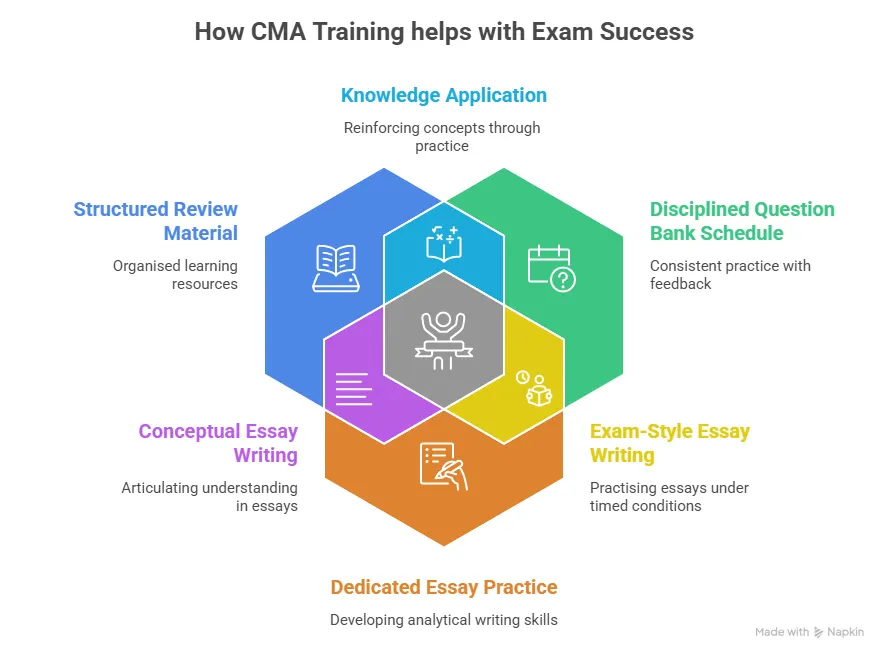
Also Read: Smart guide to plan CMA course fees for every finance aspirant.
Who Should Actually Pursue US CMA Training?
From what I’ve seen, US CMA training makes the most sense if your career ambitions sit clearly in one of a few areas: financial planning and analysis, management accounting, corporate finance, internal controls, or the CFO track. If you’re aiming to influence how a business makes decisions – not just how it reports outcomes – the CMA curriculum maps directly to that work.
| Ideal Candidates | Why US CMA Training Is Useful |
| Finance & Accounting Graduates | Builds strong expertise in management accounting, cost analysis, and strategic financial decision-making. |
| FP&A Professionals | Validates and deepens the exact skills used in budgeting, forecasting, and variance analysis. |
| Cost & Management Accountants | Provides formal recognition of expertise that employers increasingly expect at mid-senior levels. |
| Corporate Finance Professionals | Adds rigorous credentials in investment decisions, risk management, and capital structure. |
| Internal Auditors & Controllers | Strengthens understanding of internal controls, compliance, and performance management. |
| MBA (Finance) Aspirants | Complements an MBA with specialised, globally recognised management accounting expertise. |
| Working Professionals Targeting CFO | Positions you as a strategic finance leader, not just a functional accountant. |
Don’t pursue the CMA because it sounds impressive. Pursue it because the skills it certifies are exactly the skills your target career requires.
Many students struggle not because they lack knowledge, but because they’re used to rote learning. CMA tests whether you can think like a finance professional, not just recall formulas. To get a more practical perspective on this, watch this:
Choosing the Right US CMA Training Program
This is where the decision becomes genuinely practical. The quality of CMA training programs varies meaningfully, and that variation shows up directly in pass rates, not just claims.
From what I’ve seen evaluating CMA training programs, a CMA institute worth your investment shares a few consistent characteristics:
- Instructors with real practitioner experience – not just academic credentials. You want someone who’s worked in management accounting and understands how the concepts play out in practice, not just in textbooks.
- Structured mock exam programs – the gap between understanding concepts and passing the actual exam is bridged almost entirely by timed practice under realistic exam conditions.
- Strong study material – curated, exam-focused content that supplements the IMA’s Learning Outcome Statements without burying you in everything that could theoretically appear.
- Transparent pass-rate data – any program that can’t give you a credible breakdown of student outcomes should give you pause.
- Essay section support – the MCQ section is well-served by most providers; the essay section is not. Prioritise programs that take the written component seriously.
Ask any training provider you’re evaluating for their Part 1 and Part 2 first-attempt pass rates – not their overall pass rates. The distinction matters, and a provider that tracks this data is a provider that cares about outcomes.
Also Read: How CMA after graduation unlocks great career opportunities.
Online vs Classroom US CMA Training
The rise of CMA training online and the CMA online course has genuinely changed how candidates prepare, and for the better, in most cases. Here’s a simple approach that you can follow to choose a suitable mode of training:
| Your Situation | Recommended Approach |
| Working full-time, strong self-discipline | Online CMA training with a structured personal schedule |
| Need accountability and regular deadlines | Live online or classroom-based program with cohort sessions |
| Want flexibility but need periodic support | Hybrid: self-paced content + live doubt sessions and mock reviews |
| First-time candidate, limited accounting background | Instructor-led program strongly recommended |
| Retaking after a failed attempt | Targeted coaching focused on weak areas + heavy essay practice |
The combination of both formats consistently produces better outcomes than either pure self-study or rigid classroom-only formats.
Before you decide how to approach the US CMA, you need to understand one thing clearly – Part 1 and Part 2 are not just two exams; they test two very different skill sets. This breakdown will give you clarity.
US CMA Training Material
When it comes to preparing for the US CMA, most students overcomplicate things. In reality, your resources fall into two simple buckets: what the exam expects and how you train for it. If you get this balance right, your preparation becomes a lot more focused and less overwhelming.
IMA Learning Outcome Statements (LOS)
Think of the LOS as your exam blueprint. It tells you exactly what the exam can test – nothing more, nothing less. But here’s the catch: it’s not a study material you sit and learn from.
Use it as a checkpoint tool:
- Are you covering everything that can be asked?
- Are there any blind spots in your prep?
Most students ignore this, and that’s how gaps get created.
Third-Party Review Courses (Gleim, Wiley, Becker, Hock)
This is where your actual studying happens. These providers take the full CMA syllabus and turn it into something structured, condensed, and exam-focused. And honestly, most successful candidates rely heavily on one of these.
Each has its own edge:
- Gleim → strong for deep practice and large question banks
- Hock → especially helpful for essay preparation and explanations
- Becker / Wiley → more structured, classroom-style learning
There’s no “perfect” provider or best CMA books – the key is to pick one and stick with it instead of jumping between multiple sources.
Question Banks
If there’s one thing that truly moves the needle in CMA prep, it’s this. You should be solving thousands of MCQs, not a few hundred. Why? Because the exam is less about memorisation and more about pattern recognition. The more questions you solve, the faster you start recognising:
- How concepts are tested
- where traps are set
- How to manage time under pressure
Reading alone won’t get you there.
Essay Practice
This is the part most candidates underestimate, and it’s exactly where many lose marks. In the last 4-6 weeks before your CMA exam, essay practice should become a daily habit, not an occasional activity. And not just casual practice – you need:
- timed attempts
- structured answers
- clear reasoning
Because in Part 2 especially, it’s not enough to know the answer – you need to explain your thinking clearly and quickly.
Most candidates don’t fail the CMA because the content is impossible. They fail because:
- They rely too much on passive reading.
- They don’t practice enough questions.
- And they leave essays for the last minute.
If you fix these three things, you’re already ahead of a large chunk of candidates.
Also Read: Explore how the CMA salary in India compares with global salary ranges.
US CMA Training and Career Opportunities
I get this question constantly: What will the CMA actually do for my career? Here’s my honest answer.
The designation significantly improves your access to senior roles in financial planning and analysis, management accounting, corporate finance, and the CFO track. In these fields, the CMA is increasingly moving from a differentiator to an expectation at mid-to-senior levels. It tells hiring managers that you’ve gone beyond the mechanics of accounting into the strategic and analytical dimensions of financial management.
Where you should reduce your expectations in CMA jobs: the CMA doesn’t replace experience. Candidates who pass both parts and expect immediate seniority are often disappointed. The credential accelerates your trajectory – it doesn’t replace the years of actually doing the work. Here’s how the typical salary difference of a CMA vs a non-CMA looks in the US:
| Career Stage | Without CMA | With the US CMA | Salary Uplift (Approx.) |
| 0-2 yrs experience | $55,000-$75,000 | $65,000-$90,000 | +20-30% |
| 2-5 yrs experience | $75,000-$100,000 | $90,000-$125,000 | +20-30% |
| 5-10 yrs experience | $100,000-$140,000 | $130,000-$175,000 | +25-35% |
| 10+ yrs experience | $140,000-$200,000 | $185,000-$260,000+ | +30-45% |
(Source: IMA Global Salary Survey data and industry benchmarking) Figures represent US market medians and vary by industry, company size, and location.
The strongest returns I’ve observed come from candidates who pair the CMA with two to four years of relevant experience. At that combination, the credential and the track record reinforce each other powerfully.
Timeline Guidance:
Most candidates who are working full-time complete both parts in 12-18 months. The IMA recommends studying for approximately 150-170 hours per part. If you budget 12-15 hours of study per week, you can realistically complete each part in three to four months.
Is US CMA Training Worth the Investment?
Let’s address the question everyone wants answered but sometimes hesitates to ask directly: Is CMA training worth the financial commitment? And can I find CMA training near me?
The honest version: yes – for the right candidate, with the right career direction. The CMA pays off most significantly for professionals who pair it with relevant work experience and a clear target in management accounting or strategic finance. The credential accelerates your trajectory into higher-paying, higher-influence roles. But it multiplies your existing experience – it doesn’t substitute for it.
The CMA is most financially impactful in FP&A, cost management, and corporate finance roles, where it’s becoming a baseline expectation at senior levels rather than a bonus credential. It can meaningfully accelerate your entry into roles that might otherwise take several more years to reach.
The candidates who see the strongest returns are those who combine the CMA with strong communication skills, genuine business thinking ability, and a clear sense of the career they’re building. The credential opens the door – you still need to walk through it prepared.
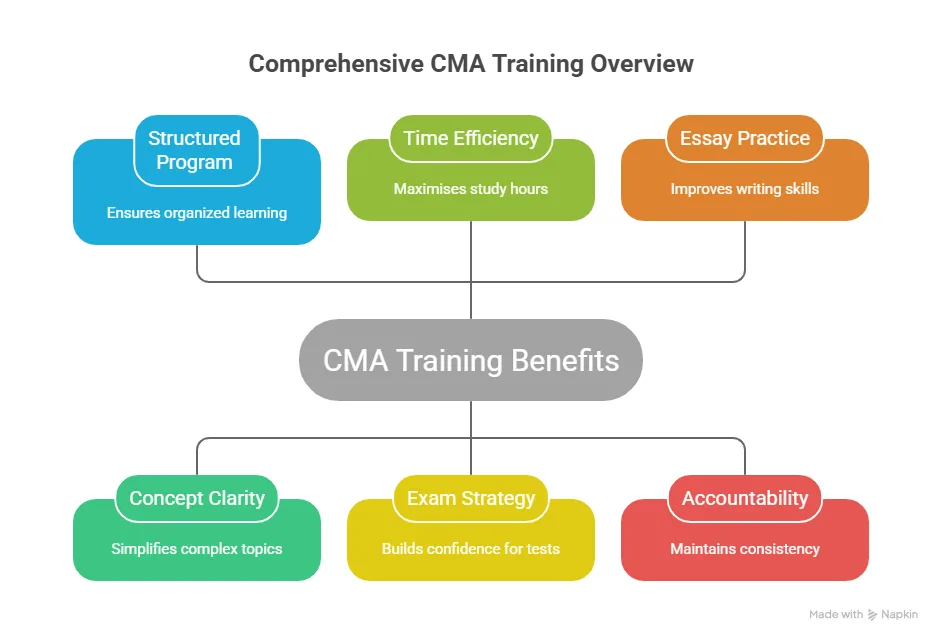
Also Read: How online CMA classes help you boost exam preparation.
Why Students Choose Imarticus Learning for US CMA Training
The first thing that matters when choosing a CMA program and Certified Management Accountant training provider is whether the preparation actually connects to real exam outcomes and to real work. Here’s what makes Imarticus Learning a great choice:
India’s Only IMA Gold Learning Partner – Imarticus holds IMA Gold Status – the highest recognition awarded by the Institute of Management Accountants globally, earned through rigorous audits of student outcomes, content alignment, and faculty standards. It’s a compliance mark that the IMA awards only to providers whose programs meet its own benchmarks for quality.
The Only Authorised Provider for India’s Top Five Finance Certifications – Imarticus is India’s first and only authorised preparation partner for all five of the world’s most recognised finance certifications: the US CMA, CFA, US CPA, ACCA, and FRM. That breadth signals something important about the seriousness of the operation.
KPMG in India Partnership – This matters because the CMA exam tests applied judgment, not just theoretical recall. Candidates who’ve worked through real business scenarios – not just textbook examples – handle the essay section and application-based MCQs with a level of comfort that purely exam-focused prep doesn’t build.
A Pass Guarantee – Imarticus is India’s only US CMA training provider that backs its program with a formal pass guarantee. If you don’t clear both exam parts under the program terms, you are eligible for a 50% refund of the course fee. A provider only makes that commitment when the system behind it is proven – from instructor quality to study material depth to mock exam structure.
Surgent-Powered Material, Personalised Mentorship – The study material at Imarticus is powered by Surgent – one of the most respected CMA exam preparation platforms globally – combined with Kaplan books, curated MCQ banks, timed mock exams, video modules, and digital flashcards.
Strong Hiring Network – Beyond the exam, Imarticus offers structured career support: pre-placement boot camps, resume and interview preparation, and assured interview opportunities across its network of 3,500+ hiring partners.
FAQs About CMA Training
Here are some of the most frequently asked questions candidates ask repeatedly about CMA training, not because they haven’t researched well, but because they want a straight answer and clear guidance.
Is online CMA training as effective as classroom training?
For genuinely self-motivated candidates with structured schedules, online CMA training works very well and often produces better outcomes than classroom programs, because the flexibility supports consistent daily study. For candidates who lose momentum without external structure, and most people do, if they’re honest, a live program with scheduled sessions and accountability is worth the additional investment.
What jobs open up after US CMA training?
The credential was built for management-oriented finance work, and that’s where it opens the most doors: FP&A analyst and manager roles, cost accounting, financial controller, treasury, internal audit, and eventually CFO or VP of Finance positions. If you’re targeting those roles, the CMA sends a strong signal to employers that you’ve formally mastered the skills the job actually requires.
How long does US CMA training take?
Most working professionals complete both parts within 12 to 18 months of dedicated preparation. Each part typically requires 150 to 170 hours of structured study at institutes like Imarticus Learning. It usually takes three to five months of consistent effort, which requires 10 to 15 hours per week. Move at a pace you can sustain without cutting corners on the material; that approach almost always finishes faster than the cycle of cramming, burning out, and repeating.
What is the difference between CMA training and self-study?
The study material is largely the same. The difference is everything that surrounds the material: structure, accountability, faculty access, essay practice, and a peer group to study with. The candidates who succeed with pure self-study tend to have two things in common: a strong background in the subject matter that gives them a head start, and an unusual capacity for disciplined self-direction over several months. If you’re confident you have both, self-study is a good path. If you’re uncertain about either, structured training is the lower-risk investment.
Can I complete CMA Training while working full-time?
Yes, and most people who clear the CMA do exactly that. A structured approach is simpler to follow while working full-time. Build your study plan around your real life. If you can manage 1.5-2 hours on weekdays, add a slightly longer session on weekends. Keep it sustainable, not ambitious. Twelve focused hours every week will beat twenty “planned” hours that actually become eight. And if you can maintain that for 3-6 months per part, clearing CMA alongside a full-time job is absolutely realistic.
What is the training period of CMA?
There’s no fixed training period set by the Institute of Management Accountants. What matters is how long you take to prepare for and clear both parts. Most candidates typically follow this timeline:
- 3-6 months per part
- 6-12 months total to complete the CMA
It is recommended to maintain consistency rather than rushing and risking a retake.
How to do CMA USA Training?
Students feel lost before starting CMA training. It’s simpler than it looks if you follow a structured approach:
- Understand the Syllabus
- Choose one reliable primary study resource.
- Don’t separate learning and practice.
- Identify weak areas early.
- Start essay practice early, especially for CMA Part 2
- Revise Strategically and in the final weeks, focus on high-weightage topics.
- Take mock tests under exam conditions.
If you stay consistent, CMA is absolutely manageable – even alongside work.
Build Your Career with US CMA Training
Finance careers are built on decisions. And the decision to pursue the CMA to go through the preparation, earn the credential, and develop the skills it certifies tends to compound over decades of a career.
I always tell people on the fence: the real question isn’t “is CMA training worth it?” The real question is: “worth it for what specific outcome?”
Get clear on where you want to be in five to seven years. If you’re aiming for roles in FP&A leadership, the CFO track, or strategic corporate finance, and you want a globally recognised credential that signals exactly those capabilities, then the US CMA is worth pursuing fully. Commit to the process, choose a training program that fits your learning style and schedule, invest in quality study material, and build a plan you can actually sustain.
Among the credentials available to management accounting and corporate finance professionals today, the US CMA offers a rare combination: deep curriculum relevance, global recognition, and a clear salary premium that compounds with experience. The CMA course is valuable precisely because it’s not easy and not everyone who starts it finishes. If you go in with clear intent and genuine discipline, it can be one of the best investments you make in your professional life.
