What is Agile Scrum? Agile Scrum Master Tutorial Guide for Beginner

Are you a tech geek and have heard of terms like scrum, agile, sprints, backlogs and more? Well, these terms have become a part of the language of floors with cross-functional teams. Let’s explore the agile scrum tutorial to be able to better understand how prioritizing and efficient backlogging can help use Agile Scrum values to resolve complicated issues and hurdles in achieving productivity through rapid release cycles.

Agile Scrum master tutorial guide for beginner

This step-by-step tutorial will help you understand these following topics.

  • Basics of Agile.
  • Fundamentals of Scrum.
  • Scrum features.
  • The persons in Scrum Framework.
  • Implementing a basic framework in Scrum.
  • Why use Agile Process.
  • Why iteration is needed.

What are Scrum and Agile?

Though the terms are used together scrum and agile have an important differentiator. Agile is described in its manifesto and is the complete method-set applicable to team collaboration, cross-functionality, self-organization and more. Scrum, on the other hand, is used to execute Agile. Just as a recipe embodies the diet-plan, so also scrum embodies Agile and hence the terms are often interchangeable.

What are the Scrum features?

Scrum can effectively quicken the process and time taken to achieve the desired results. This is so because Scrum values help not just developers, but also the other teams like DevOps, marketing, production and everyone who uses the methodology and framework.

The Scrum Agile Roles:

The roles that are normally used are those of the Agile-expert/coach, ScrumMaster, Scrum product-owner, Scrum-developer, etc. Mainly it is team-work of Scrum members where all are equally communicative, collaborative and contributive within the Scrum framework.

Scrum Methodology:

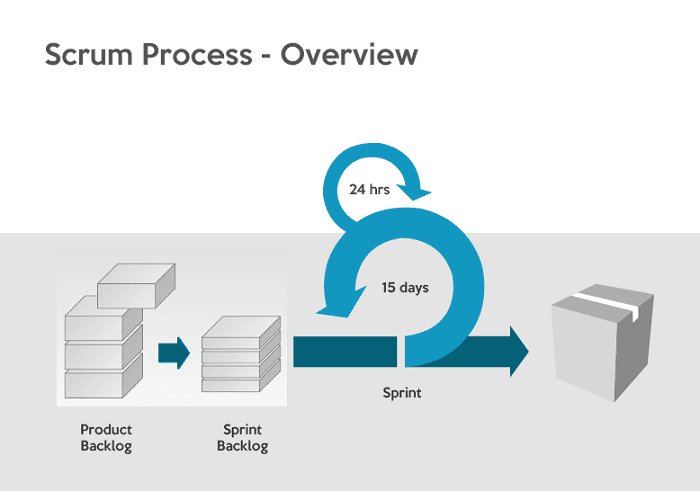
The normal flow of the Scrum methodology is as below.

  • The SPO/Product-Owner is client facing and is the final authority to bring 100% user requirements and product parameters to the team.
  • The SPO defines Backlog and how it is prioritized.
  • The time-boxed Sprint sets the framework to enable the team task of completing all tasks related to the backlog within the preset-time framework.
  • Teams huddle together in Daily Scrums to review their daily progress and targets.
  • The Retrospective forms the Review-Meet to assess the results of the Sprint and use the learning for the new Sprint.

While learning the principles is easy it is the efficient practices of Scrum that take time to learn and practice.

How to implement a basic framework in Scrum:

  • The Scrum website provides a downloadable file in PDF format to help define the framework.
  • Learn all about your role as an SM and as the unofficial Project Manager especially about conflict resolution, hurdle removals and ego-clashes in teams. Scrum team members are equals striving to achieve a common goal and hence cannot afford ego clashes and team conflicts.
  • Backlog creation is an important task leading to proper prioritization of the project. Though this is initially incomplete the SPO adds details and client requirements to enable clarity and progress with the backlog.
  • The Sprint is where the team will decide on how to work on the prioritized backlog tasks within the allocated time-frame.
  • In the next stage, the Scrum team members execute their tasks in a self-organized manner where you may need to play the enabler, hurdle remover and constant supervisor of the Daily Scrum progress. This is where what each member did yesterday and what they will do today is of utmost importance to review.
  • The Retrospective is meant for feedback, review, testing and evaluation on how to move forward and improve the upcoming sprint.
  • The Sprint ends and the next sprint will begin with a new backlog item.

In parting, the transparent Agile Scrum methodology breaks the entire project into achievable products that are viable and executed in short Sprints. Due to progress being constantly reviewed this means frequent changes, evaluation and testing.

Rather than spend on one complete project that becomes unviable later, it is a very attractive feature of Scrum that smaller market-ready products are frequently released, providing for feedback incorporation and iteration. Thus Scrum enables efficiency in production and anytime iteration in a product lifecycle.

An efficient Scrum Master can be either self-taught or use a CSM Course from a reputed institute like Imarticus Learning to learn Agile Scrum practices and earn his CSM certification. All the best in Scrum learning!


What specific technical skills does Business Analyst need?


The career of that of a Business Analyst that you can achieve through a business analyst certification is one that requires varied technical skills, general skills and requires one to be consistent, hardworking and patient in their business approach to become a strong Business Analyst professional and a leader in the industry.

Let us go through what skills and techniques help a business analyst become a better professional. 

  1. Develop one’s modeling skills consistently– As a business analyst tools and techniques that involve process modeling are extremely helpful and efficient for the professional life of a business analyst. Visual representations and other forms of modeling helps one gain deep insight into business problems, and helps in understanding where the leaks are, and helps cover them. You can gain more insight into this through a business analyst course.
  2. Stakeholder management – As a business analyst, you will learn that your business projects and operations are absolutely nothing without the stakeholders. They make up more than sixty percent of your business impact and understanding their needs, requirements, and standards, delivering their desired results, are always a must if you wish to lead your business projects towards successful completion.
  3. Documentation skills and writing skills – As a Business Analyst you will engage with the preparation of various types of documentation processes and the types of documents can also vary depending on the size of your company/organization. Your writing skills need to be strong, pleasant, simple, direct and you must avoid as much jargon as possible so as to be able to appeal to a greater number of people.
  4. Time management – As a business analyst, you must learn how to manage your time successfully. This helps you in delivering the projects and their successful completion on time. It is also useful to know which projects or tasks to prioritize and which ones need more time/focus and delegates them accordingly. Sometimes as a business analyst, you may end up multitasking but here too you must understand that time management and effective/efficiency of time is very significant to your overall success.
  5. Presentation skills – Presenting a project pitch or holding a workshop for the awareness of your company’s colleagues are an important task that cannot be effective or have a positive impact without excellent presentation skills. To hone your presentation skills you must know what are the topics to be covered, how can they be presented to your audience in a sincere, direct and engaging manner, and how you can deliver your project’s promises to your stakeholders so that they agree to your projects’ success potential.
  6. Listening abilities – As a business analyst you must possess a deep desire to understand and learn from your stakeholders, their concerns and targets, learn about your company’s strengths and weaknesses by constant interaction with your colleagues and staff. When you give the other person the opportunity to speak, you must listen in keenly and also engage in absorbing information which can later help you create and meet stakeholders’ concerns and demands. Sometimes, only when you listen carefully can you find answers to some of the deepest, lingering business queries you may have.

How much time does it take to become a Full Stack Developer?

How much time does it take to become a Full Stack Developer?

All of us have this doubt about every learning journey we are about to take. Learning, especially something complex as web development is a major investment of energy, time and opportunity cost. So, it is natural to be curious about how long it will take to reach your goals. However, despite this being a common query, it is not easy to put a solid number on how long it will take you to become a full-stack developer. This article attempts to give you an idea about the full stack learning procedure and how much time it could take.

What is actually full stack?

We know that traditionally, the developers were categorized into two.

  1. Front-end Developers – Who handle the user interface and user experience architecture of an application.
  2. Back-end Developers – Who designs and handles the interactions between the server and the database.

Later, with the evolution in customer requirements and associated technologies, a new breed of developers was born. They are full stack developers. Unlike their predecessors, full stack developers are not specialists of a single end. They can handle both back-end and front-end operations. Obviously, to handle all this work, you should have proficiency in a couple of technologies as a full stack developer.

To be a Full Stack Developer

A full stack developer can be called as a jack of everything but master of none. You have to cover a relatively long list of skills to become one finally. In short, you should be able to:

  • Carry out core programming
  • Build the front-end and handle user interactions with the application
  • Design the business logic and application’s interactions with the database.
  • Handle the data of your application.

It should also be noted that if you are trying to learn enough full stack development for a rudimentary application, you might succeed in one or two months. You can join a full stack developer course and readily learn it. However, it takes more work to become a professional full stack developer. The individual tools, frameworks, and libraries will keep changing all the time, but the fundamentals never change, and your learning should be concentrated towards those basics.

Mastering the Fundamentals

Mastering the fundamentals of full stack is a long process and takes time. Often you will find it difficult to focus on the process and jump ahead when you think they know something. It is quite natural and should be taken care of. In the very beginning, while you are exploring each skill, you find your confidence rising. But, that is only the first stage of the process.  Soon after that, you will realize the difficulties associated with it your doubts will start to increase. In this period the progress will be very slow and hard to measure. In the next stage, you will really start to learn things and make progress in the process.

What I am implying here is that you can’t actually predict with certainty how long it will take you to become a full stack developer. This gets harder if you want to become really good at it. A good full stack developer tutorial can take you really ahead in the process, but being a professional takes practical experience. So, a good suggestion is to worry less about the time and focus on the process. You will most probably end up exceeding your original goals in a shorter period.

What skills are required for Full Stack developer?

What skills are required for Full Stack developer?

This is the era of digitisation, and many businesses and organisations have established a distinct online presence through their websites. So naturally, the web development domain is experiencing unprecedented growth, resulting in a significant increase in demand for experienced and skilled Full Stack Developers. 

Innovations and developments are taking place everywhere, creating new positions to support them. The full stack developer is such a position created by innovation and technologies. This article discusses the skills required to become a successful full-stack developer.

What is a Full-Stack?

A web application or website’s development process has three sections. They are Front-end, back-end, and database-related methods. Traditionally, there are different developers for different end development. These developers are experts in one area of action—for instance, Front-end and back-end development. But the full-stack developer is an expert in all three sections.

Later, a new set of developers was born with the associated technologies’ development. They are full-stack developers. In simple words, a full stack developer is a programmer who can work equally well with both front-end and back-end technologies. Full-stack developers are an all-purpose resource in the development process.

To become a full stack developer following skills are required and are critical to getting the job. So let’s get into the details.

Skills of a full-stack developer

As we said earlier, a full-stack developer has to be proficient in both back-end and front-end operations. So, the list of skills required is a little longer than the usual job titles.

Front-end development

HTML/CSS: let’s begin from the basics. HTML and CSS are two basic building blocks of web development. While HTML allows the developers to add content to the website, CSS enables alteration in the look of websites or applications.

JavaScript

This one is also an essential skill. JavaScript is a mandatory language to make a career out of full stack development. A survey conducted in 2016among the developers suggests that JavaScript is the best-suited programming language for full stack development.

Cascading Style Sheets (CSS)

CSS improves the visual appeal of a website’s content. CSS is a style sheet that allows changing the font, size, spacing, and other aspects of the web component and style. How HTML elements should be displayed on the screen is also defined here.

Back-end Languages

To handle the back-end processes, at least one of the following languages is a must for a full-stack developer.

  • Java
  • SQL
  • C#
  • JavaScript
  • Python
  • C
  • PHP
  • IOS
  • RUBY/RAILS

Naturally, it is better to have fluency in more languages. However, an excellent full-stack developer should work towards an ultimate proficiency in one chosen language.

HTTP/HTTPS

HTTP and HTTPS application protocols are essential for communication between clients and servers. Moreover, HTTPS holds value nowadays due to the growing security concerns.

Databases/Web Storage

The developer has to use a web storage facility to store data while developing websites and applications. So, the concepts behind relational databases and memory storage are mandatory for full-stack developers.

Web Architecture

 It is one of the more advanced skills. A developer must know how to structure their code and data in the database. The design project complexity involved in the development process makes such skills almost mandatory for the job. These are the essential skills you must learn before starting a career in full-stack development. Any full-stack developer course will consist of all these technologies as part of their syllabus. Also, remember that it is essential to practice these skills just as attending a full stack developer tutorial.

Who is Full Stack Developer?

Who Is a Full Stack Developer?

From the early days of software development, each developer is defined by the sector he works in. So, in that sense, a developer who works on the back-end is a back-end developer, and a developer who deals with the front-end is a front-end developer.

There are a considerable number of professionals working in this career field. This article helps you understand who is a full stack developer and how they differ from traditional developers.

What do Full Stack Web Developers do?

A full-stack web developer is someone who has experience writing both client-side and server-side code. They are proficient in HTML and CSS, as well as programming for servers, databases, and browsers.

The front end and back end of web development must be understood in order to fully appreciate the responsibilities of a full-stack developer.

The user interacts with the application’s front end, which is the visible portion, while the back end houses the business logic.

Front-end and Back-end Developers

A front-end developer’s responsibility is to build the user interface and the user-experience architecture of a software or website.

They have to work with the designers to create and improve the UI/UX of software. An experienced front-end developer can precisely recognise every possible issue that might affect the user experience. He can also provide suggestions and coding solutions to make the design more attractive.

The back-end developers, on the other hand, handle the server and data side of the project. It is they who build the application and design its interactions with the server and database. They have to manipulate data and work with private and public APIs.

A qualified back-end developer would have great expertise in Linux/Windows as a development and deployment system. Insights on various version control systems such as GIT/SVN are also a requirement for this job.

What abilities do full-stack developers need?

A Full Stack developer ought to be knowledgeable about:

  • Basic languages – HTML, CSS, and SQL are examples of basic languages that must be mastered.
  • Front-end frameworks: JavaScript, TypeScript, AngularJS, VueJS, ReactJS, Python, Ruby, and PHP
  • Back-end frameworks: Ruby on Rails, Django, Express, and NodeJS
  • Various databases, including MySQL, SQLite, Postgres, MongoDB, Cassandra, Apache Storm, and Sphinx

Git, machine learning, SSH, Linux command, data structures, and character encoding are additional abilities that are advised.

The Rise of Full Stack Developers

The front-end and back-end developers are specialised positions among developers. However, as customer requirements evolved with time and became more complex, a team of engineers started to create helper libraries and frameworks for the software development process.

One of the most common examples of such a library is jQuery. This library made JavaScript development in browsers much easier and feasible. Some other popular examples are AngularJs, Knockout, Backbone, and EmberJs. Similar progress was happening in the back-end technologies as well. This sector introduced popular frameworks Zend, Symfony, CakePHP for PHP, and CodeIgnitor for Ruby on Rails.

With such advancement emerged a new category of developers, the full stack developers. This new set of developers blurred the lines between back-end and front-end developers. One of the crucial factors behind the popularisation of this role was the rise of startups. These jack-of-all-trades developers can provide a full package and work cross-functionally on the entire technology stack of the organisation. Both developers and companies benefit from this arrangement.

If this career interests you, join a Full-stack developer course and acquire the skills required for this job. As a full-stack developer, you will be expected to have a fair amount of proficiency in technologies such as HTML5, CSS3, Python, Ruby, MySQL, MongoDB, etc. A full stack developer course will help you make this process faster, but it is also important to have some practical experience in them before entering the industry.

What are the latest trends in full-stack development?

(AR+VR) Mixed reality low-level programming. language fashions. Web apps that are progressive.

Sharpen Your Knives -Making Agile a Reality

According to the reports of a joint study by Forbes magazine and Scrum Alliance, Agile-suites have become the buzz word of the latest models for SME businesses and across sizes that include startups, large companies with cross-functional teams, and everything in between. Being so is synonymous with faster marketing times and efforts, improved financial results, rapid innovations, and better workplaces.
Management practices today demand the implementation of effective change management, constant changes in requirements of the backlog, and snapping free of traditional ladders in organizations to scale and transition to a Scrum-Agile environment.
The Agile transitioning parameters:
The all-important parameters when training and recruiting for a successful agile organization are:
Developing talent:
Upskilling and certifications are the norms today with many large organizations retrenching the employees who do not up-skill. Agile environments require developing Scrum minded talent. An aspirant for agility needs formal training, a can-do attitude, creativity, and innovative capacities to learn rapidly, enthusiasm for the Agile thinking, knowledge of Scrum practice, change management skills and effective CSM’s motivation.
Stability and Loyalty in employees:
Crucial to all growth is its dedicated workforce. One of the best means to earn these parameters is to retrain employees interested in change and the benefits including financial ones that such changes can bring in.
CSM/ Coach Motivation:
Being transitioned needs a knowledgeable, certified coach or SM to lead by example. Staff motivation and retention sees an upswing when the organization is committed to collaborative work culture, where loyalty and retention may depend on the rewards, biasing Scrum environments effectively, re-skilling and training and many more such factors.
Employee Skills:
Retraining employees is possible by doing advanced courses at Imarticus who are reputed globally for their excellent courses. Agile does encompass technological changes incorporation and cross-functional knowledge of fields like Big Data analytics, Deep and neural networking,  AI, ML and visualization techniques which will need to be over-hauled and re-trained for effectiveness.
 Perceptual changes:
The very success of the technology and framework lies on adapting the uniform mindset required to become self-organized. Lip-service is insufficient and involvement from the grassroots levels up-wards will need drastic Agile changes in perception.
The benefits that accrue:
1. Scrum tools ease the process of managing the Scrum projects even if they work remotely.  These tools are reliable, help the teams to work, aid team collaboration, and facilitate the team’s and organizational productivity: Ex: Jira, Scrum Vivify, Manuscript, Scrum DO, Axosoft, Targetprocess, QuickScrum, Yodiz, ScrumDesk,   ScrumWise, Zoho sprints, and ClickUp.
2. The Scrum success story has spurred recruitments in large, medium and startups including Philips, Honeywell, Dell, Siemens, Accenture, Capgemini, Allstate Insurance (India), Informatica, and Zensar Technologies. Scrum tools are conducive to remote-working and are extremely reliable across platforms, technologies, and types of teams. Life in an Agile-Scrum cross-functional team of experts is an excellent aid in collaboration, communication, and contribution of the true Scrum team members. No one is different in the framework and success depends on the team performance spurred by an able SM.
3. Scrum has the potential the playing ground of organizations and is poised to affect everyone in the environment.
Why being Agile has become popular:
The changes brought about by the transformation are welcomed by employees and organizational management alike because

  1. The agile work-hierarchy has turned flat and encourages the thinking of all as Scrum team-members who are equal and work collaboratively.
  2. Over half the organizations have transitioned successfully.
  3. The framework has included effective Scrum mentors and Agile coaches to help and aid the teams to perform better.
  4. Re-training is easy by doing a formal course at Imarticus.
  5. Agile framework and Scrum values have very many benefits for the organization including efficiency and productivity with rapid time-boxed frequent viable products releases.
  6. The methodology is actually a philosophy that is equally applicable in personal tasks and life.

Conclusion:
Agile running on a Scrum framework is akin to sharpening the blades of success. Everyone from a flexible director and project manager, the self-organized Scrum team, the crucial strategy of an Agile Coach’s role, and the transforming mindset are set to impact everyone in the chain and across processes. Do a good pro degree with Imarticus in the classroom mode to get your CSM or Agile Scrum certification and contribute positively to your team and organization.

What is the role of a full-stack developer?

What is the role of a full-stack developer?

Creating an application is one of the most common jobs in the world of computer science and IT today. There are plenty of coders out there who are adept at making different applications for businesses to thrive online. However, one of the most important missing elements that a lot of IT heads tend to lapse on is that of a good full stack developer.

A full stack developer is a versatile coder who will be able to master many different skills that are essential in building a company’s profile. It is their job to oversee the various applications – both backend and frontend and ensure everything runs smoothly.

 Why should companies get full stack developers?

Full stack developers are those engineers who will be able to handle the different work of servers, clients, systems engineering, databases and so much more. Based on a project and the end-customer, you’ll need a mobile stack, native application stack as well as a web stack. Full stack refers to a collection of different technologies that are used to complete a given project.

As every project has different requirements, they also need to have a developer who understands the various software used for each element. That’s where the full stack developer comes in. Their awareness and versatility make them a crucial asset to any company looking to scale up from a digital perspective. By having one point of reference, the heads of a company will also be able to understand the various aspects of the technology being used holistically.

The “stack” in an application generally refers to the range of sub-modules that are used in the application. These sub-modules combine together to achieve an established function without a real need for any of the other modules in place.

 What does a full stack developer need to know?

A full-stack developer must be adept at the different programming languages such as PHP, C#, Ruby, Pearl, Java and so on. Most of the core businesses use these platforms to build their digital assets and a full stack developer must have at least a working knowledge of all of if not full-fledged. The structure, design, testing, and implementation must also be taken care of. If a programmer chooses Java, then they must also be aware of Object-oriented programming, J2EE component development, and design as well.

A project for any product requires a strong database in order to sustain. Full-stack developers need to understand at least one or two of the databases and also know how to interact with the database. The most popular database is MongoDB, Oracle, MySQL, Redis and so on. MongoDB is one of the more widely used internet products. Good knowledge of MySQL also acts as a great precedent to any project they’re working on.

With Imarticus, you can get all the information you need on a full stack developer courseWe also have a full stack developer tutorial in case anybody wants to know what the course is about before enrolling.

What is Full Stack Python?

What is Full Stack Python?

To understand what full stack Python is, let us start with what exactly is a full stack. A full-stack developer is a jack-of-all-trades in servers, databases, systems engineering, and facing clients. This means the:

Front End:

This is the user interface and needs language experience in CSS, HTML, JQuery, Bootstrap, JavaScript and any display-related issues.

Back End:

This involves specific languages like Java, PHP, Ruby, Python and logic or validation issues.

Database:

This deals with the storage of programs, data or queries.

A customer may specify a web, mobile or native applications stack of technologies needed to map all sub-modules into writing the most effective software program. The developer is required to use a variety of full-stack lateral designing abilities, languages, frameworks, servers and databases to rapidly develop the prototype design.

Being good at very broad-based issues resolutions they reduce the technical team-communication costs, docking of technology and time spent and are hence great business-value adds to the organization.

Their skills, active innovative thinking, creativity, collaborative and communicative skills make them very self-organized, entrepreneurial and excellent team members on cross-functional teams. That’s why start-ups and organizations that are Agile prefer them. But, having multiple skills also implies they may not have the expert skills required in any one field or area.

Python is a versatile all-purpose high-level language that is used for scientific data and other structured and unstructured data. A full-stack Python would mean expertise in using the Python suite of languages for all applications.

The best way to become a full-stack Python developer is to

  • Make a plan of action by listing all front-end languages you know and want to master.
  • Do a ‘learn full stack development course from reputed training partners like Imarticus or others. These may be in the classroom, virtual online or fast-tracked interactive courses.
  • Learn a web framework like Django and the best practices for queries.
  • Become proficient in data processing, servers, deployment of applications, and OSs.

What you learn.
Doing a course has many benefits. Importantly the course curriculum covers the following topics.

  • Use Full-Stack Django 1.11 to create a functional comprehensive website.
  • Use HTML for content and CSS to style websites.
  • Use Bootstrap in the rapid styling of websites.
  • Learn Front-End Javascript and site interactions.
  • Use jQuery with DOM, analyze HTTP requests and create landing pages.
  • Use Python to code web applications and Django as a back-end for the sites.
  • Deploy and implement a structure with Models-Views-Templates.

By learning one software technology needed for every stack part, you will be in a position to build your own software and use it to add business value to your job. It is always best to do a course since you get hands-on experience writing software and the workshop covers the in-demand stack languages. Hone your techniques, tools, documentation, and error-message capabilities at the course.

The Framework That Changes Everything

Everybody is talking about Scrum-Agile principles, its framework, and success. Well, Scrum is not a technology suite. Rather it is an implementation toolset to revamp the way organizations function and think. And this framework when looked at from its core aims and values needs to be adopted across the organization and affects every employee. Scrum has the answer to implementing productive AI, ML, VR or AR technologies and changing the very way we think across industrial infrastructures, technologies applied and size of organizations. Everyone is set to benefit and think in Scrum.
The implementation benefits:
Scrum efficiency brings great results to teams who use Agility related principles on the Scrum framework because in this philosophy it is all about being effective and robust as a team and managing projects under a talented SM to infuse the mindset, values, and practices into the equal-members Scrum team. They flourish on getting self-organized, communicating effectively and contribute through being constantly contributive in all transactions private and team-wise. Thus the talent pool allows efficient scaling and functional management.
Drawbacks:
The framework is a recent addition and is yet evolving to deal with rapid technological changes, increase in data capabilities and scaling issues. Though compatible with many evolving technologies the basic Agile premise of the main project being sub-divided into achievable product backlogs dealt with in short sprints with Scrum values implies that a uniform Scrum mindset is being applied across all processes of the organization. This is hard to achieve and can negatively impact performance, productivity, and efficiency when not adhered to. And this is true also because of the vast variety of verticals, processes, and ownership to which it is being applied.
Key Scrum functions:
Since nearly all industries wish to implement the Scrum benefits, we need to look at the core functions listed below.

  • Revamping team structures: The movement to cross-functional teams and hiring an effective CSM is at the core of up-scaling.
  • Scaling design: This cannot be isolated and needs to factor in the various strategies, compliance, and inter-departmental integration to induce Scrum oneness across the framework.
  • Monitoring the product backlog and release management: This factor is crucial in large projects and best achieved with an efficient CSM, the Scrum team and product owner working together effectively.
  • A productive backlog: This crucial element needs team consensus, constant CSM monitoring, and a knowledgeable CSPO.
  • Mentoring Support: The CSM is the unofficial manager of the team leading through effective Scrum value implementation and lies at the very heart of success as a team.

Why Scrum is popular:
Here is how Scrum is instrumental in such success.

  • The Scrum growth has been exponential in terms of its adoption by nearly 65 percent in the IT sector.
  • Scrum is effective in handling timely schedules, and preventing project costs overrun which is an important factor according to the McKinsey report for project failures.
  • The framework is simple and compatible with all verticals and sectors as long as you have an efficient SM.
  • The Scrum-Agile framework has been tried and tested across large, medium, small and startup environments successfully.
  • The SM is essentially the Scrum values leader and unofficial team manager to induce the Scrum state in all processes and persons associated.
  • Scrum requires smaller teams and results in higher efficiency and productivity across departments.
  • Scrum basic assumptions are collaborative teamwork in the framework where all are equal, self-organizing and responsible for team performance.

Conclusion: 
The software when working for Agility in Scrum incorporates items like product backlog and sprint planning features important to developing the framework for Scrum operations. But Scrum goes beyond the IT industry and can be used as an effective management practice in all sorts of situations and even in personal life. Scrum is a philosophy and is definitely set to impact all who learn it across all levels of the organization.
In parting, to imbibe Scrum effectively one will need formal training. It should involve hands-on practice on industry-relevant situations and is a process that benefits from the mentorship of a certified SM. It is also important to get your training at a reputed organization like Imarticus Learning where the Scrum Alliance issues your certification. You also earn a 2-year alliance membership for free which provides you with efficient peer-support when you implement Scrum values and transition teams to an Agile state. Why wait? Grab this opportunity today.

What Languages Should I Know To Be A Full Stack Developer?

What Languages Should I Know To Be A Full Stack Developer?

A full stack developer is someone who takes care of both the front-end and back-end of any application. The front-end is the part which the user interacts with while the back-end runs the logic, developer integration, servers, and systems engineering.

In order to be a good full stack developer, you need to have a formidable knowledge of a variety of skills and tools including programming languages. Any good full stack developer course will set aside a good portion of time and resources in order to familiarise yourself with these languages. Here are the top languages you must focus on.

  • JavaScript

JavaScript is one of the friendliest and most widespread languages used today. Most of the web’s most popular sites such as Gmail, Facebook, and Twitter use JS to provide their users with dynamic content. JavaScript is one of the most powerful languages used for front-end web development.

In addition to knowing the language, there are also many frameworks that work with JS in order to simplify the process of web development. These include Angular, React, Vue, and Ember, and you will need to be comfortable with more than one of these frameworks.

JavaScript is also used for back-end development through the Node.js framework. Node.js works well with Linux, Microsoft, Mac OS X, and Sun OS. These days it is impossible for software developers to work without having some knowledge of JS in some form.

  • Python

Python is fast becoming one of the most coveted skills in development due to its massive adaptability for complex projects. It is highly valued, particularly in science and data-driven fields. Python is one of the easiest languages to learn and is ideal for beginners. It has a wide range of applications, making it hugely versatile. You can focus on back-end development through frameworks like Django, which has been used for Mozilla, Instagram, and Spotify.

  • Swift

Swift was developed precisely to meet the demands of developing native iOS applications. If you are interested in Apple products and apps, then this is the language you should be focusing on. This language is fast, easy to debug, and streamlined which allows it to create native, high-performing, powerful native apps for iOS, Mac OS, and Linux apps.

  • Ruby

Ruby is one of the friendliest scripting languages due to its active and supportive developer community, which is why most beginners gravitate to Ruby. It has its own dedicated web application framework called Ruby on Rails which has been used by Airbnb, Bloomberg, and Twitter.

  • C#

C# is an object-driven language based on the same syntax as C language. It is the default language used when designing web applications and products for the Microsoft platforms. When used in conjunction with the Xamarin platform, you can create cross-platform apps that can release on both Apple and Android. C# is also one of the most popular languages used for VR development. It is used to build 2D and 3D video games for the VR interface.

While you can benefit significantly from a full stack developer course, it is imperative that you continue to develop your skills in these languages. They continue to grow and have more applications, and you must stay up to date.