What is the job description of a blockchain architect?

What is the job description of a blockchain architect?

A blockchain is a decentralized digital record that saves transactions on thousands of computers all over the world. These are registered in a way that prevents them from being modified afterward. Blockchain technology improves security and speeds up information transmission in a cost-effective and transparent manner.

It also eliminates the need for third parties, whose primary duty was to provide confidence and validation in transactions (such as notaries and banks).

The significant importance of blockchain has piqued the interest of companies from all industries, with the banking sector being the most active at this moment.

Certification in software engineering helps aspirants fetch lucrative jobs in this field. There are several blockchain courses available, you just need to pick the right one.

What skills do blockchain architects need?

  1. A blockchain architect is in charge of collaborating with R&D teams and incorporating blockchain into the development and design of solutions that employ cross-asset frameworks and concepts.
  2. Furthermore, you will work on new technologies and develop performance standards for appraising any new solutions. Apart from that, blockchain architect capabilities include extensive knowledge of blockchain architectural concepts and the development of storage solutions.
  3. In any case, the essential point is that the position is at the top of blockchain developer and engineer positions. As a result, the architect will be in charge of directing any blockchain-based projects and laying out the overarching strategy for the team to follow.
  4. One of the primary roles of a blockchain architect is the creation of Blockchain Product Specifications.
  5. A blockchain solution architect must be fluent in several programming languages. Furthermore, they must have advanced knowledge about these programming languages. Furthermore, your role may need you to code challenging sections of the project that no one else is capable of. Learning C++, Python, and Java is imperative in this field.
  6. As a blockchain architect, you would need to hone your leadership abilities in order to provide your team with the correct direction to ensure that any solution is a tremendous success
  7. The smart contract is a must-have for blockchain architects. Any architect of a blockchain solution must be familiar with smart contracts. It is one of the most in-demand qualities of corporate businesses.
  8. Learning cryptography is another excellent blockchain architect skill. The entire foundation of security would crumble if cryptography has not been used. It would be necessary to employ it in order to provide greater security and immutability to the system.
  9. One has to have command over blockchain development tools.

The job description/requirements for becoming a Blockchain architect:

  • A solid understanding of Blockchain foundations, consensus algorithms, and smart contracts
  • A solid understanding of the various varieties of Blockchain
  • Excellent knowledge of blockchain frameworks
  • Good command over the several consensus algorithms used for the Bitcoin Blockchain, Ethereum, Byzantine fault-tolerant algorithms
  • Strong command over cryptography
  • Build performance indicators to assess the performance of the Blockchain.
  • Preparation of a risk and failure analysis and risk prevention plan.
  • Train and advise technical employees on Blockchain tools and frameworks, Blockchain principles, and so forth.
  • Skilled in programming languages, like Go, Java, or NodeJS.

Conclusion:

An architect must be knowledgeable in the business domain in order to develop solutions that are practical rather than theoretical. At the same time, an architect must keep up with the field’s rapid evolution as it progresses toward becoming a true engineering profession. New approaches, processes, and vendor tools are constantly redefining an architect’s roles and obligations.

Every architect owes it to the software architecture community to participate and be involved in a constructive way. Blockchain is slowly getting integrated into IoT networking and eventually blockchain architects may have looked into smoothing out the relationship between Blockchain and IoT Networking process.

Many aspiring students must be looking for a Certification in Software Engineering. There are several blockchain courses available that will teach you all the necessary skills required in the field.


What is the Difference Between a Business Analyst and Project Manager

Workspaces have evolved dynamically. This has led to the creation of different job roles and functions across industries. Different key roles have come into the picture in recent times. These roles have strategic importance in the functioning of organisations of all kinds. Also, in most cases, these new roles have now become pivotal points around which the stakeholders of a company revolve.

Project managers and business analysts are now seeing the light in different corporations. They handle some of the most important functions within and outside the organisation.

Let’s know more about their roles and responsibilities.

Who is a Business Analyst?

Business Analysts analyse and evaluate huge sets of data to come to different conclusions which can later be transformed into a business decision. A business analyst has good control over data and knows how to extract important information from a pile of Data. A Business Analyst works with the organisation and drives the changes the company goes through. These people are analytical and are good with numbers.

Role of a Business Analyst

Mentioned below are some of the roles of a Business Analyst:

  1.  Tries to understand the needs of different departments and stakeholders and serve them with what they require
  2. Uses various data modelling and handling techniques to crunch data and come with important data points
  3. Forecasts and manages risks which arise during the normal course of business.
  4. Recommend business solutions to the top management to improve the processes and outputs
  5. Formulation and implementation of strategic plans to drive growth and revenues of a company.

You can take up a business analyst course to train yourself and become a better business analyst.

Who is a Project Manager?

The job of a project manager is quite interesting. He is in charge of the different work projects which are taken up by any company. He leads an entire project and manages everything that is required to make a project successful. These activities include Planning, Strategizing, Execution, etc.

Project managers also have to become good leaders as they handle an entire team. He must also know about project management as it is an elaborate task. A good project manager should have the willingness to use innovative techniques while handling different projects.

Role of a project manager

A project manager performs the activities listed below:

  1. Guide his team throughout the different phases of project management
  2. Set up expectations and goals to be achieved by a particular project and work towards achieving those goals.
  3. Track the entire project lifecycle
  4. Develop a plan to manage the entire project
  5. Ensures the completion of a particular project within the given time frame

The difference between a Business Analyst and a Project Manager?

Though the two roles sound similar they have a huge difference when it comes to their role in the organisation. A business analyst course will help you understand how business analysts are different than project managers. A project manager takes care of a particular project.

He is responsible for running that project. He has to formulate a strategy and develop processes for the completion of the project. On the other hand, the Business Analysts analyzes different data sets to come to different conclusions. His job is to analyse different trends and draw out conclusions from these observations.

Both of these roles are very different. A project manager takes up a managerial role and manages all the aspects of the project whereas a business analyst has an analytical role where he deals with all kinds of data related to the company.

What is the Difference between Business Analyst and Business System Analyst

There a lot of processes in any business. These processes/systems need to be analysed to produce maximum results. A Business Analyst focuses on the various business systems like work culture, team performance, etc. and will analyse the shortcomings.

A Business System Analyst focuses on the specific requirements of various business systems. It has a technical approach to work. The goal of both types of analysts is to create maximum result but they are different from each other. Let us see the key differences between a Business Analyst and a Business System Analyst.

Differences Between Business Analyst and a Business System Analyst

  • A Business Analyst works on the business. He analyses the working environment, working methodologies, and tries to interconnect all the processes to increase accuracy and performance. He finds out the lacking areas of a business where more input is to be required whereas a Business System Analyst is focused more on the specific requirements for any particular system.A Business System Analyst focuses on activities that drive the work processes in a business. A Business System Analyst works on a more granular level as compared to a Business Analyst.
  • A Business Analyst focuses on business problems and has mostly a non-technical approach. A Business Analyst analyses business processes through communication and brainstorming sessions.He tries to manage the business systems and keep them collective. A Business System Analyst provides his/her service when any application/software related processes are to be managed. He helps the company/firm in finding out the best services/technologies to be used to boost your processes/business.
  • Both, Business Analysts and Business System Analysts work in attracting stakeholders. They find stakeholders who are interested in company projects, services, vision and organize meetings with them. A Business Analyst works with a broader range of stakeholders as compared to a Business System Analyst.A Business Analyst finds people who are interested in the company or the company’s vision. A Business System Analyst attracts stakeholders who are interested in IT services. A Business System Analyst works closely with the technical community which includes developers, IT professionals, business architects, etc.
  • A Business Analyst is worried about the performance and morale of the employees. He uses business models that focus on working culture and strategy. A Business Analyst uses models like organizational structure, business strategy models, process maps, etc. whereas a Business System Analyst is concerned with the requirements that will fuel the processes individually. He focuses more on entity-relationship models.
  • A Business Analyst knows human resource management and can work across various domains to boost the business processes. He is aware of various business functions and strategies that will produce maximum ROI (Return on Investment) whereas a Business System Analyst is knowledgeable on a more concentrated level and has a technical approach. He is also aware of the latest technologies and trends.

Why Business System Analysts and Business Analysts are Important?

Both these professionals help in finding out the business processes which are not working to the full extent. They can find out the faulty areas and work closely to implement a successful business strategy.

They help in the creation of SDLC (Systems Development Life Cycle). Both of these professionals help companies/firms in adapting to new changes and to forecast. A lot of people are both Business Analysts and Business System Analysts due to their skills. One can find many Business Analyst courses available on the internet to learn from.

Conclusion
Both the job roles are very important for a company/firm and there are dedicated jobs for both these professionals. This article was all about the differences between a Business Analyst and a Business System Analyst.

What is the best software engineering professional certification?

Being able to concretely display your talents and abilities as a software engineer is one of the finest methods to become a competitive applicant for top employment. Obtaining certification in software engineering-related courses demonstrates to employers that you are a well-rounded and qualified IT developer, regardless if you have a restricted portfolio or experience.

software engineering coursesObtaining a Certification in Software Engineering can help you demonstrate your talents to potential employers and set you apart from other applicants by displaying your experience. Employers can trust the quality of your work in your certification area if you obtain certification from a well-known authority.
Some firms even require specialized credentials as a prerequisite for consideration for software engineering positions. Earning a range of certifications might help you qualify for more roles or even negotiate a higher compensation based on the added value that you bring to the organization.

Here is the best software engineering certificate course you must check out!

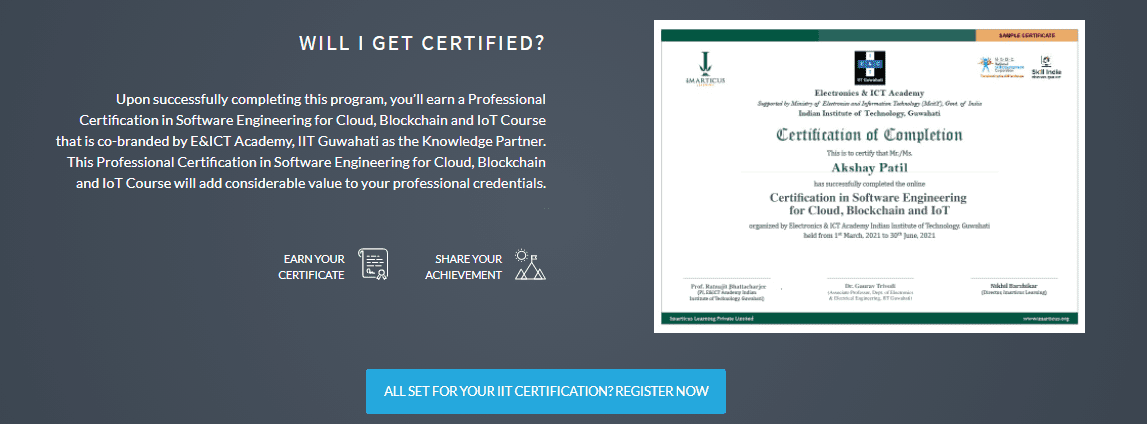
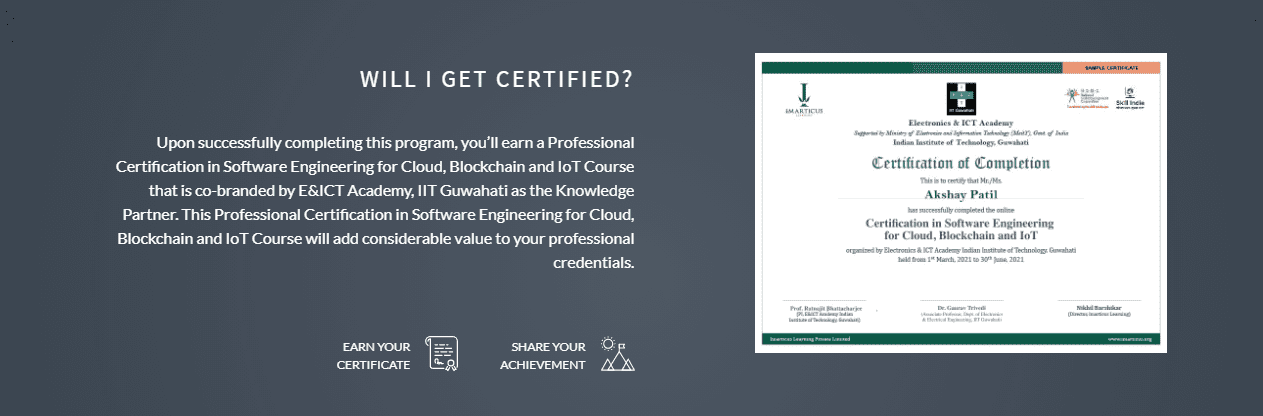
The Certification in Software Engineering for Blockchain, and IoT Cloud program was created in collaboration with E&ICT Academy, IIT Guwahati, and industry leaders to deliver the finest learning experience for budding software engineers.

You will gain a solid understanding of technology concepts, and industry professionals will guide you through the actual application of Cloud, Blockchain, and IoT in real-world projects from a variety of industries. This rigorous 9-month curriculum will equip you for the new-age Software Engineer profession, with specialization in Cloud, Blockchain, and IoT.

Perks of taking up this course:

  1. You get to learn Software Engineering skills for Cloud, Blockchain, and IoT with the most up-to-date curriculum built by E&ICT Academy, IIT Guwahati, and industry professionals.You will be able to impress employers and raise your profile with a certification from E&ICT, IIT Guwahati, one of India’s most respected universities.
  1. Engage in six existing projects that result in a Capstone Project, and master ten various tools and technologies that will help you further your career.
  2. This program allows you to gain hands-on knowledge by working on a variety of projects inspired by prominent corporations and authentic scenarios. The GitHub project portfolio, which is included in their personalized curriculum, ensures that your CV shines out in the minds of potential companies and boosts your chances of getting the job.
  3. The curriculum has been designed in accordance with NEP 2020, allowing you to transfer program credits for a period of one year.
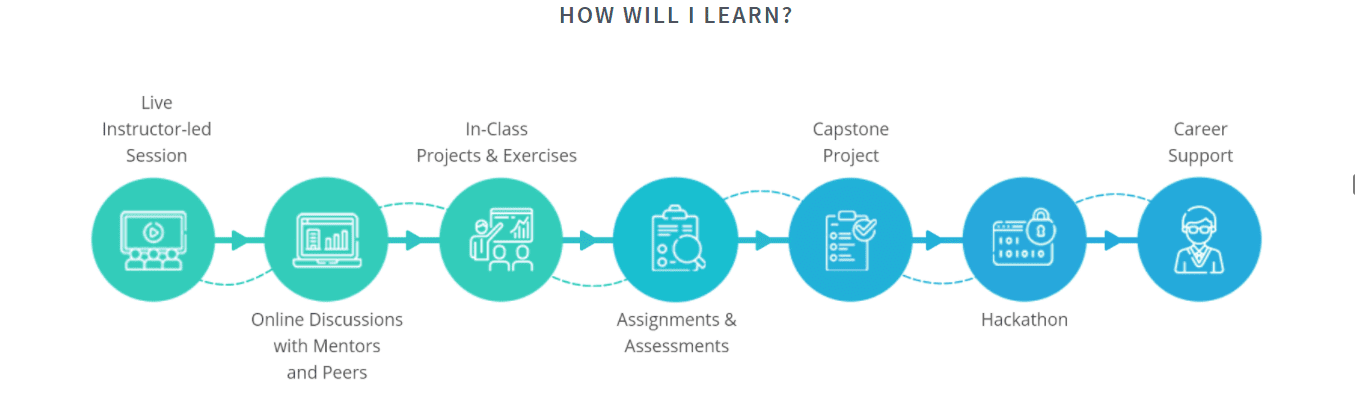
  4. You will be able to learn from India’s practical implementation experts through live online sessions and conversations. Academic Professors’ seminars will assist you in developing software engineering concepts.

Conclusion:

Increase your software engineering knowledge and abilities with this software engineering certificate course designed to satisfy the demands of professionals wishing to further their careers. A certificate course always comes in handy when you apply for jobs in your desired organizations.

software engineering coursesThere are many who have a degree from reputed colleges but it is equally important to have additional skills to stand out in today’s world where competition is so high. It is important that you have all the skill sets required to bag a good job in the industry and further your career according to your wishes.



This course has been accredited by the UGC and in collaboration with the E&ICT academy, Indian Institute of Technology Guwahati. If you are thinking of giving your career the right boost, go for this course!

What is Business System Analysis?

As the name suggests, Business System Analysis is the analysis of business systems. Different processes like team performance, the performance of business tools, human resource evaluation, etc. are analyzed by a business system analyst. A business system analyst finds ways to enhance the processes in a business.

A business system analyst works with both people and the resources available in the business. He or she interacts with the various team leaders within an organization and makes sure that every system is running properly. Problem detection is also done with the help of Business System Analysis and is managed.

The main focus of a business system analyst is to work on people, tools, systems, work environments, and optimise them. It helps in creating a better business strategy which will eventually help in growing of any particular business. Let us have some more insights into Business System Analysis.

Pros of Business System Analysis

  • The theoretical model created via Business System Analysis helps in creating a practical SDLC (Systems Development Life Cycle) model which is implemented to increase the effectiveness of business processes. SDLC includes planning, designing, development, maintenance, etc.
  • It helps in finding the shortcomings faced by the employees in terms of resources and tools. If the requirements for any particular job can be identified at the right time and employees are provided with the right guidance, they can produce better results.
  • It helps in finding tools, workers, initiatives which are taking more investment but are not producing expected results. Such processes, systems can be given a second thought form the administration. It will also help in cost optimization.
  • Business System Analysis helps in adapting to new changes. A good business system analyst can forecast and stay ahead of others in terms of working culture, technology, and resources.
  • A business analyst suggests companies/firms in finding out the best web application, software, and hardware tools which can increase speed and accuracy.
  • Risks in businesses are identified via Business System Analysis and are managed.
  • They also help in maintaining a good office culture. It helps in increasing employee satisfaction.
  • Business analysts help in meeting the market requirement. They monitor any particular process and make sure that it fulfils its objective. They try to maintain communication within employees which helps in increasing clarity.
  • They also help in proper documentation and analysis of required chores and processes and monitor them from time to time. There are many sub-processes in a business that is to be interconnected to achieve the company goal which can be done with the help of a business system analyst.

Skills Required to Be a Good Business System Analyst

  • Good communication skills are required to communicate and understand the problems of the employees.
  • A good business system analyst has good problem-solving skills. He/she can find the faulty areas within a business and can work on it.
  • Good business analysis skills are required where you can understand the processes and their architecture. A business system analyst must be able to work on various business analysis software. He/she should be able to create various analysis models like Process Flow Diagram, Data Mapping, Entity-Relationship model, etc.
  • A good business system analyst can connect to people and find out the loopholes. He/she is an excellent relationship manager and has good presentation skills. A business system analyst must be good in information systems, maths, computer science, etc. One can learn from Business Analysis courses available on the internet.

Conclusion
A company/business can generate revenue using their investments and technology but to maintain it for a longer time, trusted employees, tools are required.

A business system analyst helps any particular company in interconnecting the business processes and optimising it in such a way that it gives a maximum result. This article was all about Business System Analysis and its importance. I hope it helps!

What is a Business System Analyst Salary

The jobs today are dependent on the systems we use to do our work. Therefore, it is quite important to keep the system up and running. This brings in a need to hire someone who is an expert in the field of managing business systems and how we operate. This expert is usually known as a business system analyst.

Systems analysts are people with high order thinking ability and a diverse skill set. These people are responsible for developing projects and delivering high-quality results. Successful and high performing organizations have one thing in common: An exceptional analyst of business systems.

Who is a Business System Analyst?

A business system analyst is a person who takes up initiatives and projects of developing new business processes and drives major changes in the organization. These analysts have a comprehensive understanding of different types of business systems and how these systems operate.

They make use of the existing data sets to come up with conclusions that aid business decisions. Also, these individuals contribute immensely in achieving the organizational and strategic goals of a company.

The duties of a business system analyst

  • He performs different functions within the organization. Some of these common functions are:
    Dealing with the entire management and relevant stakeholders regularly to understand their new requirements or to know about the need for updating the existing systems.
  • They develop possible business cases and scenarios and come up with innovative solutions. Also, they map different business processes to keep a tab on the activities going on inside the company.
  • They track the performance of individuals, the progress of different projects, etc. Also, they resolve issues which arise from these projects.
  • They keep a track on the implementation of proper system throughout the organization. They work quite closely with the tech professionals working in the company.
  • They are responsible for generating performance reports for all the employees and the projects on which the company is working.
  • They build up new business information systems which might be required to adhere to the strategic needs of the company and also to align with the goals of the company.

A business analyst course will give you a better understanding of the roles a business system analyst would be expected to perform.

How Much Money Do Business Systems Analysts Make?

This job requires specialised training. Also, it can only be taken up by people who have expertise in dealing with technological products. An analyst is known for his analytical bent of mind. It is a high paying job. The average pay of a business system analysts in Australia will lie somewhere between $100K to $120K. In India, the base pay is around 9-10 lakhs which is considered to be quite good.

The companies in the US pay their business systems analysts around $69000 which is considered to be quite decent. Different companies and countries have different salary ranges for BSAs but they are paid quite well everywhere. You can keep upgrading your skills to earn even better.

How Can You Become a Business Systems Analyst

A business analyst course will be the best way to go about it. It will give you all the important information that you would need while delivering results. Also, a course will give you a better understandi9ng of how different business systems work and the kind of ecosystem these analysts build for the companies they work in. You can also go for a specialization in the field of IT, Finance, Communications, etc. to have an edge over your competitors.

What is Full Stack Development?

What Is Full Stack Development?

Full-stack development can be defined as the development of applications’ front and back end or a website. It includes the complete modelling and maintenance of a website. Let us understand the terms front end and back end.

Front end:

It is the user interface of a website or web application where the user interacts with the application’s presentation layer. The languages used during this process include HTML, CSS, and JavaScript. It comes under the presentation layer.

Back end:

It refers to the server-side of the web applications and website that mainly focuses on how it works. It comes under the business logic layer and includes tasks like data validation. It is the part that does not come in direct contact with the users. Back-end languages include PHP, JAVA, Python, etc.

Besides the aforementioned layers, work on the database layer is also done in full-stack development for extracting meaningful information and data storage.

Skills Required for Full Stack Developer

Besides having skills in the front and back end of applications, a lot is demanded from a good full stack developer. He should be well aware of web architecture and its attributes. It is expected that a good full-stack developer should have great command over-development languages like HTML, CSS, etc. Knowledge about the database, APIs and their management are also required in a full stack developer.

A full-stack developer can face situations in which he has to deal with version control systems. In addition, they are required to make prototypes or basic designs for various lucrative products we buy in the market. Therefore, a full-stack developer is always a top priority for any web development company.

Why is Full Stack Development in Demand?

Full-stack development came into the limelight very recently. Earlier, people used to develop skills only for one side, like the client or server side. However, the rising demand for absolute technology has enabled developers to work on the presentation layer, business logic layer, and many other related fields. Various talks have claimed the future scope of full-stack developers and how this domain can change the business game for many companies worldwide.

These kinds of developers offer much worth to organisations. In the contemporary world, companies are hiring these developers so that they can develop an application from scratch and can give their full participation throughout the development process of the web application or website. A person these days calls such developers “King of all trades” and believes they have an important role in today’s technological landscape.

Pros and cons of being a full-stack developer

 Pros

You can be an expert in all the tools and techniques in a development project

Being a full-stack developer, you can guide the team members

Since you have much knowledge of both client-side and server-side, you can switch anytime based on the requirements

You can easily understand new technologies better

You can even bring down the cost of a project

Being experienced, you can lower the time for a project

Cons

Being a full-stack developer can increase the complexity

The solution to a particular project can sometimes be wrong

The solution to a project is personalised

Conclusion

Full-stack development has grown a lot with the advancement of parallel technologies. Nowadays, developers are coming with smart ways to store and manipulate data. Full-stack development also addresses problems through smarter modelling and web designing. The web ecosystem should be stable so that our web application serves its purpose with full efficiency. Learn the intricacies of data structures and algorithms and prepare for a career in full-stack development with the best program – The Full Stack Developer Pro. By giving you the technical know-how of front-end and back-end programming, this program will increase your proficiency in coding and web design. We guarantee that you will be recruited as a full-stack developer by the end of the course with over 450 hours of intensive practical instruction, or we will refund your fees.

How can a software engineer become a blockchain developer?

As a breakthrough technology, blockchain has undoubtedly spawned a new branch of development, known as blockchain development. As a result, there are a plethora of work prospects for developers and tech aficionados. Many people look for jobs after completing a certification in Software Engineering.

best software engineering courses in IndiaThe two kinds of Blockchain Developers are:

  1. Core Blockchain Developers
  2. Blockchain Software Developers

In most cases, a Core Blockchain Developer is engaged in the design, architecture, and security of a blockchain system.

Blockchain Software Developers have their own set of responsibilities. These responsibilities have nothing to do with the system’s consensus design or architecture. Blockchain software developers use blockchain technology to build decentralized applications in the same way that a regular web developer uses the protocols and architectural structure established by a core web architect to build web apps.

As blockchain technology and its myriad applications gain popularity, a slew of new opportunities for software developers emerge. The blockchain developer is in a high-level position in the industry. However, because it is such a unique profession, the role is not as well-defined as other tech positions that have been on the market for a long time.

This is because a blockchain developer can be any software engineer who is qualified to work with blockchain technologies. Plus, since blockchain works closely with cloud systems, a Cloud DevOps Engineer training can also help in setting up the systems. A software engineer/Cloud DevOps Engineer can help in this regard.

best cloud engineering coursesHow can a software engineer turn into a blockchain developer?

Any software engineer may become a blockchain expert. Furthermore, the vast majority of blockchain specialists began their careers as programmers or software engineers. As a result, you can receive a standard software engineer education while also taking various specialist courses on blockchain technologies.

To flourish as a blockchain developer, you must be well-versed in essential programming languages utilized in blockchain projects. Javascript is one of the most often used programming languages in blockchain projects. Solidity would be another important language that will give ambitious developers a leg up.

It is one of the few languages to concentrate on because it is the language of Ethereum’s smart contracts. Python, Java, and Clojure are some major languages utilized to develop the majority of blockchain applications around the world.

Blockchain is synonymous with security. Furthermore, cryptography assures that blockchain networks are impenetrable. It is the branch of engineering concerned with active and intelligent opposition. Being a cryptography expert will improve your blockchain development skills as it will allow you to encrypt decentralized records, which in reality is the foundation of blockchain.

The ability of a blockchain developer to tinker with data structures to get desired results is critical to the project. As a result, as an aspiring blockchain engineer, you must grasp the applications of data structures in order to achieve exponential results in your future projects.

Blockchain projects also include UI design, request handling, and Application Programming Interface Management. Most of these tasks are performed by experienced engineers; however, full-stack web development knowledge will add extra points to your profile. It also gives you a tremendous head start because you will already have the skills needed to function in larger roles.

Here are some tips on the skills to acquire that have been laid down by IBM:

  1. Learning the basic database technology is useful for understanding blockchain and, in particular, data structures.
  2. Learn how to create digital assets, how to preserve them, and how to retrieve them.
  3. Gain knowledge about distributed computing, network formation, and how to interact and send data across point A to point B.

Conclusion:
As evident from this article, the job of a blockchain engineer is very much in demand these days. Hence, a certification in software engineering course might just be the right boost you need in order to bag placement in a good firm. Blockchains are also being used in IoT networking, and software engineers can help in integrating blockchain systems with IoT networking.

What Are the Roles of a Cloud DevOps Engineer and How To Become One?

The fields of software engineering and IT are expanding. DevOps engineering merges the development of software applications with various IT operations.

This has increased job opportunities in the industry. Various companies require the services of a Cloud DevOps engineer. Therefore, students with a bachelor’s degree in engineering can seek such specialization through an SCBI course.

What roles does a cloud DevOps engineer have?

A professional cloud DevOps engineer has many roles and responsibilities in the software engineering industry. The code changes constantly in DevOps, therefore an engineer needs to be involved in constant development and automation.

The primary role of a DevOps engineer is to find the right combination of code for the integration of the various elements in SQL data. DevOps engineers also work with IoT cloud and the development of IoT applications to update software and firmware. Apart from this, a DevOps engineer fulfills the following roles.

  • DevOps engineers deal with the entire IT infrastructure and create combinations of code that are suitable for the needs of a business. DevOps engineers are tasked with monitoring the performance of specific codes in a multi-tenant setup.
  • DevOps engineers also work in teams. Teams have to handle coding and scripting, and the challenges that arise from it. These teams develop software kits and libraries to optimize and automate various processes.
  • A team of DevOps engineers collaborates and works with other professionals to deliver tools that suit the needs of a business and OS. They are also involved in process re-engineering.

DevOps engineers are constantly designing and testing new applications. Usually, tools like Jenkins and Maven Git are used. The engineering teams work in close collaboration with the operations and development teams. This helps businesses create suitable services that improve customer experience.

These roles are ideal for DevOps engineers because they have the necessary skills. A DevOps engineer will be trained in the following aspects.

  • Scripting languages including Shell, Python, Ruby, and Pearl.
  • Operating and working with Linux environment.
  • Use of management tools like SaltStack, Ansible, and Puppet for configuration purposes.
  • Regulation of software development processes with the operations and integrations teams.
  • Handling of SaaS projects by using CI/CD processes and tools like Jenkins and Maven Git.
  • Utilization of Docker, Kubernetes, and other such tools for dealing with VM’s Containers

How to become a cloud DevOps engineer?

For those aspiring to become a Cloud DevOps engineer, a Certification in Software Engineering for Cloud, Blockchain and IoT from Imarticus Learning is the best choice. The certification is provided by the E&ICT Academy and IIT Guwahati.

software engineering courses in indiaThe curriculum of the course has been created in collaboration with industry experts.  Students will be able to participate in live sessions and interact with professionals and academicians.

Imarticus Learning’s course on software engineering provides specializations in IoT cloud and blockchain. Students are asked to complete 15 assignments. Instructors guide them through 6 industry projects that deal with real challenges.

software engineering courses in IndiaThe course is for 9 months and it prepares students to implement DevOps applications in diverse fields. The assignments and projects help students develop relevant skills for the software engineering industry. Working with industry professionals in interactive sessions will also allow students to have better exposure and hands-on experience.

The curriculum of this certification course in software engineering for Cloud, blockchain, and IoT has been designed according to NEP 2020. Due to this design, Imarticus Learning allows students to transfer their credits after a year. This makes the learning process much more flexible.

software engineering courses in IndiaTo become a successful professional cloud DevOps engineer, students need to gain industry experience.

Imarticus Learning provides live training and even includes a campus immersion program of 3 days. Students develop necessary soft skills and get placed with reputable companies.

What is the Job Description of an IoT Software Engineer and What Are the Common Interview Questions for the Role?

The job opportunities of an IoT software engineer are varied as many companies are investing in the implementation of IoT technology. Therefore, students with a bachelor’s degree in engineering should consider Imarticus Learning’s certificate course on software engineering. The course will also teach new-age skills in IoT Cloud and blockchain.

Job Description of an IoT Software Engineer

An IoT software engineer is tasked with the development of devices embedded in the IoT technology. The job description of an IoT software engineer requires skilled candidates to conduct thorough research and design sensors in connection with IoT devices.

The job also requires IoT engineers to invest considerable time and effort in testing devices. Rigorous testing is necessary to create devices that will connect seamlessly. Every feature of these devices requires different sets of coding. This is what the SCBI from Imarticus Learning teaches students. With specializations in blockchain and IoT Cloud, this software engineering course is ideal for meeting the job requirements of a well-paid IoT software engineer.

What interview questions can IoT software engineers expect?

Students who wish to become IoT software engineers will have to sit for interviews with several companies. Most interviewers ask the following questions.

  • How are IoT devices used in this age?

IoT devices contribute to the global capital. Almost every sector, including the education sector, governments, and transportation, make use of IoT devices. At an interview, candidates evolution of technology in this age

  • What is the basic concept of IoT devices?

Candidates are expected to explain the working of IoT devices in detail. Interviewees will have to elaborate on various aspects of IoT technology including data processing, communication, intuitive performances, and sensor devices.

  • What effect does IoT have on everyday life?

IoT technology is present in various aspects of life. The use of smart devices has increased and most people invest in them. These devices are designed with IoT technology. Candidates will have to elaborate on the implementation of IoT in such areas.

  • Can you describe the different IoT components?

Here, candidates will have to explain the 4 components of IoT. These are sensors, connectivity, user interface and data processing. Interviewers will expect candidates to provide details on each component.

  • Do you think IoT can influence the formation of smart cities?

Smart cities implement IoT technology in the promotion of projects that are energy-efficient and versatile. Interviewers will expect answers that detail how IoT technology can create smart homes, energy grids, better waste management systems, water conservation mechanisms and security features.

  • Can IoT be energy efficient?

The answer to this question lies in knowing the implementation of IoT technology in the creation of smart cities. IoT helps to build energy-efficient structures and candidates need to elaborate on the environmentally friendly aspects of the technology.

  • Do you know any economic impact of IoT?

IoT has a positive impact on industries, thus ensuring a booming economy. IoT can help to reduce the cost of labor by increasing automation. This is what candidates need to focus on when asked this question.

An online software engineering course from Imarticus Learning can help students prepare for such questions. It is important to know the basics of IoT technology and its impact on everyday life. Certification in software engineering for Cloud, blockchain, and IoT from Imarticus Learning will prepare students for all interviews. They can learn about real-world projects related to the use of IoT technology. This SCBI course has an industry improved curriculum that will allow students to tackle all assignments and questions.

Several institutes offer an online software engineering course, but the program offered by Imarticus Learning is in collaboration with the E&ICT Academy and IIT Guwahati. This means that students will be able to interact with academicians and experts who have worked in the industry. Such a holistic approach allows students to learn better and develop all necessary skills.