Data Analytics, Productivity, and Well-being: Are they interrelated?

Forms and benefits of data analytics have shifted majorly in the last few years. Major firms have also been using it as a way to decipher the habit patterns of their employees to take care of their well-being. Needless to say, their wellbeing directly relates to their workplace productivity. However, with the evolution of data analytics, data analysts also have to be able to evolve constantly.

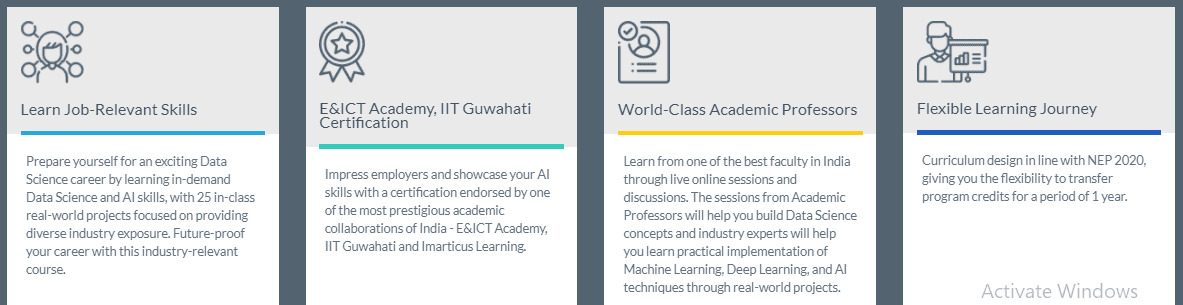
And that is only possible when they have the proper training to adapt to situations, and that can only happen if they learn data analytics from a proper institution. Imarticus Learning has come forth with a great opportunity for people who would like to polish their skills with their new PG program with data analytics and machine learning certification.

Coming back to the impact of the well-being of employees on company productivity, studies have found that being comfortable in their workplace can make the workers about 12% more productive.

Data analysis as a tool to ensure happiness

Major firms have been trying to gather and decipher the patterns of their employees’ behavior to provide a personalized experience to them for some time now. There are a lot of ways companies have decided to approach it. Some offered wearables to their employees that will teach how much time they spend, sitting, talking, writing, or moving about. Some have chosen the company intranet to trace their online tracks.

Now it falls to the data analytics team to extract, and decipher these patterns. It is fruitful in the sense that these patterns always give indications of not only their physical health but also their mental ones. This is also a way where companies can provide personalized suggestions for their well-being. And the employees get benefitted from it in a way that impacts their daily life. As a result, they feel more loyalty towards the company.

Hurdles to jump over

There are some evident advantages of exchanging data for the betterment of the employees’ wellbeing, and in turn, increase their productivity. However, it is also a possibility that when it comes to data gathering and analysis, the employees might have some privacy concerns about them.

Which in turn, might make them unwilling to participate actively in the bandwagon. This is why, there are a few things that should be kept in mind when it comes to the interrelation of wellbeing and productivity of the workers, such as:

  • The first and most important thing is to make sure the workers consent to the exchange of data for the company’s use, as many might have privacy concerns relating to that.
  • Companies will need to have experts in the analytics team to properly extract and use the data and make it a priority for both the main wing of the business and the analytics team to prioritize the employees well being.They need to communicate properly to the workers how it benefits them and the company both at once.
  • The key is to recognize what the employees want and be able to cater to it. Otherwise, even after using data analytics to define the workers’ needs, it will be utterly irrelevant.

Conclusion

Using data analytics as a mode of communication between the employer and employee needs time and expert skills. And it can only come if you learn data analytics from a good place. Many institutes in India offer a data analytics certificate course. Imarticus Learning is one of the topmost among them, so do check out their PG program of data analytics and machine learning.


Which Is Better For Machine Learning R or Python?

Machine learning is not a single science. It comprises a blend of fields such as analysis, recognition, prediction and decision making. There are several open-source tools available for machine learning out of which R and Python are the most demanded or rather the most popular ones. The main difference between the two languages has been seen in the fields of analysis and data science.

Both the languages provide open source tools and support from a wide variety of libraries for machine learning but because of the high degree of robustness provided by the python packages such as Scikit-learn built on numpy and Scipy, Python is preferred more for machine learning. According to a recent survey, Python had an increment in its popularity and use from 53% to 69% within two years.

Several machine learning courses aim at delivering courses dedicated to R and Python. The question as to whether an individual should learn both languages depends highly on the field of application and interest of an individual. Both languages have highly efficient ecosystems for machine learning tasks.

The difference in popularity and use is because of the comfort of an individual with the programming language, interest and application needs. Also, job opportunities can be one of the deciding factors whether an individual should learn Python or R for machine learning.

Provided below is a comparison of Python and R which could help an individual decide whether they need to learn both languages.

R:

R was developed by the statisticians primarily for analysis. The programming language is based on the mathematical calculations comprising machine learning and hence forms a really important part of the statistics involved in the project. Thus, a project which is largely dependent on statistics should use R as a programming language.

Advantages:

  • Highly suitable for data analysis and visualization.
  • Support from the libraries
  • Highly robust
  • Highly suited for exploratory work

Disadvantages:

  • Scarcity of expertise in the language due to low learning rates.
  • The algorithms in R comes primarily from the third parties and hence, it is not very consistent to build the models.

 Python:

Python came into existence in the ’80s. Today, it forms a core of the machine learning operations being performed by Google. It has extended its roots in the field of artificial intelligence as well and is being widely used in almost every possible domains whether technical or non-technical.

Advantages:

  • In contrast to R which provides support for only statistics, machine learning has extended beyond just statistics.
  • Python unlike R provides a smooth learning curve and is more consistent than R.
  • Huge support from libraries such as numpy, pandas, OpenCV, sklearn, etc.
  • Simplicity in the syntax making it easy to learn the language.
  • Highly robust models and boosting techniques.

Disadvantages:

  • Less support for statistical models due to the non-availability of suitable packages.
  • Multithreading is Pyhton is not generally preferred as it is difficult to implement.

From the above comparison, it can be seen that both the languages having their advantages and disadvantages. But the key point that differentiates them is the use and library support. R and Python in machine learning have succeeded in their way. One has left footprints in the field of analytics while the other has emerged victorious in the field of data science.

Conclusion

To choose the right language, the right strategy is needed. For a person stepping into the industry as a fresher, Python is preferred as compared to R because of its simple syntax and ease of learning.

Also, if an individual is looking for a career in the field of data science they should go for Python as the programming language and if they want to handle the huge data-related tasks such as analysis and prediction making, no doubt that R is a better choice.

R is closely related to analysis and Python is closely tied to huge tasks such as object detection, disease prediction, computer vision and so on. Hence, we can conclude by saying that an individual needs to rightly assess their needs before choosing one of them and should master only one trade.

What Are the Characteristics of Big Data?

Big data is the next big wave that is shaping the corporate sector today. Big data gives an idea about the size of data but there are various aspects associated with it. It is also driven by various other factors apart from the size of data such as the sources of data, various formats in which it is available, chunking and extraction, etc.

Big data has managed to find space in all sectors of the market – technology, retail, telecommunications or any other broadly recognized field. It makes use of the available data to derive conclusions.

Need for Big Data

Organizations have huge data resources in an unstructured format. Mostly this data is stored in various devices and is never brought to any use. Data can prove to be a mega resource for the growth of any company as it can equip the company with numerous insights thus acting as the steering wheel of the company. Traditional tools such as Excel are not that efficient in extracting information and putting it to any relevant use. Big data comes into the picture here.

When you have a huge amount of data, it needs to be sorted and then classified under various heads so that the important fields can be easily recognized and brought to use. This space is getting bigger with every passing minute as we are becoming more and more data-oriented.

The volume of data is huge. With the increase in the number of internet users, more data and information are coming into circulation and this has given rise to the value data holds today. This data is produced through various channels like search engines, social media networks, business informatics, etc. It makes use of various tools to summarize information.

Learning Big Data and Hadoop can pave a great career path for someone who wants to have a career in data analytics.

Characteristics of Big Data

 The 4 Vs of Big Data characterize big data. Data needs to be classified and organized for better understanding. The 4 Vs of Big Data are:

  1. Volume
  2. Velocity
  3. Variety
  4. Veracity

These characteristics form the essence of Big Data. It gives insights on how the data should be dealt with and how can the insights from that data can be put to good use.

  1. Volume: Volume defines the size of the data which in today’s time is exploding and increasing exponentially. To be precise, this defines the quantity of data available for the extraction of information. Based on the volume of data, various tools are applied for the segregation of information.
  2. Velocity: Velocity refers to the speed in which the data is processed. The speed of data processing plays a very important role in Big data as a lot of data has to be analyzed and insights have to be drawn within a stipulated time frame, thus making the velocity of data an important feature of Big Data.
  3. Variety: Variety refers to the various types of data from which the relevant information has to be extracted. It is important as data collected from different sources are diverse in many aspects. Big Data makes use of various tools to integrate the diversified data and draw insights for the business.
  4. Veracity: Veracity refers to data accuracy and its relevance with the business information we require or the business decision that has to be made. Veracity helps in the identification of relevant information and hence saves a lot of time.

Conclusion

Big Data today has various dimensions and has opened a new world for data harvesting and extraction. With the help of the Big Data Analytics course, one could gain expertise and in-depth insight into the field.

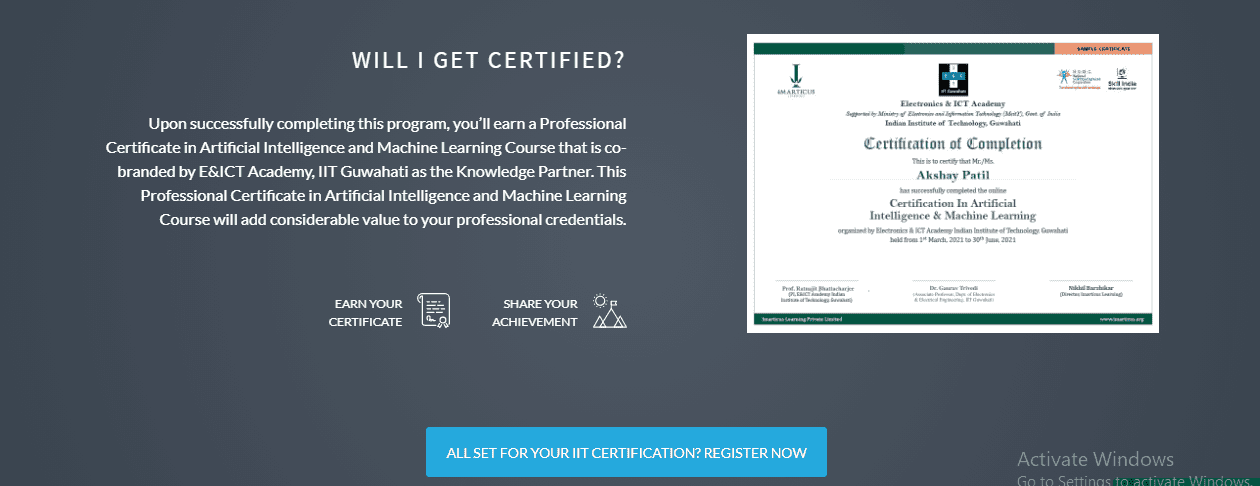
Enrol for the best artificial intelligence and machine learning course from E&ICT Academy, IIT Guwahati

The most important question to any student these days would be what to study that will tremendously benefit his/her career, and where to study it from. Numerous courses are offered by several institutions, and choosing the best option for yourself in such a scenario can be very confusing. This is why we are here to shed light on possibly the most relevant course right now.

That is, of course, the artificial intelligence and machine learning course. It is one of the most versatile courses out there that lets you work in almost any field you want. That is because all the major sectors now need the help of artificial intelligence and machine learning to optimize their business and keep the customer and employee-friendly. A lot of institutes in India provide AI ML courses. Imarticus Learning is one of the best in this field with its certificate course.

best artificial intelligence and machine learning course from IIT

However, if we are to talk about the best institute to learn an artificial intelligence and machine learning course from, then it would undoubtedly be an IIT. Here, we are going to take a look at why an AI and ML course might be one of the most relevant courses out there that will benefit your career. And, why an AI and ML course from an IIT is the best.

artificial intelligence and machine learning course from IITBenefits of an AI and ML course

Data analytics basically uses numerous tools to extract and analyze data in a way that helps to detect patterns from past records. It also analyses where the company is now and predicts where it can go from here. All of it is done through analyzing market trends, the company’s financial condition as well as the customer’s online habits. The main benefits of this course are:

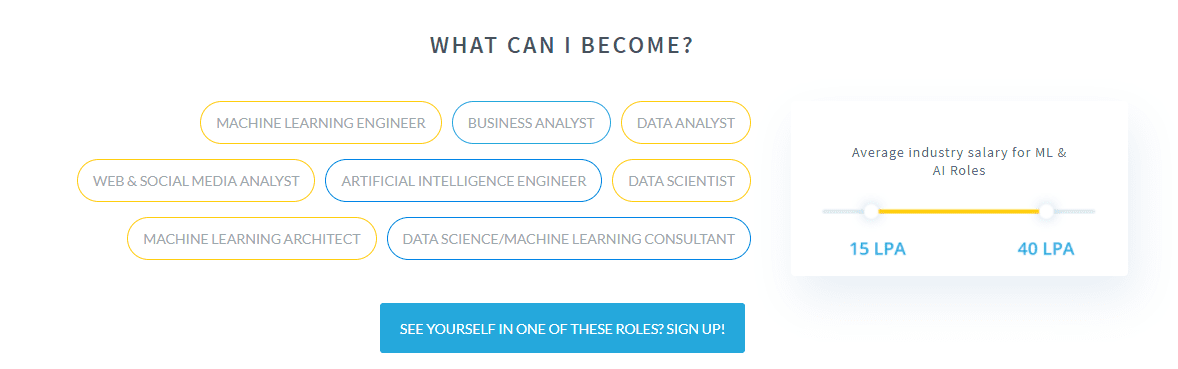
  • It is one of those jobs that is applicable in any given field, from the health sector to finance to marketing. This means that you can land your dream job from the get-go or if you feel like it, then you can even change your sector without much thought.
  • It is one of the highest-paying jobs in the country right now, which, of course, means a stable future.
  • Expert reports state that in the near future, there are going to be even more positions opening up in all corporate sectors.artificial intelligence and machine learning courses from IIT

 Why IIT is the best choice

As we all know, IIT is an unparalleled choice when it comes to courses in any sector of business. There are few reasons for that, such as:

  • It teaches you deep skills that are most popularly used in AI and ML.
  • The opportunity to learn from actual corporate cases, that too from the top-level industry professionals of AI and ML.
    artificial intelligence and machine learning courses from IIT
  • Overall excellent vocational training, as students experience hands-on learning with lab-based cases related to the most high-level industry problems.
  • Another thing that IITs are most known for is excellent industrial exposure.
  • The opportunity to learn AI and ML from any IIT will immediately put you leagues beyond your peers.
  • An excellent package right from the beginning in your preferred sector.

 Conclusion

best IIT artificial intelligence and machine learning coursesThe opportunity to learn AI ML courses from an IIT is the best thing that can happen to your career. It is an academic investment that will be paying off throughout your life.


So, prepare hard enough to give yourself that edge over others. Also, do check out Imarticus Learning’s AI and ML certificate course as we have one of the best-planned courses in this field.

How to Start a Supply Chain Management Career?

How to Start a Supply Chain Management Career?

A supply chain management career is the best choice for those who are interested in research and logistical development. Students with a basic knowledge of programming and operations management can opt for the certificate course from Imarticus Learning.

This course will prepare students for a career as production planner, purchasing and warehouse manager, logistics resource planner, and maintenance supervisor. There are many more jobs in inventory control, procurement, and logistics administration.

Get a Degree in Supply Chain Management

To start a career in supply chain management, aspirants should opt for an SCM course. Imarticus Learning offers professional certification in supply chain management & analytics.

The certification is provided in collaboration with IIT Roorkee. Live lectures are organized by industry professionals and academicians. Students are encouraged to participate and interact with their peers and instructors.

The supply chain management course from Imarticus Learning requires students to complete projects that are based on real industry issues. These projects help students develop strategic planning skills at operational levels. For students aspiring to become data scientists, supply planners, demand planners, or supply and operations planners, this certificate course is the best choice.

Mentoring sessions are held frequently. These sessions are great for building networks and gaining hands-on experience. The campus immersion program at IIT Roorkee is a great opportunity for students to interact and develop soft skills.

Things to Know Before Starting a Career in Supply Chain Management

A supply chain management career is very rewarding and provides many opportunities. Students who wish to study supply chain management and build a career should keep in mind the following points.

  • Supply chain management is data-centric.

In supply chain management, professionals focus on data-driven decisions. A large volume of data is processed on a daily basis and analyzed to generate actionable insights. The extraction of relevant data needs to be accurate in order to create an efficient supply chain.

  • Supply Chain Management includes more than storage and movement of products.

supply chain management courses in India

The storage of products and movement from supplier to manufacturer, then to wholesaler to retailer, and finally to the consumer.

But the job also includes supply chain planning and monitoring of finances.

The certificate course from Imarticus Learning on supply chain management and analytics will help students learn every aspect.

  • Supply chain managers require soft skills for networking.

Supply chain managers need to collaborate and communicate with clients and other teams. This is why it is essential to have soft skills that include communication, people skills, and social intelligence.

To have a successful career, new professionals in the field should develop connections. Networking is essential to expand the knowledge base. Imarticus Learning helps students develop such skills through interactive sessions and project work with industry experts.

  • The supply chain management industry is competitive.

While there is scope for advancement in supply chain management, the industry is very fast-paced and challenging. The competition is intense and managers need to be able to process the planning and movement of goods quickly and efficiently.

  • The supply chain needs to be environmentally sustainable.

A supply chain manager should focus on creating an efficient supply chain. Such chains can optimize the movement of products which reduces wastage. This makes it more sustainable and environmentally friendly.

The professional certification in supply chain management & analytics from Imarticus Learning is ideal for learning relevant skills. This is a 6-month long program and prepares students for a lucrative career in supply chain management.

A supply chain management course can help candidates start and continue a successful career. Since there are many job opportunities in the industry, certification from a leading institute like Imarticus Learning allows students to create an impressive portfolio and get jobs in their fields of interest.

Imarticus Learning: Fuelling India’s Data Analytics Workforce

What is Data Analytics?

 Data Analytics involves analyzing raw data and drawing meaningful conclusions and patterns from that data. In data analytics, a lot of processes are automated to eliminate manual intervention. You can take up a data analytics course to understand the intricacies of the subject.

In data analytics, a lot of algorithms are prepared to make the job easy. These days you can take up a data analytics course with placement. A data analytics certification course makes you credible enough for the job.

Understanding Data Analytics

best data analytics certification courses in IndiaData Analytics can be complex when you try to understand it. A data analytics certification course can help you know what the subject entails and how to make the best use of it. The data analytics course will also introduce you to the world of algorithms.

Data Analytics is a broad subject that includes several diverse types of data analysis techniques.

Data Analytics can be used to mine different kinds of data insights. These insights can be used in improving processes and transforming them for the convenience of the data users. You can take up a data analytics course with placement to practically apply these algorithms and techniques of data sorting and data analysis.

Companies like Imarticus Learning are tirelessly working towards making the Indian workforce tech-savvy and well-versed with data analytics and its application. If more and more workforce joins hands with Imarticus to learn data analytics, the workforce will become digitally enabled to deal with a large amount of data. They would know how the data would be put to proper use.

Use Cases of Data Analytics

Data Analytics training can be used to understand several trends that dominate the market. You can apply predictive analysis using the insights from these data points. Several industries are now making use of data analytics to optimize their processes.

For instance, in the manufacturing industry, data analytics is used to store and record runtime, work queue, and downtime of all the machines in the factory. The data can then be utilized to optimize all the processes and to make manufacturing better.

However, data analytics is not limited to spotting bottlenecks in the process. It can do much more. It can make the entire process better and more efficient. You can also use data analytics to speed up the manufacturing process as a whole, as with data analytics, you can reduce the waste to a great extent.

Types of Data Analytics

If the workforce knows how to use Data Analytics, they will be able to use technology better. Some of the types of Data Analytics are:

  1. Descriptive Analytics: This is used to understand what has happened over a while.
  2. Diagnostic Analytics: If something happens, you can analyze what went wrong using diagnostic analytics.
  3. Predictive Analytics: In the case of predictive analytics, the algorithms are used to predict a future trend.
  4. Prescriptive Analytics: These algorithms are used to take a suggestive measure for any action.

Conclusion

Building an analytics workforce is the need of the hour. Therefore, it is essential to train more professionals and prepare them for the analytics world. Digital literacy is very important to automate functions, and data analytics is an integral part of it.

Imarticus is on a spree to enable people to use data analytics to decode patterns and understand data. Imarticus has several courses on data analytics. You can enroll in all of these courses to get an in-depth insight into how data analytics works and make the best use of it. The certifications from Imarticus have a great value in the industry.

Top 7 industries that depend heavily on artificial intelligence and machine learning

AI and machine learning are possibly two of the most versatile technologies of the corporate world. It is now used in most sectors to extract and analyze data to make logical decisions. It also helps them to cater to their client’s needs more accurately and make helpful suggestions regarding the same.

It has also come to light that many major companies have decided to use AI to take better care of their employees’ well-being. This is high time to do a machine learning and artificial intelligence course if you are thinking of good career prospects. A lot of institutions in India provide good artificial intelligence and machine learning courses with certificates.

Imarticus Learning has a good AI and ML certificate course that will be beneficial to students who want to pursue this career. Experts state that artificial intelligence and machine learning are going to be even more in demand in the near future.

AI and machine learning courses in IndiaThey find applications in a versatile field, so you will be able to work in your dream sector. And not just that, you will even be able to change sectors as most major companies already rely heavily on artificial intelligence and machine learning.

Industries that rely heavily on AI and ML

Most of the big industries already rely heavily on AI and machine learning. And, the ones still left behind are starting to come over to this side slowly but steadily. Here is a list of 7 industries that function through AI and machine learning the most:

Transportation

AI and ML provided algorithms are used to monitor and predict the clients’ needs and give suggestions accordingly. From traffic management to the production of self-driving cars, all of it relies heavily on the data provided by AI and ML.

 Finance

Instead of replacing accountants with an automated system, AI and ML have proven to be reliable support tools for accountants and all of the finance industry. By taking on the grunt work, it lets accountants focus on the creative aspects of their jobs.

 Advertising

Collecting data from the online habits of the target audiences and providing advertisements according to it are the main reasons this industry has profited so much in the last few years, and it is all thanks to AI and ML.

 Healthcare

Thanks to the data collection of the patients by AI, the process saves a lot of time on both sides, which is crucial in a life or death situation.

 Agriculture

AI-powered robots can detect the specific places where weeds and pests are harming the plants and take actions to prevent them. This helps in developing a resistance to herbicides.

 Production industries

From dealing with supply chain issues to predicting malfunctioning machines, AI and ML have proven to be irreplaceably helpful to manufacturing or production industries.

 Retail and customer care

It is one of those fields that has benefited from AI the most. From bots to deal with customer issues and predicting clients’ needs to offer suggestions, this industry runs a lot smoother because of AI and ML.

 Conclusion

Artificial intelligence and machine learning courses can land you your dream job in any sector. It is one of those jobs that will never run out of positions as all industries need the help of technology to function properly these days. Check out Imarticus Learning’s machine learning and artificial intelligence course to learn from the best and always be on top of your game.

Related Article:

Top AI and machine learning courses in India

What are the Perks of Learning Data Science with Imarticus post COVID-19?

Covid-19 has pushed most corporate sectors to the inside of people’s homes. This in turn has made the already big flow of data turn into a tidal wave. Basically, the whole industry more or less relies on data analytics now. Experts state that there is going to be a major hike in the positions for data scientists in the near future.

artificial intelligence and machine learning coursesHowever, one thing to be concerned about is that it is going to make the already competitive industry even more neck and neck.  The first preference for positions is going to be data scientists with experience, and then freshers with a high level of skills.


The best thing to do in this situation is to properly learn data science with artificial intelligence and machine learning from a good institution.

Imarticus Learning is one of the topmost options when it comes to data science in this country. They offer PG programs in the data science course with placement in renowned companies. This will give you a much-needed boost when you are starting as a fresher in the sharp-edged competitive world of data science.

Major changes

Because of the world working in a virtual space, it has recently been in the trend for companies to hire professionals from other parts of the country along with locals. This is true for all sectors, not just data science. The perk of this trend is you can get a job anywhere in the country without moving an inch from your home. The downside is, you’re competing against numerous data scientists all over the country.

The only thing that will give you an edge over others in this condition is to learn data science from institutions that will put you in a speed race with a proper destination. Basically, institutes that will enhance your skills to the maximum while giving you a placement offer right out of your course.

This will help you gain all the real-world experience you might miss out on while being stuck at home, as companies used to provide workshops as well as in-person training for the new data scientists joining the team.

 Benefits of a data science course with Imarticus Learning post Covid-19

Many institutes in India offer an artificial intelligence and machine learning course after graduation. Imarticus Learning is one of the foremost institutions when it comes to this field. They have various forms of learning to offer, such as full-time courses for students, as well as part-time ones for working professionals who want to polish their skills again or change careers. There are lots of benefits of getting a data science degree from Imarticus Learning, such as:

  • They offer a full-time course, as well as a part-time one for those already with a job.
  • They have a course set so versatile that you will never have any problems working in any sector with your data science degree.
  • They provide a data science course with placement offers to renowned companies in different sectors. So, you have a chance of working in your dream job right from the start.

Conclusion

If expert reports are to be followed, companies in the future may be inclined to hire more versatile workers than specialists. So future data scientists will need to be razor-sharp all the time with an ability to do a variety of different types of work at the same time. Check out Imarticus Learning’s all-rounded PG program on data science if you are thinking of pursuing this career or re-polishing your skills.

Case Studies: Training Neural Networks to Play the Legendary Snake Game!

Video games play a critical role in developing and evaluating futuristic AI and ML models. Thanks to their performance in a variety of tests, the gaming world has been used time and again as a playground for testing AI devices.

This isn’t a new phenomenon, but one that goes back at least 50 years. The Nimrod digital computer built by Ferranti in 1951 is widely touted as the first known example of the use of AI in gaming. Mega Man 2 was used by Japanese researchers to test AI agents and the AI system Libratus was used to beat pro players of Texas Hold ‘Em Poker to make technological and gaming history.

The Snake game is quite a familiar feature of many childhoods because of its simple objective and playing process. The player controls the snake by eating apples which are spawned at random locations to optimize the game. For every time the snake consumes an apple, the snake must begin to expand one grid. And the one rule? Don’t let the snake collide with anything.

To take things one step further, global researchers and have been applying neural networks and machine learning algorithms to this legendary game.

Machine Learning Course If you’re a student in a neural network course or a machine learning course, this is fertile ground for experiments of your own! Here are some case studies born of such experiments:
Creating the Snake Game Using Deep Reinforcement Learning

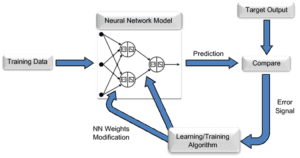
In this experiment, the researchers used a Convolutional Neural Network (CNN) that had been trained with a Q-learning variant. The aim of the experiment was to use a Deep Reinforcement Learning model in enabling a self-ruling agent to play the game with the constraints getting stricter as time passes.

A reward mechanism was also designed to train the network, make use of a training gap strategy to circumvent training during target changes and categories a variety of experiences for better training.

The final results of the experiment showed that the agent outshone the ground-level DQN model. It even surpassed human-level performances in terms of high scores and duration of survival.

Playing the Snake Game Using Genetic Algorithms and Neural Networks

Researchers at a Polish university used a framework of a neural network that essentially determined what action to take from any given data at the time. The researchers referred to the neural network as “DNA”– it functioned as the “brain” of the snake, so to speak, due to its role in influencing decisions.

The class has patterns with weights as well as other patterns with biases, reflecting each neural network layer. Next, a function is created that allows the calculation of performance. In this case, the performance included the number of moves that the snake executed without dying as well as the scores.

Neural Network TrainingThe neural networks training that were used had one inconspicuous layer with six neurons as well as a genetic algorithm to identify the best possible methods and parameters. The population of snakes was first generated and allowed to play so that researchers could identify the number of steps and the count of apples that were consumed.

Based on this, the researchers identified which snakes performed best and would be selected for breeding. The “parents” were chosen and the DNA– weights and biases– transferred to the new snake produced.

The selection stage was followed by a mutation, where every new snake ended up inheriting a neural network from its “parents”. This was repeated time and time again until the best results were achieved.

Conclusion
The video gaming world has played pivotal roles in enhancing the quality and complexity of AI and ML over the past few decades. It remains to be seen what future advances come of this surprising yet clever collaboration.

What Is Experiential Learning and Is It the Right Choice for You?

The days of rote learning are long gone. With the development of EdTech and similar technologies used across campuses all around the globe, learning now is more of an experience than a curriculum. As an organization that aims to future proof itself, it is time you adapt and embrace the modern technological interventions.

What Is Experiential Learning?
David A. Kolb, an American Education Theorist defines learning as the process whereby knowledge is created through the transformation of experience. The definition of experiential learning closely follows this.

Experiential learning is the process where candidates learn the course material through experience paired with other traditional forms of teaching.

How to Develop an Environment for Experiential Learning?

Now that you know the meaning of experiential learning, let us explore how as an organization you can develop and foster an environment that promotes the same.

  1. Create Safe Learning Spaces

One of the first and most important criteria for developing experiential learning is to develop safe learning spaces, where students have the ability and the freedom to learn better.

An important aspect to understand here is the fact that safety doesn’t entail spaces which are risk-free. After all, students need to have some form of risk evaluation in order to learn. Safe learning spaces can thus be explained as spaces where experimentation is encouraged and failures are embraced without judgment. This will not only allow the students to be more creative, but it will also promote them to be bolder with their assessments, thus fostering a better learning experience.

2. Take Account of Logistical Challenges

While the development and promotion of experiential learning can sound easy to adapt at first, there are several hurdles that you need to consider. Mentioned below are some of the most significant aspects for to you keep in mind:

  1. Survey the learning spaces you already have at your disposal and analyze if they will be able to adapt to safe environments to foster experiential learning. Not all learning spaces are built equal and thus you need to analyze and sit down with experts before you proceed further.
  2. You need to make sure that all the enrolled students understand the values of the environment, both within and surrounding the learning space and come to respect the same. Without respect for the learning environment, the students will only learn half of the principles and values and thus this aspect needs to be taken care of.
  3. If you are considering creating an environment off-campus, security is a concern you need to address. Conduct background checks on all the properties you are taking into consideration and assess with your experts which one suits your purpose the best while taking into account security measures.
  4. One of the most difficult challenges of experiential learning is scheduling for all the involved stakeholders. Be it the students or the instructors, scheduling needs to be done months prior so that no other commitments or engagements are affected in the process. This calls for careful planning and effective communication both within and with all the stakeholders to ensure a smooth process for everyone.
  5. Another concern for students and instructors is transportation. An approach followed by most companies is to hire an external contractor who will be responsible for all the transportation needs of the stakeholders. This way, there is no concern for parking and other logistical difficulties which might hinder the learning process.
  6. Last but not the least, is the concern for privacy. In this world of data leaks and compromises in security, as an organization, you need to maintain and ensure the highest standard of security and privacy for all your students and instructors. Always make use of secure databases and restricted access, so that vital information is safe to round the clock.

Conclusion
Experiential learning is one of the latest trends in the education technology industry and companies who have adapted to it, have reported benefits over other conventional learning methodologies. Now that you know all about experiential learning, go ahead and discuss it with all the stakeholders and make an informed decision on its applicability in your organization.