


Last updated on September 22nd, 2026 at 04:33 pm
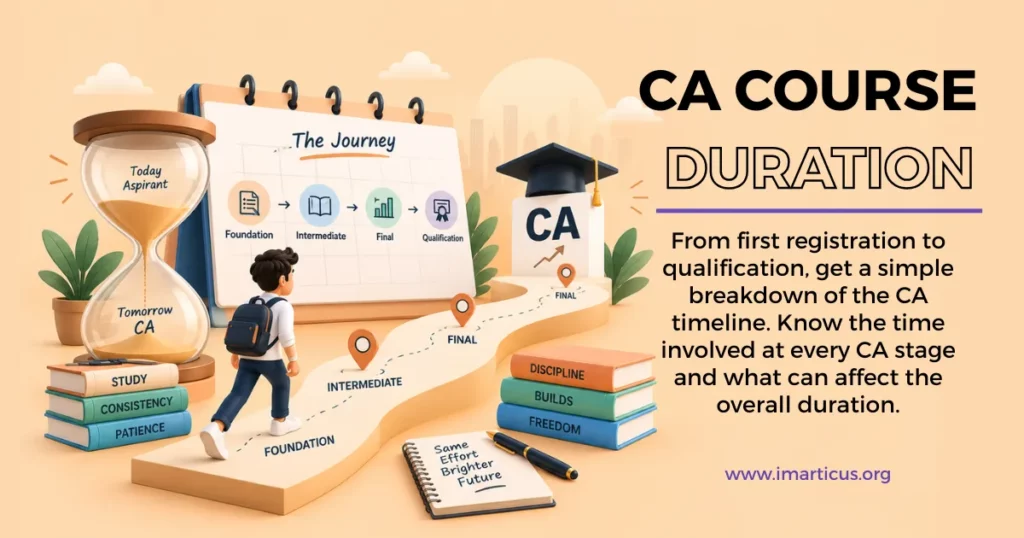
The standard timeline for the CA course duration is 3.5 to 5 years, but the exact CA duration depends entirely on your entry point, exam pass rate, and training schedule.
Under current ICAI guidelines, students entering the Foundation route after Class 12th can complete the Chartered Accountancy program in roughly 42 months (3.5 years) on a first-attempt basis. For those choosing the Direct Entry route after graduation or B.Com, the minimum duration is around 3 years since the Foundation stage is exempted.
The number of years you spend becoming a CA can change long before you sit for the final exam. That may sound surprising, but the CA course duration is not simply a number you can pick from a table and work backwards from. Your entry route, exam attempts, practical training, study requirements and the time between different stages can all change the calendar.
So, how long does the CA course actually take? If you are in Class 12, you may be looking at the Foundation route and wondering whether you should prepare for CA alongside college. If you are already a graduate, the calculation changes because the Direct Entry route can allow you to skip Foundation. And if you have completed BCom, you may be asking a more practical question: after BCom CA course duration is how many years if everything goes according to plan? These are very different starting points.
That is why the duration of CA course deserves a closer look than a single “minimum years” figure. For students after Class 12, the question is usually about the full journey from Foundation to Final. For graduates, the more relevant question is whether Direct Entry can shorten the early part of that journey. For someone who has already completed BCom, the calculation becomes even more specific.
Don’t Let Our Best Advice Get Buried
Add Imarticus as a Preferred Source — see more of what we publish, every time you search.

That distinction matters if you are choosing CA after 12th, considering CA after graduation, or trying to work out your CA course duration after graduation alongside a job. It also matters when you are deciding whether to add another qualification later, such as finance courses, CFA, ACCA or a specialised programme in investment banking. So, in this guide, I will break down the CA course duration stage by stage, look at the Foundation, Intermediate, practical training and Final requirements, and then map the timelines for students entering after 12th, after BCom and through Direct Entry.
Did You Know?
ICAI’s May 2026 Foundation examination had 106,144 candidates admitted, while the Intermediate examination had 153,862 candidates admitted. These figures show the scale of the CA pathway and the number of students moving through its stages each year.
CA Course Duration At A Glance
Before you plan your studies, it helps to see the full route in one place. The table below shows the main stages under the current ICAI framework and explains what each stage adds to your timeline.
| CA Stage | Main Time Requirement | What You Do | Exam or Training Point | Route |
| Foundation | Minimum four months of study | Prepare for four Foundation papers | Foundation examination | After Class 12 route |
| Intermediate | Minimum eight months of study | Prepare for two groups | Intermediate examination | Foundation or Direct Entry |
| Articleship | Two years under the New Scheme | Work and build practical skills | Practical training requirements | Eligible CA students |
| Final | Depends on study and eligibility | Prepare for Final papers and complete requirements | Final examination | After required stages |
| Membership | After completing all requirements | Complete the remaining formalities | Apply for membership | Final stage |
The exact CA full course duration can therefore vary from one student to another. The minimum study periods set by ICAI give you a framework, while exam attempts and other requirements decide how closely your journey follows that framework. ICAI states that Foundation needs at least four months of study and Intermediate needs at least eight months.
How Long Does The CA Course Take?
The CA course duration depends first on your entry route. A student entering after Class 12 usually follows the Foundation route. A graduate who meets the Direct Entry requirements can register for Intermediate without taking Foundation.
Think of it like joining a train at different stations. A Class 12 student starts earlier in the route. A qualifying graduate joins further ahead. Both students still have to complete the stages that apply to their route.
Your timeline can also change if you need another attempt. ICAI examinations now give CA Foundation and CA Intermediate students more exam opportunities during the year, which can help reduce long gaps between attempts. ICAI announced three annual examinations for Foundation and Intermediate from 2024, while Final continues twice a year.
CA Course Duration After 12th: Foundation Route
The CA course duration after 12th starts with Foundation. You need to complete the required study period before appearing for the examination. A simple route looks like this:
- Complete Class 12 or meet the applicable Senior Secondary requirement for Foundation eligibility.
- Register for the Foundation course with ICAI.
- Complete the required four-month study period.
- Appear for the Foundation examination.
- Register for Intermediate after meeting the required conditions.
- Complete the eight-month Intermediate study period.
- Clear Intermediate requirements and move into practical training.
- Complete the required practical training and Final requirements.
- Clear the CA Final examination and complete the remaining membership requirements.
The CA course duration after 12th can therefore be planned from the point when you go for CA registration. A student who clears every stage without a delay can follow a much tighter timeline than someone who needs several attempts.
CA Course Duration After Graduation: Direct Entry Route
The CA course duration after graduation can be shorter at the entry stage because eligible graduates can use the Direct Entry route. ICAI allows eligible commerce graduates and postgraduates with the prescribed marks to enter Intermediate directly. The current ICAI course FAQ states that Direct Entry candidates can appear for Intermediate after completing eight months of study from registration. For a commerce graduate, the Direct Entry route can look like this:
| Stage | What You Need To Complete | Time Factor | Where It Fits | Main Outcome |
| Graduation | Meet the required marks | Degree period | Before CA entry | Direct Entry eligibility |
| Intermediate Registration | Register with ICAI | Registration date matters | First CA stage | Begin Intermediate study |
| Intermediate Study | Complete required study period | Minimum eight months | Before exam | Examination eligibility |
| Practical Training | Complete applicable training | Two-year framework | During CA journey | Practical exposure |
| Final Requirements | Meet study and other conditions | Depends on progress | Later stage | Final examination eligibility |
The CA course duration after graduation still depends on your exam performance. Skipping Foundation removes one stage from your route. It does not remove Intermediate, practical training or Final requirements.
After BCom CA Course Duration
The after bcom CA course duration is a common question because many BCom graduates want to move straight into professional accounting.
If you meet the marks required for Direct Entry, you can register for Intermediate without appearing for Foundation. ICAI’s current guidance says eligible graduates can register through Direct Entry and appear for Intermediate after completing eight months of study.
Imagine you have already completed the first floor of a building. You do not need to rebuild that floor. You still need to complete the upper floors safely. Your BCom gives you a useful academic base, but the CA route still has its own examinations and training requirements.
That is why the after bcom CA course duration should always be calculated from the date of your Intermediate registration, not from the date you started your BCom.
Also Read: What Is the CA Salary in Big 4 Firms?
CA Course Duration From Foundation To Final
The CA course duration becomes easier to plan when you break the journey into stages. Each stage has a different purpose. Foundation checks your basic understanding. Intermediate takes that knowledge further. Practical training brings real work into the picture. Final tests whether you can use your knowledge at a much higher level.
CA Foundation Course Duration
The CA foundation course duration has a clear minimum study requirement. ICAI states that students must complete four months of study before they can appear for the Foundation examination. Students can also provisionally register for Foundation after passing Class 10, but they must meet the conditions for appearing in the examination. This makes an early start possible for school students.
You can register after Class 10, continue with Classes 11 and 12, and then move towards the Foundation examination once you meet the required conditions. Your registration can therefore start earlier than your actual Foundation examination journey.
The CA foundation course duration may look short on paper, but the quality of those four months matters. A student who uses the period only to finish chapters may struggle later. A student who builds a strong base in accounts, law, mathematics and economics can carry that base into Intermediate.
CA Intermediate Course Duration
The CA intermediate course duration has a minimum eight-month study period. ICAI requires students to complete this study period before appearing for the Intermediate examination.
Intermediate is also where your preparation starts to feel more specialised. You deal with subjects that demand stronger application and regular practice.
You can prepare for one group at a time or plan for both groups based on your study capacity and exam strategy. Your choice can affect the overall CA course duration.
ICAI’s May 2026 results show why planning matters. The pass rate for candidates appearing for both Intermediate groups was 8.47%, while Group I recorded 10.25% and Group II recorded 16.11%.
These figures are not a prediction of your result. They simply show why you should give Intermediate enough preparation time instead of treating the eight-month requirement as a target to rush through.
The CA intermediate course duration is therefore only one part of your overall timeline. Your preparation quality can decide how many exam cycles you need.
Did You Know?
ICAI reported that 90,217 candidates appeared for the May 2026 Foundation examination, with 18,124 candidates passing. The overall pass percentage was 20.09%.
CA Articleship Duration
Practical training is a major part of the CA course duration because CA is designed to connect study with actual work. You do not spend the entire journey with books and exam papers. Practical training brings you into the day-to-day side of finance and accounting.
Under the New Scheme, ICAI introduced two years of uninterrupted CA Articleship training from 1 July 2023. ICAI’s July 2026 announcement also refers to proposed amendments concerning the two-year practical-training framework. During this period, your work can involve tasks such as:
- You may work with financial records and learn how accounting processes operate inside a real organisation.
- You can see how tax work moves from textbook rules to documents, deadlines and actual client requirements.
- You may assist with audit work and learn why small checks can matter when financial statements are reviewed.
- You can build workplace habits such as meeting deadlines, checking figures and communicating clearly with senior team members.
- You may also gain exposure to areas that help you decide which part of finance you want to pursue after qualification.
The duration of CA course therefore includes time spent developing workplace skills as well as time spent preparing for examinations. ICAI also introduced a mandatory digital E-Diary for students starting practical training from 1 January 2026. It records attendance and tasks performed during practical training.
Also Read: Which Best Courses After 12th Commerce Have the Highest Salary?
CA Final Course Duration
The CA final course duration is difficult to reduce to one fixed number because your preparation speed and eligibility conditions can differ. Your Final timeline can therefore include several moving parts.
At this stage, your focus shifts towards higher-level application. You also have additional requirements under the New Scheme, including Self-Paced Online Modules. ICAI currently lists Self-Paced Online Modules across areas such as Corporate and Economic Laws, Strategic Cost and Performance Management, Risk Management, International Taxation and Financial Services and Capital Markets.
| Final Stage Element | What It Involves | Why It Matters | Time Impact | What You Should Plan |
| Final Study | Preparation for the prescribed papers | Builds exam readiness | Depends on your plan | Set weekly targets |
| Practical Training | Required training period | Builds work skills | Fixed framework | Track completion |
| Self-Paced Modules | Prescribed module requirements | Forms part of the New Scheme | Depends on completion | Finish early where possible |
| Advanced Training | Required course elements | Supports professional readiness | Depends on eligibility | Check current ICAI rules |
| Final Examination | Final examination attempt | Tests your overall preparation | Exam cycle dependent | Plan revision carefully |
The CA final course duration can stretch when one requirement is left until the last moment. I would keep a simple checklist from the start. It is much easier to track five small tasks than to remember everything when your Final exam is close.
Also Read: How Hard Is the CFA Exam?
CA Course Duration After 10th
Because when you are planning five years of your life, knowing that CA takes “X years” is only the beginning. Knowing why it can take that long is what helps you plan it properly.
The CA course duration after 10th needs a small clarification. You can provisionally register for the Foundation course after passing Class 10. ICAI introduced this option so that students can begin the process earlier. However, registration does not mean that you can immediately sit for the Foundation examination.
You still need to meet the conditions for examination eligibility, including the required Senior Secondary stage and study period. A student who starts early can use Classes 11 and 12 to become familiar with the Foundation syllabus. This can be useful if you already know that CA is the career you want.
Think of it like learning to swim before joining a long-distance race. You still have to complete the race later. The early practice simply makes the starting point more comfortable.
The CA course duration after 10th can therefore include a period of early preparation that runs alongside school. Your actual professional qualification still depends on completing every required CA stage.
Also Read: What Are the Different Types of Accounting?
CA Course Duration After 12th
The CA course duration after 12th is usually the route most students think about first. You complete Class 12, move into Foundation, and then progress through the remaining stages. Your stream can influence how familiar some topics feel, but the CA route remains the same.
After 12th Commerce
Commerce students may already know basic accounting and economics. That can make some Foundation topics easier to recognise.
You should still prepare every subject properly. Familiarity with a topic is different from being ready to answer an examination question under time pressure. The CA course duration after 12th will depend on how well you convert that academic base into exam performance.
After 12th Science
Science students can also pursue CA. You may need more time to become comfortable with accounting and other commerce-focused areas.
That does not mean you need to change your career plan. You simply need a clear study routine and enough practice. For a science student, the CA course duration after 12th can follow the same Foundation route as a commerce student once the eligibility requirements are met.
After 12th Arts
Arts students can also consider CA if they meet the applicable eligibility conditions. The key issue is your willingness to build the required accounting and finance base.
You can think of the first few months as learning a new language. At first, the terms may feel unfamiliar. With regular use, they become much easier. This means the CA course duration after 12th is not decided by your school stream alone. Your preparation and exam progress matter far more.
Also Read:What Is the CA Foundation Syllabus for 2026?
CA Course Duration After Graduation
The CA course duration after graduation depends on whether you qualify for Direct Entry. Eligible graduates can enter at Intermediate instead of starting with Foundation. ICAI’s guidance requires eight months of Intermediate study before the examination for Direct Entry candidates.
For commerce graduates, the Direct Entry route can be especially useful because your degree may already give you exposure to accounting, business law, economics and finance.
After BCom
The after bcom CA course duration starts from the point at which you enter the CA route. You should first check whether you meet the prescribed marks for Direct Entry. If you do, you can move towards Intermediate directly. If you do not, the applicable Foundation route may become relevant.
Your BCom knowledge can also help you connect CA subjects with topics you have already studied. For example, financial accounting may feel less unfamiliar when you have already worked through basic accounting and financial statements. The after bcom CA course duration can still increase if you need extra attempts, so it is wise to plan for exam preparation rather than simply counting calendar months.
After A Non-Commerce Degree
A graduate from another stream can also use Direct Entry if the applicable marks requirement is met. ICAI’s current course information provides different marks thresholds for commerce and non-commerce graduates.
You may need more time to build your accounting base. That is a learning issue rather than a separate CA route. The CA course duration after graduation can therefore be similar in structure for different graduates, while the amount of preparation you need may vary.
Minimum Vs Realistic CA Course Duration
The CA full course duration should never be treated as one magic number. There is a difference between the time allowed by the rules and the time you may actually need.
| Situation | What Happens | Likely Effect On Timeline | What You Can Control | Planning Approach |
| First-attempt success | You clear each required stage | Keeps the journey tighter | Preparation quality | Follow a fixed study plan |
| One extra attempt | You need another examination cycle | Adds waiting time | Revision and practice | Analyse weak areas early |
| One group at a time | You split Intermediate preparation | Can extend the journey | Group selection | Match groups to your capacity |
| Training delay | Practical requirements take longer | Can push later stages | Documentation and planning | Track requirements monthly |
| Missed requirement | A condition remains incomplete | May create a new delay | Timely action | Use an ICAI checklist |
The duration of CA course is therefore shaped by both fixed rules and personal progress. A realistic plan gives you room for revision, exams and practical requirements instead of assuming that every stage will go perfectly.
Can You Complete CA In The Minimum Possible Time?
The CA course duration becomes easier to manage when you stop looking at the entire journey as one huge target. Focus on the next milestone.
For example, a Foundation student can first aim to complete the four-month study requirement with strong preparation. After that, the focus shifts to Intermediate. Later, practical training and Final requirements become the priority. A useful approach is to divide your calendar into three types of time:
- Keep fixed study hours for subjects that need repeated practice rather than relying on last-minute revision.
- Reserve separate time for mock tests so you can measure whether your preparation is working.
- Keep a small buffer for registration, examination forms and other deadlines that can affect your next attempt.
- Use practical training to understand why accounting and finance rules matter in real business situations.
- Review your progress every month instead of waiting until the end of a study cycle.
This approach gives your CA course duration a practical shape. You can see what needs to happen next and what could create a delay.
CA Course Duration And Fees
The CA course duration and fees are often searched together because students want to understand both the time and money involved. ICAI fees are only one part of your total spending. Coaching, books, travel, technology and other study costs can also affect your budget. I would separate these costs before making a plan. It gives you a much clearer view of what you are committing to.
| CA Stage | Main Cost Area | What The Cost Covers | Other Possible Spending | Planning Tip |
| Foundation | ICAI registration and examination | Course and exam requirements | Coaching and study material | Set a separate study budget |
| Intermediate | ICAI registration and examination | Course and exam requirements | Classes and revision material | Plan group-wise spending |
| Articlehsip | Training-related needs | Work and training requirements | Travel and daily expenses | Track monthly expenses |
| Final | ICAI and examination requirements | Final-stage requirements | Revision and preparation costs | Keep an exam buffer |
| Career Preparation | Skill development | Additional professional skills | Finance courses and certifications | Choose skills linked to your target role |
The CA course duration and fees can rise when you need extra attempts or additional preparation. A good budget should therefore leave some room for unexpected costs.
What Can Increase Your CA Course Duration?
The duration of CA course is affected by more than the official study periods. A missed attempt can create a gap. A delayed requirement can move another stage. Even a strong student can lose time through poor planning. Common reasons include:
- Missing an examination form deadline can remove an otherwise useful attempt from your planned study calendar.
- Preparing for too many papers without enough revision can increase the chance of carrying a group forward.
- Waiting until the final stage to complete required modules can create avoidable pressure close to examination time.
- Treating practical training as separate from your career plan can make it harder to use those years for skill building.
- Changing your study plan every few weeks can waste time that should have gone into practice and revision.
The CA course duration is easier to control when you treat deadlines as seriously as your syllabus.
Also Read: What Is the Latest CA Foundation Study Material?
Building Your Career While You Complete CA
Your CA full course duration can cover several years. That gives you time to build more than CA exam knowledge.
You can use your practical training and study years to decide where you want to work later. Some people enjoy audit. Others prefer corporate finance, investment banking, risk, taxation or financial markets. This is where targeted finance courses can add value.
For example, an investment banking course from Imarticus Learning focuses on investment banking operations, financial markets, compliance and asset management. The programme currently offers a weekday format and a weekend format. That can be useful if you want to understand investment banking while building your CA foundation.
You can also consider an ACCA course if you want a global accounting qualification alongside your existing professional profile. Imarticus Learning currently offers ACCA preparation in collaboration with KPMG in India, with case studies, learning resources and career support.
For finance and investment roles, CFA course can be another route. Imarticus currently offers CFA prep with structured learning, case studies and access to Kaplan Schweser material. The point is simple. Your CA journey can build a strong accounting base. You can then add skills based on the role you want.
Career Options You Can Build Alongside Your CA Journey
Your CA full course duration gives you several years to work out where you want your finance career to go. The right add-on can help you build skills for a specific role rather than simply adding another qualification to your CV.
| Career Direction | Possible Role After CA | Useful Skill / Qualification | Indicative Salary in India |
| Audit & Assurance | Audit Manager, Assurance Professional | CA + audit, IFRS, financial reporting | ₹7-30 LPA+ |
| Tax & Compliance | Tax Consultant, Tax Manager | CA + direct/indirect tax, international tax | ₹8-30 LPA+ |
| Corporate Finance | FP&A Analyst, Finance Manager | CA + financial modelling, FP&A | ₹10-35 LPA+ |
| Investment Banking | Investment Banking Analyst, Deals Professional | CA + investment banking, valuation, financial markets | ₹15-50 LPA+ |
| Risk & Compliance | Risk Analyst, Risk Manager | CA + risk, AML, compliance | ₹9-30 LPA+ |
| Financial Analysis | Financial Analyst, Business Finance Professional | CA + financial analysis, modelling, Excel | ₹8-30 LPA+ |
| Global Accounting | Financial Reporting Specialist, Accounting Manager | CA + ACCA, IFRS, global reporting | ₹8-30 LPA+ |
| Investment Analysis | Investment Analyst, Portfolio Analyst | CA + CFA, valuation, investment analysis | ₹10-40 LPA+ |
| Finance Leadership | Financial Controller, Finance Director, CFO | CA + leadership, strategy, business finance | ₹30 LPA-₹1 Cr+ |
A Useful Career-Planning View
| Your CA Stage | What to Focus On | Career Question to Ask Yourself |
| CA Foundation course duration | Build your accounting and finance base | Which areas of finance interest me most? |
| CA Intermediate course duration | Strengthen technical knowledge and practical skills | Do I enjoy accounting, tax, markets, risk or finance? |
| Practical Training | Gain real workplace exposure | Which type of finance work do I want to pursue? |
| CA Final course duration | Prepare for qualification and specialise further | What role do I want immediately after CA? |
| CA Full Course Duration | Build qualifications and job-ready skills together | What will make my profile stronger beyond CA? |
This also gives the section a natural connection to the article’s main theme. The CA full course duration may span several years, so students can use that period to test different areas of finance and build relevant skills before qualification. Your existing section already makes this point through investment banking, ACCA and CFA pathways.
If accounting feels too narrow and markets feel more exciting, the CA vs CFA decision deserves a closer look before you commit years to either path. Two respected finance qualifications can lead to very different workdays. Knowing what each path prepares you for can make the choice far easier.
CA Course Duration Vs Your Career Goal
The CA course duration should be planned with your career goal in mind. The subjects you study give you a base. Your practical exposure then shows you which areas interest you.
If you want investment banking, you may want stronger knowledge of markets, transactions and financial products. If you want global accounting, ACCA can add another recognised qualification. If you want investment analysis, CFA can help you build deeper knowledge in that direction.
A short finance course can also make sense when you want a practical skill that fits beside your CA studies. For example, CIBOP is currently designed for graduates and finance learners seeking entry-level investment banking roles. Imarticus lists the programme as 2.5 months on weekdays or five months on weekends on its current programme page.
That kind of focused learning can fit into a longer professional journey without asking you to start another multi-year qualification.
Is Spending Five Years To Complete My CA Really Worth It?
The answer depends on what you do with those years. If you spend the entire period only chasing examination attempts, you may finish with a qualification but limited exposure to other areas of finance. If you use your training period to build practical skills, work with financial data and understand different finance roles, the same period can become much more valuable. The CA course duration gives you time to build a professional profile. Use that time with a clear goal.
CA or ACCA? The better choice can come down to where you want to work, the roles you want and how you see your finance career taking shape. A closer look at both can help you figure out which one fits your plans.
Why Imarticus Learning Makes Sense For Your Next Finance Move?
Once you have spent years completing CA, the next course should have a clear purpose. You may want to move into investment banking, strengthen your global finance profile, enter fintech, or build a career in risk and financial analysis. That is where the range of finance courses at Imarticus Learning becomes relevant. Its finance portfolio covers 15+ programmes across investment banking, global accounting and finance, financial planning and analysis, banking, fintech and risk management, so you can choose a course around the role you want rather than simply adding another qualification to your CV.
- 15+ finance programmes give you room to specialise: You can choose from programmes built around areas such as investment banking, global accounting and finance, financial planning and analysis, retail and commercial banking, fintech and risk management, depending on where you want your career to move next.
- The numbers give you a useful sense of the career ecosystem: Imarticus currently lists 40,000+ placements, 1,500+ hiring partners, a ₹7 LPA average salary, a ₹22 LPA highest salary and a 60% salary hike across its finance offering.
- There is a strong global certification angle: Imarticus states that it is India’s first and only approved preparation provider for four global accounting and finance programmes, giving you access to preparation pathways beyond the Indian qualification route.
- ACCA, CFA, US CPA, US CMA and FRM sit within the same broader ecosystem: This matters if you are already a CA and want to add a qualification based on the finance role you are targeting rather than starting from scratch with another general course.
- Investment banking is covered through a dedicated route: The CIBOP programme focuses specifically on investment banking operations, including areas such as financial markets, banking operations, AML, KYC, transaction monitoring and asset management, making it more targeted than a broad finance course.
- The finance offering is backed by a recognised industry collaboration: Several of its global certification programmes are developed or delivered with industry partners such as KPMG in India, giving learners exposure to case studies, practitioner sessions and industry-led learning rather than relying only on textbook preparation.
FAQs About CA Course Duration
Still unsure how the timeline changes after 12th, graduation or BCom? These answers clear up the most frequently asked questions students usually have about attempts, completion time, difficulty, maths requirements and whether taking the longer route is worth it.
Can You Complete CA In 2 Years?
Completing the full CA qualification in two years is generally not realistic because the route includes prescribed study periods, examinations, practical training and other requirements. The exact CA course duration depends on your entry route and current ICAI rules.
How Long Will It Take To Complete CA?
Your timeline depends on your entry route, exam attempts and completion of practical training and other requirements. A Foundation student and a Direct Entry graduate will follow different paths, so the CA course duration cannot be reduced to one fixed number for everyone.
After The BCom Graduation, How Many Years Will The CA Take?
Eligible BCom graduates can use the Direct Entry route and skip Foundation. ICAI requires eight months of Intermediate study before the examination for Direct Entry candidates. Your CA course duration after graduation will then depend on exam attempts, training and other requirements.
Is It Better To Do CA After 12 Or After Graduation?
Both routes can work well. Starting after Class 12 lets you enter through Foundation, while an eligible graduate can use Direct Entry. Your CA course duration after graduation can therefore be shorter at the entry stage, but your choice should also match your academic and career plans.
Is Spending 5 Years To Complete My CA Really Worth It?
The value depends on how you use the time. CA can build strong accounting and finance knowledge, while practical training adds workplace exposure. You can also use the journey to pursue programmes such as CIBOP, ACCA or CFA through Imarticus Learning and build skills for specialised finance careers.
How much time will it take to do a CA with BCom?
An eligible BCom graduate can enter through Direct Entry and begin from Intermediate after meeting the required conditions. The after bcom CA course duration depends on exam attempts, practical training and other requirements, so a single fixed total should not be assumed.
Your CA Course Duration: What To Plan Next
The CA course duration can take several years, but your career does not have to wait until the final certificate to take shape. You can use your Intermediate studies to build stronger finance knowledge. You can use practical training to understand the work you enjoy. You can then add a focused qualification that takes you towards a specific role.
If you are entering after 12th, you have Foundation, Intermediate, practical training and Final ahead of you. If you are eligible for Direct Entry after graduation, your route begins differently. After BCom, the CA timeline can also look quite different from that of a student starting straight after school. Your CA full course duration is only one part of the professional journey. The skills you build during those years can shape where you go after qualification.
The useful takeaway is simple: plan around the stages you need to clear, rather than chasing an ideal number of years. Give yourself enough time to prepare properly, keep track of the current ICAI requirements and think ahead about the kind of finance role you want after qualification. There is also no need to treat CA as the final stop in your learning journey.
Once you know where you want to go, you can add a specialised qualification or skill that supports that direction. Someone interested in investment banking may look towards a focused programme. Another student may prefer CFA, ACCA, risk management, fintech or another area of finance.
That is where a platform like Imarticus Learning and their finance courses can be useful to explore when you are ready for that next step. Its finance portfolio covers areas ranging from investment banking and global accounting to financial planning, fintech and risk management, so you can choose based on the career path you want to build rather than simply collecting another certificate.
Liked This? Follow Us Where You Already Search.
Preferred Sources is Google’s built-in follow button — no app, no login, just more Imarticus in your results.