Supply chain management and analytics digitization: Cloud computing and predictive analysis

We are currently living in the era of digitization. From our daily life needs to education to retail to corporate, everything is taking to it pretty fast. Supply chain management too is a sector that has recently started integrating its essential business aspects with technology. The main reason for that is how easy it makes the process of collecting big data and silo breakdown in the supply chain. 

This is why it might be the best time to pursue a course on supply chain management if you are thinking of career prospects for a better future. As always, Imarticus Learnings has come through with its Supply Chain Management online course. It will not only provide you with amazing exposure but also put you, leagues, beyond your peers. 

Here, in this article, we are going to elaborate further on what is digitalization in supply chain management? What is predictive supply chain analytics? and how it can reinvent the whole process for a better outcome. Please go through the whole article to learn more.

How cloud computing and predictive analytics can change the supply change management process?

Service and product life cycles are getting shorter and shorter. This is what basically is pushing businesses towards cloud computing and predictive analytical solutions across industries. Cloud computing provides immediate insights and better responsiveness and predictive analytics helps to predict future issues and any changes that can come into the supply or demand cycle. This essentially answers, what is digitalization in supply chain management and what is predictive supply chain analytics. Now, we take a look at the benefits that come with it.

The benefits of cloud computing

There are obviously some major benefits to this process which as of now are not found anywhere else. The benefits are, as follows:

  • Cloud computing provides immediate insights into all the issues that can affect the chain directly. This, in turn, helps the managers to address the issues quickly and effectively. It also improves collaboration across all the sectors that come into play in the process. 
  • Once all the aspects are tied in the loop, predictive analytics will help the decision-makers with quick insights. With the help of ML and advanced statistical algorithms, it can help process big data to predict a likely outcome for the future. This includes all kinds of variables that have been gathered from different sources. 
  • Cloud computing also enables you to seamlessly add in different parties as needed at a moment’s notice. You can also adjust the provisions in this system immediately to fit the constant changes in demands or market trends. 
  • Digitalization will help to plan and execute things faster. This is supported by in-memory computing and big data analytics. This way you can improve your responsiveness to things that need immediate attention.

Best suited supply chain processes for cloud computing

There are some supply chain processes that are best suited for the cloud format, such as:

  • Sourcing and procurement: SaaS tools are best suited to create a collaborative format. 
  • Logistics: from inventory management, replenishment planning to world trade compliance, every process here can easily be turned cloud-based.
  • Manufacturing: this again can be cloudified very easily.
  • Planning and Forecasting: predictive analytics is evolving to offer better planning and forecasting options.

Conclusion

Supply chain management is evolving constantly. This is why it has opened a new horizon of job prospects. Check out Imarticus Learnings’ Supply Chain Management online course to gear up for it and give your career the spark it needs.

PGDM in banking and finance: Opportunities and Impact in 2022

A Post Graduate Diploma in Banking and Finance opens up avenues to great job roles in the sensitive sectors of finance and banking. A good online MBA course or diploma program introduces learners to the world of strategic management, organizational behavior, human resource management, business law, and business economics.

These are absolutely essential for any senior finance professionals as well; however, in order to open up doors in Finance or Banking, one needs to learn financial accounting, analytics, cost accounting, retail banking, management accounting, and many other subjects that are very crucial for financial or banking sectors. 

Benefits of a Diploma in Banking and Finance

Here are some of the benefits of getting a Diploma in Banking and Finance or finishing an online MBA course:

  • Get better salary packages and more interesting job roles.
  • Prepare yourself for a professional environment with practical training and real-world projects.
  • Keep up with financial technologies and New Age Banking.
  • Industry-oriented training with domain experts and professors who help you solve real-world problems in finance or banking.
  • Learn research methodology and strategic management.
  • Learn treasury management.
  • Understand business ethics, risk, assurance, and governance.
  • Get introduced to Foreign Exchange Management and International Banking.
  • Learn about markets and financial institutes.
  • Understand corporate finance and financial services marketing.
  • Learn corporate banking, investment banking, and retail banking.
  • Learn about governing bodies, corporate law, and business law.
  • Become a master of financial accounting, management accounting, and cost accounting.
  • Master financial analytics and business analytics.
  • Learn about Information Systems and other ERP software.
  • Become a master of Decision Science and Operation Management.
  • Understand human resource management and the relation between financial management and marketing.

Career Options after Graduation

The impact of a PGDM in Banking and Finance is immense. The diploma holder’s value immediately increases in these domains, and thus, opportunities start presenting themselves in the form of management roles and other crucial or respectable roles within large organizations.

Finance is the backbone of businesses, and without financial experts, a business will not be able to manage itself very well. Not just financially, the business will also collapse in terms of organizational stability and operational infrastructure. Bankers experienced in investment banking or international banking are also extremely respected and rewarded handsomely.

Thus, if one decides to pursue banking and finance through a PG Diploma or MBA, then he/she can expect amazing returns in terms of job satisfaction and salary packages. For individuals who have completed programs such as the Post-Graduate Program in New Age Banking from Imarticus Learning (PGPNAB), getting desirable jobs in companies such as Morgan Stanley, Goldman Sachs, Deutsche Bank, J.P. Morgan, HSBC, and BNP Paribas is easy. 

Here are some popular career options after graduation in finance and banking:

  • Private Banker
  • Asset and Wealth Manager
  • Portfolio Manager
  • Investment Banker
  • Global Financial Researcher
  • Business Analyst
  • Financial Analyst
  • Budget Analyst
  • Operations Manager
  • Financial Strategist
  • Market Advisor
  • Business Development Manager
  • Investing Counsellor
  • Credit Manager

Conclusion

With a good program such as the PGPNAB from Imarticus Learning, one can get dual certifications and a salary increment. Imarticus Learning also assures placement support and a 25% salary hike. The PGPNAB is arranged in a manner that students get the Imarticus Learning PGPNAB diploma in 11 months and an MBA from NMIMS in 2 years.

This is extremely helpful for students as they are able to secure themselves jobs while also learning to become finance professionals. Through the PGPNAB, one can also benefit from the option to pay a certain amount of the fees only after getting placed in a company.

What is Business Analytics All About?

Business Analytics Definition

The importance of Business Analytics stems from the fact that it is the method by which firms analyze historical data using statistical methods and techniques to generate new insights and enhance tactical decision-making.

Since data-driven firms see their data as a business asset and actively seek methods to transform it into a competitive advantage, an increasing number of employees are taking data analytics and machine learning courses and acquiring a business analytics certification.

Data quality, trained analysts who understand the technology and the business, and a dedication to leveraging data to uncover insights that influence business choices are all essential components of business analytics success.

What is Business Analytics?

Business analytics is a data managing solution and a subset of business intelligence that involves analyzing and transforming data into valuable information, identifying and predicting outcomes and trends, and making better, data-driven business choices using methodologies such as data mining, predictive analytics, and statistical analysis.

The key elements of a conventional business analytics dash are as follows:

  • Data Visualization: For easy and rapid data analysis, visual representations such as charts and graphs are offered.
  • Optimization: after identifying patterns and making forecasts, firms may use simulation tools to test best-case scenarios.
  • Predictive Analytics: predicting business analytics uses a number of statistical approaches to building predictive models that extract data from datasets, discover trends, and offer a score for a variety of organizational results.
  • Forecasting: examines historical data from a given time period to make educated predictions about future occurrences or behaviors.
  • Association and Sequence Identification: identifying predictable behaviors that are conducted concurrently or sequentially with other acts
  • Text Mining: examines and organizes huge, unstructured text collections for quantitative and qualitative analysis 
  • Data mining for business analytics: data mining for business analytics sifts through large datasets to uncover patterns and connections using databases, statistics, and machine learning.
  • Data Aggregation: data must be acquired, structured, and filtered before being analyzed, whether through provided transactional records or data.

Why is business analytics important?

Business analytics has a lot of moving pieces, but it’s not always evident why it’s vital to your company. To begin with, business analytics is the instrument that your company requires in order to make informed judgments. These decisions are likely to have an impact throughout your whole organization, assisting you in increasing profitability, market share, and possible shareholder returns.

There’s no doubting that technology has an influence on many enterprises, but when utilized appropriately, BA may have a beneficial impact on your business by giving you a competitive advantage in a variety of ways.

While some firms are unclear what to do with vast volumes of data, business analytics combines data with actionable insights to help you make better business decisions.

Furthermore, because this data may be provided in any manner, your organization’s decision-makers will be well-informed in a way that suits them and the objectives you set at the start of the process.

Conclusion

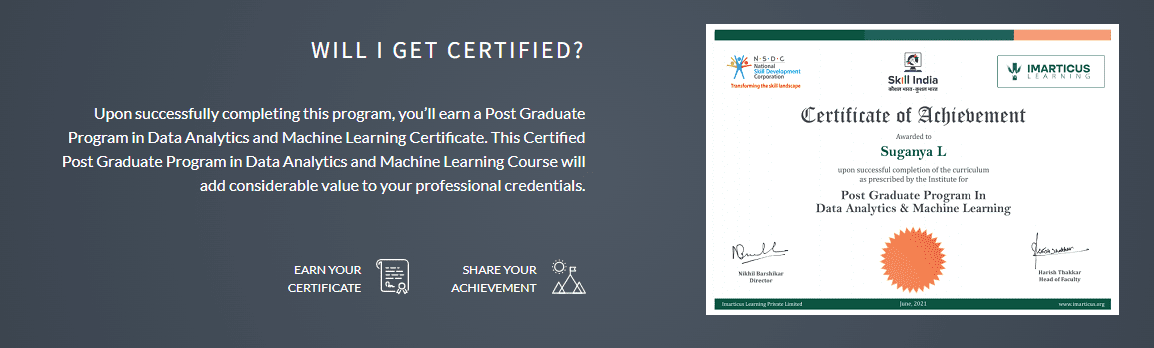
If you are aware of the importance of Business Analytics and are interested in obtaining a business analytics certification, then you should subscribe to our data analytics and machine learning course given at Imarticus.  

Related Article:

https://imarticus.org/what-are-the-benefits-of-business-analytics/

Figure Out the True KPIs That Drive Your Business with Digital Marketing

Key performance indicators or KPIs assist in quantifying the performance of a business and provide essential insights. While they help track financial goals and prepare the company for future opportunities, KPIs also help evaluate marketing solutions and improve customer service.

It would help if you used KPIs to understand what strategy will benefit a company in the digital marketing industry. You can opt for a digital marketing course to learn about the practical use of KPIs. You can choose Imarticus Learning’s Digital Marketing program to land a lucrative job in the field. 

Top 5 KPIs That Will Drive Business with Digital Marketing

KPIs are not the same for every business that uses digital marketing. They change depending upon the type of business and the goals set. If you learn digital marketing, you will identify the KPIs that will ensure growth for a specific business. Following are a few of the most important KPIs that can drive your business. 


  • Revenue or Sales Growth


You need to calculate revenue or sales growth to understand how well your business is performing. Usually, sales growth is in percentage, and positive growth means the company is thriving. However, you need to change strategies and introduce radical modifications to boost sales and revenue generation if you see negative growth. 


  • Revenue Streams


It is essential to analyze the revenue streams or income sources. It can help to understand which customers are driving the profit. An accurate analysis of revenue streams can also help with decision-making. If you have the correct information, you can implement the right digital marketing strategies and grow the business. 


  • Revenue Concentration


In an ideal business, the revenue is not concentrated on one aspect. It comes from multiple clients and is diverse. If you see that the revenue comes from a single client, you need to change the portfolio. If that client stops doing business with you, you might end up losing the entire venture. You can rely on digital marketing to diversify your portfolio and improve revenue concentration. 


  • Working Capital


Businesses need to figure out a strategy that will help them take on more opportunities and stay afloat. So you need to understand your working capital. It will help you decide where to invest and how to maximise business growth. To calculate working capital, you need to subtract the current liabilities from current assets. You also need to check your current working capital ratio to understand where the business stands. 


  • Business Performance


Business performance means prioritizing profitability over time. Over time, financial resources will get drained. However, if you analyze all reports, you will understand what is triggering the losses and how you can increase the profits. You can do this by using digital marketing to enhance business performance.  

The best digital marketing course will teach you to recognize the importance of having KPIs to boost business growth. 

Launch a Successful Digital Marketing Career

For a successful career in digital marketing, you will need to choose a course that has an industry-oriented curriculum. You can learn digital marketing from Imarticus Learning and get industry certification.

The institute offers a PG Program in Digital Marketing. You will get to work on four Capstone projects which are based on real business issues.

There are many case studies available for students that prepare them for the industry. The digital marketing course from Imarticus includes multiple interactive sessions and lectures where students can discuss important topics related to the digital marketing industry. 

Imarticus Learning offers the best digital marketing course and guarantees placements. Students can build industry contacts and learn essential job-related skills to launch a rewarding career. 

An introduction to neural networks: AI/ML for beginners

The field of AI and machine learning is overgrowing, with new advancements in algorithms happening nearly every day. One area with a lot of growth recently is neural networks, which are artificially intelligent systems built on an architecture inspired by the human brain. In this post, we will explore what precisely neural networks are and how they work so you can get started today!

What is a neural network?

Neural networks are machine learning algorithms that you can use to recognize objects in pictures or understand human speech. 

For example, imagine you wish to teach a convolutional neural network how to recognize pictures of cats. You might show the computer thousands of examples of what cats look like and let it learn from that data. Then, when somebody shows the computer a picture that isn’t a cat, it could determine whether or not this is an image of something else using its knowledge of cats.

A step-by-step tutorial on how to train the convolutional neural network and make predictions:


  • Choose your dataset:


The first step is choosing a dataset to train your neural network. It could be a data set of images, text, or anything else you want to predict.


  • Preprocess the data:


Before starting training your neural network, you need to preprocess the data. It includes cleaning and formatting the data to be ready to be used by the deep neural network.


  • Choose your model:


The next step is to choose a model for your neural network. There are many different models, so you need to choose one that will work best for your dataset.


  • Train the model:


Now it’s time to train the network. It is where you will feed in your data and let the neural network learn from it.

The future of AI/ML:

AI/ML is becoming more widely used today. AI/ML has many benefits for the world around us. Machine learning help diagnose diseases, drive cars and even write music!

  • Websites like Amazon use AI/ML to recommend products you may like based on what you have bought in the past.
  • Facebook uses AI/ML to determine which posts or status to show first in your newsfeed.
  • Google uses AI/ML to generate search results.

The possibilities are endless, and the future of AI/ML is inspiring!

Discover Artificial intelligence and machine learning course with Imarticus Learning

This Artificial intelligence and machine learning course is by industry specialists to assist students in learning real-world applications from the ground up and building sophisticated models to offer helpful business insights and forecasts. This AIML course is for recent graduates and early-career professionals (0-5 years) who want to further their careers in Data Science and Analytics, the most in-demand job skill.

Course Benefit For Learner: 

  • Students get a solid understanding of the fundamentals of data analytics and machine learning and the most in-demand data science tools and methodologies. 
  • Learn data science skills by participating in 25 in-class real-world projects and case studies from business partners. 
  • Impress employers & showcase skills with artificial intelligence courses recognized by India’s prestigious academic collaborations.

Using AI models for credit risk assessments can help financial institutions make smarter decisions to boost the customer life cycle

Credit risk may vary differently depending on the type and amount of credit, but now there are new methods to assess it. Artificial intelligence models are the next step up from traditional scoring systems and offer a more nuanced look at your customers.

The use of AI models for credit risk assessment has been on the rise in recent years. It’s easy to see, unlike traditional scoring systems, these models provide a more nuanced view of customers and their financial history.

With this information, you can ensure that reliable data will back any loans or other financial products offered.

This article helps you to understand AI-based credit scoring models and how they help make your business more profitable.

AI-based credit scoring model: 

It is about improving the transparency of credit through increased access to information, higher credit standards, and improved risk assessment.

The big contribution of the AI-based credit score model is not only figuring out people’s real identity or whether they are eligible for loans. Instead, it changes the old idea that people who make more money could easily get a loan.

The model evaluates borrowers not by personal income levels but by risk factors, including employment history, credit report, assets, and liabilities.

This way, when making decisions about an individual’s eligibility for loans without lessening the effect on others in society.

Consumers can be evaluated according to their implications rather than just their income level- thus decreasing the incidence of the poverty cycle.

Benefits of integrating AI credit risk assessment model 

AI is fast, smart, and efficient at making decisions without any biases or emotions getting involved. This means you can make more informed financial decisions based on scale data from the entire population.

AI-based solutions transform credit scoring in several ways. Involving such a model can help the financial institutions as follows:

  • With the support of the AI credit score model, financial institutions can learn about their customer’s financial behavior based on historical data and potential income forecasting. Such analyses help the institutions to sell their credit plans to the right category of clients.
  • AI model offers greater speed without compromising quality or precision. The lending decision is much easier than traditional methods where banks used to apply decision trees, regression, and complicated arithmetic analyses to generate the client’s credit score.
  • AI smart applications are available to check the customer’s creditworthiness and maximum credit limit.
  • It has allowed the banks to increase the customers’ lifetime value by engaging with them continuously and intelligently to strengthen each relationship across diverse products and services.
  • Increased profits due to efficient targeting of low-risk loans. Both economic and efficiency terms benefit from reduced bankruptcy rates.

Learn more with Imarticus Learning:

Imarticus Learning presents credit risk management courses that help to understand India’s credit landscape and the entire loan assessment process.

Our Credit Risk Management Course USPs:

  • Quality learning experience through learning pedagogy consists of 145 hours of live lectures.
  • The comprehensive credit risk management courses strongly emphasize the digital innovation that is disrupting the lending space.
  • Helping to build a career in banks, NBFCs, and start-ups through resume enhancing workshops, interview preparation sessions, and mentorship.
  • Holistic, well-rounded, and practical curriculum designed and delivered in collaboration with Moody’s Analytics.

For further details, contact us through the Live Chat Support system or visit our training centers in Mumbai, Thane, Pune, Chennai, Bengaluru, Delhi, and Gurgaon.

MBA degrees over the years and how to choose the right one

Traditionally, an MBA degree is offered as an on-campus option, where a student has to pause their career and cede their salary for it. But, in recent years, technology has shaped course delivery methods considerably, and most of the leading business schools are now offering part-time and online MBA courses

Due to the COVID-19 pandemic, a vast shift towards remote studies made aspirants opt for the online mode of education. Few of the world’s leading business schools have recently shifted to a complete online course curriculum. But, how do choose the right one? Here are the tips for settling on the right MBA course.

Tips to Choose a Right MBA Program 

Tip 1: Know Your Purpose  

While opting for an MBA program, it is vital to know the goals beforehand. Some aspirants wish to pursue the MBA to get a promotion, while others want to excel and get started in the business genre. For people who don’t want to leave their current job but want the degree to reach heights, an online MBA course will be perfect as physical meetings with new people, networking with industry experts, and reaching different companies might not be the primary priority. 

But, for a student who wants to get started in the business sector, physically meeting people is the primary criteria; hence, a traditional on-campus course will be ideal for them. 

Tip 2: Budget

While considering a business management course, budget is one of the primary deciding factors. While it is quite common to notice that on-campus courses are relatively costlier than digital MBA courses, it is essential to choose the suitable one.  

Few business programs also provide scholarships for deserving students. Hence, students who have a tight budget or are meritorious can check out the institution providing financial aids.   

Tip 3: Employability and Competition of Admission 

Institutions providing the best online MBA courses have a high employability rate. This factor is beneficial for students looking for a course that will provide them significant opportunities but within a limited budget. These online courses will groom them with all the amenities with options of industrial connection and a virtual networking ecosystem. The employability rate of a particular university is provided on the website itself, or it can be found on the internet if researched well. 

Additionally, an online business management course will give candidates options to study from their residence, with a minimum computer and fast internet connection requirement. Although most of the on-campus leading MBA courses have a high competition to get into due to their limited seat availability, these online programs have relatively more seats for students as institutions do not need to accommodate them on-campus. Hence, the competition to get into an online MBA degree course is somewhat easier for aspirants. 

It is easy to get lost in the different university prospectus when choosing an MBA program. Apart from these primary pointers, you can check – 


  • Class Profiles – 


Look at the profile of previously passed out candidates, where they are now, what positions are they serving, and others. This will provide you with the necessary idea of how the alumni have performed and your chances of success. 


  • Institution’s Reputation- 


Lastly, know about the national and international reputation of the university. A highly reputed institution will let its students connect with a large alumni base, thus widening the scope of employability and further studies. 

Hence, before choosing an MBA course, check out every above-mentioned factor to settle for an ideal one. Candidates should remember that both the digital and physical MBA’s have their pros and cons; hence it is crucial to choose accordingly. Imarticus offers some of the best management programs from some of the world’s renowned universities that one can choose from.

5 tips to get started in Ethical Hacking

5 tips to get started in Ethical Hacking

When you have been online for a few years and you start to see the potential dangers you can encounter on the internet, many questions arise. One of them is whether it is possible to do something about it, in order to protect your data and your privacy. This can be done with some knowledge in cybersecurity. Then the question is, How do you get started in hacking or cybersecurity?

It seems like a simple question, but learning something like this requires effort and time, you need to prepare yourself and find the necessary tools to be able to train as a cybersecurity expert. In this article, we are going to mention 5 tips for you to start your career in Ethical Hacking

The most important thing is to find courses that are comprehensive enough and evaluated by experts so that you can acquire the necessary knowledge. Without a good course, you will never get off the ground as an Ethical Hacker.

That’s why, at Imarticus, we offer a 6-month ethical hacking course that gives you everything you need. In this complete hacking course, you will learn from a very basic level all the knowledge and techniques of hacking. 

With the ethical hacking training, you will learn a wide variety of techniques, tools, and the fundamentals on which they are based. The course is organized in several levels ranging from basic to more advanced levels. Here you will be able to learn directly from experts and apply your knowledge in 10 different industry-level real scenarios. To participate, no previous technical knowledge is required for this course.

Learning the basics of computers, how a computer works, how to put it to work, and recognizing the components necessary for it to work optimally, is paramount in cybersecurity. If any of these items sound unfamiliar to you, it’s best to start researching to feed your knowledge.

Start learning a bit of programming. You can start with Python because of its versatility, but the more you learn the better. Programming is the best tool you can have to be an ethical hacker.

Learn about networks and wireless networks, as well as technology related to networking. You must understand how the network works, browsers, protocols, and sending information. Most cyber-attacks come from networks so it is of utmost importance to understand how they work.

Start learning the basics of cyber security. As a hacker, you will have to deal with password-protected systems. Understanding how different encryption and decryption systems work will allow you to achieve your goals. Some of the operating systems you need to master to become an ethical hacker include Linux.

These are just a few tips we can give you to feed your curiosity about cybersecurity. At Imarticus we aim to help you delve deeper into each of the key elements to become an expert in cyber security. The ethical hacking training is aimed at all those who want to strengthen their knowledge of computer security based on hacking techniques, to see weaknesses in networks and software. For those who want to learn how to use different tools to develop their work.

In other words, it is especially dedicated to those who work or study in the areas of programming, security, and computer science. You will not regret taking this ethical hacking course, in the end, you will become an expert in cyber security thanks to the projects and your certification.

This course will allow you to enter the professional world without any problems. If you have any questions about the program, please do not hesitate to contact us so that we can answer your questions and you can start your career in Ethical Hacking.

Which languages should you learn for data analytics?

Data science is a fascinating topic to work in since it combines high statistical and mathematical abilities with practical programming experience. There are a variety of programming languages in which a prospective data scientist might specialize.

In this article, we will tell you how by learning machine learning and taking a python course you can obtain a Data analytics Certification

big data analytics courseWhile there is no one-size-fits-all solution, there are various factors to consider. Many factors will determine your performance as a data scientist, including:


  • Specificity: When it comes to sophisticated data science, re-inventing the wheel each time can only get you so far. Master the numerous packages and modules available in the language of your choice. The extent to which this is feasible is determined by the domain-specific packages that are initially accessible to you! 
  • Generality: A smart data scientist will be able to program in a variety of languages and will be able to crunch statistics. Much of data science’s day-to-day job is locating and processing raw data, sometimes known as ‘data cleaning.’ No amount of clever machine learning software can assist with this. 
  • Productivity: In the fast-paced world of commercial data science, getting the work done quickly has a lot of appeal. This, however, is what allows technical debt to accumulate, and only rational procedures may help to reduce it.
  • Performance: In some circumstances, especially when working with enormous amounts of mission-critical data, it’s crucial to maximize the performance of your code. Compile-time languages are often substantially quicker than interpreted languages and statically typed languages are far more reliable than dynamically typed languages. The clear trade-off is between efficiency and productivity.

These can be viewed as a pair of axes to some extent (Generality-Specificity, Performance-Productivity). Each of the languages listed below can be found on one of these spectra. 

Let’s look at some of the more popular data science languages with these key ideas in mind. What follows is based on research as well as personal experience from myself, friends, and coworkers – but it is by no means exhaustive! Here they are, roughly in order of popularity:

    • R: R is a sophisticated language that excels in a wide range of statistical and data visualization applications, and it’s open-source, which means it has a vibrant community of contributors. Its current popularity is a reflection of how effective it is at what it accomplishes. 
    • Python: Python is a fantastic language for data research, and not only for beginners. The ETL process is at the heart of most of the data science processes (extraction-transformation-loading). Python’s generality is appropriate for this task. Python is a tremendously interesting language to work with for machine learning, thanks to libraries like Google’s Tensorflow.
    • SQL: SQL is best used as a data processing language rather than as a sophisticated analytical tool. Yet ETL is critical to so much of the data science process, and SQL’s endurance and efficiency demonstrate that it is a valuable language for the current data scientist to grasp. 
    • Java: There are several advantages to studying Java as a primary data science language. Many businesses will value the ability to easily incorporate data science production code into their existing codebase, and Java’s performance and type safety will be significant benefits. However, you won’t have access to the stats-specific packages that other languages provide. That said, it’s worth thinking about, especially if you’re already familiar with R and/or Python.


  • Scala: When it comes to working with Big Data using cluster computing, Scala + Spark are wonderful options. Scala’s characteristics will appeal to anybody who has worked with Java or other statically typed languages. However, if your application doesn’t deal with large amounts of data, you’ll likely discover that adopting alternative languages like R or Python will increase your productivity significantly.


Conclusion

At Imarticus we commit to giving the best quality education, so if you are interested in getting a data analytics certification, taking a python course, and learning machine learning come and visit us! 

Related Article:

https://imarticus.org/what-are-top-15-data-analyst-interview-questions-and-answers/

Understanding global securities settlements and reporting in investment banking operations

Conceptually speaking, global investment banking is an activity focused on obtaining and intermediating resources for the sale of companies, mergers, and acquisitions, issuing shares for the entry of new investors (traditionally carried out on stock exchanges), placing debt bonds in the market, or for the development of new companies or projects. In countries such as the United States, the United Kingdom, and those belonging to the European Union, investment banking has also been associated with the trading of securities in the capital markets.

Securities settlement systems (SSSs) are a fundamental component of the infrastructure of international financial markets. Over the last years, the volumes of trading and settlement have grown significantly as securities markets have developed to be an increasingly imperative channel for intermediating streams of resources between creditors and debtors, and because investors are being able to manage their portfolios of securities more dynamically, in part because of declining transaction costs. Cross-border trading and settlement volumes have grown particularly fast, reflecting the increasing integration of international markets.

best investment banking courses with placement in IndiaAny disruption in securities settlement has the potential to spill over to any of the payment systems used by the SSS or to any payment system used by the SSS to transfer collateral.

In the securities markets themselves, market liquidity depends critically on confidence in the safety and reliability of settlement arrangements; traders may be unwilling to trade if they have significant doubts about whether the transaction will actually be settled. 

Thus, in order for investment banking to be able to carry out its intermediation and resource management activity, it develops basic services and activities to identify the financial situation of the companies it supports. These activities are financial analysis and diagnosis, company valuation, and financial advisory services, the main one being the financial structuring of projects. These services are the same as those provided by financial consultancy firms.

In addition, some investment banking firms also specialize in the comprehensive development of the company’s strategic process vis-à-vis third parties. For example, if a company wants to sell a shareholding, the investment banking firm prepares a booklet for the sale of these shares, indicating the details of the activities to be carried out by the interested agents in order to purchase the shares. This is the importance of reporting in investment banking.

Why an Investment Banking Career? 

Global Investment Banking professionals are among the highest-paid in the world, but with this great reward comes enormous responsibility. To be able to work in this field, you need to have many competencies and skills in concepts like global securities settlements and good reporting practices. In fact, the investment banking sector will deal with responsibilities such as the financing of companies through debt or equity, as you will decide things like whether to buy or sell companies or parts of it, risk hedging, or joint ventures.

Why Imarticus for investment banking courses in India?

In Imarticus we offer CIBOP Certified Investment Banking Operations Professional courses in India for everyone that needs to start from the basics of an Investment Banking Career. Visit our site today to start a career in global investment banking operations, and learn more about the importance of well understanding global securities settlements and reporting techniques in this field.  

Conclusion

To succeed in an Investment Banking Career, professionals must acquire and demonstrate a multidisciplinary profile with extensive financial knowledge. Concepts and skills such as global securities settlements and reporting must be well mastered. At Imarticus, we offer you the possibility to take online investment banking courses in India. Enroll today and start your Investment Banking Career.