Finding the right path in the finance industry can be overwhelming. With roles constantly evolving and the demand for skilled professionals on the rise, it’s no longer enough to simply hold a commerce degree. Employers are now looking for individuals with practical expertise, strategic thinking, and real-world exposure — and that’s exactly where the Financial Analysis Prodegree with KPMG stands out.
This program, offered by Imarticus Learning, in collaboration with KPMG in India, is not just another certification — it’s a professional transformation experience designed to elevate your trajectory in the world of finance careers.
The Edge: Why This Prodegree Outshines Others
Let’s break down what makes this program a game-changer.
🔍 Key Features of the Financial Analysis Prodegree
Feature
Description
Industry Co-Created Curriculum
Designed in collaboration with KPMG India for real-world relevance
Live Weekend Training
Ideal for working professionals and final-year students
140+ Hours of Learning
Deep dive into core and advanced financial concepts
6 Hands-On Projects
Practical experience in financial modelling, valuation, equity research, and more
Certification by KPMG & Imarticus
Co-branded recognition that opens doors in top companies
Real-World Relevance with KPMG Finance Certification
One of the biggest strengths of this Prodegree is the KPMG finance certification that adds serious credibility to your resume. The workshops are conducted by KPMG experts, who bring real-world challenges and case studies to the classroom. This ensures that you’re not just learning theory but also understanding how finance works in dynamic, practical scenarios.
💡 Want to see how financial analysis impacts real decision-making? Check out this video where industry mentors walk through the essentials.
Practical Skills That Recruiters Actually Want
Many finance aspirants struggle with bridging the gap between academics and industry needs. The Financial Analysis Prodegree benefits you by providing job-ready skills such as:
Financial statement analysis
Excel-based financial modelling
Company valuation techniques
Equity research fundamentals
Corporate finance strategy
These are all core to a thriving finance career with Prodegree. Graduates are not just certified; they’re confident, capable, and ready to deliver value from day one.
Perfect Fit for Aspiring Analysts
If you’re aiming to be a financial analyst, this program is tailor-made for you. It stands out as a financial analyst course by KPMG because of how focused it is on building the exact skills that analysts use daily.
You’ll work on models, interpret financial data, and even present investment ideas — all while being mentored by seasoned finance professionals. This makes it one of the most practical and immersive Prodegree in financial analysis options available today.
Build a Long-Term Growth Path in Finance
Let’s face it — one certification won’t guarantee a job, but the right learning experience can trigger exponential growth. The Prodegree in finance career growth has been proven by 6,000+ alumni who’ve secured roles at top companies like J.P. Morgan, Accenture, and TresVista.
Here’s how the program supports long-term growth:
Growth Factor
How the Program Helps
Strong Portfolio
Through 6 industry projects
Professional Mentorship
Guidance from KPMG experts
Job Readiness Module
Resume building + mock interviews
Premium Job Portal Access
Through IIMJobs Pro
Certification That Adds Real Value
There’s a reason companies recognise the KPMG certification for finance jobs — it’s not just a name-drop. It signals that you’ve been trained under one of the top consulting firms and understand finance beyond the books.
Whether you’re a fresher or an early-career professional, this certification acts as a key differentiator in interviews and promotions alike.
📖 Curious about how financial analysis fits into investment banking? Read this to understand its deeper relevance.
Career Support That Actually Works
Many programs promise placement help, but very few deliver structured and ongoing support. This Prodegree offers personalised assistance, including:
Career mentorship
Resume revamp workshops
Mock interviews
Access to top finance recruiters
This targeted guidance ensures that you’re not only job-ready but also positioned for the best opportunities in finance careers.
Built for Working Professionals and Students
Juggling a job or studies while upskilling can be difficult. Thankfully, this Prodegree is designed with flexibility in mind:
Live virtual classes on weekends
Batch options to suit your schedule
Hands-on projects done remotely
This makes it a perfect way to enhance your finance career with Prodegree without disrupting your current routine.
A Strong Curriculum Backed by Expertise
A great curriculum is the foundation of any good course — and this one covers it all. From the basics of financial statements to complex modelling, the content is rich, current, and practical.
With over 40 batches completed and 6,000+ alumni placed across top firms, this is one of the most recognised Prodegree in financial analysis programs in the country. The credibility of the KPMG finance certification adds trust, while the real-world projects deliver substance.
Here’s a snapshot of where alumni are getting hired:
Hiring Companies
J.P. Morgan
Morgan Stanley
Accenture
Infosys
WNS
Tata Consultancy Services
Transformative ROI on Time and Investment
Let’s not forget the value. In just 4 months of part-time commitment, you emerge with:
A prestigious KPMG certification for finance jobs
Deep practical knowledge
A strong portfolio
Interview readiness
Access to top recruiters
For professionals and students alike, this is a solid investment in long-term Prodegree in finance career growth.
FAQs
1. What are the top Financial Analysis Prodegree benefits? You gain hands-on skills, a co-branded certificate, job readiness, and access to top recruiters.
2. Is the KPMG finance certification recognised by employers? Yes, it’s highly respected and adds strong credibility to your resume.
3. How will this help my finance career with Prodegree? It builds core skills and boosts your chances of landing top finance roles.
4. Why choose this Prodegree in financial analysis over others? It’s co-created with KPMG and offers real-world projects and expert mentoring.
5. Is the KPMG certification for finance jobs enough for freshers? Yes, it gives freshers a strong start with practical skills and industry exposure.
6. What’s covered in the financial analyst course by KPMG? You’ll learn financial modelling, valuation, equity research, and more.
7. Does the Prodegree in finance career growth include placement help? Yes, it includes resume support, mock interviews, and job portal access.
8. Can working professionals benefit from this Financial Analysis Prodegree? Absolutely! Weekend live classes make it easy to balance with work.
Final Thoughts
The finance industry demands more than just textbook knowledge. It needs professionals who can think critically, model effectively, and contribute immediately. That’s why the Financial Analysis Prodegree benefits stand out — because they’re not just about learning; they’re about career transformation.
Whether you’re just starting out or planning a switch within finance, the Financial analyst course by KPMG equips you with exactly what’s needed — credibility, confidence, and clarity.
So if you’re serious about building rewarding and future-proof finance careers, there’s really no better place to start.
Pursuing a career in risk management isn’t just about understanding numbers—it’s about preparing for the unexpected, making strategic decisions under pressure & mitigating financial threats before they spiral out of control. One of the most respected certifications in this space is the FRM® (Financial Risk Manager) designation- awarded by the Global Association of Risk Professionals (GARP). If you’re planning to appear… for the FRM exams in 2025 or exploring this credential for career advancement- it’s essential to understand the FRM course structure, exam duration, modules, and evaluation format.
This blog will walk you through the FRM course duration, FRM level 1 and 2 modules, and the FRM exam pattern, giving you a clear picture of what to expect and how to plan your preparation.
What is the FRM Certification?
The FRM certification is a globally recognised qualification for finance professionals specialising in risk assessment & control. It is ideal for those aspiring to work in…risk management, trading, asset management, auditing… or even regulatory compliance roles. Understanding the FRM certification structure is the first step toward earning this credential and unlocking career opportunities across banking, investment firms, hedge funds, & more.
One of the most common questions aspiring candidates ask is… “How long does it take to complete the FRM certification?”
Here’s a quick look:
Component
Duration
FRM Part I Preparation
4–5 months
FRM Part II Preparation
4–5 months
Total Estimated Duration
8–9 months (flexible)
Mode of Study
Live online sessions + recordings
The FRM course duration depends on your availability and pace of learning, but most students allocate 200–240 hours for each level.
Overview of FRM Course Structure
The FRM course structure is split into two main parts:
FRM Level 1: Focuses on tools used to assess financial risk
FRM Level 2: Emphasises application of risk tools and deep dives into risk types and issues
Let’s break down the FRM syllabus 2025 level-wise.
FRM Level 1 and 2 Modules Explained
Understanding the FRM level 1 and 2 modules is crucial before planning your study timeline. The syllabus is comprehensive and analytical, designed to train candidates in both theory and real-world application.
🔹 FRM Level 1 Modules:
Module
Weightage
Foundations of Risk Management
20%
Quantitative Analysis
20%
Financial Markets and Products
30%
Valuation and Risk Models
30%
Level 1 introduces the foundational knowledge and mathematical tools used in risk assessment and financial valuation. These are essential FRM study topics that set the tone for deeper learning in Part II.
🔹 FRM Level 2 Modules:
Module
Weightage
Market Risk Measurement and Management
20%
Credit Risk Measurement and Management
20%
Operational and Integrated Risk Management
20%
Liquidity and Treasury Risk Measurement
15%
Risk Management and Investment Management
15%
Current Issues in Financial Markets
10%
The FRM level 1 and 2 modules in Part II focus heavily on application and analysis. These modules align closely with daily tasks risk professionals undertake in leading organisations.
What’s New in the FRM Syllabus 2025?
The FRM syllabus 2025 reflects global developments in risk, regulatory changes, & new tools. Some updates in the latest syllabus include:
Greater focus on climate risk
Broader treatment of fintech and digital banking risks
More advanced techniques in scenario analysis and stress testing
Here’s a glance:
Topic Area
Updates for 2025
Operational Risk
Integration with enterprise risk frameworks
Financial Markets
Emphasis on crypto, DeFi, and ESG regulations
Quantitative Methods
Machine learning basics for risk modelling
These updates make the FRM study topics more dynamic and relevant to current industry challenges.
Understanding the FRM Exam Pattern
The FRM exam pattern is structured to evaluate both theoretical knowledge and real-world application. Here’s how each part is designed:
FRM Part I:
Format: Computer-based
Number of Questions: 100
Type: Multiple Choice Questions (MCQs)
Duration: 4 hours
Scoring: No negative marking
FRM Part II:
Format: Computer-based
Number of Questions: 80
Type: Multiple Choice Questions
Duration: 4 hours
Understanding the FRM exam pattern helps in preparing a smarter strategy for revision and mock tests. For those curious about the exam’s difficulty, this blog on how hard the FRM exam is offers valuable insights.
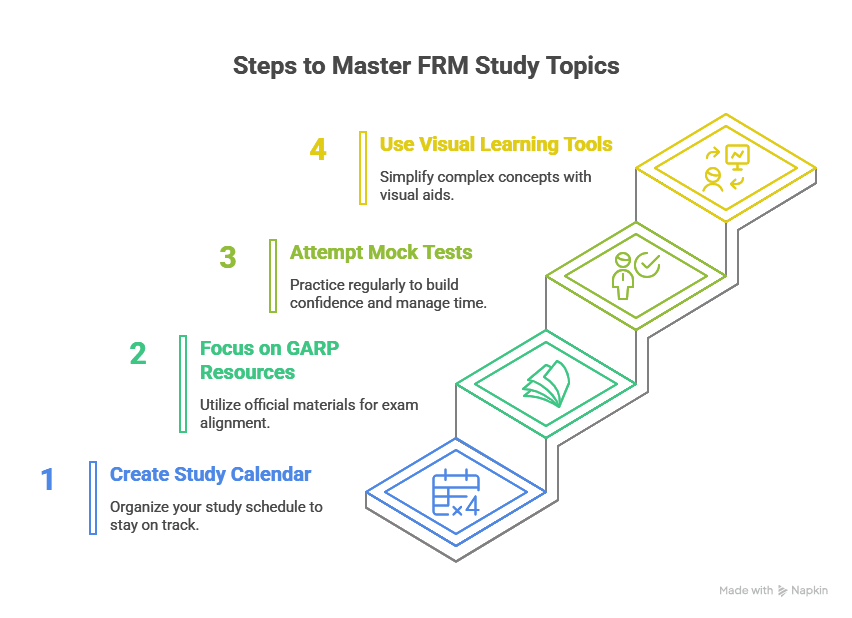
Tips to Master FRM Study Topics
Mastering the FRM study topics requires a blend of strategic planning and regular practice. Here are some preparation strategies:
Strategy
Benefit
Create a study calendar
Keeps your preparation on track
Focus on GARP-provided resources
Aligns with the official exam framework
Attempt mock tests regularly
Builds exam-day confidence and time management
Use visual learning tools
Helps simplify complex quantitative concepts
You can also explore this video on FRM preparation tips to get guidance from experts.
FRM Certification Structure: How It All Fits Together
Here’s a quick recap of the complete FRM certification structure:
Stage
Details
Part I Exam
Tools and fundamentals
Part II Exam
Advanced application and case-based learning
Professional Experience
Two years in risk or financial analysis roles
Certification Awarded
Upon passing both exams and work experience
The structured nature of the FRM course structure ensures that you’re not just exam-ready but also job-ready.
Comparing FRM with CFA: Which One Is Right for You?
For many, the decision isn’t whether to do FRM—but whether to choose FRM or CFA. Both are powerful, but they serve different career purposes. If you’re debating between the two, this FRM vs CFA comparison is a helpful guide.
Career Benefits of FRM Certification
Earning the FRM certification has a direct impact on career prospects. Recruiters across banks, consulting firms, and investment institutions value this qualification for its rigour and industry alignment.
Roles that benefit from FRM certification include:
Risk Manager
Credit Analyst
Market Risk Analyst
Treasury Professional
Quantitative Risk Analyst
Regulatory Risk Consultant
Institutes like Imarticus Learning’s FRM program also offer placement support, mentorship, and live industry sessions, making them a reliable partner in your career journey.
FAQs
1. What’s the FRM course duration? Around 8–9 months… depending on how you pace it.
2. What’s new in the FRM syllabus 2025? It now includes climate risk, fintech, and updated market topics.
3. How are FRM level 1 and 2 modules different? Level 1 is theory-focused; Level 2 is more practical & applied.
4. What’s the FRM exam pattern like? Both parts are 4-hour MCQ-based exams—no negative marking.
5. What are the main FRM study topics? Risk models, valuation, markets, quant analysis—core stuff!
6. Is the Financial Risk Manager syllabus tough? It’s detailed but doable with a solid prep plan.
7. How’s the FRM certification structure set up? Two exams + 2 years of work = you’re certified!
8. Can I manage the FRM course duration with a job? Yep, it’s totally flexible for working pros.
Final Thoughts
Choosing to pursue the FRM designation is a significant step- in advancing your finance career. The clear & progressive FRM course structure, paired with up-to-date modules & a practical exam format… ensures candidates are equipped for real-world challenges. Whether you’re just starting out or looking to switch roles, understanding the FRM syllabus 2025, preparing for both FRM level 1 and 2 modules, & aligning with the FRM certification structure will put you on the right path.
From the exam pattern to FRM course duration, every element is designed to train you as a well-rounded risk professional. So, plan your calendar, get the right prep resources, and take the leap toward becoming a certified Financial Risk Manager.
In the evolving landscape of finance and risk management, the FRM Certification has gained a strong reputation for its depth, credibility, & global recognition. If you’re someone aiming for a successful career in risk management or finance… understanding the nuances of this credential can be your stepping stone to a thriving future. In this comprehensive guide, we break down everything you need to know about the- FRM Certification in 2026—from course details to exam structure, eligibility criteria, & the promising career path it opens up.
What is FRM Certification?
The Financial Risk Manager (FRM) Certification is a globally recognised credential offered by- the Global Association of Risk Professionals (GARP). It equips professionals with the knowledge & skills needed to assess & manage risk in financial institutions. Whether…you’re looking to deepen your understanding of credit risk, market risk, operational risk, or investment management, this certification can be your gateway.
FRM holders are regarded as experts in financial risk analysis and are often preferred by top employers including investment banks, asset management firms, hedge funds, and regulatory agencies.
FRM Course Details 2026
The FRM course details 2026 have been structured to reflect the current and evolving challenges in financial risk management. The course is divided into two parts:
Part
Focus Area
Key Topics
Part I
Tools to assess financial risk
Foundations of Risk Management, Quantitative Analysis, Financial Markets and Products, Valuation and Risk Models
Part II
Application of risk management tools
Market Risk, Credit Risk, Operational and Integrated Risk Management, Liquidity and Treasury Risk, Risk Management in Investment Management
Each part is a standalone exam & must be passed sequentially. However… candidates have the flexibility to study at their own pace.
For more in-depth guidance, you can explore our FRM Certification Course designed in collaboration with industry experts.
FRM Exam Structure
The FRM exam structure is designed to test a candidate’s analytical ability and practical application of risk management concepts. Here’s a snapshot:
Exam Part
Duration
No. of Questions
Format
Part I
4 hours
100
Multiple Choice
Part II
4 hours
80
Multiple Choice
Both exams are paper-based & are typically held in May and November each year. Candidates must pass Part I to be eligible for Part II.
If you’re wondering about the difficulty level, check out this blog on How Hard is the FRM Exam to get honest insights from exam takers and experts.
FRM Syllabus and Subjects
The FRM syllabus and subjects are updated regularly to reflect the latest trends & practices in risk management. As of 2026, the syllabus includes:
Part I Subjects:
Foundations of Risk Management
Quantitative Analysis
Financial Markets and Products
Valuation and Risk Models
Part II Subjects:
Market Risk Measurement and Management
Credit Risk Measurement and Management
Operational and Integrated Risk Management
Liquidity and Treasury Risk
Risk Management and Investment Management
Current Issues in Financial Markets
Each subject carries different weightage in the exam, & a thorough understanding is crucial for success.
FRM Eligibility Criteria
One of the reasons- why the FRM Certification is accessible is its straightforward eligibility requirements. Here’s what you need to know:
Requirement
Details
Education
No minimum educational requirement
Experience
Two years of relevant work experience required post-certification
Exams
Pass both Part I and Part II
You can appear for the Part I exam without any prior work experience, making it an attractive option for students and entry-level professionals. Learn more about eligibility and the step-by-step process in our detailed FRM Certification Course.
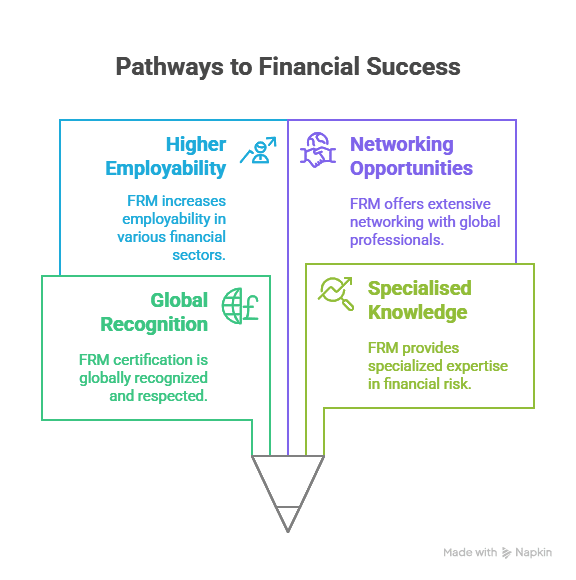
FRM Certification Benefits
Pursuing an FRM Certification comes with a host of advantages that make it a wise investment for finance professionals:
Global Recognition: It is accepted in over 190 countries and recognised by top-tier financial institutions.
Specialised Knowledge: It equips you with focused expertise in financial risk, unlike broader finance certifications.
Higher Employability: Opens doors to roles in risk management, asset management, investment banking, and more.
Networking Opportunities: Connect with a global community of over 60,000 certified FRMs.
If you’re comparing certifications, this article on FRM vs CFA will help you understand which credential aligns better with your career goals.
Career After FRM Certification
The career after FRM certification can be both lucrative and intellectually fulfilling. Here are some popular roles that FRM-certified professionals often land:
Job Title
Industry
Average Salary (INR)
Risk Analyst
Banking/Insurance
8-12 LPA
Credit Risk Manager
Corporate Finance
10-18 LPA
Market Risk Specialist
Investment Banking
12-20 LPA
Operational Risk Consultant
Consulting
9-15 LPA
These roles are not only high-paying but also provide a platform for global mobility and long-term growth.
Financial Risk Manager Course: A Smart Choice
A well-structured Financial Risk Manager course can significantly boost your chances of clearing the exams and applying your knowledge effectively. Opt for courses that include:
Live online classes with expert instructors
Case studies and practical projects
Access to mock tests and question banks
Career support and job assistance
Imarticus Learning offers a comprehensive FRM Certification Course that ticks all these boxes. It’s tailored for aspiring risk professionals and combines academic rigour with real-world applications.
Is FRM Certification Right for You?
The FRM Certification is more than just a credential…it’s a testament to your capability in managing complex financial risks. From the updated FRM course details 2026 and dynamic FRM exam structure to the comprehensive FRM syllabus and subjects… this certification is designed to produce world-class risk professionals.
To hear directly from successful candidates… watch this video about the FRM experience that provides candid feedback on preparation strategies and job outcomes.
FAQs
1. What are the FRM course details 2026? The 2026 course includes two parts covering risk foundations, quantitative tools, and advanced risk applications.
2. What is the FRM exam structure like? It has two parts: Part I with 100 MCQs & Part II with 80 MCQs, each lasting 4 hours.
3. What topics are covered in the FRM syllabus and subjects? Topics include market risk, credit risk, operational risk, valuation, & current financial issues.
4. Who meets the FRM eligibility criteria? Anyone can take the exam, but two years of relevant work experience are required for certification.
5. What are the FRM certification benefits? Global recognition, higher salary potential, and demand across top finance firms.
6. What’s the career after FRM certification like? You can work as a risk analyst, market risk manager, or credit risk specialist in global firms.
7. Which roles can I get after completing the Financial Risk Manager course? Roles include risk consultant, treasury analyst, and operational risk associate.
8. Is there a difference in FRM course details 2026 vs earlier years? Yes, 2026 includes updated topics and more focus on real-world risk scenarios.
Conclusion
The FRM Certification is more than just a credential—it’s a testament to your capability in managing complex financial risks. From the updated FRM course details 2026 and dynamic FRM exam structure to the comprehensive FRM syllabus and subjects, this certification is designed to produce world-class risk professionals.
With clear FRM eligibility criteria, a broad range of FRM certification benefits, and a rewarding career after FRM certification, it’s a compelling choice for finance professionals looking to future-proof their careers. Whether you opt for self-study or join a structured Financial Risk Manager course…your journey to becoming a certified FRM can begin today.
Ready to take the next step? Explore the FRM Certification Course by Imarticus Learning and start building your future in financial risk management.
If you’re looking to future-proof your career in finance, the FRM certification is more than just a badge — it’s a skills powerhouse. The Financial Risk Manager (FRM®) program doesn’t just teach theory; it transforms the way you analyse, manage & mitigate risk in real-world scenarios.
Let’s unpack the essential Risk Management Skills you’ll gain through the FRM journey & why they’re vital in today’s volatile economic climate.
What Are Risk Management Skills?
Risk Management Skills are the tools & techniques professionals use to identify, assess, prioritise, and mitigate financial threats. These include analytical thinking, market knowledge, quantitative modelling, regulatory understanding, and decision-making under pressure.
In the FRM course, these skills are taught through practical, scenario-driven modules designed by industry leaders.
What Do You Learn in the FRM Program?
Here’s a snapshot of FRM program learning outcomes:
Core Area
Skill Developed
Foundations of Risk Management
Risk frameworks, Basel norms
Quantitative Analysis
Probability, statistics, regression
Financial Markets and Products
Derivatives, options, swaps, hedging
Valuation and Risk Models
VaR, stress testing, sensitivity analysis
Operational and Liquidity Risk
Scenario planning, liquidity planning
Current Issues
ESG, cyber risk, fintech disruptions
These modules form the foundation of your FRM professional skill set and prepare you for complex roles in financial services.
FRM Skills List: What Makes You Industry-Ready?
Here’s a concise FRM skills list that recruiters actively look for:
Category
Skill
Technical
Statistical Modelling, Excel, Python
Analytical
Data Interpretation, Problem Solving
Regulatory
Basel III, IFRS, Risk Compliance
Strategic
Decision-Making, Scenario Analysis
Communication
Report Writing, Stakeholder Briefing
These are not just theoretical — the skills learned in FRM course are tested in exam case studies and then applied directly in professional settings.
Risk Management Skills for FRM: How Are They Taught?
The risk management skills for FRM aren’t taught through rote learning. Instead, the program uses:
Case-based learning
Real-world financial data
Mock portfolios
Market event simulations
These methods build your financial risk management competencies in a practical, job-relevant way.
Plus, FRM-certified educators ensure that the learning isn’t limited to textbooks. You’ll engage in solving problems that mimic actual financial crises — sharpening your decision-making instincts.
Why These Skills Matter: Key Skills for Risk Managers
If you’re aiming to work at places like Goldman Sachs, Morgan Stanley, or RBI, you’ll need more than technical knowledge. The key skills for risk managers also include:
Emotional intelligence
Regulatory foresight
Crisis communication
Ethical decision-making
The FRM program equips you with both the hard and soft skills essential to thriving in these environments.
Watch this video for real-world FRM insights: FRM Salary Expectations – YouTube
FRM Professional Skill Set vs Traditional Finance Degrees
Let’s compare what you learn in the FRM program versus typical finance degrees:
Skill Type
Traditional Degree
FRM Program
Quantitative Modelling
Limited
In-depth, practical application
Regulatory Knowledge
Basic overview
Detailed, updated frameworks
Market Risk Tools
Conceptual
Simulation & case-based use
Risk Communication
Rarely covered
Core part of learning
Scenario Planning
Minimal
Regularly practiced
Clearly, the FRM professional skill set offers a sharper, more practical edge.
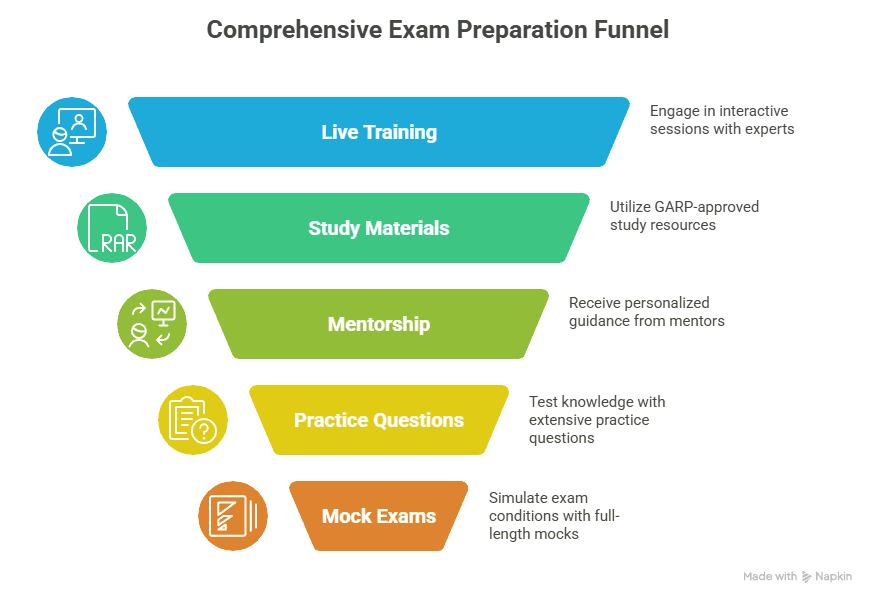
To get trained on the skills learned in FRM course, it’s important to choose the right provider. We recommend the FRM Certification Course by Imarticus Learning, India’s first and only authorised GARP prep provider.
What You Get:
200+ hours of live expert training
GARP-approved study materials
Personalised mentorship
4000+ practice questions
8 full-length mock exams
Career bootcamp + placement assistance
This is where you build the FRM skills list you need to get noticed in top firms.
Career Impact of FRM Program Learning Outcomes
The FRM program learning outcomes translate directly into better job roles and faster promotions.
Role
Relevant Skill Gained
Credit Risk Analyst
Probability, exposure analysis
Market Risk Manager
VaR, back-testing, volatility measures
Treasury & Liquidity Manager
Liquidity metrics, ALM frameworks
Regulatory Risk Analyst
Basel compliance, reporting frameworks
Investment Risk Manager
Portfolio stress testing, hedging tools
Every skill has a job tied to it. That’s the power of structured risk management skills.
FAQs
1. What’s included in the FRM skills list? Stuff like risk modelling, financial analytics, regulatory frameworks, and stress testing — all job-ready.
2. Are the skills learned in FRM course practical? Totally. It’s not just theory; everything is tied to real-world finance scenarios.
3. What are the key risk management skills for FRM students? Quant analysis, market risk tools, decision-making under pressure, and compliance knowledge.
4. How do financial risk management competencies help in jobs? They make you the go-to person for solving complex risk issues — and that gets noticed!
5. Do FRM program learning outcomes align with industry needs? Yes, 100%. The curriculum is designed with what banks and financial firms actually want.
6. What’s a typical FRM professional skill set? Think VaR, scenario planning, credit risk, and strong regulatory understanding — it’s a full package.
7. Why does the FRM skills list stand out from other finance courses? Because it’s deep, current, and built for professionals dealing with real-time risk.
8. Are risk management skills for FRM helpful for freshers too? Absolutely. Even at entry level, they give you a serious edge over others.
Final Thoughts
If your goal is to break into or grow within finance, the Risk Management Skills taught in the FRM program are indispensable. They equip you to:
Understand complex financial systems
Make informed decisions under uncertainty
Navigate global regulatory environments
Communicate risk clearly and confidently
The FRM is more than a credential — it’s a transformation in how you think, analyse, and act in the face of financial uncertainty.
Have you ever wondered what kind of salary a Financial Risk Manager earns? If you’re eyeing a career in risk management or finance, what is the FRM salary in India? is probably one of the first questions that comes to mind. And rightly so – after all, your job should reward both your skills and the time you invest in building them.
If you’ve ever found yourself wondering, “How much can I really earn with an FRM certification?” – you’re asking a very practical question. Now more than ever, risk management isn’t just a buzzword. It’s where careers are not only built but accelerated, in India and around the world.
The FRM certification, offered by GARP, has become one of the most prestigious global designations in finance. Employers across banking, consulting, and fintech respect it. But how much can you earn with an FRM under your belt in India? Let’s break it down.
What is FRM?
If you’re wondering what is FRM, think of the FRM (Financial Risk Manager) credential as a global passport in finance. Offered by GARP (Global Association of Risk Professionals), it proves your ability to handle the toughest challenges in modern finance, from market volatility and credit risk to regulatory compliance.
It’s not just another qualification on your résumé; it’s a recognition that you can help companies plan confidently through uncertainty. That’s why leading banks, investment firms, consulting companies, and fintechs actively seek FRM-certified professionals. With the demand for skilled risk managers rising, the FRM salary in India continues to reflect the value of this globally respected certification.
What Does an FRM Professional Actually Do?
FRMs are the financial risk experts who keep organisations safe when markets get unpredictable. They work behind the scenes, analysing data, building risk models, and designing strategies to minimise potential losses.
In simple terms, FRMs don’t just crunch numbers – they help businesses make smarter, safer decisions.
You’ll find them in:
Banks that manage credit or market risk.
Hedge funds and asset management firms, optimising portfolios.
Fintech companies, strengthening digital risk frameworks.
Regulatory bodies like the RBI or SEBI ensure compliance and stability.
Their expertise makes them essential to the financial ecosystem, and that’s exactly why FRM-certified professionals are among the most sought-after in today’s finance world.
Which Industries Hire FRMs?
From banks to startups, FRMs are found anywhere money meets uncertainty:
Industry
Top Employers
Banking & Financial Services
HDFC, ICICI, Axis, SBI, Barclays
Consulting & Big 4
Deloitte, KPMG, PwC, EY
Insurance & Actuaries
LIC, HDFC Life, SBI Life
Fintech & Startups
Paytm, Razorpay, Cred
Asset Management & Hedge Funds
BlackRock, Franklin Templeton
Corporate Risk (Non-financial firms)
Tata, Reliance, Mahindra
If you land an offer at Nomura, expect Analyst salaries to average ₹16-40 LPA, driven by location and market division.
Confused about what to do after BCom? This video cuts through the noise – no hype, no fluff – just clear guidance on the best certification that can fast-track your career, boost your earning potential, and help you stand out in today’s finance job market.
FRM Salary in India: A Closer Look
The FRM salary in India can vary depending on your experience, industry, and location. According to a recent salary research by QuintEdge, FRM-certified professionals in India earn between ₹6.7 LPA to ₹50 LPA.
Here’s a quick breakdown:
Experience Level
Average Salary (INR)
FRM Fresher
₹6-8 LPA
2-5 Years Experience
₹10-18 LPA
5-10 Years Experience
₹20-30 LPA
10+ Years / Leadership
₹40-50 LPA
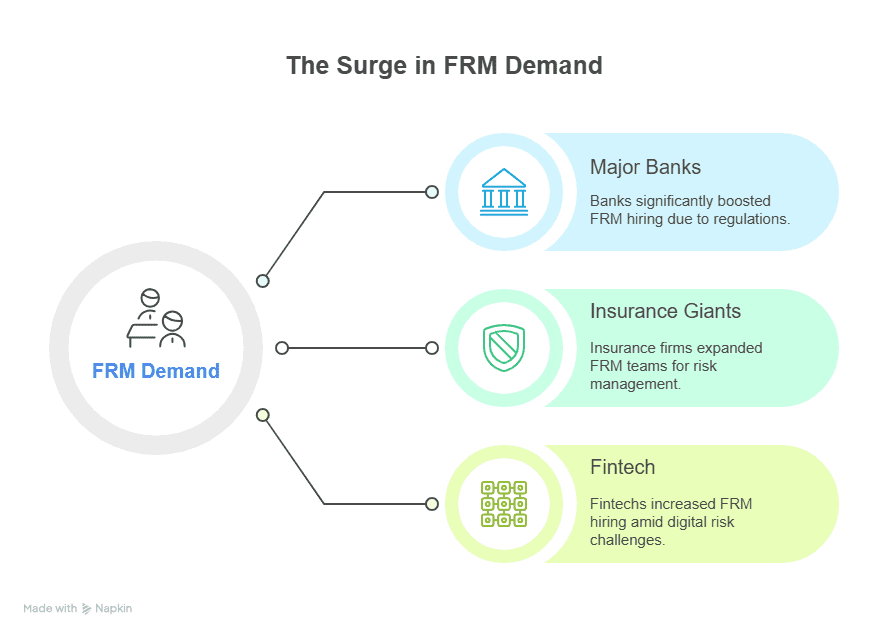
What’s driving these numbers? Companies have been facing growing regulatory pressures from the RBI and SEBI. Add the rise of digital banking and market volatility, and suddenly, risk experts are more important than ever. This demand is directly boosting FRM salary packages, especially in 2026 and beyond.
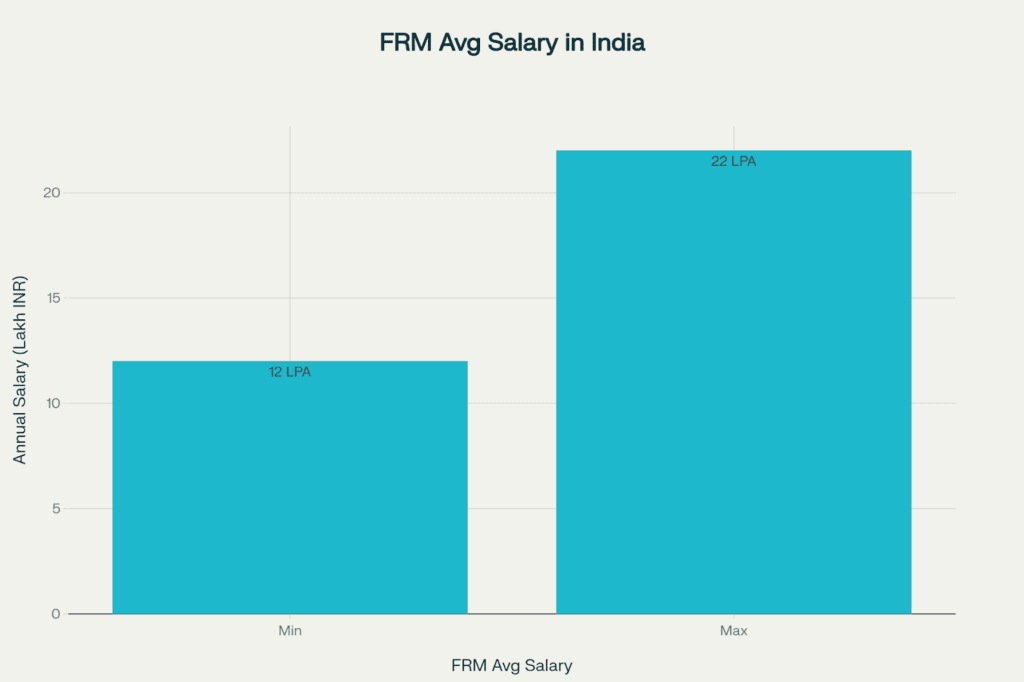
Most recent surveys show FRM-certified professionals in India earn well above average finance roles. Jobtedpegs the average around ₹12 LPA, whereas 6Figr reports experienced FRMs earning nearly ₹22 LPA annually.
The FRM Salary Ladder in India
Salary isn’t just about digits; it’s about growth and the kind of career arc you can expect. The journey starts at the fresher stage, moves quickly through specialist roles and then peaks with strategic leadership.
Experience Level
Typical Salary (INR)
Common Roles
0-2 Years
₹4-7 LPA
Risk Analyst, Junior Risk Consultant
3-7 Years
₹8-15 LPA
Risk Manager, Senior Risk Analyst
8+ Years
₹20-35+ LPA
Head of Risk, CRO, Director of Risk
In fact, veterans with global experience and broader portfolios can cross ₹1 crore per annum, especially at multinational banks or consulting houses.
Even entry-level roles such as Risk Analyst or Credit Risk Associate average ₹6-8 LPA on AmbitionBox, which is notably higher than most finance graduate salaries.
FRM Salary City-wise
Location plays a big role in salary potential – metros dominate the charts.
City
Average Salary
Mumbai
₹8-25 LPA
Bengaluru
₹7-22 LPA
Delhi NCR
₹6-20 LPA
Pune
₹5-15 LPA
Tier-2 Cities
₹4-12 LPA
Metro cities also offer faster career acceleration due to the concentration of multinational banks, consulting firms, and fintech startups.
Did You Know? Mumbai-based FRMs at J.P. Morgan can earn ₹18-30 LPA+, boosted by annual bonuses.
FRM Fresher Salary in India: Is It Worth It?
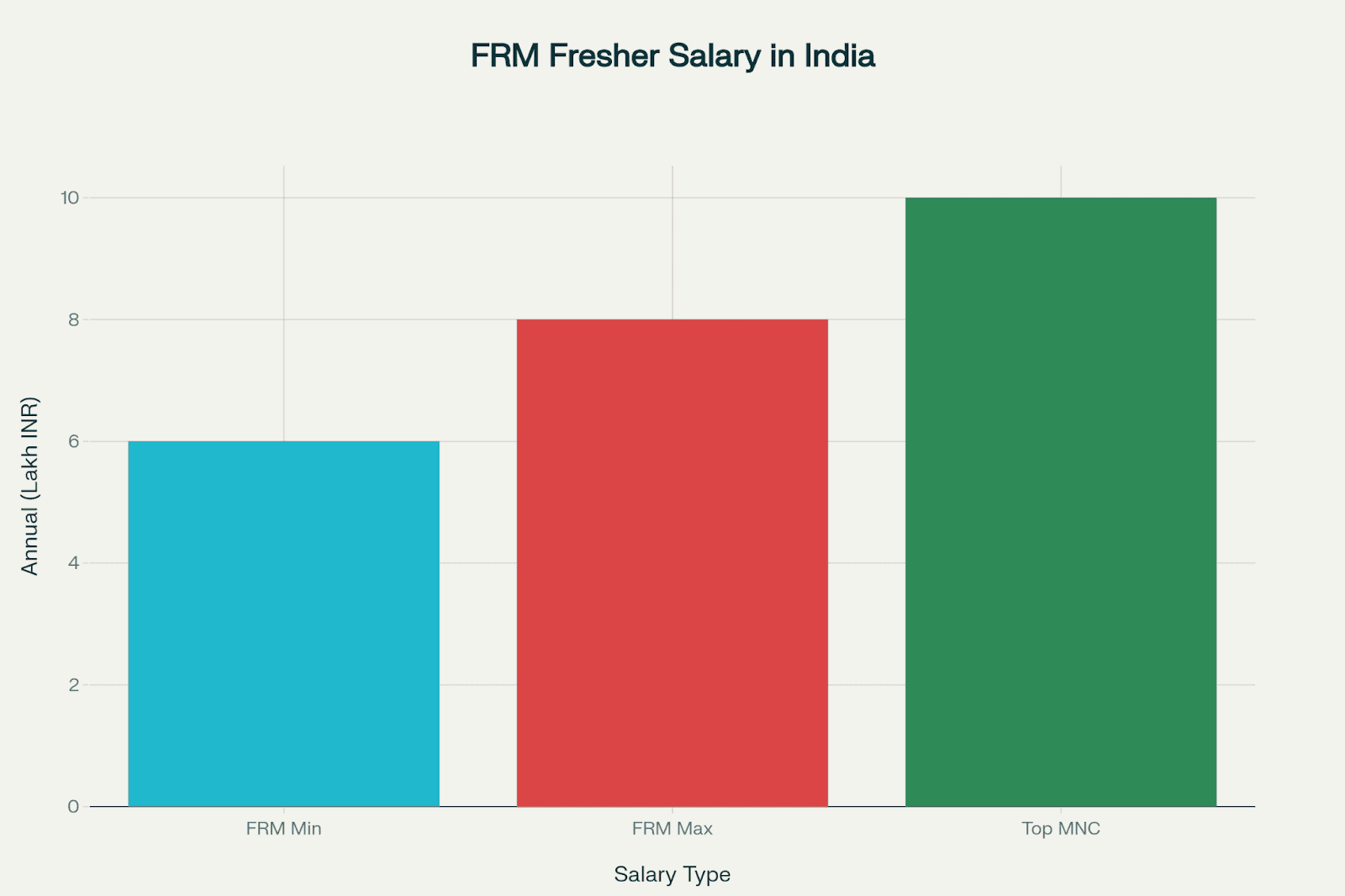
The short answer – yes, absolutely. An FRM fresher in India can expect to earn between ₹6 LPA and ₹8 LPA, depending on where they work. That’s already higher than most other finance graduates starting.
Common entry-level jobs for FRM-Certified Professionals include:
These are strong starting points that often lead to mid-level roles within a few years, which come with substantial pay hikes.
Interesting Fact! Top-tier employers (J.P. Morgan, Morgan Stanley, BlackRock, Nomura) pay above market – entry roles starting at ₹16-19 LPA, with senior managers crossing ₹31-75 LPA, including bonuses. – 6 Figr & Levels.FYI.
Why FRM Professionals are Paid Well
Ask any recruiter: the right risk expert doesn’t just spot issues; they prevent millions in losses. FRM-certified professionals earn more because:
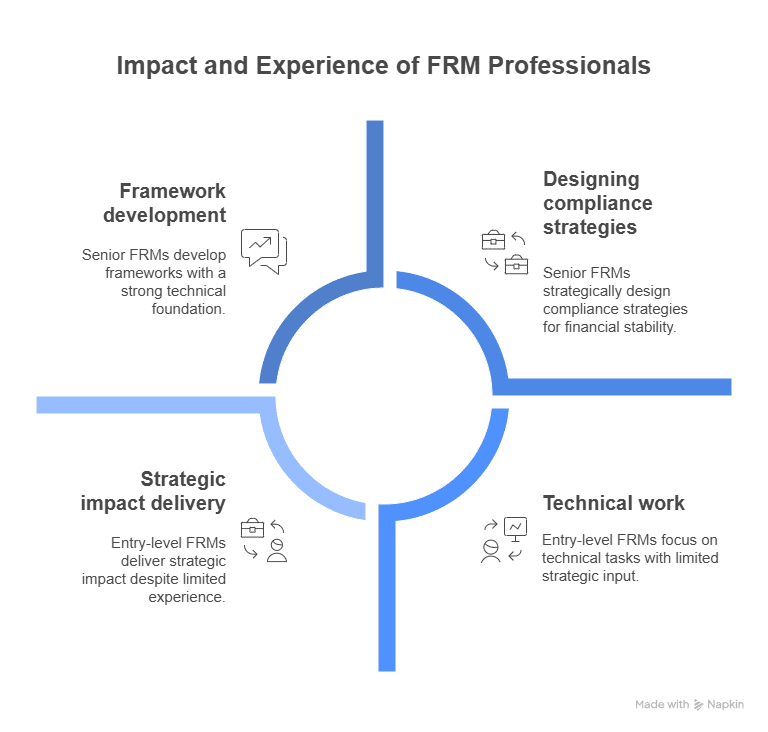
They deliver strategic impact, not just technical work.
Freshers enjoy a 20-30% premium over generalist finance grads, especially in metros like Mumbai, Bengaluru, and Delhi.
Mid-level and senior FRMs design frameworks and compliance strategies that save money and keep companies afloat during downturns.
Did you know?
Naukri and Glassdoor listings for FRM roles often show salaries 20-30% higher than comparable non-certified finance positions, especially in metro cities like Mumbai and Bengaluru. This difference is visible across platforms.
FRM Jobs and Pay Scale: Roles You Can Target
Earning your FRM qualification doesn’t box you into one type of job – in fact, it opens up multiple career paths.
Role
Salary Range (INR)
Risk Analyst
₹6-12 LPA
Credit Risk Manager
₹10-18 LPA
Market Risk Analyst
₹8-15 LPA
Portfolio Risk Manager
₹18-25 LPA
Treasury Manager
₹15-22 LPA
Regulatory Compliance Lead
₹20-35 LPA
FRM Salary in India Per Month
To get a clearer picture of earning potential, it helps to see how these annual figures translate into monthly pay. Here’s what FRM professionals in India typically earn per month.
Level
Average Monthly Salary (INR)
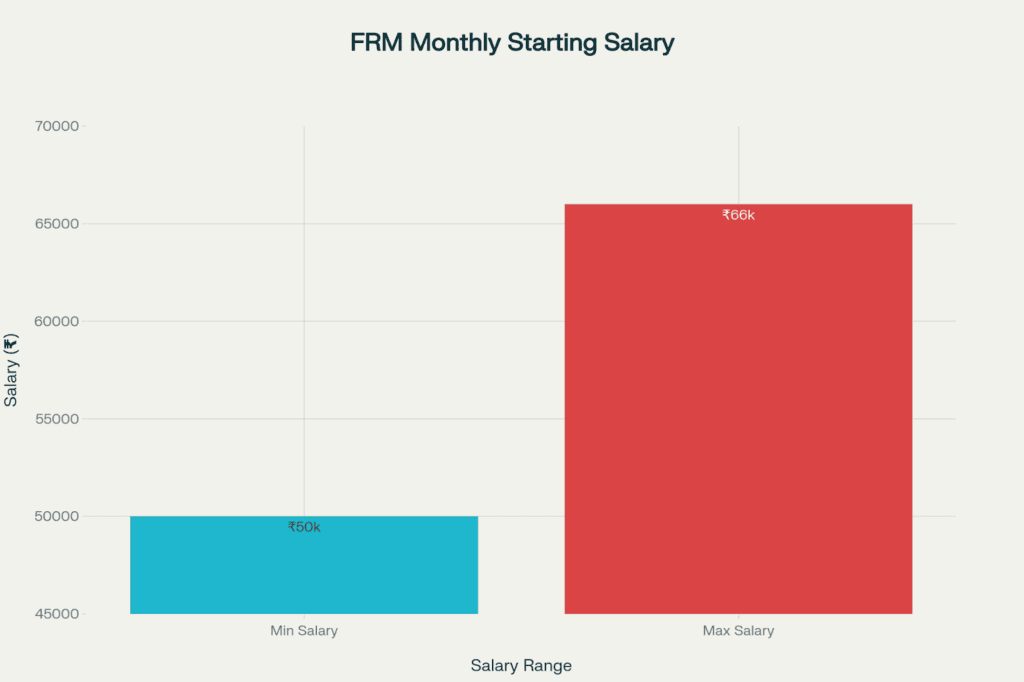
Fresher
₹50,000 – ₹66,000
Average (All)
₹64,000 – ₹1,60,000
Senior
₹1,30,000 – ₹2,80,000+
Entry-level FRMs usually start around ₹50K/month in top cities.
Senior FRMs (10+ years or leadership roles) can cross ₹2 lakhs/month in MNCs and large banks.
FRM Average Salary in India
According to the latest 2026 reports, the average FRM salary in India varies across sources.
while Glassdoor reports an average of about ₹10 LPA.
Together, these figures highlight how FRM-certified professionals in India typically earn between ₹10-22 LPA, depending on experience, role, and organisation.
These numbers reflect the rising appetite for certified risk professionals, especially as Indian banks and fintechs ramp up regulatory compliance teams in 2026.
The typical FRM-certified professional rolls in at ₹12-23 LPA on average, with mid-career specialists trending closer to ₹20 LPA.
FRM Starting Salary in India
When you’re just starting in risk management, the FRM fresher salary in India typically ranges from ₹6-8 LPA, but those landing analyst roles in top MNCs can see their starting package bumped up to ₹10 LPA, setting a solid financial foundation right from day one.
The fresher’s salary is significantly higher than most non-certified finance roles. The starting package is driven up for those placed in Mumbai/Delhi with Big 4 or top banks.
FRM Fresher Salary in India
If you’re just starting and wondering what your first paycheck as an FRM might look like, here’s a quick snapshot of what freshers typically earn in India.
Typical range: ₹6-8 LPA for Risk Analysts, Credit Risk Associates, or Jr. Market Risk roles.
Large consulting firms/US banks may pay close to ₹10 LPA for well-qualified starters.
Most freshers get their first hike within 2-3 years as they build practical risk and analytics experience.
You’ve finished your BCom, landed your first job, but somewhere deep down, you’re wondering – is this it? Or can a commerce graduate like you really break into the seven-digit salary club? This video will guide you through the best certification options after a BCom degree that can turn that question into reality.
CA FRM Salary in India
Those holding both CA and FRM certifications are paid premium salaries in risk, treasury, and strategic finance roles, quickly reaching mid- to senior-level pay bands.
Profile
Average Salary
CA
₹7-12 LPA (Freshers to 3 yrs)
CA at Top MNC
₹13-23 LPA (with 5-8 yrs)
CA + FRM
₹12-20 LPA (3-5 yrs), ₹30+ LPA (Sr)
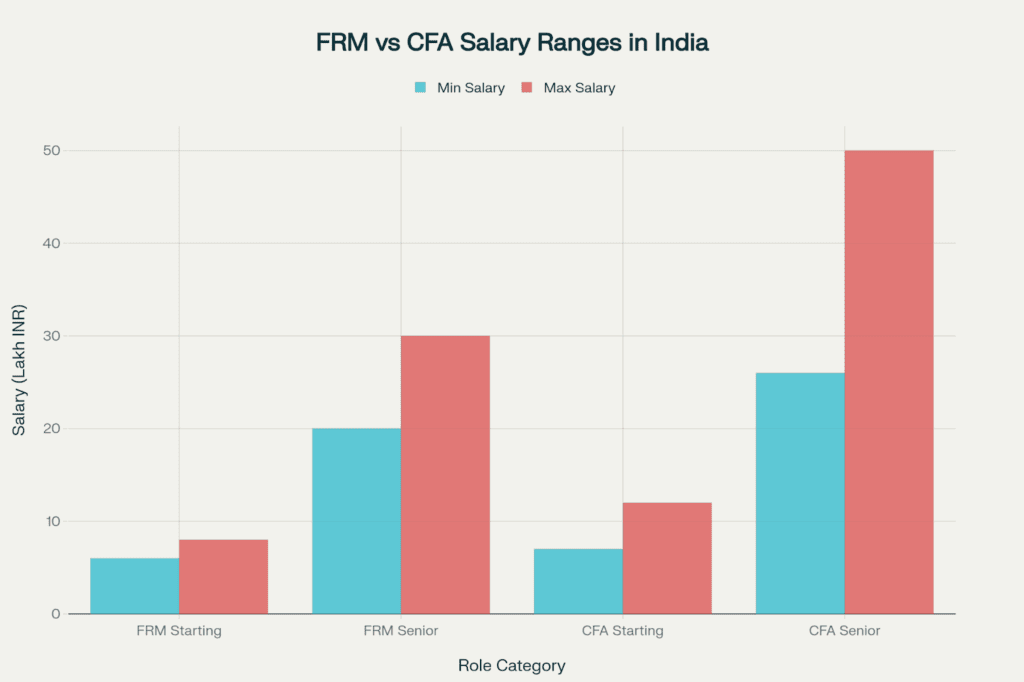
FRM vs CFA Salary in India
Both FRM and CFA are globally respected designations. Now that we know FRMs earn handsomely, the next big question is- how do they stack up against CFAs? Let’s break down the salary face-off between these two finance powerhouses.
Experience Level
CFA Salary
FRM Salary
Entry (0-3 yrs)
₹7-12 LPA
₹6-9 LPA
Mid (4-7 yrs)
₹13-25 LPA
₹10-15 LPA
Senior (8+ yrs)
₹26-50+ LPA
₹20-30+ LPA
CFA is preferred in investment/portfolio roles, while FRM is preferred for risk, compliance, and treasury.
Both see rapid jumps post 5 years, but CFA may command the highest peaks in portfolio mgmt/banking, while FRM leads in risk-intensive domains.
CFA FRM Salary in India
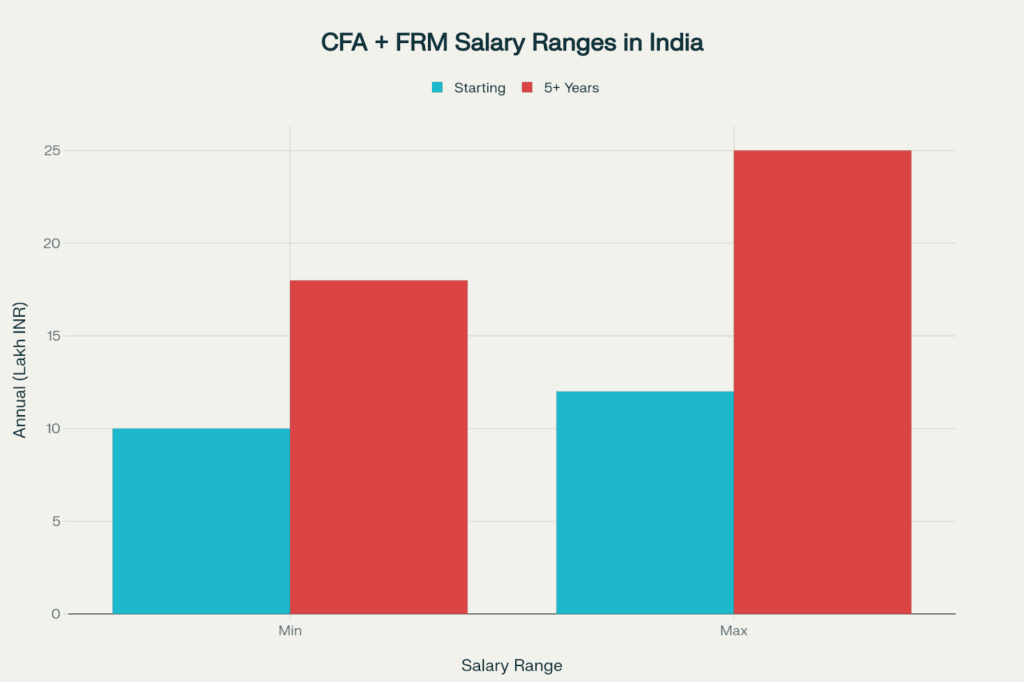
Salary for professionals holding both CFA and FRM ranges from ₹8-15 LPA for 1-4 years of experience, quickly rising to ₹18-30+ LPA with 5-8 years, especially in investment banks, asset management, and risk strategy.
Dual-certified specialists are sought after for hybrid roles – investment risk, risk analytics, and portfolio risk consulting.
Did you know? Picking up Python or R can instantly add ₹2-3 lakhs to your annual offer, as risk analytics is a premium skill.
FRM Salary in India vs Other Certifications: Value
FRM isn’t alone; CMA and CFA also give a clear career boost.
Certification
Typical Indian Salary
Main Roles
Skills That Boost Pay
FRM
₹4-7 LPA Fresher, up to ₹35+ LPA Senior
Risk Management, Analytics
Data modelling, Python, Regulatory expertise
CMA
₹3-5 LPA Fresher, up to ₹30 LPA Senior
Management Accounting, Costing
Power BI, SAP, Strategy, Communication
Why FRM sometimes edges ahead: Risk roles now attract huge demand, faster salary hikes, and job security, even during downturns.
FRM Salary in India by Job Roles
When you begin your journey as an FRM-certified professional, the title on your business card isn’t just a designation; it’s a reflection of the value you bring to the financial ecosystem.
From entry-level analysts crunching market data to directors shaping risk strategies at multinational banks, every role tells a story of growth, expertise, and reward.
Picture this-
You begin as a Risk Analyst, working behind the screens to identify early warning signs in portfolios – earning around ₹6-8 LPA. As you sharpen your understanding of credit exposure and regulatory metrics, that number begins to climb.
Soon, you might step into the shoes of a Credit Risk Manager, balancing decisions worth crores – salaries here often reach ₹15-25 LPA depending on the organisation and city.
Move a few years ahead – you’re no longer just assessing risks; you’re defining frameworks. As a Market Risk Specialist or Operational Risk Manager, your expertise becomes pivotal to every trade and compliance decision, fetching ₹20-35 LPA or more in global banks.
And for those who keep climbing, to Senior Risk Leaders, VPs, or CROs – the story turns exponential. Strategic decision-making, cross-border exposure, and advanced analytics can push annual compensation well above ₹50 LPA in top-tier firms.
FRM Salary in India: What’s the Future?
The outlook for FRM salaries in 2026 is bright. Experts predict an average 12-18% salary hike across all levels. So what makes the FRM certification a smart financial move? Let’s summarise.
Faster Salary Growth: FRM-certified professionals often get promoted faster because they bring proven credibility to risk roles.
Job Security: Risk management remains a top hiring priority even during recessions.
Global Mobility: The FRM credential makes it easier to transition into international finance jobs.
Career Diversity: From banking to fintech, every financial institution needs risk experts.
This growth is mainly driven by:
Stricter regulations by the RBI and SEBI
Expansion of GIFT City in Gujarat
Rising ESG and compliance mandates
In short, risk management is becoming the backbone of modern finance, and FRM-certified professionals are leading that change.
The demand for certified risk managers is set to grow sharply with India’s expanding financial sector and regulatory oversight.
According to Naukri and LinkedIn hiring insights, FRM-related job postings have increased by nearly 35% YoY since 2023.
By 2030, salaries in advanced risk roles are expected to rise by another 20-25%, especially in fintech and global investment banking domains.
Factors Impacting FRM Salary in India
Several things move the needle for better or worse on your pay:
Industry: Banking, investment, and insurance top the charts; consulting and fintech are strong challenger sectors.
Company Size: Large MNCs and global banks pay far more than regional outfits.
Location: Mumbai is king, followed by Bengaluru and Delhi NCR for top packages.
Skill Set: Knowing Python, R, Power BI, or Tableau? Expect a 20-30% lift.
Certifications: Adding CFA, CPA, or an MBA to FRM multiplies the value.
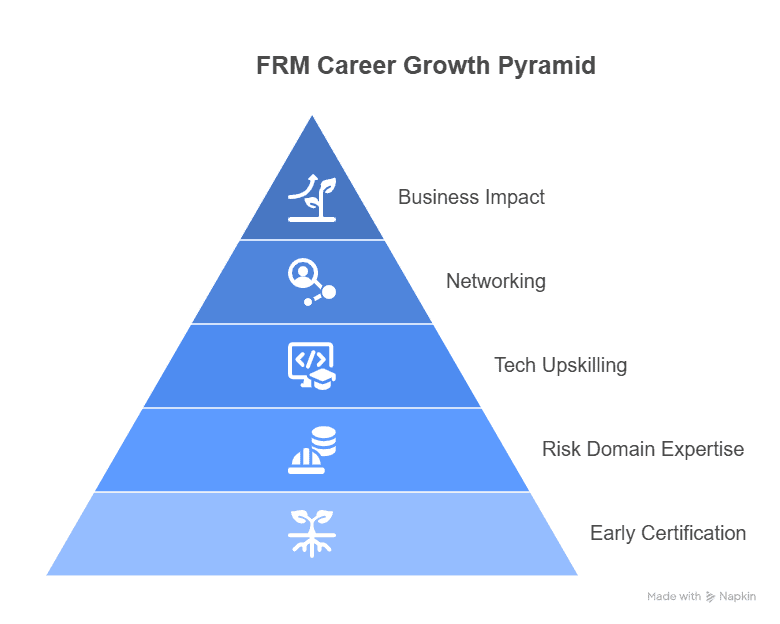
How to Boost Your FRM Salary
Earning your FRM is just the first milestone – how you build on it determines how fast your salary grows. Here are a few proven ways to stay ahead of the curve and maximise your earning potential:
Get certified early, start compounding your growth.
Work across risk domains: credit, market, liquidity.
Upskill in data analytics, AI, and fintech regulation.
Stay networked: GARP members, LinkedIn, webinars.
Always show business impact in appraisals.
Where to Start: Preparing for the FRM Journey
If you’re inspired to pursue your FRM journey, preparation is the key. Look for learning programs that provide:
GARP-approved study materials
Mock exams and classroom support
1:1 career mentorship
Placement guidance
India’s only GARP-authorised provider, the Imarticus FRM Certification Program, offers a structured path to earning your FRM credential and accelerating your risk career.
FAQs about FRM Salary in India
Here are a few frequently asked questions about FRM Salary in India to understand advanced career opportunities and salary growth for professionals aiming to master risk management in the finance industry.
Who earns more, FRM or CFA?
While both CFA and FRM professionals enjoy competitive pay, FRMs often earn slightly higher in specialised risk management roles due to their niche expertise in managing financial uncertainty. On the other hand, CFAs earn more in investment and portfolio management roles. Ultimately, the better-paying path depends on your interest in domain – risk or investments.
What is the salary of an FRM in Deloitte India?
At Deloitte India, FRM-certified professionals typically earn between ₹5-12 LPA for freshers; the pay range increases depending on experience and role. Mid-senior professionals in risk consulting or financial advisory can see packages crossing ₹25 LPA. FRM certification adds a strong edge in global risk and compliance projects.
What is the salary of ACCA vs FRM in India?
Both ACCA and FRM offer global finance careers, but their pay scales differ by role. FRMs specialise in risk management and usually earn around ₹10-20 LPA, while ACCAs specialise in accounting and audit roles, earning an average of ₹6-15 LPA. The FRM salary in India tends to rise faster due to their demand in banking and fintech risk functions.
Is FRM in demand in India?
Absolutely. FRM-certified professionals are increasingly sought after as Indian banks, NBFCs, and fintech firms strengthen their risk and compliance frameworks. With the RBI tightening regulatory norms, FRMs are now among the most in-demand finance specialists in 2026.
What is the expected FRM salary in India in 2026?
In 2026, the FRM salary in India is projected to range between ₹10-30 LPA depending on experience, role, and sector. Senior professionals in banking and treasury roles often command packages above ₹25 LPA.
What is the average Financial Risk Manager salary in India?
The average FRM salary in India stands around ₹12-18 LPA for mid-level professionals, according to AmbitionBox and Glassdoor data. This number continues to climb as more firms recognise the value of certified risk talent.
What is the FRM fresher’s salary in India?
Fresh FRM-certified professionals typically start between ₹6-8 LPA. Companies like Deloitte, KPMG, and fintech startups actively hire FRM freshers for entry-level risk and analytics roles, offering a solid launchpad for career growth.
How are FRM jobs and pay scale structured?
FRM salaries scale quickly with experience and role complexity. Risk analysts and associates earn mid-level pay, while risk managers, treasury heads, and credit risk specialists earn significantly more due to higher responsibility and exposure.
What is the average FRM salary in India for freshers?
For FRM-certified freshers, salaries usually fall in the ₹6-8 LPA range, depending on the company, role, and city. Tier-1 firms and global banks may offer slightly higher packages to those with additional finance or analytics skills.
Which companies hire FRM-certified professionals in India?
Top recruiters include Deloitte, KPMG, PwC, Barclays, and various fintech startups.
What roles can I get after FRM certification?
Common roles include Risk Analyst, Credit Risk Manager, Market Risk Analyst, and Treasury Manager.
Transform Your Finance Career With FRM
Choosing a career is never just about passion; it’s also about potential. And when it comes to both, the FRM certification delivers on every front.
FRM salary in India ranges from ₹4 LPA as a fresher to ₹35 LPA+ at leadership/strategy roles, with global salaries crossing $100K for experienced pros. Major cities and global firms offer the best packages and now often match international pay for Indian talent. Salary is just the start – risk management means you’re helping shape finance and business strategy, both locally and worldwide.
From strong starting salaries to international opportunities, the FRM opens doors to some of the most dynamic and secure roles in finance. Whether you’re a fresh graduate or a mid-career analyst, earning your FRM could be the smartest investment you make this year.
If you love analytics, strategy and want a career with impact and global recognition, FRM is more than an exam. It’s the next leap in finance – backed by salary, security, and story. So if you’ve been thinking about it, now’s the time to leap. The world needs skilled risk managers, and your next big opportunity could be just one FRM exam away. Enrol Now!
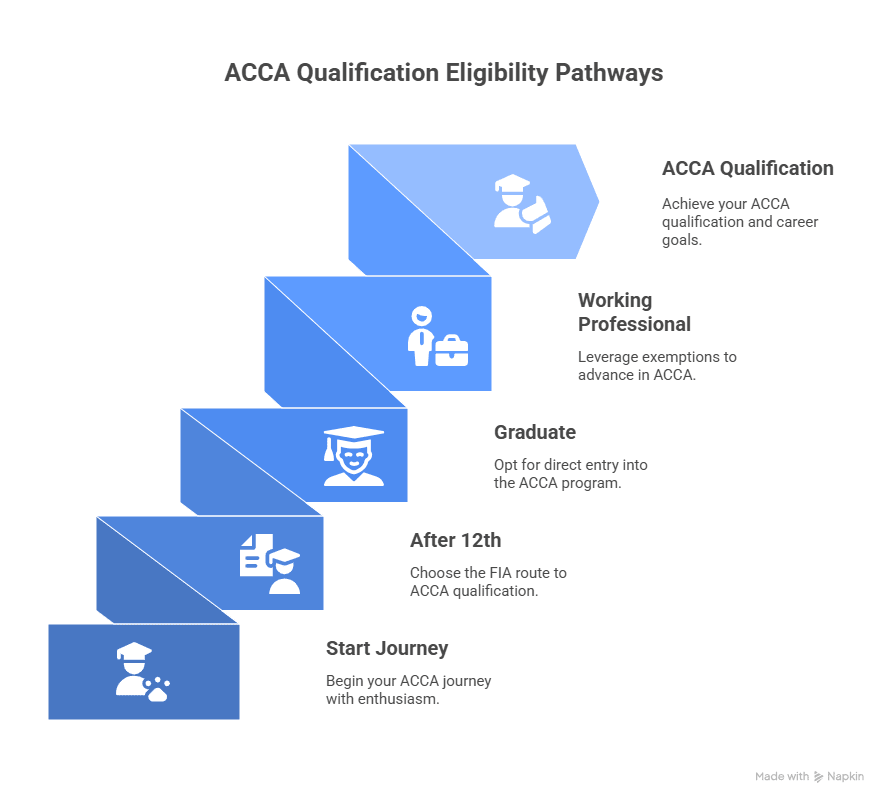
For aspiring finance professionals, understanding the ACCA eligibility criteria is the first step towards a globally recognised qualification. Whether you’ve just completed your 12th grade or are a working professional planning a career switch, ACCA offers a structured and inclusive path into the world of accountancy.
This blog will guide you to the actual ACCA qualification criteria or minimum qualification for ACCA that is required, or eligibility for ACCA after the 12th.
By 2026, career change is increasing, and employers globally are experiencing retention issues, but the ACCA qualification provides a rock-solid platform for those who want mobility, credibility, and global exposure. Global Talent Trends, a PrimeGlobal report, indicates that 62% of professionals anticipate a job change within two years. No surprise, therefore, that ACCA-certified professionals are sought after.
What is ACCA, and why is it in demand?
Association of Chartered Certified Accountants (ACCA) is a globally acclaimed accountancy organisation with more than 240,000 members in 180 countries. The qualification is available not only for freshers but also for working professionals, and that gives students a career advantage in finance, accounting, and strategic management careers.
One of the best aspects of ACCA is that it is flexible in entry paths as well as learning modes.
ACCA Eligibility Criteria 2026 – An Overview
If you are curious about who can choose ACCA, here is a brief overview of the minimum eligibility criteria for ACCA in 2026:
Qualification Level
Eligibility Criteria
After 12th (Commerce/Science)
Minimum 65% in Accounts/Maths and English, and 50% in other subjects
Graduates (Any Stream)
Bachelor’s degree from a well-known university
Non-Commerce Background
May have to start with ACCA Foundation in Accountancy (FIA)
Professionals with Experience
Can be eligible for exemptions based on valid work experience or qualifications
ACCA Eligibility After 12th – A Hot Favourite
The majority of Indian students now begin their ACCA career right after Class 12th, more so the commerce students. Science students also qualify if they gain the required marks.
The following is what you need:
Minimum 65% marks in Accounts or Maths, and English
Minimum 50% in the rest of the subjects
A sound interest in finance and accounts (not essential but very useful!)
ACCA Graduating Student Requirements
Graduating students from any stream are eligible to become a member of ACCA, but only graduating students of commerce with the subjects accounting, finance, or economics can take some exemptions of the papers.
Students who hold degrees from approved colleges or possess professional certificates, such as CA Inter or CMA, can also opt for paper exemptions and accelerate their ACCA career.
What If You Don’t Meet the ACCA Course Eligibility?
Don’t worry. ACCA has the Foundation in Accountancy (FIA) pathway, a bridging course for:
Students who did not fare well enough in their 12th board exams
Students with a non-commerce stream
Working professionals from another profession
Once you finish, you can go on to the final ACCA qualification with confidence.
Other ACCA Course Requirements to Keep in Mind
Language Proficiency
Exams for ACCA are conducted in English, and therefore students must be comfortable with the language—i.e., reading and writing.
Age Criteria
There is no upper age limit mentioned, but students must be above 18 years of age to register.
Exemption Policy
Depending on your educational and career development background, you can gain a maximum of 9 exemptions from the 13 papers.
Find your exemptions information online on the ACCA website:
Why Passing the ACCA Eligibility Criteria is Only the Beginning
Passing the ACCA eligibility criteria is step one. What really gets your career underway is:
Staying focused on all 13 papers
Choosing the right study buddy
Forcing yourself to get practical experience
And like global companies, multi-skilled as they are, many ACCA students today are also adding data analytics, financial modelling, and ESG reporting certifications to their CVs.
Industry Attitudes at a Glance
According to the 2025 ACCA Global Talent Trends, 58% of professionals at work wish for their next role to be in a different organisation. This demonstrates high employability, mobility, and a high demand for future-proof qualifications, such as ACCA, which have international recognition.
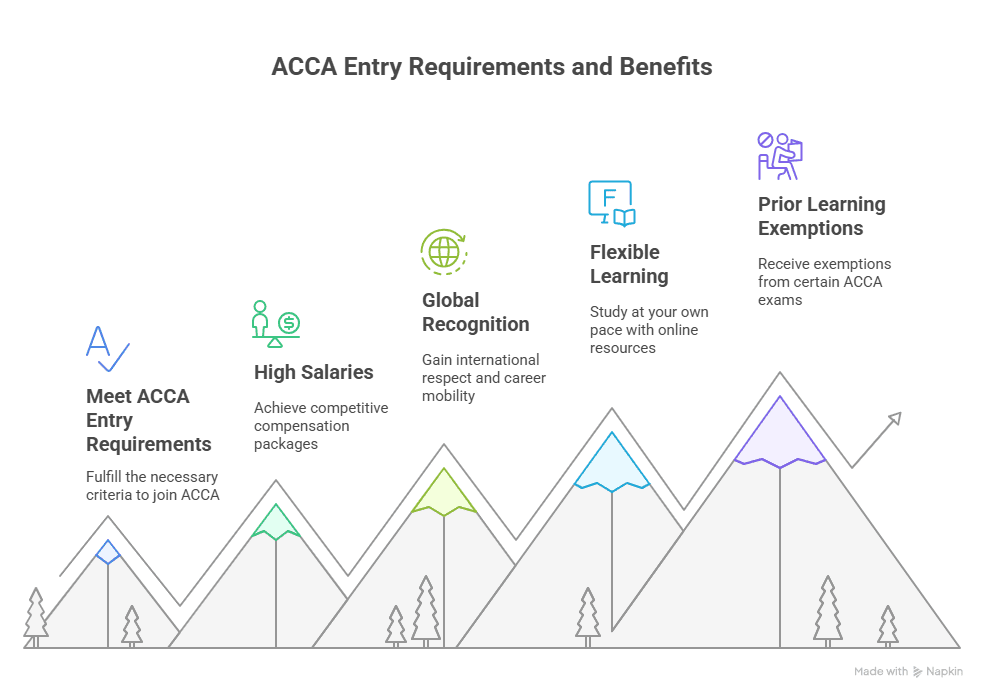
Benefits of Satisfying ACCA Eligibility Criteria
High Salaries – Especially in multinational organisations and Big 4s
Global Recognition – Career prospects in over 180 countries
Flexible Learning – Study while you work, at your own pace
Prior Learning Exemptions – You can finish earlier if you qualify
Webinar: Kickstart your Membership Journey
FAQs About ACCA Eligibility Criteria 2026
1. What is the lowest criterion for ACCA in India?
The student should have passed Class 12 with 65% in English and Maths/Accounts, and 50% in others.
2. Can one apply from a non-commerce course to pursue ACCA?
Yes, they may have to start with the FIA path if they do not possess basic accounting data.
3. Can I apply for ACCA at any age?
There is no upper age limit, but an individual must be at least 18 years old.
4. Can I study ACCA while pursuing my degree?
Yes. Indian students usually finish ACCA while graduating.
5. Can CA or CMA students get exemptions?
Yes. CMA or CA Inter cleared candidates can obtain exemptions up to 9 papers.
6. Do I need work experience to start ACCA?
No. But you need 36 months of work experience in the relevant field to get the final ACCA membership.
7. What if I am not eligible after passing 12th?
You can appear for the exam called Foundation in Accountancy (FIA) and then convert to ACCA.
8. Are working professionals eligible for ACCA? Yes.
Yes, working professionals also pursue ACCA for career switching or promotion.
9. Do I have to sit for IELTS or TOEFL for ACCA?
No. But take care of English since all papers are in English.
10. Where do I find official eligibility information?
The ACCA eligibility criteria for 2026 are again inclusive and available to everyone, making them most suitable for students and working professionals who want to pursue a career in international finance. New to school or a seasoned pro, there’s an entry route that’s most appropriate for you.
Key Takeaways
Start after 12th or graduation – Different entry routes based on where you’re from.
Offer exemptions to speed up progress – Commerce graduates and professionals can forego specific papers.
FIA is a solid base – Good option if you are not already meeting against the eligibility requirements.
If there’s one credential that has truly erased the boundaries of finance, it’s the ACCA Qualification. Recognised in over 180 countries, the ACCA (Association of Chartered Certified Accountants) opens the gateway to a world of opportunities, literally.
From London’s financial district to Singapore’s fintech hubs, ACCA professionals are in demand for their deep technical expertise, ethical grounding, and ability to navigate international regulations.
The qualification has over 240,000 members and 600,000 students globally, forming one of the largest professional communities in finance. Whether you aim to work for the Big 4 firms, consult across emerging markets, or lead corporate finance divisions, ACCA sets a foundation that’s as globally relevant as the career aspirations it fuels.
In this blog, we’ll break down how the ACCA Qualification opens doors to global career opportunities, helping finance professionals work across 180+ countries with recognised credibility and limitless growth potential.
What is the ACCA Qualification?
The ACCA Qualification is a professional accounting credential awarded by the Association of Chartered Certified Accountants (ACCA), a UK-based global body established in 1904. The goal of the ACCA course is to produce well-rounded finance professionals who not only excel in accounting principles but also understand technology, sustainability, and ethics, skills that define the modern finance leader.
At a Glance
Element
Details
Founded
1904 (London, UK)
Exam Levels
Applied Knowledge, Applied Skills, Strategic Professional
Practical Experience
36 months (documented via the ACCA PER Tool)
Ethics Module
Ethics and Professional Skills (EPSM)
Recognition
Accepted in 180+ countries
Members Worldwide
240,000+ professionals
Students
600,000+ globally
After understanding what is ACCA, it is important to know that ACCA’s syllabus integrates traditional finance disciplines like audit and taxation with new-age subjects like digital transformation, data analytics, and sustainability reporting – ensuring members remain relevant in an evolving economy.
Here is a video to distil down the ACCA course details in an engaging manner for you –
Why the ACCA Qualification Matters in 2025
Finance roles today demand agility across regulation, automation, and sustainability. Employers want professionals who can interpret IFRS standards, manage ESG disclosures, and make tech-driven financial decisions.
That’s why the ACCA Qualification continues to rank among the top global finance credentials. It’s not just an exam; it’s an evolving benchmark that shapes accountants into strategic business partners.
The ACCA framework also supports hybrid and remote learning, allowing candidates to prepare through online programs.
ACCA Eligibility 2025: Who Can Register
Before you begin your ACCA journey, understanding the eligibility criteria is crucial. ACCA welcomes learners at various stages: students, graduates, or professionals seeking a global credential.
Eligibility Routes
The ACCA Qualification is designed to be inclusive; whether you’re a school-leaver, a graduate, or a working professional, there’s a pathway suited to your background. Each route outlines the academic qualifications, exemptions, and preparatory options available, helping you choose the most efficient start toward earning your ACCA credential.
Candidate Type
Requirements
School-Leavers
Minimum of 3 GCSEs and 2 A-Levels (or equivalent) in five subjects, including Maths and English.
Graduates
Recognised degree holders may receive up to 9 paper exemptions
Mature Students
It can begin with the Foundations in Accountancy (FIA) and then transition to the full ACCA.
English Proficiency
IELTS, TOEFL, or equivalent certification (if prior education wasn’t in English).
Minimum Age
16 years old on the date of first exam registration.
This flexible eligibility framework ensures inclusivity and adaptability, one of ACCA’s strongest appeals. Here is a snapshot to help you understand better.
Check your exemptions eligibility with this free calculator:
The ACCA Qualification is structured across three distinct stages, each progressively deepening your technical and strategic acumen.
1. Applied Knowledge (3 Papers)
A foundational stage that introduces core business and finance principles:
Business and Technology (BT) – understanding business structures and digital integration
Management Accounting (MA) – planning, budgeting, and performance measurement
Financial Accounting (FA) – recording and reporting financial transactions
2. Applied Skills (6 Papers)
Bridges conceptual learning with practical skills:
Corporate and Business Law (LW)
Performance Management (PM)
Taxation (TX)
Financial Reporting (FR)
Audit and Assurance (AA)
Financial Management (FM)
3. Strategic Professional
At this level, ACCA moulds you into a leader and decision-maker. Compulsory Papers:
Strategic Business Leader (SBL)
Strategic Business Reporting (SBR)
Optional Papers (Choose any 2):
Advanced Financial Management (AFM)
Advanced Performance Management (APM)
Advanced Taxation (ATX)
Advanced Audit and Assurance (AAA)
Alongside, you must complete:
Ethics and Professional Skills Module (EPSM) – a real-world ethics simulator focused on judgment and integrity.
Practical Experience Requirement (PER) – 36 months of verified professional experience in finance or audit roles.
Global Recognition of ACCA in 180+ Countries
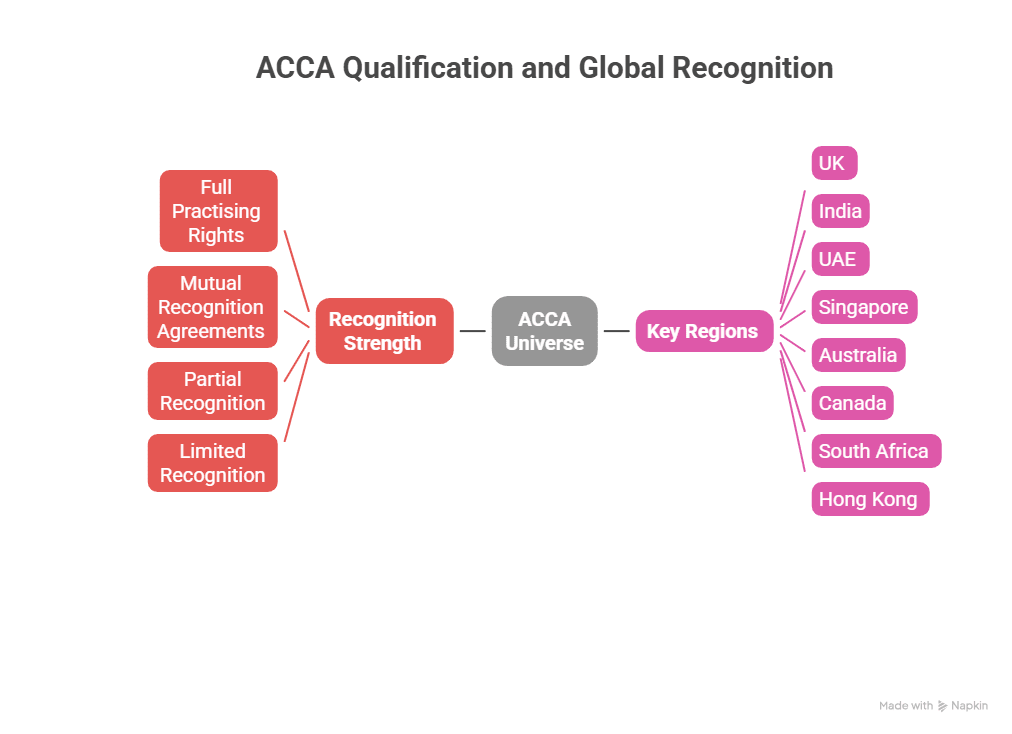
Few qualifications rival ACCA’s worldwide acceptance. Through Mutual Recognition Agreements (MRAs) and partnerships with top professional bodies, ACCA ensures its members can work or register locally in nearly every major economy.
Region
Partner/Recognition
Notes
UK & Europe
Full practising rights through ICAEW & ICAS
Recognised as a Chartered Certified Accountant
Australia & New Zealand
CPA Australia & CA ANZ
Reciprocal membership agreements
Middle East
UAE, Qatar, Saudi Arabia
ACCA is recognised by financial authorities
Asia-Pacific
Hong Kong, Singapore
Registration through local boards
North America
CPA Canada
Direct entry route post-qualification
Africa
South Africa, Nigeria
MRAs & exemptions available
This level of portability makes the ACCA Qualification ideal for professionals who want career flexibility without needing multiple national certifications.
The Real-World Advantage: Salaries and Roles
The global demand for ACCA professionals translates into strong pay packages across geographies.
With senior finance positions exceeding ₹20 LPA in India and £100,000 in the UK, the earning potential mirrors the qualification’s global prestige.
Building the Future-Ready ACCA Professional
The finance world has evolved far beyond the cubicle. Today’s accountants are no longer bound by physical offices or city-based firms; they work across time zones, tools, and digital ecosystems. The ACCA Qualification fits perfectly into this global shift.
A Fresh Perspective: The Remote-Ready Accountant
The ACCA curriculum’s inclusion of modules in Digital Finance, Data Analytics, and Sustainability Reporting reflects how the profession itself has transformed. The future finance professional isn’t just crunching numbers; they’re interpreting data through platforms like Power BI, automating workflows through RPA, and advising management on environmental disclosures.
A remote-ready accountant can:
Collaborate with international audit teams via cloud-based software like CaseWare and Xero
Provide virtual CFO services to startups scaling across geographies
Leverage AI tools to optimise tax filings and forecasting
Participate in online board meetings and financial reviews seamlessly
With the ACCA’s global syllabus and flexible examination system, professionals can qualify while working remotely or studying online.
Why Employers Value ACCA in the Hybrid Economy
The pandemic taught global organisations that accounting systems must be agile. Firms like EY, Deloitte, and KPMG have since prioritised hiring finance professionals trained in global reporting standards (IFRS) and capable of using digital audit tools, both hallmarks of ACCA graduates.
According to ACCA Global’s 2024 survey, 82% of multinational employers said they prefer ACCA-qualified candidates for roles requiring cross-border reporting and sustainability insights.
That’s because an ACCA Qualification doesn’t just represent exam success — it symbolises analytical thinking, business strategy understanding, and ethical decision-making.
These attributes collectively explain why the ACCA credential has become synonymous with future-ready finance leadership.
ACCA Qualification and the Global Job Market
Every economy needs credible, ethical finance professionals, which is precisely why the ACCA India Talent Trends 2025 data shows. This makes the ACCA qualification so relevant in global hiring. In 2025, top roles for ACCA members include:
Financial Analyst – evaluating investment opportunities and corporate performance
Audit Manager – leading statutory audits under IFRS frameworks
Tax Consultant – managing direct and indirect taxes for multinational clients
Risk Manager – identifying and mitigating market or operational risks
Management Accountant – supporting business strategy with financial insights
ESG Finance Specialist – preparing sustainability and climate disclosures
Regional Demand Snapshot (2025)
Region
Hiring Trend
Typical Roles
India
Rapid growth in Big 4 hiring and fintech
Analyst, Auditor, Finance Controller
UK
Consistent demand for IFRS and ESG roles
Senior Accountant, Reporting Manager
Middle East
Preference for ACCA in MNC finance divisions
FP&A, Internal Audit, Treasury
Asia-Pacific
Growth driven by digital finance startups
Management Accountant, Data Analyst
Africa
Increased public sector and NGO adoption
Compliance Officer, Budget Manager
The takeaway: wherever finance flows, ACCA follows.
ACCA in India: Rising Scope and Demand
The ACCA Qualification has witnessed exponential growth in India, driven by the country’s increasing integration with global financial systems.
Indian firms adopting IFRS-based reporting and global outsourcing hubs for audit and consulting are fuelling this trend. The Big 4 firms (EY, PwC, Deloitte, and KPMG), as well as multinational banks like HSBC and Barclays, are among the largest recruiters of ACCA-qualified professionals.
India’s demand for ACCA-certified professionals is continually on the rise, along with finance certifications like the CMA and CPA.
Top Cities Hiring ACCA Professionals in India
Major financial hubs like Mumbai, Bengaluru, and Delhi NCR have become hotspots for ACCA-qualified talent, with opportunities spanning audit, taxation, consulting, and corporate finance.
City
Average Salary (₹ LPA)
Key Recruiters
Mumbai
8–30 LPA
Deloitte, EY, PwC
Bengaluru
8–28 LPA
KPMG, HSBC, Flipkart
Delhi NCR
7–25 LPA
PwC, Genpact, Barclays
Hyderabad
7–23 LPA
Amazon, Deloitte, ICICI
ACCA professionals in India often start as finance associates, analysts, or internal auditors and quickly transition into managerial positions within 3–5 years.
The value of ACCA in India isn’t just in the paycheque — it’s in the global exposure and flexibility it offers. Whether you wish to work from Mumbai for a Singapore client or relocate to London for a Big 4 role, the qualification ensures mobility.
ACCA’s 180+ Accepted Countries: Your Global Career Passport
When you hold an ACCA credential, you’re not confined to one geography. You can:
Apply for finance and accounting roles across 180+ countries
Easily convert membership under MRAs to practice locally
Access the ACCA Careers Portal, which lists global openings across industries
Enhance your work visa profile with a recognised international qualification
One of the most compelling aspects of the ACCA Qualification is its worldwide recognition.
The ACCA 180 countries list includes key economies like:
United Kingdom
Australia
Canada
Singapore
United Arab Emirates
Malaysia
South Africa
India
Qatar
Hong Kong
This global acceptance is supported by Mutual Recognition Agreements (MRAs) that allow ACCA members to:
Register as CPAs in Australia and Canada
Obtain audit rights under UK laws
Join local accounting bodies (e.g., CA ANZ, ICAEW, ICAS)
Apply for work visas with professional status recognition
In essence, the ACCA Qualification acts as your finance passport; one that needs no translation wherever you go.
Why ACCA Professionals Earn More
Employers reward qualifications that deliver tangible results. The ACCA Qualification signals global readiness, technical proficiency, and leadership potential — qualities that command competitive salaries worldwide.
What’s particularly interesting is the sectoral spread. ACCA professionals are not limited to audit or tax — they work in consulting, fintech, investment management, and sustainability finance. This diversification shields their career from economic fluctuations and opens multiple revenue channels over time.
ACCA vs. the Future: Where the Profession Is Headed
The next decade will redefine accounting as technology merges with financial decision-making. Artificial Intelligence will handle routine reconciliations, while human accountants will focus on strategy, risk, and innovation.
That’s precisely the mindset ACCA promotes, turning accountants into digital strategists.
Through its updated syllabus, ACCA ensures members are fluent in:
Gold Status Learning Partner: Imarticus Learning is recognised as an approved learning partner for ACCA UK, ensuring its curriculum, materials, and training align with ACCA’s global standards.
Collaboration with KPMG in India: The ACCA programme is delivered in partnership with KPMG in India, offering real-world case studies, internships for top performers, and expert masterclasses from industry practitioners.
Kaplan-powered content: Your study materials are sourced from Kaplan (official ACCA-approved content provider), giving you high-quality books, question banks, live and on-demand modules, aligned with the latest ACCA syllabus.
Placement / Internship Guarantee: Even after completing the early levels, students gain access to internships; after two levels of the ACCA route, Imarticus offers a 100% placement or internship guarantee (or money-back option) for selected batches.
Pass Guarantee / Money-Back Assurance: The programme offers strong student success backing, such as the ability to retake sessions without extra cost and, in some cases, refunding fees if professional-level exams are not cleared.
Flexible learning for working professionals: With live online classes, recorded sessions, personalised mentors and modular batches, Imarticus supports both full-time students and working professionals pursuing the ACCA Qualification.
Global career focus: Since ACCA is recognised in 180+ countries, Imarticus ensures its programme emphasises international mobility. Their brochures highlight salary ranges, global job roles and accepted countries.
By enrolling through Imarticus Learning, candidates benefit from mentorship that blends exam mastery with career readiness, ensuring every learner emerges not just qualified, but employable.
Key Takeaways
Global Reach: Recognised in over 180 countries through MRAs
Flexible Pathways: Start after 12th, during graduation, or as a working professional
High Earning Potential: Senior ACCA professionals earn ₹20-35 LPA in India and six-figure salaries abroad
Digital & Ethical Edge: Curriculum integrates analytics, automation, and sustainability reporting
Career Mobility: Enables relocation and recognition across continents
FAQs on the ACCA Qualification
If you’re planning to start your global accounting journey, it’s natural to have a few questions about the ACCA Qualification. From who can apply and how many exams there are, to where it’s recognised and what salary you can expect, this section answers the most common queries students and professionals have.
What is the qualification ACCA?
The ACCA Qualification (Association of Chartered Certified Accountants) is a globally recognised professional accounting credential headquartered in the UK. It certifies expertise in financial management, auditing, taxation, and business strategy under international standards like IFRS. The qualification includes three levels – Applied Knowledge, Applied Skills, and Strategic Professional – along with 36 months of practical experience and an Ethics & Professional Skills module.
Who is eligible for the ACCA exam?
To register for the ACCA Qualification, candidates must be at least 16 years old and have completed five subjects at the high school level, including Maths and English. Graduates with recognised degrees can claim up to nine exam exemptions, while those without formal education can begin with the Foundations in Accountancy (FIA) route. With Imarticus Learning, students receive end-to-end guidance on eligibility, exemptions, and registration to ensure a seamless start to their ACCA journey.
Is ACCA harder than CA?
The ACCA Qualification is not inherently harder than the Chartered Accountancy (CA) course; it’s structured differently. ACCA emphasises applied learning, international standards, and flexibility with multiple annual exam sessions. Since it follows global accounting frameworks like IFRS, professionals aiming for international roles find ACCA a more globally portable choice. With Imarticus Learning’s guided ACCA training, students can navigate the syllabus efficiently and gain clarity on complex IFRS concepts.
Can I take ACCA after 12th?
Yes, students can start the ACCA Qualification immediately after completing Class 12 (or equivalent). You’ll begin with the Applied Knowledge Level, which covers business, management, accounting, and financial accounting fundamentals. Imarticus Learning offers guided batches specifically for school-leavers, making the transition from academic learning to professional qualification smooth and structured.
Is ACCA full of math?
No, the ACCA Qualification focuses more on logic, analysis, and business application than advanced mathematics. While you’ll use arithmetic and financial formulas, the course prioritises understanding financial systems, corporate decisions, and ethical implications. Anyone comfortable with basic numerical reasoning can succeed with structured guidance and consistent practice.
What is the ACCA salary per month?
Salaries for ACCA professionals vary across countries and experience levels. In India, freshers typically earn between ₹50,000 and ₹1,00,000 per month, while mid-level professionals can make ₹1.5–2.5 lakh monthly. Internationally, average monthly pay ranges from £3,000 in the UK to AED 15,000 in the UAE. These figures reflect the premium attached to the ACCA’s global reputation.
How many levels are in ACCA?
The ACCA Qualification consists of three levels:
Applied Knowledge (3 papers)
Applied Skills (6 papers)
Strategic Professional (4 papers: 2 compulsory + 2 optional) Additionally, candidates must complete the Ethics & Professional Skills Module and a 36-month Practical Experience Requirement (PER) to achieve full membership status.
What is the 7-year rule in ACCA?
The 7-year rule in the ACCA Qualification refers to the time limit to pass all exams at the Strategic Professional level. Once you pass your first paper at that level, you have seven years to complete the remaining papers. The Applied Knowledge and Applied Skills levels have no time limits, ensuring flexibility during your early ACCA journey.
Is ACCA in demand in India?
Absolutely. The ACCA Qualification is gaining immense traction in India due to the country’s adoption of IFRS-aligned accounting standards and the rise of global service centres. Top employers such as Deloitte, PwC, and HSBC actively hire ACCA professionals for cross-border finance roles. Through Imarticus Learning’s offering of ACCA prep, learners can build the global skills employers seek and position themselves for high-demand opportunities in India.
Conclusion: From Classroom to Global Boardroom
Earning the ACCA Qualification is more than a milestone; it’s a mindset. It’s about preparing to think globally, act ethically, and lead strategically. In an economy where borders blur and industries evolve overnight, this credential gives you the professional currency to thrive anywhere.
Through structured mentorship, live classes, and global accreditation, Imarticus Learning transforms ACCA aspirants into competent professionals ready to step into international finance roles.
Begin your journey toward becoming a globally recognised Chartered Certified Accountant today — visit the Imarticus Learning ACCA page and start your global career.
Embarking on a professional finance journey straight after high school often raises the question: Can I do ACCA After 12th? The ACCA Foundation in Accountancy (FIA) route ensures Class 12 pass-outs meet ACCA eligibility after 12th criteria and start building a global career.
This article explains how to start ACCA after 12th, outlines ACCA course requirements, explores the scope of ACCA after 12th in India, and highlights the ACCA benefits for students. You’ll find a comparison table, ten FAQs, study tips, a unique perspective, and clear next steps.
ACCA Eligibility After 12th
To satisfy ACCA eligibility after 12th, you must meet one of the following conditions:
Academic requirement
Pass Class 12 (or equivalent) with at least 60% aggregate from a recognised board.
English proficiency
IELTS overall 6.0 or TOEFL iBT 79 (or equivalent).
Alternative entry
Hold a relevant diploma recognised by ACCA.
Meeting these points confirms how to start ACCA after the 12th through the FIA pathway.
This table helps visualise the ACCA course after high school structure.
Webinar: Destination ACCA – Supercharge your journey with EPSM
ACCA Exemptions for Commerce Graduates
Certain diplomas can earn you credits against ACCA course requirements:
B.Com graduates
May receive exemptions for Applied Knowledge papers.
Diploma in Business Accounting
Credits for MA and FA papers.
Other professional diplomas
Check the ACCA exemption database.
Exemptions reduce study load and fast-track progress.
Scope of ACCA After 12th: Career After ACCA in India
The scope of ACCA After 12th is vast, with roles such as:
Audit & Assurance: Big Four firms and boutique auditors.
Financial Management: Financial controller, CFO or treasury manager.
Taxation: Direct and indirect tax consultant across sectors.
Consulting & Advisory: Risk advisory, transaction services and corporate strategy.
Forensic Accounting: Fraud investigation and compliance roles.
Corporate Finance: Mergers, acquisitions and valuation projects.
Market insight: The demand for ACCA professionals in India grew by 25% year-on-year in 2025, driven by stricter financial regulations and globalisation of Indian businesses. (Source)
For salary benchmarks, visit Glassdoor ACCA salaries.
ACCA Benefits for Students
Pursuing ACCA benefits for students includes:
International recognition
Qualify to work in 180+ countries.
Flexible exam sittings
Year-round opportunities for Applied Knowledge papers.
Ensure success in your ACCA course after high school with these strategies:
Time management
Allocate 12–15 hours weekly per subject.
Peer study groups
Collaborate with classmates for complex topics.
Mock exams
Practice past papers under timed conditions.
Professional tuition
Consider accredited tuition providers such as Imarticus Learning.
Regular revisions
Use flashcards for definitions and frameworks.
Unique Perspective: Student Success Story
“I balanced my Class 12 board exams with ACCA FIA study,” recalls Rohit Mehra. He credits Imarticus Learning’s weekend workshops and mentorship sessions for clearing all three papers in four months.
This fresh viewpoint emphasises support networks often overlooked in standard guides.
Frequently Asked Questions
Can I start ACCA immediately after Class 12? Yes, once you meet academic and English proficiency criteria, you register for FIA.
What is the total cost of ACCA after 12th? Registration and subscription fees total about £250 (~₹25,000), plus exam fees of £85–£120 per paper.
How long does the FIA route take? Applied Knowledge level typically requires 3–6 months.
Do commerce students get exemptions? Relevant diplomas may grant credits; check the ACCA exemption list.
Can I work while studying ACCA? Yes, many students take internships or part-time roles to gain practical experience.
What are the pass rates for ACCA exams? Applied Knowledge sees pass rates of 70–80%; Applied Skills vary by paper.
Is ACCA better than CA in India? ACCA offers global mobility; CA focuses on India’s regulatory framework. Choice depends on career goals.
How does ACCA stay relevant? Through annual syllabus updates, CPD requirements and industry-aligned webinars.
What career growth can I expect? Entry-level roles in 0–2 years; managerial positions in 3–5 years post-qualification.
Are there study resources provided by ACCA? Yes, ACCA offers study guides, past papers and online practice tests on their student portal.
Conclusion
The question “ACCA After 12th?” unlocks a pathway to global finance careers and professional excellence.
Key Takeaways:
Entry Access: Class 12 graduates join via FIA without a degree.
Global Reach: Work in over 180 countries with ACCA.
Rising Demand: India witnessed a 25% surge in ACCA hiring in 2025.
US CMA exam is the globally most sought-after management accounting exam. The Institute of Management Accountants (IMA), USA, designs it to test candidates on 12 key finance and accounting skills. First-time candidates are typically curious about how to prepare, how much time to study, and what is the ideal study plan.
In this blog, we’ll explore comprehensive US CMA exam preparation tips, a practical study plan for beginners, and essential strategies to boost your chances of clearing the CMA USA exam on the first attempt.
Begin with complete knowledge of the subjects in both segments. Awareness of CMA USA exam guide prevents you from missing high-weightage subjects.
2. Create a Personalized Study Plan
Successful CMA USA study plan for starters should have:
15–20 hours of study every week
Weekly goals for every module
Monthly comments
Mock test planning every 3–4 weeks
3. Use Official IMA-Approved Content
Imarticus Learning provides students with content infused with Surgent—a well-known content provider with a 95% CMA exam pass rate. It offers quality, depth, and relevance.
The testing environment-like setup helps overcome test anxiety and increased confidence.
3. Join Peer Study Groups
Clear doubts, discuss, and remain accountable. Imarticus students enjoy social learning.
4. Don’t Ignore Essay Questions
Most learners skip this part. Practice answering structured answers within time limits.
Tips for CMA First Attempt Success
1. Don’t Skip the Basics
Concept of accounting is crucial. Imarticus starts with basic training.
2. Allocate Time Wisely
Spend more time on topics such as budgeting, costing, and financial analysis, which carry more exam weightage.
3. Use Flashcards and Mnemonics
Flash recall aids make memorizing formulas and key words easy.
4. Stay Consistent
CMA is a marathon and not a race. Remain consistent in your study schedule without wide gaps.
CMA USA Study Plan for Beginners (3-Month Schedule)
Month 1:
Understand the pattern of the exam
Study accounting and planning basics
Attend live classes weekly
Practice MCQs chapter-wise on a regular basis
Month 2:
Practice analytics, costing, risk, and performance
Practice weekly quizzes
Practice one essay question weekly
Month 3:
Practice full-length mock exams every 10 days
Practice revision and clarification
Attend final review classes
How Imarticus Learning Supports Your US CMA Exam Journey
1. Live Online Sessions
Interactive classes by CMA-certified professionals.
2. Unlimited Study Resources
Kaplan books, MCQs, mock tests, videos, and flashcards.
3. Expert Mentoring
Individual 1:1 doubt-clearing sessions to reinforce tough concepts.
4. Soft Skills & Interview Training
Placement bootcamps and resume workshops are part of it.
5. Money-back Guarantee
If you don’t clear the CMA exam, 50% of your fee is refunded (T&Cs apply).
FAQs: How to Prepare for US CMA Exam
Q1: What is the best way to study for the US CMA exam?
Follow a disciplined schedule with live classes, practice tests, and consistent practice.
Q2: How long should I study for each CMA exam part?
The majority of the students practice 3–4 months per part for 15–20 hours a week.
Q3: Are mock exams important?
Yes. They mimic actual test tension and enhance time management.
Q4: What are common mistakes first-time CMA test takers make?
Missing essay questions, poor time management, and no revision.
Q5: Can I prepare for the CMA exam without coaching?
Self-study is possible, but pass rates are enhanced with mentorship.
Q6: How can I stay motivated during preparation?
Establish weekly targets, participate in peer groups, and monitor your milestones.
Q7: Do I need accounting background to attempt CMA?
Not required, but basic knowledge is a must. Imarticus provides foundation training.
Q8: What are the key sections in Part 1 and Part 2?
Part 1: Budgeting, Performance Management; Part 2: Risk, Financial Analysis.
Q9: When should I take my first mock exam?
Ideally after completing 50% of your syllabus.
Q10: Is CMA difficult to crack on the first attempt?
Not if you have a strategic study plan and regular practice.
Conclusion: Conquer the CMA USA Exam with Confidence
It is possible to pass the US CMA exam for the first time with the correct attitude, resources, and approach. Right from customized study calendars to the expert guidance, every step of your process should be deliberate.
Imarticus Learning provides you with best-in-class preparation, mentoring, and placement assistance—making your CMA journey simple and successful.
Take the first step toward global finance leadership—study wisely, study purposefully, and clear the US CMA exam in 2026.
The world of finance is changing with a fast pace, as is the expectation of the best employers. To stand out in today’s global economy, the professionals need to have strategic, analytical, and leadership capabilities. That is where the US CMA certification becomes the game-changer. The CMA holds the certification of the IMA, USA, which is acceptable all over the world as the best certification of a management accountant.
US CMA certification by the US is recognized across the world in over 170 nations and has picked up immense speed in India due to its quick time period (6–8 months per level), real-world application, and sound return on investment. As an employed professional or a student, this certification has the potential to unlock opportunities with Fortune 500 organizations, Big 4 accounting firms, and top MNCs.
CMA certification is a globally recognized certification that comprises 12 skills which finance professionals in today’s times are required to possess. They are accounting, analytics, planning, budgeting, and risk management, among others.
Advantages of US CMA certification in 2026 are:
170+ worldwide recognition across nations
Excellent job placement in multinational companies
Strategic training with practical exposure
In-depth syllabus which encompasses finance, business, and analytics
Why Choose the US CMA Certification in 2026?
1. Fast-Track Credential
Unlike other finance certifications of 3–5 years, US CMA certification is possible in 6–8 months for both levels, faster entry into the professional market.
2. Global Recognition
With more than 1,40,000 members spread across the world as of 2026, CMA members confirm the increasing faith in this certification.
It’s particularly useful for foreign job seekers who are submitting their resumes for foreign jobs.
3. Industry-Driven Curriculum
It spans broad areas of core concepts relevant in actual business situations:
Financial reporting and analysis
Budgeting and forecasting
Risk management
Technology and analytics
4. High Salary Potential
US CMA certification test takers witness salary increase of 58% at the time of completion of course, from ₹7.5 LPA to ₹18 LPA and above.
5. Job-Ready Skillset
The course equips test takers for actual use in finance, accounting, analytics, and strategy—job-ready day one.
Career Growth with the US CMA Certification : What to Expect
Rapid Promotions
CMA professionals will assume strategic positions such as Financial Controller, FP&A Manager, and Cost Analyst in 3–5 years.
International Career Opportunities
US CMA career opportunities reach US, UAE, Singapore, UK, and global top-notch companies.
Benefits of US CMA Certification for Indian Professionals
US CMA jurisdiction in India is expanding as a result of the growth of multinational companies and increasing financial disclosure requirements. Indian candidates will benefit as follows:
Global Curriculum, Local Relevance: International training with India market relevance
Global Pay Scale: International-level compensation package
Big 4 and Indian MNCs recognition
Chance of Fast-track positions in finance, strategy, and compliance
US CMA Salary Potential in 2026
The US CMA salary opportunity keeps increasing, and particularly with work experience and certification. According to industry facts:
Experience Level
Average Salary (INR)
Freshers
₹7.5 – ₹10 LPA
Mid-Level
₹12 – ₹18 LPA
Senior-Level
₹20 – ₹35 LPA+
These are a reflection of the significant career progression with CMA USA.
US CMA Job Opportunities in 2026
The US CMA profession is full of work opportunities with good compensation packages, international exposure, and leadership positions:
FP&A Specialist – Planning budgets, predicting the future, building fiscal models
Risk Analyst – Rule compliance and risk minimization
Cost Accountant – Process efficiency, cost planning
Controller – Reporting, audit, strategic planning
Finance Manager – Fiscal operations and financial strategy overall
These US CMA career prospects are promoted in sectors such as IT, FMCG, BFSI, Consulting, and others.
Why Imarticus Learning Is the Best Choice for US CMA Certification Prep?
Imarticus Learning, being the first and sole licensed prep partner for the global leading four accounting and finance certifications—CMA included—provides:
1. Live Online Learning
Interactive live classes with thorough treatment of all topics
2. Expert Faculty
Counselling through faculties with CMA, CA, CPA, and CFA backgrounds
3. Unlimited Learning Access
Surger-powered tools like e-books, MCQs, mocks, flashcards, and so on
4. Job Readiness
Big placement boot camps like resume creation, mock interview, and soft skills
5. Money-back Guarantee
If you fail your exams, Imarticus will reimburse 50% of course fees (T&Cs apply)
FAQs on US CMA Certification
Q1: What is the eligibility for US CMA?
Graduates or final-year students in Commerce, Accounting, and Finance.
Q2: How long does it take to complete the US CMA course?
It takes 6–8 months to finish both sections of the US CMA exam.
Q3: Is US CMA worth it in 2026?
Yes. With world acceptability, excellent ROI, and quick career advancement, US CMA is even more deserving now.
Q4: What is the salary potential of a CMA in India?
It offers freshers ₹7.5–₹10 LPA, and experience holders ₹20 LPA and above.
Q5: Does CMA help in getting international jobs?
Yes. It’s accepted in 170+ countries and appreciated by multinational companies.
Q6: What are the top companies hiring CMA-certified professionals?
Amazon, Deloitte, PwC, Accenture, Genpact, and Tata Group to name a few.
Q7: Can I get placement support after US CMA?
Yes. Imarticus guarantees interviews and full placement assistance.
Q8: What are the job roles I can get after CMA?
Financial Analyst, Cost Accountant, Controller, FP&A Specialist, Risk Analyst, etc.
Q9: Is US CMA better than Indian CA?
Both are useful, but US CMA provides faster ROI, worldwide availability, and strategic emphasis.
Q10: What is the pass rate for US CMA exams?
Worldwide pass rates of approximately 45–50% for each part, and even higher with intensive training.
Conclusion: US CMA Certification—Your Global Career Catalyst
In a world where business success is driven by financial strategy, analytics, and global compliance, the US CMA credential enables professionals to take charge.
Whether your goal is to boost your pay cheque, transition to a multinational organization, or move into a strategic position—this credential is priceless.
With proper preparation, expert guidance, and placement assistance from Imarticus Learning, your journey to reaching a satisfying career after US CMA starts today.
Select the Money World of Finance by selecting Select US CMA in 2026 for Confidence.