


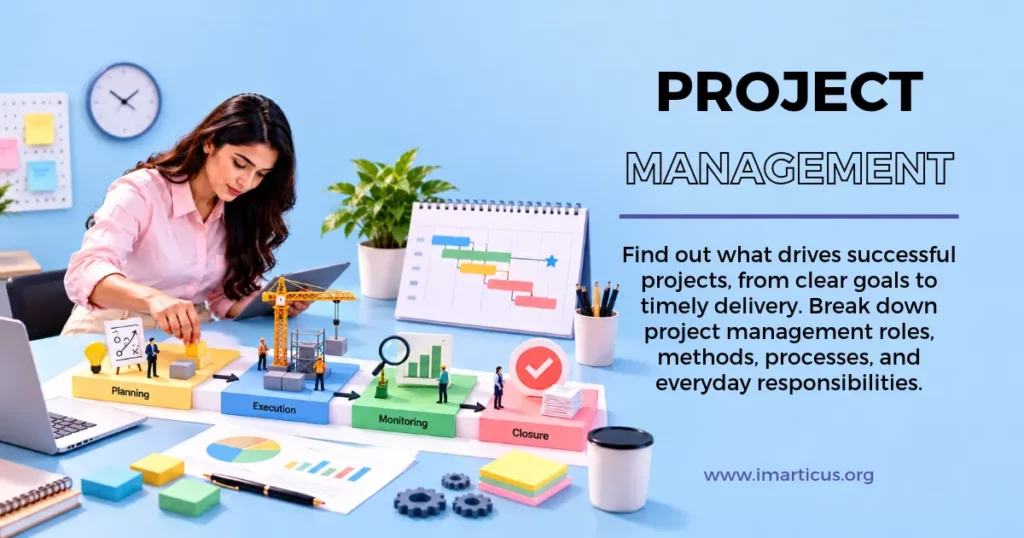
Project management is how you take a goal with a deadline and turn it into finished work. The project manager decides what’s in scope, estimates the time and money, lines up the people, watches for risks and keeps everyone updated until delivery. The work moves through five stages: initiating, planning, executing, monitoring and closing.
Teams choose how to run it, whether waterfall, agile or a blend, and use methods like the critical path method to find the tasks that fix the finish date. Done well, it delivers what was agreed, on time and on budget. You’ll find it in construction, IT, healthcare, banking and marketing.
Back in 1957, a young Danish architect named Jørn Utzon won the contest to design the Sydney Opera House. Sydney was told to expect a A$7 million building by 1963. What it got was an opera house in 1973, with a price tag of around A$102 million. Now think about the Empire State Building. New York built it in roughly thirteen months, and it came in under budget.
Same century. Same kind of big dreams. Completely different outcomes. For a long time I put that down to talent or luck, and I’ve changed my mind. One team knew what it was building before it picked up a single tool. The other worked it out along the way and paid for each discovery. That difference is what project management is really about.
If you got here by googling what is project management, good. You’ll get the short version in a minute, then the longer story that short versions leave out. And if you’d rather learn this with mentors and live projects than muddle through alone, take a look at the Project Management Course from Imarticus Learning.
Don’t Let Our Best Advice Get Buried
Add Imarticus as a Preferred Source — see more of what we publish, every time you search.

What Is Project Management?
Project management means planning, organising and steering a piece of work so it delivers what was agreed, within the agreed time and budget. Every project has a start, an end and a reason for existing. Baking bread each morning is operations. Opening a second bakery across town is a project.
That can sound like splitting hairs until you’re in the middle of one. Routine work gets smoother the more you repeat it. A project never gets to repeat, because it’s all happening for the first time. That’s the hard part. Here’s what makes a project a project:
- It ends. Either the goal gets met, or somebody finally has the guts to stop it.
- It creates something new, even if only slightly. Doing last quarter’s task again? Call it a process and carry on.
- Scope, time and cost keep pulling against one another, and quality gets caught in the middle. Quality is usually what gives first.
- Someone has to own the outcome. That person is the project manager, and they’re rarely the one doing most of the hands-on work.
What Is Project Management With An Example?
Imagine a company moving its payroll to new software. Nobody’s going to thank the team for the installation. People will remember one thing: did my salary arrive on the last working day of the month?
- The goal: payroll live on the new system from 1 April, with no missed or incorrect salaries.
- The plan: move the data over, test it, train the finance team, then run the old and new systems in parallel for a month.
- The big worry: the old employee records are a mess. Cleaning them comes first and will take longer than anybody wants to admit.
- How you’d judge it: were salaries paid correctly? Going live on the planned date matters far less.
Also Read: What are the benefits of Business Process Management?
Project Management vs Operations and Program Management
For years I kept mixing these three up. What finally helped was three simple questions. Does the work repeat? Does it end? Does it sit inside something bigger?
- Operations is the repeating stuff: payroll every month, tickets every day, shelves restocked every night. It has no end date because the business needs it indefinitely.
- A project has an end. Swapping out the payroll system is one, and it borrows people from operations, then hands the finished result back.
- Open ten new stores under one plan, and you’ve got a program, which is simply a set of related projects run together.
- A portfolio is the full list of what the company has agreed to pay for. Honestly, it’s mostly a leadership debate about what to turn down.
The skills overlap heavily. Run one project well, and you’ll probably be handed the program next, whether you asked or not.
Why Project Management Is Necessary
Projects seldom die in one dramatic afternoon. They drift. A requirement stays vague, a supplier turns up a week late, someone skips a review, and nobody says a word until the end. Good project management drags that drift into the open while fixing it is still cheap.
We imagine failure as a big bang. In reality it tends to be a hundred small delays, each one sensible at the time. Add them up, and they stop being sensible. A little structure gets you a lot:
- Risks are written down early, so they show up as a line in a document rather than a 9 pm phone call.
- Scope changes become decisions someone makes deliberately, not things that sneak up on you.
- People know who owns what, so fewer tasks slip between two teams.
- Trade-offs get said out loud. Fast, cheap or wide: pick two.
- You end up with a written record, which makes the next project a bit less of a gamble.
There’s a human side as well. A clear plan means fewer late nights spent patching things nobody saw coming.
Who Does What on a Project Team?
Job titles differ from company to company, yet the roles underneath barely change. Agree on them early, and you’ll avoid a lot of pointless arguments.
- Sponsor: The senior person who funds the work and clears blockers the manager can’t. If they stop showing up, take it as the first warning sign.
- Project manager: Owns the plan, the schedule and the day-to-day coordination, and gives people straight answers about progress.
- Team: The people doing the work, who know how long things really take. A sensible manager asks them for estimates instead of handing out dates.
- Stakeholders: Anyone affected by the outcome, from customers to the finance team. Some want weekly updates. Others only want a heads-up before it lands.
- PMO: Where there is one, it sets templates and standards and keeps an eye on many projects at the same time.
Did You Know?
The Sydney Opera House’s original building estimate was A$7 million. Its final cost reached A$102 million, and the building opened in 1973. (Source)
Project Management Life Cycle (and the 5 Basics)
The project management life cycle has five stages, which PMI calls process groups, and they double as the answer to the “5 basics” question. On paper, they run neatly one after another. In practice, they overlap and loop back, and I stopped letting that bother me ages ago.
Initiating: This is the point where you ask whether the project should exist at all. Quite a few start simply because someone senior had an idea in a meeting.
- Put it on one page: why this project, who gains, what success looks like.
- Find the person who can really say yes, and list your stakeholders before anyone starts building.
- Decide what’s out of scope. It’s uncomfortable in the room and saves real pain later.
Planning: Planning converts a vague goal into tasks with owners and dates. I’ll gladly spend two extra days here to dodge two weeks of repair work later.
- Break the work into small pieces, estimate each, and build the schedule and budget from those numbers.
- List the biggest risks, and beside each one write what you’ll do when it appears.
- Show your draft to the people who’ll do the work before finalising anything. They’ll spot the fantasy bits within minutes.
Executing: Now the team gets on with the work, and the manager’s role shifts to removing obstacles and keeping conversations going.
- Short, regular check-ins surface problems while they’re still small enough to laugh about.
- Keep stakeholder updates brief and honest, even when it’s bad news. Especially then.
- Maintain a simple decision log so nobody has to remember why something changed three weeks back.
Monitoring and controlling: This runs in the background of everything else. Each week you set progress against the plan and correct course early.
- Track schedule, cost and scope in numbers. How a project feels is a poor measure.
- Route changes through a simple change request so the plan stays truthful.
- One late task is noise. The same sort of delay five times is a pattern and deserves a proper talk.
Closing: Teams skip this stage because they’re exhausted by then, which is a shame, because it’s what makes the next project better.
- Hand over the result, settle contracts and free people up for other work.
- Run a lessons-learned session while everyone still remembers, and note what you’d change.
- Thank people properly. It’s free, and they remember it.
12 Project Management Principles in Plain Words
PMI’s guide, updated in 2021, lists twelve principles. I see them as habits more than rules, which probably explains why they’ve lasted.
- Stewardship: Look after the money, the people and the environment as if they were your own.
- Team: Build a culture people genuinely want to be part of.
- Stakeholders: Bring them in early and keep them involved throughout.
- Value: Judge the work by what it delivers, not by how busy everyone looks.
- Systems thinking: Understand how the pieces connect before you move one.
- Leadership: It shows up whatever your job title says.
- Tailoring: Fit the approach to the project in front of you, because no two are alike.
- Quality: Build it into the process. Inspecting it at the end is too late and too costly.
- Complexity: It won’t disappear because you ignore it, so deal with it.
- Risk: Respond in proportion to its size.
- Adaptability and resilience: Expect surprises and bounce back from them.
- Change: People need support through it, so the new way actually sticks.
Critical Path in Project Management
The critical path in project management is the longest chain of dependent tasks, and it sets the earliest date you can finish. Delay anything on it and the whole project moves. Delay something off it, within limits, and nothing happens.
The technique goes back to the late 1950s, when it was developed around DuPont Analysis and Remington Rand. It’s older than most of the software we use to draw it. A small example takes two minutes on paper:
- Design is 3 days. Call it task A.
- Build is task B, 5 days, and it can’t begin until A is finished.
- Content is task C, 4 days, and it also waits for A.
- Launch is task D, 2 days, and needs both B and C done.
- A, B, and D totals 10 days. A, C, D totals 9.
That makes A, B, D the critical path, and C has one day of float, so it can run a day late without moving the launch. Tasks with zero float are the critical ones. When you’re behind, they’re the only place where extra people or a smaller scope actually help.
I look at the critical path every day and everything else once a week. If a manager can’t explain the critical path in project management terms for their own project, they’re largely guessing.
Also Read: How Do Prototyping Tools Help Designers Test Ideas?
Project Management Methodologies
There’s no single right way to run a project, only the way that fits the work in front of you. These are the approaches you’ll run into most, with what each does well and where it bites.
Waterfall
Waterfall runs in a straight line: requirements, design, build, test, release. Each phase gets signed off before the next one starts. It’s usually traced back to a 1970 paper by Winston Royce, who, funnily enough, was warning about the risks of working this way. It still earns its place wherever changing your mind halfway is expensive.
- Requirements: Locked early and written down.
- Phase gates: Nobody moves on until the last phase is approved.
- Documentation: Heavy, which is a feature once auditors get involved.
- Best fit: Construction, manufacturing, regulated work, anything where concrete can’t be un-poured.
The trade-off is real: it’s predictable right up until the customer realises they wanted something different.
Agile Project Management
Agile management swaps the big upfront plan for a loop: build a little, show it, learn, adjust. The 2001 Agile Manifesto put that idea into words, and most software teams have worked this way ever since. It suits work where nobody can describe the finished thing on day one.
- Iterations: Work arrives in short cycles, usually one to four weeks.
- Early feedback: Real users see real output soon, so wrong turns get caught while they’re cheap.
- Working product over paperwork: Documentation exists; it just doesn’t lead.
- Change is welcome: A new requirement is a normal Tuesday, not a crisis.
You gain flexibility and lose some certainty about the final scope and date.
Scrum
Scrum is the most popular way of doing agile, and it grew out of software project management teams who wanted a steady rhythm. Think of it as agile with a rulebook, short enough to fit on a few pages.
- Product owner: Decides what matters most and in what order.
- Scrum master: Clears blockers and protects the process.
- Developers: The people who build, and who decide how much fits in a sprint.
- Sprint review and retrospective: How every cycle ends, with a look at the product and then at the team.
The ceremonies can quietly eat a week of every sprint if nobody guards the calendar.
Kanban
Kanban comes from Toyota’s factory floors. Work sits on a board and moves from left to right, and the team caps how much can be in progress at once. There are no sprints and no fixed batches.
- Visual board: Everyone sees the whole flow at a glance.
- WIP limits: They stop teams from starting ten things and finishing none.
- Continuous flow: Items ship when they’re ready, not when a sprint ends.
- Best fit: Support desks, operations and content teams.
Trello and Jira can run a Kanban board in minutes, but the discipline matters more than the project management tools. Because there are no built-in deadlines, long-range planning needs another layer on top.
Hybrid
Hybrid takes the planning discipline of waterfall and the delivery rhythm of agile. A smartphone launch is the classic case: hardware follows a fixed plan because factories can’t pivot, while the software runs in sprints.
- Fixed frame: Budget, milestones and governance are set upfront.
- Flexible inside: Sprints handle the uncertain parts.
- Integration checkpoints: The moments where both streams meet and get tested together.
- Best fit: Large organisations and regulated industries with some uncertain work.
It needs a clear owner. Without one, you get the bureaucracy of the first approach and the chaos of the second.
Lean
Lean comes from the Toyota Production System and has one obsession: waste. If a step doesn’t add value for the customer, it’s a candidate for deletion.
- Value stream mapping: Draw every step from request to delivery, then circle the waiting.
- Kaizen: Small improvements, made constantly, by the people doing the work.
- Just in time: build what’s needed, when it’s needed, and no earlier.
- Respect for people: The ones closest to the work usually know where the waste hides.
Lean is easy to preach and hard to practise. Strip out all the slack, and your team has no room left for surprises.
Six Sigma
Six Sigma began at Motorola in the 1980s as a way of cutting defects using data instead of opinions. Pair it with Lean, and you get Lean Six Sigma, which is common in manufacturing, banking and operations.
- DMAIC: Define, Measure, Analyse, Improve, Control.
- Root cause tools: Fishbone diagrams, Pareto charts and the 5 Whys.
- Data first: A claim without a baseline number doesn’t count.
- Belts: Green and Black Belts mark how deep someone has gone.
It’s heavy for small projects, and it’s easy to drown in statistics when a conversation would do.
PRINCE2
PRINCE2 stands for Projects IN Controlled Environments. It started as a UK government method and is now used well beyond it. Its core idea is that a project should be controlled in stages, with a business case that’s checked at every step.
- Stages: The project is managed one stage at a time, with a go or no-go decision between them.
- Defined roles: A project board, a project manager and team managers, all with clear jobs.
- Business case: The reason for the project stays in view from start to finish.
- Qualifications: There’s a PRINCE2 project management certification at Foundation and Practitioner levels.
It brings plenty of structure, so scale it down for small work. Tailoring is one of its own principles, after all.
Critical Path Method
The critical path method is a scheduling technique rather than a full style, and it often sits inside waterfall or hybrid plans. The critical path in project management is the longest chain of dependent tasks, and it sets your earliest finish date.
- Dependencies: Tasks can’t start until another one finishes.
- Float: How late a non-critical task can run before it matters.
- Crashing: Adding people to critical tasks to shorten the schedule.
- Fast-tracking: Running tasks in parallel that were planned in sequence.
It’s only as good as your estimates, and the path itself can shift the moment a task slips.
Software Project Management
Software project management has the same basic bones as any other kind, with a few extra headaches. The work is invisible, requirements keep moving, and estimates are wrong in a very consistent direction, which is too optimistic.
- Scope creep is the usual villain. Every new request should arrive with a visible price tag.
- Testing and code review are tasks with time on the clock, not afterthoughts.
- Technical debt is a real cost, so I’d put it on the schedule where everyone can see it.
- Sizing work in relative terms beats guessing hours, at least in my experience.
- A rollback plan should exist before the launch date does.
Most software teams I know run agile project management inside a hybrid shell: fixed budgets outside, flexible sprints inside.
Project Management Tools
Blaming the tool is easy when a project goes wrong. I’ve seen a good manager run a launch from a shared spreadsheet and a weaker one sink under six software licences. Project management tools help once the habits are there. They can’t build the habits for you.
| Tool | Best For | Key Uses |
| Trello | Visual task tracking | Organises work into boards and cards so teams can track tasks from start to completion. |
| Jira | Software and Agile projects | Tracks issues, sprint tasks, backlogs and team progress across development cycles. |
| Microsoft Project | Project scheduling | Helps managers plan timelines, allocate resources and track task dependencies. |
| TeamGantt | Timeline planning | Uses Gantt charts to map tasks, deadlines, dependencies and project milestones. |
| Asana | Team task coordination | Assigns tasks, sets deadlines, and tracks progress across projects and teams. |
| monday.com | Project tracking and reporting | Combines task boards, project workflows, dashboards and progress reports. |
| ClickUp | All-in-one project management | Brings tasks, documents, goals and reporting into one workspace. |
| Notion | Project documentation | Keeps project plans, meeting notes, task lists and decisions in one shared space. |
| Confluence | Team knowledge management | Stores project documentation, meeting records, decisions and process guides. |
Your choice mostly comes down to team size, how many dependencies you juggle, what your boss wants reported and, yes, price. Teams doing software project management often live in Jira, while marketing and operations teams usually want something lighter. If only the manager updates the board, it’s decoration. The whole team has to use it.
Start with the lightest thing that works and upgrade when it starts to hurt. Plenty of good project management tools offer free tiers, so try before you pay.
Pro Tip: Close every project with a short review. Record what worked, what caused delays and what the team would change next time. Give each action an owner. This turns project experience into a practical guide for future work.
Project Management Skills
Project management skills fall into two piles. The hard pile covers scheduling, budgeting, risk and reporting. The soft pile covers listening, negotiating and telling a senior person something won’t fit. Fewer people are good at both than you’d expect.
On one content launch, my team and I missed the date by three days. It knocked the campaign calendar badly, and the cause was a review step nobody owned. We had the talent. We just had nobody responsible for that step.
- Estimating. Everyone’s bad at it, so the real skill is knowing how bad you are and padding for it.
- Risk thinking, which is mostly asking “what could make this fail?” before it does.
- Writing short messages people actually finish. A clear two-line update beats a long email nobody opens.
- Negotiation, especially trading scope for time without anyone feeling cheated.
- Getting work out of people who don’t report to you, which is most of the job.
- Deciding with incomplete information, which is nearly always. Waiting for certainty is a decision too.
- Enough basic finance to read a budget and explain a variance in plain words.
None of these project management skills is rare. They’re just unglamorous, which is why people skip them.
Why Projects Fail (and What I Watch For)
Daniel Kahneman tells a story about a textbook project he worked on. The team’s own estimates ran from a year and a half to two and a half years. It took eight, and the book was never used. Everyone in that room had experience, and everyone still assumed this one would go differently. Psychologists call it the planning fallacy, and I’ve never met a team that’s immune.
- The goal was never clear, so different people built different things and called them the same project.
- Nobody owned the result, so everyone assumed someone else did.
- Estimates came from hope. Teams nearly always guess faster than reality.
- Scope grew a little every week, and nobody added up the total.
- Stakeholders joined late, then changed their minds, loudly.
- Decisions travelled through side chats, and half the team never heard.
- The team skipped the closing stage of the project management life cycle, so the same mistakes turned up again on the next job.
Your First Project: A Simple Starter Plan
You can practise all of this on something small. Plan a family event, a house move or a college fest the way a company would plan a launch. The stakes are lower, and the lessons are the same.
- Write the goal in one sentence, with a date. If you can’t, it isn’t ready.
- List every task you can think of, then group them into five to eight bigger chunks.
- Put a rough time on each, then ask someone who’s done it before whether the numbers look sane.
- Lay the tasks out in order and find the longest chain. That’s your critical path.
- Give each task one owner. Two owners usually means none.
- Write down the few things most likely to go wrong, plus what you’d do about each.
- Check progress at the same time every week, even if it’s only ten minutes.
- When it’s over, write five lines on what you’d change and keep the page for next time.
Pro Tip: Make progress updates useful. Ask each team member to report three things: what is done, what comes next and what is blocking progress. This keeps meetings focused on action.
Project Management as a Career: Jobs and Salary
So what does this look like as a career? Mostly, it’s a role people drift into from somewhere else. Engineers, marketers, finance analysts and operations staff all end up here, which is why the backgrounds look so mixed.
| Career Level | Common Job Titles | Key Responsibilities |
| Entry level | Project Coordinator, Associate Project Manager, PMO Analyst | Track tasks, maintain project records, coordinate meetings and support schedules and reports. |
| Mid-level | Project Manager, Delivery Manager, Scrum Master | Manage project timelines, coordinate teams, monitor budgets, handle risks and report progress. |
| Senior level | Senior Project Manager, Programme Manager, PMO Manager | Oversee complex projects, manage multiple teams, align delivery with business goals and improve project governance. |
| Leadership level | Programme Director, Head of PMO, Director of Delivery | Set delivery priorities, oversee major programmes, allocate resources and guide project management strategy. |
Strong skills plus a recognised project management certification, often picked up through project management courses, usually get you from coordinator to manager faster than either alone. In software teams, a Scrum or agile credential often sits on top, since many roles expect it.
What affects a project manager’s salary?
A project manager’s salary depends on several factors, including work experience, industry, location, qualifications and the size of the projects they handle. Project management certifications can strengthen a candidate’s profile, while skills in budgeting, risk management and team leadership can support career growth. The employer, level of responsibility and demand for project management skills also influence pay.
| Factor | How It Affects Salary |
| Experience | Professionals managing larger or more complex projects may qualify for higher-level roles. |
| Industry | Pay varies across sectors such as technology, construction, banking and consulting. |
| Location | Salary ranges can differ by city, region and employer. |
| Certifications | Credentials such as PMP can support career development, depending on the role and employer. |
| Specialisation | Skills in areas such as Agile delivery, software projects or programme management can influence earning potential. |
Did You Know?
In PMI’s 2023 survey, 68% of respondents named communication as their most critical power skill. Problem-solving followed at 65%. Clear updates help teams spot blockers and settle issues early. (Source)
Project Management Certification And Courses
Project management certification shows employers you speak their language. It won’t replace experience, but it often gets you into the interview room. Many people take project management courses first, then sit the Project Management Professional exam, and a few wonder whether an MBA in project management would serve them better.
How to Choose a Project Management Course?
A good project management course changes what you do on Monday morning. When you compare programmes, run each through this checklist, and put the Imarticus Learning Project Management ProDegree through it as well.
- Real projects, or only slides?
- Is it aligned with PMI standards, and does it cover agile too?
- Will you practise on actual tools?
- Are the mentors people who’ve run projects themselves?
- Is there help with interview prep and placements?
- Can you fit the time commitment around your job?
Project Management Professional (PMP)
The Project Management Professional credential from PMI is the best known in the field. Check PMI’s website for the current rules before you apply, because they do get revised.
- Eligibility is a four-year degree plus 36 months leading projects and 35 hours of formal project training, or a secondary diploma plus 60 months of experience.
- The exam is 180 questions over 230 minutes.
- It covers people, process and business environment, with agile and hybrid approaches included.
- CAPM is the entry-level option for people with little or no experience.
- Scrum and PRINCE2 credentials suit teams that work those specific ways.
MBA in Project Management
An MBA in project management suits people aiming for leadership who want finance, strategy and operations alongside the craft. It’s long and expensive, so I wouldn’t take it just to learn scheduling.
- Usually one to two years of study.
- Best for people heading towards senior or general management.
- Costs far more than a focused course or a certification.
- For hands-on delivery roles, a certification plus real experience is often enough.
Also Read: What Is the Monthly Management Consultant Salary in India?
Why Imarticus Learning Is Worth a Look If Project Management Is the Goal
Here’s the uncomfortable truth about consulting pay: firms don’t pay for knowing frameworks. They pay for people who can take a messy piece of work and finish it. That’s the skill the Project Management Course from Imarticus Learning is built around, and this is what stood out to me:
- Built in knowledge partnership with PwC India, with a certificate awarded jointly by Imarticus Learning and PwC Academy.
- You bring a real project from work or life and build it end-to-end with mentors. It isn’t a simulation.
- Case studies include setting up a PMO at AstraZeneca and Toyota Kirloskar’s lean rollout.
- Hands-on practice with Jira, Trello, Asana and Microsoft Project.
- Agile, Waterfall, Hybrid and Lean Six Sigma covered in a single programme.
- 35 PDUs towards PMP eligibility, over four months of live online classes.
- Faculty with 20+ years of industry experience, including PwC India leaders.
FAQs About Project Management
Still wondering about something? These are the frequently asked questions people have most often about project management, answered in plain words so you can get back to work.
What is project management?
Project management is the practice of planning, organising and steering a project so it finishes with the agreed result, on time and within budget. A project manager looks after scope, schedule, cost, risk and people, and the work usually moves through initiating, planning, executing, monitoring and closing.
What are the 5 basics of project management?
The five basics of project management include: Initiating, planning, executing, monitoring and controlling, and closing. Think of them as the five stages of a project’s life. They rarely run in a perfectly straight line, but every project touches all five at some point.
What are the 12 project management principles?
The 12 principles of project management come from PMI’s 2021 guide: stewardship, team, stakeholders, value, systems thinking, leadership, tailoring, quality, complexity, risk, adaptability and resilience, and change. I treat them as habits of thinking rather than a checklist to tick off.
What is L1, L2, and L3 in project management?
Most often L1, L2, and L3 in project management are levels of a work breakdown structure. L1 is the whole project, L2 the major deliverables and L3 the work packages underneath them. In IT teams the same labels can also mean support escalation levels, so check the context before assuming.
What are some examples of project management skills?
Some examples of project management skills include planning and estimating, risk thinking, clear communication, negotiation, leading people who don’t report to you, and basic budgeting. Decision-making with incomplete information belongs on that list too, since it’s what most days actually look like.
Where can I learn the skills required for project management?
You can learn skills required for project management with structured courses, PMI material and mentors all help. Still, the fastest teacher is a small real project you actually finish, like organising an event, because it forces you to plan, estimate and deal with surprises.
What is the difference between project management and skill?
The difference between project management and skill is that one is a discipline for taking a project from start to finish. The other is a single ability you use inside it, such as negotiating or estimating. You can have the skill without ever running a project.
Why is Project Management necessary?
Project management is necessary because projects drift quietly. A bit of structure catches the drift early, makes trade-offs visible and gives the work a clear owner, which saves money and a fair amount of stress.
Take the First Step Towards a Project Management Career
The Opera House is one of the most loved buildings on earth now, and hardly anyone brings up the extra ten years or the 102 million. That’s the odd thing about this work. When it goes well, people notice the result. When it doesn’t, they remember the mess for decades.
If you take only a few things from this guide, make them these. Learn the project management life cycle first, because everything else hangs off it. Watch the critical path closely and let the rest breathe. Choose your tools last and your habits first. And please don’t skip the closing stage. That one lessons-learned page is what makes your second project cheaper than your first.
Here’s the part I’d say to a student across a desk. Reading only takes you so far. Memorising the five process groups is easy, and so is freezing the first time a vendor goes quiet or a stakeholder changes their mind on a Friday evening. The people who get good fastest are the ones who’ve been answerable for something real, with real deadlines and real people, and had to untangle it themselves. It’s why I’d pick a project management course that makes you finish something of your own over one that hands you slides.
That’s the thinking behind the Project Management Course from Imarticus Learning, built in knowledge partnership with PwC India. You bring a project from your work or personal life and build it end to end with mentors, across Agile, Waterfall and Hybrid methods, over four months of live online classes. It also carries 35 contact hours towards the Project Management Professional exam, so it’s worth a look if a project management certification is on your list. Whichever route you take, check the current PMI rules and compare a few programmes before you commit.
If you’re not ready for any of that yet, start small. Pick one thing you actually need to get done this month, write the goal in a sentence with a date, find the longest chain of tasks, and run it. You’ll learn more from that than from another ten articles, this one included.
Liked This? Follow Us Where You Already Search.
Preferred Sources is Google’s built-in follow button — no app, no login, just more Imarticus in your results.