What Skills Are Needed to Be A Data Scientist?

Last Updated on 2 years ago by Imarticus Learning

A career in data science is highly attractive owing to its payment structure, job opportunities, and future career prospects. There is any number of Data scientist courses that you can find and that makes you qualify for the job.
The major criteria for this career are a few skills that one can easily master through the right path.

These skills could very well be different from any former experience in the career thus far. Developing these skills will help the recruiters to identify you as the best option for what they are looking for!

Programming language
A strong knowledge base of any major programming languages such as Python, R, or SQL is the foremost requirement to be an expert in data science. No matter what the company or the job profile is, this is one field of expertise that is non-negotiable.

Statistics
Statistics hold more value in data science since it helps to deal with the raw data of the companies. It helps with the evaluation, designing, and making decisions in the later stages.

Deep learning
This machine learning technology enables computers to work like the human brain.

Data Science CourseAn enormous amount of data is managed through computing power to make it possible. A career in data science, especially that in the automobile and AI industry requires this particular skill.

Working with unstructured data
Data science is mainly about the gigantic amount of data from various sources. The vast majority of this data is in a raw and unstructured format. A skilled data analyst can easily go through them to find and identify what they are looking for to make it useful.

Appetite for problem-solving
Simply looking at the data is not what makes the analyst skillful. It also calls for the right appetite to identify the problems underneath and finding the ideal solution as well. For which the analyst needs to have the drive for problem-solving and look in the right areas.

Data visualization
This is the skill that enables a data scientist to identify and decode the raw data into an identifiable visual to use it to convey. This skill enables the analyst to see what the data is useful for with the help of the various data visualization tools.

Communication skill
It comes next to the visualization part. The visualized data needs to be explained in a simple and well-constructed plan to the stakeholders. AT this juncture, the analyst must have strong communication skills to convey the key points and make them believe in the same. Polishing communication skills would be an added advantage to improve career prospects.

Familiarity with data science tools
Data science involves various types of tools to help with data processing. An analyst must have a fairly good idea about the working of most of the tools. Since each type of data requires different tools, it is highly imperative to be on familiar terms with these tools. Most of them are pre-programmed, so you just need to know how to use them in the proper way.

Intuition
Last but not the least, having a strong intuition on what to look for, how to use it, and which tool needs when to get the best result out of the data analysis happens to be the strongest point of being a successful data scientist.

Conclusion
Most of these skills are covered in the Online data scientist course in India available from various sources online or otherwise. What needs more work would be on soft skills which also have an equally important role in a successful career. A career in data science does not have refined eligibility criteria, instead, it mainly depends on these acquired skills.

Top Career Options in Data Science!

Last Updated on 4 years ago by Imarticus Learning

Data Science is an emerging and yet established interdisciplinary filled that makes use of objectively led processes, methodology, systems, and carefully curated algorithms to study data. This file is very close to and often overlaps with Big Data and Data Mining.

By careful study of the Data Science Course, this field aims to extract important information and patterns that can be used for a number of decision making, information gathering, and data collection tasks.

Where is Data Science Used? 

Data Science is being used by a myriad of fields ranging from state-sponsored departments, the police, military, private companies, NGOs, marketing experts, researchers, and customer service support groups around the world. Most recent and successful technologies such as face recognition are a product of data science innovation. Cookies that online retail stores and online publications use are based on this field too. Data science has entered almost every aspect of our digital lives in a short span of time.

What are some of the jobs that Data Science has?

Here is a list of top Data Science Career Options in Data Science that are shaping our future:

  • Data Scientist: This is a highly sought after job in the field of Data Science. A data scientist is expected to study all big and small data that has been gathered. They are also supposed to form the recommender systems and organize the data for analysis. All major corporations like Facebook, Google, Microsoft, Twitter, etc. employ data scientists. This job is better suited for people who are good at mathematics and coding.
  • Machine learning engineer: A machine learning engineer is entrusted with the job of making data funnels that aid in software creation. They also construct the appropriate and suitable algorithms needed for problem-solving. The machine learning engineers study the systems and its prototypes by running regular tests. They experiment with different problem-solving techniques and modify the current operating steps to improve the current methodology and quality of work. Machine learning engineers are highly paid.
  • Business Analyst: A business analyst tests data by keeping in mind the requirements of the business house it is serving. One does not have to be specifically from a technical field to perform this job. A business analyst has knowledge about industries like telecom, finance, logistics, marketing, and retail.These people are well informed about government and legal policies related to financial technology. A business analyst helps a company find out what information they need to enhance the company’s consumer behavior, marketing strategies, and relationship with its customers.
  • Data Analyst: Like the name suggests data analysts are responsible for primarily web tracking, testing, and operating big and large data sets. They use a mix of statistical tests and interdisciplinary methodology made up of qualitative and quantitative tools to study big data.They have to pick relevant patters and form conclusions based on a set of figures available. A good data analyst is equipped with the number of fact-finding and statistical tests that can be applied to a varied set of data packs depending on the availability of the information. A capable data analyst will be perceptive and informed about which tool and method have the best probability of revealing the most reliable information.

Conclusion

Data Science is one of the most expansive and quickly growing fields in the world. There has been a steep rise in several Data Science Coursetakers in the last few years. The reason for this recent increase in popularity is the number of jobs that have emerged in this area. Since data science is multidisciplinary, people from different subjects and work fields can collaboratively work in it.

Challenges Looming in the Investment Banking Industry

Last Updated on 4 years ago by Imarticus Learning

How do the Investment Banks function?

Before assessing the challenges that the investment banking sector is facing in the contemporary, it’s important to gain some insights into the functioning of the investment banks. From underwriting of new stocks to handling mergers and acquisition deals and advising clients on profitable investment avenues, there is a lot that investment banks bring to the world of finance. Let’s find out how investment banks handle this multi-dimensional role in the financial services industry.

Investment Banks as Underwriters

As underwriters, the investment banks serve as intermediaries between the corporation seeking to raise funds through IPO and the investors who are ready to invest money in a profitable venture. Investment banks buy the securities from the corporations as per the agreement and then resell it through stock exchanges.

Investment banks in Merger & Acquisition deals

Mergers and Acquisition deals are one of the most important aspects of the investment banking field. Investment banks have a huge role to play in the Merger & Acquisitions deals which are carried out to increase profitability and reduce competition between corporates.

Investment Banks in an advisory capacity

Investment banks guide big corporations and high net worth individuals to park their money in profitable avenues. Investment banks assess the needs and risk appetite of their clients and provide customized investment solutions to them.

Challenges in the Investment Banking domain

It all seems so fancy from the outside but all is not well in the investment banking sector. Ever since the global financial crisis in 2008, regulatory bodies have imposed new standards that are to be met by the players in the financial services industry. Let’s dig deeper into some of the most prominent challenges in the investment banking landscape.

Regulatory Challenges

One of the most pressing challenges that the investment banks face in the contemporary is regarding the regulatory requirements imposed by regulatory bodies. The Basel III norms require financial institutions to maintain core liquidity, reduce short term funding and hold more liquid assets. Basel III has caused fundamental shifts in product profit margins.

The Disruptive Fintech Industry

Everybody is talking about the Fintech industry, the finance and technology amalgamation has completely disrupted the traditional finance industry. Working on the principles of democratization and financial inclusion, the Fintech industry proves to be the next big thing in the Finance segment leaving investment banks behind. Fintech companies also enjoy much more flexibility when it comes to aligning itself with regulatory requirements.

Talent Acquisition

Talent acquisition has been one of the most significant challenges in the investment banking industry. The workforce today has equally lucrative alternatives to try out their career in, working in the investment banking industry can be challenging given the long hours and complexities in the job.

Cybersecurity

Cybersecurity has been a nightmare for the finance industry, according to the UK’s financial regulatory body cases of security breach has grown multiple folds in the last 2 years. More than five prominent British banks, including the likes of Royal Bank of Scotland and Barclays, were forced offline temporarily after a series of cyber-attacks.

Augmenting Client Experience

We are no longer living in a world where products and services are offered, today it’s all about selling experience, and customers value the experience of availing the product or service more than anything else. Hyper personalization has totally changed the game in the B2C segment, the B2B segment is looking up to a similar makeover. This has increased the client’s expectations from investment banks who are still operating as per traditional standards.

Conclusion

With the advent of Fintech companies and the stringiness of regulatory bodies post-global financial crisis, the investment baking world is facing some real challenges and quickly need to adapt to new requirements and changing expectations of its clients.

What is Full Stack Development?

Last Updated on 2 years ago by Imarticus Learning

What Is Full Stack Development?

Full-stack development can be defined as the development of applications’ front and back end or a website. It includes the complete modelling and maintenance of a website. Let us understand the terms front end and back end.

Front end:

It is the user interface of a website or web application where the user interacts with the application’s presentation layer. The languages used during this process include HTML, CSS, and JavaScript. It comes under the presentation layer.

Back end:

It refers to the server-side of the web applications and website that mainly focuses on how it works. It comes under the business logic layer and includes tasks like data validation. It is the part that does not come in direct contact with the users. Back-end languages include PHP, JAVA, Python, etc.

Besides the aforementioned layers, work on the database layer is also done in full-stack development for extracting meaningful information and data storage.

Skills Required for Full Stack Developer

Besides having skills in the front and back end of applications, a lot is demanded from a good full stack developer. He should be well aware of web architecture and its attributes. It is expected that a good full-stack developer should have great command over-development languages like HTML, CSS, etc. Knowledge about the database, APIs and their management are also required in a full stack developer.

A full-stack developer can face situations in which he has to deal with version control systems. In addition, they are required to make prototypes or basic designs for various lucrative products we buy in the market. Therefore, a full-stack developer is always a top priority for any web development company.

Why is Full Stack Development in Demand?

Full-stack development came into the limelight very recently. Earlier, people used to develop skills only for one side, like the client or server side. However, the rising demand for absolute technology has enabled developers to work on the presentation layer, business logic layer, and many other related fields. Various talks have claimed the future scope of full-stack developers and how this domain can change the business game for many companies worldwide.

These kinds of developers offer much worth to organisations. In the contemporary world, companies are hiring these developers so that they can develop an application from scratch and can give their full participation throughout the development process of the web application or website. A person these days calls such developers “King of all trades” and believes they have an important role in today’s technological landscape.

Pros and cons of being a full-stack developer

 Pros

You can be an expert in all the tools and techniques in a development project

Being a full-stack developer, you can guide the team members

Since you have much knowledge of both client-side and server-side, you can switch anytime based on the requirements

You can easily understand new technologies better

You can even bring down the cost of a project

Being experienced, you can lower the time for a project

Cons

Being a full-stack developer can increase the complexity

The solution to a particular project can sometimes be wrong

The solution to a project is personalised

Conclusion

Full-stack development has grown a lot with the advancement of parallel technologies. Nowadays, developers are coming with smart ways to store and manipulate data. Full-stack development also addresses problems through smarter modelling and web designing. The web ecosystem should be stable so that our web application serves its purpose with full efficiency. Learn the intricacies of data structures and algorithms and prepare for a career in full-stack development with the best program – The Full Stack Developer Pro. By giving you the technical know-how of front-end and back-end programming, this program will increase your proficiency in coding and web design. We guarantee that you will be recruited as a full-stack developer by the end of the course with over 450 hours of intensive practical instruction, or we will refund your fees.

How Do I Become a Certified Credit Analyst?

Last Updated on 7 months ago by Imarticus Learning

How do I become a certified credit analyst?

A credit analyst is responsible for determining the credit risk associated with a person applying for a credit/loan. They analyse the borrower’s financial data and help in determining the worthy borrowers who will return the loan on time. Credit risk analysts create reports based on their findings which is used by the banks in loan authorisation. Credit risk is affected by many factors such as collateral associated, paying capacity, credit history, etc. Credit analysts use various applications for evaluating the credit risk associated with any borrower. Credit analysis is witnessing technological reforms as new-age technologies like machine learning, big data analysis, etc. are helping in making more accurate credit analysis models.

How to Become a Credit Analyst?

Many sources offer a certification course for becoming a credit risk analyst. Association of International Wealth Management of India offers a CCRA (Certified Credit Research Analyst) which is a comprehensive education program and aims at providing credit risk analyst certification. You can also opt for various online certification programs in credit analysis. Imarticus Learning is a trusted source that can provide you online certification course in credit analysis. It is tough to opt for a college degree amidst the Covid-19 scenario, so getting a certification in a credit risk analyst course via an online medium is the right choice. Choosing an online medium for a credit analysis certification course will help you in studying at your own pace. It is good if you have a bachelor’s degree in finance, accounting, statistics, economics, etc. as it will help you with the prerequisites required for becoming a certified credit analyst.

Why Choose Imarticus Learning?

Imarticus Learning will help you in learning the fundamentals of the finance industry via industry experts with in-depth case studies. The industry-oriented learning approach of Imarticus will help you in getting industry-ready. You will also get placement support by opting for their online courses. You can opt for a demo class and can decide for yourself. Imarticus Learning is tied up with the leading players in the finance industry & has experienced faculties. You will also learn the aspects of credit analysis experimentally with case studies.

What to Learn?

The terminologies of credit analysis which you should be aware of to become a successful credit analyst are as follows:

• You should be aware of the credit analysis fundamentals like credit history, the capacity to pay, etc.

• You should be familiar with the cash flow cycle & analyses which helps in sustaining capital.

• You need to know how to manage a loan using security. Credit risk analysts are also good at risk identification & management.
• A good credit analyst knows about the loan covenants which are the conditions in a loan agreement.

• You should be able to administrate and document credit.

• You should know about the credit application and the loan processes.

• You should be able to use various software(s)/applications used for credit analysis in banks/financial institutions. One should also be aware of various credit risk models used to determine the risk associated.

• You should be able to read, analyse, and combine financial statements of the borrowers to calculate the risk associated.

Note: Make sure you choose a certification course in credit analysis that covers all the aforementioned aspects of credit analysis.

Conclusion

Credit risk analysts will be in huge demand in the coming years as firms/financial institutions require individuals who can help them in minimising losses. The good borrowers may also face problems in terms of capital if a financial institution encounters many NPAs/defaulters. To maintain the cash flow & capital in a bank/financial institution, credit risk analysis is necessary. Browse Imarticus Learning courses now!

Why Are Companies Considering Candidates With An Artificial Intelligence and Machine Learning Certification?

Last Updated on 2 years ago by Imarticus Learning

Artificial Intelligence has expanded at an exponential rate in recent years, despite significant progress in the field. In the field of computer science, AI practices can be found everywhere. It provides you with an idea of how many different ways a computer system can be designed.

artificial intelligence and machine learning courses in India It is designed to carry out the cognitive functions that humans have specified.


This indicates that the scope of an artificial intelligence and machine learning course is enormous, and AI has potential that is currently beyond human grasp.

Scope of An Artificial Intelligence and Machine Learning Course in India

Artificial Intelligence has enormous potential to transform every sector of the economy for the greater good.

AI encompasses a wide range of technologies, including self-improving algorithms, machine learning, big data, and pattern recognition, to name a few. There will be few industries or sectors left unaffected by this potent weapon in the not too distant future. This is why online Artificial Intelligence courses are becoming increasingly popular in India.

With each passing day, the gap between the number of AI professionals required and those available widens. Corporations are spending money to train their existing employees on Artificial Intelligence technologies. However, the demand is far higher.

Learn AI

Certification In Artificial Intelligence & Machine Learning

Learn AI via 25 in-class, real-world projects focused on offering exposure to various industries. This 9-month program will help you prepare for the roles of Data Scientist, Data Analyst, Machine Learning Engineer, and AI Engineer.

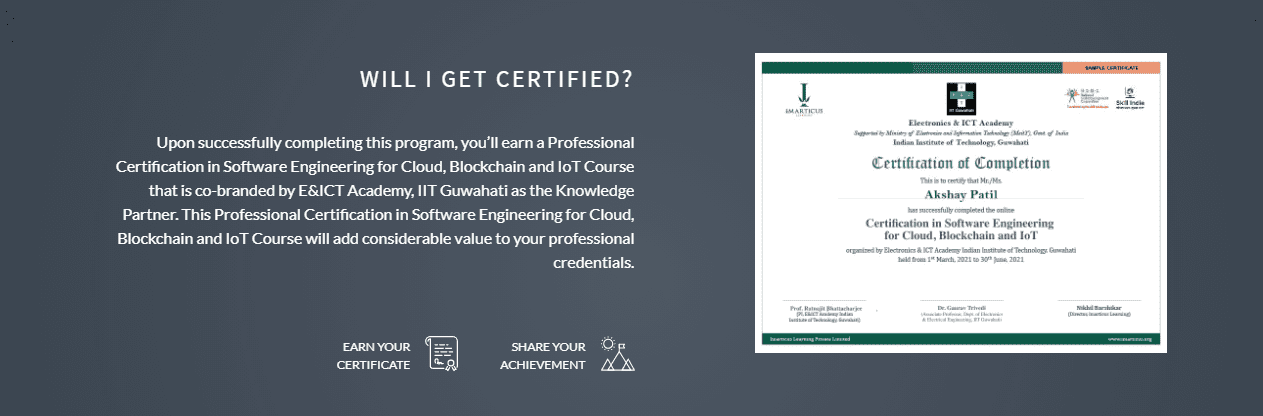
This machine learning certification program was established in collaboration with the E&ICT Academy, IIT Guwahati, and industry professionals to give an optimum learning outcome,

This course will strengthen your core abilities, allow you to take advantage of our Expert Mentorship program, and give you a practical grasp of AI and Machine Learning.

Data Science Prodegree

Develop your knowledge of Data Science ideas and build robust models to generate relevant business insights or forecasts with a working knowledge of critical Data Analytics technologies such as Python, R, SQL, and Tableau in these 14 in-class and industry-oriented projects.

PGP In Digital Marketing

Our Digital Marketing Postgraduate course is meant to provide you with a more in-depth and practical understanding of Digital Marketing ideas. The postgraduate program takes a collaborative approach that emphasizes several Capstone projects, job-specific skills, and guaranteed job interviews.

best digital marketing courses in India

This course will prepare you from beginning to end to start or advance your career in the Digital Marketing segment, including resume building, mock interviews, job leads, and references,

making it an ideal Digital Marketing course with a strong focus on placements to help you land your dream job.

Post Graduate Program in Data Analytics & Machine Learning

This machine learning certification program is for recent graduates and early career professionals interested in pursuing a career in Data Science and Analytics, the most in-demand job skill.

To become job-ready, master the fundamentals of data analytics and machine learning, as well as the most in-demand data science tools and methodologies.

With this job assured program, you’ll learn Python, SQL, Data Analytics, Machine Learning, and Data Visualization. After completing the course, students are promised interview opportunities.

Takeaway

AI is one of the most popular technologies on the planet because of its diversity and superior solutions. It has been rapidly expanding. As you can see, the scope of AI has broadened to include a wide range of industries, including healthcare, transportation, security, etc. Multiple industries require the expertise of experienced AI specialists as a result of this increase.

Check out Imarticus IT classes, targeted at working professionals, if you want to learn more about AI and machine learning algorithms.

How can a software engineer become a blockchain developer?

Last Updated on 2 years ago by Imarticus Learning

As a breakthrough technology, blockchain has undoubtedly spawned a new branch of development, known as blockchain development. As a result, there are a plethora of work prospects for developers and tech aficionados. Many people look for jobs after completing a certification in Software Engineering.

best software engineering courses in IndiaThe two kinds of Blockchain Developers are:

  1. Core Blockchain Developers
  2. Blockchain Software Developers

In most cases, a Core Blockchain Developer is engaged in the design, architecture, and security of a blockchain system.

Blockchain Software Developers have their own set of responsibilities. These responsibilities have nothing to do with the system’s consensus design or architecture. Blockchain software developers use blockchain technology to build decentralized applications in the same way that a regular web developer uses the protocols and architectural structure established by a core web architect to build web apps.

As blockchain technology and its myriad applications gain popularity, a slew of new opportunities for software developers emerge. The blockchain developer is in a high-level position in the industry. However, because it is such a unique profession, the role is not as well-defined as other tech positions that have been on the market for a long time.

This is because a blockchain developer can be any software engineer who is qualified to work with blockchain technologies. Plus, since blockchain works closely with cloud systems, a Cloud DevOps Engineer training can also help in setting up the systems. A software engineer/Cloud DevOps Engineer can help in this regard.

best cloud engineering coursesHow can a software engineer turn into a blockchain developer?

Any software engineer may become a blockchain expert. Furthermore, the vast majority of blockchain specialists began their careers as programmers or software engineers. As a result, you can receive a standard software engineer education while also taking various specialist courses on blockchain technologies.

To flourish as a blockchain developer, you must be well-versed in essential programming languages utilized in blockchain projects. Javascript is one of the most often used programming languages in blockchain projects. Solidity would be another important language that will give ambitious developers a leg up.

It is one of the few languages to concentrate on because it is the language of Ethereum’s smart contracts. Python, Java, and Clojure are some major languages utilized to develop the majority of blockchain applications around the world.

Blockchain is synonymous with security. Furthermore, cryptography assures that blockchain networks are impenetrable. It is the branch of engineering concerned with active and intelligent opposition. Being a cryptography expert will improve your blockchain development skills as it will allow you to encrypt decentralized records, which in reality is the foundation of blockchain.

The ability of a blockchain developer to tinker with data structures to get desired results is critical to the project. As a result, as an aspiring blockchain engineer, you must grasp the applications of data structures in order to achieve exponential results in your future projects.

Blockchain projects also include UI design, request handling, and Application Programming Interface Management. Most of these tasks are performed by experienced engineers; however, full-stack web development knowledge will add extra points to your profile. It also gives you a tremendous head start because you will already have the skills needed to function in larger roles.

Here are some tips on the skills to acquire that have been laid down by IBM:

  1. Learning the basic database technology is useful for understanding blockchain and, in particular, data structures.
  2. Learn how to create digital assets, how to preserve them, and how to retrieve them.
  3. Gain knowledge about distributed computing, network formation, and how to interact and send data across point A to point B.

Conclusion:
As evident from this article, the job of a blockchain engineer is very much in demand these days. Hence, a certification in software engineering course might just be the right boost you need in order to bag placement in a good firm. Blockchains are also being used in IoT networking, and software engineers can help in integrating blockchain systems with IoT networking.

Data Analytics, Productivity, and Well-being: Are they interrelated?

Last Updated on 4 years ago by Imarticus Learning

Forms and benefits of data analytics have shifted majorly in the last few years. Major firms have also been using it as a way to decipher the habit patterns of their employees to take care of their well-being. Needless to say, their wellbeing directly relates to their workplace productivity. However, with the evolution of data analytics, data analysts also have to be able to evolve constantly.

And that is only possible when they have the proper training to adapt to situations, and that can only happen if they learn data analytics from a proper institution. Imarticus Learning has come forth with a great opportunity for people who would like to polish their skills with their new PG program with data analytics and machine learning certification.

Coming back to the impact of the well-being of employees on company productivity, studies have found that being comfortable in their workplace can make the workers about 12% more productive.

Data analysis as a tool to ensure happiness

Major firms have been trying to gather and decipher the patterns of their employees’ behavior to provide a personalized experience to them for some time now. There are a lot of ways companies have decided to approach it. Some offered wearables to their employees that will teach how much time they spend, sitting, talking, writing, or moving about. Some have chosen the company intranet to trace their online tracks.

Now it falls to the data analytics team to extract, and decipher these patterns. It is fruitful in the sense that these patterns always give indications of not only their physical health but also their mental ones. This is also a way where companies can provide personalized suggestions for their well-being. And the employees get benefitted from it in a way that impacts their daily life. As a result, they feel more loyalty towards the company.

Hurdles to jump over

There are some evident advantages of exchanging data for the betterment of the employees’ wellbeing, and in turn, increase their productivity. However, it is also a possibility that when it comes to data gathering and analysis, the employees might have some privacy concerns about them.

Which in turn, might make them unwilling to participate actively in the bandwagon. This is why, there are a few things that should be kept in mind when it comes to the interrelation of wellbeing and productivity of the workers, such as:

  • The first and most important thing is to make sure the workers consent to the exchange of data for the company’s use, as many might have privacy concerns relating to that.
  • Companies will need to have experts in the analytics team to properly extract and use the data and make it a priority for both the main wing of the business and the analytics team to prioritize the employees well being.They need to communicate properly to the workers how it benefits them and the company both at once.
  • The key is to recognize what the employees want and be able to cater to it. Otherwise, even after using data analytics to define the workers’ needs, it will be utterly irrelevant.

Conclusion

Using data analytics as a mode of communication between the employer and employee needs time and expert skills. And it can only come if you learn data analytics from a good place. Many institutes in India offer a data analytics certificate course. Imarticus Learning is one of the topmost among them, so do check out their PG program of data analytics and machine learning.

Fuelling Business Growth and Innovation with Investment Banking Operations

Last Updated on 2 years ago by Imarticus Learning

Investment banking is that division within the banking sector that facilitates large capital funding for corporations and governmental bodies. Common perceptions make us immediately associate investment banking with Harvey Specter like bankers assisting corporations to crack high stakes negotiations and deals. But there are massive backend operations going on at all times without which these deals would be impossible.

That is the importance of investment banking operations. An operational investment banker, more commonly referred to as an operations specialist, is responsible for ensuring efficiency, accuracy, profitability, and risk reduction vis-a-vis the clearance and settlement of transactions for the company’s clientele.

Utilizing investment banking operations to their full potential engsures infinite business growth and innovation. Which is all the more reason why operations is an extremely lucrative career path.

In this article, we discuss the ways in which business growth and innovation can be fuelled with investment banking operations as well as provide recommendations for investment banking online certification and investment banker courses in India for anyone looking to learn investment banking to improve their career prospects.

best investment banking courses with placement in IndiaFunction Of Investment Banking Operations

Investment banks offer transactional, legal, and advisory services to their high-profile clientele with complex financial needs.

Some of the activities included in the oeuvre of investment banking are underwriting, mergers and acquisitions, equity research, and asset management.

During the processing of transactions, there is a huge volume of information, products, and money that continuously flow from end to end. The smooth processing of this data falls under the jurisdiction of the operations teams which is also referred to as the back office or engine room in investment banking parlance.

Apart from providing support to client-facing departments, the operations staff also ensure the optimal functioning of IT solutions and data management systems deployed across the organization. They also oversee the regulatory requirements of a bank.

Driving Growth Potential With Investment Banking Operations

Investment banks play a pivotal role in sustaining the larger economy by adding liquidity to the financial markets. They promote business growth and aid the circulation of money in the economy thereby promoting growth. Banking operations are the dark knight of any investment bank – the heroes who hide in plain sight. Although, they perform non-revenue functions, without them the profit-making capacity comes crashing down.

Think of it as having a strong core. No matter the amount of muscles one grows in the arms or legs, without a strong core, the body is unable to support or balance them. Streamlined banking operations can save banks tons of money which can then be utilized for business growth and building innovations.

How To Be An Operational Investment Banker

There are several roles and functionalities under the banking operations of an investment bank. New entrants usually undergo extensive on-the-job training for at least one to two years that helps in the development of niche expertise.

Hiring teams in investment banks look for formal education in finance and internship or apprenticeship experiences in potential candidates. Having an investment banker online certification also adds to a candidate’s competitive edge.

Conclusion

To learn investment banking, a good place to start is to get a degree from any reputed institution in India. A Certified Investment Banking Operations Professional course from a good institution can be the best investment banker course in India that can guarantee a CIBOP degree and best job interview opportunities.

best investment banking courses with placement in IndiaIf a classroom environment seems uncomfortable in the post-Covid world then you can also consider this online Certified Investment Banking Operations Professional course that offers holistic learning in the nitty-gritty of investment banking operations.

Which Is Better For Machine Learning R or Python?

Last Updated on 4 years ago by Imarticus Learning

Machine learning is not a single science. It comprises a blend of fields such as analysis, recognition, prediction and decision making. There are several open-source tools available for machine learning out of which R and Python are the most demanded or rather the most popular ones. The main difference between the two languages has been seen in the fields of analysis and data science.

Both the languages provide open source tools and support from a wide variety of libraries for machine learning but because of the high degree of robustness provided by the python packages such as Scikit-learn built on numpy and Scipy, Python is preferred more for machine learning. According to a recent survey, Python had an increment in its popularity and use from 53% to 69% within two years.

Several machine learning courses aim at delivering courses dedicated to R and Python. The question as to whether an individual should learn both languages depends highly on the field of application and interest of an individual. Both languages have highly efficient ecosystems for machine learning tasks.

The difference in popularity and use is because of the comfort of an individual with the programming language, interest and application needs. Also, job opportunities can be one of the deciding factors whether an individual should learn Python or R for machine learning.

Provided below is a comparison of Python and R which could help an individual decide whether they need to learn both languages.

R:

R was developed by the statisticians primarily for analysis. The programming language is based on the mathematical calculations comprising machine learning and hence forms a really important part of the statistics involved in the project. Thus, a project which is largely dependent on statistics should use R as a programming language.

Advantages:

  • Highly suitable for data analysis and visualization.
  • Support from the libraries
  • Highly robust
  • Highly suited for exploratory work

Disadvantages:

  • Scarcity of expertise in the language due to low learning rates.
  • The algorithms in R comes primarily from the third parties and hence, it is not very consistent to build the models.

 Python:

Python came into existence in the ’80s. Today, it forms a core of the machine learning operations being performed by Google. It has extended its roots in the field of artificial intelligence as well and is being widely used in almost every possible domains whether technical or non-technical.

Advantages:

  • In contrast to R which provides support for only statistics, machine learning has extended beyond just statistics.
  • Python unlike R provides a smooth learning curve and is more consistent than R.
  • Huge support from libraries such as numpy, pandas, OpenCV, sklearn, etc.
  • Simplicity in the syntax making it easy to learn the language.
  • Highly robust models and boosting techniques.

Disadvantages:

  • Less support for statistical models due to the non-availability of suitable packages.
  • Multithreading is Pyhton is not generally preferred as it is difficult to implement.

From the above comparison, it can be seen that both the languages having their advantages and disadvantages. But the key point that differentiates them is the use and library support. R and Python in machine learning have succeeded in their way. One has left footprints in the field of analytics while the other has emerged victorious in the field of data science.

Conclusion

To choose the right language, the right strategy is needed. For a person stepping into the industry as a fresher, Python is preferred as compared to R because of its simple syntax and ease of learning.

Also, if an individual is looking for a career in the field of data science they should go for Python as the programming language and if they want to handle the huge data-related tasks such as analysis and prediction making, no doubt that R is a better choice.

R is closely related to analysis and Python is closely tied to huge tasks such as object detection, disease prediction, computer vision and so on. Hence, we can conclude by saying that an individual needs to rightly assess their needs before choosing one of them and should master only one trade.