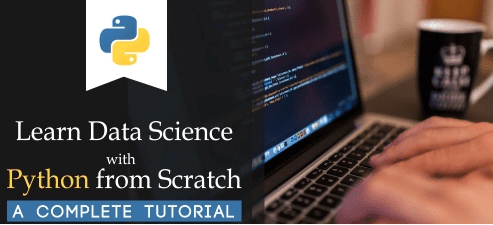
What Are The Best Online Courses in Data Science Using Python?

Reading Time: 3 minutes


Truth be told, today it is all about data and using it to further business growth and productivity using cutting-edge technology to sift through huge volumes of data. The data and its analysis provide gainful insights that are used in strategic decision making, various business-related predictions, and for gaining foresight into market conditions.

Online Vs Classroom courses:

Online courses are trending and are the latest in a series of measures to equip yourself with new skill sets. You may be either looking to make a career or change professions. Such courses fill the gap in addressing the chronic shortage of trained personnel in the data science field. While the online courses do not make experts of you, they serve the purpose of giving you an overview of the subjects involved and making a generalist of you. You may also find a few free online data science certificate courses.

In contrast to the online data science certificate, the paid classroom certification courses help acquire hands-on practical-learning applications,  an improved skill set, an effective framework for learning and mentorship,  and boosts your confidence. Many also help you acquire certifications that come in handy as measurable proof of your being able to practically apply your skill sets to work issues and industry-relevant applications. However, in terms of being useful to get your dream career and job, remember that many aspects of learning about data sciences and programming languages are best learned through the hands-on approach.

Why Python?

Python is a free open-source general-purpose programming language that is very useful in data sciences. It allows you to create CSV files that help read data in spreadsheets. It also permits other complicated outputs using computational ML clusters. It has a wide range of available libraries like Pandas for tasks like data import from Excel sheets, processing time-series analysis and everything in between. Its ML libraries like PyBrain and Scilkit-Learn provide ready-made components and modules for data processing and neural networks. It is a bit slow but makes up for its excellent compatibility with other languages, simple syntax, and applicability to varied verticals.

Requisite Educational Qualifications:

Most online data science courses are introductory and fundamental in nature and do not require any formal qualification or degree. Data analysts can definitely use the resources online to learn data analytics when they have a good understanding of subjects like Computer Science, Mathematics, Statistics, Economics, Engineering, etc. Allied subjects like Machine Learning, Neural Networks, Deep Learning, and such courses are also available in the mode of online courses.

Online courses do improve your foundation in theory. Many career aspirants pursue such online data science certificate courses at reputed training institutes to equip themselves on how to apply their learning to different situations and verticals. Classroom learning, however, becomes essential to pick up crucial skills like comprehensive data capture, organization of databases, cleaning of data, applying insights to business decisions and strategy and the effective presentation of the insights gained. Proficiency in Microsoft Excel techniques, having good mathematical abilities and the knowledge of statistics are huge advantages.

  • The criteria for selecting these courses are that the online data science certificate
  • Cover all relevant data science process topics.
  • They use free open-source libraries and tools.
  • Basic machine learning algorithms are covered.
  • It covers basic applications and the theory behind them.
  • Projects, assignments and hands-on supervised practical sessions are provided.
  • Lead instructors are certified, engaging and presentable.
  • Courses are rated at least 4.5 on a scale of 5.
  • Frequency of courses can be on-request or monthly.

Conclusion:

Learning reinforcement and hands-on practice scores! With so many resources and a learning data science in Python for free and on one’s own is never easy. It emerges that the paid-courses are better than the online courses in Data Science for their widely accepted certification, mentorship by certified trainers, personalized personality-development modules, a skill-oriented approach with tons of practice and assured placements.

The Imarticus Learning courses deliver skilled well-rounded personnel in a variety of latest technology courses which are based on industry demand. If you want to be job-ready with data science certification from day one, then don’t wait.

For more details in brief and further career counseling, you can also search for – Imarticus Learning and can drop your query by filling up a simple form from the site or can contact us through the Live Chat Support system or can even visit one of our training centers based in – Mumbai, Thane, Pune, Chennai, Bangalore, Delhi, Gurgaon. Hurry and enroll.

What Are The Machine Learning Interview Questions?

Reading Time: 3 minutes


It is not surprising that machines are an integral part of our eco-system driven by technology. Reaching a point in technical pinnacle was made easier from the time machine started learning and reasoning even without the intervention of a human being. The world is changing from the models developed by machine learning, artificial intelligence and deep learning which adapt themselves independently to a given scenario. Data being the lifeline of businesses obtaining machine learning training helps in better decision-making for the company to stay ahead of the competition.

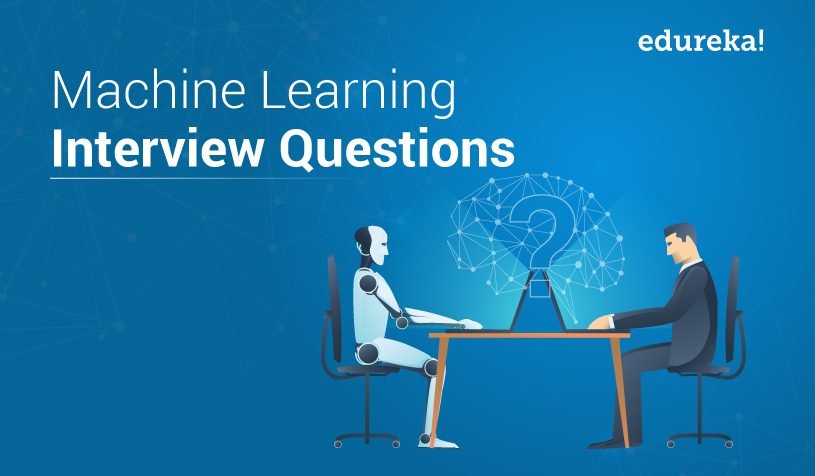
Machine learning interview questions may pop up from any part of the subject like it may be about algorithms and the theory that works behind it, your programming skills and the ability to work over those algorithms and theory or about your general insights about machine learning and its applicability.

Here is a collection of a comprehensive set of interview questions about machine learning and guidelines for the answers:

1. What are the different types of machine learning?

Machines learn in the following ways:

Supervised learning: A supervised learning essentially needs a labeled data which are pre-defined data set using which machines provide a result when new data is introduced.

Unsupervised learning: Here machines learn through observation and defines structures through data as these models do not require labeled data.

Reinforcement learning: Here there is an agent and reward which can meet by trial and error method. Machine tries to figure out ways to maximize rewards by taking favorable action.

2. How does machine learning differ from deep learning?

Machine learning essentially uses algorithms to parse data, learn from them and makes informed decisions based on the learnings. Whereas, deep learning structures different algorithms and gimmicks an artificial neural system to make intelligent decisions by learning on its own.

3. Having too many False positives or False negatives which one is better? Explain

It completely depends on the question and domain for which we are figuring out a solution. For a medical domain showing false negatives may prove risky as it may show up no health problems when the patients are actually sick. If spam detection is the domain then false positives may categorize an important email as spam.

4. What is your idea about Google training data for self-driving cars?

Google uses Recaptcha to sense labeled data from storefronts and traffic signals from its eight sensors interpreted by Google’s software. Creator of Google’s self-driving car Sebastian Thrun’s insights is used to build a training data.

5. Your thoughts on data visualization tools and which data visualization libraries do you use?

You may explain your insights data visualization and your preferred tools. Some of the popular tools include R’sggplot, Python’s seaborn, Matplotlib, Plot.ly, and tableau.

6. Explain about a hash table?

In computing, a hash table is a data structure which that implements an associative array. It uses a hash function using which a key is mapped to certain values.

7. Explain the confusion matrix?

Confusion matrix or error matrix essentially visualizes the performance of algorithms in machine learning. In the below table TN= True negative, FN=False negative, TP=True Positive and FP=False positive.

8. Write pseudo-code for a parallel implementation by choosing an algorithm

Enlighten your knowledge about pseudo-code frameworks such as Peril-L and some visualization tools like Web sequence diagram to aid you in showcasing your talent to write a code that reflects parallelism well.

9. How do you handle missing or corrupted data in a dataset efficiently?

You could identify missing or corrupted data in a dataset and ideally drop them or replace them with another value. In pandas isnull() and dropna() are two useful methods which can be used to identify columns of missing or corrupted data and drop them or replace an invalid value with a placeholder value like fillna().

10. Difference between a linked list and an array?

An array consists of an ordered collection of objects wherein it assumes that every object has the same size. A linked list, on the other hand, is a series of objects with directions as to sequentially process them which helps a linked list to grow organically than an array.

Conclusion

For becoming a successful machine learning engineer, you could join Machine learning certification training to make yourself proficient in various topics of machine learning and its algorithms. From this curated list of interview questions, you would have understood that machine learning is an internal part of data science. Use these sample questions to broaden your knowledge about the questions that may pop up in your interview and be ready to spellbind the interviewer with your swift answers.

For more details, in brief, you can also search for – Imarticus Learning and can drop your query by filling up a simple form from the site or can contact us through the Live Chat Support system or can even visit one of our training centers based in – Mumbai, Thane, Pune, Chennai, Bangalore, Delhi, Gurgaon, and Ahmedabad.

Is Mathematics Required To Implement Blockchain Solutions in Business?

Reading Time: 3 minutes

Yes, the good mathematical ability will be required if you intend to implement blockchains in business. Especially when you are a data analyst, ML programmer or in the finance areas of the business. And, it isn’t just data that increases by the minute. With the phenomenal growth and use of data analytics and the technology for it, the demand for education and training is certainly also increasing every minute. So are the jobs and demand for trained professionals.
Data is today’s gold in businesses. Blockchains use the scrutiny of information to analyze data using various techniques and tools. The results that the data analysts derive from the data available are used by their employers or clients to make informed decisions. So also programmers, algorithm writers, architects and engineers in blockchain technology all use data, databases from various sources, and the principles of analytics which include mathematics, probability, SQL, and such concepts for making predictions and gaining insights from data. Thus, one will need mathematics to gain Blockchain certification and understand how the blockchain technology works.
The blockchain technology with its root in cryptocurrencies forerunner Bitcoin is one of the innovations that have transformed digital money transactions. And since money and business go together it has worked excellently for all industries associated and has become a part and parcel of every new innovative solution in industries like real estate, healthcare, sports, banking, logistics, insurance and you name it!
Let’s explore what you need to scale a blockchain solution. Doing your Blockchain certification is certainly a good idea and can help you make a career in this nascent field if you have a reputed and reliable training partner like Imarticus Learning.
The skills needed for blockchain experts:
To be successful as blockchain implementer you will need the following skills:
Excellent mathematical ability: Your comfort levels should include statistics, algebra, calculus, financial formulae and the techniques of data analysis.
Knowledge of financial concepts: Solving of logic, business problems and transactions on blockchains will need the ability to resolve common transaction problems like interest calculations, depreciation, compound interest, statistical concepts like mode, mean, median, averages, etc.
Presentation skills: To make your presentations understandable you will need a good working knowledge of Microsoft Excel, the use of graphs, charts, tables and more. This is important as not all people will understand your inferences without good presentation skills.
Programming languages: Most applications use Javascript (including Java, JavaScript ES6, JSON), Golang, R, Python and the C suite for blockchains and apps. You need proficiency in programming languages like C, C#, R, Java, Python, MATLAB, PHP, etc to manipulate and effectively use data. The more the languages you learn the better.
Data cleaning, manipulation, analysis, and management: Data scientists and analysts will score if they have the ability to handle languages like HIVE, SQL, NoSQL, HyperLedger Fabric and such languages. Queries and requests are important aspects of data manipulation and hence popular tools like Cognos, SAS, Microsoft Power BI, Oracle Visual Analyzer, Tableau, Simplicity, Serpent, Solidity, Go, Rust and more are best learned to handle blockchain implementation.
Great domain knowledge and interpersonal skills: A good implementer has to excel at interpersonal skills to be able to achieve blockchain scalability. It needs team efforts, good management skills, and the ability to be able to accept feedback as no standard procedures may be present in the emerging field of blockchains. Collaboration, Communication, and Contribution are the three C’s to success!
The top blockchain jobs:
According to Glassdoor statistics, the career choices available specifically in blockchains where the Blockchain certification counts are those of the

  • Developer
  • Architects
  • Blockchain Engineers
  • Certified educators
  • Consultants
  • Market Research
  • Sales Officers
  • Logistics Officers

Blockchain technology benefits:
Technologies like Quantum Computing, Virtual Reality, Neural Networks, data analytics, AI, Augmented Reality, driver-less vehicles, smartphones, cryptos and many more have digitized the modern world and have come to prominence over the last decade. Blockchains have immense benefits for the industries adopting its technology as they reduce costs, increase process efficiency, improve productivity and ease-of-operation.
Key Takeaways:
Blockchain certification is the way to go, to land a career in the evolving and emerging field of blockchain applications across all verticals. Many sectors like healthcare, real estate, education, insurance, and the traditional banking system have already benefitted from it. Blockchain technology is booming and it has the potential to disrupt any industry it is used in. The high demand for professionals with professional certifications makes blockchains an excellent career choice. The industry is in dire need of professional accountants, managers, analysts, developers, programmers and such to grow and realize its potential.
Start your Imarticus Blockchain course today! Also for more details, you can also search for – Imarticus Learning and can drop your query by filling up a simple form from the site or can contact us through the Live Chat Support system or can even visit one of our training centers based in – Mumbai, Thane, Pune, Chennai, Banglore, Delhi, Gurgaon, and Ahmedabad.