Machine Learning For The Curious: Placements made easy

Machine Learning For The Curious: Placements made easy

You can use curiosity as a strong motivator to your advantage. We all share a fundamental human quality to varying degrees: a desire to learn more. In this course, we will explore machine learning, an exciting field that has been fundamental to the development of AI. We will introduce some key concepts such as neural networks, deep learning, and more to understand how these technologies work.

Machine Learning for The Curious

The Machine Learning course will teach you how to build a machine learning system from scratch. In this course, you’ll learn the theory behind machine learning, how it works, and practical applications of the technology in real life. You’ll also get hands-on experience with several different ML algorithms: linear regression, Naive Bayes classification, and matrix factorization (also known as PCA). 

Techniques from other disciplines cannot duplicate the capabilities and outcomes produced by machine learning methods, and if they could, they would refer as machine learning. Machine learning techniques differ from other techniques in two ways:

  • They are applications that use data to learn.
  • They are programs that produce programs to solve issues.

What Is The Difference Between AI, Deep Learning, and Machine Learning?

  • AI is a general term used to describe machines capable of exhibiting intelligent behavior.
  • Machine learning is the application of AI to create machines that can learn from data and make predictions. It is the most widely used technique in machine learning, especially in deep learning (DL) systems.
  • Deep learning is a form of machine learning and artificial intelligence (AI) that resembles how people learn specific subjects. Data science, which also includes statistics and predictive modeling, includes deep learning as a key component. 

Machine learning: A fascinating field

It is a branch of AI (artificial intelligence) that enables computers to learn from data. It’s also called statistical modeling because it uses algorithms to predict future events based on past ones. Machine learning gets used in many applications, including computer vision, natural language processing, and speech recognition.

Programs that use machine learning learn from examples, which makes it fascinating. A machine learning method can automatically analyze and understand the structure of the data you have collected to solve the problem you are trying to solve.

Discover a career in data analytics with Imarticus Learning

online learning

With this machine learning course, students can become data analysts and receive job offers. Learn machine learning using data science that produces vital business forecasts and insights by applying your new knowledge to practical use.

Course Benefits for Students:

  • The most widely used data science tools and methodologies, as well as data analytics and the fundamentals of machine learning, will be familiar to students.
  • To receive a data analytics certification course, students must complete 25 real-world projects and case studies directed by business partners.
  • Using a data analytics tool to display data is one of the most in-demand skills in the market. Therefore, recent graduates and those starting their careers might want to think about enrolling.

 Contact us through the chat support system, or visit our training centers in Mumbai, Thane, Pune, Chennai, Bengaluru, Delhi, Gurgaon, or Ahmedabad.

7 Machine Learning Trends You Should Not Miss!

7 Machine Learning Trends You Should Not Miss!

Today, we live in a highly digitised world of rapid technological progress. This accelerating pace of technological developments is opening up newer ways of data assessment, vital for all businesses regardless of size or scale.

Machine Learning is essentially a component of big data analytics that brutalizes the process of model building through data analysis. Some of the common questions around this subject would include: How is machine learning achieved? Or, what does this model building involve? Data and algorithms are the two essential components in the process of Machine Learning. Machines are trained using either the previous algorithms or the newly discovered ones to interpret methods and structure in data.

Corporate leadership

If you wish to make a career in data analytics and are interested to learn machine learning to understand data entirely, you must keep up with global machine learning trends.

At Imarticus Learning, we offer a job-assured Machine Learning Certification course that teaches you the real-world application of data science and ML concepts to build a robust data analytics career.

Following are the 7 Machine Learning trends that you must be aware of if you wish to make a career in data analytics using Machine Learning –

Hyperautomation

Companies look for speed, accuracy, dependability, and other similar attributes to carry out business processes. The advent of machine learning has made it possible to automate processes requiring large amounts of data to function. Hyperautomation has increased productivity and eliminated mundane, tedious tasks. Natural Language Processing helps in understanding an email and interpreting it through hyperautomation.

Machine Learning Operations (MLOps)

The use of development operations (DevOps) combined with machine learning tools branches out the concept of MLOps to automate tasks. It combines machine learning deployment and development systems to produce a unit method. MLOps is a unique technology that helps optimise and execute various business strategies. It includes data gathering and analysis, model validation and service, and training and transformation of data models.

Internet Of Things (IoT)

Some might also refer to IoT as the digital nervous system since it bridges communication gaps using big data analytics and artificial intelligence. The main communication complications involved lower speed and discrete connectivity. With the introduction of 5G, these hurdles will be eradicated, making communication a smooth process. 5G will be the base of IoT, and with machine learning techniques backing it up, IoT will be the next big thing in the market!

No-Code Machine Learning

The processes which run Machine Learning are collecting data, debugging, generating algorithms, and so on. These processes are often time-consuming and repetitive. No-Code machine learning introduces ways to achieve machine learning practices by eliminating the traditional code system. It devitalises the requirement of experts to develop any project and saves expenses. This can prove beneficial for small-scale businesses that lack the budget for a data scientist.

Reinforced Learning 

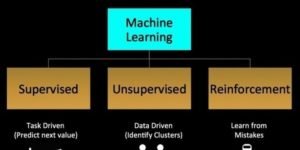
Reinforced learning resembles the reward-system training used to train animals. The machine learns from its environment and imparts value to the training through direct experiences. It tries to get to the maximum level of value assigned to it and gradually gets better and better. Reinforcement learning can be a powerful tool in developing Artificial Intelligence. However, if not controlled properly, it can prove to be a dangerous tool.

TinyML

TinyML enhances security and operation speed. It entirely depends upon the hardware gadgets, and the AI models operate on the same. It is best suited for servers carrying large amounts of data for large-scale companies. TinyML, along with the IoT tools, generates a suitable model for healthcare and similar industries. The use of TinyML intensifies persistence and lowers the power consumption making it far more efficient and reliable.

Unsupervised Machine Learning

If you know supervised learning, you must have guessed what unsupervised machine learning refers to. Unsupervised learning provides a way to execute more complex operations than supervised learning. The machine discovers new, fresh structures and particulars which were earlier under the veil. Even though it can solve complex problems, it can be a little unpredictable compared to supervised learning models.

Takeaway

As we witness the growth of new business methods and models, problems have subsequently increased. Since there are more queries, there is a growing need to find perfect and profitable solutions. With the help of machine learning and data science, along with artificial intelligence, companies aim to achieve higher productivity and offer enhanced customer experience. Hence, it is essential for an aspiring data analyst professional to stay updated on current and upcoming machine learning trends.

Have you got questions about Machine Learning Career prospects but don’t know whom to reach out to? Contact us through chat support, or just visit our nearest training centers in Mumbai, Thane, Pune, Chennai, Bengaluru, Delhi, Gurgaon, or Ahmedabad.

Machine Learning To Revolutionise The Adoption Of AI?

Machine Learning To Revolutionise The Adoption Of AI?

Machine Learning and Artificial Intelligence are disruptive technologies that are changing business, manufacturing, healthcare, and finance in productive ways. Most companies are spending more on AI. Learn Machine learning and AI from Imarticus Learning Pvt Ltd. This will set you up to be a specialist in this area. 

How do AI and Machine Learning work?

Machine learning focuses on feeding the computer large quantities of data and information to help computers learn, act and think as human beings do. A typical example of machine learning is how web browsers learn how to improve results by tracking how we search results. Behind the scenes, the algorithm attempts to understand whether the results are successful. Machine learning requires lots of data. Traditional applications use the knowledge gained about a process or business requirements to produce a specific, desired outcome. Machine learning is where data from IT services and processes is used to learn about the collected data without pre-programmed outcomes.  

The four key areas of the application of Machine Learning are:-

1)  Data Analytics

2)  Communications management 

3) Process automation

4) Customer care

  • Analytics:  A communication service provider would use AI

in data gathering and analysing. If you are a manufacturer or a product-based company,

AI would be implemented in customer interaction and services. 

  • In manufacturing, technology has made many processes faster, easier, and more efficient. Machine learning is one such technology. Through AI, machine learning algorithms learn from experiences, enabling automated processes to improve and adopt changes necessary to obtain better results. Machine learning has stepped in to monitor production phases, focusing on inbound supplier quality through manufacturing scheduling and showing every process from gathering material to fulfillment. Machine learning tracks the health status, alerts the factory of possible failures, and predicts the maintenance time required. This reduces unplanned machinery downtime, increases production throughput, and reduces maintenance costs.
  • Used in Fraud detection and protection against malware.

Doing a course on machine learning and AI will give you exposure to subjects like:

  • Data clustering Algorithms        
  • Machine Learning
  • Classification Algorithms 
  • Decision Tree
  • Python Programming
  • Machine Learnings Concepts
  • Deep Learning 
  • Linear Regression
  • Ridge Regression
  • Lasso (Statistics)
  • Workflow of Machine learnings Projects
  • AI Terminology
  • AI Strategy
  • Workflow of data science projects

Eligibility to do a course on Machine Learning and AI

  • You would need to have a Bachelor’s/Master’s degree in Computer Science/Engineering/Math/Statistics/Science with a minimum of 50% in graduation
  • The next step is doing a Machine Learning and AI course for your data science career. E&ICT Academy designs this course, IIT Guwahati and Imarticus Learning, for future Data Scientists & ML Engineers.

What will be your role as a Data Scientist or an ML Engineer?

  • You will analyse large and complex data sets, create systems that adapt and change over time, and build intelligent applications to make predictions from data.
  • You will gain all the tools to build AI, from foundational basics to advanced applications.
  • Apply best practices and delivery techniques to maintain and monitor a continuously operating production system.
  • Apply different techniques like machine learning, statistical modelling, deep learning, data visualisation, and artificial intelligence to draw insights and make predictions useful to achieve long-term as well as short-term business goals

Career Prospects for a Data Scientist or an ML Engineer.

According to the World Economic Forum, by 2025, 58 million jobs will be generated in Data Science and Artificial Intelligence. Google, Amazon, Microsoft, and Facebook are in the vanguard of companies increasingly demanding data scientists. The world is currently undergoing the 4th Industrial Revolution, the Information revolution. There is a demand-supply mismatch with the demand for data scientists at an all-time peak and the supply far short of the demand. 

As data scientists, some of the career opportunities available could be

  1) A Big Data engineer 

2) Business intelligence developer

 3) Data Scientist 

4) Machine Learning Engineer 

5) Research Scientist 

6) AI Data Analyst 

7) AI Engineer 

8) Robotics Engineer.

Key Takeaways:

 The scope for Machine Learning and AI is limitless as they can be extended to all industries and sectors. This increases the career scope for a Machine Learning and AI expert. Capitalise on the opportunities available in this sector by honing your skills and developing your expertise to the next level. Imarticus Learning Pvt limited offers a ready-made solution for this purpose through their Machine Learning certification course

Visit Imarticus Learning. Contact us through chat support, or drive to our training centers in Mumbai, Thane, Pune, Chennai, Bengaluru, Delhi, and Gurgaon. 

Explore Machine Learning: Here’s How to Find Your Way Through the Data Science Maze

Explore Machine Learning: Here’s How to Find Your Way Through the Data Science Maze

The term ‘Machine Learning’ was coined in 1959 by then-IBM computer scientist Arthur Samuel while designing a computer algorithm for the classic game of Checkers. Today, this term is immensely popular owing to the technology’s wide application across industries.

But what is Machine Learning or ML? It is a computational method that is used to obtain artificial intelligence by making a machine learn how to solve problems on its own rather than requiring explicit programming software. 

Machine Learning is widely used in the field of data science as it helps find the way through tons of data instantly and accurately! But how? By using statistical methods and algorithms to train computers so that they can accurately classify data sets and make reliable predictions to uncover key data insights.

Does all this sound interesting to you? Do you aspire to use advanced Machine Learning technologies to solve real-life problems and arrive at data-driven solutions? If yes, then you should check out our data science courses which are equipped with not only data mining techniques but also machine learning tools along with Python, SQL, and Tableau.

Machine Learning Concepts Which Every Data Scientist Must Know About

Data science learners must be able to develop a solid foundation and specialise in machine learning with Python for data-driven decision-making. Ultimately, you want to assist organisations to make smart decisions for growth and offer insightful data analysis.

Following are some of the key Machine Learning tools which you must know about if you are aspiring for a data science career:

  • Clustering

CLustering is the simplest unsupervised ML method that lets the algorithm define the output for mining data. The most famous clustering method is ‘K-Means’ under which the letter ‘K’ refers to the number of clusters into which the miner wants to divide the unlabelled data. 

The clustering method is used for drawing analysis in varied fields such as for creating customer segments for different marketing techniques as well as for identifying earthquake-prone areas.

  • Neural Networks

If you are interested in the Deep Learning subset of ML, then you must know Neural Networks in and out. Neural Network is a network of algorithms that identify patterns or relationships among different data points in a set in a way similar to the working of a human brain. 

It is widely used for making forecasts and improving decision-making in fields like stock market trading, medical diagnosis, etc. You can learn more about neural networks in our data science online training programs.

  • Regression

Regression is one of the fundamental supervised ML techniques which help data scientists in creating predictive models by defining a relationship between dependent and independent variables. 

There are various types of regression models, however, broadly they can be classified into three groups: Simple Linear Regression Model (SLRM), Multiple Linear Regression Model (MLRM), and Logistic Regression.

  • Natural Language Processing (NLP)

Natural Language Processing (NLP) forms the basis of Machine Learning as it trains machines to learn the language of humans. You can find some of the everyday applications of NLP in voice-controlled applications like Apple’s Siri, Google Assistant, Amazon’s Alexa, etc. NLP is also found in execution in the fields of text summarization and sentiment analysis. 

  • Ensemble Methods

The concept of the Ensemble Method is quite similar to that of assembling. For instance, if you are not happy with all the car options available in the market and wish to come up with a car design, you can assemble your favorite car parts of different cars and design a car of your choice. 

Similarly, if as a data scientist, you are not convinced with the results of different predictive models, you can combine all of them to arrive at better predictions.

  • Transfer Learning

Transfer Learning is one of the efficient ML techniques which lets you use parts of previously programmed neural nets to develop a similar model. For instance, if you are a data scientist who has developed a technique to filter different styles of men’s clothing in buckets like shirts, t-shirts, kurtas, etc., you can use parts of transfer learning to develop a mechanism that can be used for categorising women’s clothing in say, dresses, jumpsuits, tops, etc.

Takeaway

Machine Learning has become a crucial part of the data science field today, which has made the process of analysing and predicting data faster and more accurate than before. 

Be it for real-time navigation, or product recommendations, as a data scientist you will always find Machine Learning and Data Science going hand-in-hand. And the future of data science is expected to be even more promising with the advancements in ML techniques and methods.

Thinking of kickstarting your data science career? Contact us through chat support, or just visit our nearest training centers in Mumbai, Thane, Pune, Chennai, Bengaluru, Delhi, Gurgaon.

Our Certificate Program In Data Science And Machine Learning is created by iHUB DivyaSampark at IIT Roorkee and will instruct you on the fundamentals and features of data science and machine learning and give you the skills necessary to put these ideas into practice and apply them to real-world issues.

From zero to research- An introduction to IIT AI/ML course

AI & Machine Learning in Everyday Life

The importance of Artificial Intelligence (AI) is constantly on the rise and so is its involvement in our everyday lives. Although we don’t often think about it, AI is everywhere.

From chatbots that communicate with us on various online shopping platforms and websites to social media platforms that target audiences and advertise products based on our searches, AI is encoded everywhere. Being such a pertinent part of business, these days makes enrolling in an artificial intelligence and machine learning course a viable option to ensure a lucrative offer in the job market.

Here are 8 ways AI is present in our everyday lives without us even noticing:

  1. Face recognition locking on our phones
  2. Friend suggestions, product/service advertisements based on searches on social media
  3. Spell checkers and Grammarly tools installed on emails and messaging portals
  4. Google searches
  5. Voice assistants such as Siri and Alexa
  6. Smart home devices such as air conditioning machines, electrical switches, refrigerators, and so on
  7. Google maps and other satellite-based trackers
  8. Content suggestions on Netflix based on your watching history

IIT AI/ML Course

Given the way AI is becoming a part and parcel of our lives, the Indian Institute of Technology (IIT) is offering AI/ML specialized courses so that you can gain in-depth knowledge and skills in the applications and techniques associated with machine learning. The idea is to upskill professionals and train them in a manner so that they are ready to take on high-paying jobs in the world’s most demanding computer language.

These are certificate courses that span over a period of 6 months and during this time you will be taught the following subject areas:

  •         Basics of Python
  •         Mathematical Background
  •         Introduction to Machine Learning
  •         Regression Analysis
  •         Optimization in ML
  •         Unsupervised Learning
  •         NLP and text analysis
  •         Feature Selection and Dimensionality Reduction
  •         Reinforcement learning

Outcomes of the Program

  •   Are able to quickly and relevantly gather insights by analyzing data
  • Are able to come up with predictive models that use decision trees and neural networks
  • Can carry out mathematical operations on an array of data
  • Are skilled enough to operate Pandas so that you can manage data, rearrange them and carry out various kinds of analysis
  • Can create text classifications systems making use of learning methods and linear classifiers
  • Professionals can compare optimization techniques and how they effectively solve learning issues across platforms and models to reduce the extent of errors

Who Can Apply for the IIT AI/ML Course?

The artificial intelligence and machine learning course is perfect for anyone keen on learning about machine learning.

Additionally, this program is the right fit for professionals who understand computer programming language and has completed their graduation with preferably a year of practical experience in the industry. You will find this course if you:

  •         Are tasked with machine learning projects or software development
  •         Wish to be at the helm of machine learning projects or want to work in this field
  •         Already have practical knowledge of programming languages such as C, C++, and java

Why Should You Go for this Program?

When you enroll in the artificial intelligence and machine learning course at IIT, you are to get the following benefits:

  • Get a chance to learn and earn a degree from the country’s best engineering school
  • Get a chance to participate in interactive online learning sessions which will be in live mode
  • Will be able to interact and exchange ideas with the best faculty comprising of the top industry professionals
  • Engage in productive peer-to-peer networking and learning
  • Build a strong foundation in concepts such as high-level Python programming, AI, and ML 
  • Participate in the biggest placement on-campus drive

Conclusion:

The importance of artificial intelligence and machine learning courses will continue to be on the rise given the greater involvement of AI in our daily lives. From healthcare, banking, financial institutions, gaming & entertainment to the airline industry, AI is a necessity, and enrolling in the IIT AI/ML course will equip you with industry-specific skills that will help you in every aspect of your professional life.

Here’s Why Upskilling With A Machine Learning Course Is Imperative In 2022

Machine learning has incorporated itself into your everyday lives to a great extent. This futuristic technology is empowering the world a little more with each passing day. Be it product recommendations at window shopping, fraud detection in the financial institutions, or content used by various social media platforms like Instagram, Facebook, and LinkedIn, everything uses machine learning algorithms. Simply put, machine learning is the future and it plays a very important role in our lives. And this is what makes machine learning so important. 

It doesn’t matter in which field you’re in, you can take your career to the next level by taking a machine learning course. In this blog, we will discuss why you need to upskill with a machine learning course in 2022!

Machine Learning

Why Machine Learning Course in 2022? 

Machine learning has emerged as the most sought-after skill to have because of the increasing demand and the numerous benefits that it offers. Below are some reasons why a machine learning course is imperative in 2022:

1. Better Growth and Career Opportunities 

A TMR report suggests that Machine Learning as a Service (MLaaS) is expected to rise from just $1.07 billion (in 2016) to a whopping $19.9 million by 2025. As you can see, this is not normal growth, the demand for ML is increasing exponentially. 

If you’re planning to give a boost to your career then ML is the best tool to do that. Learning this course can help you become a part of both the global and contemporary world. Machine learning is not limited to just the IT industry, it has a strong foothold in areas like cyber security, medicine, image recognition, facial recognition, and many more. As more and more businesses are realizing that this technology is impacting their business, they are investing more and more in it. 

For example, Netflix has put a reward of $1 million to anyone who can sharpen their machine learning algorithm by increasing its efficiency to 10%. This clearly indicates that even the slightest enhancement of ML algorithms can offer immense profit to the company, and thus more and more businesses are behind people who know ML. 

2. Attractive Salaries 

If you’re looking for a hike in your salary, then there is no better way than upskilling with a machine learning certification. Believe it or not, the best machine learning professionals earn as much as the popular sports personalities. According to Glassdoor.co.in, the average salary of a machine learning engineer is INR 10 lakhs per year ﹘ and it is their starting salary which eventually goes as high as INR 15 to 25 lakh per annum. 

3. Lack of Machine Learning Can Be Harmful to Companies 

Technological advancements are happening at the speed of lightning. And due to this, many corporations are left behind. Digital transformation is a vast field, and the fact is, there are not enough ML professionals to cater to increasing demands. 

If we look at the stats, then a New York Times study that took place in 2017 stated that the total number of professionals in the AI and ML field was less than 10,000 people all across the globe. 

This number is most likely to both increase and decrease. It is likely to increase because of the increased number of job opportunities that are being created, and it’s likely to decrease because more and more people are upskilling with ML every day. 

The best part about upskilling with ML is that you don’t need to have an advanced set of skills and qualifications to take a machine learning course, anyone from any background can learn it. 

Machine Learning is the Heart and Soul of Data Science 

There is no doubt that data science rules the market because of its innovative viability and all-explaining nature. And machine learning is the heart and soul of this pioneering technology. By becoming proficient in ML, you can build your career in the field of data science as well. Note that many organizations have data scientists and ML engineers working hand in hand to complete highly demanding tasks. You can get exposure to the world of data science while having a chance to learn and work with industry-leading experts. 

How to Get Started with Machine Learning in 2022?

Once you’ve made up your mind to become a machine learning expert, you’re just a step away from upskilling your career. All you need to do is find and enroll in the right machine learning course or certification program. With a combination of the right ML course, deduction, practice, and experience, you can soon become a machine learning professional. 

The Bottom Line

That’s all about why machine learning is the best way to upskill in 2022. We have discussed everything from the importance of machine learning, its potential benefits, and why you should learn machine learning. It’s up to you to use this data to make the right decision. 

6 Trends Shaping the Future of Data Science

6 Trends Shaping the Future of Data Science

Introduction

The data science industry is rapidly evolving. The field is changing from the types of data collected to the tools and techniques used to analyze it. More and more companies are using these insights as part of their business strategies. As the world becomes more digitally adept, data scientists are in high demand to help businesses make sense of the information they collect.

At Imarticus, we offer data science courses as we are always on the lookout for what’s next in this rapidly changing future of data science

Here are six predictions for trends shaping the future of data science:

1. Data Collection Becomes More Ubiquitous

As companies become more comfortable with data to improve their business performance, they will likely collect more data about their customers and employees. In particular, we expect to see an increase in the amount of location-based information that companies collect about their customers’ movements (and even their emotions).

We are still in the early stages of understanding how to use data to make better decisions, but we are beginning to understand which best practices are most effective. For example, there’s a growing consensus that it’s essential to train your models on as much data as possible—not just large datasets but a variety of datasets representing different data types and problem areas.

2. Data Scientists Become More Valuable

As companies start collecting more data types, they’ll need to hire people who can help them make sense of it all. They will be willing to pay top dollar for those people because they know how important it is to access insights from every corner of their organization. There will also be an increased demand for people training in applied statistics or machine learning to apply those skills broadly across all areas. 

Data democratization: Data scientists are not just going to be working in corporations anymore—anyone with an internet connection can harness the power of data science.

3. The Internet of Things 

IoT is already changing/defining how we interact with our environment, and it will continue to change how we interact with data. As our physical world becomes increasingly connected, we can analyze our surroundings better and understand what they mean.

4. Machine learning

ML is becoming more accessible than ever before. Thanks to cloud computing and powerful open-source tools like TensorFlow and Keras, even non-coders can create powerful models without needing a Ph.D. in mathematics or computer science.

Additionally, there is a growing awareness regarding the importance of machine learning algorithms that can handle complex tasks with no human-defined solution. It means creating systems that can learn from their users’ behavior over time and use this information to solve new problems. It is similar to how Google Search knows what you want when you type in “tacos” or “puppies” while providing recommendations based on your previous searches.

5. Deep learning

Deep learning helps us understand language at a deeper level than ever before. By analyzing a text at various levels—from individual words up to sentences, paragraphs, and entire documents—we can extract information that would otherwise be impossible to find using traditional keyword search or keyword matching algorithms.

6. The growth of Big Data

As more people start using personal data to make discoveries, we’re going to see a lot more information about human behavior emerging—and as it becomes easier for people everywhere to collect this information and share it with others, we’ll see even more discoveries made through crowdsourcing efforts than ever before.

The future of data science will also be shaped by developments in automation technology, including AI assistants like Siri or Alexa. These technologies allow us to interact with computers in new ways. For example, they can understand natural language input like commands or questions and provide answers quickly without requiring us to learn programming languages.

Conclusion

The future of data science is an exciting one. We’ve already seen some incredible advancements and more to come. Now is the best time ever to enrol in data science courses and build a career for a digital future.

Imarticus learning offers a Certificate Program in Data Science and Machine Learning to guide and train you with the best resources to prepare you for this data journey.

Get in touch with us and find a detailed analysis of how this program can potentially revamp your career. Contact us through chat support or drive to our training centers in Mumbai, Thane, Pune, Chennai, Bengaluru, Delhi, and Gurgaon for more information.

How Machine Learning is Reshaping Location-Based Services?

Today life is a lot different from what it used to be a decade ago. The use of smartphones and location-empowered services is commonplace today. Think about the driving maps, forecasts of local weather and how the products that flash on your screen are perhaps just what you were looking for.

Location-enabled GPS services, devices that use them and each time we interact and use them generates data that allows data analysts to learn about our user-preferences, opportunities for expansion of their products, competitor services and much more. And all this was made possible by intelligent use of AI and ML concepts.

Here are some scenarios where AI and ML are set to make our lives better through location-based services.

Smart real-time gaming options without geographical boundaries.
Automatic driver-less transport.
Use of futuristic smartphone-like cyborgs.
Executing perilous tasks like bomb-disposals, precision cutting, and welding, etc.
Thermostats and smart grids for energy distribution to mitigate damage to our environment.
Robots and elderly care improvements.
Healthcare and diagnosis of diseases like cancer, diabetes, and more.
Monitoring banking, credit card and financial frauds.
Personalized tools for the digital media experience.
Customized investment reports and advice.
Improved logistics and systems for distribution.
Smart homes.
Integration of face and voice integration, biometrics and security into smart apps.
So how can machine learning actually impact the geo-location empowered services?

Navigational ease:

Firstly, through navigation that is empowering, democratic, accurate and proactive. This does mean that those days of paper maps, searching for the nearest petrol station or location, being late at the office since the traffic pileups were huge and so many more small inconveniences will be a thing of the past. We will gracefully move to enhanced machine learning smartphones that use the past data and recognize patterns to inform us if the route we use to commute to office has traffic snarls and provide us with alternative routes, suggest the nearest restaurant at lunchtime, find our misplaced keys, help us locate old friends in the area etc all by using a voice command to the digital assistant like Alexa, Siri or Google.

Machine Learning can make planning your day, how and when to get to where you need to be, providing you driving and navigational routes and information, and pinging you on when to leave your location a breeze. No wonder then that most companies like Uber, Nokia, Tesla, Lyft and even smarter startups that are yet to shine are investing heavily on ML and its development for real-time, locational navigational aids, smart cars, driverless electric vehicles and more.

Better applications:

Secondly, our apps are set to get smarter by the moment. At the moment most smartphones including Google, Apple, Nokia among many others are functioning as assistants and have replaced those to-do lists and calendar keeping for chores that include shopping, grocery pickups, and such.

Greater use of smart recommendatory technology:

And thirdly, mobile apps set smartphones apart and the more intelligent apps the better the phone experience gets. The time is not far off when ML will be able to use your data to actually know your preferences and needs. Imagine your phone keeping very accurate track of your grocery lists, where you buy them, planning and scheduling your shopping trips, reminding you when your gas is low, providing you with the easiest time-saving route to commute to wherever you need to go and yes, keep dreaming and letting the manufacturer’s know your needs for the future apps. The smart apps of the future would use your voice commands to suggest hotels, holiday destinations, diners, and even help you in budgeting. That’s where the applications of the future are headed to.

In summation, ML has the potential to pair with location-using technologies to improve and get smarter by the day. The future appears to be one where this pairing will be gainfully used and pay huge dividends in making life more easily livable.

To do the best machine learning courses try Imarticus Learning. They have an excellent track record of being industrially relevant, have an assured placement program and use futuristic and modern practical learning enabled ways of teaching even complex subjects like AI, ML and many more. Go ahead and empower yourself with such a course if you believe in a bright locational enabled ML smart future.

How a machine learning course will transform your resume in 2022?

An artificial intelligence (AI) technology that trains computers to learn and better itself based on experience without being explicitly designed is termed Machine learning (ML). It is a set of computer programs trained to retrieve and use data. Machine learning enables computers to observe the data and provide a result without any human intervention or observation.

Machine Learning with Python

AI is the machine intelligence that leads to the practical solution to the problem, and machine learning takes AI technologies a step further by employing algorithms to examine data, learn, and make intelligent conclusions. 

For AIML, the program developers use the programming language python because it has many libraries and frameworks to make coding easy, and it also saves time.

Thus, machine learning is all about application, and if you know python, you can grasp machine learning fast. To implement anything, you should know how to code it.

Machine Learning Course

At Imarticus, we offer you an extensive program to become a data scientist, data analyst, machine learning engineer, or AI engineer, and, by becoming analytics, you can build machines and systems that will react as humans do.

In the Data analytics certification, we will teach the technique to create a machine learning model that will accurately work to give suitable and best outcomes. We will develop your analytical abilities to choose the correct algorithm as per the model compatibility and your requirement.

The first requirement of a machine learning model is data collection and its interpretation. Therefore, at Imarticus, we give you the knowledge of data manipulation, analysis, and visualization. 

As analytics, you learn to extract ideas from your team, choose proper tools, use a machine learning framework, and stay up to date with the latest development. 

The key responsibilities of analytics are:

  • Collect data, study, and then convert it into data science prototypes
  • Research for the appropriate machine learning tools and algorithm
  • Build a machine learning application that will meet the industry requirement
  • Choose the correct data and the visualization methods
  • Perform machine learning tests
  • Execute statistical analysis from the test results.
  • Set the model for accurate results

Machine Learning Resume

Your resume is your introduction and first impression for recruiters, but writing perfect codes and preparing a good model may not get you your dream job. You have to delve deeper.

Furthermore, if you want to survive in the job market, you should not only have the skills, but you should also know how to endorse these skills to your name. Furthermore, you should have an exceptional and organized resume. Hence, you must include the following points in your resume:

  • You are a certified machine learning engineer
  • Briefly mention your projects and your contribution
  • Describe your work experience in one-liner points
  • List down every information in reverse chronological format
  • Prepare a summary of your resume while highlighting your contributions

 Machine learning has a promising future, and these professionals are high in demand. At Imarticus, we know this so, the expert mentors will give you a practical understanding of AIML. They will help you to develop skills to unlock lucrative career opportunities. 

A Complete Guide On How To Approach A Machine Learning Problem For Beginners!

As beginners in machine learning, you will want to have questions answered to common problems. Questions like how to approach, how to start, which algorithm fits best, and so on.

Common problems in machine learning for beginners

Here, we will help you resolve those problems by answering common questions:

Where can you use machine learning?

You can use machine learning for problems when:

  • Automation is involved
  • Learning from data is needed
  • An estimated outcome is required
  • Need to understand pattern like user sentiments and developing recommendation systems
  • Object required to identify or detect an entity

How to solve machine learning problems?

Here are steps to solve problems in machine learning:

  • Read data from JSON and CSV
  • Identify dependent and independent variables
  • Find out if there are missing values in the data or if it is categorical
  • Apply pre-processing data methods if there are missing data to bring it in a go to go format
  • Split data in groups for testing and training for concerned purposes
  • Spilt data and fit into a suitable model and move on validating the model
  • Change parameters in the model if needed and keep up the testing
  • An optional step is to switch algorithms to get different answers to the same problem and weigh the accuracies for a better understanding – this explains the accuracy paradox
  • Visualize the results to understand where the data is headed and to explain better while representing it

What algorithm should you use?

You need to understand what labelling is to answer this. Labels are the values we need to make an estimate. This represents the Y variable, also known as the dependent variable.

Here is a small example to help you understand this:

if

dependent_variable_exists==True:

supervised learning()

else:

unsupervised learning()

Machine Learning CourseWhile you’re learning from a machine learning course, you will understand that your supervision and training refers to supervised learning. This means that the results need to be compared by a frame. The frame here is the dependent variable. However, there is no reference for frame under unsupervised learning, which is why the name.

It is time to figure out how algorithms are served. However, it is essential to note that this is a generalized approach. The situations can differ, and so will be the usage of algorithms:

  • Numeric data for linear regression
  • Logistic regression when the variable is binary
  • Multiple category classification through a linear discriminant approach
  • Decision Tree, Naive Bayes, KNN, and Ensembles for regression and classification

Machine Learning Course

As you grow in your machine learning career, you will learn how to take random XG boost, forest, Adaboost, among other algorithms for ensembles. You can try these for both regression and classification.

Ensembles, as the name goes, refer to a group of at least two classifiers or regressors. Moreover, it doesn’t matter if it is the same or if working towards the same goals.

Building visualizations

Here are some of the things to remember when visualizing reports:

  • You can show class clustering with a scatter plot
  • Avoid scatter plot if there are several data points
  • Class comparisons can be explained through histogram
  • Creating pie charts help comparative breakdown
  • Line charts can help analyze reports with frequent deviations like stocks

If a scatter plot has too many data points, it will look clumsy. It will not be a presentable representation to show stakeholders. In such cases, you should use scatter charts.

Final thoughts

These points will help a beginner in machine learning career to become more aware of how to solve problems. You now know the essential things to do and things to avoid to get accurate results.