
Career as Investment Banker

An investment bank stands as the intermediary between businesses that need to raise funds and investors who can invest. Therefore, companies need to issue securities, and investors decide to provide money in exchange. The work of an investment banker is to handle all the transactions happening between both the parties. Here, we will take you through the basics of how to start an investment banker career.

What is Investment Banking?

Investment banking is a part of the finance industry where the target is increasing and managing clients’ financial assets. The investment bankers assist organizations in investing their assets to increase the value of their profiles. If you choose the investment banker career, you will become an advisor to help clients capitalize on credible opportunities.
You must know that investment banking falls under a special division in the finance industry at a basic level. It serves the central government, state government, commercial banks, non-commercial banks, corporations, institutions, etc.
Investment banks offer complete guidelines about mutual funds and stock. Thus, it acts as an advisor and guides investors to put their money in the most profitable place.

Functions of Investment Banks

Before you join an investment banking course, know the kind of work you will be responsible for. These are the main functions of an investment bank:

  • Securities research: Investment bankers use the “Hold,” “Sell,” and “Buy” rating system to research and provide detailed reports. They find out the status of a company, investments they made, and other necessary details to check their credibility.
  • Investment management: Investment bankers help companies by giving them the correct suggestions regarding their investment. Since they take over the research and analysis, they have a sound method of understanding what would benefit their clients the most. They help businesses that need financial aid and also enable investors to choose the best organizations for investment.
  • Proprietary trading activities: Bankers in this financial institution help in selling and buying of assets to bring profit in every trade. These financial products are bonds, stocks, derivatives, and more.

Why become an investment banker?

Investment bankers are highly respected professionals in the finance sector. They help companies get the necessary funds to achieve their goals. They are also responsible for helping companies attract investors and determine what is the best way to solve their financial issues. A career in investment banking can be highly lucrative and rewarding. The statistics are the best proof for this claim.

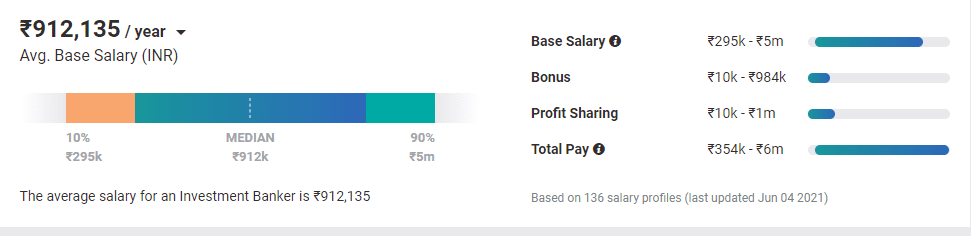
In India, the average pay of an investment banker is ₹9.04 lakhs per year. Their salary starts from ₹2.86 lakhs per annum and goes up to ₹50 lakhs, depending on their experience, skills, and employer.
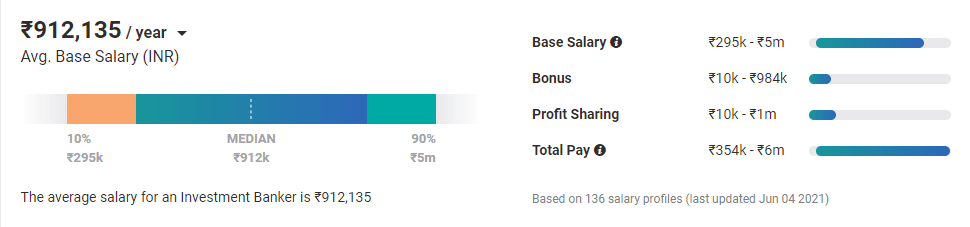
Investment Banking Course with placement in IndiaYou can easily bag a high-paying salary in this field as you gain experience. The average salary of an investment banker with five to nine years of professional experience is ₹20 lakhs per year. Apart from the lucrative pay package, you will also have the opportunity to work with senior executives, investors, venture capitalists, and other highly esteemed individuals when you will be working as an investment banker.
Investment Banker Course with placement in IndiaFurther, becoming an investment banker would provide you with a stable and secure career path. Investment bankers are regarded as one of the best-paying jobs globally, so it is certainly worth the effort and time.

How to start a career as an investment banker?

To become an investment banker, you will need to be well-acquainted in management, statistical analysis, finance, financial law, and other relevant subjects. Investment bankers have to create fully detailed financial models to facilitate M&A (merger and acquisitions) transactions, and financial planning and analysis.

They also have to evaluate companies for investments and use different methodologies, such as LBO (leveraged buyout) and transaction comparisons, for the same.

Due to such complexity of this role, companies look for certified and highly skilled professionals. That is why it is best to get an investment banking certification to become a professional in this sector.

There are many courses for investment banking in India. You should choose the ones that teach you the necessary concepts most efficiently.

It is best to look for online courses for investment banking as they teach you financial modeling, statistical analysis, and other important concepts safely without requiring you to leave home or go anywhere.

Investment Banker Career Positions

The investment banker career grows along a straight path. Here are the positions from juniors to seniors as investment bankers:

  • Analyst: Your career will start as an analyst as you can become one as soon as you’re out of college. Prior knowledge of 1-2 years in the financial sector is even better to add credibility.
    Your job profile will be collecting data, creating presentations, and analyzing financial data. Thus, as an aspirant, you must go through this process to understand how the world of investment banking works.
  • Associate: You need around three years of experience as an analyst to get promoted as an associate. At this point, you interact with clients, manage teams of analysts, and more.
  • Vice President: A vice president in an investment bank has years of experience in the field. They build and maintain client relationships and ensure operational efficiency at each level under them.
  • Managing Director: It takes around 15 to 20 years to become an MD in the field of investment banking. MD’s primary focus is getting more work into the business and converting potential clients into real deals.

Final thoughts

The first step to investment banking is to have a bachelor’s degree in finance and accounting. If you have a master’s degree, your credibility will be higher. Many aspirants complete their MBA before joining an investment bank. You need to be well aware of subjects like marketing, economics, accounting, mathematics, and more. Lastly, you need to have a license for several stock exchange programs to get through as an investment banker.


Is Investment Banking Glamorous?

The answer depends on how you define the word ‘glamorous’. In the most basic sense of the word, investment banking does come off as a professional field that is restricted to big corporations, high net worth individuals (HNIs), or those who are at higher social strata. And thinking about them does invoke a sense of being glamorous, posh, and attractive. Right?

This is also because investment banking deals with high-level mergers and acquisitions, high-profile corporate deals, and takeovers that can impact whole industries as well as the economy of the country.

Professionals working in the investment banking field may also be called glamorous owing to their daily tasks and meetings with VIPs and business leaders. Here’s a bit more information about the field from a social lens.

Investment Banking Itself is a High-Profile Profession

Today, aspiring finance students in India take investment banking courses with the hope to earn a good package and set their life. It is one of the most sought-after and popular fields in the world of finance. A part of this attraction can be attributed to the glamorous day-to-day work.
Take the case of Saket who works at the Delhi office of a multinational conglomerate. The company majorly focuses on investment banking, wealth management, and corporate consultation. Some of his most common daily tasks are:

  • Scheduled meetings with corporate lawyers, CEOs, analysts, and business leaders at 5-star offices
  • Attending industry seminars, sessions, and talks that are organized in 5-star hotels/resorts
  • After-hour parties at 5-star clubs and lounges where he talks shop with her peers and other business leaders

Even after work, the role of an investment banker demands that he maintain the high culture image so as to convert potential clients into customers. This is why Saket owns an iPhone X, a Macbook Pro, and AirPods. The good thing is that they all were paid for by his company.
This is perhaps the most appropriate answer to the question. The job provides you with a social life that is not possible in many of the other finance jobs such as branch banking, loan officer, and insurance agent. One profession that comes close is that of a stockbroker.

High Earnings

Enrolling for an investment banking course may be cheap, but the returns are too high. The average salary of an investment banker at an analyst position is INR 10,00,000. Those with experience go on to earn up to 3x depending upon the level and company.
With such high salary packages, investment banking professionals are able to lead a glamorous lifestyle. The bit about iPhone and Macbook was about the professional side of things, which are just some of the perks for working at a reputed company. Investment bankers in India can also afford to splurge on the good things in life. The average salary is higher than that of many other professions.
This is why finance graduates and postgraduates who get hired by companies like Indiabulls, JP Morgan Chase, and Goldman Sachs, and Barclays start with an impressive package. The earning potential gives them a free hand at splurging, which in turn makes their professional and personal lives glamorous.

In short, the answer to the question is yes. If you have what it takes and can master all the necessary skills for an investment banking job, then you too can lead a glamorous life. The same is true for most high-profile finance and computer science jobs. Learn a bit of management too and you can really climb the corporate ladder faster than the average Indian professional.

Sign up for an investment banking course today and enter the world of glamour, wealth, and corporate fame.

Functions of Investment Banking

Today investment banking is one of the most lucrative career options for finance students in India. It involves keeping a track of the economy and the markets, having knowledge of critical financial concepts, and understanding of technology tools. It is one of the very few subfields in the world of finance which requires an end-to-end approach in finance for professionals to qualify and make it big.
While an investment banking course will set you up with the basics and take you deeper, this intro guide will come in handy as you sit down to plan.

Core of Investment Banking

The core function of investment banking lies in advice. Here, a team of experts assess the financial situation (historic) of a company and provide counsel in all associated affairs, help leaders make decisions in terms of mergers and acquisitions (M&As), and ensure that the financial infrastructure of the company is well-maintained and future-proof. For example, a conglomerate (Walmart) looking to acquire a startup (Flipkart) will turn to investment banking to understand the pros and cons of such an acquisition.
An investment banking professional typically undertakes the following tasks:

  • Assessment of historical financial framework of the company
  • Underwriting stock issues and other portfolios
  • Examination financial statements, books, and all related materials
  • Projecting the company as a safe, growing investment and attract investors

Apart from these tasks, investment banking majorly has to do with improving the projected state of a company. If it is a listed company, all the dealings that it does will impact its share price, and further influence the investors’ stance on it. Today, most corporations and organizations use investment banking professionals to assist them in their day-to-day financial decisions.

Skills Required for Investment Banking Career

Investment banking is a great choice for students who are interested in the stock market and the economy. Having a natural interest as well as knowhow of how the economy works will give an upper hand when it comes to landing jobs in the field.
This is why a natural interest in trading, stocks, mutual funds, taxation, and the global economy is the default requirement. Other than that, this is the list of select skills that are in demand:

  • Strong mathematical and analytical skills
  • Accountancy, bookkeeping, taxation
  • Knowledge of the global economy
  • Understanding of economics and key concepts such as markets, mutual funds

Another important skill is communication and relationship building. Experts have rightly suggested that the companies that have wide hands and an extensive client network perform the best. This is because they are capable of improving the prospects for any company by providing better financial counsel. And for all these, the ability to communicate well and maintain relationships is important.
For students, the focus should be on understanding basic concepts. Enrolling in an investment banking course can help you get started. Whether you want to proceed or not will depend on how you fell when you start studying.

Hard Skills Needed for Investment Banking Jobs

Considering that technology is continuously helping us improve our work, there are a set of tools and skills that you should master:

  • Debt and equity finance
  • Derivatives
  • Traditional trading
  • Corporate bonds
  • Trend analysis
  • Comparative Finance
    • Fund flow analysis
    This is not an exhaustive list but only the most common skills. The key would be to learn the basics of investment banking and then focus on individual concepts.

Investment banking aids corporations to make better financial decisions and thereby help in their growth and development. If you are a student who is interested in exploring the field as a career option, you can easily do it by joining an investment banking course. Understanding the concepts will set you up for a career path that is one of the best in India.

Ways to Get the First Job at an Investment Bank

What are investment banks

An investment bank is a specialised bank that is involved in different financial services. These are large companies who aid other companies with complex financial transactions. An investment bank takes care of all the processes like mergers and acquisitions, security transactions, Forex trading, etc.

An investment bank is also seen as an organisation that acts as a financial advisor. The investment bankers working in these companies are the agents of the bank who lead major financial transactions across all companies. Investment banks also provide these services to different individuals who need help with their finances.

What is Investment Banking?

Investment banking is related to the creation of capital for different functional needs of different entities. Investment bankers help their clients in underwriting debt and in also managing the purchase and sale of different securities.

Investment banking can only be taken up as a profession if you have a required knowledge base. One of the major aspects of investment banking is the formulation of different deals and helping companies in raising capital. A lot of companies also take the help of investment bankers to aid their investment decisions. It acts as a middleman between potential investors of the company who are interested in purchasing the stocks of the company and the company itself.

Types of activities managed by an Investment Bank

An investment bank performs a different set of functions. Some of these important functions are listed below:

  1.  Acts as a financial advisor: Investment banks act as financial advisors who aid companies in looking for potential investors. On the other hand, they also aid several potential investors in finding the right investment. They act as a bridge between a company and the investors. They formulate financial strategies for all of their clients helping them in making major financial decisions
  2. Mergers and acquisitions: Investment banking plays a major role in the case of different mergers and acquisitions. They perform calculations to ascertain the net worth of the company which is to be taken over by some other company. These banks structure a fair deal which is agreed to by both the parties.
  3. Financial Research: Research plays a very important role in investment banking. Researches are being conducted daily to evaluate the financial positions of different companies. These banks manage major financial transactions therefore they must stay in touch with the ongoing market trends.

Getting your first job at an investment bank

Investment Banking is a specialised area of working. Therefore, before applying to any investment banking companies, make sure that you have the required technical skills which are required by the bank.
In case you are still in college and you want to go into the field of investment banking, make up your mind. You can opt for different investment banking courses which are available both online and offline. Given below are some of the important steps that will help you land in and investment bank.

  • Start networking and build a resume: Networking and talking with people who are already in the investment banking industry helps a lot. Use this network to get yourself a job interview. You can use different platforms to connect with these professionals.
  • Prepare yourself for the interview process: Your interview will cover different aspects of Finance. Therefore, make sure to brush-up all your concepts. Different technical questions might be asked.
  • Master all the technical skills: Investment banking requires extensive knowledge about the technical aspects of the job. Therefore, make sure to train yourself and become proficient with some of the popular software like Excel

Conclusion

Investment banks hire in a very structural way. Try maintaining a good GPA and build your resume keeping in mind the skills which are needed to become a successful investment banker.

Also Read: Different Types of Investment Banking Jobs

All You Need To Know About Investment Banking!

Investment banks can be categorised into four types that include regional boutique banks, elite boutique banks, middle market and bulge bracket banks.

Let’s delve deeper into each category.

  • Regional Boutique Banks: The regional boutique is considered as the smallest category of investment banking based on the typical deal size and firms operation scale. These investment banks specialise in a particular niche, for example, a Merger and Acquisitions investment bank. The employee count is also very small as compared to other investment banks.
  • Bulge Bracket Banks: The bulge bracket category includes high-profile investment banks in the industry who have an international presence. The clientele ranges from high net-worth individual to large corporations. They have multiple offices in different locations and have employee count in thousands. For example Morgan Stanley, Deutsche Bank, etc.
  • Elite Boutique Banks: The elite boutique category includes those investment banks who are almost at par with bulge bracket investment banks in terms of deals managed by them. The monetary value of these deals is often higher than $1Billion. These banks also have an international presence but the scale of operations is somewhat limited when compared with bulge bracket category. For example JP Morgan Chase & Co.
  • Middle-Market Banks: Middle-market banks fall somewhere between the regional and bulge bracket category. The average deal range for banks in this category is between $50 million to $500 million. They majorly operate domestically but some can have a limited international presence as well. For example Cowen Group.

Is Investment Banking a Good Career?

Many fresh college graduates aspire to make a career in the investment banking industry. Most of them are thrilled by the lucrative remuneration and perks attached to the title of an investment banker. However, not everyone turns out to be a successful investment banker. Is the investment banking career a good one for you? Well, the answer to this question depends on how committed are you to your career.

The investment banking career is a demanding one, the role of an investment banker is multidimensional. It requires honing a range of skills including both soft skills and technical skills to achieve success. The day-to-day of an investment banker includes doing research for your clients, staying updated on the financial news, conducting complex financial analysis, projecting prospects, meeting with various stakeholders and building relationships on behalf of the investment banks, etc.

The rewarding remuneration is justified by the workload it entails. The job of an investment banker is a high-pressure one, demanding most of your time. On average, the investment bankers work for 12-16 hours a day, it is far from 40 hours’ work-week that a normal job has. The pay scale is also very high, compensating you for every bit of your time and effort. If you are willing to invest your time and effort that is required to be successful as an investment banker then it is surely a good career option.

How Do You Become an Investment Banker?

Investment banking has been one of the most sought after and lucrative career prospects. Most people aspiring for a career in the field of finance have their eyes set on the title of an investment banker. The primary reason why most people consider investment banking as their ultimate career goals is the type of remuneration this job role has to offer. The pay scale is unmatched by any other industry, even an entry-level position has very rewarding perks.

How can you become a successful investment banker? The answer to this question depends on what stage of your career you are presently at. If you are yet to graduate you have the utmost flexibility to choose your path. The best way to start is by pursuing your bachelor’s degree in a relevant field like economics, commerce, finance, accounting, statistics, etc. This degree alone can help you get into the investment banking industry at an entry-level position.

The best way to kick-start your career in this field is by pursuing an MBA degree with a specialisation in Finance. Another equally rewarding way is to enrol for an investment baking related course which will provide you with hands-on knowledge and skills relevant to the job that you will be doing as an investment banker. Being a successful investment banker takes time, determination and commitment to your job.

What Is An Investment Banking Course?

Investment banking is a specialised division in the banking and finance industry that primarily focuses on helping individual and corporate clients to raise capital from the market. Investment banks act as mediators between the party seeking funds and the investors who are looking to gain a profitable sum on their investment. It also provides financial consultancy on an array of financial instruments for investment purpose by assessing the risk and return profile of the individual.

Investment banking courses are programs specifically created to provide comprehensive knowledge of the capital markets and the investment banking division. The curriculum of these programs is designed to provide both theoretical knowledge and practical understanding of the investment banking landscape. The main objective of the investment banking courses is to impart hands-on knowledge and skills required to become a successful investment banker.

The investment banking course takes a holistic learning approach and focuses on core subject matters including strategic planning, financial management, financial analysis, corporate finance, valuation, alternative investments, equity, portfolio management, quantitative analysis, ethics, etc. The course also provides contextual insights into the primary functions of investment banking that includes Mergers & Acquisitions, corporate restructuring, leveraged buyouts, Initial Public Offering launches, etc.

Which Course Is Best for Investment Banking?

Investment banking is one of the most promising industries to build a rewarding career. The lucrative job prospects attract a lot of young aspirants who want to build a successful career, this leads to high competition in the investment banking industry. Investment banking courses are designed to provide a comprehensive understanding of the core financial subjects. It aims to build your practical understanding of the industry and impart you with relevant technical skills to beat the competition.

Staying ahead in the game requires a lot of hard work and determination. You have to stand out from the crowd; this can be achieved by having an in-depth understanding of the financial industry. Choosing the best investment banking course is subjective and can get tricky at times.

Some important factors to consider before choosing an investment banking course are the technical skills to be gained, the price of the course and the institution’s experience and reputation. The level of specialisation that you require also determines which course would be the best fit for you.

If you are looking for the best investment banking course then join Imarticus Learning’s Certified Investment Banking Operational Program. This placement assured investment banking course can help you to build a successful career in an investment banking industry.


Investment Banking Online Training: The Ultimate Guide!

Investment banking (IB) is a huge sector with global market size of $289 billion. An investment banker helps his/her clients in generating capital. A good investment banker stands by his/her client in any type of financial unhappening and gives his/her experienced advice.

They help out their client with Mergers and Acquisitions (M&A). If you have made your mind to step in this field and learn more, you can do it through Investment banking online training. You can choose from a plethora of courses available on the internet. Let us see which online courses are the best? & what does an Investment banking online training focus on?

What Skills Do Online Investment Banking Courses Focus On?

  • These courses focus on developing the analytical skills of the learner. As an investment banker, one can find situations where they have to analyze the available information and predict whether any particular venture is good for his/her client’s business or not? Online IB courses also focus on making the learner familiar with databases, from which the data can be accessed. With good analytical skills, one can predict the roadmap for any particular business in a good way.
  • One should have a prerequisite about accounting before leaping forward. These courses also focus on required technical skills like valuation, financial modelling, etc. Some courses also focus on the usage of spreadsheets and Microsoft Excel for better analysis.
  • They also focus on communication & presentation qualities. A good investment banker can convey his/her thoughts to people effectively and convincingly.
  • The learner is taught about the trade life cycle. There are online courses available that teach risk analysis and management at bad times. This will help you in assisting your client in a better way and gaining his/her trust/loyalty.
  • These online courses also focus on Mergers & Acquisitions. Topics like leverage buyout are covered which is the acquisition of a company that has taken debt to meet the cost of acquisition.
  • They also make you familiar with legal terms and conditions related to Investment banking.

Few good Investment Banking Online Training/Courses

  • The Complete Investment Banking Course 2020 – This course is spanned across 33 key topics ranging from trading & brokerage to Initial Public Offering. There are also 12-course challenges to evaluate your skills. Currently, this course has 72,721 students. Previous versions of this course were also successful. They have always added new topics and have worked on improving their course from time to time. It is one of the best online courses available in the market. Its duration is also self-paced.
  • Investment banking Training by CFI – This course is for 6 weeks. They cover the fundamental topics of IB like valuation, financial modelling, corporate finances, etc. They also focus on teaching banking statement analysis & creation.
  • Free Investment banking Course by WallStreetMojo – You will get ample time to complete this course as it is self-paced. This course focuses on topics like equity investments, IPO, etc. This course will help you in increasing your analytical and accounting skills. It also teaches you to work on Excel sheets for calculations related to finance/investment.
  • Introduction to Finance: Valuation and Investing Specialization by Coursera – This course is for people who have intermediate knowledge about Investment banking. This course focuses on specialized topics of IB.
  • Investment banking Certification by New York Institute of Finance – Besides basic terminologies like M&A & risk management, this course also focuses on mutual funds, equity, hedge funds, portfolio management, etc.

Conclusion

Investment banking is a developing field. Besides the aforementioned skills, there are many soft skills which a person has to develop within himself/herself if he/she wants to rise high. Resilience, confidence, etc. are some of them. This article was all about the general contents of an online course/training on IB & some good online courses available in the market. I hope it helps!

Also Read: Career & Scope in Investment Banking

What Is the Societal Benefit of Investment Banking?

Understanding Investment Banking

Investment banking can be defined as a unique division in the Finance and Banking Industry that deals with providing capital for companies, guiding on profitable investment avenues and complex securities, facilitating other investment-related transactions.

One of the primary functions of investment banking is seen in the context of Initial Public Offerings (IPOs). Investment banks act as the underwriter and mediate the deal between the company seeking funds and the investors looking to park their investments in profitable avenues. Investment banks also help to facilitate the mergers and acquisition deals for their clients by leveraging their vast network and expertise in the domain.

How Does It Help Society?

The Finance and Banking Industry are the twin pillars of the present day Capitalism. The concept of money multiplier came into existence due to the evolution of the banking industry. The wealth creation process has been escalated due to the presence of investment infrastructure created by the investment banking industry. Let’s see the macroeconomic impact of the investment banking industry that helps the contemporary capitalist society.

Market Liquidity

The contemporary economic setting is characterized as a mixed one; a mixed economy system has elements of kinds, the market economy as well as the planned economic system. In the mixed economic structure, both the government and private enterprises rely on investment banks for fundraising to a great extent.

The traditional function of investment banks included mediating deals between the buyers and sellers of securities and other financial instruments, in facilitating the deals investment banks helps to add liquidity in the market. Think of a situation where investment banks are not present in the economy, how will a company raise funds during its IPO? Well, it’s certainly a difficult situation to find two parties who need what the other has, almost like a barter system scenario.

Connecting Present And Future Consumptions

One of the major functions of the banking industry is to control the supply of money to induce saving and consumption using interest rates. The market rate of interest determines how lucrative it is to save or invest money; if the interest rates are higher people will save more money than spend it because they will get a higher return in the future.

If interest rates are lower, people will prefer keeping liquid money instead of investing it in a financial instrument or saving it in a bank. The investment banks help in shaping the market rate of interests, the more efficient it is in establishing the interest rates the better the resources can be channelled between the present and future needs.

Impact Investing

In the contemporary landscape, people and companies are more concerned about the environment. Today, it’s not just about growth but about creating sustainable growth that will not compromise with the needs of the future generations. The new-age start-ups are all about solving modern problems and creating businesses around the problems that are hampering the environment and society.

The main emphasis is laid on using money and investment capital for social gains rather than just boosting profitability, it’s more like making an informed investment decision.

Funding is the most important factor to grow any business, no matter how good your intentions are for the society you need funds for running and growing your business to make an impact. Investment banks can help businesses with good intentions in their funding needs. This process of providing funds to businesses that are determined to make an impact in society is called impact investing. Impact investing aims to produce environmental benefits in addition to financial gains for the business.

What Are the Golden Rules of Investment Banking

A career in the Investment Banking industry often seems very lucrative for an outsider given the huge perks and benefits that the role entails. The reality of the job is quite different from what it seems. The remuneration is certainly very lucrative, there is no denying that but the work it takes to make it, in the long run, is undesirable by a normal person. To thrive as an investment banker one needs to work on their soft skills as much as they work on their financial knowledge and other technical skills.

The Investment Banking industry is very dynamic and volatile. No matter what you do you can’t predict the outcomes with perfect accuracy, there is always some uncertainty and risk involved in this game. To succeed and grow your career in the Investment Banking industry you need to be a hard worker who is persistent and patient. Knowing about the industry is not enough; you need to know everything about your clients and competition.

At managerial levels, the job involves a lot of socialising and networking with high-profile individuals and organizations that require you to be an effective communicator. One of the most important skills that you need to have or develop is being a great salesperson because at some point or another in your career you will need to bring more clients and revenue for the company. Let’s talk about some of the golden rules of investing that every investor should be aware of, these are more like thumb rules of investment.

Goal Setting

One of the most important factors that are common to all vocation but more like a rule in the investment banking sector. Being an investment banker you need to handle the money of your client. When you invest the money you need to know about the financial goals and the time frame that you’ll be an investment for. This provides clarity and helps you stick to your strategy.

High Risk, High Returns Trade-Off

High returns often seem very lucrative but the other side of the story is not very appealing. There is often a high degree of risk associated with high returns. You should choose your investments based on your client’s risk appetite and return estimates.

Investment Diversification

Diversification is one of the most rudimentary steps in mitigating the risk associated with investing. Spreading your investment amount across a range of assets and geographical areas is often a smart move and helps to protect your overall investment amount. It is as simple as not putting all the eggs in one basket.

Invest With A Long Term Vision

When you are investing the money it should not be from a short-run perspective, the return is often very volatile in the short run and hard to predict what you’ll get back. Long run investments are often very stable and provide a balanced return on investment. The process of investing is not a get ultra-rich instantly scheme.

Portfolio Review

One of the most important rules of investment is to review the portfolio that you have created. Your investment will change in value over time and might differ from your investment objectives in the beginning, this needs to be handled proactively by making necessary iterations in your investment portfolio to get the desirable outcomes.

Refrain From Timing The Market

When markets are efficient and you have perfect knowledge you could buy the securities when they are undervalued and sell them when they become overvalued. Unfortunately, it’s very hard and risky to time your investments given the fluctuations in the stock market. Buying and holding your securities in the medium run is a good option to stay afloat in the game.

Is it Possible to Up-skill My Career to Crack Interviews?

Here’s the story of Swapnil Wade and how he transformed his career through upskilling.

I completed my graduation in April 2019 in B.Com – Computer Applications with a distinction.

After graduation, I appeared for interviews at banks but was not able to crack any of them. That’s because I think, I didn’t have the skill set that was required for the job role. After my last interview, I received confirmed feedback that, yes, I was indeed lacking the skills and knowledge necessary for the dream jobs that I was applying for.

First, I researched on my own about the skills that were required for the investment banking and finance industries. After seeing many Imarticus Learning reviews, I came to Imarticus, and the counselors told me about the CIBOP course. I instantly joined, and I haven’t looked back since.

Upskilling gave me a competitive edge that many former classmates didn’t have.

Upskilling helped me a lot. Earlier, I didn’t have the knowledge required on crucial topics like derivatives, money market, and so many more. However, after coming to Imarticus and joining the CIBOP Investment Baking course, I was able to answer the same questions which I was not ready to tackle earlier. I used to fumble a lot but after doing this course, now I say that I can answer all IB-related questions with confidence.

I think many of my former classmates are still struggling to find a job without upskilling. Some of them are still looking for jobs; some have them in their hand but are not happy with what they’re doing. This is because they don’t have the required skills for the jobs they actually desire. This is precisely why I feel that upskilling is very important to get the job of your dreams.

Imarticus Learning helped me land a most-coveted job.

I think the competition in this field is growing every single day, but actual job roles are less. So, your skillset is the most essential factor you possess to get your desired job. I can confidently say I do not lack anywhere now, in terms of skills. I have enough knowledge and backing through Imarticus Learning to get my desired job.

Looking to Upskill Your Career but don’t know where to start? Chat with our counselors today.

What Is Investment Banking Course?

What Is Investment Banking?

Investment banking is one of the most sought after career choices in the Finance industry. The lucrative remuneration and added privileges to information make it a dream job for many young finance enthusiasts. What exactly is an investment banking and what do the high profile investment bankers do?

Investment Banking can be understood as a discipline or division in the Finance and Banking Industry that specializes in providing investment solutions and capital creation for various government and private organizations.

The main role of investment banks is highlighted in underwriting new securities, sale of securities, facilitating mergers and acquisitions deals, guiding profitable investment avenues and complex financial instruments.

In addition to this, the investment banks also help in assessing the worth and creditworthiness of an organization, structuring deals for clients during mergers and acquisitions process and to plan and manage the financial aspects of projects carried out by the government and private enterprises.

During the underwriting process, investment bankers act as middlemen and mediators between the company issuing new securities and the investors looking for profitable investment opportunities. They leverage their vast network and expertise to connect both parties into a profitable agreement.

They guide the corporations in pricing financing instruments and navigating through strict guidelines of financial regulators. In Mergers and acquisition deals, investment bankers safeguard the interest of their clients by finding the right business to acquire or to merge with.

This includes conducting thorough industry-wide research and individually researching the companies shortlisted for probable M&A deals.

The Investment Banking Course

Most people eying for a career in the financial services industry or specifically into investment banking are puzzled with how to get into the investment banking industry and get their first breakthrough into this highly rewarding career prospect.

How to get into this industry is very subjective and is contingent on what stage of your career you are at presently. Those who are already into the Finance industry and want to specifically get into the role will eye for the investment banking course as it’ll provide them with in-depth knowledge about the industry and its functioning.

The investment banking courses are specifically designed for professionals who want to get an in-depth understanding of the core investment banking process. It aims to provide hands-on knowledge and skills to become a successful investment banking professional. It focuses on multiple aspects of the investment banking field such as equity research, corporate finance, financial modelling, portfolio management, Capital market, mergers, and acquisitions, etc.

People who are still in college or about to start their majors can plan it in an organised way by choosing relevant subjects that’ll help their ultimate career goals. They can start by opting for a Bachelor’s degree in statistics, economics, commerce or related fields.

For getting into top-notch investment banks, a Master’s in Business Administration with specialisation in Finance is a must, other ways to get into the game is by opting for more specialised investment banking courses like Chartered Financial Analyst (CFA) program, Financial Risk Manager (FRM), etc.

Equity research and financial modelling are some of the important aspects of investment banking and are more on the technical side of it. Financial modelling courses are also considered among the important investment banking course which will help you perform the job more effectively. The specialised courses give you an edge in the game and help you with your career goals.

The investment banking course aims to impart core investment banking knowledge. It guides the individual on various aspects of the investment banking industry like equity research, corporate finance, portfolio management, etc.