
Is the Investment Banker Salary Worth the Hype?

The finance industry is famous for compensating high performers handsomely, and no career is more representative of this than investment banking. As you consider a career in finance, you ought to know the prevailing investment banker salary trends so that you can make an informed decision. Along the way, we’ll cover everything from starting salaries to seven-figure executive deals and what’s driving them—so you can chart a successful finance career with intention and accuracy.
Investment Banker salary

Understanding the Investment Banker Salary Landscape

The banking sector does not have too many positions as desirable as high-paid as an investment banker. The compensation of the investment banker sets a benchmark for the maximum earning potential in the corporate sector. Investment banker compensation varies based on various factors like career, experience, location of the bank office, and global professional reputation of the bank. 

What Influences Investment Banker Salary Packages?

The components of an investment banker pay typically consist of base compensation, bonuses based on performance, and sometimes stock options. The following factors typically play a significant role in overall compensation:

  • Level of experience: Analysts are significantly lower-compensated compared to Managing Directors.
  • Location: Global financial hubs such as London, New York, and Hong Kong compensate more handsomely.
  • Firm size and performance: More prestigious banks tend to provide higher packages.
  • Specialisation: Specialisation in areas like M&A or equity capital markets can have more satisfying remunerations.

Entry-level Salaries: A Strong Start

A fresh investment banking analyst in India can expect an initial salary of ₹7–8 LPA, the total compensation reaching as high as ₹10–12 LPA when bonuses are factored in. Overseas, it could reach as much as USD 150,000 in global financial hubs.

Mid-Career Compensation: Scaling the Ladder

When you are promoted to the level of being an associate or a VP, your investment banker’s salary gets doubled or tripled. Indian associates receive ₹12–20 LPA, while the counterpart in London or New York receives up to nearly USD 300,000 per year.

Senior Roles: The Big League

Managing Directors and Partners in international banks typically earn more than USD 1 million a year. Such roles are, however, under enormous performance pressure and are very stressful.

Key Skills That Justify High Investment Banker Salaries

A finance undergraduate degree alone cannot command high-paying investment banker remuneration. High-profile firms are looking for a whole package of skills for an investment banker, including:

  • Financial modelling
  • Deal structuring
  • Communication and negotiation
  • Regulatory knowledge
  • Market analysis and valuation

Professional certification such as attaining the best investment banking certification can be used to hone these abilities.

Regional Trends in Investment Banker Salary

India

As certified experts in India are needed, extra pay has been implemented. Especially in major cities of Mumbai and Bangalore, finance investment banking course students receive a higher starting pay and faster promotion.

United Kingdom

London remains one of the better-paying markets. Salaries will start at £60,000 per annum, rising to six figures in five years. Bonuses are bound to equate to or even surpass basic pay.

United States

Wall Street remains the best for investment banking compensation. The average analyst is paid USD 120,000–150,000 per annum, and total compensation often tops USD 200,000 in top firms.

Middle East & Asia-pacific

Increasingly, the financial hubs of Dubai and Singapore are close on their heels, too. Aggressive compensation levels to attract are used to entice talent in the expanding markets.

Career Roadmap: From Entry to Executive

Developing a successful investment banking career route is a step-by-step approach with ongoing learning:

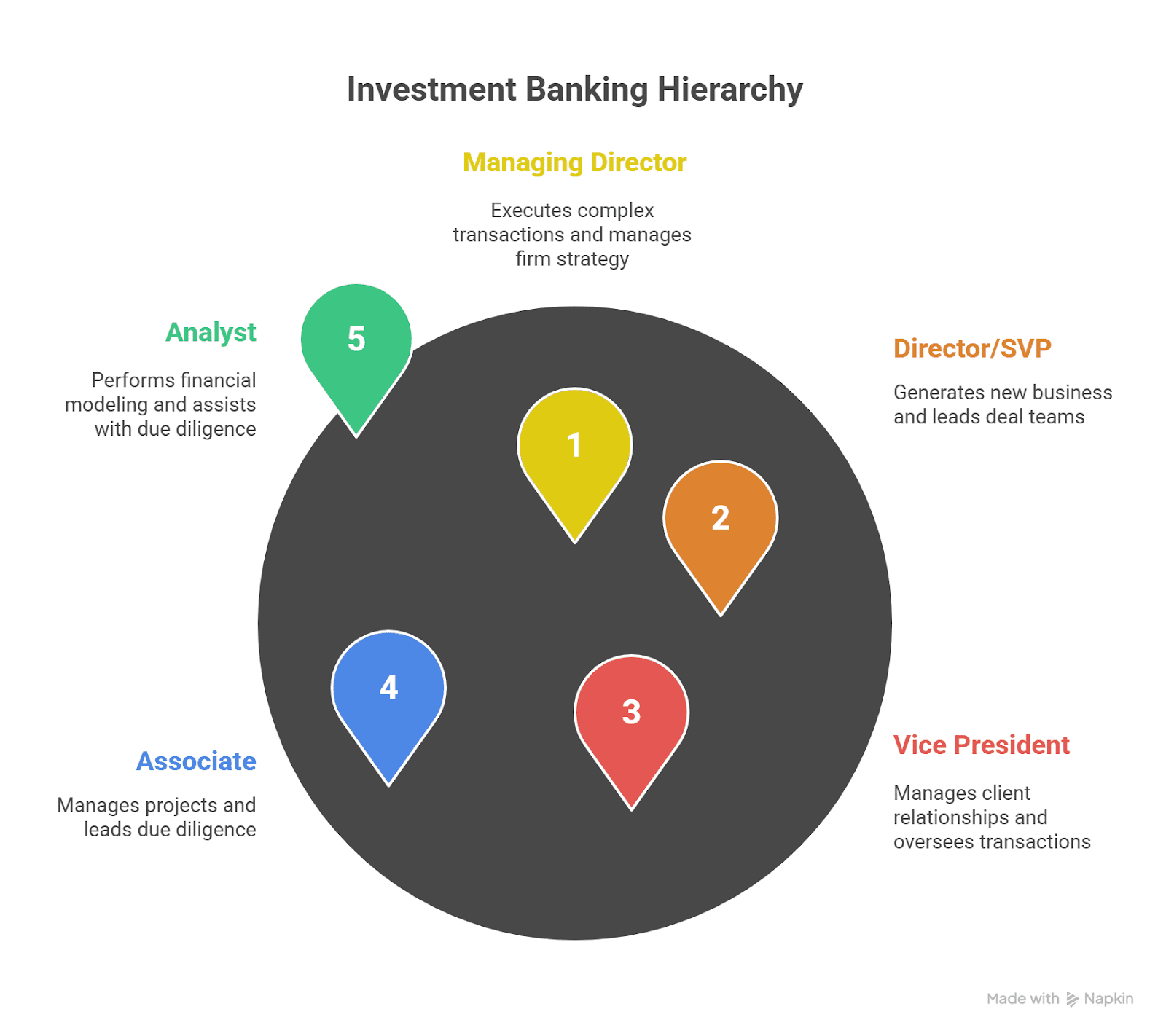
  • Analyst (0–2 years): Gain fundamentals, support senior bankers.
  • Associate (3–5 years): Begin contributing to client accounts.
  • VP/Director (6–10 years): Execute transactions and manage teams.
  • Managing Director (10+ years): Build and create business portfolios.

Each step is marked by transparent progress in compensation and responsibility.

Finance Career Growth: Why Timing and Strategy Matter?

Career direction by the comp trends in investment banking allows for more knowledgeable monetary decision-making. Career change, the building of skills, and firm selection are all essential engines behind compensation streams. Staying ahead of the curve on industry progress cycles is crucial so that one does not end up on a sideways career track.

Boosting Your Salary Potential with Certification

You are in mid-career or a fresher; certifications are one of the most valuable investments to climb. Selecting the best investment banking certification not only enhance your profile but can even raise your salary instantly.

FAQs

1. What is the average investment banker salary in India?

Investment bankers in India are typically offered approximately ₹7–8 LPA as base, reaching ₹20’30 LPA for mid-level roles.

2. How does the investment banker salary compare across regions?

Salaries vary geographically—India (₹8–20 LPA), UK (£60,000+), and US (USD 150,000+). Bonuses can noticeably affect total compensation.

3. Do certifications affect investment banker salary?

Yes, certifications like the CIBOP™ by Imarticus Learning can enhance salary opportunities by enhancing value to your skill set and employability.

4. What skills are required for high-paying investment banking jobs?

Financial modelling, M&A planning, regulatory know-how, and communications are some investment banking competencies.

5. What are the highest paying finance jobs today?

The best-paying finance careers in the world are hedge fund management, private equity, and investment banking.

6. How can I start a finance career in investment banking?

Start with quality education, have an investment banking career plan, and have a certification like CIBOP.

7. What is the role of bonuses in investment banker salary?

Bonuses will be on or above base salary, especially in high-performing teams or supporting market conditions.

Conclusion: Planning Your Future in Investment Banking

Investment banking is not just a lucrative profession but also one that involves thinking. Knowledge of dominant trends in investment banker compensation allows you to have a better chance of charting your career and making final points of professional achievement.

One of the most effective methods to take your career forward is by becoming a part of the Certified Investment Banking Operations Professional (CIBOP™) program of Imarticus Learning. With over 50,000 learners and 1,000+ hiring clients, CIBOP is designed specifically to place finance graduates.

With 7 guaranteed interviews, 100% employment guarantee, and live projects, CIBOP is the safest bet for a candidate wanting to begin a serious career in investment banking. Being an investment banking operations-focused course with a focus on risk management and financial compliance, CIBOP gets the students job-ready from day one.

With two versatile tenure plans (3-month and 6-month) and an average salary of 4 LPA (with scope for rise by as much as 60%), this course is your golden key to professional triumph. Start now from boardroom to classroom with Imarticus Learning.

How Much Do Investment Bankers Earn in India?

Do you know the average salary of an Investment Banker in India is from 12 lakhs to 13 lakhs, according to Glassdoor? The investment banking sector is growing at a 1.2% CAGR for 2018 to 2023. It is expected to reach a value of $78,008.7 million by 2023.

According to the Bureau of Labor Statistics, the demand for financial services sales reps is estimated to rise by 4% by 2029. This data is combined with attractive salary packages and a secure career. This positions investment banking as one of the most profitable and in-demand career choices.

In this article, we have revealed the salary of an Investment Banker in India. We have also covered the factors that influence it and the Investment banker’s salary in the US.

Investment Banker

What does an investment banker do?

Investment bankers act as a bridge or intermediary between investors looking for investment opportunities and organisations looking for funding. The duties of investment bankers are divided into two categories: assessing a company’s financial situation and assisting it in meeting its financial goals. Investment bankers are responsible for analysing a company’s financial situation and capital requirements to offer a viable plan for meeting its financial goals.

Investment banker’s salary in India

The pay ranges from 3 lakhs to 1 crore depending on the skills, roles, designation, experience, job location, company, etc. But, the starting salary of an investment banker is better than many other professions, with initial pay of Rs.7-8 LPA. That’s why experienced investment bankers or  Investment Banking Analysts can rise to higher positions fast. This is because their salaries rise quicker, and they earn higher paychecks.

Designation-wise salaries of an investment banker in India

Salary of an Investment Banking Analyst

This is the role assigned to people who’ve just graduated from business schools. Their tasks mainly include research and analysis of investment banking methods. A fresher with this designation would earn around Rs. 5 LPA on average. Also, an experienced candidate can earn Rs.6-7 lakhs.

Package of an Investment Banking Associate

This role is an upgrade from the role of a Banking Analyst. The duties involve the analysis of business strategies. They act as an intermediate between junior analysts and senior officials. The average salary for this role lies between Rs. 7 lakhs to Rs.10 lakhs.

Pay of a Business Analyst

This role is similar to the role of an Investment Banking Analyst. However, the difference here is that the focus shifts to business strategies such as profit optimisation and asset management. For this profile, a candidate would earn between Rs.6 lakhs and Rs.7 lakhs.

Remuneration of a Financial Manager

Being a high-profile role, financial managers mainly oversee a company’s financial health. They audit financial reports, analyse investment activities, and work out long-term financial goals for the company. Also, they use tools to analyse the data. A financial manager in India would earn around Rs. 10 lakhs on average.

Compensation of a Financial Director

The role of the Financial Director is a senior one, as they are leaders of senior executive teams. And their primary responsibility is to frame financial policies. They also make the proper process to meet a company’s business requirements. In addition, they oversee operational and strategic ongoing at the company. So, a Finance Director can have a starting salary of around Rs. 20 lakhs. With an experience of 4-5 years, one can earn anywhere between Rs.45 lakhs and Rs. 50lakhs.

Factors affecting Investment banker salary in India

In India, the average investment banker’s salary is significantly higher. But, to determine the exact pay, you must understand the factors that influence the salary of an investment banker.

The below-mentioned factors affect the salary of an investment banker.

Skills

An investment banker’s most essential skills are financial analysis and modelling expertise. Along with this, the knowledge of mergers and acquisitions plays a critical role too. The ability to work independently is also an essential skill to succeed in the investment banking field.

An understanding of deal structuring and closing principles is essential. Having excellent communication and networking abilities play a vital role. In addition, the ability to conduct research, be quantitative and analytical and explain market events.

Location

Few cities have a higher demand for investment bankers, causing average pay to vary significantly. But, depending on the cost of living, some cities pay comparatively less. Surprisingly, Mumbai (84% higher than average), Pune, and New Delhi pay 4% higher than average. So, these cities are the best locations to work as investment bankers. But, some places offer lower salaries to investment bankers, like Bangalore, Hyderabad, and Chennai.

Work Experience

More experience results in more gain in the field of investment banking. The average salary of one to four years of an experienced investment banker is Rs. 9 lakhs annually. However, bankers with five to nine years of experience earn around Rs. 20 lakh per annum. With an experience of around ten years, professionals can earn approximately Rs 30 lakh per year.

Companies

Some banks and companies are paymasters, while others pay less. So, investment bankers prefer firms such as Morgan Stanley and Goldman Sachs. Other liked banks are Barclays and J.P. Morgan. Investment bankers are generally paid well by most firms. However, you should not focus only on the package. The profile and work are deciding factors in rejecting or selecting a company.

Investment banker salary in the US

The United States pays well to investment bankers. It consistently ranks first in terms of compensation for its investment professionals. Furthermore, cities such as New York reward their professionals besides the salary. It offers valuable and lucrative benefits.

How to start your journey as an Investment Banker?

Before entering any sector, gathering knowledge about the industry, scope, career growth, and job opportunities are always good multitool. The second step is to equip yourself with the knowledge and skill set to become an investment banker. For this, you should get enroled in an institute and learn investment banking concepts.

An institute that offers excellent knowledge, expert faculty and an industry-oriented curriculum will be lucrative. But, if they provide career assistance and interview preparation, that will be the cherry on the cake So, try to find an institute that offers all these and then invest your money. 

Apart from this, having a good network also plays a significant role in getting you to start your career as an Investment Banker. For that, you can do an internship with top companies and work hard. Moreover, during the internship, you can learn industry concepts and how to behave professionally.

Conclusion

In conclusion, careers in investment banking training usually offer good salaries. However, they are exclusively bagged by candidates with the best academic backgrounds.

Hence, candidates must work hard. They should try to graduate from a top educational institute. Also, they must know how to reap the benefits of their effort. And, plan a financial career properly to take up the role of an analyst.

Is Investment Banking the Highest Paying Job?

Is Investment Banking the Highest Paying Job?

Investment Banking is an exciting and thriving career. Every year, lots of brilliant minds from the world’s finest universities, decide to enter the world of investment banking.

Venturing into the competitive world of high finance has some well-defined merits; great pay, esteemed deals, and remarkable training. For many, investment banking is a profession that gives the best of all – job satisfaction, money and a reputable way of life.

Expensive apparels, expensive valise and a walk with pride are just the outward attributes of an investment banker course.  These days, many are two-fisted to join the extremely competitive and demanding aide of an investment banking company. This is mainly because a career in investment banking is very beneficial and rewarding.

Several educational institutions are also providing investment banking endorsements to help support the entry of candidates who wish to pursue a career in this sector. Creative, brilliant and idealistic – these are some of the qualities that many banking firms look for in a candidate.

Being an investment banker is one of the best-paying jobs available today, which means, in terms of salary, it outstrips other jobs by a huge margin. That said, the role of an investment banker is no walk in the park – it is also one of the hardest jobs there is.

The investment Banking sector is constantly on the lookout for individuals who have had investment banking training, are productive, committed, and ardent. It is a field with fierce competition, long working hours and therefore only those individuals who acquire these qualities will thrive. The field also demands individuals with high communication skills, can build and promote relationships, and make quick thoughtful decisions at each step of the journey. However, the learning process is endless, and the list could go on and on.

Investment Banker Salary

The biggest reason many individuals join this sector is that most of the banking and fintech firms provide lucrative salaries to both fresher and experienced professionals. This is primarily because these are the individuals who deal with money predominantly. All are highly ambitious and paid hefty pay cheques which can support a lavish lifestyle.
The below salaries represent the compensation average of the investment banker

  •  An Investment Banker having an experience of less than a year can earn a salary of around ₹553,500
  • An experience of 1 to 4 years in the Investment Banking field can earn the individual an average compensation of ₹687,845 (approx.)
  • An Investment Banker with a work experience of five to nine years can earn a salary of approximately ₹1,300,000
  • And finally, a senior level Investment Banker with experience of 1-2 decades can earn a compensation of ₹3,000,000 (approx.)

If you want to be a part of the dynamic world of banking, are excited by numbers, and want the coveted lavish lifestyle, then investment banking is a wonderful career choice. As a baseline, it can be an incredible training ground for entry into other professions. However, if investment banking doesn’t sound like you, then it’s time to look out elsewhere.
After all, nobody said making millions of dollars would be easy.

Also Read: Career & Scope in Investment Banking

Why Do Investment Banker Make So Much?

Why do people in Investment Banking make so much money? The question has been oft-heard and is as often as Excel gets heard in financial analysis. When it is just another banking job, why should one get paid so high that every career aspirant wants a job in IB?

Yes, IB has those punishing hours of 80-120 hours at times per week and do have such high-stress values that it is an accepted fact that 44 per cent look for alternative careers even before they get promoted upwards and hardly have a social life.

It is also true that you are at the client’s mercy and that it is a competitive field where every other person is highly educated if not more. All valid points that could be also be applied to entrepreneurs and other careers too? So why?

What People in Investment Banking Actually Get Paid?

Commissions: In Investment Banking at the level of MD/Group Head/ VP, you really start earning well. That’s because every sale gets you commissions just like the car selling agent or real estate broker does. Banks sell the companies for acquisitions, mergers and restructuring. Higher the deal amount betters the commissions.

And when the deals run into many millions, billions or thousands of them calculate the commissions! They are just selling very high-priced commodities.

Expenses and margins:
Well if that’s true then the wealth management and commercial finance people should also make as much. No, they do not. Because the commission rates are lower and they have more incidental expenses like effective profit margins. The ATMs, branch offices, cheque books all cost money.

Even when you deposit money into your savings accounts and the money is larger than the ceiling limit you have to pay the bank for depositing your money with them. However, paying 1per cent on USD 1 million in the checking account is not fair right?

Banks, in contrast to real businesses, have very few staff, small offices, tiny payrolls by contrast, and almost zero real expenses like infrastructural costs, manufacturing processes, or maintenance and operational expenses. Perhaps they do have a tiny bit of travelling and hotel expenses which the client gladly pays for the banker’s role as intermediaries and custodians besides the regular multi-million dollar fees for their services.

About a generous 50 to 60per cent of such revenue goes to the IB employees as bonuses, salaries and commissions. Now that’s why they get paid so much.

Why Investment Banking is a Popular Career Choice?

Are you aware of why most foreign banks have an office in and operate from India? The factors that contribute to their presence are:

• Availability of skilled local talent in data analytics.
• Large English speaking population.
• Presence of services like LPOs, KPOs, back-offices and transcription services.
• Lower costs in financial operations.
• Availability of reliable firms like Infosys, Wipro, TCS, Syntel to do business with.
• Training institutes for technological skills and the latest trending skills are world class.

These banks need to run profitably and promote the use of local talent who find well-paying prestigious jobs and make investment banking their careers.

Investment Banking Services:
Certification in IB helps.
The Investment Banking certification measures your skills in the services of an investment bank. Namely,
• Advice on buy-outs and acquisition of firms.
• Acquisition and mergers
• Trading in securities
• AMC
• Corporate finance
• Services involving Custodianship
• Restructuring of debts
• Other allied services.
• Capital market investments

Education:
The career progression in Investment Banking requires sound financial knowledge. A graduation degree is not mandatory and IB encourages disciplines like finance, economics, business administration, and mathematics which do give you an upper hand.

Doing an IB certification endorses and enhances your skill sets for the job and your resume. Certification also serves the purpose of being a measurable index of practical implementation skills in the basics of IB. The career progression ladder may also have an odd-ball who starts as an Intern, moves to an Associate role, and then upwards to Vice President, CFO, MD job roles etc.

Skills required:
The banking field’s crucial skills are:

• A graduate degree for Associate roles.
• Adept at Microsoft PowerPoint presentations and Excel manipulation techniques, and MS Office and Word suites.
• Extremely long working hours of 80 hours with hardly any holidays.
• Being a team player and effective learner from feedback.
• An eye for details and data organization.
• Conceptual knowledge of accounting and financial issues and solutions.
• Investment banking certification course.
• Financial and business modelling knowledge.

In parting, the Investment Banking career aspirant does make a wise choice for some fantastic pay-packages. The demand for them is high. If you want to be in IB then do the course at Imarticus Learning who even offer assured placements to the deserving in this hallowed field.