Unveiling the Future: The Era of Cloud Computing

First things first, let’s understand what cloud computing is. Think of it as a vast virtual space. Here you can store and access data over the internet, instead of relying on a physical hard drive. It’s like having a massive, invisible filing cabinet. You can reach it from anywhere, anytime!

Transforming Business Operations: The Power of Cloud Computing

Cloud computing isn’t just about storage. It’s a powerful tool that’s revolutionising business operations. It’s making businesses more efficient, more flexible, and more scalable. From sharing documents with a team member on the other side of the world to using sophisticated software without installing it on your computer, cloud computing is changing the way we work.

1. Cost Efficiency: Maximising Profits with Cloud Computing

One major advantage of cloud computing is cost efficiency. By moving to the cloud, businesses can reduce the cost of managing and maintaining their IT systems. They no longer need to invest heavily in hardware, upgrades, or in-house IT staff. Plus, the pay-as-you-go approach of most cloud services means companies only pay for what they use.

2. Data Security and Recovery: Protecting Business with Cloud Computing

In the digital age, data security is a top concern for businesses. Cloud computing provides robust security features. These ensure sensitive data is securely stored and handled. Moreover, it makes data recovery a breeze. Information stored in the cloud can be accessed or retrieved from anywhere.

3. Scalability and Flexibility: Growing with Cloud Computing

Another transformative aspect of cloud computing is its scalability. Businesses can easily scale up or down their storage needs based on demand. Thus, it turns out to be a flexible solution for businesses of all sizes. This flexibility also extends to working practices. As a result, it allows employees to work remotely and collaborate efficiently.

4. Stepping into the Future: Cloud Computing Courses

To fully harness the power of cloud computing, one must possess the right knowledge and skills. This is where Cloud Computing Courses come into play. These cloud computing courses are designed to equip you with an understanding and technical expertise. Thus, you can easily navigate the world of cloud computing.

5. Improved Collaboration: Teamwork in the Cloud

Cloud computing is redefining teamwork in businesses. It allows for seamless collaboration among team members. You do not have to worry about their location. Multiple individuals can work on the same project simultaneously, with real-time updates and sharing capabilities. This increased collaboration leads to efficiency and improved productivity. In turn, it makes the business more competitive.

6. Sustainability: A Greener Approach with Cloud Computing

Did you know cloud computing is also environmentally friendly? By using virtual services instead of physical products and systems, businesses can reduce their carbon footprint. Plus, the scalability of cloud computing means that businesses only use the energy they need, leading to less waste. This shift towards sustainable practices is a significant step in the fight against climate change.

7. Innovation and Competitiveness: Staying Ahead with Cloud Computing

Cloud computing has the necessary agility and flexibility. So, businesses can bring products and services to market more quickly. This capability to innovate rapidly gives companies a competitive edge in today’s fast-paced business environment. With cloud computing, even small businesses can disrupt the market. Moreover, they can compete with larger, established companies.

8. Insight and Decision Making: Smart Business with Cloud Computing

Cloud computing also provides businesses with valuable insights for decision-making. With sophisticated data analysis tools available in the cloud, businesses can collect and analyse large amounts of data. This analysis can inform business decisions and strategies. This leads to better outcomes and increased profitability.

9. Automating Business Processes: Efficiency through Cloud Computing

Cloud computing enables businesses to automate many routine tasks. This comprises sending out automatic updates to manage customer relationships. Indeed, automation can significantly increase efficiency. Also, it can free up staff time to focus on more strategic tasks. This shift not only improves productivity but also enhances job satisfaction. That’s because employees can focus on the more engaging aspects of their roles.

Conclusion

Cloud computing is more than a technological innovation. Certainly, you can call it a business revolution. It’s redefining how businesses operate. It makes them more efficient, secure, and adaptable to change.

Are you ready to be part of this transformative era? Cloud Computing Courses are your ticket to joining this revolution. Are you a fresh graduate? Or are you a young professional? Looking for structured technical proficiency development courses on the internet?

Start your journey with the Professional Certificate Course in FinTech from Imarticus. Visit Imarticus today for amazing cloud computing courses. Take the first step towards a promising career in cloud computing. The future is in the cloud. Are you ready to soar?


Exploring the World of Financial Technology: Your Guide to Learning and Mastering FinTech

FinTech or Financial Technology is revolutionising the way we manage money. Let’s take a closer look at this exciting world and learn about the surprising impact of FinTech in our daily lives.

What is Financial Technology and Why Does it Matter?

Financial Technology, or FinTech, combines finance and technology, making monetary transactions easier and hassle-free. Think digital banking, online payments, and robo-advisors; FinTech makes these possible.

But why does it matter? It offers ease, convenience, and speed. It’s changing how the financial sector operates and making it more accessible.

The Growing Impact of FinTech on the Financial Landscape

FinTech is not a passing trend. It’s here to stay. Its impact is growing and altering consumer behaviour. From banking to investing, FinTech is reshaping how we deal with money and introducing a new era in financial management.

Opportunities in the FinTech Sector

The rise of FinTech means more job opportunities. This booming sector needs skilled professionals and you could be one of them!

The roles are diverse. You could be a blockchain developer, a data analyst, or even a cybersecurity expert! The opportunities are limitless.

Key Areas of Focus in FinTech

There are many areas in FinTech. Let’s explore a few.

Digital Payments

This relates to online transactions. It’s the backbone of e-commerce. The key areas for development here are speed and security.

Blockchain and Cryptocurrency

These game-changers are transforming how we view money. Blockchain is about secure transactions while cryptocurrency is digital money.

Robo-Advisors

These are digital platforms that offer automated financial advice.

InsurTech

This field focuses on tech in insurance and makes it more efficient. It’s about personalised policies and quick claims.

RegTech

Short for regulatory technology, this helps firms comply with regulations. It’s about risk management and staying within the law.

Skills Needed for a Career in FinTech

A career in FinTech demands a mix of skills. You need technical, soft and interpersonal skills to become successful here.

Coding

FinTech needs tech experts. You need to know how to code as this arena is all about building digital solutions.

Data Analysis

FinTech generates lots of data. You need to understand this data and that’s possible through thorough analysis. It helps make informed decisions.

Cybersecurity

Most of the FinTech domain is online. Thus, it needs protection from cyber threats and people with cybersecurity skills are generally preferred.

Understanding Finance

It’s not just about tech. You need to understand finance as well. You must know how the financial sector works, the latest rules and changing trends.

Problem-Solving

FinTech is about solving problems like making finance better. Thus, you need to be a problem solver with an analytical mindset.

Trends Shaping the Future of FinTech

FinTech is always evolving as it’s driven by trends. Let’s look at a few key trends:

  • Artificial Intelligence- AI is big in FinTech. It’s about smart solutions. Think chatbots and automated trading.

  • Big Data- FinTech is about data. It’s about understanding customer behaviour and offering personalised services.

  • Peer-to-Peer Lending- The new-gen banking systems will completely bypass banks! The focus will be on lending and borrowing online.

The Role of FinTech Courses in Your Career Progression

FinTech courses can boost your career. They give you an edge by making you stand out. You are also updated with the latest developments in the field.

FinTech is always evolving. Thus, you need to keep learning. FinTech courses help you do that. They help you stay relevant and climb the ladder quicker!

Understanding the Value of Certification in FinTech

Certification matters. It’s proof of your skills and is recognised by employers. It shows you’ve learned from experts, making them a massive boost in your CV. It can open doors and lead to better job opportunities. It’s an investment for your future.

How Can You Learn and Master FinTech?

Are you intrigued by FinTech? Do you want to join this tech revolution? FinTech courses are the answer. They offer in-depth knowledge and cover a range of topics. Think blockchain, digital payments, and AI in finance. They also teach you practical skills. You’ll learn how to apply FinTech solutions in real-world scenarios.

Why Choose FinTech Courses?

FinTech courses offer many benefits. They give you an edge in the job market. They help you understand complex FinTech concepts. They equip you with the skills the industry needs while offering certification. It’s proof of your expertise.

Jumpstart Your FinTech Journey

Ready to dive into the world of Financial Technology? The Professional Certificate Course in FinTech from Imarticus is your perfect launchpad. Learn from industry experts and gain the skills the sector demands. Visit Imarticus and enrol today. The future of finance awaits you!

Fintech and Cryptocurrency: Opportunities and Challenges

Are you interested in learning more about Fintech and cryptocurrency? Due to the rapid development of technology, these two disciplines are revolutionizing the financial industry in ways that have never been possible.

Financial services are now more readily available, effective, and inventive than ever, thanks to Fintech. Additionally, cryptocurrency, a decentralized digital currency, has many advantages for consumers and businesses.

Great opportunities do, however, also present great challenges. Fintech and cryptocurrency confront regulatory barriers, cybersecurity issues, and a lack of standardization. There are several career opportunities in Fintech, from project management and marketing to software development and data research.

This blog will thoroughly explain what is Fintech and examine the advantages and disadvantages of Fintech and cryptocurrency. We’ll investigate investment potential in these fascinating sectors and their influence on the financial sector.

What is Fintech?

“Fintech,” or “financial technology,” refers to any innovation that employs technology to enhance or completely change how financial goods and services are delivered. Fintech encompasses various technologies, such as peer-to-peer lending, crowdfunding, robo-advisors, Blockchain, and mobile banking and payments.

 The relationship between Fintech and Cryptocurrency

As of September 2021, the market value of all crypto assets exceeded $2 trillion, a 10-fold rise from early 2020. A whole ecosystem also thrives, including exchanges, wallets, miners, and stablecoin issuers.

Financial technology, or Fintech, is the abbreviation for any innovation that leverages technology to enhance or revolutionize financial services. Consider robo-advisors, peer-to-peer financing, internet payments, mobile banking, and other innovations. With the help of Fintech, everyone may now access financing more easily and effectively.

A digital currency known as cryptocurrency employs cryptography to safeguard and verify transactions. Cryptocurrencies, unlike conventional money, are managed by a network of computers that adhere to a set of rules rather than by a single central authority. The most well-known cryptocurrencies include Dogecoin, Ethereum, and Bitcoin.

Opportunities in Fintech and Cryptocurrency

Over the past few years, blockchain technology has become increasingly widely used in contemporary life. The Blockchain is fundamentally simply a collection of code that records occurrences, each being unalterable. However, for those who see the Blockchain as a network of nano-bots ready to take over humanity, the Blockchain is just a set of codes. 

This list of resources might include storage space and a ledger of peer-to-peer cryptographic transactions without needing a financial institution to operate as a mediator. But the starting point is the connection to financial technology – Fintech. The Fintech industry, which heavily relies on calculations and analysis, is driven by efficiency and effectiveness, and Blockchain is a key component of this.

Crypto transactions will make up a sizeable share of the FinTech investment opportunities, projected to rise to $158 million by 2023 after experiencing rapid growth in recent years. People who own smartphones but do not have bank accounts can also use cryptocurrencies to gain access to financial and Fintech services. 

Around 1 billion people fall into the “unbanked” category, which presents a huge opportunity for cryptocurrency-powered Fintech services to offer their customers goods and services previously out of reach. Crypto transactions are far more attractive than conventional money transfers because they are less inefficient and slower. 

  • People who are underserved or unbanked by traditional institutions can benefit from greater financial inclusion and empowerment thanks to Fintech and cryptocurrencies. 
  • Fintech and cryptocurrencies can also reduce the costs and obstacles associated with cross-border transactions, making sending and receiving money internationally simpler and less expensive. 
  • Fintech and cryptocurrencies can open new doors for innovation and entrepreneurship in the financial industry. Fintech platforms, for instance, allow users to generate money, invest, borrow, lend, trade, or contribute in novel ways that were before impractical.

What are the challenges facing Fintech and Cryptocurrency?

Although it is difficult to quantify the extent of cryptocurrency asset adoption, surveys and other indicators imply that developing and emerging market nations may be setting the pace. Most significantly, citizens of these nations drastically raised their trading volumes on cryptocurrency exchanges in 2021.

The economy may become more dollarized, or in this case, crystalized, due to broad and quick adoption, which might cause serious problems if people use crypto assets rather than their local currency. The ability of central banks to successfully conduct monetary policy may be hampered by cryptoization. There are many challenges in cryptocurrency adoption.

It might also increase the significance of some of the dangers to consumer protection and financial stability that were already there, such as funding and solvency problems brought on by currency mismatches.

  • There are certain issues with Fintech and cryptocurrencies as well that need to be resolved. Regulating is one among them. Since Fintech and cryptocurrencies are still relatively new and changing quickly, they frequently operate in a legal gray area with ambiguous regulations. 
  • As a result, there may be uncertainties and dangers for both customers and service providers. Safety presents another difficulty. Fintech and cryptocurrencies are susceptible to cyberattacks, hacking, fraud, and theft since they depend on technology and networks.
  •  People may lose their money or personal information, for instance, if their devices, accounts, or platforms are compromised, hacked, or shut down.

The Final Words

Fintech and cryptocurrency are two of the most exciting and disruptive trends in finance today. They offer many opportunities for innovation, inclusion, convenience, and efficiency, but they also pose challenges that must be overcome. As a consumer or an entrepreneur, you must be aware of these technologies’ benefits and drawbacks and how to use them wisely and responsibly.

With the Professional Certificate in Fintech from SP Jain School of Global Management and Imarticus Learning, you may realize your full potential in Fintech. Through hands-on instruction from subject matter experts, real-world case studies, cutting-edge tech projects, and networking opportunities with Fintech trailblazers, this fintech course will give you cutting-edge Fintech skills. With this degree, you’ll be equipped to start a rewarding career in the fascinating and rapidly evolving field of Fintech.

What is the Impact of FinTech on the Future of Money

Welcome, curious minds and financial adventurers, to a place where the present meets the future and money dances with technology! 

Prepare to expand your horizons, disconnect from the past, and plunge headfirst into a kaleidoscope of opportunities. Let’s explore the enormous influence of Fintech in banking and finance, where finance and technology walk hand in hand and carry us into a future with limitless possibilities. 

We’ll explore the mysteries of the future of finance with FinTech in this blog. So grab your virtual glasses, strap yourself in, and prepare for an incredible voyage that will change how you view your hard-earned money!

In what ways does FinTech improve financial inclusion?

Fintech, a technology-driven innovation in financial services, accelerated quickly, demonstrating its significance in preserving business as usual for financial services while abiding by social segregation policies. Customer-centric business models and the incorporation of cutting-edge technology are what are driving Fintech’s transformational influence on the Global Financial Ecosystems. 

The future of money and the role of financial technology

The benefits of FinTech for small businesses are numerous and revolutionary. FinTech solutions offer simplified and effective financial operations that save time and money by easing administrative responsibilities. Small companies may handle their money simply and securely with the help of user-friendly mobile banking applications and digital payment systems, freeing them up to concentrate on their core company activities.

Democratization of Financial Services: A Burst of FinTech Revolution!

The sweeping revolution of FinTech has utterly transformed the realm of financial services. In the bygone era of traditional banking, the doors were often closed for those who needed a pristine credit history or proximity to brick-and-mortar bank branches. But enter FinTech, the vanguard of change, and witness the glorious metamorphosis!

Behold the advent of online banking, the awe-inspiring rise of peer-to-peer lending, and the majestic flourish of mobile payment platforms, bestowing the keys to financial emancipation upon a broader audience. 

Enhanced Convenience and Accessibility: A Symphony of Financial Innovation

Perchance, has there ever been a greater symphony of convenience than the FinTech concerto? Its harmonious composition of mobile banking apps, digital wallets, and contactless payments has orchestrated a symphony reverberating through the ages. We no longer bear the burden of physical cash, nor must we embark on pilgrimages to bank branches for every fiscal endeavor. 

FinTech has blessed us with the divine gift of managing our finances from the cozy sanctum of our smartphones! This ballet of enhanced accessibility and simplicity has metamorphosed the essence of our daily interaction with money.

Financial Inclusion and Empowerment: A Renaissance of Liberation

In the annals of history, one shall find a few chapters as liberating as the FinTech renaissance! With grace and kindness, it extends its hand to the unbanked and underbanked, welcoming them into the embrace of credit, savings, and insurance products. 

Innovation in Payments: A Maverick’s Waltz

Dare you not ignore the daring mavericks of FinTech who challenge the traditional payment order with brazen innovation! Cryptocurrencies, the elusive sirens of the digital realm, dance with blockchain technology and digital currencies in a waltz that stuns the masses. 

In their wake, they leave the relics of traditional payment systems, replaced by swifter, more secure, and borderless transactions. Across the globe, FinTech’s enchantment enables seamless cross-border payments, unraveling the complexities and slaying the dragons of international transfers!

Data-Driven Personalization: An Eloquent Ode to Individuality

The FinTech maestros are no strangers to the grand tapestry of data. With the prowess of masters, they weave the threads of consumer behavior and preferences into a mesmerizing tapestry of personalization. FinTech has redefined the art of delivering financial counsel, firmly placing the reins of control in every consumer’s hands!

Automation and Artificial Intelligence: A Marvelous Symphony of Progress

Amidst the orchestra of FinTech, automation and artificial intelligence strike a chord like never before! Witness the marvel of robo-advisors, virtuosos of investment recommendations, guided by the celestial algorithms and the echoes of historical market data. 

Gone are the days of traditional human financial advisors, for the dawn of a new era has arrived. This epoch of automation trims costs and unfurls the curtain of financial advice to embrace a wider audience, beckoning all with open arms!

Security and Fraud Prevention: A Fortified Citadel of Trust

As the great citadel of FinTech arises, it stands as an impregnable fortress, fortified with the latest innovations against the perils of cyber threats and fraud. Biometric authentication, the guardian of truth, joins forces with two-factor authentication, a stalwart sentinel, and advanced encryption techniques, the mightiest bulwark. 

Changing Landscape of Lending: A Paradigm-Shift of Destiny

Peer-to-peer lending platforms and online loan marketplaces rise like resplendent phoenixes, connecting borrowers directly with lenders, severing the chains that once bound them to traditional banking institutions. 

A streamlined application process, swift approval times, and fair winds now usher in a new era of efficient borrowing for individuals and businesses alike!

Financial Education and Awareness: An Odyssey of Enlightenment

With FinTech as their compass, people embark on a journey of financial enlightenment! In the halls of FinTech academies, knowledge flourishes like a timeless library, brimming with resources and tools to educate the masses on the arts of financial literacy, investment strategies, and the wisdom of responsible money management. 

This heightened awareness guides individuals to make informed decisions about their finances, painting a canvas of responsible financial behavior across the ages!

Conclusion: A FinTech Saga for the Ages

The future of money lies enthralled within the epic FinTech saga. As the financial cosmos continues its ever-changing dance, we witness the relentless march of disruption, the symphony of convenience, and the crescendo of financial inclusion. 

FinTech’s impact on the future of money is an awe-inspiring testament to how technology, like a benevolent deity, empowers individuals, transforms financial services, and opens the gates of prosperity to all. A career in Fintech offers a dynamic and innovative path in finance and technology.

Imarticus Learning provides future-focused specialized programs, allowing you to obtain a competitive edge and future-proof your job in the quickly developing FinTech sector.

These ground-breaking courses provide an industry-aligned curriculum by thoroughly studying important industrial issues and practical exposure to cutting-edge technologies like Cloud Computing and Cybersecurity.

Embrace these winds of change, keep pace with the latest FinTech symphonies, and you shall find the power to embrace the digital financial revolution with open arms and hearts!

The world is changing with the combined forces of fintech and crypto

The world is changing with the combined forces of fintech and crypto

The long tail of financial services in emerging markets has proven to be fertile ground for fintech. Still, the game-changing force of crypto and blockchain technology might have even more significant implications.

What happens when the power shifts from global banks to the individual? What does this mean for mobile phone banking and digital wallets? How will online and peer-to-peer trading change how we manage our money?

Here are nine ways the world is changing with the combined forces of fintech programs online and crypto — for better or worse.

1) Blockchain is going to change how your business works.

If you are not keeping up with the latest trends in business, you risk being left behind. One of the biggest changes on the horizon is the rise of blockchain technology.

2) Cryptocurrencies are going to change who owns your data.

We are all becoming increasingly reliant on digital systems to store our data. From our social media profiles to our financial records, our lives are now contained within 1s and 0s. It means that whoever owns those systems also owns our data.

3) Your data on social media might be worth more than you think.

Your data is worth a lot to social media companies. The average person’s data is estimated to be around $250. That might not seem like a lot, but when you consider that there are over 2 billion active social media users, that number starts to look much bigger.

4) Preparing for the shift will benefit your business and wallet.

We are currently in the midst of a digital revolution. Financial technology (Fintech) and cryptocurrency are two of the driving forces behind this change. So let us not waste our time and learn cryptocurrency online from Imarticus today.

5) You might become the bank of tomorrow sooner than you think.

In the past, banks were the only institution that could provide financial services. But with the rise of fintech and crypto, that’s all changing.

Now, several companies are providing banking services without being banks. It is made possible by combining the Fintech certification course and crypto. And it is changing the world as we know it.

6) Blockchain can help anyone raise funds with fewer regulatory hurdles.

Blockchain technology can help entrepreneurs and small businesses raise funds with fewer regulatory hurdles. Using blockchain, companies can tokenize their products or services and sell them to investors in a crowd sale.

This fundraising method is often called an initial coin offering (ICO). In the past few years, ICOs have become a popular way to raise funds for new projects. In 2017, startups raised over $5 billion through ICOs. This trend is likely to continue as more people become aware of the potential of blockchain technology.

7) People will buy more goods using crypto instead of fiat money.

With the combined forces of fintech and crypto, the world is changing. People are now able to buy goods using crypto instead of fiat money.

It is a massive shift that is taking place in the world economy. In developing countries, it can be a boon for small businesses where people have few ways to access traditional banking systems.

One example of this happening already is with customers who live in Venezuela. They have adopted Bitcoin as an alternative currency because their national currency has lost value due to hyperinflation. In addition, they can use it to avoid government-imposed restrictions on buying foreign currencies like US dollars.

8) Ownership of assets will move from offline to online.

Fintech and crypto are working together to change the world as we know it. Ownership of assets is moving from offline purchases to online investments.

This shift will profoundly impact the economy, businesses, and individuals. Online assets offer more opportunities for innovation, creativity, and growth. We are excited to see what the future holds for fintech and crypto!

9) Real estate is in for a massive upgrade.

Real estate is one of the world’s oldest and most important industries. But it is also an industry that has been slow to change and adapt to new technologies. That is, until now.

Conclusion

Cryptocurrencies, both Bitcoin and Ethereum, are revolutionizing how we do business, buy or sell products and services and even store our hard-earned wealth. Just as electricity changed the world, crypto has altered how people live, work, and play in so many ways that it’s mind-boggling to think about the implications of this emerging new world order.

Asia’s leading fintech program online is from Imarticus Learning  – The Professional Certification In FinTech. This course enhances your crypto knowledge through hands-on training from industry leaders, real-world case studies, projects involving technologies like Blockchain and Cloud Computing, and beneficial interactions with FinTech industry experts and entrepreneurs.

Facing the real challenge while an examination? Check this interesting format of SP Jain’s Fintech program.

Are you looking for a job in the Indian Fintech industry? Fintech exams for recruitment or certification can be tough and you need to have the required skills to crack it. There are many online certification courses on the internet but many of them do not provide an in-depth learning curriculum.


The SP Jain’s Fintech program provide by Imarticus Learning will provide you industry-oriented learning. It will help you in building a successful career in the fintech industry. Read on to know more about the interesting format of SP Jain’s fintech program.

Fintech Career

 Course Overview


The Professional Certification in Fintech is provided by Imarticus & SP Jain School of Global Management. Along with in-depth coverage of fintech aspects, this course will also provide you experimental learning. This course comes in two formats i.e. CORE Modules & PRO Modules.


The CORE Modules will cover various tools & technologies used in the fintech sector. The PRO Modules include the topics covered in CORE Modules plus extra learning. Let us see the detailed curriculum of both modules.


CORE Modules

Fintech Career


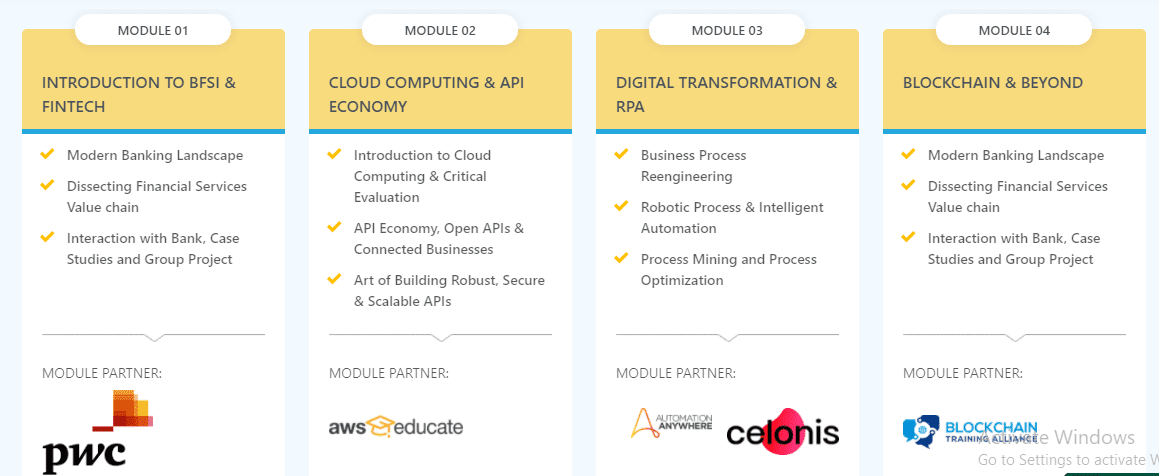
The topics covered in the CORE Modules are as follows:


• Introduction to BFSI & Fintech – You will go through various case studies to understand the modern banking landscape. You will also get to work on a group project under this module.


• Cloud Computing & API Economy – Recruiters in the fintech industry look for candidates who are experts in modern-day technologies like cloud computing, big data analysis, etc. You will learn about APIs, open APIs & connected businesses. You will learn about API management in the fintech industry.


• Data Transformation and RPA – RPA (Robotic Process Automation) is used to automate many processes in the fintech industry. This course will help you in learning about process mining & optimization. It will also cover various aspects of business process reengineering.


• Blockchain & Beyond – This topic in CORE Modules will cover the usage of blockchain in the current fintech industry. You will also learn about various tools & applications used to provide fintech services to consumers.


PRO Modules

Fintech Course


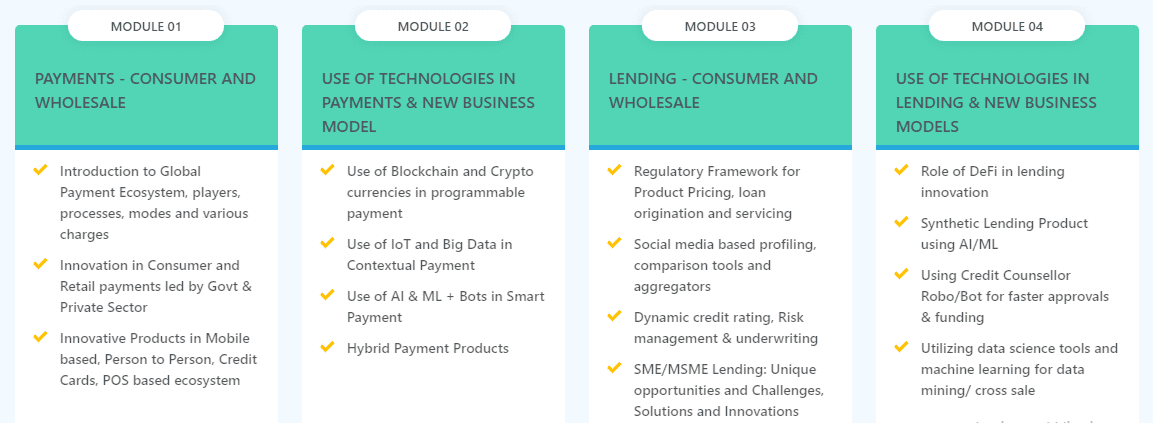
The topics covered in PRO Modules (140 hours) are:


• Payments – Consumer & Wholesale – You will get to know about modern-day payment practices. This module will also help you in understanding various innovations in the payments & lending market led by the government/private sector.


• Use of Technologies in Payments & New Business Model – You will get to know about programmable payment systems. This module will cover various aspects like the use of AI/ML bots, cryptocurrency management, hybrid payment products, IoT in fintech, etc.


• Lending – Consumer and Wholesale – This sub-module covers various aspects of the fintech industry like social media-based profiling, comparison tools, regulatory frameworks, SME/MSME lending. You will get to know about the innovations in the lending/loan industry.


• Use of Technologies in Lending & New Business Models – This sub-module will focus on the use of data science & machine learning for cross-selling. It will also teach you about synthetic lending products using AI/ML & DeFi lending.

 Benefits of the SP Jain’s Fintech Program

• You can get your hands on the Project: Paradigm shift under this course. It will help you in working on a visionary fintech business idea/project.


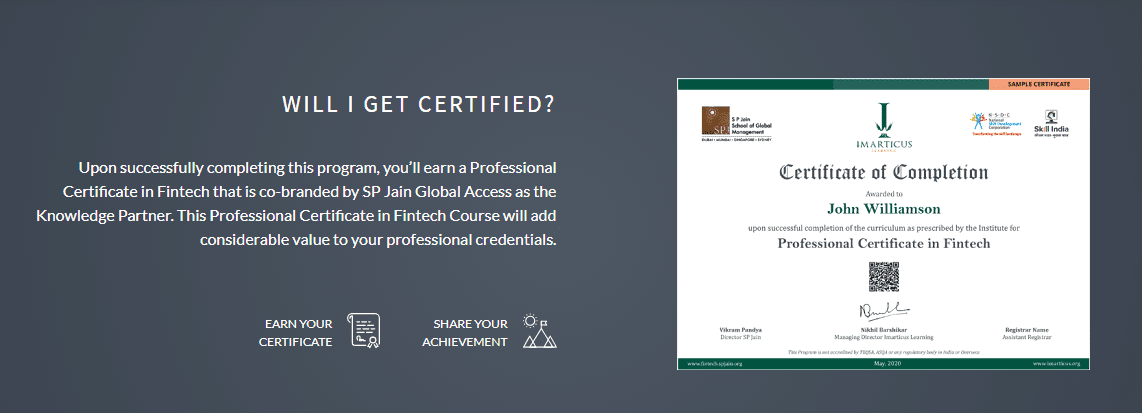
• Your final examination will be open-book and you will have to make business decisions in this simulated test as a CXO. Upon the completion of the course, you will be handed the fintech certificate.

Fintech Career

• You will also get to be a part of the Singapore Immersion Program and can meet fintech professionals from more than 140 different countries.


• You will be a part of the Perpetual Learning Program (PLP) giving you lifetime access to webinars from various industry experts.


• You will also gain access to the SP Jain’s laboratories along with becoming an alumnus of the SP Jain School of Global Management.


In a Nutshell


The in-depth course curriculum of SP Jain’s fintech course will help you in learning the practices in the fintech industry. You will also learn about the role of modern-day technologies in fintech. You can download the course brochure from the Imarticus website.

You will be able to know the operations involved in digital banks. Start your fintech course now!

What Are Some Fintech Companies?

The Basics of Fintech

At the very core of any technological evolution is a determination to provide something better than what already prevails in the market. Can you think of any industry that is not influenced by technology? I am wondering it’s very hard to think of one. Fintech is the short form of Financial Technology, meaning the use of technology in the financial domain to provide better finance-related services over tthe traditional methods.  

The Fintech industry comprises companies and start-ups that are focused on providing solutions to various problems that exist in the industry. The bottom line of using cutting-edge technology in the financial domain is to provide more efficient services that could work in conjunction with our fast-paced world, ultimately increasing customer satisfaction. Let’s dig more into the players in the Fintech industry who are revolutionizing how people use banking and financial services.

Players in the Fintech Industry

Some of the key players in the Fintech domain are mentioned below.

Ant Financial 

One of the major global players in the Fintech industry is based in China. Established in October 2014, Ant Financial Services Group is on a mission to bring inclusive financial services worldwide. It is also the official operator of Alipay, the digital payment portal by the Alibaba group for its e-commerce platform.

Xero

Xero is one of the fastest-growing software as a service (SAAS) provider worldwide that already has more than 2 million subscribers. Founded in the year 2016 in New Zealand, it aims to provide accounting solutions for small and medium business enterprises through its cutting edge software technology. Xero has also backed the title for the World’s Most Innovative Growth Company in 2014 & 2015 by Forbes.

Avant

Founded in the year 2012, Avant is one of the key players in the Fintech domain. Originally registered as AvantCredit, Avant is a Chicago based Fintech firm that provides online credit solutions for customers. On a mission to eradicate the obstacles in the borrowing process and minimize the cost of borrowing for individuals, Avant brings more transparency to the whole system through its revolutionary technology. 

Tala

Tala is a game-changer in the Fintech domain for providing micro-loans through its smartphone application. Founded in the year 2011, Tala has a customer base like no other, it provides credit facilities to people in the remotest parts of the world. On a mission to expand financial access and choices to billions of underserved people worldwide, Tala is using technology for the best! 

PayPal

One of the most prominent players in the industry, PayPal was the harbinger of the Fintech revolution. With a customer base of more than 277 million active users, PayPal believes in empowering individuals and businesses to connect and prosper in the globalised economy through its digital financial services platform. It adds value by enabling individuals and merchants to indulge in monetary transactions in multiple currencies worldwide.

Stripe

Stripe is a US-based Fintech company that was founded in the year 2009. It uses its software technology to provide payment solutions for individuals and business owners that help to receive and make payments online. Stripe has built a customer base in the e-commerce domain by catering to the payment solution needs of the online business owners.

Robinhood

Robinhood is a US-based Fintech firm that provides investment solutions through its mobile and web applications. It was founded on the core principle of increasing participation of people in the finance industry through commission-free access to investing. Robinhood is a fast-growing company that already has a customer base of more than 6 million active users, a major percentage of which belongs to the millennial population.


Skills and Tools Which Are Required in Fintech Industry

FinTech which stands for Financial Technology is a rapidly growing but highly expansive field. FinTech’s areas of interest are many such as Net Banking, Cryptocurrency, Insurance, Trade, Application Design, and Online wallets. Since this interdisciplinary field is so widespread, it entails professionals from a wide variety of disciplines within its folds. A software designer and an accountant both can work in the field of financial technology, as this field caters to a large set of skills.

Some of the most sought after skills and tools in FinTech Course

● Cybersecurity expertise: One of the main threats that the FinTech industry faces is malware infections and hackers. If a financial technology system is infected and its data gets breached then, the corporation can face penalties; hence people who can secure the computer systems from virus invasion and prevent a breach of privacy are of great value in FinTech.

Machine learning and Artificial Intelligence: FinTech works heavily with artificial intelligence. This field needs people who have apt statistical knowledge and instincts. One needs continuous analysis and study of data in FinTech. A candidate who knows how to use the machine learning to add, edit, remove, and study statistics will always be a useful addition in the FinTech industry. A person is needed to be proficient in Hive, SQL, and Pig. They are also expected to know how to work with toolkits like Weka, Python, NumPy, and MatLab.

Soft Skills: The nature of FinTech industry is highly collaborative. A person is required to work closely with people who come from different backgrounds. This makes it necessary for a worker to have soft skills like teamwork, the ability to work in a group and be amicable. This industry also requires people to be highly open to ideas, edits, and suggestions so a person who is not receptive to feedback will not be a good fit for this industry. People with soft skills help in team-building and communicating ideas. They are useful in managing human resources and resolving conflicts that might arise in different groups due to the dense presence of workers from different disciplines.

What are the challenges and questions of the FinTech industry?

Like all industries in the world, FinTech also has its share of problems and challenges. FinTech is a relatively new industry; hence its challenges are still being explored. But over the years, government regulations and breach of data are the two main challenges faced by FinTech companies.These restrictions and lack of government support prevent these innovative companies from establishing themselves due to legal and bureaucratic hurdles. These problems are particularly harmful to start-ups than established companies.

Another major challenge that surrounds FinTech is that of hacking and breach of privacy. In the world of Big Data, information is gold, and hence hackers and cybercriminals are always on a lookout for profitable data. The breach of security by hackers or malware infection in FinTech brands does not just ruin the credibility of the company but it also leads to fines and penalties.
Some of the strictest penalties for FinTech corporations are made by the European Union (EU). All FinTech companies that are practicing in the European Union are mandated to adhere to the GDPR guidelines that deal with privacy and data protection. Any FinTech company that fails to protect the data of its users can face up to 20 million euros in fines or give up 4 per cent of their annual turnover in penalty. To prevent any intrusion by hackers, FinTech institutions end up splurging a copious sum of money into developing firewalls and other security systems such as anti-viruses. Not just money but time is also spent in ensuring that the information base is secure from all kinds of Trojans, malware, and snooping.

Conclusion

Contrary to popular belief, FinTech is not completely run by engineers or bankers only. Even people who are not particularly tech-savvy can work here in a highly collaborative space. In this cabalistic and digitalized world, by taking a Fintech Course you will be able to understand the immersion of financial technology which is in almost all kinds of fields and disciplines around the urban world.

The Fintech Sector: Scope of the Industry and Opportunities for Agriculture!

The fintech sector is a rising industry that has come to define the contemporary era. The term “fintech” refers to financial technologies and encompasses digital innovations in payments, lending, insurance and investment management. One of the primary reasons for this growth is that these companies offer better solutions than traditional financial institutions.

The Scope of the Fintech Industry?

The Fintech sector is a fast-growing industry that has been evolving rapidly since the word was first coined in 1999.

  • The Fintech sector is revolutionizing the way we do business. It will be difficult for banks to compete with this new wave of technology that has come about in recent years. 
  • There are many opportunities in the agricultural industry, but it’s essential to know where you stand on your current level of technological development before taking any steps forward.
  • India’s fintech market is the world’s fastest-growing- 67 per cent of the more than 2,100 fintech entities in operation have been set up in the last five years. India’s fintech market is valued at US$31 billion, which is projected to grow to US$84 billion by 2025. 
  • The fintech transaction value size is projected to grow to US$138 billion by 2023 from US$66 billion in 2019. 
  • According to a Boston Consulting Group report, Indian fintech companies will reach a valuation of US$150-160 billion by 2025, becoming thrice more valuable in the next five years.

Evolution of Fintech: Opportunities for Agricultural Sector

Fintech is now looking at opportunities to serve agricultural sectors and farms across India, which can potentially transform rural life by providing access to affordable credit and insurance products- two things that we take for granted but are often inaccessible without significant wealth or connections. Here is how Fintech is assisting Agricultural Sector:

  • Easy Loans for Farmers: The agricultural sector needs to borrow money frequently. With Fintech, there are no middlemen, the efforts of the fintech sector to make direct loans are consistent.
  • Direct Connections: Farmers have better opportunities to establish direct connections with lenders & other institutions for better operations. This change can potentially stabilize the sector.
  • Ongoing Payment Model: Instead of paying large payments for equipment & tools, farmers can now use various ongoing payment programs. People can better organize finances more efficiently by paying for what is used, skipping problems arising from conventional payment models.
  • Affordable Financial Services: Financial services are becoming more accessible to farmers. Some companies are focusing on this aspect to bring a greater variety of financial tools & utilities.
  • Better Insurance: The availability of crop insurance plans for farmers is shaping the sector in a better manner.

Grow your Career with Imarticus Learning:

Imarticus Learning has collaborated with prestigious universities to enhance robust Fintech Training courses. Enrol into MBA in FinTech, which covers every paradigm of cutting-edge New Age FinTech solutions. The curriculum is designed to provide students with in-depth exposure to critical elements of the FinTech domain.

This program covers every critical aspect of FinTech via hands-on training with prominent technologies such as API, Blockchain, Cloud Computing, AI, Machine Learning, RPA, IoT and Big Data. This program enables students to apply what they learn while dealing with real business scenarios & problems.

Some Course USP’s:

  • UGC Entitled Online Degree Programs
  • NAAC ‘A’ Graded University with Graded Autonomy Status
  • Top Ranked University in India – NIRF & QS World Rankings
  • Program Delivery follows the prescribed four quadrants approach from UGC
  • Learning Hours and Credits at par with Full-Time Classroom Programs
  • Innovative Programs Accredited by Global Professional Bodies

If you want to skyrocket your FinTech career prospects by transforming into a FinTech expert, your search ends here, and a spectacular FinTech learning journey begins. Contact us through Live Chat Support system or visit our training centres in Mumbai, Thane, Pune, Chennai, Bangalore, Hyderabad, Delhi and Gurgaon.

The Scope of Cryptocurrency Technology in India

In addition to the day-to-day politics, if there is any news which haunts the television shows in India, it is cryptocurrency. In order to have an idea about the scope of cryptocurrency in India, it is equally important to go into the depths of its evolution. It has gained acceptance all over the finance sector. However, in India, the Reserve bank of India has declared transactions to be independent, and the Indian government is not answerable to any gains or losses.

WHAT IS CRYPTOCURRENCY?

Cryptocurrency is a virtual currency which utilises encryption techniques to make transactions. The plus point of using this currency is that every single deal you make is transparent and secure. Some of the peculiar features of this currency are:

  1. Transfer of funds between two parties becomes more relaxed with a negligible processing fee.
  2. It makes use of blockchain technology to secure and encrypt transactions, whose database is highly secure and unalterable.
  3. It is outside the ambit of governments and central banks of countries.


Also Read: Top 6 Incredible Benefits of Cryptocurrency
However, there are some risks associated with it as well. These are as follows:

  1. The rates of exchange fluctuate by large margins which makes the little investment bit risky.
  2. These are prone to hacking.
  3. These are often used to make transactions for activities which are harmful to a nation’s economy such as terror funding or money laundering.

Despite all the odds, cryptocurrency is still the favourite investment spot for those involved in the trading world.

BITCOIN- THE MOST POPULAR CRYPTOCURRENCY

Bitcoins are the rulers of the cryptocurrency market. Although these are not legal tenders, still they chart high on market trends. Bitcoin is the first digital currency used to make transactions. The price of a bitcoin depends on bitcoin mining. More the number of bitcoins, the more it becomes difficult to add in the blockchain. These are eminent rivals to government currency.

SCOPE OF CRYPTOCURRENCY IN INDIA

A country like India which has recently faced demonetization has developed great affection for cryptocurrencies in the recent past. It has been nearly five years since bitcoin made its debut in Indian Financial markets. In India, the transactions made through cryptocurrency are on the rise despite the notifications circulated by the finance ministry. This makes it clear that the upcoming future of bitcoin in India is dazzling. There are about 1548 cryptocurrencies currently operational in the market available as an alternative to Bitcoin.FinTech Banner
Since bitcoin is not available in the physical form, this virtual currency can be converted into physical form by listing it on various online exchange platforms. Taxing the cryptocurrency is another way to legalise this currency. It becomes clear that it is a risky investment option, but there is no harm in opting for a calculated risk.

CONSEQUENCES OF BANNING CRYPTOCURRENCY IN INDIA

  1. Ban has never been a solution to any problem. Instead, a ban can result in brain-drain. If investors are not allowed to make transactions in bitcoin, they might shift to other countries like US and Canada where the use of cryptocurrencies is permissible.
  2. Money- minded people will never mend their ways. Instead, they would find some loopholes in the system which will eventually lead to an increase in cryptocurrencies through illegal means.

The government should make its stand clear since banning a promising technology might mean that India has to suffer backlog in a technique in which the whole world is continually improving. Realizing the importance of bitcoin, Marc Kenigsberg aptly said “Blockchain is the tech. Bitcoin is merely the first mainstream manifestation of its potential.”
Article Source: