

With the Indian rupee listed at 71.65 versus the US dollar in November 2018, the rupee appeared to stabilize and strengthen up for 2019. Global events over the last decade have affected the Indian financial markets in general with commodities, bonds, equity and the currency all feeling the heat. A crude oil price slip four years ago caused our current account deficit reduction while strengthening the growth of the equities market and bringing in the dollars to impact seeing the rupee firming up. The then newly elected government was stable and zealous and the little instability on the domestic front saw the rupee strengthening.
The factors for the decline:
In ushering in 2019 the promises of global events dominating the financial scene was a given. The outcomes this time around saw a 9% decline in the rupee value which ended with a 15% value decrease as in October 2018. The main factors contributing to this were the prices rising for crude oil to 86 USD for Brent and the Federal rates rising with the US dollar’s strengthening.
WTI crude oil prices plummeted in October 2018 and November saw prices per barrel decline from the once 77 USD to 57 USD. Domestically too we were on the urge of a historic mid-term election. The turmoil in Turkey and the tumbling of currencies caused also in some measure a very conservative currency market globally and especially so in the emerging Indian markets. This was the stack against the Indian rupee and naturally, the rupee in 2019 would see a downward trend in response.
A sudden and strong crude oil prices surge with the FPIs-foreign portfolio investors withdrawing from the debt segments has kept the pressure on the value of the Indian rupee and the equity markets. RBI on its part did intervene with the REER- Real Effective Exchange Rate as its basic focus.
The interventions were sanguine and half-hearted and designed to keep the weakening steady. This measure as understood by economists was what could be done. To effectively fight such factors in a currency war low inflation rates and higher efficiency are prime factors. No currency war is ever won by quarreling!
The US scenario with its higher Fed rates will mean the dollars will flow back to the US and in 2019 the rupee will continue to steadily weaken as US dollars become a globally scarce commodity. The policy of “USA first”, the meddling with the financial policy by US President Donald Trump and the protectionist measures implemented in the USA are all sources of trouble and fear for the trade markets in India.
The uncertainty over a clean Brexit deal hurts India too as money moves away and foreign investors prefer to invest in the safe bet of the rising dollar value. Concurrently a listless slipping market can see a further decline in the rupee values which may even test the 68-69 limits.
The 2019 predictions:
So, how much will the rupee strengthen against the US dollar and what should we do now? A 10-year study on the rupee shows the recovery of the rupee could proceed well into 2019. A Fibonacci retracement study considering five parameter legs of the rupee movement from high to low values discloses that the rupee always returned to values between 50 to 61.8% of the rupee support values when the rupee fell from the 2018 January rate of 63.59 to the October 2018 rate of 74.48.
The mid-term polls have fortunately taken us past a phase of uncertainty with the BJP romping home with a majority and offering an outsider chance of helping stabilize the market with economic growth and unfinished financial measures like demonetization, digitalization and such, finally seeing the light of day. A stable government is a welcome feature and the RBI interventions to stem the rise in inflation could shore up the weakening rupee’s downward spiral and bias.
Conclusions:
Predictions remain so till they turn into results and facts. But given the above factors, it would not be unreasonable to see 2019 ending with the US dollar value at 75 Indian rupees.
If you would like to study such trends and make a profession of data analytics and studying financial trends, then head to the Imarticus Learning Academy for advice on careers in emerging fields and technical updated skills.
Imarticus is where financial experts are born and honed for success. Why wait? For enrolling yourself and for further career counseling, you can also contact us through the Live Chat Support system or can even visit one of our training centers based in – Mumbai, Thane, Pune, Chennai, Banglore, Hyderabad, Delhi, Gurgaon, and Ahmedabad.
Tag: Capital Market Courses
How Can You Get Into Capital Market After Having Of Banking Experience?

Your decision to take up a banking course after graduation will stand you in good stead after being in retail banking. Corporate banking is a great career choice. Corporate Banking which is an area many career aspirants would love to join surprisingly has very few good certification courses.
Recently FLIP introduced a specific Corporate Banking certification course which is apparently popular among the B-school aspirants. This course covers non-funded and funded products while taking you through all corporate banking important work areas. It is an apt course for SME and corporate banking career aspirants and is also used for employee training by leading NBFCs and banks.
Employment Outlook:
The pay packages, bonuses, and career-progression when you make a career in any field of banking like Corporate Banking are not just lucrative and prestigious. They are performance and certification related enabling continuous learning and very satisfying job roles.
According to Glassdoor salaries, the Manager in Corporate Banking at YES bank draws a salary in the range of 1,205 to 1,716K per annum in India. In the US the corporate banker aka Personal banker at Bank of America draws an average of USD 43,330 per annum. These salaries are post based and depend on the bank you join.
Most say a banking course after graduation offers some great pluses like:
- Job security and working in MNC environments.
- Super salary packages topped with great benefits
- Jobs for retired bankers and career-changers within the banking areas are never a problem.
- Wide variety of jobs experiences and roles.
- Banking industry jobs are prestigious and have a thriving ecosystem.
- To update knowledge of latest banking trends and practices training can help. They also help with certifications and interview skills.
- Excellent career progression and scope for banking jobs makes this career choice great.
- Community service goals and continued learning opportunities are satisfying and enriching.
- The working hours are good and the environment conducive to career-progression.
- Certifications gained will add to your resume and knowledge endorsing your skill levels.
Skills required:
To become career-prepared you need to undertake a course in corporate banking. An academic bachelor’s degree would be essential and experience in banking practices definitely help. Fluency in English communication and excellent skills in presentations using Microsoft Excel Macros and financial software is critical to presenting a report of insights that help decision-making based on predictive analysis foresight and data analytical skills. Yes, conceptual knowledge and expertise in the domain enable you to stand out in this prestigious job.
Why banking jobs are so popular:
In comparison to investment banking, corporate banking dealing with corporate has relatively fixed working hours, fewer deals, large-deal amounts and offers a broader job-scope. New-age banks have evolved which are needs and market-based. Traditionally the roles were related to customer-service and teller areas in banks. This means multi-tasking banking professionals are in high demand. Today rather than specific roles in corporate banking, an aspirant can also take up any of the trending opportunities in new-age banking like
The banking course after graduation syllabus covers topics like
- Understanding products, solutions, corporate client requirements and the matching of these parameters.
- RAROC adjustments of risk, wallet sizes, Matrix for product penetration, and relationship management.
- Credit note memos, analysis, and presentations to the management.
- Client credit-profile analysis and assessment through quantitative and qualitative techniques.
- Corporate banking products, Treasury products, and both non-funded and funded products.
In retail banking aka consumer banking, the focus is on the individual consumers or mass-market large commercial banks offering services through their local offices. Some examples of such banks are Citibank, JPMorgan, Goldman Sachs, Wells Fargo and Bank of America.
Increasingly the trend is to go in for new-age banking with a gamut of services and products that are consumer-need and profitability based one-stop banking solutions providers with services like retirement planning, private banking, brokerage accounts, corporate banking, wealth management, and even third-party services being included. Hence a wide-scope new age banking certification is best undertaken at a reputed institute like Imarticus Learning.
Conclusion:
The pay packages, bonuses, and career-progression when you make in corporate banking are not just lucrative and prestigious. They are performance and certification related enabling continuous learning and very satisfying job roles.
Hurry to Imarticus Learning today! For more details, you can also contact us through the Live Chat Support system or can even visit one of our training centers based in – Mumbai, Thane, Pune, Chennai, Bangalore, Hyderabad, Delhi, Gurgaon, and Ahmedabad.
Why Project Portfolio Management Is Important?
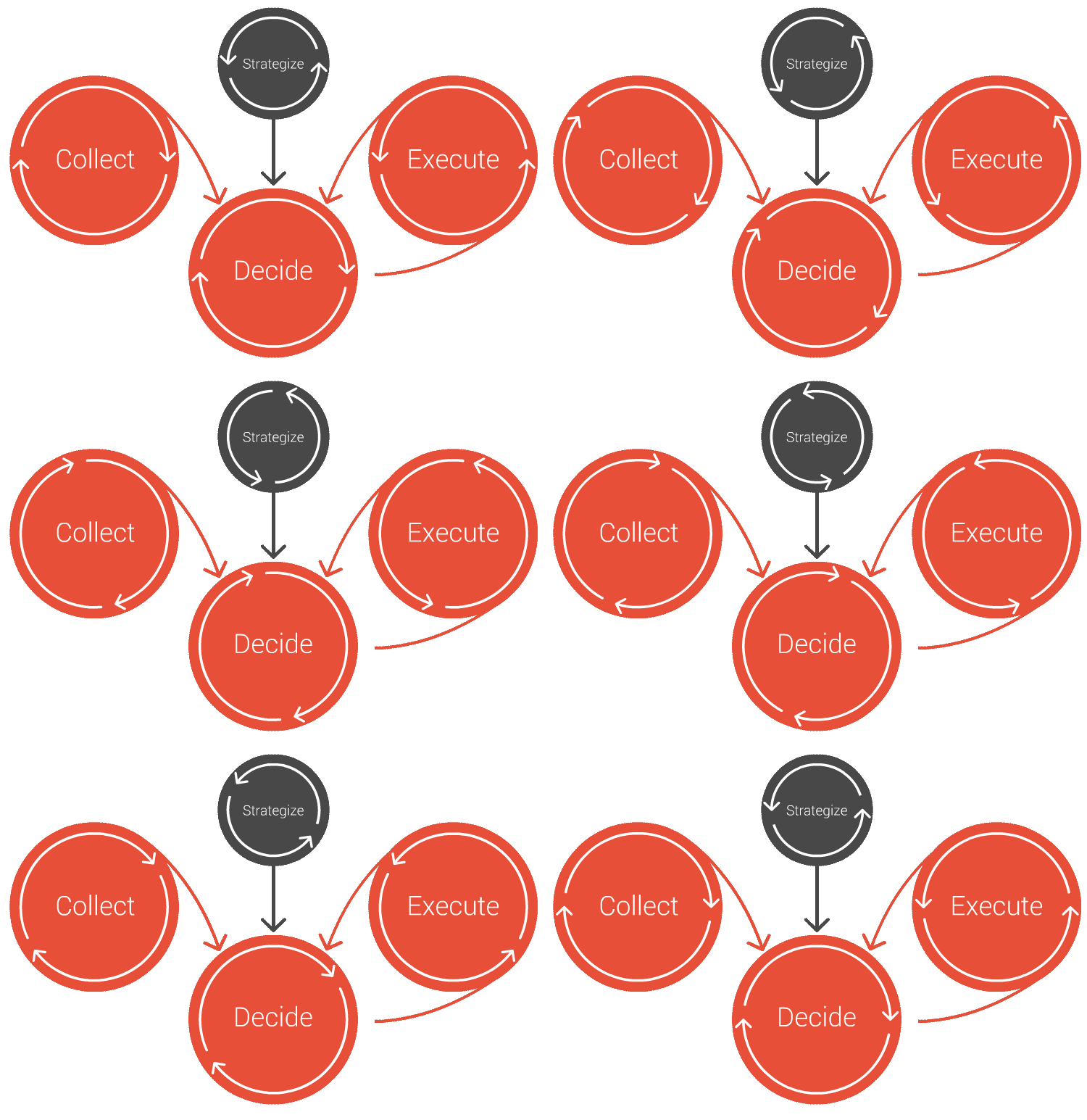
PPM or Project Portfolio Management means the collective project management of an entire portfolio of projects rather than managing a single project from start to finish. The PPM is responsible for the entire project portfolio process, which projects to choose and include in it, how to budget and allocate resources to each project in the portfolio when to take on such projects, what is the impact of the time taken and such. Let us explore the best features and mistakes that happen in the PPM process.
The PPM benefits:
1. Decision Making:
PPM drives the business decisions which are taken based on data forecasts and insights. The visibility of data needs to be from the tactical perspective which is a bottoms-up model and the strategic perspective which is a top-down model. Only when this integrated perspective and model is visible and presents the past metrics of PM will one be able to forecast the future trends and draw insights from the strategy. This also helps weed out those projects that are misaligned with corporate objectives.
2. Risk Management
This critical criterion is essential to project portfolio process and PM. The amount of risk-taking needs to be optimal and between safe and risky to ensure profitability. But, PPM is a safe bet to check overspending caused by no visibility into project data, inaccurate scheduling, poor project estimating, and improper resource allocation. Forrester reports suggesting a decrease of 10 percent in overspending on an average in organizations by using effective tools and techniques of PPM.
3. Faster turn times:
Efficient project portfolio process training can help lessen project turn-times by a median value of 10 percent. Repeatable processes such as standardization, governance, and workflow are proven and by aligning PPM with such processes the ambiguity is removed and leads to productivity and business value. The shortened time to market often prove to be decisive factors in being competitive and getting through earlier.
4. Increases success:
Project failures are oft because of unsuccessful project delivery. The delivery itself depends on schedule delays, cost overruns, ill-managed resources, badly defined requirements, lack of strategy alignment, technical limitations and unresolved issues. PPM ensures minimization of these factors. The PMI reports affirm project failures reduce by 60 percent and projects executed increase by 30 percent with PPM.
5. Increases collaboration:
Many organizations till date use manual tools for PPM like Excel worksheets located on a client’s computer and not available to the organization in real-time. This can lead to inconsistent and conflicting data. PPM streamlines the data channels in real-time. PPM can help reduce by 25 percent the volume of administrative tasks while improving team collaborations for data streamlining.
The PPM mistakes:
1. Not having a tangible investment strategy:
It is a common practice in many companies, whether start-ups or larger corporations, to directly Starting with funding and budgeting is common in many industries. The priority list of projects is spent on till the budgets are exhausted and a project lower the list often do not see the light of day. PPM works on the resource allocation to all prioritized projects after listing projects aligned with the organization’s productivity and achievement goals.
2. Not dividing large projects into smaller ones:
The agile method is to break large projects into smaller achievable tasks and then prioritize the tasks. This provides smaller releases for testing and action even when the large project is still on-going rather than allowing the whole project to reach a stage of no return. Assigning and allocating team members to each task is also easier and achievable.
3. Not prioritizing tasks:
When multiple projects run it is often easy to ignore those with lower visibility. It is important to prioritize all tasks small and big on to a backlog list which is reviewed often to allow for realigning projects, prioritizing them and getting them done.PPM ensures just this.
4. Letting change get out of hand:
PM is always full of scope-creep which slips in gradually and escalates only when such projects need extra resources to restore their scope. When done late in a project this leads to project failures. PPM is adept at managing scope creep and hence leads to better productivity and efficient time-keeping.
5. Not using a PM tool:
PM tools envisage the status of a project and its visualization using graphic-tools. They enable better opportunity finding, efficient resources allocation, and spot problems before they become critical. Regular reviews even on a daily basis can ensure the smooth process of the project portfolio process.
In parting, PPM is a very good course you can take up at Imarticus Learning. They also train you to undertake PPM certification from PMI and assure your placements.
How Should You Acquire Domain Knowledge In Capital Markets?

Domain knowledge in project management is crucial when making a career in a banking project sector. Hence it would be great to do a course when looking to make a capital market for beginners career in this core sector. When starting your career there are many questions as to what one should do to assimilate knowledge quickly so one can move into a good banking career. The capital markets world over may differ in product offerings, trading practices, and regulations. However, the one constant has been the growing demand for skilled capital market personnel in banking circles.
What is the capital market?
The capital market instruments are:
1. Shares: Share is a part of the ownership in the form of the share and forms the capital base of any company. The sharing unit can be traded in and many people hold shares to sell when the markets boom making huge profits.
There are two types of shares. Namely,
- Equity shares
- Preference shares
2. Debentures: Companies issue debentures under the company’s seal as funds borrowed for a long term and form a part of the borrowed capital of the company. Such debentures carry a fixed interest rate and maturity period. These are the certificates issued
3. Bonds: To raise capital for projects governments and large companies issue bonds which are again long-term capital borrowings. Like the debentures bonds also carry a fixed interest rate and maturity period. The interest charged on such bonds is on the coupon rate.
4. Derivatives: These instruments derive from other underlying assets and securities. The selling price, function, risk, etc of the derivative depend on the assets underlying them.
Some examples of the Capital Market for beginners drawn from derivatives are
- Futures
- Swaps
- Options
- Exchange commodities
- Traded Funds
 Here are simple steps in a tutorial to increase domain knowledge especially in the capital market for beginners.
1. Research your knowledge to narrow down to your domain choices:
For example, if you want to be a domain expert in banking you must narrow down to the capital markets from the various services offered by investment banks. Next, add questions and actions to research and act upon them.
2. Question bank building:
Ask your questions of an expert on the subject of capital markets.
What questions to ask depends on your question list and domain knowledge. Rather than ask an obvious question try asking questions like-Do all asset classes get mark-to-market action? How are bad loans monitored? and such.
When and whom to ask questions is important. Never ask domain technical questions to the executive or a domain operations question to the accountant!
Record the answers for further reviews.
3. Do a course:
You have a variety of domain choices here related to the capital market domain.
· WMI-Wealth Management Institute course
· Do the CFA-Chartered Financial Analyst course
· An MBA course with a finance domain focus
· Do the MFE-Masters of Financial Engineering degree
· Get experience in domain work: To get practical hands-on skills many students opt to take the financial professionals course at a reputed institute like Imarticus Learning.
4. Attend events:
This is the best place to learn more about domains. Build your domain knowledge with reading from
- Banking Associations / Magazines – FundSuperMart, The Asian Banker, WealthMatters, etc
- Software vendors – FlexCube, Temenos, SAP, SilverLake, Finacle, etc
- Hardware vendors – HP, IBM and such
- Consulting firms – Boston Consulting Group, McKinsey and Company, PWC, Accenture, IBM GBS, etc
5. Knowledgebase building:
Create a base on hard disk from your records, questions, etc and build on it. Update it periodically and add indices to it to demarcate the domains.
6. Knowledge Communities:
Join such communities for mentorship and issue resolutions in your domain from a peer group. You can teach, learn and explore domains at the same time!
7. Mentorship:
This is crucial to emulate in domain expertise building.
8. Offer to help:
This method is a great way of gaining hands-on information and experience in domain knowledge.
9. Update Solutions Knowledge:
Technology is evolving as are standard practices. Hence do continued domain learning to get ahead of the career curve.
Wrapping Up …
Acquiring domain knowledge is not difficult. There exist SO MANY things you can do to acquire such knowledge. Firstly start with a plan, build knowledge bases through MOOCs and online reading, question all your premises, enroll in courses, and take the support of community groups.
Do your capital market for beginners course at Imarticus Learning because they help you in all the above aspects, offer excellent mentorship, prepare you for certification exams, and go further with assured placements.
Their course has a comprehensive part, modules on soft skills, resume writing, mock interviews, and personality development too. Enroll today! For more details and further career counseling, you can also contact us through the Live Chat Support system or can even visit one of our training centers based in – Mumbai, Thane, Pune, Chennai, Hyderabad, Delhi, Gurgaon, and Ahmedabad.
What Qualification Does One Need To Go For Capital Market Training?

If you are passionate about the Finance industry and have a fine knowledge and interest in the Sensex and nifty, why not make a career in the Capital Market and become a Capital Market Analyst?
A Capital Market Analyst is the one who combines sales, consultation, trade, and banking and balances these to work for the cause. With the market growing vast, there is a rewarding career in the Capital Market Analysis. Today we have professional training in Capital Market that produces highly skilled analysts.
What does a Capital Market Analyst do?
The Analyst can be found working in a various established organization such as Hedge Funds, consulting firms, the investment banking group, and other related firms.
They have a key role in facilitating communication between the company, investment firms, and research organizations. Companies count on them to bring the best possible deal for the clients and investors both. Capital Market Analyst is the supporter of the business that seeks capital investment in their company or the other way around.
The responsibilities of a Capital Market Analyst are:
- Communicating with the investors: They are the first ones who start the communication with the investors and are also responsible to research about them in details.
- Setting or negotiating price: It is the responsibility of the analyst to deal with the pricing and thus they need to be highly persuasive and also adjusting in nature.
- Organizing events: These analyst act as the middleman between the firms and the companies and thus will make efforts and organize events for the frequent meetings.
- Pitching documents: They prepare the pitching documents that contain clear messages with all the details and helps to put forward the case.
- Closing the deals: Last but not least, the analyst’s seals and finalizes the deal and ensures satisfaction on both sides.
Qualifications and Skill required to become a Capital Analyst
It is a field which requires all-round varying knowledge and different skills to be put together to create huge profit for the employers. In today’s contemporary times, a specialist is preferred who have a specific area of focus but some key qualities need to be present in common.
They require prominent knowledge in :
- Trading
- Settlements
- Custody
- Compliance
- Risk
- OTC derivatives
- Finance
- Prime Brokerage
- Knowledge of IT Softwares
To become a Capital Analyst, one will need at least a Bachelor’s Degree in Finance, Business, Statistics or related field. Though there are no hard and fast qualification requirements to train in Capital Analysis, having strong communication skills, negotiation skills, analytical and research skills will surely give an upper hand. Also, if you intend to become a specialist in certain fields such as Healthcare, Tech, Media and Communication, you need to have deep knowledge about the sector.
There are several pioneer institutes in the country that run Capital Market Courses and provide top-notch training in the making of Analyst experts. The capital market tutorial is an easy way to gain basics in this field that will boost up your start. These tutorials are easily available, highly simplified that ensures the technicalities of this field are easily understood.
Share and Derivatives Analysis
Derivatives are among the most powerful financial tools which mainly represents contracts between two parties and derives its value from an underlying asset. The most common types of derivatives are stocks, commodities, market indexes or interest rates.
With shares and derivatives as a fast-growing financial instrument category, it becomes of utmost importance that a company dealing with finance takes measures for Share and Derivative Analysis. Derivative Analysis plays a pivot role in eliminating risks and helps in making successful predictions about the company and its future performances. This analysis indicates how well a firm is doing in the market in comparison to its competitors.
Share and Derivative analysis manifest complete details about the company’s strengths and weaknesses, its business relations, financial performances and all those factors that affect its earnings, dividends and future growth prospects. This analysis tool is being used worldwide to initiate successful trades. The purpose of the analysis is to help make more financially sound investment-related decisions by the investors.
Ways to learn Share and Derivative Analysis
Today, we have access to multiple sources of education that are easily accessible and highly reliable. To learn about Share and Derivative Analysis, a beginner needs to focus on fundamentals and basics of derivatives. There are so many resources and different platforms that can help gain a strong and sound knowledge about how derivative analysis works. Few of the ways we can approach are,
- Read books
- Tutorial videos
- Certified courses
- Resources and guidelines available online and offline
- Blogs and Articles
- Online and Offline Seminars
All the above-mentioned categories are helpful for a beginner to gain knowledge in this field. A word of advice is to make sure the resources are reliable and credible. For more details, you can also contact us through the Live Chat Support system or can even visit one of our training centers based in – Mumbai, Thane, Pune, Chennai, Hyderabad, Delhi, Gurgaon, and Ahmedabad.
How Can You Prepare For a Capital Market Trading Interview?

Interviews can be daunting and nightmares for an underprepared candidate. One can never be fully aware of what is going to pop up in the interview, thus there can be no hard and fast rule for preparation. As far as an interview for Capital Market beginners is concerned, there isn’t any set formula. To start with the preparation for the interview, you have to research, analyze and make proper framework. Your strategies will decide how well you will perform in the interview.
Finance is an ever-changing, stress bringing industry and the interviewer aims to test if you can handle the heat. Just being aware of technicalities is not enough, you will be tested for your problem-solving attitude, behavioral ability, management skill and so on. Here are a few tips that can go handy, fairly giving you ideas to boost up your preparation,
Know Your Resume:
It is your resume that presents you in front of the interviewers, much before you face them. They are free to judge you by your resume. Hence, you ought to have command over it. It is up to you to make the best use of it by highlighting your strengths and area of interests. It becomes really important that you don’t brag in your resume and prepare it skilfully.
Be aware of the current market scenario:
Even though you are a Capital Market Beginner, it is expected of you to be aware of what is happening in the market. Questions will pop up about trends and happenings in the related field.
Have Clear viewpoints:
If you are a beginner, you may not know the correct and exact answers to the question, but you must have a clarity of view. The interviewer will not like to see to you juggle from one viewpoint to another. You need to have a clear head which shows your confidence level.
Know the technical aspects:
The finance sector is full of technical details and you need to have a fair idea about the basic jargons and knowledge of the subjects. Academic excellence is always required in this field along with personality excellence. So, have command over accounting and finance topics.
Focus on the soft skills:
Leadership abilities, teamwork ability, your strategies, and problem-solving skills, commitment level, creative thinking, analytical thinking and personality, all come under the soft skills that the interviewer surely looks out for. They may try to stress you out, or give you situation based problems just to check your patience and calmness.
Research about the organization:
Every organization has a certain ideology which you need to dig out. Once you know about the belief of the organization, you can give them those pleasing and impressive replies.
Examine the requirements:
When applying, you need to know about what the interviewers are seeking. These can be about qualifications, qualities, and background of the candidates. Align yourself with these details and show yourself as a deserving option. These descriptions may also give you ideas about the questionnaire.
There are several options available out in the open that will help you prepare for the training interview. This information can be found on your fingertips and are well suited for the purpose. Methods can be opted to be prepared for the interview are :
Capital Market Courses:
There are several certified courses in capital Market that are not time taking but will help you gain a basic idea about Capital Market. These courses are certified and can be availed both online and offline.
Blogs and Sites:
There are numerous blogs and websites dedicated to preparing the candidate for the interview. They provide fair knowledge about the questions that can be asked and how to respond.
Videos:
With just one click you gain access to several videos focusing on the tips and tricks to excel in the interview. Some of these videos feature experienced and veterans of this field who share their knowledge and experiences to guide the candidates.
Mock Interviews:
Mock interviews are a great way to overcome the interview phobia. Several sites run these mock interviews to give the candidate a realistic experience of the interview.
Prepare well, be learned about the financial news and trends and know the academics thoroughly. Besides, never forget to shape up your analytical and thinking ability. Don’t show the rush to answer. Take your time, allow the interviewer to judge your thinking process and then, answer with confidence. And with proper preparations, you can ace the interview.
For more details, in brief, you can also contact our career counselor. For that, you contact us through the Live Chat or can contact on – info@imarticus.com or 1-800-267-7679 or can even visit one of our training centers based in – Mumbai, Thane, Pune, Chennai, Hyderabad, Delhi, Bangalore, Gurgaon, and Ahmedabad.
What Modeling Skills are Needed For an Analyst Working in Debt Capital Market?

At the very onset, let us tell you that one does not need to have extensive skills in modeling especially in a debt- capital- markets job role when working for such a firm. However, modeling skills will be required if your data needs cleaning, formatting and then analysis. Most firms use databases on equity research that are procured from other sources as well as in-house databases and the need for financial modeling is a bare minimum.
It is important though to track the indices for outstanding debt, share repurchases, cash, pending acquisitions, etc. since they foretell debt retirement, future issuances and such which may be required when advising clients.
Any capital market tutorial should begin with answering questions related to what the DCM actually is. Most companies prefer to turn to DCM markets when they need funds for expansion but do not want to trade in their private ownership tag.
The DCM market is ideal since they deal with the sale of units called bonds. For the investors in bonds, this is a fixed-income investment where on redemption they get their money back along with attractive interest. To explain this Capital Market Courses concept assume you buy a bond of 1000Rs face-value with a redemption date of 1 year.
After a year the bond can be redeemed at 100Rs plus the interest rate which may vary. When bond prices fall the interest rate moves up and vice versa. If you get 1100 Rs your interest rate is 10% and is much higher than the FD rate of 6-7 %. The investment is low-risk and earns a fixed interest rate. Such funds are a short-term boon for firms needing funds for expansion without the dilution of ownership. It’s a win-win deal for both.
The different types of bonds:
The bond types are risk-of-default related and can be categorized as
- The government bonds are at low-risk for default.
- The companies issued investment bonds also fairly safe from default.
- The bonds that are high-yield susceptible to risk and hence offering a better rate of returns.
The DCM also handles debt-equity issuances for several purposes. At times on reaching debt-maturity bonds are refinanced or reissued. At other times the expanding company may be looking to reduce cost-to-company capital. A quick look at the statistics espoused by Dealogic shows the bond markets are huge in comparison to issuances.
In 2013 alone, the DCM market figures showed debt-deals worth 6.1 trillion $ versus the 832.2 billion $ equity issuance markets. Compared to its value in 2012 there was a reported surge of 25 percent upwards.
How to get a DCM job and why?
The DCM job is part of the investment banker’s portfolio. This is a highly prestigious and well-paying job with a lot of hard work and challenges thrown in like the inordinately long work hours, the need for classroom and paid training to get placements as IBs and the long attributes list required of an IB.
DCM is way larger than the ECM and banks or firms find this large volume low-returns market needs constant new-deals to be worked on. ECM thrives in sectors like mining, aerospace, etc. The need to generate profits from large volumes of new-deals means more IBs to pitch the issuances and provide services for both investors and clients.
Further half the volumes of debt-issues are from the financial institutions.
Hence, in larger firms, there could be separate CM and ECM divisions, private firms, and public companies divisions, or corporate and government debt markets divisions. The plus point is that a lot of debt-issuances ensure you are not just a salesperson of equity issuance.
The normal workday of the FA is to convince investors and clients for deals. You will need to track trends, make presentations, draft pitches, create models, meet HNI clients, or work in inter-bank funds syndication. No matter where expect 80-100 hours of stress-laden work per week. No wonder then that nearly half the aspirants for IB jobs quit within 3 years. For the persistent expect to move up every 2-3 years from Analyst to Associate, VP, Director, and CFO or MD.
Conclusion:
The DCM and ECM are areas that cover the various roles of an investment banker in capital markets. The Capital Market Training at Imarticus Learning is specially designed to help you hit the ground running.
It has modules for resume building, personality development and interview facing techniques besides a robust financial Capital Market Tutorial curriculum. You will need classroom training, mentorship, certification and experience to help you stand out from the many IB career aspirants. Enroll at Imarticus today.
L&T and Mindtree – Hostile Takeover or Investment Strategy

Understanding the market trends and bids for hostile takeovers or investment strategy is of prime importance in investment banking and financial careers, which are evidence and data based on their forecasts. The L&T case study is an interesting example of how one can use the strategy effectively in takeover bids or in placing investment bids based on smart predictions and forecasts of the capital markets.
The L&T group is well known in the capital markets with L&T‘s construction division securing the order for the 2nd phase of Bangalore Metro and L&T Infotech completing the acquisition of four companies including Neilson and partners of Germany. L&T Infotech went public in the year 2016, and its latest move to spur its growth by the acquisition of MindTree is hotly debated in trading circles.
Markets are abuzz with rumours of VG Siddhartha the Cafe Coffee Day founder and largest stakeholder in Mindtree striking a deal for selling his 20% stake in MindTree to L&T Infotech. For L& T the Mindtree acquisition will give it global presence and the much-needed portfolio expansion of its investment strategy and a potential area for expansion into IT services, media and technology industries the forte of Mindtree which reported a Q3 profit with a 35 percent increase in consolidated and net profit.
Is it a hostile take-over?
According to Mint, its inside sources claim to have knowledge of India’s giant construction and engineering company, and that Siddhartha is all set to seal a binding deal closure in the nearby future which triggered a hostile bid for the takeover of MindTree. L&T has offered to up its stakes to 51 percent to ensure a loss of control by the current management team of Mindtree.
The promoter’s of Mindtree and its founding members Subroto Bagchi, Krishnakumar Natarajan, Rostow Ravanan and N.S. Parthasarathy is an unhappy lot, with a collective stake of a mere 13.32 percent and are set on resisting such a move which is evident from their resistance to the M&A offers in the recent past. Large fund operators in the private equity market like Baring PE Asia and KKR & Co are also not so shy in showing interest in acquiring MindTree.
CCD founder VG Siddartha’s story:
Early investor Siddhartha acquired an interest in Mindtree in 1999 and systematically built up his investments to a large holding of 3.3 percent of the stakes with 54.69 lakh shares by 2018 Q4.
His firms Coffee Day Enterprises Ltd owned more than a 10.63 percent stake of 1.74 Cr shares of MindTree and Coffee Day Trading Ltd, accounted for 6.45 percent of the shareholding. Ashok Soota, the former chairperson and shareholder, were effectively bought out by systematically planned buying of a stake in MindTree by Siddhartha. It is of interest to note that management rights are not included in the large stakeholding and Siddhartha vacated the MindTree board last year.
Is it just a smart investment strategy?
Per the daily Mint’s reporting, Siddhartha the CCD founder borrowed a sum of 3,000 Cr Rs by pledging his entire personal and firms holdings in Mindtree to various foreign and domestic lenders. His repayments of loans have been irregular, and it is anticipated that lenders may invoke the share pledges if he fails to repay and regularise his borrowings from the capital markets.
This move will impact the bid by L&T to take over Mindtree’s control. L&T hence quickly offered to step in with a letter-of-comfort providing a two-month moratorium on the pledge invocation measures initiated by the lenders. L&T Infotech, which is into digital and technology consultancy solutions, is making a smart move in getting market antitrust approvals from its market represented areas like the US, India and European Union countries.
Conclusion:
Mindtree, with its profitable and robust presence in the fields of technology and media, was ripe for a potential sale of stake by Siddartha. It could be an ingenious investment strategy to bail him out with the two-year moratorium. But the resistance of stakeholders and voting partners of MindTree add credence to a hostile takeover bid.
Whether it is a hostile take-over or investment strategy, these trends are best evaluated by doing a Capital Market Course with reputed training partners like Imarticus Learning. It is crucial that you know how to use predictive analysis, data analytics and big data if you are a career aspirant in the investment banking field of capital, equity, and debt markets. Hurry and enroll!
Role of Capital Market in Growth of Economy
Capital Market is one of the most confronted sectors of the financial services industry. The dynamics of the changing global industry, including new regulations and business models have laid impact on the performance of the capital market and its instruments. Capital markets basically focus on wealth management and are engaged in cash management, asset management, protection, credit, retirement and estate planning, fixed income, equities, and financial and credit derivatives.
Indeed, capital market firms target customers with a range of products as solutions to individual wealth management needs. Apart from managing wealth products, capital market plays an important role by contributing to the growth of the country’s economy.
- Provides several avenues for investment opportunities that encourage a thrift culture beneficial in increasing country’s savings and investment ratios that are essential for rapid industrialization.
- In order to enhance economic productivity, it encourages the participation of private sector in productive investments by promoting public-private sector partnerships.
- Improves the efficiency of capital allocation through competitive pricing mechanism for better utilization of scarce resources for increased economic growth.
- It encourages equity capital investment and infrastructure development while complementing its effort in financing essential socio-economic development, through raising long-term project-based capital.
- It helps in diffusing stresses on the banking system by matching long-term investments with long-term capital.
‘Imarticus Learning offers well-recognized Capital Market Course which will give you an edge on Capital Markets in today’s highly competitive finance industry.