ACCA Exam Guide: Syllabus, Timetable, and Smart Study Plan

The ACCA Exam is one of the most widely respected gateways to global finance careers. Students do not only see it as another certification. They treat it as a personal milestone that shapes the next decade of their professional journey. When you speak to learners who cracked the final stage on their second or third attempt, they often say the ACCA taught them a way of thinking rather than a set of rules. That is the energy we carry into this guide.

In this article, I will help you to understand how the ACCA Exam works, how the sessions are structured, how the exam dates are set throughout the year, and how the entire study journey can be simplified with the right approach. 

The goal is to give you clarity through relatable examples, tables, practical tools, mock exam strategies, and section-wise breakdowns. Every insight comes from hands-on mentoring experience and feedback shared by hundreds of learners. Use this as a long-form guide that grows with you during your ACCA preparation.

What is ACCA Exam?

Understanding what is ACCA becomes far easier when you look at it as a global framework that prepares you for modern finance roles instead of a traditional accounting qualification. ACCA stands for the Association of Chartered Certified Accountants.

It is an international professional body that builds talent for financial reporting, analysis, risk, audit, governance and strategic decision making. The organisation has existed for more than a century and has members who work in over 180 countries.

Students join ACCA because the qualification covers three learning zones. Technical accounting. Digital era business thinking. Applied strategic judgment. These three areas equip professionals to work with multinational companies, global audit practices, fintech firms, investment teams and consulting groups. The ACCA Certificate is recognised across continents, which removes barriers for learners who aspire to cross-country careers.

Once a learner registers for the qualification, the next step is to face the exam pathway. The ACCA Exam is a structured assessment series that checks how well you understand financial concepts, regulations, business environments and real-world scenarios. The pathway contains 13 exams placed across three levels. Each level builds a different part of your professional foundation.

This table shows the connection between the ACCA course itself and the exam structure that brings you closer to membership.

ComponentWhat it RepresentsWhy it Matters
ACCA QualificationA global certification for accounting, audit and finance careersOffers international recognition and cross-border opportunities
ACCA Exam Pathway13 papers divided into 3 levelsTests the technical, analytical and strategic skills needed in global finance
ACCA MembershipFinal status after exams, ethics module and experienceGives professional identity and industry-wide credibility

Why employers care

Recruiters in finance teams see ACCA employability because the exam focuses on global compliance, IFRS mastery, strategic thinking and digital era decision making. From my personal mentorship experience, the ACCA Exam bends your mind toward analytical thinking rather than mechanical calculations. This is why candidates who complete all 13 papers find roles across fintech, IB, audit, consulting and even CFO tracks over time.


Here is a video that explains ACCA in greater detail and how the exam prepares you for global finance roles:


Complete ACCA Exams List

The ACCA Exam pathway is divided into three stages. Applied Knowledge. Applied Skills. Strategic Professional. Each stage builds a different layer of your finance capability.

This table summarises the exam framework before I break down each level with greater depth.

LevelPurposeNumber of PapersExam Format
Applied KnowledgeBuild a conceptual base3 papersComputer-based on demand
Applied SkillsStrengthen technical and analytical ability6 papersSession-based exams
Strategic ProfessionalTrain leadership and advanced judgment4 papers (2 compulsory plus 2 optional)Session-based exams

This structure provides a smooth learning progression for the exams. No matter which background you come from, the qualification slowly upgrades your thinking so you can handle real-world finance scenarios with clarity. The following visual helps you understand the concept and skills that the various ACCA levels prepare you for:
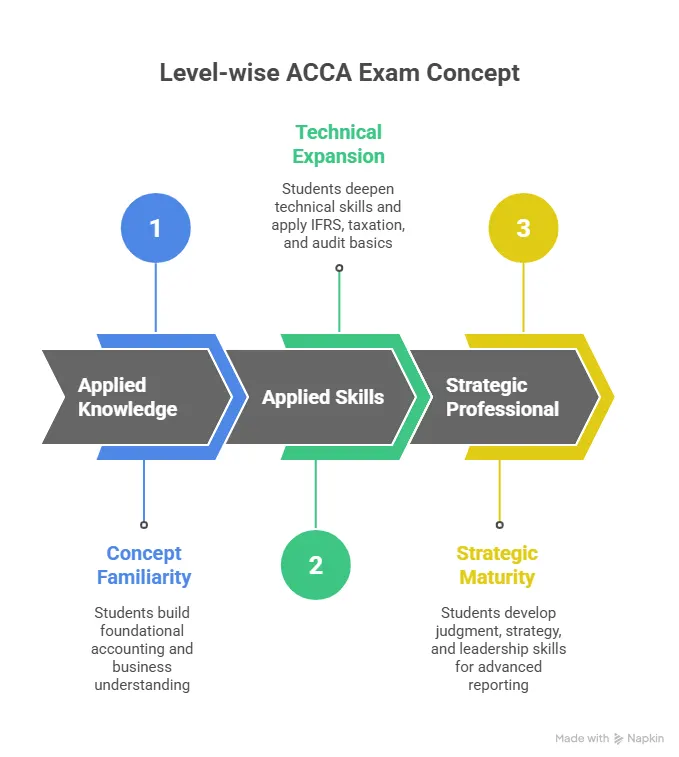
Level -Wise ACCA Exam Concept
  1. Applied Knowledge Level

The Applied Knowledge level introduces the essential foundations of accounting, business, and finance. These are the building blocks you will apply repeatedly in later papers.

Purpose of Level 1

  • Build fundamental business vocabulary.
  • Learn accounting basics clearly.
  • Understand organisational structure and processes.
  • Develop early confidence with computer-based exams.

Papers in Level 1

This table explains what each Applied Knowledge paper contributes.

PaperFull NameFocus Area
BTBusiness and TechnologyBusiness structures, corporate governance, people and systems
MAManagement AccountingCosting, budgeting, planning and performance concepts
FAFinancial AccountingRecording transactions, preparing financial statements and core reporting logic

These exams are designed to be friendly for beginners. Even students without a commerce background can pick up the pace because the content is structured logically.

  1. Applied Skills Level

This level forms the technical heart of the ACCA Exam. The papers here reflect the responsibilities that entry-level and mid-level finance professionals handle in companies.

Purpose of Level 2

  • Push your technical reasoning.
  • Strengthen IFRS interpretation.
  • Build analytical thinking for management decisions.
  • Introduce law, taxation and audit with practical relevance.

Papers in Level 2

This table offers a detailed view of each Applied Skills paper so students can understand what to expect.

PaperFull NameFocus Area
LWCorporate and Business LawLegal environment, contract law, company law and regulatory frameworks
PMPerformance ManagementCosting techniques, variance analysis, decision support and performance evaluation
TXTaxationDirect and indirect tax systems and computation logic
FRFinancial ReportingIFRS-based reporting, adjustments and interpretation of financial statements
AAAudit and AssuranceAudit process, risk assessment and assurance principles
FMFinancial ManagementInvestment appraisal, working capital management, risk and return fundamentals

This level introduces deeper problem-solving. Students begin to think like analysts, auditors, managers and reporting specialists. The ACCA Exam starts becoming more scenario-oriented here.

  1. Strategic Professional Level

This is the final stage of your exam journey. The papers here resemble real corporate challenges. You will think like a business leader, risk evaluator, financial reporter and strategic planner.

Purpose of Level 3

  • Build advanced professional judgment.
  • Combine ethical thinking with strategic options.
  • Interpret financial statements with high-level accuracy.
  • Analyse business scenarios in a leadership context.

Papers in Level 3

This table breaks down the Strategic Professional papers.

CategoryPaperFull NameFocus Area
EssentialsSBLStrategic Business LeaderBusiness leadership, governance, strategy and integrated decision making
SBRStrategic Business ReportingAdvanced IFRS application, complex reporting issues and professional judgment
OptionsAFMAdvanced Financial ManagementComplex financial management decisions and valuation
APMAdvanced Performance ManagementAdvanced performance evaluation and strategic analysis
ATXAdvanced TaxationHigh-level tax planning and advisory competencies
AAAAdvanced Audit and AssuranceComplex audit scenarios and advanced assurance techniques

Students choose two optional papers to unlock their ACCA career potential based on their goals. For finance roles, AFM is highly useful. For audit roles, AAA is valuable. For managerial paths, APM becomes a strong choice.


How the ACCA Exam Booking Process Works Step by Step

The ACCA Exam Booking process often confuses students when they attempt it for the first time. The booking window for each session opens on specific dates, which vary by season. The student must register on the myACCA portal, select the relevant exam session, choose the exam mode and confirm their payment method. Many candidates delay booking until the final week, which increases stress. A structured approach works better.

This list simplifies the entire exam booking flow that students follow on the myACCA portal.

  1. Create your myACCA account.
  2. Complete identity verification and initial registration.
  3. Log in and navigate to the Exam Entry section.
  4. Choose your exam session.
  5. Select specific papers from the exams list.
  6. Confirm location or remote mode.
  7. Review fee details.
  8. Complete payment.
  9. Receive confirmation email.
  10. Save your invoice for official records.

Students who follow this structure do not run into unexpected issues. It is also sensible to complete your exam Booking step at least 20 to 25 days before the deadline because payment gateways sometimes lag during high traffic days.


Understanding the ACCA Exam Timetable and Yearly Cycle

The ACCA Exam timetable is set quarterly. March. June. September. December. These four points in the calendar create a predictable rhythm for both working professionals and full-time students. The timetable is usually stable year after year.

For planning purposes, here is a simplified general layout. This table illustrates the typical ACCA Exam timetable pattern that appears every year. Use this model to estimate your study cycles. Actual dates vary slightly each year.

QuarterTypical Exam WindowNotes
March SessionWeek 1 to Week 2 of MarchEarly-year attempts often attract fresh graduates
June SessionWeek 1 to Week 2 of JunePopular among students balancing internships
September SessionWeek 1 to Week 2 of SeptemberGood window for retakes and skill building
December SessionWeek 1 to Week 2 of DecemberHeavily booked by working professionals

The ACCA Exam Dates for each session are published by the organisation on official announcements every year. Students should keep a calendar on their devices that includes the important dates, fee deadlines, and result release days. This habit alone improves exam readiness significantly because mental clarity reduces anxiety.


How ACCA Mock Exams Transform Exam Performance

ACCA mock exams are one of the strongest predictors of actual results. Students who attempt at least four full-length mocks per paper usually score higher. This pattern comes from my internal mentoring logs collected over many years. The logic is simple. 

A mock replicates the mental fatigue and decision-making chain that a student faces during the real ACCA Exam. If the student completes enough mock exams, the brain develops familiarity with pressure.

→ Familiarity reduces cognitive friction, which boosts performance.

Here is a short list explaining how to use ACCA mock exams effectively.

  1. Attempt one diagnostic mock before starting deep study for the paper.
  2. Attempt two timed mocks after completing 60 per cent of the syllabus.
  3. Attempt one final full mock five days before exam day.
  4. Review answers line by line and prepare a small mistake log.
  5. Practice professional marks especially for SBL and SBR.

Professional marks account for a surprising portion of final grades in higher-level papers. Students should not neglect them. This video explains the detailed exam plan for students preparing for ACCA and gives key insights to sail smoothly on the journey:


Smart Planning for the ACCA Exam

The ACCA Exam requires a calm but strategic study schedule. Many students assume they must study for endless hours, but the real secret is to manage energy more than time. When planning, divide your timeline into three phases. Concept building. Problem practice. Examination conditioning.

Phase 1. Concept Building

Spend the first section of your timeline reading course notes, listening to faculty sessions, summarising chapters, solving basic questions and revisiting your summaries. Concept building is about expanding your working memory for key ideas like IFRS treatments, audit assertions, corporate law principles and costing logic.

Phase 2. Problem Practice

In this stage, tackle past papers, revision kits, numerical sheets and case study drills. Most students improve significantly when they time themselves for every question. The ACCA Exam rewards structured problem-solving. For instance, Performance Management often tests logic around variances rather than mechanical calculation. Financial Reporting tests the interpretation of adjustments. Audit papers test your ability to evaluate risk triggers. Practising questions builds these judgment skills.

Phase 3. Examination Conditioning

This is the phase that most competitors avoid explaining in depth. Examination conditioning means building your mental stamina for the ACCA Exam. You must recreate exam day conditions with strict timing, zero interruptions and a clear plan for reading questions. Students who complete this stage have a sharper edge than peers who rely solely on content memorisation.
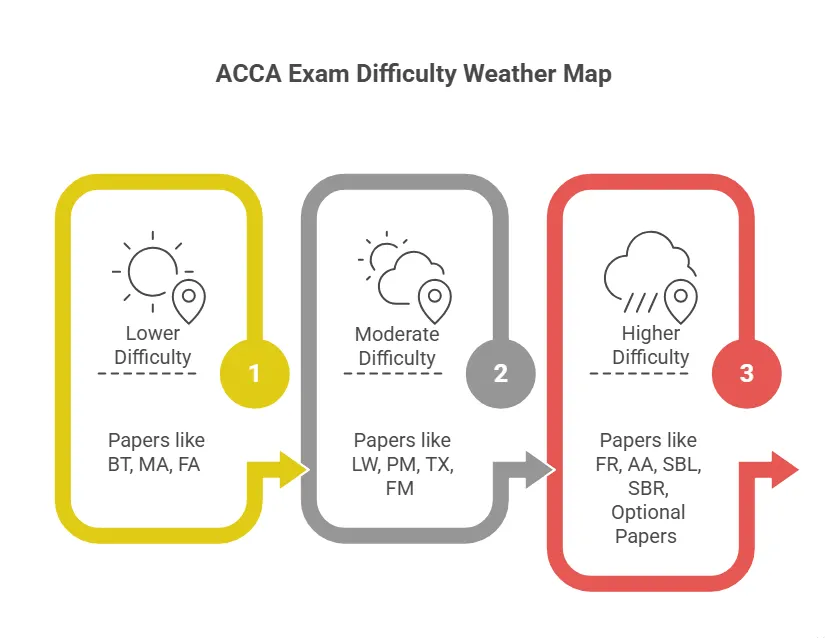
ACCA Exam Difficulty Weather Map

How to Prepare Well for the ACCA Exam?

One of the most powerful yet underused methods for preparing for the exams is the creation of memory palaces and cognitive anchors. These tools help you recall frameworks within seconds. For example, in an audit, you can create a memory palace where each room represents a stage of the audit cycle.

In financial reporting, you can place IFRS adjustments at visual points in your report. This technique is widely recommended in cognitive science papers.

Students who design memory cues tend to retrieve concepts like impairment rules, tax calculations or risk evaluation methods faster during the exams. When a time-bound question appears, quick recall increases confidence.

  1. How to Read Questions Correctly During the ACCA Exam

Students often misread questions during the ACCA Exam because of anxiety or speed pressure. Reading the requirement carefully is half the battle.

For example:

→ In long case studies, students should read the final requirement lines first so they understand what the examiner is looking for.

→ In computational questions, reading the scenario twice prevents small mistakes.

Below is a checklist that reduces exam day errors. This checklist helps students approach the exam requirement lines correctly.

  1. Identify command words such as evaluate, explain, calculate and illustrate.
  2. Break the requirement into smaller parts.
  3. Match each part to a section of your answer.
  4. Highlight data points during reading.
  5. Allocate time proportionally to marks.

This technique ensures clarity during the exams.

B. Avoiding the Most Common Mistakes Students Make in ACCA Exam Preparation

Many students struggle with repeated issues which can be prevented with awareness. These challenges usually appear across papers. Here is a list of widespread mistakes encountered while preparing for the ACCA Exam.

  1. Over-reliance on passive reading instead of active practice.
  2. Neglecting professional marks in SBL and SBR.
  3. Avoiding mock exams due to fear of low scores.
  4. Studying without a timetable.
  5. Focusing on the wrong chapters because of advice from peers.
  6. Not tracking errors.
  7. Hoping for easy topics instead of building a deep understanding.

This exam rewards consistent effort rather than last-minute memorisation.

C. How to Select the Right Paper Combination Each Session

Students sometimes take too many papers at once during the ACCA Exam cycle. While ambitious attempts can work, it is often more productive to choose combinations that complement each other.

For example, combining Financial Reporting with Audit and Assurance creates a natural overlap because both share concepts around materiality, interpretation and controls. 

Similarly, combining Performance Management with Financial Management helps reinforce internal logic around costing and investments.

Planning combinations smartly reduces the cognitive load on your brain. It also increases your chance of success with effective preparation strategies since your study time is better aligned.


Watch this video, which shares very practical and insightful strategies to help you ace those ACCA papers with precision:


Why choose Imarticus Learning for your ACCA journey

When you decide to take the ACCA Exam, the choice of institution matters a great deal. At Imarticus Learning, you’ll find a set of advantages built specifically to support success in the ACCA course preparation journey. Here are the main reasons:

  1. Industry-led programme in collaboration with KPMG
    Imarticus Learning offers the ACCA programme in collaboration with KPMG in India. This directly supports your exam preparation by aligning your study with how large firms operate.
  2. Joint certification plus ACCA qualification
    Completing the programme not only prepares you for the exams. You also receive a joint certification (with KPMG in India), which enhances your profile. This extra credential gives you a competitive edge when applying for roles after your ACCA qualification.
  3. Gold status learning partner of ACCA
    Imarticus Learning is a gold-status learning partner of the Association of Chartered Certified Accountants, offering globally recognised ACCA training backed by expert faculty, high-quality content and strong support.
  4. Kaplan-powered content and resources
    The ACCA programme at Imarticus features study material developed in partnership with Kaplan Publishing, a leading ACCA-approved content provider. You gain access to books, question banks, practice papers, flashcards, videos and live classes.
  5. Internship or placement guarantee
    A distinctive USP: Imarticus offers an internship or placement guarantee. That means as soon as you start your preparation journey, you are supported not just in passing the exams, but also in transitioning into a career role.
  6. Flexible mode of learning
    For the ACCA, you need both flexibility and structure. Imarticus offers both online and offline classes, making it feasible for working professionals or full-time students alike. Their infrastructure supports the diversified needs of ACCA learners.

FAQs About the ACCA Exam

This section brings together the most frequently asked questions about the ACCA Exam. Each answer is written to simplify complex ideas, clarify misconceptions and guide learners with real insights.

What are ACCA exams?

The ACCA Exam consists of 13 professional papers that evaluate your readiness for global accounting and finance roles. Each paper tests a different area such as financial reporting, audit, taxation, corporate law and performance management.

Students progress through Applied Knowledge, Applied Skills and Strategic Professional levels. Many learners choose training support from Imarticus Learning because structured guidance often improves clarity during preparation. 

Is ACCA better than CA?

Students often compare qualifications, although the better choice depends on personal goals. ACCA offers global mobility with a curriculum designed around international reporting standards, strategy and business readiness. This makes it valuable for students who want to explore multinational roles. On the other hand, the Chartered Accountant route focuses heavily on national laws and regulations. 

What is an ACCA salary?

Salary ranges for learners who clear the exam vary based on country, industry and experience. Public reports shared by employment surveys show that fresh ACCA affiliates in India can expect salaries between 5 lakh and 8 lakh. Global salary data shared by industry sources indicates that candidates with three to five years of experience can earn significantly higher salaries depending on their role.

What are the 13 exams of ACCA?

The ACCA Exam contains 13 papers, which are divided into three levels. Applied Knowledge includes Business and Technology, Management Accounting and Financial Accounting. Applied Skills contains Corporate and Business Law, Performance Management, Taxation, Financial Reporting, Audit and Assurance and Financial Management. Strategic Professional includes Strategic Business Leader, Strategic Business Reporting and four optional advanced papers such as AFM, APM, AAA and ATX. Imarticus Learning helps learners navigate this entire structure with detailed study plans.

Can ACCA earn 1 crore?

Students who complete the ACCA often aim for senior positions in finance. Earning one crore annually is possible for professionals who reach leadership roles such as finance controllers, senior auditors, risk leaders or CFOs in large organisations. Global mobility also plays a role in salary growth. Many learners transition to international roles where compensation packages are higher.

Can I finish ACCA in 2 years?

Completing the ACCA Exam in two years is possible if a student maintains a highly disciplined study schedule. The exam sessions run quarterly, which allows motivated students to attempt multiple papers consistently. However, finishing all papers within two years requires clear planning, multiple mock exams and efficient time management.

Working professionals usually take a slightly longer timeline, but full-time learners with strong dedication complete the exams faster. Structured coaching support from Imarticus Learning can speed up the journey because guided study reduces trial and error.

Is ACCA hard or easy?

Many learners wonder whether the ACCA Exam is hard or easy. The difficulty depends on your study habits, understanding of concepts and consistency. The exam is designed to challenge your judgment and decision-making rather than your ability to memorise. Students who practice regularly, complete full mock exams and follow the exam timetable usually score well. 

How many attempts for ACCA in a year?

You are allowed four attempts each year because the sessions are held in March, June, September and December. Students can choose to attempt one paper or multiple papers in each session, depending on their readiness. Preparing with mock exams and reviewing the exam timetable ensures that students pick their attempts wisely. 

Is ACCA closing in 2026?

There is no public information or announcement that suggests the ACCA will close in 2026. The ACCA body continues to conduct exams globally and remains one of the largest accounting qualifications in the world. The ACCA adapts to global financial changes and updates its syllabus regularly to stay relevant. Students preparing now can confidently plan their journey across multiple sessions.

What is the 7-year rule in ACCA?

The 7-year rule applies only to the Strategic Professional level of the ACCA Exam. Once a student completes their first Strategic Professional paper, they must complete the remaining ones within seven years. This ensures that learners remain updated with evolving global financial standards. Imarticus Learning often guide students on how to plan their timeline effectively around this rule.


Moving Forward in Your ACCA Exam Journey

The ACCA Exam shapes your growth in a steady and meaningful way. As you move through the papers, your ability to analyse information, solve problems and make sound financial decisions becomes sharper. When you keep your study routine consistent and use mock exams to refine your approach, the entire qualification starts feeling more achievable.

Many learners find that clarity comes faster when their preparation is supported by dependable guidance. If you prefer studying in a structured environment with mentors who understand how the exam works, Imarticus Learning offers the direction and rhythm needed to stay on track for your ACCA course prep.

How I Passed All My ACCA Exams on the First Try – My Untold Story

The Journey to becoming a Chartered Certified Accountant (ACCA) is one that many aspire to, but few achieve with ease. With its demanding exams and rigorous curriculum, the ACCA qualification is known to challenge even the most dedicated students. 

However, passing all my ACCA exams on the first try was not only possible but also incredibly rewarding. I’m sharing my personal story and the strategies I used, hoping to inspire and guide others on this challenging path.

The ACCA Challenge: Understanding What Lies Ahead

The ACCA qualification is globally recognized, offering a deep understanding of accountancy, finance, and management. The program is structured into three levels: Applied Knowledge, Applied Skills, and Strategic Professional. Each level consists of exams that test different aspects of accounting, from financial reporting to performance management.

If you want to study ACCA courses, you must pay different fees at different stages. 

Here are the ACCA exam fees that you’ll need to pay:

Registration and Subscription Fees

  • Initial Registration: £89
  • Re-registration: £89
  • Annual Subscription 2024: £134

Exemption Fees

An exemption fee applies for each ACCA exam from which you are awarded an exemption:

  • Applied Knowledge Exams: £86
  • Applied Skills Exams: £114

Exam Fees

An exam entry fee is required for each exam you register for.

Please note that if you are taking examinations at a special center, you must pay any additional local invigilation and accommodation fees.

The Power of Planning: A Roadmap to Success

One of the most crucial elements of my success was planning. Without a clear plan, it’s easy to feel overwhelmed by the sheer volume of material. Here’s how I approached my ACCA studies with a detailed and focused plan.

  • Setting Clear Objectives

  • Define Your Goals: I set achievable goals before diving into the coursework. I broke down the 13 exams into smaller milestones, which made the process feel less daunting and more manageable.
  • Understand the syllabus: I spent time understanding the syllabus for each exam. This allowed me to prioritize my study efforts on the most challenging areas.
  • Crafting a Study Schedule

  • Daily Routine: Consistency was key. I established a daily study routine that suited my natural rhythms, focusing on the most challenging subjects when I was most alert.
  • Weekly Check-Ins: I reviewed what I had learned each week, reinforcing my understanding and highlighting areas that needed more attention.
  • Balancing Work and Study

  • Effective Time Management: Balancing a full-time job with ACCA studies requires careful time management. I used tools like planners and calendars to keep track of my commitments and ensure I was making steady progress.
  • Strategic Breaks: I also understood the importance of taking breaks. Regular, short breaks helped me maintain focus and prevent burnout.

Leveraging Quality Study Materials

Success in ACCA exams requires more than hard work; it demands smart work. I didn’t rely on just one resource but used various study materials to deepen my understanding and prepare.

  • Textbooks and Study Guides

  • Official ACCA Resources: The official ACCA textbooks were my primary study materials. They are specifically designed to cover the syllabus and provide a strong foundation for each subject.
  • Additional Guides: I supplemented these with additional study guides and revision kits. These resources often included practice questions and tips that were invaluable for exam preparation.
  • Utilizing Online Resources

  • ACCA Website: The ACCA website offers many resources, including past exam papers, examiners’ reports, and technical articles. These materials were crucial in understanding the examiners’ expectations.
  • Video Tutorials: For complex topics, I turned to online video tutorials. Visual explanations helped clarify difficult concepts and provided alternative perspectives on the material.
  • Practice Makes Perfect

  • Past Papers: Practicing past exam papers was one of my most effective strategies. It familiarized me with the exam format and allowed me to identify weak areas early on.
  • Mock Exams: I also took several mock exams under timed conditions. This practice helped me manage my time during the actual exams and reduced anxiety.

Understanding the ACCA Exam Levels

  • Applied Knowledge Level
    All three exams at this level are entirely multiple-choice questions (MCQs), with a passing score set at 50%.
  • Applied Skills Level
    The Corporate and Business Law exam is 100% objective questions (OTQs) and requires a 50% score to pass. The other five exams—Financial Management, Financial Reporting, Performance Management, and Taxation—feature a blend of 60% OTQs and 40% subjective questions. Each exam requires a minimum pass mark of 50%.
  • Strategic Professional Level
    All four mandatory and optional exams are fully subjective at this level, with a passing mark of 50% for each.

Understanding the ACCA exam pattern structure is crucial for those aiming to become recognized professionals in the global accounting arena. With a focused approach and commitment to diligent study, candidates can confidently tackle all levels of the ACCA exams.

Maintaining Motivation

The mental aspect of preparing for ACCA exams is just as important as the academic preparation. Staying motivated over a prolonged period was challenging, but I developed strategies to keep my spirits high.

  • Focus on the End Goal
  • Reward System
  • Support Network
  • Learn from Mistakes
  • Resilience

Exam Day: Strategy and Execution

When the exam day arrived, I approached it confidently and clearly. 

Here’s how I ensured I was ready to perform at my best.

  • Pre-Exam Preparation

  • Get Enough Sleep: I slept a full night before the exam. Being well-rested helped me stay sharp and focused during the test.
  • Healthy Breakfast: A nutritious breakfast provided the energy I needed to stay alert throughout the exam. I avoided heavy or sugary foods to prevent any post-meal drowsiness.
  • Exam Strategy

  • Time Management: During the exam, I carefully managed my time. I started with confident questions, which helped build momentum and allowed more time for challenging questions.
  • Stay Calm: If I encountered a difficult question, I didn’t panic. I skipped it and returned to it later, ensuring I didn’t waste time and could address all questions.
  • Post-Exam Reflection

  • Review and Learn: I reflected on how it went after each exam. This reflection helped me identify areas for improvement and apply those lessons to future exams.

Success: Becoming ACCA Certified

The day I received my results was one of the most gratifying moments of my life. Passing all my ACCA exams on the first try was a testament to my hard work, preparation, and determination.

  • Celebrate Your Achievements

  • Acknowledge the Journey: I celebrated my success with those who supported me. Recognizing the effort and sacrifices made the achievement even more meaningful.
  • Looking Ahead

  • Career Advancement: With the ACCA qualification, I was ready to take the next step in my career. The opportunities that opened up were exciting, and I felt well-prepared to excel in my chosen field.
  • Lifelong Learning: The ACCA qualification is not the end of the road. The finance and accounting world constantly evolves, and I am committed to continuous learning and professional development to stay ahead.

Lessons for Aspiring ACCA Students

As I share my story, here are some key takeaways for those of you who are on the path to ACCA qualification:

  • A well-structured study plan is essential for success. Understand the syllabus, set clear goals, and stick to your study schedule.
  • Use a combination of textbooks, online resources, and practice papers to prepare for each exam thoroughly. The right materials can make a significant difference.
  • Motivation and resilience are just as important as academic preparation. Stay positive, surround yourself with supportive people, and don’t let setbacks discourage you.
  • On exam day, manage your time effectively and stay calm. Trust in your preparation and focus on doing your best.
  • Passing the ACCA exams is a remarkable achievement. Celebrate your success, but continue to pursue opportunities for growth and development in your career.

The ACCA qualification is not the end of the road. The finance and accounting world constantly evolves, and commitment to continuous learning and professional development is needed to stay ahead.

Final Words

Passing all my ACCA exams on the first try wasn’t just about working hard—it was about working smart. It required careful planning, effective use of resources, mental resilience, and strong support.

For those of you pursuing the ACCA qualification, know it’s possible to achieve your goals with the right approach. The Journey may be challenging, but the rewards are worth it. 

Advance Your Accounting Career with ACCA – Today!

When you enroll in the ACCA course, you’re not just signing up for a course – you’re securing a career. They offer a 100% placement guarantee upon completing even the first two levels of ACCA. You can claim a full refund if you don’t secure a placement or internship. 

The ACCA curriculum offers unconditional and unlimited guarantee to coach you until you pass the ACCA exams. You can retake the entire program and all sessions as many times as needed, at no extra cost, until you succeed.

ACCA course materials include everything you need to succeed: ACCA books, question banks, practice papers, MCQs, flashcards, learning videos, live classes by ACCA-certified faculties, and on-demand sessions by international ACCA trainers. 

Enroll in the ACCA course today and secure your future with our guaranteed placement and success-oriented approach!

Advancing Your Accounting Career with ACCA Exam

A significant aspect of financial stewardship, accounting professionals play a crucial role in any organisation. They enable businesses to focus on their development and growth. Notably, over 79,600 additional financial auditors and accountants will be required from 2019 to 2028, as per IRCC. Considering the increasing job opportunities, it is a good idea to explore a career in accounting or advance your career with ACCA certification. Read ahead to learn more about ACCA, its advantages and how pursuing an ACCA course can help get the globally recognised certification.  

What is ACCA?

The ACCA certification is one of the leading accountancy qualifications in the world. Acquiring this certification can help students or aspiring financial professionals gain the necessary knowledge, skills, and values to be successful in the domain of accounting. Also, existing accounting professionals can get on this journey of acquiring the ACCA certification so that they can get into leadership roles to strategically drive organisations into the future.

Aspirants can achieve the ACCA Qualification in a minimum of three years, if they:

  • Complete a maximum of 13 exams which depend on their previous qualifications
  • Complete an ethics and professional skills module
  • Have three years of work experience in a relevant role

If you don’t have the above-mentioned qualifications, then you can pursue Foundations in Accountancy qualifications first and then move on with the ACCA Qualification. 

Besides, anyone can pursue ACCA membership irrespective of his/her existing qualifications or work experience. If an aspirant has two A levels and three General Certificates of Secondary Education (GCSEs) in five separate subjects including English and mathematics or equivalent qualifications, then he/she can begin studying at the ACCA Qualification and become an ACCA member upon completion of this master’s level qualification.  

Becoming an ACCA member after the competition of the ACCA Qualification not only makes you a part of the network with more than 200,000 members, but also helps you develop the necessary skills to work in any sector across the world. 

Notably, ACCA members who are known to hold international accounting standards, enjoy the reputation of forward-thinking finance professionals. That is why, employers trust them the most.  

ACCA Certificate

Benefits of ACCA Certificate

While better job opportunities and improved earning potential are some of the major reasons to pursue the ACCA certification, let’s learn about other advantages that aspirants can get.

  • Preparing you for the corporate world, the course helps you acquire transferable skills like time and task management. Also, critical business information is imparted in order to meet the demands of the dynamic financial sector. From strategic corporate leadership to management accounting, accounting professionals learn different concepts that help them take up varied job roles.
  • Pursuing an ACCA course can help you shine in the crowd by instilling a strong business and accounting understanding. The ACCA certificate will let you prosper in the highly competitive job market.
  • The ACCA journey opens up networking possibilities with agencies worldwide. ACCA members get to meet people with similar interests. They also get opportunities to connect with businesses aligned with their competence and needs. Notably, American Express Services Europe, Accenture, and Apex Group are amongst ACCA Approved Employers.
  • ACCA membership offers instant recognition to get employed by big players in different markets. It allows your resume to create a good first impression in employers’ eyes.

Conclusion

By and large, ACCA certification holds immense significance for ambitious accounting professionals. The qualification not only exposes you to varied job opportunities, but also prepares you for a long and prosperous career. If you have any queries related to a career in accounting, ACCA course or ACCA course fees, then reach out to Imarticus Learning.  

Discussing the 9 ACCA Exams: A Complete Breakdown

Before you can master strategy and leadership, you first need to build the core skills that define a world-class finance professional. The 9 ACCA exams form this foundation; they’re where every ACCA journey begins. Covering areas like business technology, performance management, taxation, and financial reporting, these papers shape your understanding of how organisations operate, make decisions, and maintain financial integrity.

Together, the 9 ACCA exams under the Applied Knowledge and Applied Skills levels act as the building blocks of the qualification. They ensure that before you move to the strategic stage, you’ve already developed the analytical, technical, and ethical mindset that the ACCA qualification is known for.

In this guide, I’ll walk you through each of these ACCA exams: what they cover, how they connect to real-world finance, and how you can prepare effectively to clear them with confidence.


What Is ACCA? How Do ACCA Exams Build the Foundation for a Global Finance Career?

Whenever someone asks me, “What is ACCA?” I tell them to picture a skyscraper. You can’t build something tall and enduring without a solid base, and that’s exactly what the Association of Chartered Certified Accountants (ACCA) gives you in your finance career. Each of the ACCA exams acts like a floor in that structure: carefully planned, skillfully layered, and designed to take you higher, one level at a time.

The ACCA course is one of the most respected global credentials in accounting and finance. It’s recognised in over 180 countries, trusted by top employers, and valued by professionals who want to go beyond bookkeeping to real financial leadership. Through its structured pathway, from Applied Knowledge to Strategic Professional, ACCA trains you to understand how businesses actually work: how money moves, how value is created, and how ethical decisions shape organisations.

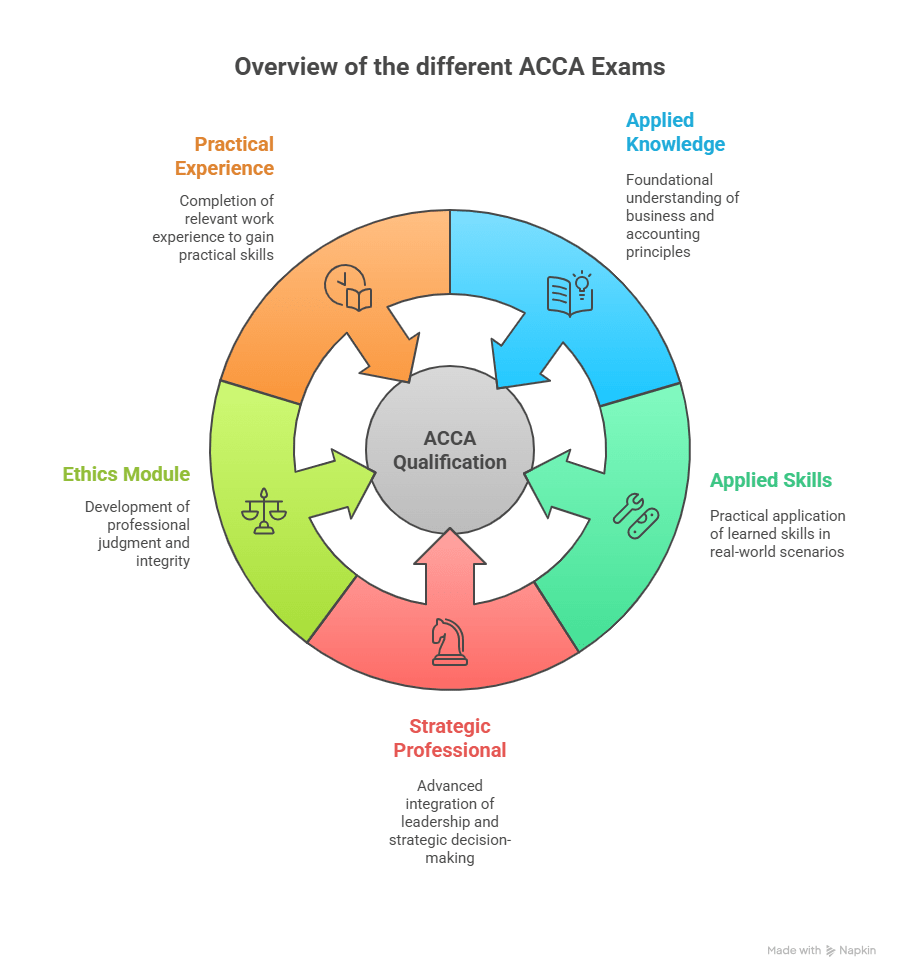
Here is a visual overview of the various ACCA exams that you have to master as you sign up for this credential. Each of these is discussed in detail as we move ahead in this blog.

Overview of ACCA Exams.webp

Overview of the different ACCA Exams

The foundation begins with concepts like business and technology, performance management, and financial reporting. As you move up, you reach the strategic levels, where you’re learning to think like a CFO, design global strategies, and advise on financial decisions that can transform entire companies.

To simplify, imagine building a skyscraper in a fast-growing city. You need architects, engineers, planners, and strong materials. In the same way, the ACCA exams equip you with technical knowledge, analytical tools, and ethical grounding, the essential materials to build a career that stands tall in any economy.

But what makes ACCA special is how universal it is. Whether you study in Mumbai or Manchester, the standards are the same. It prepares you not just to do accounting, but to understand business; a language that every global organisation speaks.


Watch this video to get a thorough understanding of what the ACCA qualification means for a global finance career:


Structure of ACCA Exams

The structure of ACCA exams is designed to take you from mastering the fundamentals of accounting to becoming a strategic finance leader. Instead of overwhelming students with theory, ACCA builds knowledge in progressive layers, starting with core business concepts and gradually moving into complex analysis, reporting, and decision-making.

The qualification is divided into three key levels:

  • Applied Knowledge
  • Applied Skills
  • Strategic Professional

Each serves a specific purpose in shaping your professional capability. The early levels focus on understanding how businesses function and how financial systems work, while the later ones prepare you to interpret, advise, and lead with financial insight.

LevelNo. of PapersExam ModeFocus Area
Applied Knowledge3Computer-BasedCore business & financial literacy
Applied Skills6Computer-Based / Paper-BasedPractical accounting and financial management
Strategic Professional4Computer-BasedAdvanced strategy, leadership, and reporting

The first 9 ACCA exams cover everything from business technology to taxation and audit. These aren’t just subjects; they’re simulations of real-world decision-making.


Breakdown of the Applied Knowledge Level

The Applied Knowledge Level is where every ACCA journey begins,  covering the fundamentals of business, management accounting, and financial reporting. These initial ACCA exams build the conceptual base for everything that follows.

While there are some challenging ACCA subjects, consistent practice, smart time management, and guided mentoring make mastering this level completely achievable.

Paper F1 (BT): Business and Technology

This paper introduces you to the modern business ecosystem. You learn not just accounting systems, but how technology, governance, and ethics shape a company’s financial behaviour.

For example, understanding how automation changes auditing standards isn’t theoretical; it’s a real scenario many ACCA candidates face in their first roles.

Skills built:

  • Understanding business structures
  • Recognising ethical dilemmas
  • Using digital tools for finance

Paper F2 (MA): Management Accounting

This one turns you into the “numbers whisperer.” You’ll build models to help managers plan budgets, analyse costs, and optimise performance.

To visualise it: if a company produces 10,000 units and wants to find its break-even point, you’ll be the one designing that cost model.

What you’ll master:

  • Budgeting and variance analysis
  • Decision-making with cost behaviour
  • Short-term vs long-term financial planning

Paper F3 (FA): Financial Accounting

You’ll dive into the language of business and accounting standards. This ACCA exam trains you to prepare and interpret financial statements that investors and auditors rely on.

Core ConceptsPractical Use Case
Double-entry bookkeepingMaintaining general ledgers
IFRS and IAS complianceCorporate reporting
Trial balance and adjustmentsFinancial accuracy

Takeaway → If you’ve ever looked at a balance sheet and wondered, “How does this all connect?”, F3 is where you learn that logic.


Breakdown of the Applied Skills Level 

Once you’ve laid your foundation, the next six ACCA exams (F4–F9) focus on decision-making, ethics, taxation, and reporting.

Paper F4: Corporate and Business Law (LW)

Law is the invisible skeleton of every business. In this paper, you’ll understand contracts, company structures, and liabilities. Knowing when a company director is legally accountable or how to interpret regulatory updates is key for global accountants.


💡 Fun fact: Over 70% of corporate disputes involve contract ambiguity; ACCA equips you to prevent those before they happen.
Source: IFAC Legal Insights Report


Paper F5: Performance Management (PM)

Imagine running a business unit. How do you know if your team is performing efficiently? F5 trains you to measure that using quantitative and qualitative performance indicators.

You’ll build metrics, interpret variances, and link performance outcomes to business strategy.

What makes this ACCA exam important:

  • Real-world case analysis
  • Use of key performance ratios
  • Scenario-based decision frameworks

Paper F6: Taxation (TX)

If finance is a body, taxation is its circulatory system. This paper takes you through how tax systems operate: personal, corporate, and international.

You’ll learn:

  • Income tax computations
  • VAT and corporate tax planning
  • Ethical considerations in tax management

For example, when advising an SME on depreciation or allowable expenses, the principles from F6 decide the financial strategy.

Paper F7: Financial Reporting (FR)

The FR paper is where you become fluent in IFRS. You’ll learn to consolidate statements, interpret financial disclosures, and apply international accounting standards.

ACCA Subject Highlights:

  • Frameworks for financial reporting
  • Consolidated accounts and disclosures
  • Interpretation of statements for decision-making

Paper F8: Audit and Assurance (AA)

In today’s data-driven world, auditors are the gatekeepers of trust. This paper teaches you how to evaluate evidence, understand audit risks, and build internal control systems.

Exam focus:

  • Audit procedures and sampling
  • Internal control evaluation
  • Auditor’s ethical responsibilities

Paper F9: Financial Management (FM)

This ACCA exam is the bridge between theory and boardroom decisions. You’ll learn how to make financing, investment, and dividend decisions under uncertainty.

Key ConceptsApplication in Business
Cost of capitalDeciding between debt vs equity
Investment appraisalEvaluating new projects
Risk managementHedging and sensitivity analysis

Real-World Application: From Classroom to Career

Here’s a practical example:
Imagine you’re analysing whether your company should acquire a new warehouse.

  • F2 helps you model the cost.
  • F4 ensures your contract is legally sound.
  • F7 lets you account for the asset correctly.
  • F9 tells you if the investment is worth it financially.

That’s how the ACCA exam papers connect theory with strategy; one reason global employers trust this qualification.

Breakdown of the Professional Level of ACCA Exams 

If the first nine ACCA papers build your technical foundation, the Strategic Professional Level is where your skills meet leadership.
This level has four ACCA exams: two compulsory and two optional. Every ACCA candidate must complete these to earn the full certification.

Unlike the foundational levels that focus on what and how, this stage asks why. Why does a business pursue a certain strategy? Why does one reporting decision change investor perception? That’s the maturity ACCA expects at this level.

ACCA Subjects List: Strategic Professional Level

CategoryPaper Code & NameTypeExam Duration
Core PapersSBL – Strategic Business LeaderMandatory4 hours
Core PapersSBR – Strategic Business ReportingMandatory3 hours 15 mins
Optional PapersAFM – Advanced Financial ManagementChoose any 23 hours 15 mins
Optional PapersAPM – Advanced Performance Management
Optional PapersATX – Advanced Taxation
Optional PapersAAA – Advanced Audit and Assurance

📚 Source: ACCA Global Exam Overview

Strategic Business Leader (SBL)

If you could sit in a CEO’s chair for four hours, that’s what this paper feels like. It evaluates your ability to lead, make decisions under pressure, and communicate with clarity.

Instead of theoretical questions, you’ll be given a 20-page business case study with multiple exhibits like financial reports, news clippings, emails, and board notes. You must respond as if you’re a senior manager presenting to stakeholders.

You’ll be tested on:

  • Integrating strategy, leadership, and risk
  • Corporate governance and ethics
  • Business communication and stakeholder management

Strategic Business Reporting (SBR)

SBR is the evolution of the earlier Financial Reporting paper. But now, you don’t just prepare reports: you interpret, analyse, and justify reporting choices.

For example, you might need to explain how a company’s fair value adjustments impact investor decisions. That’s why employers value SBR; it shows your ability to defend financial logic at a leadership level.

Skill TestedExample Scenario
Ethical application of IFRSReporting mergers or asset impairment
Professional judgmentAdvising the board on disclosure impacts
Analytical communicationWriting investor reports or audit summaries

💡 Expert Tip for Learners:

When you plan your ACCA papers list, never attempt SBL and SBR together if you’re working full-time. Their integrated nature demands separate mental bandwidth. Instead, pair one core paper with one optional (like SBR + AFM).


Breakdown of the Optional ACCA Papers 

Every business needs different kinds of financial minds: strategists, auditors, tax planners, or performance consultants. The optional ACCA exams let you specialise accordingly. 

AFM: Advanced Financial Management

Think of this as the paper for aspiring CFOs. You’ll learn capital structure planning, foreign exchange risk management, and advanced investment appraisal.
Real-world application? Evaluating whether your firm should issue bonds, seek equity funding, or hedge against currency exposure.

APM: Advanced Performance Management

This is for those who enjoy connecting numbers with strategy. You’ll study performance evaluation frameworks like Balanced Scorecards, strategic KPIs, and behavioural performance management.

🎓 In global corporates, APM-qualified professionals often move into Business Analyst or Management Consultant roles, bridging finance and strategy.

ATX: Advanced Taxation

Designed for tax specialists, this ACCA exam deep-dives into cross-border tax issues, inheritance tax, and group taxation. You’ll develop advisory skills to guide clients or employers on complex tax implications.

AAA: Advanced Audit and Assurance

If you’re drawn to risk, ethics, and forensic detail, this one’s for you. AAA tests how you handle complex audits, group audits, and assurance engagements beyond financial audits, such as ESG or sustainability assurance.

Global Career Paths After Each Optional ACCA Exam

The optional ACCA exams at the Strategic Professional level let you shape your career based on your interests: whether it’s financial management, auditing & taxation, or performance strategy. Each paper opens distinct global career paths, helping you specialise in the areas most valued by multinational firms and Big 4 employers.

ACCA PaperTop Global Career Roles
AFMCorporate Finance, Treasury, Investment Banking
APMPerformance Analyst, Strategy Consultant
ATXTax Consultant, International Tax Planner
AAAAudit Partner, Risk Advisory, Compliance Lead

Watch this video to explore free resources to help boost your ACCA preparations:


ACCA Exam Exemptions Explained: Who Can Skip Which Papers

One of the biggest advantages of the ACCA exams is that they recognise your prior qualifications. Depending on your background, you may be exempted from some or all of the nine Applied Knowledge and Applied Skills papers.

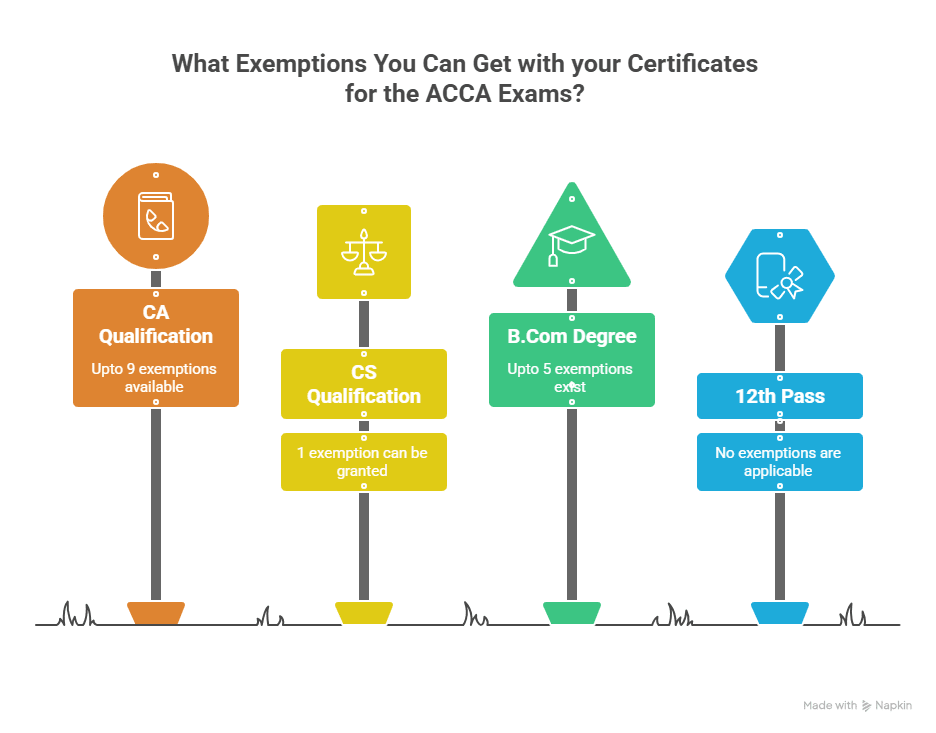
If you’re a Chartered Accountant (CA), Company Secretary (CS), or B.Com graduate, you could skip multiple foundational papers like Business and Technology (BT) or Financial Accounting (FA). Even certain postgraduate degrees in commerce or finance can grant exemptions, meaning you can fast-track your ACCA journey.

You can check your eligibility through the official ACCA Exemption Calculator, which matches your existing qualifications with applicable exemptions.

This system saves time, reduces costs, and lets experienced learners focus directly on higher-level ACCA exams that strengthen their global finance credentials.

Explore through this visual which ACCA exams you can get exempted from if you hold certain certifications:

ACCA Exam Exemption.webp

ACCA Exams Exemptions

ACCA Exam Structure

All ACCA exams are conducted four times a year in March, June, September, and December, and can be attempted through both computer-based testing and session-based exams, depending on location.

ACCA Exam TypeFormatPassing MarksDuration
Applied KnowledgeObjective + Case50%2 hours
Applied SkillsScenario + Short Questions50%3 hours
Strategic ProfessionalCase-Based50%3–4 hours

Key Takeaway → You can attempt a maximum of 8 papers a year, with up to 4 in one session. (Source)


Watch this video to explore the ACCA Exam Structure in depth:


Life After ACCA Exams

Today, the finance world is evolving faster than ever: automation, ESG reporting, fintech, and cross-border compliance are reshaping what it means to “work in finance.” And that’s where ACCA professionals stand out. With their deep grounding in international standards and practical decision-making, they aren’t just keeping pace, they’re driving the change.

Whether you see yourself decoding complex mergers, leading a risk advisory team at a Big 4 firm, or shaping financial strategy for a tech startup, your ACCA qualification gives you the flexibility and credibility to do it anywhere, from Mumbai to London to Dubai. According to the ACCA Global Talent Trends 2025, salaries reflect that global premium, with ACCA members often commanding higher packages for their analytical and cross-functional expertise.

But let’s go beyond the usual narrative of “career opportunities.” Here’s what the real landscape looks like today:

Top Career Roles After Completing ACCA Exams

Clearing your ACCA exams opens doors to some of the most rewarding roles in global finance. From auditing and taxation to financial strategy and consulting, here’s a look at the top career paths you can pursue after becoming ACCA-qualified.

Career PathCore ACCA Papers LinkedTypical Job Titles
Financial Reporting & AnalysisF3, F7, SBRFinancial Analyst, Reporting Manager
Audit & AssuranceF8, AAAAuditor, Internal Control Specialist
Tax & ComplianceF6, ATXTax Consultant, Compliance Officer
Investment & RiskF9, AFMTreasury Analyst, Risk Consultant
Strategy & PerformanceF5, APM, SBLBusiness Analyst, Strategy Lead

These roles often become stepping stones to Finance Controller, CFO, or Partner-level positions within 8–10 years.


ACCA Salary Trends in India and Abroad

One of the most common questions students ask after completing their ACCA exams is, “What kind of salary can I expect?” The truth is, your earning potential as an ACCA-qualified professional is shaped by a mix of factors like where you work, the industry you enter, and the experience you build.

In India, ACCA members often start with roles such as Financial Analyst, Statutory Auditor, or Tax Associate, earning competitive salaries comparable to Indian CAs.

Abroad, ACCA-qualified professionals are recognised across 180+ countries, including the UK, UAE, Singapore, and Canada. This international recognition translates into higher compensation bands and accelerated career mobility, particularly in finance hubs where global reporting and IFRS expertise are valued.

Below is a quick look at the average ACCA salary range after clearing ACCA exams:

CountryAverage Salary RangeTop Employers
India₹6 LPA – ₹25 LPAKPMG, Deloitte, EY, PwC
UK£35,000 – £70,000Barclays, BDO, HSBC
UAEAED 120,000 – AED 280,000EY, Mashreq, Emirates NBD
SingaporeSGD 45,000 – SGD 100,000DBS, OCBC, Accenture
CanadaCAD 60,000 – CAD 120,000RBC, TD, KPMG

Did you know? In 2025, almost 51% of people who took the ACCA Exams were mid-level management professionals. (Source)


Global Mobility and Demand for ACCA Professionals

The biggest value of the ACCA qualification isn’t just its depth,  it’s its passport. Unlike local certifications (such as CA or CPA, limited by geography), ACCA exams give you recognition with high-paying global finance jobs.

Countries where ACCA professionals are in high demand:

  • United Kingdom
  • India
  • Singapore
  • UAE
  • Canada
  • Malaysia
  • South Africa

Each of these markets values ACCA for one key reason: it aligns with International Financial Reporting Standards (IFRS), which are used by over 140 nations.


💬 “The digital landscape presents significant opportunities for accountancy and finance professionals to achieve meaningful work experiences – ones that are driven by purpose and which afford the potential to stretch oneself in new and fulfilling ways.”

Mark Millar, Head of Education Partnerships, ACCA Global (Source)


Why Choose Imarticus Learning for Your ACCA Journey

As you work through the phases of the ACCA course, you’ll quickly realise two things: one, that the exams demand more than rote learning; and two, that the environment you prepare in makes a huge difference.

Imarticus Learning helps you prepare not just for the papers, but for the role, and the fact that we partner with KPMG in India and integrate globally-recognised content adds real strength.

Imarticus ACCA Program Highlights:

  • Live mentorship by industry experts
  • AI-powered performance tracking
  • Kaplan-published content and mocks
  • Job assurance with top-tier firms
  • Option for full or hybrid learning
  • 100% Pass Guarantee and 100% Job Guarantee

FAQs About ACCA Exams 

The following section answers some of the most searched and frequently asked questions about ACCA exams: from exam structure and eligibility to exemptions, costs, and career scope. Whether you’re just beginning your ACCA journey or planning your next level, these FAQs cover everything you need to understand how the ACCA qualification works

What are the 13 exams in ACCA?

The ACCA Exams consist of 13 papers divided into three levels: Applied Knowledge, Applied Skills, and Strategic Professional.

  • Applied Knowledge: Business and Technology (BT), Management Accounting (MA), Financial Accounting (FA)
  • Applied Skills: Corporate and Business Law (LW), Performance Management (PM), Taxation (TX), Financial Reporting (FR), Audit and Assurance (AA), Financial Management (FM)
  • Strategic Professional: Strategic Business Leader (SBL), Strategic Business Reporting (SBR), and two optional papers from Advanced Financial Management (AFM), Advanced Performance Management (APM), Advanced Taxation (ATX), and Advanced Audit and Assurance (AAA).

Each paper is designed to progressively develop your technical and strategic expertise in accounting and finance. With Imarticus Learning, you get structured guidance, mentor-led sessions, and access to Kaplan study materials that help you master each of these 13 exams efficiently.

How many exams are there for ACCA?

There are 13 ACCA Exams in total, spread across foundational and advanced levels. However, depending on your prior qualifications (like a B.Com, CA, or CS), you may be eligible for exemptions for some ACCA papers. This flexibility allows professionals and students to fast-track their certification journey. To navigate these exemptions and design a smart study plan.

What are the 9 ACCA exams?

The 9 ACCA exams at the fundamentals level form the backbone of your accounting and business acumen. They include BT, MA, FA, LW, PM, TX, FR, AA, and FM. These exams test your grasp of concepts like management accounting, taxation, financial reporting, and business law. Scoring well at this stage requires consistency and clarity, both of which Imarticus Learning helps you build through live sessions, mock tests, and performance analytics.

What is an ACCA exam?

An ACCA exam is a globally recognised assessment conducted by the Association of Chartered Certified Accountants (UK). Each exam evaluates your theoretical understanding, analytical reasoning, and practical problem-solving abilities in accounting, audit, taxation, and finance. The exams are conducted quarterly, offering flexibility for working professionals. With Imarticus Learning’s online classes, you can prepare strategically for each exam cycle through a blend of live teaching, self-paced learning, and Kaplan’s adaptive resources.

Is ACCA costlier than CA?

The total cost of pursuing the ACCA qualification can range between ₹3–4 lakhs, depending on exemptions and exam attempt frequency. While this is generally higher than the initial CA registration costs, ACCA provides global recognition, access to international roles, and flexible scheduling. Imarticus Learning offers cost-effective ACCA training with EMI options and placement support, making international accounting education more accessible without compromising on quality.

What is the 7-year rule in ACCA?

The 7-year rule in ACCA Exams applies to the Strategic Professional Level, meaning you must pass all four professional papers within seven years of your first pass at that level. This ensures that your knowledge remains current and relevant to the evolving global accounting standards. 

Can ACCA earn 1 crore?

Yes, ACCA-qualified professionals can earn ₹1 crore or more annually, especially in senior finance, investment banking, and international audit roles. Salaries depend on experience, location, and domain specialisation. Firms like Big 4s (KPMG, Deloitte, PwC, EY) and multinational banks often seek ACCAs for leadership roles.

Can I finish ACCA in 2 years?

Yes, it’s possible to complete the ACCA Exams in two years if you plan effectively and qualify for a few exemptions. Most students, however, complete it in 2.5 to 3 years. A disciplined study plan and access to the right study material are key. Imarticus Learning’s structured training enables accelerated completion through expert mentorship, performance tracking, and focused revision cycles tailored for quick progression.

Is ACCA closing in 2026?

No, ACCA is not closing in 2026. The ACCA qualification continues to grow in global demand, with employers worldwide recognising its value. The association regularly updates its syllabus to reflect emerging trends in finance, technology, and sustainability. Imarticus Learning keeps its ACCA course aligned with these updates, ensuring students prepare for the most current exam structure and industry expectations.

Will ACCA be replaced by AI?

While AI and automation are transforming the accounting landscape, the ACCA qualification is evolving to include technology, data analytics, and sustainability reporting in its syllabus. This ensures ACCA professionals remain indispensable for strategic decision-making.

How many attempts for ACCA in a year?

Students can attempt ACCA Exams four times a year: March, June, September, and December. You can appear for up to four papers in one session and eight papers in a year, giving enough flexibility to manage your workload and goals. With Imarticus Learning’s expert support, students receive personalised guidance on when to appear for which paper to balance efficiency and exam readiness.

Is ACCA losing its value?

Absolutely not. The ACCA qualification continues to be one of the most globally respected accounting credentials, recognised in over 180 countries. As global financial systems become more complex, ACCA’s emphasis on ethics, technology, and strategic analysis makes it even more valuable today. 


Summing Up the ACCA Exams

The ACCA qualification isn’t just a set of exams; it’s a global benchmark that shapes accountants into strategic decision-makers. Each of the 9 ACCA exams builds essential skills in reporting, taxation, performance management, and leadership, creating professionals who can adapt to global standards and digital finance.

In today’s world of automation and analytics, ACCA-qualified professionals are valued for their ability to combine financial insight with ethical and technological awareness. It’s not just about passing exams; it’s about mastering a mindset built for the future of finance.

If you’re ready to take this step, the ACCA course offered by Imarticus Learning in collaboration with KPMG in India, with expert mentorship from industry leaders, is built to help you clear every paper confidently and launch a career that spans borders.