


Last updated on October 22nd, 2026 at 03:03 pm
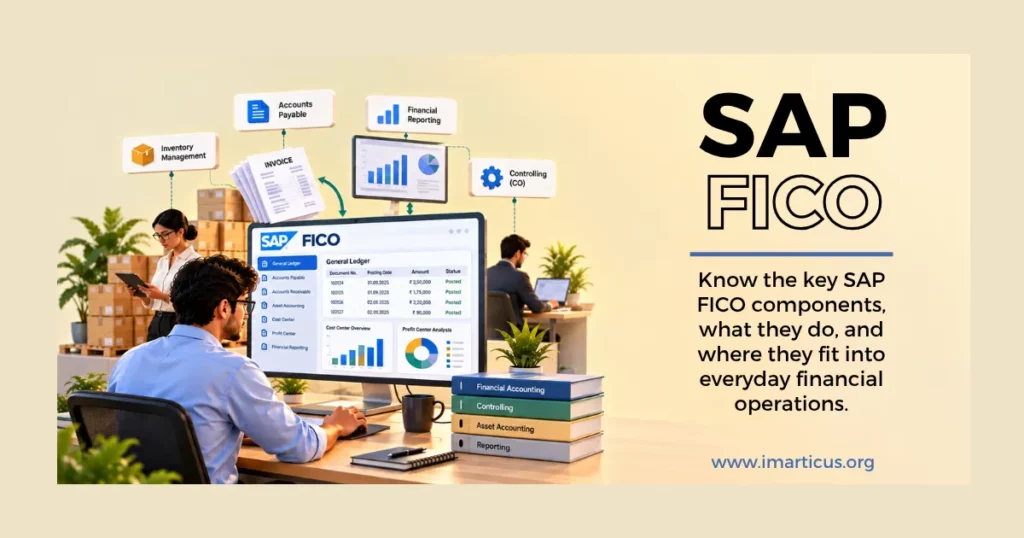
SAP FICO is the SAP system used to manage a company’s financial accounting and internal cost information. FI, or Financial Accounting, covers areas such as General Ledger, Accounts Payable, Accounts Receivable and Asset Accounting. CO, or Controlling, looks more closely at costs, cost centres, profit centres and profitability. In S/4HANA, the Universal Journal brings financial and management accounting information together, making it an important part of modern SAP Finance.
Learning SAP FICO is not just about knowing SAP transaction codes. You also need to understand accounting, financial statements and how everyday transactions affect a business. These skills can lead to roles such as SAP FICO consultant, finance systems analyst, ERP support professional and other finance-related positions.
A business does not record money just for the sake of keeping books. Every entry has a reason behind it. A supplier has to be paid, an employee cost has to be recorded, an asset has to be accounted for, and someone in management will eventually want to know where the money went. SAP FICO (Systems, Applications and Products in Data Processing Financial Accounting and Controlling) brings these finance activities into one system.
FICO covers two closely related areas. FI, or Financial Accounting, deals with the books and statutory reporting. CO, or Controlling, gives the business a closer look at costs, departments, profit centres and internal performance. Once you see that distinction, the SAP FICO meaning becomes much easier to grasp.
Consider a company buying new computers for its sales team. The purchase affects the supplier account, the company’s cash or payable balance and the asset records. The finance team may also need to assign the cost to the sales department. There are several pieces to the same transaction, and SAP FICO helps keep those pieces connected.
Don’t Let Our Best Advice Get Buried
Add Imarticus as a Preferred Source — see more of what we publish, every time you search.

That is the part of SAP FICO that deserves more attention than memorising transaction codes. A person working with the system needs to understand what the finance team is trying to record before deciding how it should be handled in SAP. In S/4HANA, the Universal Journal brings FI and CO information together at line-item level, which supports both financial accounting and management reporting.
The same point matters when you start looking at the career side. An SAP FICO consultant needs finance knowledge as well as SAP knowledge. Someone moving into this field may also build towards financial analysis, accounting, banking, risk or FinTech. If you are building a career around finance and technology, it also helps to look beyond one software skill. Strong financial analysis course can add knowledge in areas such as financial analysis, banking, fintech and risk. That wider knowledge becomes useful when you decide where you want your career to go.
What Is SAP FICO?
SAP FICO is the SAP area that brings together Financial Accounting and Controlling. The SAP FICO full form is SAP Financial Accounting and Controlling. Financial Accounting deals with the financial records of a business. Controlling deals with internal costs and performance. You can think of the difference through a simple question.
- Financial Accounting asks: What happened financially?
- Controlling asks: Where did the money go, and what does that tell us about the business?
That distinction makes the SAP FICO meaning much easier to understand. Consider a company that spends ₹5 lakh on advertising.
- The financial accounting side needs to record the expense correctly.
- The management accounting side may need to identify which department or business activity incurred that cost.
Both views matter. SAP’s current S/4HANA (Business Suite 4 High-Performance Analytic Appliance) learning material describes the Universal Journal as a central source for accounting-relevant transactions across Financial Accounting and Controlling.
SAP FICO Full Form Explained
The FICO full form in SAP is Financial Accounting and Controlling.
| Term | Full Form | Main Purpose |
| FI | Financial Accounting | Records external financial transactions |
| CO | Controlling | Analyses internal costs and performance |
| GL | General Ledger | Holds core financial accounts |
| AP | Accounts Payable | Tracks amounts owed to suppliers |
| AR | Accounts Receivable | Tracks amounts owed by customers |
The distinction matters when you study an SAP FICO course because FI and CO solve different finance problems. You should understand the reason behind each area before learning system steps.
Also Read: Accounting Ratios and Their Role in Financial Analysis
SAP FICO Module Structure
The SAP FICO module is commonly discussed as two connected areas: FI and CO. Financial Accounting covers the accounting records needed for financial reporting. Controlling gives management a way to examine costs and profitability inside the business. SAP’s current Financial Accounting learning path includes:
- General Ledger
- Accounts Payable
- Accounts Receivable
- Asset Accounting, closing and reporting.
Financial Accounting In SAP
FI deals with transactions that affect the financial records of the organisation. I would break the main areas down like this:
- General Ledger keeps the main financial accounts and supports the preparation of financial statements.
- Accounts Payable records supplier-related transactions and helps track amounts that the business needs to pay.
- Accounts Receivable records customer transactions and helps track amounts that customers still need to pay.
- Asset Accounting records assets such as equipment and supports their financial treatment over time.
- Bank-related processes help businesses record and reconcile transactions involving their bank accounts.
- Financial reporting turns recorded transactions into information that finance teams can review and use.
The value comes from the way these areas connect. A supplier invoice can affect an expense account and the supplier balance. A later payment changes the outstanding supplier amount. Both events remain part of the company’s financial record.
Controlling In SAP
CO deals with internal financial analysis. Cost centres are a good example. Imagine a company has separate sales, finance and human resources teams. The company pays ₹30 lakh in total staff costs. Management may want to know how much belongs to each department.
That is where cost allocation and cost centre information become useful. The main areas you may encounter include:
| CO Area | What It Helps Track | Example |
| Cost Centres | Department costs | Finance department expenses |
| Internal Orders | Costs for specific activities | Company event costs |
| Profit Centres | Business area performance | Regional business unit |
| Product Costing | Cost of producing goods | Manufacturing cost |
| Profitability Analysis | Profit by market dimensions | Product or customer profitability |
SAP’s current Management Accounting material includes overhead cost accounting, product cost planning, cost object controlling and profitability analysis. This is why a solid SAP FICO course syllabus should include both sides.
How SAP FICO Connects Finance Transactions
The easiest way to understand SAP FICO is to follow a transaction. Suppose a company buys a laptop for ₹80,000. The business needs to record the purchase. Someone also needs to know what the purchase means for the company’s accounts. If the laptop qualifies as an asset, it needs to be handled through the relevant asset process. Its value may then affect future depreciation.
Now take a different transaction. A customer buys goods for ₹1 lakh on credit. The company has earned revenue. The customer now owes money. When the customer pays, the outstanding amount needs to be cleared. These are simple accounting ideas. SAP gives businesses a structured system for recording and managing them.
The Basic SAP FICO Flow
A transaction usually follows a business process rather than existing as a standalone entry.
- A business event creates a financial transaction that needs to be recorded in the accounting system.
- Relevant organisational and master data tell SAP where the transaction belongs within the business.
- The transaction is posted to the relevant accounts using the configured accounting rules.
- The resulting information becomes available for financial reporting and internal analysis.
- Relevant cost information can also be used for management accounting and performance analysis.
- Finance teams review the resulting information during reporting and closing activities.
The exact steps depend on the transaction and system configuration. That point matters. A learner can memorise a transaction code and still struggle with a real finance problem. A learner who understands the accounting event can usually make much better sense of the system.
SAP FICO And S/4HANA
This is one area I would take seriously when choosing SAP FICO training. A lot of older material still explains SAP Finance through concepts associated with SAP ERP systems and ECC. Those concepts can still matter for understanding the subject. Your learning should also cover the current S/4HANA environment.
SAP’s S/4HANA Finance architecture uses the Universal Journal, with ACDOCA (Accounting Document Accounting, or more commonly known as the Universal Journal Entry Line Items Table) as its technical table. SAP describes it as the central line-item structure for Financial Accounting and Controlling data. That changes how you should think about finance data.
What Is The Universal Journal?
Imagine keeping separate notebooks for General Ledger, Controlling and several other accounting areas. You would need to bring information together when you wanted one complete view.
The Universal Journal gives S/4HANA a common line-item structure for several accounting components. SAP states that the Universal Journal supports areas including General Ledger, Asset Accounting, Controlling, Material Ledger and Profitability Analysis.
| Concept | Meaning | Why You Should Know It |
| Universal Journal | Common accounting data structure | Connects financial information |
| ACDOCA | Technical table for the Universal Journal | Stores actual accounting line items |
| General Ledger | Main financial accounting record | Supports financial reporting |
| Controlling | Internal management accounting | Helps analyse costs |
| Profitability Analysis | Analysis of profitable market areas | Supports management decisions |
The important lesson is simple. SAP FICO learning should now include S/4HANA concepts because SAP’s current finance architecture is built around this integrated data model.
Did You Know?
SAP describes the Universal Journal as a single source for accounting-relevant transactions across Financial Accounting and Management Accounting. It is technically represented by table ACDOCA. (Source)
SAP FICO Course Syllabus
The SAP FICO course syllabus should make sense from a finance point of view. I would start with accounting basics. Then move into FI. After that, study CO. S/4HANA should sit within that learning path rather than being treated as an unrelated topic. A useful syllabus can include:
| Learning Area | Topics | Practical Outcome |
| Accounting Basics | Debit, credit, journals and ledgers | Understand transactions |
| FI | GL, AP, AR and assets | Record financial activity |
| CO | Cost centres and profit centres | Track internal performance |
| S/4HANA | Universal Journal and reporting | Understand modern SAP Finance |
| Closing | Period-end activities | Support finance reporting |
| Reporting | Financial and management reports | Read business results |
SAP’s own beginner record-to-report course lists prior knowledge of basic financial concepts such as postings, debit and credit. That tells you something useful about the learning order. Accounting should come first. SAP comes next.
Also Read: What Are The Main Components Of Financial Literacy?
SAP FICO Course Duration
The SAP FICO course duration varies from one programme to another. Your existing finance knowledge also changes the amount of time you need.
Someone who already understands journal entries, ledgers, financial statements and cost accounting has a useful base. Someone starting from zero needs more time with those ideas. I would divide the learning into stages rather than focus only on the number of classroom hours.
Stage 1: Accounting Foundation
Learn the financial concepts behind the transactions. You should know why a debit and credit are posted and what happens to the financial statements.
Stage 2: FI Processes
Study General Ledger, Accounts Payable, Accounts Receivable and Asset Accounting. Follow complete transactions.
Stage 3: CO Processes
Move into cost centres, profit centres, internal orders and profitability analysis. Try to connect every topic to a management question.
Stage 4: S/4HANA
Study the Universal Journal, current finance processes and reporting. This gives your SAP FICO course details a modern context.
Also Read: What Are Index Funds India And How Do They Work?
SAP FICO Course Fees
SAP FICO course fees can differ because programmes offer different levels of support and practical access. I would check the course structure before looking at the fee. Ask yourself:
- Does the programme provide practical system access so you can perform transactions rather than only watch demonstrations?
- Does the SAP FICO course cover both Financial Accounting and Controlling in enough depth?
- Does the trainer explain the accounting effect of each transaction during practical sessions?
- Does the programme include S/4HANA content rather than relying only on older SAP examples?
- Are there assignments that require you to solve complete business scenarios?
- Is interview preparation included for people targeting entry-level SAP roles?
These questions give you a much clearer way to judge SAP FICO course fees.
SAP FICO Training And Practical Learning
Good SAP FICO training should make you work with transactions. Take Accounts Payable. You should know what a vendor invoice means before you learn how to enter it. Then you can follow the process from invoice to payment. The same approach works with Accounts Receivable.
Start with a customer invoice. Follow the outstanding amount. Record the receipt. Check the resulting account position. This method gives context to the system.
SAP’s current learning content uses transaction-based scenarios to explain how financial information enters the Universal Journal and becomes available for reporting.
Also Read: Why Is Financial Management Important For A Business?
SAP FICO Certification
An SAP FICO certification can show that you have studied a defined SAP Finance curriculum. It should still sit alongside practical skills.
SAP provides current learning journeys around Financial Accounting and Management Accounting in S/4HANA. Its Financial Accounting content includes organisational structure, master data, General Ledger, Accounts Payable, Accounts Receivable, Asset Accounting, closing and reporting. For a learner, this creates a useful checklist. You should be able to explain:
- How financial transactions enter the accounting system and become part of the company’s financial records.
- How the General Ledger connects with other finance processes during regular accounting and reporting activities.
- How supplier and customer transactions affect the financial position of a business.
- How Controlling adds internal cost and performance information to financial analysis.
- How S/4HANA uses the Universal Journal to connect financial and management accounting information.
That knowledge gives your certification preparation more substance.
SAP FICO Jobs For Freshers
Searches for SAP FICO jobs for freshers usually come from people who want to move from accounting into ERP work.
Your first role may not have the title you expect. You may find opportunities in finance operations, ERP support, SAP support, accounting systems or junior functional roles. The key skill is your ability to connect accounting with system processes.
SAP FICO Jobs For Freshers By Job Role
A fresher may enter SAP FICO through a regular finance job. Accounts, finance operations and ERP support can all lead towards SAP work, depending on what you handle on the job.
| Job Role | Typical Work | SAP FICO Skills You Can Use |
| Accounts Executive | Posting entries, checking invoices, handling receivables and payables | FI basics, GL, AP, AR |
| Finance Operations Associate | Payments, reconciliations, customer accounts and routine finance work | Accounting, SAP transactions, Excel |
| ERP Support Executive | Handling user issues and checking finance-related system entries | SAP basics, FI processes, troubleshooting |
| SAP FICO Trainee | Practising finance processes and assisting with basic project work | FI, CO, accounting concepts |
| Junior SAP FICO Consultant | Supporting testing, documentation, users and finance processes | FI, CO, SAP configuration basics |
| Finance Systems Analyst | Working with finance data, reports and ERP processes | SAP FICO, accounting, reporting |
For someone looking at SAP FICO jobs for freshers, the first job does not have to carry the SAP FICO title. What matters more is getting close to the finance processes that SAP handles. That experience can make the move into a dedicated SAP role much easier.
Suppose an interviewer asks why a customer payment has not cleared an outstanding invoice. A useful answer needs more than a definition of Accounts Receivable. You should be able to discuss the customer account, the payment, the open item and the clearing process.
That is the level of thinking you should build during SAP FICO training.
Also Read: What Are The Main Value At Risk Models?
SAP FICO Consultant Role
A SAP FICO consultant works with finance processes and SAP systems.
- The role can include requirements gathering, configuration, testing, issue resolution and user support.
- You may need to sit with a finance team and understand a problem in plain business language.
- You then translate that requirement into an SAP process.
SAP’s current implementation material covers organisational structure, company codes, ledgers, controlling areas and other settings that influence how finance processes work in S/4HANA. That gives you an idea of why configuration knowledge matters.
What A SAP FICO Consultant May Work On
- A consultant may study a finance requirement and identify the SAP process that can support the required business outcome.
- A consultant may configure relevant finance settings based on the organisation’s structure and accounting requirements.
- A consultant may test postings to confirm that the accounting result matches the expected business result.
- A consultant may investigate errors by checking master data, configuration and transaction details.
- A consultant may support finance users during implementation, testing, system changes and post-go-live activities.
Communication matters here. You may know the answer and still need to explain it to someone who does not work in SAP.
SAP FICO Salary
SAP FICO salary depends on several factors. Your experience matters. So does the role you enter, the employer, location, project exposure and depth of SAP knowledge.
I would avoid treating one online salary figure as a guaranteed outcome. The same applies to SAP FICO salary for freshers. A fresher entering finance operations will have a different profile from someone entering a junior SAP functional role. Their responsibilities can differ from the first day.
For a SAP FICO consultant salary, project experience can become important as your career develops. The skills that can influence your progression include:
- Strong accounting knowledge helps you understand financial transactions and explain their effect during SAP implementation and support work.
- FI knowledge helps you work with General Ledger, Accounts Payable, Accounts Receivable and Asset Accounting processes.
- CO knowledge helps you discuss internal costs, cost centres, profit centres and profitability.
- S/4HANA knowledge gives you a clearer view of the current SAP Finance architecture and data model.
- Communication skills help you work with finance users, technical teams, managers and other project stakeholders.
SAP FICO Salary By Role
SAP FICO salary can look quite different from one job to another. A fresher in an accounts role may start at a different level from someone hired into SAP support or consulting. Experience with SAP projects can also change the picture as you move ahead.
| SAP FICO Role | Experience | Approx. Salary in India |
| SAP FICO Fresher | 0-1 year | ₹3-5 LPA |
| Junior SAP FICO Consultant | 1-3 years | ₹4-7 LPA |
| SAP FICO Consultant | 3-6 years | ₹6-12 LPA |
| Senior SAP FICO Consultant | 6-10 years | ₹10-18 LPA |
| SAP FICO Lead | 10+ years | ₹15-25+ LPA |
These figures are only a broad guide. Your SAP FICO salary will depend on the company, location, role, previous experience and the kind of SAP work you handle. Fresher salaries can also vary quite a bit depending on whether the first job is in accounting, finance operations, SAP support or consulting.
SAP FICO Jobs And Career Paths
The term SAP FICO jobs covers several types of work. You could move towards functional consulting. You could work in finance systems support. You could move into business analysis. You could work on implementation projects. Your accounting background can also take you into wider finance roles.
| Career Direction | Main Work | Useful Skills |
| SAP Functional Consultant | SAP finance processes | FI, CO and S/4HANA |
| Finance Systems Analyst | Finance systems and reporting | Accounting and analysis |
| ERP Support Analyst | User and transaction support | SAP process knowledge |
| Business Analyst | Business requirements | Finance and communication |
| Finance Transformation | Process and system change | Finance and technology |
| Management Accounting | Internal performance analysis | Cost and profitability |
This is where I would think beyond one job title. Your SAP skills can form one part of a larger finance profile.
SAP FICO Online Course Or Classroom Course?
An SAP FICO online course can work well when you need flexibility. The format itself does not decide the quality. I would check how much practical work you get.
A recorded class where you only watch screen demonstrations will give you a different learning experience from a programme where you complete transactions yourself.
| Learning Format | Main Benefit | What To Check |
| Recorded Online | Study at your own pace | Content freshness |
| Live Online | Ask questions during sessions | Trainer interaction |
| Classroom | Fixed learning routine | Practical system access |
| Hybrid | Mix of live and self-paced study | Overall structure |
| Self-Study | Full control of schedule | Quality of learning material |
Your SAP FICO course duration should also leave enough time for practice. Speed has little value when you cannot explain the transaction afterwards.
What Skills Should You Build After SAP FICO?
Once you have the core SAP Finance knowledge, you can widen your finance skills. This is where I would look at the kind of work you actually want.
- Someone interested in investment analysis may benefit from CFA-focused study.
- Someone interested in banking can build skills in retail and commercial banking.
- Someone interested in technology may move towards fintech.
- Someone who enjoys uncertainty, controls and financial exposure may find risk management more relevant.
These paths can sit alongside your SAP background.
Finance Skills Worth Adding
- Financial analysis can help you read company performance and connect accounting information with business decisions.
- CFA-focused study can take you deeper into investment analysis, valuation, portfolio concepts and financial markets.
- Retail and commercial banking knowledge can help you understand lending, deposits, credit and customer-facing financial products.
- Fintech knowledge can help you understand how technology is changing payments, banking and financial services.
- Risk management can help you study market, credit, operational and other forms of financial risk.
That is why I would treat an SAP FICO course as one possible part of a longer finance career plan.
SAP FICO And S/4HANA Skills
The S/4HANA part deserves attention because the underlying finance architecture has changed. SAP describes the Universal Journal as a common line-item structure for General Ledger, Asset Accounting, Controlling, Material Ledger and Profitability Analysis. The system can therefore connect financial and management accounting information much more closely. You should understand a few ideas clearly:
| S/4HANA Concept | Simple Meaning | Why It Matters |
| Universal Journal | Common accounting line-item structure | Connects FI and CO data |
| ACDOCA | Technical Universal Journal table | Stores actual accounting data |
| Ledgers | Support accounting views | Useful for different reporting needs |
| Profit Centre | Tracks business area performance | Supports internal analysis |
| Cost Centre | Tracks organisational costs | Supports cost management |
| Margin Analysis | Examines profitability | Supports business decisions |
SAP also explains that S/4HANA can support parallel accounting, segment reporting, consolidation preparation and profitability analysis through the integrated finance data model. This is why modern SAP FICO training should give you some understanding of the S/4HANA architecture.
Is SAP FICO Still In Demand?
The question is worth asking because SAP Finance has changed over time. The finance processes remain important. The technology supporting them continues to evolve.
SAP’s current Financial Management material covers accounting, cost management, reporting, reconciliation and other finance processes in S/4HANA.
So, when you research what is SAP FICO, look at the current S/4HANA environment too. That gives you a more useful picture of the skill.
Did You Know?
SAP’s current learning material says transaction data in the Universal Journal is stored once and shared across several finance applications. This supports integrated reporting across financial and management accounting. (Source)
Why Imarticus Learning Makes Sense For A Financial Analysis Course?
A financial analysis course should leave you with something you can actually use at work. The Imarticus Learning Postgraduate Financial Analysis Course is built around that idea. The programme runs for 200+ hours and covers financial statement analysis, modelling, valuation, equity research, transaction execution, Excel and PowerPoint. More importantly, the course page puts real-world case studies, simulations and career preparation alongside the finance curriculum.
- 200+ hours of finance training give the programme enough room to go beyond basic financial analysis and cover modelling, valuation, FP&A and strategic finance.
- Real-world business case studies form part of the training, so you get to work through situations that require financial thinking rather than simply recalling concepts.
- Excel and financial modelling get dedicated attention, including integrated three-statement models, scenario analysis, sensitivity analysis and automation techniques.
- Business valuation is taught as a practical finance skill, with topics including DCF valuation, trading and transaction comparables, enterprise versus equity value and business driver mapping.
- FP&A is part of the curriculum, with budgeting, forecasting, variance analysis and cost centre management covered as part of strategic finance foundations.
- The programme uses in-class simulations to put learners into financial decision-making situations and give them hands-on practice with financial modelling.
- Personal branding is built into the programme through a dedicated project and LinkedIn challenge, which is a useful addition for someone trying to move into a finance role.
- Career support includes resume building, interview preparation and 1:1 career mentoring, alongside the programme’s stated 100% placement assistance.
For someone coming from SAP FICO, this distinction is useful. SAP FICO gives you exposure to financial accounting and controlling processes. A financial analysis programme can take that knowledge further into FP&A, modelling, valuation, reporting and business decision-making. That makes the Imarticus programme a relevant next step for someone who wants to move from ERP-based finance work towards broader financial analysis roles.
FAQs About SAP FICO
A career decision around SAP FICO usually comes down to practical doubts: how technical the work gets, how long the learning curve is, what employers expect from freshers, and where the role can take you. These answers address those frequently asked questions without dressing up the realities of working with SAP finance systems.
What Is FICO In SAP?
SAP FICO stands for Financial Accounting and Controlling. FI handles financial accounting processes. CO supports internal cost and performance analysis. The two areas work together within SAP’s finance environment.
What Is The Highest Salary In SAP FICO?
There is no fixed maximum for SAP FICO earnings. Senior consultants, specialists, architects and programme leaders can have different compensation based on their skills, responsibilities, employer and project experience.
Is SAP FICO An IT Job?
SAP FICO is a functional technology role with a strong finance base. You work with accounting processes and SAP systems. Programming is not the main requirement for most functional finance positions.
Can I Learn SAP FICO In 2 Months?
You can build a foundation in SAP FICO in two months with focused study. Job readiness can take longer because you also need transaction practice, accounting knowledge, S/4HANA concepts and interview preparation.
Is SAP FICO Difficult?
SAP FICO becomes easier when you understand accounting before learning system processes. Regular practice also helps. The subject has technical areas, yet you can break them into small finance processes and study them one at a time.
Is SAP FICO Good For Freshers?
SAP FICO can suit freshers with a finance or accounting background. Imarticus Learning also offers finance programmes covering areas such as banking, financial analysis, fintech and risk management for people building wider finance skills.
Is SAP Better Than MBA?
SAP FICO and an MBA lead to different types of learning. SAP develops functional technology skills around finance processes. An MBA covers broader management subjects. Imarticus Learning offers finance-focused programmes for learners who want specialist finance skills.
Is SAP FICO Still In Demand?
SAP FICO remains relevant within SAP’s current finance ecosystem, including S/4HANA Financial Accounting and Management Accounting. Imarticus Learning also offers wider finance programmes covering banking, fintech, risk and financial analysis.
Turning SAP FICO Skills Into A Finance Career
SAP FICO can open doors in finance, but the course itself is only one part of the picture. You still need to know accounting properly, work comfortably with financial data and understand what happens behind each transaction. That is what helps you make sense of the system at work, rather than simply knowing which screen to use.
For someone starting out, I would focus on getting the basics right first. Accounting, financial statements, cost accounting and Excel will give your SAP FICO knowledge some substance. With that base, roles such as SAP FICO consultant, finance analyst and accounting professional become easier to work towards.
You can then decide where you want to go deeper. You may want to stay close to ERP and finance transformation. You may prefer investment analysis. Banking may interest you more. Fintech may be the better fit. Risk management can open another route. I would choose the next skill based on the work you want to do. Imarticus Learning offers financial analysis course across these areas, so students who want to build beyond SAP FICO have related paths available within the same finance portfolio.
The main point to take away is that SAP FICO works best when it sits alongside strong finance knowledge. Learn the accounting behind the transactions, practise the system properly and pay attention to how companies actually use the information. That will give your SAP FICO skills far more value when you step into a real finance role.
Liked This? Follow Us Where You Already Search.
Preferred Sources is Google’s built-in follow button — no app, no login, just more Imarticus in your results.