


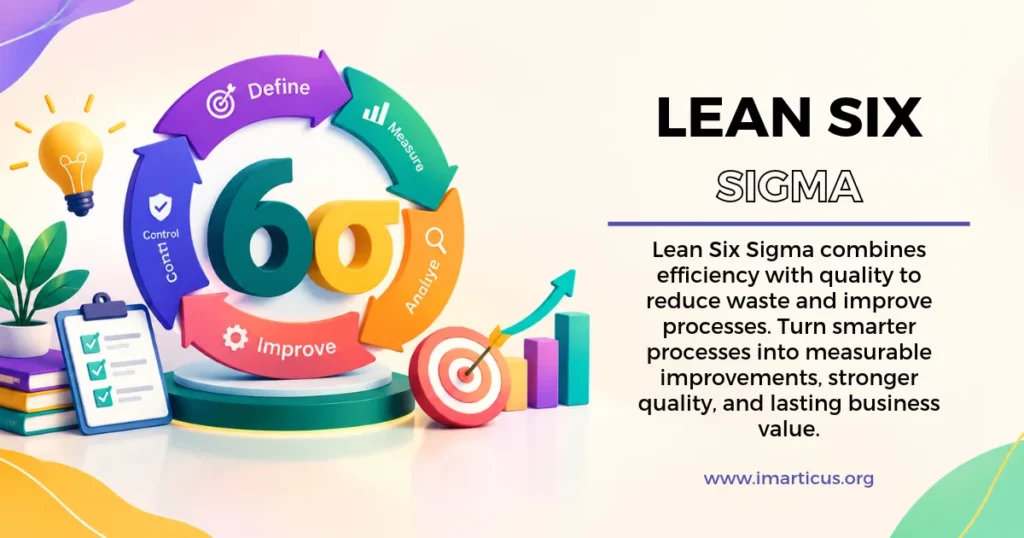
Lean Six Sigma is a structured method that helps organisations remove waste, reduce errors and deliver steady quality by combining Lean, which cuts steps that add no value, with Six Sigma, which uses data to reduce variation. Teams follow the five-phase DMAIC cycle of Define, Measure, Analyse, Improve and Control to solve problems with evidence instead of guesswork. Professionals grow through belts, starting with the Lean Six Sigma Yellow Belt, moving to the Lean Six Sigma Green Belt and then the Lean Six Sigma Black Belt. Lean Six Sigma certification cost in India usually ranges from a few thousand rupees for entry-level training to around ₹1,50,000 for advanced Black Belt programmes. The method is used in manufacturing, healthcare, banking, IT and logistics, which makes it a rewarding skill for anyone aiming at operations, quality or project roles.
Every workplace has one process that everybody complains about, and nobody quite fixes. It could be an approval that takes nine days, a report that needs three rounds of corrections, or a delivery that is late more often than anyone likes to admit. Over the years, I have noticed that the people who finally fix such problems rarely rely on luck or long meetings. They rely on a method, and one of the most trusted methods for this job is Lean Six Sigma. If you have ever wondered what Lean Six Sigma is and why so many hiring managers mention it in job descriptions, this blog is written for you.
I wrote this guide the way I would explain it to a colleague over a cup of tea. We will look at the meaning of Lean Six Sigma, the DMAIC framework, the different belts, the certification path and the costs involved, and then we will talk about the careers it can open. If you are already thinking about building project and process skills in a structured way, you can also explore the Project Management Prodegree course from Imarticus, which includes a Lean Six Sigma process improvement project as part of its learning journey.
Lean Six Sigma Meaning
Let me begin with the question that brings most readers here: what is Lean Six Sigma? In simple terms, it is a way of running and improving a business process so that it becomes faster, cleaner and more reliable at the same time. Instead of fixing problems by instinct, it asks teams to look at facts, find the real cause and solve it in a way that lasts. In this section, I break the idea into its two halves so the Lean Six Sigma meaning becomes easy to remember.
Don’t Let Our Best Advice Get Buried
Add Imarticus as a Preferred Source — see more of what we publish, every time you search.

What Lean Brings to the Table
Lean is all about flow and value. It looks at every step in a process and asks whether the customer would be happy to pay for that step. Steps such as waiting, repeating work, moving files around or producing more than is needed are treated as waste, and Lean helps teams remove them one by one. When I first applied this thinking to a content approval cycle, I was surprised to find that nearly half of the elapsed time was just files waiting for someone to open them.
What Six Sigma Adds
Six Sigma focuses on consistency. It measures how much a process varies and works to bring that variation down so that results look the same every single time. The name comes from statistics, where a process that performs at the six sigma level produces only about 3.4 defects for every million opportunities. The idea began in the electronics industry in the 1980s, while Lean took shape in Japanese car manufacturing, and the two were later joined because they solve different halves of the same problem.
Definition of Lean Six Sigma
Putting the two together gives us the definition I like best. Lean Six Sigma is a team-based, data-driven approach that removes waste and reduces variation so that processes deliver quality at speed. Lean tells you what to remove, Six Sigma tells you how to measure and control what remains, and together they give organisations a complete toolkit for improvement. That is the heart of the Lean Six Sigma meaning, and everything else in this blog builds on it.
Also Read: Business Process Optimisation
Core Principles Behind Lean Six Sigma
Once the definition is clear, the next thing I want you to see is the thinking that drives the method. Lean Six Sigma is not a collection of random tools. It rests on a handful of principles that guide how teams choose problems, collect information and make decisions. Understanding these principles makes every belt level and every tool easier to learn.
- The customer defines value, so every improvement starts by understanding what the customer actually needs and expects from the product or service.
- Decisions are taken from data and facts, which keeps opinions and assumptions from steering a project in the wrong direction.
- Processes are mapped end to end so that the team can see exactly where time, effort and money are being spent without adding value.
- Variation is measured and reduced, which means customers receive the same quality on a Monday morning as they do on a Friday evening.
- Everyone in the team is involved, because the people who do the work every day usually know where the real problems hide.
- Improvement is continuous, so once a process is fixed, the team keeps watching it and looks for the next opportunity.
These principles are the reason Lean Six Sigma works equally well in a factory, a hospital ward and a banking operations team. When I explain them to beginners, I tell them to think of the method as a habit of asking better questions rather than a rulebook to memorise.
DMAIC Framework in Lean Six Sigma
If the principles are the philosophy, DMAIC is the road map. DMAIC stands for Define, Measure, Analyse, Improve and Control, and it is the cycle that most Lean Six Sigma projects follow from the first meeting to the final report. I find it the most practical part of the subject because it turns a vague complaint into a clear, step-by-step project.
The table below gives a quick view of what happens in each phase and the kind of tools teams commonly use. Read it as a journey, because each phase hands its output over to the next one.
| Phase | Purpose | Common Tools |
| Define | Agree on the problem, the customer need and the goal of the project | Project charter, SIPOC diagram, voice of the customer |
| Measure | Record how the process performs today with reliable data | Process maps, data collection plans, baseline sigma level |
| Analyse | Find the true root causes behind the problem | Fishbone diagram, five whys, Pareto chart, hypothesis tests |
| Improve | Test and put in place solutions that remove the root causes | Brainstorming, pilot runs, process redesign |
| Control | Make sure the gains stay in place over time | Control charts, standard work, response plans |
What I like about this structure is that nobody can skip ahead and jump to a favourite solution. The Define phase keeps the team honest about the problem, the Measure and Analyse phases give them evidence, and the Improve and Control phases make sure the fix is real and lasting. Once a team has completed one DMAIC project, the cycle becomes second nature and is easy to repeat on the next challenge.
Did You Know?
Six Sigma quality performance means 3.4 defects per million opportunities, the benchmark the whole method is named after. Source
Types of Lean Six Sigma Belts
Lean Six Sigma borrows the idea of belts from martial arts to show how deep a person’s knowledge and responsibility run. Each belt prepares you for the next one, and you can start at the level that matches your current role. This section walks through the belts so you can see where you fit and where you might want to go.
| Belt | Typical Role | Depth of Learning |
| White Belt | Awareness of the basics and supports the team | Introductory concepts |
| Yellow Belt | Team member who supports improvement projects | Core terms, basic tools and DMAIC overview |
| Green Belt | Part-time project leader within a function | DMAIC in detail, data analysis and Lean tools |
| Black Belt | Full-time project leader and coach | Advanced statistics, change management and complex projects |
| Master Black Belt | Strategic leader and mentor to Black Belts | Programme-level planning and training |
The table shows that the belts follow a natural climb from understanding to leading to mentoring. Most professionals I meet settle into the Yellow or Green Belt level at first and then decide, based on their goals, whether to continue further. The next three subsections look at the most popular levels in a little more detail.
Lean Six Sigma Yellow Belt
The Lean Six Sigma Yellow Belt is the friendliest doorway into the subject. It introduces the vocabulary, the main Lean ideas and the DMAIC cycle, and it equips you to contribute meaningfully when a project team needs extra hands. I often recommend it to fresh graduates and to professionals in sales, HR or finance who want to speak the same language as their operations colleagues. Training is short, the learning curve is gentle, and the confidence it builds is a good foundation for the next step.
Lean Six Sigma Green Belt
The Green Belt is where the method starts to feel hands-on. A Green Belt professional learns to lead a project inside their own function, collect and analyse data, draw process maps and apply the main Lean and Six Sigma tools with confidence. Many people find that this level is the sweet spot because it adds real project ownership without requiring a full-time commitment. If you work in operations, quality, supply chain, IT services or banking, the Lean Six Sigma Green Belt can quickly show up in the quality of the projects you handle.
Lean Six Sigma Black Belt
The Lean Six Sigma Black Belt is for people who want to lead larger and more complex improvement projects, often across departments. Black Belts go deeper into statistics, coach Green Belts, and work closely with senior leaders to choose the projects that matter most to the business. This level carries a lot of respect in the industry because it signals both technical strength and the ability to guide teams through change. It is an excellent goal for anyone who sees themselves in a long-term process excellence or transformation role.
Also Read: Significance of Six Sigma in Supply Chain Management
Lean Six Sigma Certification Path
Knowing the belts is one thing, and holding a recognised credential is another. A Lean Six Sigma certification confirms that you have completed structured training and, in many cases, passed an exam or delivered a project. In this section, I explain how the path usually works so that you can plan it with a clear head.
- Lean Six Sigma Green Belt Certification
The Lean Six Sigma Green Belt certification is the most popular starting point for working professionals. A typical programme covers the Lean toolkit, DMAIC in depth, basic statistics and the use of data to make decisions, and it usually ends with an exam and sometimes a small project. Training providers offer it in classroom, live online and self-paced formats, so you can pick the style that suits your schedule. I have seen colleagues complete it alongside a full-time job within a few weeks, and many of them applied their first improvement idea within the same month.
- Lean Six Sigma Black Belt Certification
The Lean Six Sigma Black Belt certification builds on the Green Belt and takes you further into advanced analysis, project leadership and change management. Most programmes ask for prior Green Belt knowledge or relevant work experience, and many include a real project that shows measurable results. It takes longer to complete than the earlier belts, and the effort is rewarded with a credential that employers look at when they hire for senior quality and operations roles. For anyone who wants to be known as the person who solves the hardest process problems, this certification is a proud milestone.
- How to Pick the Right Level
Choosing the right level is easier when you look at where you are today and where you want to be in two or three years. If you are new to the subject, start with the Yellow Belt or move straight to the Green Belt if you already work with processes. If you already lead teams or projects and want a bigger role, the Black Belt is the natural next step. Whichever level you choose, check that the programme includes practice with real tools and real case studies, because that is where the learning really settles in.
Lean Six Sigma Certification Cost in India
Cost is one of the first things people ask me about, so let us look at it openly. The Lean Six Sigma certification cost depends on the belt level, the mode of learning, the duration and whether the fee includes the exam and project review. Because providers price their programmes differently, the figures below are typical ranges seen in India rather than fixed prices.
| Belt Level | Typical Cost Range in India | Usual Duration |
| Yellow Belt | Entry level, from free or low-cost courses to a few thousand rupees | A few days |
| Green Belt | About ₹15,000 to ₹50,000 | 2 to 4 weeks |
| Black Belt | About ₹30,000 to ₹1,50,000 | 4 to 8 weeks |
| Master Black Belt | About ₹1,50,000 to ₹3,00,000 | 3 to 6 months |
This table shows that the Lean Six Sigma Green Belt certification cost sits in a comfortable middle range, while the Black Belt certification cost rises with the depth of the programme and the amount of mentoring. When I compare options, I look at what the fee includes, such as live sessions, recorded lectures, project guidance, exam attempts and certificate validity. A slightly higher fee that includes mentoring and project review often gives better value than a very low price that stops at recorded videos.
Also Read: Guide On How to Become Scrum Master
Benefits of Lean Six Sigma for Organisations and Professionals
By now you can see that Lean Six Sigma is a rich subject, so let me explain why it keeps its place in so many boardrooms. The benefits show up for the organisation, for the customer and for the person who learns the method. I have seen each of these benefits in action, and they tend to build on each other over time.
- Organisations save money because waste, rework and delays are identified and removed at the source.
- Customers receive more consistent products and services, which strengthens trust and loyalty.
- Teams communicate better because everyone shares the same simple language of process improvement.
- Employees grow into leadership roles faster since they learn to run projects, analyse data and present results.
- Decisions become calmer and more confident when they are backed by measurements instead of opinions.
Taken together, these benefits explain why Lean Six Sigma has remained relevant for decades. A single successful project can free up time, money and energy that the team can then invest in the next improvement. For a professional, that story of visible results is the best possible line on a resume.
Where Lean Six Sigma Is Used
One of the things I enjoy most about this subject is how widely it travels. The same thinking that shortens a production line can also shorten a loan approval or a patient discharge. The table below shows some of the industries that use it and the type of improvement they typically chase.
| Industry | Typical Improvement Focus |
| Manufacturing | Fewer defects, faster production and lower scrap |
| Healthcare | Shorter waiting times and smoother patient journeys |
| Banking and Finance | Quicker approvals and fewer errors in operations |
| IT and Software | Faster delivery, better testing and stable releases |
| Logistics and Supply Chain | On-time delivery and better inventory flow |
Seeing the method in so many places tells me that it is really a way of thinking, and that is why a Lean Six Sigma Green Belt or Black Belt can move comfortably between industries. If you enjoy variety in your career, that flexibility is a real advantage.
Career Scope After Lean Six Sigma Certification
Many readers ask me what kind of roles open up once they are certified. The short answer is that Lean Six Sigma strengthens almost any role that touches processes, quality or projects. It does not lock you into one title, which gives you the freedom to shape the career you want. Here are some of the roles where I most often see this credential valued.
- Process excellence analyst or manager, where you study workflows and lead improvement projects.
- Quality assurance and quality control professional, where you track defects and keep standards high.
- Operations manager, where you balance cost, speed and customer satisfaction every day.
- Supply chain and logistics analyst, where you smooth the flow of goods and information.
- Business analyst or project manager, where you translate business needs into well-run projects.
Professionals who pair Lean Six Sigma with project management skills tend to stand out even more, because they can both choose the right problem and deliver the solution on time. That combination is exactly why I suggest learners look at structured programmes that teach both sides together.
How I Would Start Learning Lean Six Sigma
If you are standing at the beginning and wondering how to get going, here is the simple path I would follow. It keeps the effort manageable and builds confidence step by step. You do not need a statistics degree, only curiosity and a willingness to look closely at how work gets done.
- Learn the basic vocabulary first, including waste, variation, DMAIC and customer value.
- Pick a small process from your own day, such as how a report is prepared, and draw it on paper step by step.
- Enrol in a Yellow Belt or Green Belt programme that suits your current role and your schedule.
- Practise with real data, even if it is a simple spreadsheet of turnaround times.
- Complete a small improvement project and note the before and after numbers.
- Appear for the certification exam and then decide whether to move to the next belt.
This path works because each step produces something you can see and share. A drawn process map or a before and after chart is more convincing in an interview than a long list of terms.
Future of Lean Six Sigma
The future of this method looks bright to me. Organisations are collecting more data than ever, and Lean Six Sigma gives people a trusted way of turning that data into better decisions. Automation and artificial intelligence are also fitting nicely into the DMAIC cycle, since tools can now gather process data faster and highlight patterns that used to take weeks to find.
Professionals who combine Lean Six Sigma with digital skills, analytics and project leadership will be well placed for the roles that organisations are creating. The method keeps growing in service industries, technology teams and public services, and it welcomes anyone who enjoys solving problems in an orderly way.
Why Choose Imarticus for Project and Process Skills
If this blog has made you curious about building process improvement and project leadership skills, I would like to share why I recommend the Project Management Prodegree course from Imarticus Learning. It is designed so that you learn the ideas and then practise them on real-style projects.
- The programme runs for 4 months and about 100 hours in a live online format, which fits comfortably around a job.
- You learn to work with project management methods and AI tools together, which matches how modern teams actually operate.
- The curriculum covers waterfall, agile and hybrid approaches, and includes a Lean Six Sigma process improvement project.
- It carries 35 PDUs towards PMP certification, which helps learners who plan to pursue that credential.
- Hands-on workshops led by industry practitioners and career support add practical exposure and direction.
For learners who want the Lean Six Sigma mindset inside a complete project management skill set, this combination is a strong and practical choice.
Also Read: Significance of Six Sigma in Supply Chain Management
FAQs About Lean Six Sigma
Here are the frequently asked questions readers ask me most often about Lean Six Sigma. I have kept the answers short and friendly so you can find what you need quickly and then return to the sections above for the full picture.
What is the concept of Lean Six Sigma?
Lean Six Sigma is a process improvement method that combines Lean, which removes waste and unnecessary steps, with Six Sigma, which uses data to reduce errors and variation. Teams usually follow the five-phase DMAIC cycle of Define, Measure, Analyse, Improve and Control. Together, they help organisations deliver faster, more consistent and higher quality results.
Is Six Sigma hard to learn?
Six Sigma is very learnable, especially when you move up one belt at a time. The Yellow Belt introduces the basic terms and DMAIC in simple language, and the Green Belt adds practical data tools gradually. Most beginners build confidence quickly with regular practice on real process examples, even without a strong statistics background.
What are the 6 points of Six Sigma?
The six points of Six Sigma are commonly described as six key principles: focusing on the customer, understanding and mapping the process, making decisions using data, removing waste and reducing variation, involving and equipping the team, and improving continuously. Sources word them slightly differently, but together they guide how teams plan and deliver improvement projects.
Is Six Sigma still relevant in 2026?
Yes, Six Sigma remains highly relevant in 2026. Organisations in manufacturing, healthcare, banking, IT and logistics still use it to improve quality, reduce costs and make decisions from data. It also works well alongside analytics, automation and AI, which makes it a valuable skill for modern operations and project roles.
What is a Lean Six Sigma salary?
A Lean Six Sigma salary depends on the belt level, role, industry, city and years of experience. In India, commonly reported averages are around ₹10 lakh per year for Green Belt professionals and around ₹14 to ₹15 lakh per year for Black Belt professionals. Combining the certification with project management or analytics skills can open the door to higher-paying roles.
What is Six Sigma vs Kaizen?
Six Sigma is a structured, data-driven method that uses projects and the DMAIC cycle to reduce defects and variation. Kaizen is a Japanese philosophy of small, continuous improvements made by everyone in the team every day. The two work well together, since Kaizen builds the habit of improvement and Six Sigma gives teams a measurable way to achieve it.
Can I learn Six Sigma on my own?
Yes, you can learn the fundamentals on your own through books, free tutorials, and practice with a simple process from your daily work. A structured course adds guided project work, expert feedback and a recognised Lean Six Sigma certification that employers value. Many learners start with self-study and then choose a formal Green Belt programme to validate their skills.
From a Process Everyone Complains About to a Skill That Shapes Your Career
When I look back at the problems I have seen solved with Lean Six Sigma, the common thread was never a fancy tool. It was a team that decided to look closely, measure honestly and improve patiently. That habit is what makes the method so valuable, whether you are mapping a small workflow or leading a company-wide change.
Whichever belt you choose, whether the Lean Six Sigma Yellow Belt to get started, the Green Belt to lead projects or the Black Belt to guide others, you are investing in a skill that travels across industries and roles. The certification gives you proof, the projects give you confidence, and the results give you stories that employers love to hear. Start small, pick one process, and let the numbers show you what is possible.
If you are ready to pair this mindset with a complete project management skill set, I invite you to explore the Project Management Prodegree course from Imarticus Learning. It can help you turn the ideas from this guide into real projects, real results and a career that keeps moving forward.
Liked This? Follow Us Where You Already Search.
Preferred Sources is Google’s built-in follow button — no app, no login, just more Imarticus in your results.