


Last Updated on 4 months ago by Imarticus Learning
Preparing for the CMA (Cost & Management Accountant) exam? Then, picking the right CMA books is as important as any revision schedule. With a huge variety of study materials floating around – textbooks, course notes, question banks it’s easy to get overwhelmed.
Your books shape your entire learning journey – the clarity you build, the speed you gain, and the results you finally achieve.
With multiple authors, coaching notes, question banks, and online materials out there, choosing the right books can get overwhelming. Different students learn differently, the syllabus is vast, and exam expectations are very specific.
In this comprehensive guide, I’ll bring everything together – the best CMA India books and the best CMA USA books, who they’re ideal for, how to pick study material based on your learning style, and how to combine CMA books with a strategy for the best results.
Understanding CMA
Before worrying about exams or CMA books, let’s slow down and understand what CMA actually is – because everything flows from there.
Students often ask me what is CMA. Is it similar to CA?
So, clearing the confusion, CMA stands for Cost & Management Accountant, offered by IMA US. At its core, it’s a qualification meant for people who want to understand how businesses really run. They do not just know how numbers are recorded, but how those numbers are analysed, questioned, and used to make decisions.
If you’ve ever wondered:
Why is this product profitable while another isn’t?
Where are companies actually losing money?
How do managers decide prices, budgets, or expansion plans?
That’s exactly the kind of thinking CMA trains you for.
Unlike courses that focus heavily on memorisation, the CMA course teaches you to connect concepts with real business situations – costing, planning, control, performance analysis, and strategy. It’s about becoming someone management relies on for insights, not just reports.
Today, you can pursue CMA in two formats:
- CMA India, offered by ICMAI, is rooted in the Indian business, regulatory, and corporate environment.
- CMA USA, offered by IMA, takes a global approach and focuses heavily on financial planning, analytics, risk management, and performance evaluation.
Both routes aim for the same outcome: turning you into a professional who can think like a business partner, not just an accountant.
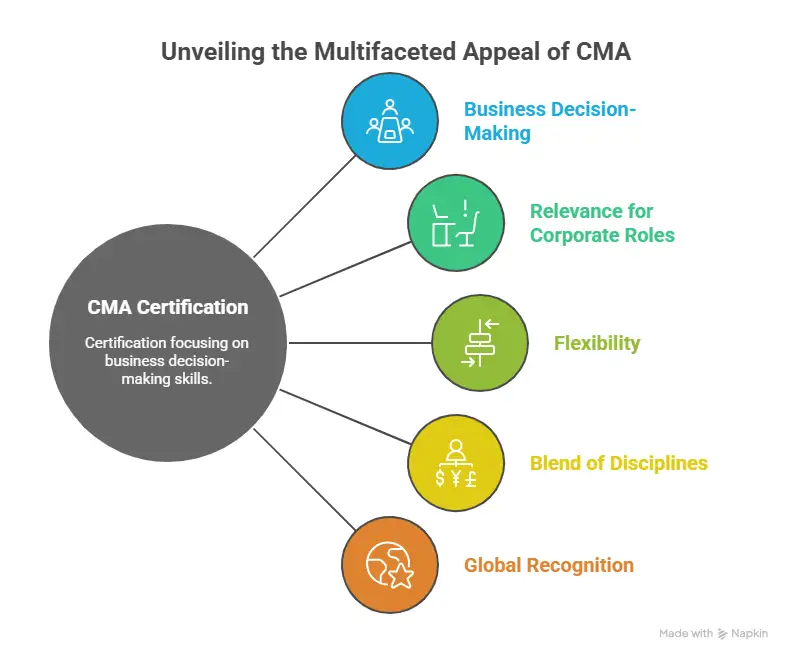
Once you’re clear on what CMA is and what it prepares you for, choosing the right books, study material, and preparation strategy becomes far easier – because you’re no longer studying blindly, you’re studying with purpose.
When you’re preparing for the CMA exam, it really helps to base your studies on credible, officially aligned sources. Coaching providers and publishers can add a lot of value, but going back to authoritative material gives you confidence that what you’re studying is accurate, up to date, and actually relevant for the exam.
Want a quick overview of whether CMA is worth your effort before diving into book lists? This video gives you a clear sense of why the US CMA credential is considered a strong career move – what kind of roles it leads to, how it boosts your earning potential, and why strategic finance skills matter today.
Why CMA Books Matter More Than You Think
The CMA exam – whether in India or the US – is designed to test your ability to think, analyse, and solve real business problems. It is not a memory-based exam. High-quality Certified Management Accountant books build analytical thinking, decision-making skills, and exam confidence – all of which the CMA exam strongly evaluates.
The CMA course duration is flexible compared to many professional courses, which is why it appeals to candidates balancing studies with work.
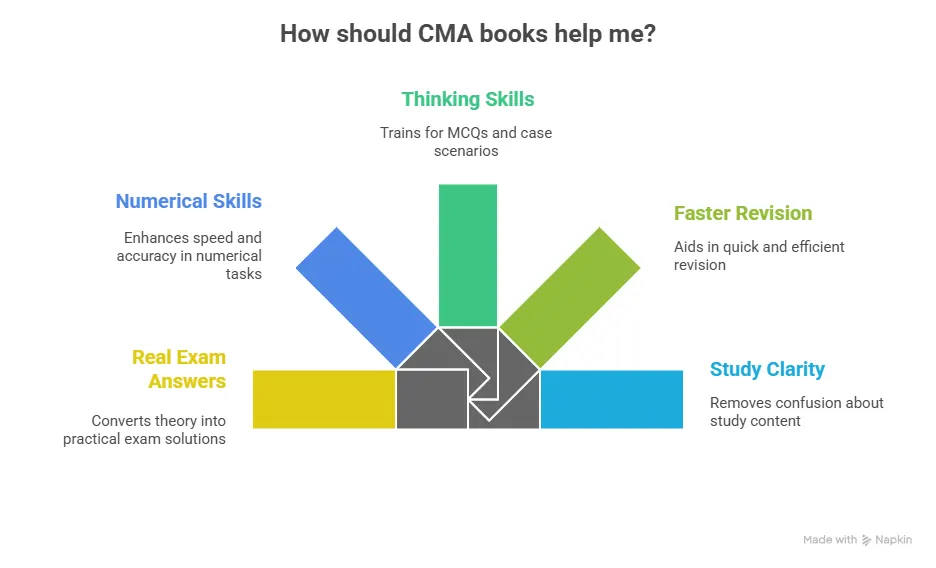
The right CMA books help you:
- Understand concepts deeply instead of memorising formulas.
- Learn frameworks used in real corporate decision-making.
- Build confidence in numerical and analytical topics.
- Practise real exam-style MCQs, essays, and case studies.
- Study in a structured way over months.
- Revise faster and stronger closer to exam day.
- Strong books remove confusion and give you a clear roadmap: what to study, how to study, and how to practise.
Ultimately, the best CMA study material is the one that balances concept clarity, exam-focused practice, and alignment with the official syllabus – not just what’s trending online.
CMA India Books vs CMA USA Books
Before we jump into recommendations for CMA books, it’s important to understand what CMA is and why the CMA pathways have very different structures, levels, and exam patterns.
CMA India (Offered by ICMAI)
Levels: Foundation → Intermediate → Final
Focus: cost accounting, management accounting, laws, taxation, corporate strategy
Heavy on: theory + numerical problems
Books needed: subject-wise, concept + practice-centric
CMA USA (Offered by IMA)
Levels: Part 1 & Part 2
Focus: finance, analytics, risk, costing, planning, strategic analysis
Heavy on: MCQs, essays, managerial problem-solving
Books needed: integrated, exam-oriented, question-bank heavy
I’ll now break down the best CMA books for both tracks – starting with CMA India and then CMA USA – so you can compare, choose, and start your preparation with clarity.
Best CMA Books for CMA India (ICMAI)
When it comes to clearing CMA India, choosing the right CMA books matters far more than collecting too many materials. The CMA India syllabus is deep, structured, and progressively technical – which means your CMA course books, CMA exam textbooks, and overall CMA study resources need to work with the institute’s expectations, not against them.
Many students struggle not because they don’t study hard, but because they rely on scattered notes or generic CMA exam prep books that don’t fully align with ICMAI’s evaluation style. The best books for CMA exam preparation are those that explain concepts clearly, offer enough numerical practice, and follow the syllabus word for word – especially at the Foundation and Intermediate levels. Students are also tested on financial decision-making tools such as project selection methods, making case-based practice essential.
Below, we break down the best CMA books for CMA India, level-wise – Foundation, Intermediate, and Final – so you know exactly which CMA exam book recommendations make sense at each stage of your journey.
CMA Foundation Books
CMA Foundation is meant to build your basics in accounting, maths, economics, and law. The best books here are:
ICMAI Official Foundation Books (For All 4 Papers)
These are the most accurate and safest books because they strictly follow the latest syllabus.
You get full coverage for:
- Fundamentals of Economics
- Fundamentals of Accounting
- Fundamentals of Laws
- Fundamentals of Business Mathematics & Statistics
Why choose these:
- Clear explanations
- Perfect alignment with the syllabus
- Enough illustrations for beginners
Ideal for: Anyone starting CMA India preparation from zero.
CMA Intermediate Books (Most Recommended)
This level is where students need strong, clear, and detailed CMA books as subjects become more technical. Many recommended author books (such as those by D.S. Rawat and Tulsian) are published by Taxmann, making it a reliable academic publisher rather than a coaching-driven source.
1. D.S. Rawat – Accounting (Taxmann)
One of the most trusted CMA Intermediate books for accounting.
- Step-by-step and student-friendly explanations
- Clear logic
- Simplified examples and strong coverage for Accounting, Costing, and Law papers
- Great for non-commerce backgrounds
- Latest editions updated with law and syllabus changes
2. P.C. Tulsian & Bharat Tulsian – Cost & Management Accounting
A favourite among CMA, CA, and CS students.
- Strong conceptual coverage
- Plenty of solved and unsolved problems
- Real-world costing examples
3. Munish Bhandari – Corporate & Other Laws
This book is highly recommended for the Law paper.
- Crisp summaries
- Charts and flow diagrams
- Case law explanations
4. Fundamentals of Laws & Ethics – CA Jaishree Soni
A practical book for Ethics and Law components.
- Easy-to-understand language
- Covers theory with conceptual examples
- These books help build a strong base before you move to the Final level.
CMA Final Books (Advanced-Level Preparation)
At the CMA Final, your books must prepare you for real-life decision-making and cost strategy, not just exam questions. Final-level preparation places strong emphasis on applying cost management strategies to realistic business situations.
1. Tulsian Series – Advanced Cost & Management Accounting
A comprehensive book that simplifies complex costing techniques.
2. ICMAI Official Books
Useful because they are syllabus-perfect and contain updated concepts aligned with the latest laws and regulations.
3. Case Study Digest (ICMAI)
- Essential.
- Helps build exam-oriented thinking
- Improves case-solving skills
- Gives real-industry scenarios
Ideal for: Students aiming for clarity, exam confidence, and structured revision.
Given the investment involved in CMA Course Fees, choosing the right study material becomes even more important to avoid wasted time and effort.
If you are eager to know the CMA US salary trends in India and the USA, compare earning potential at different career stages, and want to know whether CMA is really worth it in the long run? This video gives you a detailed insight.
Best CMA US Books (Top CMA USA Books)
CMA USA, offered by IMA, is a globally recognised program and requires fully exam-focused material. The CMA USA exam demands high numerical ability, conceptual understanding, and strong MCQ + essay writing skills.
Most successful candidates rely on the best CMA review course books that combine concept explanations, MCQ practice, essay scenarios, and mock exams – which is why providers like Wiley, Gleim, Hock, and Becker dominate CMA USA preparation. Here are the top CMA USA Books.
A. Wiley CMA USA Books (Part 1 & Part 2)
One of the most widely used CMA USA books globally. Among all US CMA books, the Wiley CMA Excel books are especially popular for their simplified explanations, integrated test banks, and strong alignment with the official exam blueprint. Topics such as internal control systems, including the COSO Framework, are frequently tested conceptually in CMA Part 1.
Why Wiley is a top choice:
- Concept clarity
- Simple language
- Strong illustrations
- Large question bank
- Online test bank included
Best for: Students who like simplified notes + lots of practice.
B. Hock International – CMA US Books
Many self-study candidates prefer the Hock CMA study material because of its detailed explanations and beginner-friendly approach to complex financial topics.
Why students love Hock:
- Depth of explanation
- Detailed theory
- Strong practice questions
- Good for beginners or those without prior accounting exposure
Best for: Students who need deeper conceptual coverage before attempting MCQs.
C. Gleim CMA USA Books – The Exam Champion
If you talk to CMA USA toppers, many swear by Gleim. The Gleim CMA review books are among the most trusted CMA Part 1 study books and CMA Part 2 study books, especially for candidates aiming for exam-level MCQ practice and realistic essay scenarios.
Gleim stands out because:
- It has the largest question bank.
- Contains exam-level difficulty MCQs.
- Covers highly realistic essay scenarios.
- Provides detailed explanations.
Best for: Students who want high MCQ practice + real exam simulation.
D. Becker CMA US Books
Becker is known for CPA and is now equally respected for CMA USA. The Becker CMA review books are ideal for learners who prefer a structured, digital-first approach with guided practice and adaptive question banks.
Why Becker works great:
- Digital-first learning.
- Smart question banks.
- Clear bite-sized concepts.
Best for: Students who want structured, guided learning.
Some candidates also explore alternatives like Surgent CMA study materials, known for adaptive learning and diagnostic-based preparation, though most students still prefer Wiley, Gleim, Hock, or Becker for comprehensive coverage.
When students look at CMA vs CFA, the difference usually comes down to focus. CMA is geared more toward internal business decision-making, cost control, and performance management, while CFA leans heavily toward investment analysis and portfolio management.
Recommended CMA Books For All Levels
Naturally, the first question most students check is CMA Eligibility, since both CMA India and CMA USA are designed to be accessible to students, graduates, and working professionals.
With syllabus updates, changing exam trends, and evolving evaluation standards, using outdated CMA material can hurt more than help. That’s why choosing CMA prep books from the latest edition matters just as much as choosing the right author. The goal isn’t to collect many books – it’s to rely on CMA exam prep books that are current, exam-aligned, and easy to revise.
Most aspirants perform better when they start with CMA official review books or institute-recommended texts, and then supplement them with focused practice material. Many also prefer a CMA study bundle that combines concepts, question banks, and revision tools instead of juggling multiple disconnected resources.
While some consider using used CMA books to save costs, it’s important to ensure the content is updated and matches the latest syllabus – especially for law, taxation, and strategic management topics. The recommendations below focus only on reliable, updated books of the latest edition that support clarity, confidence, and exam success.
Foundation / Beginner Level
Books by the official institute (for Fundamentals) – For the foundational papers (Accounting Principles, Business Laws, Maths & Stats, Economics & Management), the standard study materials prescribed by the institute remain a safe starting point.
Intermediate & Final Level – Strong Picks
Based on the latest recommendations and what many CMA aspirants swear by:
- Accounting Principles by D.S. Rawat – Taxmann – Taxmann is one of the most trusted names in professional accounting education in India. Recommended for Intermediate students: it explains accounting concepts in a simple, step-by-step manner, with practical examples. Great if concepts feel abstract, otherwise.
- Corporate & Other Laws by Munish Bhandari – For the Legal & Corporate-Law papers: this book simplifies complex legal concepts, uses charts/diagrams for clarity, and helps make the subject less intimidating.
- Cost & Management Accounting by P.C. Tulsian & Bharat Tulsian – A solid choice for cost & management accounting. Useful for students who want both theory and plenty of practice.
- Specialised books on Laws & Ethics / Business Laws & Ethics – For example, books like Fundamentals of Laws & Ethics by CA Jaishree Soni are often recommended for the laws & ethics component of the CMA exam, helpful if you need well-explained legal theory and clarity on laws.
Strategy: Combine Strong Texts With Practice & Revision
Often, top performers don’t rely on a single book – they:
- Use one or two strong concept books (for clarity)
- Use one practice-oriented book (for problem solving and revision)
- Revise regularly, practise questions & case studies, and keep revisiting tricky areas.
Many students also supplement with past-year papers, mock tests, or question-bank style materials to develop speed, accuracy and exam readiness. Selecting CMA prep books from the latest edition ensures syllabus accuracy, updated MCQs, and relevance to current exam trends.
With experience and the right skills, a CMA qualification can lead to a competitive CMA salary in India, especially in roles such as cost control, financial planning, consulting, or corporate finance.
CMA India Books vs CMA USA Books – Quick Comparison
This CMA exam material comparison helps aspirants understand how book structure, exam focus, and preparation style differ between CMA India and CMA USA – making it easier to choose the right study path.
| Feature | CMA India Books | CMA USA Books |
| Structure | Subject-wise books (Foundation, Inter, Final) | Integrated books (Part 1, Part 2) |
| Best Authors | Rawat, Tulsian, Bhandari | Wiley, Gleim, Hock |
| Exam Style | Descriptive + numerical + case studies | MCQs + essays |
| Book Style | In-depth theory + practice | Concept + exam-oriented practice |
| Ideal For | Indian corporates, PSUs, accounting roles | FP&A, finance, global MNC jobs |
Source – ICMAI Study Material
Ultimately, strong preparation opens doors to diverse CMA jobs across finance, strategy, cost control, and performance management roles.
How to Choose CMA Books Based on Your Learning Style
When students ask how to choose CMA study material, the answer depends largely on their learning style, background, and comfort with numerical and analytical problem-solving. Different CMA aspirants need different types of books. Here’s a simple way to match books to your style:
| Choose This Book | Best For |
| Tulsian / Wiley | If you need simple, easy-to-understand explanations |
| Rawat / Hock | If you want an exam-like practice and simulation |
| Gleim | If law topics feel complex and confusing |
| Munish Bhandari | If you prefer structured, coaching-style notes |
| ICMAI Official Material / Becker | Makes your CMA journey smoother, clearer, and more organised |
Source – IMA | CMA Resources
Once the structure and study pattern are clear, CMA Registration becomes the formal starting point of your journey, marking your entry into the certification process.
Who Should Use Which CMA Books?
Your choice should depend less on what’s popular and more on how you learn, what your strengths/weaknesses are, and which level you are at.
| Your need/learning style | CMA Books to pick |
| Strong fundamentals, proper fundamentals coverage (start of CMA) | The institute’s official study material or foundational-level books |
| Need full clarity on accounting concepts (Intermediate level) | Accounting Principles by D.S. Rawat |
| Want to simplify legal / law-related CMA papers | Corporate & Other Laws by Munish Bhandari; Fundamentals of Laws & Ethics by CA Jaishree Soni |
| Prefer theory + practice + exam-oriented prep (cost, management accounting) | Cost & Management Accounting by P.C. Tulsian & Bharat Tulsian |
| Need structured revision + quick recap before exam | Concise notes + question banks (from above or coaching-provided materials) |
When you study for the CMA, using the latest edition of CMA prep books isn’t just a nice-to-have – it’s often a necessity. Whether you’re tackling CMA India or CMA USA, always check the edition date before investing in prep material, and prefer the latest one – it keeps your preparation aligned with what’s actually being tested.
CMA Books You Should Avoid
Each book you choose should directly reflect the latest CMA Syllabus, ensuring relevance to what is actually tested in the exam. Not all books are helpful. Avoid books that are:
- Outdated (laws, costing rules change often)
- Too theory-heavy without examples
- Too light with no practice questions
- Not aligned to the latest IMA or ICMAI syllabus
- Good books save time; wrong books waste months.
Avoid using used CMA books – These are often outdated, missing supplementary resources, or not aligned with the latest syllabus. Use them only for concept reference, never as your primary exam material.
Be cautious of random CMA study guide free download sources online – many are outdated, incomplete, or not aligned with the current IMA or ICMAI syllabus.
Students often compare professional paths like CMA vs CA, but the preparation approach for CMA is far more application-focused.
How to Use Your CMA Books Effectively (The Strategy That Works)
Many aspirants opt for a CMA study bundle that includes textbooks, question banks, mock tests, and revision notes – offering better structure and cost efficiency than purchasing books individually. A great book won’t help unless you use it right.
Since the CMA Course Subjects span accounting, finance, performance management, and strategy, books must balance theory with application. Here’s the preparation strategy followed by successful CMA students:
Step 1: Start with Core Concepts
Books are best used for understanding – not for memorising.
Use the first 30-40 days to:
- Read each chapter
- Mark important topics
- Solve basic illustrations
- Summarise formulas
Step 2: Shift to Question Practice
Especially for CMA USA, MCQ practice is critical.
Use:
- Gleim (for exam-level MCQs)
- Wiley/Hock (for conceptual practice)
- ICMAI problems (for Indan students)
Step 3: Revise Every 10 Days
Revision ensures retention.
Use:
- Short notes
- Flashcards
- Summaries at the end of each chapter
Step 4: Attempt Mock Tests
For CMA USA, mock exams are a must.
For CMA India: practice previous-year questions + case studies.
Step 5: Final 30 Days – Pure Exam Mode
In this phase:
- Revise only summaries
- Solve high-weightage chapters
- Attempt chapter-wise tests
- Solve essay scenarios (for CMA USA)
This balanced use of CMA books + practice makes your preparation bulletproof.
Many global aspirants also weigh CMA vs CPA when choosing between a management-accounting-driven career and public accounting or audit-focused roles.
This video gives a realistic comparison between CMA (Cost & Management Accountant) and CPA (Certified Public Accountant). It helps you visualise what each certification offers – which can help shape not just your reading list, but your career goals, study path, and long-term planning.
Should You Use One Book or Multiple CMA Books?
These days, most students find it easier to buy CMA books online. You get instant access to the latest editions, refreshed question banks, and often some added digital support as well.
Use 1 concept book along with 1 practice book.
This is the optimal combination for both CMA USA and CMA India.
CMA USA: Wiley (concepts) + Gleim (practice)
CMA India: Rawat/Tulsian (concepts) + ICMAI material (practice)
This gives you both clarity + practice depth. Always check syllabus alignment and edition year before purchasing CMA books online to avoid outdated material.
Common Mistakes To Avoid
Choosing fewer, well-aligned books and using them consistently is far more effective than collecting a shelf full of material.
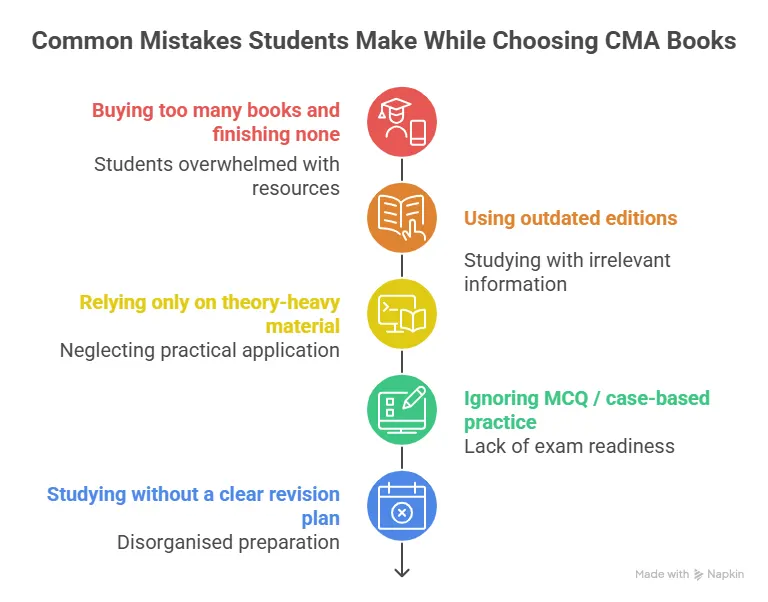
Common mistakes students make while choosing CMA books that you should avoid:
- Buying too many books and not finishing any properly.
- Using outdated editions that don’t match the latest syllabus.
- Choosing books that are too theory-heavy, with little exam practice.
- Ignoring MCQs, case studies, and application-based questions.
- Relying only on coaching notes without a strong reference book.
- Picking books meant for a different level (Final books at the Foundation stage).
- Studying without a clear revision and practice plan.
Before you choose books or commit to a study plan, this honest take on whether CMA USA is difficult and how students overcome those challenges will help you build a smart prep plan confidently.
Why Imarticus for CMA Preparation
CMA Books are important – no doubt about that. But anyone who’s seriously prepared for a professional exam knows this much: reading alone doesn’t clear CMA. What really makes a difference is how you learn, how you practise, and how you apply concepts under exam pressure.
That’s where structured guidance helps. At Imarticus Learning, CMA certification isn’t just about finishing the syllabus or watching lectures. It’s about helping you understand what the exam expects and preparing you for that reality.
What students really get at Imarticus:
- Clear direction, not confusion – Instead of juggling multiple books, notes, and videos, you get a clear learning path – what to study, when to revise, and how to practise.
- Teaching that connects theory to real work – Faculty members don’t just explain formulas or rules. They show why a concept matters and how it applies in real business and finance roles – exactly how the CMA exam tests you.
- Focused prep for MCQs and essays – CMA is not a memory test. Imarticus places strong emphasis on:
- Exam-level MCQ practice
- How to structure essay answers
- Time management during the exam
- So you’re not caught off guard on exam day.
- Support when you actually need it – Doubts, revisions, mock tests, guidance – support is built into the journey. You’re not left figuring things out on your own when topics get tough.
- Aligned with the CMA USA exam structure – Everything – from coverage to practice – follows the CMA USA exam framework, so you’re always preparing with relevance, not guesswork.
Whether you’re starting with core CMA concepts or working towards confident exam performance, Imarticus helps ensure you don’t just study harder – you study smarter.
And when preparation feels structured and supported, clearing the CMA course stops feeling overwhelming – and starts feeling achievable.
FAQs About CMA Books
If you’re confused about which CMA books to choose, how many books are actually needed, or whether self-study is enough. These frequently asked questions will help you get answers to all your doubts, from choosing the right study material to understanding exam difficulty, preparation time, and book selection.
Which are the best books for the CMA exam?
The best books for CMA exam preparation are those that are:
- Aligned to the latest syllabus
- Updated in content
- Strong in MCQs, case studies, or numerical practice
For US CMA aspirants, CMA review course books like Gleim and Wiley stand out. For India, CMA course books from ICMAI, along with selected Taxmann publications, work best.
What is the difference between CMA India books and CMA USA books?
This CMA exam material comparison of the CMA books helps clarify:
- CMA India books focus more on theory, laws, taxation, and descriptive answers
- CMA USA books are MCQ-intensive and application-driven
That’s why CMA US books / CMA USA books are usually compact, integrated, and exam-oriented.
Which books should I use for CMA Part 1 and Part 2?
For CMA USA preparation, the most effective study resources include Wiley CMA Excel, Gleim, and Hock for CMA Part 1, and Gleim, Becker CMA Review, and Wiley CMA Excel for CMA Part 2. These are considered top US CMA books for exam-level MCQ and essay practice. While books are essential, many candidates improve their success rate by combining them with structured guidance from Imarticus Learning.
Are official CMA books enough to pass the exam?
CMA official review books are essential, but usually not enough on their own.
Most toppers use:
- 1 concept book
- 1 practice-heavy question bank
- Mock exams
Together, these form strong CMA study resources.
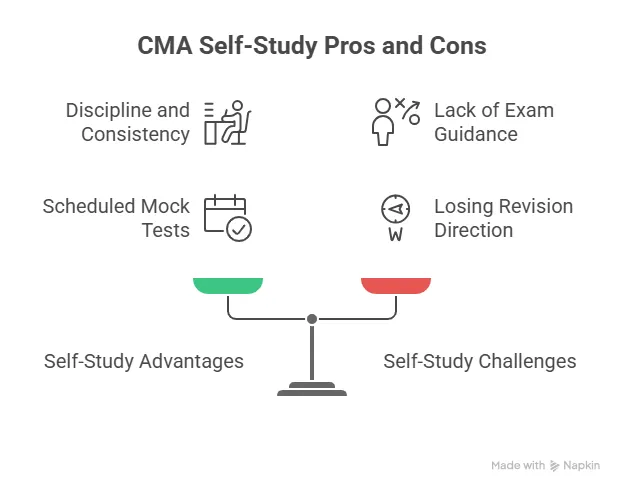
Can I do CMA by self-study?
Yes, many candidates clear the CMA through self-study using the right CMA exam prep books and structured revision.
However, self-study requires:
- Strong discipline
- Proper book selection
- Regular mock tests
Self-study works best when supported by the right CMA exam book recommendations.
How to choose CMA study material?
If you’re wondering how to choose CMA study material, keep this simple:
- For beginners → ICMAI / Wiley / Hock
- For heavy practice → Gleim
- For structured digital learning → Becker
- Revision-focused → Concise notes + question banks
Avoid collecting too many books – clarity beats quantity.
Is it safe to download CMA books in PDF format?
Be careful with the CMA books PDF or the CMA study guide free download.
Many free PDFs are:
- Outdated
- Incomplete
- Not syllabus-aligned
A random CMA study guide free download should never replace textbooks.
Is buying CMA books online better?
Yes. Most students prefer to buy CMA books online because:
- Latest editions are easily available.
- You can compare reviews.
- Official seller copies are safer.
Always check the edition year before purchasing the books.
Your CMA Journey Starts With Books And Succeeds With Strategy
Choosing the right CMA books gets you only halfway. Passing the exam – and doing well – calls for strategy, discipline, practice and consistency. Strong books give you clarity, structure, confidence, and speed. But passing CMA India or CMA USA requires more than just reading.
Start with concept-building: understand each topic deeply rather than memorising. Solve lots of questions, case studies, and past-year problems. Regularly revise – especially law, accounting standards, and management accounting. Track progress and note weak areas, revisit them often, and don’t ignore fundamentals even when doing advanced topics.
If you do that – with the right books as your foundation – CMA becomes not just an exam to pass, but a worthwhile learning journey in accounting and management. Whether you’re choosing CMA books, CMA US books, or CMA USA books, make sure your material is updated, exam-aligned, and matches your learning style.
With the right books and strategy, your CMA course journey becomes not just achievable, but enjoyable – and your career possibilities become limitless.
