In the rapidly evolving digital landscape, cybersecurity and blockchain technology have emerged as pivotal elements, revolutionising various industries and reshaping the future of technology. As organisations worldwide grapple with the complexities of securing digital assets and ensuring data integrity, the demand for skilled professionals in these domains has skyrocketed.
Understanding Blockchain Technology
What Is a Blockchain?
A blockchain is a distributed ledger or database that is shared by all nodes in a computer network. Though they have applications outside of cryptocurrencies, they are most recognised for playing a critical part in cryptocurrency systems that preserve a safe and decentralised record of transactions. Any industry can employ blockchain technology to make data immutable, or incapable of being changed.
The one place where confidence is required is when a user or program submits data, as blocks cannot be changed. This feature lessens the requirement for reliable third parties, which are typically auditors or other people who incur expenses and make mistakes.
Blockchain applications have multiplied since the launch of Bitcoin in 2009 thanks to the development of smart contracts, Decentralised Finance (DeFi) apps, Non-Fungible Tokens (NFTs), and other cryptocurrencies.
Why Is Blockchain Important?
Blockchain is important because it provides a secure, transparent, and tamper-proof way of recording transactions and data. It eliminates the need for intermediaries, reduces fraud, and enhances trust in digital systems. Blockchain’s applications extend beyond cryptocurrencies to sectors such as finance, healthcare, supply chain management, and more.
Key Elements of a Blockchain
To fully grasp the potential of blockchain technology, it is essential to understand its core components:
Decentralization: Unlike traditional centralized databases, a blockchain operates on a network of computers (nodes), where each node holds a copy of the entire blockchain. This decentralized nature ensures that no single entity has control over the entire network, enhancing security and trust.
Immutability: Once a transaction is recorded on a blockchain, it cannot be altered or deleted. This immutability is achieved through cryptographic hashing, which links each block to the previous one, creating a secure chain of data.
Consensus Mechanisms: Blockchain relies on consensus algorithms such as Proof of Work (PoW) or Proof of Stake (PoS) to validate and confirm transactions. These mechanisms ensure that all participants in the network agree on the validity of transactions, maintaining the integrity of the blockchain.
Smart Contracts: These are self-executing contracts with the terms of the agreement directly written into code. Smart contracts automatically enforce and execute the terms of an agreement when predefined conditions are met, eliminating the need for intermediaries and reducing the risk of fraud.
The Importance of Cybersecurity
As the digital world expands, so do the threats that target its vulnerabilities. Cybersecurity is the practice of protecting systems, networks, and programs from digital attacks. These attacks are aimed at assessing, changing, or destroying sensitive information, extorting money from users, or interrupting normal business processes.
With the increasing sophistication of cyber threats, robust cybersecurity measures are essential to safeguard digital assets and maintain trust in digital systems. Cybersecurity encompasses various practices, including network security, information security, application security, and operational security. It also involves regular updates and patching, employee education, and incident response planning.
The Advanced Certificate in Cybersecurity and Blockchain By E&ICT IIT Guwahati
This Blockchain certification course is meticulously designed to provide a comprehensive understanding of both cybersecurity and blockchain technologies. The curriculum is tailored to address the latest trends, challenges, and solutions in these fields, ensuring that participants are well-equipped to tackle real-world problems.
Course Highlights:
In-depth Knowledge: The program covers fundamental and advanced topics in cybersecurity and blockchain, providing a solid foundation and deep insights into these domains.
Hands-on Experience: Participants will engage in practical exercises, simulations, and real-world projects that mimic industry scenarios, enabling them to apply their knowledge effectively.
Expert Faculty: The course is taught by experienced faculty from IIT Guwahati, along with industry experts who bring a wealth of knowledge and practical experience.
Industry-Relevant Curriculum: The curriculum is constantly updated to reflect the latest advancements and industry requirements, ensuring that participants are learning the most relevant and up-to-date information.
Certification: Upon completion of the program, participants will receive an Advanced Certificate in Cybersecurity and Blockchain from E&ICT IIT Guwahati, validating their expertise and enhancing their career prospects.
Career Opportunities and Benefits
Completing the Blockchain certification course opens up a plethora of career opportunities. Graduates can pursue roles such as:
Blockchain Developer: Specialising in creating and managing blockchain-based applications and systems.
Cybersecurity Analyst: Focusing on protecting an organisation’s digital infrastructure from cyber threats.
Smart Contract Developer: Developing and deploying smart contracts on blockchain platforms.
Blockchain Consultant: Advising organisations on implementing and leveraging blockchain technology for various use cases.
Information Security Manager: Overseeing an organisation’s cybersecurity strategy and implementation.
The skills and knowledge gained from this program are highly sought after in various industries, including finance, healthcare, supply chain, government, and technology. Organisations are increasingly recognising the importance of cybersecurity and blockchain, leading to a growing demand for professionals with expertise in these areas.
Conclusion
In today’s digital age, mastering emerging technologies such as cybersecurity and blockchain is crucial for staying ahead in the competitive landscape. The Advanced Certification in Cybersecurity and Blockchain by E&ICT IIT Guwahati offers a unique opportunity to gain in-depth knowledge and practical skills in these fields. This Blockchain certification course not only enhances your technical abilities but also prepares you to tackle the challenges of the digital world with confidence and competence.If you’re ready to advance your career and become a leader in cybersecurity and blockchain technology, enrol in the Advanced Certification Course in Cybersecurity and Blockchaintoday. Visit Imarticus Learning for more information and to get started on your journey to mastering these transformative technologies.
This article will cover 50 SQL interview questions and answers that are asked in SQL developer interviews. This article is for freshers, intermediates and experienced professionals who want to ace their next SQL interview.
In this age of digitisation and data dependence, knowing SQL will give an edge in various career prospects. SQL or Structured Query Language, is a database language for accessing and decoding complicated data in databases.
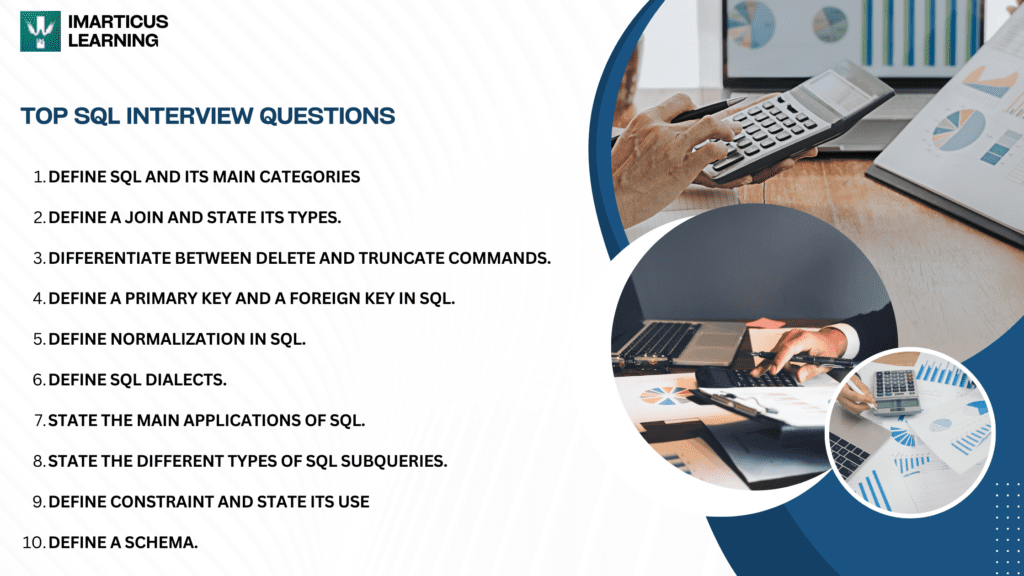
Top SQL Interview Questions
SQL interviews are tough. Interviewers look for individuals who not only know the basics of SQL but also have practical knowledge about it. Here are the Top 10 SQL interview questions and answers.
Define SQL and its main categories. This is one of the basic SQL interview questions asked by any employer. SQL stands for Structured Query Language, and it is used to manage and change databases. Its categories include Data Query Language (DQL), Data Manipulation Language (DML), Data Definition Language (DDL), Data Control Language (DCL), and Transaction Control Language (TCL).
Define a JOIN and state its types. This is one of the most important SQL interview questions for developers. A JOIN function combines data from more than one table by using a common column to connect them. There are several forms of JOINs, including INNER JOIN, LEFT JOIN, RIGHT JOIN, and FULL JOIN. These JOIN variants determine how data from the relevant tables are combined and obtained.
Differentiate between DELETE and TRUNCATE commands. This is one of the most important SQL interview questions for experienced professionals. Specialists employ the DELETE command to eliminate certain rows from a database based on a criterion, allowing them to carefully eliminate records. TRUNCATE, on the other hand, deletes all rows from a database table without any constraints. TRUNCATE is quicker and requires less computing power than DELETE, but it does not record specific row removals.
Define a primary key and a foreign key in SQL. A primary key serves as a distinctive identification for each entry in a database, ensuring the accuracy of data and entity originality. In contrast, a foreign key is an assortment of columns that creates a link between tables by mentioning another table’s primary key.
Define normalization in SQL. Normalization is a strategy for streamlining storing information in the form of a database, decreasing duplication, and improving data quality. This method comprises breaking down the tables into simpler, interconnected tables and connecting them.
Define SQL dialects.
SQL dialects refer to the numerous free and commercial versions of SQL. SQL syntax is extremely identical across all variants, with just minor differences in extra capability.
State the main applications of SQL. The basic applications of SQL are:
Manage database tables by creating, deleting, and updating them, as well as accessing and modifying their data.
Extract and consolidate the pertinent data from a single or many tables.
Add or Delete certain columns or rows from a data set.
State the different types of SQL subqueries. These are the various types of SQL subqueries:
Single-row- returns a maximum of one row
Multi-row- returns a minimum of two rows
Multi-column- returns a minimum of two columns
Correlated- a subquery connected to the data contained in the outer query.
Nested- a subquery within a subquery.
Define constraint and state its use. A collection of criteria that specify the kind of data that may be entered into all the columns of a table. Constraints maintain the confidentiality of information in a database and prevent undesirable activities.
Define a schema.
A set of database structural pieces, including tables of information, procedures that are stored, indexes, operations, and triggers. It depicts the general database structure, describes the interconnections between various information items, and assigns various access privileges to them.
Basic Interview Questions and Answers
The smartest way to crack a SQL interview is to have clarity and knowledge of the basics. Additionally, it also increases the chances of cracking the interview. The following set of questions will cover some of the basic SQL interview questions and answers.
Define a database. A database is a planned set of data that is saved and accessed securely from a distant or localized computer system. Databases may be large and complicated, and these databases are created utilizing predetermined architectural and modeling methodologies.
Define DBMS.
The acronym DBMS refers to a Database Management System. It is a type of program that is in charge of creating, retrieving, updating, and managing databases. It guarantees that the information that is stored is consistent, structured, and easily available by acting as a liaison between the relational database and its intended users or applications.
What is a Cross-Join? A Cross-join may be described as a cartesian good of both tables involved in the join. The table following the join has the same amount of rows as the combined product of the two tables. If a WHERE clause is implemented in a cross-join, the search query will behave as an INNER JOIN.
Define a Subquery and state its types. A subquery is a query contained within one more query, referred to as a stacked query or internal query. It is employed to limit or improve the data requested by the primary query, hence limiting or improving the original query’s result.
There are two types of Subquey- Correlated and Non-Correlated
A correlated subquery can never be regarded as a separate query, however, it may allude to a field in a table specified in the initial query’s FROM clause.
A non-correlated subquery might be regarded as a separate query, with its output inserted into the primary query.
Define Data Integrity Data integrity is the guarantee of data correctness and uniformity throughout its life. It is an essential component of the creation, execution, and upkeep of any device that gathers, organizes, or extracts data. It also establishes integrity limitations, which impose company standards on information as it is input into a program or system.
Explain Data Definition Language. DDL or Data Definition Language permits the execution of queries like CREATE, DROP, and ALTER.
Define data manipulation language. The Data Manipulation Language, or DML, is a method for obtaining and altering database information.
Does SQL support programming language features? SQL, albeit a language, does not facilitate coding since it is not a language for coding, but rather a command-line language.
Define a Default constraint. The DEFAULT constraint fills an area with preset and set values. When no alternative value is specified, the chosen one is applied to all newly created records.
Define an ALIAS command. Aliases are transitory names assigned to tables or columns for the intent of a specific SQL query. It is employed when the title of an area or database is changed from its initial designation, but only temporarily.
SQL Interview Questions and Answers for Freshers
It is preferable for aspiring data analysts, to opt for a data science course with placement. Choosing a data science course that has placement can help to set foot in the industry sooner. Here are some SQL interview questions and answers for those who are just starting to work.
What are the different types of SQL statements? There are four types of SQL statements. They are- Data Manipulation Language (DML), Data Definition Language (DDL), Data Control Language (DCL) and Transaction Control Language (TCL).
State the difference between CHAR and VARCHAR data types. This is one of the most common SQL interview questions for freshers. CHAR is a fixed-length character string type, whereas VARCHAR is a variable-length character data structure. CHAR always utilizes an identical quantity of storage capacity, but VARCHAR utilizes just the space required for the data itself.
Differentiate between INNER JOIN AND OUTER JOIN.
The difference between INNER JOIN and OUTER JOIN are as follows:
INNER JOIN
OUTER JOIN
INNER JOIN retrieves the identical and appropriate data between both tables.
OUTER JOIN retrieves every entry from the database fields.
An INNER JOIN returns entries that share similar fields or attributes.
Since every record is sent back, the OUTER JOIN doesn’t need an identical column ID.
There exists no inner join variation.
An outer join can be either left or right-side complete (cross join).
Inner joins are useful when several entry points for data are necessary.
Outer joins are ideal if you do not require connected data entries as necessary.
The sluggish velocity that occurs in the inner join causes low efficiency.
Outer joins perform superior to inner joins in SQL.
Explain the ACID properties in SQL. ACID in SQL denotes Atomicity, Consistency, Isolation, and Durability.
Atomicity: Guarantees that an operation is handled as a single piece of activity that either finishes or does not.
Consistency: Guarantees that the relational database is in an identical state before and following the operation.
Isolation: Allows numerous actions to occur simultaneously without influencing one another.
Durability: Ensures that when an operation has been committed, the modifications are enduring, even if the system fails.
Define a SQL index. A SQL index is an arrangement of data that speeds up retrieval of information activities on the database tables by allowing rapid utilization of rows depending on the contents of specific fields.
What is an SQL trigger? A SQL trigger is a collection of SQL commands that run periodically as a reaction to specific events, including INSERT, UPDATE, or DELETE actions on a database table.
Define a SQL transaction. A SQL transaction is a set of a few SQL statements performed as one piece of work. Transactions protect the integrity of data by enabling activities to be either entirely performed or completely reversed.
What is a self-join in SQL? This is one of the most asked SQL interview questions. A self-join is a type of join procedure that joins a table to itself. It serves to merge rows from an identical table using an associated column.
Differentiate between a view and a table in SQL. A table is an actual storage component that contains data, while a window is an electronic table created from several tables. Views cannot save data, but they do give a means to show data from tables.
What is an SQL injection? This is one of the popular SQL interview questions for freshers. SQL injection is an approach for exploiting user data via website submissions by inserting SQL instructions as statements. Simply said, unscrupulous individuals can use these assertions to influence the program’s internet server.
SQL Interview Questions and Answers for Intermediates
These are some of the most asked SQL interview questions and answers to intermediates and developers.
Define a function in SQL. State its use. A database object that represents a collection of SQL commands frequently employed for a particular task. A function accepts certain parameters as inputs, calculates or manipulates them, and then delivers the output. Functions increase the understanding of code and prevent unnecessary repetition of programming snippets.
State the different types of SQL functions. There are two types of SQL functions- Aggregate and Scalar Functions. Aggregate functions act on many, generally aggregated records from a table’s given columns and produce a single result. Scalar functions deal with specific values and ultimately produce a single output.
State the different types of aggregate functions.
AVG()- returns the average value SUM ()- returns the sums of values MIN ()- returns the minimum value MAX ()- returns the maximum value COUNT ()- returns the number of rows, including NULL values. FIRST ()- returns the first value from a column LAST ()- returns the last value from a column
Define case manipulation functions. Case manipulation functions are a particular category of the character operations used to manipulate the formatting of textual information.
State the difference between local and global variables. Local variables are only accessible within what function they were defined in. Instead, global variables are identified outside of any function and maintained in persistent memory frameworks, allowing them to be utilized throughout the whole program.
State the difference between a primary key and a unique key. Although both forms of keys assure distinctive values in a table’s section, the first distinguishes each record, whilst the second prohibits redundancies in that category.
State the difference between renaming a column and giving an alias to do it. Renaming a column completely alters its real identity in the initially created database. Assigning an alias to a column is to give it an interim title when running a query using SQL, to make the source code more understandable and concise.
Can a view be used if the original table is deleted? No. Any views that utilize the table in question will turn obsolete once the main table is deleted. If we attempt to utilize a view like this, we will get an error notice.
Can a view be created based on another view? Yes. This is additionally referred to as “nested views.” Nevertheless, we should steer clear of layering many views since it makes the code harder to comprehend and troubleshoot.
State the different types of SQL relationships.
There are primarily three types of relationships:
One-to-one- Each record in a particular table matches exactly one record in a different table.
One-to-many- Each record in a particular table refers to multiple records in a different table.
Many-to-many- Each entry in the two tables relates to numerous records in the additional table.
SQL Interview Questions and Answers for Experienced Professionals.
These are some important SQL interview questions for experienced professionals.
State the different types of case manipulation functions available in SQL.
There are three types of case manipulation functions available in SQL. They are:
LOWER- This method returns a phrase in lowercase. It accepts a string of characters as a parameter and produces it in lowercase.
UPPER- This method returns a string in uppercase. It accepts an address as input and comes back it in uppercase.
INTCAP- This method returns a string with the initial letter in uppercase as well as the remainder of the characters in lowercase.
Which function is used to remove spaces at the end of a string?
The spaces are eliminated using a trim function.
Which operator is used in queries for pattern matching?
A Like operator is used to get specific data by looking for a specific pattern in the where clause.
What is SQL Order by the statement? This statement is used to classify the recorded data in either ascending or descending order based on multiple columns.
Are NULL values the same as zero or a blank space? In SQL, zero or blank spaces are distinguishable and contrasted with one another. One null could not be considered equivalent to a different null. Null indicates that data may not be given or that no data exists.
Why is group functions required in SQL? Group functions or aggregate functions are used to group values of multiple rows as input on certain criteria to form one single value.
Define Nested Triggers. A nested trigger incorporates its data alteration mechanism.
State the operator that is incorporated for appending two strings. The “Concentration operator” is used to append two strings in SQL.
Define a cursor. The pointer represents a Temporary Storage or Work Station. The database engine allocates it when the user performs DML actions on the table. Cursors are employed to save tables of data.
Explain the ON DELETE CASCADE constraint. In MySQL, an ‘ON DELETE CASCADE’ constraint is employed to purge entries from the youngest table whenever the main table’s entries are eliminated.
Conclusion
Understanding SQL is critical for data administration. This guide explored essential SQL principles with simple questions and straightforward answers. Keep in mind that practice makes perfect. Continuously improve the skills by carrying out actual tasks and staying informed on the newest innovations in SQL technology.
Apply now to the Postgraduate Program In Data Science And Analytics by Imarticus to learn more about the latest trends of analysis and its relevance in the modern world.
FAQ’s
How to start learning SQL?
To get started understanding SQL, proceed with the fundamentals of database principles and managing relational databases.
What are some basic SQL interview questions for beginners?
SQL interview questions and answers for beginners are easy. Beginners are usually asked the difference between SELECT and INSET statements, the importance of Keys, simple queries to collect data, and other such basic questions.
Which concepts should an intermediate practitioner prepare for an SQL interview?
Intermediates face questions from complex concepts such as different types of JOINS, subqueries, grouping data, and the utility of set operations.
What to expect in the technical round of a SQL interview?
In technical rounds, questions are asked to test the understanding and knowledge of syntax, database design, query optimization, and troubleshooting skills.
The business world is alive due to the effective integration of technology and management. Business analysts (BAs) are the strategic link between these two conflicting departments. Therefore, they help the industries communicate through translation and interpretation and innovate for the nation’s prosperity.
This article explores a business analyst’s job description and profile, giving relevant tips on how to become a business analyst.
What Does a Business Analyst Do?: Business Analyst Duties
1. Eliciting Requirements
One of the main business analyst job descriptions is providing the first reactions to anything concerning an organisation’s enlargement. They behave as if they were detectives, obtaining information from different stakeholders in the company. Consequently, they gather the data by using interviews, workshops and surveys revealing the who, what and why behind business needs.
2. The Process of Analysis and Modification
After a comprehensive analysis of the market environment, they turn into specialists in optimisation processes. They specifically inspect the resource utilisation of existing workflows and find out the constraining and imperfect zones. This analysis involves the process of identifying the existing or current processes, detecting the shortcomings of these processes, and proposing solutions to the problem of streamlining the processes so that they can be more efficient. Candidates searching about how to become a business analyst should know this.
3. Data Analysis
Data may be considered as being a “goldmine” for data analysts. Such an ability allows them to have a look at the well-hidden trends and patterns as long as they are somewhere hidden in the dataset. Insights are like precious jewels, they translate into the information that will lead to the recommendations that are data-driven and thus will be the decisions that will be made. This will demand factual support on the assumptions if any, avoiding unrealistic strategies. Hence, data analysis is important for people aspiring to know how to become a business analyst.
4. Communication and Documentation
Business Analysts are the medium through which corporate and technical sides are intermediately linked. They possess the vital skill to transform hard-to-grasp concepts and mould them into understandable packets for tech-minded and people with non-technical backgrounds. This transparent and punctual communication, annotated clearly, is the key to unanimity in the whole project’s life cycle and one should know what is a business analyst before getting into this job profile.
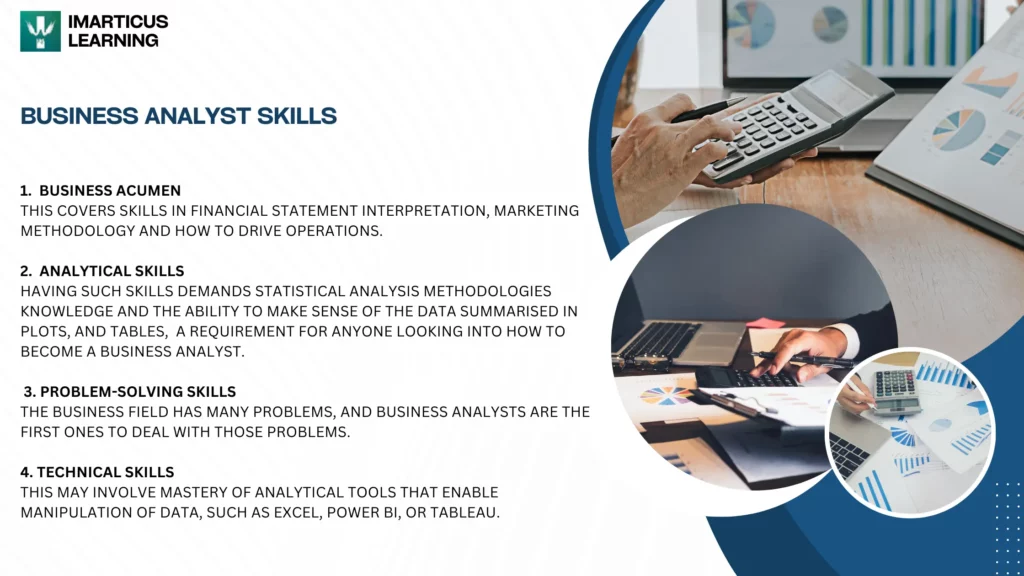
Business Analyst Skills
1. Business Acumen
An exceptional business analyst shouldn’t just be seen as a tech guy, they are a business partner, a critical insight for those aiming to understand how to become a business analyst. This is a way of saying that one should know the fundamentals of business before trying to excel in a certain area. This covers skills in financial statement interpretation, marketing methodology and how to drive operations. The valuable industry-specific knowledge ranks high. The basic knowledge of the sector’s particular challenges and opportunities will enable BAs to modify their solutions in the best way possible.
2. Analytical Skills
Business analysts have the potential to datasets, to find hidden trends and patterns, and to transform these insights into actionable recommendations. Having such skills demands statistical analysis methodologies knowledge and the ability to make sense of the data summarised in plots, and tables, a requirement for anyone looking into how to become a business analyst.
3. Problem-Solving Skills
The business field has many problems, and business analysts are the first ones to deal with those problems. Business analysts should be resourceful and good at solving problems by finding the source of problems, suggesting possible solutions and creating wonderful recommendations. Normally, the person doing this is confronted with the challenge of being creative and finding better solutions for complex problems. Upcoming BA asking how to become a business analyst should possess this.
4. Technical Skills
Even though this qualification is not obligatory, technical competency is a vital point of advantage that anyone looking to know how to become a business analyst should possess. This may involve mastery of analytical tools that enable manipulation of data, such as Excel, Power BI, or Tableau. Honing analytical skills requires candidates to know about various analytical tools. Moreover, the knowledge of project management methodologies like Agile or Waterfall can facilitate the smooth flow of the projects. Having fluency in Python or R programming languages will also be as advantageous depending on the more technical tasks. While it is true that technical skills should be a supplement rather than a substitute for business competency and analytics aptitude, both are very critical areas that one should master.
Exploring the Business Analyst Scope: Different Business Analyst Careers
After knowing how to become a business analyst, one should know what they can become after successful completion of the data science course.
1. Business Systems Analyst
Business analyst roles and responsibilities include accessing and explore the deep details of the business systems, analysing how these systems operate, along examining their effectiveness and integration with other functions. Their speciality is in recognising the places of significance and suggesting solutions that will make the system perform better and the user interface more user-friendly. Above all, they are the ones who collaborate most closely with the IT teams so that the flow of business processes and technologies work together.
2. Business Process Analyst
BPAs are the best people to implement business processes aiming at making them as efficient as possible. Working in very small detail, they thoroughly scrutinise the existing business workflows, seeking the slowdowns, the unnecessary repetitions, and the places for improvement, a prerequisite for any person who wants to know how to become a business analyst. BAs should have astounding abilities to use their eagle eyes and delve into every corner of the present system to reveal its obsolete stats and demonstrate how to improve the workflow and make it more efficient.
3. Data Analyst BA
Nowadays, the data-driven world is the one where the Data Analyst is a very popular job profile. Such managers not only have entrepreneurial wit coupled with foreign know-how and data analysis ability. Data scientists use various data analysis tools and methodologies to find out what value is stored in datasets that can be hidden from plain view. The results of the analysis are then translated into practical recommendations which in turn are used to make business decisions based on facts not just assumptions. Before diving into this Business Analyst world, one must be sure about the business analyst job profile.
4. Requirement Analyst
The task of Requirement Analysts is to acquire information that is needed for the completion of the BA team. As a facilitator, they have to perform a central function of offering the bridge so that the company may be able to collect the needs of the stakeholders through the organisation. In the process of their research, they conduct interviews, workshops, and surveys and thus they very carefully record the needs, challenges, and pain points that should be resolved which is essential for anyone aspiring to know how to become a business analyst. The security issue they work on is that they provide the link between the business and the development sides of the industry.
Business Analysts Salary
The earning potential for BAs is entirely dependent on their experience, location, and industry type, a consideration for anyone who plans on learning how to become a business analyst. According to Payscale, the annual salary of a business analyst is $87,660.
Nevertheless, this is the starting point. A skilled BA with experience, honed abilities, and specialised skill sets like data analysis or process optimisation can reach salary ranges well above the national average.
At the entry-level, BAs can expect a starting salary on the low end, but as they gain experience and undertake more complex projects, their earning potential grows in a parallel way. Location is another factor that can influence such behaviour main cities are the ones responsible for the highest salaries to attract high-level talent.
Lastly, vacation particularisation and income can be influenced as well. Fields such as technology, finance, and healthcare are usually the ones that have the highest salaries since they are the most sought-after BAs. Dive into the Post Graduate Program in Data Science and Business Analytics of Imarticus. This data science and data analytics course gives candidates all the skills and the know-how to be a data-based business analyst and start their BA career. Therefore, this is a prosperous career for those who want to know how to become a business analyst
Top Recruiters For Business Analysts
1. Accenture
A global professional services firm dedicated to consulting and digital transformation processes. (A business entity that provides consultancy services as well as digital transformation services.) Business analysts’ roles at Accenture include bringing together business requirements and technological solutions.
2. Amazon
An e-commerce major that is among the highest revenue generators with constant innovation. If people want to know how to become a business analyst, they should know that BAs at Amazon create timely and efficient processes. They optimise operations and make decisions based on an evidential examination.
3. Deloitte
An international professional services network, which is offering consulting, audit, and tax services. BAs at Deloitte contribute know-how by assessing and finding solutions to complex business problems.
4. IBM
A large technology company leader with a portfolio including hardware, software, and cloud computing services. BAs at IBM analyse business needs, design solutions, and make sure that technology projects are being implemented successfully.
5. Microsoft
A multinational sector engaged in the production, marketing, and sale of software, consumer electronics, and related services. The combination of BAs at Microsoft creates a bridge between the tech teams and the business stakeholders that address the business objectives, as well as certified technology solutions.
Business Analyst Trends that Will Define the Success of the Industry
1. Demand for Data-Driven Decision Making
The world today lacks no data. Organisations are, therefore, including data as one of the tools used in informing their strategic decisions. Employers will highly value business analysts who excel in data analytics, for example, by having the capability to gather data and analyse and interpret results. The knowledge of data visualisation tools and techniques will be a key factor in the ability to present insights to the stakeholders. If one wants to know how to become a business analyst, one will be in high demand for data-driven decision-making.
2. Rise of Agile Methodologies
While waterfall project management methodologies have been dominant up to date, more agile approaches have been narrowing the gap going forward. Being capable of coping with this dynamic environment which is evolving and changing flexibly and sequentially is an essential step when learning how to become a business analyst. They will be a key part of the project by understanding the user stories and organising sprint planning sessions as well as continuous collaboration between business stakeholders and development teams.
3. Focus on Automation
Automation is altering different dimensions of enterprise operations. A business analyst’s role is to identify those areas where doing the same tasks can be outsourced to machines. The academic staff will have to collaborate with IT teams to design and implement the automation solutions. This will help to automate the processes and thus improve the efficiency of the workflow.
Conclusion
As a business analyst, candidates will be presented with a new set of challenges, which will also challenge their ingenuity and logical thinking. It is a way to a fulfilling career with a lot of room for growth. Filling the gap between business and technology, business analysis is a functional role worthy of consideration if one seeks a dynamic role. If this description resonates with you, follow this guide to learn how to become a business analyst today.
Are you ready for the first step? Enrol in the Post Graduate Program in Data Science and Business Analytics by Imarticus to learn what you need to be a good business analyst and start your journey of fulfilment. This PG course help you gain access to the fundamental skills required for enhancement in this field and launch your BA career today.
Frequently Asked Questions
What is the career path for a business analyst?
The career track of business analysts is a transition into becoming a senior business analyst, a business consultant and even specialising in other important fields such as data analytics or business process management.
Do I need a degree to become a business analyst?
While a business administration or information technology degree is often preferred for this position, any other relevant degree may be approved or some substantial experience by particular employers may apply.
What are the benefits of being a business analyst?
Good salary, job security, and industry diversity.
What are the challenges of becoming a business analyst?
If anyone wants to know how to become a business analyst, then the job calls for one to be good at more than one thing at a time in communication, very good at handling more than one issue at a time, and being in line with the latest advancement in technology that is known.
Generative AI marks a significant advancement in artificial intelligence. Given its capacity to significantly assist human abilities and knowledge, it is designed to revolutionise the way we work and reshape the workforce of the future. It is critical that professionals not only recognize the potential of Generative AI but also equip themselves with the skills to handle the inevitable shifts in the organisation.
To go on a path of bringing forth the content revolution, enhancing machine learning, and confirming fresh and original ideas, enrolling in a Generative AI course is a trend worth pursuing. Not only that, but it is a rapidly increasing force that is transforming industries and bringing them incredible opportunities.
What is Generative AI?
Generative artificial intelligence (AI) refers to algorithms (like ChatGPT) that can generate novel content, such as images, videos, audio, code, text, simulations, software code and product designs. Recent advances in the discipline have the potential to fundamentally alter the way we approach content development.
Generative AI may learn from existing artefacts to create new, realistic artefacts (at scale) that represent the properties of the training data while without repeating it. The process involves various techniques that continue to evolve. First and foremost are the AI foundation models, which are trained on a massive set of unlabelled data which can be used for different tasks, with extra fine-tuning. These trained models need complex mathematics and huge computational capabilities to develop, yet they are essentially prediction algorithms.
Presently, generative AI is most typically used to generate content in response to natural language queries; it does not require knowledge of or access to code; nevertheless, corporate use cases are many, including advancements in medication and chip design and material science findings.
What are the Benefits of Generative AI?
Automation, machine learning, and autonomous IT and business process execution are all possible with AI architectural innovations, one of which is generative pre-trained transformers, one of the foundation models which power ChatGPT.
The benefits of generative AI include:
Enhanced product development
Boosted customer experience
Advanced productivity of the employees
It has to be noted that the specifics depend on the use case.
Also, end users should be realistic about the value they expect to achieve, especially when utilising a service that has significant limits. Generative AI produces artefacts that may be incorrect or discriminatory, necessitating human validation and potentially restricting the time it saves workers.
Applications of Generative AI
Thecommon generative AI applications are vast in number and these use cases can be applied to generate virtually any kind of content. As different kinds of users can access the technology’s ground-breaking breakthroughs like GPT that can be utilised for various applications. Some of the major generative AI uses have been listed below:
Drafting email responses, dating profiles, resumes, etc.
Implementing chatbots for customer service and technical support.
Improvising dubbing for movies and product demonstration videos.
Enhancing educational content in different languages.
Creating photorealistic art in a particular style.
Suggesting new drug compounds to test.
Designing physical products and buildings.
Optimising new chip designs.
Improvising product demonstration videos.
Use deepfakes to impersonate persons or specific individuals.
Composing music in a specific style or tone.
Final Words
Aiming to bring about the fusion of technology and creativity, Imarticus Learning, the premier edtech company for upskilling and professional education, in collaboration with the E&ICT Academy at IIT Guwahati, has established an Advanced Certificate Program in Generative AI.
The Advanced Generative AI Course is spanned over a duration of 6 months. The curriculum depends on a renewed focus on skills that leverage human talents and automation. With 140 hours of instruction, together with 3 days of campus immersion at IIT Guwahati, the program delivers a learning experience that will empower learners to pioneer new positions of the future.
In 2024, with the continuous growth of complex data and analytics, the demand for BI has increased in the corporate world. As digitalization continues and firms thrive to sustain themselves in the competition, BI is becoming a game-changer.
Here is a set of important Power BI Interview questions and answers to help you crack a Power BI interview with ease. The article has been divided into three sections, Power BI interview questions and answers for freshers, Power BI interview questions and answers for intermediates and Power BI interview questions and answers for experienced professionals.
Power BI Interview Questions and Answers for Freshers
Freshers having completed a data analytics course and possess some basic knowledge about BI are eligible for an interview. Freshers are asked some of the basic Power BI questions in an interview for entry-level Power BI analyst roles. This section deals with some of those basic Power BI interview questions and answers.
Define Power BI.
Microsoft introduced Power BI, an array of corporate statistical applications that allow users to gather, analyse, display, and circulate data. Power BI covers a diverse set of databases and offers powerful analytics features via connections with Excel.
What is the purpose of using Power BI?
Its simple interface and broad features serve as an effective tool for firms seeking insights, making data-driven choices, and cultivating a data-driven culture.
What are the differences between Power BI and Tableau? State any three
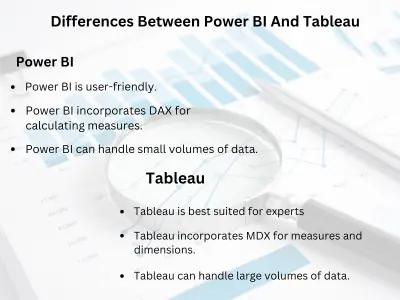
Tableau and Power BI are the biggest data analytics tools in today’s time, but both have some significant differences. They are as follows:
Power BI
Tableau
Power BI is user-friendly.
Tableau is best suited for experts.
Power BI incorporates DAX for calculating measures.
Tableau incorporates MDX for measures and dimensions.
Power BI can handle small volumes of data.
Tableau can handle large volumes of data.
What are the differences between Power Query and Power Pivot?
The differences between Power Query and Power Pivot are as follows:
Power Query
Power Pivot
Power Query analyses data.
Power Pivot gathers and shares data.
This is an ETL service tool.
his is an in-memory data modeling component.
Explain Power BI Desktop.
Microsoft built and developed Power BI Desktop, a free application. Power BI Desktop enables individuals to effortlessly link to, alter, and visualise their data. Users can share the accumulated data as reports with their heads and colleagues.
Define Power Pivot.
Since 2010, Microsoft has released a plugin for Excel known as Power Pivot. Power Pivot was created to expand Excel’s data analysis features and assistance.
Define Power Query
Microsoft developed Power Query, a business analytics application for Excel. Power Query enables users to input data from a variety of sources and then neat, alter, and restructure it as needed. Power Query enables users to compose a query once and subsequently execute it with a single reload.
What are the two main components of the self-service BI solution by Microsoft.
Self-service business intelligence (SSBI) has two main components, the Excel BI Toolkit and Power BI.
Explain what is a self-service BI.
Self-Service Business Intelligence (SSBI) helps users from no technical or coding background use Power BI to generate reports.
Define DAX.
Data Analytics Expressions (DAX) is a group of functions and constants incorporated in formulas to determine and return values.
Power BI Interview Questions and Answers for Intermediates
Power BI interview questions and answers for the intermediate level are more advanced and require more knowledge. This portion will highlight some of the important Power BI interview questions and answers for intermediates. Here are the Power BI questions and their answers.
How is data collected and stored in Power BI?
Power BI stores data with the help of the cloud. Power BI primarily uses Microsoft Azure, a cloud service provider to store data.
Define row-level security.
Row-level security uses filters to restrict the information that a user can examine and retrieve. Users may establish guidelines and roles in Power BI Desktop and then upload them to Power BI Service to set up row-level security.
Why should general formatting be applied to Power BI data?
Users may apply basic formatting to help Power BI organise and locate data, rendering it substantially simpler to analyse and work with.
State the different views available in Power BI Desktop.
Power BI has three views, each serving a distinct objective:
Report View – The Report View allows users to add visuals and supplementary analysis pages before publishing them on the site.
Data View – The Data View allows users to shape information employing the Query Editor tools.
Model View – The Model View allows users to handle connections among complex databases.
What are the different versions of Power BI?
Power BI Desktop
Power BI Service
Power BI Android app
Power BI iOS and app
State the critical components of the Power BI toolkit.
The important components of Power BI are as follows:
Power Query
Power Pivot
Power View
Power Map
Power Q&A
Shed some light on the content pack.
A content pack is a pre-built set of visuals and Power BI presentations created by the selected provider.
How to use a custom visual file?
If the preconfigured files do not meet a company’s requirements, a developer will create a customised visual file. Developers construct customised graphic files, which may be imported and used identically as prepackaged files.
State some of the sources for data in the Get Data menu in Power BI.
Some of these sources are text data, data from the internet, spreadsheets, Power BI datasets, SQL server, and analysis services.
State the categories of data types.
All
File
Database
Power BI
Azure
Online Services
Other
What are the commonly used tasks in the Query Editor?
Connect to data
Shape and combine data
Group rows
Pivot columns
Create custom columns
Query formulas
Define grouping.
Power BI Desktop allows users to organise the information in the visualisations into sections. To group components in the graphic, select them with Ctrl + Click. Right-click on any of the items and select Group from the option that displays. The Groups box allows you to establish fresh groups or change ones that already exist.
In Power BI, what do we mean by responsive slicers?
A programmer may adjust the responsive slicer to different widths and designs, and the information gathered in the framework is reorganised to locate a match. If a visual report grows too tiny to be usable, an icon of the visual replaces it, conserving the area on the report page.
Explain query folding in Power BI.
Query folding occurs when steps described in the Query Editor are converted into SQL and performed by the original database rather than the mobile device. It promotes flexibility and effective computing.
Define M language.
M is a coding language utilised by Power Query that is effective, case-dependent, and user-friendly.
Power BI Interview Questions and Answers for Experienced Professionals
Power BI interview questions and answers for experienced professionals require in-depth knowledge of the software and data analytics. These Power BI developer questions and answers are a must-go-through before appearing for an interview.
State the major differences between visual-level, page-level, and report-level filters in Power BI.
Visual-level filters are implemented to restrict data inside a single display. Page-level filters are employed to operate on a full page in a summary, and each page might have distinct filters. Report-level filters are applied to narrow down all the data in the document’s graphics and sections.
State the most common tools for data shaping.
Adding indexes
Applying a sort order
Removing columns
How does the Schedule Refresh function?
Users can schedule an automated refresh of data depending on their routine needs. Users are limited to scheduling one refresh every day unless they are using Power BI Pro. The Schedule Refresh feature allows users to pick an interval, zone of time, and moment of day using the pull-down menus.
How is a map created in Power Map?
Power Map supports geographical representations. As a result, some geographic information is required, such as city, state, nation, or geographical coordinates.
What is the name of the in-memory analytics engine that is used by Power Pivot?
Power Pivot employs the xVelocity engine. xVelocity can handle large volumes of information and store it in tabular systems. When using in-memory statistics, every bit of information is put into the RAM, resulting in quicker analysis.
State the important components of SSAS.
The important components of SSAS are:
OLP Engine- Users employ an OLAP Engine to conduct ADHOC queries more quickly.
Data Drilling- Data Drilling in SSAS is defined as a method of investigating data characteristics at different levels of precision.
Slicers- The data slicing method used by SSAS is described as the storage of information in the form of columns and rows.
Pivot Tables- Pivot Tables assist in toggling among the many kinds of data recorded in rows and columns.
Name the variety of Power BI Formats.
Power BI is primarily available in three formats. They are:
Power BI Desktop
Power BI Services
Power BI Mobile Application
State the different stages in the functioning of Power BI.
The three different stages in the functioning of Power BI are as follows:
Data Integration
Data Processing
Data Presentation
Who are the ones who use Power BI the most?
Power BI is primarily used by Business Analysts, Business Owners, and Business Developers.
Explain advanced editor.
The advanced editor is employed to inspect searches that Power BI is performing against information sources when importing data. The query is displayed in M-code. To access the query code, users need first pick “Edit Queries” from the main menu, then “Advanced Editor” to begin working on the search query.
How to depict a story in Power BI?
Every graph or graphic report created is compiled and shown on one screen. This strategy is known as a Power BI Dashboard. A dashboard in Power BI is an instrument to tell a narrative with data.
Define KPIs in Power BI
Key Performance Indicator (KPI) is used by professional organisations for all their employees. A KPI is an indicator of an employee’s targets. KPIs are used to compute progress in comparison to previous performances.
What is a Power BI designer?
It is an integrated solution that allows users to post visualisations and reports to the PowerBI.com portal for reference. It includes Power Pivot, Power Query, and Power Table.
How to reshape data in Power BI?
Power BI supports a wide range of information source connection options. Data Editor is an instrument for manipulating the cells and rows of information and reshaping them to meet particular demands.
State some applications of Power BI.
Some of the applications of Power BI are as follows:
Business Analysis
Data Analysis
Database Administration
IT Professional
Conclusion
Business Intelligence (BI) is vital for modern firms, offering vital understanding through the evaluation of data. BI solutions such as Power BI play a critical role in translating unstructured information into meaningful business insight, encouraging an environment that values data throughout companies.
Enroll in Imarticus’ Postgraduate Program in Data Science and Analytics course to launch a career in Data Analytics.
FAQ’s
Does Power BI support mobile devices?
Power BI has apps for Android and iOS devices and Windows 10 devices.
What are the requirements to use Power BI?
A Web browser and email are all that are required to use Power BI. The Power BI mobile apps can also be downloaded for free from the various app stores.
How to undo in Power BI?
To undo an action in Power BI, simply press CTRL+Z.
Why is a work email required to sign up for Power BI?
Power BI does not support email addresses from customer email providers or telecommunications firms.
Python is a dynamic, high-level programming language. Developers across the globe continue to use Python for a wide variety of applications. This open-source programming language has gained popularity in the community due to its wide array of features and capabilities.
But what is Python? Python is one of the simplest yet most useful programming languages. A survey showed that 49.28% of developers across the globe use Python, making it third on the list of most used programming languages.
It is a general-purpose language used for creating various applications, including web development, data science, automation, etc. Today, if you want to make a career in data science, understanding the nooks and crannies of Python is very important.
In this blog, we will learn about the key features of Python.
What is Python?
Python can be defined as a high-level, open-source, object-oriented, general-purpose programming language. Does that sound like a lot? Let’s break it down.
High level: Allows programmers to develop computer programs that are independent of the type of machine it is running on.
Open source: The language is free and available for further improvements. Programmers can add a helpful feature or fix a bug, there are no restrictions.
Object-oriented: An object is a data field having unique behavior and attributes. An object-oriented programming language is a model that organizes software design around objects.
General-purpose: The programming language can be used on any kind of platform. It is not specialized for any kind of problem.
It is widely used in software development, web applications, machine learning, and data science. Python has gained popularity because it is easy and efficient and can run on many platforms.
For entry-level coders, Python is one of the best programming languages to start with. Its versatility and easy-to-interpret tools have made Python a beginner-friendly programming language.
How did Python gain popularity?
Python features and advantages make it a popular coding language. Even people who do not know coding have heard about Python. It started as a hobby project and soon turned into the successful giant that it is today. According to a survey, the size of the Python community in the world is 44.6%, making it third on the list.
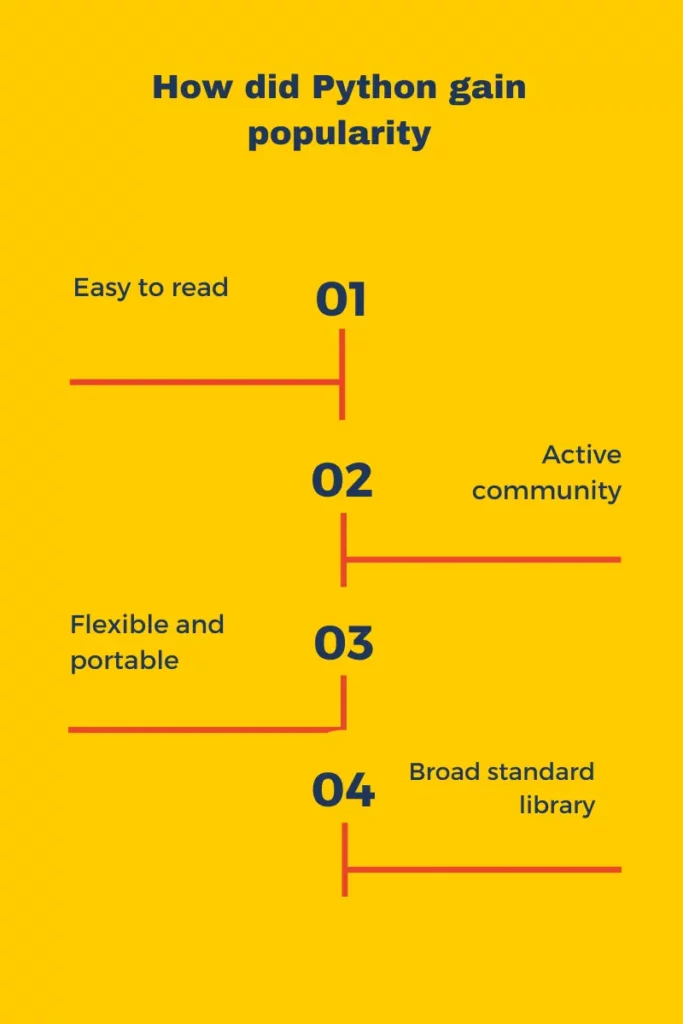
Here are some reasons why Python continues to gain popularity:
Easy to read: Python code uses English keywords. It has a simplified intuitive syntax that makes it easy to read. For people entering the world of programming, Python is easy to interpret. One can simply understand what the code is meant to do by looking at it.
Active community: Unlike the English language, Python programming language is fairly new. Every programmer is trying to learn how to work around the language. Python has built a dedicated user community in the last thirty years of its running. This community has developers of all skill levels. Programmers have easy access to guides, documentation, tutorials, and more. Developers from the community also crowdsource their work to find effective solutions.
Flexible and portable: Python is not domain-specific. Which means, it is not designed for certain applications only. Python can be used to develop nearly all kinds of applications in any field. Python is also portable. This means, unlike some languages which need to be modified to run on different platforms, Python doesn’t. It is a cross-platform language. The same code can be run on any operating system using a Python interpreter.
Broad standard library: The Python library is available for anyone to access. This means that programmers don’t need to write code for every function. Built-in modules are available to help with issues that might come up during coding.
Advantages of Python programming
Python is a flexible, powerful, and easy-to-use computer language. It has gained a lot of popularity and is widely used for many reasons. Here are some Python features and advantages:
Higher productivity: Python has a lot of uses. It is a simple language that allows programmers to focus on solving the issue. Rather than worrying about the syntax. For beginners, this is ideal cause they don’t need much time to learn about the syntax of the language. With Python, programmers can complete more assignments with less code.
Supports multiple programming models: Python supports procedural, object-oriented, and functional programming. The object-oriented approach facilitated code modularity, reusability, and extensibility. This is done using the four pillars of OOPs – inheritance, abstraction, encapsulation, and polymorphism. Using functional programming, programmers can write clearer and bug-resistant codes.
Test-driven development: With Python, one can easily do test-driven development (TDD). Programmers can easily write code and test it at the same time. Using the TDD approach, programmers can test cases before creating the source code.
Frameworks and libraries: Python has frameworks and libraries for practically every application domain. For example, NumPy, a Python toolkit is used for altering multidimensional arrays along with performing high-level mathematical operations. Ggplot, Matplotlib, Plotly, and Seaborn are some of the graphics and visualisation Python libraries. Programmers who want to do web programming can use popular Python frameworks such as Bottle, Django, or Flask. These are just a few examples, there are several more offering various features.
High-earning prospects: Software developers are needed in almost every industry. Python professionals are among some of the highest-paid developers. Companies are always on the lookout for well-trained Python professionals.
Check out the Python job salaries offered to freshers and experienced candidates.
Characteristics of Python
Now that we have learned the advantages of the languages, what are the key features of Python? Python offers a lot of features which makes it a popular programming language. Here are a few key features of Python:
Interpreted language: Python by definition is an interpreted language. This means each line of code is executed separately by the Python interpreter. This makes the debugging process much easier. Furthermore, when Python code is executed, it is immediately translated to byte code. This makes execution simpler and runtime is saved in the long run.
Cross-platform language: Python is a cross-platform language. This is one of the key features of Python. It can run on different operating systems such as Linux, Windows, and macOS without any alterations. This helps developers to write their code once and deploy it on various platforms. It is a great way of saving time and effort in application development. Cross-platform compatibility makes Python ideal for modern software development. With this, applications can reach a broader audience across various devices and operating systems.
Dynamic language: Python is a dynamically typed language. This means the type of variable is determined during the runtime. In the case of statistically typed languages such as Java or C++, explicit type declarations are needed. However, Python does not need that. Python also allows variables to be bound to different objects at runtime. This helps in creating reusable codes and reduces code redundancy.
Object-oriented and procedure-oriented: An object-oriented programming language focuses the code design around objects and data. Not on logic and function. On the other hand, a procedure-oriented language focuses more on functions. One of the key features of Python is that it supports both object-oriented and procedure-oriented programming.
Read-Evaluate-Print Loop (REPL) Environment: Python offers are REPL environment or an interactive shell. It enables developers to experiment with code snippets easily. It also allows developers to execute their code and immediately see the output. This facilitates rapid experimentation and prototyping. REPL is one of the key features of Python plays a crucial role in development and debugging. In this way, developers can test code snippets, check results, and refine the code.
Importance of Python programming in different areas
Python programming has become a very important programming language and has a wide array of applications. Here are important Python programming applications:
Web development: Developers often use Python to build the back end of a website. It is used for sending data to and from servers, communicating with databases, ensuring security, and routing URLs. Some commonly used web development frameworks are Django and Flask.
Game development: In the rapidly evolving gaming industry, Python programming has proved to be an exceptional choice for game development. Many games like Pirates of the Caribbean and Battlefield 2 are built using Python programming.
Data analysis: Python has become the building block of data science. It permits data analysts and other professionals to perform complex statistical calculations, build ML algorithms, analyse and manipulate data, etc.
Automation: It is one of the key features of Python for those who perform the same task repeatedly. Creating a code using the automated process of Python is called scripting. Programmers use automation to find errors across various files, perform simple math, and remove duplicates from data.
Every-day tasks: Python isn’t only for data scientists and programmers. Non-programmers can also use Python to simplify their lives. Here are a few everyday tasks you can simplify using Python.
Converting text files to spreadsheets
Filling out online forms automatically
Renaming large files
Randomly allotting tasks to office or family members
Conclusion
From Google to Instagram to NASA – leading technology giants of the world are using Python. The language has gained a lot of popularity because of the key features of Python.
Python has a lot of applications in software development, web development, application development, etc. Data analysts use Python tools to create visual structures like pie charts, bar graphs, line graphs, etc. This makes their job much easier and hassle-free.
If you want to build a career in data science, learn from the industry experts at Imarticus. This six-month programme has been curated to help you become a pro data analyst.
Python was created in 1989 by Guido Van Rossum, a programmer from the Netherlands. It was initially started as a Christmastime hobby and later became the language that we know today.
What are some Python libraries?
Python has several libraries each offering a different function. It is one of the main characteristics of Python. Some of the popular Python libraries are:
Pandas Matplotlib NumPy Keras
What are some popular Python frameworks?
Many key features of Python are executed using Python frameworks. Some of the popular Python frameworks are:
Flask Django PyTorch TurboGears
What is the average salary of a Python developer?
The average annual salary of a Python developer in India is INR 5.7 LPA.
Understanding data and its storage is integral to anyone looking to kick start their career in data science. Today, even non-technical roles demand an understanding of data handling and management.
Data is any information that is stored in a system. Now if you are working with a small dataset, you can handle it manually. However, owing to the rapid digitisation of businesses, the influx of data has grown manifold. This brings in the need for different types of databases.
However, if you are someone who nurtures an interest in all things data, it is never too late. Consider enrolling in a data science coursetoday to give your resume the edge it deserves!
What are Databases
Owing to all the hubbub about data management today, you must have come across the word “database”. A database is a structured collection of data that is stored on a system of your choice.
Typically, you would think of a database as a computer system, but your phone is also a database and so is your smartwatch. Any platform or device that stores information for you is a database. Broadly classifying, there are two different types of databases– internal and external.
Internal databases are the ones that companies themselves own such as data lakes and warehouses. External databases, on the other hand, are owned by third-party organisations and can be accessed on the Internet such as cloud-based storage solutions.
What is a Database Management System (DBMS)?
Now that you know what are databases, the next step after you have stored your data is to manipulate it, right? As in, you might want to perform some function on a selected section of the data, or even delete a part of it. This is where a different type of DBMS comes in handy.
A DBMS is a software system that is used to manage a database. It allows the user to store, retrieve or manipulate the data to make it more consumable and accessible. DBMS serves as an interface between the database and the user, without hampering data integrity.
Here, there is a provision for a database administrator (DBA) as well. The DBA is responsible for maintaining databases and ensuring their integrity, security, performance and availability.
Database Components
Different components work together to facilitate the creation, management and utilisation of different types of databases. Each component plays a crucial role in the overall functionality and performance of a database system.
Hardware The hardware aspect of a database is undoubtedly one of the integral components ensuring the smooth functioning of the system. It includes devices such as servers, networking equipment and storage devices that work together to optimise database scalability and accessibility.
Software Now that we have the hardware in place, we need to integrate database software into the system. Database software includes the database management system (DBMS), which is used to manipulate and interact with databases. DBMS provides functionalities such as data storage, retrieval, manipulation, deletion and security. To make it simpler, think of a DBMS as a librarian and the different types of databases as their library.
Data Procedures Data procedures refer to the methods and protocols used to manage and manipulate data within a database. Data procedures ensure that data remains accurate, consistent and consumable to authorised users. This includes defining data structures, implementing data integrity rules and establishing backup and recovery procedures.
Database Access Language Database access languages interact with databases and perform operations such as querying, updating and deleting data. SQL (Structured Query Language) is the most widely used database access language, allowing users to write queries to retrieve and manipulate data.
About Primary Database Types
Depending on the user’s requirements there are different types of databases. They are classified based on the storage pattern, technique and accessibility. Broadly classifying the different types of databases, we have:
Centralised database
This is one of the different types of databases where all data is stored in a centrally monitored unit. The data can be accessed from any device after a user passes verification measures.
In this arrangement vendor intervention is significantly less as the datasets are all centrally stored. Hence, it is cost-effective and provides for better data consistency. However, centrally storing the data does have some demerits to it.
Owing to the large size of the repository, the buffer time is high and retrieval takes time. On top of that, the database may be relatively inexpensive to install but requires extensive maintenance.
Distributed database
Think of the distributed database as the polar opposite mechanism to the centralised database system. Distributed databases divide and compartmentalise datasets into different systems. This is done so that users can access only relevant information from their respective databases.
Two different types of databases constitute distributed databases– homogenous and heterogenous. The difference is simple. Homogeneous databases use the same devices and operating systems across units. For heterogeneous databases, the operating systems, application processes and hardware devices are all different.
Distributed database systems facilitate better scalability and growth across the organisation. It is also beneficial in a server-error scenario. As in, one anomaly does not disrupt the entire database and hinder smooth functioning. However, they are costlier to build and maintain due to the compartmentalised infrastructure mechanism.
NoSQL database
Structured query language (SQL) servers store extensive amounts of structured data. Now, NoSQL is the exact opposite of that. These databases store a wide variety and range of datasets. Also known as non-SQL database, this system stores data outside traditional storage norms of a tabular format as in relational databases.
This data storage system is also cost effective when compared to the traditional RDBMS. Maintaining a NoSQL database does not require powerful and extensive infrastructure. This allows companies to allocate resources effectively and provides for high scalability.
NoSQL database can be further divided into the following types:–
Key value storage This type of NoSQL database stores every data input with a key value or identification mark. It is the most commonly used method.
Graph database When working with an exponentially growing amount of data, graph databases come in handy. Social media networks use graph databases to store all the information they handle in graph formats.
Document oriented database Suppose you want to store your data in documents that are grouped as per the application code. This is where document oriented databases should be your pick. They group the data in JSON-like documents, in open interchange format that are both human and machine readable.
Wide-column store or column store database It is similar to storing data in relational databases. Data is stored in columns instead of rows to make it more consumable.
Cloud database
Imagine an organisation that has a huge volume of data to be managed. So, it might not want to get into the hassle of owning and maintaining an extensive database system. This is where cloud databases come in. These are data storage solutions that run in public or hybrid cloud environments.
Other than being cost-effective, cloud databases are also relatively more accessible than traditional databases. Owing to the huge influx of disparate data the need to scale and compartmentalise databases is essential to growing businesses.
Furthermore, cloud databases are customisable to the user’s needs. They are equipped with robust security measures and in-built data recovery mechanisms in addition to their high accessibility.
Relational database
You must have heard about storing data in rows and columns. Well, that is the principle of relational databases. Invented in 1970 by E.F. Codd, a relational database stores the data in tuples and attributes. It uses structured query language (SQL) to create a unique identification for each data that is entered into the system.
The relational database has four components which are popularly known as the ACID properties. They are:
Atomicity Like atoms are the smallest independent units of matter, operation is the smallest unit of a relational database. This means that an operation or transaction has to be completed in its entirety. In case that is not possible, the operation is aborted. This is in accordance with the “all or nothing” policy of an SQL server.
Consistency This property of a relational database ensures that the value of a data remains consistent before and after a function is performed on it. If the data is manipulated during an operation, the database should reflect the changes correctly.
Isolation This property ensures that simultaneous operations do not affect each other. Operations must not be visible to one another until they are completed and the changes are reflected in the database. This ensures that multiple users can access the same database independently without interfering with one another.
Durability Once an operation is completed, the changes it brings about are stored permanently in a nonvolatile memory. This means that even if a system failure occurs, the memory of the transaction will remain intact. The system will not revert to its previous state and the effect of the operation updates the database.
Object-oriented database
Also known as OODB, an object-oriented database functions on the basic definition of object-oriented programming (OOP). It stores data in the form of objects and classes. The object-oriented data model has three major components– object structure, object classes and object identity.
Object-oriented databases are used when you’re working with weaving complex data structures and techniques. It integrates all the core principles of OOPS such as polymorphism, inheritance and encapsulation. This significantly reduces the amount of translation required and thus makes retrieval efficient.
However, OODB structures are costly to implement, maintain and integrate in the system. On the other hand, OODB eliminates the concept of mapping, directly giving developers access to the database objects. In addition to supporting challenging data types, it also provides for efficient scalability of the database.
Hierarchical database
The hierarchical database structure is based on the parent-child model. Developed in the 1950s by IBM, it operates in a tree-like structure. This model views data as a collection of segments that form hierarchical relationships.
Segments can be connected in a chain-like structure through logical, directional associations. In this model, segments pointed to by logical associations are called child segments, while the segment pointing to them is the parent segment.
Hierarchical models are widely used due to their semantic and physical alignment with real-world biological, political and social structures. Also, they are suitable as physical models because of the hierarchical organisation of disk storage systems, like tracks and cylinders.
Network database
Although based on the principle of traditional hierarchical databases, network databases allow records with multiple parents. Although easy to design and maintain, network databases do not embody the tree structure.
Instead, they follow a graphical pattern defined by a schema containing the intra-data node relationships. Although network databases are preferred over hierarchical databases for more data independence, they still lack a flexible structure.
While creating the database there is a lot of flexibility, however, once populated, the structure is very rigid.
Conclusion
Different types of databases allow for greater accessibility of options for users with varied requirements. Depending on the resources at hand, users can opt for the database that best suits their needs.
However, maintaining these databases needs efficient experts who supervise the entire operation. If you are someone who is fascinated by data science this is your chance. The global demand for data scientists is projected to increase by 200% by 2026. So why wait? Head over to Imarticus’ Postgraduate Program In Data Science And Analytics and learn as you earn hands-on experience.
FAQ’s
What are databases?
Databases are organised data collections that make data retrieval and manipulation easy for the user. Different types of databases use different methods to group and store the data.
What are the different types of DBMS?
The different types of DBMS can be broadly categorised as hierarchical, relational, network and object-oriented. They are differentiated based on the way they structure and manipulate the database.
What are some database examples?
There are several database examples such as– MySQL, Oracle, MongoDB, IBMDb2, and so on.
How many types of databases are there?
There are mainly eight types of databases. They are– centralised, distributed, noSQL, cloud, relational, object-oriented, hierarchical and network database. Each of them are designed to meet specific data management needs.
What is RDBMS?
RDBMS stands for Relational Database Management System. It is one of the many types of DBMS that uses SQL to manage data in relational tables.
Generative AI models are revolutionizing industries by automating complex tasks, enhancing creativity, and driving innovation. From healthcare to entertainment, the applications of these models are vast and varied. This post explores current trends and future directions of generative Artificial Intelligence models in industry, providing valuable insights for businesses and enthusiasts alike.
Generative AI models have become a cornerstone in the tech landscape, offering unprecedented capabilities that are transforming industries. These models, which include technologies like GANs (Generative Adversarial Networks) and language models such as GPT-4, are designed to generate new content—be it text, images, music, or even intricate designs.
Salesforce’s latest survey on generative AI usage reveals a fascinating divide among the general populations of the US, UK, Australia, and India. The results, influenced by cultural biases, show a clear split between users and non-users of this cutting-edge technology.
As we examine the applications of generative AI models in industry, we’ll examine the current trends and potential future of AI in businesstypes of generative AI models, providing a comprehensive overview of this dynamic field.
How generative AI is transforming the manufacturing industry
There are many types of generative AI models, each designed to create different forms of data. Some of the projecting types of generative AI models include Generative Adversarial Networks (GANs), which consist of a generator & a discriminator working in tandem to produce realistic data; Variational Autoencoders (VAEs), which encode input data into a latent space & then decode it back to generate new data.
Enhanced Creativity in Content Creation
Generative AI ethics is pushing the boundaries of creativity. Tools powered by AI can now write articles, compose music, and create visual art with remarkable proficiency. Artists and designers are also leveraging Artificial Intelligence generation to create unique and innovative pieces, blending human creativity with machine precision. Moreover, they can generate synthetic data to train other AI-driven solutions, enhancing their accuracy and reliability.
Advancing Autonomous Systems
Generative AI is integral to the development of autonomous systems, particularly in the automotive and robotics sectors. Self-driving cars, for example, use AI to generate and simulate numerous driving scenarios, improving their decision-making capabilities. In robotics, AI-generated models help in designing more efficient and adaptable robots that can perform complex tasks in various environments.
Transforming Finance and Risk Management
The economic sector is harnessing the power of generative AI to enhance risk management, fraud detection, and algorithmic trading. AI models can generate synthetic financial data to simulate market conditions and test trading strategies.
Elevating Customer Experiences
In customer service, generative AI is enhancing user experiences through chatbots and virtual assistants. These AI-driven tools can generate human-like responses, providing personalized and efficient customer support.
Future Directions of Generative AI.
Ethical and Responsible AI.
As generative AI continues to evolve, ethical considerations will become increasingly important. Ensuring that AI systems are transparent, fair, and accountable will be crucial in building trust and mitigating risks associated with bias and misuse.
Democratization of AI Technology
The future will likely see the democratization of generative AI technologies, making them accessible to a broader audience. This will empower small businesses, startups, and individual creators to leverage AI for innovation without the need for extensive resources.
Integration with Augmented and Virtual Reality
Generative AI is poised to revolutionize augmented reality (AR) and virtual reality (VR) experiences. By generating realistic and interactive content, AI can enhance virtual environments, making them more immersive and engaging.
Breakthroughs in Natural Language Processing
Natural language processing (NLP) is set to make significant strides, with generative AI models becoming even more sophisticated in understanding and generating human language. This will lead to more advanced AI assistants capable of engaging in complex conversations, providing nuanced responses, and performing intricate tasks. Improved NLP capabilities will also enhance language translation and cross-cultural communication.
Innovations in Design and Manufacturing
In the design and manufacturing sectors, generative AI will drive innovations in product development and optimization. AI models can generate multiple design iterations based on specific criteria, allowing for rapid prototyping and testing. In manufacturing, AI can optimize production processes, reduce waste, and improve overall efficiency. The future will likely see more integrated AI-driven workflows, from concept to production.
What are the applications of generative AI in industry?
1. OpenAI’s DALL-E
DALL-E, an AI model developed by OpenAI, generates images from textual descriptions. This innovative tool has demonstrated the potential of AI applications to create detailed and imaginative visuals based on simple text prompts. Industries such as advertising, entertainment, and education are exploring their applications for creating custom illustrations, marketing materials, and educational content.
2. DeepMind’s AlphaFold
AlphaFold, developed by DeepMind, has revolutionized the field of protein folding. By accurately predicting protein structures, AlphaFold is advancing our understanding of biology and accelerating drug discovery. Its success underscores the transformative impact of generative AI in scientific research and healthcare.
3. NVIDIA’s GauGAN
GauGAN, an AI tool by NVIDIA, enables users to create photorealistic images from simple sketches. This technology is being used in architecture, urban planning, and game design, allowing creators to visualize and refine their ideas quickly. GauGAN exemplifies how generative AI can enhance creativity and streamline design processes.
4. Tesla’s Autopilot
Tesla’s Autopilot system employs generative AI to enhance its self-driving capabilities. By generating and analyzing vast amounts of driving data, the system continuously improves its performance and safety. This real-world application showcases the potential of generative AI to transform the automotive industry and drive advancements in autonomous transportation.
Challenges and Considerations
The use of generative AI raises concerns about data privacy and security. Ensuring that AI systems handle sensitive information responsibly and securely is paramount. Future developments will need to address these challenges, implementing strong data protection measures and compliance with regulatory standards.
AI models can inadvertently perpetuate biases present in their training data. Addressing this issue requires ongoing efforts to identify and mitigate bias in AI algorithms. Developing more inclusive and representative datasets will be crucial in creating fair and unbiased AI systems.
Training large generative AI models requires significant computational resources, leading to substantial energy consumption. Future advancements should focus on improving the efficiency and sustainability of AI technologies, minimizing their environmental footprint.
The Final Words
Generative AI models are transforming industries by enhancing creativity, improving efficiency, and driving innovation. As we look to the future, the ethical and responsible development of AI will be crucial in realizing its full potential.
The applications of generative AI models are vast and varied, spanning content creation, healthcare, autonomous systems, finance, and more. With ongoing advancements & a focus on ethical considerations, the future of generative AI holds immense promise, paving the way for a more innovative and interconnected world.
Discover the Advanced Certificate Program in Generative AI with Imarticus Learning and E&ICT Academy IIT Guwahati
The Advanced Certificate Program in Generative AI with Imarticus Learning and E&ICT Academy IIT Guwahati. This program is perfect for Engineers, IT, Software, and Data Professionals eager to dive into the world of AI. By joining, you will explore how artificial intelligence can generate new and original content from text, images, audio, and video. Learn about different generative AI models, their applications, ethical considerations, and real-world use cases transforming industries. Unleash your creativity and explore the immense potential of generative AI.
Ready to Transform Your Career with Generative AI Courses?
In today’s digital age, where cyber threats are becoming increasingly sophisticated, the need for cybersecurity expertise has never been more critical. For IT professionals, staying ahead of the curve means more than just keeping up with the latest technologies.
It means actively defending against the ever-evolving landscape of cyber threats. This is where cybersecurity courses come into play, offering essential knowledge and skills that are vital for career advancement and organizational security.
In this post, we’ll explore the importance of cybersecurity courses for IT professionals. We’ll dive into the current cyber threat landscape and the specific skills information security courses provide. How they can significantly impact both career trajectories and organizational safety. By the end of this post, you’ll understand why investing in cybersecurity training is a smart move for any IT professional looking to stay relevant and effective in their field.
Why Cybersecurity Courses Are Essential for Today’s IT Professionals?
The digital world is a double-edged sword. While it brings unparalleled convenience and connectivity, it also opens up avenues for cybercriminals. Cyber attacks are on the rise, with data breaches, ransomware, and phishing attacks becoming everyday news.
According to Cybersecurity Ventures, the cost of global cybercrime is set to skyrocket, climbing by 15 percent annually over the next five years. By 2025, these digital heists are projected to cost the world a staggering $10.5 trillion USD each year, a dramatic leap from the $3 trillion USD tally in 2015. This staggering figure underscores the urgent need for robust cybersecurity measures.
Cybersecurity courses equip IT professionals with the knowledge to identify, prevent & respond to these threats effectively. Understanding these tactics, techniques, and procedures (TTPs) used by cybercriminals is the first step in defending against them. IT Security Certifications cover a different range of topics, including network security, ethical hacking, and incident response, providing a comprehensive defence strategy.
Here are somebenefits of enrolling in Cybersecurity Courses:
Enhancing Professional Skills
One of the most significant benefits of taking cybersecurity courses is the enhancement of professional skills.
Here are some key areas where these courses make a substantial impact:
Threat Detection and Response: Cybersecurity courses teach professionals how to detect & respond to security breaches swiftly. With hands-on training, IT professionals learn to use tools such as Security Information & Event Management systems, which are critical for monitoring and analyzing security events in real time.
Risk Management: Understanding & managing risk is crucial in cybersecurity. Courses often cover risk assessment methodologies, helping professionals identify vulnerabilities and apply security measures to mitigate potential threats.
Compliance and Legal Knowledge: With regulations like GDPR and HIPAA, compliance is a major concern for organizations. Cybersecurity courses provide knowledge about these regulations, ensuring that IT professionals can help their organizations stay compliant and avoid hefty fines.
Ethical Hacking: Ethical hacking is a positive approach to security. By learning how to think like a hacker, IT professionals can identify and fix vulnerabilities before malicious actors exploit them.
Career Advancement
In addition to enhancing skills, cybersecurity courses can significantly boost career prospects. The demand for cybersecurity professionals is at an all-time high, and this trend is expected to continue.
According to the U.S. Bureau of Labor Statistics, information security analysts make about $99,730 a year on average. Currently, about 131,000 people are working in this field, and this number is expected to increase to 171,900 by 2029.
Certification and Credentials: Many cybersecurity course offers certification upon completion. Credentials such as Certified Information Systems Security Professional, Certified Ethical Hacker (CEH), and CompTIA Security are highly regarded in the industry. Holding these certifications can open doors to advanced job roles and higher salaries.
Diverse Job Opportunities: Cybersecurity expertise is needed across various industries, from finance and healthcare to government and retail. This diversity allows IT professionals to choose from a range of career paths involving roles like Penetration Tester, Security Analyst, and Chief Information Security Officer (CISO).
Organizational Benefits
For organizations, having IT professionals with cybersecurity training is invaluable. Here are some ways these courses benefit companies:
Improved Security Posture: Trained professionals can implement and manage advanced security measures, reducing the risk of data breaches and cyber-attacks. This improved security posture not only protects sensitive information but also enhances the organization’s reputation.
Cost Savings: Preventing cyber attacks is far more cost-effective than dealing with the aftermath. Cybersecurity course enables IT professionals to identify and address vulnerabilities proactively, saving organizations significant amounts of money in potential damages and legal fees.
Compliance and Avoidance of Penalties: As mentioned earlier, compliance with regulations is critical. Organizations with well-trained cybersecurity staff are better equipped to meet these requirements, avoiding costly penalties and ensuring smooth business operations.
Enhanced Customer Trust: Customers are becoming increasingly concerned about the security of their personal information. Organizations that prioritize cybersecurity and demonstrate a commitment to protecting customer data can build stronger, trust-based relationships with their clients.
How to Choose the Right Cybersecurity Course?
Cybersecurity training trends often reflect the adoption and integration of the latest technologies, such as artificial intelligence, machine learning, blockchain, and cloud computing, into security practices.
This includes shifts in how cybersecurity training is delivered, such as the rise of online courses, virtual labs, gamification, and immersive simulations. Trends in cybersecurity training indicate the types of skills and expertise that are in high demand by employers and organizations, such as threat intelligence analysis, penetration testing, incident response, and security architecture.
With so many options available, choosing the right cybersecurity course can be daunting.
Here are some tips to help you make an informed decision:
Identify Your Goals: Find out what you want to achieve with the course. Are you looking to gain basic knowledge, earn a certification, or specialize in a particular area of cybersecurity?
Research Course Content: Look for courses that offer comprehensive coverage of relevant topics. Ensure that the course includes hands-on training and practical exercises, as these are crucial for developing real-world skills.
Check Credentials: Choose courses from reputable institutions or organizations. Check if the course is accredited and whether the certification is recognized in the industry.
Read Reviews: Look for reviews and testimonials from past students. This can give you insights into the quality of the course and the experiences of others.
Consider Online vs. In-Person: Decide whether you prefer an online course or an in-person class. Online courses offer flexibility, while in-person classes provide direct interaction with instructors and peers.
The Final Words
Cybersecurity courses are essential for today’s IT professionals. They provide the knowledge and skills needed to combat the growing threat of cyber attacks, enhance professional capabilities, and open up numerous career opportunities. For organizations, having well-trained cybersecurity staff is crucial for maintaining a strong security posture, achieving compliance, and building customer trust.
Master Cybersecurity and Blockchain with E&ICT Academy IIT Guwahati and Imarticus Learning
Introducing the Advanced Certificate in Cybersecurity & Blockchain with E&ICT Academy IIT Guwahati and Imarticus Learning. Unlock the dynamic worlds of cybersecurity, cryptography, and blockchain with our comprehensive program. Ourblockchain technology course, aligned with industry practices, is your guide to mastering essential skills. Prepare for a secure and innovative future where you will learn to defend against cyber threats, leverage encryption for data protection, and explore blockchain’s transformative impact across various industries.
Meticulously crafted by IIT Guwahati faculty and industry specialists, the curriculum covers networking fundamentals, ethical hacking, vulnerability analysis, blockchain, and comprehensive network security. Engage in immersive, hands-on lab sessions and utilize industry-standard tools such as VMware, Kali OS, Wireshark, Nessus, Nmap, and more. Demonstrate your practical expertise in cybersecurity techniques and methodologies.
Enroll Now and take the initial step towards becoming a cybersecurity and blockchain expert!
In an era that is dominated by digital innovation and interconnectedness, the significance of cybersecurity cannot be overstated.
According to a recent report, the global market for cybersecurity is expected to grow by 10.56%, amounting to as much as US$273.60 billion by 2028.
However, with the exponential growth of technologies, such as the Internet of Things, blockchain, and cloud computing, the attack surface for cyber threats has also expanded dramatically. There are as many as 2,200 cyber attacks occurring on a daily basis.
Navigating these challenges requires a comprehensive understanding of this field and advanced cybersecurity training.
On that note, in this article, we will delve into the multifaceted real-world cybersecurity challenges and how a cybersecurity and blockchain course can empower individuals to tackle these obstacles.
Top Three Real-World Cybersecurity Challenges
Generative AI Phishing
The advent of generative AI platforms, including advanced models such as ChatGPT, has undoubtedly marked a significant milestone in the field of artificial intelligence. However, along with this, these technologies have also introduced new security challenges, especially in the realm of phishing.
Phishing can be described as a form of cyber attack wherein attackers deceive individuals into divulging sensitive information such as login credentials or financial data. These attacks have now become more sophisticated and difficult to detect.
One of the key concerns surrounding GenAI-powered phishing attacks is their ability to generate highly convincing messages. Attackers can quite easily leverage AI models to craft phishing emails, messages, or websites that appear genuine to unsuspecting recipients.
Ransomware
Ransomware, as the name suggests, is a form of malicious software that is designed to encrypt files or lock users out until a ransom is paid. It operates by encrypting the victim’s files or entire system using strong encryption algorithms, rendering them inaccessible.
The rise of these attacks can be viewed in recent years, with 2020 often deemed as ‘The Year of Ransomware.’ However, even with so many digital innovations happening all around, there has been no solution; instead, the problem has continued to escalate in the subsequent years.
Insider Threats
While external threats dominate the headlines in discussions about cybersecurity, one aspect that often gets overlooked is the danger lurking within the four walls of an organisation. Insider attacks, carried out by employees or partners with authorised access to sensitive information, pose a significant threat to enterprises worldwide.
These attacks can lead to significant financial loss for an organisation, alongside their reputation. To mitigate the same, companies need to implement effective cybersecurity measures. These include data monitoring and traffic analysis, firewall devices, behavioural analytics, and, most importantly, employee training and awareness.
Advanced Certificate in Cybersecurity and Blockchain: An Effort to Curb Cyber Security Threats
Considering the growth of cyber vulnerabilities and the number of cyber attacks every day, skilled professionals are being sought after with proficiency in sophisticated approaches for utmost protection. IIT Guwahati understands this demand and, therefore, has curated a specialised program- the Advanced Certificate in Cybersecurity and Blockchain.
This 10-month Cybersecurity course, in collaboration with Imarticus Learning, offers a comprehensive and practical approach to mastering the intricacies of cybersecurity, cryptography, and blockchain technology. Through a blend of lectures, case studies, simulations, and practical exercises, students can gain a deep understanding of blockchain concepts, while honing their problem solving and critical thinking skills.
Some of the many topics that are covered in the curriculum of the cybersecurity and blockchain course include,
Ethical hacking introduction and footprinting
Networking fundamentals
Malware threats and sniffing
Cryptography and
Blockchain fundamentals, among others.
Additionally, there are numerous advantages that you can avail with this program. They consist of,
Hands-on learning with industry-prevalent tools such as VMware and Wireshark
Live sessions with IIT Guwahati and industry experts.
Certified Ethical Hacker (CEH) credential from EC-Council, and more.
Conclusion
As organisations continue to tackle these emerging and sophisticated cybersecurity challenges, the need for skilled professionals who can successfully navigate these complexities remains high. By staying abreast of emerging threats, understanding the complexities of IT environments, and emphasising the importance of cybersecurity awareness, you can play a pivotal role in safeguarding enterprises against cyber threats in an increasingly digital world.