Vulnerability scanning proactively identifies weaknesses in your systems, akin to inspecting any other defence systems for hidden loopholes and vulnerabilities before attackers exploit them. Unpatched vulnerabilities are entry points for cyberattacks, potentially leading to data breaches, financial losses, and reputational damage.
Choosing the right vulnerability scanning tools is crucial, as different tools excel at specific areas like web applications or network infrastructure. A well-suited scanner strengthens your overall cybersecurity posture.
Adapting to the Evolving Threat Landscape With Vulnerability Scanning Tools
The cyber threat landscape is a constant arms race. Attackers develop new exploits, particularly zero-day vulnerabilities unknown to security vendors. Effective vulnerability testing tools need to adapt by:
Regularly updating vulnerability databases: Scanners should incorporate the latest vulnerability information to identify even recently discovered weaknesses.
Leveraging threat intelligence: Integration with threat intelligence feeds allows vulnerability assessment tools to prioritise vulnerabilities based on exploit likelihood and potential impact.
Utilising advanced scanning techniques: Techniques like fussing and behavioural analysis can help uncover even zero-day vulnerabilities by probing for unexpected system responses.
Vulnerability Prioritisation: Making Informed Decisions
Not all vulnerabilities are created equal. Effective vulnerability testing tools can prioritise identified weaknesses based on severity, exploitability, and potential impact. This helps security teams focus on patching critical vulnerabilities first, optimising their remediation efforts.
Scanners might employ scoring systems that consider factors like:
CVSS (Common Vulnerability Scoring System) score: An industry standard rating the severity of a vulnerability.
Exploit availability: Whether a publicly known exploit exists for the vulnerability.
Affected systems: The number and criticality of systems impacted by the vulnerability.
You can enrol in a comprehensive cybersecurity course to learn how to effectively use vulnerability scanning tools.
The Top 10 Vulnerability Scanning Tools for Shielding Digital Assets
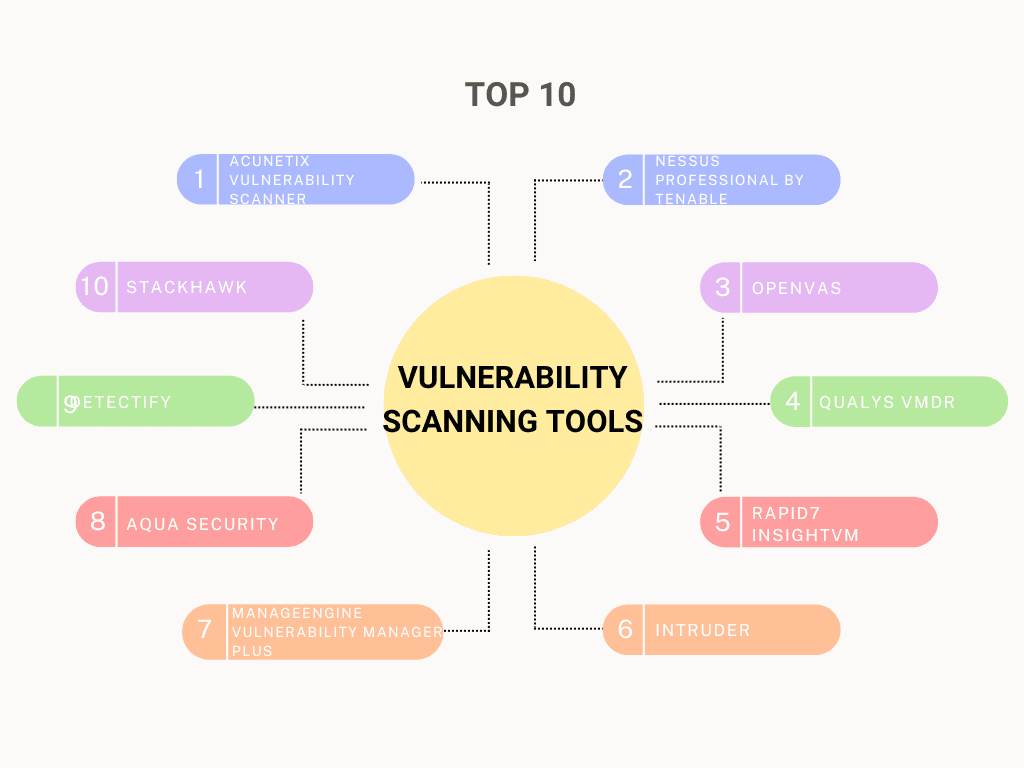
Choosing the right vulnerability scanner is essential for protecting an organisation’s digital assets effectively. Using the wrong vulnerability scanning tools can lead to failure in stopping a cyber attack. Here is a breakdown of the top 10 vulnerability scanning tools, highlighting their strengths and considerations to help you pick the optimal defender for your digital fortress:
A. Acunetix Vulnerability Scanner
Features: Web application scanning (DAST), extensive vulnerability coverage, compliance checks.
Strengths: User-friendly interface, in-depth scans for web applications.
Considerations: Cost-prohibitive for some, complexity might deter beginners.
B. Nessus Professional by Tenable
Features: Comprehensive scanning for networks, web applications, and configuration assessments.
Strengths: Integrates with other security tools, robust feature set.
Considerations: Free version has limited functionality, paid plans can be expensive.
C. OpenVAS
Features: Open-source and free, extensive plugin library for various scanning needs.
Strengths: Large, active community for support, highly customisable.
Considerations: Steeper learning curve, requires technical expertise to manage effectively.
D. Qualys VMDR
Features: Cloud-based deployment for easy access, patch management and automated remediation.
Considerations: Primarily focused on network security, limited web application scanning capabilities.
G. ManageEngine Vulnerability Manager Plus
Features: Comprehensive vulnerability management for networks, web applications, and endpoints.
Strengths: Cost-effective solution for SMBs, user-friendly interface with reporting functionalities.
Considerations: Feature set might be less extensive compared to high-end enterprise solutions.
H. Aqua Security
Features: Focuses on cloud-native and container security with vulnerability scanning and posture management.
Strengths: Deep integration with containerised environments, ideal for DevOps workflows.
Considerations: Primarily caters to cloud-based deployments, might not be suitable for traditional on-premise environments.
I. Detectify
Features: Continuous web application security testing (WASM), focuses on identifying business-critical vulnerabilities.
Strengths: Focus on real-world exploitability, prioritises vulnerabilities based on potential impact.
Considerations: Primarily targets web application security, limited network or endpoint scanning capabilities.
J. StackHawk
Features: Developer-friendly vulnerability scanning for web applications, integrates seamlessly with CI/CD pipelines.
Strengths: Simplifies security integration for developers, automates vulnerability detection in the development process.
Considerations: Primarily focuses on web application security during development stages, might not be suitable for comprehensive post-deployment vulnerability management.
Choosing the Right Vulnerability Scanning Tools
Forget feature overload. Selecting the ideal vulnerability scanner goes beyond a laundry list of functionalities. Here is a framework to guide your decision based on your specific needs:
Deployment Type
Cloud-based vulnerability scanning tools offer ease of use and scalability, while on-premise options provide greater control. Hybrid environments might require scanners compatible with both deployments.
IT Expertise
User-friendly interfaces and intuitive dashboards are crucial for teams with limited technical knowledge. Conversely, advanced users might prioritise extensive customisation options.
Budget
Open-source and freemium vulnerability scanning tools offer a cost-effective entry point, while paid solutions often provide more comprehensive features and support.
Do not operate in silos. Integrations with security information and event management (SIEM) systems or ticketing platforms can streamline vulnerability management by automating workflows and enriching threat context. You can also consider using VMPs that go beyond basic scanning. These platforms offer comprehensive vulnerability management, integrating scanning with features like patch management, reporting, and threat intelligence for a holistic security posture.
The Future of Vulnerability Scanning Tools
The vulnerability scanning landscape is constantly evolving. Here is a peek into what the future holds for vulnerability scanning tools:
Cloud-Based Dominance: Cloud-based vulnerability scanning tools are poised for even greater adoption due to their ease of use, scalability, and centralised management capabilities.
Continuous Scanning for Real-Time Defense: The shift towards continuous vulnerability scanning will become more prominent, enabling near real-time detection of emerging threats and faster response times.
AI and Machine Learning Take Center Stage: Artificial intelligence (AI) and machine learning (ML) will play a more significant role. Vulnerability scanners will leverage AI and ML for advanced threat detection, vulnerability prioritisation, and even automated remediation strategies.
Wrapping Up
Vulnerability scanning is an essential shield in today’s cyber battlefield. It empowers you to proactively identify weaknesses before attackers exploit them. Remember, the “best” vulnerability scanner isn’t a universal solution. You should carefully consider your specific needs and choose a tool that seamlessly integrates with your environment.
With the power of vulnerability scanning and robust vulnerability management practices, organisations can build a formidable defence and ensure the long-term security of their digital assets. Want to learn how to defend organisations against cyber threats and explore advanced cybersecurity practices? Enrol in the Advanced Certificate in Cybersecurity and Blockchain By E&ICT IIT Guwahati. This holistic cybersecurity course will prepare you for a solid career in cybersecurity.
Frequently Asked Questions
What is the difference between vulnerability scanning and penetration testing?
Vulnerability scanning is an automated process that identifies weaknesses in systems. Penetration testing simulates real-world attacks to exploit those vulnerabilities and assess your overall security posture. Both are crucial for a layered defence.
Are free vulnerability assessment tools any good?
Free vulnerability testing tools can be a great starting point for smaller businesses or personal use. They might have limitations in features or scan depth compared to paid options. Consider your needs and weigh the features against the cost.
How often should I scan for vulnerabilities?
The frequency depends on your industry, risk tolerance, and how often your systems change. Regular scans (weekly or monthly) are ideal, with additional scans after system updates or security incidents.
Are vulnerability assessment tools enough to secure my systems?
Vulnerability scanning is a vital first step, but it is not a silver bullet. You need to implement vulnerability management practices like prioritisation, patching, and retesting to ensure vulnerabilities are addressed and don’t linger.
In today’s hyper-connected world, our reliance on digital technologies has created a vast and complex landscape, one that unfortunately attracts malicious actors. Cybersecurity is the practice of protecting our digital assets, information, and systems from unauthorised access, use, disclosure, disruption, modification, or destruction. It is the digital armour that shields our businesses, personal data, and critical infrastructure from the ever-evolving threats posed by cybercriminals.
The stakes have never been higher. Cybercrime is a booming industry, costing businesses trillions of dollars globally each year. This Is not just a statistic, it translates to real-world consequences. A successful cyberattack can cripple a company’s operations, erode customer trust, and inflict significant financial damage.
In this article, we will learn about what does cybersecurity protect and what kind of threats it protects us from. By understanding the cybersecurity landscape and taking proactive measures, companies and even individuals can significantly reduce the risk of falling victim to cyberattacks. Let us learn more.
Understanding the Cost and Financial Impact of a Cyber Breach
Before we delve into the cybersecurity threats and strategies for mitigation, let us first find out the financial damage caused by cyberattacks (aside from data loss and many other damages). Here are the costs incurred when a cyberattack is successfully carried out:
Malware: $23,856 per incident
This is the average cost per incident businesses incur due to malware infections.
Denial-of-Service (DoS) Attacks: $100,000 per hour)
This is the immense financial losses businesses experience per hour during such attacks.
Source: Gartner: Cost of DDoS Attacks
So the answer to “what does cybersecurity protect” would be “everything” as these attacks lead to great financial losses, regardless of the asset or data that got compromised.
Common Cybersecurity Threats and Attacks
The digital landscape is teeming with malicious actors wielding a diverse arsenal of cyber threats (threat definition cybersecurity: any attack that can lead to losses or damages). Let us delve into the most common ones and equip you with the strategies for mitigation to combat them:
Malware
Malware are fundamentally any malicious program that is intended to cause harm to target computing systems. Here are some:
Viruses: These malicious programs self-replicate by attaching themselves to legitimate files. Once a user opens an infected file, the virus can spread throughout the system, corrupting data and disrupting operations.
Worms: Similar to viruses, worms can self-replicate, but they exploit network vulnerabilities to spread from device to device without requiring user interaction.
Ransomware: This particularly nasty form of malware encrypts a victim’s data, essentially holding it hostage. Attackers then demand a ransom payment in exchange for the decryption key.
Real-World Example: The 2021 ransomware attack on Colonial Pipeline, a major fuel pipeline operator in the United States, crippled fuel distribution for several days. The attack resulted in millions of dollars in ransom payments and widespread gas shortages.
Phishing
Phishing attacks are a deceptive attempt to trick victims into revealing sensitive information, such as passwords or credit card details. Attackers often use tactics like:
Spoofed Emails: Emails disguised to appear from legitimate sources (e.g., banks, social media platforms).
Urgency and Scarcity: Creating a sense of urgency or exploiting fear of missing out (FOMO) to pressure victims into clicking malicious links.
Suspicious Attachments: Attaching infected files or documents that appear enticing but compromise systems upon opening.
To empower your employees to identify phishing attempts, you can create a “Phishing Email Spotting Checklist.” This checklist would outline key red flags to watch out for, such as:
Mismatched Sender Addresses: Does the email address look slightly off compared to the legitimate sender’s address?
Generic Greetings: Beware of generic greetings like “Dear Customer” instead of personalisation.
Grammatical Errors and Typos: Professional organisations rarely send emails riddled with errors.
Suspicious Links and Attachments: Hover over links before clicking to see the actual destination URL. Do not open attachments unless you were expecting them from a trusted source.
Social Engineering
Social engineering exploits human psychology to manipulate victims into divulging confidential information or granting unauthorised access to systems. Attackers employ various tactics, including:
Pretexting: Creating a fabricated scenario to gain a victim’s trust, such as impersonating IT support and requesting login credentials.
Quid Pro Quo: Offering something in exchange for sensitive information, like fake technical support promising to fix a non-existent issue.
Baiting: Luring victims with tempting offers or exploiting curiosity to click on malicious links or download infected files.
Case Study: In 2016, attackers successfully breached the computer network of the Democratic National Committee (DNC) using a combination of spear phishing emails and social engineering techniques. By impersonating legitimate sources, attackers tricked DNC staff into clicking on malicious links and revealing login credentials. This attack highlights the importance of employee awareness and training to identify social engineering tactics.
Denial-of-Service
A Denial-of-Service (DoS) attack aims to overwhelm a website or online service with a flood of traffic, rendering it inaccessible to legitimate users. Imagine a crowd blocking the entrance to a store, that is the basic idea behind a DoS attack. Businesses that rely heavily on online services, like e-commerce platforms or financial institutions, are particularly vulnerable to DoS attacks.
Here are some strategies businesses can adopt to mitigate DoS attacks:
Implementing DDoS protection services: These services can detect and filter out malicious traffic before it disrupts operations.
Limiting login attempts: This can help prevent brute-force attacks, a common technique used in DoS attacks.
Having a backup plan: A disaster recovery plan ensures business continuity even if a DoS attack occurs.
Zero-Day Threats
Zero-day attacks exploit previously unknown vulnerabilities in software or systems. These attacks are particularly dangerous because security patches have not been developed yet. The importance of staying updated with the latest security patches and software updates cannot be overstated in mitigating zero-day attacks.
Insider Threats
Do not underestimate the threat posed by insiders. Disgruntled employees, contractors, or even business partners with authorised access can misuse their privileges to steal data, disrupt operations, or launch cyberattacks.
Here are some strategies for mitigating insider threats:
Implement strong access controls: Granting access only to the data and systems employees absolutely need for their job functions minimises the potential damage an insider can inflict.
Regular monitoring and auditing: Monitor user activity and system logs to detect suspicious behaviour that might indicate an insider threat.
Background checks and security awareness training: Conduct thorough background checks on potential employees and contractors, and provide ongoing security awareness training to educate employees on insider threats and best practices.
Essential Cybersecurity Measures
In today’s digital age, fortifying your defences is paramount. Now that we know what does cybersecurity protect, let us find out about some essential cybersecurity measures. Here is your arsenal to build a robust cybersecurity posture and safeguard your digital assets:
Network Security
Your network is the gateway to your data. Here are crucial tools to secure it:
Firewalls: These act as digital gatekeepers, filtering incoming and outgoing traffic based on predefined security rules. They block unauthorised access attempts, preventing malicious actors from infiltrating your network.
Intrusion Detection/Prevention Systems (IDS/IPS): These systems continuously monitor network activity for suspicious behaviour. IDS systems detect potential threats, while IPS systems actively prevent them from causing harm.
Network Segmentation: Dividing your network into smaller segments can minimise the impact of a security breach. If one segment gets compromised, the damage is contained, preventing attackers from accessing your entire network.
Assessing your current network security posture is crucial. You should follow a solid roadmap to evaluate your defences and identify areas for improvement. This roadmap would cover aspects such as:
Firewall configuration and rule management
IDS/IPS deployment and monitoring
Network segmentation strategies
Secure remote access protocols
Endpoint Security
Every device connected to your network is a potential entry point for cyberattacks. Endpoint security solutions provide vital protection for these devices:
Antivirus and Anti-malware Software: These traditional solutions scan devices for known malware threats and prevent them from infecting your systems.
Endpoint Detection and Response (EDR): EDR solutions go beyond basic antivirus by providing real-time monitoring, threat detection, and response capabilities. They can identify and neutralise even sophisticated zero-day attacks.
Choosing the right endpoint security solution depends on your specific needs and budget. Here is a comparison chart to help you navigate the options:
Feature
Vendor A
Vendor B
Vendor C
Antivirus Protection
Yes
Yes
Yes
Anti-malware Protection
Yes
Yes
Yes
EDR Capabilities
Yes
Yes (Limited)
Yes (Advanced)
Mobile Device Security
Yes
Yes
Yes
Centralised Management
Yes
Yes
Yes
Data Security
Data is the lifeblood of any organisation. Here is how to ensure its confidentiality and integrity:
Data Encryption: Encryption scrambles data using a secret key, rendering it unreadable to unauthorised users. This protects sensitive information even if it is intercepted during a cyberattack.
Access Controls: Implementing access controls ensures that only authorised users can access specific data based on their job roles. This principle of “least privilege” minimises the potential damage if access credentials are compromised.
A well-defined data security policy outlines your organisation’s approach to protecting sensitive information. You should follow a recognised data security framework for crafting your own policy, covering aspects such as:
Passwords are the first line of defence for user accounts. Here is how to fortify them:
Strong Passwords: Encourage the use of complex passwords with a combination of uppercase and lowercase letters, numbers, and symbols. Avoid using easily guessable words or personal information.
Multi-Factor Authentication (MFA): MFA adds an extra layer of security by requiring a secondary verification factor beyond just a password, such as a code from an authentication app or fingerprint verification. This significantly reduces the risk of unauthorised access even if attackers steal a password.
Equipping your employees with the knowledge to create and manage strong passwords is vital. We should always promote generating secure and memorable passwords for personal and business accounts.
Employee Training & Awareness
Employees are often the first line of defence against cyberattacks. Investing in cybersecurity awareness training empowers them to identify threats and make informed decisions online:
Security Awareness Training: Regular training sessions educate employees on various cyber threats, social engineering tactics, and best practices for secure online behaviour.
Phishing Simulations: Simulating phishing attacks allows employees to test their skills in identifying suspicious emails and helps them learn from their mistakes in a controlled environment.
We understand that developing training materials can be time-consuming but it is extremely important for streamlining cybersecurity processes. Companies should offer downloadable cybersecurity awareness training materials to their employees, including:
Presentations on common cyber threats
Interactive quizzes and exercises
Short explainer videos on key security concepts
Regular Backups & Disaster Recovery
Even with the most robust defences, cyberattacks can happen. Here is how to ensure business continuity:
Regular Backups: Regularly backing up your data to a secure offsite location allows you to recover critical information in the event of a cyberattack, hardware failure, or natural disaster.
Disaster Recovery Plan: A well-defined disaster recovery plan outlines the steps your organisation will take to resume operations after a disruptive event. It should include procedures for data recovery, system restoration, and communication with stakeholders.
Creating a comprehensive disaster recovery plan can seem daunting but it is necessary. It should have a structured approach that covers aspects like:
Identifying critical business functions
Risk assessment and mitigation strategies
Data backup and recovery procedures
Business continuity communication plan
By implementing these essential cybersecurity measures and empowering your employees, you can build a strong digital fortress and significantly reduce the risk of falling victim to cyberattacks. We should always remember that cybersecurity is an ongoing process, stay vigilant and adapt your defences as new threats emerge.
If you wish to become a cybersecurity expert, you can enrol in the Advanced Certificate in
Cybersecurity and Blockchain by E&ICT IIT Guwahati. This cybersecurity course will help you become an effective cybersecurity professional capable of protecting an organisation’s data and assets.
Advanced Cybersecurity Safeguards
While the essential measures outlined previously form a solid foundation, cybersecurity is an ever-evolving battlefield. In this kind of modern warfare where threats are always evolving and getting more effective, advanced strategies for mitigation are needed. These advanced safeguards, implemented alongside the essential measures outlined earlier, provide a comprehensive approach to cybersecurity.
Here, we delve into advanced strategies for mitigation to further fortify your digital defences:
Vulnerability Management
Vulnerability management is the systematic process of identifying, prioritising, and patching vulnerabilities in your software and systems. Here is why it is crucial:
Exploited vulnerabilities are the entry points for many cyberattacks. Regular vulnerability assessments help identify these weaknesses before attackers do.
Patching vulnerabilities is like repairing those loopholes or weaknesses in your defences, closing the gaps that attackers could exploit.
Security Information and Event Management (SIEM)
Security threats come from various sources such as suspicious login attempts, malware infections or network traffic anomalies. SIEM solutions act as your central nervous system for security, offering:
Real-time monitoring and analysis of security events from various devices and applications across your network.
Log aggregation and correlation. SIEM gathers data from diverse sources, consolidates it into a single platform, and identifies patterns that might indicate a potential security breach.
Incident alerting and investigation. SIEM can automatically trigger alerts when suspicious activity is detected, allowing you to investigate and respond to potential threats promptly.
Penetration Testing
Think of penetration testing as a controlled ethical hacking exercise. Security professionals simulate real-world cyberattacks to identify vulnerabilities in your systems and network defences. Here is how it benefits you:
Proactive identification of weaknesses: Penetration testing helps uncover security gaps that attackers might exploit before they launch a real attack.
Improved defence strategies: By understanding how attackers might infiltrate your systems, you can prioritise patching vulnerabilities and strengthen your defences accordingly.
Enhanced security posture: Regular penetration testing helps ensure your organisation stays ahead of the curve and maintains a robust security posture.
The Evolving Threat Landscape
The cybersecurity landscape is akin to a chameleon, constantly changing colors and adapting tactics. Here is why staying informed is paramount:
New threats emerge all the time. Cybercriminals are constantly devising new techniques to exploit vulnerabilities. Being aware of the latest threats allows you to proactively take steps to mitigate them.
Security best practices evolve. As threats change, so do the best practices for defending against them. Staying updated ensures your cybersecurity strategies remain effective.
Staying Informed
Equipping yourself with knowledge is your greatest defence. Here are some reputable resources to keep you informed about emerging cybersecurity threats and trends:
Websites:
The National Institute of Standards and Technology (NIST) Cybersecurity Framework (https://www.nist.gov/cyberframework) provides a comprehensive framework for managing cybersecurity risk.
The Cybersecurity & Infrastructure Security Agency (CISA) (https://www.cisa.gov/) offers valuable resources on various cyber threats and best practices for mitigation.
Publications:
SecurityWeek (https://www.securityweek.com/) offers a wealth of news and analysis on cybersecurity threats, vulnerabilities, and security solutions.
SC Magazine (https://www.scmagazine.com/) is another industry publication providing in-depth coverage of cybersecurity news, trends, and best practices.
The Key to Success
Now that you know the answer to “What does cybersecurity protect?”, it is important to understand that cybersecurity is not a one-time fix, it is an ongoing process. Here is how to ensure your defences stay strong:
Regularly review and update your cybersecurity policies and procedures. As threats evolve, so should your defences.
Conduct periodic security assessments and penetration testing. Identify and address emerging vulnerabilities before they become critical issues.
Foster a culture of security awareness within your organisation. Educate your employees on cybersecurity best practices and encourage them to report suspicious activity.
Building a Culture of Cybersecurity
In today’s digital age, cybersecurity is no longer optional, it is a strategic imperative. By adopting a proactive approach and fostering a culture of security awareness within your organisation, you can significantly reduce your cyber risk and safeguard your valuable assets.
Shifting from Reactive to Proactive
Reactive cybersecurity is akin to closing the barn door after the horses have bolted. A proactive approach emphasises prevention and preparedness. By implementing the essential and advanced safeguards outlined in this guide, you can anticipate threats and build robust defences before attackers strike.
Fostering a Culture of Security Awareness
Your employees are your first line of defence. By fostering a culture of security awareness, you empower them to identify threats, make informed decisions online, and report suspicious activity.
Here are some key strategies to cultivate this culture:
Regular Security Awareness Training: Invest in ongoing training programs to educate employees on cybersecurity best practices, common threats, and social engineering tactics.
Phishing Simulations: Simulate phishing attacks to test employees’ ability to identify suspicious emails and provide real-world learning experiences.
Open Communication: Encourage employees to report suspicious activity or concerns without fear of reprisal. Foster a culture of open communication where security is everyone’s responsibility.
Wrapping Up
By prioritising cybersecurity, building strong defences, and empowering your employees, you can navigate the ever-evolving threat landscape with confidence. Remember, cybersecurity is a journey, not a destination. Embrace continuous improvement, stay informed, and adapt your strategies to stay ahead of the curve. Together, we can create a more secure digital future for everyone.
Finally, by staying informed, continuously adapting your strategies, and fostering a culture of security awareness, you can build a resilient digital posture that can withstand even the most sophisticated cyberattacks. So, what does cybersecurity protect? All of us. Me, you and everybody else. Remember, cybersecurity is a shared responsibility, let us work together to create a safer digital world.
Wish to become a cybersecurity expert? You can enrol in Imarticus Learning and IIT Guwahati’s Advanced Certificate in Cybersecurity and Blockchain to become a cybersecurity professional. This cybersecurity course will open up new doors for you in the domain of cybersecurity.
Frequently Asked Questions
I keep hearing about phishing attacks, what are they and how can I avoid them?
Phishing emails (or messages) try to trick you into clicking malicious links or downloading infected attachments. They often appear to be from legitimate sources like your bank or employer. Be cautious of suspicious emails, don’t click on unknown links, and verify sender legitimacy before opening attachments.
What are some common cybersecurity threats for businesses?
Businesses face various threats, including malware attacks (viruses, ransomware), data breaches, and unauthorised access attempts. These can disrupt operations, damage reputations, and result in financial losses.
What’s the best way to protect my business from cyberattacks?
There is no single solution, but a layered approach is key. Implement strong passwords, install security software, educate employees on cybersecurity best practices, and regularly back up your data. Consider security audits to identify vulnerabilities in your systems.
What should I do if I suspect a cyberattack on my business?
Act swiftly. Isolate affected devices, disconnect from networks, and report the incident to the relevant authorities. If ransomware is involved, don’t pay the ransom – seek professional help for data recovery.
As generative AI takes over, a tidal wave of innovation is set to hit all sectors. It will help create ground-breaking marketing campaigns, design new products, and develop code ideas—all in one go! That is the power that generative AI applications put in your hands.
This blog explores the numerous ways generative AI is being used in the real world. We explore areas of marketing, design, science, and manufacturing.
Definition of Generative AI
Generative AI, short for generative artificial intelligence, is a type of AI that can create new data —text, images, music, or code. It works by learning the patterns and relationships within a massive dataset of existing content.
It is similar to having a giant library with books on every topic. Generative AI applications read all these, learn the rules of grammar, sentence structure, and storytelling, and then use that knowledge to write their own stories.
Here’s how it works:
Training: Generative AI models are trained on massive datasets. This could be millions of images, lines of code, or pieces of music.
Pattern recognition: As the model is trained, it recognises patterns and relationships within the data. It learns to recognise the elements that make up a cat picture, a pop song, or a computer program.
Content creation: Once trained, the model can use that knowledge to generate new content. It can create realistic images of cats that have never existed, compose music in a specific genre, or write code for a new software program.
After all, what is generative AI if it isn’t about diversification?
Examples of Generative AI
Generative AI is an emerging field with many applications. We’re already seeing it used in:
Marketing: New ad copy, product descriptions, and social media content.
Art and design: New design ideas, unique visual content, and music.
Science and engineering: Drug discovery, materials science, and new product development.
Here are some examples of generative AI applications by area of expertise:
Text Generation
Jasper: Marketing copy, blog posts, website content, and scripts.
Writesonic: Product descriptions, social media posts, and email marketing campaigns.
Scribe: Academic and professional writing, research, summarising articles and reports.
Image Generation
DALL-E 2: OpenAI’s tool that turns text descriptions into photorealistic images.
Midjourney: Image generation platform for creative and artistic outputs.
NightCafeCreator: Digital artwork based on user prompts and artistic styles.
Code Generation
Github Copilot: AI assistant for programmers that suggests code completions and functions based on context.
Tabnine: Code completion tool that learns from your coding style.
DeepCode: Code quality improvement.
In terms of miscellaneous activities, here’s more of what generative AI applications can perform:
Murf.ai: Voiceovers in many styles and languages.
Amper Music: Music to your preferences and mood.
Synthesia: Videos from text inputs. AI presenters.
Generative AI Applications
Generative AI deals with multitudes of industries. Its applications are known to have worked within these industries successfully:
Marketing and Advertising
Marketing has gotten even more creative with generative AI applications. Here’s how generative AI is making marketing effective:
Personalised messages for everyone: What is generative AI but a haven for human interaction? No more one-size-fits-all marketing! Generative AI can create content, like ad copy and social media posts, that talks directly to each person’s interests. Not just that, a recent report even showed how over 44% of marketers use GenAI solely for email copy while others depend on it for social media copies.
Visuals in a flash: Creating great images and videos is a pain. Generative AI can create unique visuals for your brand and campaign in seconds, saving you time and money. Access fresh content, constantly, without the hassle.
Testing made easy: Finding the perfect marketing message is similar to finding a needle in a haystack. Generative AI can create multiple versions of ads and headlines, and you can test them all quickly to see what works best. It’s like having a million test audiences at your fingertips!
Targeting like a professional: The definition of Generative AI extends to analysing tons of data to know what people want. You can precisely target your ads, making them reach the right people with the right message at the right time. To learn more, opt for generative AI courses like the Advanced Certificate Programme in Generative AI by Imarticus.
Here are a few popular examples of where we can experience Gen AI:
Netflix: A movie trailer made just for you, highlighting the bits you’ll love most. That’s what Netflix does with generative AI, and it keeps people hooked.
Uber: Ever get an Uber email with a special offer just for you? Generative AI applications like this use your past rides to suggest deals that make sense and keep you seeking more.
BBC: The BBC uses generative AI applications to create personalised social media posts based on your viewing habits so you discover various content.
Software Development
The definition of Generative AI is incomplete without the mention of software development. This technology allows you to write repetitive code snippets.
Moreover, you can use it for suggestions to solve problems and even instruct it to catch bugs before they sabotage your code. Moreover, 91% of Deloitte professionals believe in the power of Generative AI applications to improve organisational productivity.
Let’s look at some examples:
Github Copilot: This popular tool is like an AI assistant regarding generative AI applications. It suggests code completions and functions as you type.
Tabnine: Another code completion tool, Tabnine learns your coding style and preferences over time and gives you suggestions based on how you work.
DeepCode: This AI tool goes beyond just writing code. It analyses your codebase to find potential bugs and security vulnerabilities so you can write cleaner and more secure software.
Financial services
Generative AI applications create entirely new data and are moving quickly across industries. Below are a few ways generative AI is disrupting industries:
JPMorgan Chase: Experiment with generative AI to analyse data and find trading opportunities.
HSBC: Use generative AI to create synthetic data for fraud detection models.
BlackRock: Explore generative AI for portfolio optimisation, building more diverse investment strategies.
Enterprises
Generative AI can automate the mundane —data entry, report generation, and even basic coding. It frees employees to do what they do best: innovate, strategise, and crush those quarterly targets.
Here’s how generative AI applications aid enterprises:
Personalised customer interaction: Create unique content, targeted marketing materials, and chatbots that truly connect with customers.
Work smarter: Brainstorm new product ideas, generate design variations, and write basic code for prototypes —all with AI as your partner.
Data-driven decisions: Analyse massive datasets and find hidden insights to make better business decisions.
Streamline operations: Less time on admin tasks means more money saved.
Alleviate marketing and sales: Personalised content creation means higher conversion rates and a stronger brand.
R&D to the rescue: Bring innovative ideas to market faster.
Become a risk management expert: Identify and mitigate financial risks before they strike.
Generative Adversarial Networks (GANs)
Two AI systems are in an artistic battle. One is the generator, trying to create more realistic paintings, and the other is the discriminator, trying to separate the real from the fake. This is the basic idea of Generative Adversarial Networks (GANs), a deep learning technique that explores the limits of artificial creativity. This is where generative AI applications find their extension.
How GANs Work
Here’s an example to get you started: A forger is creating very convincing counterfeits while a detective is trying to catch the forgeries. The forger improves their technique based on the detective’s feedback, and the loop continues.
In a GAN:
The generator: Creates new data, like images, text, or music, from random noise.
The discriminator: Analyses the generated data and tries to determine if it’s real or fake based on its training on real data.
Through this ongoing competition, the generator learns to create increasingly realistic outputs, while the discriminator becomes a sharper critic.
Generative AI Applications Using GANs
Generative AI courses often cover GANs, an integral part of GenAI. GANs are no longer confined to research labs. Instead, you can find them in these areas:
Art and Design
GANs can create incredibly realistic images in any style. With Generative AI applications, you can generate new fashion designs that capture the essence of a particular era or designer or compose music that seamlessly blends different genres. GANs can even create photorealistic portraits from text descriptions, opening up new possibilities for personalised art.
Marketing and Advertising
Personalise marketing campaigns by generating targeted visuals or crafting product descriptions for specific demographics. For instance, generative AI applications let GANs create custom social media posts for a user’s interests or generate product mockups. GANs can also generate different ad variations for A/B testing so marketers can optimise their campaigns for maximum impact.
Drug Discovery and Materials Science
Simulate complex molecules or materials to speed up research and development. GANs can analyse huge datasets of existing molecules and materials and then use that knowledge to generate entirely new ones with specific properties.
This can lead to breakthroughs in areas like medicine, where GANs can design new drugs with fewer side effects, or in materials science, where GANs can create new materials with better strength, conductivity, or other desirable properties.
Fashion and E-commerce
Create personalised clothing recommendations based on a user’s style or browsing history. Imagine a virtual stylist powered by GANs who can suggest new outfits that match your current wardrobe or create a look for a special occasion.
GANs can also create product images for online stores, eliminating the need for expensive photo shoots and allowing for more product views to be shown.
Summary
Generative AI applications are modifying industries, from automating tasks in companies to creating new art forms with GANs. As this tech matures, the demand for skilled people will skyrocket.
This is the right time to register for generative AI courses. An Advanced Certificate Programme in Generative AI will give you the knowledge and skills to lead in this space, learn from industry experts, develop practical skills, and move your career forward.
Don’t miss out – sign up now and command generative AI!
FAQs
What is generative AI?
The definition of Generative AI extends to a type of AI that can create entirely new data, such as text, images, music, or even code from inputs in the same format. All you have to do is give it instructions according to the modality of the system.
What is the difference between AI and generative AI?
AI is great at data analysis, the foundation for tasks like recommendation systems or fraud detection. Generative AI applications let a specialised type of AI go a step further. It can analyse data and use that knowledge to create new content, like realistic images or new product designs.
How to use GenAI?
Using GenAI is as simple as it gets. Describe what you want (text, image, code), and feed it data. You will have your AI output in no time.
What are GenAI examples?
Generative AI applications are widespread in terms of text generation (like AI-written articles), image synthesis (creating images from descriptions), and music composition (generating songs on varied styles).
Artificial intelligence encompasses tasks related to replicating human brain activities such as learning, reasoning, language comprehension, problem-solving abilities, etc., by computers or software-driven robots. Thus, AI is a modern-day technology experiencing speedy evolution with each passing day to match and surpass human intelligence. Machine learning, deep learning, etc., are different specialised verticals of AI.
In this article, we shall explore in detail the answer to ‘what is generative AI’. We shall also learn about generative AI tools, skills in generative AI and generative AI courses.
What is Generative AI?
There are several types of artificial intelligence. Some are purely reactive with expertise in only one field, while some respond with limited memory. Robots with “theory of mind” and “self-awareness” are being researched and shall be the future of AI.
However, another type of AI has gained tremendous momentum in recent years—generative AI. Generative AI is a vertical of artificial intelligence tasked with developing new, imaginative, or futuristic content in the form of images, video, written content, etc., from available data. Applications of generative AI are plentiful, including police departments, healthcare, marketing, security, etc.
In the modern digital economy, generative AI plays a major role, and hence, learning skills in generative AI and expertise in handling generative AI tools can give aspirants a significant edge in the job market.
What is Generative AI and its benefits?
Generative AI leverages its huge data bank and realises human inputs to produce desired results. The advantages of generative AI abilities are multi-fold, and benefits can be obtained across many sectors. Some of the benefits of generative AI are as follows –
Automation
In digital marketing, even small business houses look forward to automation in some of their basic or routine functions. The main purpose is to deploy fewer human resources and achieve speedier execution.
Customisation
With the help of generative AI, business houses can offer extremely tailor-made services. Based on user inputs and preferences, generative AI activates its recommendation engine to suggest user similar products, services, visuals, articles, etc.
Optimisation
Client behavioural patterns and preferences both change drastically over time. However, organisations must withstand challenges and still be competitive. Generative AI can boost creativity and product design optimisation.
Enhanced service experience
Generative AI enhances customer service experience to the next level. Customers may clarify most of their queries with the chatbot services around the clock. Thus, clients get better services, and organisations reduce the cost of excess manpower.
Reduction in cost and time
The creativity of generative AI in automation reduces production processes, thus saving both cost and time. Generative AI also analyses client reviews and helps create acceptable, cost-effective, futuristic product designs.
Enhanced revenue and profit
When better customer service is realised, revenue increases. When cost production time is reduced, profit is enhanced.
Skills in Generative AI
To get a fair idea of ‘what is generative AI’, we need to understand the important skills in generative AI. There are a good number of institutions offering generative AI courses, which can transform the career path of any prospective candidate. Some of the most sought-after skills in generative AI are as follows –
Natural language processing (NLP)
Understanding natural human languages is important for replicating human intelligence. Thus, a vast amount of data is collected through different communication channels, such as emails, chats, texts, videos, etc.
Deep learning
This specialised type of machine learning is meant for critical (but human-like) decisions through robots. Designed after the neurons of the human brain, the DL method uses several layers of artificial neural networks to achieve its objectives. DL is utilised in industrial manufacturing, self-driven cars and for cancer cell detection.
AI Chatbot
This robotic agent is mainly used to respond to client queries as a customer support function. E-commerce, retail, banking, and insurance sectors use this extensively. However, these services are not completely independent and require human intervention for maintenance and even responding to critical or unique queries.
PyTorch
It is a framework based on the open-source ML library from Facebook. It helps create and train deep learning models and neural networks used in NLP and related software. PyTorch is developed using Python and is extremely popular among Python developers.
This is a skill that creates ideal inputs so that the results produced by generative AI models are useful for their intended purpose. A prompt engineer handholds the entire process of a generative AI model until it reaches its ideal evolution.
Computational biology
This skill utilises big data from the biological science field and, with the help of generative AI, understands biological systems, relationships, genetic research and medicine development for new diseases.
TensorFlow
It is a Google-coded open-source ML framework used to create and train neural networks. Because of its creative elements and real-world applications, it is equally appreciated in the AI research and developer communities.
AI image generation
Many generative AI services are available that can create desired images from natural language inputs. This skill is widely used in police services to generate images of alleged criminals.
We can understand what is generative AI by reviewing these top on-demand skill sets. These different skills in generative AI help an aspiring candidate to understand and choose the right skill set as per his or her abilities and likings. It is required to understand that artificial intelligence will require special professionals with desired skill sets. Thus, upskilling is the best mantra to sustain and survive.
Generative AI Tools
To successfully reflect upon ‘what is generative AI’, we must understand the different generative AI tools and languages that pave the way for a futuristic world of artificial intelligence.
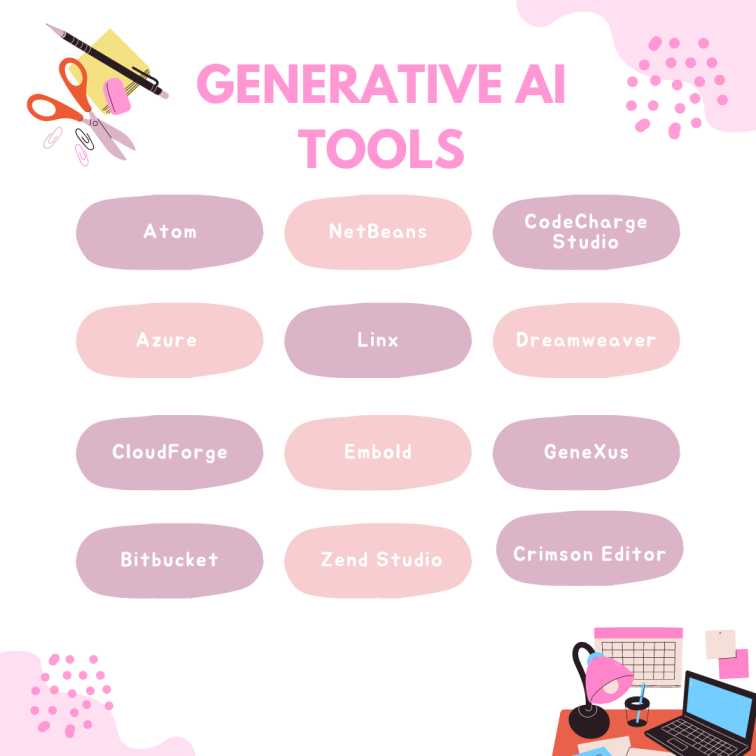
The different generative AI tools or programming tools and software development tools are as follows –
Atom
It is a free, open-source desktop and code editor that works on Windows, Linux and OS X. It performs cross-function editing and is capable of smart auto-completion.
NetBeans
It is a Java-based open-source tool capable of quickly developing mobile and desktop apps. It performs static analysis and visual debugger functions.
CodeCharge Studio
It is a pre-built rapid application development (RAD) tool meant for data-driven web functions using the internet or intranet with limited coding. It has the feature of a visual integrated development environment (IDE) and code generation.
Azure
Azure is a cloud-based MS tool that can deploy AI models as APIs. It performs several important desktop functions, such as storage services, data management, virtual networking, caching, etc.
Linx
It is a low-code tool for data centre backend automation. This tool makes web services easier to design and develop.
Dreamweaver
It is an Adobe-owned software programming editor tool for developing complex and responsive websites. It supports fast and flexible coding with multi-monitor support.
CloudForge
It is a SaaS platform for cloud-based collaborative application development. It can manage and integrate different development tools and support file sharing and document management. Its visibility and reporting functions are worth mentioning.
Embold
It helps to locate the bugs that disturb software’s robustness and maintainability. It generates code problems and security flaws. It is often used in mobile development.
GeneXus
It is a customer-based platform with digital analytics that creates, automates, and maintains databases and applications in various languages.
Bitbucket
It is a browser revision control tool for the software development team to create and review codes. It is also capable of storing large files in Git.
Zend Studio
It is a cloud-based IDE tool for creating, debugging, prototyping and testing mobile and web applications.
Crimson Editor
It is a free MS compact HTML text and code editing tool with syntax highlighting and auto-indentation properties.
All the above-mentioned tools will help the prospective candidate to get an idea about what is generative AI.
Conclusion
To be a master of generative AI tools, one needs to be a master of programming languages. Some of the top software languages for AI are Python, Java, SQL, C#, C or C++, and R. For a beginner to get a guideline regarding what is generative AI and which language to start with, they need to enrol in good generative AI courses with reputed institutions.
The Advanced Certificate Programme in Generative AI in Association with E&ICT Academy, IIT Guwahati by Imarticus, will give prospective candidates a massive head start in their careers. The course is 6 months long and includes 140 extra hours.
Visit the official website of Imarticus for more details.
FAQs
How are generative AI tools applied in daily life?
Productivity and information availability become faster and hassle-free when generative AI is used.
What is Azure?
Azure is a cloud-based MS tool with the capability of deployment of AI models as APIs.
What is PyTorch?
It is a framework from an open source ML library on Facebook.
In the vast world of cybersecurity threats, Trojan Horse malware stands out as one of the most insidious. Named after the Greek strategy used during the Trojan War, these malicious programs sneak into your system disguised as legitimate software, only to wreak havoc once inside.
A Trojan horse (or just Trojan) is a type of malicious software that trick clients into thinking it’s a harmless program. It gets its name from the ancient Greek tale of the Trojan Horse that led to the downfall of Troy.
Trojans usually spread through tricks called social engineering. Understanding what is Trojan Horse and learning how to protect yourself from Trojan viruses are crucial steps in safeguarding your digital life.
What is Trojan Horse?
A Trojan Horse is a type of malware that deceives users by masquerading as benign or useful software. Unlike viruses and worms, which replicate and spread autonomously, Trojans rely on social engineering tactics to trick users into executing them.
The term “Trojan Horse” derives from the ancient Greek tale where Greek soldiers hid inside a giant wooden horse presented as a gift to the city of Troy. Similarly, Trojan malware hides its malicious intent under the guise of a seemingly harmless program or file.
This story gives its name to modern “Trojan horse” cyber attacks for a few reasons:
The Trojan horse was a clever way to bypass Troy’s defenses after years of trying unsuccessfully to breach them. Similarly, a Trojan virus can bypass strong cybersecurity measures.
The Trojan horse looked like a harmless gift, just as a Trojan virus disguises itself as legitimate software.
Once inside, the Greek soldiers controlled Troy’s defenses. Similarly, a Trojan virus can take over your computer, making it vulnerable to other malicious attacks.
In simple terms, just as the Trojan horse was a sneaky way to conquer Troy, a Trojan virus is a sneaky way for cyber attackers to take control of your computer.
How Trojans Work?
Understanding how Trojans work is essential for recognizing and defending against them. Trojans typically infect systems through:
Phishing emails: Disguised as legitimate messages, these emails contain malicious attachments or links.
Software downloads: Trojans are often bundled with free software downloads from untrusted sources.
Exploiting vulnerabilities: Some Trojans take advantage of security flaws in software or operating systems.
Types of Trojan Malware
Trojans come in various forms, each with specific targets and methods. Here are some of the most common types of Trojan Malware:
Backdoor Trojans
Backdoor Trojans create unauthorized access points on infected systems, allowing attackers to control the device remotely. This type of Trojan is particularly dangerous as it can facilitate further attacks and espionage.
Banking Trojans
Banking Trojans specifically target financial information. They often intercept online banking transactions, capturing login credentials and other sensitive data.
Remote Access Trojans (RATs)
Remote Access Trojans (RATs) grant attackers complete control over the infected system. This access can be used for surveillance, data theft, or launching additional attacks.
Rootkit Trojans
Rootkit Trojans are designed to hide their presence and the presence of other malicious software on the system. They modify system settings and processes to evade detection by antivirus programs.
Other Notable Types
Other types of Trojans include DDoS Trojans, which facilitate distributed denial-of-service attacks, and Ransomware Trojans, which encrypt files & demand ransom payments for decryption.
How to Recognize a Trojan Virus?
Spotting a Trojan infection early can mitigate damage. Here are some common signs to watch for:
System slowdowns: Unexplained sluggishness can indicate the presence of a Trojan consuming resources.
Unexpected pop-ups: Frequent, unsolicited pop-ups are a red flag.
Unfamiliar programs: Unknown software appearing on your system is a cause for concern.
Unusual network activity: High levels of network traffic or unexpected data transfers can signal a Trojan.
Changes in system settings: Unauthorized modifications to settings or security configurations can also be indicative of an infection.
How to Protect Yourself from Trojan Viruses?
Prevention is always better than cure. Here are some effective strategies to protect against Trojan infections:
Protecting yourself from Trojan viruses is essential to keep your computer and personal information safe. Here are some easy steps you can take:
Be cautious with emails and links: Avoid email opening from unknown or suspicious sources. Sometimes, Trojans come disguised as emails from friends or legitimate businesses.
Download from trusted sources: Only download software and apps from well-known and reputable websites. Avoid downloading from pop-up ads or unfamiliar sites, as they may contain Trojans.
Keep your software updated: Regularly update your operating system, antivirus software, and all programs on your computer.
Use strong passwords: Create strong passwords for your accounts. Avoid using easily guessable passwords like “123456” or “password.”
Be careful with removable devices: Scan USB drives, external hard drives, and other removable devices for viruses before opening any files or transferring data.
Use a reliable antivirus program: Install updated antivirus software. It can detect and remove Trojans before they cause harm to your computer.
Importance of Antivirus Software
Using reputable antivirus software is crucial. These programs can detect and remove Trojans before they cause significant harm. Make sure that your antivirus software is always up to date to combat the latest threats.
Regular System Updates
Keeping your operating system & all software up to date is another important defense strategy. Software updates frequently include fixes for security flaws that Trojans exploit.
Conclusion
In the digital age, the threat of Trojan Horse malware is ever-present. By understanding what is Trojan horse, recognizing the signs of an infection, & taking proactive steps to protect yourself, you can easily reduce the risk of falling victim to these malicious programs. Additionally, investing in cyber security courses online can further arm you with the knowledge needed to safeguard your digital assets.
Master Cybersecurity, Cryptography, and Blockchain with Imarticus Learning
Explore the dynamic domains of cybersecurity, cryptography, and blockchain through Imarticus Learning, where cyber security courses online mirror real-world industry practices. Our curriculum and teaching approach serve as your guide to mastering essential skills, preparing you for a secure and innovative future. You’ll learn to defend against cyber threats, implement encryption for data security, and understand blockchain’s transformative impact across industries. Additionally, students benefit from EC-Council-aligned content, hands-on experience on EC-Council iLabs, and an exam voucher for the EC-Council CEH certification.
Designed in collaboration with IIT Guwahati and industry experts, our curriculum emphasizes networking fundamentals, ethical hacking, vulnerability analysis, and blockchain technology. Engage in immersive lab sessions where you’ll work with industry-standard tools like VMware, Kali Linux, Wireshark, Nessus, and Nmap, demonstrating practical proficiency in cybersecurity techniques.
Interact live with cybersecurity experts from IIT Guwahati and industry leaders in interactive sessions covering networking, ethical hacking principles, vulnerability assessment, and blockchain concepts. Prepare yourself for a rewarding career in cybersecurity with Imarticus Learning.
Join us to fortify your skills and prepare for the future of cybersecurity with Imarticus Learning.
In recent years, blockchain technology has emerged as one of the most transformative innovations across various industries, transcending its origins in cryptocurrency. From finance to healthcare, supply chain management (SCM) to voting systems, blockchain’s decentralized and secure nature has sparked interest in a career in blockchain worldwide.
As this technology continues to evolve, professionals across diverse sectors are recognizing the need to equip themselves with blockchain expertise for a successful career in blockchain.
Enter blockchain technology, the ingenious system powering these digital currencies. But guess what? Blockchain’s applications extend far beyond crypto, and it’s rapidly transforming how businesses operate across industries.
Here’s why a blockchain certification course could be the key to unlocking a future-proof career in blockchain.
Exploring Blockchain Education: Bridging the Gap Between Cryptocurrency and Enterprise Opportunities
A blockchain is like a digital ledger that specially keeps track of information. It stores records, called blocks, which are securely connected using special codes. Each block contains information about the one before it, along with details like when the information was added and what transactions were made.
Think of it like a chain of blocks where each new block is linked to the previous one. Once information is added to a block, it can’t be changed without changing all the blocks that come after it. This makes blockchain transactions very secure because it’s extremely difficult to alter them without everyone noticing.
Blockchains are usually managed by a network of computers that work together to add and check new blocks of information. This network follows specific rules to make sure everything is accurate and secure. While blockchains aren’t completely immune to changes, they’re designed to be very reliable and resistant to problems.
Imagine a giant, shared record book – that’s essentially what a blockchain is. Transactions (cryptocurrency exchanges, data transfers, etc.) are recorded in chronological blocks, cryptographically linked together. This creates an immutable ledger, meaning information can’t be tampered with.
How can blockchain training improve the prospects of building a blockchain developer career?
So, why is this tech getting all the buzz in the enterprise world?
Here are some key benefits that are making businesses drool:
Enhanced Security: Forget about data breaches! Blockchain’s decentralized nature makes it incredibly secure. Every member of the network has a copy of the ledger, so hacking becomes a near-impossible feat.
Streamlined Processes: Say goodbye to clunky, paper-based systems. Blockchain automates workflows and simplifies complex processes, saving businesses time and money.
Improved Transparency: Transactions are transparent and verifiable on the blockchain, fostering trust and accountability between parties.
Traceability and Provenance: Need to track the origin of a product? Blockchain shines! It allows companies to track goods throughout the supply chain, ensuring authenticity and quality control.
Why is understanding blockchain fundamentals crucial for professionals in diverse industries
Now that you understand the power of blockchain, let’s explore how distributed ledger technology courses can equip you with the knowledge and skills to thrive in a career in blockchain.
How to Start Career in Blockchain: Building a Strong Foundation
A good blockchain technology course online will start with the fundamentals. You’ll learn about:
The core concepts of blockchain technology: You’ll delve into the intricacies of distributed ledger technology, consensus mechanisms, and cryptography.
Different types of blockchains: There’s not a one-size-fits-all solution! You’ll explore public, private, and permissioned blockchains, understanding their unique functionalities.
The evolving landscape of blockchain applications: From supply chain management to healthcare, you’ll discover the diverse ways blockchain is transforming industries.
Beyond the Basics: Developing In-Demand Skills For A Career in Blockchain
Here are some areas you might explore:
Smart Contract Programming: These self-executing contracts automate agreements on the blockchain, and learning to build them is a valuable asset.
Blockchain Security: Understanding potential vulnerabilities and how to mitigate them is crucial for businesses implementing blockchain solutions.
Business Applications of Blockchain: Dive deep into specific use cases relevant to your desired career path. This could be anything from trade finance to intellectual property management.
The Benefits of Structured Learning
While there’s a wealth of free information online, a structured blockchain course can help understand how to start career in blockchain:
Comprehensive Curriculum: A well-designed course ensures you learn everything you need to know, presented logically and progressively.
Expert Guidance: Instructors with real-world experience can answer your questions, clarify complex concepts, and provide valuable insights.
Networking Opportunities: Courses often create a platform to connect with fellow learners and potential employers for a promising career in blockchain.
The Final Words
Diving into a blockchain certification can truly supercharge your career trajectory. Whether you are a professional or just starting, the skills and knowledge gained from such a course can open doors to a plethora of opportunities for a career in blockchain across various industries. From understanding the intricacies of cryptocurrency to implementing blockchain solutions in enterprise settings, the possibilities are endless.
By staying ahead of the curve & mastering this transformative technology, you’ll position yourself as a valuable asset in today’s digital landscape. So, why wait?
Take the leap, enroll in a blockchain technology course, and embark on a journey toward a brighter and more rewarding career in blockchain. The future of blockchain awaits – seize the opportunity and make your mark!
Key Takeaways: Remember These Blockchain Course Benefits
Gain in-demand skills: Blockchain expertise is becoming increasingly sought-after by businesses across industries.
Future-proof your career: Blockchain technology is here to stay, and a course equips you to be part of this revolutionary movement.
Open doors to exciting opportunities: The applications of blockchain are vast, leading to a variety of career paths.
Become a valuable asset: Companies are actively seeking individuals who understand blockchain and its potential to optimize operations.
Unlock Your Cybersecurity Future with IIT Guwahati & Imarticus Learning!
Say hello to the Advanced Certificate in Cybersecurity and Blockchain, brought to you by the experts at IIT Guwahati in collaboration with Imarticus Learning!
This program is your ticket to mastering a career in blockchain and the latest techniques in cybersecurity and cryptography – just like the pros do in the industry. You’ll learn how to defend against cyber threats, secure your data with encryption, and tap into blockchain’s game-changing potential across different sectors.
IIT Guwahati faculty and seasoned industry specialists meticulously design this curriculum. From networking fundamentals to ethical hacking and everything in between, we’ve got you covered for a strong blockchain developer career!
Get your hands with immersive lab sessions using top-notch tools like VMware, Kali OS, and more. Trust us, there’s no better way to learn cybersecurity techniques than diving right in!
Learn with cybersecurity gurus from IIT Guwahati and industry experts in live sessions. It’s your chance to explore topics like ethical hacking, vulnerability assessment, and blockchain concepts firsthand.
Picture yourself spending three awesome days soaking up knowledge on the vibrant campus of IIT Guwahati. Plus, you will also meet fellow students, faculty, and industry insiders – talk about networking gold!
Ever dreamed of becoming a Certified Ethical Hacker?
With this program, you’ll gain the skills and knowledge needed to ace the CEH exam and take your cybersecurity game to the next level. From the basics to advanced techniques, we’ll equip you with everything you need to tackle real-world cyber challenges like a pro.
So, what are you waiting for? Secure your spot in the Advanced Certificate in Cybersecurity and Blockchain today and take the first step towards an exciting career in cybersecurity!
Keeping data right is very important for all databases. When we have copies, it can cause problems and use more space. To help with this, we will learn how to delete duplicate rows in SQL. We’ll start with simple ways and work up to complicated ones.
We’ll explore a range of techniques, from the fundamental DISTINCT keyword to utilizing advanced Common Table Expressions (CTEs) in conjunction with the ROW_NUMBER() function. This will make you adapt at using SQL and keep your data clean and efficient in no time!
Delete duplicate rows in SQL
In SQL, deleting duplicate rows means putting off entries from a table comprising equal information primarily based on specific criteria. Duplicate rows can occur for diverse reasons, including data entry mistakes, integrations from different assets, or incomplete deduplication methods.
Deleting duplicates facilitates:
Improve data integrity: By eliminating redundant data, you make sure that the tables are correctly filled with data and constant.
Save storage space: Duplicate rows occupy needless garage space, and getting rid of them can optimize database performance.
Enhance data analysis: Duplicate rows can skew statistics evaluation consequences. Removing them results in more correct and dependable insights.
How to delete duplicate rows in SQL using sample data
Here’s how testing makes it clear to see how duplicate rows take-out works in SQL:
Sample data
Let’s consider a table named Customers with the following columns:
CustomerID
Name
Email
1
John Doe
john.doe@email.com
2
Jane Smith
jane.smith@email.com
3
Mike Jones
mike.jones@email.com
4
John Doe
john.doe@email.com (duplicate)
This table has the same row twice for John Doe. We can take an example like this to show how various SQL ways find and delete duplicate rows.
Delete duplicate rows in SQL using Group
Using GROUP BY and HAVING clauses is a strong method to remove repeated rows in SQL. You select columns to group the data and then use the HAVING clause to filter the groups. It helps find rows with the same values in specific columns.
Here’s how it works:
Group By: You choose which columns to group the data by. This puts rows with the same values in those columns into categories.
HAVING Clause: This filters the groups made by GROUP BY. You can use COUNT(*) inside HAVING to find groups with more than one row (copies).
How to delete duplicate rows in SQL with Group By and Having
To do this, follow the steps mentioned here.
Step 1. Find duplicate rules: Decide which columns show a duplicate in your data. For example, in a list of customers, duplicates can be found by matching Name and Email together.
Step 2. Build the DELETE Query: This is the basic format:
DELETE FROM your_table_name
WHERE your_table_name.column_name_1 IN (

  SELECT column_name_1

  FROM your_table_name

  GROUP BY column_name_1, column_name_2 (columns for duplicate check)

  HAVING COUNT(*) > 1

);
Example
Consider a table named Products with columns ProductCode, ProductName, and Price. We want to delete duplicate products based on ProductCode and Price.
DELETE FROM Products
WHERE Products.ProductCode IN (

  SELECT ProductCode

  FROM Products

  GROUP BY ProductCode, Price

  HAVING COUNT(*) > 1

);
Result: This query will put things together by ProductCode and Price. The part saying HAVING COUNT(*) > 1 shows sets with the same products and prices. The DELETE statement then takes away rows with codes that are the same as these found duplicates.
Fetching and Identifying the duplicate rows
It’s crucial to identify them accurately before knowing how to remove duplicates in SQL. Data science professionals often use SQL’s functionalities like querying and filtering to pinpoint these duplicate entries. Here are some methods to fetch and identify duplicate rows:
1. Using GROUP BY and COUNT(*)
This is a common approach that uses both grouping and aggregate functions. The idea is to group rows based on the columns that define duplicates.
Use COUNT(*) to determine the number of rows in each group. Groups with a count greater than 1 indicate duplicates.
Syntax
SELECT column_name_1, column_name_2, …, COUNT(*) AS row_count
FROM your_table_name
GROUP BY column_name_1, column_name_2, …;
2. Using DISTINCT and Self-Join
The SQL remove duplicates option is a very handy way to handle your data. This method utilizes DISTINCT to fetch unique combinations and a self-join to compare rows. Use SELECT DISTINCT on the columns defining duplicates to get unique combinations. Later on, perform a self-join on the table itself, matching these unique combinations with the original table.
Syntax
SELECT t1*.
FROM (SELECT DISTINCT column_name_1, column_name_2, … FROM your_table_name) AS unique_data
INNER JOIN your_table_name AS t1 ON (unique_data.column_name_1 = t1.column_name_1 AND …)
WHERE unique_data.column_name_1 = t1.column_name_1 AND …;
3. Using ROW_NUMBER()
This method assigns a row number within groups defined by duplicate criteria, allowing you to identify duplicates based on their order.
Syntax
SELECT *, ROW_NUMBER() OVER (PARTITION BY column_name_1, column_name_2, … ORDER BY column_name_3) AS row_num
FROM your_table_name;
How do you choose the right method?
The right way depends on your needs and table size. Using GROUP BY and COUNT(*) is good for most cases. If you know how to remove duplicates in SQL, you might as well learn when to use which method.
If you have complicated copies or need to filter based on order, you could try ROW_NUMBER(). If you want to see all the copies, using self-join can help.
Delete duplicate rows in SQL with an intermediate table
The “Intermediate table” way is good for doing away with the same rows in SQL. You use another table to keep the different info, and then swap it with the first table. For example, in a table called Customers with CustomerID, Name, and Email, with the same data.
Steps
Create Intermediate Table: CREATE TABLE Customers_Temp LIKE Customers;
Insert Distinct Rows: INSERT INTO Customers_Temp
SELECT DISTINCT CustomerID, Name, Email
FROM Customers;
(Optional) Drop Original Table: DROP TABLE Customers;
Rename Intermediate Table: ALTER TABLE Customers_Temp RENAME TO Customers;
Deleting duplicate rows in SQL using ROW_NUMBER() function
The ROW_NUMBER() function is a handy tool for deleting duplicate rows within a database table. For a query to delete duplicate records in SQL, you have a convenient option in this function.
This function assigns a unique number to each row within a result set, based on a specified ordering. It uses the following syntax:
ROW_NUMBER() OVER (PARTITION BY <column_list> ORDER BY <column_list>) AS row_num
where
PARTITION BY <column_list>: This clause groups rows together based on the specified columns. Rows within each group will be assigned unique row numbers.
ORDER BY <column_list>: This clause defines the order in which the rows within each partition will be numbered.
Example
Suppose you have a table named Customers with columns customer_id, name, and email. You want to delete duplicate customer entries based on name and email. Here’s the query:
WITH cte AS (

  SELECT *, ROW_NUMBER() OVER (PARTITION BY name, email ORDER BY customer_id) AS row_num

  FROM Customers

)

DELETE FROM cte

WHERE row_num > 1;
Result: This query first creates a CTE named cte. It assigns a row number (row_num) to each row in the Customers table. The partitioning is done by name and email, and the ordering is based on customer_id. Then, the DELETE statement removes rows from the CTE where row_num is greater than 1, eliminating duplicates.
Delete duplicate rows in SQLusing Common Table Expressions (CTE)
Common Table Expressions (CTEs) offer a powerful way to delete duplicate rows from your database tables. Here’s how you can use CTEs with the ROW_NUMBER() function for this task:
Step 1. Define the CTE
The CTE identifies the duplicate rows. Here, you’ll use the ROW_NUMBER() function to assign a unique sequential number to each row.
The PARTITION BY clause groups rows together based on specific columns. Only rows within the same group will compete for unique numbering.
The ORDER BY clause defines the order in which rows within each group are numbered.
Step 2. Filter and delete
After creating the CTE, you can use the DELETE statement to target the CTE alias.
Within the DELETE statement, you’ll filter for rows where the ROW_NUMBER() (often aliased as row_num) is greater than 1. This effectively removes duplicates while keeping the first occurrence of each unique combination.
How toDelete duplicate rows in SQLusing CTE
While procedures are a great way to encapsulate logic, removing duplicates with CTEs is typically done within a single SQL statement. However, here’s how you could potentially create a procedure using CTEs as an example:
Step 1. Procedure creation
CREATE PROCEDURE RemoveDuplicates (
@tableName VARCHAR(50),  -- Name of the table to process

       @columnList VARCHAR(200) -- Comma-separated list of columns for duplicate check

   )

   AS

   BEGIN

       -- Implement the logic here

   END;
Step 2. Logic within the procedure (using CTE)
DECLARE @cteName VARCHAR(50); — To store dynamic CTE name
SET @cteName = 'cte_' + @tableName;  -- Generate unique CTE name

   WITH (@cteName) AS (  -- Define CTE dynamically

       SELECT *,

              ROW_NUMBER() OVER (PARTITION BY @columnList ORDER BY some_column) AS row_num

       FROM @tableName

   )

   DELETE FROM @cteName  -- Delete from CTE

   WHERE row_num > 1;

   END;
Rank function to SQL delete duplicate rows
The RANK() function in SQL can be a great tool for deleting duplicate rows from a table. The function assigns a ranking number to each row within a result set, considering a specified ordering. Similar to ROW_NUMBER(), it uses the following syntax:
RANK() OVER (PARTITION BY <column_list> ORDER BY <column_list>) AS rank_num
where
PARTITION BY <column_list>: This clause groups rows together based on the specified columns. Rows within each group will receive ranks.
ORDER BY <column_list>: This one defines the order in which the rows within each partition will be ranked.
Steps forDeleting duplicate rows in SQLwith RANK
The steps are explained here:
Step 1. Identify duplicates: The RANK() function assigns the same rank to rows with identical values in the PARTITION BY columns.
Step 2. Delete ranked duplicates: We can leverage a CTE to isolate the duplicates and then delete them based on the rank.
Example for RANK function
Suppose you have a table named Products with columns for product_id, name, and color. You want to remove duplicate rows in SQL by targeting the product entries based on name and color. Here’s the query:
WITH cte AS (

  SELECT *, RANK() OVER (PARTITION BY name, color ORDER BY product_id) AS rank_num

  FROM Products

)

DELETE FROM cte

WHERE rank_num > 1;
Result: This query first creates a CTE named cte. It assigns a rank_num to each row in the Products table. The partitioning is done by name and color, and the ordering is based on product_id. Rows with the same name and color will receive the same rank_num.
Then, the DELETE statement removes rows from the CTE where rank_num is greater than 1, eliminating duplicate entries.
Final Thoughts
Duplicate rows in your database can cause wasted space and skewed analysis. This article enables you to delete duplicate rows in SQL effectively. We explored methods like GROUP BY with HAVING for basic tasks, and advanced techniques with ROW_NUMBER() and CTEs.
Choosing the right method depends on your table size and needs. For a data-driven approach to managing your databases, consider Imarticus’s Postgraduate Program in Data Science Analytics. This data science course equips you with the skills to wrangle, analyze, and visualize data, making you an expert in data management. Register instantly!
Databases have always been crucial in the business sphere and have become an integral part of every sector. SQL and MySQL are two major topics when working on databases. Where SQL is the query language, MySQL is the RDBMS platform that uses the SQL language to maintain and modify large amounts of data.
Read on to get a deeper understanding of SQL vs MySQL. Also, learn how both these components work and why they are important in the field of data science, and management.
What is a Database?
A database can be defined as an assortment or compilation of data that is stored in a digital system such as a computer or a server. A database is used to store and keep track of large amounts of data which becomes easier to manage when stored within a database. Users can also update and retrieve information as and when required without any hindrance.
Generally, a database appears in the form of tables consisting of the desired number of rows and columns. Tables are the foundation of a database. One can easily read and retrieve data from tables. Each column consists of one feature or component, such as names and serial numbers and the corresponding rows consist of the values that the user adds.
So the question of the difference between SQL and MySQL can easily be answered if one knows the concept of database and its usage.
SQL vs MySQL – What is the Difference?
Here comes the most important portion of the topic, SQL vs MySQL. It consists of the answers to ‘What is the difference between SQL and MySQL’. Even though both of them are closely related to each other, they possess certain differences that are listed in the following table:
Basis
SQL
MySQL
What is it?
SQL is a well-organised query programming language that is used to manage relational database management systems.
MySQL is an open-source RDBMS which uses SQL language for working with data.
stands for
Structured Query Language.
’My’ is the name of the daughter of the co-founder, and SQL is an RDBMS that uses the SQL language.
Used for
Generally, SQL is used to write queries in order to operate and work with the database management systems.
On the other hand, MySQL assists users in modifying, deleting, updating and storing structured data within the platform.
Supports and is compatible with
SQL is less flexible and it does not support any connecting applications. It is not compatible with any connectors.
The MySQL platform has an inbuilt application, called the MySQL Workbench. This tool helps users to promptly create, build, modify and design various databases.
Storage capacity
There is only one single storage engine when SQL is concerned.
MySQL is a very flexible platform and it can support multiple storage engines. At the same time, it also comes with the facilities of plug-in storage.
format/structure
SQL only supports one single standard format. It does not come with frequent application updates.
MySQL platform, on the other hand, has variations and it comes with frequent updates. It helps the platform remain up to date with the latest technology inclusions.
manipulation of data
While working with SQL, it does not allow the processors to update or manipulate data at the time of execution. Hence, it is a secure language.
MySQL is less secure and prone to security threats as it permits third-party processes to access and modify information at the time of execution.
What is SQL?
While understanding the concept of SQL vs MySQL, one may often think what is SQL in DBMS? So the concept of SQL which is Structured Query Language can be defined as a standardised and widely recognised language that is often used to work on databases. Database management systems generally employ the use of SQL in order to maintain and manage the information contained in it.
The standard SQL syntax provides the same type of syntax for performing different database functions, such as adding data, retrieving data, modifying data and so on. However, there can be negligible differences in syntax while working on different databases but the major part remains the same.
Various SQL syntaxes allow users to perform different mathematical and management functions. It permits users to add or delete data, modify and update data, alter data and many other functions.
What is an SQL Server?
To understand what SQL is and MySQL, it is important to understand the different components of SQL and SQL servers. SQL Server can be defined as the RDBMS, which expands to a Relational Database Management System developed by Microsoft. It works just like any other database and allows users to manage, store and retrieve information for a variety of services and applications.
The SQL server uses SQL language to work on and interact with the databases. SQL vs MySQL is a basic but important understanding for tech aspirants. SQL Server is also a programming language that performs tasks like filtering, sorting, creating tables, joining data, writing queries etc so that users can properly maintain track of data in an electronic form.
Additionally, an important feature of SQL server is that it can provide high-end features such as more security, longevity of data, advanced availability and increased scalability. All kinds of businesses such as small-scale businesses and MNCs can make use of SQL servers for their web applications and data analysis processes.
What is MySQL?
MySQL is a type of relational database management system, and it is also one of the oldest RDBMS available. It was introduced in 1995 and has proven to be greatly helpful for the purpose of storing and managing data. MySQL AB developed this database and it was acquired by Sun Microsystems, which is present-day, Oracle Corporation. MySQL full form is ‘My’, which is the daughter of the co-founder and SQL is a relational database management system that uses Structured Query Language.
One question, what is MySQL used for? To understand this one should know that MySQL is an open-source application and was launched as an attempt to provide a platform for storing and managing well-organised data. MySQL is written in C and C++ programming languages and it is compatible with all available operating systems such as Linux, Unix, Windows etc.
One can thoroughly understand SQL vs MySQL if one knows how the two components independently work. How is MySQL used and why it is important is a significant factor for database professionals.
How Do You Use SQL With MySQL?
Many people wonder ‘Is SQL and MySQL same?’ Well, both of these are closely related, but it has some minor differences. SQL is commonly defined as a foundational language that is employed to manage and modify data in various databases, whereas MySQL is an open-source RDBMS that is compatible with the structured query language.
In simple terms, SQL is the language and MySQL is the platform where the SQL language is used. It is one of the most common components of SQL vs MySQL. In order to use SQL in connection with MySQL, one needs to install the application of MySQL in their computer system along with a client application that is compatible with SQL.
If one wants to build communication with my SQL employing SQL, one needs to either employ a Graphical User Interface (GUI) tool or a command-line client that supports the working of SQL with MySQL. One can use common query statements to define the connection such as:
SELECT
INSERT
DELETE
UPDATE
Do All Databases Use SQL?
No, all databases do not use SQL. Databases have various kinds and most of them use SQL, but there are some other databases as well that use some other query, language and structures. Even though it is easier to manage relational databases by using SQL and it is one of the most convenient forms of database, there exist other forms as well.
Other databases like MongoDB and Cassandra, use a document-based approach and exhibit specialised query languages. These are also very promising databases, but these do not employ SQL.
Another form of database, which is graphically extensive, such as Neo4j uses organisational structures and some other particular programming styles, which again is not SQL.
Almost every sector uses electronically controlled systems to store and manage large amounts of information. SQL is a command-based query language that is used to store, manage, update, modify, alter, and manipulate data in relational databases. Structured Query Language is expansively used in industries like IT, retail, healthcare, marketing, finance an so on.
SQL vs MySQL is a significant topic for understanding the variations in both components. MySQL is a famous open-source platform that uses the SQL language to communicate with databases and enhance the RDBMS functionalities. MySQL is the RDBMS that employs the structured query language to store, modify, alter, manage, and retrieve data from various web applications.
MySQL has the ability to develop robust and dynamic web pages when collaborating with programming languages like PHP. It elevates the capabilities of the open/source platform, which conclusively generates meaningful web applications and websites. One may consider signing up for the data science course to understand the deeper insights of both these components.
Commonalities Between SQL and MySQL
The topic of SQL vs MySQL also throws some light on the similarities between the two. Both SQL and MySQL are two crucial components in the sphere of data management. MySQL is one of the widely recognised open-source RDBMS platforms, whereas SQL is a popularly used query language. mostly, these two differ in their characteristics and features, but it has certain similarities as well.
The commonalities between SQL and MySQL are enumerated as follows:
The data types used and supported by SQL and MySQL are very similar for example; numeric, string, boolean etc.
Both SQL and MySQL have similar data modification and manipulation operators such as SELECT, UPDATE, INSERT, DELETE etc.
The syntax used by both SQL and MySQL are very identical to each other as the keywords used while writing the queries are similar. For example, both SQL and MySQL make use of the keywords WHERE, ORDER BY, FROM etc.
How to Choose Which is Best to Use Between SQL and MySQL?
When contemplating the question of whether should I learn SQL or mySQL, it’s crucial to understand that my SQL is essentially a specific implementation of SQL language. In order to modify, change and alter a relational database management system, individuals make use of SQL language. Hence, MySQL is the RDBMS platform and SQL is the query language that is used by MySQL.
Both SQL and my SQL are important as both of them have different functionalities. While contemplating the topic of SQL vs MySQL, it is imperative to understand that one cannot work with MySQL without implementing SQL query language and vice versa. One must remember that MySQL is just one particular implementation of the SQL language.
Conclusion
SQL vs MySQL is a very important topic for people who want to take up data science and computer applications as their field of career. There is no winning over the other, and no one can say which one is best because both SQL and MySQL have different characteristics and functionalities having limited similarities. The smartest thing to do is to use both of them together and take out the best output, considering the specific needs of the companies. If you wish to learn more about databases, SQL, and MySQL consider enroling in the Postgraduate Program in Data Science and Analytics by Imarticus. This data science and analytics course will help you get a personalised learning experience with proper practical knowledge. This postgraduate programme will help you stand out among your contemporaries and help you advance in your professional life.
FAQ’s
Should I learn SQL or MySQL first?
When contemplating ‘Should I learn SQL or MySQL’, you need to understand that without learning the SQL language, you cannot start working on database management. To master the skills of database management, one must first learn the SQL language. Understanding the language helps users to write queries for managing and manipulating the RDBMS.
Can I use MySQL without SQL?
No, one cannot use my SQL without SQL. SQL is a quarry language that is crucial to working on database management management systems, like MySQL. One needs to make use of the SQL programming language when working on RDBMS like MySQL.
Is MySQL free to use?
MySQL is an open-source platform that can be used by individuals as well as companies free of cost. The MySQL community edition is available free of cost, but there are certain great versions as well. The paid versions give more accuracy and clarity in database management. The paid versions are Cluster Carrier Grade Edition, Enterprise Edition and MySQL Standard Edition.
One of the most common programming languages used to create database management interfaces is Structured Query Language or SQL. Many web-developing companies and web developers have adopted SQL to learn and manipulate data stored in databases. This language is also used to build new tables, indexes and databases as it is the standard programming language for the Relational Database System.
SQL schema is the most essential feature of this language. Keep reading this article to learn more about schema and why it is so important as well as useful!
What is Schema in SQL with Example?
SQL schema definition is one of the most sought-after questions. Schema in SQL are logical data structures that are usually in a dash format and are associated with a database. A schema is always associated with a single database, however, a database can be associated with more than one schema.
A schema is owned by a database user and the username of a database is termed a schema owner. This logical data structure comprises tables, indexes, views, etc. It sets the object of various databases according to the specific objective and relationship.
SQL Schema Example
Schema Name: my_database
Here are the tables:
products:
product_id (INT, PRIMARY KEY): Unique ID for each product.
customer_id (INT, PRIMARY KEY): Unique ID for each customer.
first_name (VARCHAR): Customer’s first name.
last_name (VARCHAR): Customer’s last name.
email (VARCHAR): Customer’s email address.
orders:
order_id (INT, PRIMARY KEY): Unique ID for each order.
customer_id (INT, FOREIGN KEY): References the customer_id in the customers table.
order_date (DATE): Date the order was placed.
total_amount (DECIMAL): Total cost of the order.
order_items:
order_item_id (INT, PRIMARY KEY): Unique ID for each item within an order.
order_id (INT, FOREIGN KEY): References the order_id in the orders table.
product_id (INT, FOREIGN KEY): References the product_id in the products table.
quantity (INT): Quantity of the product ordered.
Explanation:
products: This table stores basic information about the products you sell.
customers: This table keeps track of your customers.
orders: This table records individual orders placed by customers.
order_items: This table details the specific products included in each order, along with the quantities.
Various Components of SQL schema
The schema in DBMS is made up of various components that are extremely essential for efficient work. As a beginner who wants to commence his career as a data scientist, it is essential to know about the various components of SQL schema. Here are a few components of SQL schema that have been explained vividly:
Table
The basic structure of schema in DBMS is laid down by the table feature. The main function of this feature is to maintain all the data inside itself. A table is made up of various rows and columns which are also known as records and fields respectively.
The main task of a table is to give structure to the data that already exists in the database. In a schema table, the original data is stored in the records or rows whereas, the fields presented in the table indicate the data type.
Index
Index is a schema feature that is closely associated with the table feature. This feature allows a user to retrieve all the deleted data within a few minutes. Hence, with the assistance of the index feature schema improves its performance as well as query execution.
An index can be easily found in a schema table occupying a single column or more than one column.
Columns
One of the most important parts of a database table is columns. It helps a user to understand what type of data has been stored inside the table. Each column has a definite name along with constraints.
Views
Views are just like schema tables but in a virtual format. It can be used as a normal table that can perform data abstraction, access restriction, etc.
Triggers
The last important component of schema in DBMS is triggers. Its main task is to supervise data integrity along with business logic. Triggers are created so that it can execute itself automatically after certain commands like delete or insert.
A user can enable or disable the triggers feature according to their convenience.
Advantages of Using Schema
SQL schema has many advantages so many companies are rapidly adopting it. Here are a few advantages that have been elucidated properly:
SQL schema plays a very important role in structuring databases and organising data. It properly structures data by creating indexes as well as tables. This feature of SQL schema allows a web developing company or a web developer to understand and locate the database easily.
SQL schema provides strong security as well as access control to the existing database in the system. This allows only the authorised members to get access to the internal database and protects it from intruders. The members who have access can easily modify the data and can delete them according to their convenience.
This feature of SQL is highly scalable and maintainable with databases. It also customises and optimises data according to the current performance.
Schema allows web developers and administrators to work together as a team on the same database. This results in a higher productivity rate.
Data schema enhances query performance with the assistance of data management systems, tables, indexes, etc.
How to Create a Schema in SQL?
Certain in-built schema commands are present in the SQL server that can be used to create schema. INFORMATION_SCHEMA, dbo, sys, etc. are some in-built SQL schema examples. To create a schema one must use comment tags that must be enclosed all the object names within double quotes.
Double quotes are also used for special characters which do not consist of numbers, underscore, and letters. If you wish to learn how to create a schema in SQL in more detail, you can enrol in a data analytics course.
Types of Schema in SQL
There are various types of schema in SQL. These various types have been elucidated below:
Star Model
One of the most popular types of data schema is the Star model. Various warehouses have opted for this kind of schema so that they can easily shape the important work-related data. A star model comprises a single fact table that is connected with numerous dimension tables.
All the business-related facts are generally stored in the fact table while all the business data that are present in the fact table is stored in a dimension table.
Snowflake Model
The second type of SQL schema model widely used in warehouses is the snowflake model. It replicates the star model but in a complicated manner. Snowflake models can easily perform advanced analytical works as well as solve complicated doubts about a warehouse.
In a snowflake model structure, there is a single fact table that is interconnected with several dimension tables which are further connected with other required tables. This structure gives a snowflake shape to the SQL schema model. This unique shape allows a warehouse to store more data with little storage space.
Hierarchical Model
The hierarchical schema model is used by various sectors such as the telecommunication sector, banking sector, and healthcare sector. In this model, there is a main root table that is interconnected with several other sub-root tables. The main root table can have several sub-root tables, however, the sub-root tables must originate from a single root table.
The single connection with the sub-root tables reduces the flexibility between databases. This structure of the hierarchical model helps it to quickly perform various actions like deletion, retrieval, etc.
Galaxy Model
Fact constellation model or galaxy model is one more type of SQL schema. In this model, there are numerous fact tables which are interconnected with numerous dimension tables. This is one of the challenging schema shapes which is very difficult to maintain in the long long-term.
Flat Model
There are many companies that do not require a complicated schema model, for them the Flat model is appropriate due to its simple structure. Simple data castoredstore in this type of schema as there is only one table that contains all the data. The information in a flat model schema is separated with the help of commas.
How to Drop a Schema?
The term dropping a schema in SQL means removing or deleting a schema from a database that has been defined by the user. The “IF EXISTS” command is used to detect and delete an existing schema. Here is a syntax that one can follow to drop schema in DBMS:
Conclusion
SQL schema is one of the most essential topics and a beginner who is willing to commence his or her career in data science and computer application must know the basics. This knowledge will help one to grow in the corporate sector without any hassle.
If you wish to learn more about databases, DBMS and SQL then enrol yourself for the Data Science Course by Imarticus Learning. This 6 months program by expert faculty will help you to learn more about SQL along with practical knowledge. Enrol yourself today to bag lucrative job opportunities!
FAQ’s
What is SQL schema definition?
Schema in SQL is logical data structures that are usually in a dash format and are associated with a database. It comprises tables, indexes, views, etc.
What are the types of SQL schema databases?
There are three basic types of SQL schema databases. The databases are View schema, Logical schema, and Physical schema.
What is Table schema in SQL?
Table schema in SQL is a set of query tables that has been named so that it is identically defined. This table comprises the primary index as well as the secondary index.
What is the importance of SQL schema?
SQL schema is important so that the integrity of the stored data can be used widely by the main business.
Pandas is a two-dimensional data frame or structure within the open-source Python library. Elementary components of Pandas are data, rows and columns. Practically, Pandas data frame must be created from available storage like Excel, CSV file or SQL database.
Python programming language uses Pandas as a software library. The main function of Pandas is the analysis and manipulation of data. Users value Pandas for high-end performance when back-end codes are written in C or Python.
Python Pandas tutorial explicitly teaches how to use Python Pandas. Python Pandas tutorial contains Pandas practice questions to help prospective candidates.
Python Pandas tutorial also contains several “try then yourself” sections and some “frequently asked questions” at the end of each session.
What is Python Pandas?
Python has evolved in 1991. It rapidly became the most dependable programming language for Data Analysts, Web Designers and machine learning processes. Python is a simple, versatile and easy-to-use language.
Pandas use in Python was introduced by Wes McKinney in 2008. This DataFrame was developed over two key Python libraries – NumPy for mathematical operations and Matplotlib for data visualisation.
The conclusion becomes easier with Pandas since it cleans data and makes it relevant for analysis. The use of Pandas has become widespread due to the ease of Pandas data structure.
Pandas is considered a flexible and powerful quantitative tool for data manipulation, cleaning, segregation and analysis. Pandas Program in Python may be understood by going through its uses. Pandas use in Python are as follows –
Pandas data structure is an important use of Pandas. Series and data frames are used to manipulate big data.
Correlation between two or more columns.
Detect average, maximum or minimum values.
Interpolation, cleaning and filtration of data.
Identification of missing data and handling of non-floating point data.
Data can be aligned to a set of labels.
Merges and joins data with system-driven intuition.
Data inspection and analysis.
Variables in time series functionality.
Categorised or graded labelling of axes.
Pandas has a statistical model functionality.
Split-apply-combine operations on data sets can be easily performed.
Statistical analysis in SciPy and machine learning algorithms in Scikit-learn.
Pandas use in Python makes the system robust, smooth and practical.
Read more about Python training to learn how Python can be beneficial in reducing the skill gap in the modern workforce.
Python Pandas tutorial
Learning Pandas has become a key objective for professionals across Engineers, Data Analysts and Scientists. Python Pandas tutorial teaches an aspiring professional all the minute details, one must learn regarding Pandas. Python Pandas tutorial covers stepwise instructions regarding how to use Python Pandas.
Python Pandas tutorial also encourages students to solve Pandas practice questions to become more confident and conversant in the use of Pandas. Some aspirants also enrol in a data science course which helps them to learn about what is Pandas in Python.
The topics on how to use Python Pandas as given in the Python Pandas tutorial are as follows:
Installation of Pandas
The process is to install ActivePython as guided in the Python Pandas tutorial.
Create/slice a DataFrame in Pandas
A DataFrame in Pandas is preparing SQL Table or spreadsheet type two dimensional labelled data structure, in the form of columns and rows.
Grouping data in Python Pandas
The grouping function allows parameter-based data splitting into either rows or columns. The steps of this function are stated in the Python Pandas tutorial.
Access a row and column in a DataFrame
A student can use the loc and iloc functions to access both rows and columns in a DataFrame. Practical illustrations with CSV files are available in the Python Pandas tutorial.
Delete a row and column in Python
A student may use the drop function to delete columns and rows in the Python Pandas DataFrame.
Apply function
This function allows effective manipulation of columns and rows in a DataFrame. A proper guide to this function is available in the Python Pandas tutorial.
Import a data set in Python
A DataFrame object must be created first to import data from a CSV file. It is a good practice to save the file in the same directory as that of the Python code. Python Pandas tutorial help us learn the method in detail.
Indexing in Pandas
The process of indexing a Pandas DataFrame is essentially the identification of subsets of data, like rows, columns or individual cells, from a data frame. The steps are given in the Python Pandas tutorial.
Access to an element in the data frame
An element i.e. a row and a column or multiple rows or columns can be accessed using either iat or at functions. Detailed demonstrations with sample examples are available in the Python Pandas tutorial.
Reading CSV and JASON
The Python Pandas tutorial also covers how to read and understand CSV and JASON files.
How to analyse data
There are quite a few steps which a student must follow to analyse a data set. When the objectives are clear, the data analysis workflow needs to be understood. Data must be obtained and read through the CSV files.
Data should be cleansed with Python and relevant columns need to be created. Then the data analysis is performed by using Python Pandas. The methods on how to analyse data are given elaborately in the Python Pandas tutorial.
Framing data with Pandas
Python Pandas deal with linear series of data expressed in numbers. However, real-world data comes with other attributes also associated with the numbers. This two-dimensional data structure is known as DataFrame.
Python Pandas tutorial has enough inputs regarding the understanding of DataFrame.
Cleaning data and moving duplicates
Data cleaning is also known as data cleansing or data scrubbing. It is a method wherein incorrect, incomplete, erroneous or duplicate data in a data set are handled to suit analysis purposes. Data is updated, removed or changed as per requirement. A detailed explanation of the steps is given in the Python Pandas Tutorial.
Cleaning machine learning data sets using Pandas
A practical data set has all useful information. Columns with irrelevant information should be dropped. Those columns that have data not aligned with the final goal need to be deleted.
Those columns that have many empty cells also deserve removal. Columns containing non-comparable or non-compatible values also need to be deleted. A proper guide to this step is given in the Python Pandas Tutorial.
Correlation and plotting of data using Pandas
First, the right data set must be collected for the correlation matrix. Then, a data frame must be created. Next, correlation can be modelled with Python Pandas, followed by plotting data for graphical representation. A proper guide to this function is available in the Python Pandas tutorial.
Pandas tutorial in Python gives the prospective candidate a detailed insight into all the necessary steps that a prospective candidate needs to know. It also provides information on how to run the Pandas program in Python. Pandas tutorial in Python covers important topics like the Pandas series and operations.
Pandas tutorial in Python offers both textbook and video formats of learning. Python Pandas tutorial also renders a detailed knowledge of Pandas data structure.
Pandas series
A Pandas series is one of the many data structures. It is a one-dimensional array holding data of the following types – integer, string, float, Python objects etc. Collectively, axes labels are known as indexes.
Series may be created using inputs like an array, scalar value or constant. An empty series may also be created. A user needs to get accustomed to the Pandas program in Python to delve into the series.
Creation of a Pandas series is done using the following constructors – data, index, type and copy. Data can be any list, dictionary or scalar value. The index should be unique. Dtype refers to series data types while copy is used for copying data.
Pandas series needs to be studied since it is the basics of a DataFrame. DataFrame is a two-dimensional labelled data structure. It consists of rows and columns like a spreadsheet. Python Pandas tutorial coaches a student with both theoretical and practical knowledge of the Pandas series.
If predetermined indexes are available, they may be utilised to access Pandas series objects. Indexing or subset selection in Pandas is the identification of certain data from a Series object.
Interconversion of series into Data Frame and vice versa is possible. In specific functions, merging of Data Frame with series is also performed. The study of the Pandas series covers a lot of Pandas series attributes and Pandas series methods to perform a variety of functions.
It is recommended that you always solve a large variety of Pandas practice questions. This will help you to understand the Pandas series and what is Pandas in Python. A solid Python Pandas tutorial will have a good number of exercises and solutions to clear the reader’s doubts.
Operations
The most important function of data science is to prepare the data for model building, exploration and visualisation. Pandas is an exceptionally useful package in Python with several in-built functions capable of arithmetic, rational and logical operations. Those special symbols that carry out operations on values and variables are known as operators.
There are seven frequently used arithmetic operators and operands in Python Pandas. They are addition, subtraction, division, multiplication, modulus, exponential and floor division.
The rational operators and operands compare a value with another which is greater than, lesser than or equal to it.
The logical operators and operands are generally applied in conditional statements, like true or false. Here, a couple of situations should be satisfied to fulfil an equation.
Python Pandas tutorial helps a student to be a master of these operators. Practical knowledge of operations will help a student to understand what is Pandas in Python. There are quite a few data operations for the data frame, as follows –
Row and column
Selection of any value can be done by selecting the name of the row and column. Thus the representation is one dimensional and may be considered as a series.
Filter data
Data may be filtered by using some special data frame functions.
Null value functions
Null values (NaN), as the name suggests, do not contain data for the given item. In Python Pandas, users have the benefit of applying several unique functions for identifying, removing and/or replacing NaN in the data frame.
String operation
The string function in Pandas helps to deal with missing or NaN values in a data frame.
Count values
This operation supports locating the frequency of items.
Plot
Pandas deploy the plot function to draw the graph of the given data. The reverse
the function of tabulation can be also performed from a given graph.
Thus, the operation helps users to rationalise data in the first phase and convert the inputs into visual graphs, histograms, pie charts, etc. for easy understanding. All the above-mentioned topics are well covered in the Python Pandas tutorial.
Wrapping Up
Professional engagements as Data Scientists, Data Analysts and Artificial Intelligence Experts are lucrative in terms of future growth and compensation. A Python Pandas tutorial from a reputed institute will strengthen the learning foundation of the aspirant.
The Postgraduate Program In Data Science And Analytics by Imarticus will enable prospective candidates to have massive growth right at the beginning of their careers. The duration of this course is 6 months.
Visit the official website of Imarticus for more details.
FAQ’s
What are the different types of data structures in Pandas?
Pandas have three types of data structures, namely series, data frame and panel.
What is multi-indexing in Pandas?
Multi-indexing is a function of analysis, manipulation and storage of higher dimensional data.
What is the difference between operators and operands in Python?
Operators are special symbols in Python Pandas that facilitate different functions on variables and constants, known as operands.
What is NumPy?
NumPy, an abbreviation of Numerical Python, is a simple, open-source, versatile and widely used general-purpose package for processing arrays.