Fundamentals: What does a Business Analysis Plan Contain?

A Business Analysis Plan is a document that contains information about the business analysis process. A plan usually starts with a problem statement and then outlines solutions, research findings, and recommendations for improvements.

This blog post aims to understand what comprises a typical business analysis plan by providing an example of one. In addition, we’ll explore how these plans are beneficial for businesses both large and small alike. So let’s get started!

  1. The first and most important part of a Business Analysis Plan is the problem statement. The problem statement answers the following question: What is currently happening in your company that you would like to be different? For example, you work at an e-commerce store called Amazon, and one of our problems is slow checkout processes. A reason for this could be that servers cannot handle all of the traffic you get during peak hours. So, the problem statement might look something like this: “The checkout process takes too long at Amazon.com’s peak hours.”
  2. The next section is called proposed solutions. It is where you would state how you plan to resolve the problems outlined in the previous step. Possible things that include here are additional servers or changes to existing systems. If you wanted to add more servers, one solution might be to ask another company to provide extra computing power during peak hours through an implemented cloud system.
  3. The third section is called research findings, and it should include details about the project’s environment. This information will help you and others better understand the state of the business analyst training involved with your analysis work. Imagine that you have a company called IKEA, and their customers are families looking to furnish their homes.To better determine customers’ problems, research findings could include customer interviews where they asked them questions about their home decorating habits and any challenges faced when furnishing their homes. This information then allows you to create a plan that caters more directly to your customers’ wants.
  4. The next section is potential solutions which include possible approaches for finding optimal solutions. You might want to consider creating high-level solutions for each problem is solved. For example, if you are looking to improve the checkout process at Amazon, some potential solutions would be implementing an online chat service, adding more servers, or having employees work overnight shifts.
  5. The final part is called the implementation plan, which includes details on how your solution(s) deployed and the expected outcome after implementation is complete. It should describe how your solution addresses the problems outlined in Step 1 and any other benefits customers could experience from using a said solution.

Enroll today with Imarticus Learning

The Agile Business Analyst course is a six-month program that will prepare the student for the tasks of an Agile Business Analyst. This placement-driven program teaches students to handle modern business analysis processes with appropriate tools and approaches through several case studies, role-playing activities, and business analyst training.

This program features a one-of-a-kind pricing structure in which students pay their fees only when they get a job offer with a minimum income of 5 lakhs per annum, with the possibility of earning up to 12 lakhs per year.

Some course USP:

  • The Agile business analyst course lets the students learn job-relevant skills that prepare them for an exciting Analyst career.
  • Impress employers & showcase skills with a certification endorsed by India’s most prestigious academic collaborations.
  • World-Class Academic Professors to learn from through live online sessions and discussions. It will help students understand the practical implementation with real industry projects and assignments.

What is Scope Vision in Business Analytics?

Business analytics is the process of analyzing data to make better decisions about business performance. Analytics can use in various fields and industries, such as healthcare, marketing, and sports. This post will explain the Scope and Vision of Business Analytics.

Who is  Business Analyst?

Business analysts encompass a wide range of business professionals. Analysts have a unique opportunity to contribute to many different functions within an organization, from sales and marketing to human resources and finance.

Analysts typically work on projects involving the following tasks:

  • Conducting needs analysis
  • Managing change initiatives
  • Managing projects

What is the Scope of Business Analyst job responsibilities?

Analysts’ job responsibilities are to be the liaison between Business and IT by capturing its requirements. Analysts can be involved in all areas of the project life cycle, starting from business strategy analysis, understanding the problem statement, and ensuring that required processes are defined correctly, leading to successful application implementation.

Few Scope of Analyst job responsibilities can be defined as follows:

Business analysts typically perform the following activities:

  • Business strategy analysis
  • Business case/Business opportunity review
  • Defining requirements
  • Creating process flows and Data flows diagrams
  • Mapping data and processes

Business Analyst Scope and Vision

The Business analyst must be working closely with the client to understand their business needs and which solution will best fit their requirements.

The analyst’s Scope and vision are to understand the problem in detail, and the Business requirement document should be able to communicate Business requirements.

Business Analyst Roles & Responsibilities:

Individuals who work as business analysts in India expect to assist in strategic planning through real-time analysis. A business analyst’s role and functions are as follows:

  1. The BA collaborates to identify quality and enhance operations.
  2. The BA is also engaged in the business system’s development and maintenance.
  3. Their primary responsibility is to collect, document, and analyze a variety of business needs.
  4. They assist in the resolution of business issues as needed and the development of technological solutions.
  5. They also assist with system testing and the creation of system documentation and user guides.

How to get Business Analyst Certification?

Students always have a query on how to get a Business Analyst Certification. Students can get a Business Analyst Certification by pursuing the course from a reputed institute.

Imarticus Learning provides a Business Analyst course with placement assurance. This certification will teach students how to use their knowledge and skills to help businesses achieve success by analyzing their needs!

Enroll Today with Imarticus Learning!

The Agile Business Analyst PG Program is a six-month program that will prepare students for an Agile Business Analyst role. The Agile Business Analyst course with placement assistance teaches students to handle business analysis processes with practical tools. It approaches through several case studies, role-playing sessions, and hands-on learning. Students can get hired at top companies and start-ups with salaries ranging from 5 to 12 lakhs per year.

Some course USP:

  • The business analyst course lets the students learn job-relevant skills that prepare them for an exciting Analyst career.
  • Impress employers & showcase skills with a certification endorsed by India’s most prestigious academic collaborations.
  • World-Class Academic Professors to learn from through live online sessions and discussions. It will help students understand the practical implementation with real industry projects and assignments.

Contact us through the live chat support system or schedule a visit to training centers in Mumbai, Thane, Pune, Chennai, Bengaluru, Hyderabad, Delhi, and Gurgaon.

What Business Problems do Scrum Masters Solve?

The Scrum Master on an Agile team is not a leader in the traditional sense but more of a facilitator. They work at everyone’s level to ensure that the organization and its operations stay smooth and efficient.

This blog post highlights the role of Scrum Masters in an organization and some common challenges faced by them while at work.

Role of a Scrum Master in an Organization!

The primary responsibility for success within agile software development goes back to one person -the “Scrum Master.” This individual must be skilled both technologically and organizationally if they want any hope of achieving their goal, which involves being able to understand other members’ skill sets well enough. Hence, there are no gaps when things go wrong during project execution.

The Scrum Master’s role can be a difficult one within an organization. Even the most experienced Scrum Masters find themselves overwhelmed with pressure sometimes! We’ll share what challenges they face while being in the role!

Business Problems or Challenges Faced by Scrum Master:

Maintaining Time-boxing

The Scrum Master maintains the time-boxing of activities like Daily Stand-up. Time-boxing is utilized to define the upper limit of duration for activities & events, with teams not limited to this duration. Individuals with a lack of focus can derail the meeting; a Scrum Master controls the direction to avoid excessive delays.

That Extra Effort in the Role

The Scrum Master isn’t a leader of the team. They are only a contributing member, enabling & empowering work while removing obstacles hindering smooth operations progress.

Lack of Buy-in from Senior Management

Agile is a system that everyone must follow in the company. Apart from lining in employees, the Scrum Masters also align the senior management to get on board to avoid any problems inside the team.

Agile Meetings not conducted properly

Many individuals feel meetings to be a waste of time. For agile values of transparency & inspection to work correctly, regular meetings must have the whole team on board. Core Agile meetings are brief and add value with collaboration, which helps get past hurdles & prepare them for tasks.

The conflict between Agile and Waterfall

The senior team members who have followed the Waterfall approach may know the principles of Agile but find it challenging to implement them. Due to this, agile transformation fails, leading to conflicts, misunderstanding, & lack of beliefs. Scrum Master patiently advocates the benefits & share data on successful Agile product deliveries.

Lack of Agile Training

Agile concepts are easy to learn but challenging to implement. Only team members having basic knowledge of Agile principles will be invested to follow them closely. In a reverse situation, the Scrum Master is responsible for passing on knowledge and information about the fundamental understanding of Agile terminology & processes to everyone.

How to Become a Business Analyst with Imarticus Learning:

Imarticus Learning offers business analytics certification and a PG Program for Agile Business Analyst. This comprehensive 6-month course prepares students for the responsibilities of being an Agile Business Analyst. The placement-driven program teaches students to manage modern business analysis processes with relevant tools and techniques through multiple case studies, role-playing activities, and hands-on training.

USPs of this Business Analyst Course in India:

  • The program is uniquely structured, which lets you pay fees only after you get a placement with a minimum salary of ₹5LPA, potentially rising to ₹12 LPA.
  • The program focuses purely on student outcomes, which is high-earning job placement.
  • The program allows students to undergo state-of-the-art training at no upfront cost and guarantees jobs interviews.
  • After placement, students can pay course fees from their salary for a maximum of 36 months. The arrangement is known as the “Income Sharing Agreement (ISA)”.

What Is Cloud DevOps and How To Become A Professional Cloud DevOps Engineer?

Cloud DevOps combines cultural philosophies, practices, and tools that increase an organization’s ability to deliver applications and services at high velocity—evolving and improving products faster than organizations using traditional software development and infrastructure management processes. Cloud DevOps aims to unify development and IT operations by furthering collaboration between the two.

It seeks to support businesses to move from a siloed approach of working on individual projects toward an integrated “full-stack” team, which can create business value faster through automation, self-service provisioning, and continuous integration & delivery. The world has changed recently due to technological advancements. It has taken a completely new shape, making Cloud DevOps Engineer one of the most wanted professions.

What is Cloud DevOps?

Cloud development (also known as “cloud” or “dev”) is the practice of using web-based, internet-connected tools to develop software, usually for web applications. Developers can use these tools from anywhere they have an internet connection. The benefits of this approach include increased productivity and reduced costs.

What are the two categories of Cloud DevOps?

Cloud Development has two main categories: On-Premise and Off-Premise.

Off-Premise developers work from their own office or residency, leveraging a service provider to host and manage the software. They have complete control over hosting environments but are responsible for configuring them themselves.

On-Premises Cloud development happens in a company’s data center with no reliance on third-party hosting services. The team has complete control over what goes on in their environment, where they can configure it to suit the needs of the business. The main goal of Cloud DevOps is to make applications and services available via continuous delivery.

How to become a professional Cloud DevOps engineer?

cloud devops engineering coursesTo become a cloud DevOps Engineer, students need to be familiar with different development tools. Candidates need to have experience with any cloud platforms, including Amazon Web Services (AWS), Microsoft Azure, or Google Cloud Platform, to deploy applications.

Students should also be familiar with Infrastructure as a Service (IaaS) and Software as a service (SaaS).

Students should know how tools like Jenkins or GitLab can be helpful in automation processes. The more students learn about the tools and technologies involved, the easier their life will be as a cloud DevOps engineer or professional working with the team. Having experience with some of these tools is already enough to start getting job offers even before finishing college!

Judging by the fact that Cloud DevOps is a relatively new concept. Thus it will take some time for people to realize its importance and fully understand how it can benefit their work. However, Cloud Development has opened up tremendous opportunities for developers and organizations looking to hire or build teams of Cloud DevOps Engineers.

Why Enroll In SCBI Progam At Imarticus Learning

Imarticus Learning connects students to the top academic professors across the globe. Through live online workshops and conversations, a student learns more about the practical implementation of faculty in India. With the industry-relevant training, the student can future-proof their career and gain an advantage over other Software Engineers.

In contrast, industry specialists will lead Cloud, Blockchain, and IoT implementation using real-world examples from various industries.

Some course USPs:

  • The course lets the students learn job-relevant skills that prepare them for an exciting Software Engineering career.
  • Impress employers & showcase skills with a certification endorsed by India’s most prestigious academic collaborations – E&ICT Academy, IIT Guwahati, and Imarticus Learning.
  • World-Class Academic Professors to learn from through live online sessions and discussions. This will help students understand the practical implementation with real industry projects and assignments.

Contact us through the Live chat support system or schedule a visit to training centers in Mumbai, Thane, Pune, Chennai, Bengaluru, Hyderabad, Delhi, and Gurgaon.

Learn to Assess Risks and Opportunities in Supply Chain Management and Analytics with This Coveted Certification

Every business wants to meet the supplies as per the demand of the end-users. For doing so, a business has to ensure effective SCM (Supply Chain Management). Supply chain management can help a business in knowing about the flow of raw materials and finished goods. In this digital era, businesses need individuals who are familiar with supply chain analytics.

Supply chain analytics can uncover areas of improvement and reduce overhead costs of an organization. Read on to know more about SCM and how to learn it.

 Why is SCM necessary for a business?

Businesses are now realizing the benefit of effective supply chain management. The demand for SCM experts has increased over the years. The pros of SCM in the current scenario are as follows:

  • You can protect your business from market disruptions and production shortages via effective supply chain management.
  • SCM improves your inventory system and reduces errors in day-to-day operations. You can optimize the space for finished goods with SCM.
  • A business can optimize the display of products on sale outlets with SCM. You can decide which product should be highlighted at your physical store with supply chain analytics.
  • You can increase the customer walk-in ratio with better supply chain management. You will have better relationships with suppliers and vendors due to SCM.
  • When fewer errors occur in your day-to-day operations with SCM, you can increase the overall productivity of your business.
  • You can accumulate raw materials and finished goods according to the demand of customers. Oversupply and undersupply issues can be avoided with better SCM.
  • You can uncover all types of overhead costs with SCM. Unwanted overhead costs can be managed when you know about your operational expenses with SCM.

What are the risks in supply chain management?

 Some of the risks associated with supply chain management that should be avoided are as follows:

  • Sometimes, businesses miscalculate the demands of the customer for a product or service. Demand risks can result in oversupply or undersupply.
  • SCM is concerned with managing environmental risks that can delay the delivery of products or raw materials. Political, governmental, and social issues often lead to delay in supply chain processes.
  • Contingency risks are also associated with supply chain processes. Your business should have a backup plan for any supply chain disruptions.
  • Manufacturing risks are also to be addressed by SCM experts in an organization. A small manufacturing error can affect the complete supply chain system.

How to learn supply chain analytics?

More and more businesses are understanding the importance of SCM in cutting losses. There will be a lot of opportunities in the SCM industry in the coming years. You can complete a supply chain management course to futureproof your career.

supply chain management coursesEnthusiasts can go for the Professional Certification in Supply Chain Management & Analytics provided by Imarticus Learning. The pros of the supply chain management online course offered by Imarticus are as follows:

  • Imarticus provides this course in association with IIT Roorkee which, is a leading university in India.
  • You will learn quickly via numerous real-world SCM projects under this course.
  • You will be applicable for a 3-day campus immersion program where you get to interact with peers and faculty of IIT Roorkee.
  • The IIT supply chain management course covers numerous aspects like sales planning, operations planning, supply chain performance, and distribution network.

Conclusion

The recent COVID pandemic has highlighted the need for SCM experts. With supply chain analytics, businesses can avoid market disruptions and economic disturbances. The industry-oriented online course of Imarticus can help in learning SCM industry practices. Start your IIT supply chain management course now!

How To Enrol for an Online Software Engineering Course

There are many institutes offering online software engineering courses. The course offered by Imarticus Learning provides hands-on experience and prepares students for real-world projects. 

Get Certified in Software Engineering For Cloud, Blockchain and IoT

Imarticus Learning offers certification in software engineering. The course is designed for students with a bachelor’s degree in engineering. Imarticus offers online training to all students. To enrol for the course, follow the steps given below. 


  • Step 1: Open Imarticus Learning’s website and select “certification in software engineering” from the programs menu. 
  • Step 2: Read through the course description and click on “Apply Now”.
  • Step 3: You will need to provide personal information like your name, a valid phone number and email address. 
  • Step 4: Select a convenient time to receive calls from Imarticus Learning. 
  • Step 5: Once you accept Imarticus Learning’s terms and conditions and click “Next”, you will be redirected to a page. Here you will be asked to add information relevant to the course.
  • Step 6: Select your qualifications, professional experience, what job function you are seeking and your expected salary range. You can also add the URL to your LinkedIn profile. 
  • Step 7: Submit all details and complete your application. Imarticus Learning will give you a call to discuss your enrollment. 

The enrollment process in the online software engineering course is quite simple. Once your application is accepted, you will be provided with the schedule for classes and course material. 

The certification course in software engineering at Imarticus Learning is in collaboration with IIT Guwahati and E&ICT Academy. Live sessions are available for 8 hours each week and are conducted by academicians closely associated with the industry. Students are given 15 assignments and 6 projects which are based on real industry requirements. This program is for 9 months and includes specializations in Cloud, Blockchain and IoT. It opens a world of job opportunities. A student graduating from Imarticus Learning can go on to become a successful Cloud DevOps engineer

Why should you enrol in an online software engineering course?

Take a look at the following points to know why you should opt for an online software engineering course.


  • Impressive Job Opportunities

The software engineering industry is booming. Therefore there are many job opportunities. Students graduating with a certificate in software engineering will be able to sit for interviews with various companies and they are bound to get placed. 

  • Teamwork

Software engineering is not a job for just one person. Most aspects of this field involve a team of professionals. Online software engineering courses with projects help to encourage students to participate in teams and build their skills accordingly. For those who prefer collaborating and working in groups, this is a great career choice. 

  • Scope for Advancement

Since technology and computer applications are constantly evolving, software engineering has a vast scope of advancement. A software engineer or a Cloud DevOps engineer can build information systems, strengthen cyber security, or even work on creating the company’s website.

  • Development of Troubleshooting Skills

A software engineering course teaches students to troubleshoot as this is an essential part of the job. While it is great to build and use new software applications, students need to learn how to solve problems. Most companies look for candidates who are skilled in troubleshooting. To troubleshoot, software engineers need to take the application apart and get to the root cause of the problem. The ability to do this efficiently is highly valued in the industry. 

  • High Pay 

Software engineers are well paid. Since there is a high demand for software engineers, companies are willing to pay a lot for new hires. The pay package is especially lucrative for software engineers who have completed specialized courses in a particular field. 

Certification in software engineering from Imarticus Learning teaches new-age software skills to students. It is ideal for the current demands of the industry. 

We’ve found the Best Professional Cloud DevOps Engineer Certification in India!

With the growing popularity of the cloud, it has become more critical than ever for organizations to adopt a culture of innovation and agility. This is where DevOps comes in. At its core, DevOps is about integrating software engineering (Dev) with system administration (Ops). It’s really about automating as much as possible and making sure that you can deploy code quickly without worrying about downtime or failures.

This blog post highlights the jobs and responsibilities of a cloud DevOps engineer and the benefits of having a certification.

What is Cloud DevOps Engineering All About?

As an engineer on the team, your job will be to ensure that everything runs smoothly from end-to-end: from development and testing to deployment and production support. Cloud DevOps engineers are responsible for the development and management of cloud-based applications.

They oversee the entire process from inception to completion without any interruption or mistakes. Additionally, they can work independently on a project with no oversight needed! The benefits of having a professional certification include:

(1) you will be more attractive to potential employers

(2) your salary may increase by up to 10%

(3) It’s an opportunity to prove yourself as an expert in this field.

What do cloud DevOps engineers do? 

A cloud DevOps engineer is an IT professional responsible for connecting and bridging software development, engineering, and management. This is done to make the software development process faster. Thus, a DevOps engineer is mainly responsible for various development and operations of software applications. Below listed are some of the most common job responsibilities of a cloud DevOps engineer:

  • Find & analyze new ways of automation
  • Use automated configuration tools
  • Maintain web-based applications
  • Deploy web-based applications
  • Becoming a part of the development process
  • Be a part of application integration & testing

Career Scope for Cloud DevOps Engineer: 

By earning professional certification, there are many benefits that a person can enjoy while boosting their candidature in resume. With professional certification, when it comes down to finding employment or advancing in a career in an industry, you have a golden opportunity to get familiar with the field’s best practices and open multiple options.

After earning professional cloud DevOps engineer certification, a person can find employment in the following job roles:

  • Software Engineer
  • Software Tester
  • Software Developer
  • Security Engineer
  • Quality Assurance
  • Automation Expert

Make a Career with Imarticus Learning:

To make a career in software engineering, you can opt for an online software engineering course offered by Imarticus Learning.

Industry leaders design the Certification in Software Engineering for Cloud, Blockchain, and IoT program to provide the best learning outcome to aspiring Software Engineers. The 9-month extensive program prepares students for a new-age Software Engineer role specializing in Cloud, Blockchain, and IoT.

Course USP’s:

  • Students build a strong foundation of Software Engineering concepts.
  • Industry experts help students learn the practical implementation of Cloud, Blockchain, and IoT through real-world projects from diverse industries.
  • The course goes a long way towards helping you unlock lucrative career opportunities in the ever-growing field of Software Engineering.
  • The course is uniquely designed by E&ICT Academy & IIT Guwahati academicians to help you learn exactly what the job market demands.
  • Students learn Cloud, Blockchain, and IoT application skills through multiple business projects.
  • The projects have been taken from diverse industries to expose a wide range of problems and find solutions.

For further details, contact us through the Live Chat Support system or visit our training centers in Mumbai, Thane, Pune, Chennai, Bengaluru, Hyderabad, Delhi, and Gurgaon.

Principal Component Analysis in Python – and its Most Common Applications!

Principal Component Analysis is a widely used data analysis technique that can identify patterns in large datasets. It has been applied to fields as diverse as astronomy, psychology and even marketing!

PCA in Python: Explained

PCA is a statistical technique that can reduce the dimensionality of data sets by transforming them into new sets of orthogonal (uncorrelated) variables called principal components or eigenvectors. PCA is a data analysis technique that reduces the dimensionality of data to reveal patterns. It’s an essential method in many fields, including machine learning, bioinformatics and statistical computing.

When to use PCA?

  • Whenever you need to ensure that variables in data are independent of each other.
  • When you need to reduce the number of variables in a data set with different variables in it.
  • When you need to interpret variable & data selection out of it.

Some Common Applications of Principal Component Analysis (PCA)

Principal Component Analysis performs well in identifying various influencing factors affecting results in particular areas. It can correlate factors associated with a candidate who might be winning/losing. In the election commission, the PCA technique is also used in many applications, different industries, & multiple fields. Some are discussed below:

  • Image compression: PCA can be employed in image compression and can resize the image as per the requirements while determining different patterns.
  • Customer profiling: Principal Component Analysis helps in Customer profiling based on demographics & their intellect in the purchase.
  • Research: PCA is a widely known technique widely used by researchers in different fields, especially food science.
  • Banking: It can also be used in banking for activities like filing applicants’ names for loans, credit cards, etc.
  • Maintaining Customer Perception towards brands.
  • Finance: PCA is used diversely in the field of Finance to analyze stocks quantitatively, forecast portfolio returns, and interest rate implantation.
  • Medical and Healthcare: PCA is also used in the Healthcare sector and related areas like patient insurance data. There are multiple sources of data with a vast number of variables correlated to each other. Probable resources are hospitals, pharmacies, etc.

To make a career in profiles associated with all these functions, a person needs to have a thorough knowledge of IoT and cloud computing. The best way to gain insights is to enrol into professional cloud DevOps engineering certification.

Learn and Grow with Imarticus Learning:

Enrol on the best Cloud, Blockchain and IoT Software Engineering Course at Imarticus Learning. The Certification in Software Engineering for Cloud, Blockchain and IoT program has been designed by industry leaders to provide the best learning outcome to aspiring Software Engineers. 

The extensive program helps students prepare for the new-age Software Engineer role specialising in Cloud, Blockchain and IoT. It is an opportunity to build a strong foundation of Software Engineering concepts & industry experts who will help you learn the practical implementation of Cloud, Blockchain and IoT through real-world projects. The course goes a long way to help unlock lucrative career opportunities in the field of Software Engineering. Here are some Course USPs of Certification in Software Engineering:

  • Uniquely designed by E&ICT Academy, IIT Guwahati & other industry leaders
  • Learn exactly what the job market demands. 
  • Get ready for the job roles you aspire. 
  • Learn Cloud, Blockchain and IoT application skills through multiple business projects.

Contact us through the Live Chat Support system or visit our training centres in Mumbai, Thane, Pune, Chennai, Bengaluru, Hyderabad, Delhi, Gurgaon, and Ahmedabad.

What is the difference between supervised learning and unsupervised learning in Software Engineering?

Software engineering is a discipline of engineering concerned with creating software products based on scientific concepts, methodologies, and procedures. Certification in software engineering encompasses a broader range of activities such as communication, IOT networking, pre-and post-delivery support, and so on.

It is most essential to learn the difference between supervised and unsupervised learning in software engineering. This blog post will highlight few significant differences between both.

What is Supervised Learning?

Supervised learning is a task that learns from labeled training data. Training example has input variable (x) and output value(y). A supervised learning algorithm tries to find a function that maps the input variables to correct outputs. In an optimal scenario where there are no errors in the training dataset, a supervised learner can learn an exact mapping between x and y.

What is Unsupervised Learning?

Unsupervised learning is a task that discovers hidden patterns in data without the need for labels or predefined categories of items to be identified. Unlabeled data can take many forms: images and sounds often have pixel intensities and spectra, respectively; web pages contain words and text, etc. Unsupervised learning is just the opposite of supervised learning. Both input and output values are known (although not necessarily correct).

The main differences between supervised Learning and Unsupervised Learning:

The main differences between supervised Learning and Unsupervised Learning are:

Data with labels: The usage of labeled datasets is the critical difference between the two methodologies. Supervised learning algorithms use labeled input and output data, whereas unsupervised learning algorithms do not.

Accuracy: While supervised learning models are more accurate than unsupervised learning models, they necessitate human interaction to identify the data correctly.

Dependency: A supervised learning model, for example, can forecast the length of your commute based on the time of day, weather conditions, and other factors. But first, you’ll have to teach it that driving in rainy weather takes longer.

Unsupervised learning models function independently to uncover the structure of data. It’s worth noting that validating output variables still necessitate human intervention.

Complexity: Supervised Learning is a straightforward learning method usually calculated using languages like R or Python. You’ll need robust tools for working with vast amounts of data in unsupervised learning. Unsupervised learning models are complex because they require a training set to obtain the results.

Goals: The purpose of supervised learning is to predict the results of new data. You know what to expect from the start. The purpose of an unsupervised learning algorithm is to derive insights from enormous amounts of further data.

Application: Spam detection, sentiment analysis, weather forecasting, and pricing forecasts are just a few of the applications for supervised learning models. On the other hand, Unsupervised Learning is well suited to anomaly detection, recommendation engines, customer personas, and medical imaging.

Why Enroll in SCBI Program at Imarticus Learning

With a rigorous training schedule devised by industry professionals, a student will master new-age software engineering technologies, including Cloud, Blockchain, and IoT networking.

software engineering coursesThe certification in software engineering course will help manage students’ real-world challenges, understand software design fundamentals, and learn vital skills.

The software engineering certificate course allows students to gain practical experience by working on various projects inspired by prominent corporations and real-life scenarios.

Some course USPs:

  • The Software engineering certificate course lets the students learn job-relevant skills that prepare them for an exciting Software Engineering career.
  • Impress employers & showcase skills with a certification endorsed by India’s most prestigious academic collaborations – E&ICT Academy, IIT Guwahati, and Imarticus Learning.
  • World-Class Academic Professors to learn from through live online sessions and discussions. This will help students understand the practical implementation with real industry projects and assignments.

Contact us through the Live chat support system or schedule a visit to training centers in Mumbai, Thane, Pune, Chennai, Bengaluru, Hyderabad, Delhi, and Gurgaon.

What is a Scrum Master Course?

Almost 75% of companies are reported to use Agile methodology and approaches one way or the other. These companies successfully adopted agile methods to drive profits and save time. It is essential to learn, understand and implement agile approach wherever necessary.

Scrum:
Scrum is one of the ways how the agile approach can be taken forward. Scrum is a framework that helps teams to work efficiently and collaborate freely. Scrum helps in encouraging groups to self-organize while working on an issue, learn through new experiences and continuously improve efficiency. Scrum is not only useful in software development, but the ideas of Scrum can be implemented in other industries as well.

What is Scrum?
In the Scrum framework, the critical aspect is speed; hence there is Backlog of implementable product/service enhancements. In each Sprint planning (generally 14 days) the upgrades that are on priority and need are taken forward and worked on. Each day of that sprint “Daily Scrum” meetings take place where the project updates are discussed, and issues are addressed. This is continued in every sprint, and the cycle continues.

To handle all these efficiently, a Scrum Master is needed who will contribute, promote and support the team.

Scrum Master:
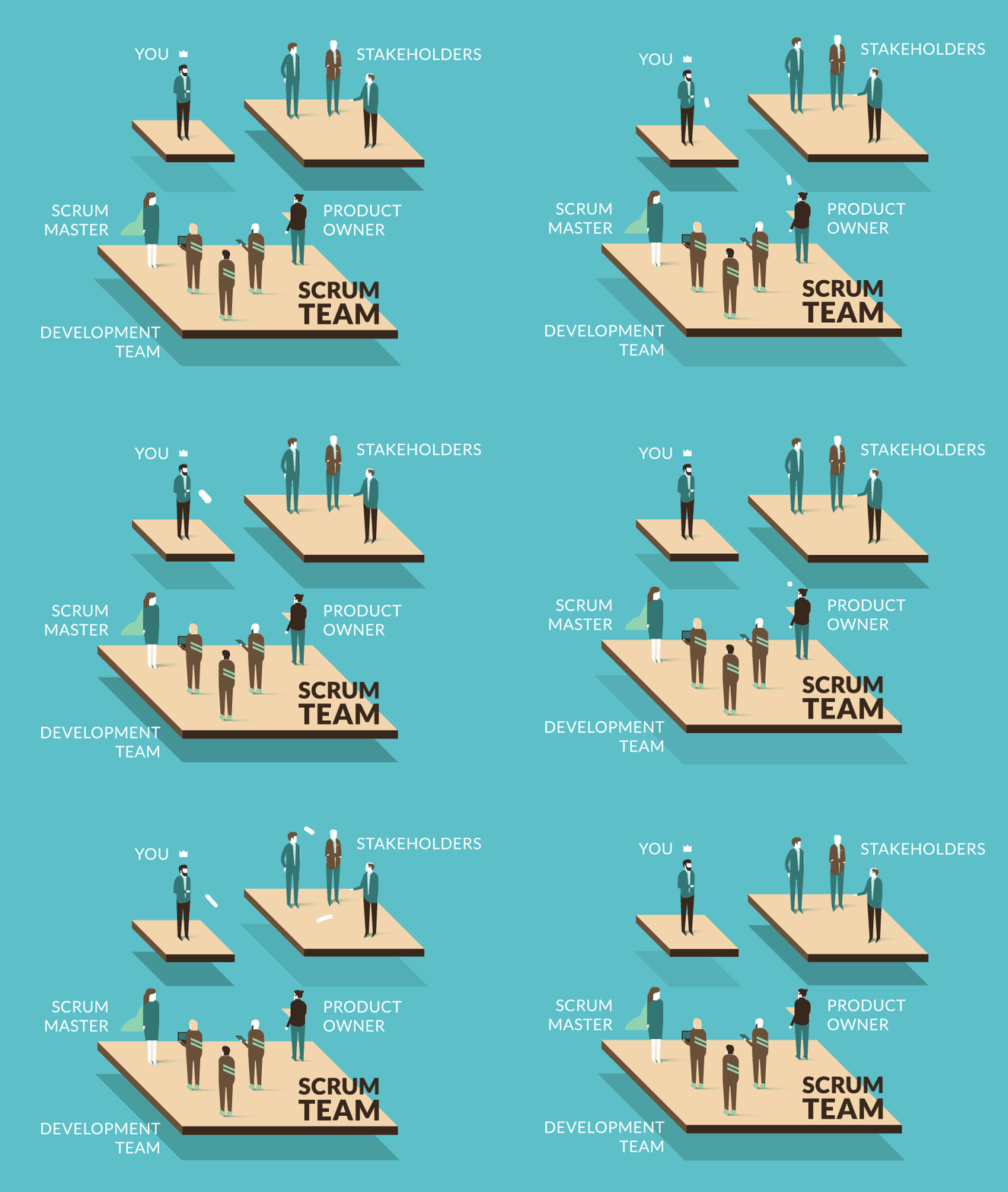
Scrum Master is the member of a Scrum Team who is responsible for the team to follow the scrum framework. Scrum Masters help them pursue this by training them on the Scrum theory, practices, rules and values. The Scrum Master works in servant-leadership style where it is necessary to provide service to others, promote community behavior, holistic work approach, shared decision-making power.
Scrum Master also helps in communicating the information that is needed in the daily scrums to the people outside the Scrum. They are also responsible for driving the conversations to maximize the impact during the scrum meetings.

There are various roles a scrum master usually plays. They provide services to the
1. Product Owner: Scrum Master helps the product owner by ensuring that the team understands the product owner’s goals, product domain scope. They will help in understanding product planning, ensure product owner to arrange product backlog for efficiency. They will also help in providing the addition of new enhancements in the Backlog.
2. Development Team: Scrum Master helps the development team to produce high-value products, removing any obstacles in team’s progress, facilitating failed scrum events and rescheduling the same. They are also helpful in coaching the team to self-organize and cross-function. They are also useful in deploying the Scrum Framework in teams that don’t follow the same.
3. Organization: A Scrum Master plays a significant role in coaching and training organizations to adopt Scrum. They help in planning Scrum adoption within the organization, helping individual employees to understand/implement Scrum, Increasing efficiency through meaningful changes in the process.

Scrum Master Course:
A Scrum Master has umpteen responsibilities, which we have seen above when it comes to an efficient application of the Scrum Framework. A Scrum Master Course is essential to achieve this training to be an effective Scrum Master. This course will help you get the holistic approach on how to implement the Scrum Framework Effectively. Scrum Master Course opens up avenues to new job opportunities not only in the IT industry but also in many diverse sectors. A Scrum Master course is helpful for any employee/Professional who is interested in working in an agile environment.
Scrum Master Course also helps in becoming an Agile Coach which opens up more opportunities. A Scrum Master Certification is useful not only for new career opportunities but also to boost the growth in the career trajectory.