


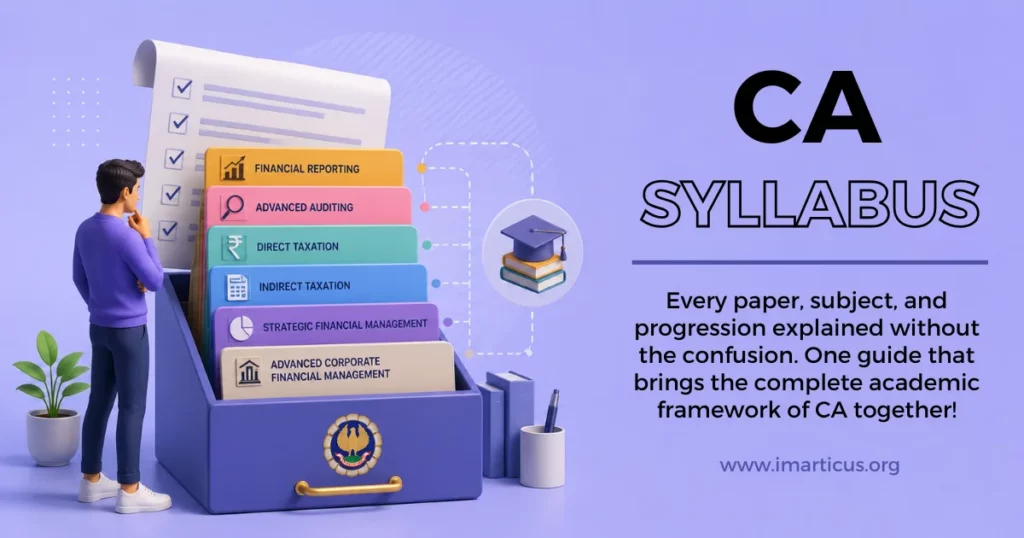
When you decide to pursue chartered accountancy, you are signing up for a complete transformation in how you view businesses, numbers, and regulations. The Institute of Chartered Accountants of India keeps changing the game to make sure we stay relevant in a fast-evolving corporate ecosystem. If you are planning your study journey right now, looking closely at the active CA syllabus is your very first step toward strategic success. Building a powerful foundation in accounting rules is incredible, but the modern corporate landscape demands that you look even further to truly expand your global career reach.
I always tell aspirants that pursuing comprehensive finance courses gives you an edge in global investment banking, corporate valuation, and complex risk analysis. These programs add massive value to your core accounting routine by giving you direct, hands-on exposure to market valuation tools and practical corporate finance frameworks.
The current education framework shifts the focus away from old-school memory tracking and puts the spotlight entirely on multi-disciplinary analysis. Let us break down the exact subject parameters across all three distinct levels of your chartered accountancy path.
Understanding The ICAI New Scheme Of Education & Training
If you look at the modern financial world, businesses do not just need someone to record past transactions or maintain basic balance sheets anymore. The updated CA course syllabus changes the entire learning journey for you by forcing you to analyse complex corporate problems instead of just memorising textbook pages. When you dive deep into understanding what is CA, you will explore that ICAI made the path much cleaner by removing outdated, low-value topics, reducing the total paper count significantly, and cutting down the mandatory practical articleship training window from three years to a focused two-year period.
Don’t Let Our Best Advice Get Buried
Add Imarticus as a Preferred Source — see more of what we publish, every time you search.

This modern setup of the CA syllabus ensures that you develop real-world consulting capabilities, learn technology integration, and understand high-level corporate strategy right from the start. A massive structural change you will notice is the introduction of a uniform assessment design for both your intermediate and final levels, combining a 70% descriptive exam pattern with a 30% case-study-based objective evaluation.
You need to understand exactly how these training modifications affect your daily study routines and preparation choices. The table below displays the key parameters of this modernised structural framework across every evaluation level.
| Level of Examination | Total Assessment Papers | Total Passing Marks | Minimum Group Aggregate Percentage |
| Foundation Stage | 4 Papers | 400 Marks | 50% Aggregate |
| Intermediate Stage | 6 Papers | 600 Marks | 50% Aggregate |
| Final Examination Stage | 6 Papers | 600 Marks | 50% Aggregate |
| Self-Paced Online Modules | 4 Modules | Pass/Fail Baseline | 50% Per Module |
| Practical Training Window | Continuous Evaluation | Experience Check | Mandatory Completion |
This clean structural layout of the CA syllabus optimises your learning time by removing repetitive theories and bringing in modern commercial insights that actually matter to corporate employers. You can budget your daily preparation hours perfectly once you realise how the exam parameters balance descriptive problem-solving with multi-disciplinary case tracking. This balance keeps your mind clear, ensuring you finish the course with highly practical skills that line up with what modern companies expect from top-tier professionals.
Comprehensive Breakdown Of The CA Foundation Syllabus
Think of this entry-level gateway as your personal launchpad for building real business acumen and solid financial literacy. The syllabus of CA Foundation gives you four distinct evaluation papers designed to test your basic analytical aptitude, legal understanding, quantitative logic, and core economic principles. This initial setup of the CA syllabus ensures that whether you come from a commerce background or a science stream, you enter the professional learning levels with a uniform understanding of corporate frameworks.
CA Foundation Accounts Syllabus
This very first paper of the CA syllabus foundation level serves as the essential bedrock for all the advanced financial tracking and corporate reporting work you will encounter later. The CA Foundation Accounts Syllabus takes you through everything from the absolute basics of accounting principles to the actual preparation of detailed financial statements for sole proprietors, complex partnerships, and non-profit organisations. It makes sure you master the double-entry accounting model completely before you move on to advanced corporate consolidation topics.
- Theoretical Framework Basics teaches you the vital definitions, capital policies, asset valuation concepts, and accounting estimations that govern everyday data entry.
- The Core Accounting Process involves consistent practice with journalising, ledger posting, trial balance creation, and the systematic rectification of errors.
- Bank Reconciliation Statement Drafting helps you identify and resolve timing differences between your cash book records and bank passbook statements.
- Depreciation and Inventory Tracking teaches you how to calculate asset wear using mathematical models and measure physical stock valuations accurately.
- Special Transaction Recording guides you through tracking consignment sales, handling bills of exchange, and managing goods sent on an approval basis.
- Final Statement Preparation shows you how to structure manufacturing summaries, draft profit and loss statements, and build accurate balance sheets.
- Partnership and LLP Frameworks train you to manage goodwill adjustments, admission calculations, retirement events, and the complete dissolution of firms.
- Company Accounts Introduction gives you full command over share capital issuance mechanics, forfeiture rules, debenture tracking, and bonus issue entries.
Paper 2: Business Laws
This legal paper introduces you directly to the regulatory ecosystem that governs commercial contracts and corporate operations across the country. The entire module focuses purely on contract validation rules, sale conditions, partnership agreements, and corporate compliance without forcing you to deal with any old-school business correspondence clutter. You will learn exactly how these legislative frameworks protect consumer interests and keep corporate systems operating smoothly across various industries.
| Chapter Name | Primary Legislative Scope | Core Learning Target |
| Indian Regulatory Framework | Macro Governance Systems | Understanding legislative bodies and law-making processes in India |
| The Indian Contract Act, 1872 | General Agreements Law | Validating agreements, consideration rules, performance, and breach remedies |
| The Sale of Goods Act, 1930 | Moveable Property Trade | Mastering conditions, warranties, transfer of ownership, and unpaid seller rights |
| The Indian Partnership Act, 1932 | Unincorporated Firm Setup | Managing mutual relations, registration rules, and firm dissolution processes |
| The Limited Liability Partnership Act | Hybrid Corporate Models | Learning registration benefits and compliance rules for modern LLPs |
| The Companies Act, 2013 | Corporate Entity Basics | Understanding corporate features, incorporation, and share classification |
| The Negotiable Instruments Act | Financial Trade Paper Laws | Checking promissory notes, bills of exchange, and cheque bounce liabilities |
CA Foundation Maths Syllabus
Analysing corporate data and calculating financial values quickly requires you to build sharp mathematical logic. The CA Foundation Maths Syllabus brings together basic business arithmetic, logical puzzles, and core statistical tools into a single comprehensive evaluation paper. It builds the strong numerical reasoning capabilities you need to handle complex business valuation models and risk management metrics later in your career.
- Ratios and Logarithms help you calculate structural proportions, handle fractional indices, and manage mathematical base changes with absolute ease.
- Equations and Matrices show you how to solve linear systems up to three variables and use quadratic models to optimise business returns.
- Linear Inequalities Optimisation teaches you to identify common graphical region spaces based on specific mathematical constraints.
- Mathematics of Finance covers how to calculate simple interest, compound interest, nominal returns, annuities, sinking funds, and perpetuity factors.
- Permutations and Combinations explain how to determine arrangement patterns and selection possibilities for complex corporate groups.
- Sequence and Series Logic guides you through tracking mathematical progressions using arithmetic and geometric formulas.
- Calculus Application Basics lets you use differential and integral calculus tools to identify marginal revenue points and minimum cost targets.
- Logical Reasoning Systems involve solving number series puzzles, coding challenges, direction tests, seating arrangements, and complex family relation maps.
- Statistical Data Representation shows you how to design clean diagrammatic layouts, frequency distributions, and precise data tracking visuals.
- Central Tendency and Dispersion help you find mean, median, mode values, standard deviations, and quartile variations across corporate data.
- Probability and Distributions guide you through calculating likelihood outcomes, binomial trends, Poisson charts, and normal curve properties.
- Correlation and Regression Analysis teach you to measure relationship strengths between business variables and plot accurate prediction lines.
- Index Numbers Formatting explains how to track price changes over time and measure inflation impacts across various industry sectors.
Paper 4: Business Economics
This final paper of the entry stage in the CA syllabus gives you a clear look at macro-level financial policies and everyday market behaviours. The syllabus of CA outlines price discovery mechanisms, production functions, cost analysis curves, and national income calculations. You will gain a very clear perspective on how domestic policy decisions and global capital flows shape the everyday financial choices of modern businesses.
- Microeconomics Basics takes you through consumer preference tracking, demand changes, elasticity calculations, and supply chain adjustments.
- Production and Cost Curves focus on how you transform physical raw materials into finished products while managing scale economies.
- Market Pricing Structures teach you how to set output levels under perfect competition, monopolistic markets, oligopolies, and pure monopolies.
- Business Cycle Fluctuations help you identify economic contraction markers, peak performance times, recession indicators, and market revival patterns.
- National Income Framework shows you how to calculate gross domestic product values using income, expenditure, and production methods.
- Public Finance Policies outline how to track government spending rules, tax collection mechanisms, and national debt management strategies.
- International Trade Principles show you how to evaluate global trade policies, exchange rate movements, and international capital flows.
The entire entry-level framework focuses on building your long-term analytical capabilities. Balancing descriptive accounting work with objective aptitude tests ensures that you develop real problem-solving habits very early in your journey. Completing these foundational subjects prepares you beautifully to handle the technical complexities of intermediate corporate laws, advanced taxation systems, and complex reporting standards.
Deep Dive Into The CA Inter Syllabus (6-Paper Structure)
The CA intermediate stage serves as the real technical engine of your qualification journey, testing your operational command and tactical execution capabilities. The current CA inter syllabus condenses the older, bulky eight-paper structure into a highly integrated six-paper format split across two balanced groups. This clean structural design lets you focus deeply on core business concepts without feeling overwhelmed by the CA syllabus and excessive paperwork.
Every single topic in this professional phase requires you to develop a thorough understanding of statutory definitions and financial metrics. The table below outlines the core subjects you will master during this intense corporate training phase.
| Group Designation | Paper Nomenclature | Primary Focus Area | Comprehensive Subject Coverage |
| Group I Modules | Paper 1 | Financial Reporting | Advanced Accounting Standards, Company Restructuring, Consolidated Statements |
| Group I Modules | Paper 2 | Legal Compliance | The Companies Act 2013, FEMA, SEBI Regulations, Interpretation of Statutes |
| Group I Modules | Paper 3 | Fiscal Obligations | Direct Income Tax Computation, Goods and Services Tax Frameworks |
| Group II Modules | Paper 4 | Cost Management | Material Costs, Marginal Costing, Standard Variance Analysis, Budgetary Controls |
| Group II Modules | Paper 5 | Assurance Framework | Audit Evidence, Sampling Strategies, ICAI Code of Ethics, CARO Clauses |
| Group II Modules | Paper 6 | Business Strategy | Capital Budgeting, Capital Structure, Strategic Analysis, Strategic Implementation |
These core subjects turn you from a theoretical learner into a highly capable financial analyst. Bringing separate accounting papers together into a single, unified advanced accounting framework means you must understand financial reporting standards from day one. This deep structural alignment trains your mind to read corporate financial statements with the exact precision needed for professional auditing.
Group I Papers Breakdown
This initial group focuses heavily on your financial reporting capabilities, corporate legal frameworks, and national tax computations. Under the updated CA exam syllabus, these three intensive papers demand sharp analytical thinking because case-study-based objective questions test how you apply laws to real business scenarios.
- Advanced Accounting brings fundamental bookkeeping together with modern corporate reporting standards. You will learn to apply accounting standards across complex corporate situations like company mergers, internal financial restructurings, and group consolidations. This ensures that the financial statements you work on meet every single legal reporting requirement.
- Corporate and Other Laws takes you through the entire operational framework of the Companies Act 2013, corporate management rules, and foreign exchange regulations. You will learn to read statutory texts with absolute accuracy, which helps you manage corporate filings, protect investor interests, and handle cross-border capital transactions safely.
- Taxation splits your learning directly between national income tax laws and indirect goods and services tax frameworks. This highly practical paper requires you to track continuous legal updates, calculate taxable individual salaries, evaluate corporate profits, and manage input tax credits across complex corporate supply chains.
CA and ACCA follow different career paths, and those differences are often reflected in salary growth over time. Salary comparisons between CA and ACCA become more meaningful when viewed alongside career progression and job opportunities.
Group II Papers Breakdown
The second group shifts your focus entirely toward internal business management, corporate assurance operations, and long-term strategic decision-making. These papers prepare you to evaluate internal corporate workflows, protect corporate governance frameworks, and optimise financial setups.
- Cost and Management Accounting teaches you exactly how to track, control, and optimise business expenditures across modern production lines. By mastering process costing, marginal analysis, and variance tracking, you learn to give executive teams the precise data they need for long-term product pricing strategies.
- Auditing and Ethics addresses corporate transparency requirements, risk management setups, and professional integrity. The subject combines rigorous global auditing standards with the official ICAI code of conduct. This training shows you how to evaluate internal control frameworks, gather reliable audit evidence, and draft objective corporate reports.
- Financial Management and Strategic Management connect day-to-day capital management with long-term corporate positioning. You will practice optimising capital structures, managing corporate working capital, and evaluating investment risks while designing strategic plans to build lasting competitive advantages.
Building a powerful understanding of these core papers prepares you perfectly to handle the final stages of your professional training. The capability to connect tax strategies with cost controls and legal compliance turns you from a traditional bookkeeper into a highly valued business consultant. Developing these multi-disciplinary habits ensures you can navigate advanced strategic case studies seamlessly.
Mastering The CA Final New Syllabus
The CA final level represents the ultimate peak of your professional accounting education, challenging your executive judgement and high-level strategy. The updated CA final new syllabus features a streamlined six-paper structure across two groups, backed by mandatory online learning modules. This advanced framework ensures that you finish the course with the deep analytical capabilities required to advise corporate boards on complex global transactions.
You must master global accounting standards and global taxation frameworks to cross these final milestones successfully. The table below details the advanced structural modules of the final tier.
| Group Split | Paper Number | Specialised Area | Core Operational Subject Matter |
| Group I Papers | Paper 1 | Reporting Standards | Indian Accounting Standards (Ind AS), Corporate Social Responsibility, Integrated Reporting |
| Group I Papers | Paper 2 | Strategic Wealth | Portfolio Management, Derivatives Valuation, Mergers, International Finance |
| Group I Papers | Paper 3 | Global Assurance | Quality Control Standards, Forensic Auditing, Digital Auditing, Risk Assessment |
| Group II Papers | Paper 4 | Global Taxation | Corporate Tax Assessment, Transfer Pricing, Double Taxation Avoidance Agreements |
| Group II Papers | Paper 5 | Supply Chain Taxes | Advanced GST Compliance, Customs Valuation, Foreign Trade Policy Frameworks |
| Group II Papers | Paper 6 | Multi-Disciplinary | Open-Book Case Analysis, Strategic Application, Cross-Functional Problem Solving |
This advanced structural setup challenges you to think like a senior financial consultant right from the start. By moving company law and basic cost management into self-paced online modules, the core curriculum allows you to focus directly on international financial reporting standards, global risk management, and cross-functional corporate planning.
Group I: Advanced Financial Reporting & Assurance
The first group in this part of the CA syllabus focuses heavily on high-level corporate reporting, strategic investment management, and global auditing assurance standards. It ensures that you can confidently prepare, evaluate, and audit the financial statements of massive, multinational organisations.
- Financial Reporting demands absolute command over Indian Accounting Standards (Ind AS), which line up closely with international IFRS frameworks. You will practice accounting for complex financial instruments, evaluating large business combinations, assessing goodwill impairments, and drafting multi-national group consolidations.
- Advanced Financial Management turns you into a strategic wealth advisor for corporations. The curriculum focuses deeply on managing complex equity portfolios, valuing financial derivatives, evaluating international mergers, and mitigating foreign exchange risks in multi-currency transactions.
Advanced Auditing, Assurance and Professional Ethics addresses modern quality control frameworks, digital auditing systems, and fraud detection techniques. You will learn to evaluate complex corporate IT infrastructure, conduct forensic accounting investigations, and maintain the absolute highest standards of professional ethics.
Group II: Strategic Taxation & Integrated Solutions
The second group tests your executive decision-making across direct tax planning, indirect tax compliance, and multi-disciplinary business challenges. It trains you to look at corporate decisions from every single financial and legal angle simultaneously.
- Direct Tax Laws and International Taxation cover complex corporate tax assessments, global transfer pricing frameworks, and double taxation avoidance agreements. You will learn to optimise tax structures for multinational firms while keeping all operations perfectly aligned with international tax guidelines.
- Indirect Tax Laws deal with advanced goods and services tax compliance, customs valuation methods, and national and foreign trade policies. The module focuses on minimising supply chain tax friction, managing export incentives, and handling complex legal disputes with tax authorities.
- Integrated Business Solutions is an open-book, case-study-based assessment that evaluates your cross-functional business expertise. It requires you to solve complex corporate challenges by applying accounting, legal, taxation, and strategic management principles all at the same time.
Mastering these integrated final papers of the CA syllabus prepares you to step directly into leadership roles across the global financial sector. The capability to synthesise accounting, tax, and legal rules allows you to handle complex corporate adjustments with absolute precision. This intensive technical training serves as an incredible foundation for moving into elite international corporate finance careers.
The Mandatory Self-Paced Online Modules (SPOM)
An excellent innovation of the updated framework of the CA syllabus is using self-paced online modules to handle essential commercial topics. You must clear these digital validation courses after passing your intermediate exams but before you can sit for your final papers. This flexible structure lets you master vital economic and legal concepts without adding extra pressure to your main written exam timeline.
You will watch high-quality recorded lectures online and take computer-based objective examinations at certified testing centres. This modern setup ensures that you maintain an exceptional understanding of corporate governance guidelines and strategic cost management tools before you sit for your final evaluations.
| Module Set | Evaluation Format | Total Maximum Marks | Mandatory Cleared Baseline |
| Set A: Corporate Law | Online Computerised Test | 100 Objective Marks | 50% Minimum Score |
| Set B: Strategic Cost | Online Computerised Test | 100 Objective Marks | 50% Minimum Score |
| Set C: Digital Elective | Online Certification Check | 100 Objective Marks | 50% Minimum Score |
| Set D: Domain Studies | Online Certification Check | 100 Objective Marks | 50% Minimum Score |
| Total Digital Portal | Aggregated Modular Run | Multiple Assessment Split | Segmented Pass Run |
These modern digital modules help expand your business knowledge into specialised corporate areas. The list below outlines the primary subject paths included in this digital testing framework.
- Set A: Corporate and Economic Laws covers economic regulations, corporate insolvency processes, and securities market controls in deep detail.
- Set B: Strategic Cost Management and Performance Evaluation explores modern cost reduction tools, value chain analysis, and strategic product pricing models.
- Set C: Elective Specialisations includes online learning tracks covering data analytics, digital corporate governance, professional psychology, and constitutional laws.
- Set D: Multi-Disciplinary Domain Studies focuses on international commercial operations, financial markets, and sector-specific business regulations.
Key Strategic Preparation Tips For The 2026 CA Exams
Succeeding under this modern evaluation setup requires a complete shift in how you study the CA syllabus. Because 30% of your marks come from case-study-based objective questions, you must focus entirely on understanding the core logic behind every single accounting standard and statutory rule. Regularly writing mock exams within real-time constraints is absolutely essential for building your speed and structural clarity.
You should always use the official ICAI study materials as your primary learning guides for the CA syllabus because these texts set the baseline for how your exam papers are evaluated. Creating a structured, paper-wise study calendar that leaves plenty of room for multiple revision rounds will help you retain complex statutory details. Writing out your answers by hand regularly improves your presentation structure and teaches you to manage your time perfectly during real exam hours.
A closer look at CA and ACCA highlights the distinct skills, opportunities and learning experience each qualification offers. Exam structure, global recognition and career pathways are some of the key areas that set CA and ACCA apart.
Why Choose Imarticus Learning For Your Finance Courses
Building a great career in finance is all about connecting what you know with what companies actually need. While standard degrees give you the basic theories, the real world looks for practical skills you can use from day one. Choosing a specialised training partner helps you pick up these hands-on skills quickly, making your resume stand out to top companies. When you study finance courses with Imarticus Learning, you get a direct path to the industry built on real, proven results:
- India’s First Global Prep Partner: It is the only training provider in the country approved for 4 different global finance and accounting certifications, giving you a clear path to pass international exams.
- 40,000+ Career Transitions: The platform has helped over 40,000 students move successfully out of regular college classrooms and straight into active corporate finance jobs.
- 7 Guaranteed Interviews: Eligible programs secure your job hunt by locking in 7 guaranteed interviews with top companies from a network of over 1,500 global hiring partners.
- 60% Average Salary Hikes: People who finish these courses see a real jump in their earnings, with an average salary increase of 60% and top packages going up to ₹22 LPA.
- Real Technical Skills: You skip the boring lectures and spend your time learning tools that companies use every day, like Financial Modelling, advanced Excel, Power BI, and SQL.
FAQs About CA Syllabus
Getting your head around the exam structure, passing requirements, and study timelines can feel like a lot to process when you are trying to map out your career. This quick breakdown answers the most frequently asked questions students ask about managing this workload, staying on track, and discovering where to head next.
What is a syllabus for CA?
Think of the CA syllabus as your ultimate blueprint for master-level corporate finance, covering everything from fundamental bookkeeping up to heavy boardroom advisory strategies. The ICAI updates these modules periodically, so you stay sharp on modern compliance, structuring a rock-solid foundation for professionals chasing high-impact global placements and jobs.
What are the CA subjects?
The core curriculum in the CA syllabus covers Advanced Financial Reporting, Strategic Auditing, Corporate Laws, Taxation, and Wealth Management. If you ever feel like broadening your professional reach beyond these traditional subjects, Imarticus Learning offers phenomenal industry-aligned training tracks that prepare you to step straight into highly impactful finance careers.
Is CA difficult or easy?
It is undeniably a mountain to climb, mostly because the pass percentages of CA syllabus demand absolute conceptual perfection under pressure. But remember, the grid is worth the grind. To hedge your bets beautifully while tackling this path, Imarticus Learning helps you scale up your core finance skills and prepare you to land top-tier global finance jobs.
How many subjects are there in the Chartered Accountant syllabus?
Under the modern streamlined regime of the CA syllabus, you face sixteen core exam papers split symmetrically across three operational milestones, alongside self-paced online modules. Getting through this structured grid turns you into a financial asset, which gives you an edge for landing global finance roles.
Can you get a job even if you fail Chartered Accountancy?
Absolutely, because the market heavily values your raw technical accounting muscle, which you learn in the CA syllabus, in roles like corporate controller or credit analyst. By partnering with Imarticus Learning, you can rapidly pivot your semi-qualified expertise into industry-ready credentials, opening up immediate parallel corporate avenues and industry-leading skills for finance careers.
What is the syllabus for the Chartered Accountancy Executive program?
While “Executive” officially belongs to the CS track, the equivalent Intermediate stage in the CA syllabus focuses heavily on advanced bookkeeping, corporate laws, and operational costing. It is the exact zone where you develop the raw, hardcore corporate execution capabilities needed to comfortably crush interviews for finance roles.
How does accountancy taught in a BCom differ from accountancy as covered in the Chartered Accountancy syllabus?
College degrees give you a nice, high-level theoretical view of basic corporate ledger entries. The professional curriculum of the CA syllabus, however, drags you deep into the practical trenches of statutory compliance, complex tax litigation, and live auditing. Imarticus Learning bridges this exact practical gap, ensuring you have the corporate dealmaking skills required for making a long-term career in the finance industry.
Is the syllabus of ACCA and CA the same?
Not quite, because the CA syllabus prioritises hyper-local statutory rules, direct tax codes, and Indian compliance mandates, while ACCA leans heavily into global financial frameworks, international case studies, and strategic management, creating a highly agile skill set that perfectly prepares you for cross-border multinational corporate ACCA Jobs.
From the CA Syllabus to High-Impact Corporate Roles
Getting a complete grip on the structural shifts in the professional curriculum of the CA syllabus is the best way to clear your exams with confidence. The transition to the modern framework shows that the industry now values analytical depth and strategic execution over old-school memory testing. Once you master these fundamental principles, you have a powerful foundation that sets you up perfectly for the global corporate landscape.
The most successful professionals rarely stop at a single qualification. They know that combining core regulatory knowledge with international investment strategies or specialised financial analytics makes their profiles incredibly valuable to global employers. If you want to expand your professional horizons smoothly, looking into alternative global credentials or advanced asset management programs is an excellent next step. Discover how you can elevate your training by exploring the industry-backed finance courses at Imarticus Learning and build the practical skill sets needed to confidently claim your spot at the top of the financial world.
Completing the modern CA syllabus is an outstanding achievement that proves your deep technical capability and professional dedication. However, today’s fast-paced business world frequently requires you to have cross-functional expertise that reaches far beyond regulatory accounting boundaries. Expanding your professional capabilities with investment analysis or global risk management completely transforms your long-term career potential. Advanced training in financial modelling, investment banking, or corporate wealth management prepares you beautifully to lead complex deals in international corporate finance.
Liked This? Follow Us Where You Already Search.
Preferred Sources is Google’s built-in follow button — no app, no login, just more Imarticus in your results.