


Last updated on August 19th, 2026 at 02:01 pm
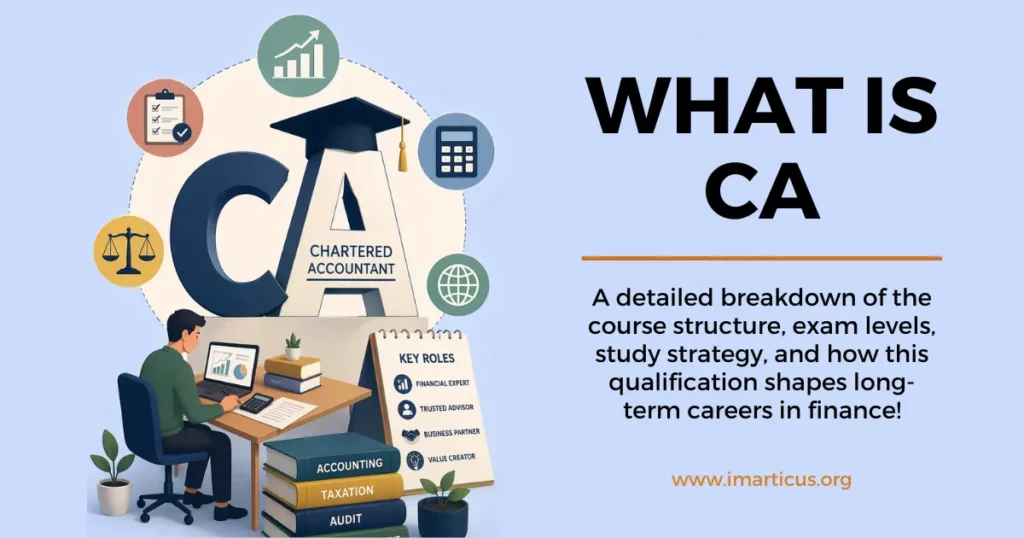
Right after school, many students hear about CA and wonder what it really means. Some see it as a tough path. Others see it as a stable career. If you are exploring finance careers or comparing options, understanding ‘what is CA’ becomes the first step.
On the surface, it looks clear enough. A structured course, a few levels, decent pay, strong reputation. But that surface view doesn’t help you decide anything. The real questions are simpler and more practical.
→ What is the work of CA once you actually start working?
→ What kind of thinking does this path build?
→ And more importantly, what does your day-to-day life start to look like a few years into it?
A lot of students approach the CA course by focusing only on the exams. Foundation, Intermediate, Final. Clear them, and you’re done. But the course is just the entry barrier. The real shift happens when you begin to look at numbers differently. You notice patterns in how businesses spend, earn, and sometimes fail. You start understanding why decisions are taken, not just how they are recorded.
That’s also where the confusion creeps in. Because the finance world you’re stepping into today is not the same as it was even a few years ago. Roles are broader. Expectations are higher. It’s no longer just about knowing the rules. It’s about understanding how those rules play out in real situations. This is why many students, even while preparing, start exploring finance courses that give them a closer look at how the industry actually works beyond textbooks.
Don’t Let Our Best Advice Get Buried
Add Imarticus as a Preferred Source — see more of what we publish, every time you search.

So, before we go deeper into ‘what is CA’, it helps to reset the way you’re looking at it. Not as a course you need to finish, but as a path that shapes how you think, work, and grow in finance.
What Is CA?
When someone asks What is CA’, the simplest way to understand it is this. A Chartered Accountant is a professional who handles money matters for individuals and businesses. This includes taxes, audits, financial reports, and advice on spending and saving. The profession in India is governed by the Institute of Chartered Accountants of India.
A CA works like a financial doctor. Just like a doctor checks your health, a CA checks the financial health of a company or person.
What Is The Full Form Of CA
The full form is Chartered Accountant. When you think about ‘what is the full form of CA’, it refers to someone certified to manage financial records, ensure compliance, and provide financial advice. The term is globally recognised, but the qualification process differs by country. Before moving ahead, here is a quick snapshot to make it even clearer:
- A Chartered Accountant is a certified finance professional.
- Handles accounting, taxation, auditing, and financial reporting.
- Ensures businesses follow financial laws and regulations.
- Helps individuals and companies plan finances better.
- Recognised across industries like corporate, consulting, and finance.
What Is The Meaning Of CA In Simple Terms
Many students search ‘what is the meaning of CA’ because the term feels technical. In simple words, a CA is someone who ensures that money is handled properly.
Think of a small business owner. They need help with taxes, profits, and expenses. A CA steps in and makes sure everything is correct and legal. This is also where the work of CA becomes easy to understand.
| Situation | What The CA Does | Why It Matters |
| Filing taxes | Calculates and files accurate tax returns | Avoids penalties and legal issues |
| Managing business finances | Tracks income and expenses | Helps understand profit and loss |
| Auditing accounts | Checks financial records for accuracy | Builds trust and transparency |
| Financial planning | Suggests savings and investment strategies | Improves long-term financial health |
| Compliance and regulations | Ensures rules and laws are followed | Keeps business legally safe |
What Is CA Course?
To understand ‘what is CA’ course, you need to look at it as a structured journey. It is not a single exam. It is a series of levels with training. The course has three main levels and one practical phase.
Structure of the CA Course
Before diving deeper, here is a simple breakdown.
| Level | Description |
| Foundation | Entry-level exam |
| Intermediate | Second level |
| Final | Last exam |
| Articleship | Practical training |
This structure answers ‘what is CA’ study in a clear way. It combines theory with real work.
What Is CA Foundation
Students often ask, ‘What is CA Foundation?’ because it is the starting point. It is the first level after Class 12. It tests basic knowledge of accounting, maths, and business.
Key Details
- Entry after 12th
- Four subjects
- Objective and subjective papers
| Aspect | Details | Why It Matters |
| Level | Entry-level stage of the CA course | First step toward becoming a CA |
| Eligibility | After Class 12 (any stream) | Open to all students |
| Number Of Papers | 4 Papers | Covers basic subjects |
| Subjects | Accounting, Law, Maths, Business Economics | Builds foundational knowledge |
| Question Type | Objective and Subjective | Tests both concepts and application |
| Difficulty Level | Basic to Moderate | Prepares students for higher levels |
| Frequency | Conducted multiple times a year | Flexible attempt opportunities |
Understanding ‘what is CA Foundation exam’ is important because it sets the base for future levels.
What Is CA Intermediate
After clearing the first level, the next step is ‘what is CA’ intermediate. This level is more detailed and technical. It covers deeper accounting concepts and laws.
Key Details
- Two groups of subjects
- Requires strong preparation
- Must clear before articleship
| Aspect | Details | Why It Matters |
| Level | Second stage of the CA course | Builds core technical knowledge |
| Number Of Groups | 2 Groups (Group 1 and Group 2) | Flexibility to attempt separately |
| Number Of Papers | 8 Papers | Covers wide subject areas |
| Focus Areas | Accounting, Taxation, Law, Costing | Forms a strong conceptual base |
| Difficulty Level | Moderate to High | Requires consistent preparation |
| Articleship Eligibility | After clearing one group | Entry into practical training |
| Common Term | Also called CA Inter | Same meaning, widely used |
Students often refer to this as ‘what is CA’ inter. Both terms mean the same stage.
What Is CA Final
The last stage answers ‘what is CA’ final. This is the most advanced level. It tests your full understanding of finance, audit, and law.
Key Details
- Final exam before qualification
- Requires practical understanding
- High difficulty level
| Aspect | Details | Why It Matters |
| Level | Final stage of the CA course | Last step before becoming a CA |
| Number Of Groups | 2 Groups | Can be attempted together or separately |
| Number Of Papers | 6 Papers | Covers advanced subjects |
| Focus Areas | Financial Reporting, Audit, Taxation, Strategy | Builds real-world expertise |
| Outcome | Qualification as a Chartered Accountant | Enables professional practice |
Once cleared, along with training, you become a Chartered Accountant.
What Is Articleship In CA
Many students are curious about ‘what is articleship in CA’ because this is where real learning happens. Articleship is a 3-year practical training period.
What You Do During Articleship
Before choosing CA, it helps to know what happens during this phase.
- Work under a practising CA
- Handle real client work
- Learn audits and taxation
- Gain office experience
Think of it as an internship, but much deeper. This phase answers ‘what is the use of CA in real work situations?’
What Is CA Qualification And Eligibility
Understanding what a CA qualification helps you see if this path suits you.
Eligibility Criteria
- After Class 12 for Foundation
- Graduation entry is also possible
- No specific stream required
Commerce students may find it easier. But many non-commerce students also succeed with the right preparation.
| Entry Route | Minimum Qualification | Key Requirement |
| After Class 12 | Passed 12th (any stream) | Register for CA Foundation |
| After Graduation | Graduate in any stream | Direct entry to CA Intermediate |
| Commerce Background | 12th or Graduation in Commerce | Better familiarity with subjects |
| Non-Commerce Background | 12th or Graduation in any stream | Requires strong conceptual preparation |
| Skill Requirement | Not academic | Discipline, consistency, and analytical thinking |
While the eligibility is quite flexible, success in this path depends more on your approach than your background. A strong study routine, clarity of concepts, and regular practice can help any student perform well, regardless of their stream.
Numerous working professionals and students are seeking an online CA Foundation Course from institutes like Henry Harvin. The institute has professionally qualified and expert trainers who deliver excellent training and prepare learners for a successful career in CA. Your dedication and regular practice with sample questions and mock test series will build your confidence to achieve your career goals. After completion of the course, you will earn a CA Foundation Certification from Henry Harvin.
CA Foundation in 2026 has proven to be a fruitful career path for students and working professionals in Accounting, Taxation, Auditing, and Financial Management. Preparing for the CA Foundation ensures students and professionals have conceptual clarity, analytical thinking and well-planned exam preparation. This enables learners to take the next step towards their Chartered Accountancy Career Success.
What Is CA Exam And Difficulty Level
Students often search for ‘what is CA’ exam to understand the challenge level. The exams are known for being tough. The passing rates are low compared to many courses.
Exam Structure Across Levels
The CA exam is not a single test. It is divided into three levels, each increasing in complexity and depth.
- Foundation focuses on basic concepts
- Intermediate builds technical knowledge
- Final tests advanced application and judgment
Each level prepares you for the next, making the journey structured but demanding.
Difficulty Level Explained
The difficulty of CA exams comes from conceptual clarity rather than memorisation. Questions often test how well you understand and apply concepts in real situations.
- Foundation: Basic to moderate level
- Intermediate: Moderate to high level
- Final: High level with case-based thinking
Students who stay consistent usually find the progression manageable.
| Aspect | Details | Why It Matters |
| Exam Levels | Foundation, Intermediate, Final | Clear progression path |
| Difficulty Level | Moderate to Very High | Builds strong expertise |
| Pass Percentage | Around 20-30% (varies by level) | Reflects competition |
| Attempt Frequency | Multiple attempts each year | Flexibility to improve |
| Question Format | Objective, descriptive, case-based | Tests real understanding |
| Preparation Time | 4-6 months per level | Requires planning and discipline |
The challenge is not just the syllabus. It comes from the depth of understanding required and the consistency needed over time. Students often balance studies with articleship, which adds to the pressure but also builds practical skills. With the right study approach and regular revision, the exams become more structured and less overwhelming.
What Is The Pass Percentage Of CA Foundation
Before moving ahead, it helps to know what is the pass percentage of CA foundation. This gives you a realistic idea of the competition and the level of preparation required.
Typical Pass Percentage Range
The pass percentage for CA Foundation usually falls within a certain range.
- Around 20% to 30% in most attempts.
- Can go slightly higher or lower depending on difficulty.
- Varies based on student performance and exam pattern.
This shows that not everyone clears it on the first attempt, which makes preparation important.
Why The Pass Percentage Is Low
The numbers may seem low, but there are clear reasons behind it.
- Many students underestimate the level of preparation required
- Lack of conceptual clarity in basic subjects
- Inconsistent study routines
- First attempt without proper guidance
A strong base is important because it builds the foundation for later stages.
What This Means For Students
Understanding what is the pass percentage of CA foundation helps you set the right expectations.
- You need a disciplined study plan from the beginning.
- Regular revision is more important than last-minute study.
- Practice and mock tests improve confidence.
- Concept clarity matters more than memorisation.
How To Improve Your Chances
With the right approach, clearing this level becomes more manageable.
- Study daily with a fixed schedule.
- Focus on understanding concepts clearly.
- Solve past papers and mock tests regularly.
- Revise multiple times before the exam.
The pass percentage should not discourage you. It simply highlights the need for consistency and the right preparation strategy.
What Is The Work Of CA, And What Is The Role Of CA?
Before choosing this path, it helps to clearly know ‘what is the work of CA’ and ‘what is the role of CA’ in real life. A CA does not just sit with numbers. The role is wide and practical.
Key Areas Of Work
Before going into details, it helps to see how varied the role is.
- Auditing company accounts
- Filing taxes and planning tax savings
- Managing financial reports
- Advising businesses on growth
- Handling compliance and regulations
Now think of a startup founder. They focus on building a product. A CA helps them manage cash, avoid penalties, and plan future investments. That is what is the job of CA in daily life.
What Is The Work Of CA In India
The scope becomes even more interesting when you understand what is the work of CA in India. India has a complex tax system and growing businesses. This creates strong demand for CAs. Some common work areas include:
- GST filing and advisory
- Income tax planning
- Company audits
- Financial consulting
- Risk management
A CA may work in a firm, a company, or independently. Many also start their own CA firm after gaining experience.
What Is CA Firm And Career Setup
Once qualified, many students explore ‘what is CA’ firm. A CA firm is a professional setup where Chartered Accountants offer services like audit, tax, and consulting.
Types Of Workplaces
- CA firms
- Corporate companies
- Government roles
- Independent practice
Career Options Explained
Before choosing a direction, it is useful to understand what each path involves.
- CA Firms: Work on audits, taxation, and client services across industries
- Corporate Companies: Handle internal finance, reporting, and decision-making
- Government Roles: Work in public sector audits, finance departments, and regulatory bodies
- Independent Practice: Start your own firm and work with individual or business clients
Comparison Of Career Setups
| Career Path | Nature Of Work | Growth Opportunity |
| CA Firm | Audit, tax, compliance, client handling | High with experience and client base |
| Corporate Company | Financial reporting, budgeting, strategy | Stable with structured growth |
| Government Role | Audits, compliance, public finance | Secure with steady progression |
| Independent Practice | Own clients, tax filing, consulting | Unlimited based on network and expertise |
This flexibility is one reason why students explore what is the use of CA as a long-term career.
What Is The Salary Of CA In India
After understanding ‘what is CA’, the next question that naturally comes up is what is the salary of a CA. Salary is one of the biggest decision factors for students and professionals. A CA’s income depends on skills, experience, and the type of organisation they work with. The range can vary a lot, especially between freshers and experienced professionals.
Salary Breakdown Across Levels
This table gives a clear idea of what is the salary of CA in India at different stages.
| Experience Level | Average Annual Salary | Monthly Estimate |
| Fresher | ₹6-9 LPA | ₹50,000-75,000 |
| 2-5 Years | ₹10-18 LPA | ₹80,000-1.5 lakh |
| 5-10 Years | ₹20-35 LPA | ₹1.6-3 lakh |
| Senior Roles | ₹40 LPA+ | ₹3 lakh+ |
These numbers are based on aggregated salary data from platforms like Glassdoor and AmbitionBox.
What Is The Salary Of CA Per Month
Many students search what is the salary of CA per month to understand their real income.
- For a fresher, the monthly salary usually ranges between ₹50,000 and ₹75,000. In top firms or metro cities, it can go higher.
- With experience, what is the salary of a CA in India per month can cross ₹2 lakh comfortably.
This steady growth is one of the biggest reasons why CA remains a popular career.
What Is The Starting Salary Of CA
When you look at what is the starting salary of a CA, the range depends on where you begin your career.
Starting Salary Factors
Before looking at numbers, it helps to understand what affects your first salary.
- Rank in CA exams
- Articleship exposure
- Communication skills
- Type of employer
Entry-Level Salary Snapshot
- Mid-sized firms: ₹6-8 LPA
- Big firms: ₹8-12 LPA
- Industry roles: ₹7-10 LPA
This also answers what the starting salary of a CA is in practical terms.
What Is The Minimum Salary Of CA
Students also look for what is the minimum salary of a CA to understand the downside. In smaller towns or firms, the starting salary can be around ₹4-5 LPA. However, growth tends to be faster once experience builds. So even if the starting point feels modest, the long-term trajectory remains strong.
What Is The Average Salary Of CA In India
To simplify things, what is the average salary of a CA in India falls between ₹8-12 LPA for early to mid-career professionals. As experience increases, this average shifts upward significantly. This also ties into what is the income of CA over a lifetime. Many CAs move into leadership roles or start their own firms, which increases earning potential.
What Is The Monthly Salary Of CA In Real Terms
Breaking annual figures into monthly income gives a clearer picture.
Monthly Salary Progression
| Stage | Monthly Salary |
| Fresher | ₹50,000-75,000 |
| Mid-Level | ₹1-2 lakh |
| Senior Level | ₹2-4 lakh |
This explains what is the monthly salary of a CA in a simple way.
What Is The Income Of CA Beyond Salary
When you explore what is the income of CA, salary is just one part. Many professionals increase income through multiple streams.
Additional Income Options
Before you think only about jobs, consider these paths.
- Independent consulting
- Starting a CA firm
- Freelance taxation work
- Advisory for startups
For example, a CA helping five small businesses with GST can build a steady side income. Over time, this can grow into a full business. This flexibility adds depth to what is the use of CA in real life.
What Is The Job Of CA In Different Career Paths
After salary, understanding ‘what is the job of a CA’ becomes important. The role changes based on where you work.
Career Options After CA
Before choosing a path, it helps to see the variety.
- Audit and Assurance
- Tax Consulting
- Investment Banking
- Corporate Finance
- Risk and Compliance
For example, a CA in audit checks the company records. A CA in finance helps businesses plan investments. This is where what is the role of CA becomes more dynamic.
What Is CA Firm And Independent Practice
Many professionals explore ‘what is CA’ firm after gaining experience. A CA firm offers services like tax filing, auditing, and financial advice.
Why Many Choose This Path
- Independence
- Higher income potential
- Flexible work
A simple example is a CA helping small businesses manage GST and taxes. Over time, this can grow into a full-fledged firm.
What Is The Difference Between CA And CMA
A common question is what the difference is between CA vs CMA. Both are respected careers, but their focus areas differ.
| Aspect | CA | CMA |
| Financial Reporting & Audit | ✅ Strong focus | ❌ Not a core focus |
| Cost & Management Accounting | ❌ Basic level | ✅ Core strength |
| Internal Business Strategy | ❌ Limited | ✅ Strong focus |
| Independent Practice | ✅ Allowed (CA firm) | ❌ Not applicable |
| Corporate Finance Roles | ✅ Available | ✅ Strong preference |
| Global Recognition | Moderate (needs add-ons) | ✅ Strong global acceptance |
| Practical Training | ✅ 3-year articleship | ❌ No mandatory articleship |
| Work Type | ✅ Compliance and external reporting | ✅ Business decision-making and analysis |
While CA focuses more on external reporting, CMA focuses on internal financial management. This makes both valuable, depending on your career goals.
Choosing between CA and CFA often comes down to the kind of work you see yourself doing in the long run. While one builds strong expertise in accounting, audit, and compliance, the other leans more towards investment, markets, and financial analysis, making the distinction clearer when you look at real career roles.
What Is CA Course Duration And Timeline
When exploring ‘what is CA’ course, duration is an important factor. The journey is structured but requires patience and consistency. Each stage builds on the previous one, combining study with practical exposure.
Complete CA Course Timeline
To understand the full journey clearly, here is a stage-wise breakdown:
| Stage | Duration | What You Do | Outcome |
| CA Foundation | 4-6 months | Study the basics of accounting, law, and maths | Entry into the CA pathway |
| CA Intermediate | 8-12 months | Learn core subjects like taxation and accounting | Builds technical knowledge |
| Articleship | 3 years | Work under a CA in real scenarios | Practical experience |
| CA Final | 6-12 months (prep phase) | Advanced study and application | Final qualification stage |
Total Time Required To Complete CA
The total duration depends on your pace and the number of attempts.
| Scenario | Estimated Duration |
| First attempt to clear all levels | 4.5 – 5 years |
| With multiple attempts | 5 – 6+ years |
What Affects The Timeline
Not every student finishes at the same pace. Several factors influence your journey:
- Number of attempts taken at each level
- Consistency in study routine
- Articleship workload and exposure
- Concept clarity and revision
Key Takeaways
- CA is a long-term commitment, not a short course.
- Practical training takes the most time but adds real value.
- Consistency matters more than speed.
- Planning each level properly can reduce delays.
What Is The Registration Fee For CA Foundation
Students also search what is the registration fee for CA foundation before starting.
Approximate Cost
- Registration: ₹9,000-₹10,000
- Exam fees: Separate
You can check updated details on Institute of Chartered Accountants of India.
What Is CA Study And Preparation Approach
Understanding ‘what is CA’ study helps set the right expectations. The course requires discipline and consistency.
Study Approach
Before starting, it helps to build a routine.
- Daily study schedule
- Concept clarity over memorisation
- Regular revision
- Mock tests
Think of it like preparing for a marathon. Consistency matters more than speed.
What Is CA Qualification And Skill Set Required
Understanding ‘what is CA’ qualification is only one part. Skills matter equally.
Skills That Make A Strong CA
Before entering the field, it helps to build these abilities.
- Attention to detail
- Problem-solving
- Communication skills
- Analytical thinking
Even simple habits like checking small errors can make a big difference.
What Is CA Course And The Need For Practical Skills
While exploring ‘what is CA’ course, one thing becomes clear. The syllabus is strong, but practical exposure matters a lot. This is where structured learning platforms add value.
Many learners today combine CA preparation with industry-focused finance courses from Imarticus Learning to gain hands-on skills. These programs help bridge the gap between theory and real-world work.
Is CA A Good Career In 2026
If you are still thinking about ‘what is CA’ as a career choice, the answer depends on your goals. The profession offers:
- Stability
- Growth
- Respect
- Flexibility
It requires effort and patience. But the rewards grow over time.
What Is The Use Of CA In A Global Career
As finance careers become more specialised, many professionals look at how to expand beyond traditional roles. Understanding what the use of CA in a global career is becomes clearer when you see how additional qualifications build on it.
A CA gives you strong fundamentals in financial accounting, audit and taxation. Global certifications then add specialised skills and international relevance on top of that base.
How CA Acts As A Strong Foundation
Before adding anything, it is important to understand what CA already gives you.
- Deep knowledge of accounting and financial reporting.
- Strong understanding of taxation and tax compliance.
- Exposure to audits and regulatory frameworks.
- Practical experience through articleship.
This foundation makes it easier to move into advanced or global roles.
How Global Certifications Build On CA
Each global certification adds a different layer of expertise. Instead of replacing CA, they expand your career direction.
- ACCA: Adds global accounting standards like IFRS and international exposure.
- CMA: Focuses on business strategy, cost control, and decision-making.
- CFA: Builds expertise in investment, financial and capital markets, and portfolio management.
How Each Certification Builds On CA
| Certification | What CA Already Gives | What Gets Added | Career Impact |
| ACCA | Strong accounting base | Global standards (IFRS), international roles | Global accounting careers |
| CMA (USA) | Financial knowledge | Strategic decision-making, cost management | Corporate leadership roles |
| CFA | Accounting fundamentals | Investment analysis, financial markets | Investment and finance roles |
What This Means For Your Career
When you combine CA with these certifications, your profile becomes much stronger and more versatile.
- You move from compliance roles to strategic roles.
- You expand from domestic jobs to global opportunities.
- You increase your earning potential and role flexibility.
For example, a CA working in audit can move into global finance roles with ACCA, or shift into strategy roles with CMA.
Stepping away from CA is a decision many students quietly consider at some point. Before making that call, it helps to pause and look at what the journey really involves, where most challenges come from, and what options you still have moving forward.
Why Choose Imarticus Learning For Finance Courses
If you are planning to build on CA with global certifications like ACCA, CMA, or CFA, the right learning ecosystem matters a lot. Beyond just clearing exams, you need practical exposure, industry alignment, and career support. This is where structured finance courses offered by Imarticus Learning can make a real difference in how your career shapes up. Here are some key aspects that make their finance programs stand out:
- Industry-designed curriculum aligned with current finance roles and market demand.
- Training delivered by 650+ industry experts with real experience in global firms.
- Exposure to diverse finance domains like investment banking, risk, fintech, and global accounting.
- Programs aligned with global certifications like ACCA, CFA, FRM, and CMA in collaboration with leading partners.
- Strong placement track record with 6000+ placements and significant career transitions.
- Certifications and programs are delivered in collaboration with institutions like KPMG and top business schools.
This kind of structured learning becomes especially valuable when you are trying to move from a traditional qualification like CA into more specialised or global finance roles.
FAQs About What Is CA
If you still have a few practical doubts, these quick answers to the most frequently asked questions will help you understand what is CA more clearly and make better decisions about this career path.
What Exactly Does A CA Do?
When you ask ‘what is CA’, it refers to a professional who manages audits, taxes, and financial records while helping businesses stay compliant and grow. Many learners also build practical skills through Imarticus Learning programs.
What Is CA In Salary?
Understanding ‘what is CA’ helps explain salary ranges, which start from ₹6-8 LPA and grow with experience. Structured training from Imarticus Learning can improve job readiness and earning potential.
How Do You Become A CA?
To understand ‘what is CA’ as a process, you must clear the Foundation, Intermediate, and Final exams along with articleship training under Institute of Chartered Accountants of India.
How Do I Become A Freelancer CA?
If you explore ‘what is CA’ in practice, freelancing involves offering tax and audit services independently. Many professionals enhance their skills through Imarticus Learning to attract clients.
Is Doing CA Really Worth It?
When you evaluate ‘what is CA’, it offers long-term stability, strong income growth, and diverse career options. With added certifications from Imarticus Learning, opportunities expand further.
What Is The Process Of Becoming A CA After Graduation?
To understand ‘what is CA’ after graduation, you can enter directly into the Intermediate level, complete articleship, and clear Final exams under ICAI guidelines.
What Are The Scopes After CA?
When exploring ‘’what is CA’ scope’, opportunities include audit, consulting, corporate finance, and entrepreneurship. Many professionals also pursue global roles with added certifications.
Can I Start CA At The Age Of 28?
If you are wondering, ‘’what is CA’ eligibility’ at 28, there is no age limit. Many professionals start later and succeed with consistent effort and planning.
Move Forward In Your Career With CA And Top Global Courses
By now, you have a clear understanding of ‘what is CA’, how the course works, what the exams demand, and how the career unfolds over time. It is a path that requires patience and consistency, but it also offers strong stability, growth, and respect in the finance world.
At the same time, careers today are not limited to one qualification. Many professionals choose to build on CA with additional skills and global exposure to stay relevant and expand their opportunities. This is where the right learning support can make a difference.
Exploring structured finance courses through Imarticus Learning can help you move beyond theory and gain practical skills that align with real industry roles. Whether you want to strengthen your foundation or explore global pathways, having that added layer of expertise can shape how your career grows over time. The journey does not end with understanding CA. It begins with how you choose to use it.
Liked This? Follow Us Where You Already Search.
Preferred Sources is Google’s built-in follow button — no app, no login, just more Imarticus in your results.
