Today, financial planning isn’t just an advantage—it’s the backbone of modern CFO qualifications and skills. For those who wish to be CFOs, to plan finance is like holding a map in a storm. Without it, even the most promising businesses may falter.
From optimising cash flow to strategic decision-making, the CFO skill set is evolving rapidly, and financial planning sits at its core.
So, how does financial planning shape the CFO skills and abilities of tomorrow’s finance leaders? Why is financial planning the most essential among the skills for CFO in shaping a successful finance leader?
What is a Chief Financial Officer?
TheChief Financial Officer functions as a top-level executive responsible for managing the financial activities of a company. Financial data analysis has become an essential practice they employ to support business expansion. The CFO possesses top-level control over the finance department and represents the organisation as its primary financial spokesperson.
CFO Skills and Abilities
The CFO oversees income and expense tracking to maintain company liquidity and stable operations.
The Risk Management function detects financial risks and develops strategies to reduce their impact.
The department generates financial forecasts and manages resource allocation to achieve effectiveness. This function evaluates potential investments and maximises capital utilisation.
Regulatory compliance maintains strict adherence to financial legislation while meeting tax requirements and industry norms.
The individual guides financial teams through leadership and mentoring while enhancing team performance.
Cost control & optimisation minimise financial expenditures while maintaining operational effectiveness and business growth.
The Role of Financial Planning in a CFO’s Success
A CFO’s skills and abilities go beyond accounting. They bridge the gap between finance and strategy, ensuring an organisation’s sustainability.
Financial planning helps CFOs:
Forecast future business performance
Manage cash flow effectively
Allocate budgets strategically
Mitigate financial risks
Guide investment decisions
Cash Flow Management
Managing cash flow is at the core of CFO skills and abilities. A single misstep in forecasting can lead to severe liquidity crises.
Short-Term Liquidity Planning – CFOs must ensure there’s always enough cash for operational needs.
Optimising Working Capital – Maintaining the balance between receivables and payables is a fine art.
Investment in Growth – Smart financial planning helps CFOs allocate surplus cash for innovation and expansion.
Every CFO must decide: where should the company invest its money?
Investment Allocation Breakdown for a Growing Business
Investment Area
Percentage Allocation
Research & Development
30%
Technology & Automation
25%
Marketing & Expansion
20%
Employee Training
15%
Risk Management & Compliance
10%
According to PwC,the share of CFOs that devote the majority of their time to the financial planning and analysis (FP&A) and business performance management increased from 32% to 58%. Many CFOs, specifically more than 50% reveal that they have to spend time more with compliance, financial reporting, risk management, and capital management tasks.
Financial Forecasting
Modern CFOs use data analytics, AI, and economic trends to forecast future financial scenarios.
Revenue Projections – CFOs predict revenue streams based on market conditions and internal financial performance.
Scenario Planning – Preparing for best-case, worst-case, and base-case scenarios enables proactive decision-making.
Budgeting and Cost Control – A meticulous budgeting strategy aligns financial resources with business priorities.
Many CFOs rely on rolling forecasts rather than annual budgets, as they allow greater flexibility and adaptability.
Flowchart
Step 1: Collect Financial Data
Step 2: Analyse Historical Trends
Step 3: Model Future Scenarios
Step 4: Evaluate Risks
Step 5: Implement Forecast-Based Strategies
Developing Financial Planning as a Core CFO Skill
1. Key Skills Every CFO Must Master
A CFO course can provide foundational knowledge, but hands-on experience and continuous learning are what sharpen a CFO’s financial planning acumen.
Essential CFO Skills
Why It Matters
Financial Strategy
Guides long-term business decisions
Risk Assessment
Identifies and mitigates financial threats
Budgeting & Forecasting
Ensures optimal allocation of resources
Leadership & Decision-Making
Drives company-wide financial performance
Cash Flow Management
Maintains liquidity for operational stability
2. The Digital CFO
With the emergence of AI, blockchain, and predictive analytics, today’s CFO fully embraces digital transformation.
AI-Driven Forecasting – Machine learning models now offer more accurate predictions of financial trends.
Real-Time Financial Dashboards – CFOs utilise dynamic dashboards to keep track of KPIs as they happen.
Automated Risk Assessments – AI tools identify anomalies and highlight potential financial risks.
To drive their businesses forward, emerging CFOs must refine their skills for CFO, including forecasting, budgeting, and cash flow management. CFOs have the tools they need to prosper in this changing profession. The question is not whether CFOs should use these technologies; rather, how soon they can begin to revolutionise their influence.
Imarticus Learning – Postgraduate Certificate Programme for Emerging CFOs
Boost your job with the Postgraduate Certificate Programme for Emerging CFOs, a top finance course made with IIM Indore and Imarticus Learning. Built for pros with five-plus years in the field, this 126-hour programme gives deep know-how in finance and firm growth. Taught by IIM Indore’s top minds, this course builds sharp, smart, and tech-based finance skills that all CFOs must know.
This CFO course teaches FinTech, smart firm picks, firm worth, and risk checks, shaping new CFOs who lead with skill. Learn key skills in firm cash rules, funds, risk checks, and new CFO tasks, plus FinTech and tech-based cash work.
Engage with top CFOs through insightful masterclasses, gaining real-world financial expertise to drive organisational success. Meet top minds in your field, build key links, and grow in your job with strong ties to peers and cash pros.Join top CFOs in live talks and gain deep real-world tips to push your firm to the top.
FAQ
1. Why is financial planning critical for CFOs?
CFOs must plan funds to match finance with business goals, cut risk, and boost profitability.
2. What are the most important CFO qualifications and skills?
CFO skill sets include financial strategy, risk management, forecasting, and leadership.
3. How does a CFO improve cash flow management?
They must track cash in, trim costs, and keep a cash fund for business continuity.
4. Which CFO courses help in mastering financial planning?
CFOs must take courses on financial modelling, risk assessment, and strategic forecasting.
5. How can CFOs use technology in financial planning?
They must use AI tools, automated dashboards, and digital financial tools to make smart choices.
As a result of years of training, you have learnt financial management techniques, bookkeeping and data assessment, and crucial decision-making skills. The title Chief Financial Officer (CFO) isn’t just a distant dream—it’s a natural progression for finance managers who aspire to lead at the top.
A chief financial officer represents a real possibility for finance managers who demonstrate their desire to guide organisations at the top level. Your experience as a finance manager does not suffice for the successful transition to the CFO position.
The path to becoming a CFO demands strategic leadership, financial expertise, and knowledge of specific industries that surpass basic number analysis ability. The first question to address is how individuals can successfully transition to this elevated position. So, how can you make this leap? And more importantly, how to become a CFO in India in today’s competitive corporate world?
Why do finance managers struggle to become CFOs?
Despite widespread dreams of becoming C-suite executives, a small selection of accounting professionals have achieved this career progression. Why?
29% of CFOs are delaying their investment decisions because of potential changes in tax policies.
Here are the common roadblocks:
Challenges
Why it Holds You Back?
Lack of Strategic Thinking
CFOs need to think beyond financial reporting and make high-level business decisions.
Limited Leadership Skills
Managing a finance team is different from leading an entire organisation.
Not Enough Industry Exposure
CFOs must navigate economic trends, risks, and investments at a macro level.
No Formal CFO Training
Many finance professionals lack CFO-specific skills like financial modelling and investment strategies.
The good news?
These challenges can be overcome with the right approach.
How to Become a CFO in India?
Step 1: Develop a CFO Mindset
The role of CFO exists beyond accounting procedures because it requires expertise in business direction. This requires a transformation of your financial executor role to strategic decision-making abilities.
Key Traits of a CFO:
Business growth emerges from CFOs who think beyond storing financial records because they truly direct organisational expansion.
Risk management skills allow effective anticipation of financial risks during the planning stage.
A strategic vision helps CFOs understand how financial choices within business goals create their impact.
The primary task requires you to move your mind above traditional financial reporting procedures.
Active involvement in strategic business discussions allows CFOs to work with other departments as they develop financial connections between accounting, operational marketing, and sales departments.
Step 2: Upgrade Your Financial Expertise
A CFO manages financial strategy along with risk management responsibilities and investments, whereas operation finance falls under the finance manager role.
The critical abilities every Chief Financial Officer must learn include:
Skill
Why It’s Important
Financial Forecasting
Helps predict revenue and plan business expansion.
Investment Strategies
CFOs must optimise capital allocation and financial planning.
Risk & Compliance
Strong knowledge of regulations like SEBI, RBI policies, and taxation is crucial.
Digital Finance
Understanding fintech, AI in finance, and blockchain is a game-changer.
Financial experts who grasp digital finance standards, including fintech, together with AI finance practices and blockchain, hold the advantage. To develop crucial CFO skills, you need to enrol in a CFO training programme to study actual business cases alongside financial modelling approaches and risk testing approaches.
Step 3: Get Certified
The key to securing the position of CFO in India requires proper certification training. CFO training represents a vital factor that determines why many professionals fail to advance to senior executive levels.
Top Certifications for CFO Aspirants:
The CFO course stands out as the best option for developing financial analysis abilities.
Certification demonstrates expertise in budgeting alongside cost management practices.
The CFO certification provides all the necessary training to fill the knowledge gaps.
People who want to become CFOs after completing their 12th grade should study for a B.Com or finance-related degree and finish their MBA in finance while earning CFO certifications.
Step 4: Build Leadership & Decision-Making Skills
Finance Managers vs CFOs – Leadership Difference
Aspect
Finance Manager
CFO
Scope
Departmental focus
Organisation-wide impact
Decision-Making
Budgeting & Cost Control
Growth Strategies & Investments
Leadership
Managing a small team
Driving company-wide financial strategy
CFOs are not ‘finance leaders’; they are ‘business leaders’.
They control finances that affect the company. They enable junior finance professionals to gain leadership experience. CFOs become masters of crisis management, managing financial downturns and strategic shifts.
Tip: Meet with senior finance executives. Attend CFO summits, workshops, and leadership programmes to gain exposure.
Step 5: Gain Industry Exposure & Build a Strong Network
Many aspiring CFOs lack industry connections, and their career growth is slow. A big professional network offers mentorship, jobs, and insider industry insights.
How to Build Your CFO Network?
CFO Communities: Finance forums, LinkedIn groups, and networking events.
Engage in thought leadership: Read articles on financial trends and investment strategies.
Find a Mentor: A CFO will mentor you on career planning and career decisions.
Fact: 80% of CFO hires come from professional networks, not through traditional applications.
Step 6: Master Digital Finance & Technological Trends
Today’s CFO is a tech leader. Companies demand CFOs who understand the following:
FinTech & AI in Finance
Blockchain & Cryptocurrency
Data Analytics for Financial Decision
Making a CFO role might be difficult to transition into if you are a finance manager without digital finance skills.
Tip: Get special courses on financial technology to remain ahead.
The transition from finance manager to CFO is challenging, but with the right skills, mindset, and strategic career moves, you can achieve this milestone.
Advance Your Finance Career with IIM Indore’s Emerging CFO Programme
The CFO course with IIM Indore helps finance professionals build key skills for top jobs. This 126-hour postgraduate certificate programme is best for those with five-plus years of work experience who want to learn more about finance and new technology.
Led by IIM Indore’s top team, this course will teach you how to plan funds, risk, cash flow, and technology in finance. You will learn what new CFOs must know and gain the sharp mind and tech skills you need to lead your firm.
The postgraduate certificate programme also fosters peer learning and networking, offering opportunities to connect with industry leaders, exchange insights with fellow professionals, and build valuable relationships. You will also learn from top CFOs, who will share tips from their jobs to help you see what it takes to lead.
Enrol now to accelerate your journey to becoming a CFO!
FAQ
What qualifications do I need to become a CFO in India?
A finance degree, an MBA in Finance, and CFO-specific qualifications.
How to become a CFO after the 12th?
You must have a financial degree (B.Com, CA, or CFA) and gain industry experience.
How long does it take to transition from finance manager to CFO?
Typically, 8-15 years of experience in finance and leadership positions.
Do I need an MBA to become a CFO?
While not required, an MBA in finance provides a competitive advantage.
What CFO course should I take to fast-track my career?
Enrol in a CFO course focusing on financial strategy, risk management, and leadership.
How important is networking in becoming a CFO?
A strong professional network helps in career advancement.
In the modern era, CFO roles and responsibilities go beyond simple financial management activities that involve money and accounting duties. Modern CFOs function as company visionaries by driving revenue growth while maximising financial performance and navigating economic uncertainties.
CFO responsibilities in finance introduce significant difficulties to overcome in the current rapid financial world. CFOs battle against multiple significant barriers, including managerial pressure alongside digital transformation needs and workforce management requirements. This post analyses the significant difficulties that modern CFOs need to overcome and provides workable solutions for each challenge.
Key Challenges CFOs Face Today and How to Solve Them
A Chief Financial Officer (CFO) at the executive level controls a firm’s financial planning by recording operations and reporting finances precisely. The organisation utilises these professionals to guide financial decisions and project choices and analyse data so they can better handle complex financial situations.
Strategic and financial operational requirements often compete against one another because CFO roles and responsibilities require excellent business insights combined with strong financial management competence.
How to Overcome This Challenge:
The development of strategic thinking by CFOs means their active involvement in board-level discussions enables them to merge financial strategies with business objectives.
The CFO should leverage data analytics through predictive modelling and financial analytics to make strategic decisions.
Enhanced decision-making success requires CFOs to get active involvement from the CEO, CIO and COO to achieve mutual business goals.
2. Digital Transformation and Technology Adoption
Financial automation processes are advancing rapidly, so CFOs need to choose advanced technology solutions to compete in the business. The process of deploying FinTech solutions with return on investment requirements proves challenging to most organisations.
How to Overcome This Challenge:
Financial services should invest in AI and automation through robotic process automation (RPA) to automate invoice processing and compliance checking systems.
The financial operations of your organisation will experience significant transformation
through implementing blockchain together with AI predictive forecasting systems and cloud-based.
3. Enterprise Resource Planning solutions
A CFO course in digital transformation allows finance leaders to learn Financial Tech effectively so they can adapt to new-age technologies at work. Using cloud-based financial systems enables Indian organisations and their leading IT companies to improve their operational efficiency and minimise data errors in their daily processes.
The current financial regulations in India and worldwide require CFOs to maintain compliance with tax regulations, data protection standards, and corporate governance protocols.
How to Overcome This Challenge:
The efficiency of managing tax changes becomes possible by following the latest regulatory updates, such as tax law alterations like GST in India, thereby avoiding financial penalties.
Managers should deploy AI-driven software tools because they automate regulatory reporting and detect fraudulent activities within the system.
You need to work hand in hand with staff from both the Legal and Compliance departments to reduce financial liability while defending organisational reputation.
4. The Growing Importance of ESG (Environmental, Social, and Governance)
Financial strategy integration with sustainability has become essential for CFOs as investors and stakeholders require it. Companies experience difficulties when they track ESG metrics together with financial goal alignment.
How to Overcome This Challenge:
Organisations should adopt sustainable financial practices to boost their ESG stature through green bond investments together with sustainability-linked financing.
AI-driven ESG platforms provide the capability to monitor environmental impact together with corporate social responsibility (CSR) activities and governance compliance through their ESG reporting tools.
Business sustainability objectives should link with ESG targets to produce long-term financial profit gains through strategic alignment.
How CFOs Are Shaping the Future: CFO Roles and Responsibilities
New trends have revolutionised the job scope and obligations of CFOs in their role. CFO duties and responsibilities are solely financial oversight functions because they must now lead strategically and accept new technology while also reducing operational risks. CFOs transform difficulties into possibilities through digital technology adoption, regulatory monitoring and innovation application.
According to AmbitionBox.com, the latest 2025 salary data in India, the annual salary range varies from ₹12 lakhs to ₹1 crore, with an average annual salary of ₹53.1 lakhs. Meanwhile, the monthly in-hand salary typically falls between ₹2.8 lakhs and ₹2.9 lakhs.
As part of the CFO key responsibilities, monitor corporate finances for cash streaming operations, together with maintaining financial planning and performing financial performance evaluations to identify enterprise weaknesses.
You can achieve long-term financial stability at companies through strategic actions enabled by CFOs who optimise profitability and reduce risks. Among the CFO key responsibilities is developing financial strategies that support business targets that drive lasting business expansion alongside market resilience.
Key Challenges & Solutions for CFOs
Challenge
Solution
Balancing strategic and financial responsibilities
Leverage data analytics, collaborate with leadership, and focus on long-term goals.
Digital transformation
Adopt AI, cloud ERP, and automation tools
Cash flow management
Use real-time reporting, optimise working capital
Compliance & governance
Implement automated compliance tools and stay updated on regulations
Talent acquisition & retention
Provide continuous learning opportunities and leadership training
ESG integration
Track ESG metrics and adopt sustainable finance practices.
Achieve Excellence with the Chief Financial Officer Programme
The Chief Financial Officer (CFO) Programme at the Indian School of Business (ISB), in partnership with Imarticus Learning, exists to develop superior financial executive capabilities. This 8-month CFO education programme develops professionals into leaders who use strategic predictions to direct teams toward successful business expansion.
Financial leaders today need to lead complex organisations by demonstrating integrity and purpose as the corporate landscape continues to change at a rapid pace. ISB has organised its training programme with precision to deliver advanced lessons about business strategies and financial leadership while teaching governance principles to CFOs and prospective financial leadership candidates.
Networking plays a vital role in career development, so the flagship CFO Programme delivers maximum networking opportunities with senior executives, including CXOs and industry leaders from multiple sectors worldwide. Through this CFO course, participants can establish valuable contacts and gain valuable industry insights to develop their career-based relationships.
Elevate your career with the CFO Programme by ISB & Imarticus Learning!
FAQ
What are the core CFO responsibilities in today’s business environment?
CFO roles and responsibilities involve managing financial planning, risk management activities, and strategic leadership while making financial decisions and ensuring compliance.
What are the biggest CFO challenges in 2025?
The major business challenges CFOs are facing in 2025 consist of four areas: digital transformation, regulatory compliance and risk management alongside ESG integration.
How can CFOs manage financial risk effectively?
Through effective cash flow management methods along with risk-hedging techniques combined with real-time financial reporting systems, CFOs can manage their financial risks effectively.
What role does technology play in modern CFO duties and responsibilities?
The modern finance sector includes AI and automation alongside blockchain technology, which creates better process efficiency and data-informed operations.
What are the benefits of enrolling in a CFO course?
A CFO course leads to enhanced abilities in financial strategy development along with leadership enhancement and technical expertise in forthcoming technologies.
How can CFOs contribute to business growth?
The strategic financial alignment with business targets combined with data analysis and regulatory adherence practices brings maximum value to the organisation.
The US CPA is the superior certification for building an outstanding career in accounting and finance. The American Institute of Certified Public Accountants delivers the Certified Public Accounting (CPA), which operates as a worldwide recognised accounting accreditation.
Since 2020, the US CPA examinations have begun in India. Professional accountants from the CPA Association provide services that encompass financial statement analysis, tax preparation, financial planning, internal auditing, corporate tax responsibilities management, and many other financial support functions.
Before beginning your journey to becoming a Certified Public Accountant, explore the CPA course details, including CPA course fees, exam structure, and CPA course duration, to plan effectively.
What is a CPA?
In various English-speaking nations, theCertified Public Accountingqualification allows accountants to operate as CPAs. The CPA title matches the qualifications of the worldwide Chartered Accountants. CPAs possess public licenses from the United States, which enables them to provide accounting services to the public. Every US state offers a licensing authority that authorises CPAs to perform services across their territory. The Indian CPA qualification shows characteristics that are equivalent to those of the CA framework yet function under international US standards for accounting.
Why Pursue CPA After Post-Graduation?
The CPA course fees in India typically range from Rs 1,00,000 to Rs 1,20,000, depending on the institution and the quality of the training.
Here’s why:
1. Higher Career Prospects & Salary Growth
Gaining CPA certification serves as an effective method to increase your professional income potential. According to Payscale, the average salary of a CPA in India is ₹670,179 in 2025.
Role
Average Salary (₹ per annum)
CPA Accountant
₹8 – ₹12 lakh
CPA Financial Analyst
₹10 – ₹15 lakh
CPA Auditor
₹12 – ₹18 lakh
CPA Tax Consultant
₹15 – ₹20 lakh
2. Global Job Opportunities
Unlike CA (Chartered Accountancy), which is mostly recognised in India, CPA certification is worldwide accepted, particularly in the USA, Canada, Australia, and the Middle East.
3. Competitive Edge Over Non-CPA Professionals
Organisations choose to hire CPAs because they specialise in U.S. GAAP, IFRS and international taxation laws. Achieving roles in the global financial market becomes much simpler with CPA certification.
Eligibility Criteria for CPA After Post-Graduation
A prospective CPA candidate in India needs to fulfil qualifications defined by U.S. state boards. Different U.S. state boards control the CPA exam, which results in varying requirements for qualification.
1. Educational Qualification
A postgraduate degree in accounting, commerce, or finance is usually required.
You need 150 credit hours in your academic qualifications.
(B.Com alone is usually insufficient; postgraduate education helps meet the requirement.)
2. Work Experience Requirements
Most states require 1–2 years of experience under a CPA to get licensed.
Some states allow you to write the exam without work experience, but licensing requires it.
3. State Board Selection
Since each U.S. state has different requirements, choosing the right state board is crucial.
State
Educational Requirements
Work Experience Needed?
California
150 credit hours, no specific degree
Yes, 1 year under CPA
New York
150 credit hours with accounting major
Yes, 1 year under CPA
Texas
150 credit hours; ethics course required
Yes, 2 years under CPA
How to Prepare for the CPA Exam?
These basic steps will prepare you effectively.
1. Apply for the exam
International candidates must pick one of the US states that lets foreign applicants take the CPA exam.
Seek approval from the Board of Accountancy of your requested state while paying their admission costs.
You need to use the NTS to select an exam date and cover any necessary payment costs.
Check the sections of your examination to avoid erroneous exam registration.
2. Schedule your examination
When you obtain the Notice to Schedule (NTS), you should proceed to schedule your exam date at Prometric testing facilities.
Select the time along with the date that works well for your schedule.
The ideal time to schedule the exam falls during the beginning portion of the test window. You have sufficient scheduling flexibility because of the extended NTS validity.
State regulations determine the validity period of NTSs, which typically amounts to six months, except for specific exceptions per state policies.
3. Review the CPA Exam Blueprints
All topics belong to the four CPA examination sections.
The AICPA website features the blueprints as one of its available resources.
These documents show you which core areas and relevant knowledge, together with essential competencies, need attention in each part of the examination.
You should use these blueprints to develop study plans and direct your focus toward essential material.
4. Take Online Practice Tests
Websites like AICPA and NASBA offer free practice tests.
You succeed in familiarising yourself with the actual exam structure along with question types through mock evaluations that mimic real examination conditions.
The use of practice tests enables you to effectively organise your examination time during the actual test session.
Multiple resources featuring video tutorials and comprehensive explanations exist for each part of the test.
Job Opportunities and Career Growth After CPA
CPA certification unlocks high-paying roles in India and abroad.
Job Role
Industry
Financial Analyst
Investment Banks
Tax Consultant
Big 4 Firms
Internal Auditor
MNCs, Corporates
Risk Management Specialist
Insurance Firms
The CPA course is excellent for postgraduates aiming for international accounting roles. It not only enhances career growth but also opens doors to global opportunities.
People who seek professional development in their careers should begin their CPA exam preparation right now. Check various resources for the specific CPA course details while studying pricing and exam duration before commencing your journey toward becoming a Certified Public Accountant.
Become a Globally Recognised CPA with Imarticus Learning
Strengthen your CPA journey with comprehensive premium content, live simulations, and a money-back guarantee—all designed to help you succeed. Imarticus Learning received the Best Finance Education Provider award during the 30th Elets World Education Summit 2024.
Imarticus Learning enables students to receive their US CPA certification course from AICPA, which stands as the worldwide standard in accounting. The CPA course duration is 12-18 months.
The CPA title provides membership access to the AICPA network, which enables you to connect with leaders across industries and access worldwide professional opportunities. The US CPA certification course contains four exams, which include three mandatory core subjects together with an elective that lets you personalise your certification for your career objectives.
Start Your CPA Journey with Imarticus Learning—Enrol Now!
FAQ
What is a CPA, and how is it different from a CA?
CPA represents a globally recognised accounting accreditation, which concentrates mainly on accounting operations within the United States, but the CA certification acts as an official qualification functional for both India and the Commonwealth nations.
Who is eligible to pursue a CPA after postgraduate?
Candidates need to obtain either their postgraduate studies in commerce, finance, or accounting to qualify for the programme. Such candidates must possess 150 credit hours for CPA exam qualification, and these credit requirements differ according to state boards in the United States.
How long does it take to complete the CPA course after postgraduate study?
Professional college accounting training extends between 12 and 18 months. The duration to finish the CPA exam consists of your training calendar, exam preparation, and section exam completion speed.
Is CPA beneficial for career growth in India?
Yes! Financial auditing services and tax advisory, together with international accounting jobs at Indian MNCs, mainly employ professionals who possess the CPA certification, which includes the Big 4 accounting firms Deloitte, PwC, EY and KPMG.
How can I prepare for the CPA exam while working?
You can balance work and studies by following these tips:
Create a study plan and dedicate 2-3 hours daily for CPA preparation.
Use CPA study materials from AICPA-approved providers.
Attempt mock tests and practice exams to track progress.
Join an online CPA course for structured learning and expert guidance.
You just got your BCom, and you want to step into the world of finance. You seek a job that pays well and grows with time. But you ask—how much can you earn as a financial analyst in India?
The field of funds grows each day, and firms need bright minds. From fresh graduates to those with years of work, this role gives a good wage and scope. However, cash flow, skill, place, and work type shape pay.
In this blog, we break down the financial analyst salary in India, from entry-level positions to senior roles. We will also discuss the impact of a CFA course and other certifications on salary growth.
What Does a Financial Analyst Do?
Financial analysts evaluate financial data between businesses and investors to lead them toward better decision-making. By analysing market data along with economic conditions and company reports, financial analysts recommend stock buy or sell decisions together with bond purchases, property acquisition and commodity investments.
Junior Analyst: 0–3 Years of Experience
In the first few years of their career, junior financial analysts spend most of their time gathering data, updating financial models and spreadsheets, and reviewing industry news and reports. Their work with these tasks allows junior analysts to develop comprehensive knowledge about a designated business sector or industry.
Senior Analyst: 3+ Years of Experience
Once junior analysts gain industry expertise and build a strong professional network, they transition into the role of senior analyst. At this stage, they focus on interpreting financial data to form investment opinions.
Key Responsibilities
Examining financial information comprises reviewing organisational accounting records and market tendencies together with economic monitoring procedures to gauge business health.
Future performance predictions require financial tools to evaluate investment and business operations dynamics.
The financial expert recommends what assets investors should purchase or dispose of as a result of evaluation and financial examination.
The role includes portfolio management duties, which cover investment strategy development as well as risk measurement and financial outcome monitoring for achieving business targets.
The salary of a financial analyst in India largely depends on these skills and expertise. Financial analysts find employment within banks, together with insurance companies, investment funds and several other financial organisations. Multiple financial analysts find employment with regulatory bodies operating under the Securities and Exchange Commission (SEC).
The finance industry contains diverse positions that fall under the role of financial analyst. Their core responsibility involves checking company financial documents to discover suitable investment prospects. Through financial asset analysis, financial analysts aid businesses and investors in making well-informed choices.
Financial analysts determine merger and acquisition worth through their examination of economic trends and financial market analysis before making investment recommendations for profitable gains. Financial models help predict investment returns, while risk evaluation supports the development of secure financial planning methods.
Financial Analyst Salary in India: A Breakdown
Financial analyst salary per month varies based on experience, qualifications, and location.
A financial analyst’s salary per month amounts to approximately ₹50,000, excluding additional earnings.
Average Financial Analyst Salary in India (2024)
Experience Level
Average Annual Salary (INR)
Monthly Salary (INR)
Entry-Level (0-2 years)
₹4 – ₹6 LPA
₹33,000 – ₹50,000
Mid-Level (3-5 years)
₹7 – ₹12 LPA
₹58,000 – ₹1,00,000
Senior Financial Analyst (6+ years)
₹12 – ₹20 LPA
₹1,00,000 – ₹1,67,000
Financial Analyst Salary in India: By Industry
Each industry provides financial analysts with distinct pay structures and unique financial problems, which lead to different salary levels in those sectors. Higher compensation levels exist within the banking and finance sectors because of their advanced demands and detailed requirements.
Industry
Average Annual Salary (INR)
Banking and Finance
8L
IT and Technology
8L
Healthcare
7L
E-commerce
8L
Manufacturing
7.5L
Financial Analyst Salary in India: By Experience Level
Analysts at the entry-level perform data collection activities and conduct basic analysis, and mid-level workers handle financial modelling and forecasting duties. At the senior level of analysis, responsibilities consist of both strategic planning and leadership tasks. As expertise grows, so does the senior financial analyst salary, reflecting the increased value they bring to organisations.
The job title that a financial analyst holds directly affects their salary and compensation levels. Higher financial analysis roles that require more responsibility and expertise, such as senior financial analyst and financial associate, along with business analyst, result in higher salaries.
Average Annual Salaries by Job Title:
Senior Financial Analyst Salary– ₹8-15 lakh per year
Chartered Financial Analyst (CFA): Your Gateway to a Top Finance Career
Ace the CFA Programmes with Imarticus Learning
Time: 6 Months Per Level
Mode: Live Web Class
Top Award in Funds—Recognised as the Best Education Provider in Finance at the 30th Elets World Education Summit 2024
Obtain one of the top financial qualifications to boost your capabilities as an investment manager in a challenging career sector. Imarticus Learning provides CFA Institute Learning Partner accreditation to offer skills and know-how that lead to success.
Instructors who hold extensive industry experience train students specifically to pass this challenging finance certification test. The instructors at Imarticus Learning utilise their extensive finance industry knowledge to empower candidates for CFA programmes, thereby helping professionals build their professional opportunities.
Start Your CFA Course with Imarticus Learning Today!
FAQ
What is the average financial analyst salary for BCom graduates in India?
New hires earn ₹4-6L a year, while skilled pros make up to ₹20L a year.
What is the financial analyst salary per month in India?
The pay starts at ₹33K-50K a month and can go up to ₹1.5L for top ranks.
Which industries pay the highest salary in India?
Banks, IT, and investment firms pay the most, from ₹7-20L a year.
Can a CFA boost a financial analyst’s salary?
Yes, a CFA course can raise pay by 30-50%, making one stand out.
Which towns in India give the most pay for financial analysts?
Mumbai, Bengaluru, and Delhi NCR give the most pay for this job.
Which companies pay the most for financial analysts in India?
Deloitte, KPMG, PwC, Accenture, and EY pay from ₹4-15L a year, based on skill.
Financial analyst jobs are among the most promising positions in modern finance because they offer good earning potential, diverse prospects, and great expansion potential.
BCom graduates should consider this profession because it provides them with an outstanding career path. Institutional foundation courses within your BCom studies gave you essential competencies in accounting and economics as well as business fundamentals, which help you analyse finance effectively.
Strategic planning, together with upskilling and effective networking, is essential for successful job acquisition in financial analysis. This post provides an in-depth explanation about how to become a financial analyst along with salary projections and necessary competencies and identification of essential career-boosting certifications including the CFA course.
Understanding the Financial Analyst Role
Before discussing career development strategies, we need to understand the financial analyst job description.
Financial Analyst Job Description
Financial analysts evaluate both financial market patterns and corporate performance indicators to enable businesses to make decisions about investment and budget control.
Their responsibilities include:
Assessing financial statements
Conducting market research
Forecasting economic trends
Preparing reports for management or clients
Advising on investment decisions
Industries Hiring Financial Analysts
Various industries need financial analysts to fulfil their business requirements.
The banking, along with the financial services sector, comprises investment banks commercial banks and wealth management companies. The finance divisions within extensive businesses form one of the major sectors that employ financial analysts.
Career Growth Opportunities
Indian financial services continue to thrive, thus creating new opportunities for financial analysts in the country.
Beginning financial analysts typically advance to become:
Senior Financial Analyst
Investment Analyst
Risk Analyst
Portfolio Manager
Chief Financial Officer (CFO) (long-term career path)
Steps to Become a Financial Analyst After BCom
Educational Requirements
The BCom curriculum develops essential knowledge of accounting and economics and financial subject matters. Achieving strong job market success requires qualifications beyond your basic academic degree.
Internships: The Gateway to Experience
The most proven pathway toward securing a financial analyst job relies on securing professional internships. Financial giant firms Deloitte, PwC and Goldman Sachs provide internship programmes that let you practice through:
Financial modelling
Data analysis
Investment Research
Budgeting and forecasting
Many full-time financial analyst jobs come from successful internship programmes.
Key Skills You Need to Develop
Successful financial analysts possess a mix of technical and soft skills.
Technical Skills
Soft Skills
Financial modelling
Critical thinking
Data analysis (Excel, SQL, Python)
Communication skills
Risk assessment
Problem-solving
Valuation techniques (DCF, NPV)
Decision-making
Report writing
Adaptability
Certifications to Boost Your Career Prospects
If you’re serious about building a long-term career in financial analysis, getting a certification can significantly increase your job prospects and salary.
CFA Course: The Gold Standard for Financial Analysts
The Chartered Financial Analyst (CFA) certification is one of the most recognised credentials in finance.
Here’s why:
Increases credibility among employers
Deepens knowledge in investment analysis and portfolio management
Enhances salary potential
The CFA course consists of three levels and covers topics like:
Financial reporting and analysis
Corporate finance
Portfolio management
Ethics in finance
Financial Analyst Jobs and Salary Expectations
Types of Financial Analyst Jobs
There are different roles within financial analysis.
Here’s a breakdown:
Role
Description
Investment Analyst
Evaluate stocks, bonds, and market trends
Risk Analyst
Assesses financial risks in investment decisions
Corporate Financial Analyst
Manages budgeting and financial planning for businesses
Credit Analyst
Analyses the creditworthiness of individuals or companies
Note: Salaries in investment banking and multinational corporations tend to be on the higher end.
Factors Influencing Salary:
Industry type (Investment banking offers higher salaries than corporate finance)
Skillset and certifications (CFA holders earn 30-40% more than non-certified analysts)
Location (Mumbai, Bangalore, and Delhi offer better pay due to the concentration of financial hubs)
Tips to Secure a Financial Analyst Job
Finance professionals, including students who want to dominate investment banking and asset management and corporate finance should take the CFA programme because it provides specialised educational content and improves analytical abilities and creates diverse professional opportunities.
1. Leverage Networking
Referrals fill most financial analyst jobs. Join LinkedIn groups, attend finance conferences, and connect with alumni in financial roles.
2. Prepare for Interviews
Expect technical and behavioural interview rounds.
Common topics include:
Financial ratios
Market trends analysis
Case studies on company valuations
Pro Tip: Practice with mock interviews and real-world financial case studies to boost confidence.
3. Use the Right Job Portals
Apply on these platforms for the best financial analyst jobs:
Naukri.com – Top Indian job site for finance professionals.
LinkedIn Jobs – Great for networking-based applications
eFinancialCareers – Best for global finance roles
Monster India – Strong for fresher-level finance jobs
4. Build a Strong Resume
A well-structured CV should highlight:
Education and certifications
Key financial analysis skills
Internship experience
Notable financial projects
The path to securing a financial analyst job as a BCom graduate becomes achievable through implementing appropriate steps. The combination of practical experience with certification pursuits such as the CFA course and valuable networking contacts will boost your job prospects substantially.
Competitive patterns exist within the finance industry, yet professionals who master industry trends together with analytical abilities and build robust professional connections maintain constant employment opportunities.
Become a Chartered Financial Analyst (CFA) with Imarticus Learning— Your Gateway to a Global Finance Career
A CFA charter stands as one of the most regarded certifications for investment management and financial expertise. Because of its international recognition CFA certification proves mastery in financial analysis together with portfolio management expertise and ethical investment principles, thus becoming a top choice among employers across the globe.
Imarticus Learning provides a CFA programme built for the real world. This course gives you the skills and tools to help you do well in the finance industry. Imarticus Learning stands as one of India’s top CFA guides with a nod from the CFA group.
The CFA programme makes it smooth for you to pass this tough test. Get full help from Kaplan Schweser with books, notes, test sets, and mock tests. Learn from pros who have helped many pass hard finance tests. Achieving a CFA certification opens doors to high-paying financial analyst jobs and leadership roles in investment management.
Start Your CFA Journey with Imarticus Learning—Enrol Now!
FAQ
What does a financial analyst do?
The financial analyst position involves analysing financial information together with market pattern analysis while also developing reports for business advice on investment choices. Financial analysts assist businesses in handling organisational risks while enhancing financial planning efficiency with the result of increased profitability.
How to become a financial analyst?
BCom graduates should acquire financial modelling expertise and knowledge in accounting together with investment analysis to obtain financial analyst positions. Generally, the combination of internships alongside the CFA certification and financial professional networking boosts possibilities for better job opportunities.
What is the average financial analyst salary in India?
The salary structure of a financial analyst in India depends on both professional experience and the industry segment in which the analyst works. Financial analyst first-year employees earn 40000 to 60000 rupees per annum, and experienced analysts receive 70000 to 120000 rupees per annum. People who hold CFA certification will experience increased salary growth as a result.
Is the CFA course necessary for becoming a financial analyst?
The CFA course provides substantial career benefits to those pursuing financial analysis, but it remains optional for the profession.
What industries hire financial analysts?
Financial analysts serve in investment banking and corporate finance and operate in wealth management while performing risk assessment tasks and delivering financial consulting services.
You’ve just completed your BCom degree, and now you’re ready to step into the world of finance and accounting jobs. But with so many career paths, where do you begin?
Management accounting represents a career path that delivers exceptional fulfilment to professionals. Companies require financial data interpreters who can predict market trends to help make strategic business decisions.
This post outlines the essential skills, certification pathways, and professional development strategies needed for career success. It also provides a detailed accountant job description, helping BCom graduates understand the responsibilities, expectations, and opportunities in management accounting.
Understanding Management Accounting
Companies use financial data through management accounting methods to create well-informed strategic decisions. Internal business strategies remain a focus for management accounting since this field avoids external reporting obligations of financial accounting.
A management accountant fulfils various essential duties throughout their role. Financial planning and business strategy development highly depend on management accountants. A management accountant job description includes budgeting, cost analysis, and financial planning to support business growth.
Managers can make wise decisions by using data analysis from both financial and operational sources through managerial accounting. Internal company leaders rely on managerial accounting for planning and performance enhancement since this accounting system serves different purposes than external financial reports.
Key Areas of Managerial Accounting
Managerial accountants focus on various aspects of a business, such as:
Product Lines—Analysing which products bring in the most profit.
Cost Accounting – Tracking expenses to manage budgets better.
Operations – Reviewing how efficiently a company runs.
Facilities – Understanding costs related to company assets and infrastructure.
Main Functions of Managerial Accounting
1. Planning
Managerial accounting helps businesses set goals and create budgets.
It provides financial and operational insights to help companies:
Predict future financial performance.
Set targets for revenue and expenses.
Allocate resources effectively.
2. Controlling
Companies use managerial accounting to track performance and compare it with budgets. This process involves:
Identifying differences between actual and expected results.
Analysing the reasons behind these differences.
Making necessary adjustments to stay on track.
3. Decision-Making
Managers rely on financial data to make smart business choices.
Managerial accountants help by:
Predicting future trends.
Comparing different business scenarios.
Evaluating profitability and cost-effectiveness.
The decision-making process receives backing through financial and operational data analysis for pricing and investment decisions and production plans.
Complex financial data becomes valuable business insights through managerial accounting, which results in operational efficiency and profitable growth.
Essential Skills for a Management Accountant
Management accounting professionals achieve success when they unite technical expertise with interpersonal competencies.
Here’s what employers look for:
The career path in management accounting demands essential technical abilities along with essential soft abilities.
Technical Skills
Financial Modelling entails using database analysis to construct financial tactics.
Accounting Software – Expertise in Tally, QuickBooks, and SAP. The ability to predict financial trends emerges from both budgeting and forecasting operations.
Management Accounting Meaning & Concepts – Understanding cost structures and financial policies.
Soft Skills
Critical Thinking permits professionals to recognise both financial possibilities and risks.
Problem-solving – Developing solutions for cost efficiency.
Communication – Explaining financial insights clearly.
Practical experience proves to be the preference of employers when searching for new candidates. Internship programmes deliver actual workplace experience to students who want to become accountants. The majority of accounting job candidates succeed because they possess direct work experience acquired through internships.
Relevant Certifications to Boost Your Career
A BCom degree alone might not be enough to stand out. Earning professional certifications can significantly boost your career prospects.
Top Certifications for Management Accountants
Certification
Recognition
Benefits
US CMA Course (Certified Management Accountant)
Globally recognised
Higher salary potential, international job opportunities
Chartered Accountant (CA)
India
Comprehensive expertise in finance, taxation, and auditing
CMA India (Cost and Management Accountant)
India
Ideal for cost and management accounting jobs
ACCA
Global
Opens doors to corporate finance roles
The US CMA course is one of the most sought-after qualifications.
Gaining Practical Experience
Practical experience is essential for landing a management accounting job in India. Employers prefer candidates with internships and entry-level work experience.
Best Ways to Gain Experience
Work as an intern in a corporate finance team.
Assist in financial analysis, audits, and budgeting.
Handle real-world projects in cost management.
Networking for Career Growth
Use LinkedIn to connect with finance experts.
Attend career fairs and finance workshops.
Find a mentor in the industry.
Practical exposure enhances your resume. It also improves your confidence in real-world financial scenarios.
Job Search Strategies for BCom Graduates
Step 1: Build a Strong Resume & Cover Letter
Highlight certifications like the US CMA course.
Showcase internship experience and projects in accounting jobs.
Use action words to describe achievements (e.g., “Analysed financial data to reduce costs by 15%”).
Step 2: Apply on Job Portals & Company Websites
Top platforms for accounting jobs:
Naukri.com
LinkedIn Jobs
Indeed India
Monster India
Step 3: Ace the Interview Process
Organisations evaluate both quantitative expertise and analytical solution-building competencies.
Prepare for questions like:
What distinctive elements make financial accounting different from management accounting?
How would you enhance cost effectiveness within an organisational framework?
Why does predicting financial outcomes hold vital importance for business operations?
Career Growth and Future Opportunities
Once you secure your first accountant job in India, there are multiple paths for career growth:
Position
Experience Required
Salary Range (INR)
Entry-Level Accountant
0-2 years
3-6 LPA
Management Accountant
2-5 years
6-12 LPA
Finance Manager
5-10 years
12-20 LPA
CFO (Chief Financial Officer)
10+ years
30+ LPA
Advanced certifications, together with leadership responsibilities, provide the best pathway for career acceleration. BCom graduates who develop the correct approach can secure their ideal position in management accounting. Diligence coupled with suitable qualifications enables you to progress up the corporate system toward becoming a finance leader throughout India.
Certified Management Accountant (CMA) – Your Path to Global Accounting and Finance Success
Step into the world of accounting and finance with Imarticus Learning’s Certified Management Accountant (CMA) programme. This six to eight-month live online class will help you gain the right skills. With a CMA badge, you can work with big firms, top banks, and top trade groups. Our learners are well prepare to excel in the global accounting and finance industry, with the ability to work across various business domains.
We help you get set for work with sure job meets. Our CMA course has a pre-job camp, tips on how to build your CV, and interview preparation. We also teach soft skills and help you find the right job to give you an edge in the job market. Take charge of your future with Imarticus Learning’s CMA programme and become a leader in accounting and finance.
Enrol today and take the first step towards a global career!
FAQ
1. What is the best way for a BCom graduate to start a career in management accounting?
BCom graduates should gain relevant skills, pursue certifications like the US CMA course, and get practical experience through internships to build a strong foundation in management accounting.
2. What does a management accountant do?
A management accountant analyses financial data, prepares budgets, controls costs, and helps businesses make strategic decisions to improve performance.
3. How does the US CMA course help people get an accountant job in India?
The US CMA course is globally recognised and enhances skills in cost management, financial planning, and risk analysis, making candidates highly employable for accounting jobs in India and abroad.
4. What are the key skills needed for a management accounting job?
Essential skills include financial analysis, budgeting, forecasting, cost control, and proficiency in accounting software like Tally, SAP, and QuickBooks.
5. What is the difference between financial accounting and management accounting?
Financial accounting focuses on external reports for investors and regulators, while management accounting meaning revolves around internal reports for business decision-making.
If you’ve completed your Bachelor of Commerce (BCom) and are unsure about the next step in your career, you’re not alone. The world of finance and accounting offers numerous pathways, and management accounting stands out as a highly lucrative and rewarding field.
Management accounting is a top choice. It blends money skills and planning to help firms make smart moves.
But why pick this field?
Firms need pros who read numbers and guide plans. A management accountant does just that. If you want a job with good pay and growth, this is a smart path.
Now, let’s check the best accounting career options and learn how to start.
What is management accounting?
Businesses require financial information analysis through management accounting methods to achieve strategic decision-making support. The accountant career description for management accountants differs from financial accountants, as they take a proactive approach to business planning, cost management, and profitability analysis to drive better decisions.
A management accountant checks costs, makes reports, and helps firms stay on track. Unlike finance accountants, they look ahead, not just report past numbers. Inmanagement accounting, managers analyse accounting information to make decisions, manage operations, and improve performance in their control functions.
Key Responsibilities of a Management Accountant
Responsibility
Description
Budgeting & Forecasting
Planning company budgets and predicting future financial performance.
Cost Analysis
Assessing business costs and identifying areas for cost reduction.
Performance Evaluation
Analysing financial reports to improve business performance.
Risk Management
Identifying financial risks and implementing mitigation strategies.
Investment Appraisal
Evaluating potential investments and their financial impact.
Top Career Paths in Management Accounting After BCom
If you’re wondering what accounting career options are available, here’s a breakdown of the best opportunities in careers in accounting and finance after BCom.
1. Certified Management Accountant (CMA – US)
If you want to stand out in the field of management accounting, the US CMA course is one of the best qualifications you can pursue. This global degree boosts pay and opens doors to top firms.
Job Titles:
Management Accountant
Cost Planner
Money Guide
This US CMA course helps pros land jobs in big firms.
2. Chartered Accountant (CA) – India
One of the most sought-after accounting certifications in India, CA offers a strong foundation in financial management, taxation, and auditing.
A top pick in India, CA jobs focus on tax, audits, and money planning.
Need: BCom (or after 12th)
Time: 4–5 years
Job Titles:
Money Manager
Tax Guide
CFO
3. Cost and Management Accountant (CMA – India)
The CMA India certification focuses on cost control, financial management, and regulatory compliance. Focuses on cutting costs and tracking money flows.
Need: BCom
Time: 3–4 years
Job Titles:
Cost Accountant
Internal Auditor
Finance Head
This qualification is particularly valuable for manufacturing and production-based industries.
If you’re more inclined towards investment banking and financial analysis, the CFA certification is ideal. Best for those who understand stock markets and money plans.
Need: BCom
Time: 2–3 years
Job Titles:
Money Expert
Market Guide
Stock Advisor
CFA jobs pay well in banks and funds.
Skills Required for a Successful Management Accounting Career
Technical Skills
Soft Skills
Financial Modelling
Problem-Solving
Data Analytics
Leadership
Cost Control
Communication
Taxation Knowledge
Decision-Making
Proper success in both accounting and finance careers requires mastering technical abilities combined with soft skills capabilities. Organisations seek professionals who combine the ability to assess financial information with market prediction skills and leadership consultation abilities.
How to Start Your Journey in Management Accounting?
Step 1: Define Your Career Objective
Before choosing a certification, it’s essential to define your career objective for accountant roles. Ask yourself:
Do I want to work in corporate finance or investment banking?
Am I interested in cost control and financial planning?
Do I want to work abroad or in India?
Your career objective for accountant roles will help you choose the right path.
Step 2: Choose the Right Course
Here’s a flowchart to help you select the best path:
BCom Graduate
|
——————————–
| | |
CA CMA India US CMA Course
| | |
CFO Cost Accountant Financial Analyst
Step 3: Gain Practical Experience
Join finance firms for real work.
Learn SAP, QuickBooks, and Tally.
Take short courses in Excel and numbers.
Step 4: Network & Stay Updated
Join money events & workshops.
Connect with finance pros on LinkedIn.
Read new tax laws & rules.
Future of Management Accounting in India
The management accounting field in India is changing. AI and data tools are shaping new ways to track money. Firms now need pros who use tech for better plans.
Trends to Watch:
AI in Accounting – Smart tools make reports faster.
High Demand for Experts – US CMA pros get top jobs worldwide.
Green Money Rules – Firms track eco-costs with ESG reports.
If you’re looking to future-proof your career, investing in management accounting certifications is a smart move. If you like working with numbers and checking money data, management accounting is a great job path. With the right course, work skills, and learning, you can grow in finance jobs.
Choose CA, CMA, or US CMA—each brings good pay and job chances. Take charge now and start your path to a strong career in accounting and finance.
Master the World of Finance with CMA at Imarticus Learning
TheCertified Management Accountant (CMA) programme at Imarticus Learning is your gateway to a thriving career in accounting and finance. In 6–8 months, you will gain the expertise to excel in financial management, cost control, and business strategy. Our live online training ensures you receive a world-class education, recognised as the Best Education Provider in Finance at the 30th Elets World Education Summit 2024.
We believe in your potential and the quality of our training. That’s why we offer a Money-Back Guarantee—if you don’t clear all your CMA exams, we will refund 50% of your course fee. Your success is our commitment.
Upon completion, learners can explore top placements with Fortune 500 companies leading firms in finance, consulting, and multinational corporations. With our guaranteed interviews, you’ll receive placement support, resume-building guidance, soft skills training, and interview coaching to secure high-paying roles in the global financial sector.
Enrol in the CMA programme at Imarticus Learning and take the next step in your finance career.
FAQ
What are the best accounting career options after BCom?
After BCom, top accounting career options include CA, CMA, US CMA course, and CFA, leading to roles in finance, taxation, and auditing.
What is the career objective for an accountant after BCom?
After completing the BCom programme, an accountant should aim to develop deep expertise in financial reporting combined with cost management skills and decision-making abilities to achieve business growth potential.
Which careers in accounting and finance offer the highest salaries?
High-class careers in accounting and finance are Chartered Accountants (CA) and Certified Management Accountants (CMA) alongside Financial Analysts (CFA).
What is an accountant career description for a management accountant?
Management accountants perform budgeting tasks while conducting financial analyses to control costs for making strategic business decisions in their career description.
Which industries hire management accountants?
Management accountants find employment opportunities in banking institutions, consulting companies, and MNCs, together with manufacturing entities, IT firms, and investment firms.
There’s something fascinating about watching numbers unfold over time: salaries, markets, costs, everything that frames a finance career. When I speak with ACCA aspirants, the questions eventually converge on the same theme: “What does the earning journey look like?”
These ACCA Salary Insights are meant to simplify exactly that. When you can see how compensation grows in different regions, how capability compounds, and how employers value global mobility, planning a career path becomes far more strategic.
Before we move across India, the UK, UAE, Canada, and Australia, let’s build a baseline for what governs the ACCA salary insights, because ACCA doesn’t operate in a vacuum. Every number is a product of industry behaviour, economic temperament, demand-supply cycles, and the maturity of finance ecosystems.
A Quick Breakdown of What ACCA Really Is
Before exploring deeper into ACCA Salary Insights, it’s important to start with the foundation: what is ACCA? The Association of Chartered Certified Accountants (ACCA) is a globally recognised professional qualification built around one core idea: creating finance leaders who can adapt to different regulatory systems, economic environments, and business models.
Unlike region-restricted accounting credentials, the ACCA course carries mobility across more than 180 countries, which is why its earning patterns look so different from one market to another. The qualification combines financial reporting, audit, taxation, performance management, ethics, and business strategy in a way that prepares candidates for both traditional accounting roles and modern analytical or advisory positions.
What makes ACCA stand out is the structure of learning itself. Students progress through skill-based and strategic-level papers while simultaneously developing practical experience through real-world roles. This pairing of theory + applied exposure is exactly what employers look for when deciding salary bands, both in entry-level hiring and in mid-career progression.
As we move forward into the detailed ACCA Salary Insights across India, the UK, UAE, Canada, and Australia, this context becomes important. Salary behaviour is shaped not only by geography, but by how organisations perceive ACCA-trained professionals, as globally adaptable, analytically strong, and prepared for increasingly hybrid finance roles.
This understanding lays the groundwork for why salary growth happens the way it does, and why ACCA remains one of the most internationally relevant qualifications for finance aspirants today. Watch this video to get a ground-up understanding of the ACCA course structure:
Understanding the Modern ACCA Earnings Landscape
Before we look at specific countries, it helps to understand the economic forces shaping the ACCA pay scale worldwide. The global finance industry has entered a new era where the definition of “accounting” has expanded beyond compliance and audit.
Today’s ACCA professionals are transitioning into hybrid roles: finance business partnering, enterprise risk analysis, sustainability reporting, digital finance transformation, and strategic performance management.
Recruiters repeatedly mention that roles requiring analytical judgment, scenario modelling, and real-time reporting are seeing the sharpest salary expansions. When cross-border experience is added, the ACCA earning potential grows at a steady pace, almost like a compounding graph.
A Snapshot Indicator of Global Salary Trajectories
(Description: A simple line graph showing salary growth curves across five countries from entry level to senior level. The slope is steepest for Australia and UAE, moderate for the UK and Canada, and stable but upward for India.)
If someone were to map the median salary growth of ACCA talent over a 10-year lens, three broad patterns emerge:
High-growth countries (Australia, UAE): Accelerated jumps because of strong financial services ecosystems and shortages of qualified accountants.
Mature markets (UK, Canada): Consistent but stable increments driven by structured corporate ladders.
Emerging markets (India): Steady upward curve aligned with digital finance expansion, GCC outsourcing, and the rise of captive finance centres.
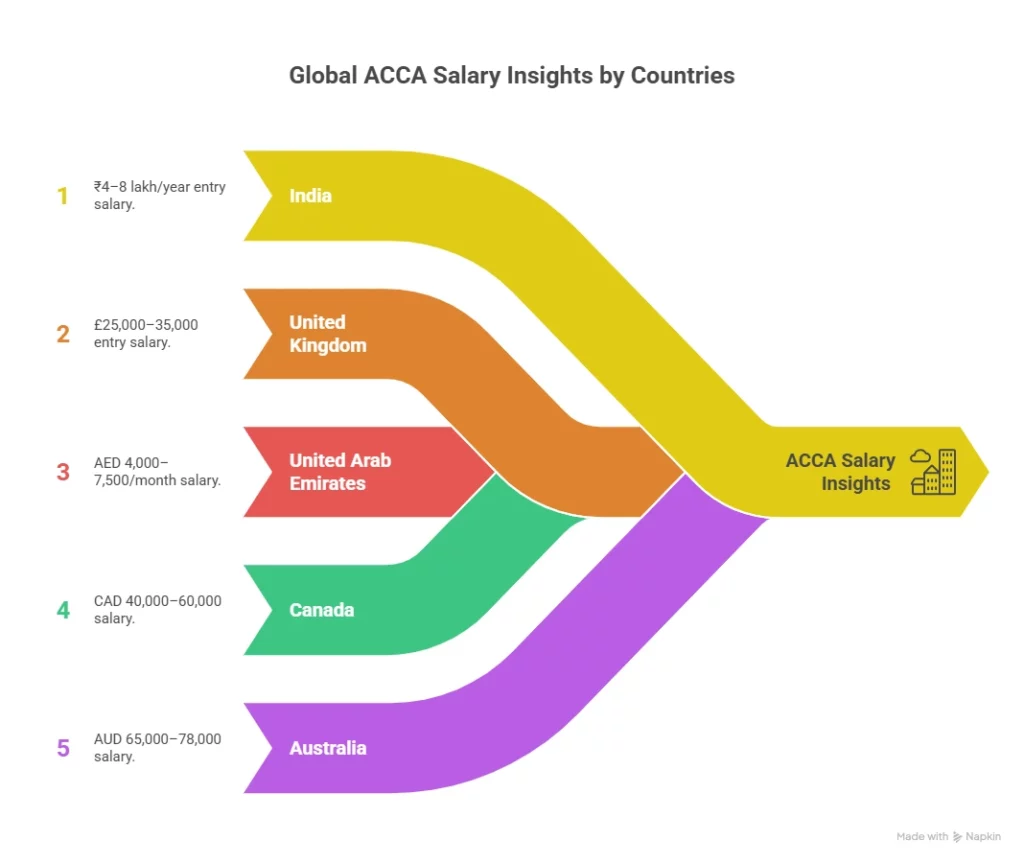
These broad forces act as the foundation for the ACCA salary comparison across our five focus countries. Here is a visual overview of the ACCA salary insights across the 5 countries we are going to discuss in detail ahead:
ACCA Salary Insights for India (2025)
India is experiencing one of the most interesting transitions in global finance. Over the last decade, the country shifted from being a back-office engine to a strategic global finance hub. Consultancies, MNCs, fintech companies, global capability centres, and Big Four firms are all restructuring teams to align with the IFRS-based reporting environment.
This demand expansion is reflected directly in the ACCA global salary benchmarks set for professionals working in India.
To better understand the landscape, let’s break down earnings across levels, roles, and industries.
ACCA Salary Structure in India: Level-by-Level
A structured breakdown of ACCA salaries and career prospects in India across each career stage, showing how earnings progress from entry-level roles to senior finance positions.
These numbers anchor the Indian ACCA Salary Insights narrative. The shift from mid to senior levels is especially pronounced in India because of the scarcity of IFRS-trained, ACCA-qualified seniors who can lead multi-country reporting.
Sector-Wise Salary Breakdown
Different industries value ACCA skill sets differently. For example, a role in internal controls for a bank demands a completely different skill orientation compared to an FP&A analyst in a tech company.
Below is an overview that reflects industry-wide salary behaviour:
ACCA Salary by Sector (India)
Sector
Salary Range
Hiring Demand Level
Big Four Consulting
₹6-22 LPA
Very High
Large MNCs / GCCs
₹6.5-23 LPA
High
Banks & NBFCs
₹5-18 LPA
High
Tech & IT Services
₹4.5-16 LPA
Moderate
Manufacturing & FMCG
₹4-14 LPA
Moderate
The rise of GCCs (Global Capability Centres) significantly influences the Indian ACCA pay scale. Over 1,600+ GCCs operate in India, with new ones opening every year, and finance is one of the dominant verticals.
ACCA Salary Growth Path in India
A finance professional’s early years often feel chaotic: learning, adjusting, absorbing frameworks, and mastering practical judgment. ACCA students tend to peak faster because the qualification trains them for competency-based application rather than pure theoretical learning.
ACCA Salary Insights for the United Kingdom (2025)
The UK is the birthplace of the ACCA qualification and one of the most mature accounting markets in the world. Its salary graph is shaped by a stable economy, high regulatory standards, and deep financial systems.
Because ACCA members in the UK often progress into specialised roles in audit, risk, advisory, tax, and banking, the ACCA global salary framework in this region is fairly structured and predictable.
Salary Snapshot: UK
Here is a structured look at how compensation evolves by experience level:
The UK remains one of the strongest destinations for ACCA international jobs due to its structured hiring systems and the size of its financial sector (London alone hosts 300,000+ finance roles).
London’s salaries are significantly higher because many global banks, hedge funds, and consulting firms base their European HQs there.
Skills That Trigger Salary Growth in the UK
A unique trait of the UK market is the premium placed on specialised technical knowledge. ACCA professionals with mastery over:
Sustainability reporting
IFRS 9 and IFRS 16
Investment accounting
Risk and regulatory frameworks (Basel III, Solvency II)
UK Job Market Stability
The UK has maintained a consistently high demand for ACCA professionals even during periods of economic uncertainty. Roles in audit, internal control, and compliance remain evergreen because regulatory governance forms the backbone of the UK corporate environment.
ACCA Salary Insights for the UAE (2025)
The UAE is one of the most attractive global destinations for ACCA professionals because of its tax-free compensation, multi-sector finance ecosystem, and steady creation of regional headquarters. Dubai, Abu Dhabi, and Sharjah have emerged as multinational finance hubs, each with its own employment pattern.
What stands out in the UAE’s ACCA salary structure is speed: the time taken for a career to accelerate is much shorter compared to Western economies. Large corporate structures move quickly, markets expand rapidly, and companies are constantly on the lookout for professionals with IFRS fluency.
Salary Overview: UAE
Below is a region-specific breakdown that represents the 2025 hiring landscape:
These ranges reflect both free-zone and mainland structures. Free-zone entities typically offer slightly higher salary bands due to international exposure and demand for global frameworks.
Why ACCA Salaries Grow Quickly in the UAE
The UAE’s salary acceleration is shaped by five structural advantages:
1. Tax-Free Income
A finance professional earning AED 17,000 per month in Dubai retains nearly the entire amount, a significant advantage.
2. Abundance of Multinational HQs
Dubai is home to 70%+ of the Middle East’s regional headquarters for global corporations.
3. Compliance-Heavy Environment
The UAE’s push toward global regulatory alignment (IFRS, FATF compliance, AML standards) increases demand for ACCA-trained professionals.
4. Rapid Sector Diversification
Banking, logistics, tourism, energy, fintech, and free-zone operations all contribute to job creation.
5. Employer Preference for Global Certifications
ACCA is seen as a “plug-and-play” qualification in the UAE market because the curriculum aligns with IFRS, the UAE’s official reporting framework.
All of these contribute directly to upward-moving ACCA Salary Insights for the region.
Most Common Roles for ACCA Professionals in the UAE
The market strongly favours professionals with a blend of accounting fundamentals, business understanding, and analytics capability:
Junior Accountant
Accounts Payable/Receivable Analyst
Audit Associate
Financial Analyst
Internal Auditor
Management Accountant
Treasury Analyst
Senior Accountant
Finance Manager
Compliance & Risk Roles
Finance managers and senior auditors in the UAE often handle cross-country portfolios for KSA, Qatar, Oman, and Kuwait, making the region one of the most globally connected markets for ACCA members.
ACCA Salary Insights for Canada (2025)
Canada’s financial job market is structured, stable, and deeply influenced by regulatory expectations. Unlike the UAE’s rapid-growth model, Canada rewards consistency and specialisation.
Where ACCA fits into this system is quite interesting: even though ACCA is not recognised as a “Chartered Accountant” designation in Canada, it is widely accepted for corporate finance roles, controllership tracks, banking, and FP&A roles.
What makes Canada particularly appealing is the clarity of its pay scale and the importance given to structured progression, something ACCA candidates find empowering.
Salary Overview: Canada
An at-a-glance view of how ACCA salaries progress across experience levels in Canada, offering a structured look at earnings from entry roles to senior finance positions.
These figures represent corporates, banks, and public-sector entities combined.
Did you know? Ontario, home to Toronto, the financial capital, consistently leads the country’s salary scales.
Canadian Hiring Preferences That Affect ACCA Salaries
1. Hybrid Roles Are Highly Valued Companies increasingly seek professionals who understand both financial reporting and business analytics.
2. Strong Premium on IT Skills Good command over SAP, Oracle, Power BI, and financial modelling tools significantly improves the ACCA earning potential in Canada.
3. Public Sector Stability Government and non-profit organisations often hire ACCA professionals for compliance and budgeting roles.
4. Corporate Finance Focus Canada’s finance teams value consolidation, forecasting, and risk management abilities, areas where ACCA training strengthens the candidate profile.
ACCA Salary Insights for Australia (2025)
Australia presents a compelling mix of strong finance demand, immigration pathways, and high-quality living. Melbourne and Sydney dominate the accounting employment landscape, and both cities consistently rank in global liveability indices.
Australia’s labour shortage for skilled financial professionals has widened over the last decade. This shortage directly strengthens the ACCA global salary benchmarks in the region.
4. Strong Governance Standards: Australian companies emphasise robust internal controls and consolidation; key strengths of ACCA training.
5. Multi-Industry Exposure: Mining, agriculture, fintech, education, and healthcare all maintain steady finance hiring cycles.
City-Wise ACCA Salary Comparison in Australia
A quick breakdown of how ACCA salaries vary across major Australian cities:
Salary Ranges by Major Cities
City
Salary Range (Per year)
Sydney
AUD 80K-155K
Melbourne
AUD 75K-150K
Brisbane
AUD 70K-140K
Perth
AUD 72K-145K
Sydney and Melbourne dominate finance roles, but Perth’s mining-driven financial ecosystem is also expanding.
Global ACCA Salary Insights: Understanding Patterns Across 5 Countries
By now, we’ve walked through the five regions individually. What ties them together is not just the numbers, but the behavioural patterns behind those numbers.
When professionals look at long-term earning arcs, they often focus on the headline figure of a country. What matters just as much is why a country pays the way it does, and how salary decisions are shaped under the hood.
This section is crafted to give a holistic view that ties together India, the UK, UAE, Canada, and Australia, linking patterns that can guide a 10-year finance career.
Global Salary Patterns That Shape ACCA Careers
Across all the salary datasets, three clear salary behaviours emerge.
1. The “Early Complexity” Reward Curve
Countries reward ACCA professionals for handling complex tasks early in their careers.
Examples include:
Consolidation
Audit planning
IFRS application
Due diligence
Financial modelling
Controls testing
Countries like the UAE and Australia accelerate salaries faster because juniors handle regional or multi-entity exposure earlier than usual.
This is a driving force behind the ACCA Salary Insights framework across geographies.
Governance, Risk & Controls: Regulations tighten each year. Professionals with GRC experience rise faster.
ESG & Sustainability Reporting: One of the fastest-growing areas linked to salary jumps in the UK, Australia, and Canada.
Watch this video to find out the various high-paying job roles you can explore after completing your course, as well as the associated ACCA salary insights:
ACCA International Jobs: Global Mobility Advantage
Mobility is one of ACCA’s strongest traits. Professionals with this qualification often receive interview opportunities across borders because the curriculum aligns with IFRS, the global language of reporting.
Some of the most active international markets for ACCA in 2025 include:
UAE
UK
Singapore
Canada
Australia
Qatar
Ireland
Malaysia
This mobility directly influences the ACCA salary comparison across countries, because moving to a higher-paying geography becomes a strategic option. The following visual captures the various job roles you can explore for global finance roles with your ACCA certification.
FAQs on ACCA Salary Insights
This section addresses the most frequently asked questions surrounding ACCA Salary Insights, helping learners understand real earning trajectories, global opportunities, and long-term career value.
Can ACCA earn 1 crore?
Yes, reaching the 1-crore annual mark is achievable for ACCA professionals when viewed through long-range ACCA Salary Insights. In India, domestic packages alone rarely reach this number unless the individual is in a senior leadership role in a large conglomerate. Senior finance managers, controllers, and specialist roles in regions like the UAE, Australia, and the UK can cross the 1-crore equivalent once currency conversion is considered.
What is the 7-year rule in ACCA?
The 7-year rule states that students must complete all Strategic Professional exams within seven years after passing their first Strategic Professional paper. The purpose is to maintain current knowledge and ensure qualification relevance. For employers evaluating ACCA candidates, this timeline signals commitment and consistency. Students preparing through structured programs such as those at Imarticus Learning typically complete their exams well before this window closes.
Can you make $500,000 a year as an accountant?
From an ACCA Salary Insights perspective, $500,000 per year sits at the leadership tier of global finance roles. It is an achievable range for CFOs, finance directors, senior partners in consulting firms, and specialists working in investment-heavy industries such as private equity, energy, or multinational banking. While mid-career ACCA professionals generally fall below this bracket, those who progress into executive roles, especially in markets like the US, UK, or Australia, can move toward the $500,000 range as total compensation, including bonuses, stock options, and performance incentives.
Is ACCA a high-paying job?
Yes, ACCA careers align strongly with high-paying global finance roles, which is visible across all ACCA Salary Insights discussed in this article. The earning trajectory begins modestly in emerging markets but rises rapidly with experience, sector transitions, and international exposure. Countries like the UAE and Australia offer significantly higher median salaries compared to local roles in India.
Is ACCA closing in 2026?
There is no indication within any ACCA Salary Insights, ACCA Global publications, or industry reports that the qualification is closing in 2026. ACCA is currently expanding into newer domains like sustainability reporting, digital finance, and global regulatory compliance. The qualification has sustained relevance for over a century and is continuously updated to reflect the needs of global employers. Professionals enrolling today are entering a long-term, globally evolving pathway.
Are ACCA jobless in India?
The concern that ACCA professionals are jobless in India is not supported by any hiring trends or ACCA Salary Insights data. India’s finance ecosystem is expanding rapidly through global capability centres, Big Four firms, consulting companies, fintech players, and multinational corporations. While freshers may need targeted guidance during early job searches, trained candidates, especially those supported by placement ecosystems like Imarticus Learning, secure employment across audit, accounting, analysis, and compliance roles.
Will ACCA be replaced by AI?
AI will transform the nature of finance work, but ACCA will not be replaced. In fact, ACCA Salary Insights show higher demand for professionals who can blend analytical reasoning with digital literacy. Automation handles repetitive tasks, but strategic thinking, interpretation, regulatory judgment, scenario planning, and advisory responsibilities remain human-driven. ACCA regularly updates its curriculum to align with emerging technologies, ensuring that members stay relevant in AI-integrated environments. Roles that combine accounting knowledge with digital tools are witnessing the strongest salary increases globally.
Do Google hire ACCA?
Companies like Google hire for finance, audit, compliance, and FP&A roles, many of which align with ACCA competencies. While ACCA is not an explicit requirement for most roles, global corporations value IFRS knowledge, analytical capabilities, and finance leadership traits, all of which strengthen the overall ACCA Salary Insights profile. ACCA professionals who pair their qualification with strong modelling, analytics, and communication skills often find opportunities within tech giants, particularly in financial planning, controllership, and internal audit teams.
Is ACCA worth it in 2025?
Yes, ACCA carries strong value in 2025 based on global hiring data and ACCA Salary Insights. The blend of international recognition, IFRS orientation, and flexible learning continues to make it one of the most relevant qualifications in the finance world. Countries across the GCC, Europe, Australia, and Asia-Pacific actively recruit ACCA talent. Structured learning platforms like Imarticus Learning further enhance the career readiness of ACCA students.
Do the Big 4 hire ACCA?
All Big 4 firms: Deloitte, PwC, EY, and KPMG, hire ACCA professionals extensively, which influences ACCA Salary Insights in nearly every country. These firms recruit ACCA candidates for audit, advisory, taxation, risk, and financial reporting roles. ACCA aligns well with Big 4 work because of its global accounting focus, IFRS integration, and emphasis on applied professional judgment. Entry-level roles begin modestly, but salary escalates rapidly through performance cycles, international projects, and leadership pathways.
Is ACCA demand decreasing?
Current ACCA Salary Insights show stable and rising demand globally. The qualification has expanded into ESG reporting, risk, digital finance, and strategic modelling, areas with high employer demand. In India, the hiring ecosystem has grown because multinational firms are scaling operations, GCCs are expanding, and regulatory alignment is increasing. Internationally, regions like the UAE, UK, Canada, and Australia continue to recruit ACCA professionals consistently. The demand curve is upward, not declining.
Bringing It All Together
As you’ve seen throughout these ACCA Salary Insights, the earning journey of an ACCA professional isn’t defined by a single country, role, or salary number. It’s shaped by how global finance ecosystems evolve, how skills deepen over time, and how opportunities expand when a qualification is recognised across borders.
If this blog helped you understand anything clearly, it’s that the ACCA pathway opens doors in ways that are both structured and flexible: structured in how salaries rise with experience, yet flexible in how easily professionals can move across industries, specialisations, and countries. That blend is what makes ACCA such a strong long-term investment for anyone building a global finance career.
Many professionals choose structured mentoring to strengthen their preparation, and platforms like Imarticus Learning with their ACCA course prep support that journey with the kind of training that builds confidence and competence at the same time.
Capital budgeting is not just about numbers; it’s about ensuring that every rupee invested generates the highest possible return. Whether you are a business owner, a financial analyst, or someone taking a financial accounting course, understanding capital budgeting methods is essential for making informed financial choices.
In this guide, we will break down capital budgeting definitions, capital budgeting techniques, and methods with real-world examples.
Capital Budgeting Definition
Businesses implement capital budgeting to examine and pick investment opportunities that will return money across various years. This strategy evaluates money flows for future periods instead of short-term earnings.
Indian companies prefer NPV, IRR, and risk-adjusted sensitivity analysis for capital budgeting. WACC is the most used cost of capital method. However, advanced techniques like real options, MIRR, and simulation are rarely adopted. Non-financial factors also influence project selection.
Organisations implement capital budgeting methods to evaluate investments between new projects along with machinery, real estate, and other long-term assets before making their decisions. The main purpose is to determine investment profitability along with financial compatibility with corporate objectives.
Long-term investments, called capital investments, are purchases of assets that serve organisations for numerous years. Enterprise investments such as factory construction and equipment and machinery acquisition fall under capital investing categories. Using capital budgeting tools enables organisations to predict financial returns from capital projects over their total operational period.
Types of Capital Budgeting
Capital budgeting differs from alternative investing because it concentrates on monitoring financial inflows and outflows instead of revenue generation. The method tracks incoming money alongside outgoing money without considering revenue or expenses through accounting.
The capital budgeting system includes loan repayments as transactions while it neglects non-cash expenditures except when these expenses affect tax computations for “after-tax” cash flows. The evaluation process within capital budgeting examines all capital costs related to asset purchases or financing.
Business organisations apply multiple capital budgeting approaches to select their long-term investment projects.
Here are some common ones:
Net Present Value
An evaluation between project cash inflows and outflows analyses their compatibility by factoring in the concept of the time value of money.
Internal Rate of Return
A project receives a positive IRR when the present cash inflows’ value equals the outflows at a specific discount rate.
Payback Period
Using this method, organisations determine the length of time needed for their projects to earn enough cash to pay back their start-up capital.
Profitability Index
Project profitability analysis through PI determines the relationship between project cash flow and start-up investment. The project earns a profit when the Payback Period indicator is higher than one.
Modified Internal Rate of Return
The fixed reinvestment rate used by MIRR enhances IRR calculations by providing exact profitability evaluation methods.
Equivalent Annual Annuity
EAA turns the project’s cash flows into a series of annual payments for evaluating projects with varying duration times.
A Step-by-Step Guide: Capital Budgeting Process
The capital budgeting process contains key steps that we can simplify as follows:
Step 1: Identifying Investment Opportunities
Companies evaluate possible investment projects across various business areas once they run asset assessments.
Purchasing new machinery
Expanding into new markets
Research and development (R&D)
Building new factories
Step 2: Evaluating Investment Feasibility
The process at this point requires organisations to collect information about costs together with risk assessments and anticipated returns. The analysis of time-dependent cash movements happens through financial analyst forecasting.
Step 3: Implementing the Investment
The company proceeds with implementing the investment after receiving approval. Implementing the investment requires the purchase of equipment and staff employment or new product development initiatives.
Step 4: Monitoring and Reviewing Performance
Companies perform consistent performance checks on their investments to confirm financial targets.
Capital Budgeting Methods: Choosing the Right Approach
There are several capital budgeting techniques used to evaluate investment opportunities.
Each method has its own strengths and weaknesses.
Method
Definition
Advantages
Limitations
Payback Period
Measures how long it takes to recover the initial investment.
Simple and easy to calculate.
Ignores profitability beyond payback period.
Net Present Value (NPV)
Calculates the present value of future cash flows, adjusted for risk.
Accounts for time value of money and risk.
Requires estimating future cash flows accurately.
Internal Rate of Return (IRR)
Determines the expected percentage return on an investment.
Helps compare different investment opportunities.
Can give misleading results for non-traditional projects.
Profitability Index (PI)
Measures the ratio of benefits to costs.
Useful for ranking multiple investment options.
Doesn’t work well for mutually exclusive projects.
Accounting Rate of Return (ARR)
Evaluates return based on accounting profits.
Easy to understand.
Ignores cash flow and time value of money.
Common Challenges in Capital Budgeting
The essential nature of capital budgeting operations does not eliminate their complexities.
Businesses must address:
Capital budget decisions become hard to fulfil because projected cash flows often remain unclear.
The operating analysis of projects remains vulnerable to economic risks, including market movements and inflation levels, together with policy variations.
Initial capital outlays for large investments need detailed financing strategies because of their high costs.
Projects maintain value at present, but they have lost their worth because of technological progression.
High-level competence in capital budgeting is essential for financial professionals alongside executives in business organisations and individual financial planners.
Postgraduate Financial Accounting and Management Programme—Your Pathway to a High-Growth Finance Career
Imarticus Learning’s Postgraduate Financial Accounting and Management Programme trains 0-3 years postgraduate graduates with the skills and competencies necessary to succeed in the finance and accounting sector. This intensive, industry-relevant programme offers a strong grounding in financial management, accounting concepts, and data-driven decision-making—the necessary skills to drive business success.
With a 100% job guarantee, students get seven assured interviews with top financial companies, guaranteeing the best career prospects based on their skills and knowledge. The course is hands-on oriented, with practical exposure to vital tools such as MS Office, Power BI, Tally, QuickBooks, and ZOHO, all of which are vital for career growth in finance and accounting.
The financial accounting course by Imarticus Learning also includes realistic finance and accounting simulations, enabling students to address challenging financial situations and improve problem-solving skills. Moreover, detailed case studies enhance financial decision-making skills, making graduates ready for high-impact finance roles.
In addition to driving employability, the programme encompasses interview practice sessions targetingsoft skills, aptitude, and presentation skillssothat the learners confidently land their dreamjobs. If you’re interestedindeveloping a career in financial management, corporate finance, or accountancy, this programme is perfect for professional development.
Secure your future in finance—enrol today!
Frequently Asked Questions
What is capital budgeting?
Businesses use a procedure to evaluate and choose long-term investments that produce future profits. Companies use this process to distribute their resources in an organised manner.
Why is capital budgeting important?
Capital budgeting enables businesses to choose productive investment opportunities while handling
potential risks and planning their financial expansion successfully.
What is the difference between NPV & IRR?
The NPV method determines the total project value, but investors use IRR to estimate the expected return percentage.
How do businesses decide which capital budgeting method to use?
Businesses make their decisions based on three core elements: project risk assessment, expected returns and financial achievement targets.
Can individuals use capital budgeting for personal finance?
People can utilise capital budgeting methods in planning their personal financial decisions.