5 Ways How Machine Learning Improves Customer Experience

Developing a Machine Learning course to make customers’ user experience more human can seem counterintuitive. ML alone will not create the level of service that customers can demand today. The combination of user experience and emotional intelligence combined with the functioning of Machine Learning is what will achieve the goals of a satisfactory customer experience with optimal performance. If you have an aim of pursuing post-graduation in Machine Learning, the Analytics program offered here at Imarticus could be a great learning path. 

  • Personalised Attention

The ability to offer a unique and micro-personalized customer experience is essential to create competitive added value today. We believed that these capabilities, like those offered by Amazon, were out of the reach of companies, but thanks to advances in the functioning of Machine Learning, Artificial Intelligence, cloud computing, and a wealth of data, it is the ideal time to start offering, adapting and personalizing the experience that customers want. To improve results at each point of contact with the customer, 67% of companies, according to  Salesforce, need to be connected in a special way with their customers.

  • Anticipation of Customer Demands

For a post-graduation in Machine Learning, it is necessary to redesign the business processes through technological applications. In this way, we can better evolve the customer experience. Keeping up with customers with an increasingly technological profile, whose preferences are constantly changing, requires that companies also adapt continuously. But we not only have to stay in this continuous improvement if we do not anticipate the expectations of customers to be able to surprise them and generate memorable moments.

  • High Performance and Precision

For AI to develop, large amounts of data are needed to feed Machine Learning algorithms, to be able to identify patterns and thus learn from which it arises and obtain behaviours. The visualization of this data will offer high performance, having identified billions of minutes of recorded conversations with customers, therefore, as there is a large amount of dialogue in those recordings where customers have expressed their intentions and needs, and provide all kinds of comments about products and services. The real value of this is largely in transforming this unstructured data and converting it to digital form. 

  • Real-Time Interactions

This will allow a more spontaneous interaction, which is constantly adapting and evolving depending on what happens with the client, in real-time. Although there are scripts and procedures, what will allow us is to innovate, adapting to the client’s needs, by using its thousands of hours of experience to find the most effective way to deal with the client at that moment, regardless of the design of the interaction. With ML, we have the opportunity to develop a digital coach based on the best interpretations that help tailor individual customer conversations in real-time.

  • Analyse Process Changes

Relying on reliable collaborators who can help build value. Managing it alone is a waste of time in a competitive environment. The collaborator who helps you establish the customer experience, it is necessary that they have experience in analysis and measurement. It should help provide insight into process changes and where you will be best in order to apply robotic automation rather than where a more personalized touch is needed.

Conclusion

The ultimate goal of every Machine Learning course is to offer extraordinary personalized experiences that will make customers feel satisfied. Technology alone does not make sense, we must establish collaborations between humans and technologies. The art of conversation will be at the heart of the customer experience and trust is what will unite consumers with their favourite brands.


Top 5 Regulatory Changes in the Investment Banking Operations Industry

The investment banking industry is responsible for raising capital for businesses. In 2021, investment banks will help their clients in identifying revenue-generating opportunities. The investment banking operations industry must perform per some of the regulatory norms. Regulations for the investment banking operations industry are decided by the central/state government. If an investment bank fails to comply with the regulations, it may go through legal hassles. Besides finance professionals, investment banks also need expert compliance officers for following the regulations. There are investment banking courses online that can help you in learning regulatory compliance. Before you search investment banking courses online, you should know about these five regulatory changes.


  • Lending limits


The exposure limit for investment banks is decided by the central government. The exposure limit defines the amount of loans banks can give to borrowers based on their total funds. The exposure limit is often revised by the central government and investment banks must follow it. The current exposure limit for banks in India is 15% for a single borrower. For a group of borrowers, the exposure limit for banks in India goes up to 25%. The exposure limit can be increased by 5% for financing infrastructure projects. Investment banks often identify capital ventures and invest themselves. While doing so, they should not lend more than the exposure limit to avoid legal hassles.


  • Cash Reserve Ratio (CRR)


Financial institutions in India must keep a certain amount of cash with RBI (Reserve Bank of India) to meet payment obligations. The CRR is decided by the RBI and changes all the time. Investment banks must keep an eye on the current CRR to avoid any legal hassles with RBI. The current CRR for financial institutions in India is 3%. It means that if the deposit of a financial institution increases by INR 100, then INR 3 will have to be deposited to the RBI.


  • Operation norms


Once an investment bank has been incorporated, it must conduct operations according to the regulatory norms. According to the norms, an investment bank must list its shares within three years of its incorporation. The regulatory structure also defines the percentage of foreign shareholding. As for now, the foreign shareholding is restricted to 49% in India (maximum). Investment banks can increase foreign shareholding further but only after contacting RBI. The latest regulations also state that financial institutions must open 25% of their branches in rural areas where banking facilities are limited.


  • RBI


RBI will only set the banking regulations in India for all investment banks. The RBI Act launched in 1934 has given this power to the RBI for deciding the banking regulations. All investment banks that are incorporated under the ‘Companies Act’ will have to follow the RBI regulations. Often, RBI reviews the regulatory structure and makes changes. Compliance officers must keep an eye on the latest announcements from RBI.


  • Investment Advisors Act


The Investment Advisors Act brought a paradigm shift in the investment banking sector. Before this act, investment banks misinformed investors to curb the competition. In 1940, the Investment Advisors Act was created in which all investment banks had to register themselves. The fees collected by investment advisors are also regulated by this act. An investment banking certification can help learn more about the regulatory structure.

Which is the best investment banking course in 2021?

Imarticus Learning provides an investment banking certification in partnership with London Stock Exchange. The Certified Investment Banking Operations Professional course will help you in launching your investment banking career. With an industry-endorsed curriculum and career guidance, you can build your investment banking career. Start your CIBOP course with Imarticus now! 

Here’s why you must technologize supply chain using advanced analytics and AI

The supply channels of the industry are experiencing a crucial moment for their existence and those responsible for this vital area for any business face the greatest challenge of their careers; manage an innumerable list of suppliers, information and communication flows, technologies, procedures, and levels of demand, as never before in the history of the global industry.

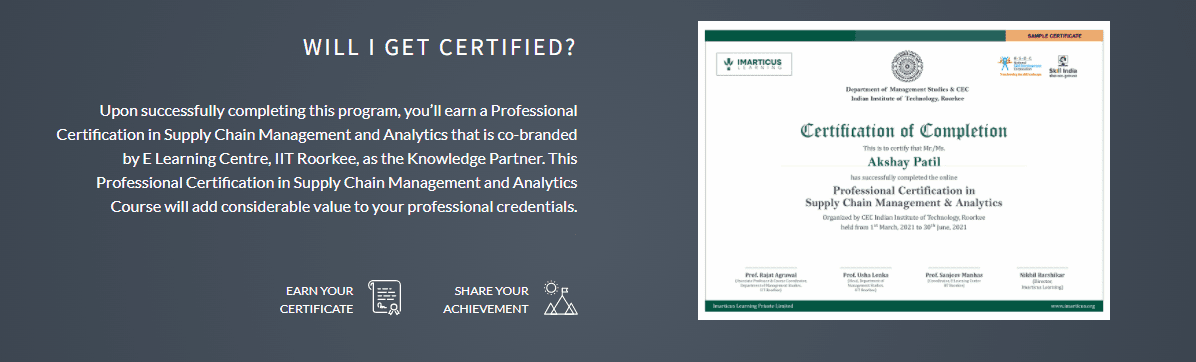
These supply networks have grown in complexity appreciably and have suffered the consequences of the global economic crisis with particular virulence. To help you understand the importance of technologizing the supply chain using advanced analytics and AI, we offer an SCM program where you can obtain a certification in supply chain management.  

best supply chain management and analytics coursesHere are 7 reasons why you must consider technologizing the supply chain using advanced analytics and AI: 

  • Agility is key to success, more than ever. Designing supply chain network systems must work like a clock, and take advantage of new technologies, such as IoT, Blockchain, or Artificial Intelligence, to reach new levels of efficiency. 
  • Advanced analytics is another alternative high impact in this world, taking into account the permanent state of evolution and change network provision of any business. Evaluating the best options, those that provide the greatest value and margin, and taking advantage of all the data at our disposal has an immediate positive consequence on the results. Thankfully, our professional certification in supply chain management explains how advanced analytics is beneficial for the supply chain management. 
  • The information must be analyzed comprehensively and quickly, with the powerful support of the cloud. The large corporations are moving quickly so that their supply chains are aligned more with your customer strategy, and are connected more directly, accurately, and flexibly. But, above all, an “always ON” supply chain is sought that responds to commercial needs at all times. 
  • The interconnection of all its links is crucial for the machinery to function and respond to the demanding market conditions. Analyzing that information has profound implications for B2B processes. For this reason, one of the fundamental attributes of this supplier ecosystem is its “resilience”, understood as the ability to anticipate and react immediately to any potential anomaly that could endanger it. 
  • Staying safe from the unexpected requires intelligent use of multiple data sources, new, traditional, structured or not, of diverse typology, even in natural language, and easy to find or obscure to the provider. And all of them must be leveraged by certification in supply chain management. 
  • You need expert staff and precisely the links in the supply chain have long suffered thinning plans that have reduced their workforce like never before. And when older veterans leave the organization, they will carry with them a lot of knowledge and experiences that have been treasured for decades, with the consequent brake on exhaustive analyzes that require intelligence to interpret the information. 
  • Designing a supply chain network with full intelligence is capable of managing in real-time large amounts of structured and unstructured data from internal and external sources, including data sets that may previously have been difficult to reach. Precisely anticipating future demand and managing assets, inventory, and shipments in real-time improve the bottom line for any operator, requiring an optimized, near-automatic supply model. 

The new forms of commerce that have fostered the Internet, the cloud or connected objects will only gain shape if they have the most efficient logistics processes, a modern supply chain that meets their high demands with a permanent journey to excellence. Professional certification in supply chain management offered by Imarticus can lead to a truly digital supply chain. 

Modern security strategies: Here’s how you can embed cybersecurity into everything you do

The digital age has been helpful not only for people but also for companies, who have relied on digital transformation to evolve and stay in the competition. Being able to automate processes, facilitate communication with customers and suppliers, as well as the opportunity to work even from home has been a great advance, but not everyone does it responsibly and that is when cyber security online certification courses from Imarticus come into play. Stay tuned to know more about the cybersecurity program. 

What Is Cybersecurity?

Computer security or cybersecurity are measures and actions aimed at protecting mobile devices, computers, servers, networks, and all the information that is stored on them. Due to everything that computer security encompasses, it is also known as information technology security. Protecting our data and our electronic devices from cyberattacks does not only consist of creating a secure access password.

Hackers can access and take control, simply with us running a virus without realizing it, this can be done through emails or links that we access without taking precautionary measures. Although the security tools available today are increasingly effective, cyberattacks are also constantly renewed, making the battle against them far from over. For this reason, we must pay the attention it deserves to computer security, to protect ourselves from the increasing dangers that exist.

What Is Cybersecurity at All Levels?

When we talk about cybersecurity at all levels, we refer to the measures to protect all the devices that we use daily, from mobile phones and computers that we use at work, to the information that we handle online. With today’s great technological development, many everyday devices are interconnected with the internet, which we know as  IoT  (the Internet of Things).

All that interconnection that we live in today makes computer security even more relevant and necessary in our lives. At the business level, protecting all levels that use digital tools is vital, it should not only focus on protecting the server and computers, it must also provide coverage to the network and personal devices of employees if they use them to work.

How To Protect All Levels?

To carry out effective cybersecurity measures, a solid strategy must be created to prevent all types of attacks, locate the origin in case they could not be avoided, and have an equally effective response plan.

Once the risks have been identified, the first thing to do is identify all the computers that have access to the company’s data, from the personal devices of the employees, if applicable, to the computing infrastructure of the entire company.

information security courseAfter identifying which devices we have to secure, antivirus is installed to protect against malicious software and use anti-phishing tools to protect electronic commerce transactions.

In the same way, encryption tools are used to prevent information leakage and to install firewalls to protect communication between users and keep up the information security of the system.

Conclusion

Undoubtedly, computer security is a requirement and obligation for a company to maintain its continuity in the future. The theft of information and both financial and prestige losses that affect the truth is significant, so allocating resources to ensure data security is very important.

Thankfully, good cybersecurity strategies can be learned via many professional cyber security courses offered by Imarticus. They should apply to monitor every certain period to each system since many cyber-attacks are kept hidden without causing any damage. So, by applying efficient security measures and conducting monitoring, you will make the cybercriminals have to work very hard to try to access your information.best cybersecurity online certification course

5 steps to master python for artificial intelligence

Python is among the most-used programming languages on the globe. Developed in 1991, Python has been useful for new-age technologies also. Python is helpful for new-age technologies like AI (Artificial Intelligence) and machine learning. AI algorithms can be developed easily with Python as compared to other programming languages.

Most of the companies and AI experts find Python easy than other programming languages. Python has left behind some popular programming languages like C and Java when it comes to AI. Read on to know five steps to master Python for AI.


  • Learn the basic concepts of AI


Before you start making AI algorithms with Python, you should know basic AI terminologies. You should know different types of learning methods for AI algorithms, agents, environment, and other basic things about AI. You do not need to know everything about AI initially. Learning AI with Python is the perfect way to become an expert. However, you need to know the basic AI terminologies beforehand.

Getting your concepts cleared is of utmost importance. You cannot become an AI expert if you don’t know much about the basics. Knowing the basic concepts of AI and its importance is as important as knowing the complex concepts.


  • Learn the syntax of Python


For every programming language, you first learn its syntax. The syntax can be referred to as the code writing style which is different for each language. Python is chosen by AI experts because it has a simple syntax and involves less coding. You need a way of writing code in Python first to master it in the future. It won’t take much time to learn the syntax of Python. You can join an online Python course to learn quickly.


  • Join an online course for AI with Python


You need to go for an online course for AI with Python to master it quickly. An industry-oriented course can help you in learning Python for building smart AI algorithms. Imarticus Learning is a reliable source that can provide you with artificial intelligence and machine learning certification. With a globally-recognized artificial intelligence and machine learning certification, you can also get a job as an AI expert. 

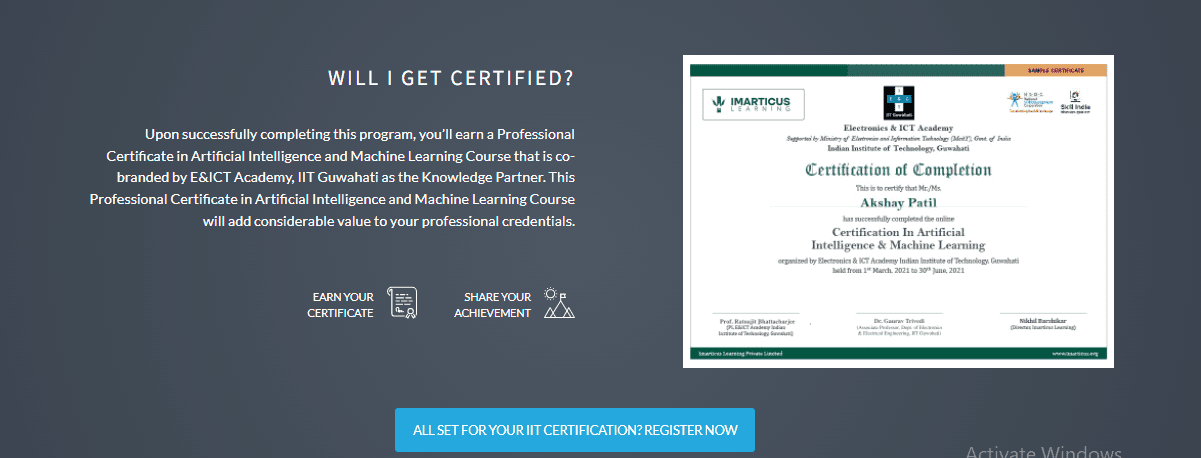
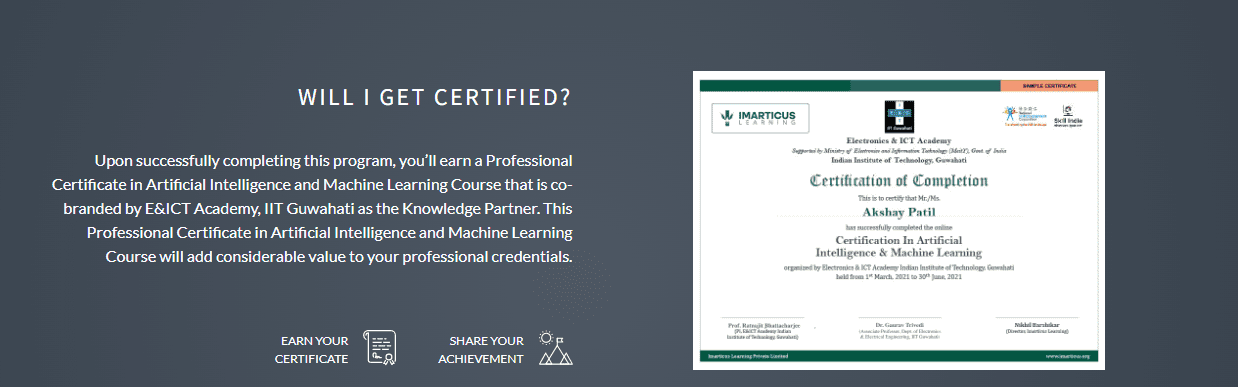
Best Python programming course for Artificial IntelligenceImarticus provides an artificial intelligence course that helps you earn a job. The Certification in AI & ML gives you a chance to learn according to the curriculum of IIT Guwahati. You can learn from a premier institute of the nation from your couch with Imarticus Learning.


  • Know about Python libraries for AI


Python has many built-in libraries for AI which makes the task easy. A python library is a pre-existing chunk of code that can be used time and again for your AI projects. Python libraries save your time when working on AI projects. Some of the Python libraries used by AI professionals are NumPy, SimpleAI, SciPy, Matplotlib, etc. Make sure about the function and capability of each Python library for AI. It can save you time when designing AI algorithms.


  • Work on some AI projects with Python


Choose a Python course that allows you to work on AI projects. Working on AI projects can help you learn Python more quickly. You would not want to make mistakes as an AI employee. It is better to make mistakes beforehand and learn from them by working on AI projects. The AI course offered by Imarticus lets you work on around 25 industry-related projects.

Conclusion

Python is a simple programming language that is easy to use and learn. It is why many AI experts choose Python for boosting their productivity. You can learn about the role of Python in AI via the online course offered by Imarticus. Start your artificial intelligence course right away!

3 Ways Big Data Can Influence Decision-Making for Organizations!

An enterprise or any organization collects a massive amount of data daily while performing its operations. This data can be in the form of customer information while making purchases, vouchers,s, and bills by manufacturers, viewership on the online portals, etc.

For an upward movement in the market, it is significant that this big data does not lie untreated in the systems of the company instead it should be worked upon and put to good use to increase the efficiency of the company.

To screen and filter the big data, data analysts are hired to convert that data into a useful piece of information. It may be likely to occur to you that how big data influences an organization’s functioning. There are some decisions that are largely based on big data.

Influence of Big Data on Decision Making of an Organization

In the following three ways, big data creates an impact on the decision-making and the overall performance of a company.

  1. Promotional enhancement through real-time data

Whenever you shop from a branded store, you start receiving emails about their offers which sometimes claim that some deals are exclusively for you. Do you ever wonder how they send personalized emails to every customer based on their interests and their shopping histories?

Big Data CareerThese all are some promotional activities which the companies do by making use of big data. Big data influences the decision-making of the promotional activities of a company.



By doing this, customers may feel informed through the brand and it is sometimes the biggest and the most important step towards creating customer loyalty and long-term relationships.

  1. Expanding Operations Without Spending Too Much

To initiate a promotional activity or a campaign to attract customers, some companies spend a hefty amount of money which may or may not turn out to be 100 percent successful. However, by making effective use of big data these expenses can be avoided. If you already know which customer tends to buy within a specific price range, personalized promotions through the internet become easy.

Big Data Career

Moreover, wasteful expenditure can be avoided to a great extent. Real-time data can prove to be beneficial in determining some major issues in a particular product or service.

Companies can appoint data analysts who can screen the real-time data and make necessary changes as and when required.

  1. Speeding the Action

Whenever a company launches any product in the market, it is always hard for the company to anticipate the response it may get. Supposedly, the customers have questions or certain queries about the product, taking some time to answer them might affect the overall image of the company as well as the product.

Big data helps to tackle this problem in real-time. Queries can be handled in seconds than wasting several minutes and replacements can be made in fewer days as compared to the time it used to take earlier. Big data has brought about a paradigm shift in decision making which has made customer dealing and answering queries a much simpler task.

Conclusion

With edge-to-edge competition in the market, it is significant for any organization that it makes effective use of big data in its favor.

Big Data Career

With the proper use of big data, companies can foresee and predict the future market for their products and services as well. The points mentioned above have presented a lucid picture of how important big data has become lately.

Big Data CareerA big data career can prove to be beneficial and is considered among the most demanded career options.

For big data training, you must check out the courses and professional assistance being offered by Imarticus learning.

How will a Supply Chain Management Certification transform your career?

How will a Supply Chain Management Certification transform your career?

Supply chain management is one of the most in-demand and rapidly growing fields today. If you’re looking forward to boosting your career in this field or just looking to expand your knowledge, a certification in supply chain management is a great option. But what are the benefits of getting a supply chain management certification? In this blog post, we’ll take a closer look at these questions and more. So keep reading to find out why getting certified in supply chain management is a smart move for your career!

What is supply chain management, and why should you take a course?

  • A supply chain is a process businesses use to get suppliers to customers.
  • The supply chain can contain multiple people and organizations, who may be customers or suppliers to each other.
  • Supply chain management is the process of planning, implementing, and managing these activities within a business to meet client requirements at the possible lowest cost for a compelling return on investment (ROI).
  • It always ensures that product or service quality meets customer and regulatory requirements.

The benefits of a supply chain management certification

Now that you understand what SCM means, here are some reasons it might be beneficial to take a course in supply chain management.

  • If you’re already working as a logistics or analyst manager, then taking this certification will give your career a huge boost forward.
  • It can give you the knowledge and skills you need to manage your company’s supply chain more effectively.
  • It can help you build your career by giving you the credentials you need to move up in your organization.
  • SCM certification can give you an edge over other candidates who do not have any formal training in this area.
  • You will be able to understand the complexities of the supply chain and how different elements work together to create a smooth process for getting products from suppliers to customers.
  • It can help you troubleshoot any potential problems during manufacturing or distribution.
  • Lastly, taking a course in supply chain management can help you stay current with the latest trends and developments in this field.

It is essential, as the supply chain landscape is constantly changing, and those who can keep up will be more successful in the long run. Hence, if you’re looking for a way to take your career to the next level, a supply chain management certification is something worth considering.

Explore More and Make a Career with Imarticus Learning

The Professional Supply Chain Management Certification is in partnership with DoMS and E-learning Centre, IIT Roorkee, and industry professionals to equip candidates interested in entering the operations and supply chain business with a cutting-edge experience.

The Supply Chain Management course allows professionals to make data-driven strategic, operational, and tactical choices. There is a scarcity of experts with process and analytical skills in the Supply Chain Management area. This Logistics and supply chain management course prepares students for jobs such as Demand Planner, Data Scientist, Supply Planner, and Supply and Operations Planner, which are in great demand.


Some course USP:

  • This best Logistics and supply chain management course is for students with placement assurance to aid the students in learning job-relevant skills.
  • Impress employers & showcase skills with a certification recognized by India’s prestigious academic collaborations.
  • World-Class Academic Professors to learn from discussions and live online sessions.

Contact us through the chat support system or visit Mumbai, Thane, Pune, Chennai, Bengaluru, Delhi, Gurgaon, training centers.

Here Is How to Perform Scenario Analysis of a Financial Portfolio with Python

Here Is How to Perform Scenario Analysis of a Financial Portfolio with Python

The finance sector is constantly trying to predict future scenarios to make impactful and positive decisions. Scenario analysis can help generate important insights from financial portfolios that allow professionals to understand future conditions and what might affect or cause them. As a chartered financial analyst, you will be able to implement Python packages and simulate scenarios. To acquire the necessary skills, you can enroll in a financial analysis course. Imarticus Learning offers a Financial Analysis program to students who are interested in the finance industry. 

Completing Scenario Analysis of Financial Portfolio with Python

If you learn financial analysis, you will undertake the scenario analysis process for financial portfolios using Python. While performing scenario analysis with Python, you will have to implement the Monte Carlo simulation. 

When you start scenario analysis of a financial portfolio, you will need to collect all relevant data. You can install a data library like finance and download the necessary information on stock prices. Now, once you have that, you will have to find out the daily close price of each stock.

To do this, you need to calculate the price “p” from a specific day “t” till the day “t+1”. You can use the pct_change method when you have Python and quickly get the formula for this calculation. You will then need to understand the composition of the portfolio and the loop that will provide the daily stock returns and fill the Pandas Data Frame. 

Once you have the returns, you can begin the Monte Carlo simulation of a single stock. A financial analyst course online with an updated and holistic approach to financial studies will help you apply this simulation. Suppose you want to simulate “x” days, then you need to find stock and obtain the returns time series of that stock. Make sure that you have the original returns time series. Then, you need to randomly but uniformly select “x” values with replacement. You can then complete the simulation with a single line of code.  

When you need to perform a scenario analysis of a financial portfolio, you will need to get the returns and weights of each stock in the portfolio. Using these, you have to find the weighted sum of all the stock returns. You can use a returns data frame to calculate and then perform the simulation. 

Gain Industry Certification in Financial Analysis

Financial institutions need to have a fair idea of what to expect in the future as the industry functions on accurate analysis and predictions. To learn financial analysis and perform scenario analysis, you will need to have industry-oriented training. Imarticus Learning’s Financial Analysis Prodegree is a great place to start. 

The course is ideal for freshers and working professionals who are looking to change careers and enter the financial industry. The Financial Analysis Prodegree course from Imarticus Learning is in collaboration with KPMG. Therefore, as a student, you will have access to the best industry training to prepare you for the finance sector. You will also get to know the current situations and develop job-related skills that will make you a valuable employee in the future. 

Since the curriculum is designed for students to launch successful careers, it includes several interesting and relevant topics. You will learn financial analysis, modeling, equity research, financial statement analysis, valuation, and transaction execution. You will become a chartered financial analyst and can explore numerous careers in the finance industry. 

best financial analyst coursesAfter completing the financial analyst course online, you can go into private equity, investment banking, or corporate finance. Imarticus Learning offers essential toolkits that help students develop skills and experience to work in the industry. 

5 Ways How Technology Is Changing Financial Modelling and Forecasting

5 Ways How Technology Is Changing Financial Modelling and Forecasting

For many decades, financial system modeling was based on the same traditional business models with very little innovation and integration. Later, the experts started to realize that when technology is combined with finance, it can make the financial market more efficient and highly accurate. Indeed, this has started to change the world of finance opening doors to versatility and quicker computations.

It has proven to be a revolutionary step for the companies as well. With our CIBOP program offered by Imarticus, you can have the opportunity to learn more about the money market and understand the impact of evolving technology on financial systems. 

  • Increased Efficiency

Technologies such as big data, the cloud, and robotics are contributing to greater agility and efficiency of the financial function, since their application reduces the time dedicated to traditional processes, increasing productivity. It also cuts the time spent on reporting, allowing a greater focus on analysis, decision-making, and risk management, creating value for the organization, as well as representing a change in the company and having an impact on people.

  • Fraud Detection

Since money is involved in financial markets at a global level, this sector is prone to fraud and cyberattacks. Frauds or fraudulent activities can have adverse effects on businesses. Thankfully, with Artificial Narrow Intelligence (ANI), it is now possible to detect data patterns and prevent fraud. Any abnormal behavior in online transactions can be precisely detected by modern Artificial Intelligence and Machine Learning techniques, which can help save loads of money on debugging the problem in other traditional ways instead.  

  • Sound Decision Making 

Modern Artificial Intelligence algorithms can help in modeling risk management scenarios, thus making sure that rational decisions are taken most of the time. Finance requires a very delicate task of sound judgment, which surely cannot be left unnoticed and ignored. Even a single bad decision might result in losing millions of dollars on the money market. But thanks to advancements in Artificial Intelligence and Machine Learning algorithms, proper decision-making is ensured, leaving the system more reliable than ever before. 

  • Blockchain Transaction Enhancement

With the beginning of the era of blockchain technology, advancements in financial modelling have taken a big leap. When coupled with an Artificial Intelligence algorithm, blockchain technology blends more easily in the market, causing huge benefits. While on one hand blockchain technology enhances transparency and builds safe transactions amongst peers, Artificial Intelligence, on the other hand, can further improve system security. 

  • Automation of Tasks

Automation in technology can help to avoid many repetitive and tedious tasks. Many software packages are available which can display loads of information and data with just a click of a button, thus avoiding long waiting hours for results. So instead of spending time creating the tasks, the investment banker or any other financial professional can focus more on evaluating the results and their correct interpretation. 

Conclusion

After having understood the various ways in which technology is changing financial modelling systems, it is clear that big data and finance are going to be synchronous. Be it Artificial Intelligence, decision-making processes, blockchain, or automation of systems, technology plays a crucial role in deciphering information correctly and quickly. But there is some downside involved as well.

Inaccurate or improper use of these technologies can disrupt the system completely. It is necessary to make sure that these technologies are developed and maintained by experts and professionals who can

Steps to create a dashboard in Tableau

If you are having trouble with the excel sheets and finding it hard to create complex formulas to deal with the data, the Data Visualisation tools such as Tableau are here for the rescue! It can help use unmanageable data into beautifully crafted interactive dashboards. Those who have Tableau certification are hot properties in the Data Analysis and Data Science fields. 

Tableau is easy to use, works faster, and is also easy to set up. The tool is available in both paid and free versions. Knowing how to operate this will be an added advantage while doing any Artificial Intelligence and Machine Learning course

Getting this software and creating a dashboard is required to get a simplified version of the raw data that you are dealing with. SO, here are the steps to create a dashboard in tableau. 

Step #1 Creating a dashboard

Download and install the Tableau software to start the process. Once it is set up, open it and click on the ‘New Dashboard’ button to create a fresh one. Give an appropriate name to this dashboard so that it is easy to identify.

Step #2 Adding sheets to the board

The next step is to bring in the excel sheets with the data that you need to work on. Drag the required sheet onto the dashboard space. Alternatively, you can also select the most relevant data from a sheet, instead of the whole sheet. 

Step #3 Add additional sheet(s)

Tableau dashboard allows adding as many sheets as required for the data analysis. The additional sheets may be added in the relevant space and can process the data on all or selected sheets, as required.  

Step #4 Customization

The next step is where you customize or filter the data as per the requirement to create an interactive dashboard. Choosing layouts, adding images or texts, navigation to move from one data to another set, etc can be done at this stage. 

Step #5 View and share the data

Once all the customization is complete, view the data in full-screen mode and see if any changes are needed. Once satisfied, you can share the dashboard with others for review and discussion. 

Why is Tableau important?

Tableau is a data simplifying tool that helps manage a vast data resource. It can easily blend with AI to make faster and smarter decisions regarding the data. It also assists in integrating the data to work directly with various models of Machine Learning. Having a Tableau certification will be an asset, especially one pursuing an IIT Artificial Intelligence course or an Artificial Intelligence and Machine Learning course. Integrating the results of data interpretation decisions made using AI and ML into visualized data using Tableau helps people understand it better. 

best artificial intelligence courses by E&ICT Academy, IIT GuwahatiTableau opens a way for qualifying and quantifying the data while also identifying any particular pattern with the missing data. It is one of the robust tools that is required while implementing the machine learning models or solutions so that the business side can also understand and visualize the analysis or predictions. 
Conclusion

While the top-rated Artificial Intelligence course by E&ICT Academy, IIT Guwahati can develop a qualified and faster data analyst, the Tableau tool helps them be smarter. The drag and drop spaces on the Tableau dashboard allow you to investigate and relate the data with the intended outcome. It can work with multiple external data resources, not just the excel sheets. In other words, a single dashboard can combine data from various sources. Here, the visualization is possible with the help of charts, graphs, maps, tables, and some advanced methods.   

best Artificial Intelligence courses by E&ICT Academy, IIT Guwahati