Can blockchain resolve certainties in supply chains?

Blockchains can be referred to as an upcoming technology, which has enough abilities to reduce cyber security risks available in supply chains. These mostly deal with an auditable, inconvertible history of transactions, bringing about a verifiable identity. 

To begin with, blockchains can be understood as a digitally distributed ledger that tracks transactions among several parties. It is best known for its remarkable roles in cryptocurrency systems, in order to maintain transactions that are mostly decentralized. Blockchains mostly deal with the security and understanding of information, in order to generate trust without any third-party providers.

If you are aiming to become a supply chain analyst, then this article will provide you with information regarding the role of blockchains in supply chains. 

How do Blockchains Enhance the Functioning of Supply Chains?

  • Data Visibility: Increased data visibility could bring about greater transparency and trackability of up-to-date information. Once included, these records cannot bring about change. For instance, these roles are best applicable in the cases of food safety. Data visibility allows you to track mistakes and enhance the safety of the products.


  • Process Optimisation: Blockchains provide help to optimize business operations and processes. Inefficiencies present in the supply chains are mostly manual, application-based procedures that can cause mistakes, increase fraudulent activities and bring about difficulties in management processes. 
  • Technical Considerations: Several requirements such as scalability, integrity, and security must be met in an enterprise ecosystem. The blockchains designed for business purposes bring about a sense of identity as well.
    Infrastructure also plays an important role as protection must be provided against the tampering and misuse of information. This can also add up to a higher rate in the production of data at a fast rate. Round the clock, availability is also included to support ledger replication.
  • Collaboration: Blockchain helps in combatting collaboration issues by adding up data and providing a centralized platform. Intermediary requirements are also negated by saving the organization’s primary aspects such as time and finances. It also helps to decrease miscommunications and problems, creating a platform where people can function efficiently.
  • Increased Automation: Most freight invoices comprise inaccurate and unnecessary information. These bring about vulnerabilities such as errors and miscommunication, leading to inefficient supply chain management.


Blockchain plays an adjusting role by bringing about suitable product activities. Delivery speed also increases, which finally leads to better services.

Advantages of Blockchains in Supply Chains:

The role of blockchains is to provide successful transactions or transaction facilities. 

  • ERP Software is mandatory when it comes to storage functions and managing business activities which include handling of employees, production as well as accounting. Blockchain makes such functions smoother by connecting all the organizations in order to bring efficiency to the whole process. 
  • Life cycle management is properly enhanced with the help of blockchain technology. Sufficient feedback is provided to the consumers and other members who are part of the supply chain. A distributed consensus is realized where online transactions can be understood in the future. 
  • Blockchains store products, order details, and IoT. Order and transportation are also provided to find the trust of all stakeholders present in the supply chains. These sensors are mostly updated over the cloud and real-time tracking. 
  • Blockchain systems are applicable to not only managerial sectors but to healthcare, agricultural, and legal facilities as well. Inventory management, forecasting, asset tracking, and intellectual property storage area used by blockchains to make the supply chains more alert. 
  • Real estate industries are heavily benefited from blockchains because complete decentralization is provided. 

Conclusion:

If you are looking for a supply chain and analytics management course, then Imarticus Professional Certification in Supply Chain Management and Analytics is the most ideal course available.
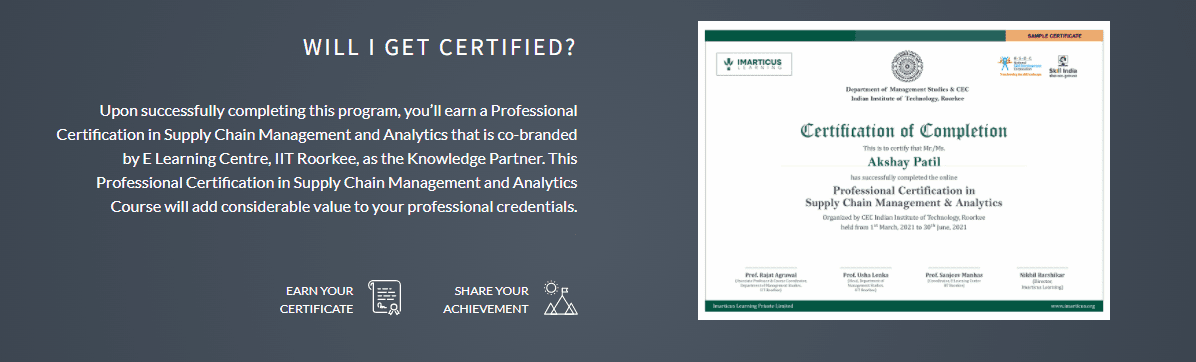
best supply chain management and analytics coursesLessons provided from IIT supply chain management based in Roorkee, the course provides for live sessions with faculty experts and a curriculum approved by industrial leaders.

Opportunities for working with international SCM projects are also provided. Overall, this certificate course will fulfill all your interests in blockchains and supply chain management.


Top 5 careers in money market

The money market is the most lucrative field. It offers a host of career opportunities with high pay and excellent job security. Whether you’re looking for a high-paying, stable job with amazing benefits and long-term career prospects in the money market – we’ve got it right here.

This blog will discuss the top 5 careers in the money market for 2022. These jobs are in demand and offer excellent pay and benefits. So, without further ado, let’s get started!

A career in the money market is a perfect choice if you look for a job with high pay and excellent benefits. It offers tremendous flexibility and the opportunity to learn new skills that can help you advance your career. 

Here are the five careers in the money market for 2022:

An Investment Banker

It is the most popular career choice in the money market. Investment bankers are responsible for helping companies raise capital by issuing and selling securities. They also advise clients on financial matters such as mergers and acquisitions. 

Stockbroker

A stockbroker can make up to six figures a year, depending on experience and qualifications. Stockbrokers help clients buy or sell stocks by connecting them with other people interested in buying or selling those same shares of ownership rights in corporations. They also provide advice on which stocks to buy or sell.

Financial Analyst

A career as a financial analyst is an excellent choice if you want to work in the money market. They are responsible for providing information and analysis on the financial health of companies. They make recommendations to management on how to improve the company’s finances.  

Financial Manager

A career as a financial manager is another great option in the money market. They develop and implement strategies to increase revenue and reduce costs. Their average salary is around  ₹991,180 per annum.

Financial Advisor

A financial advisor can make up to six figures a year, depending on experience and qualifications. Financial advisors provide advice on investments, taxes, and insurance policies. They also help people manage their finances, such as retirement planning or saving for college tuition costs. Their average salary is around ₹4,25,271 per year.

These are just some of the top careers in the money market for 2022. There are many different options available, but these five will give you an idea of what types of jobs might be available if you choose this path!

Explore courses for investment banking with Imarticus Learning

This 180-hour CIBOP (Certified Investment Banking Operations Professional) course will comprehensively equip students for a career in investment banking operations, treasury, or clearing services. Learn investment banking by understanding complex securities and derivative products, their trade-lifecycles, and the activities associated with investment banking operations.

Due to this partnership, learners interested in pursuing careers in investment banking will access the LSE Group Academy’s best-in-class learning content, given by top-rated professors.

Course Benefits For Learners:

  • Students at Imarticus Learning work in most of the world’s investment banks with the CIBOP accreditation, which the London Stock Exchange recognizes!
  • Impress employers and demonstrate expertise by enrolling in investment banking courses with job interviews  guarantees approved by India’s prestigious academic institutions.Investment Banking Course
  • Our investment banking course covers complicated securities, derivative instruments, and the trading lifecycles and functions of these assets.

Contact us through chat support, or drive to one of our training centers in Mumbai, Thane, Pune, Chennai, Bengaluru, Delhi, and Gurgaon.

A diploma in finance management needs a good tech approach

Technology has taken over the business world. Even those in finance management need to have a good tech approach. Many firms are now hiring people who know how to use technology to help manage their finances. If you want to be competitive in the job market, you need to have a finance management diploma and know how to use technology effectively. In this blog post, we will discuss how technology can be used in finance management and how it can help your career! 

How can technology be used in financial management?

It is a primary part of the financial management process, providing the tools and information necessary to make sound decisions. A good tech approach in financial management will help you save time and money. It can also improve your efficiency and accuracy in decision-making. In addition, it can keep you updated with the latest changes in the financial markets.

Technology can help you automate your financial processes, making them more efficient and accurate. It can also provide you with real-time information about the financial markets, allowing you to make better-informed decisions. In addition, it can help you connect with other finance professionals and get their insights and advice.

How does technology play a critical role in the modern workplace?

A good tech approach can help you be more efficient and organized in your work, and it can also make it easier to keep track of critical financial data. When choosing the right technology for your financial management role, there are a few key things to keep in mind.

  • Make sure you have the right tools.

The initial phase is to make sure that you have the right tools. You will need a computer with internet access, and you will need a good accounting software package. Many different accounting software packages are available, so it is vital to choose one to meet your specific needs.

  • Choose software that is easy to use.

It is also important to choose software that is easy to use. You should be able to input data and generate reports quickly. The software should also be easy to customize to track the specific information that you need to follow.

  • Make sure your data is secure.

Another important consideration is data security. You will need to ensure that your financial data is safe and secure. Choose a software package that offers both password protection and encryption.

By following these tips, you can ensure that you have the right technology to help you manage your finances effectively. You can streamline your work and make your financial management role much more accessible with the right tools.

Discover financial risk management certification with Imarticus Learning

Our investment banking course will give the student a thorough grasp of investment banking, capital markets, risk management, and fintech. IIM Lucknow’s best business school has curated this six-month intensive curriculum. It provides the finest-in-class education for experienced middle managers looking to reignite their financial service careers.

Course Benefits for Learners:

  • As a participant in this equity research course, students will have the chance to meet and communicate with their classmates and industry experts.

  • Learn with a curriculum that focuses on outcomes and a pragmatic learning style. Students will learn essential areas such as investment banking, capital markets, risk, and fintech in this course.

  • It is a comprehensive program that includes everything you need to know about the financial markets and how they work. 

Bank of 2022:Mapping the future of professionals with an IIM Calcutta Investment Banking and Capital Markets course

Rather than predicting the future, we often find ourselves mapping it out, especially in our professional lives. The decision to pursue an IIM Calcutta Investment banking degree opens many doors – and the question of what comes next is an important one. This blog post will map out the future of professionals with an IIM Calcutta investment banking degree and explore all the opportunities that come with it. Stay tuned!

The IIM Calcutta Investment Banking and Capital Markets course is a One-year postgraduate diploma program. The program is to groom future professionals in investment banking and capital markets.

The course covers various aspects of investment banking, such as financial analysis, security analysis, portfolio management, and derivative instruments. It also imparts knowledge on the functioning of capital markets, primary and secondary market operations, and regulatory frameworks.

How can IIM Calcutta Investment Banking and Capital Markets course help your career?

The IIM Calcutta Investment Banking and Capital Markets course can help you build a successful career in the finance sector. The program covers financial statement analysis, investment banking, capital markets, and more. Upon completing the course, you will find employment in banks, financial institutions, and other organizations. If you are looking for a career in finance, this is the course for you!

The course from IIM Calcutta is one of the most sought-after courses in India. The investment banking and capital markets course meets the needs of the industry. It also gives a chance to learn about banks’ multiple products and services. The course covers investment banking, capital markets, and risk management.

In collaboration with IIM Calcutta, this program will assist you in acquiring the practical knowledge and technical abilities required of a financial professional. It will provide learners with an in-depth understanding of investment banking and global capital markets and offer them the opportunity to meet with industry professionals and include a capstone project.

The course also offers many opportunities for hands-on learning. Learners have a chance to work on live projects with industry partners. They can also participate in internships at leading banks and financial institutions.

Discover IIM investment banking and Capital market course with Imarticus Learning

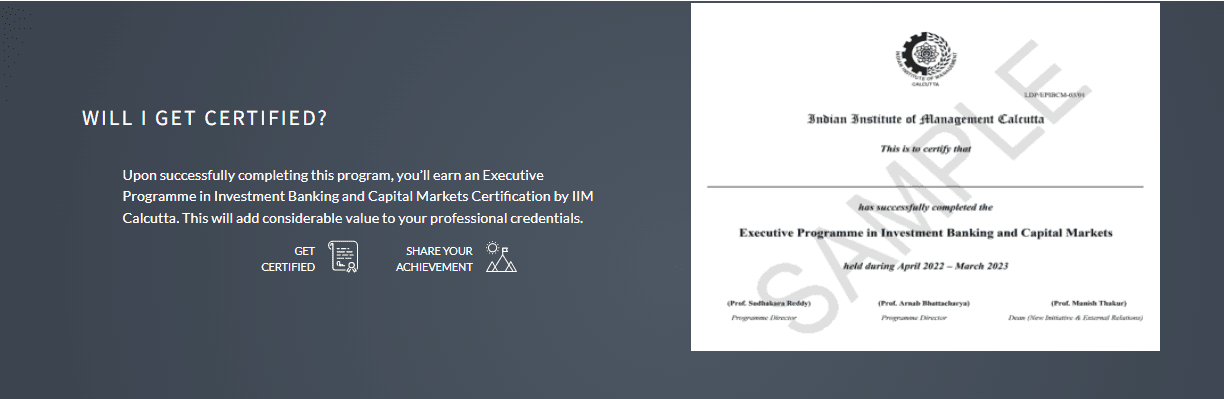
Our Executive Program in Investment Banking and Capital Markets collaborates with the prestigious IIM Calcutta. This comprehensive one-year curriculum will provide students with a fundamental and advanced understanding of global capital markets and investment banking.

Students will master the foundations of mergers and acquisitions, debt and equity capital markets, portfolio management, sales and trading, and securities legislation for finance professionals with at least two years of experience. 

Course benefits for learners:

Contact us through chat support, or drive to one of our training centers in Mumbai, Thane, Pune, Chennai, Bengaluru, Delhi, and Gurgaon.

The best career path in 2022: Certifications for valuation and equity research

What is the role of valuation and equity research? Equity research provides correct information to the stock market. It is an analysis of the business stock, its industry, and stocks in similar groups to estimate earnings and valuation. This analysis is crucial for the accurate valuation of the stock as it prevents stock from being overvalued or undervalued.

At Imarticus, through the IIML course, we prepare future analysts who accurately analyze financial services and capital markets.

Financial Risk Management Course

Every operating business entity has to face risk, but if you know how to manage the risks, you can certainly stop the revenue leakage. Managing financial risk means managing the current and anticipated financial threats. It also helps formulate a good and planned strategy to incur profits and stop the losses.

The course in financial risk management at Imarticus enhances the horizon of financial markets. It helps understand the concept of financial risks and magnifies the knowledge about the working of various financial institutions and the stock market. It also helps to increase the credit and ability of financial risk managers to increase their earning potential. 

The managers trained to anticipate financial risk and evaluate the stock market suggest the best possible remedies to a business entity or a sole businessman to avoid potential risk and financial losses. At Imarticus, through the IIML course, we train you to identify the chances of risk exposure. We further teach you how to quantify the firm’s exposure to the possible financial risk.

An excellent financial risk manager needs to quantify the risk and plan the strategies accordingly through proper financial risk management techniques.

At Imarticus, we teach our students how to keep adequate insurance to keep the firm safe and maintain dual emergency funds. Diversification of investment is another critical tool for good financial risk management, and we teach the ways for multiple diverse investments.

Identifying the financial risk is essential but prioritizing the risk according to business problems is equally important. For learning this technique, you should know to differentiate between liquidity, market, credit, operational, and legal risks.

Structured Finance Training

The advanced management program in financial services and capital market through IIML at Imarticus is a way to specialize in financial management. The students will experience the stimulations and get exposure to numerous zenith projects. Imarticus is keen to produce successful financial risk managers, and for this, the institutions have designed a unique curriculum. The campus interview and selection highlight this financial risk management course.

The students will uncover different financial strategies essential to handling and preparing for financial risk. In this regard, they will learn how to measure financial risk and thereby control it. To be an expert in financial trouble, insight, and knowledge on every liability are essential.

Further, at Imarticus, we teach the importance of skills and their enhancement. Our course through IIML will assist in controlling and coordinating unnecessary business data. It will help develop a better understanding of performance management and profit sources.

Financial risk management is a daunting task, and this you can do only by taking the right decisions and regularizing your financial investment on a slow pace and a regular basis.

Supply chain analytics certification on the rise catalyzing new technological advancements in 2022

Supply chain analytics, as a discipline, has existed for over a century now. But the associated applications, data infrastructure, and mathematical models have developed significantly with the advent of technology. Machine learning, the Internet of Things (IoT), predictive modeling, Complex Event Processing (CEP), and cloud infrastructure have greatly benefited the process of supply chain analytics. 

Organizations utilize supply chain analytics to acquire insight into their day-to-day operations and extract value from extensive amounts of data associated with the procurement, processing, and dispersal of manufactured goods. Due to an acute shortage of young professionals in the field of Supply Chain Management (SCM), Imarticus Learning has brought a supply chain analytics course for students to learn about the prospective sector. This article will give you a cursory understanding of supply chain analytics, its benefits, and why the demand for this course is seen on the rise. 

What is supply chain analytics?

Analytics denotes the capability to make data-driven decisions founded on an overview of authorized and pertinent data, often using visualization tools, such as charts, graphs, and diagrams. All large-scale corporations and start-ups have developed their supply chains to cut down on costs and to remain competitive in the business landscape. A supply chain refers to the extensive network of a company to distribute a specific product to its customer. This vast network includes all the procedures that begin with acquiring an order to meet the customer’s request, such as procurement, marketing, finance, customer service, distribution networks, and operations. 

As a result, supply chains generally yield enormous amounts of data. Supply chain analytics aids corporations to analyze all this data critically, generating insights, and locating patterns.

Different types of supply chain analytics

The various types of supply chain analytics have been briefly explained below –


  • Descriptive analytics


This type of supply chain analytics delivers visibility and acts as a single source of truth across the supply chain for both external and internal data systems. 


  • Predictive analytics


This type of supply chain analytics allows an institution to comprehend the most probable outcome and its implications on the business. For example, corporations use predictive analytics to project and mitigate perils and disturbances to their business models. 


  • Prescriptive analytics


This type of supply chain analytics enables organizations to decode problems and unite to gain maximum business value. It aids businesses in collaborating with logistic partners to cut down on time and effort to reduce disruptions.


  • Cognitive analytics


This type of supply chain analytics permits an organization to respond to complex questions in simple terms. Explaining complicated problems in layman’s terms will help a team hit upon the solution quicker. It helps businesses think through a difficult situation or problem, such as improvisations and optimizations of different aspects of the business. 

Benefits of supply chain analytics

Some of the major benefits of supply chain analytics are: 


  • Have a better understanding of risks


Supply chain analytics can help businesses pinpoint known risks and permit the prediction of future disruptions by identifying trends and common patterns throughout the supply chain.


  • Boost accuracy in future planning


By studying customer data, supply chain analytics can assist a business in better predicting future consumer demands. It enables an organization to determine the products to be cut off as they offer less profit and comprehend customer needs after their first order. 


  • Achieve an uncomplicated and lean supply chain


Corporations can utilize supply chain analytics to monitor and track partner responses, warehouses, and client needs. This will help them make sounder and well-informed future decisions for the betterment of the business. 


  • Get ready for the future


Many enterprises are looking for professionals with knowledge of advanced analytics. Familiarity with advanced analytics will help businesses process all types of complex data, mitigate risk factors at little expense and with less sustainability impact and help them optimize their decisions by ensuring timely alerts. 

Conclusion

With innovative technologies, such as Artificial Intelligence (AI), becoming more mainstream, corporations and start-ups are looking to hire more and more young professionals in the field of supply chain analytics. Due to an acute shortage of specialists, there is a rise in demand for certification courses of the discipline. Imarticus Learning’s Supply Chain Management course will tap into this new and prospective sector and help you build a supply chain management career with the assistance of various leaders and the expert faculty of DoMS and E-learning Centre, IIT Roorkee. 

A Software Engineer’s world: Tips to crack interviews

With the advent of new technologies, the role of a software engineer is changing rapidly. Software engineers need to keep up with the latest trends and technologies to stay ahead of the curve. This blog post will discuss some tips for software engineers to crack the interview process.

A software engineer is an individual who designs, develops, tests, and implements computer programs for use by other people or organizations. Software engineers are also responsible for ensuring that their systems run at optimal levels of efficiency and reliability with minimal downtime. 

In 2022, the role of a software engineer is likely to be very different from what it is today. With the advent of artificial intelligence (AI) and machine learning (ML), the demand for skilled software engineers in these areas can grow significantly.

Here are some of the tips to cracking the interview for a software engineer:

Securing the software engineer job is not easy. You need to be in a reputable company and pass through many rounds of interviews before you get a job.

The process could go for months, but it’s necessary for getting into your dream company like Google, where there are millions of applicants every year. 

The following are some tips that will help you in the interview process:

 Prepare for an aptitude test.

The initial step in the interview process is often an aptitude test. It will measure your basic skills and abilities. Be sure to prepare for this by practicing questions that you may ask.

Research the company

Before you go into an interview, it’s essential to research the company. Know their history, mission statement, and any recent news about them. It will help you know the company better and prepare for questions the interviewer may ask you.

 Prepare for HR interview.

The HR interview is often your first opportunity to show the company your personality. Be prepared for common questions like “tell me about yourself” or “why are you interested in this position?” Try to have specific examples of why you are a good fit for the job.

Prepare for a technical interview.

Your technical interviews are where you will get tested on your knowledge and abilities. Practice coding problems beforehand to write clean, efficient code in real-time during the interview process.

Knowledge of various facets of software development

The interviewer needs to know that you have a good understanding of the multiple facets of software development. It includes knowledge of design, coding, testing, and deploying software. You don’t want to be an expert in all these areas, but you should at least have a basic understanding of them.

Discover certification in software engineering with Imarticus Learning.

The online software engineering certification course works with industry professionals to provide aspiring software engineers with the best learning experience possible. This program will educate students for a career as a new-age software engineer, focusing on the cloud, blockchain, and IoT.  

best software engineering coursesCourse Benefits For Learners:

  • Prepare for a rewarding career in Software Engineering by studying cutting-edge technology and participating in numerous real-world projects that expose students to various industries. 
  • Students will get a thorough knowledge of Software Engineering fundamentals. Industry experts will lead them through real-world projects from various industries to help them study software development online. 
  • These are the best certifications for software engineers that allow students to obtain practical experience by working on projects inspired by prominent organizations and real-life events.

Ethical hacking courses landscape in 2021

Before becoming a certified ethical hacker, you have to understand ethical hacking. Ethical hacking is a legal attempt to gain unauthorized access to a computer system,

including its applications or data.

Ethical hackers, sometimes known as “white hats,” are security professionals who do security audits. They contribute towards an organization’s security posture through their proactive activities. Ethical hacking is different from criminal hacking, and it requires prior consent from the company or owner of the IT asset.

The Cybersecurity course at Imarticus is your gateway to becoming a professional, ethical hacker.

Concept of Ethical Hacking

Ethical hacking is a promising and lucrative career field as companies with online transactions nowadays require an ethical hacker. However, the cyber security course at Imarticus will provide you with rigorous training, but before that, you have to understand the critical concept of ethical hacking.

  • Whatever legal assessment you do in this field should be backed with prior permission.
  • Understand the scope and limitation of the legal assessment.
  • Report all the vulnerabilities uncovered during the evaluation—advice on fixing these flaws.
  • Data is sensitive; therefore, ethical hackers may have to sign a non-disclosure agreement in addition to the terms and conditions imposed by the inspected organization.

Difference Between Ethical Hacking and Criminal Hacking

Ethical hackers put their skills to help the businesses entities to secure and improve their technology. They help these businesses to locate any flaws or loopholes that could lead to a security breach.

While conducting a cyber security check, if they discover vulnerabilities, then they report the same to the corporation. Simultaneously, they also offer guidance on how to fix problems. The ethical hacker often re-tests with the organization’s permission to check that the vulnerabilities are entirely addressed and resolved.

Criminal hackers seek unlawful access to a resource (the more sensitive, the better) to profit or acquire personal recognition. These hackers deface websites or crash backend systems for pleasure, reputation damage, or financial gain. Whatever methods they employ and vulnerabilities they discover gets unnoticed as they are not concerned about the company’s security posture.

Functions of an Ethical Hacker

Ethical hacking seeks to imitate an attacker when evaluating the security of an organization’s IT asset(s). As a part of this process, they look for attack vectors against the target. The initial objective is to conduct reconnaissance and collect as much data as possible.

Once the ethical hacker gathers enough data, they use the same to seek flaws in the asset. They use both automated and manual testing to carry out this evaluation. Even the most advanced systems may be subject to complex countermeasure methods.

The job of an ethical hacker includes continuously uncovering the vulnerabilities and finding the chances of their exploitation by a criminal hacker. Through cyber security certifications, you will know all the aspects of ethical hacking.

In general, an ethical hacker discovers the following vulnerabilities:

  • Assaults by injection
  • Compromised authentication 
  • Mistakes in security
  • Components with known security flaws should not be used

The Cybersecurity program at Imarticus is perfect both for a novice and an expert. It will give you the best chances to enhance your knowledge and skills on the subject.

Transition from a supply chain analyst to a supply chain manager with the best supply chain management course with analytics

Making the transition from a supply chain analyst to a supply chain manager can be challenging. However, with the proper training and education, it is possible! In this blog post, we’ll go over supply chain analyst and supply chain management roles and how to make the transition.

Role of Supply chain analyst

A supply chain analyst analyzes a company’s entire supply chain and makes recommendations to improve efficiency and effectiveness. They will use various analytical tools to examine the data and identify areas of improvement. The goal of a supply chain analyst is to help the company save money and increase profits by streamlining the supply chain.

Role of Supply chain manager

A supply chain manager oversees the entire supply chain of a company. They will decide which suppliers to use, how to transport goods, and how to store inventory. The goal of a supply chain manager is to ensure that the company’s supply chain is efficient and effective.

The transition from a supply chain analyst to a supply chain manager:

You can do a few things to transition from a supply chain analyst to a supply chain manager.

 Get experience in the field:

A great way to transition is to get experience in the field. There are many ways to do this, such as working as an intern. It will allow you to learn about the various aspects of supply chain management and gain valuable experience. 

Take a supply chain management course:

If you want to transition into the supply chain manager role, you should consider taking a supply chain management course. It will give you the necessary knowledge and skills to succeed in this field. There are many great courses, so do your research and find one that fits your needs.

Transitioning from a supply chain analyst to a supply chain manager can be a great career move. You can now become an invaluable asset to any company with the proper knowledge and skills. You can give yourself the best chance of success by taking a supply chain management course.

Explore Supply Chain Management Course with Imarticus Learning

The supply chain certification provides cutting-edge expertise to those interested in entering the operations or supply chain analytics course. This supply chain analytics course will teach students for jobs such as Demand Planner, Data Scientist, and Supply Planner.

This course is by industry leaders to help students learn. Product activity has been increasing at an ever-increasing rate in recent years. Across industries, there has been a dramatic growth in the number of SCM jobs. A career in SCM can be enriching, both financially and professionally.

Course Benefits For Learners:

  • We immerse students in in-demand technologies and projects, including six real-world projects that will give them a complete grasp of the industry to prepare them for a satisfying future in Supply Chain Management and Analytics.

  • Students who complete a supply chain management online course will prepare for competitive careers such as Demand Planner or Data Scientist, which are in great demand among companies today!

  • This supply chain management career will help students become more data-centric and improve Supply Chain decision-making by harnessing the power of Python.

30+ acronyms and jargons you should learn with investment banking and capital markets course

If you’re looking to start your career in the capital markets, an IIM Calcutta Capital Markets Certification could be just what you need. This certification can give you the skills and knowledge you need to work in this exciting and rapidly-growing field.

In this blog post, we’ll provide an overview of the IIM Calcutta Capital Markets Certification program and explain why it might be a good fit for you. So if you’re thinking about making a career change or advancing your current career, read on!

The IIM Calcutta Capital Markets Certification is a great way to get ahead in your career. It also allows you to work in any country that recognizes the accreditation. 

What is the IIM Calcutta Capital Market Certification?

It is a one-year, full-time program designed to prepare students for careers in the capital markets. The course offers a comprehensive curriculum covering all aspects of the capital markets, from investment banking and asset management to securities regulation and market analysis.

The IIM Calcutta Capital Markets Certification is open to all Indian citizens with a bachelor’s degree with at least 50% marks. The IIM Calcutta Capital Markets Certification is a valuable credential for those seeking a career in the capital markets. The program is well-respected and highly competitive, and it offers students a comprehensive education in all aspects of the capital markets.  

What does life look like with an IIM Calcutta Capital Markets Certification?

The life of a student who has completed the IIM Calcutta Capital Markets Certification is very different from that of other students. The certification opens many doors for them, and they can now pursue a career in the capital markets.

The IIM Calcutta Capital Markets Certification is a valuable credential to help students stand out from the competition. The program is challenging and rigorous, but it also offers students a comprehensive education in all aspects of the capital markets. With the IIM Calcutta Capital Markets Certification, students have a valuable credential to help them succeed in their careers.

If you want to work in the financial markets, the IIM Calcutta Capital Markets Certification is the curriculum for you.

Discover IIM Calcutta investment banking and capital market certification with Imarticus Learning

Our Executive Program in Investment Banking and Capital Markets works with the acclaimed IIM Calcutta. This thorough one-year program will teach students the fundamentals and advanced concepts of global capital markets and investment banking. Students will also learn the fundamentals of mergers and acquisitions, debt and equity capital markets, portfolio management, sales and trading, and securities regulation.

Course Benefits For Learners:

  • This executive degree in investment management accelerates students’ learning by utilizing case studies and real-world examples from the current capital market. 
  • This IIM Calcutta executive program will assist students in achieving their objectives and establishing a strong career in the financial sector. 
  • The IIM Calcutta Investment banking certification is perfect for professionals looking to advance their careers in the financial industry.