


Last updated on October 22nd, 2026 at 03:04 pm
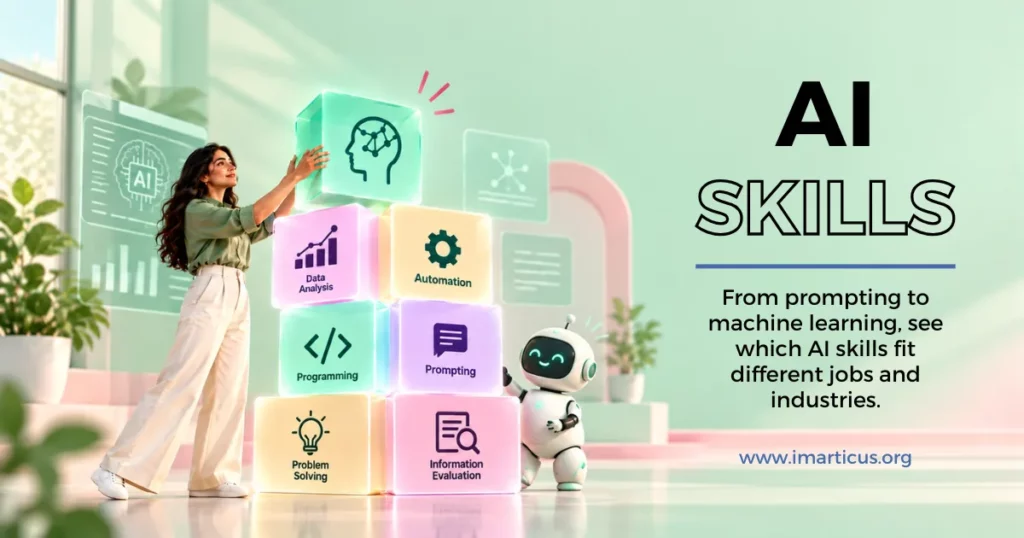
AI skills refer to the practical abilities required to use artificial intelligence effectively, from working with AI tools and writing prompts to analysing data and developing AI systems. Basic skills include AI literacy, prompt engineering and data literacy, while technical roles may require Python, SQL, machine learning, GenAI, RAG and MLOps. Their importance is reflected in current hiring trends.
PwC’s 2026 AI Jobs Barometer found that jobs requiring specific AI skills grew 69%, compared with 9% growth across the overall job market. The skills required vary by role, making it important to focus on capabilities that match a specific career path rather than learning every AI tool available.
You’ve probably noticed how quickly AI has entered ordinary working life. Reports, research, spreadsheets, emails, presentations, coding and even small everyday tasks are being done with some form of AI assistance.
A certificate can tell you that you studied AI. It cannot tell an employer what you can actually do with it.
That distinction is becoming harder to ignore. You can ask ChatGPT to write a report, Claude to summarise a document, or an AI tool to turn a spreadsheet into a neat presentation. But what happens when the numbers in that spreadsheet are wrong? Can you spot it? Can you give the tool enough context to get a useful answer? Can you take the output, question it, improve it and use it for a real business decision?
Don’t Let Our Best Advice Get Buried
Add Imarticus as a Preferred Source — see more of what we publish, every time you search.

That is where AI skills become much more interesting. The useful skill is rarely the tool itself. It is knowing what to ask, what information to provide, what to check and what to do with the result. I have found this distinction particularly important when looking at areas such as data analysis, finance and business reporting.
The same applies to people moving towards technical roles. An aspiring AI engineer cannot stop at prompt writing. Python, SQL, machine learning, model deployment, RAG and GenAI start becoming relevant. Someone working in finance may need a different mix, which is why building a strong foundation through a relevant data analytics course can complement AI knowledge rather than sitting separately from it.
So the question worth asking is not simply, “Which AI tool should I learn?” It is: “What can I do better because I know how to use AI?” That question takes you towards the skills that actually matter, the roles that use them and the kind of practical work you should start building.
What Do AI Skills Actually Mean?
When you hear the phrase AI skills, you might immediately think of Python, machine learning or prompt engineering. Those are certainly part of it. They are only part of the picture.
Think about what happens when you use an AI tool at work. You have to decide what to ask. You have to give it the right information. You have to judge the response. You may need to check the data behind it. Then you still have to turn the result into something useful for another person. There are several skills hidden inside that one process.
- You need enough AI knowledge to know what the technology can and cannot do.
- You need enough communication skill to give clear instructions.
- You need data awareness so that a convincing answer does not fool you.
- You may need programming or machine learning knowledge if you want to build AI systems rather than simply use them.
- And you still need your own professional knowledge.
That last part is easy to miss. Suppose you have spent five years working in finance. An AI tool can help you compare figures, summarise a report or spot unusual movements. It does not suddenly give you five years of financial judgement. You bring that part.
That combination tells you quite a lot about the direction of work. You need technology skills. You also need to become better at thinking about what the technology gives you. I’d break your AI skills into five broad areas:
| Area | What It Means In Practice | Where You Might Use It |
| AI Literacy | Knowing what AI does well, where it fails and when to check its output | Any office or professional role |
| AI Tool Skills | Using AI applications properly instead of treating them like search boxes | Research, writing, analysis and routine work |
| Data Skills | Reading, cleaning and questioning information | Finance, analytics, marketing and operations |
| Technical AI Skills | Python, machine learning, GenAI and related technologies | Data and technology roles |
| Human Skills | Judgement, communication, creativity and problem-solving | Almost every role using AI |
You don’t need to master all five at the same time. In fact, trying to do that is one of the easiest ways to get stuck.
Why Start With AI Literacy?
I wouldn’t begin with a complicated technical course if you have barely used AI before. Start by using it. Take a task you already know how to do. Something familiar works best because you can tell when the answer goes wrong.
Give an AI tool a report you have already read and ask it to summarise the key points. Ask it to identify the main argument in an article. Give it a set of meeting notes and ask it to pull out the actions. Then read the original material again.
You’ll notice something quite quickly. AI can produce an answer that looks polished even when one of the details is wrong. That is a useful lesson. You start understanding why checking an AI response is part of using the technology well. You also start getting a feel for which tasks AI handles nicely and which ones still need a lot of human involvement.
- Can you tell when an AI answer needs checking?
- Can you recognise when you have given a tool too little information?
- Can you spot when the answer sounds confident but does not actually answer your question?
- Can you decide what information should never be pasted into a public AI system?
- Can you tell the difference between using AI as an assistant and handing over your judgement completely?
You can build this skill without memorising technical terminology. Use AI on work you understand. Check what comes back. Try again. Over time, you’ll develop a much better instinct for it.
Also Read: What Is The Average Data Analyst Salary By Experience?
How Prompt Engineering Helps You Use AI More Effectively?
Prompt engineering has become a popular phrase, and there is plenty of material around it. I’d keep the idea simple.
Tell the AI what you are actually trying to get done.
Imagine you need to write to a customer whose order has been delayed. You could type:
Write an email about a delayed order.
You’ll get an email. It may even be perfectly reasonable.
Now imagine you explain why the order is late, what has already been done, what you can promise the customer, who will receive the message and how formal you want it to sound. You have given the AI something to work with. The difference comes from context.
That is where prompt engineering becomes useful. You are learning how to frame a task clearly enough for the system to produce something that fits the situation. You don’t need to turn every prompt into an elaborate instruction manual. For most work, I’d pay attention to four things:
- Tell the tool exactly what you want it to produce rather than leaving the purpose of the task unclear.
- Give it the background information that someone doing the task properly would need.
- Tell it who will read the result and what level of detail makes sense for that person.
- Tell it what to do when information is missing instead of encouraging it to fill gaps with guesses.
That final point is particularly useful. For example, if you ask AI to analyse a business report, you can tell it to identify missing information rather than inventing an explanation. You’ll also notice something interesting as you practise prompting. Your prompts improve when your own thinking becomes clearer. Sometimes the problem was never the AI tool. You simply had not worked out what you wanted from it.
Did You Know?
PwC’s 2026 research includes prompt engineering among the specific AI skills appearing in job advertisements, with AI-skilled jobs growing 69% compared with 9% growth in the overall jobs market. (Source)
AI Tool Skills That Go Beyond Knowing One Chatbot
There is a temptation to pick one AI tool and learn every feature it has. That can work for a while. I’d rather see you understand the task first. You might use ChatGPT for one piece of work, Claude for another, an AI feature inside Microsoft software for a third and a specialised application for something else.
The names will keep changing anyway. The underlying ability you are building is more useful: you know how to work with AI to get something done. Let’s say you spend two hours every Monday preparing a report.
- You could use AI to organise the raw information, identify unusual figures, create a first version of the narrative and suggest questions you should investigate.
- You still read the report.
- You still check the numbers.
- You still decide what belongs in the final version.
That is a much more useful AI workflow than simply asking a chatbot to “write my report”. So I’d avoid becoming dependent on one tool or one particular feature. Get comfortable with the work underneath it. Learn how to summarise information with AI. Learn how to compare documents. Learn how to extract information. Learn how to work with data. Learn how to automate repetitive steps. Then changing tools becomes much less disruptive.
AI Communication Skills Deserve More Attention
You can know how to use AI and still get poor results because you haven’t explained the problem properly. Think about a normal meeting. Someone asks you why sales have fallen.
- You could give them a number.
- You could give them a chart.
- Or you could explain what changed, why you think it happened, what evidence supports that view and what you think should be checked next.
AI can help you prepare all of that. It cannot remove the need for you to understand the question. The same thing happens when you use AI for research or writing. You need to know whether the answer actually addresses the problem you started with. That is why I include communication among the AI skills worth developing.
- You need to be able to explain what you want from an AI tool.
- You also need to be able to explain an AI-assisted result to someone who has no interest in how the technology produced it.
Imagine presenting a dashboard to your manager. Your manager probably does not want a lecture about the language model you used. They want to know what changed, what caused it and what action makes sense. Your ability to make that connection is valuable.
Interesting Insight → PwC found that the skills required in the most AI-exposed jobs are changing more than twice as quickly as those required in the least AI-exposed jobs.
Python And SQL Tips Worth Learning For Technical AI Work
If you want to move towards technical AI roles, Python and SQL are difficult to avoid. That does not mean you need to spend six months memorising programming syntax before building anything. Start with a real problem. Take a sales dataset.
Use SQL to pull the records you need. Use Python to clean the data. Calculate a few figures. Create a simple chart. Then ask yourself what else you could do with the same information. That approach gives every new concept somewhere to land.
- You learn a Python function because you need it.
- You learn a SQL query because you have a question you want answered.
- You learn data cleaning because your dataset is messy.
I’d also keep your learning practical. Don’t just write code that produces an answer you already know. Give yourself a problem where you have to figure something out. That is when programming starts to stick.
Interesting Insight → foundit reported that Python appeared in nearly 75% of AI job postings in India in 2025, while SQL and data engineering skills appeared in more than half of postings.
Machine Learning Is Your Next Step Into Technical AI
Once you’re comfortable with data and some Python, machine learning starts making much more sense. You’re no longer simply asking an existing AI system to produce an answer. You’re learning how models find patterns in data and use those patterns to make predictions or classifications. Think about practical problems.
- Could you predict which customers might leave?
- Could you classify transactions?
- Could you estimate demand?
- Could you identify unusual activity?
Those questions give machine learning a purpose. Start with regression and classification. Understand training and testing data. Learn why a model can perform brilliantly on one dataset and poorly on another. Get comfortable with concepts such as overfitting and model evaluation.
Then build something small. You don’t need an impressive project title. A model that answers a sensible business question is enough to teach you a great deal. There’s another reason I’d learn the fundamentals even if your eventual interest is GenAI. Machine learning gives you a better feel for what AI can actually do.
You start asking better questions about data quality, accuracy and performance. You become less impressed by a flashy demonstration and more interested in whether the system works reliably on the problem in front of you. That shift in thinking is useful well beyond an AI engineering job.
AI Engineer Skills Require More Than Machine Learning
This is where I would make a clear distinction. You can know machine learning and still have a lot to learn before you are ready to build production AI systems. When you work as an AI engineer, the model is only one part of the job. You have to think about the application around it.
- How does the data get into the system?
- How does the application communicate with the model?
- Where does the information come from?
- How do you evaluate the response?
- What happens when the model fails?
- How do you control costs?
- How do you monitor the application after deployment?
That is why the skills required for AI engineer roles are becoming broader. You are building a system. You need software engineering habits. You need to understand APIs and databases. You need to know how models are evaluated. You need to think about deployment. And you need enough understanding of the business problem to build something people will actually use.
Did You Know?
Machine learning accounted for 34% of AI job postings in foundit’s 2025 India analysis, the largest share among the AI skill categories reported in that analysis. (Source)
Which AI Skills Should You Learn First?
I wouldn’t copy somebody else’s list and try to tick everything off. Your starting point depends on where you are today.
- If you are completely new to AI, spend time using it properly before worrying about advanced technical subjects.
- If you already work with data, you have a reason to move towards SQL, Python and machine learning.
- If you want to become an AI engineer, you’ll eventually need much more depth across programming, machine learning, GenAI, AI engineering and deployment.
The WEF’s research supports this broader mix. AI jobs and big data rank as the fastest-growing skills, while analytical thinking, creative thinking, resilience and technological literacy continue to rise in importance. A useful starting point looks like this:
| Where You Are Starting | Skills Worth Focusing On | A Practical First Project |
| New To AI | AI literacy, prompting and AI tools | Improve one repetitive work task |
| Business Role | AI tools, data literacy and communication | Improve a recurring report |
| Analytics Role | SQL, Python, statistics and machine learning | Analyse a real dataset |
| Technical Career | Python, machine learning and GenAI | Build a small AI application |
| Experienced Tech Professional | GenAI, RAG, agents, MLOps and responsible AI | Add an AI feature to an existing project |
You don’t have to stay in one category. In fact, you shouldn’t. The point is to know what comes next for you, rather than spending your time worrying about every AI skill that happens to be popular this month.
A Simple Way To Start Building AI Skills
Take one task you do every week. Pick something boring. That is usually where you’ll find the best opportunity.
- Maybe you spend an hour cleaning a spreadsheet.
- Maybe you research competitors for a presentation.
- Maybe you turn meeting notes into an action list.
- Maybe you spend half a day preparing a report that follows almost the same format every week.
Try using AI there. Don’t hand over the whole task. Give it one part. See what happens. Check the result. Then improve the process the next time. This approach also gives you something that a course certificate cannot give you on its own: a story about how you used the skill.
You can explain what problem you had, what tool you tried, what went wrong, what you changed and what the final result looked like. That becomes particularly useful when you start building a portfolio or talking about your AI skills in an interview. And there is plenty of room to build from here.
So I wouldn’t treat AI as a separate subject sitting outside your career. Take the work you already know. Find the parts that can be improved. Build the AI skills that help you do those parts better. Then move into the technical side when you have a genuine reason to go further. That gives you a much stronger base for the next set of skills, where GenAI, RAG, AI agents, AI engineering, MLOps and responsible.
Gen AI Skills Are Becoming A Practical Part Of The Job
This is where the conversation around AI skills gets more interesting. You have probably already used a generative AI tool. You type a question, upload a document, ask for ideas, get some code or turn rough notes into something usable. That is the easy part. The bigger opportunity comes when you start thinking about what you can build around the model. Say you work in HR and have hundreds of policy documents sitting in folders.
- You could keep opening them one by one whenever someone asks a question.
- Or you could build a system that finds the relevant policy and gives you an answer based on those documents.
That shift takes you from using GenAI to working with GenAI. That is why I would put GenAI skills on your list even if you have no intention of becoming a machine learning researcher. You should at least understand what a large language model does, how it uses context, what makes an output unreliable and how you can connect it to your own information.
Professionals who build Generative AI skills can apply them to real business problems, from improving team workflows to turning complex information into decisions. Apply Generative AI to reporting, research, and presentations to reduce manual work and speed up daily decisions.
AI Agents Take You A Step Further
A chatbot waits for you to ask something. An AI agent can be given a goal and allowed to take several steps towards completing it. That difference matters. Imagine you ask a normal AI tool to analyse a spreadsheet. It may give you the analysis. Now imagine a system that can pull the latest data from a database, analyse it, compare it with previous results, flag unusual changes and prepare a report for you.
You have moved into agentic workflows. That does not mean the agent should be allowed to do everything without supervision. Quite the opposite. The more actions you give a system, the more carefully you need to think about permissions, data access, error handling and monitoring.
This is already appearing in technical hiring. Current Indian job listings for AI engineering roles are asking for combinations such as Python, RAG, vector databases, LLM application development, AI agents, APIs, cloud deployment and MLOps or LLMOps. (Source)
That combination tells you something useful. AI engineering is moving beyond building a model in isolation. You need to know how the pieces connect. For example, you might have:
- An LLM that handles the language part of the application.
- A RAG layer that retrieves information from your company’s documents.
- An agent that decides which tool or action to use.
- An API that connects the system to another application.
- A database that stores information.
- Monitoring that helps you see when the system behaves badly.
You don’t need to learn all of this in one sitting. Start with one small workflow. Build an assistant that can answer questions from a set of documents. Then give it one tool. Then test what happens when the information it needs is missing. That progression will teach you much more than memorising the names of ten agent frameworks.
Also Read: What Are The Benefits Of AI In Banking?
Deep Learning Still Has A Place In Your AI Skills
You’ll probably come across deep learning once you move beyond basic machine learning. This is where neural networks become central. You may encounter them in image recognition, speech systems, natural language processing and many of the technologies sitting underneath modern AI applications.
You don’t have to start here. For most beginners, deep learning makes more sense after you understand data, Python and basic machine learning. Once you have that foundation, concepts such as neural networks, training, optimisation and representation learning become easier to place. Think about the kind of work you want to do.
- Interested in language models? NLP becomes relevant.
- Interested in medical imaging, quality inspection or visual recognition? Computer vision becomes much more relevant.
- Want to work on advanced AI research? Deep learning becomes increasingly important.
Your career direction should decide how deep you go.
Also Read: What Is ANOVA In Statistics And How Does It Work?
Claude AI Skills And Other Tools Should Fit Into A Bigger Skill Set
You may be searching specifically for Claude AI skills, ChatGPT skills or Microsoft Copilot skills. That makes sense. Each tool has its own interface, strengths and ways of working. But I wouldn’t make the mistake of thinking that mastering one AI assistant means you’ve mastered AI.
- Learn how to work with long documents.
- Learn how to give useful context.
- Learn how to ask an AI tool to analyse information.
- Learn how to check its work.
- Learn how to connect it with other tools when appropriate.
Those skills travel with you. The tool can change. Your underlying ability stays. So yes, learn Claude. Learn ChatGPT. Learn the tools your company actually uses. Just don’t stop there.
An AI tool is useful when it enhances your work efficiency. See 10 tools that can help you handle more, deliver faster and create stronger evidence of your contribution.
How To Learn AI Skills Without Getting Lost
I would keep your learning path much more practical than most roadmaps make it sound. Start with one problem. Then build enough knowledge to solve it.
For example, say you work in operations and spend every Friday preparing a report from three spreadsheets. Your first project could be simple. Use Python or an AI tool to combine the data. Clean the obvious errors. Generate the basic analysis. Then review the final numbers yourself. Once that works, improve it.
- Maybe you add a dashboard.
- Maybe you automate part of the report.
- Maybe you build a small assistant that answers questions about the data.
Now you’ve gone from AI literacy to data skills, programming and AI application without trying to study four subjects separately. The same approach works if you are a student.
Take a public dataset. Analyse it. Build a simple model. Explain what you found. Put the work somewhere you can show it. Or perhaps you want to become an AI engineer. Build a document question-answering application. Add RAG. Connect it to an API. Add evaluation. Deploy it. Each stage gives you a reason to learn the next skill. That is how I would approach how to learn AI skills. Don’t collect courses. Build things.
Also Read: How Much Do Data Science Jobs In India Pay?
How To Show Your AI Skills To An Employer
Knowing something and proving that you know it are two different things.
- A certificate can show that you completed a course.
- A project can show what you actually did.
Suppose your CV says:
AI, Python, machine learning, GenAI, SQL
That tells me very little. Now suppose you can say:
Built a document Q&A application using RAG, Python and a vector database, then tested responses against a set of known questions.
That gives me something concrete to ask you about.
- What documents did you use?
- How did retrieval work?
- What happened when the answer wasn’t in the documents?
- How did you evaluate the responses?
- What did you change after testing?
That conversation demonstrates your AI skills much more clearly. The same principle applies to non-technical roles. If you used AI to reduce the time spent preparing weekly reports, explain the process. If you built an AI-assisted research workflow, show how you checked the results. If you automated a repetitive task, explain what changed.
AI Skills For Students And Beginners
If you’re a student, I wouldn’t wait until your first job to start. You have an advantage right now because you can experiment without needing a perfect business case for everything. Take a subject you are already studying. Use AI to explain a difficult concept in three different ways. Then check those explanations against your textbook or trusted academic sources.
- Move on to data.
- Take a public dataset and analyse it.
- Then learn some Python.
- Build a small project.
You’ll start building a portfolio while you’re still studying. The opportunity is also becoming more accessible. The EY-Microsoft AI Skills Passport is available to people aged 16 and above, in both English and Hindi, and includes practical exercises and career-readiness content.
Also Read: What Is The Data Engineer Salary In India?
Your AI Skills Checklist For 2026
By this point, you should have a clearer idea of how the pieces fit together. You don’t need every skill on this list today. Use it as a check against where you are heading.
| AI Skill | What Being Comfortable With It Looks Like | When To Go Deeper |
| AI Literacy | You understand basic AI capabilities and limitations | When you start using AI regularly |
| Prompt Engineering | You can give context and clear instructions | When AI becomes part of your daily workflow |
| AI Tools | You can choose tools based on the task | When your work involves several AI applications |
| AI Communication | You can explain AI-assisted findings clearly | When you present or make decisions |
| Data Literacy | You can question, clean and interpret data | When your work depends heavily on data |
| Python | You can manipulate data and build basic applications | When moving towards technical AI |
| SQL | You can retrieve and work with database information | When working with larger datasets |
| Machine Learning | You understand models, training and evaluation | When targeting data or AI roles |
| GenAI | You understand LLMs and practical applications | When building modern AI workflows |
| RAG | You can connect AI to external information | When building knowledge-based applications |
| AI Agents | You understand tool use and multi-step workflows | When building autonomous workflows |
| MLOps | You understand deployment and monitoring | When moving AI systems into production |
| Responsible AI | You consider bias, privacy, security and oversight | From your very first serious project |
You can see the pattern. The opportunity is moving from simply knowing what AI is to being able to make it work with data, software and real business problems.
Also Read: What Are The Types Of Statistics For Data Science?
What Should You Look For In An AI Skills Course?
If you’re considering an AI skills course, don’t choose one simply because the course page has a long list of tools. I’d look at what you actually get to do.
- Are you working with real datasets?
- Are you writing Python?
- Do you build projects?
- Do you work with GenAI?
- Do you understand machine learning fundamentals?
- Do you get to work with current AI applications such as RAG or agents?
- Can you explain your work afterwards?
That last question is important. A good course should leave you with enough understanding to explain what you built, why you built it and where it could fail. It should also match your starting point. A beginner does not need the same course as someone already working as a developer.
You can also start with free resources. The EY-Microsoft AI Skills Passport is one example, with approximately 10 hours of content covering fundamentals, responsible AI, practical exercises and career readiness. (Source)
If you’re looking for a more structured route combining data, programming, analytics, machine learning and GenAI, Imarticus Learning’s data analytics course currently lists Python, SQL, statistics, machine learning, Power BI and GenAI among the areas covered.
Begin with core data skills, strengthen your technical foundation, and progress towards AI projects that put your knowledge to practical use.
What Makes Imarticus Learning’s Data Analytics Course Worth Considering
A lot of data science courses can give you a syllabus. The more useful question is what you actually do with that syllabus. Imarticus Learning’s data analytics course puts considerable weight on practice, projects and the transition from learning to job applications. The details below are the parts I’d pay attention to when comparing the programme with other options.
- 300+ hours of live learning: You get more than a quick introduction to data science, with live sessions covering the concepts and their practical use.
- 35+ tools and projects: The programme does not stop at a handful of software tools. Its hands-on component spans 35+ tools and projects across the data science learning journey.
- A nine-step learning journey: The programme moves from Excel and SQL foundations through Python, statistics, machine learning, Power BI, Tableau, model deployment, deep learning and GenAI, followed by project and career preparation.
- GenAI is part of the core programme: You work with tools such as ChatGPT, Copilot and Claude, along with prompt engineering, RAG, automated reporting and data storytelling applications.
- Model deployment is actually covered: The curriculum goes beyond building models and includes deployment using Flask, AWS and Streamlit, which is a useful distinction for anyone interested in practical data science work.
- 10 guaranteed interviews: The programme lists 10 guaranteed interview opportunities through its job assurance offering, with eligibility conditions applying. This is a much more specific promise than simply saying “placement assistance”.
- A three-week Project Bootcamp: There is a dedicated project bootcamp towards the end of the learning journey, giving you a defined period to work on project-based applications rather than finishing with only classroom exercises.
- Hackathons, Blogathons and competitions: The Data Science and AI Studio gives you additional ways to practise through hackathons, Blogathons, masterclasses and business challenges.
- Classroom and live online options: You can choose between classroom and live online learning, with weekday and weekend formats available according to the programme page.
- NSDC certification: Successful completion comes with an NSDC certification alongside the programme certificate.
The practical takeaway: Imarticus Learning’s programme is built for someone who wants to come out with more than a certificate. You spend time on tools, projects, deployment, AI skills & GenAI, internships and interview preparation.
FAQs About AI Skills
Whether you are starting from scratch, moving into a technical role, or figuring out which abilities employers actually value, these answers cover the frequently asked questions people tend to have about AI skills and building a career around them.
What Are Basic AI Skills?
AI skills at a basic level mean knowing how to use AI tools, write sensible prompts, check the output and spot obvious errors. You should also know when not to trust an AI response. Coding is not necessary at this stage.
What Are The Top 5 AI Skills?
The five AI skills I’d put at the starting point are AI literacy, prompt writing, data handling, using AI tools and critical thinking. For technical careers, Python and machine learning come next. Your job goal should decide how far you take each one.
How Do I Learn AI Skills?
The easiest way to build AI skills is to use AI while doing something real. Try it on research, spreadsheets, writing or data. Imarticus Learning can add structure through guided training and practical projects, especially when you want to move beyond basic tool usage.
How To Start A Career In AI?
Start by choosing the job you actually want. AI skills for an AI engineer will look very different from those needed by a data analyst. Imarticus Learning can help with the technical side through structured programmes, projects and career support.
Which AI Skills Are Worth Learning For Future Jobs?
The AI skills with staying power are likely to be data literacy, GenAI, machine learning, problem-solving and the ability to work confidently with AI tools. Imarticus Learning also brings these areas together with practical projects, which gives you something tangible to build alongside your knowledge.
Can Students Get A Job By Learning AI Skills?
Students can certainly improve their job prospects with AI skills, but a list of completed courses will not say much on its own. Build projects, work with real datasets and be ready to explain what you made. Imarticus Learning includes project-based learning for this reason.
How Can Learning AI Skills Be Easier And More Fun?
Learning AI skills becomes easier and more fun when you learn by doing. Use AI as a personal tutor, build small projects, try no-code workflows and turn everyday tasks into practical AI exercises. Try building a simple chatbot, analysing a dataset, creating an AI-powered report or automating a repetitive task.
Which AI Skills And Courses Are Most Useful For Getting A Job In 2026?
For 2026, look for courses covering AI skills alongside Python, SQL, data analysis, machine learning and GenAI. Imarticus Learning’s data-focused programmes bring several of these areas together, with projects and career support included. The course should match the kind of role you want.
Put Your AI Skills Into Practice
You don’t need to wake up tomorrow and become an AI engineer. Start with the work in front of you. Find a repetitive task. Use AI to improve it. Check the result. Learn what went wrong. Try again. Then go one level deeper. Learn data. Pick up Python. Understand machine learning. Experiment with GenAI. Build something with RAG. Try an agent.
For a student, data is a good place to build that base. SQL, Python, statistics, dashboards and machine learning give you practical things to work on, while GenAI adds another layer to how you handle everyday tasks. You can start small with a dataset or a simple project and build from there.
A structured data analytics course offered by Imarticus Learning can help when you do not want to figure out the whole learning path yourself. Imarticus Learning’s programme brings together Python, SQL, statistics, machine learning, visualisation and GenAI, with 35+ tools and projects, a three-week project bootcamp and placement preparation.
The useful part is what you do after learning each skill. Keep working on projects, keep questioning the answers you get from AI and get comfortable explaining your work. A certificate can show that you completed a course. Your work shows whether you can actually use what you learned.
Liked This? Follow Us Where You Already Search.
Preferred Sources is Google’s built-in follow button — no app, no login, just more Imarticus in your results.