


Last updated on May 15th, 2026 at 03:05 pm
In 2026, Generative AI Skills are very critical. Organisations across finance, healthcare and retail are embedding GenAI in data science workflows to accelerate insights and reduce time‑to‑value. With the global generative AI market poised to hit US$356.10 billion by 2030 at a 46.47% CAGR, adapting is essential Statista.
What Are Generative AI Skills?
Generative AI skills cover the end‑to‑end process of building AI co‑pilots:
- Prompt engineering: Crafting inputs that produce high‑quality, relevant outputs.
- Fine‑tuning models: Adjusting pre‑trained networks to specific domains.
- Synthetic data creation: Generating privacy‑compliant datasets.
- Deployment & monitoring: Integrating AI services into production pipelines.
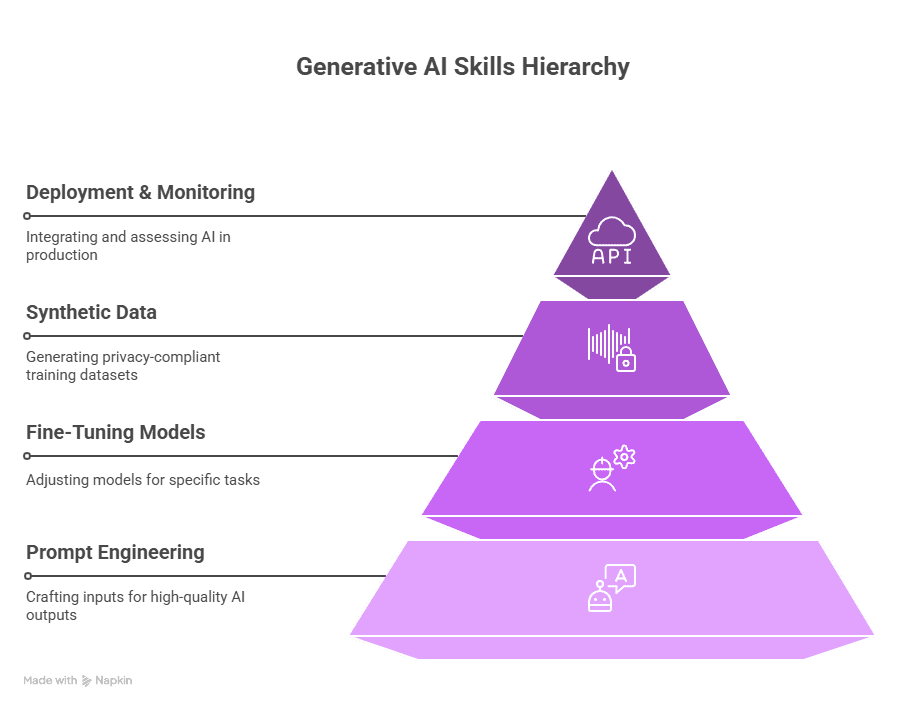
These skills surpass traditional machine learning, enabling creative outputs that drive real business value.
Why Generative AI Skills for Data Scientists Matters
Embedding Generative AI for data scientists transforms workflows:
Don’t Let Our Best Advice Get Buried
Add Imarticus as a Preferred Source — see more of what we publish, every time you search.

- Feature engineering on autopilot: AI suggests relevant variables.
- Bias mitigation: Synthetic data augments underrepresented classes.
- Automated reporting: Instant narrative summaries from dashboards.
Such enhancements accelerate project delivery and free experts to focus on strategy.
Data Science Skills 2026: A New Baseline
By mid‑2025, demand for Data science skills 2025 will centre on AI proficiency. LinkedIn reports that applicants with genAI expertise receive 35 % more interview invitations than peers LinkedIn.
Key skill categories include:
- MLOps & CI/CD: Automating model deployment in Kubernetes or Azure AI.
- Ethical AI practices: Auditing outputs for fairness and compliance.
- Visualisation & storytelling: Converting AI insights into compelling narratives.
- Cloud platforms: Mastering AWS SageMaker, GCP Vertex AI and Azure AI.
Table: Traditional vs Generative AI Skillsets
| Skill Category | Traditional Data Science | Generative AI Emphasis |
| Data Preparation | Pandas, SQL, ETL | Synthetic data creation, augmentation |
| Modelling | Regression, classification | Transformers, diffusion architectures |
| Evaluation | Cross‑validation, AUC | Human‑in‑the‑loop validation, adversarial testing |
| Deployment | Flask, Docker, Kubernetes | AI‑as‑a‑service (OpenAI API, Azure AI) |
Emerging Tech for Data Scientists
Keeping pace with emerging tech for data scientists is pivotal. AutoGPT, LangChain and open‑source diffusion libraries enable:
- Iterative pipeline development: Agents that autonomously refine code.
- Multi‑modal workflows: Combining text, image and time‑series in unified models.
- Custom operator creation: Embedding proprietary logic into generative frameworks.
Early adopters gain a first‑mover advantage.
Unique Perspective: AI as a Co‑Pilot
Generative AI acts as a co‑pilot rather than a replacement. A McKinsey study found AI integration can boost team productivity by up to 40 % by handling repetitive tasks and accelerating experimentation McKinsey.
This partnership model defines the Future of data science: humans guide strategy while AI executes.
Generative AI Skills enable data scientists to design, fine‑tune and deploy models that produce novel content—text, images, code or synthetic data—boosting productivity, innovation and competitive edge in 2026.
GenAI in Data Science: Real‑World Use Cases
Applications of GenAI in data science span multiple domains:
- Automated Reporting: Auto‑drafting slide decks and executive summaries.
- Data Augmentation: Synthesising rare event records for fraud detection.
- Research Acceleration: Generating code snippets for rapid prototyping.
- Personalised Marketing: Crafting targeted content for segmented audiences.
A global bank reduced model‑training time by 60 % using synthetic credit‑risk data [Forrester].
Case Study: Synthetic Data at Scale
A major insurer faced privacy constraints on customer records. By deploying generative models, they:
- Created 1 million+ synthetic policyholder profiles.
- Trained fraud‑detection algorithms achieving 95 % accuracy.
- Reduced data‑prep time from weeks to hours.
This unique approach showcases how must‑have AI skills unlock new possibilities.
Emerging Roles for Data Scientists
With AI skills for data professionals in high demand, new roles are emerging:
- Prompt Engineer: Specialises in optimising model inputs for desired outputs.
- GenAI Architect: Designs end‑to‑end generative systems, ensuring scalability.
- Ethical AI Officer: Oversees responsible AI practices and bias audits.
Organisations are creating these positions to harness generative capabilities.
Masterclass AI in Excel: From Basics to Advanced Techniques
Must‑Have Generative AI Skills for Data Professionals
To thrive, data scientists must cultivate:
- Prompt design mastery: Evaluating and refining inputs.
- Framework fluency: Hands‑on experience with Hugging Face, TensorFlow and PyTorch.
- Cloud AI services: Deploying scalable endpoints on AWS, GCP or Azure.
- Ethics & Governance: Implementing bias detection and data‑privacy controls.
Investing in these must-have AI skills ensures resilience in evolving markets.
Future of Data Science: Trends for 2026
Analysts predict the future of data science will be shaped by:
- Hyper‑automation: AI‑driven pipelines from data ingestion to insights.
- Self‑service analytics: Citizen data scientists using low‑code GenAI tools.
- Adaptive learning: Models that continually retrain on streaming data.
Gartner forecasts 80 % of analytics platforms will embed GenAI by 2026.
Integrating GenAI: Practical Steps
- Assess Current Skills: Audit team capabilities against desired GenAI competencies.
- Set Up a GenAI Lab: Provision sandbox environments with GPUs and secure data access.
- Launch Pilot Projects: Start with customer‑facing chatbots or synthetic data trials.
- Define KPIs: Measure model accuracy, time saved and business impact.
Track ROI to justify further investments.
Measuring Success: KPIs for GenAI Projects
Key performance indicators include:
- Time‑to‑prototype: Hours vs weeks spent on model development.
- Prediction accuracy uplift: Percentage improvement over baseline.
- Cost savings: Reduction in data‑labelling or cloud compute expenses.
- User satisfaction: Feedback from analysts using AI co‑pilots.
Robust KPIs ensure accountability and continuous improvement.
Challenges and Solutions in Generative AI Skills
Challenge: Model hallucinations can produce misleading outputs.
Solution: Implement human‑in‑the‑loop reviews and prompt validation checks.
Challenge: Data privacy concerns with synthetic generation.
Solution: Use differential privacy techniques and audit synthetic samples.
Addressing these hurdles is vital for responsible adoption.
FAQs About Generative AI Skills
- What exactly are Generative AI Skills?
Ability to design, fine‑tune and deploy AI models that generate new content. - Why must data scientists learn GenAI?
It automates workflows, enhances creativity and scales analytics beyond manual limits. - How do I start with prompt engineering?
Experiment in OpenAI’s Playground; analyse output variations to refine inputs. - Which frameworks support generative AI?
Hugging Face Transformers, OpenAI API, TensorFlow and PyTorch offer robust tooling. - What role does ethics play in GenAI?
Ethical frameworks mitigate bias, ensure fairness and comply with regulations. - Can generative AI replace traditional data science?
No—it augments existing methods, shifting focus to strategic tasks. - How much can GenAI improve productivity?
Teams report up to 40 % gains when AI handles repetitive steps McKinsey. - What industries benefit most?
Finance, healthcare, retail and manufacturing lead in GenAI adoption for simulation and design. - Where can I upskill?
You can explore Imarticus Learning Executive Post Graduate Program in Data Science and AI - What’s the expected salary uplift?
GenAI‑proficient data scientists command 15–25 % higher salaries according to Kaggle’s 2024 survey Kaggle.
Conclusion
Adopting Generative AI Skills is non‑negotiable for data scientists in 2026. By mastering prompt engineering, model fine‑tuning, MLOps and ethical practices, professionals will drive innovation, achieve measurable ROI and secure future career growth.
Key Takeaways About Generative AI Skills
- Competitive Edge: GenAI expertise accelerates workflows and enhances career prospects.
- Collaborative Model: AI as a co‑pilot amplifies human creativity and productivity.
- Ethical Imperative: Responsible AI practices maintain trust and compliance.
Ready to lead the AI revolution? Enroll in Imarticus Learning Executive Post Graduate Program in Data Science and AI and become the data scientist every organisation competes to hire.
Liked This? Follow Us Where You Already Search.
Preferred Sources is Google’s built-in follow button — no app, no login, just more Imarticus in your results.